SINGAPORE: The Housing and Development Board (HDB) has launched 6,753 flats for sale under its latest Build-to-Order (BTO) and Sale of Balance Flats (SBF) exercise, it said in a press release on Wednesday (May 22).
The launch includes 3,485 BTO flats in Kallang Whampoa, Tengah and Woodlands as well as 3,268 SBF flats across various towns and estates.
This is the first HDB sales exercise in which the balloting time for BTO flats has been reduced from six to three weeks, and where upcoming BTO sites are announced six months in advance instead of the previous three months.
The 3,485 BTO flats on offer are spread across four projects.
This includes 583 units in the Kempas Residences project in the mature town of Kallang Whampoa and 722 flats in the Champions Green project in the non-mature town of Woodlands.
Artist’s impression of Champions Green. (Image: HDB)
It also includes 987 units in the Garden Vale @ Tengah development and 1,193 flats in the Plantation Acres project in the non-mature town of Tengah.
Artist’s impression of Garden Vale @ Tengah. (Image: HDB)
Artist’s impression of Plantation Acres. (Image: HDB)
Eligible first-timer families can enjoy up to S$80,000 of housing grants, comprising the Additional CPF Housing Grant (AHG) (up to S$40,000) and the Special CPF Housing Grant (SHG) (up to S$40,000).
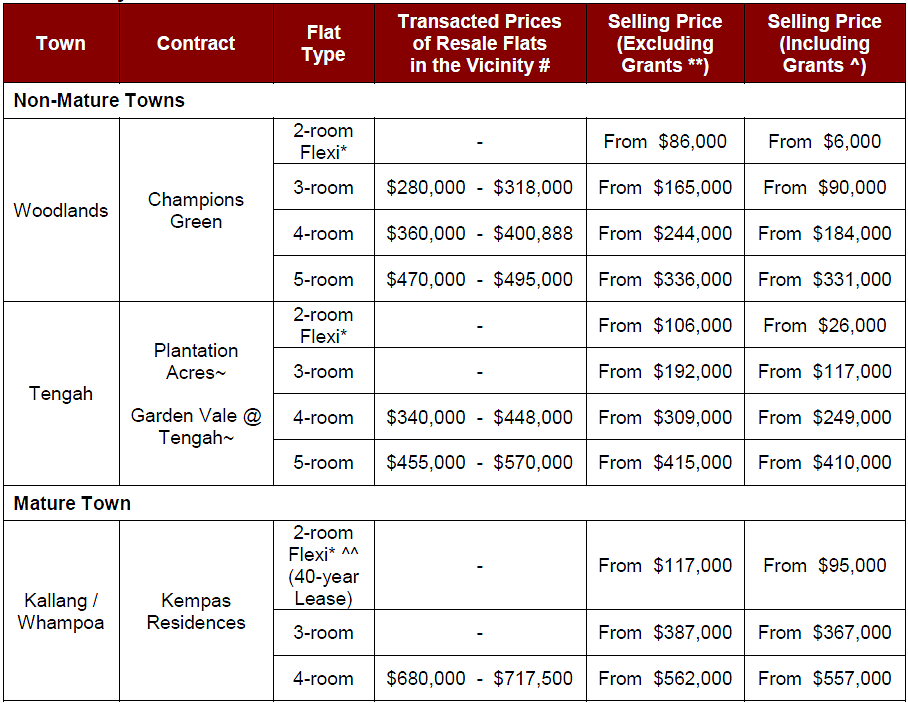
“With these grants, flat buyers could pay as little as S$6,000 for a two-room Flexi flat, S$90,000 for a three-room flat, S$184,000 for a four-room flat, and S$331,000 for a five-room flat,” said HDB.
BTO prices for May 2019. (Graphic: HDB)
This is the first exercise in which second-timer families who live in public rental flats may enjoy the Step-Up CPF Housing Grant of S$15,000 when they apply for a two-room Flexi or three-room flat in non-mature estates.
As with the previous sales exercise, lower-income families living in subsidised two-room flats in non-mature towns may also enjoy the grant when applying for a three-room flat in a non-mature town.
In addition to the BTO flats, HDB will also offer 3,268 balance flats under the SBF exercise.
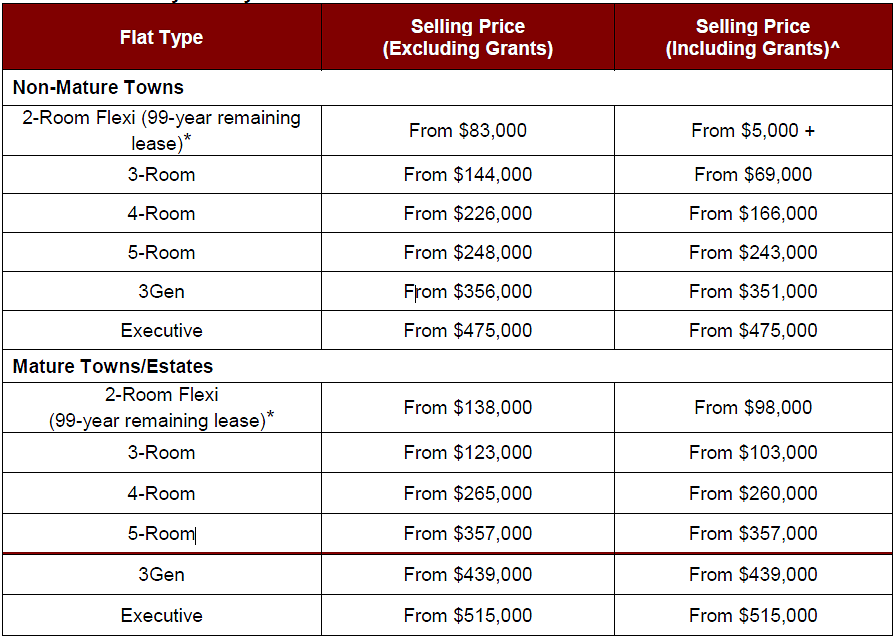
“They comprise 535 units of two-room Flexi, 432 units of three-room, 1,384 units of four-room, 799 units of five-room, 111 units of 3Gen and seven units of executive flats across various towns/estates,” said HDB.
SBF prices for May 2019. (Graphic: HDB)
The majority of the flats offered under the SBF exercise are reserved for first-timer families. Eligible first-timer singles may also apply for a two-room Flexi flat in non-mature towns.
Applications can be made online on the HDB website from Wednesday to next Tuesday. Buyers can apply for only one flat type in one town in either the BTO or SBF exercise.
MELBOURNE: An Australian man who was based in Singapore pleaded guilty in a Melbourne court on Tuesday (May 21) to sexually abusing dozens of children over a period of 16 years, filming the acts and distributing the pictures and videos.
Boris Kunsevitsky, 52, groomed children from across four countries, including Singapore, and took photographs and videos of himself performing sex acts with them, the Age newspaper reported.
Police found more than 3,300 images and videos on a laptop and two hard drives that showed him abusing or sexually exploiting 47 boys. Most were teenagers, although some were 12 and others possibly younger.
He also distributed the images of the depraved acts, while downloading another 37,000 images and videos showing other children being abused.
Kunsevitsky pleaded guilty in the Supreme Court of Victoria to maintaining a sexual relationship with a child, 25 counts of engaging in sexual intercourse with a child outside Australia, 12 of inducing a child to engage in sex with a child, child pornography charges and other offences.
The court was told he had migrated to Australia with his family from Russia when he was 12 years old and he moved to Singapore in the early 2000s.
The Singapore Police Force (SPF) said it was in touch with Australian authorities regarding the matter.
“When required, SPF will act and render the necessary assistance within the ambit of our laws and international obligations,” the force said in a statement.
ABUSED CHILDREN ACROSS FOUR COUNTRIES
The court heard that Kunsevitsky had travelled through Southeast Asia on supposed work trips, but those trips were used instead for “sex tourism”.
Prosecutor Krista Breckweg said the videos and images showed Kunsevitsky had either engaged in sex with boys or instructed them to perform demeaning sex acts.
Australian police had been investigating him since 2016, the Age reported, and searched his phone in 2017 when he visited Australia from Singapore.
They found child exploitation material on the phone and police had his possessions shipped over to Australia.
It was in the laptop and two hard drives that investigators discovered video footage and thousands of pictures showing Kunsevitsky abusing or sexually exploiting 47 boys across four countries.
They include children in Australia, the Philippines, Singapore and one in Indonesia, the Age reported.
The footage, which dated back to 2001, had been distributed and one was later detected by German police, Ms Breckweg is quoted as saying.
Singapore-based Australian Boris Kunsevitsky, 52, pleaded guilty in the Supreme Court of Victoria to sexually abusing dozens of children. (Photo: Facebook/Thẩm mỹ quốc tế Bally)
One victim, now in his 20s, told the court he was groomed by Kunsevitsky and the abuse left him confused and isolated from those close to him. He reportedly turned to drugs and tried to take his own life while he was in his teens, and later lost his marriage.
EXTREMELY SERIOUS OFFENDING
Kunsevitsky’s defence laywer said the man had endured an abusive childhood and had been bullied in school in his native Russia. Her added that Kunsevitsky disputed some of the allegations, such as the seriousness of the sexual activity against Melbourne boy and the ages of the others.
But Ms Breckweg said the man’s claims showed he lacked remorse, calling the offences against the Melbourne boy “depraved and despicable”.
“Clearly, this is extremely serious offending,” she is quoted as saying by the Age.
The 52-year-old, whowas diagnosed with a paedophiliac disorder after his arrest, was remanded in custody and is set to be sentenced at a later date.
SINGAPORE: Two familiar National Day Parade (NDP) songs will form the basis of this year’s theme song as the parade commemorates 200 years since the founding of modern Singapore.
The theme song, titled Our Singapore, will draw on the lyrics of the NDP 2002 theme song We Will Get There and the 2015 edition of Our Singapore.
Speaking at the launch event for this year’s NDP at the Asian Civilisations Museum on Wednesday (May 22), music director Sydney Tan said the song represents a way of expressing gratitude for those who have gone before.
“It is a piece … recognising and to give honour and homage to the older generation, those that walked before us – it’s not just another song,” said Dr Tan. “When we say thank you to someone, we are building somebody up. That’s how you build a nation.”
This year’s theme song comprises verses sung by 27 artistes representing different generations.
They include veterans such as Rahimah Rahim and Jacintha Abisheganaden, contemporaries such as Stefanie Sun and JJ Lin, local icons including Dick Lee and Kit Chan, as well as various local rappers.
THEME AND LOGO
On the theme Our Singapore, chairman of the NDP 2019 executive committee Brigadier-General Yew Chee Leung said it emphasises the “collective ownership” of the nation.
“It’s a theme that is simple to understand and a theme that can connect with Singaporeans,” he said.
“It is a theme that also complements the bicentennial. It allows us to tell our Singapore story from past to present and also allows us to look to the future together.
“We are living the dreams of our pioneers and it’s now up to our generation to continue to build Singapore for the future. We are now our pioneers for our future.”
The logo for NDP 2019.
This year’s logo will feature the lion – symbolic of the name Singapura, or Lion City – as well as the crescent moon and five stars from the Singapore flag.
This year also marks the 60th anniversary since the first unveiling of the national flag on the City Hall steps at the Padang in 1959.
NDP will be staged as one integrated show, comprising a total of six acts that relate to the theme.
Highlights of the parade will include the inaugural participation of the Singapore Armed Forces (SAF) and Home Team Volunteer contingent in the parade and ceremony segment.
The Republic of Singapore Air Force’s Multi-Role Tanker Transport will also participate in the aerial display for the first time.
This year’s parade, which celebrates Singapore’s 54 years of independence, will be held at the Padang. The parade was last held at the Padang in 2015, when Singapore celebrated 50 years of independence.
As part of efforts to bring the parade to the masses, a convoy of vehicles from the SAF and Home Team will travel to Bishan, Geylang Serai, Jurong East, Punggol and Woodlands a day after the parade.
Carnivals will be organised by the People’s Association at those heartland sites and the one-day celebrations will end with fireworks displays there.
Organised by HQ Armour, together with private and public sector agencies, this year’s edition of the parade will involve about 15,000 participants, volunteers and personnel behind the scenes as well as on stage.
SINGAPORE: Finishing touches are being put on the redeveloped Funan mall, which closed for a revamp three years ago in July 2016.
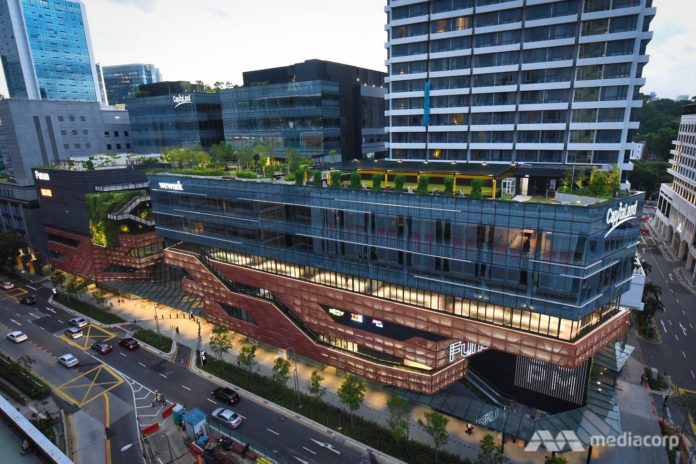
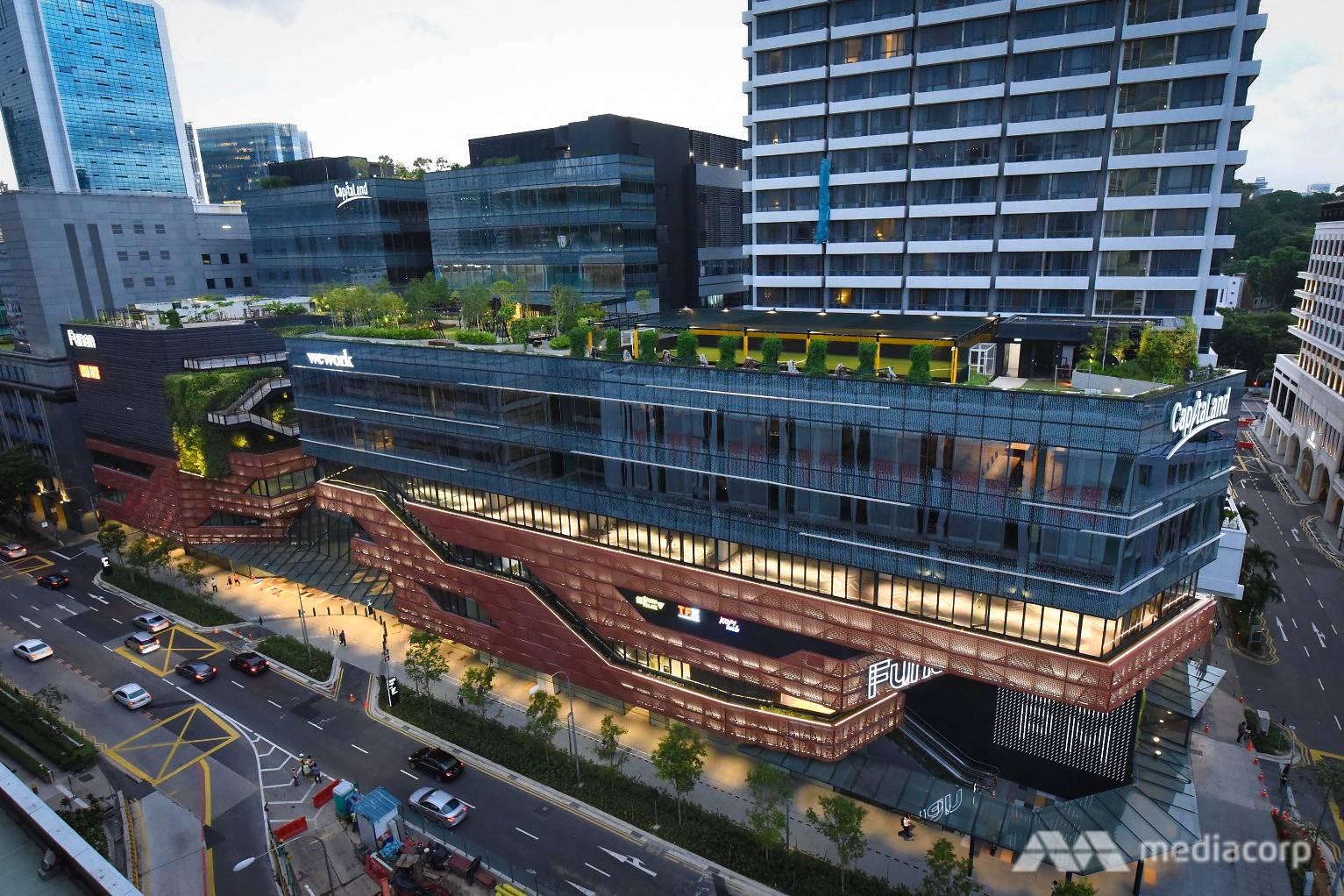
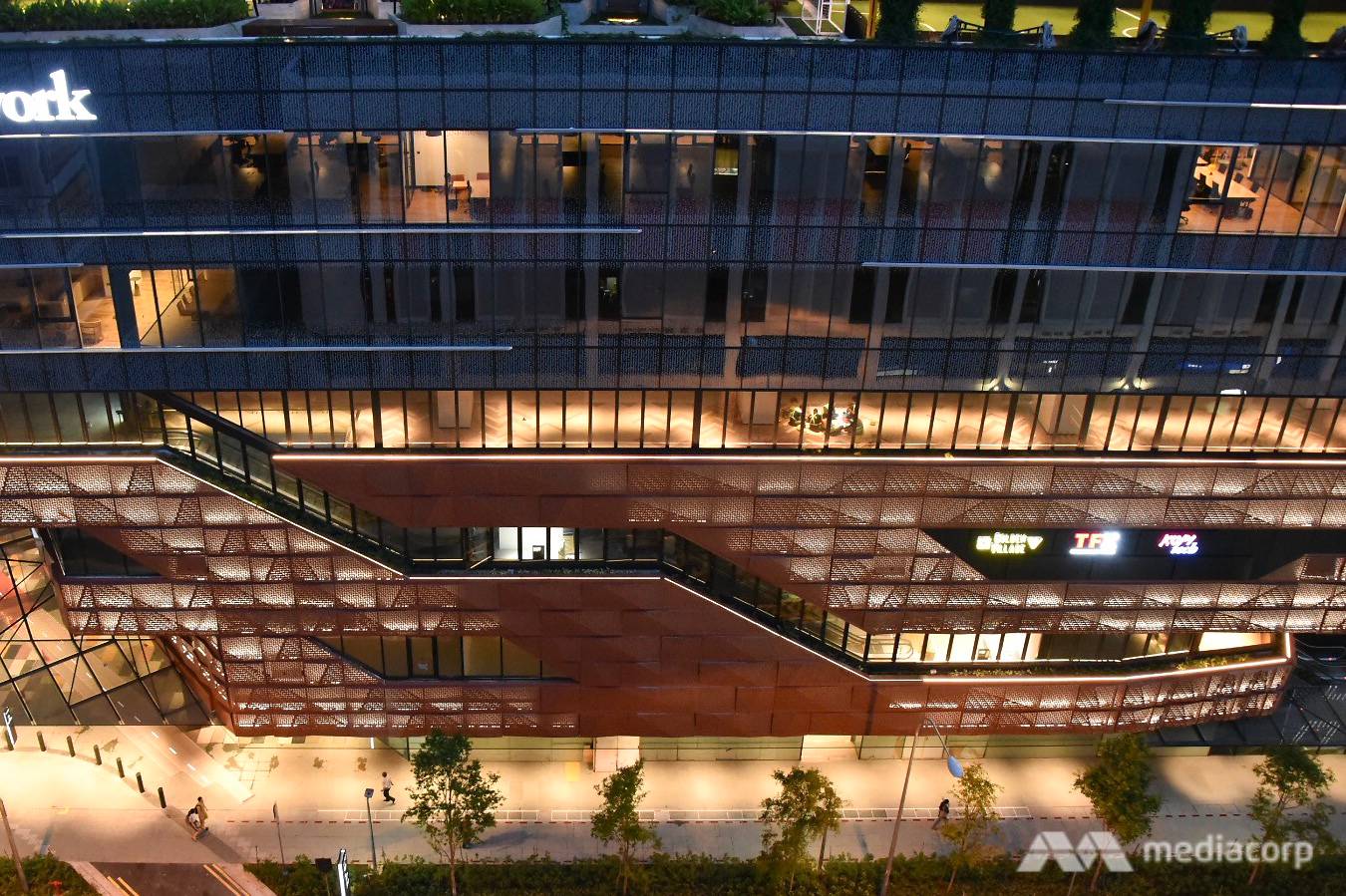
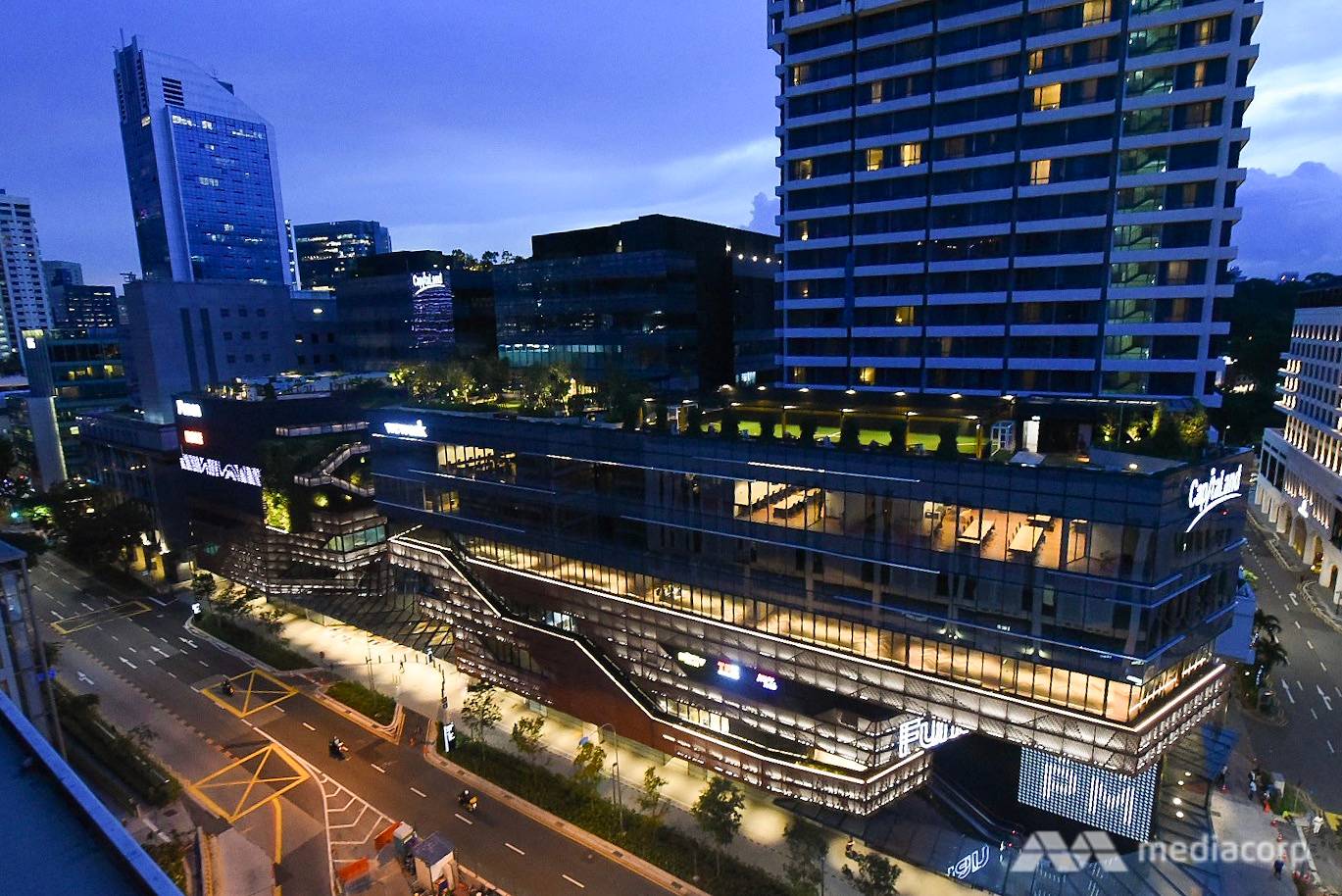
The nondescript beige building that used to stand at the junction of Coleman Street and North Bridge road is now completely unrecognisable, with its copper-coloured exterior and perforated aluminium panels.
Aerial view of Funan. (Photo: Gaya Chandramohan)
At 887,000 sq ft, the new six-storey mall is 85% larger than its Funan DigitaLife mall predecessor and boasts significantly more amenities and highlights.
KINETIC WALL
Kinetic Wall at Funan. (Photo: Gaya Chandramohan)
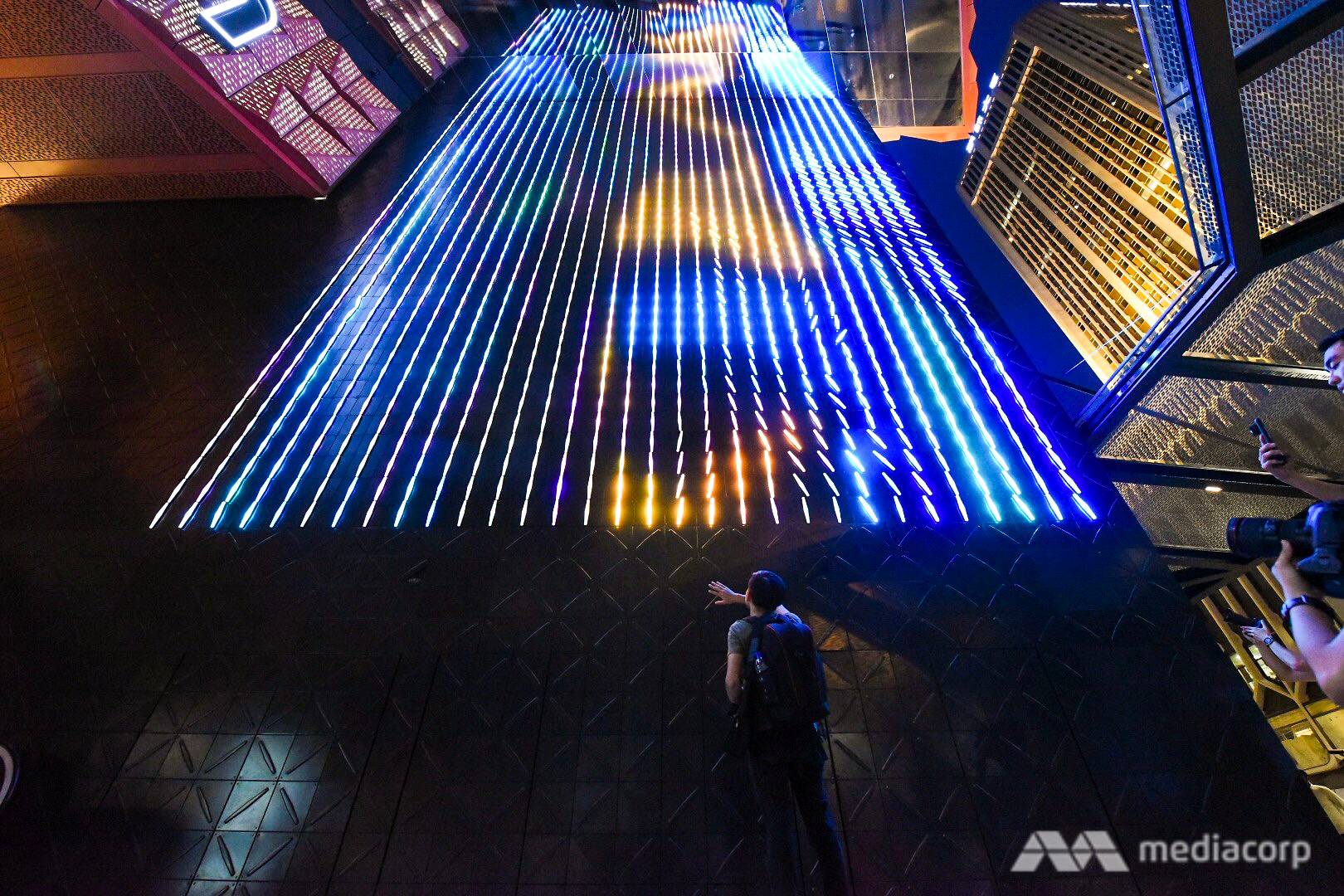
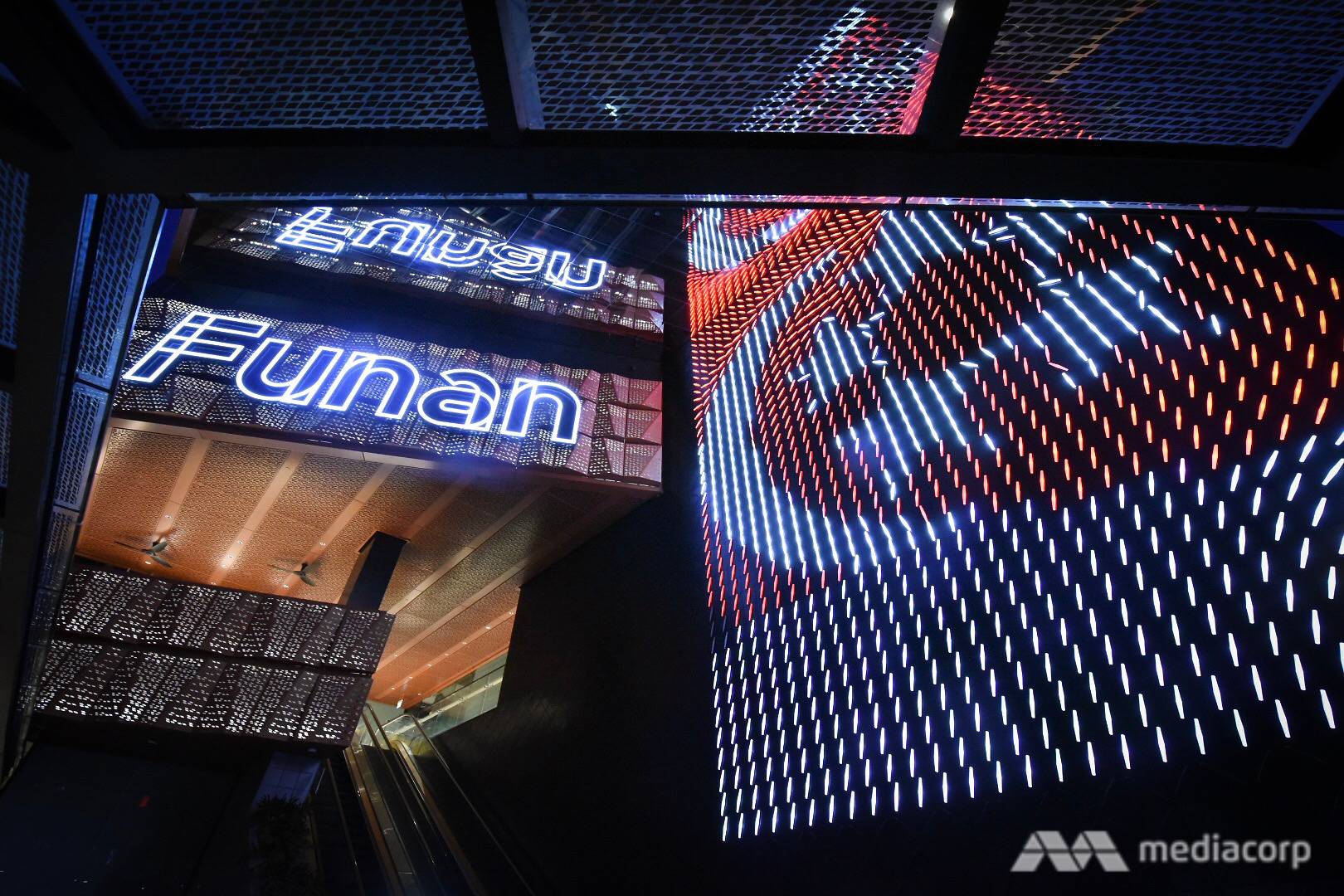
Taking pride of place on the facade is the Kinetic Wall installation: 1,271 motorised light blades, mounted on a panel 13m high and 9m wide, move in a mesmerising dance to display the date and time.
When the occasion calls for it, the plastic blades can be programmed for themed or festive greetings.
Kinetic Wall at Funan. (Photo: Gaya Chandramohan)
TREE OF LIFE
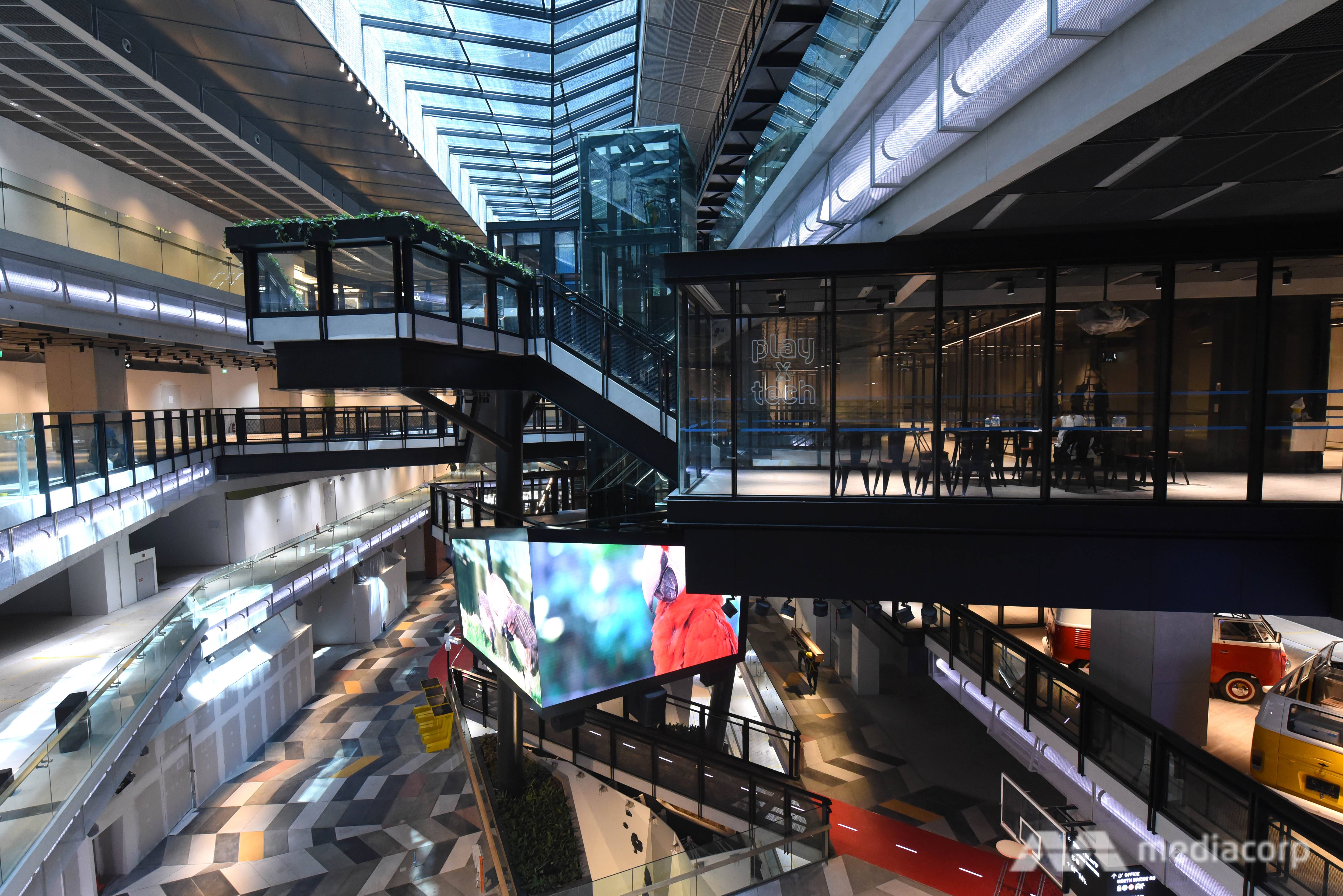
Leaning into the “industrial chic” vibe, the mall features a 25-metre-tall steel structure in its atrium, extending from basement 2 to level 4.
Funan adopted “industrial chic” in its design to exude contemporary and energetic vibes. (Photo: Gaya Chandramohan)
Dubbed “Tree of Life”, the structure houses so-called “retail pods” that offer short-term leases to brands and entrepreneurs.
A retail pod (top right) in the “Tree of Life”. (Photo: Gaya Chandramohan)
The “tree” also serves as the connector to other parts of the building that house the office blocks, serviced residences and access to the Urban Farm.
The structure is made of 250 tonnes of composite steel – equivalent to the weight of three mature rain trees, developer CapitaLand says.
INDOOR CYCLING PATH AND BICYCLE HUB
The cycling path inside Funan mall. (Photo: Gaya Chandramohan)
An indoor cycling path extends from a bicycle trail on North Bridge Road and runs through the mall, in a first for a commercial building in Singapore.
The 200m path runs across the first level to The Bicycle Hub at the back of the building, which has 166 bicycle bays, shower cabins, lockers, and a bicycle repair and pump station.
URBAN FARM
Staircases connect the retail mall to the urban farm. (Photo: Gaya Chandramohan)
An urban farm in the middle of the civic district. (Photo: Gaya Chandramohan)
Sitting above the shops on the seventh floor, an 18,000 sq ft urban farm and garden thrives in the middle of Singapore’s civic district, with more than 50 types of edible fruits and vegetables.
Funan’s urban farm on level 7. (Photo: Gaya Chandramohan)
A part of the Food Garden is operated by Edible Garden City, which champions the grow-your-own-food movement in Singapore – meaning diners at Funan will be able to enjoy farm-to-table concept eating, as harvest from the urban farm will be supplied to restaurants in the building.
The urban farm is one of the few farms in Singapore open to the public where visitors can learn how vegetables are produced and harvested. (Photo: Gaya Chandramohan)
The pesticide-free produce includes herbs like lemon balm, lemon grass and mint; as well as ginger, chilli padi, turmeric, dragonfruit, passionfruit, lady’s finger and brinjal.
ROOF GARDEN, FUTSAL COURT AND CLIMBING WALL
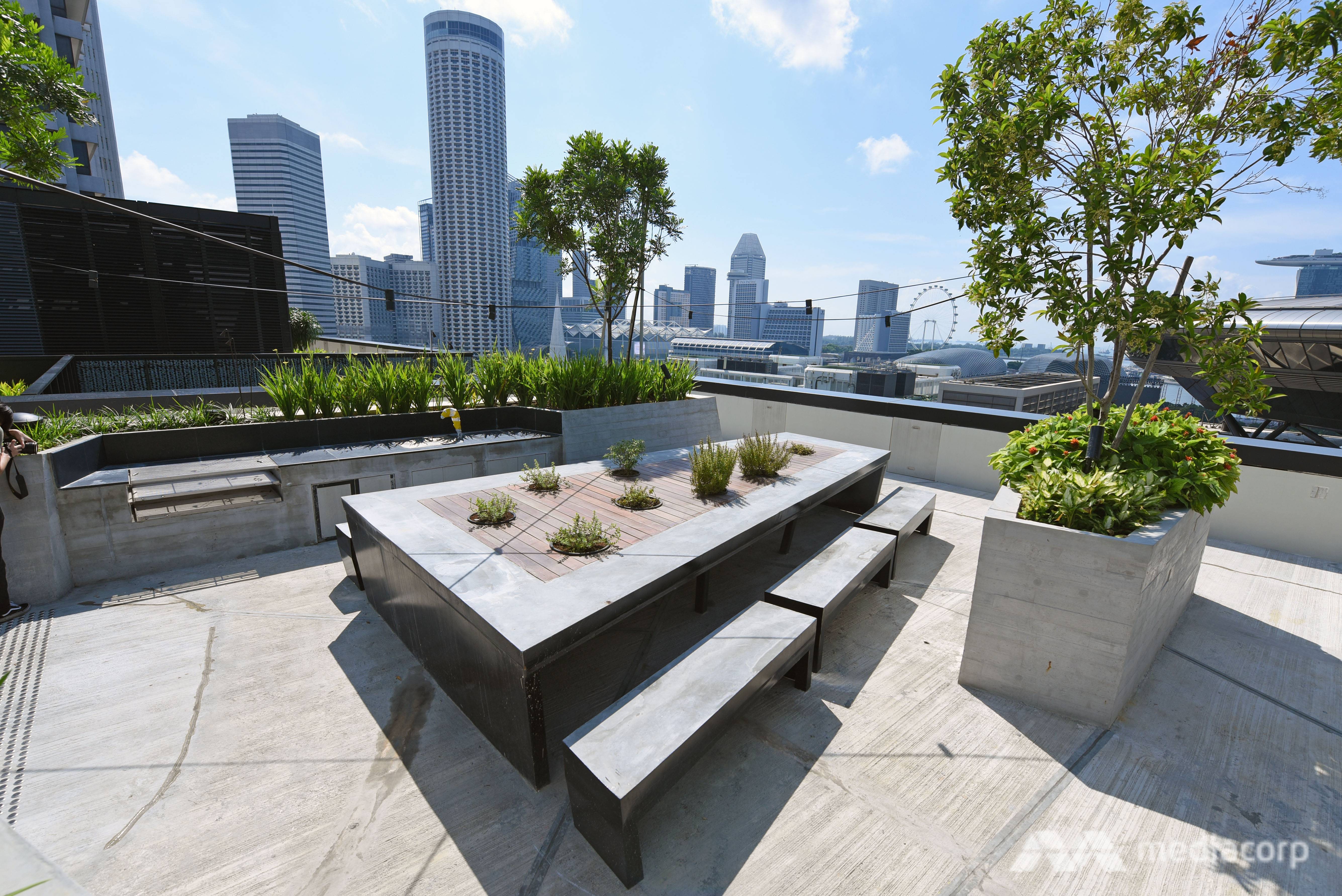
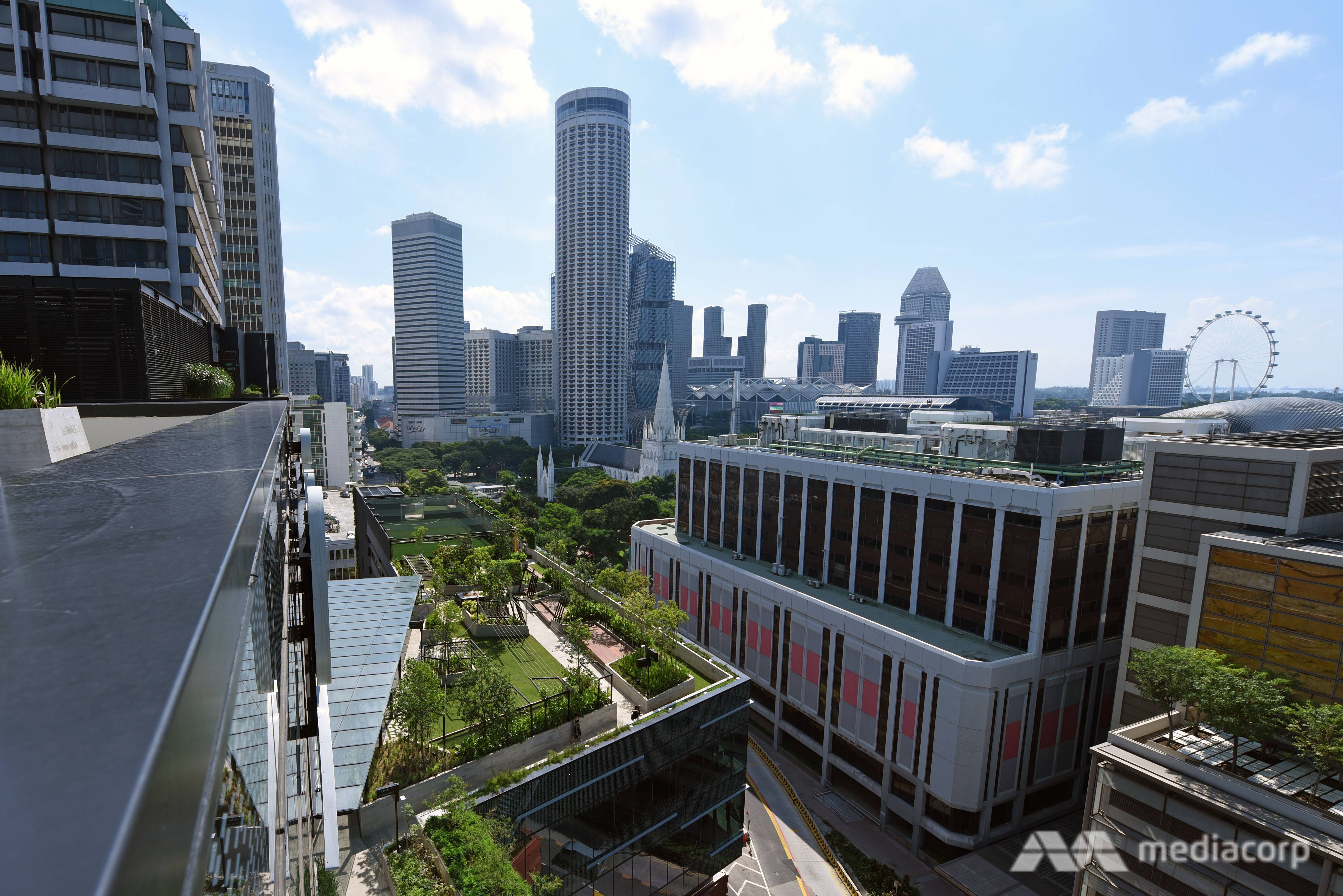
A green oasis in the bustling civic district, the roof garden offers excellent vantage points. (Photo: Gaya Chandramohan)
The roof garden has a BBQ pit with a great view. (Photo: Gaya Chandramohan)
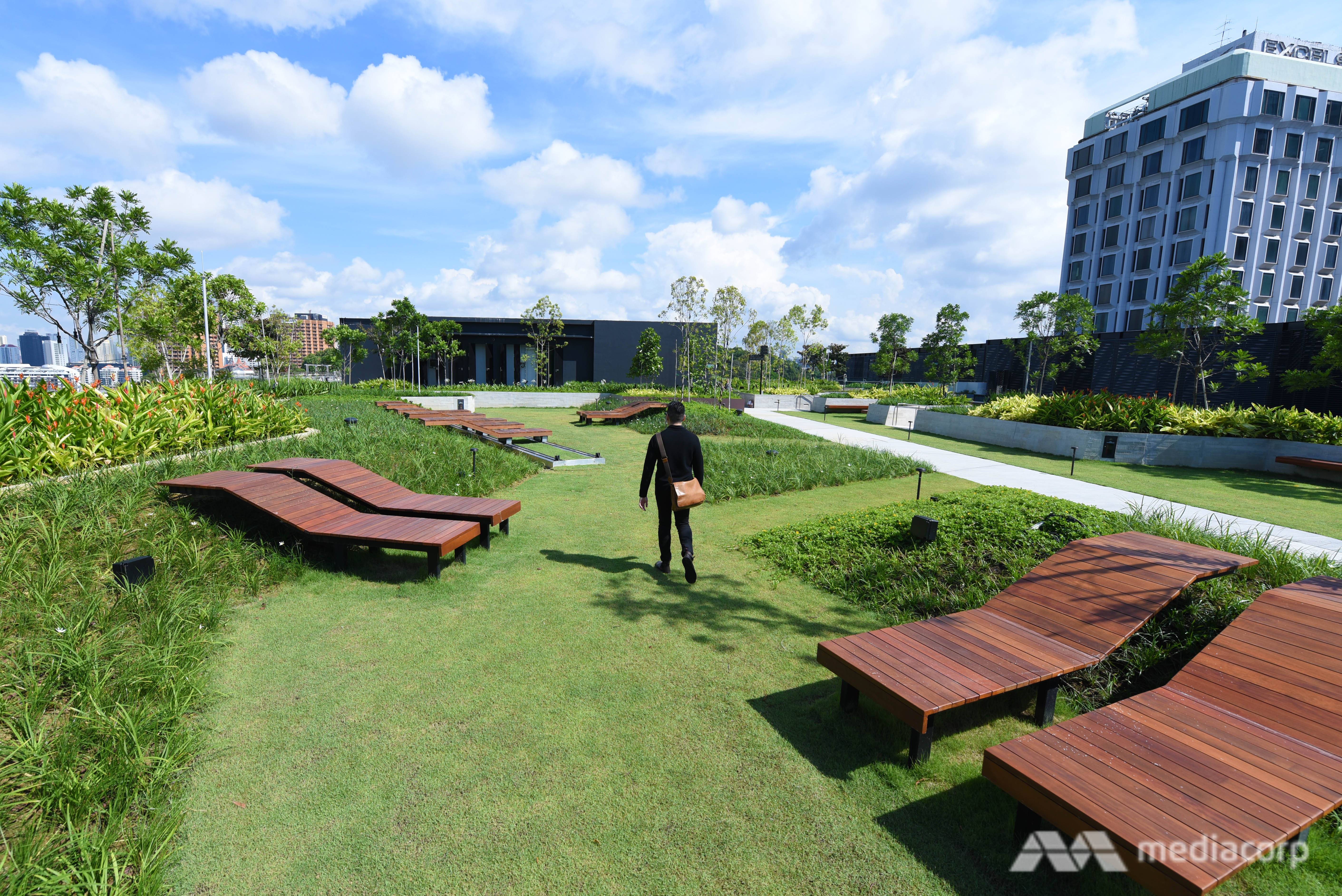
Among the lifestyle offerings at Funan mall is a rooftop garden with panoramic views of the Marina Bay and central business district skylines. The 32,000 sq ft oasis is open to the public during the mall’s operating hours, and even has lounge chairs for those who want to stay for a while.
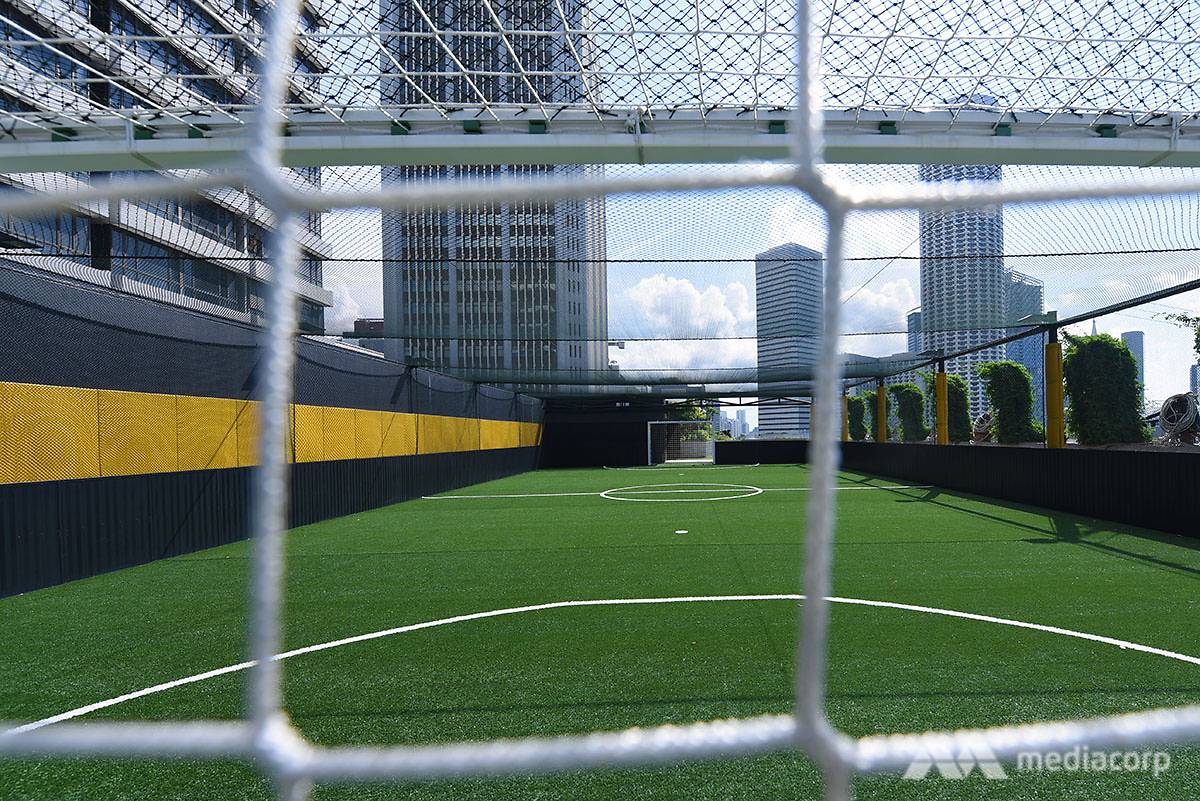
Operated by The Ark, the futsal court caters to 10 players each time for five-a-side matches. (Photo: Gaya Chandramohan)
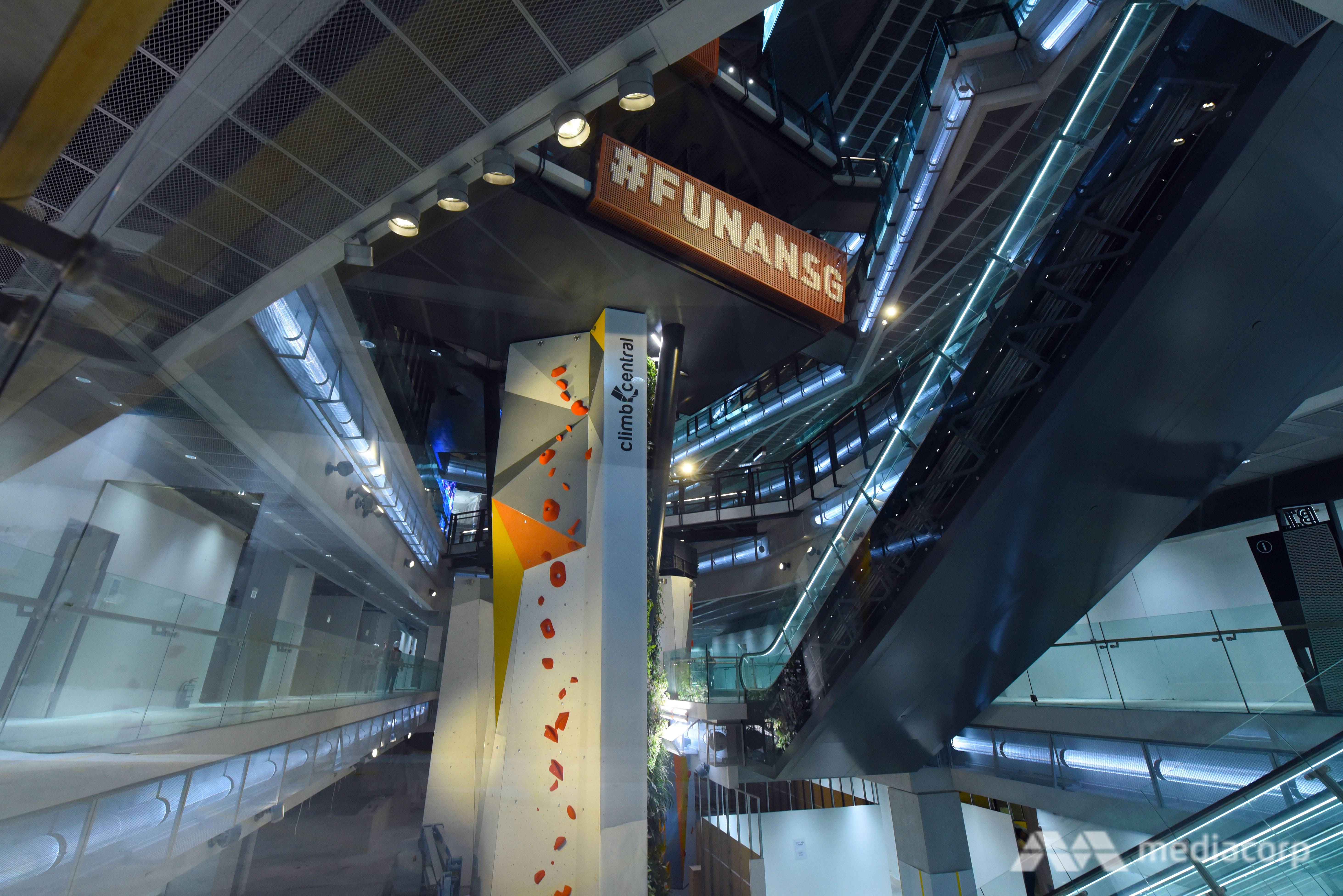
The indoor rock climbing wall stretches from basement 2 to level 2 and offers a total of 46 lanes. (Photo: Gaya Chandramohan)
Funan’s outdoor spaces offer many vantage points. (Photo: Gaya Chandramohan)
The mall also has a futsal court and an indoor climbing wall that stretches from basement 2 to level 2.
AMPHITHEATRE
The amphitheatre has 33 steps for shoppers to lounge about on. (Photo: Gaya Chandramohan)
The S$560 million mixed development also boasts an indoor amphitheatre that seats 150 people.
After the sun goes down, the building flickers to life.
Facade of Funan by night. (Photo: Gaya Chandramohan)
Aerial view of Funan by night. (Photo: Gaya Chandramohan)
The mall is set to open in the second quarter of 2019, along with the retail and office components, while the serviced residences, lyf Funan, will be completed in the fourth quarter of 2019.
SINGAPORE: A smoking cabin that is fitted with a filtering system, turning cigarette smoke into clean air, was launched on Tuesday (May 21) outside Fusionopolis in one-north.
“It is the first facility that has been developed to solve the issue of secondhand cigarette smoke in Singapore,” said Southern Globe Corporation (SGC), the company which launched the cabin.
It uses a three-layer filtration system that was developed in Denmark.
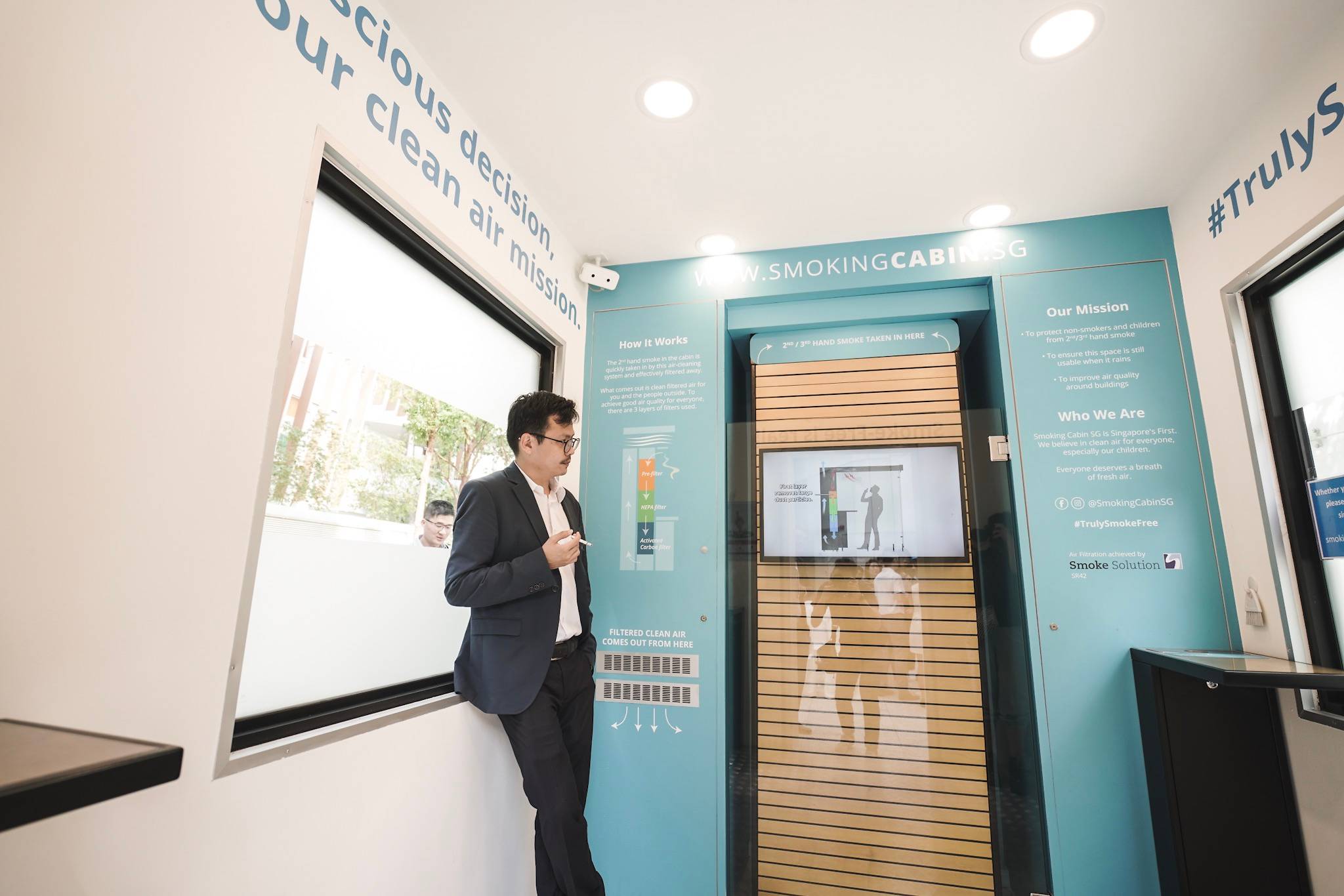
First, cigarette smoke is passed through a pre-filter which removes larges dust particles. A HEPA filter then removes small harmful particles the size of 0.3 microns, before an “activated carbon filter” removes tobacco smells and chemicals.
It then releases “99.95 per cent pure air” to the environment, said SGC.
Smoking Cabin SG filters various particles in cigarette smoke. (Image: SGC)
The air-conditioned cabin can hold up to 10 smokers.
A prototype that was introduced earlier this month has been used by about 100 smokers daily, said SGC.
Design Jukebox director Drake Lim smokes in Smoking Cabin SG. (Photo: SGC)
The filtration system made by a Danish company has been used in countries such as Dubai, Japan and Kuwait, said SGC.
It added that it plans to roll out 60 smoking cabins around Singapore by the end of the year.
SINGAPORE: Last year saw impressive growth for the cruise industry in Singapore.
Data released by the Singapore Tourism Board (STB) revealed that total cruise throughput jumped 35 per cent to 1.87 million in 2018 compared to the year before.
But the industry is not being complacent. It acknowledges it needs to do more to attract certain segments in a bid to stay competitive.
Experts CNA spoke to say that millennials and Gen Z form an untapped market for cruise operators.
“The cruise operators will have to provide different offerings to different segments of the market especially to the millennials, who have not really warmed to the idea of a cruise holiday,” said Dr Michael Chiam, senior lecturer in tourism at Ngee Ann Polytechnic.
“There is tremendous potential for growth.”
Dr Chiam’s comments echoed a report by the Cruise Lines International Association (CLIA), which said that Gen Z is set to become the largest consumer generation by the year 2020 – outpacing even millennials.
Generation Z, or Gen Z for short, typically refers to those born from the mid-1990s to the early 2000s.
“This generation like the one before, prefers experiences over material items and is seeking out travel,” said CLIA.
“The appeal of multiple destinations and unique experiences, such as music festivals at sea, is attracting this new category of cruisers.”
CLIA also noted that the increase of younger cruise passengers will contribute to what it describes as “instagrammable cruise travel”, via social media.
“Instagram photos are driving interest in travel around the world,” said the association.
“With on board connectivity, cruise passengers are filling Instagram feeds with diverse travel experiences both onboard and on land from several cruise destinations.”
CLIA also noted that Asia saw a 4.6 per cent increase in cruise passengers to 4.24 million, occupying 14.8 per cent of total global passenger volume.
Spectrum of the Seas is the largest and cruise ship in Asia. (Photo: Royal Caribbean)
NEWER AND BIGGER SHIPS TO CATER TO YOUNGER PASSENGERS
Major cruise companies like Royal Caribbean also acknowledge that the younger segment is crucial to its business.
Speaking at a media presentation on Tuesday (May 21) following the Spectrum of the Seas’ maiden call to Singapore, senior vice president of international for Royal Caribbean, Mr Gavin Smith, told CNA that “it is a natural progression” for the younger segment – especially for those in their 30s with families – to book cruise holidays.
“This group might have experienced a cruise with their parents earlier on and have formed an opinion about when they went with their families,” he said.
“Normally, old-style cruising was very regimented and very fixed and very organised – like sitting for dining. What we have spent the last decade doing is de-regimenting what we do.”
He added: “Young people want a more authentic experience and they want a more immersive experience.”
The largest cruise ship in Asia, weighing over 170,000 gross registered tonnes and able to accommodate more than 5,600 guests, the Spectrum of the Seasfeatures activities such as a virtual reality trampoline and skydiving simulator as well as robotic bartenders.
“Asia has one of the largest demands for cruising worldwide, and markets for Asia, including Singapore continue to see double digit growth,” said Mr Smith.
Perception of the cruise industry is also another factor in wooing younger customers, said Ms Alice Tan, a hospitality and tourism management lecturer at Nanyang Polytechnic.
“They need more personalisation, and have different needs and wants. The perception of cruises to them is boring, mainly with eating and gambling,” said Ms Tan.
“The cruise industry has lost its novelty.”
She suggested having more tech-based activities, instead on board entertainment solely being “just casinos and live shows”.
Spectrum of the Seas – Ultimate Family Suite (Photo: Aaron Chong)
STB WORKING WITH INDUSTRY PARTNERS
Responding to CNA’s queries, Ms Jeannie Lim, assistant chief executive of STB’s policy and planning group, said they will continue to work with cruise industry partners to secure a “vibrant pipeline” of ships and new cruise offerings to Singapore.
“This diversity of ships appeals to different market segments and a wide range of travellers,” she said.
“Bigger ships in particular, such as Spectrum of the Seas and Genting Dream, are also able to provide facilities, experiences and programmes on board that appeal to all age groups.”
STB also said that India is Singapore’s number one cruise market with 160,000 cruise passengers in 2018, up 27 per cent year-on-year.
Ngee Ann Polytechnic’s Dr Chiam said that in order for Singapore to remain competitive, more creativity in marketing is needed in encouraging cruise passengers to stay here before and after their cruise, instead of seeing Singapore as just a transit hub.
While Dr Chiam described the cruise industry’s growth as “healthy”, he said that one of the major challenges is uncertainty in the global economy.
“The uncertainty will affect consumers’ sentimental, thus affecting their willingness to spend, as well as their travel choices,” he said.
Nonetheless, Dr Chiam is “cautiously optimistic” that the cruise industry will do well in the year ahead.
SINGAPORE: Singapore has agreed to suspend the construction of the Johor Bahru-Singapore Rapid Transit System (RTS) Link until Sep 30 at Malaysia’s request, Singapore Transport Minister Khaw Boon Wan said on Tuesday (May 21).
Under a supplemental agreement signed between both governments on Tuesday, Malaysia will also reimburse Singapore for the abortive costs incurred due to the suspension, Mr Khaw said during a press conference with his Malaysian counterpart, Mr Anthony Loke.
Mr Khaw said that after several rounds of discussions, both sides reached a “mutually acceptable arrangement” on the way forward.
During the suspension period, Malaysia will decide if it intends to proceed with the RTS Link project as it is. Malaysia can also propose changes to the project scope, and Singapore will give any such changes due consideration, he added.
“We hope that the RTS Link project will resume at the end of the suspension period – either in its current form as prescribed in the RTS bilateral agreement or incorporating any project scope changes that both sides agree on during the suspension period,” Mr Khaw said.
If not, the project will be deemed to have been terminated by Malaysia, and Malaysia will reimburse Singapore for the costs incurred in fulfilling its RTS Link obligations until now, he said.
The RTS Link, which connects Bukit Chagar in Johor Bahru to Woodlands in Singapore, is expected to ferry up to 10,000 passengers per hour each way.
The project was meant to be completed by 2024, but is now behind schedule with Malaysia repeatedly delaying confirmation of its joint venture partner.
According to a bilateral agreement signed in January last year, a joint venture company comprising Singapore’s SMRT and Malaysia’s Prasarana Malaysia should have been constituted by Jun 30 last year.
The joint venture company should also have been appointed as the RTS Link operator (OpCo) through a Concession Agreement with Singapore’s Land Transport Authority and the government of Malaysia by Sep 30, 2018.
Both milestones were missed. Malaysia then asked for an extension until Mar 31, to confirm its joint venture partner.
Early last month, Putrajaya said it has requested for a further six-month extension from Singapore before making a decision on the RTS. This will enable the Malaysian government to examine several issues including the cost of implementing the project, said Malaysian Transport Minister Anthony Loke.
“We will approach this issue as we did for the suspension of the High-Speed Rail project, with goodwill and reasonable accommodation,” Mr Khaw said on Apr 8.
SINGAPORE: For those growing up in Singapore, it has become a rite of passage that they go through not once, but at least twice a year: The dreaded academic examinations.
And it is the time of the year again, when the majority of students across the Primary and Secondary levels are busy mugging or sitting for the mid-year exams.
However, this time round, many others will instead be staging a fashion show, trying their hand at sand-art animation and wushu, learning to write haiku while taking in the sights at the Singapore River, or learning about algebra through manga or anime characters, for example.
Starting this year, as announced by Education Minister Ong Ye Kung last September, schools have done away with mid-year exams for Secondary 1, as well as all graded assessments and examinations for Primary 1 and 2 pupils.
Mid-year exams will also be removed in phases over the next three years for Primary 3, Primary 5, and Secondary 3.
Apart from Secondary 1, some schools have gone ahead to remove mid-year exams for other levels this year ahead of the impending changes.
Nevertheless, students in Secondary 1 this year and their parents — fresh from the stress of the high-stakes Primary School Leaving Examination — are among the first to reap the benefits of the Ministry of Education’s (MOE) moves to reduce stress and emphasis on grades, and to inculcate the joy in learning.
Among other things, the scrapping of mid-year exams has freed up about two weeks of curriculum time which means more opportunities for students to engage in self-discovery through lessons within and outside the classrooms.
It also means less anxiety and stress for parents. For the teachers, they say they now face less pressure to rush through the syllabus before the mid-year exams. They also have more time to come up with creative lessons, and do not have to be saddled with marking of exam scripts.
File picture of secondary school students in Singapore. (Photo: TODAY)
Hua Yi Secondary School principal Sandra Gwee said: “The most immediate benefit of the changes has been the additional bandwidth that we have, which has allowed us to spend more time discussing student matters, different aspects of their learning, and to have deeper conversations with stakeholders and parents about our school approaches.”
Yet, as observers had earlier predicted, the reduction in the number of graded assessments and exams has inadvertently driven some anxious parents to turn to tuition agencies to fill the void.
While some tuition centres are also taking the cue from the schools in slowing down the pace of teaching, at least one centre — Kent Ridge Education — said that it has seen a spike in enrolment amid concerns that the absence of exams will make it harder for parents to gauge how their kids are doing in school.
These concerns were mainly voiced by working parents. “Because they don’t have time to monitor their kids’ progress at home,” said Kent Ridge Education principal Max Wong.
MAKING LEARNING FUN
In the past few years, Hua Yi Secondary School had been holding a one-day “Learning Fiesta” in May, which included carnival rides and a singing competition.
The school removed mid-year exams this year not just for Secondary 1 but Secondary 3 as well.
And its principal Ms Gwee, 58, who took over the reins in 2017, decided to tweak the annual initiative this year since the removal of the mid-year exams for Secondary 1 and 3 opened up some “free time”.
Renamed “Learning Festival”, the event later this month will be extended to five days and students will have the chance to demonstrate their understanding of topics such as robotics. For instance, some students are organising a fashion show relating to healthcare technology.
They can also participate in programmes and activities such as sand-art animation.
“For students, an important part of learning and development is having an opportunity to apply their learning in authentic context and to receive recognition for their learning,” said Ms Gwee, who has been an educator for 35 years.
Huayi Yi Secondary has an annual language festival where every student is encouraged to come dressed up in their favourite character. (Photo: Hua Yi Secondary)
Over at another secondary school, students are enticed to learn mathematical concepts through the stories behind them, such as who came up with those ideas and how. The stories are told through animated manga and anime characters, after their teacher surveyed students’ interests.
The teacher, who declined to be named as he was not authorised to speak to the media, said that students became “more excited” when the lessons had a touch of multimedia. He added:
I could see that their motivation to learn fluctuate during lessons with and without the use of multimedia.
At Zhonghua Secondary School, the additional free time is used to teach Secondary 1 students to write Haiku poems and fiction by the Singapore River. Students in the school’s art elective programme also visit the National Gallery to learn the history of the artefacts exhibited there.
At Waterway Primary School, which has removed its mid-year exams for Primary 3 students, these pupils now get to learn science through an investigative study on “man and its environment” where they present their findings via skits and drama.
In response to queries, an MOE spokesperson said that it is up to schools to decide how best to use the time which has been freed up.
“Schools also understand that the mid-year examinations should not be replaced with additional practice or high-stakes tests,” said the spokesperson.
On its part, MOE helps schools adjust by providing resources and professional development for teachers on the use of formative assessment practices to help students understand their strengths and improve their learning.
What kind of future should education be preparing us for? (Photo: Alvin Chong)
Principals and teachers said that teachers now have more time to come up with creative lessons, gauge students’ interests and bounce off ideas with their colleagues.
Mrs Wee-Kwan Liam, principal of Waterway Primary School, said: “Changes to assessment do not change the curriculum, the intents, contents and processes.
What they do is to give teachers more time to plan for and implement learning activities to make learning more authentic, fun and effective.
A 37-year-old science teacher from a secondary school in the east, who declined to be named as she was not authorised to speak to the media, said there is now “more breathing space” for teachers to experiment with lessons.
She recounted that in the past, she had to rush through six topics prior to the two weeks of revision before the mid-year exams.
But this year, for instance, she managed to get her Secondary 3 biology students to create a website to explain how osmosis and diffusion work, using animation and other methods.
“Previously, I don’t have the time to let students do that,” she added.
Ultimately, students benefit from the slower pace of teaching, said teachers interviewed.
A teacher in her 30s from Meridian Secondary School said: “Yes, it’s less stressful for teachers, but students are the biggest beneficiaries. Imagine you’re in the students’ shoes, jumping from Primary 6 to Secondary 1 is daunting. It’s a big jump having to study from four to eight subjects.
So, it helps that teachers follow the students’ pace instead of rushing through the syllabus.
‘LESS STRESS, MORE JOY’
When she had to sit for examinations during primary school, Amirah Prisca, 13, recounted that she used “to get fever, vomiting and anxiety”.
The Secondary 1 student at Assumption English School is glad that she does not have to go through that experience again at this time of the year.
“I feel less stressed. It gives me a little more play time and I will also have more time to study for the year-end examinations. That is still important because it tests how well you are doing,” she added.
Her mother Priscilla Ramachandran, 35, who works as a preschool educator, said that the removal of mid-year exams “has been a great relief”. “I still monitor her progress as usual and keep encouraging her,” she said.
Some parents noted that the removal of mid-year exams has no bearing on their children’s learning at home. Finance manager Ang Keh Sin, a mother of two boys in Secondary 1 and Primary 5, said her eldest son “still does his revision every night, we still buy him assessment books”.
Students at Swiss Cottage Secondary School discuss meritocracy and social inequality at a Glocal Perspectives class led by teacher Mini Sathiya Sidhan. (Photo: Lianne Chia)
Others, however, said it makes a difference — they can space out the revision and set aside more time for family activities.
Nevertheless, all the parents interviewed agreed that the changes have helped them feel less stressed.
Dr Jeremy Lim, a father of three children aged between 10 and 16, said his family has “piles of exam worksheets and assessment books which the children go through over the year”.
But since his son, who is in Secondary 1, does not have mid-year exams, ploughing through the study materials will be “more spaced out”.
“That said, without the mid-year exams to prepare for, there is more time to spend on enrichment activities like going to the park, visiting the zoo and bird park, watching plays and musicals,” said Dr Lim, who is a partner at the global consultancy firm Oliver Wyman.
For Ms Wang Hanqing, a mother of two boys in Primary 1 and 3, the removal of exams provided “some relief”. More importantly, it gives her “a bit more space to focus on the process of learning” and not to be fixated on grades.
“I just teach them (her children) the value of putting in consistent work,” said the 37-year-old freelance writer whose kids do not have any tuition.
MOE previously said that from this year, all students from Primary 3 to Secondary 4 or 5 will not have more than one weighted assessment per subject per school term.
Schools can still conduct assessments, although the scores will not count towards overall results.
To gauge students’ learning progress, schools use various assessments such as class work and homework, the MOE spokesperson said.
The spokesperson said that by gathering feedback from parents and students, the ministry will continue to evaluate the effectiveness of the changes and identify areas of support needed by schools.
While most parents and students spoken to welcomed the scrapping of mid-year exams, some were concerned that it could raise the stakes of the year-end exams, given that these now carry higher weightage.
Previously, the weightage given to year-end exams was 40 per cent. This has gone up to between 50 and 60 per cent in some schools, according to teachers and principals interviewed.
File photo of a student taking an exam. (Photo: CHARLY TRIBALLEAU / AFP)
St Anthony’s Cannossian Secondary School student Jadyn Tan, who is in Secondary 3, said that it has become more stressful for her to know that her year-end exams would count towards such a big part of her overall results.
Her final-year exams results will make up 60 per cent of her overall results, and the remainder will come from weighted assessments which account for 10 to 15 per cent each.
Jadyn noted that if she and her classmates do not do well in their year-end exams, their overall grades would be “pulled down”. She said:
In the old system, the weightage for the mid-year exams, year-end exams and common tests were quite equal. So, the stress wouldn’t be too much on the year-end exams. We also had class tests in the old system (which contribute to overall scores), unlike the new system that solely depends on the weighted assessments.
However, not all schools have increased the weightage of their year-end exams, following the scrapping of mid-year exams.
Hua Yi Secondary School, for example, has kept it at 55 per cent.
Its principal, Ms Gwee, reiterated that students are encouraged to “do consistent work throughout the year, without focusing only on common tests and exams”.
“In fact, the weighted assessments in the first three terms serve to inculcate in students the ownership of learning and instill the values of consistent work that builds up to the end of year exams,” she said.
HOW TUITION CENTRES ARE ADAPTING
The concerns of students like Jadyn could be compounded by the slower pace of teaching in schools, said Mr Lim Wei Yi, who is the co-founder and managing director of tuition centre Study Room.
Mr Lim said that his centre, like some others are slowing down their pace in line with what the schools are doing. Even so, his centre is still teaching ahead of the syllabus taught in schools, he added.
For example, he noted that previously, Secondary 1 students enrolled at his centre would have learnt about summary writing and composition by March.
How can kids pick up their mother tongue if their parents are not fluent in the language, without recourse to expensive tuition classes? (Photo: Pixabay/weisanjiang)
However, some of the Secondary 1 students currently taking English language classes at the centre have yet to learn these as of this month.
Mr Lim felt that while it is good that schools can now focus on injecting creativity in lessons through podcasts and drama for example, there are still exams at the end of the year that students have to sit for.
Though students could be less stressed now, it also means that the stakes for the year-end exams could be raised.
“As they may not have been consistent with their work, there is a higher likelihood of a last-minute scramble then, which results in even more stress for the child,” said Mr Lim.
But principals and teachers spoken to disagree.
A secondary school teacher, who declined to be named, said that while the pace of teaching has been reduced, learning is now done with more depth.
And teachers still have to cover the syllabus within a certain time frame, she added.
South View Primary School principal Sharida Batcha Sahib noted that the removal of mid-year exams for a particular level cannot be seen in isolation.
The impact of removing mid-year exams for the school’s Primary 3 students would be felt across the other levels, she pointed out.
This is because when a Primary 3 student moves up to the next level and finds that the pace of teaching is different, it can be a shock to them and they would struggle to cope, she said.
“We look at learning in its totality, throughout the six years in (primary) school. So, when students are exposed to a consistent pace and what the exam format is like, they won’t feel stressed out,” she added.
Last year, shortly after Mr Ong announced the removal of some exams, he noted that there was a greater concern that tuition centres could simulate exam-like conditions.
“I strongly urge them not to do so,” said the Education Minister then. “Doing so would just be preying on the apprehension and anxieties of parents and students.”
There had been previous news reports about some tuition centres rushing in to fill the gap and soothe anxious parents, by introducing more classes and assessments.
One centre, Gavin’s Tuition, also planned to make available its in-house mid-year and year-end exams to students not enrolled with it.
When contacted last month, the centre’s director Gavin Ng said it has set aside 50 slots for its in-house mid-year exams, and there are interest from students not on its books.
Following Mr Ong’s announcement last year, Kent Ridge Education’s enrolment has increased by 10 per cent.
Mr Wong, the centre’s principal, said this was driven by parents who were worried that they would not be able to get a good gauge of their children’s progress in school, following the scrapping of the mid-year exams. They were also concerned that their children could become complacent, and as a result, struggle with the year-end exams, he added.
“One of the first things they ask me before they sign up is ‘Do you have review exercises or mock exams?’” said Mr Wong, whose centre has 21 branches islandwide.
“They feel that exams give a better indication or a reality check of their children’s progress. They do not want to end up in a situation where they delay the ‘medical check-up’ only to get a rude shock later on.”
Mr Wong said that for the past decade, students at his centre have been doing practice exam papers. These are not graded as the focus is not on scores but students’ understanding of the subjects.
From these assessments, the centre then tailors its lessons to the students’ strengths and weaknesses, he said.
“We are not undoing the ministry’s work,” said Mr Wong. “We are complementing the schools’ efforts because we help students in areas which they are weak in, which schools might have insufficient time to do so. We are all in it for the same thing (helping students) and it’s not just about business.”
Some parents spoken to admitted that they were worried about the new policy.
The scrapping of mid-year exams might make it harder for them to gauge their children’s academic performance, they said. This is especially so for working parents, who might not have the time to coach and monitor their children’s progress.
Ms Joscelin Kwek, a 37-year-old managing director of a public relations firm who has two boys including one in Primary 1, reiterated that working parents should not depend on exam grades to determine their child’s progress.
Instead, they should gauge their children’s learning through homework and assessments.
“Take the time to go through their homework to see if they have understood the concept, which is more important. You don’t really need a score to know if your kid is doing well or not,” she said.
SINGAPORE: The first housing project in Tengah’s Garden District will be launched for sale in the Build-to-Order (BTO) exercise this month, said the Housing and Development Board (HDB) on Monday (May 20).
Garden District is the second of five housing districts in Tengah to be developed, after Plantation District.
Unveiling plans for Garden District on Monday, HDB said it is expected to provide up to 6,500 new homes when fully completed.
The whole Tengah new town, about the size of Bishan town, will provide about 42,000 new homes.
Garden Vale @ Tengah will be launched during the May 2019 Build-to-Order exercise. (Image: Housing and Development Board)
Located close to the future Jurong Innovation District, Garden District will have greenery and water features, in line with the nature concept of Tengah.
A key feature is a greenway which will meander through the housing blocks, said HDB.
“With recreational, social and communal facilities lining both sides, the farmway will serve as a green recreational corridor linking the precincts in Garden District together,” it added.
An artist’s illustration of the Garden Farmway, which serves as the main social-communal spine of Garden District. (Image: Housing and Development Board)
Flowering creepers will be used for the arbours in Garden District. (Image: Housing and Development Board)
There will be six thematic playgrounds inspired by nature or motifs such as flowers and garden creatures.
Garden District will feature playgrounds resembling tree-houses and common garden insects. (Image: Housing and Development Board)
All the roads in the district will feature 2m-wide dedicated cycling paths, alongside 1.5m-wide pedestrian paths to promote walking and cycling, said HDB.
The district will also be served by an MRT station along the upcoming Jurong Region Line.
An artist’s illustration of landscaped open spaces within Garden District. (Image: Housing and Development Board)
An artist’s impression of Tengah Pond. (Image: Housing and Development Board)
Plans to redevelop Tengah, a former military training area, was announced in 2016 with the launch of its master plan.
In this month’s BTO exercise, HDB said there will be more than 2,000 flats on offer, ranging from two-room Flexi flats to five-room flats. In addition to the flats in Garden District, more units in Plantation District will be launched for sale.