Home Blog Page 782

‘It’s a different world under the microscope’: HSA’s crack team can tell authentic documents from the fake

SINGAPORE: If you were to very carefully forge a signature on a cheque, what are the chances the crime would be discovered? 

If it passes through the doors of the forensic scientists at the Health Sciences Authority (HSA), then the chances are very high – possibly as high as 100 per cent.

That is because within HSA, which houses Singapore’s forensic capabilities, is a team that is trained to examine documents for forgery and other crimes.

READ: Man forged documents including NUS degree to get work, snagging 38 jobs in 4 years

The team handles 80 to 100 cases a year, the majority of which come from law enforcement agencies like the Singapore Police Force who submit material they need examined. Among the evidence that needs to be examined could be a degree certificate that is thought to be fake, potentially counterfeit bank notes, or even “O$P$” splashed on a wall in a loanshark investigation.

Other than the police, the team, which has eight members, also counts law firms and private individuals among its clients. They usually want documents like wills and business contracts analysed.

“We are specialised in forensic document examination and our analysis includes examination of handwriting, signature, ink, paper, printing, counterfeit, and alterations,” senior forensic scientist Nellie Cheng told CNA at the team’s lab at HSA on Outram Road.

“It’s a different world under the microscope,” she said.

The lab is not unlike a kitchen, albeit a sterile one, with the tools the scientists need – microscopes, different lighting sources and image processing software – arranged neatly along two workbenches. An aisle separates the workbenches. 

Alongside the microscopes are display monitors that show the magnified evidence. Outside the lab is the team’s office, where the scientists work on other cases.

WHAT’S IN THE LETTER “H”?

The bulk of their work involves analysing handwriting and signatures, and they have their work cut out for them. Handwriting may need to be analysed on documents like threat letters and suicide notes, although such cases do not only include paper documents. If there is handwriting on a wall, table, dustbin, or mirror, these surfaces are also considered documents, Ms Cheng said.

Fellow forensic scientist Ngor Yi Hui explained how handwriting is analysed.

They examine the handwriting in the suspect document to note its features, and compare it to a specimen provided by the police. The process, however, may not be as straightforward as it sounds.

READ: Students graduating from local schools to receive ‘tamper-resistant’ digital certificates

“Some people write in a cursive manner (and) some write individual letters, so the way they connect the letters is one of the features we will see. Features like hand pressure and slant of the handwriting also vary,” Mr Ngor said.

She gave the example of the letter H. There are many ways the letter can be written, with various starting points and pen direction.  The horizontal bar could protrude on the left or right, be short, or be slanted upwards or downwards.

“H is just one letter and we can look at so many different combinations and features, so can you imagine if you combine it with the rest of the alphabets?” she asked.

When it comes to signatures, a forger will try to mimic the original signature and it may even pass off as legitimate to the naked eye.

pen ink laser ink toner ink

This is how different things can look under microscope. Pen ink (left), inkjet liquid ink, laser toner. (Photos: Health Sciences Authority)

“But under a microscope – maybe because the person is attempting to copy – the handwriting may not be as smooth, and the hand pressure will differ. These are some features you can’t find just by doing a basic visual examination. We will need to examine it under the microscope to look at these features,” Ms Ngor said.

TINKLING WITH INK

Handwriting and signatures aside, the team also analyses ink – whether printed or written. Under a microscope, toner from a laser printer and liquid ink from an inkjet printer appear different. Different pens also produce distinctive features.

READ: Law graduate struck off the roll for forging her grades to get a job

Indeed, as CNA observed, under a microscope, pen ink looks like a tangle of leaves tinged with purple, ink from an inkjet printer has a smooth, even colour, and toner ink has a distinctive pattern that resembles a cell structure. 

Printers could also have unique characteristics that provide tell-tale clues in investigations.

“For example, it could be an extra dot which appears periodically because of some defects from the printer,” Ms Cheng said. 

In some cases, the forensic scientists do not have much to go on. In one particularly memorable case of a written threat, Ms Cheng recounted lifting indentation marks off blank pieces of paper seized from the suspect. 

By examining the lifted indentation marks, Ms Cheng was able to compare the indentation marks to the written threat and assisted in linking it to the suspect. 

She was unable to reveal more so as not to tip off any potential criminals. 

She said the case was not easy because there was a lot of confusing details of the indentation marks that were on the being analysed. “It was kind of like a puzzle. We took a lot of time,” she said.

EXAMINING EVERYTHING A WORK HAZARD

The forensic scientists’ passion is palpable, and unsurprisingly, their work habits seep into their everyday lives.

Whether it is food packaging after they have finished eating, or new pens, they are hard-wired to think about them in relation to work, they said sheepishly. In fact, they examine new pen ink and printed food packaging under the microscope to acquaint themselves with how they look.

Once, Ms Ngor even put a card she received to the test.

“I once received a card from a friend. It was claimed to be painted by a certain person who does street art. I decided to see under the microscope, and found out that it was screen printing, which is used for things like mass production of t-shirts,” she said.

EVOLVING WITH THE TIMES

Ms Cheng and Ms Ngor said that the methods behind producing the faked documents they analyse have improved with technology, for example through the use of editing software like Photoshop, and more people using sophisticated printers which are now cheap and readily available.

Previously, efforts were more rudimentary, like physically cutting and pasting of paper.

However, the changing methods of forgery also present the investigators with opportunities. When documents are printed, there is a higher chance that the team will be able to associate the material with a specific type of printer, which would provide leads for the police.

They have also improved their methods. In a scenario where a bar is added to the number 1 so it becomes a 7, one of the chemical analysis methods was to take out a small portion of the ink of the bar using a scalpel and tweezer under microscope, dissolve it, and run a chemical analysis.

“The not so good side is that we will have to destroy a portion of the precious signature or document,” Ms Cheng said.

They now have more sophisticated methods which don’t damage the evidence.

“In that scenario, maybe under infrared light, the two inks behave differently. Using alternate wavelengths of light, I do not need to take out the stroke,” she said. 

FOR THE LOVE OF LEARNING AND JUSTICE

Like acquiring new skills in the analysis of ink, the learning never stops in their job, the forensic scientists said. Their enthusiasm remains unwavering.

“For questioned documents, the learning doesn’t stop once we become competent. With technology, there are many different methods. There are endless things to learn,” Ms Ngor said.

For Ms Cheng, it is the knowledge that she is helping in the administration of justice.

She said: “Most importantly, I know that what I am doing can play a part in the administration of justice, however small. In fact it doesn’t matter whether small or big, it is that I can play a part.”      
Source link

From finance undergrad to food waste warrior, with a made-in-Singapore invention

SINGAPORE: As a finance student at the Singapore University of Social Sciences, there was a time when Rayner Loi dreamed of a career in investment or private banking. But that changed with one fateful conversation about three years ago.

The then 22-year-old was working on a service learning project that involved befriending at-risk youth. He had taken a boy out for dinner and, while dropping him off at his doorstep, mentioned to the mother that there was no need to prepare dinner for her son.

“She just broke down and started thanking me profusely,” Loi recounted. “I was like, Auntie, it’s one dinner. I can afford it.

“But then she said that on most days, she can’t afford to put dinner on the table for herself and her son.”

It was this, said Loi, that broke his heart — and moved him to invent a solution to food waste.

“As an ignorant 22-year-old, I didn’t realise that there were such families struggling so badly to the point where even having dinner was a challenge,” he added.

“What made matters worse was that I was also reading about Singapore’s food waste situation, and I couldn’t reconcile (myself to) the fact that we could be throwing away so much good food as a country, when there are families like that struggling with food insecurity.”

Rayner Loi was moved by a conversation about three years ago to invent a solution to food waste.

Trays of food waste.

Today, Loi is on a leave of absence from school to work on his new project: A smart food waste tracker that uses artificial intelligence to measure and identify all the food waste that goes into dustbins.

POWERFUL INFORMATION

Through his start-up, Good For Food, he works with businesses such as hotels and dining halls to install his tracker, known as Insight, on top of their existing dustbins.

When food is thrown into a bin, the tracker uses a built-in camera, sensors and image recognition technology to log the food waste generated.

Good For Food's tracker uses a built-in camera, sensors and image recognition technology.

The tracker uses a built-in camera.

The data collected is automatically sent to the cloud, which Good For Food uses to generate reports — actionable insights as Loi describes them — for clients to act on to reduce their food waste.

“If we can tell a buffet restaurant that for the last 30 days, they’ve thrown away … maybe 10 kilogrammes of curry chicken, on average, for every lunch service, they can then use that information to better plan for future lunch services,” he explained.

“Perhaps they could reduce the amount of curry chicken they put on their buffet line by 5 kg first, and then continue to monitor and see if there can be further optimisations.”

There are now 12 trackers installed, spread across hotels, central kitchens and catering kitchens. But Loi said he looked to hotels as his first market, as they face a unique challenge when it comes to preparing their buffet food.

Good For Food CEO Rayner Loi looked to hotels as his first market because of their buffet food.

A buffet spread.

As they must ensure that the lines are well stocked with food, they tend to err on the side of caution and prepare more than enough, resulting in leftovers.

“The worst thing for (hotels) is to have guests complain that they paid S$80 or S$90 for a buffet and the food has run out, so what the hoteliers normally do is to overproduce,” he said.

“The hoteliers and kitchens know they’re throwing away a lot of food, but they don’t really know how to go about dealing with it.”

Loi said he has seen clients’ food waste fall, on average, by 30 to 40 per cent with the help of the Insight tracker, and their food costs go down by about 3 to 8 per cent.

Good For Food CEO Rayner Loi has seen clients’ food waste fall with the help of the Insight tracker.

Dustbin with the Insight tracker.

Andaz Singapore, for example, began trials on the Insight tracker last month, and while the hotel’s general manager Olivier Lenoir said it is early days, he expects a food waste reduction of at least 20 per cent.

Prior to that, said Lenoir, the hotel had been manually weighing its food waste and recording the amounts generated. But the waste had not been classified into different categories, such as smoked salmon or orange peels.

“It doesn’t tell us whether we’re throwing away things that are still good to eat or could’ve been kept in a better way,” he said. “The Good For Food system is super simple, and there are no extra steps required.”

The information generated can be powerful: Knowing the exact amounts and specification of what the hotel throws away can go a long way towards reducing its waste, even by making small changes such as reducing the size of its buffet plates.

Andaz Singapore general manager Olivier Lenoir says the Good For Food system is "super simple".

Olivier Lenoir.

“Instead of putting all our smoked salmon out on the buffet line on a large platter, we could have three smaller plates, and put just one out at a time,” said Lenoir.

“You’d rather have a small plate that’s full than a big platter that’s half full.”

A LONG THREE YEARS

Today, Good For Food is going from strength to strength, with international hotel brands among its clients, and growing interest from markets such as Jakarta and Macau.

Good For Food is going from strength to strength, with international hotel brands among its clients.

The company, which Loi co-founded in 2017 with his current chief technology officer Keshav Sivakumar, also receives funding from the Temasek Foundations family.

“We’re heartened to see young people like Rayner producing an innovative solution to deal with a food waste problem,” said Temasek Foundation Ecosperity chief executive Lim Hock Chuan.

“We hope more young people will join the ranks of innovators and find solutions to make Singapore a more sustainable and liveable place.”

It may have been just three years since Loi’s life changed, but it was a long journey from finance undergraduate to CEO of his own technology start-up: A journey filled with learning experiences, setbacks and no small measure of hard work.

It has been a long journey for Rayner Loi, from finance undergraduate to CEO of his own start-up.

Rayner Loi.

His first idea was a mobile app he started in late 2016 that allowed restaurants with surplus food to sell it to needy customers at a heavy discount.

It was easy to find customers, but he struggled to get restaurants on board, largely because he had been targeting mainly fast-casual restaurants.

“A lot of them are à la carte and cook to order … so under those circumstances, they don’t really have a lot of waste to begin with, which I was pleasantly surprised by,” he said.

“But sad to say, I think they also found that having such a platform was going to be a hassle.”

There were other people, he added, who had the same idea. His co-founder Keshav was one of them. The two met by chance the following year, on an incubator programme for budding entrepreneurs.

Keshav Sivakumar and Rayner Loi met by chance on an incubator programme for budding entrepreneurs.

The two co-founders.

When he realised they shared the same passion for solving the food waste problem, he seized the opportunity to get Keshav, then 18, to join him. “He’s an amazing engineer, and I think we complement each other quite well,” said Loi.

“I’m super thankful to him because every business needs a CTO and a CEO … No tech start-up can flourish and grow without both, so it was a blessing from heaven that I could find him in that programme.”

Loi was then juggling his schoolwork with his responsibilities in the start-up. But when the company received its first round of funding in the middle of 2017, he knew it was time to hit the pause button on school.

It was also around that time, he said, that he no longer dreamed of going into private or investment banking. “Previously, I was so excited about modules on portfolio management and finance,” he said.

“But slowly, those things became boring to me. And all I could think about was how I was going to help hoteliers manage their food waste and how I was going to build Good For Food.”

How to build up Good For Food is a question never far from the mind of its CEO Rayner Loi.

Working tirelessly.

‘LEGACY OVER CURRENCY’

With hopes of regional expansion, it is exciting times for Good For Food. But as Loi said, there are challenges aplenty and also times when the work can get monotonous.

For one thing, a lot of time is spent building the image recognition system in the tracker by training the AI to understand the different types of waste generated in any kitchen.

This process, said Loi, is similar to training a toddler to distinguish between a cat and a dog — by generating images of food waste to help the AI tell the difference between, say, roast beef and chicken.

Generating food waste images to help Good For Food's AI tell the difference between different types.

Generating images of food waste.

“We have tens of thousands of images in our data bank,” he said. “So you can imagine how many man hours we’re investing in this.”

Every food item thrown away by a restaurant must be manually tagged by a human and verified by another.

And there Loi was, with lead product engineer Adriel Tan, hunched over their keyboards in the Good For Food office, fingers flying as they tagged image after image, oblivious to the flurry of activity around them.

His record? Tagging 700 images in one sitting. “That was all I did the entire day. Adriel was sitting there looking at me … and I was like, I’m not going home until I finish it,” he said, grinning.

“There are 82 images today — I think it’s a good day.”

Good For Food CEO Rayner Loi (left), with lead product engineer Adriel Tan, tagging photos.

Tagging photos.

For now, the monotony of such work is par for the course. As his machine toddler grows up and recognises more images, he hopes that these tasks will take less time in future.

But like a proud parent, Loi said there is not a moment when he is not thinking about his work. While he tries to shut it out on Sundays, he admits it is a challenge.

“As a parent, do you ever not think about your child? You want the best for it, you want to nurture it … have full control over it,” he said. “It’s the same for a start-up.”

He stopped suddenly. “Wah, I sound like a controlling parent,” he added, laughing.

Good For Food CEO Rayner Loi is like a proud parent of the Insight tracker, his machine toddler.

Loi’s machine toddler, the Insight tracker.

Just as he once dreamed of a high-flying financial career for himself, today he has big dreams for his baby. Beyond going regional, Loi believes there is great potential for working with airlines or cruise ships.

But over the years, he has also realised that his dreams and passion encompass far more than dollars and cents. “Today, what drives me is legacy over currency,” he said.

“What do I want to be known for in 10, 20 years’ time? It’s not so much about me being able to draw a five-figure salary, or Good For Food becoming a billion-dollar unicorn.

“I want to be remembered as someone who took action to tackle global problems and who brought about a serious reduction in carbon emissions by tackling food waste.”

Rayner Loi wants to be remembered as someone who reduced carbon emissions by tackling food waste.

Source link

Commentary: Hong Kong and Shenzhen showed us what quality early childhood education looks like

SINGAPORE: “We do not use commercially bought toys. We only use learning materials. All of them are developed by the teachers themselves, over time,” said Ms Young*, a principal of a kindergarten in Lam Tin, Hong Kong.

One of us was in Hong Kong in 2017 to study how pre-schools had been developing their own curriculum for children between three and six.

“In the science area, you want the children to play with water, but how? Teachers should read up to learn about science concepts, as well as take the time to think through, to get some ideas for developing the materials that will be best for children to explore big ideas and concepts about the flow of water and how it moves, for example,” she continued.

In Hong Kong and Mainland China, many kindergartens have been designing their own centre-specific curricula since the turn of the millennium, an effort in line with the Chinese authorities’ early education reform efforts and improvements in service quality standards. 

WHAT IS QUALITY EARLY CHILDHOOD EDUCATION?

During Minister for Education Ong Ye Kung’s U@Live forum at the National University of Singapore in March, the subject of early childhood education was raised.

There was a call for pre-schools to be nationalised so that all children can benefit from quality early childhood education. But what makes a high-quality early childhood education?

While nationalisation of the sector could be seen as a shortcut to raise the bar for early childhood education and fast-track the provision of quality preschool education, it is worth taking a step back to think about what our society considers to be high-quality early education within childcare centres and kindergartens.

READ: What a 21st century pre-school education looks like, a commentary

Generic preschool image

Teacher and children at a pre-school in Singapore. (File photo: TODAY)

Effects of high-quality early years education can have a lasting impact on children’s learning and development, according to one UK study involving 3,000 students.

Many studies have also revealed that high-quality early years provision is not about academic hot-housing, nor letting children play freely all day. Rather, it is teachers who play a big role in facilitating children’s thinking and learning.

Early childhood educators’ abilities and willingness to learn alongside children, to cater to their curiosities, perspectives, and changing developmental needs make the difference.

But this requires a customised curriculum created with children’s day-to-day learning progress and experiences in mind.

COMMUNICATION IS KEY

In our study of Hong Kong and Shenzhen pre-schools, we noticed the teachers at all five would encourage children to engage in thinking about the physical and social world.

Children were nurtured to be more observant, to self-regulate, to see others’ perspectives, generate questions and ideas, and use their reasoning to try and solve problems.

They actively engage in all sorts of learning activities with their own interests and paces – to play with materials and work with their peers, to problem-solve in projects of their choice, and to enjoy festivals or parties with families. 

what quality early childhood education looks like

(Photo: Pixabay)

Quality education can only be achieved if there are positive relationships between well-trained teachers and children, with both sides in constant two-way communication throughout the day.

Teachers and parents should also come to an agreement that the early years should be geared towards grounding in good citizenship and wellbeing rather than preparation for the academic requirements of primary school.

READ: Effective partnerships with parents require teachers to step back too, a commentary

BOLD LEADERSHIP

Beyond teachers’ efforts, all five kindergartens showed how the quality of education was enhanced when centre leaders exercised bold leadership and were deeply involved in the area of curriculum development, alongside their teachers.

Leaders – consisting of curriculum leaders as well as administrative leaders overseeing the daily operations of the centres – put together curriculum with little guidance and support from state authorities.  

In these five kindergartens, effective curriculum leadership – which influences the core tasks of teaching and learning – helped teachers, children and their parents to navigate through major changes in the curriculum with less tears and angst.

READ: In pre-school boost, parents are the missing critical players, a commentary

Before China’s curricular reform in early childhood education in the late 1990s, most Chinese kindergartens adopted subject-based curricular practices which promoted uniform, academic learning without factoring in children’s individual interests, curiosities, and individual variations in development.

Child plays outside the kindergarten run by pre-school operator RYB Education Inc

A child plays outside a kindergarten in Beijing, China November 24, 2017. (Photo: REUTERS/Jason Lee)

But children have multiple learning styles and needs. Principal Chen from one Hong Kong kindergarten in Causeway Bay said: 

I believe every child is different. Even if I as a teacher taught them the same thing, every child’s level of understanding is not the same.

She added:

So, we cannot require them to learn exactly the same thing with the same standards. Every child is unique. What to learn depends on the children themselves.

Aware of the need to rethink their respective kindergartens’ curricula to make them more child-centred and provide for more active learning and thinking, the five kindergartens’ leaders have implemented a slew of changes to achieve their vision.

RESPECTING CHILDS’ STRENGTHS AND WEAKNESSES

The five Chinese kindergartens too designed each curriculum to respect each child’s strengths and weaknesses in learning, and provide a framework to support their different abilities. They also incorporated ideas such as play-based learning and individualised learning.

They recognised that each child might have a unique pace, and choice of learning content should cater to their needs and interests.

Children in the schools engage in activities meaningful to them and intellectually challenging enough to provoke them to think about what they are seeing and doing.

That is not to say that foundational skills necessary to a child’s development is ignored, for teachers could still support children’s development of literacy and numeracy skills through such personalised and play-based curricula. 

children and teacher in preschool

(Photo: Unsplash/Jerry Wang)

READ: No excuses, your kid should be ready for math before kindergarten, a commentary

Principal Chen said that her kindergarten adopted a hybrid structure for its new curriculum. 

Spiritual education is the core of the curriculum, while thematic activity forms its overall structure … Play with objects and materials is the major channel through which children learn.

COACHING TEACHERS

After every centre developed its new curricula, the principals had to deal with another challenge: Coaching teachers and motivating them to continue developing and modifying curricula to suit children’s interests and needs.

The kindergarten leaders admitted that the process was not always easy, since they also had to get parents’ buy-in, to convince them why the new curriculum would better support their children’s intellectual learning.

In one kindergarten in Shenzhen, parents were invited to be volunteer teachers or workers in the kindergartens, where they gave talks to the children or helped to make learning materials for a particular classroom.

The vice-principal in the Hong Kong kindergarten located in Causeway Bay said they held a meeting with parents at the start of a new semester to introduce the curriculum, where they were told that no writing tasks would be assigned to children at the age of three.

We’ll show them how their kids are happy to learn. So parents have begun to share the same educational beliefs.

PRINCIPALS NEED TO TAKE LEAD

We are already seeing centre-based curriculum development in Singapore, as the early childhood education sector’s development here ramp up.  

children MOE kindergarten

Kids playing in a pre-school. (Photo: MCI)

READ: How we nurture children hasn’t changed, even if tools have become digital, a commentary

For instance, the Early Childhood Development Agency (ECDA) launched its Professional Development Programme (PDP) for Leaders last year, following from its earlier launches of PDP for teachers and educators who work in childcare centres. 

The various experiences of the five Chinese kindergartens suggest that professional development for early childhood educators must empower and encourage principals to exercise curriculum leadership in kindergartens and support leaders’ abilities to coach and mentor teachers within their centres.

If Singapore’s early childhood educators believe strongly in having children learn through playful and inquiry-based activities, they must continue to be supported by their organisations and leaders to persuade parents to share their vision of quality early childhood education. 

Early childhood educators hold the keys to quality lifelong education, which can go a long way to developing high-functioning adults. Ongoing centre-based improvements can go a long way in creating more meaningful, authentic and interesting learning for young children’s overall development and benefit. 

*The names used in this commentary are pseudonyms.

Dr Yang Weipeng is a lecturer, and Associate Professor Sirene Lim is the Academic Lead for Early Childhood Education Programme, both at the Singapore University of Social Sciences.

Source link

Commentary: Clean meat – the next big thing in Singapore’s push towards agriculture?

SINGAPORE: Would you eat a burger that doesn’t use meat?

Not only are plant-based alternatives sprouting in restaurant menus in Singapore, there seems to be more demand for them. 

Local burger chain, Fatboy, for example recently launched an “Impossible” menu made with Impossible Food’s plant-based meat to long queues and rave reviews online. 

California-based Impossible Foods is just one of the many companies growing plant-based meat in labs. These foods, also known as “clean” or “cellular”, are increasingly popular, driven by concerns around the sustainability of current meat production systems, both in terms of animal ethics and environmental impact. 

Impossible Foods research technician Alexia Yue pours a heme solution into a plant-based mixture fo

Impossible Foods research technician Alexia Yue pours a heme solution, the key ingredient, into a plant-based mixture for burgers at their facility in Redwood City, California, US March 26, 2019. Picture taken March 26, 2019. (Photo: REUTERS/Jane Lanhee Lee)

READ: Why you should add more plants, and less meat to your meals, a commentary

As the world becomes more environmentally conscious, these trends present huge opportunities for businesses keen to venture into the food industry. 

Singapore is already seeing a home-grown company Shiok Meats using similar technologies to make “clean shrimp”- one of the world’s first lab-grown shrimp. It recently raised S$4.6 million in funding giving their ambitions to feed the world an extra boost. 

But plant-based meat is just one example of what modern agriculture can offer.

Singapore’s recent push in farming could see many other ideas bubble to the surface and be given greater support. In March, Senior Minister of State for Trade and Industry Koh Poh Koon announced that Singapore will develop a new 18 hectare Agri-Food Innovation Park (AFIP) in Sungei Kadut, to be opened in stages after the second quarter of 2021. 

The park, which will bring together high-tech farming and research and development activities, is a huge effort geared at helping Singapore produce its own food and raise its self-sufficiency levels. 

READ: Is Singapore’s decades-long shift away from agriculture about to take a U-turn? A commentary

We don’t know what the Singapore new agri-tech park will look like, but given its scale, it surely presents the country a chance to push for bold ideas and develop its agricultural sector in a way that reflects its position as a city-state with little traditional agricultural land but is able to lead in the development of new food technologies and systems.

shiok meats 1

Co-founders of Shiok Meats Dr Ka Yi Ling and Dr Sandhya Sriram, Director of Innovate 360 John Cheng, APAC Managing Director of Good Food Institute Elaine Siu and CEO of Monde Nissin Henry Soesanto at Shiok Meats’s launch of the Shiok Shrimp Dumpling on Friday (Mar 29). (Photo: Cindy Co)

OPPORTUNITIES IN AGRI- AND AQUA-CULTURE TECHNOLOGY

So how can Singapore’s new agri-tech park do this? 

Singapore has demonstrated good progress in technology-enabled farming, such as in indoor and vertical farming for vegetables, large scale commercial fish farms and technology-enabled egg farms. These areas can be further developed as core activities in the AFIP.  

But it’s the use of innovative technologies for farming can be further given a boost to tap on ongoing research and development work in Singapore’s tertiary institutions on food science. An export sub-sector for urban farming technologies and integrated production systems could be created for these purposes. 

READ: Soon, our food won’t be grown in soil, a commentary

Aquaculture is another area of opportunity. There is renewed interest in this around the region due to concerns over the sustainability of ocean caught fish, the increasing impact of micro-plastics, and questions over the suitability of offshore cage systems in some areas due to currents and pollution. 

The AFIP could encourage the development of land-based farming based on advanced water filtration, sustainable feeding systems and adapted fish species to be more suitable to such production systems.

It could do so by tapping on Temasek Polytechnic’s Centre of Innovation in Aquaculture, taking their technologies and piloting them, with the view to roll out to mass production-scaled farms. 

Additionally, as the AFIP is envisaged to have capabilities to produce food that can be exported to the region, Singapore could produce fingerlings (young fishes) to be sold for fish farming both domestically and in the region. These fingerlings could be certified and traced throughout its production and growing phase in external farms.

Fish farm in Singapore

Fish in nets at a farm in Singapore. (Photo: Afifah Ariffin)

This tight control of the production cycle would allow a “Singapore Certification” on the quality of the produce and address the consumer’s desire for food safety assurance. 

This certification initiative could be further strengthened by the development within the AFIP of technologies that support traceability, product integrity, and food safety, such as advanced RFID systems, blockchain, and genetic fingerprinting or tagging.

BEYOND URBAN AGRICULTURE SYSTEMS

While the demand for lab-grown meat seems to be growing, little work has yet been done on the economics of production or on any potential nutrition effects of such food. 

Start-ups, and those interested to take advantage of the AFIP should actively aim to develop original technology to bridge this gap. 

READ: Farming could sure use a boost from tech giants to feed more people, a commentary

One need is technology for quick identification of food items to prevent false claims of expensive meat items like wagyu beef or cod fish. Much research and development is still needed to develop mobile tools to accurately identify authentic or fake produce.

Untapped markets for new technologies exist on Singapore’s door step in the approximately 350 million small holder farmers in Asia, and 100 million in ASEAN. Technologies that improve productivity, increase water and energy efficiency, ensure sustainability and reduce drudgery have huge potential. 

ENSURING THE SUSTAINABILITY OF THE INNOVATION PARK

The Singapore AFIP must have focus and relevance to Singapore’s agri-food industry, and additionally, be able to capitalise on the food and farming needs of the region. 

Singapore farm

File photo of a farm in Singapore. (Photo: AFP) 

This can best be achieved by forming a not-for-profit entity, built with public and private sector support that can serve to coordinate, catalyse and guide efforts to achieve synergies across the agrifood sector. This independently operating entity could “connect the dots” among the many sector players and accelerate progress in delivering tangible outcomes. 

China’s Ping Tung Agricultural Biotechnology Park has an apex entity providing this kind of coordinating function as does the Netherlands Food Valley through its Food Valley Organisation (FVO). 

Building human resource capacity and capability, and a vibrant culture of innovation and entrepreneurship directed to raising Singapore’s exports of food technology and products, is key to a long-term sustainability of the AFIP. 

The biggest challenge for this new push into agriculture is people with knowledge of the whole value chain.

Local tertiary institutions such as Republic and Temasek Polytechnic have responded by developing courses in plant agriculture and aquaculture respectively, but specific course modules focused on relevant key industry verticals such as indoor farming and aquaculture systems, or cellular meat, could be developed in conjunction with global education partners as part of broader biology programmes. 

But the application of other technologies to farming systems must not be neglected. Opportunities for technology applications in agriculture could be highlighted in other university programs such as engineering, electronics and computer science.

All of these will help sustain Singapore’s agriculture businesses in the long run. 

sky greens vertical farm

Sky Green’s vertical farm in Singapore. (Photo: Sara Grosse)

Singapore is right to move quickly on this initiative as many countries and cities around the world see similar opportunities in urban and smallholder farming. 

With its intellectual capital, strong innovative culture and protection of intellectual property, not to mention its geographical position in the middle of growing urban populations and untapped markets, Singapore is well positioned to play a role in the development of new global farming systems.

Paul Teng is Adjunct Senior Fellow (Food Security) in the S Rajaratnam School of International Studies, Nanyang Technological University in Singapore. Andrew Powell is CEO of Singapore company Asia BioBusiness, and Rob Hulme is Head of Asia for Beanstalk Agtech.

Source link

Residents transform HDB spaces in bid to liven up the neighbourhood

SINGAPORE: Apartment blocks by the Housing and Development Board (HDB) often share community gardens, but 49-year-old Leon Yap and his team of neighbours sought to have something different for their Woodlands neighbourhood. 

They decided to build a hydroponics garden, which now sits at a common area near Block 573 Woodlands Drive 16. Rows of white PVC tubes occupy 30 square metres of land or about half the size of a three-room flat. So far, it has been used to grow edible greens like chye sim and Chinese cabbage. 

HDB Buildathon 2019 (1)

The Hydroponics Community Garden in Woodlands. (Photo: HDB)

The Hydroponics Community Garden is one of the top three winning ideas at Build-a-thon 2019, a competition which encourages residents to propose and implement ideas for creating friendly and lively neighborhoods in HDB estates.

The winners were chosen for their ability to address the needs of the community and for the sustainability of their ideas, and were each awarded S$2,500. 

Since its opening in March, more than 200 people have been drawn to the eco-talks and workshops held there. 

The first harvest also yielded 5kg to 6kg of vegetables, which were distributed among the residents. 

The team also received the Best Social Media Team prize of S$500 for effectively using social media to engage residents on their project.

Mr Yap moved into the area about a year ago and embarked on this project with the hope of getting to know his neighbours.  

“Seeing the interest and smiles of the residents has been rewarding,” said Mr Yap. 

He said juggling his full-time job with building the project between January and March was “challenging”, but thanked his dedicated team members.

HDB Buildathon 2019

The Hydroponics Community Garden in Woodlands. (Photo: HDB)


A similar story of teamwork can be seen at Block 683C Woodlands Drive 62.

The void deck has undergone a makeover, with 3-D murals showcasing different eras of Singapore’s development. Residents can also play traditional games such as hopscotch and snakes and ladders on the floor decals. 

The Instagram-worthy hangout spot won the top prize at HDB’s Build-a-thon 2019. Named Konnect Point, the space will be used for monthly weekend breakfast events, as well as workshops and flea markets.

The garden and the Konnect Point are some of the building projects supported by the HDB Friendly Faces, Lively Places (FFLP) Fund.

Set up in 2016, it aims to encourage residents to initiate and implement projects that contribute to the building of active communities which can range from public installations to workshops.

HDB Buildathon 2019 (1)

Residents pose for photos at Konnect Point in Woodlands. (Photo: HDB)

In 2018, funding was increased to up to S$20,000 per project, compared to just S$10,000 previously. 

So far, HDB has supported four community projects by merchants’ associations and a further 14 building projects from residents.

Out of the 144 applications for funding it has received to date, HDB has supported 110 projects with about S$370,000 disbursed. 

More HDB residents are also playing an active role in community building. 

A volunteer programme launched by the HDB in 2017 has grown to almost 7,900 participants, with more than 75 per cent or 5,900 of these volunteers aged 35 years and below.

Through their work, the volunteers have reached out to more than 118,000 residents by organising workshops and engagement sessions.

About 760 of these volunteers were given Certificates of Appreciation for their efforts at the launch of the HDB Community Week on Saturday (May 25) at Kampung Admiralty. 

The event will run until Jun 2 at Bedok Town Square and Punggol’s Oasis Terraces.

Speaking to the media at the sidelines of the event, Minister for Social and Family Development & Second Minister for National Development, Mr Desmond Lee, said the HDB Friendly Faces, Lively Places (FFLP) Fund allows communities together to take ownership of the places that they love. 

Source link

Resolve challenges arising from technology and innovation in order to harness opportunities: DPM Heng

SHANGHAI: Technology and innovation have opened up many possibilities, from transportation to healthcare to sustainable development, but new technologies also bring about challenges which we must work hard to resolve, said Singapore Deputy Prime Minister Heng Swee Keat.

Mr Heng made the remarks on Saturday (May 25) at a forum in China, where he is on a eight-day visit.

According to Mr Heng, the challenges include “geopolitical tensions resulting from the disruption of economics and value chains”, fraying social fabrics “due to the prospect of jobs being displaced by automation”, widening inequality, reduced human interactions, “echo chambers enabled by social media”, as well as data protection and digital privacy.

READ: Singapore and China reaffirm ties, importance of rules-based trading system

READ: Singapore, China need to develop new areas of cooperation, says DPM Heng

“Trust is strained because the speed with which fake news can be spread and digital anonymity are challenging the trust in our communication, and ethics and governance now require new interpretations as AI and blockchains raise new dimensions of accountability and liability,” he added.

These challenges, he said, must be resolved in order to harness the opportunities that technology is opening up.

In his speech, Mr Heng also shared lessons from Singapore in harnessing technology.

He pointed to three main thrusts and the first was to take a holistic, integrated approach to technology and innovation.

Second was to address issues that are most critical to society. In Singapore’s case, this includes issues such as water scarcity and security.

Third was to take concrete action towards collaboration. He cited Singapore’s joint project with China on the Tianjin Eco-city as an example.

READ: China will treat businesses equally, continue to uphold free trade, says Li Keqiang

He added that Singapore looks forward to exploring further opportunities with China through various bilateral platforms, including the Singapore-Shanghai Comprehensive Cooperation Council and the Joint Council for Bilateral Cooperation. 

The Pujiang Innovation Forum is an annual event organised by China’s Ministry of Science and Technology and the Shanghai municipal government. 

This year’s edition saw Singapore being invited to attend as the guest country of honour. Previous countries of honour include the UK and Germany.

The forum was also attended by China’s Minister of Science and Technology Wang Zhigang, Shanghai Party Secretary Li Qiang and Shanghai Mayor Ying Yong.

DPM Heng meeting China's Minister of Science and Technology Wang Zhigang

DPM Heng Swee Keat meeting China’s Minister of Science and Technology Wang Zhigang on the sidelines of the Pujiang Innovation Forum in Shanghai on May 25, 2019. (Photo: MCI)

In a wide-ranging speech at the opening ceremony, Mr Wang touched on topics including China’s science and technology strategy, as well as research ethics.

“Researchers must defend the bottomline of academic standards. They must not do things that go against research ethics and public interest. As we gaze upon the sky of science, we must hold fast to mankind’s noble moral law,” said Mr Wang.

On Saturday, Mr Heng also toured the Zhangjiang International Innovation Harbour, which is part of a bigger Artificial Intelligence hub boasting corporate giants like Alibaba and Microsoft.

Mr Heng is halfway through his first overseas trip as Singapore Deputy Prime Minister.

The eight-day visit ends on May 29, and covers the cities of Beijing, Shanghai, Guangzhou, Shenzhen and Hong Kong. 

Source link

LTA to assess feasibility of new rail line connecting northeast and south Singapore

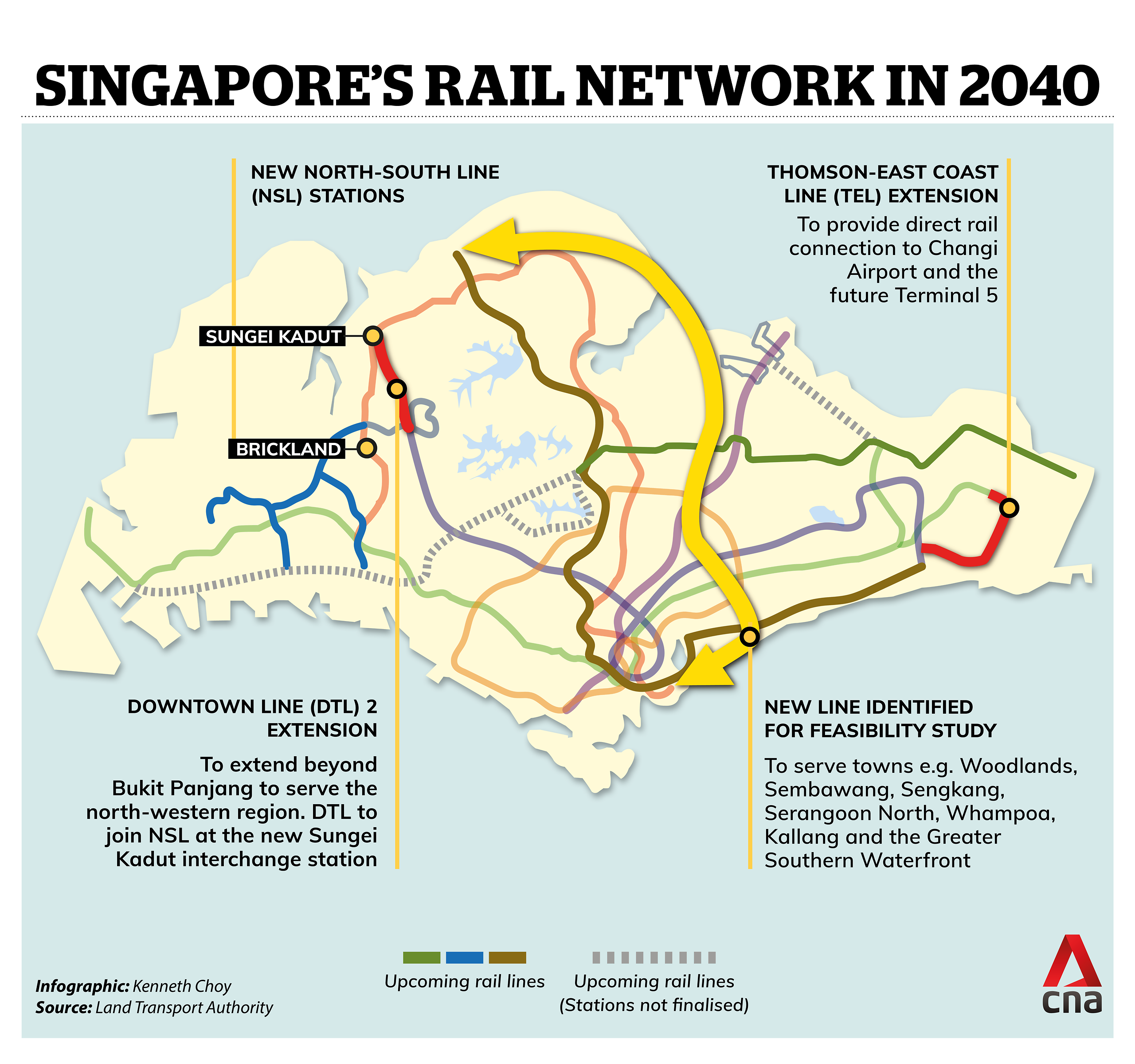
SINGAPORE: The Land Transport Authority (LTA) will study the feasibility of constructing a new rail line to serve the developing north and northeastern regions of Singapore.

The new line would supplement the transport network in those areas to serve new and growing developments as well as existing towns which currently do not have direct access to the rail network, LTA said in its Land Transport Master Plan 2040 (LTMP 2040) which was released on Saturday (May 25). 

The proposed line could cover areas such as Woodlands, Sembawang, Sengkang and Serangoon North, as well as Whampoa, Kallang and the Greater Southern Waterfront, LTA added.

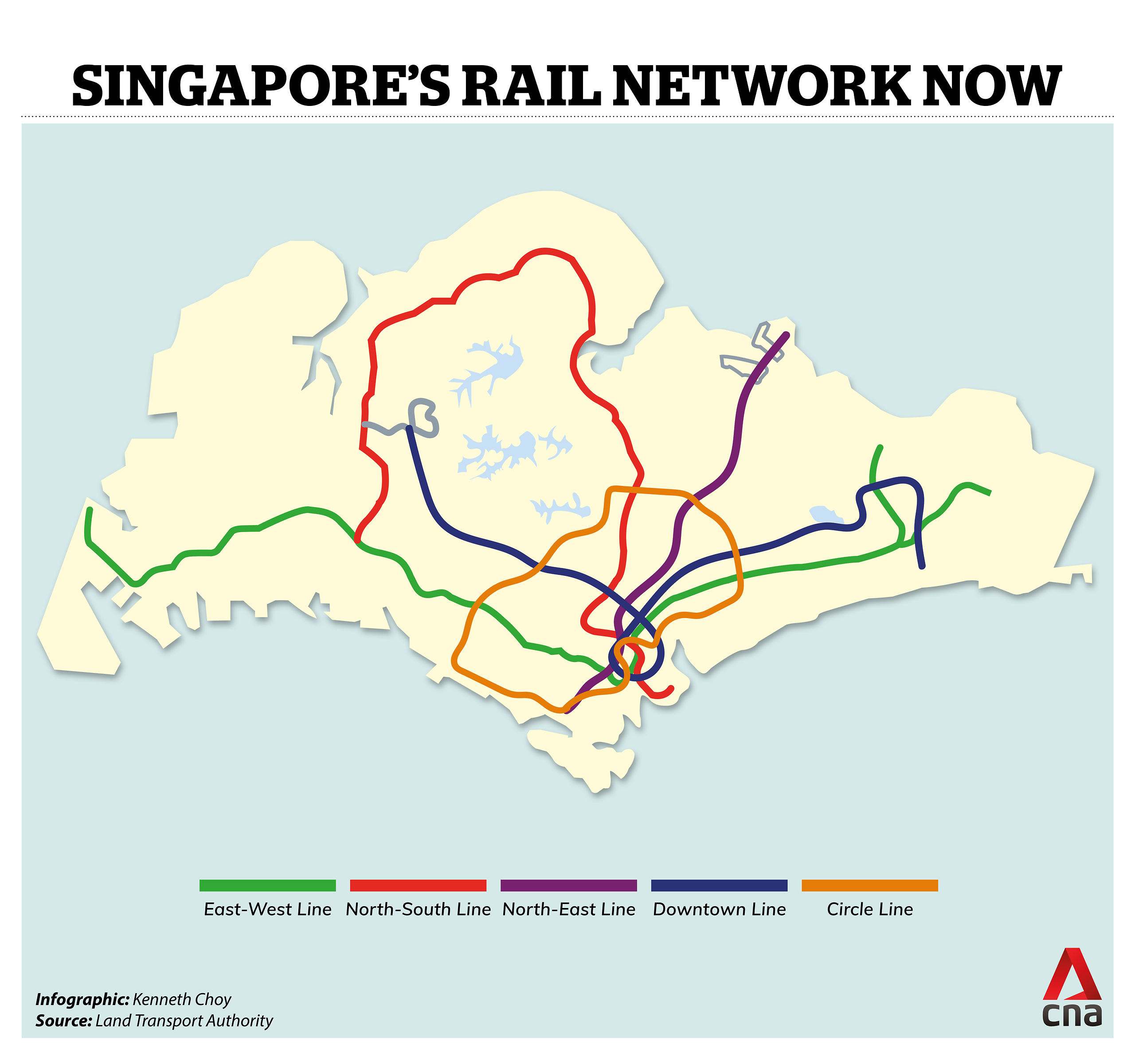
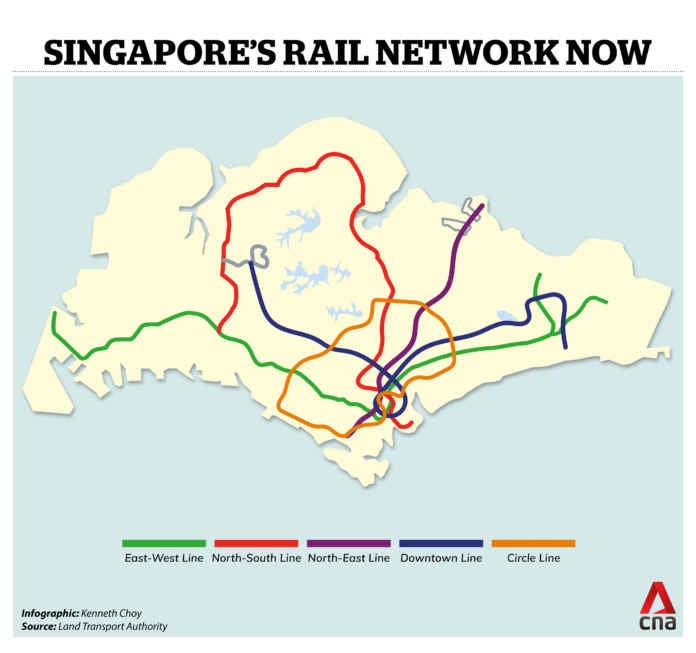
Graphic showing Singapore's current rail network - LTA Master Plan 2040

Graphic showing Singapore's rail network in 2040 - LTA Master Plan 2040

As part of the feasibility study, LTA will assess issues such as demand, station locations and how long developing the new line would take. It will also take into account existing and future land use developments along the corridor.

“When completed in phases, the line could serve more than 400,000 households, with commuters in the northern region of Singapore enjoying time savings of up to 40 minutes to the city centre,” said LTA.

It also said that the new line could relieve increasing travel demand along the northeast corridor and strengthen the overall resilience of the MRT network. 

“This would help to make rail a faster, more convenient and reliable transport option for more Singaporeans,” added LTA.

The feasibility study will begin shortly and take up to two years to complete. 

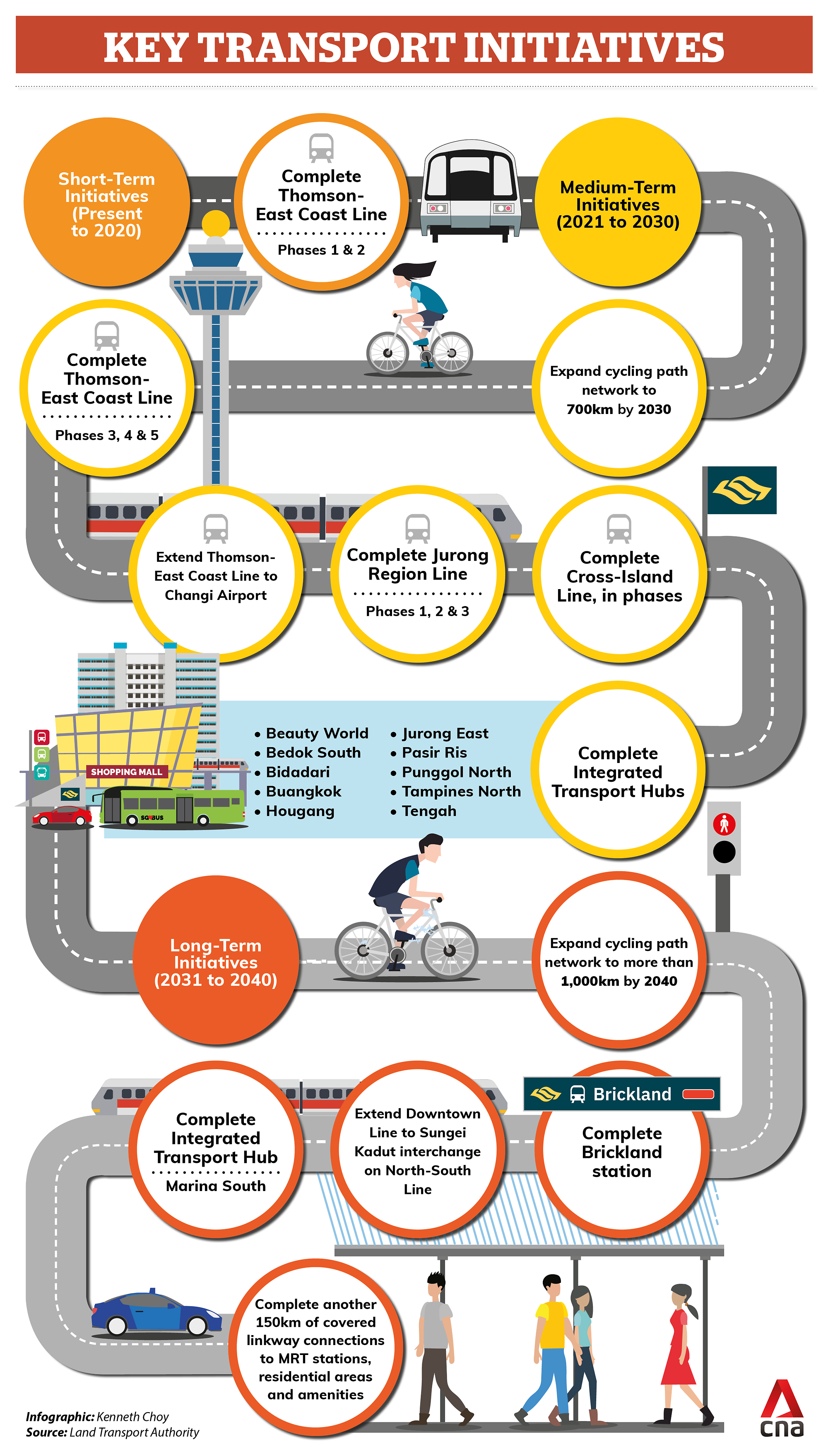
Graphic showing key initiatives of LTA's Land Transport Master Plan 2040

IMPORTANCE OF REGIONAL WORKPLACES

One of the goals of LTMP 2040 is to ensure a “45-minute city with 20-minute towns”. This means that commuters need only a 45-minute journey to get to work and 20 minutes to reach amenities within residential towns.

LTA said that the key to achieving that goal is creating more regional employment centres, instead of having workplaces situated mainly in and around the city centre. 

Some examples of areas that “bring jobs closer to homes” are the Punggol Digital District, Jurong Lake District, Jurong Innovation District and Woodlands Regional Centre. 

READ: ‘45-minute city, 20-minute towns’: Advisory panel outlines vision for Land Transport Master Plan 2040

The LTMP 2040 report noted that such new employment centres will also be supported by other transport initiatives “to ensure seamless connectivity and easy accessibility to them”.

This includes having more “Transit Priority Corridors” (TPCs) which are dedicated bus lanes and cycling paths for travel in and across towns, with the first example already implemented on Bencoolen Street. 

The authority noted that the regional employment centres will be served by new TPCs in possible areas such as Robinson Road, Loyang, Tengah, Jurong Lake District and Woodlands North Coast. 

At the same time, rail enhancements like train line extensions will also connect to such new workplaces.

LTA also said that having more Walk-Cycle-Ride transport facilities is another method to achieving its “45-minute city with 20-minute towns” goal, thus getting to these new employment centres will become easier over time.

Source link

40 species potentially new to Singapore discovered in Bukit Timah Nature Reserve survey

SINGAPORE: More than 40 species potentially new to Singapore have been discovered during a comprehensive survey of the Bukit Timah Nature Reserve, according to a National Parks Board (NParks) media release on Saturday (May 25).

In total, around 200 species new to the nature reserve were listed during the survey.

Of these, more than 30 species of spider and 10 species of beetle are potentially new to Singapore. Some may also be new to science, said NParks.

These include two new types of armour-plated spiders – the Paculla bukittimahensis, named after Bukit Timah and a type of jumping spider with white and gold scales – as well as a species of stick insect. 

Researchers also found records of more than 160 plant species not previously listed in the nature reserve. 

These plant records were collected during the survey, as well as during previous surveys conducted by researchers from the Nanyang Technological University, National University of Singapore, NParks and expert enthusiasts.

In addition, the Yellow-striped Caecilian, a critically endangered amphibian, was also listed in the survey. It was last seen in Singapore in 1989, according to NParks.

Bukit Timah Nature Reserve survey 1

The critically endangered Yellow-striped Caecilian. (Photo: Noel Thomas, National Parks Board)

In spite of the new discoveries, the findings also “serve as a reminder” of the fragility of nature as many of the new species were not found in large numbers, said Mr Lim Liang Jim, group director of NParks’ National Biodiversity Centre.

“While there have been many new species listings, many of them were not found in large numbers,” he said. “This finding reflects the fragility of Bukit Timah Nature Reserve, and the need to strengthen the conservation and resilience of the reserve.”

The survey, which was first proposed in 2014, involved more than 300 researchers and volunteers. Pre-survey preparation work started in 2014, while fieldwork was carried out from 2015 with most data collection finishing two years later. Some data analysis is still ongoing, said Mr Lim. 

It was the first comprehensive survey of Bukit Timah Nature Reserve in two decades, with the previous major survey carried out between 1993 and 1997.

NIGHT VISION GOGGLES, BAT DETECTORS

New technology will be used to add “relevance and diversity” to NParks’ biodiversity surveys, said the agency, adding that new techniques can improve data collection and reduce the impact on wildlife. 

“For example, night vision equipment employing thermal imaging can be used to observe animals in their natural habitat without disturbing them through the conventional use of spotlights,” said Mr Lim. “These methods also have a much better detection rate, especially for fauna which may be masked by dense vegetation.”

It highlighted the example of ultrasonic bat detectors, which are already in use to detect and identify bats.

In future, these detectors will be complemented by other acoustic sensors which can remotely monitor the calls of birds, frogs, reptiles and mammals in the forest, distinguish between different species and assess the number of individuals of a species nearby.

Marine acoustic sensors will also be used to monitor marine species – such as dolphins – in the water, while drones will be deployed to take aerial images of habitats and track changes over time.

NParks is also working with researchers to compile DNA databases, so that minute traces of DNA in the environment can be used to detect plant and animal species without the need to see or disturb them.

Source link

LTA to boost length of cycling path network to 1,000km by 2040

SINGAPORE: The Land Transport Authority (LTA) plans to increase the country’s cycling path network by a third to 1,000km by 2040, according to the Land Transport Master Plan 2040 (LTMP 2040) released on Saturday (May 25).

This will build on an earlier commitment from 2013 to construct 700km of cycling paths by 2030, LTA said.

So far, more than 440km of cycling paths have been built, it added.

To meet that goal, the authority will place cycling paths on both sides of the road in new development areas such as Kampong Bugis, Tengah and Woodlands North Coast. 

LTA will also explore facilitating cycling in private residential and industrial estates.

It noted that “only about half of intra-town journeys (are) made on foot or by bicycle today”, adding that “there is room for more to embrace a healthier lifestyle”.

“By expanding our active mobility network, we will not only improve first and last-mile connectivity, but also make it more convenient for people to reach everyday amenities in their nearest neighbourhood centre by walking and cycling,” said the authority in the LTMP 2040.

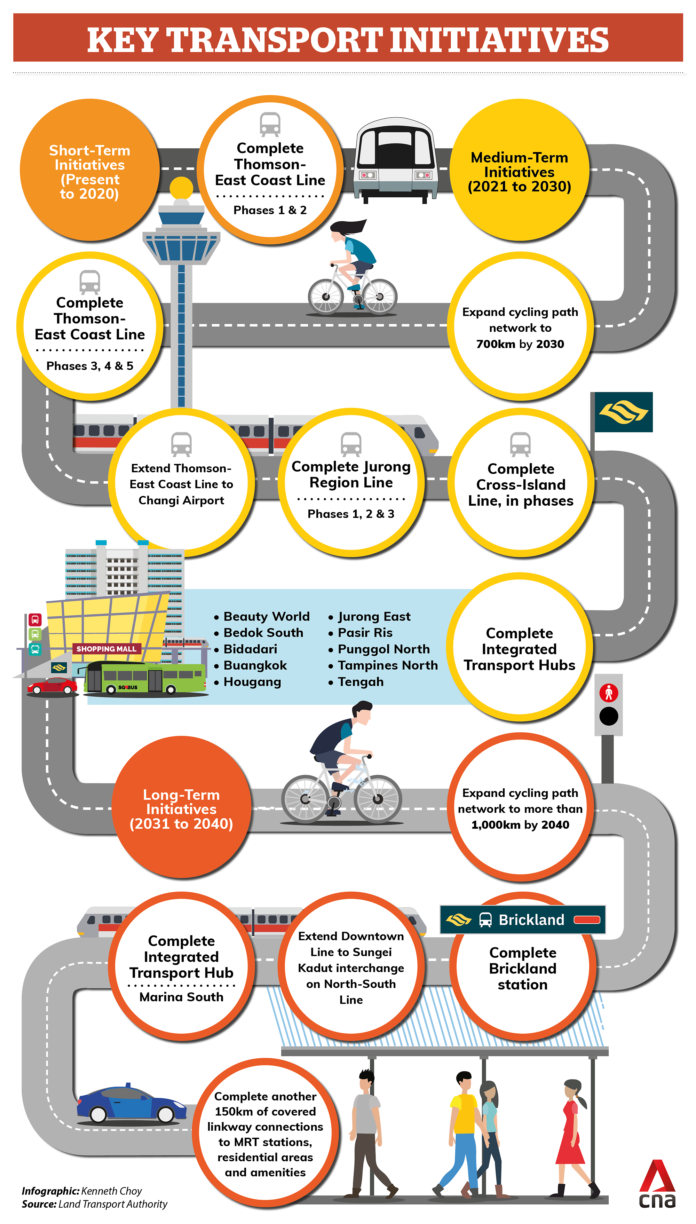
Graphic showing key initiatives of LTA's Land Transport Master Plan 2040

Expanding Singapore’s cycling path network is part of LTA’s vision to create a “45-minute city with 20-minute towns”. 

This means that commuters need only a 45-minute journey to get to work, and 20 minutes to reach amenities within residential towns.

IMPROVING BUS SPEEDS

Another goal of the LTMP 2040 is to improve bus speeds. To that end, LTA said it will progressively introduce more “Transit Priority Corridors” (TPCs).

TPCs are dedicated bus lanes and cycling paths for travel in and across towns, with the first example already implemented on Bencoolen Street. 

LTA shared that other areas that could have TPCs are Robinson Road, Loyang, Tengah, Jurong Lake District and Woodlands North Coast. 

READ: Commuters want more inclusive public transport system, better bus journeys: Feedback sessions

LTA said that the North-South Corridor, to be completed in 2026, will be Singapore’s longest TPC and will save bus passengers up to 15 minutes of travel time. Other bus priority measures such as sections of bus-only roads and bus signal priority are also being explored for the North-South Corridor. 

On its website, LTA notes that the North-South Corridor was originally conceived as a 21.5km expressway to connect towns in the North to the city centre, but was redesigned to become Singapore’s first integrated transport corridor featuring continuous bus lanes and cycling trunk routes.

​​​​​​​MORE INTEGRATED TRANSPORT HUBS

In terms of public transport infrastructure, besides the construction of more MRT stations and a potential new rail line, the authority will look to construct new integrated transport hubs to provide seamless connections between bus and train services.

LTA said these fully air-conditioned facilities will be connected to malls “to give convenient access to amenities as a part of the public transport journey”.  

Such facilities are being planned at Beauty World, Bedok South, Hougang, Jurong East, Marina South, Pasir Ris, Tampines North and Tengah.  

Integrated transport hubs are already under construction at Bidadari, Buangkok and Punggol North.

Source link

New stations, line extensions planned for Singapore’s rail network

SINGAPORE: Accessibility to the rail network is set to be further improved with the extension of some lines and the development of new stations.

Among the proposals announced on Saturday (May 25) by the Land Transport Authority (LTA) in its Land Transport Master Plan 2040 (LTMP 2040) is the addition of a new station on the North-South Line (NSL).

Located between Choa Chu Kang and Bukit Gombak stations, the new Brickland station will benefit people living in Keat Hong, Bukit Batok West and Pavilion Park, as well the Brickland district in the upcoming Tengah town.

The NSL will also have a new interchange station at Sungei Kadut that will connect to the Downtown Line (DTL). LTA explained that this will be achieved by extending the DTL beyond Bukit Panjang station to serve Yew Tee and Choa Chu Kang.

Responding to queries during a media briefing on Tuesday (May 22), LTA said that the new interchange station will be located between Yew Tee and Kranji stations.

LTA added that with this development, people living in the northwest can expect to cut up to 30 minutes from their journey time to the city area.

The Sungei Kadut interchange station, which could be ready by the mid-2030s, will also serve future developments by JTC Corporation at Sungei Kadut, such as the upcoming site for SMEs in the metal, machinery and timber industries, and the future Agri-Food Innovation Park.

Graphic showing Singapore's current rail network - LTA Master Plan 2040

Graphic showing Singapore's rail network in 2040 - LTA Master Plan 2040

UPCOMING TERMINAL 5 AT CHANGI AIRPORT TO GET DEDICATED MRT STATION

Separately, LTA said it will extend the Thomson-East Coast Line (TEL), with a station serving the upcoming mega Terminal 5 at Changi Airport, as well as a new Sungei Bedok station. 

LTA said the new link will connect to the stretch of rail network between Tanah Merah and Changi Airport on the East-West Line (EWL), which will be converted to form part of the TEL extension.

When fully completed, the extension will link Changi Airport to stations along the TEL up to Woodlands North, where commuters may be able to transfer to the future Singapore-Johor Bahru Rapid Transit System Link.

At present, the train to Changi Airport serves Terminals 1, 2 and 3. Passengers at Terminal 4 have to take a bus transfer. 

LTA said that it will announce more details about the rail network expansions at a later date. However, it highlighted that the openings of the new stations will be “in tandem” with infrastructure developments.

​​​​​​​

Graphic showing key initiatives of LTA's Land Transport Master Plan 2040

Source link