Home Blog Page 781

The Big Read: Calls to ban PMDs mount as accidents persist — but is it the best option?

SINGAPORE: Some have abandoned their daily walks for fear that they would be hit by a motorised vehicle hurtling down footpaths. Others have had close shaves with impetuous riders.

In recent months, many Singaporeans — including Members of Parliament (MPs) — have joined a growing chorus of condemnation against these motorised vehicles, which have left riders and pedestrians with all manner of injuries from deep cuts to fractures and concussions. There have also been deaths.

Popular with riders for daily commutes and deliverymen whose livelihoods depend on them, these vehicles — known as personal mobility devices (PMDs) in Singapore — include electric scooters, hoverboards and electric unicycles.

READ: Why being hit by an e-scooter can be deadly – and a call to ban them from footpaths

e-scooter file

An e-scooter rider on a shared path. (File photo: TODAY)

Despite efforts to regulate their use, safety concerns persist and calls are mounting to keep them off footpaths and the void decks of public housing estates.

AN ISSUE AROUND THE WORLD

These exhortations come as countries around the world grapple with the dangers posed by these vehicles.

Some have laid down speed limits, barred them from footpaths, or confined them to private land.

Germany this month banned e-scooters from pavements and France will follow suit in September.

In the United Kingdom, roads and pavements are off-limits to e-scooters. They are allowed on private property, such as parks and universities, with the landowner’s permission.

Earlier this month, Dr Lee Bee Wah, an MP for the Nee Soon Group Representation Constituency (GRC), asked in Parliament if Singapore could emulate France’s impending ban.

Allowing PMDs on footpaths shifts “more risks to the pedestrians”, said Dr Lee. She added that some of her residents feel so unsafe on footpaths that they have “even given up their daily walks”.

There are no signs, however, that a ban in Singapore is on the cards.

Dr Lam Pin Min, Senior Minister of State for Transport, said in reply to Dr Lee that, while the Government was mindful of the safety concerns, the solution was “not to ban them, but to cultivate the right culture where users ride safely and responsibly, and only at the allowed places”. 

READ: Don’t complain about rules for bikes and PMDs until we’ve proven we can be responsible, a commentary

man on pmd - file photo 3

Man riding a personal mobility device (PMD) across the road in Singapore. (File photo: Jeremy Long)

CALL FOR BANS

At the same sitting, there were also calls to ban PMDs from void decks of Housing and Development Board (HDB) estates.

Bukit Batok MP Murali Pillai wondered if the ground-level lift lobbies and areas around letter boxes could be designated pedestrian-only paths under the Active Mobility Act to prevent collisions involving PMDs.

The Act spells out the rules governing the use of PMDs and other equipment on public paths.

Dr Lam replied that void decks are exempted from the Act as they are “not critical for connectivity”.

Therefore, town councils — which take care of public housing estates — can impose their own rules, including barring PMDs from void decks, he said.

More than a week after Dr Lam’s comments, the 15 town councils under the ruling People’s Action Party (PAP) said that they would not rule out banning PMDs from void decks as they relook their by-laws.

On Saturday (May 25), Dr Lam provided more details, saying that the Government is working with the town councils to ban PMDs from accident-prone areas within housing estates. 

When Aljunied-Hougang Town Council, run by the opposition Workers’ Party, was asked if it would consider a ban in void decks, it said that more needed to be done to educate users on riding responsibly in common areas not limited to void decks, lift lobbies and footpaths.

“We will continue to increase our educational efforts,” it said.

Meanwhile, for many pedestrians, the worries are real.

e-scooter file

File photo of an e-scooter.

Some had written to forums to express their concerns. 

One took aim at reckless food delivery riders after a close call with one in Tampines this month. Another lamented the recklessness of PMD users who speed down footpaths, mostly at night.

On social media, stories abound of encounters with errant riders.

A GROWING MENACE

Statistics from the Land Transport Authority (LTA) show that nearly a fifth of the 3,700 active-mobility offences between May 2018 and April 2019 involved users who sped, rode recklessly or used PMDs on roads.

Under Singapore’s law, PMDs cannot be used on roads. They are allowed only on footpaths and shared pathways, such as cycling paths and park-connector networks.

In 2017 and 2018, there were 228 reported accidents involving PMDs on public paths, 196 of them resulting in injury, Transport Minister Khaw Boon Wan told Parliament last month.

One mishap left a rider dead and 32 other accidents resulted in major injuries, such as concussions and fractures, he said.

The LTA said that it has increased enforcement efforts in recent months. From February to April, it carried out about 2,260 enforcement operations and seized more than 400 devices.

The government agency said that regulations and enforcement are key to deterring irresponsible behaviour, and the public can help by providing details of where they have encountered errant users and irresponsible retailers.

For Singapore’s lawmakers, devising a solution to the problem took some years.

An Active Mobility Advisory Panel was set up in 2015 to look into rules governing the use of PMDs, bicycles and other equipment.

PMD

LTA’s Active Mobility Enforcement teams at work. (Photo: Kenneth Lim) 

It submitted its recommendations in 2016, spelling out rules for users, the types of devices permitted on various pathways, and the speed, width and weight criteria for devices allowed in public spaces.

The Government accepted the proposals in full and incorporated these into the Active Mobility Act, which took effect in May last year. The panel made further recommendations in August last year after a second review.

The present measures include having owners of e-scooters register their vehicles, which must meet weight, width and speed requirements. From July, it will be an offence to ride an unregistered e-scooter on public paths. PMD users must also keep within 10kmh on footpaths and 25kmh on shared paths.

Still, Singaporeans, MPs and transport analysts have said that the measures could go further. 

Here are some suggestions:  

SUGGESTION #1: COMPULSORY SAFE-RIDING COURSE

Some PMD groups stressed that Singapore has already gone some way to roll out a regulatory regime and riders know the rules, but they acknowledged that educational efforts can be more widespread.

Mr Wilson Seng, president of the PMD Retailers Association of Singapore, suggested that the LTA’s Safe Riding Programme be made compulsory for all riders.

The 90-minute course on safe-riding practices takes users through a training circuit and the rules governing PMDs.

Free until the end of this year, it is conducted in community clubs and schools, for instance.

Users found riding recklessly must attend the programme and pay for it.

Safe riding PMDs Car-Free Sunday

Safe riding demonstrations for personal mobility devices at the Car-Free Sunday event on Feb 26, 2017 (Photo: Olivia Siong)

Mr Seng, 30, whose association represents about 25 retailers, said that users could be made to show retailers a certificate of attendance before they buy a PMD.

He noted that some retailers have already been nudging riders to attend the programme when they buy a device.

Agreeing, Mr Joseph Lum, a member of The Wheelies, a unicycle enthusiast group, said that training could be mandatory for users, leading to a licence akin to a driver’s licence.

This will make users accountable, said Mr Lum, 43, a bank vice-president.

Transport economist Walter Theseira of the Singapore University of Social Sciences (SUSS) said a primary concern with PMD users is the lack of licensing or testing.

“There are practically no minimum standards a user has to meet to be able to operate a PMD,” said Associate Professor Theseira, head of the SUSS’ Master of Management (Urban Transportation) programme.

He added that it would make sense to resolve the problem by regulating issues such as licensing.

Dr Lee, the Nee Soon GRC MP, also supported licensing e-scooter riders, who should be of a minimum age and receive training. “If they get into an accident with pedestrians, their licence will be revoked,” she added.

Right now, users must be at least 16 years old to register their e-scooters with the LTA.

Even so, Mr Pillai, the Bukit Batok MP, said that issues of concern must be identified clearly before making any programme compulsory.

For instance, he asked if the problem lies with a lack of understanding of the rules or with non-compliant equipment.

PMD 1, Aug 14

An impounded overweight PAB weighing 36.32kg. (Photo: Land Transport Authority)

Mr Denis Koh, chairman of Big Wheel Scooters Singapore — the largest online community of e-scooter enthusiasts here with more than 26,000 members — also felt that more thought was needed before making the Safe Riding Programme compulsory. 

Mr Koh, who sits on the Active Mobility Advisory Panel, said that the panel had not ruled out this possibility, but felt that it may be too early to consider the move.

“Policies should be introduced one step at a time and we’ve to see ground conditions and sentiments, and look at statistics and the data,” said Mr Koh.  

Nevertheless, he proposed that recalcitrant riders be banned from owning PMDs if they re-offend and attend the Safe Riding Programme more than thrice.

READ: What happened to caution and graciousness on the roads? A commentary

In response to queries, an LTA spokesperson said that more than 46,000 people have taken part in the Safe Riding Programme, which was rolled out in February last year.

Asked if there are plans to make it compulsory, the spokesperson added: “We will look at how we can make the Safe Riding Programme even more effective.”

SUGGESTION #2: CURB PMD NUMBERS

Besides posing dangers to persons in the street, the presence of PMDs has also clogged pathways, as pedestrians, cyclists and PMD users jockey for space.

More than 70,000 e-scooters had been registered in Singapore by April 30, the LTA said previously.  

SUSS urban transport analyst Park Byung Joon said that PMDs have added to the congestion in densely populated Singapore.

e-bike file (1)

An e-bike rider on a road in Singapore. (File photo: TODAY)

To control their numbers, he suggested a system similar to the Certificate of Entitlement (COE) scheme for vehicles, such as cars.

Under the system, buyers wishing to own a vehicle must bid and pay for a limited supply of COEs.

Associate Professor Park said that imposing the system on PMDs would consequently make ownership more expensive.

Still, he questioned if the legislative and administrative effort to roll out such a system for PMDs would be worthwhile. “Government resources are not unlimited,” he said.

Assoc Prof Park noted that limiting such motorised devices to persons with disabilities could also work, since they are not in large numbers.

Right now, personal mobility aids such as motorised wheelchairs and mobility scooters are allowed on footpaths and shared paths. They are bound by a 10kmh limit on public paths.

As for delivery riders, who have come under fire lately for speeding to fulfil orders, Assoc Prof Park felt that they should not be given an exception.

“If their plan is to clutter Singapore’s streets with e-scooters, that is not acceptable,” he said.

Earlier this month, retired general manager Francis Cheng Choon Fei, 64, urged the LTA to step up enforcement against reckless food delivery riders.

The Tampines resident had a close shave with a speeding GrabFood delivery rider on an electric scooter.

Mr Cheng wrote that he was nearly knocked down on May 12 along a walkway beside the Telepark building in Tampines Central.

Food delivery e-scooter

File photo of e-scooters used by food delivery riders. (Photo: ElectroWolf, Electric Scooters Singapore‎/ Facebook) 

Associate Professor Muhammad Faishal Ibrahim, who chairs the Active Mobility Advisory Panel, said that engagements are continuing with food delivery firms to ensure that their riders have third-party liability insurance when they are at work.  

Such insurance schemes allow victims to lodge claims for damages.

Food delivery business Deliveroo, for instance, rolled out free accident and injury insurance for all its riders in May last year.

“Accident insurance is applicable to riders on all vehicle types and their substitutes, while all cyclists and e-scooter riders also have access to third-party liability insurance,” Deliveroo’s spokesperson said.  

Food delivery companies said that they would act against riders who break the rules.

Technology firm Grab said its food delivery arm, GrabFood, takes customer feedback seriously and will act against errant delivery-partners, including warning, suspending or banning them from the platform.

At Deliveroo, customers may report objectionable rider behaviour and the company will ensure that action is taken.

This may include terminating a rider’s supplier agreement.

“If a rider has been found to have endangered a pedestrian, we will stop working with (him). We will co-operate with the relevant authorities however possible,” said Deliveroo’s spokesperson, adding that the firm requires all riders to abide by local rules and regulations.

Both companies have training programmes for riders.

New GrabFood delivery-partners are trained in road safety rules and regulations, for instance, and are reminded regularly to abide by speed limits and wear proper safety gear. They are also given road safety tips, said Grab’s spokesperson.

Riders who join Deliveroo are required to complete an introductory road safety guidance programme.

Deliveroo selected neighbourhoods

(Photo: Facebook/Deliveroo Riders Singapore)

The company also works with the LTA to hold Safe Riding Programmes for its riders every month, and reminds riders regularly of road safety programmes and regulations, added the Deliveroo spokesperson.

Foodpanda could not respond to this reporter queries, as its spokesperson was away from the office this week.

SUGGESTION #3: LIMITED BAN IN CERTAIN AREAS

Beyond training and curbing supply, some MPs repeated their calls for a ban on PMDs in areas with high human traffic, such as void decks of HDB blocks and town centres — a move supported by some analysts and PMD interest groups.

Dr Lee said that this would protect the young and old, and allow people to “feel safe when gathering in these areas”.

In her Nee Soon South constituency, riding is already disallowed in void decks.

Under the Nee Soon Town Council by-laws of 2013, all vehicles, except wheelchairs and toy vehicles, cannot be used in void decks, Dr Lee said.

Some PMD users have been fined, although she did not provide figures. Enforcement is done with the police.

Barriers have also been installed in areas such as lift lobbies, coffeeshops and pre-schools, so that PMD users have to dismount, noted Dr Lee.

As a result, some residents have reported feeling much safer, she said.

Mr Koh from Big Wheel Scooters said that disallowing PMDs in void decks, where there are many pillars and blind spots, was “reasonable”.

He suggested that town councils consult agencies such as the LTA to align their policies not only in void decks but their surrounds.

Enforcement can be done jointly between agencies such as the LTA and the police, he said.

e-scooter

A man riding an electric scooter. (File photo: TODAY)

“We do not want some towns to enforce like this and another to enforce like that,” Mr Koh said.

Bedok, Pasir Ris and Tampines are all very near one another; do you want different rules or enforcement in every town?

Assistant Professor Terence Fan, a transport specialist at the Singapore Management University (SMU), said that residents could take photos of errant users and report them to the authorities.

Signs or lines demarcating no-go zones should be rolled out to make the rules clear, he added.

Mr Loh Chow Kuang, a former secretary of the Public Transport Council, said that a combination of education, warning signs, significant penalties, an enforcement team, and closed-circuit television (CCTV) cameras was needed to enforce such rules.  

Most, if not all, lift lobbies, corridors and void decks of HDB estates already have CCTV cameras, noted Mr Loh, who is president and chief executive officer of Singapore Urban Transport International, which promotes Singapore’s know-how in urban transport development and management globally.

Asked if installing more CCTV cameras would work, Mr Pillai said that the police had already fitted a number of ground-floor lift lobbies with these tools, which could be tapped for enforcement.

Mr Lum from The Wheelies said that PMDs could be restricted at certain hours from areas where many young children or elders gather, such as void decks.

Opening alternative paths will reduce PMD users’ need to use those areas, he added.

hdb cctv camera

A CCTV camera installed at a void deck of a HDB block in Singapore.

Assoc Prof Faishal said that the Government is working with town councils to explore measures that can improve residents’ safety.

Meanwhile, Dr Paul Barter, an adjunct associate professor specialising in urban transport policy at the Lee Kuan Yew School of Public Policy, suggested that the authorities could identify a comprehensive network of streets where vehicle speed limits could be cut to 30kmh.

PMD and bicycle users without helmets could be allowed on these streets, creating additional safe routes for them.

These users, except children and their adult escorts, could then be banned from footpaths wherever there are streets with a 30kmh limit or cycling paths, said Dr Barter.  

SUGGESTION #4: TOTAL BAN

While most people interviewed did not support an all-out ban on PMDs, one analyst and several pedestrians were in favour of such a move.

Assoc Prof Park said that, with the exception of persons with disabilities who need mobility aids to get around, the Government could give users up to a year’s notice before it rolls out a ban, to give them time to seek alternatives.

This, too, will help to calm demand for PMDs and give the authorities time to draw up a licensing scheme for persons with disabilities, he added.

Nevertheless, a ban on PMDs could mean that Singapore would be “back to square one” in its efforts to improve last-mile connections.

“We will only have walking (and) we should pay attention to walking as a more enjoyable and preferred mode,” said Assoc Prof Park.

For those wishing to ride e-scooters just for leisure, he said that a confined space meant only for such devices, for instance, could be explored.

to kien lanes

(Photo: To Kien)

Project manager Tan Chi Wei, 41, who urge for greater action against reckless riders, also supported a ban.

A year ago, an e-scooter rider emerging from a blind spot bumped into him at the void deck of an Yishun Avenue 4 block. He was walking his daughter, who was then three years old, to her pre-school. They were not hurt.

Still, Mr Tan acknowledged that a complete ban is hard to achieve immediately as “enforcement officers cannot be everywhere”. The devices first need to be stopped at the ports of entry before they reach the market, he said.

Mr Cheng, the Tampines resident, also prefers a ban, as many riders exercise poor judgement and “speed along walkways without a care for pedestrians”.

It is not quite possible to build more PMD lanes given Singapore’s land constraints, he said.

‘HOLISTIC APPROACH’ NEEDED

Notwithstanding calls for a ban, many interviewed for this article said that such an extreme move would be a step backwards for Singapore’s vision of a “car-lite” city.

Assoc Prof Faishal, who is also Senior Parliamentary Secretary for Social and Family Development, said that when used responsibly PMDs have an important role in Singapore’s transport landscape.

While some may argue that PMDs have no place here since the country is so well-connected, he said that those who use these vehicles as an alternative to driving, walking or taking public transport have found them “convenient, useful and environmentally friendly”.

He said that most e-scooter riders, for instance, are safe and responsible.

elderly man on personal mobility device PMD file photo (1)

A senior citizen riding a personal mobility device (PMD) in Singapore. (File photo: Gaya Chandramohan). 

“We should, therefore, not go down the path of imposing a complete ban on PMDs because of a small number of people who misuse them,” said Assoc Prof Faishal.

“Instead, we should take a balanced and holistic approach to improve active-mobility safety and build this as part of the evolving transport landscape.”

Dr Barter reiterated that PMDs have greatly expanded users’ freedom to make trips that are inconvenient by public transport.

“Banning them would harm the mobility of many thousands of people who already find them useful,” he said.

Agreeing, SMU’s Asst Prof Fan said that PMDs are important in linking homes that are farther from public transport.

For instance, some workers travel from the Central Business District to their homes in Tanjong Rhu on PMDs, completely replacing public transport, he added.

For some, such as Mr Lum of The Wheelies, PMDs are a more convenient alternative to cars.

In the mornings, he parks his car on the edge of town and rides his unicycle to his Shenton Way office to avoid the traffic snarl-ups.

He also occasionally takes his eight-year-old daughter to her primary school on an electric scooter to steer clear of the peak-hour traffic, saving up to 20 minutes during the journey.

Mr Sitoh Yih Pin, chairman of the Government Parliamentary Committee for Transport, said that an outright ban at this stage would be “a little excessive”.

Apart from stricter rules and enforcement, the Potong Pasir MP said greater effort is needed to communicate with PMD riders and other road and pavement users about taking precautions and observing proper etiquette.

e-bike file

An e-bike rider in Singapore. (File photo: TODAY)

Agreeing, Mr Koh of Big Wheel Scooters said that pedestrians, too, have to play their part.

For instance, pedestrians would sometimes veer into the cycling paths at East Coast Park.

Ultimately, Mr Koh said a balance must be struck without restricting Singaporeans’ commuting options.

“We don’t want to make this a nanny state, where everything is governed by rules, rules, rules, and enforcement, enforcement, enforcement,” he added.
Source link

Commentary: Dealing with the difficult issue of organ donation when a loved one passes on

SINGAPORE: One way to make group meetings more productive is to adopt the ground rule that silence means agreement with decisions.  

Similarly, the Human Organ Transplant Act (HOTA), which aims to make organ donation more efficient to save lives, presumes that silence – not registering an objection – means tacit consent to organ donation at death.  

A recent CNA story revealed that families often harbour doubt that their deceased loved ones would have wanted their organs donated. Reeling from the shock of the death of a loved one, families may be uncertain of their loved one’s wish, “feel that their loved one would not have wanted to”, or that she or he had not been informed of the HOTA.

READ: ‘Are you sure he is dead?’: Doctors struggle with families’ lack of understanding of HOTA

Such reasons are not valid objections to organ removal under the Act, which has been in force since 1987, and is regularly communicated to the public through multiple channels. 

RAISING AWARENESS, REDUCING OBJECTION

Despite this, awareness remains painfully low. In a survey conducted by one of us with 60 over intensive care physicians in Singapore who are involved in referring ICU patients for brain death certification, almost nine in 10 highlighted lack of awareness and acceptance of the HOTA among family members.

Healthcare professionals are put in a difficult position. If a certified brain dead person had not opted out, it is not unlawful to authorise organ removal against the objection of families.

So it is no surprise almost eight in 10 surveyed recommended the need for increasing public awareness of the HOTA. “(We need) to create a societal culture of willingness to donate organs, ” one said.

READ: Timely to review our opt-out organ donation policy, a commentary

Lebanon's leading paediatric heart surgeon Issam al-Rassi each week sets aside a day to operate

Has the Human Organ Transplant Act (HOTA) come of age? (Photo: AFP/Mahmoud Zayyat)

Still, a culture of willingness to donate is insufficient if it remains in one’s own mind, as a mental attitude as families’ doubts about a deceased person’s consent for donation under the HOTA will likely remain common and strong.

In Wales where deceased persons will be deemed to have consented to organ donation unless they have expressed a decision in life since 2015, a study on the short-term impact on consent rates and donation numbers found significantly more family support for previously expressed wishes to donate (about 26 per cent) – whether this is a registered or a verbally communicated opt-in decision – than for deemed consent.  

It is clear that many family members have yet to accept “doing nothing” (deemed consent) as a positive decision in support of organ donation.

Consistent with previous studies on family support for deceased organ donation, this suggests that families of those who had expressed a prior decision to donate are more likely to agree to donation than those with no prior expressions, notwithstanding families may also oppose donation even if their deceased loved ones had expressed a decision to donate. 

EXPRESSED WISHES AND POSITIVE FAMILY EXPERIENCES

Knowledge of prior wishes of donors may take the issue out of the hands of family members at an emotionally tumultuous time and make the experience of donation less distressing.

surgeon, doctors in hospital

(Photo: Unsplash/Luis Melendez)

When a 23-year-old man in England died from brain injuries caused by multiple strokes in 2017, his family agreed to donation of his organs upon knowing that his son had opted in. His father said: 

What he did, by joining the Organ Donor Register, was take the pressure off. He had made the decision.

Sometimes all it needs is a conversation, not necessarily the creation of a formal opt-in system.

Despite his sudden death from brain haemorrhage, and the (initial) objection of her in-laws, the wife of a 49-year-old man in Singapore supported donation under the HOTA. They had discussed their mutual willingness to donate in their event of their death and she knew her husband had not opted out. 

In both of these cases, family members said they were “very proud” of what their loved one had done. This is a common narrative thread for families of deceased organ donors who had expressed a positive decision.

The families of those who had passed on without expressing a decision to donate may not inevitably object to the presumption of consent and donation under the HOTA framework. They may support for many reasons, because they know and agree with the law, or sense that donation is consistent with their loved one’s past deeds and character.

And they may also find meaning and comfort in their bereavement in knowing that parts of their loved ones live on in others.

But families are more likely to be supportive and have a positive experience of donation under the HOTA if the deceased person had expressed, or, better still, document a decision to donate while alive.

TOWARDS A CULTURE OF VOICE

There are two ways to make a deceased person’s wish for organ donation clearer to their families.

First, for people to opt in under the Medical (Therapy, Education and Research) Act (MTERA), which covers the donation of all organs and tissues for the purposes of transplantation, education and research, evidence of a deceased person’s consent for organ donation should be clear and strong to a family if in addition to tacit consent under the HOTA, she or he had expressed it under the MTERA.

SGH

File photo of a hospital ward. 

Consent for the donation of kidneys, livers, hearts and corneas (covered by HOTA for people 21 and above) under the MTERA is typically performed by families of minors or foreign deceased persons.

Given that the minimum age for becoming an organ pledger under the MTERA is 18, one way to promote MTERA donation of transplant organs among Singaporean citizens and permanent residents is to prompt individuals to consider it during driving license registration, or during NRIC re-registration.

Second, to encourage people to share their wish to donate with their families. This is already actively promoted by the Ministry of Health. A website Live On, which carries out organ donation outreach in Singapore, has a section on true stories of patients who have benefited from organ transplants.

Posting stories of families of donors who have benefited from the donation, in knowledge of their loved one’s positive wishes, could encourage such sharing.

Informing one’s family of one’s decision to donate may be challenging for some because of the taboo over a discussion of death. 

Social media campaigns could encourage people to publicly profess their support for organ donation, by way of a note or a symbol like the cancer ribbon, to help start the conversation with one’s family, or be shown to them when one becomes a viable donor under the HOTA.

What we need to promote is a culture of voice, a culture of expressed willingness for organ donation to make it clear to our families that our choice and our body have not been sacrificed in becoming a gift of life to others.   

Voo Teck Chuan is an Assistant Professor at the Centre for Biomedical Ethics at the NUS Yong Loo Lin School of Medicine. Dr Shahla Siddiqui is Adjunct Assistant Professor at NUS, and Senior Consultant in the department of Anaesthesiology at Khoo Teck Puat Hospital.

Source link

Firefighters battle blaze in Kaki Bukit for more than two hours

SINGAPORE: A fire broke out on Monday (May 27) in an industrial unit in Kaki Bukit which took two and a half hours to extinguish.

At about 3.10pm, the Singapore Civil Defence Force (SCDF) responded to the fire at 175 Kaki Bukit Ave 1, which had engulfed the second floor of an industrial unit.

The SCDF deployed water jets outside the unit to surround the fire, which involved rubber and insulation materials.

Firefighters battle blaze in Kaki Bukit

A fire engulfed the second floor of an industrial unit at 175 Kaki Bukit Ave 1. (Photo: SCDF)

“Initial attempts to penetrate the burning unit proved challenging due to the heavily smoke-logged condition and falling debris from storage racks,” said SCDF.

A total of 11 emergency vehicles and 35 firefighters were deployed, with foam used to effectively bring the fire under control.

As a safety precaution, SCDF and the police evacuated more than 100 workers from the neighbouring units. There were no reported injuries.

The fire was extinguished after two and a half hours with four foam jets. 

In an update at about 7.16pm on Monday, SCDF said in a Facebook post that it was still carrying out damping down operations, which involves the wetting of burnt surfaces after a fire is extinguished to prevent the fire from being rekindled.

The cause of the fire is under investigation.

Source link

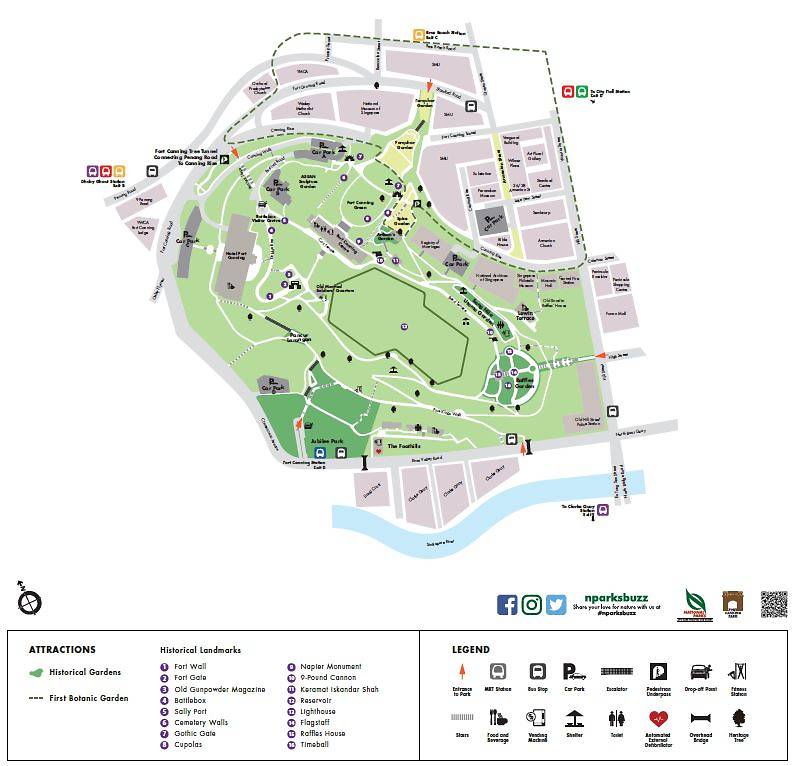
Nine historical gardens open at Fort Canning Park

SINGAPORE: Nine historical gardens, designed to tell the story of Fort Canning Park, opened on Monday (May 27).

About eight hectares of land were restored to reflect landscapes that were known to have existed in the 14th to 20th centuries.

The National Parks Board (NParks) referenced historical texts to restore and curate the nine gardens.

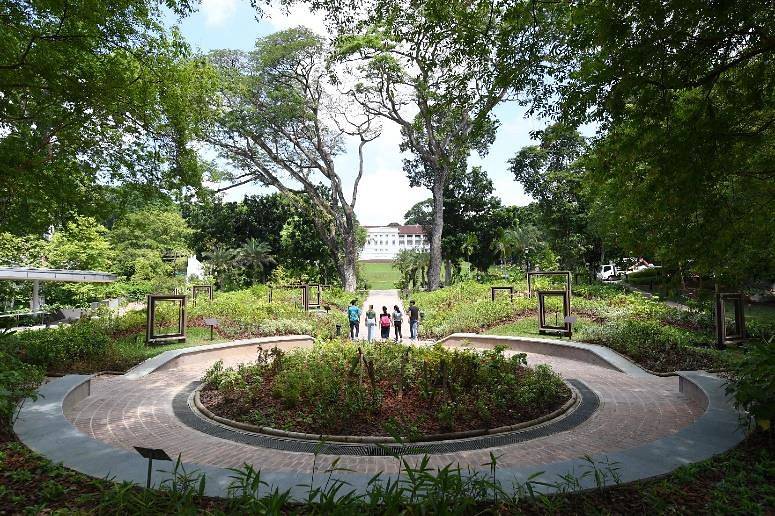
Stepping into the Sang Nila Utama Garden is a journey back in time: Named after one of the five kings who are believed to have resided at Fort Canning Hill, the garden reimagines a royal orchard in 14th-century palace grounds.

Sang Nila Utama Garden walkway at Fort Canning Park

The Sang Nila Utama Garden is named after the ancient founder of Singapura. (Photo: National Parks Board)

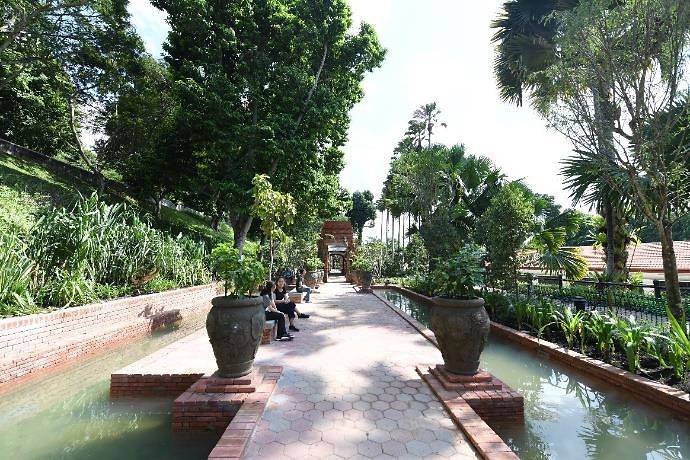
Similarly, the Pancur Larangan, or Forbidden Spring in Malay, is modelled after a bathing place for noble ladies of the royal court of Singapura during the 1300s.

NParks has also restored the Singapore’s first experimental and botanical garden – which was established by the British in 1822 at the foot of Fort Canning Hill.

Other gardens include the Jubilee Park, Farquhar Garden, Spice Garden, Artisan’s Garden, Raffles Garden and Armenian Street Park.

View of a mural wall handcrafted in natural volcanic rock

The Pancur Larangan garden features a commissioned mural wall handcrafted in natural volcanic rock. (Photo: National Parks Board)

PROGRAMMES AT FORT CANNING

To bring the stories of Fort Canning to life, a trail guide on an augmented reality app developed by the National Heritage Board, called BALIKSG, will complement the experience.

READ: ‘We are never done building Singapore’: PM Lee at launch of Singapore Bicentennial

The augmented reality experience can be accessed at eight checkpoints through a 2.5km trail.

NParks is introducing a wider range of programmes which will reflect the history of Fort Canning.

Map of new historical gardens at Fort Canning Park

Map of Fort Canning Park. (Image: National Parks Board)

It will work with archaeologists from the National University of Singapore, the Nanyang Technological University and the Institute of South-East Asian Studies to organise programmes through the year. 

Visitors can look forward to archaeology workshops, guided heritage walks and concerts held in conjunction with From Singapore to Singaporean: The Bicentennial Experience.

READ: Bicentennial edition of Singapore Heritage Festival heads to Kranji, Bedok and Telok Blangah

NParks has also made efforts to make the park more accessible. It has installed two stretches of covered escalators and a platform lift to reach Fort Canning Centre and Fort Canning Park.

The connections will provide easier access from MRT stations such as Fort Canning, City Hall and Bras Basah.

View of Farquhar Garden at Fort Canning Park

The Farquhar Garden is named after Major-General William Farquhar, the first British Resident and Commandant of Singapore. (Photo: National Parks Board)

At the opening of the gardens, Minister for National Development and Second Finance Minister for Finance, Mr Lawrence Wong announced that the second phase of enhancements to Fort Canning Hill will be completed by 2021.

READ: Immersive, multisensory Bicentennial Experience showcase

It will include the complete restoration of Jubilee Park to cater for events and a nature playgarden. Galleries and eateries will also be added to the foothills of the park.

NParks is also conducting a year-long feasibility study on the possibility of a lookout point and gallery at the top of Fort Canning Hill.

Source link

Jurong Bird Park welcomes first king penguin chicks in more than a year

SINGAPORE: Jurong Bird Park has seen the arrival of its first baby king penguins in more than a year with the hatching of three new chicks, Wildlife Reserves Singapore (WRS) announced in a news release on Monday (May 27).

Percy, Brix and Arlo mark the park’s first king penguin chicks since the arrival of Maru in October 2017. They hatched on Feb 22, Mar 3 and Mar 10 respectively. Each weighed more than 200g at the time.

King penguins are the world’s second largest penguin (after the emperor penguin), according to WRS. They can weigh up to 15kg and live up to 30 years under human care.

The three chicks were artificially incubated at the park’s breeding and research centre, before being introduced to the rest of the colony after a couple of months.

Percy the king penguin at Jurong Bird Park

Percy, the oldest of the new king penguin chicks, is introduced to the rest of the colony. (Photo: Wildlife Reserves Singapore).

They are currently on a diet of herring and capelin and are fed three times a day.

The chicks’ arrivals take the park’s king penguin population to 17. Jurong Bird Park exhibits six species of penguin in total: African, Gentoo, Humboldt, King, Macaroni and the Rockhopper.

Visitors can see the new chicks at the park’s indoor Penguin Coast exhibit.

Source link

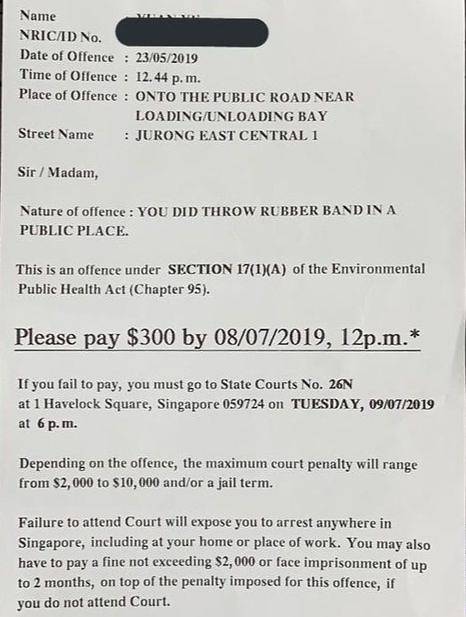
Man fined S$300 after shooting two rubber bands that landed on public road

SINGAPORE: A man has been fined S$300 for shooting two rubber bands that landed on a public road, the National Environment Agency (NEA) said on Monday (May 27).

Photos of a S$300 ticket issued by NEA, for the offence of “throwing rubber band in a public place”, were posted on social media over the weekend and widely shared.

A ticket issued by NEA for littering a rubber band

A photo of a ticket for throwing “rubber band in a public place” was posted on social media. (Photo: Twitter/khrluffy)

Responding to queries from CNA, the agency said the incident occurred last Thursday and that the man was issued a ticket for littering. 

It added that the offender “was cooperative throughout (the NEA) officers’ engagement with him”.

READ: New Corrective Work Order vests introduced as littering offences rise

“NEA enforcement officers observed a man walking towards his vehicle and shooting two rubber bands, one after the other, into the air,” the agency said. “The rubber bands landed on the public road. Our officers thus informed him of the littering offence and issued him an enforcement ticket.”

In another incident on May 16, two men were fined S$300 each for leaving behind their drink cans on a wooden box outside a unit at Woodlands MRT station, NEA said.

The offenders paid their fines four days later.

NEA said: “We would like to remind the public that littering has environmental consequences, and keeping our environment clean by not littering is a gracious and socially responsible thing to do.”

READ: Woman who threw used sanitary pads out of the window fined S$1,600

READ: NEA will use cameras to detect illegal smoking – here’s how it could work

Source link

ERP rates at selected gantries to be reduced during June school holidays

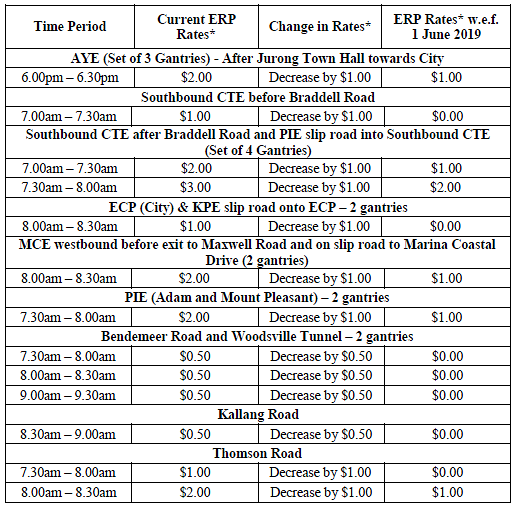
SINGAPORE: Electronic Road Pricing (ERP) rates at selected gantries will be reduced during the school holidays in June this year, the Land Transport Authority (LTA) announced on Monday (May 27). 

The revised rates will apply from this Saturday (Jun 1) to Jun 30, said the authority in a media release. 

The affected gantries and new rates are as shown below: 

ERP rates for June school holidays 2019

The rates for other gantries will remain unchanged, said LTA, adding that the revised rates will revert to the pre-school holiday rates from Jul 1 onwards.

The next quarterly ERP review will take place in August, said LTA. 

Source link

The Singaporean who conquered Everest after braving a traffic jam 8,000m in the sky

SINGAPORE: As the sun rose above the horizon and illuminated a narrow, exposed ridge jutting 8,000m into the sky, Jeremy Tong finally understood just how many climbers were trying to conquer the tallest mountain in the world.

The 29-year-old saw that he was just one of hundreds with the same goal that morning of May 22, shifting and struggling in a long line all the way to the summit. “I was like wow, that is a lot of people,” he told CNA on Sunday via video call from Kathmandu.

Tong had just passed the south summit (8,690m) en route to the Hillary Step, the final stretch before the summit of Mount Everest (8,850m). But the human traffic jam did not ease up.

Nepal had issued a record 381 permits for this year’s spring climbing season, meaning more than 750 climbers – including Nepali guides – were expected to tread the same path to the summit.

And as poor weather narrowed the climbing window and triggered bottlenecks, at least eight have died on Everest this season alone, surpassing the total for 2018. Hiking officials have attributed most of the deaths to weakness, exhaustion and delays on the crowded route.

The congestion leaves climbers exposed longer to the dangerous wind, cold and lack of oxygen at the highest natural point in the world.

On the way up, Tong battled 35kmh winds and minus 40-degree Celsius temperatures, fully aware that every second spent waiting could spell the difference between life and death – especially as frostbite and hypothermia set in.

“Your fingers start to freeze, your toes start to become cold,” he said. “And you need to clip and unclip yourself to a safety rope, but you’re fumbling because you have mittens on. It is a very dangerous situation over there.”

Jeremy Tong Mount Everest traffic jam

This May 22 photo taken by climber Nirmal Purja’s Project Possible expedition shows the human traffic jam on Everest. (Photo: Facebook/Nirmal Purja MBE: “Project Possible – 14/7”)

Tong ended up spending more than an hour just letting other climbers through on the single rope-path barely wide enough for two people to stand side by side.

“I just flattened myself to the side of the rope so people coming down could pass me,” he added. “One misstep on the left side, you’re plunging 2,000m into camp 2. On the right side, you’re plunging 2,000m into China.”

THE SUMMIT

But with his trusted Sherpa guide Pemba, Tong kept “charging forward” through the Hillary Step, past the point where he was forced to turn back during his virgin summit attempt in 2017.

Back then, Tong only had about 200m to go when he was hit with hypothermia. This time, he didn’t look back. “I was like well, this is it,” he remembered thinking. “It was the feeling of overcoming that point of failure.”

Jeremy Tong Mount Everest death zone

Tong at camp 4 before the summit push, in the “death zone” almost 8,000m high. (Photo: Jeremy Tong)

Standing on a ridge, Tong caught his first glimpse of the summit, decorated with colourful prayer flags fluttering in the wind.

“I was looking at it and I thought, well that is really the top of the world,” he said. “Since I was a young boy, I would be thinking about that top. But I didn’t imagine it would look like that.”

Tong summited Everest at 6.14am, almost 12 hours after leaving base camp (5,364m) at 7.30pm the evening before.

His “game plan” on the summit was to pose for three photos with three different banners: One of his sponsors, one of the adventure company he runs, and one dedicated to his wife.

But within minutes of taking off his oxygen mask and balaclava, Tong’s ears had gotten frostbite from the frigid winds slicing through the air. It was getting too windy, his guide said, and they needed to go down.

“In the end, the game plan totally failed,” he said with a laugh, adding that he only managed the first photo. “I only had 10 minutes on the summit.”

Regardless, Tong said his achievement had vanquished the “black shadow” that hung over him and only grown bigger since his failed attempt two years ago. On many occasions he would wake up thinking he had scaled Everest, only to realise it was just a dream.

“But this time round, it’s different,” he said. “Now when I wake up, I realise I have climbed Mount Everest.”

THE DESCENT

However, getting to the summit was only half the job done. On the way down, Tong had to deal with the traffic jam again, this time spending even longer stuck on the steep and slippery slopes.

Tong said the most dangerous part of mountain climbing is the descent, when people lose focus after the euphoria wears off and fatigue kicks in. The most recent death this season was reportedly due to weakness, after the climber suddenly fainted while going down. 

“People just give up on life because it is a really different world out there,” he said, pointing to the “death zone” more than 8,000m high where oxygen levels are extremely low. “Without oxygen, you cannot survive for five minutes.”

Jeremy Tong Mount Everest camp 2

Tong making his way to camp 2 (6,400m). (Photo: Jeremy Tong)

As Tong has been climbing mountains for 15 years, he could deal with the challenges better. Even then, he had some problems of his own. Icy winds and plummeting temperatures had blurred his vision and frozen his oxygen mouthpiece, meaning he could barely see and breathe on the way down.

“It was really steep and really scary,” Tong recalled, admitting he was mentally tired. “I was starting to get a bit fearful for my life, and I thought that the best way was to try and get down as quickly as possible, and just remain calm.” 

Tong kept his focus and had to squint to ensure he didn’t miss a step. He relayed his troubles to his guide, who told him to go slow and not to worry. While Tong eventually regained full use of his vision, others were not as lucky. He saw Sherpa guides attempting to drag a climber down the mountain as she lay sprawled in the snow.

READ: Three more deaths on overcrowded Everest

READ: ‘Traffic jam’ on Everest as two more climbers die reaching summit

Some climbers trying to scale Everest were clearly too inexperienced, Tong lamented. “This is not what I wanted to see,” he added. “It’s very saddening for the mountaineering community.”

THE FAMILY

Tong returned to base camp about 30 hours after initially setting out, and immediately grabbed his phone to call his wife. He knew she would be worried, especially as he had been unable to check in after his satellite phone went dead before the final push to the summit.

“She was very happy, very relieved,” he said. “She had just given birth a few months ago, and of course she would loved for me to be by her side, taking care of the baby and everything.”

Jeremy Tong Mount Everest Camp 1

Tong traversing from base camp to camp 1. (Photo: Jeremy Tong)

However, Tong said his wife – who is also a mountain climber – has always been “very supportive” since he made it his mission five years ago to climb Everest. She even cooked ikan bilis and peanuts in chilli for him to eat on the way up.

“Even before we got married, she has been the one pushing me up this pedestal,” he added.

Tong has spent almost two months in Nepal, so he misses his wife and three-month-old son. Once back, he and his extended family will go on a short vacation in Malaysia.

Jeremy Tong Mount Everest base camp

Tong posing for a photo at Everest base camp. (Photo: Jeremy Tong)

For now, Tong is spending some time recuperating in Kathmandu before going home at the end of the month. His face is still sunburnt and his ears still frostbitten, but he has already set his sights on conquering the seven summits in the next three to four years.

The seven summits refer to the tallest peaks on each of the seven continents: Everest, Kilimanjaro (Tanzania), Kosciuszko (Australia), Aconcagua (Argentina), Denali (Alaska), Elbrus (Russia) and Vinson (Antarctica). Tong has scaled the first three.

But first, he’s prepared a list of his wife’s home-cooked dishes he intends to “feast” on once he gets back: Laksa, Indian rojak, soy sauce chicken, chicken rice and dory fish wrapped in banana leaf.

Source link

Singapore and Guangdong discuss new areas of cooperation in culture, education

GUANGZHOU: Singapore and the southern Chinese province of Guangdong have discussed new areas of cooperation – including in culture, education and tourism.

Deputy Prime Minister Heng Swee Keat, who is on a eight-day visit to China, met Guangdong Party Secretary Li Xi in Guangzhou on Sunday (May 26) to also discuss greater collaboration in smart cities between both countries. 

READ: Singapore hopes China, US can cooperate while competing: DPM Heng

Both leaders welcomed the good progress in Singapore-Guangdong cooperation, including the upgrade of the China-Singapore Guangzhou Knowledge City to a state-level bilateral cooperation project in November last year.

“DPM Heng and Party Secretary Li expressed confidence that Singapore and Guangdong can build on the positive momentum in bilateral relations to further strengthen ties,” said Mr Heng’s press secretary.

Mr Li, who is part of the Communist Party of China’s politburo, also welcomed Singapore to further contribute to the Guangdong-Hong Kong-Macao Greater Bay Area.

This is Mr Heng’s first visit to the country since becoming Deputy Prime Minister earlier this month. 

READ: Resolve challenges arising from technology in order to harness opportunities: DPM Heng

Deputy Prime Minister Heng Swee Keat and Guandong Party Secretary

Guangdong Party Secretary Li Xi also welcomed Singapore to further contribute to the Guangdong-Hong Kong-Macao Greater Bay Area. (Photo: Ministry of Communications and Information)

“Choosing to visit Guangdong on your first visit shows the high level of importance attached to developing ties between Singapore and Guangdong,” said Mr Li.

On Monday, Mr Heng will visit the Guangzhou Knowledge City before heading to neighbouring Shenzhen.

Mr Heng’s visit to China ends on My 29 and covers the cities of Beijing, Shanghai, Guangzhou, Shenzhen and Hong Kong. 

Source link

Malaysian minister denies interfering with Singapore court case on death row inmate

PUTRAJAYA: A Malaysian minister on Sunday (May 26) denied that he interfered with Singapore’s decision to grant a stay of execution to a Malaysian citizen on death row

Minister in the Prime Minister’s Department Liew Vui Keong said that such allegations were “totally unfounded and baseless” and were “purely a figment of an imagination on someone’s part”. 

READ: Clemency petitions for Malaysian on death row ‘carefully considered’: MHA

READ: ‘Not tenable’ for Singapore to go easy on Malaysian drug offenders: Shanmugam

His comments comes after Home Affairs and Law Minister K Shanmugam said that it was “not tenable” for Singapore to go easy on Malaysian drug offenders who have been caught. 

Mr Shanmugam had mentioned the case of Pannir Selvam Pranthaman, who was granted a stay of execution just a day before he was due to be executed. 

The 31-year-old was found guilty of carrying 51.84g of heroin at Woodlands Checkpoint in 2014. 

Mr Liew, who is also in charge of law and parliamentary affairs, said on Sunday that he had spoken to Singapore’s Senior Minister of State for Law on Wednesday regarding the case, as he was unable to speak to Mr Shanmugam, who was not available at that time. 

With the blessings of Malaysia’s foreign minister, Mr Liew said he had communicated with the Singapore government and wrote an email where he “made a representation based on valid legal grounds”. 

“The allegation that I have interfered with their judicial system is totally unfounded and baseless. It’s purely a figment of an imagination on someone’s part,” said Mr Liew in the statement.  

The Malaysian minister said he was issuing the statement to “avoid further confusion and unnecessary innuendos” as there had been serious allegations made against him “by a certain quarter across the causeway”.

Singapore Court of Appeal Pannir Selvam

Pannir Selvam’s lawyers and family pose for a photo outside the Singapore Court of Appeal. (Photo: Bernama)

Singapore has received three requests from Malaysia to intervene in executions since the Pakatan Harapan government came into power a year ago, and two of these were drug traffickers, according to Mr Shanmugam. 

He noted that there are some from PH who are “ideologically opposed” to the death penalty and that they “have to respect that position”. 

“At the same time, we do impose the death penalty in Singapore, and I expect that Malaysia will respect that position as well,” he said.

“It is not tenable to give a special moratorium to Malaysians, and impose it on everyone else, including Singaporeans who commit offences which carry the death penalty,” Mr Shanmugam added.

He also said that both sides should discuss how to tackle cross-border drug offences and “get to the root of the problem”. 

“We have good cooperation with Malaysian agencies; they do a good job, we cooperate effectively. And I hope they can be given every support, and we can get more evidence on the other kingpins operating in Malaysia to be picked up,” Mr Shanmugam said.

I RESPECT DECISION OF SINGAPORE’S COURT: LIEW

Mr Liew said even though he had not read the grounds of the decision, it was obvious that the Singapore court made its decision after having considered the prevailing circumstances and the rule of law applicable to the case. 

“It is therefore equally untenable to allege that there’s an interference on my part to their judicial process.

“I, and so is everyone of us here in Malaysia, respect the decision of the Singapore’s Court,” Mr Liew said.

Pannir Selvam had applied for more time to file a fresh application to impugn the clemency process. 

The inmate and his family was notified of the president’s rejection of his clemency petition and the scheduled date of his execution in letters just a week in advance.

In an affidavit, Pannir Selvam had questioned the transparency of the clemency process, saying he was “surprised” the letter from the Istana about the clemency rejection and the letter from Singapore Prison Service informing him of his execution were both dated May 17.

Source link