SINGAPORE: Total wages in the private sector grew 4.2 per cent last year, after accounting for inflation, up from 3.2 per cent in 2017, the Ministry of Manpower (MOM) said on Wednesday (May 29).
Nominal wages were up 4.6 per cent in 2018, a higher increase than the 3.8 per cent in 2017, according to the Report on Wage Practices 2018 released by MOM’s Manpower Research and Statistics Department.
The numbers, which included employer Central Provident Fund contributions, were obtained through a survey of about 5,300 private establishments, which employed 1.2 million people.
Industries that registered the highest growth wage in 2018 were financial and insurance services (6.3 per cent), real estate services (5.0 per cent) and professional services (5.4 per cent).
The report added that manufacturing, food and beverage services, and retail trade saw “similar or moderated wage growth”.
“The labour market performed better in 2018 compared to 2017, with strong employment growth for local residents, lower unemployment and retrenchments,” said the report.
It noted that the growth in wages occurred amid a 3.1 per cent growth in the economy in 2018, “though performance was uneven across industries”.
Wage practices among Singapore’s private establishments in 2018. (Graphic: MOM)
A smaller proportion (45 per cent) of establishments employing low-wage employees adopted the National Wage Council’s (NWC) quantitative guidelines last year than in 2017 (48 per cent).
The main reason establishments did not give wage increases was “poor business conditions”.
The basic wage increase for low-wage employees (7.8 per cent) and outsourced low-wage workers (7.0 per cent) continued to be higher than all rank-and-file workers (5.5 per cent) in 2018.
In 2017, low-wage employees refer to those earning up to S$1,200 in basic wage. In 2018, this threshold was raised to S$1,300.
Of private firms with outsourced employees earning up to S$1,300, 71 per cent gave wage increases to these employees. This figure is higher than in 2017 (55 per cent) and 2015 (68 per cent).
At 81 per cent, the proportion of employees who received wage increases went up last year from 78 per cent in 2017.
The proportion of establishments that raised their employees’ total wages in 2018 increased to 67 per cent from 65 per cent in 2017 – as a result of “improved profitability”.
For employees who received wage cuts, the average wage cut was higher last year (-4.3 per cent) compared to 2017 (-3.9 per cent), though their proportion among all employees decreased to 8 per cent in 2018 from 10 per cent in 2017.
MOM said the wage practices were aligned to NWC’s guidelines.
“The performance of establishments and individuals were employers’ main considerations when determining wage change or variable payment,” the report said.
“Profitable companies gave higher wage increases and bonuses compared to loss-making ones.”
The report noted an area of improvement for small and medium enterprises (SMEs) in having good and regular communication between employers and employees – which is critical in maintaining and improving staff engagement and morale.
While 74 per cent of private sector employees work in establishments that shared information with their employees on the establishment’s performance, only about a third of employees in SMEs received such information regularly in 2018.
The Report on Wage Practices 2018 is available at MOM’s website.
SINGAPORE: Ten personal mobility devices (PMDs) were impounded after several riders were caught flouting rules during enforcement operations last week.
Around 80 officers were deployed during operations over the weekend, which took place at Admiralty, Bukit Panjang, Choa Chu Kang, Marsiling and Woodlands, the Land Transport Authority (LTA) said on Wednesday (May 29), in response to CNA’s queries.
A power-assisted bicycle user caught speeding. (Photo: Facebook/LTA)
Some of the operations were conducted together with the police and National Parks Board, LTA added.
Riders were found committing offences that included speeding, riding non-compliant PMDs and power-assisted bicycles (PABs), as well as riding PMDs on the road and PABs on footpaths.
On Saturday night, sixteen offences were detected and 10 PMDs were impounded, LTA said in a Facebook post on Monday. Six of which were used on the road, it added.
SINGAPORE: Teachers hope to see more students interested in taking up literature in their mother tongues, following plans to expand the language elective programme (LEP) next year.
The Chinese LEP secondary schools are mostly Special Assistance Plan (SAP) schools, which have a strong focus on Chinese language and culture.
Nan Chiau High School is one of the SAP schools to introduce Chinese LEP in 2020.
Mr Tang Jun Piow, Nan Chiau High School’s head of department for mother tongue language, is “very optimistic” that more students will be enticed to read Chinese literature in secondary school.
He added that the school plans to invite local and international authors to share their experiences as part of the new LEP next year.
“We have this ambition to really break down the frontiers between English and Chinese literature to allow students to see literature as a whole,” said Mr Tang.
Chinese literature lessons in Nan Chiau High School are student-centric and focus on drawing connections between curriculum content and students’ interests. (Photo: Corine Tiah)
Currently, students are only able to take Chinese literature at secondary three, according to Mr Tang.
“Our school hopes that we are able to infuse more of Chinese literature right from the start of secondary one and two so that they have greater exposure to literature in a fun and engaging way,” he said.
Students who are enrolled in the programme can also look forward to a range of activities on top of the Chinese literature curriculum, including an LEP camp and an immersion programme at the national level.
Through this, the Ministry of Education said it hopes to nurture a base of students who can progress to either LEP at junior college (JC) level or mother tongue-related diplomas in polytechnics.
For Chinese literature student Lim Qi Xin, this supports her goal of pursuing Chinese studies beyond secondary school.
“I’ve always wanted to get into NYJC (Nanyang Junior College) to study Chinese Language and Literature,” said the Secondary 3 student.
“In the future, I would like to be in the Chinese media industry and I would like to be a reporter or an editor. My parents are Chinese journalists and editors in (Lianhe) Zaobao so … I aspire to be like them.”
The Education Minister emphasised the importance of learning languages and Singapore’s bilingual policy in his address announcing the expansion of the programme.
“In the coming decades, this will be even more important as Asia is the fastest growing economic region in the world,” he said.
“Knowing our mother tongues will allow us to access valuable business and employment opportunities, in our immediate region, in China and in India.”
The expansion of the LEP in both secondary schools and JCs will be “an effort fit for the times”, he said.
NEW TAMIL LEP AT JCs
A new Tamil LEP will be introduced in two JCs – Anderson Serangoon and National JCs – for students who excel in the language to pursue their passion for and interest in Tamil.
Currently, the two-year LEP is conducted at selected JCs in Chinese and Malay.
Tamil literature lessons at Anderson Serangoon Junior College (Photo: Corine Tiah)
Anderson Serangoon Junior College will be introducing the Tamil LEP next year to their students doing Tamil Language and Literature at H2 level.
“Right now the whole lesson is based in the classroom, based on the textbook that has been prescribed. But with the new elective programme, they can go beyond the boundaries of knowing the literary works,” said Tamil teacher Mdm Kamalavani Palaiyan.
She mentioned that the school is looking to work with lecturers from universities for curriculum planning.
“For Singapore, we need to know our identity to carry forward to the next generation,” said Mdm Kamalavani. “We hope that through this, by instilling this passion and interest, the students will be all able to better contribute to this society, building our economy.”
A discussion on Puthumaipithan’s Machine Yugam and Nadarajan’s Ayisha during a lesson at Anderson Serangoon JC. (Photo: Corine Tiah)
Current Tamil Literature JC 2 student Reddy Kannan Yugesh has expressed interest in studying the “deeper meaning behind the Tamil language and where it all started”.
The student, who aspires to become a Tamil teacher, said he hopes as much emphasis can be placed on the subject as math and science: “I feel that it’s important as it is your culture, it is your mother tongue. I would say own it, and not study for the sake of doing so and for the grades.”
SINGAPORE: A video circulating on social media of rubbish purportedly being thrown out of a moving taxi has prompted the National Environment Agency (NEA) to launch an investigation.
In a Facebook post on Tuesday (May 28), NEA said that they have established the identity of the taxi driver, who is currently assisting in their investigations.
According to a video posted by ROADS.sg, the incident occurred on May 17, at about 7.47am along Penang road.
Ms Leong, who submitted the video, told ROADS.sg that she worked nearby, so she returned to the location to take a photo of what the driver allegedly threw into the bushes, before disposing of the litter in a bin.
Rubbish that was purportedly thrown out of a moving taxi along Penang Road on May 17, 2019. (Photo: Facebook/ROADS.sg)
“NEA would like to thank the feedback provider for highlighting the incident,” said NEA.
“A clean Singapore reflects our collective civic and social values and we would like to encourage more of such public-spirited actions to keep our home clean.
“Feedback can also be channelled to NEA through our Online Feedback Form or myENV mobile application.”
On Monday, NEA said a man was fined S$300 for shooting two rubber bands that landed on a public road. According to NEA, the incident occurred on May 23, and the man was issued a ticket for littering.
In another incident on May 16, two men were fined S$300 each for leaving behind their drink cans on a wooden box outside a unit at Woodlands MRT station.
When investigators opened Jailbait, they found videos and images of Kunsevitsky having sex with children in his Singapore home, as well as subfolders that related to his victims’ names, according to court documents seen by CNA.
Jailbait is an informal word for someone who is perceived by some to be sexually attractive, but younger than the legal age of consent for sex.
The five victims in Singapore make up part of the 47 children Kunsevitsky has admitted to abusing over a period of 16 years. Kunsevitsky, 53, pleaded guilty in a Melbourne court last week.
The victims, aged between 10 and 17 years old, were in Singapore, Malaysia, the Philippines, Indonesia and Australia at the time of the offences.
He is facing 59 charges relating to child sexual abuse, including having sex with a child, making child pornography material, inducing a child to have sex with another child, persistent sexual abuse of a child, and importing child pornography.
Kunsevitsky sexually abused his five victims in Singapore on three occasions, prosecution court documents show.
The crimes between August 2002 and August 2003 in Singapore were among the first offences Kunsevitsky committed.
The Russian native, who moved to Australia with his family when he was a child, was living in Singapore at the time of most of his offences, the court heard.
Prosecutor Krista Breckweg told the court that “victim one” was a child residing in Singapore at the time of the offences.
Kunsevitsky had sex with “victim one” between September 2002 and August 2003, the court heard.
“The offender took a series of 17 photographs of a young male, known as (redacted), who was aged approximately 12 to 14 years old, and this was at the offender’s home,” Ms Breckweg said.
Some of the images showed Kunsevitsky having sex with the boy, the prosecutor added.
In November 2002, while living in Singapore, Kunsevitsky took another 28 photographs of a boy. These images included himself committing sodomy and the boy performing oral sex on him.
Between 2001 and 2003, he also had sex with children in four countries, namely Singapore, the Philippines, Malaysia and Indonesia, and photographed those incidents.
The crimes went undetected and he continued abusing children and producing child pornography material until he was caught in 2017. On at least one occasion, he showed those pictures and videos to other children he also abused.
Singapore-based Australian Boris Kunsevitsky, 53, pleaded guilty in the Supreme Court of Victoria to sexually abusing dozens of children. (Photo: Esthemedica)
The Singapore Police Force said they are working with Australian authorities on the Singapore cases.
In a statement on May 24, they clarified that no police report had been lodged by any person in Singapore against Kunsevitsky and therefore, no investigations were initiated.
“Prior to his arrest in Australia in September 2017, the police had also not been informed by the Australian authorities that Boris was wanted by them, or that he was involved in any crime,” the force said.
CHILDREN ABUSED IN THE PHILIPPINES, INDONESIA
The court was told that most of Kunsevitsky’s crimes were against children in the Philippines – and one in Indonesia – and that he flew out of his base in Singapore to commit the offences.
“The offender was a prolific traveller. In his police interview, he explained that he travelled extensively for work,” Ms Breckweg said.
“Some of his offending occurred in Singapore, where he was based for most of the charged periods (January 2001 to September 2017).
“He also travelled regularly to the Philippines and to Indonesia, with most of the offending occurring in the Philippines. Often his trips to these Asian countries were brief and the arrival date coincided with the commencement of the offending.”
The court was told of how Kunsevitsky groomed his victims to perform sex acts on him and other children.
He would record these acts, which included himself having sex with children, and keep those videos in his hard drives.
One of those videos exceeded 35 minutes, the prosecution said, and some of them included persistent abuse of the same child.
Ms Breckweg also laid out how Kunsevitsky abused a 12-year-old boy in Indonesia. Images retrieved from his computer showed the victim sitting and eating McDonald’s takeaway food before he performed a sex act on Kunsevitsky. This boy was repeatedly abused over four months.
EXPOSED BY HIS OWN IMAGES
The first hint of Kunsevitsky’s crimes was in 2007, when German police identified 55 child pornography images of an Australian boy who had been groomed and abused by Kunsevitsky.
Of the images found, 49 were titled Aussie01jpeg to Aussie 39jpeg and had been shared on Microsoft Office Groove.
In 2008, German police referred the investigation to Australian authorities.
The boy was identified by Australian police in 2016 and an arrest warrant was issued for Kunsevitsky, but it could not be executed immediately because he was working in Singapore at the time, the court was told.
Singapore-based Australian Boris Kunsevitsky, 53, pleaded guilty in the Supreme Court of Victoria to sexually abusing dozens of children. (Photo: Facebook/thammyquoctebally)
KUNSEVITSKY BEFRIENDED VICTIM IN TEEN CHATROOM
The court was also told how Kunsevitsky had befriended the Australian boy by posing as a 19-year-old on a “teen chatroom” in 2004.
Their chats grew to become sexual in nature, and Kunsevitsky asked to speak to the boy, who was 13 years old at the time, on a webcam to confirm he “wasn’t a cop”.
Kunsevitsky later picked the boy up from his home and drove to a friend’s house, where he put on child pornography on TV, including pictures of his abuse of Asian children.
He also had sex with the boy in his parents-in-law’s house, filming the encounter. Between the period of January 2004 and October 2005, he committed several sex acts with the Australian boy after grooming him.
Kunsevitsky was finally arrested on Sep 4, 2017, when he returned to Australia.
During the years between when the case was first referred from Germany to the day of his arrest, Kunsevitsky continued to abuse children around Southeast Asia.
When Australian authorities shipped over his belongings from Singapore, they found hard drives with more than 31,000 images and 4,550 videos detailing the abuse.
Some were more than 40 minutes long, the court was told, and involved the most serious kinds of child sexual abuse.
It also included pictures and videos of child pornography that he downloaded from other Internet users.
When he was arrested, Kunsevitsky was found with a mobile phone that contained images of him engaged in sexual activity with a child.
When the police questioned him, Kunsevitsky claimed that he “helps with a couple of families and their children informally” and that he allowed the children to “hang out” at his hotel.
He claimed that the children were “slapping each other” in the hotel shower and that they had used his phone to take videos of each other. Kunsevitsky told the police he also deleted a photo taken by one of the children when he was asleep.
“He said he did not get aroused looking at the photos, he’s disinterested in any sort of pornography, and he has never engaged in any sex acts with children in or out of Australia,” the prosecutor said.
Kunsevitsky, who was diagnosed with paedophiliac disorder after he was arrested, has been remanded in custody and will be sentenced at a later date.
SINGAPORE: French aircraft carrier Charles de Gaulle berthed at Changi Naval Base on Tuesday (May 28) morning as part of a five-month deployment from its home port in Toulon, France.
Deployed with it is a carrier strike group comprising Rafale fighter jets, a naval multi-purpose helicopter and two Hawkeye early warning aircraft in its air wing, as well as multi-mission frigates, a command and supply ship, and a nuclear attack submarine.
The Rafale Marine jets taking pride of place on the flight deck of the aircraft carrier Charles de Gaulle. (Photo: Gaya Chandramohan)
The deployment, dubbed Mission Clemenceau, has taken the French strike group and its crew of 3,200 through the Mediterranean and Indian oceans – two of its areas of strategic interest.
During its time in Singapore, the French Navy will participate in bilateral exercises with the Singapore army, including an amphibious exercise with the Singapore Navy involving frigates, naval units as well as fighter jets from the Singapore Air Force.
The French aircraft carrier Charles de Gaulle has a crew of 1,200, and its main mission is the control of air and maritime operations. (Photo: Gaya Chandramohan)
This is the French aircraft carrier’s second time in Singapore after 17 years. Commander of the Charles de Gaulle and Task Force 473, Rear-Admiral Olivier Lebas noted that it was a testament to the relationship between the two countries, given how “both navies have regularly maintained strong links, illustrated by common exercises”.
The Singapore skyline seen from the flight deck of the French aircraft carrier Charles de Gaulle. (Photo: Gaya Chandramohan)
The carrier strike group arrived in Singapore ahead of the Shangri-La Dialogue, an annual security forum which French minister of armed forces, Florence Parly, is due to attend. The forum begins on Friday.
The Charles de Gaulle has a 75m deck for catapult-launching and landing aircraft weighing 15-25 tonnes. (Photo: Gaya Chandramohan)
A sailor stands in front of a Rafale Marine jet on the flight deck of the aircraft carrier Charles de Gaulle. (Photo: Gaya Chandramohan)
In March and April, the French strike group spent the first leg of its deployment in the Mediterranean and Middle East.
Separately, the French strike group also saw American, Danish, British, Portuguese and Australian allies participate in part of the Clemenceau deployment.
“This deployment is about strengthening, fostering exchanges with our strategic partners by developing strong links, common work habits, tactical cooperation and mutual knowledge which are essential to operational efficiency,” Commander Lebas said.
“Being deployed in the Indian Ocean and being here in Singapore today underlines France’s interest in these regions and in strengthening cooperation in partner navies.”
A man walks past a row of Rafale Marine fighter aircraft, with the advanced observation E-2C Hawkeye seen in the background. (Photo: Gaya Chandramohan)
On the flight deck of the French aircraft carrier Charles de Gaulle. (Photo: Gaya Chandramohan)
On the homebound stretch of the carrier strike group’s journey, it will take part in bilateral exercises with the Egyptian army before heading back to Toulon.
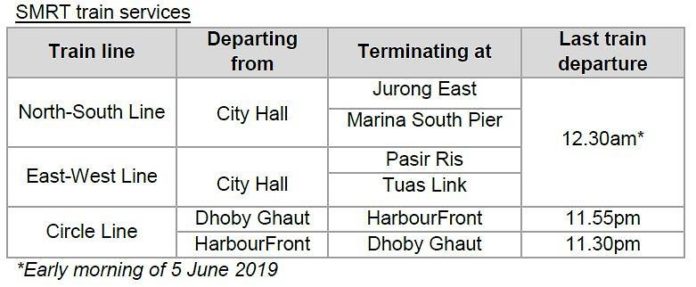
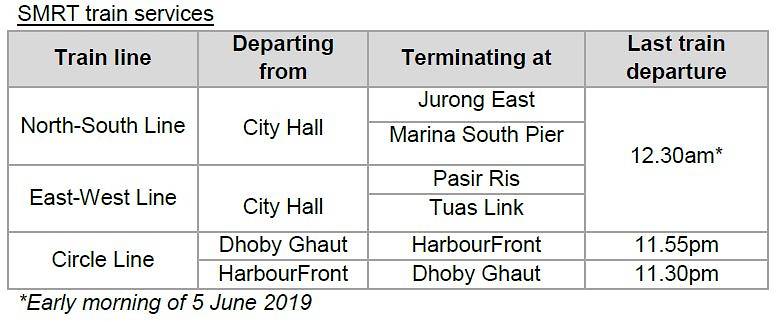
SINGAPORE: Train services, as well as selected bus services, will be extended for passengers travelling late on Jun 4 – the eve of Hari Raya Puasa, said SMRT on Tuesday (May 28).
The last trains on the North-South Line and East-West Line will depart City Hall station at 12.30am on Jun 5. These trains are bound for Jurong East, Marina South Pier, Pasir Ris and Tuas Link.
On the Circle Line, the last train to HarbourFront will depart Dhoby Ghaut at 11.55pm. The train running in the opposite direction will leave HarbourFront at 11.30pm.
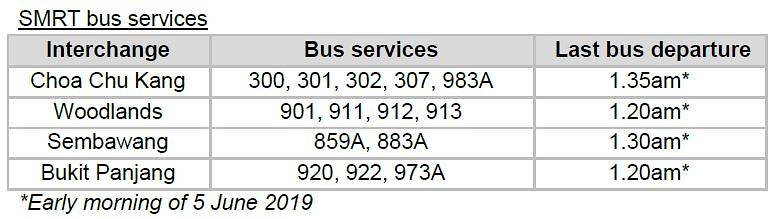
Several bus services will also be extended for passengers travelling from various interchanges.
The last buses on services 300, 301, 302, 307 and 983A will depart Choa Chu Kang interchange at 1.35am on Jun 5.
Meanwhile, the last trip for buses 901, 911, 912 and 913 will leave Woodlands Interchange at 1.20am. Last buses for services 920, 922 and 973A will also depart Bukit Panjang Interchange at this time.
From Sembawang interchange, the last buses on services 859A and 883A will leave at 1.30am.
SINGAPORE: Local telecommunications provider M1 on Tuesday (May 28) replaced its 19 mobile plans with one base plan for each SIM-only and handset bundles.
The change is part of its strategic transformation to meet “changing customer needs and expectations”, the telco said in a media release.
The SIM-only no-contract base plan starts from S$25 for 30GB of data, while the handset base plan starts from a S$30 contract for 12GB of data.
Both plans come with unlimited data on weekends and unlimited music streaming on Spotify.
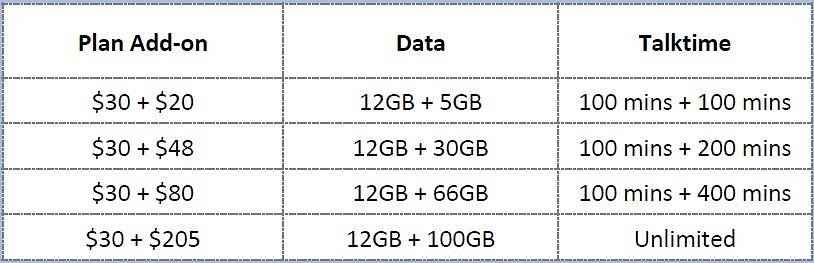
On top of the handset base plan, customers can also opt for plan add-on, which ranges from S$20 for additional 5GB of data and 100 minutes of talktime, to S$205 for additional 100GB of data and unlimited talktime.
The choice of plan add-on will determine the price of the device.
The choice of plan add-on will determine the price of the device. (Table: M1)
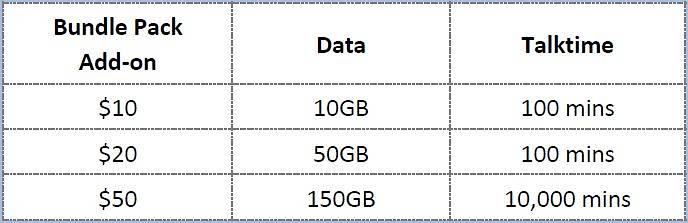
Alternatively, customers on either the handset plan or the SIM-only plan can opt for bundle pack add-on, which can be added or removed at any time during the contract.
List of options for additional data and talktime. (Table: M1)
Customers can sign up for a mobile plan on the newly launched M1 website, after which they can choose to have their SIM card and handset delivered to their doorstep at no additional cost, the release said.
“With the new plans, customers can enjoy larger data bundles as compared to the older plans being replaced,” said M1.
“Existing customers who are currently in contract with M1 can download the My M1 app or call the customer service hotline on 1627 to check if they are eligible to change to the new plan,” it added.
M1 CEO Manjot Singh Mann said the new plans will allow customers to build their own plans “just the way they want”.
“Since the recent acquisition of M1 by Keppel Corporation and SPH, the M1 team and shareholders have been working hard … to deliver the best possible customer experience and simplification of the customer journey,” he added.
SINGAPORE: The language elective programme (LEP) will be introduced in selected secondary schools for the first time next year, Education Minister Ong Ye Kung announced on Tuesday (May 28).
The programme, first introduced in 1990 at the junior college level, aims to nurture students with a high level of proficiency in mother tongue languages through the study of literature in their mother tongues.
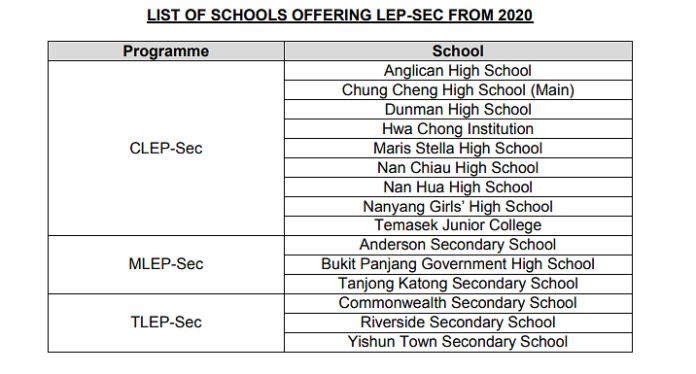
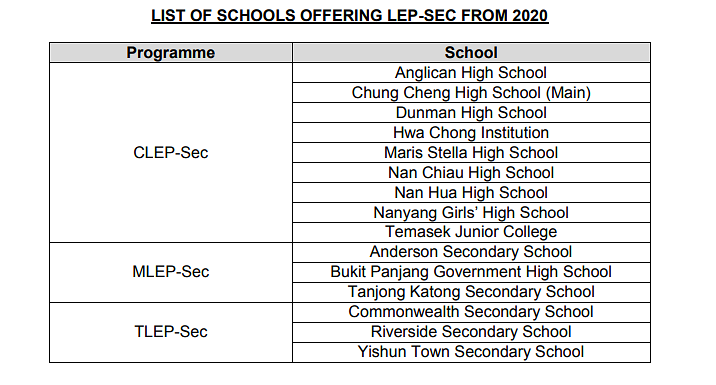
From 2020, the programme will be expanded to 15 secondary schools – nine schools will offer Chinese LEP, three will offer Malay LEP and another three will offer Tamil LEP.
Secondary schools that will offer the language elective programme from 2020. (Table: MOE)
Secondary school students taking the two-year programme will undergo “a series of literary, enrichment and immersion activities” organised by the Ministry of Education (MOE) and their schools. This includes local camps, overseas immersion trips and school-based activities such as “literary lectures”.
The move is part of efforts “to support students in pursuing their passions and interests, and to deepen students’ mastery of mother tongue languages and literature”, MOE said.
All O-Level students enrolled in the programme must sit for the O-Level literature exam in their respective mother tongues, while students from the Integrated Programme must study a school-based mother tongue literature subject.
Through this, MOE said it hopes to nurture a base of students who can progress to either LEP at JC level or mother tongue-related diplomas in polytechnics.
THREE MORE JUNIOR COLLEGES TO GET LEP
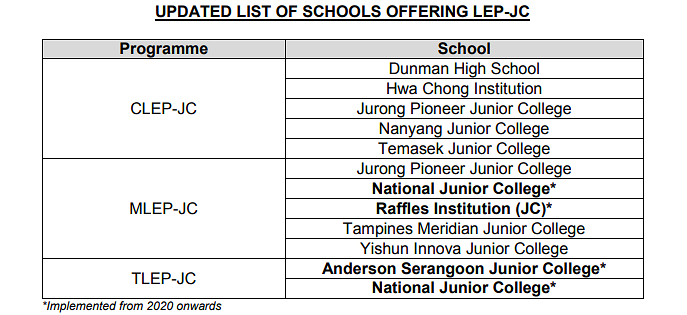
The LEP will also be expanded at the junior college level from next year, with two more JCs offering the programme in Malay. A new Tamil LEP will also be introduced in two JCs to increase opportunities for Tamil students who are strong in the language to pursue their passion for and interest in the language, said the ministry.
The Malay LEP will be offered at National Junior College and Raffles Institution, in addition to the three existing JCs to allow more students to benefit from the programme and Tamil LEP will be offered at Anderson Serangoon Junior College and National Junior College, the ministry said.
The expanded list of junior colleges that will offer the language elective programme. (Table: MOE)
All JC students taking the LEP must sit for H2 Language and Literature in their respective mother tongues at the A-Level examinations. Students can also choose to study H3 Language and Literature as a non-examinable subject, and subsequently choose to sit for the H3 A-Level examination.