Home Blog Page 779

National Wages Council calls on firms to tap on experience of older employees, provide training

SINGAPORE: The National Wages Council (NWC) on Tuesday (May 30) called on employers to tap on the older workforce as more seniors want to stay active and are prepared to continue working.

Employers should voluntarily adopt higher retirement and re-employment ages “where possible”, and provide necessary training for senior workers, it said in its wage guidelines and recommendations press release.

Companies may also provide more part-time employment opportunities, and implement workplace health programmes that meet the needs of older workers. They can also redesign jobs, workplaces and Human Resource policies “to be age-friendly”, the press release added.

Its recommendations were in line with the Tripartite Workgroup on Older Workers’ consensus that that the retirement and re-employment ages in Singapore “remain relevant”, and should go up beyond 62 and 67 respectively in “small steps over time”.

NWC guidelines workers wages 2019

Members of the National Wage Council presenting the 2019/2020 Guidelines at the Ministry of Manpower on May 30, 2019. (Photo: Aaron Chong)

NWC Chairman, Peter Seah said that the Tripartite Workgroup “will build a consensus on how far and how fast (the retirement and re-employment ages) be raised”.

“It is likely to announce its final recommendations towards the end of 2019,” he added.

“The NWC further notes that notwithstanding Singapore’s ageing population and slowing local workforce growth, seniors today are also more educated and healthier, and more seniors want to stay active and are prepared to continue working,” it added.

Meanwhile, the NWC recommended older workers “proactively seek to reskill and upskill themselves to maintain their employability” and “stay open to changes in their job scopes as they progress in their careers”.

PROVISION OF TRAINING

The NWC also stressed the need for structured training of workers.

“To do so, all employers should develop a training plan that meets their current and future requirements, drawing reference from industry standards,” it added.

The NWC said that companies may seek the assistance of Singapore National Employers Federation (SNEF), Singapore Business Federation (SBF), Trade Associations & Chambers (TACs) and the unions to develop their training plan.

On the implementation of training plans, companies may also top on available SkillsFuture, as well as Adapt & Grow programmes for their employees.

“Employers should continue to innovate and implement productivity initiatives, and work towards better wages and skills,” said NWC.

“Broadly, the thrust is to prepare our workforce to be more productive … so that they produce the productivity that we’d like to see and then translate into better wage levels,” said Dr Robert Yap, president of SNEF.

ADOPTION OF GUIDELINES FOR LOW-WAGE WORKERS

The NWC noted that more private firms performing outsourced work had adopted its guidelines for low-wage workers last year, rising to 55 per cent in 2018 from 44 per cent the year before.

Last year, it had recommended that low-wage workers earning a basic monthly salary of up to S$1,300 receive a pay increase of S$50 to S$70.

READ: National Wages Council suggests S$50-S$70 pay hike, one-off payment for low-wage workers

For 2019, it suggested an increase in the basic monthly wage threshold for low-wage workers to S$1,400 with a similar pay increment.

The NWC also listed three recommendations for both outsourced service buyers and service providers.

Firstly, both parties should recognise the lengths of service, experience and performance of incumbent workers when renewing or taking over their contracts.

Secondly, buyers and providers are to “avoid a ‘reset’ of wages and benefits” for outsourced workers who perform the same job functions when service providers are changed.

Buyers and providers are to also improve the work environments of such low-wage workers, such as making proper and reasonable rest areas available.

The Government said it accepts the NWC guidelines for 2019/2020 and welcomes the stronger emphasis placed on employer-led training this year.

“The strong tripartite partnership in the NWC has contributed to better wage and employment outcomes for our workers, while ensuring that our businesses stay productive and competitive,” it said.

“The Government is confident that with the commitment of the tripartite partners, the NWC 2019/2020 Guidelines will be successfully implemented.”
Source link

US, China need to work out ‘constructive cooperation’ to achieve stable global order: DPM Heng

TOKYO: The United States and China must work out a new model of constructive cooperation for the world to arrive at another stable global order, said Singapore Deputy Prime Minister Heng Swee Keat on Thursday (May 30).

Mr Heng, who is on a three-day visit to Japan, was addressing the 25th Nikkei Future of Asia conference themed “Seeking A New Global Order – Overcoming The Chaos”.

Mr Heng said both countries must rebuild trust in their relationship, which he described as the most important bilateral relationship that is key to continued peace and prosperity both in Asia and the world.

“For any relationship to be sustainable, there has to be some give-and-take from both sides. 

“Both sides must make an effort to avoid escalation by managing their domestic politics. Each party needs to understand the domestic constraints and red lines of the other side for negotiations to be constructive,” he said.

READ: Singapore hopes China, US can cooperate while competing – DPM Heng

Mr Heng added that both countries should also recognise that their present differences go beyond trade and address each of these issues in a meaningful but separate way, instead of allowing trade and non-trade issues to complicate each other.

In order for the US and China to work out a new model of constructive cooperation, Mr Heng said the US needs to adjust and recognise that while China is a competitor, it is also a valuable partner, which can share the responsibility of providing international public goods.

“More fundamentally, the US has to accept that it has no better option but to work with China, because trying to contain it will result in worse outcomes,” he said.

“Thus the US should strive for a new equilibrium with China – a new global balance that brings together the legitimate interests of both powers. One that continues to embrace a rules-based multilateral system so that all countries, big and small, will have their voices heard and their sovereignty respected,” he added. 

READ: Singapore prepared for negative consequences of trade war – DPM Heng

Meanwhile, Mr Heng said China will need to “accept that its increased strategic and economic weight comes with greater international responsibility”, adding that China’s Belt and Road Initiative is a positive step in this direction.

While China has said it will continue to open up, Mr Heng said it will need to convince sceptics that it will do so by accelerating economic liberalisation, levelling the playing field for foreign businesses and continuing to participate constructively in efforts to improve the multilateral trading system.

“China needs to demonstrate that its peaceful rise will indeed benefit the rest of the world, including the US, and be prepared to shoulder additional international responsibilities,” he said.

Mr Heng said that Asian countries, and almost all other countries around the world, do not want to have to choose sides.

“We want to be able to openly trade, exchange technology, invest in or receive investment from all countries. This is an important foundation in a rules-based multilateral system,” he said.

ASIA MUST TAKE GREATER RESPONSIBILITY: DPM HENG

As the two largest economies work out a new model of cooperation, Mr Heng said the rest of Asia needs to step up and take on greater responsibility in shaping the global order.

He urged Asia to redouble its efforts to strengthen the rules-based, multilateral trading system that underpins its growth, as well as to work with the global community to uphold this system.

This can be done through trade agreements like the Comprehensive and Progressive Agreement for Trans-Pacific Partnership (CPTPP) and Regional Comprehensive Economic Partnership (RCEP), which are crucial initiatives that bring the region closer.

Mr Heng praised Japan’s role in steering the CPTPP to fruition after the US pulled out and called for Japan to exercise the same leadership to bring the RCEP to fruition.

Heng Swee Keat means Shinzo Abe

Singapore Deputy Prime Minister Heng Swee Keat shakes hands with Japanese Prime Minister Shinzo Abe in Tokyo on May 30, 2019. (Photo: MCI)

He also urged Japan, which has invested in excess of US$400 billion in Asia to date, to continue its investments to help the region grow.

Mr Heng also said that Asia’s strategic weight is growing, with Asian economies’ share of global GDP projected to double from 26 per cent in 2000 to 50 per cent by 2050.

“This is an opportunity for Asia to shape an international order in a way that will support the development and stability of Asia and the world,” he said.

The goal for all countries to work together can only be realised if everyone is part of one globalised system, said Mr Heng, adding that this is precisely why the US and China have to work together.

“This will not work if the world is fragmented into two blocs, with separate systems, technologies and economies. Every country – big or small, developed or developing – needs to come together and play its part. Only then, can we be more than the sum of our parts,” he said.

Source link

First look at Jewel Changi Airport’s Canopy Park, Sky Nets, slides and mazes

SINGAPORE: Jewel Changi Airport’s much-awaited play attractions on its top-floor Canopy Park, as well as its partially glass-bottomed bridge open to the public on Jun 10.

They include the Manulife Sky Nets, Discovery Slides, the Mirror Maze and Hedge Maze and the glass-bottomed Canopy Bridge which offers a stunning view of the HSBC Rain Vortex and Shiseido Forest Valley.

EXPLORE OUR INTERACTIVE: INSIDE JEWEL CHANGI AIRPORT

The attractions in the 14,000 sqm Canopy Park had not yet been opened to the public when Jewel officially threw its doors open last month. 

On Thursday (May 30), Jewel announced pricing details for each of the attractions and gave the media a sneak preview. Entrance fees for Singapore residents to Canopy Park is S$4.50 and access to the various attractions ranges from S$7.20 to S$19.80.

THE MANULIFE SKY NETS

The Manulife Sky Nets at Jewel Changi Airport

The Manulife Sky Nets at Jewel Changi Airport (Photo: Gaya Chandramohan)

The scale of the Sky Nets in an indoor setting is a world first, organisers said in a news release. The yellow, blue and green bouncing nets span 250 metres and offer an additional thrill factor from a 8-metre-high lookout point.

Jumping on the Manulife Sky Nets at Jewel Changi Airport.

Jumping on the Manulife Sky Nets at Jewel Changi Airport. (Photo: Gaya Chandramohan)

Those who prefer taking in the sights of Jewel at a tamer pace can stroll across the 50-metre-long walking Sky Nets. The undulating brown walking nets, directly below the bouncing nets, form a taut web that straddles a five-storey-high void. The experience is designed to make you feel like you are walking on air, 25 metres above ground.

The nets are made of sturdy material and strong enough to hold 1,000 people at once, said Thomas Ferwagner, one of the two designers who conceptualised the sky nets.

Walking through the Manulife Sky Nets at Jewel Changi Airport

Walking through the Manulife Sky Nets at Jewel Changi Airport. (Photo: Gaya Chandramohan)

The price of admission for the Bouncing Nets is S$19.80 for adult Singapore residents and S$14.40 for children and seniors. For all other visitors, it is S$22 for adults and S$16 for children and seniors.

Tickets for the Walking Nets will set you back S$13.50 for adults and S$9 for children and seniors if you are a Singapore resident. For others, they are priced at S$15 for adults and S$10 for children and seniors. 

THE HEDGE MAZE

Exploring the Hedge Maze at Jewel Changi Airport

Exploring the Hedge Maze at Jewel Changi Airport. (Photo: Gaya Chandramohan)

Beneath Jewel’s glass canopy runs Singapore’s largest maze: the Hedge Maze. Wind your way through it and you will end up at the watch tower for a bird’s eye view of the attraction. 

The maze also has gates that can be pushed so you can change your path.

For Singapore residents, entry into the Hedge Maze is priced at S$10.80 for adults and S$7.20 for children and senior citizens. The standard ticket price for all other visitors is S$12 for adults and S$8 for children and seniors.

THE MIRROR MAZE

Exploring the Mirror Maze at Jewel Changi Airport

Exploring the Mirror Maze at Jewel Changi Airport. (Photo: Gaya Chandramohan)

The other labyrinth attraction, the Mirror Maze has kaleidoscopic walls and the cover of foliage overhead. Those entering the maze are equipped with a foam noodle to help them feel their way around, in case they find the multitude of mirrors disorientating. 

To immerse yourself in an environment of infinite reflections and endless hallways, the ticket price is S$13.50 for an adult Singapore resident and S$9 for children or seniors. The rate for all other visitors is S$15 for adults and S$10 for children and seniors.

THE DISCOVERY SLIDES

Having a go at the Discovery Slides at Jewel Changi Airport

Having a go at the Discovery Slides at Jewel Changi Airport. (Photo: Gaya Chandramohan)

Nearby sits an art sculpture that doubles up as a playground. The Discovery Slides attraction is made up of four slides and the work of art sits at an incline – 3 metres high on one end, and about 7 metres high on the other. 

At the edge of its 6.5-metre-high platform is a viewing deck that offers a picturesque view of the HSBC Rain Vortex and the lush indoor forest that lines Jewel. 

A woman goes down one of the Discovery Slides at Jewel Changi Airport

A woman goes down one of the Discovery Slides at Jewel Changi Airport (Photo: Gaya Chandramohan)

The underside of the mega slide is also covered in a mirror finish, helping the playground blend naturally into the Jewel’s greenery.

THE CANOPY BRIDGE

Taking in the HSBC Rain Vortex from the Canopy Bridge at Jewel Changi Airport

Taking in the HSBC Rain Vortex from the Canopy Bridge at Jewel Changi Airport. (Photo: Gaya Chandramohan)

Another highlight of Jewel opening on Jun 10 is the Canopy Bridge. 

The 50-metre-long suspended bridge offers a dizzying vantage point for you to take in Jewel’s centrepiece, the Rain Vortex, at 23 metres above the ground.

Thrill-seekers might appreciate the glass-panel flooring at the centre of the bridge for guests to look through to level 1. 

The price to walk on the bridge is S$7.20 for all Singapore residents (adults, children and seniors. For non-Singapore residents, tickets are S$8.

The Canopy Bridge at Jewel Changi Airport

The Canopy Bridge at Jewel Changi Airport. (Photo: Gaya Chandramohan)

Basic entry into the Canopy Park is priced at S$4.50 for Singaporean residents and S$5 for all others. This lets you wander around Topiary Walk, Discovery Slides, Foggy Bowls and Petal Gardens.

Source link

From sky farms to lab-grown shrimp, Singapore eyes food future

SINGAPORE: Singapore is an unlikely place for a farming revolution. With tiered fish farms, vegetable plots atop office buildings and lab-grown shrimp, the island aims to beef up its own food production and rely less on imports to feed its 5.6 million people.

Singapore produces about 10 per cent of its food but as climate change and population growth threatens global food supplies, it aims to raise that to 30 per cent by 2030 under a plan known as 30-by-30.

The challenge is space.

Vegetable seedlings are pictured at Comcrop's rooftop hydroponics farm at an industrial estate

Vegetable seedlings are pictured at Comcrop’s rooftop hydroponics farm at an industrial estate in Singapore May 17, 2019. (Photo: REUTERS/Edgar Su)

With only 1 per cent of Singapore’s 724 sq km land area devoted to agriculture and production costs higher than the rest of Southeast Asia, the pressure is on new urban farmers to answer the Government’s call to “grow more with less”.

“Whenever I talk about food security in Singapore, I tell folks ‘don’t think land – think space’. Because you can go upwards and sideways,” said Professor Paul Teng from Nanyang Technological University.

Sustenir Agriculture is one of more than 30 vertical farms in Singapore, which has seen a doubling in so-called sky farms in three years.

READ: New laws proposed to ensure Singapore’s food security

Kale grown in Sustenir Agriculture's indoor farm are packed for delivery in Singapore

Kale grown in Sustenir Agriculture’s indoor farm are packed for delivery in Singapore May 24, 2019. (Photo: REUTERS/Edgar Su)

The hydroponic farm grows non-native varieties like kale, cherry tomatoes and strawberries indoors under artificial lights and sells the produce to local supermarkets and online grocers.

Sustenir raised S$22 million from backers including Temasek and Australia’s Grok Ventures this year, which will be used for an expansion in Singapore and opening in Hong Kong.

Temasek is also providing funds to Apollo Aquaculture Group, which is building a S$70 million highly-automated, eight-storey fish farm. Apollo says the new farm will deliver more than a twenty-fold increase in its annual output of 110 tonnes of fish.

“It is too unpredictable to do things now in the traditional way,” said Apollo CEO Eric Ng, citing problems with algae blooms in recent years that have wiped out farmers’ fish stocks.

READ: New agency to be formed to oversee Singapore’s food safety, security

READ: High-tech farms in Singapore take on cold-weather crops

Apollo Aquaculture Group CEO Eric Ng checks on his fish at his prototype vertical fish farm in Sing

Apollo Aquaculture Group CEO Eric Ng checks on his fish at his prototype vertical fish farm in Singapore May 17, 2019. (Photo: REUTERS/Edgar Su)

Singapore has not given a total pricetag for 30-by-30, first unveiled in March, but it has various funding schemes.

Aside from Temasek, the Government has put aside S$144 million for research and development into food, and S$63 million for agriculture firms to use technology to boost productivity.

It also plans to build an agri-food site for indoor plant factories and insect farms by mid-2021.

‘LEAP OF FAITH’

Not everyone is convinced by the focus on high-tech.

Egg farmer William Ho, 53, said the Government is putting too much stock in new agri-tech firms with no track record.

“Many of them have failed. That’s why I’m always asking the Government ‘why don’t you invest in us old-timers’. We are more practical,” he said.

An employee pollinates strawberry plants at Sustenir Agriculture's indoor farm in Singapore

An employee pollinates strawberry plants at Sustenir Agriculture’s indoor farm in Singapore May 24, 2019. (Photo: REUTERS/Edgar Su)

A major hurdle for urban farmers, said Teng, are the expensive inputs like technology that puts their products out of reach for many consumers.

One Singapore firm still in its infancy but hoping to reach a mass market is Shiok Meats, which aims to be the world’s first to sell shrimp grown from cells in a lab.

The process, which is harmless to animals, involves cells grown in a nutrient solution in tanks. After four to six weeks, the fluid is siphoned off and leaves behind raw shrimp mince.

Shiok is backed by Henry Soesanto, CEO of Philippines’ Monde Nissin Corp, which owns British meat substitute firm Quorn.

READ: The future of local farming: Balancing technology and nature

Sustenir Agriculture's co-founder and CEO Benjamin Swan shows kale grown in their indoor farm

Sustenir Agriculture’s co-founder and CEO Benjamin Swan shows kale grown in their indoor farm in Singapore May 24, 2019. (Photo: REUTERS/Edgar Su)

Shiok co-founder Sandhya Sriram hopes to tap into the enthusiasm for alternative protein that propelled the market value of US-based Beyond Meat to more than S$6.9 billion after its debut this month.

After raising S$6.34 million in seed funding this year, Sriram said Shiok Meats plans to sell its product in one or two premium restaurants by late 2020, and by 2030 hopes to produce enough shrimp meat to feed Singapore.

“It (30-by-30) is achievable but it depends which part of the food industry they want to take a leap of faith on,” she said.

Source link

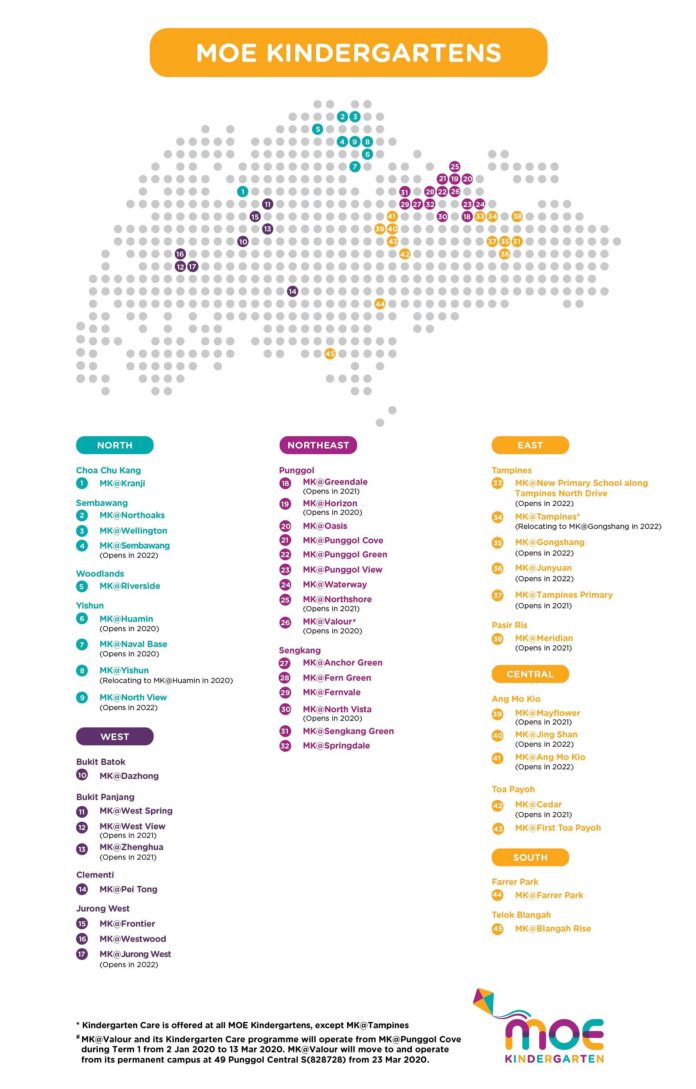
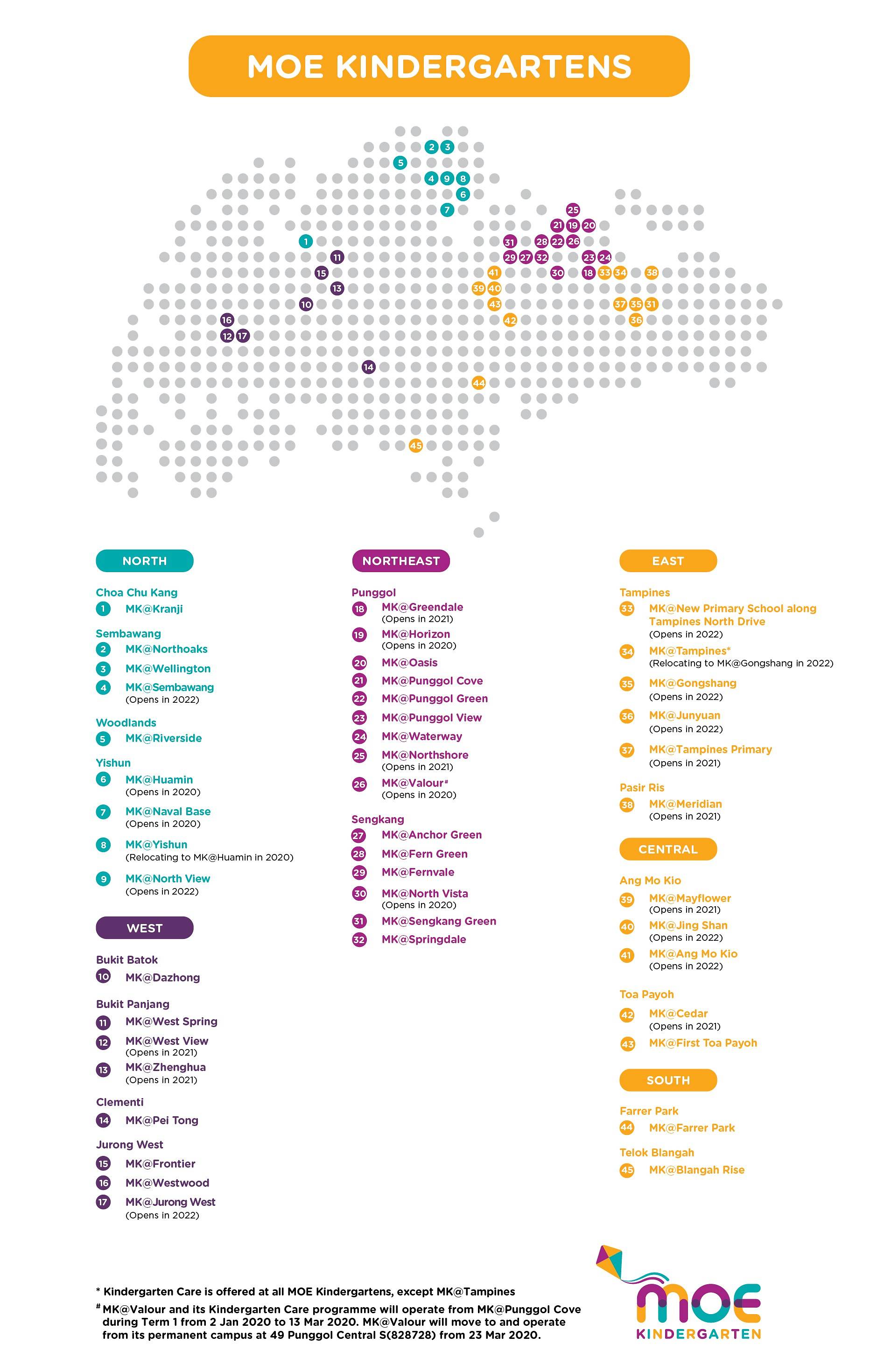
8 new MOE kindergartens to open in 2022

SINGAPORE: Eight new Ministry of Education (MOE) kindergartens will open in 2022, MOE announced on Thursday (May 30).

The kindergartens will be located at primary schools in Yishun, Sembawang, Ang Mo Kio, Tampines and Jurong West.

This includes the relocation of the current community-based MOE Kindergarten @ Tampines, as part of the ministry’s plans to relocate all community-based MOE kindergartens to primary schools.

The new kindergarten will be relocated to Gongshang Primary School and renamed.

Here’s a list of the new kindergartens: 

  1. MOE Kindergarten @ North View  (North View Primary School, 210 Yishun Avenue 6 Singapore 768960)
  2. MOE Kindergarten @ Sembawang (Sembawang Primary School, 10 Sembawang Drive Singapore 757715)
  3. MOE Kindergarten @ Jing Shan (Jing Shan Primary School, 5 Ang Mo Kio Street 52 Singapore 569228)
  4. MOE Kindergarten @ Ang Mo Kio (Ang Mo Kio Primary School, 20 Ang Mo Kio Avenue 3 Singapore 569920)
  5. MOE Kindergarten @ New Primary School along Tampines North Drive (More details will be provided later)
  6. MOE Kindergarten @ Gongshang (Gongshang Primary School, 1 Tampines Street 42 Singapore 529176)
  7. MOE Kindergarten @ Junyuan (Junyuan Primary School, 2 Tampines Street 91 Singapore 528906)
  8. MOE Kindergarten @ Jurong West (Jurong West Primary School, 30 Jurong West Street 61 Singapore 648368)

This will take the total number of MOE kindergartens to 43 by 2022, providing about 5,800 places. The ministry aims to have about 50 such kindergartens in place by 2023.

The eight kindergartens will offer kindergarten care services, said the ministry.

They will collaborate with Early Years Centres, operated by PCF Sparkletots.

All eligible Singapore citizen and permanent resident Nursery 2 children enrolled at these Early Years Centres will be offered a Kindergarten 1 place in a nearby partner MOE kindergarten.

Registration for admission to Kindergarten 1 in 2022 for the eight new kindergartens will take place in 2021. The registration exercise will be open to Singapore citizens and permanent resident children born between Jan 2, 2017 and Jan 1, 2018 (both dates inclusive). 

Details of the registration exercise will be released in the first quarter of 2021.

Infographic for new MOE kindergartens 2022

(Graphic: MOE)

Source link

Commentary: ‘They don’t deserve to take so much away from me’ – how survivors of child sexual abuse find hope, recovery

SINGAPORE: Recently, a Singapore-based Australian man was charged with 59 counts of child sexual abuse and producing pornographic material for more than 10 years. Five affected children were in Singapore. No police reports had been lodged against the man, the Singapore Police Force clarified on Friday (May 24). 

READ: ‘Jailbait’ folder exposes Australian paedophile’s sex abuse of children in Singapore 17 years ago

The silence of these children echoes those of sexual violence survivors of all kinds. 

At AWARE’s Sexual Assault Care Centre (SACC), survivors are not obliged to inform us whether they report their experiences or not – but of the cases known to us in 2018, only four in 10 lodged a police report.

Such tragedies, when they come to light, compel us to try harder to prevent child sexual crimes – a task that involves concerted effort on many fronts, such as comprehensive sexuality education. 

But we also need to break down the barriers that hinder children from disclosing their experiences to their own family and friends. After all, without speaking up, child sexual abuse survivors cannot begin the long journey of recovery. 

WHY DON’T CHILD ABUSE SURVIVORS SPEAK UP?

Tina*, now in her 30s, was a victim I saw at the centre some years ago. She was sexually abused many times by her sister’s husband and two family friends (whom she called “uncles”) for six years, starting before she turned seven. 

In her recollection of the case, Tina recalled that “something bad” would happen at least once a week when her mother was at work and the perpetrators were tasked to look after her. The abuse she suffered included molest, digital penetration and rape.

Once, her mother saw her lifting up her dress while sitting on the family friend’s torso, something he had asked her to do a few times while she was a victim. Her mother slapped her and scolded her. 

woman silhouette, silent, shadow, sexual harassment

(Photo: Unsplash/Vidar Nordli-Mathisen)

Tina shared that her mother’s reaction cemented her fear of not being believed about what she was going through. It suggested to her that she was at fault for her actions.

Feeling “tainted and dirty”, she began to blame herself, believing that she had invited the abuse by being “too friendly”. In school she acted out in trying to regain control over her life, playing truant and talking back to teachers, and gained a reputation as a “difficult child”. 

Tina kept her abuse a secret until she met her husband a few years ago. Her husband’s believing, affirming and non-judgmental response encouraged her to seek professional help from SACC. 

Shame, self-blame, betrayal, the fear of not being believed – or, if you are believed, being punished or held responsible for destabilising your family unit: These are common emotions for survivors of child sexual abuse. 

Compounded with the practical or financial hold that perpetrators often have over children, they present a multitude of reasons why many victims, like Tina, carry their secrets with them well into adulthood. 

SEXUAL GROOMING

On top of that, pedophiles confuse their victims through a deliberate process of sexual grooming. 

A perpetrator begins by establishing a relationship of trust with the child and sometimes the child’s family, positioning himself as a source of support. 

Parent child hands

(Photo: Pexels)

He becomes close by paying special attention to a child, buying gifts or playing “hugging” and “tickling” games, making them feel loved and safe. 

At some point, he starts to blur the lines between care, love and sex to escalate his actions. He may begin to show his private parts, or induce a child to show his or hers. 

Doing this over a period of time normalises the abuse and allows for the crime to increase in intensity. A perpetrator may also deliberately manipulate a child’s state of confusion and innocence by suggesting that he or she had agreed to the acts. 

WHEN DISCLOSURE IS THWARTED

Many child sexual abuse survivors I have met had attempted to disclose the abuse to a trusted adult, starting with a “smaller incident” to test the adult’s reaction. But when reactions were dismissive or judgmental, victims ceased further disclosure altogether and clammed up. 

Another survivor Sally*, who as a child was molested by her private tutor weekly for more than three years, remembers telling her teacher that her tutor had touched the area around her breasts. 

Instead of responding with care and caution, the teacher questioned whether Sally was telling the truth and suggested that the contact might have been accidental. 

This pushed Sally into silence. She eventually convinced her parents that she didn’t need any more tuition and could study with a friend. Only in her early 20s did she reveal what she endured to her two close friends. 

Commonly held myths that trivialise sexual violence (such as “If the victim didn’t say anything, it must not have been that bad”) or victim-blame (“If the victim kept going back to the situation, he or she must have wanted it”) build an intimidating wall around the survivor that further discourages him or her from seeking help. 

Woman lying in silence.

Woman lying in silence. (Photo: Unsplash/MMPR)

For example, they may feel they do not have the right to report because the abuse happened “only once”, or because it was non-penetrative – but abuse surely does not have cross that definitive physical line to have long-lasting psychological impact.

Also dangerous are attitudes that catastrophise sexual violence – e.g. “victims will never recover” or “victims will become perpetrators themselves”. Statements that confer stigma and shame can also push survivors into deeper silence, deterring them from seeking support or justice.

THE IMPORTANCE OF FIRST RESPONSE

A supportive, non-judgmental first response is pivotal in encouraging survivors to break their silence. If a child speaks up, listen and believe them. If you notice behavioural changes in a child, gently investigate.

READ: When children say they’ve been sexually abused, believe them, a commentary

Tina’s mother, for example, instead of chiding her daughter when she lifted up her dress with an adult, might have taken the child aside and asked if everything was okay. 

When we see sexualised behaviour in children, we should seek to understand where it comes from instead of shutting the child down. Though first instincts might be to scold, with an educative intent, a more helpful, open approach to assure the child that sharing is welcome can make the sum difference. 

Despite negative first responses from adults, what propelled Tina and Sally to eventually seek help was support from loved ones and friends. Both of them told us that it was incredibly powerful to be able to tell their stories uninterrupted, to be called “courageous and brave”, and to be assured of support through their difficult recovery journey. 

ENABLING RECOVERY

A traumatic incident causes a rupture in our personal narrative. It can taint relatively positive, healthy and stable relationships because of negative and unhealthy emotions. 

reflection of sad woman crying in front of mirror

(Photo: Unsplash/Kevin Laminto)

Recovery centres on increasing a survivor’s sense of safety, confidence and self-efficacy. Several key factors that can contribute to this:

  1. Taking decisive action – for example, entering therapy, forgiving the perpetrator, pursuing justice (e.g. with a police report), volunteering or helping others. 
  2. Creating a constructive narrative – naming the abuse, understanding trauma’s impact and symptoms, moving away from assuming all blame.
  3. Cultivating resilience – being willing to work through trauma and not be defined by an incident.
  4. Building support systems – nurturing supportive, caring and safe relationships with family members, partners and friends. 

Tina came to SACC hesitantly, feeling unworthy of love. 

“So many things didn’t make sense,” she said. 

I couldn’t understand, and still can’t fully come to terms with, how these people – who were supposed to look after me – did things to me.

Eventually, she saw value in her counselling sessions and in working towards recovery. 

“My case manager really listened to me. She never judged me. She always reminded that it was not my fault. She let me take things at my own pace and didn’t give up on even when I got angry with her.”

I needed to do this so that I can live a happy life with my husband. [The perpetrators] don’t deserve to take so much away from me. 

Laika Jumabhoy is Assistant Manager at AWARE’s Sexual Assault Care Centre.

Source link

Low prices for Musang King durians ‘here to stay’ this season, say suppliers

SINGAPORE: A distinct pungent smell wafted along Sims Avenue, as the shelves of fruit stalls in the area were stacked with durians on Tuesday afternoon (May 28).

Prices have been slashed during the opening weeks of this year’s durian season, with shops in Singapore selling the famous Musang King, or Mao Shan Wang, variety for as low as S$15 per kg. The same fruits were being sold for double the price around this time last year.

Why the cheaper durians? A bumper crop in Malaysia brought about by favourable weather conditions, as well as weaker demand during Ramadan, said industry players.

The manager of Ah Hung Sultan Durian located along Sims Avenue, who only wanted to be known as Huat, told CNA that the lower prices are “here to stay” this season. 

It’s Musang King durians were selling from S$20 per kg upwards on Tuesday, while last year’s price during the same period was at least S$30 per kg.

However, the store remains profitable because of “non-stop supply” from Johor, Pahang and Penang, he said.

He then pulled out a small Musang King durian, which weighed less than a kilogram. 

The entire fruit was being sold for around S$8, a price which was “unheard of” in previous years, he said.​​​​​​​

cheap musang king durian

This small Musang King durian was selling for S$8, much cheaper than previous years. (Photo: Amir Yusof) 

The Musang King durian is popular among customers for its bright yellow flesh and creamy texture. 

With a sharp knife, he slit the thorny exterior with one stroke to unveil smooth bright yellow fruit. “We are still expecting more to come from Raub, Pahang, in a few weeks, so maybe the price will drop even more,” he added.

Musang King close up

The Musang King, or Mao Shan Wang, durian is popular among customers for its bright yellow flesh and creamy texture. (Photo: Amir Yusof) 

Another store along the same stretch – Chin Yong Fruits Trading – was selling Musang King durians from Muar and Pagoh in Johor.

The store manager, who only wanted to be known only as Ah Kim, said some Musang King durians were being sold for S$15 per kg, but the premium “black gold” Mao Shan Wang fruits, were being sold for S$30 per kg.

Ah Kim highlighted that the prices were considered low as compared to 2018, when his durians sold for between S$30 and S$45 per kg during peak season. 

Price of Musang King durian

This premium Musang King durian was being sold for S$30 per kg. (Photo: Amir Yusof) 

“The low prices are attracting people to come. Visitors from the Ramadan bazaar at Geylang Serai will come here after their shopping at night, and there were queues on weekends,” he added.

BUMPER CROP FROM MALAYSIA

Low durian prices are due to an increase in supply from Malaysian plantations as well as weak demand during the Ramadan fasting month, said Ms Melissa Yap, the chairman for Pahang’s fruit farmers’ association.

“It is fasting month, so people living in peninsula Malaysia are not eating durians as much in the day time. Also, good weather means that there has been a bumper crop in many states. A combination of these factors could have led to the lower prices,” she told CNA in a phone interview.

She added that in Raub, Pahang, which is a major growing area, the price of Musang King has dropped from RM50 (S$16.46) per kg last year, to around RM30 this week.

Durian season

Durian season for Malaysia lasts from May until July. (Photo: Amir Yusof) 

Low prices will likely continue throughout this durian season although Ramadan will end next Wednesday, she added.

“The thing is, states like Johor and Penang have produced a bumper crop of Musang King. But in Pahang, which produces tonnes of Musang King, the biggest wave of fruit fall will only come in June. This will boost the supply further to all our exporting countries, including Singapore,” said Ms Yap.

“After the fasting month, people will consume more and this will stabilise the prices and keep it to around RM30 (per kg) for the whole season until July,” she predicted.

THE WEATHER FACTOR

Good weather conditions have played a part.

Durian expert Mr Lim Chin Khee, who owns a small plantation in Raub for R&D purposes, told CNA that this year’s bumper crop for Musang King, and all other durian varieties, across peninsula Malaysia can be attributed to favourable weather conditions. This has also boosted the quality of the fruits produced, he said.

Durian graphic

Durian varieties commonly grown in Malaysia. (Image: Facebook/Singapore Food Agency)

“The durians that drop during the dry season, from May to August this year, have benefited from sufficient water earlier to produce durian that are creamier, with stronger aromas,” said the agricultural science graduate from Universiti Putra Malaysia.

He estimated that during this peak season – from May until July – Raub could produce between 30,000 to 50,000 tonnes of durians in total. Despite the surge in supply, he said the current prices of around RM30 per kg for the Musang King variety for this season will soon stabilise.

“In previous years, when prices were high, people complained … but now it’s a good time to eat durian,” he said.

Source link

Singapore, China to boost defence cooperation, engage in larger military exercises

SINGAPORE: Singapore and China have agreed on an updated defence agreement that could see them increase the scale of existing military exercises, with new areas of cooperation between troops.

The revised Agreement on Defence Exchanges and Security Cooperation (ADESC) is expected to be signed later this year, Singapore’s Defence Ministry (MINDEF) said in a media release on Wednesday (May 29).

This comes as Defence Minister Ng Eng Hen formally met his Chinese counterpart General Wei Fenghe on Wednesday, ahead of the latter’s attendance at the upcoming Shangri-La Dialogue. This is the first time since 2011 a Chinese defence minister will be at the Shangri-La Dialogue.

READ: China doesn’t want confrontation with US in South China Sea: Ng Eng Hen

“During the meeting, both ministers agreed on a substantial programme to deepen defence ties and step up bilateral engagements on various fronts,” MINDEF said.

“Both ministers discussed regional security and practical ways in which the ASEAN Defence Ministers’ Meeting-Plus could build confidence among militaries and avoid conflict.” 

The ministers also welcomed the conduct of exercise cooperation involving both armies this year, and agreed for both navies to hold exercise maritime cooperation in 2020.

READ: Singapore, China reaffirm commitment to strengthen ASEAN-China defence cooperation

Another proposed exchange under the enhanced ADESC is the stepping up of high-level dialogues as well as academic and think-tank exchanges.

Dr Ng Eng Hen and General Wei Fenghe shake hands

Singapore Defence Minister Dr Ng Eng Hen and China’s National Defense Minister General Wei Fenghe shaking hands. (Photo: Try Sutrisno Foo)

When asked about the significance of the proposed agreement given the climate of US-China tensions, Dr Ng said it wasn’t meant to be a “bellwether of anything”.

“We’ve always said we want good relations with all countries and what we’re doing with China is no different from what we previously do,” he said in an interview after the meeting.

“If anything, it reflects the bilateral confidence in each other and a willingness to deepen defence ties particularly because we have shared perspectives for a stable and inclusive region, especially for security matters.”

The ADESC was first signed in 2008, when defence ministries from both countries reaffirmed their close friendship and desire to strengthen defence exchanges and security cooperation.

General Wei Fenghe and Dr Ng Eng Hen inspecting MINDEF Guard of Honour

China’s National Defense Minister General Wei Fenghe and Singapore Defence Minister Dr Ng Eng Hen inspecting the Guard of Honour at the Singapore Ministry of Defence building. (Photo: Try Sutrisno Foo)

During his visit at the MINDEF building in Bukit Gombak, Gen Wei was welcomed by a Guard of Honour before signing a guestbook and shaking hands with Dr Ng in front of cameras.

As part of his introductory visit, Gen Wei will call on Prime Minister Lee Hsien Loong and Deputy Prime Minister and Finance Minister Heng Swee Keat. He will also be hosted to dinner by Senior Minister and Coordinating Minister for National Security Teo Chee Hean.

Dr Ng also invited the People’s Liberation Army Air Force Ba Yi aerobatics team to participate at the Singapore Airshow 2020.

“Gen Wei’s visit underscores the long-standing, warm and friendly bilateral defence relations between Singapore and China, which have deepened and grown over the years,” MINDEF said.

Source link

A social network for Singapore’s special needs community? There may soon be an app for that

SINGAPORE: Mr Ooi Leong Pin is a 23-year-old part-time cook at a local restaurant. He has mild intellectual disability (MID) and struggles with social issues, such as making new friends. 

The young man was also bullied at the restaurant he worked in, said Mr James Ng from the Association of Persons with Special Needs’ (APSN) Infocomm Committee.

People with MID might find that their ability to function in society is “significantly impaired” because of their limitations in conceptual, social and practical skills, Mr Ng explained to CNA.

This results in challenges such as applying the skills they have learnt in school at their workplaces and fitting in with those around them, he added.

But a new social media concept by four teenagers from Ngee Ann Polytechnic’s School of InfoComm Technology could help people like Mr Ooi.

Team Flippers – comprising 18-year-olds Ernest Lim, Joel Tio, Lim Jiale and Liu Wai Ho – successfully pitched their Connect Us platform concept to the judges at a recent hackathon, which was organised by tech company VMware and supported by APSN.

The need for social support and helping “painfully shy” special needs people make more friends were some of the reasons why judges picked a social network concept to be the overall winner of the competition.

“Most people with mild intellectual disability have trouble making friends with neuro-typical (or normal) people. Instead, they are more comfortable with having friends in the MID community,” Mr Ng said.

Mr Ooi would sometimes speak in a voice like the Star Wars character Darth Vader when he is uncomfortable, Mr Ng added, and the 23-year-old will usually scoot off after work instead of hanging out with his co-workers at the restaurant.

“If they cannot fit in a normal workplace, it will affect their staying power at the job and, subsequently, their ability to be independent and active contributors to society,” Mr Ng said.

Mr Ooi volunteers at the APSN’s Cafe for All on his days off, and he recently made a new friend, fellow volunteer Ms Foong Poh Mun.

They struck a chord after she managed to draw him out of his shell during an event they were both participating in, Mr Ng said.

“Usually, it is hard for him to be comfortable around others,” he added.

AN APP TO BRIDGE THE GAP

Joel told CNA during an interview that the team decided on the idea of a managed social network as platforms like Facebook and LinkedIn have proven to be “very impactful”.

Team Flippers at the VMware hackathon

(From L to R): Mr James Ng, chairperson of APSN’s Infocomm Committee; Liu Wai Ho, Joel Tio Jin Hon, Lim Jiale and Ernest Lim Jun Wei of Team Flippers from Ngee Ann Polytechnic’s School of InfoComm Technology; and Mr Duncan Hewett, senior vice president and general manager, Asia Pacific and Japan, VMware. (Photo: VMware)

Based on the feedback by APSN advisors during the hackathon, the network will have to be managed as many APSN students are not able to assess risks “very well”.

In other words, APSN will be the ones deciding who should be on the platform with their students, whether they are potential employers, current employers or businesses looking to hire from the social service organisation, the team leader explained.

Another team member, Wai Ho, explained that the app would be split into two user interfaces – one for students, and the other for employers. The former would have functions like chat, a feed for event postings and school updates, as well as a profile page to showcase the skills that students have picked up.

Employers, too, would have a chat function to interact with prospective hires. They would also have a “Find” section to search for employees according to their businesses’ specific needs, he said.

APSN’s Mr Ng explained that the social network concept would help students create friendships beyond other people with special needs.

“When they are more confident socially, they can venture into friendships beyond the community (of those with mild intellectual disability) and be more integrated into society,” he said.

About 5,000 people and organisations will benefit from the app, said Mr Ng, who added that APSN has about 200 existing employer partners that will be part of this platform.

Team Flippers will now have to develop its mobile-based social network app with the help of VMware experts. The launch of a beta version is earmarked for August this year, the tech company said.

Source link

The MarTech Summit Singapore

The MarTech Summit Singapore
Thursday, February 20, 2020 at 8:00 AM

Singapore Expo

1 Expo Drive, #02-10, Singapore, 486150 Singapore

Source link