SINGAPORE: Ang Mo Kio Town Council is investigating after a 70-year-old man fell off a newly-installed hawker centre chair and was taken to hospital, 8world News reported.
The incident happened on Sunday (Jun 2) night at Teck Ghee Square hawker centre – the second day of the hawker centre’s re-opening after renovations, according to the report.
The man was having a meal when his seat suddenly came off the base, causing him to fall backwards and hurt his head, the report added. He was eventually taken to hospital.
Some areas of the hawker centre were cordoned off on Jun 3, 2019.
The Singapore Civil Defence Force (SCDF) confirmed that it responded to a call for medical assistance at 409 Ang Mo Kio Avenue 10 at about 10.55pm, and that a person had been taken to Tan Tock Seng Hospital.
Ang Mo Kio Town Council has asked the contractor to complete a thorough investigation and to make sure all the chairs and tables can be safely used, according to 8world News.
Workers could be seen fixing chairs on Monday, with tables being cordoned off while checks were carried out.
Workers could be seen fixing the chairs at Teck Ghee Square hawker centre on Jun 3, 2019, a day after the incident.
Workers could be seen fixing the chairs at Teck Ghee Square hawker centre on Jun 3, 2019.
The hawker centre’s chairman Tan Wen Xin said customers had complained that a few chairs had fallen off their bases. He told 8world News he believed the old man had sat on one such chair after other customers had put back a loose seat.
The town council told the news outlet that the hawker centre’s chairs and tables have to adhere to safety standards, and that each chair is secured with adhesive and four screws.
A photo of the incident circulating on social media shows an elderly man sitting on the ground, with another man holding a towel to the back of his head.
SINGAPORE: Flash floods were reported in various parts of Singapore after heavy rain on Monday (Jun 3), with some vehicles getting stuck in high water.
Pictures and videos posted on social media showed floods in the Central Business District (CBD), Chinatown, Beach Road, Redhill, and West Coast.
The National Environment Agency (NEA) warned on Monday afternoon of heavy thundery showers over many areas of Singapore between 1.30pm and 2.30pm.
“PUB says flash floods may occur in the event of heavy rain,” it added.
Heavy rain warning: Moderate to heavy thundery showers are expected over many areas of Singapore between 1:30pm and 2:30pm. PUB says flash floods may occur in the event of heavy rain. https://t.co/0BsrrKFkLa
At least three cars were stuck in flood water on a slip road towards Benjamin Sheares Bridge from Ophir Road at around 2.15pm.
“I was on the opposite side when I saw the cars stuck (in the water). I parked my car at the side, brought out my umbrella and tried to help them,” said Mr Aedel Who.
Flash floods occurred near Benjamin Sheares Bridge around 2pm. (Screengrab: Aedel Who)
Police officers were at the scene to help drivers, with a traffic jam forming as vehicles struggled to cross the submerged road.
Heavy rain also inundated a construction site in the one-north business park area.
Flash flood hits a construction site in one-north. (Photo: Kevin Kwang)
The Singapore Meteorological Services said last Friday that rainfall in the first half of June will likely be “above-normal over most parts of Singapore”.
Thundery showers can be expected mostly in the late morning and early afternoon on six to eight days, it added.
Passing Sumatra squalls could also bring thundery showers and occasional gusty winds in the morning over two to three days.
This story came from a reader tip-off. If you would like to send in photos or videos of something newsworthy, WhatsApp our Mediacorp news hotline at +65 8218 8281 or message us on Facebook.
SINGAPORE: A woman now suffers from severe heart failure after she consumed a weight loss product that contains an undeclared banned substance, the Health Sciences Authority (HSA) said on Monday (Jun 3).
The product, marketed as BB Body, is one of four products that have caused “serious adverse reactions” in consumers, and members of the public are advised to not purchase or consume the products, HSA said.
The other affected products are Bellow Smaze and Choco Fit which were both also marketed as weight loss products, as well as Seahorse Chop Du Zhong Ba Ji Wan which contains a potent steroid.
“The products were tested by HSA to contain undeclared potent medicinal ingredients, including a banned substance for weight loss and a potent steroid,” HSA said.
A woman in her 50s had purchased BB Body from an online seller based in Malaysia after coming across an Instagram post of the product. After consuming it for about three months, she developed an extremely fast heart rate, also known as ventricular tachycardia, which led to a loss of consciousness that required resuscitation to save her life.
The woman now suffers from severe heart failure and is implanted with a defibrillator to regulate her heart rhythm. She also requires long-term heart failure medication, said HSA.
A woman in her 20s developed palpitations and insomnia, and subsequently had suicidal thoughts, after taking Bello Smaze for four days.
She had purchased the product from a local seller to lose weight. The woman said she was recommended the product by a friend, who also experienced palpitations and insomnia.
Separately, another woman in her 30s also experienced palpitations after consuming Choco Fit for two days.
Choco Fit was found to contain Sibutramine, which caused heart palpitations in consumers. (Photos: Health Sciences Authority)
“The adverse reactions experienced by these consumers were consistent with the effects from sibutramine, which was found in the three products. Sibutramine was previously a prescription drug but was banned by HSA in 2010 due to an increased risk of heart attacks and strokes, as well as other serious adverse effects,” the authority said.
All three products were marketed on various e-commerce and social media platforms including Instagram and Facebook. They were also marketed as having “no side effects” or as being able to deliver fast weight loss within days.
HSA said that it has directed the administrators of the local online platforms to remove the affected product listings.
Associate Professor Chan Cheng Leng, group director of HSA’s Health Products Regulation Group, advised consumers to not fall for claim of quick weight loss when purchasing health products, whether they are sold online or in shops.
“Based on HSA’s enforcement operations, many of the weight loss products sold on e-commerce platforms without an established retail presence were found to contain the banned substance, sibutramine. Sibutramine can cause serious adverse effects such as mood disturbances, hallucinations, heart attacks and strokes.”
PRODUCT CONTAINED POTENT STEROID
In a separate case, a man in his 40s suffered from Cushing’s syndrome after he consumed a product marketed as Seahorse Chop Du Zhong Ba Ji Wan. He had bought the product from a medical hall in Johor Bahru and was taking it for more than two months to relieve his arthritis.
His condition, characterised by “moon” face, thin limbs, thinning of the skin and easy bruising was caused by dexamethasone, a potent steroid that was fraudulently added into the product. Tests by HSA also found that the product contained chlorpheniramine, an antihistamine for allergic reactions.
HSA said that the blister strips found in one box carried a different product name, which was another sign that Seahorse Chop Du Zhong Ba Ji Wan was an illegal product.
The blister strips found in one box was labelled as “100% Natural Pure Herbal * Acti Fast”. Tests conducted on the product showed that it contained an additional adulterant called frusemide, which is a potent medicine for removing excess water in the body.
Two different blister strips found in a box of Seahorse Chop Du Zhong Ba Ji Wan. Both strips contained Chlorpheniramine and Dexamethasone, with the strip on the right also containing Frusemide. (Photos: HSA)
“These findings are characteristic of illegal products which are manufactured without any quality control,” HSA said.
HSA advised all consumers to immediately stop taking the affected products and consult a doctor if they feel unwell or are concerned about their health.
“As Seahorse Chop Du Zhong Ba Ji Wan contains a potent steroid, consumers who have taken this product should see a doctor as soon as possible.
“Discontinuation of steroids without proper medical supervision can cause serious withdrawal symptoms such as fatigue, confusion and low blood pressure, especially when the product has been taken for more than a few weeks.”
HSA added that consumers should be wary of health products that promise or deliver “quick and miraculous” effects, or carry exaggerated claims. Consumers should also avoid purchasing health products from unfamiliar sources overseas, and exercise caution when buying such products online.
All sellers and suppliers must stop selling the four affected products immediately. Those found guilty of supplying illegal health products face up to three years in jail and/or a fine of up to S$100,000.
SINGAPORE: Defence Minister Ng Eng Hen has said the US and China should offer “moral justification” for countries to accept their dominance in Asia, warning of a reduction in this acceptance if their interests go against the collective good.
“The challenge for both the US and China, amid their bilateral struggle as dominant powers in Asia, is to offer that inclusive and over-arching moral justification for acceptance by all countries, big and small, of their dominance beyond military might,” Dr Ng said during a speech at the Shangri-La Dialogue on Sunday (Jun 2).
This comes after Acting US Secretary of Defense Patrick Shanahan and Chinese Minister for National Defense Wei Fenghe both gave speeches at the dialogue detailing their positions on the South China Sea.
In an apparent reference to China’s militarisation of the South China Sea, Mr Shanahan on Saturday said “artificial features in the global commons could become tollbooths, sovereignty could become the purview of the powerful”.
General Wei hit back in his speech on Sunday, stating that China had the right to build “limited defence facilities” for self-defence in its own territory, as he questioned the purpose of “certain countries” sending its warships and planes “all the way from afar”.
Dr Ng noted that both countries cited security as the basis for their current positions, notably the US in trade and China in the South China Sea.
“But whatever the underlying motivations for either country, if America First or China’s rise is perceived to be lopsided against the national interests of other countries or the collective good, the acceptance of US’ or China’s dominance will be diminished,” he said.
Dr Ng said countries will hedge first in trade ties and “inevitably” in security alliances, highlighting the example of how 11 countries chose to proceed after the US pulled out of the Trans-Pacific Partnership (TPP).
“For the European Union (EU), if it perceives that the US’ terms for trade are too onerous to bear, it is not inconceivable that it might even increase its engagement with China or seek other partners, apart from the US,” he added.
In an interview after his speech, Dr Ng said Singapore – as a country whose external trade is 3.5 times its GDP – has vested interests in upholding international trade.
“But beyond that, if you ask yourself what is the basis of stability that we’ve had post World War II, the reason … is you have, really, a spaghetti kindof arrangement between countries,” he added.
For instance, when the US imposed restrictions on the sale of parts to Huawei, it found that many US-based companies were affected, Dr Ng said.
“To us that interdependency is not only good economically, but good for security. Because if you’re so economically interdependent, then the price of conflict is very high,” he added.
“But if you are divided by a wall and insulated from some of the harm when you have conflict, then you think less.”
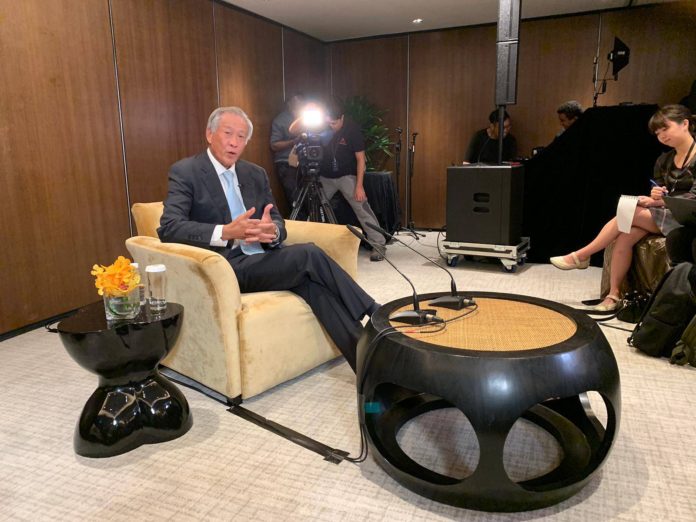
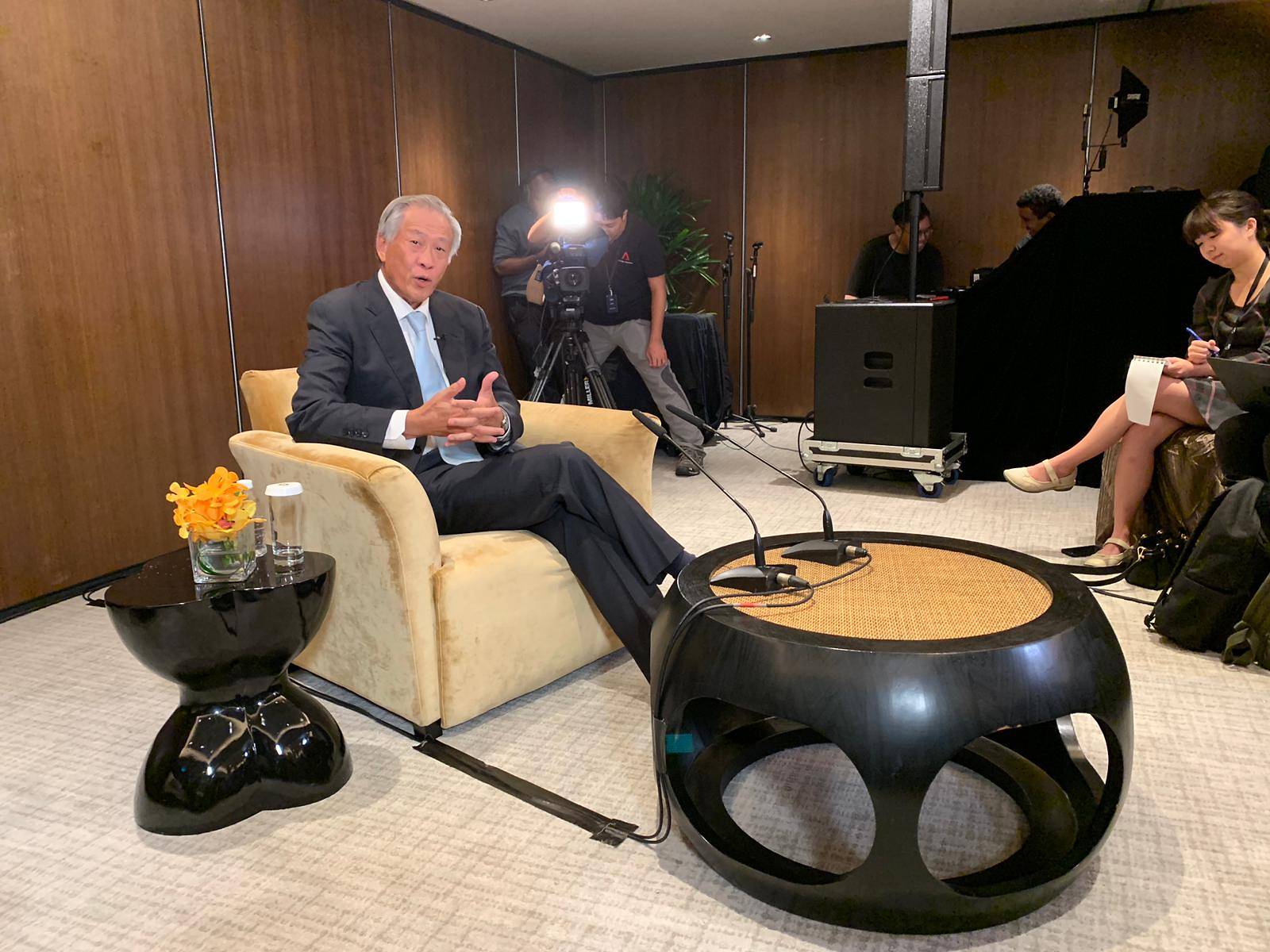
Defence Minister Ng Eng Hen addresses reporters during his round-up of the Shangri-La Dialogue 2019. (Photo: Aqil Haziq Mahmud)
SOUTH CHINA SEA
As for ownership claims and disputes in the South China Sea, Dr Ng said countries in the region were working on the Code Of Conduct as the “focus activity” to deal with the differences.
“There are countries that claim and dispute on claims in the South China Sea, but it is also a recognition that it is an international waterway,” he said.
And when it comes to the US presence in the region, Dr Ng said “it’s not really up to us or anyone else to decide”.
“The US has said it will stay and I don’t see anyone disagreeing, or even if you disagree, to changing that fait accompli,” he said.
ASEAN countries also welcome the US presence, Dr Ng said, noting that they had met Mr Shanahan at the dialogue to discuss how to increase interaction.
“The reason for that acceptance is at the end of the day, the US presence has proven itself as a stabilising force,” he added.
“Most would agree in the main that the US presence has provided for stability which then allowed our individual economies and the region to grow.”
ULTIMATE LOSERS’ GAME
Still, Dr Ng cautioned against a situation where individual countries have to choose between the US or China.
“That will be the ultimate losers’ game and a race to diminishing benefits for all concerned,” he said in his speech.
Dr Ng said maintaining stability required “openness, interconnectivity, mutual dependencies, and a willingness to listen, to accommodate, to make changes for the collective good”.
“If we can stick to that, then I think there is a chance that the next generation will continue to be stable and our people will be safe and prosper,” he added.
SINGAPORE: Under the bright floodlights of the Bishan Stadium on a sweaty Sunday night, 19-year-old Gaye Sameer had his eyes trained on the stands.
He had reached some key milestones in his burgeoning career as a footballer.
First professional goal? Check. Complicated celebration routine? Check. Half-time lead for Balestier Khalsa? Check.
But the moment was not complete without Sameer searching out his father Alassane.
The pain of the past long forgotten, there was no glass panel separating father and son this time around.
“That big smile when you are proud of someone – he had that on his face,” said Sameer. “My goal was for him.”
Recalled Alassane: “I jumped from my seat and I shouted loudly: ‘Alhamdulillah‘ (Praise be to God). That’s when the tears started to flow.
“I couldn’t stop my tears, I was just crying. I think he was too far away to see the tears!”
A fleet-footed left winger for Balestier Khalsa, Sameer made his debut for the Toa-Payoh based club earlier in the season.
“I wasn’t expecting him to score against Home United but I was expecting him to score somewhere along the line,” said Balestier head coach Khidhir Khamis.
“He had a lot of time and space. Usually when you are a young player and afforded that amount of time and space, knowing somebody is coming to you from behind, the mental part of things come into play. That was what I was afraid of – that he would think about that rather than putting it into the net.
“But, it was a good goal from him … Now it’s about him keeping his feet on the ground and working hard, and making sure the hard work translates to good performances during games.”
Gaye Sameer in action against Hougang United. (Photo: Matthew Mohan)
But Sameer is neither the first professional footballer in his family, nor the first professional footballer to score a goal in the local league – that distinction belongs to his dad, Alassane.
As a child, Sameer recalls catching several of his father’s games at various local stadiums.
The Mali-born Alassane’s career in Singapore pre-dates the start of the local professional league, having played for local Premier League club Tiong Bahru CSC in 1994 when he was 19 years old.
He went on to feature at clubs such as Tampines Rovers and the now-defunct Gombak United, his last professional side.
Alassane then obtained Singapore citizenship in 2003.
“My mum would bring me to watch his games,” recalled Sameer, who also has a younger sister. “It was him that inspired me a lot to be in the league, without him I’m not too sure if I would be that driven.”
But things took a turn in 2013, when Alassane was detained without trial under the Criminal Law (Temporary Provisions) Act for about two years following his involvement in a global match-fixing syndicate.
For Sameer, then barely out of his teens, his father’s detention came as a complete shock.
“It was a normal day and next thing we knew, there was a call that he was in the lock-up,” said Sameer. “We didn’t even know what to do.
“At first, we could only communicate and see him through a television, like a video-call. The first visits I cried because he looked different.”
He wasn’t the only one struggling.
“There was a point of time I didn’t know what to say (to my family) or what to do,” said Alassane. “There was just so much pain and regret. But, whatever is written in destiny, nobody can go through it for you.”
But with the support of his mother and his grandparents, Sameer came to grips with the new reality.
“My dad was the main breadwinner, and he apologised that he couldn’t support us for this period of time,” said Sameer. “He still is a father figure and it didn’t discourage me because he was still my dad. Given the things which he had done for us, for our family, it didn’t bring me down.
“For that two years, it was quite shaky because of financial issues and stuff. But my grandparents and mum supported me a lot, giving me what I needed and from there it helped me to forget the struggle.”
Gaye Sameer participates in a Balestier training session at the Toa Payoh Stadium. (Photo: Matthew Mohan)
Sameer vividly remembers the day his father came home.
“I was on the way home from school and when I came to the house, I opened the door and saw him right there,” he said. “There were no words, I had no idea he was coming home – I just ran straight to him and gave him a hug.”
“The gate was open and I was sitting down with his grandmother,” added Alassane. “I couldn’t even hold back my tears. We were so happy and you see the love between him and me – it was so strong.”
A further boost to the family came when Alassane was allowed to keep his citizenship in 2018, based on the recommendations of an independent committee made up of private individuals appointed by the Minister for Home Affairs.
After its inquiry, it recommended that Alassane be allowed to keep his citizenship on compassionate grounds. It said it took into consideration Alassane’s strong family roots in Singapore, the service he has rendered to the community, as well as his conduct since his release.
“At one point of time we thought he might be going back, but after getting the news that he was going to stay, that was the best feeling you could have at that point of time,” recalled Sameer.
“It was very, very difficult but as time goes on, I have to thank God for helping us,” said Alassane, who is now divorced from his wife but remains on good terms with her. “Things have gotten better and better for us as a family.”
Gaye Sameer attempts to block a cross from Hougang United’s Muhaimin Suhaimi. (Photo: Matthew Mohan)
Sameer’s fledgling career looks to have gradually gained momentum.
He has already made four starts this season, and impressed his coach with his attitude and application.
“During training you can see that he has a very raw talent, something we can polish. He has certain things genetically given to him – his physique, his strength, his speed,” explained Khidhir. “At the same time I feel that his personality is very open, he is not afraid of a lot of things and when he plays with the senior players, he just takes it as it is.
“When he gets time to play, he plays. If not, he sits and listens and watches and learns. When he gets to play, when he gets the chance, he will try his best. That’s something that I admire about him.
“You wouldn’t think looking at him that he is 19 years old, by the way he carries himself.”
Keeping his son down-to-earth is important for Alassane, who makes it a point to attend all of his Sameer’s games.
“I don’t want to hear from people about him – I want to see with my own eyes,” he explained. “I don’t hide anything from him … He is improving game by game. It is only the beginning – he doesn’t need to have big shoulders and a swollen head. He needs to be humble and work very hard.
“After games, I sit with him and tell him what he did wrong and what he did right.”
And it’s always the wrong before the right, said Sameer with a laugh.
He added: “It feels like I have to prove myself even more. He expects more of me and that motivates me to try to be better.”
Balestier also has played a critical role in developing Sameer as a player.
“It’s a club where most youngsters should start off with because of the amount of senior players that we have to guide us. The coaches especially, talk to us one on one. There is good guidance here,” reflected Sameer.
“The good thing is he doesn’t allow anything to affect him,” added Khidhir. “Mentally, he is not affected by a lot of things which is good for a 19-year-old.
“I feel that he has so much more in him to propel himself forward, with the mental resilience, the strength he has, it is going to aid him to develop faster.”
Gaye Sameer poses for a photograph. (Photo: Matthew Mohan)
Sameer and his father remain extremely close off the pitch. They go to the mosque together, have meals together and meet up almost every other day.
“The past is the past and everybody has their past,” said Alassane, who is now doing coaching. “We are focused on our family, ourselves, our present and future.
“Myself, his mother, and his grandparents are supporting him, praying for him and wishing the best for him. As a parent you want your child to succeed.”
And Sameer, currently studying at ITE College East, is on the right track, as an anecdote by his coach Khidhir highlights.
“On the days he ends school late, he will rush down and you can see him running from the dressing room to the field rather than just walking slowly and taking his time,” said Khidhir. “He does that every time, it’s not just a one-off thing and you know that he is rushing a lot from school to be here. We appreciate the effort.
“I think a certain part of him knows that now he has been given a chance to play and he’s taking it with both hands, trying to improve and trying to secure a spot in the team.
He has one goal in the league, but Sameer has one bigger goal for now. He wants to play in the national team.
“My mindset is to reach the national squad if possible,” he said. “That’s one of my goals in football, as with any footballer or youngster, you definitely want to be in the national team.”
And if Sameer eventually gets the chance to swap his Tigers jersey of Balestier for the Lions jersey of Singapore – he knows that his biggest supporter will be in the stands, cheering him on.
SINGAPORE: Teachers in Singapore, as elsewhere, play an indispensable role in educating students, not only in terms of academic content but also in terms of values and attitudes.
They are also responsible for guiding students through various education pathways and preparing them for adulthood.
Teachers passionate about their work derive intrinsic joy from intangible rewards, such as when learners suddenly understand a concept, or when former students thank them for their guidance.
These rewards do not detract from the reality that teaching is often tough work and involves its own particular set of stressors.
STRESS, BULLYING AND EXCESSIVE WORKLOADS
A recent CNA commentary reported that 80 per cent of Australian teachers surveyed in a research study had experienced verbal or physical bullying and harassment from students or parents.
About 83 per cent of respondents revealed a desire to leave the profession due to teacher-targeted student and parental bullying.
Another recent survey, this time conducted in the United Kingdom by the charity Education Support Partnership, examined the mental health and wellbeing of teachers, senior teachers, school leaders and lecturers in the further, adult and vocational education sectors, as well as other non-teaching staff like school business managers.
Respondents said they loved their work primarily because they wanted to work with children and make a difference in their lives, and they had a very strong passion for a job they found rewarding. Many also enjoyed working with like-minded individuals.
However, 64 per cent of teachers reported feeling stressed at work, with 29 per cent working an average of more than 51 hours per week.
Students at Swiss Cottage Secondary School discuss meritocracy and social inequality at a Glocal Perspectives class led by teacher Mini Sathiya Sidhan. (Photo: Lianne Chia)
Excessive workload, inadequate work-life balance and dealing with poor student behaviour in class contributed to poor mental health.
These two research studies raise questions about the situation facing Singapore teachers, their working conditions and the challenges they face.
MOVES TO BOOST TEACHING SECTOR IN SINGAPORE
The number of teachers in Singapore has increased over the past two decades, from over 22,200 to just over 33,100 in 1998 and 2017 respectively.
Over the same time period, the percentage of teachers with university degrees has almost doubled from 45 per cent to 89 per cent.
As a result of large-scale recruitment beginning in 1996, only about half of teachers today have fewer than 10 years of teaching experience.
The Ministry of Education has introduced measures to keep salaries competitive.
At the same time, the Ministry has tried to professionalise teaching. Within the past decade, it introduced an Ethos of the Teaching Profession and a Code of Professional Conduct for Educators that outline key roles and responsibilities.
It has also put in place comprehensive professional development schemes and diversified career tracks.
There is also a Teachers’ Work Attachment programme to enable teachers to take part in short-term attachments at external organisations in order to broaden their perspectives.
Parents and students at the Secondary 1 registration exercise at Crest Secondary School. (Photo: Crest Secondary School’s Facebook page)
HOW DO TEACHERS FEEL?
Little is known about Singapore teachers’ work conditions except through the findings of two cross-national surveys.
The OECD’s Teaching and Learning International Survey 2013 published its findings in 2014. Singapore had the youngest teaching force across the countries surveyed.
Almost 90 per cent of teachers said they were satisfied with their job, with 82 per cent reporting they would still choose to be a teacher if they could decide again. About 7 in 10 believed the teaching profession was valued in Singapore.
Teachers claimed to work an average of 56 hours per week, which indicated a lot of work was done after official school hours.
Besides spending most of their working time on teaching, planning and marking, teachers also said they had to engage in administrative work, teamwork with colleagues, student counselling, extracurricular activities and manage parents.
Another survey, the Varkey Foundation Global Teacher Status Index 2018, revealed that teachers worked 52 hours per week, more than the 45.33 hours that the general public estimated teachers’ working hours to be.
Just 31 per cent of Singapore parents would probably or definitely encourage their children to become teachers.
Ministry of Education kindergarten at Punggol View Primary School. (Photo: Tan Si Hui)
Neither of these two surveys dealt with the main stresses and challenges facing Singapore teachers. Although the Ministry of Education conducts regular staff climate surveys in schools, these findings are not made publicly available.
KEEPING UP WITH SLEW OF REFORMS
One of the major challenges teachers face is keeping pace with the slew of education reforms introduced during the past two decades.
These include applied learning programmes, the Direct Schools Admission scheme, changes to the PSLE scoring system, subject-based banding in secondary schools, just to name a few, not to mention greater mainstreaming of special needs students, the reduction in the number of tests and examinations and the creation of multiple pathways to educational success.
These reforms do not only involve teachers redesigning pedagogies and subject content, but more critically, teachers unlearning some of their own preconceptions of teaching based on their own experiences as students in order to embrace different ways of thinking about education.
Teachers need professional development in order to better acquaint themselves with how to respond to the reforms.
Only then can they be effective frontline ambassadors for these reforms by enacting them and explaining their rationale and their workings to students and parents.
Many parents are feeling bewildered about these reforms and are understandably influenced by their own experiences and conceptions of what learning involve.
Students and parents will judge the efficacy and meaningfulness of these reforms partly through how they perceive teachers, who are key intermediaries of the Education Ministry, to be implementing them.
Teaching is unlike other professions such as medicine and the law. The general public feels at ease questioning teachers’ professional expertise compared to doctors or lawyers.
File photo of students at a primary school.
Maintaining healthy partnerships with students and parents can be a challenging task.
There are no official statistics on teachers being bullied or harassed by students and parents, though there are occasional press reports of students verbally or physically abusing teachers, or surreptitiously filming them and uploading the videos onto social media.
There are also some parents and students who dispute schools’ disciplinary procedures and even file lawsuits against educators and schools.
One of these cases involved a parent suing his son’s secondary school in 2017 after his son’s smartphone was confiscated for a three-month period as punishment for using it during school hours.
Another case saw a teenager suing her former secondary school for failing to protect her from alleged bullying by her peers.
Such cases show a worrying tendency by parents and students to view their relationships with schools in an unnecessarily adversarial manner.
The task of maintaining teacher and student respect for teachers has been complicated by the growth of the private tutoring industry.
The concept of teacher has now expanded beyond the school to include private tutors and school attendance is no longer necessarily the sole means to attain academic success.
With the ubiquity of social media and smartphones, it is now much easier for parents, students and also school leaders to communicate with teachers. The boundaries between work and personal time have been increasingly blurred.
Teachers are often expected to be selflessly committed to developing and nurturing students. However, they also need to guard against work demands intruding into their enjoyment of a healthy personal and family life.
Students at a secondary school hall.
CHALLENGES TEACHERS FACE ARE WELL RECOGNISED
There are some indicators that the challenge teachers face in working with stakeholders received attention from officials. In 2012 then Minister for Education Heng Swee Keat said that teachers could not be surrogate parents, while urging parents to be supportive of their children’s teachers.
More recently, the Ministry of Education has published guidelines for fostering healthy school-home partnerships.
At the same time, the Singapore Teachers’ Union offers talks for teachers on topics like teachers’ rights and limitations in disciplining their students, teachers’ liabilities to their students vis-à-vis the Tort of Negligence, managing challenging parents, managing students with disruptive behaviours and navigating the social media landscape for student/parent engagement.
The third main challenge teachers face is dealing with the intense human emotions involved in their work. Because of the high-stakes competitive nature of education in Singapore, all major stakeholders – teachers, students and parents – invest not only time and effort but also a great deal of emotional energy into schooling.
Working together while grappling with one’s own, as well as others’, beliefs, attitudes and actions is not always easy.
It’s clear Singapore teachers face a few major challenges in their work. These challenges, if not carefully dealt with, may lead to unhealthy levels of stress.
The rapidity of educational reform and the increasing demands of other stakeholders mean that teachers have to work extra hard to live up to the onerous expectations being placed upon them.
Another recent CNA commentary highlighted the danger of work burn-out due to work stress, with approximately two in three employees reporting above average to high levels of stress.
Teachers and other stakeholders therefore need to pay attention to the issue of work stress in order not to impair teachers’ ability to continue being stellar educators.
Jason Tan is associate professor at the National Institute of Education.
SINGAPORE: For Yasmin Nisha, it was tough enough being her family’s sole breadwinner, struggling to care for two young daughters and an ailing 65-year-old grandmother all on her own.
But when the 28-year-old single mum tried to put her older daughter in childcare, she faced a challenge on a whole other level.
The first time Siti, then aged two, was left at the centre without her mother, she cried non-stop until she was picked up in the evening.
“She couldn’t cope. She isolated herself to one side. She didn’t want to talk to her friends. She didn’t want to join the class,” said Yasmin. “She didn’t want to do anything.”
In the weeks that followed, Siti refused to eat or even drink water at the centre.
“Some days, when she didn’t want to eat and was continuously crying, her temperature went up, and the teacher would call me. I’d have to stop work.”
Everything in the pre-school environment was new to the scared toddler – and Yasmin, too, found herself in a new situation, unable to manage Siti’s fears.
Yasmin with her daughters Siti and Benazir.
SHE ‘COULDN’T FIND A WAY’
That period in 2015 was “the most difficult part” of motherhood for Yasmin. “I asked my friends (and) relatives, do you have a child who’s like that?” she recounted. “They said no.”
Instead, the student care teacher found herself being questioned: Why was it that she could deal with children in her job, but not her own daughter? But the young mother was anxious about unnerving her already skittish girl, and didn’t know quite how to get through to her.
Yasmin’s mind was also on other things. “My priority was to earn money because I had three of them at home and I needed to buy things; I needed to feed them.”
She was earning S$900 to S$1,000 a month depending on the hours she clocked. And, after her younger daughter Benazir was born that year, she started to be late for work as she had to attend first to the infant’s needs and other chores.
“The majority of the time, I didn’t prepare lunch for my grandma… And when I finished work, I had to rush home (to) get something for them to eat,” she said.
Yasmin and her grandmother, who had looked after her from young.
Out of convenience, the family often ate processed food such as instant noodles — Siti’s favourite, which was why she later had difficulty adjusting to the food at the childcare centre.
While Yasmin had thought that putting the girl in childcare would ease her workload, it interfered with her job even more. “I couldn’t concentrate on my work,” she said. “It was also very distracting for my colleagues.”
Her expenses also went up — exceeding her income — because of the transport costs to and from the pre-school, as well as visits to the doctor when Siti fell sick.
“Also, I had to buy her food when she was hungry because normally she didn’t eat in the centre,” she added.
Feeling helpless, Yasmin pulled Siti out of pre-school after two months.
HELP FROM KIDSTART AND ELSEWHERE
Things did not improve shortly after this, however.
Her grandmother’s condition worsened, so the caregiving and frequent hospital appointments took up more of Yasmin’s time. She went from working full-time to part-time. But it got to a point where she saw no other option but to quit her job.
After that, she relied on assistance from the Ministry of Social and Family Development’s Social Service Office, receiving S$750 a month.
When her grandma’s diabetes got worse, it necessitated more frequent hospital visits.
Then in 2016, when her younger daughter Benazir was old enough to start pre-school, she decided to try again with Siti. The girl was a year older and might be better able to handle pre-school, Yasmin thought.
So she asked her social worker at the Family Service Centre for help in looking for vacancies.
In December, both girls enrolled at My First Skool @Henderson. This time, help was there in the form of KidSTART: A pilot programme by the Early Childhood Development Agency (ECDA), it supports children from low-income families in their crucial early developmental years.
That support was to prove invaluable. Centre principal Helen Goh remembers the sisters’ first day clearly: While Benazir was able to play with her peers and teachers, Siti was “clinging on to her mother’s clothes very tightly, and she refused to even move a step”.
At home, Yasmin tried to encourage Siti, but met with the same response each time: “What if they don’t like me, or maybe what if they’re going to laugh at me?”
WATCH: Helping Siti come out of her shell (6:11)
And because Siti cried and couldn’t settle down, “her friends didn’t dare to be near her and to play with her”, said NTUC First Campus’ child enabling executive Jeremy Tay.
As part of KidSTART – which is for households with a gross income of up to S$1,900 monthly or S$650 per capita – support is given by child enabling executives like him. Attached to selected anchor operator pre-schools, they work closely with teachers, parents and community partners to form a network of support for the child, including securing resources such as food vouchers, books and money for uniforms for them.
Tay looked out for Siti whenever he was at her pre-school. He had to take an “indirect” approach, starting out by playing with her classmates and inviting her to join them – albeit unsuccessfully, “for quite some time”.
Jeremy Tay and Siti in her pre-school class.
His role is also to encourage parents to send their children to pre-school regularly, and this was “one of the greatest challenges” in Yasmin’s case given her grandmother’s health, for example.
He checked in with Yasmin via phone calls and text messages, and in one instance – when he noticed they didn’t have a bookcase at home – helped her apply to Sinda to get one as well as books for the girls.
“Being a single parent, she has multiple needs and so much going on in her life. That’s why we have to empathise and empower her to come up with a plan of action,” said the 29-year-old.
THE CHANGE IN SITI
Mother and daughter also attended KidSTART Groups, a weekly playgroup programme held on Saturdays in her neighbourhood.
In these sessions supported by ECDA facilitators, the children and parents are encouraged to engage in structured, purposeful activities, from making puppets to playing with dough.
Facilitator Rainbow Ng noted that while there are developmental programmes targeted at children, KidSTART is different because it focuses on empowering the parents.
We believe the parents are the best teachers. I don’t know their child as well as they do.
“So, we tap into that – the expertise of the parent, how much they know about their kid – and then we affirm them,” she said.
Yasmin and Rainbow Ng
For six weeks, Siti and her mum attended the sessions – and it proved the turning point in the young girl’s life.
Most Saturdays, she’d watch from her mother’s side as the other children interacted with the facilitators, slowly building her inner confidence.
And then, at the last session where there was a closing party with presents for the children, Siti got excited and spoke to her facilitator – a big milestone for the timid girl.
Months after being back in preschool, four-year-old Siti was finally learning to open up and adapt.
With help from all around her, and more one-to-one attention from her teachers and a learning support educator, who assists those with added learning needs, she has since blossomed into a bubbly girl who loves playing with her classmates.
Her progress over the past two years has been in “leaps and bounds”, notes Tay, who believes that “the effort put in by the centre made a lot of difference”.
Indeed, the two sisters’ attendance record has improved dramatically, from less than 50 per cent in 2017 to 98 per cent – in part because of an improvement to their less-than-healthy diet at home.
The girls used to often fall sick. Then the centre’s teachers gradually coaxed fussy Siti into eating the centre’s more balanced meals, praising her for each spoonful she took, and “little by little” adding on the portions, said principal Goh.
My First Skool @ Henderson principal Helen Goh with Siti.
A MOTHER’S MOTIVATION
KidSTART— which began in 2016 and is expected to benefit about 1,000 children in the pilot phase — has not only made an impact on Siti, but has also helped Yasmin build her parenting skills and confidence.
She picked up parenting tips during the KidSTART Group sessions and at parenting workshops that were sponsored for her.
But the key thing she got out of the programme was learning how to bond with her girls better: That it’s not about just spending time with them, but to “spend it in a proper way”, she said, citing how her conversations with them used to consist of “You want to eat? You want to go out?” instead of “getting to know them much better”.
A moment of affirmation came for Yasmin when she was invited to read stories to Siti’s class and help the teachers with the follow-up activity.
“I was very nervous because I hadn’t taught for a long time,” she admitted. “But everything went smoothly. Siti took part, and she was happy.”
Not only was her daughter settled in, her grandmother’s medical appointments were also becoming less frequent. And so, with newfound motivation, Yasmin started a job in March as a student care teacher again.
The next milestone will be Siti’s transition to primary school next year – which KidSTART will help to ease by sharing information with the prospective school, and by “keeping a lookout” for her and her family said Tay.
“The family has built up resilience, and I’m sure that they’ll be prepared for any challenges,” he added.
While Siti is feeling anxious about primary school, her mother is more optimistic. “If she’s willing to adapt to changes quickly and to open up, she can do it. I tell (my girls), ‘I’ll always be there to help you.’”
This story by CNA Insider was done in partnership with Gov.sg.
SINGAPORE: Defence Minister Ng Eng Hen reaffirmed bilateral defence relations with his counterparts at the 18th Shangri-La Dialogue, Singapore’s Ministry of Defence (MINDEF) said in a press statement on Saturday (Jun 1).
Dr Ng met with France’s Minister of the Armed Forces Florence Parly on the sidelines of the annual defence forum, MINDEF said.
During the meeting, both parties reaffirmed their strong and broad-based bilateral defence relations, and commitment to strengthen bilateral defence cooperation in areas of mutual interest such as the air force and navy.
Ms Parly reaffirmed France’s commitment to upholding peace and security within the region, MINDEF said. This was demonstrated by the French navy’s aircraft carrier FS Charles de Gaulle’s visit to Singapore during the 18th Shangri-La Dialogue.
Minister for Defence Dr Ng Eng Hen meeting Thailand Deputy Prime Minister and Minister of Defence General Prawit Wongsuwon on the sidelines of the 18th Shangri-La Dialogue. (Photo: MINDEF)
Both sides also exchanged views on geopolitical developments and security trends, MINDEF added.
Dr Ng and his Thai counterpart, Deputy Prime Minister and Minister of Defence General Prawit Wongsuwan, also reaffirmed “close and long-standing bilateral defence relations”. Dr Ng had expressed Singapore’s support for Thailand’s ASEAN Defence Ministers’ Meeting, the ministry said.
He also met with counterparts from other countries such as Cambodia, Canada and Vietnam, and reaffirmed warm bilateral defence relations between Singapore and the respective countries.
Minister for Defence Dr Ng Eng Hen meeting Vietnam Minister of National Defence GEN Ngo Xuan Lich on the sidelines of the 18th Shangri-La Dialogue. (Photo: MINDEF)
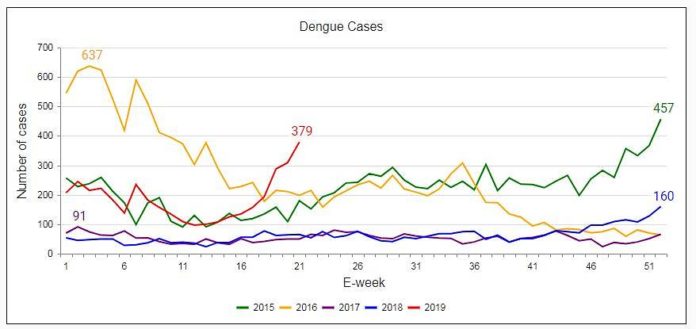
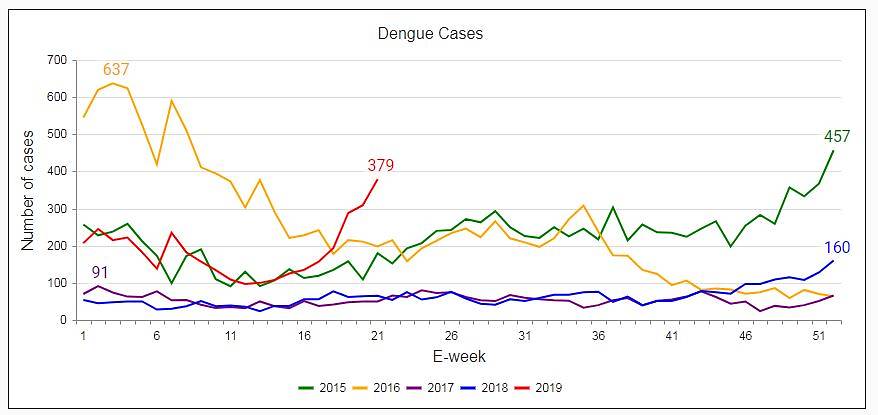
SINGAPORE: There were 379 dengue cases recorded last week, which is the highest weekly number since March 2016, the National Environment Agency (NEA) said in an advisory on Saturday (Jun 1).
“The number of weekly reported dengue cases have been on an upward trend, and have more than tripled in the past nine weeks. We have not seen such a high weekly number since March 2016,” NEA said.
The agency also added that the peak dengue season has set in.
As of last Saturday, a total of 3,918 dengue cases have been reported in 2019, according to NEA. This is more than three times reported in the same period last year, when there were 1,058 cases, it added.
“The current upward trend coincides with the start of the warmer months from June to October, where we usually experience a higher number of dengue cases,” NEA said.
NEA said it stepped up on checks in the lead up to the dengue peak season.
In April, a surveillance system deployed by NEA showed a 25 per cent increase in the Aedes mosquito population as compared to the previous month.
NEA also said about 60 per cent of breeding habitats it detected between January and March were found in residential premises.
During this period, more than 200,000 inspections were conducted, including about 1,800 that were carried out at construction sites. NEA said it uncovered about 2,900 mosquito breeding habitats during those checks.
Enforcement actions were also taken as part of efforts to stem mosquito breeding and dengue.
More than 600 households have been fined for mosquito breeding as of March, NEA said.
About 70 notices to attend court and seven stop work orders were also issued to construction sites. Three court prosecutions were made against contractors for repeated offences, NEA said.
“As we are in the traditional dengue peak season, community action is urgently needed to bring down the Aedes mosquito population, and prevent more people from being infected with the dengue virus,” NEA said.
It added: “We urge all residents living in dengue cluster areas to cooperate with NEA officers and facilitate their checks and indoor spraying of their homes.”
The public can help to stem dengue transmission by removing stagnant water through ways like inverting pails and changing the water in vases regularly, NEA said.
Those infected with dengue should protect themselves from mosquito bites by applying repellent regularly, and those showing symptoms suggestive of dengue should see their General Practitioners early to be diagnosed, it added.
Under the project, male Wolbachia-Aedes mosquitoes, which have been infected with the Wolbachia bacterium were released into test sites. When they mate with female Aedes mosquitoes, the eggs the females lay will not hatch.
As of Monday, there were 72 active dengue clusters, with the five largest clusters located at:
SINGAPORE: St John’s Island Lodge reopened on Saturday (Jun 1) after the completion of upgrading works that began a year ago.
Visitors at the lodge can now enjoy new amenities such as smart lock systems for checking in and out, electric hobs, energy-saving lights and new kitchenware. There is also a new barbecue pit area, built with recycled wood from the island.
This is the first phase of upgrades for the lodge, which began in June last year after the Singapore Land Authority took over its management from Sentosa Development Corporation. It was previously known as the St John’s Island Campsite and Holiday Bungalow.
The lodge’s bungalows and campsites are now themed after the island’s native wildlife. The holiday bungalow is named Eagle, after the white-bellied sea eagle, while the three campsites are named Dolphin, Turtle and Otter after the Indo-Pacific humpback dolphin, the hawksbill turtle and the smooth-coated otter.
St John’s Island Lodge’s Otter campsite, which can accommodate up to 50 people. (Photos: Singapore Land Authority)
Changes have also been made to the booking scheme, with visitors now given the option to make daily bookings instead of having to book in four-day blocks.
Booking fees for the Eagle bungalow, which can accommodate up to 10 people, is S$21.40 per day on weekdays and S$42.80 per day on weekends. Campsite bookings start at S$74.90 per day on weekdays and S$117.70 per day on weekends.
The lodge will remain open during the annual Kusu Pilgrimage Season, SLA said.
Upgrading works at the lodge will continue in July 2020. The bedding at the Dolphin and Turtle campsites will be improved during the second phase of upgrading, said SLA.
The public can make online bookings for the facilities at www.sla.gov.sg/tol.