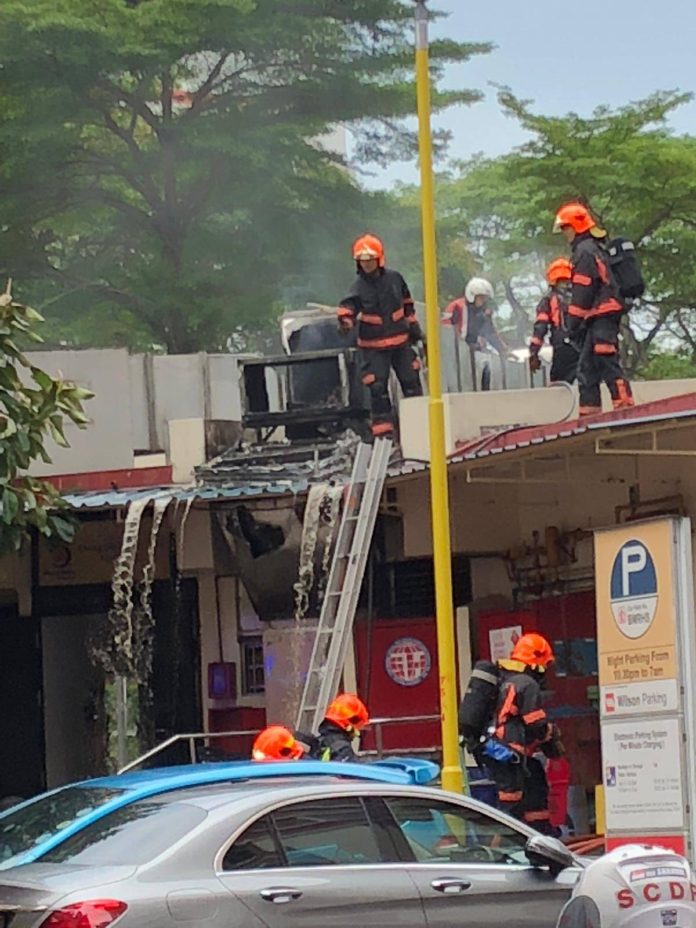
SINGAPORE: A fire broke out at a coffee shop along Redhill Road on Wednesday (Jun 5) afternoon, causing customers to evacuate the premises.
The Singapore Civil Defence Force (SCDF) said it responded to the fire at 75D Redhill Road at about 4pm.
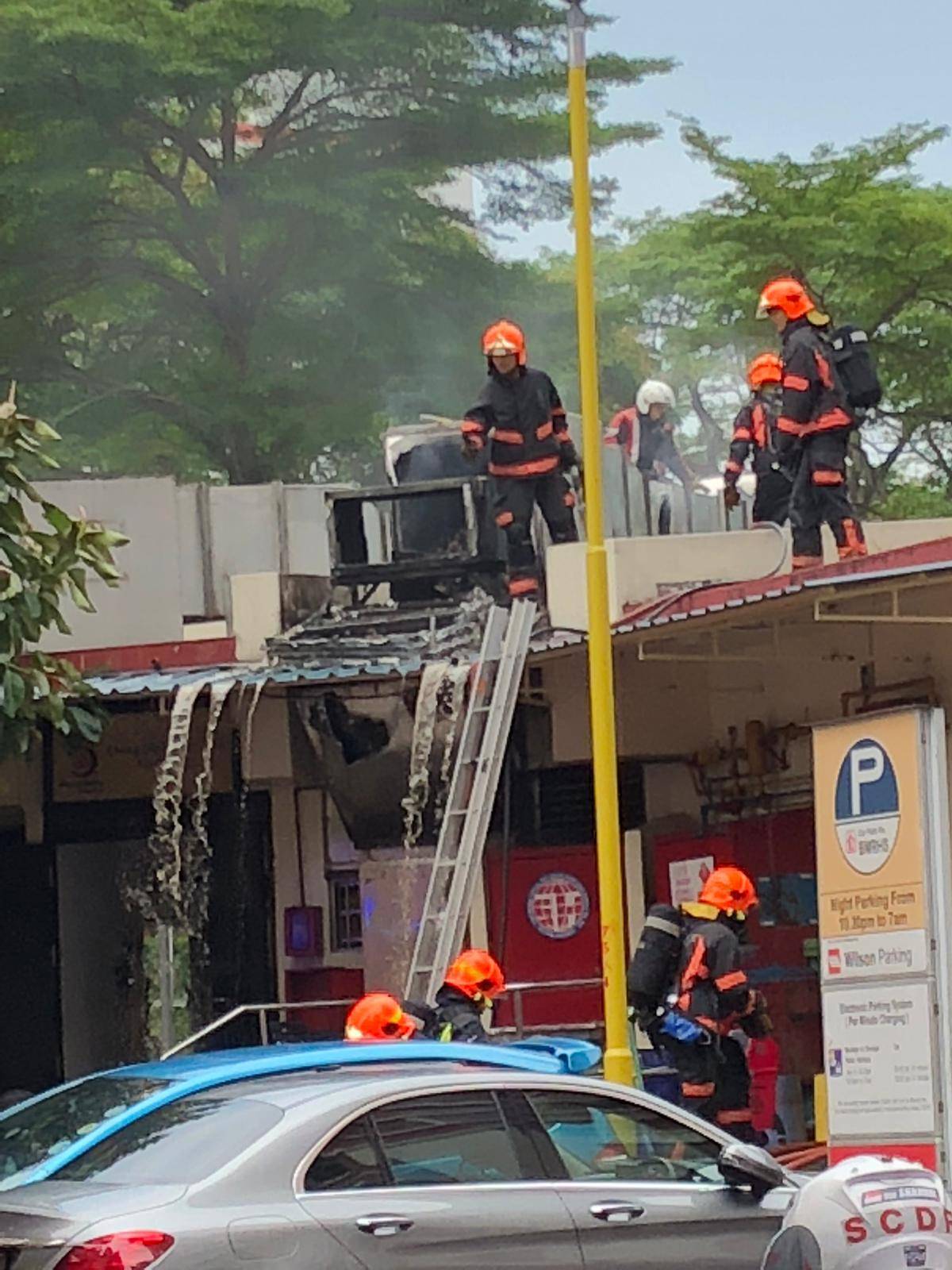
The fire involved the ventilation duct of the coffee shop, and was extinguished by SCDF using a compressed air foam backpack and a hose rail.
“Patrons of the premises had self-evacuated prior to SCDF’s arrival,” SCDF said.
There were no reported injuries, it said, adding that the cause of the fire is under investigation.
Eyewitness Tania Jim, who lives opposite the coffee shop, told CNA she saw a thick cloud of smoke at around 4pm.
“I saw a very thick cloud of smoke which rose up to around (the) 10th storey,” said the 21-year-old, who works as a senior technical officer at the National Environment Agency.
“My aunty saw the naked fire,” she added. “When my parents and I went down, we saw four SCDF fire trucks, police and (an) ambulance.”
Emergency responders at Redhill Road. (Photo: Tania Jim)
Emergency responders could be seen tackling the fire at Redhill Road. (Photo: Tania Jim)
Emergency responders could be seen spraying water and flushing out “black and dirty water”, Ms Jim said.
Smoke continued to be emitted for about 20 to 30 minutes, she added.
This story came from a reader tip-off. If you would like to send in photos or videos of something newsworthy, WhatsApp our Mediacorp news hotline at +65 8218 8281 or message us on Facebook.
SINGAPORE: New Build-to-Order (BTO) flats sold from February onwards will include higher-quality furnishings, such as more water-efficient toilets and tougher porcelain tiles, the Housing and Development Board (HDB) said on Wednesday (Jun 5).
These changes are part of efforts to make new flats more modern and to bring standards closer to mass market condominiums, it added.
Speaking at a media briefing, HDB’s deputy director of project development and management Jansen Foo said the prices of the new flats are not going to increase because of the upgrades.
“There is a marginal cost increase, but for HDB, we are able to achieve economies of scale, so all cost involved will be absorbed by HDB,” Mr Foo added.
“The pricing of new flats will not be affected by these changes.”
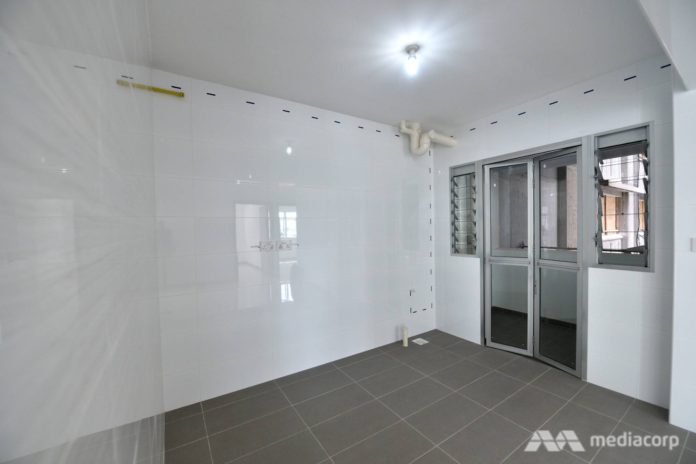
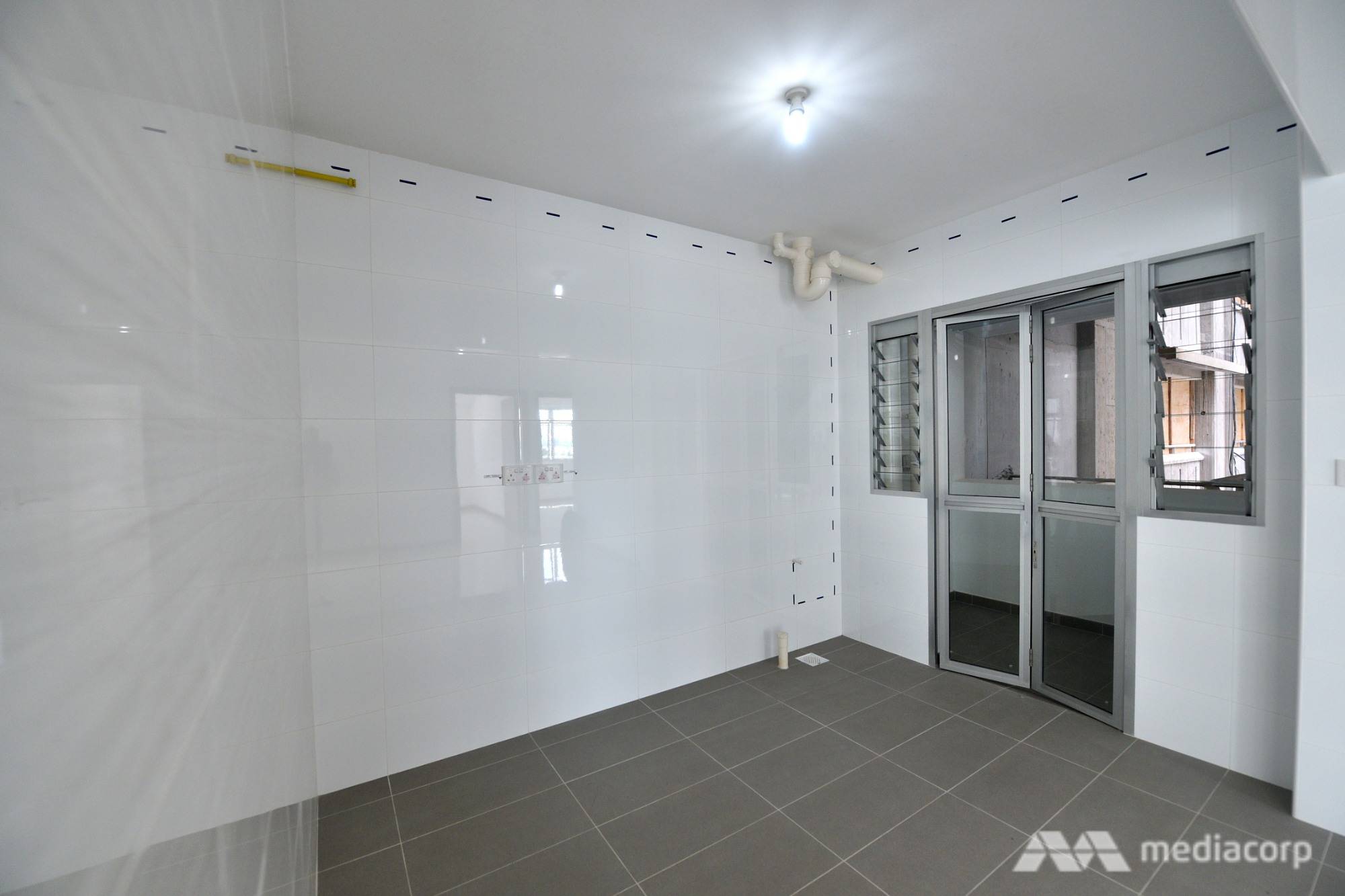
The louvred windows in the door/window ensemble between the kitchen and service yard (Photo: Jeremy Long)
“The layouts of HDB flats have also evolved from simple and functional rectangular corridor-facing units, to layouts that afford more generous views, natural ventilation and light while providing greater privacy to residents,” HDB said in a media factsheet.
BATHROOM UPGRADES
The upgrades to the flats are durable and eco-friendly and were introduced to suit residents, HDB added.
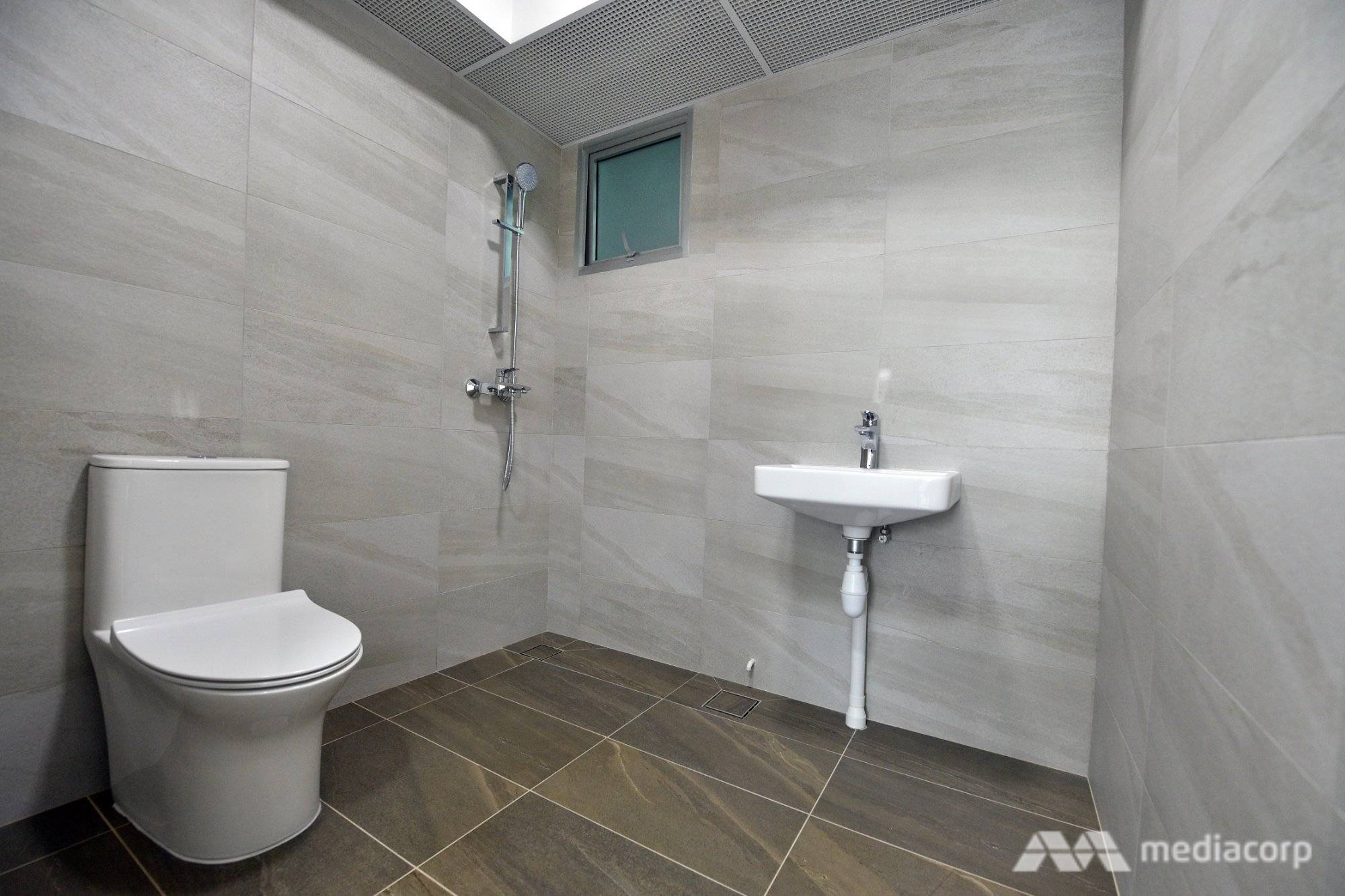
New toilets will come fitted with low-capacity dual flushes, with a wider range of contemporary designs so home owners have options.
All taps will at least have a rating of “Very Good” under national water agency PUB’s Water Efficient Labelling Scheme.
Existing WCs and wired-glass louvred vent windows will be replaced with dual-flush low-capacity WCs and top-hung windows (Photo: Jeremy Long)
Mr Foo said: “We now use better quality sanitary fittings and they look (sleeker) and more contemporary.”
Top-hung single panel windows will replace wired-glass louvred windows in kitchens and toilets, making them more durable and easier to clean.
NEW FLOOR DESIGNS
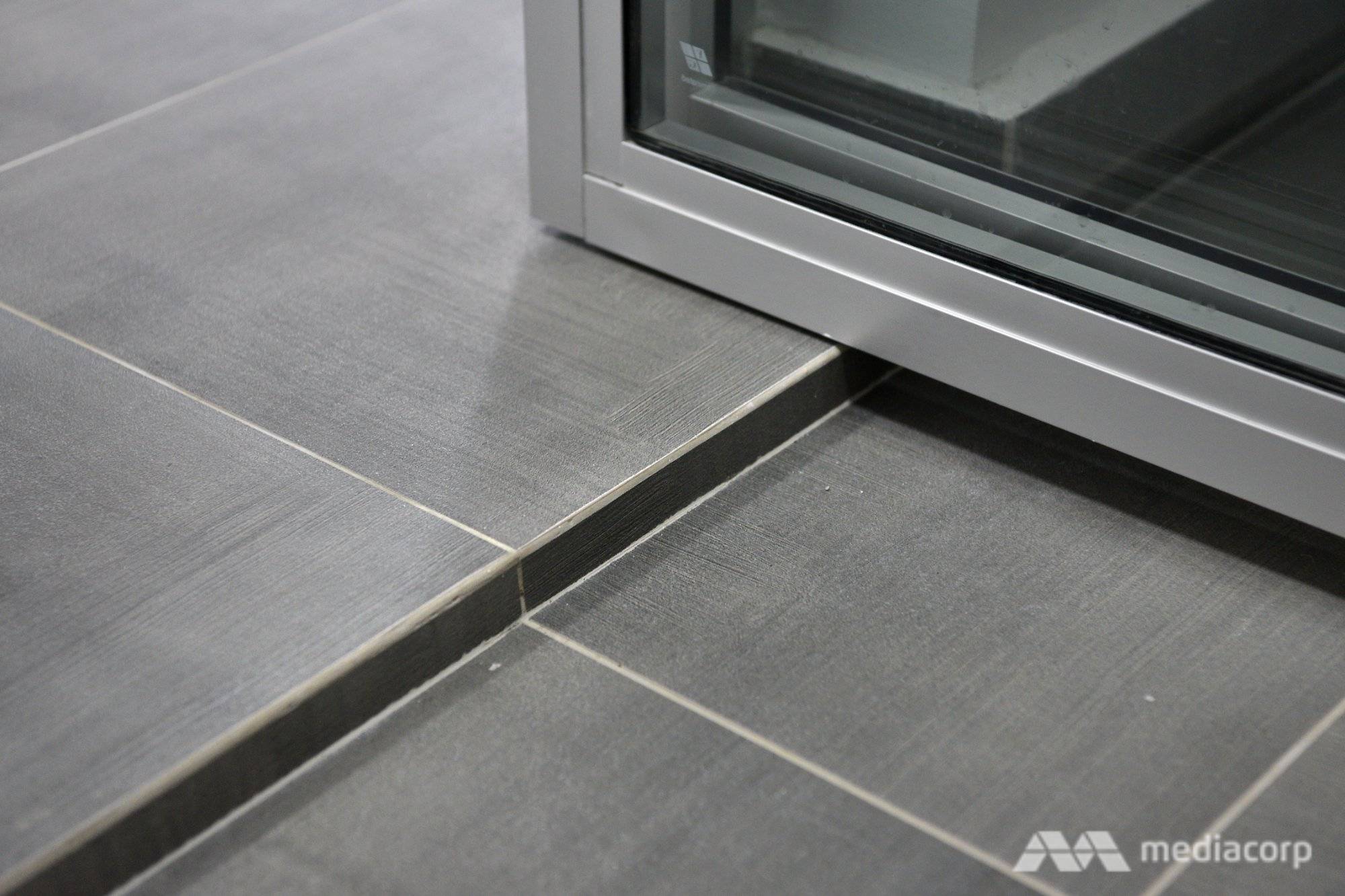
Thresholds between the bathroom and living room and thresholds between the kitchen and service yard will be changed from ramps to a 20mm drop.
This is in response to feedback from home owners that ramps often cause water to seep out from the toilets and kitchens into other rooms.
New kitchen and bathrooms will feature larger floor tiles in glazed porcelain, and a 20mm drop at threshold in place of ramps (Photo: Jeremy Long)
The flats will still be accessible to wheelchair users, HDB said.
Existing ceramic tiles will be replaced with glazed porcelain tiles, which are less vulnerable to wear and tear.
Bathroom and kitchen tiles are also becoming bigger, with bathroom tiles going from 30cm by 30cm to 30cm by 60cm, and kitchen tiles going from 30cm by 60cm to 60cm by 60cm.
“The use of new fittings will help to save about 15 per cent of man-hours spent for fittings per dwelling unit,” Mr Foo said.
“The time saving is mainly due to the reduced reliance on manual processes. This includes reducing the number of tiles required to be cut and installed and the doing away of the construction of ramps at the thresholds.”
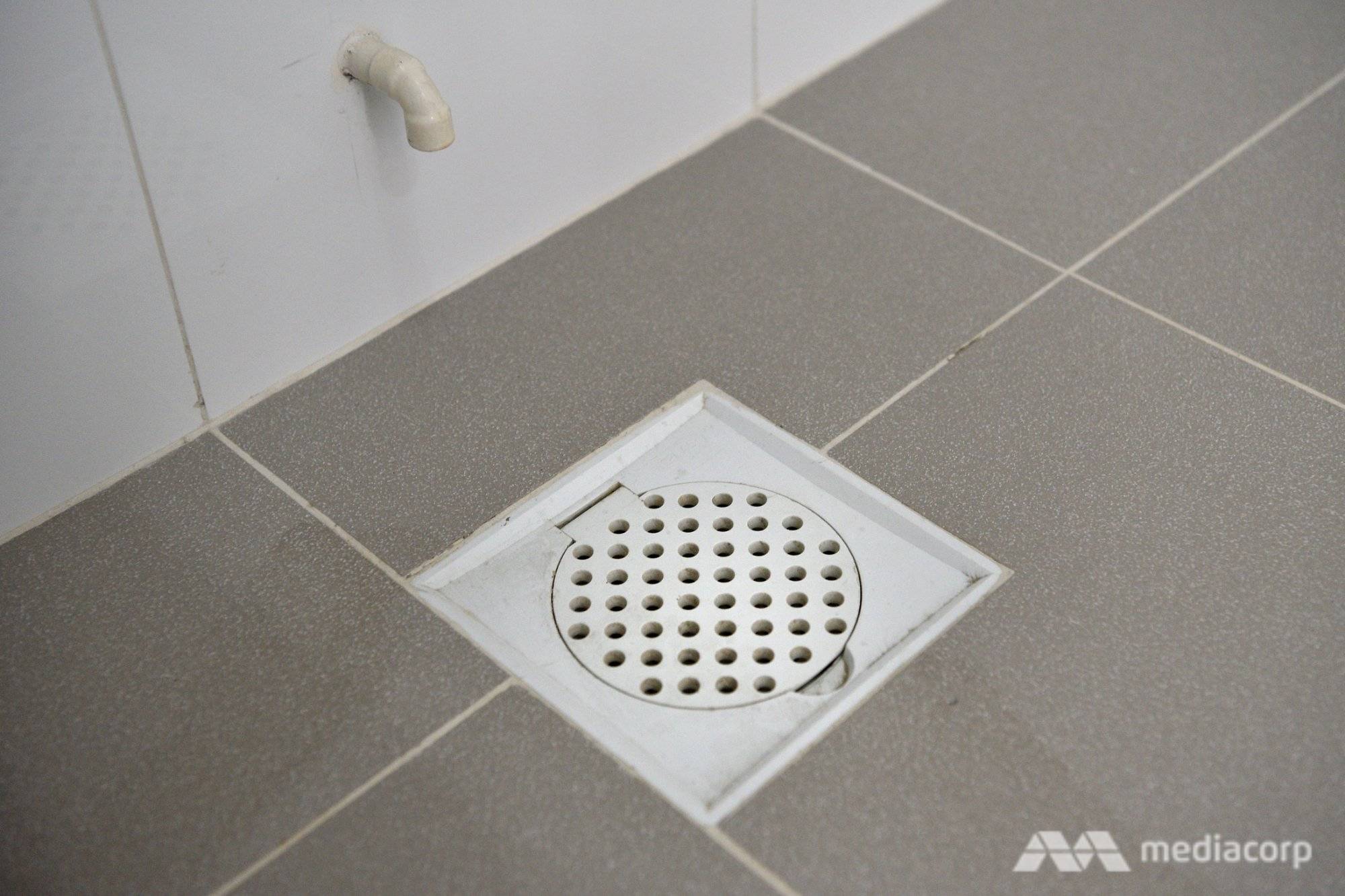
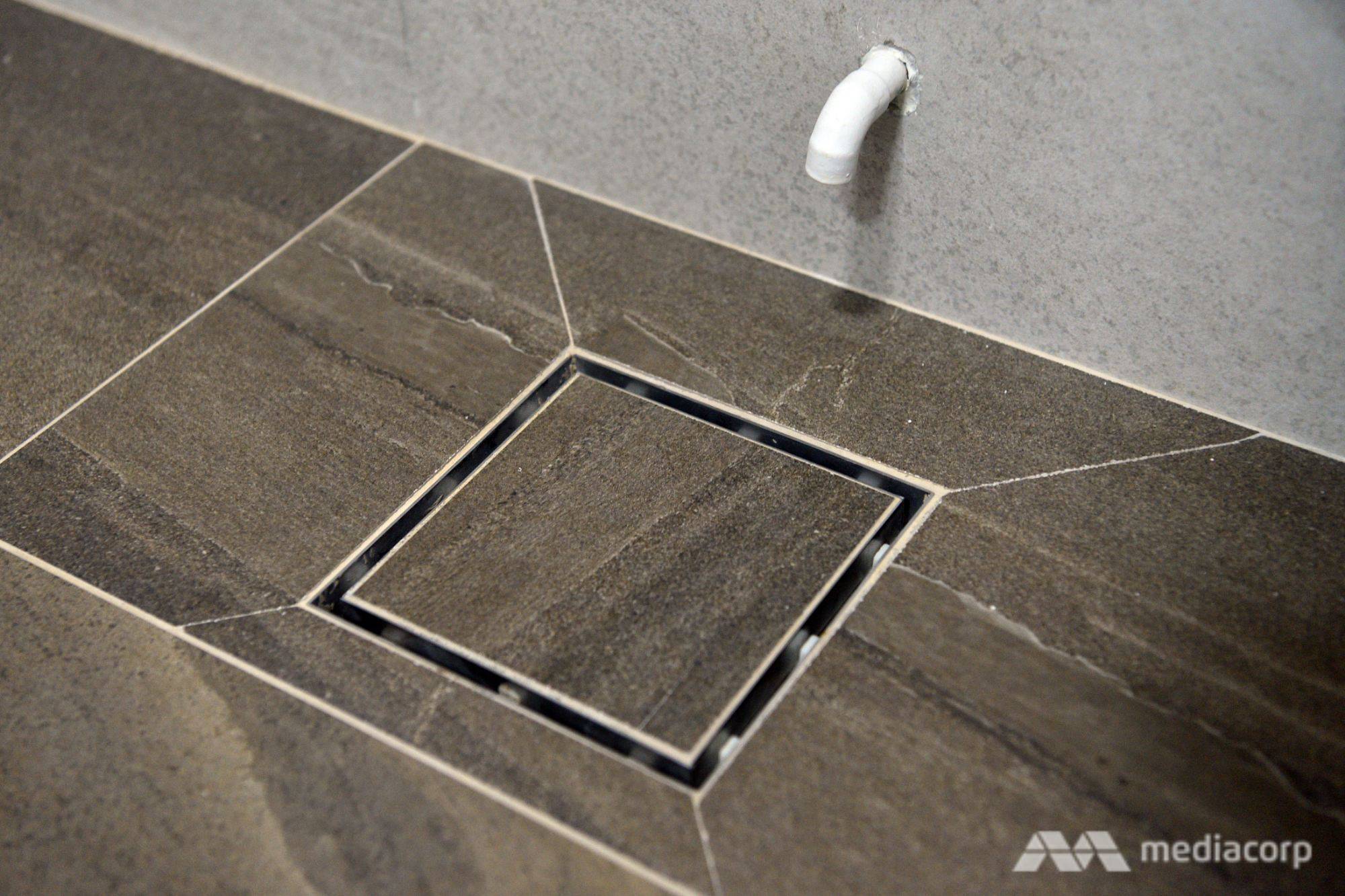
Floor traps in bathrooms and kitchens will be replaced by concealed floor traps, which are also more durable than the previous unplasticised polyvinyl chloride (uPVC) floor traps.
uPVC floor trap in existing WCs (Photo: Jeremy Long)
The concealed floor trap will replace the uPVC floor trap to provide more durability and a sleeker finish (Photo: Jeremy Long)
ENHANCED GATES AND DOORS
Mr Foo said the range of fittings provided for the new flats will give it a more modern look. That includes enhancements to entrance gates and windows for ease of maintenance and use.
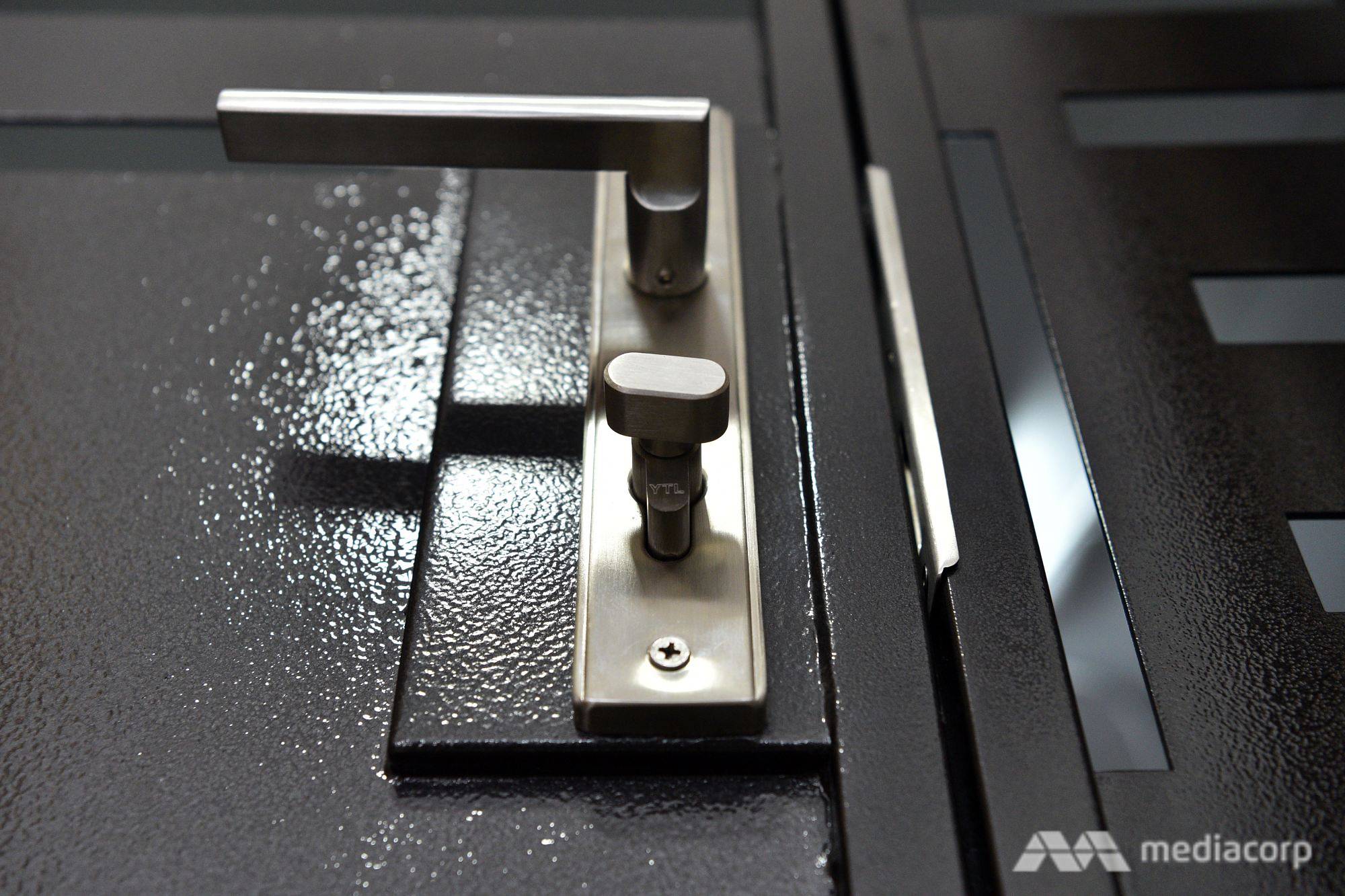
Steel entrance gate with thumb-turn knob will the replace wrought iron gate with key insert (Photo: Jeremy Long)
Thumb-turn knobs will be placed on the inside of steel entrance gates, so that home owners will not have to use a key to unlock their house from the inside.
The gates and doors will also come in more modern designs to fit the newer look of the flats.
Mr Foo said that HDB had modified the design of their flats according to feedback from home owners.
“The changes were brought about due to feedback that we received from our residents and also future needs of our residents as well. We took that into consideration for the changes that we established,” he added.
HDB said it sought to provide homes that residents “can be proud of” through thoughtful planning and purposeful designs.
“Over the years, the designs and fittings of HDB flats have evolved from the simple and functional furnishings in the 1960s, to higher quality furnishings which are sleek, durable and eco-friendly to suit the different needs of residents,” the board added.
SINGAPORE: President Halimah Yacob on Wednesday (Jun 5) launched a S$20 note to commemorate Singapore’s Bicentennial.
The note, issued by the Monetary Authority of Singapore (MAS), depicts Singapore’s journey to nationhood and pays tribute to forebears who laid the foundations for modern Singapore.
The front of the commemorative note features a portrait of Mr Yusof Ishak, Singapore’s first president, alongside the former Supreme Court and City Hall, which are now the National Gallery Singapore.
The back of the note showcases eight pioneers who made significant contributions to nation building in areas ranging from education, culture and community service to sports and defending Singapore, MAS said. Each note comes with a specially designed folder.
The back of the note showcases eight pioneers who made significant contributions to nation building. (Image: Monetary Authority of Singapore)
Two million pieces of the commemorative note will be available for public exchange at face value at branches of nine major banks from Jun 10: – DBS Bank Limited / POSB – Oversea-Chinese Banking Corporation Limited – United Overseas Bank Limited – Bank of China Limited – Citibank Singapore Limited – Industrial and Commercial Bank of China Limited – Malayan Banking Berhad – Standard Chartered Bank – The Hongkong and Shanghai Banking Corporation Limited
To allow everyone to have an opportunity to exchange for the commemorative note, each individual is allowed to exchange up to 20 pieces of the note per transaction.
In addition, there will be 5,000 limited edition numismatic sets available for sale. Each set comprises an uncut sheet of three S$20 commemorative notes.
Pre-orders can be placed with The Singapore Mint from Wednesday to Jun 13. The numismatic currency sets will be allocated by balloting if they are oversubscribed and will be available for collection from Jun 20.
The S$20 commemorative note was designed by local artists Mr Eng Siak Loy and Mr Weng Ziyan.
In conjunction with the Bicentennial, the MAS Gallery is also exhibiting for the first time a rare collection of currency notes and coins that trace the development of Singapore’s currency over the past 200 years.
SINGAPORE: This week, Singaporeans will celebrate two festivals – Hari Raya Puasa, a religious festival for the Muslim community, and Duan Wu Jie, a cultural festival commemorated by the Chinese community.
Festivals are among the most visible of rituals and celebrations, often taking on public expression. This is true of religious and cultural festivals, which, additionally, also often evidence a domestic dimension, celebrated within homes just as they transcend the walls of churches, temples, mosques and other houses of worship.
Festivals are occasions when participants express and enact their identities, whether ethnic, religious, cultural, national, or on the basis of some other commonality, such as locality or shared interest.
In celebrating festivals, we are reminded of common histories and heritages, shared beliefs, collective experiences, mutual interests and/or community ideals.
File photo of Hari Raya cookies.
FESTIVALS AN INTEGRAL PART OF AN ETHNIC IDENTITY
In a 2017 survey by CNA and the Institute of Policy Studies, festivals were found to be an integral part of the ethnic identity of many Singaporeans.
Nearly 92 per cent of Chinese, 96 per cent of Malays, and 88 per cent of Indians regarded their main festival – Chinese New Year, Hari Raya Puasa, and Deepavali respectively – as important to their ethnic identity.
In as much as festivals are expressions of our identities and evoke social memories, they may also reflect collective, if partial, amnesia. This is apparent when we repeat traditions and practices without recollecting origins or reflecting on identities and meanings.
While some of us may recall learning about Qu Yuan and the lessons of allegiance and fealty, thought to be the originating reason for rice dumplings (zongzi) and Duan Wu Jie, how many of us are aware of the alternative originating story, anchored in the person of Cao’e, the Han dynasty girl who was said to have drowned looking for her father in the river in Zhejiang Province, now named after her?
As we enjoy the zongzi, with the myriad ways of localising and modernising the taste (think nonya chang, chicken curry zongzi and durian zongzi), do we reflect on the values of fealty and filial piety?
A little girl makes dumplings at the Sun Yat-Sen Nanyang Memorial Hall in celebration of the Dumpling Festival.
As we celebrate Hari Raya Puasa, do we realise that it is not the Muslim new year, and contemplate and honour instead the values of empathy, will power and self-control? Festivals deserve to be the occasion for reflection at least as much as for celebration.
DIVERSE FESTIVALS TESTAMENT TO MULTICULTURALISM
Just as festivals have the potential to bind and bond followers, creating in-group identities and building bonding social capital, they could as well serve to divide.
What if a non-Muslim refuses to, and prohibits others from, greeting a Muslim “Selamat Hari Raya”? What if eating zongzi and participating in dragon boat races is condemned as heretic, and the gift of a rice dumpling is rejected?
A cohesive society requires both bonding and bridging social capital. Whereas bonding social capital refers to relationships within a community or a group, bridging social capital describes relationships between social groups – groups that differ on the basis of race, religion, culture, class, gender, nationality and so on.
Political scientist Robert Putman wrote in his book, Bowling Alone, that bonding social capital allows a society to “get by”, but to “get ahead”, bridging social capital is critical.
That two very different religious and cultural festivals can be celebrated in the same week in the same place is a testament to Singapore’s diversity, multi-culturalism, and multi-religiosity.
Believed to date back to more than 2,000 years, when it started in south-central China, the ancient sport of dragon boat racing retains many ceremonial and religious overtones AFP/PHILIPPE LOPEZ
Around the world, we see religious, ethnic and cultural divides widen with dire consequences. The violent attacks in Christchurch and Sri Lanka have left a devastating impact, and it will take a long time for the affected communities to heal.
We need to ensure that we remain open as a society, that cross-cultural engagement is supported and enabled on an everyday basis, and that we take a stand against behaviour that is disrespectful and unaccepting of others.
Festivals are just the occasion to reflect upon what it means to be human, to learn about our heritages, to reflect on the values they stand for, and to reach across communities, promoting greater shared understanding, and ultimately building a stronger, more cohesive society.
They provide perfect opportunities for wider engagement and interactions with other religious and cultural communities. To do so requires that we begin with opening our homes to neighbours and friends of other religions and cultures.
Festivals can be a key touchpoint for inter-religious and inter-cultural engagement.
Deepavali lights seen along Serangoon Road. (Photo: Ainslee Asokan)
Particularly as divisive and inflammatory rhetoric can now quickly spread via social media and cause damage, the opportunity for in-person everyday engagements and regular experience of shared celebrations can be foundational in building genuine relationships across religions and cultures, accentuating common values while dispelling unhealthy stereotypes about the “other”.
Building strong intercommunal ties will require concerted efforts and leadership by policymakers and community leaders.
It will also require that we are discursively engaged, such as through the upcoming International Conference on Cohesive Societies (ICCS) where 700 international delegates from academia, government, religious groups and civil society will gather to listen to a keynote by His Majesty King Abdullah II ibn Al-Hussein of the Hashemite Kingdom of Jordan, who has been a global leader in promoting interfaith understanding and dialogue across religious communities.
Above all, fundamentally, strong intercommunal relationships will depend on our own willingness to open our doors to others and welcome them into our homes.
In this week of two festivals, let us wish our Muslim friends “Selamat Hari Raya” while enjoying a zongzi or two, remembering that the values they underscore are common across religion and culture.
Professor Lily Kong is the President of Singapore Management University.
BEIJING: When two elephants fight, an impasse at some point is bound to happen in the ensuring struggle.
This weekend, defence officials from around the world descended upon Singapore to discuss regional security challenges and geopolitics at the Shangri-La Dialogue, an apt time seeing how frictions over the brewing bilateral tussle between the US and China over trade and technology have risen to a fever pitch.
The world’s two richest and most powerful countries were headed for diplomatic confrontation, after the trade truce collapsed last month when Washington raised tariffs from 10 per cent to 25 per cent on listed Chinese imports valued at US$200 billion.
US President doubled down on the pressure on China when he signed an executive order that indirectly labeled the Shenzhen-based telecommunication equipment manufacturer and smartphone maker Huawei and its affiliates a “foreign adversary”, clearing the way for barring the company from US networks and manufacturers.
China’s Commerce Ministry responded by raising tariffs on US$60 billion of US imports, blocking US deliveries of LNG and soybeans.
US President Donald Trump, pictured at Capitol Hill, Washington, on May 15, 2019, signed an order prohibiting purchase of equipment from companies that pose “an unacceptable risk to the national security”. (Photo: AFP/Brendan Smialowski)
Huawei has repatriated US employees working in Shenzhen and pressed on with a lawsuit against the US government, over earlier charges that the National Defence Authorisation Act passed by Congress in 2018, was unconstitutional.
There are also threats that China will ban certain US companies from operating in the country.
These tensions set the stage for geopolitical fireworks at the Shangri-La Dialogue in Singapore.
US Acting Secretary of Defence Patrick Shanahan and China Defence Minister General Wei Fenghe gave rousing speeches at the conference that raised the temperature, leaving many members in the audience feeling anxious about the growing split between Washington and Beijing.
Although Shanahan shied away from singling out China in most of his speech, he had earlier said before the summit started that he would use his speech to call out China specifically.
So his reference to actors who sought to undermine the rules-based order through militarising disputed areas, predatory economics and influence operations seemed targetted at China.
Acting Secretary of Defence Patrick Shanahan said the US was investing heavily in the Indo-Pacific region to maintain its military superiority and capability to defend its Asian allies. (Photo: AFP/ROSLAN RAHMAN)
Wei meanwhile highlighted that China will fight until the end, if the US wanted a fight. “Bully us? No way.”
Wei had also send a clear and unequivocal signal regarding Taiwan as a red line in the sand for China. “No attempts to split China will succeed,” he added.
Any interference in the Taiwan question is doomed to failure. If anyone dares to split Taiwan from China, the Chinese military has no choice but to fight at all costs.
“The US is indivisible and so is China. China must be and will be reunified.”
A COMMITMENT TO PEACE
Despite the strong words used by both sides, what went under the radar were the conciliatory remarks in each of their speeches.
China is at an inflection point where its focus is to maintain sustainable and inclusive growth, as it begins to grapple with the challenges of being the world’s fastest ageing country.
While it seeks to defend its interests of preserving a conducive international environment for continued development, it also has to be wary about unnecessarily giving into US demands and setting a precedence inimical to its interests.
There are many in China who believe that the US is out to encircle China through a string of alliances and partnerships with countries around China’s periphery and dampen its rise.
Despite Wei’s pugnacious speech, he also reaffirmed Beijing’s longheld commitment to peace by saying: “China will not attack, unless we are attacked.” He also highlighted how both sides should “promote a China-US relationship featuring coordination, cooperation and stability”.
Chinese Defense Minister Wei Fenghe speaks at the IISS Shangri-la Dialogue in Singapore, June 2, 2019. REUTERS/Feline Lim
He added:
The two sides realise that conflict, or war between them, would bring disaster to both countries and the world.
Shanahan too highlighted that China has stood with the US as a cooperative partner in pursuit of shared goals in decades past, and both sides have an alignment of interests, “from military-to-military dialogues to develop risk-reduction measures, to tackling transnational threats”.
Both sides also met bilaterally on the sidelines of the Shangri-La Dialogue.
WORRIES REMAIN
Still, Taiwan poses a significant flashpoint for both sides, given Chinese sensitivities over what they perceive as Washington’s meddling in its internal affairs and using Taipei to destabilise peace on the Asian continent, following US National Security Advisor John Bolton’s recent meeting with his Taiwanese counterpart David Lee last week.
A security dilemma is brewing, in which both the US and China take actions and use words to bolster their position, which inevitably ends up making the other feel less secure.
Some Chinese government officials believe the hawkish Bolton best represents US President Donald J Trump’s stance on foreign policy, while Westerners worry hawks in China hold the most influence in Beijing. Both sides are clutching onto misguided viewpoints
US National Security Advisor John Bolton speaks during a graduation ceremony at the U.S. Coast Guard Academy in New London, Connecticut, U.S., May 22, 2019. (Photo: REUTERS/Michelle McLoughlin_
US Defence Secretary Shanahan’s subsequent strong words during his Q&A where he mentioned that China had built artificial island in disputed waters in the South China Sea was also seen as provocative by the Chinese delegation.
Even when elephants fight, sometimes the grass can make a difference.
Singapore Prime Minister Lee Hsien Loong was spot on when delivering the keynote address at the Shangri-La Dialogue. He said the “fundamental problem between the US and China … is a mutual lack of trust” that “bodes ill for compromise or peaceful accommodation”.
“China’s growth has shifted the strategic balance and the economic centre of gravity of the world … China has to recognise that it is in a totally new situation created by its own success. It can no longer expect to be treated the same way as in the past when it was much smaller and weaker,” he said.
At the same time, he highlighted that “the rest of the world too has to adjust to a larger role for China. Countries have to accept that China will continue to grow and strengthen, and that it is neither possible nor wise for them to prevent this from happening”.
President Trump needs to restore trade talks with China, recognise that both sides have got to work together to rebuild trust and strengthen the international global economy, and rein in elements that might wish to take a harsh stance on China for ideological reasons.
Meanwhile, Beijing has to demonstrate it can uphold the principles and standards on trade, technology and intellectual property if President Trump and Chinese President Xi Jinping do sign a US-China trade agreement in Osaka on the sidelines of the G20 and demonstrate good faith in the lead-up to that meeting.
The trade deal can only succeed if both countries follow the rules and guidelines that will be stated in the agreement.
If there is any bright spot from this year’s Shangri-La Dialogue, it’s the realisation that a small country like Singapore can play a useful mediating role between both sides as a neutral observer that has deep and close ties with both the US and China, and rich insights that gives both perspective to their relationship.
The words used by Prime Minister Lee in Singapore has provided a face-saving cover for both sides to step back from the brink and break the impasse. What is needed next is for both to accept compromise and allow for concessions in any upcoming trade negotiations.
Tom McGregor is a commentator on Asia-Pacific affairs based in Beijing.
SINGAPORE: For 29 years, Logos Eyecare has served many generations of bespectacled residents in Ang Mo Kio. But over the last 10 years, 56-year-old Jonathan Wong has seen sales at his HDB shop gradually decline, as customers go for trendier options at international chain stores.
“If we are talking about the 1990s being the peak, I’d say there has been a 20 to 30 per cent (decline) until now,” said the optometrist.
“There are a lot more Japanese chain stores,” he explained. “The younger generation, especially between 20 to 30 years old, have their own mindset so they don’t come to individual stores like us anymore.”
Set up officially in March this year, the centre aims to rejuvenate heartland precincts and struggling neighbourhood businesses, starting with those in Ang Mo Kio and Bedok.
Senior Minister of State for Trade and Industry Chee Hong Tat was present on Jun 4, 2019 during a walkabout organised to showcase the progress of HECS in Ang Mo Kio. (Photo: Corine Tiah)
“Many of us grew up (coming) into contact with heartland shops. So this is an area I think many Singaporeans want to see how we can help to preserve our heartland enterprises to continue to provide good services and products to our residents,” said Senior Minister of State for Trade and Industry Chee Hong Tat during a walkabout in Ang Mo Kio on Tuesday (Jun 4) to showcase the work of HECS.
“But to do this we need to make sure that they stay commercially viable,” he added.
To accelerate the centre’s digitisation efforts in the heartland town centre, a memorandum of understanding was signed between HECS and the Singapore Institute of Retail Studies and Singapore Productivity Centre on Tuesday.
The move will see the Singapore Institute of Retail Studies and Singapore Productivity Centre partner HECS to train and upskill about 100 digital and productivity consultants over the next two years. These consultants will then help heartland enterprises set up their online presence.
In a workforce training session conducted by the Singapore Institute of Retail Studies, trainees were taught how to “tap into the power of Instagram for selling”. It was conducted in Mandarin and contextualised for heartland enterprises.
For Kenneth Tan, 45, owner of Trust Salon Hair Professional, the course was a “refresher” as he had taught himself to use Instagram last year.
He said he signed up for the course as he understands the power of social media; since getting onto Instagram in September last year, his business has seen a 30 per cent increase in customers.
“They taught me how to post photos, how to (take) videos, what should you post and what you shouldn’t post,” he said.
“Nowadays social media is very important to business owners, so we need to use all these platforms in order get more target audience to improve our business.”
Mr Tan said that he is also looking into using Carousell, Facebook, and Google search engine optimisation and search engine marketing.
Kenneth Tan, 45, owner of Trust Salon Hair Professional started using Instagram in September 2018 and has seen about a 30 per cent increase in customers. (Photo: Corine Tiah)
As for the optometrist Mr Wong, talks are underway with HECS to update his Facebook page and maintain a presence on other online platforms.
“We also have to fine-tune our products. We have to bring in things that the younger generation look for, like at the moment, they like to go for the Korean look, so we have to bring in that kind of frames,” he said.
While he is optimistic that the changes will bring back the younger crowd, he refrains from being too excited.
“If it requires me to get another staff just to go online, monitor, reply (and) all that, I don’t think I would want to do that,” he laughs.
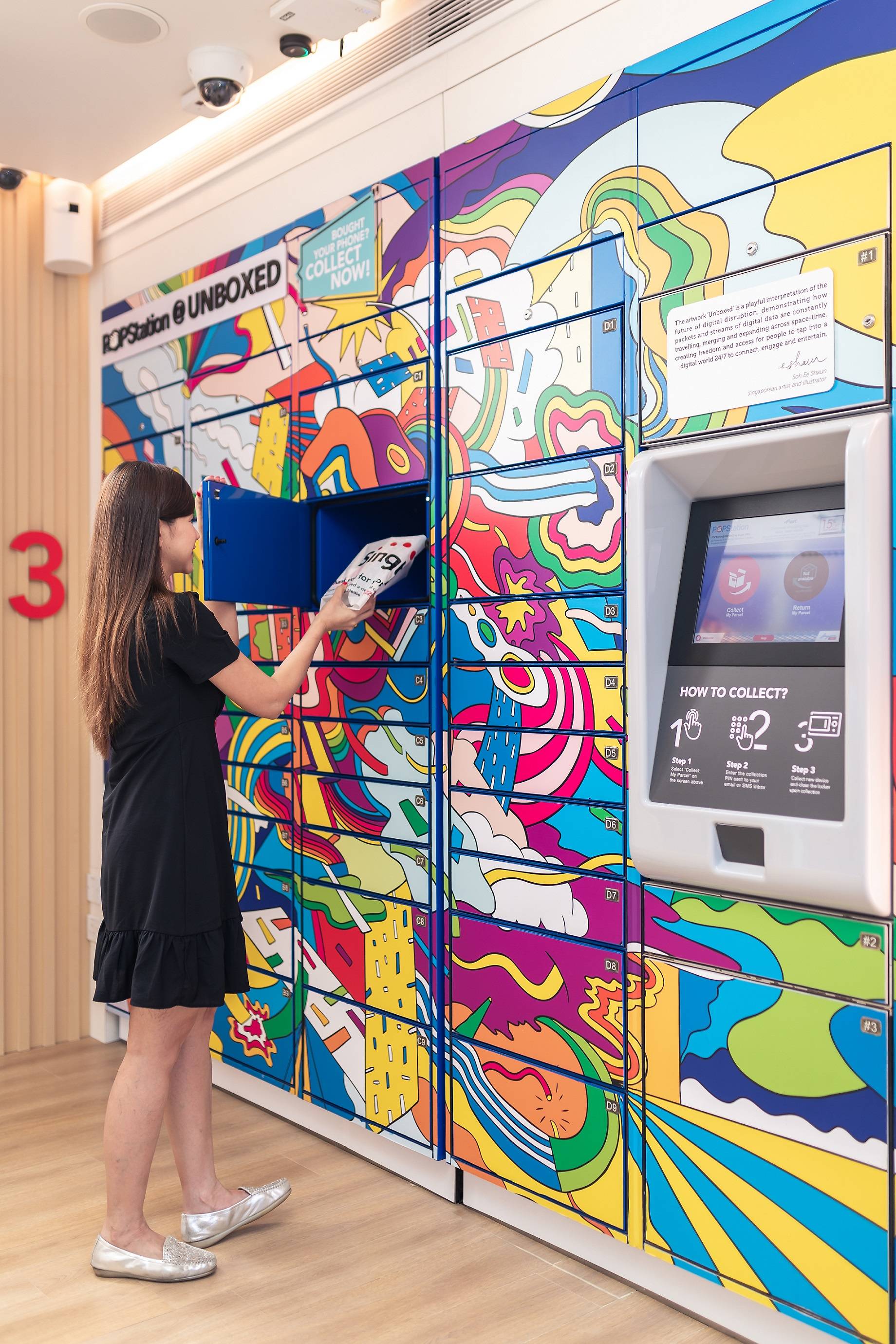
SINGAPORE: Local telco Singtel on Tuesday (Jun 4) unveiled UNBOXED, a round-the-clock unmanned pop-up store which it said is a first for Singapore.
Located at 20 Pickering Street, the 45 sq m outlet is kitted out with digital-enabled features for customers to browse and buy contract-free handsets and accessories, sign up for mobile plans and pay their bills.
At the video-assisted self-help kiosks, customers can conveniently sign up for mobile plans, make bill payments, top up prepaid cards and Dash wallets, and get instant SIM card replacements. (Photo: Singtel)
“In a first for Singapore, customers can consult with a roving live bot, which is powered by facial recognition technology, to receive personalised recommendations; try out phones; conveniently sign up for mobile plans at video-assisted self-serve kiosks; and immediately collect their purchased devices from the in-store POPStation,” Singtel said in a news release.
Customers who sign up for new mobile plans can immediately collect their purchased devices from the in-store POPStation. (Photo: Singtel)
It added: “Additionally, customers can browse and buy popular accessories such as headphones, phone cases, power banks and contract-free handsets.”
Powered by facial recognition, the store’s roving live bot meets and greets customers and provides personalised recommendations. (Photo: Singtel)
The store will move to a new location every few months, the telco said, to serve customers at high-traffic areas such as transport hubs and school campuses.
“Our digital transformation integrates online and offline customer touchpoints to deliver fresh and fuss-free buying experiences to consumers,” said Mr Yuen Kuan Moon, CEO of Consumer Singapore at Singtel.
“UNBOXED fulfils the needs of today’s consumer and provides a peek into the next-generation of retail – fast, instant, convenient and experiential.”
LEXINGTON, Kentucky: The US citizen charged with leaking 14,200 names on Singapore’s HIV registry and threatening further disclosures faced his first day of trial on Monday (Jun 3) in Kentucky, where the presiding judge refused his request to dismiss the case.
Mikhy Farrera Brochez, 34, sat quietly in a button-down shirt in a Lexington courtroom before US District Judge Danny Reeves, as prosecutors called more than a half-dozen witnesses, including FBI agents, a Ministry of Health leader and his own mother, to build their case.
Brochez has been jailed since he was found hiding in a Kentucky barn earlier this year and charged with transmitting threats for purposes of extortion and illegally transferring the identification of another person, US crimes that could carry several years in prison.
“This defendant … chose the wrong way” to obtain what he was seeking, assistant US attorney Dmitry Slavin told the jury on Monday.
The trial of Mikhy Farrera Brochez at a courthouse in Lexington,Kentucky. (Photo: Chris Kenning)
In hours of testimony, FBI agents and others said Brochez smuggled the database out of the country partly by sending it to his mother. He also kept it on seven devices including phones, a laptop and external hard drives, and uploaded it online to a Google drive.
From the US, where he lived after being deported last year, Brochez emailed links to media and government officials, witnesses said, threatening to disclose it more widely if Singapore opens an investigation into his case, do not close the registry and release his partner, Singaporean doctor Ler Teck Siang, from prison.
Ler Teck Siang at the Supreme Court on Mar 11, 2019. (Photo: Gaya Chandramohan)
Ler, who had access to the HIV registry as part of his work as the former head of the National Public Health Unit, was sentenced to two years’ jail in November last year.
Farrera Brochez, who has pleaded not guilty, is expected to testify on Tuesday before the case goes to the jury for deliberation. Judge Reeves on Monday rejected Brochez’s attorney motion to dismiss the case for insufficient evidence.
Dr Vernon Lee, director of communicable diseases for the Ministry of Health, testified on Monday that officials knew Brochez had emailed screenshots of the registry as early as 2016, but did not believe he had a full copy of it until January of 2019.
That’s when the Ministry announced that Brochez had leaked the names, addresses and medical information of 5,400 Singaporeans and 8,800 foreigners on the registry, which Dr Lee said was kept solely for public health purposes.
Dr Lee said that disclosure had fostered distrust among the HIV-positive community and undercut public health efforts.
It also sent shock through the community, leaving many on the list with deep “fear and anxiety” amid ongoing stigma, he said.
Many feared possible blackmail, discrimination in jobs and had even left some suicidal, he said. “This is something that is very personal and private,” he said.
Brochez, who had worked in Singapore as a lecturer, was initially jailed in Singapore in 2017 on charges including falsifying tests related to his HIV-positive status and gaining an employment pass.
Singapore in 2015 lifted its ban to allow HIV-positive people to enter the country, but most HIV-positive foreigners are not allowed to work in Singapore.
Brochez, who has alleged he was raped and tortured in prison, could argue on Tuesday that he was trying to bring attention to the registry, which some have argued adds to the stigma around HIV, the virus that causes AIDS.
Brochez’s attorney, Adele Brown, noted that it remains a crime to commit homosexual acts in Singapore, though the law is rarely enforced. Because the registry contained information on sexual preferences, she asked, “How do you know (the registry) couldn’t be used for a criminal prosecution?” Lee said it would not be used in such a way.
In the most dramatic moment of the day, Brochez’s mother, retired Kentucky school teacher Teresa King, testified briefly for the prosecution. She did not once look at her son.
Authorities said she shared his location at a barn in a remote Jackson County, Kentucky, where he appeared to be living out of his car when he was taken into custody in the spring.
King said she upload documents in 2016 at the request of her son, who said it “meant life or death,” but didn’t say what it was and told her not to look at it. He had asked her to send it back to him in 2018, she said.
After he berated and demeaned her, and that she demanded, he stop calling and emailing her.
Authorities have previously said they believe that Brochez also forged some degrees including a doctorate from the University of Paris. In 2010, he had told a newspaper that his mother was a renowned professor of child and adolescent psychology in the UK.
On Monday, Judge Reeves dismissed the jury after Brown said Brochez needed anti-anxiety medication to testify and was not offered it on Monday. The trial is set to reconvene on Tuesday.
SINGAPORE: As a teenager three decades ago, Mr Alfred Siew watched bulldozers take apart the Berlin Wall on a grainy television, believing that the Cold War, along with the tensions and distrust among nations that came with it, was gone for good.
This was a time after China had opened up to the West, and astronauts from Russia and America were working together in space, he reminisced.
“The world was meant to become more united and stronger together after that,” said Mr Siew, 44, a technology journalist who co-founded the website Techgoondu.
But Cold War-era rhetoric has once again seeped into the lexicon as the United States and China wage a trade and tech war against each other, threatening to undermine the globalised and free trade environment reigning today.
U.S. President Donald Trump takes part in a welcoming ceremony with China’s President Xi Jinping at the Great Hall of the People in Beijing, China on Nov 9, 2017. (File photo: REUTERS/Damir Sagolj)
“This is not the future that was envisioned,” said Mr Siew wistfully.
Since the trade war kicked off in earnest in 2018, the US has imposed punitive tariffs against some US$250 billion (S$344.4 billion) worth of Chinese goods while threatening to tax another US$325 billion of Chinese imports. China hit back with its own tariffs on US$110 billion of US goods.
The US has accused China of forced technology transfer, intellectual property protection, non-tariff barriers and cyber theft. China has rejected the US allegations.
In its latest move, the US placed Chinese phone manufacturing giant Huawei on a US export blacklist on May 16, amid concerns in Washington that Huawei’s devices could be used by China to spy on Americans.
The move, said Singaporean and international analysts, threatens to kick-start a technological cold war — or a “digital iron curtain” — that will have far-reaching effects on the rest of the world, even though Huawei has been given a 90-day reprieve which will expire in August.
Sure enough, in a retaliatory move, China’s Commerce Ministry said on Friday (May 31) that it will draft a list of foreign companies, organisations and individuals that it deems “unreliable” for harming Chinese companies, state-run China National Radio reported.
FILE PHOTO: A woman looks at her phone as she walks past a Huawei shop in Beijing, China May 16, 2019. (Photo: REUTERS/Thomas Peter/File Photo)
The recent developments crossed a line, said Mr Siew.
Smartphones and communication technology. These were meant to bring the world together, but are now used as weapons in a cold war.
Days after Washington’s announcement, Google, Qualcomm, and other US-based tech companies and component manufacturers revoked Huawei’s licence to manufacture products or use software provided by them.
The threat to Huawei, which depends on its US partners, is an existential one. Its chief executive Ren Zhengfei told the Chinese press:
The media should understand that these US companies and Huawei share the same fate. We are both players in the market economy.
Even in the nascent stage of a tech war, the man in the street has not been spared of the impact: Mobile phone shops in Singapore have stopped buying used Huawei phones from customers. The shops say they are concerned that they would not make a profit as these used Huawei phones may no longer command high prices — and there may be no takers anyway.
Meanwhile, Singaporeans, being a practical lot, are mostly concerned about whether their Huawei phones can still work the way they are supposed to, Mr Siew noted.
A visit to a Huawei concept store in VivoCity last week during the evening found the outlet to be largely devoid of customers, despite the large advertisements for its P30 Pro mobile phones throughout the mall. A sales attendant shared with this reporter how quiet his store had been since news broke of the Google ban.
A Huawei shop is pictured in Singapore August 8, 2018. (Photo: REUTERS/Edgar Su/Files)
Placed at the front of the store was a sign that read:
Huawei will continue to provide security updates and after-sales services to all existing Huawei and Honor smartphone and tablet products, covering those that have been sold and that are still in stock globally.
It was a line all too familiar for the lone sales attendant, who recounted that for the entire day, he had to inform the trickle of walk-in customers about the US-China situation and why buying a Huawei phone now comes with caveats.
“I’ve memorised and repeated the same statement many, many times. I tell people, ‘it’s the trade war, we have no choice, perhaps wait till August?’” he said.
WORLD BRACES FOR A DRAWN-OUT CONFLICT
The Huawei saga might not be resolved so quickly, said analysts.
They said the Huawei export ban and the tit-for-tat tariffs between the two superpowers are the opening salvos of what could be a long, drawn-out conflict over technological and economic primacy.
For some, the US-China trade war has historical echoes of the Cold War fought between the capitalist US and the communist Soviet Union from the 50s until the 90s.
The Cold War was also marked by a technological conflict — culminating in the space race — as well as espionage and a build-up of military forces by both sides.
Within US foreign policy circles, it has become increasingly safe to say that the US and China have entered what amounts to “a Cold War type of relationship”, wrote Fulbright University Vietnam’s Professor Christopher Balding on his website Baldingsworld.com.
A trade war between the US and China could last for years, experts say, with no clear victor. (Photo: AFP/JOHANNES EISELE)
The expert on China said:
If you believe the relationship between the US and China, whatever academic or popular term or historical analogy you prefer, is fundamentally in opposition, rather than a narrow or specific conflict over a technical dispute over financial aid to a specific industry, it is not a leap to at least tolerate the Trump administration’s actions.
The trade dispute is a mere pretext for the conflict between the two major powers, added Prof Balding, noting that tariffs or other punitive measures are all part of the confrontation.
However, Prime Minister Lee Hsien Loong stressed on Friday that there is “no strategic inevitability about a US-China face-off”. “But at the same time, if such a face-off does happen, it will be nothing like the Cold War,” said Mr Lee, noting that there is “no irreconcilable ideological divide” between the two superpowers.
Speaking at the Shangri-La Dialogue, Mr Lee warned that both countries will be making “a serious mistakes” if they continue the present path.
Should a “new Cold War” arise, there can “be no clear division between friend and foe”, he reiterated. Neither is it possible to create the equivalents of a North Atlantic Treaty Organisation or Warsaw Pact, with a hard line drawn through Asia, or down the middle of the Pacific Ocean, he added.
Prime Minister Lee Hsien Loong speaking at the 2019 Shangri-La Dialogue on May 31, 2019. (Photo: Gaya Chandramohan)
Assistant Professor Selina Ho said that since the end of the Cold War, the US had operated on the premise of bringing China into the liberal international order, rather than leave it out.
“However, American policymakers have become increasingly disillusioned that China will transform into what the US hopes it will be, and there have been increasing concerns that China has emerged as a strategic competitor, primarily in the economic and technological spheres, but also in the military sphere,” said Asst Prof Ho, who specialises in Chinese politics and foreign policy at the Lee Kuan Yew School of Public Policy.
This goes beyond US President Donald Trump’s administration and started as early as 2008, when the global financial crisis exposed the weakness of Western economies and produced a sense of hubris among the Chinese, she added.
In 2015, during Mr Barack Obama’s second term as president, a US foreign relations report called for Washington to create “a new grand strategy towards China that centres on balancing the rise of Chinese power rather than continuing to assist its ascendancy”.
That same year, China charted its own economic path with the launch of “Made in China 2025”, which was seen as a direct threat to American primacy. The Chinese state-led industrial policy would make China a dominant force in high-tech manufacturing of quality goods.
“The US perceives this as a direct threat,” said Asst Prof Ho.
The aim of the Trump administration is to dislodge China from the central role it plays in the global value chain. It is forcing countries to look elsewhere for technology, supplies, and manufactured products.
For now, China has eased its Made in China 2025 rhetoric, knowing that it has caused alarm in the US and Europe.
Chinese President Xi Jinping attends the Conference on Dialogue of Asian Civilizations in Beijing, China May 15, 2019. (Photo: REUTERS/Thomas Peter)
“However, it has continued to pursue the plan’s goals. This means that the technology war will likely continue and escalate as both governments have shown no signs of backing off,” Asst Prof Ho said.
HOW THE GLOBAL PRODUCTION CHAIN COULD BE AFFECTED
Unlike the tussle between communism and capitalism in the previous Cold War, ideology does not play a critical role in the current strategic competition between the US and China, said Asst Prof Ho.
But if the trade war continues to escalate, it could unravel the global production chain that emerged in the 80s.
According to the World Trade Organisation (WTO) and the World Bank, this global chain is responsible for more than two-thirds of the world’s trade. Manufacturers could tap the competitive advantages of various countries to produce specialised goods that would otherwise cost far more to manufacture.
Counterpoint Technology Market Research associate director Tarun Pathak said devices today are far more complex than the past, comprising electronic components from all over the world.
But over time, the balance of power of the world’s tech and electronics industry became concentrated in only two countries — China and the US, said Mr Pathak, a mobile industry consultant who is based in India.
The US took an early lead as the Internet and electronic giants — such as Google and Microsoft — sprouted up quickly in Silicon Valley. China’s domestic policies allowed its own state and private Chinese tech firms to flourish without strong external competition.
“The US has its strength in research and talent. On the other hand, China plays on its strength as an exporter to the world, and sees the rest of the world as its consumers,” said Mr Pathak.
In a sense, the trade and tech war today is inevitable, said Mr Pathak. Both countries want more control, thinking that one could gain simply by penalising the other party.
China imports almost four times less than it exports to the United States (Photo: AFP/STR)
“Both sides have their own set of beliefs on how to resolve the trade dispute, but they are making assumptions about the other side. The unfortunate side effect is that it will impact all other companies and component players that are a part of these global value chains,” he said.
Asked about the Republic’s exposure to a tech war, a Ministry of Trade and Industry (MTI) spokesman reiterated that Singapore is a node in this global community, hosting a diverse portfolio of tech companies.
“Singapore has been able to do this because of an open, rules-based multilateral trading system anchored by the WTO. We continue to support this because it provides a stable and predictable global trading environment, and gives all countries a shared interest in one another’s prosperity and stability,” the spokesman said.
All countries should collectively work to maintain and strengthen it. Singapore believes that trade disputes should be resolved within the multilateral WTO framework.
Still, UOB economist Barnabas Gan noted that Singapore’s electronics exports are at a level which is among the lowest recorded, coming in at S$2.72 billion for March.
“Singapore is a price taker. Whatever that is happening between US and China will invariably affect us deeply,” he said.
A China-US spat is hurting global trade expansion. (AFP/STR)
Nevertheless, Asst Prof Ho added:
But there are opportunities as well, because when the global value chain is reconstructed, Singapore can leverage on its strengths to become a key node.
Countries like Vietnam could also benefit if these supply chains re-orientate to South-East Asia, said Mr Pathak. But he stressed that this is a distant hope since affected companies need around two years and a lot of investment to relocate. Overall, the world will suffer a net loss as a result of the tech war, he said.
Professor Fu Xiaolan, the founding director of the Technology and Management Centre for Development at Oxford University, said if the value chains are broken, there will be significant far-reaching effects that could fragment global production and widen the divide between those who can easily access technology and those who cannot.
Prof Fu was appointed by the United Nations to participate in high-level talks between nations on technology facilitation, and also to the UN’s technology bank for poor countries.
“For innovation and knowledge creation to happen, what we need most is collaboration, and what we need least is protectionism,” she said.
THROWBACK TO US-JAPAN SPAT
Prof Fu noted that the current conflict bears a similarity to the industrial rivalry between US and Japan in the ‘80s and ‘90s. Japan was the second largest economy in the world then.
At the time, the US was saddled with a massive trade deficit and had made it a goal to protect its domestic economy from countries such as Japan, which was enjoying a trade surplus advantage due to its weak yen.
Japan was portrayed as a clear threat to US economic interests by the administrations of Mr Ronald Reagan and Mr Bill Clinton.
Former president Ronald Reagan, seen here with wife Nancy, rose from Hollywood to the White House. (Photo: AFP/MIKE SARGENT)
In a letter to The New York Times in 1981, Mr Shannon Wall, the president of the National Maritime Union of America, wrote:
We are suffering an economic Pearl Harbour while editorial writers continue to discourse on the principles of ‘free trade’ which are observed by no other nation, particularly Japan.
Five major economies — the US, Japan, Britain, France and West Germany — agreed in 1985 to a joint currency intervention plan to level the playing field, known as the Plaza Accord. Following which, the yen shot up dramatically against the US dollar, lowering the US trade deficit as American exports grew.
But Washington continued to pursue punitive trade action against Tokyo for unfair trade practices, such as creating a cartel for semiconductor chips. The US imposed a 100 per cent tariff on Japanese imports in 1987.
After that, the Japanese economy ground to a halt as prices of Japanese products surged beyond economic fundamentals. The asset bubble soon burst, and Japanese citizens responded by saving more and spending less, creating a deflationary spiral.
Japan’s economy is still recovering from its infamous “lost decade”, which remains a hotly debated topic.
Such experiences could give useful insights, said Prof Fu, adding that these global perspectives from other countries can be a major force to help resolve the current conflict, rather than leaving it to either China or the US to set the stage.
If the world stands together, these other voices can bring about a more objective third-party (approach) to think about the global challenge of protectionism.
On its part, Singapore is doing just that by working with like-minded countries to uphold and update the global trading system.
Earlier in May, Trade and Industry Minister Chan Chun Sing wrote on Facebook that the Republic is “pushing for an integrated global digital economy, rather than risk a fragmented world where small countries like Singapore are shut out”.
Minister for Trade and Industry Chan Chun Sing speaking to reporters on Apr 5, 2019.
WIDER IMPACT
As trade tensions persist, regional countries could be politically pressured to choose between the two powers, said experts.
Asst Prof Ho said: “Politically and strategically, countries in the region might have to start taking sides as it becomes harder for countries to tread the fine balance between the US and China.”
In South-east Asia, many countries traditionally see the US as a security guarantor and China for economic reliance, she said. These lines are more blurred now, she added.
She noted that the US administration has started to ask its allies in Europe and Latin America to boycott Huawei manufactured equipment in their rollout of fifth generation (5G) networks, citing security concerns.
Currently, Huawei has a headstart on the rest of the world in its 5G network equipment.
Said Prof Fu: “5G is a technology which can be highly regulated through laws that can ensure privacy standards are upheld. That is what governments should do, rather than ban a technology from a certain provider.
The reality is that the rollout of 5G might have to be pushed back and countries will have to weigh the diplomatic choice today.
5G networks are the next big leap forward for mobile and wireless communication, boasting 20 times the speed over existing 4G networks.
Beyond faster speeds, these networks enable other Internet-dependant technologies, such as autonomous vehicles and smart cities, to function properly.
A journalist uses his mobile phone to take a picture of the 5G logo prior to the auction of spectrum for 5G services at the Bundesnetzagentur head quarters in Mainz, Germany, March 19, 2019. (Photo: REUTERS/Kai Pfaffenbach/Files)
Ms Stephanie Syptak-Ramnath, interim charge d’affaires at the US Embassy in Singapore said:
The way that 5G is developed is going to have a lasting and profound impact on this world in which we live, and we encourage every country to look very carefully at every aspect of their choices in 5G networks.
An Info-communications Media Development Authority (IMDA) spokesman said that Singapore encourages “vendor diversity in its telecommunication systems to mitigate risks from dependency on any one vendor”.
The onus also falls on telco operators to ensure that the equipment purchased from vendors meets commercial operational needs and regulatory requirements in service quality, resilience and security, he said.
The IMDA has launched a public consultation on the 5G rollout, and is proposing to deploy 5G networks in Singapore from 2020.
WHAT IT MEANS FOR CONSUMERS
While there are deep, long-term geopolitical, economic and technological implications of the trade war and the Huawei ban, Singaporeans whom this reporter spoke to were mainly concerned about one thing for now — will their devices still work as normal?
Even that is a tough question to answer, said Ms Lim May-Ann, managing director of research consulting firm TRPC.
Huawei had a 13 per cent share of the Singapore smartphone market in 2018. Apple was first, at 37 per cent, followed closely by Samsung at 34 per cent, according to data from market intelligence firm IDC.
A Huawei mobile phone display at Beijing International Consumer Electronics Expo in Beijing on July 9, 2018. (Photo: AFP / WANG ZHAO)
Several key component players said they would cut ties with Huawei soon after the Google ban was announced. This includes UK chip designer ARM, whose exit would deal a major blow to Huawei as it uses the former’s designs to manufacture its own processors.
There is growing anxiety among Huawei users, some of whom have also inquired their telcos about refunding or replacing their phones with another brand.
For now, there are many uncertainties but few answers, said Huawei customer Terence Lim, 30, a system administrator.
“I have only just bought my Huawei phone in April and now, I might need to buy a new phone off-contract,” he lamented.
Huawei has said it is prepared for “a protracted battle” with the US restrictions. It plans to roll out its own operating system, HongMeng, in a China launch later this year. An international release is timed for 2020.
Details are scant on HongMeng, a replacement of Google’s Android platform. One top concern of tech watchers is whether the phone will remain fully compatible with Android applications.
Such worries over compatibility are a potential sign of what may happen if the US starts to target more Chinese tech companies, said TRPC’s Ms Lim.
“If the US ban results in a global boycott of Chinese technology in general, we could see a fragmentation of how 5G technology develops — much like how we had two standards for VHS and Betamax. The markets will have to decide what they want,” she said.
Interoperability of technology will take a serious hit, added Mr Siew.
He said: “When you take your phone anywhere in the world (now), it just works. It took years, generations, for 4G to be unified in such a way. We no longer have to worry about whether our phone is compatible with GSM or CDMA networks.
Journalists watch a trailer at the launch of new 5G Huawei products in Beijing in January (Photo: AFP/FRED DUFOUR)
SINGAPORE: Nearly 20 personal mobility devices (PMDs) were impounded during a three-day sting, according to a Facebook post by the Land Transport Authority (LTA) on Monday (Jun 3).
More than 60 active mobility enforcement officers were mobilised during the operation over the weekend at Hougang, Telok Blangah and Tiong Bahru.
A total of 31 offences were detected, LTA said, adding that many of the offences involved non-compliant devices and users riding on the wrong paths.
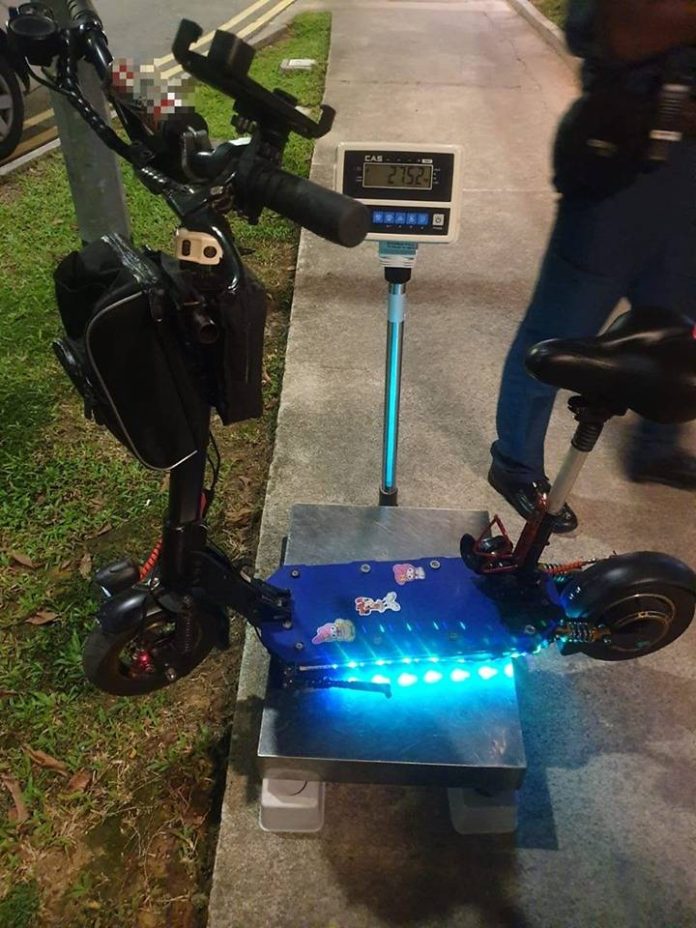
For example, two users were caught riding devices that weighed about 28kg and 33kg respectively. PMDs cannot weigh more than 20kg.
Those who make false declarations during their e-scooter registration can be fined up to S$5,000 and/or jailed up to 12 months, it added.
The government announced last year that it would make the registration of e-scooters mandatory, with owners being able to register their devices with the authorities from Jan 2 this year.
From Jul 1, it will be an offence to “ride or cause another person to ride” an unregistered e-scooter on public paths.