SINGAPORE: He slipped, he fell and then he scored.
A composed, clinical finish from substitute Ikhsan Fandi was enough to hand Singapore’s U22 side the win as they beat Thailand 1-0 at the Jalan Besar Stadium on Sunday (Jun 9) to win the Merlion Cup.
A 36th minute goal from Ikhsan separated the two sides, who faced off in the final following comfortable wins over Philippines (3-0) and Indonesia (2-1) on Friday.
Ikhsan Fandi rounds the Thailand goalkeeper en route to scoring. (Photo: Matthew Mohan)
The home side had the first chance of the game as Irfan Fandi’s acrobatic effort off a set-piece came close.
The away side fired back with a salvo of their own almost immediately as a cross-field pass found a Thai attacker onside but the combination of Irfan and Singapore custodian Zharfan Rohaizad thwarted the opportunity.
Thailand grew into the game, and continued to dominate possession but a series of crunching tackles from Singapore midfielder Joshua Pereira stemmed the tide.
Joshua Pereira attempts a tackle during the match. (Photo: Matthew Mohan)
Then came the moment of brilliance from Ikhsan who rounded the Thai goalkeeper, and tucked home a left-footed strike despite losing his footing seconds before.
The second half followed more of the same as Singapore’s rearguard held watertight.
Singapore’s Joshua Pereira tussles for the ball. (Photo: Matthew Mohan)
The Young Lions reduced the Thais to half-chances, with playmarker Hami Syahin dictating the tempo. Fandi Ahmad’s side ultimately held on for the victory, to the delight of the partisan home crowd.
In the day’s earlier game, Indonesia hammered the Philippines 5-0 to finish the competition in third place.
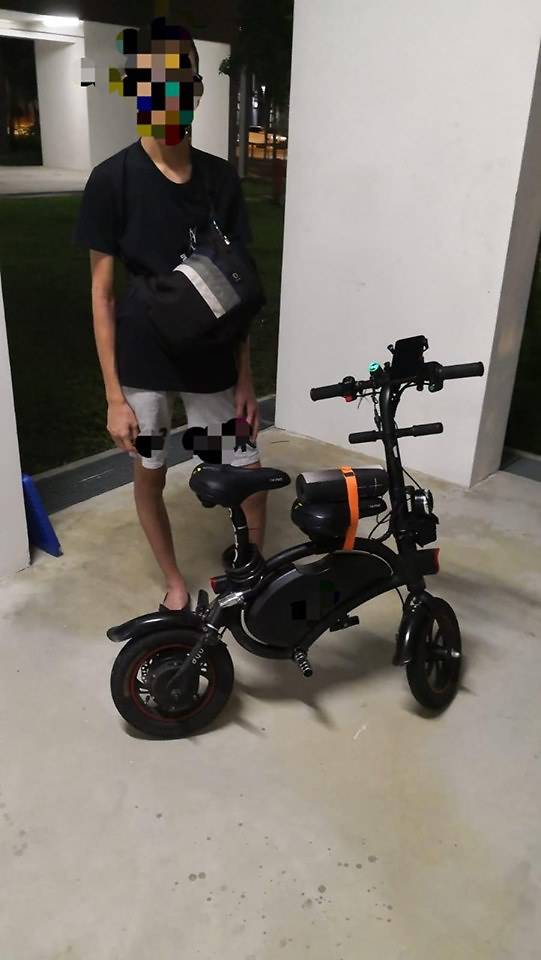
SINGAPORE: Fourteen personal mobility devices (PMDs) were impounded after several riders were caught flouting rules during enforcement operations over the weekend.
The Land Transport Authority (LTA) said in a Facebook post on Sunday (Jun 9) that 70 active mobility enforcement officers and Singapore Police Force officers were mobilised over the weekend at Tampines, Seng Kang and Ang Mo Kio.
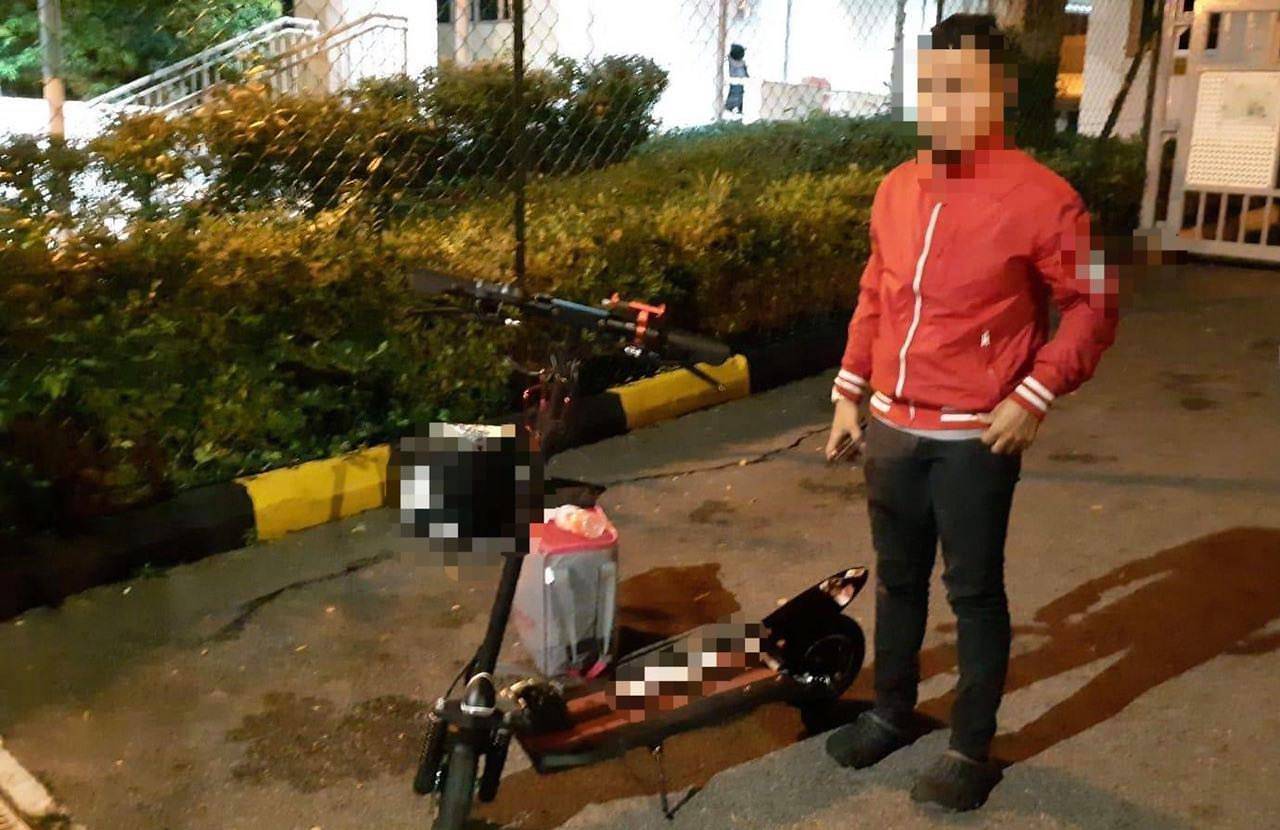
This rider was caught displaying a false Identification Mark on his e-scooter. (Photo: Facebook/Land Transport Authority)
A total of 23 offences were detected, LTA said, with several of the offences involving non-compliant devices and users speeding or riding on roads.
Other offences included users failing to stop when they were required to do so, and displaying a false identification mark on an e-scooter.
This rider was caught in Tampines riding a PMD that weighed more than 45kg. (Photo: Facebook/Land Transport Authority)
Over the weekend, one rider in Tampines was caught riding a PMD that weighed more than 45kg, LTA said.
The permissible weight limit for PMDs is 20kg.
Another rider, who was seen riding his PMD on a road, failed to stop when officers asked him to do so.
SINGAPORE: During one of our programme on body safety skills, a class of six-year-olds were shown various scenario cards depicting good and bad touches.
When a particular card showed a man touching a boy on his groin area, a boy in class insisted that it was a good touch, despite the rest of his classmates disagreeing.
When asked why, the boy replied that his father, as well as his father’s friend, had taken off his clothes and touched his penis.
To the boy, this was part of their play and because he had not been taught body safety skills before.
He did not realise that he had been sexually abused.
There has been much public attention on the case involving Australian Boris Kunsevitsky, a diagnosed paedophile who is currently facing charges for committing child sexual abuse on dozens of victims.
This case hits especially close to home, since five of his victims were from Singapore.
Even so, it is crucial to highlight that it is not just paedophiles who may sexually abuse children. There are also regressed offenders who typically have no sexual interest in children, but commit sexual abuse during times of stress; such as when they encounter financial pressures or marital strain.
We also often think that sexual abuse perpetrators are strangers, when in reality a majority of perpetrators are people familiar to the children. These perpetrators take advantage of their relationship with the children to groom them, sexually abuse them, and get them to keep the abuse a secret.
The case of Kunsevitsky is one of the latest in a spate of child sexual abuse cases reported in the news in the past year.
Child abuse investigation statistics released by the Ministry of Social and Family Development revealed that in 2018, there were 248 sexual abuse cases that were investigated. Almost all involved a family member or relative.
WHY TEACH YOUNG CHILDREN ABOUT BODY SAFETY SKILLS
Child sexual abuse is often shrouded in secrecy and shame, and younger children are particularly vulnerable.
Cases are often under-reported as they may not have the linguistic skills to verbalise the abuse. Some may not even understand that abuse has happened to them in the first place
For these reasons, Singapore Children’s Society has conducted KidzLive: I Can Protect Myself, a body safety skills programme since 2000.
Singapore Children’s Society started a sexual abuse prevention programme, KidzLive: I Can Protect Myself in 2000 (Photo: Facebook/Singapore Children’s Society)
For the last nine years, we have focused our efforts on pre-schoolers and have reached over 10,900 young children in Singapore. The key elements in our programme include guiding children to be able to identify bad touches and inappropriate actions, and to tell a trusted adult should sexual abuse happen.
Even though KidzLive is a prevention programme, we have encountered a handful of sexual abuse disclosures, like the case shared at the beginning of this commentary. This case was screened in for investigation by the Child Protective Service (CPS) and the boy was placed temporarily in his grandmother’s care.
These disclosures, which were flagged to either the CPS or the Early Childhood Development Agency for further intervention, demonstrate that young children can speak up about abuse if given the right tools.
In the course of our work, we have encountered our fair share of sceptics who question whether the children are actually able to grasp the programme’s messages and whether we are, in a crude sense, corrupting their minds.
What we have learnt is quite the contrary — our programme evaluation has shown that young children have the capacity to pick up and retain body safety messages.
KEY BODY SAFETY MESSAGES
Body safety teaching is part of sexuality education, and it takes a wider perspective than sex education, which is more narrowly concerned with explaining the act of sex.
Sexuality education, instead, focuses on equipping children with the skills to make responsible decisions about their social and sexual relationships.
File photo of children in pre-school.
Just like academic learning, body safety messages have to be carefully calibrated to children’s cognitive and sexual development. For example, with children aged two or three, we can start by using the proper terms for private body parts and emphasising the “underwear rule” – and that no one should see or touch the parts covered by their underwear.
The key is in keeping our messages age-appropriate and making use of everyday teachable moments. Some essential points to note are:
For adults to use the proper terms for private body parts. This helps children develop a healthy mindset towards their own bodies. Emphasise that the parts covered by their underwear are private and not for anyone else.
When children pose questions, keep answers as factual and simple as possible. After explaining, ask children questions to ensure that messages have been understood correctly.
Tell children that even familiar people should not behave inappropriately towards them. Empower them to be assertive in saying “no” to unwanted touches, including hugs and kisses.
Remind our children that they should always tell their trusted adults whenever they felt uncomfortable with unwanted touches, and to keep telling until someone listens. Rehearse telling so that children would know exactly what to say, and who to tell, should the situation arise.
PARENTS AS CHILDREN’S FIRST EDUCATORS
Parents are the best people to build the foundation for healthy sexuality.
Research has shown that children who receive sexuality education are less likely to be obsessed with the “mystery” of it all. Being open in communicating such messages also leads to more responsible sexual behaviours and delayed sexual initiation.
(Photo: Facebook/Singapore Children’s Society)
In this digital era, children have access to mobile devices at an even younger age. Such access is often unsupervised and this puts children at a higher risk of stumbling upon sexually inappropriate or exploitative content online.
It is increasingly pertinent for parents to maintain an open communication with children about their lives and about general advancements in technology, so that we are able to understand what they are doing in the online world.
Times may have changed, but the way parents engage with their children, in setting boundaries and teaching about respectful relationships should remain the same.
Adults also need to be supportive and assuring to children who disclose abuse. We have to be mindful of our own tendencies to want to deny, rationalise or minimise the abuse incident.
To provide support to parents and caregivers, Children’s Society also conducts teacher trainings and parents’ talks such that caregivers can also be on board with reinforcing body safety skills. Just this past month, we launched a storybook entitled Jun and the Octopus, that caregivers can use to kick start meaningful conversations about body safety.
EFFORTS MOVING FORWARD
On the legislative front, the Singapore Government has been making progress in enhancing protections for vulnerable victims of sexual offences, including children, through the Criminal Law Reform Bill. The bill provides for extra-territorial jurisdiction in the prosecution of child abuse material offences.
(Photo: Unsplash/David Clarke)
This means that sexual abuse perpetrators from overseas, like Kunsevitsky, who possess, produce or distribute child abuse material involving children in Singapore, are liable to criminal charges under our country’s laws.
We hope the Government could also look into implementing more stringent measures against known sexual abuse perpetrators.
These could include providing for the mandatory screening of would-be employees at child-centric organisations against the sex offenders registry, and tagging offenders so their movements in and out of the country are restricted.
Organisations also have the responsibility to undertake child-safe practices, such as having clear codes of conduct when interacting with children and youth, robust recruitment processes and concrete risk management strategies should allegations of abuse arise.
It takes a community effort to deter potential perpetrator and keep our children safe.
With parents and other caregivers around the children taking proactive steps in imparting body safety skills and supporting children who disclose abuse, we can, and will, create safer spaces for our children to grow up in.
Alfred Tan is CEO of Singapore Children’s Society.
SINGAPORE: Elbows pressed against concrete, body parallel to the ground, the soldier holds steady.
First are the planks, next the crunches, and then the stretches.
But there are no yelling of instructions, no rapid counts of four, no groans of sweaty anguish.
All Corporal First Class Lionel Tan has is the light emanating from his digital watch to keep the time and the rhythm of his bunkmates’ snoring to keep him company.
The sun has yet to rise at Mandai Hill Camp, but with his muscular frame wedged in the space between two bunk beds, Tan’s day has just begun.
This daily routine isn’t merely about being fighting fit, 22-year-old Tan’s goal is to be match fit.
And he will do anything in his power to make sure that is the case.
“My friends are like: ‘Who is that on the ground?'” recalled Tan. “I remember my camp mate saying: ‘6.30am is our time to get up but why is this guy awake at 6 am?’ He was saying like this guy is crazy!”
Not that Tan would disagree. He is indeed crazy – about football.
A signaller with the 1st Singapore Infantry Regiment, Tan is also a footballer with Singapore Premier League side Young Lions and represents the nation at the U-22 level.
But while most footballers opt to serve the full length of their National Service (NS) before resuming their football careers, Tan has gone down a different path.
Months away from his Operationally Ready Date (ORD) in August this year, Tan opted to interrupt his time in the army in pursuit of a dream.
A BITTER BLOW
A former graduate of the Singapore Sports School and the National Football Academy (NFA) set-up, Tan’s budding club career has gone full circle once.
In 2016, he grappled with the rejection of not making the Young Lions squad after graduating from the NFA.
Fast forward three years, and he donned the skipper’s armband for the very same team he was deemed not good enough for.
Lionel Tan during a training session with the Singapore U22 team on Jun 6. (Photo: Matthew Mohan)
But it is on the international front where Tan has some unfinished business.
In 2017, he was selected for the SEA Games – but failed to play a single minute for Singapore as the Republic crashed out in the group stages.
Fast forward two years, and he now has “a second chance”.
“After that tournament, I reflected,” said Tan, who has also featured for Home and Hougang United. “I was very upset and I took a few days to get over it.
“When I went back to Hougang for training, I didn’t speak much of my experience at the SEA Games because it wasn’t the best of memories, especially when Singapore didn’t qualify as well. After maybe about two, three weeks, I stopped football and enlisted.”
ARMY FATIGUES, BUT NO FOOTBALL FATIGUE
Upon completing his Basic Military Training in December last year, Tan was handed his new posting as a signaller.
Lionel Tan fends off a defender in Singapore U22s’ 3-0 win over the Philippines in the Merlion Cup on Jun 7. (Photo: Matthew Mohan)
“It was tough initially to juggle between football and being in the army,” he explained. “Although I had the support of my commanders, I wanted to be fully focused and have energy when I came out of camp for training sessions.”
But, Tan could only book out on Friday evenings, and was only permitted to attend training sessions on weekdays if he had no in-camp activities after 6pm.
Generally, he was permitted to leave two hours prior to training and had to return to camp two hours after. But that wasn’t always possible.
“There was a time where I had to go through the signal course and what happened was that I couldn’t even come out to train,” Tan recalled. “Sometimes in army, it’s just like there’s something that will come up at the last minute and I can’t go out.
“In the army, you’re not in control of your time, you’re not in control of what you are doing.”
But rather than mope about, Tan channelled his frustrations more productively.
While others used pockets of free time in the afternoon to tune in to their favourite TV shows, Tan snuck off to the gym.
When he was not able to leave camp in the evenings, Tan took the opportunity to work on his core muscles.
“My bunkmates think that I’m crazy at times but they do get influenced and joined in (my workouts), and it is good that way,” he said.
But with the SEA Games looming at the end of 2019, Tan had to make a drastic change to chase the opportunity. This meant putting NS on hold to rejoin the Young Lions in order to stake a claim in coach Fandi Ahmad’s U-22 squad.
With the help of the Football Association of Singapore, Tan applied for disruption in February, and has been allowed to put NS on hold until December.
“I had to be really patient throughout this journey and when they told me there was a possibility for disruption … I said: ‘Yeah sure, go ahead”,” said Tan. “In my head, I knew that this is my last SEA Games and I wanted to do something for the team.”
“Full-time National Servicemen may be granted time-off to train and win medals for Singapore in major international competitions, if they are assessed together with Ministry for Culture, Community and Youth, to have the potential and commitment to advance our national interests,” said the Ministry of Defence in response to a query from CNA. “Their commitment to and performance in National Service (NS) are also taken into account. Each request is assessed on a case-by-case basis and subjected to exigencies of service.
“Lionel Tan has been granted disruption from NS from Mar 7 to Dec 12 to train and represent Singapore in the 2019 Southeast Asian (SEA) Games. MINDEF and the SAF wish him all the best in the SEA Games.”
With this green light, Tan has been able to play for the Young Lions side this season and has also featured in Singapore’s unbeaten Football Confederation (AFC) Under-23 Championship qualification campaign in Mongolia.
The Republic registered a 3-1 win against the home nation, and two 1-1 draws against North Korea and Hong Kong. The scorer of Singapore’s equaliser against Hong Kong? None other than Tan.
“I remember that when we were in Mongolia, my camp mates were in Taiwan training. So if I was not at the AFC (Championship qualifiers), I would have been Taiwan,” said Tan. “When I was in Mongolia and in Japan (for a training camp), we still kept in touch. I would check on them and ask how they are doing.”
Regardless of whether he’s in camp or out, it’s all about the team for Tan, and this is made abundantly clear when Fandi talks about his player, who has also been selected for Singapore to play in this weekend’s Merlion Cup.
The tournament features home side Singapore, as well as regional rivals Thailand, Indonesia and Philippines.
Tan was part of the side which beat Philippines 3-0 on Friday and Singapore will face Thailand in the finals on Sunday.
“I’m happy for him that he’s in the team,” Fandi told CNA. “He has that passion and he is really motivated to help the team … I really appreciate what he has done and I hope he can improve with the players we have now.”
‘SOMETHING TOLD ME I NEEDED TO DO IT’
Tan’s decision is not without its risks. For one, the return to NS in December will delay Tan’s ORD date and eat into his pre-season next year.
Lionel Tan in action for the Singapore U22 side during their game against the Philippines on Jun 7. (Photo: Matthew Mohan)
“First of all, I don’t know if clubs want me considering that at the start of the season, you can’t be with the team training for pre-season and everything,” said Tan, who will be ineligible to rejoin Young Lions as he will be too old. “The main concern for me is career-wise.”
“Even though he doesn’t know what the outcome may be, he is willing to sacrifice, whereas there are some players not willing to sacrifice,” added Fandi. “Football not only requires good technical ability, but personality, intelligence, it’s all important.
“He’s a brave guy, I respect that and he’s always willing to listen and learn.”
Tan isn’t alone in making this leap of faith – he has the backing of his fellow enlistees as well as his commanders.
“At first when I spoke to my CO (commanding officer), he said go on, because he knows that is my dream and after all, I want to be a footballer. He’s quite supportive of me,” explained Tan. “Although I was frustrated, I try to speak with the commanders and the closer ones understand me better and they respect my decision to take the option to disrupt.”
Tan’s parents stand by him too.
“My mum was very supportive of me and she knows I want it as a career. She told me go ahead and do it, as long as you are passionate about it and you want to do it.
“Even if my parents didn’t allow me (to do it), I would have gone ahead!” quipped Tan with a laugh. “99 per cent of the people told me that I should have not disrupted because it would affect my career in the long run. Most people would want to ORD as soon as possible.
“I still have the fire, the passion to do well at the SEA Games. I don’t know why but something told me that I needed to do it.”
SINGAPORE: Wedged in between a hair salon and an interior design office, Meng’s Clinic stands like a time capsule in the middle of the busy Tanglin Halt neighbourhood.
A faded sun-bleached white and red sign hangs above the now-yellow doors. Inside, large yellowing benches frame the sides of the clinic, and a small square hole allows the receptionist to peer out at patients.
The exterior of Dr Chan’s clinic. (Photo: Darius Boey)
“Everything here is from (1964),” said Dr Chan Khye Meng, pointing to the furniture, the doors and the walls.
This is Dr Chan’s 55th year at Tanglin Halt. Now 86 years old, and with a dwindling number of patients, he is finally ready to hang up his white coat for good.
“A DOCTOR BY ACCIDENT”
“I always say I became a doctor by accident,” said Dr Chan.
When he finished taking his O-Levels, he had no idea what he wanted to do with his life. At the time, his second sister was dating a dental student, whose uncle was a general practitioner in Melaka.
“Wah, he was doing a good business. I see the family every time all going on holiday (to) fly here, fly there. I said, I want to have a good life like that, you know?” he said.
So he sat for the entrance examinations and emerged as one of two students from Melaka offered a place to study medicine at the University of Malaya, which at the time was located in Singapore.
His eyes twinkled as he recalled the moment he learned that he had been accepted.
Dr Chan sits in his clinic, which will have its last day on Jun 28. (Photo: Marcus Ramos)
“That was the best time of my life, to get this kind of result,” he said.
After university, he worked as a doctor in both Melaka and Johor Bahru for about five years, until he was approached by two medical sales representatives. At the time, he was also looking to leave his post.
“They said, why don’t you try working in Singapore? There’s a new estate called Queenstown.
“I said, maybe a good idea, you see?” said Dr Chan.
In 1964, Dr Chan put in a tender for a clinic in Queenstown, paying S$600 a month in rental for the small space.
Dr Chan briefly worked in Malaysia before coming over to Singapore to open his clinic in Tanglin Halt. (Photo: Marcus Ramos)
A TURBULENT PERIOD
In the first month of opening his clinic, Dr Chan had no patients at all.
“When I started, I’m the fourth clinic … So in the first month, I didn’t even see one patient. Can you imagine how depressing it was?
“People are not sure about me, you see? Because I was still very young and they thought I had no experience,” he said.
Although he told his father that he wanted to give up and work in Brunei instead, his father persuaded him to stay for at least another month. Things looked up in the second month, when the Tanglin Halt market opened and the area got busier.
“The first time I got my first patient, I was so happy. Just to cover the day’s rent, forget about making money,” he said.
As a new doctor, he had to work hard to build up his practice, so he held three consultation sessions a day.
“In those days, those booming days, it (was) so different. (During) the first Asian flu, I used to see about a hundred patients a day. Non-stop, no lunch. After one hundred, I said, ‘no more, cannot give (anymore queue numbers)’. I already exhausted, lah.
“But they come in by the back, you see? That time was madness. Work like mad,” he said.
Dr Chan writes a prescription for a patient. (Photo: Darius Boey)
Not only did Dr Chan have to contend with a heavy workload, he also had to deal with the rampant crime in the neighbourhood, especially in the early years. He remembered how many shops in the area often received extortion letters and even live bullets.
The gangsters slipped a letter under his door demanding S$30,000 – the cost of Dr Chan’s flat at the time. The extortion only stopped when Dr Chan saved the life of one of the gangsters, who had come down with a case of acute appendicitis.
Dr Chan remembers many of his patients well. In particular, one who visited Dr Chan until she died about two years ago. She had become depressed after losing her daughter to suicide.
As he spoke about her, his voice grew soft.
“Sometimes when she gets into that kind of mood, she will scold me, you know? But I know she didn’t mean it, because (in her state), it’s like that,” he said.
He added that she used to sing bhajan, or Tamil hymns, when she visited.
“She’d come inside here, she sing and she do the Indian dance. Strange,” he said, shaking his head with a smile.
A view of Dr Chan’s consultation room. (Photo: Darius Boey)
Another patient he remembered vividly was a man who had passed away in his clinic from a heart attack: “He was waiting for his turn and he collapsed. So the other patient brought him into my room, I said, he’s already dead!”
While he had never seen the man before, he later learned that the man’s wife and children were regulars at his clinic.
“(I called the wife), she sent the son here. She didn’t come. (I told) the son, hey, where’s your mum? Your father died here, dead already, what your mum doing?
“That was a very unpleasant experience,” he said.
AN HONEST AND COMPASSIONATE DOCTOR
For many patients, Dr Chan has been around for so long that he has become part of the fabric of Tanglin Halt.
On a Facebook post by heritage charity My Community, there were at least 50 comments lamenting Dr Chan’s retirement. Many remembered seeing Dr Chan as a child.
Mdm Angeline Lim’s family has been seeing Dr Chan for three generations.
It started with her mother-in-law, who visited Dr Chan often before she died, followed by Mdm Lim and her husband, and after that, her sons.
“Dr Meng is very good. And he’s very friendly … For me, (we are) like a brother and sister … He’s (like) the father of Tanglin Halt,” she said.
(From left) Doris, the pharmacist for Meng’s Clinic, Mr Jeremy Villenguez, Mdm Angeline Lim and Dr Chan pose for a picture. (Photo: Marcus Ramos)
For her son, Mr Jeremy Villenguez, it is Dr Chan’s honesty that keeps him coming back.
“He doesn’t upsell. He just tells you as it is … And that really appeals to us, that he is taking us very seriously and he’s treating us like family,” he said.
Speaking in Mandarin, a patient who identified herself only as Mdm Ye recounted Dr Chan’s kindness to his patients. She has been a patient of Dr Chan for 51 years.
“When he was younger, he would also do home visits for old folks who have difficulty moving,” she said.
She added that he had more patience than other doctors, and would listen to patients speak for as long as they wanted.
“(Some people) will consult him for half an hour. When I wait at other places, we’ll go in for just 10 minutes then get out,” she said.
Dr Chan speaks to his pharmacist. (Photo: Darius Boey)
Just being able to help patients is its own reward for Dr Chan.
He remembers an old lady who came from China to work as a servant, who relied on the charity of various Chinese temples to survive.
“This old lady, about 90 years old already … Sick, very sick. How to see a doctor? Cannot travel, no money. I went to see her (and) she wanted to pay me.
“You know, that time her hand already trembling. She took out the red packet, ang pow, that she had been keeping God knows for how many years until it became tattered, you know? Then pulled the money out to give to me, pay me.
“How can I accept the money? No, no way. I said, you keep for your own use. So you see, when they come to see me and say, Doctor, I have no money, I say, don’t worry, I’ll treat you,” he said.
‘MAKE USE OF MY TWILIGHT YEARS’
Dr Chan already has grand plans for his retirement. Not only will he spend the additional time pursuing his hobbies of singing and gardening, he also plans to travel more with his wife and revive the stamp collection he has been putting off for four decades.
When asked if he has any regrets, Dr Chan said he doesn’t.
“But I said (to my wife), if I have a chance again, I would be a conductor rather than a doctor … I said, if I reincarnate, I want to be the conductor and you become one of the sopranos,” he said, laughing.
Dr Chan locks up the back door of his clinic as he prepares to leave for the day. (Photo: Marcus Ramos)
Reflecting on the prospect of leaving his clinic, Dr Chan sounded tired.
“Oh, I feel very sad, really. Because I’ve spent more time here than I spent at home.
“What to do? Everything have to come to an end lah. So this is just a good time as any. At 86, I must make use of whatever time I have in my twilight years to enjoy my life, because I’ve been working all these years. It’s crazy.”
SINGAPORE: Christian Nacilla Calledo seemed to be living the dream in Singapore as a successful insurance agent. But the well-paid job made him unhappy, so he traded it for a career in roasting suckling pigs.
“Having money as the only incentive to do things just got old. I simply wanted to do more with my life, not just chase sale after sale,” said the Filipino. “I didn’t want to just die at my desk.”
He was neither a chef nor did he have any professional training or experience as a lechonero — someone who roasts whole pigs over charcoal. And running the show took a toll on him.
“After a whole day of cooking, I’d just lie down on the carpet, and I’d cry because I was so tired,” he recalled. “I was very used to working in an office.”
Today, the 38-year-old is at the forefront of Cebuano cuisine in Singapore, with his eatery Iskina Cebu serving its famous lechon, which some consider a national dish of the Philippines.
Watch: The roast pig master (3:55)
Now with his food business a success in his homeland too, his story is told in the On The Red Dot series, Makan and Migrants. (Watch the episode here.)
LAND OF MILK AND HONEY
Calledo and his then girlfriend left the Philippines in 2007 to seek new opportunities in Singapore, which he considers the Asian “American dream”.
“We didn’t know anyone,” he said. “It was the Singapore dream, full of promise — the land of milk and honey.”
The couple “wanted to make a mark”, so they came to Singapore.
Their first home was a rented room — just two metres long and wide — in a Bugis shophouse. Money was tight, and before he got his employment pass, he was selling used mobile phones.
“At lunchtime, I’d have just S$1 or S$2. I’d buy soya bean milk, and I’d sit near the river, and I’d construct my dreams there,” he recalled.
Thanks to his gift of the gab, he found another job: Convincing people to sign up for credit card subscriptions. He later started selling insurance, which he did very well — at a cost to his health.
“You have customers you need to call … After lunch, I’d call a bit and then go to Harry’s and drink. I was drunk almost every day,” he said.
Christian Calledo.
He grew tired of the humdrum work. “At first, it was fun because it afforded me a life that was good. But over time, it became all about the money, and it became so stressful,” he added.
He wanted to return home, but AJ, his girlfriend turned wife, felt that there were more opportunities for them and a better future for their children in Singapore.
So about five years ago, the couple together with a business partner set up Iskina Cebu, which became their home from home.
“We made a Cebu here … When working and living in a country that’s far from your country, the best way to go home is through food,” he said.
“I guess Iskina has saved me in a way. I was stressed … and then the solution presented itself. It was my brain telling me — just stop and do something else.”
One from the wedding album.
FOOD THAT BINDS
To him, lechon is special because back at home, it is usually eaten on special days, such as after Sunday mass, on birthdays and during Christmas. During town fiestas, he recalled, lechoneros were exceptionally busy.
“I’ve always found that to be very interesting: Having people do something very tasty and so nice. There’s so much hard work and teamwork behind it — the camaraderie, drinking and merry-making,” said Calledo.
“When I was younger, after my father left us … we had trying times in terms of finances. I specifically remember that we’d save money, just so that we’d have a good Sunday and have lechon. It binds people.”
Cebuano lechon has stuffing.
He sometimes helped out in the kitchen, but it was in Singapore where he invested time in, and experimented with, cooking.
When he opened Iskina Cebu in a Paya Lebar industrial estate, his wife doubled as a cashier and a cook while he did most of the preparation, cooking and cleaning.
“I was really afraid on the first day because, of course, you wouldn’t know how people would react,” he said. “It was a run-down place; it was really old. So we had to make do with what we had.”
He learnt that in Singapore, one does not need to be surrounded with many staff in a kitchen. “I’ve always admired (the way) people cook noodles here because it’s very efficient with just an auntie or an uncle,” he added.
Iskina Cebu opened in a coffee shop.
At first, his stall struggled because few people knew about it. But within a few months, it managed to make a profit, thanks partly to food critic K F Seetoh writing about it.
Calledo said he kept his food as authentic as possible — using charcoal to roast the meat, and spices similar to the ones in Cebu — but also adapted the recipe for the local palate, using less salt and skipping the MSG.
Cooking lechon is “all about patience”, as it takes hours of preparation and roasting, and his first lechon was far from “beautiful”, he admitted.
“Then I slowly learned … and spent time with lechoneros in Philippines,” he said. “I can proudly say that I’ve bled, I’ve got burnt, I’ve cried in the name of being a lechonero.
“Most kids would want to be pilots and astronauts when they grow up. Maybe deep inside, I wanted to be a lechonero because this is fun. This is representing your culture in the most unique way.”
As word spread, the stall began to count Philippine Ambassador to Singapore Joseph Del Mar Yap among its regular customers.
“Christian’s lechon is … famous among the local Filipinos here. All of us from Cebu obviously feel that this Cebuano-style lechon is the best Filipino lechon,” he said. “He’s the only lechonero that I’ve met in Singapore.”
ONWARDS AND HOMEWARDS
Iskina Cebu was later forced to move, as its premises were sold and the new owner wanted halal certification. It relocated to Timbre+ in Ayer Rajah Crescent, and its customers followed.
At food hall Timbre+.
“I take pride in hearing about people coming from Johor Bahru even,” said Calledo. “They really make an effort.”
About a year ago, he came full circle by bringing his brand to Manila. It was a success.
“I think he’s (one of) the first few foreigners who’d set up their foreign food business in Singapore and brought it back (home),” said Seetoh.
The decision to return to the Philippines was taken partly because Calledo had his third child and wanted more family support. He also thought that “Singapore just got stressful”.
On the second day of Iskina Cebu Manila’s operations, Calledo cried for joy.
“That was the ultimate goal in the first place: Go to Singapore and just make enough and go home,” he said.
“It’s just that whatever value you gain from moving back … gets overshadowed by what Singapore has to offer, like security. You just need to weigh the pros and cons.”
He now shuttles between the two countries. He also hopes to inspire others to see that if success can be achieved “by someone as average as me, it can be done by anyone else”.
“I’m proud that a Filipino or a Cebuano … made Cebu in Singapore,” he said. “Now it’s (about) making Cebu in Manila and hopefully in the world. So I’m bringing bits of my home to anywhere I go.”
Watch this episode here. On The Red Dot airs on Mediacorp Channel 5 every Friday at 9.30pm.
SINGAPORE: It was niggly, scrappy and very messy, but Tatsuma Yoshida began his stint as the Lions’ head coach with a win, as Singapore scored a 4-3 victory against the Solomon Islands in an international friendly on Saturday (Jun 8).
Despite a 5th minute goal from Faris Ramli at the Singapore Sports Hub, strikes from Solomon Islands’ Feni Gagame and Andrew Abba seemed to have consigned Singapore to a defeat.
Faris Ramli challenges for the ball against Solomon Islands at the Singapore Sports Hub on Jun 8, 2019. (Photo: Matthew Mohan)
A free kick from Shahdan Sulaiman then levelled things. The momentum, however, swung back in favour of the away side after a goal from Benjamin Totori.
But the Lions, ranked 21 places below Solomon Islands, grabbed two more goals – the first, a clinical finish from Gabriel Quak in the 77th minute and the winner, a tap-in from Hariss Harun close to 10 minutes later.
Singapore captain Hariss Harun holds on to possession against Solomon Islands at the National Stadium on Jun 8, 2019. (Photo: Matthew Mohan)
Yoshida, who signed a two-year contract with the option of an extension of another two years, was announced last month as the new head coach of the Singapore men’s national team.
The last man to fill the Lions’ hot seat on a permanent basis was V Sundramoorthy, who stepped down from his role in April last year.
Tatsuma Yoshida during the Lions’ match against Solomon Islands at the National Stadium on Jun 8, 2019. (Photo: Matthew Mohan)
Following Sundram’s departure, the national side was helmed in the interim by Fandi Ahmad, whose stint ended after Singapore were eliminated in the group stages at the AFF Suzuki Cup last November.
Former international Nazri Nasir then led the team as caretaker during international friendlies in March this year.
The Lions’ next fixture will be another international friendly on Jun 11 when they face Myanmar.
SINGAPORE: More than 1,600 premises, including restaurants, malls, hotels, supermarkets and schools, will take steps to encourage consumers to reduce the use of disposables such as plastic bags and takeaway containers.
They come under 59 companies and organisations that have joined the National Environment Agency’s (NEA) latest campaign launched on Saturday (Jun 8), to get people to cut down on waste and choose more sustainable alternatives.
Companies will implement initiatives such as providing only reusable straws, offering discounts to customers who bring their own cup for drinks, removing plastic bottled water in meeting rooms and reducing the use of cling wrap in kitchens.
File photo of reusable straws.
“Singaporeans in general are consuming disposables excessively,” said Senior Minister of State for the Environment and Water Resources Amy Khor at the launch of the campaign.
“The issue really is not what type of disposables is used. But instead, we should look at how to reduce or avoid the use of disposables as much as possible. And to choose or opt to reuse reusables where we can.”
The partners’ commitments cover a range of actions, such as displaying the Say YES to Waste Less campaign visuals.
The Say YES to Waste Less campaign, in line with Singapore’s Year Towards Zero Waste this year, was launched at IKEA Tampines on Saturday.
IKEA was the first retailer in Singapore to completely remove disposable plastic shopping bags from its store in 2013.
In 2019, it removed plastic straws from its restaurants and by the end of this year, the Swedish furniture giant plans to stop the sale of single-use bottled water. It will instead sell water in recyclable tetra packs.
By the end of 2019, IKEA plans to remove single-use bottled water from its Swedish Food Markets and, instead, sell water in recyclable tetra packs.
NEA said the 1,600 premises that are part of the campaign can reach out to “millions of consumers”.
At ibis Singapore on Bencoolen, the hotel has replaced the use of plastic bottled water with refillable “eco bottles”. It will also reduce the use of cling wrap in the kitchen by 50 per cent and replace them with reusable containers from December.
Fairmont, on the other hand, will phase out single-use shower amenity bottles in guest rooms by 2020.
Schools have come on board as well. Nanyang Girls High School, for instance, has partnered Kung Fu Tea at Hillion Mall to implement a discount of S$0.10 to consumers who bring their own cup.
Supermarkets such as Cold Storage, Market Place and FairPrice have offered shoppers reward points and rebates for using reusable bags.
Major food and beverage outlets such as McDonald’s and 4FINGERS, which are also part of the campaign, have been putting up notices on their straw dispensers to nudge customers into skipping straws.
Visual cues at McDonald’s to encourage customers to skip the straw.
Such efforts are not new. The World Wide Fund for Nature (WWF) announced earlier this week that more than 270 food and beverage outlets in Singapore will phase out plastic straws by Jul 1.
According to NEA, packaging waste, including plastics, make up about one-third of domestic waste disposed of in Singapore.
In 2018, about 164,500 tonnes of domestic waste were disposables, enough to fill about 300 Olympic-size swimming pools.
In 2018, about 164,500 tonnes of domestic waste were disposables.
At the current rate of waste disposal, Singapore will need one landfill every 30 to 35 years, said NEA.
It added: “As Singapore is short of land, there is a need to encourage the adoption of a more sustainable lifestyle and the avoidance of excessive consumption. The support of the public, businesses and NGOs is key to successfully reducing the use of disposables.”
SINGAPORE: Gan Sun Ling had dealt only with the cash register and NETS machine for most of the past three months of her internship.
But just two weeks ago, the cafe she was working at installed a smart Point of Sale system and enabled e-payment services. So, Sun Ling had to adapt quickly.
“I have to know how to key in the number, then I need to know which button to press, and I need to make sure the customer taps the card properly and make sure it’s received, then the receipt will come out. For the e-payment services, the customers just need to scan the QR code by themselves, and I’ll have to check to make sure the payment goes through,” Sun Ling said.
The process sounds straightforward enough, but the training wasn’t.
That’s because 18-year-old Sun Ling has cerebral palsy, and picking up new skills can sometimes be challenging.
“We whittle everything down to a step by step approach, be it to cook or to serve customers, or to collect payment. My staff then follow the steps repeatedly. That repetition allows them to understand how to do it, and eventually, they can do it on their own,” said Geraldine Tan, Sun Ling’s supervisor.
Ms Tan is the founder of social enterprise My NoNNa’s, which runs three cafes across schools in Singapore that employ young adults with special needs.
Being in the Food and Beverage (F&B) industry where e-payment options have disrupted work processes, Ms Tan feels the urgency to upskill her workers.
“We believe in meaningful employment. So our idea is to actually train them, and employ them to be able to do tasks that are also helpful life skills. In terms of doing the job of a cashier, I think, more importantly, is to teach them how to utilise these new systems, because ultimately, you still do need some human intervention,” she said.
Social enterprise My NoNNa’s designed its cafes with lower tables and wide spaces, so those on wheelchairs are able to cook and serve customers easily. (Photo: Deborah Wong)
As Singapore sets sail on the course towards becoming a Smart Nation, the Government’s narrative has been constant – upskill or risk falling behind.
This hasn’t been lost on persons with disabilities (PWDs), who already have to swim hard against the currents of social stigma.
But the storm clouds have parted somewhat; figures from the Social and Family Development Ministry (MSF) show more than 8,600 PWDs were employed in the private and public sectors in 2017, a 9 per cent increase from 2015.
BREAKING SOCIAL STIGMA
To help them keep up, one IT trainer at the Singapore Association of the Visually Handicapped (SAVH) teaches the visually impaired to use computers and smartphones.
They learn how to listen to emails, and control the computer through the keyboard instead of a mouse – digital competencies that trainer Chong Kwek Bin believes could improve their job prospects.
Mr Chong Kwek Bin (right) is a visually impaired man who teaches others like him how to use computers and smart phones, so that they can improve their job prospects. (Photo: Deborah Wong)
Mr Chong himself has low vision, which he describes as “looking through a camera that is always unfocused”.
He explained that while assistive technologies like text-to-speech tools would be useful in cases of severe impairment, some employers might be concerned about costs and choose not to hire a PWD.
“Employers often balk at the costs. But there’s a free built-in magnification tool in all computers made within at least the last 10 years, which will help people with relatively mild impairment.”
He added that changes could also be as basic as improving lighting conditions and installing larger monitors.
“For those with severe needs, there’s free software available, and paid software which can be subsidised through grants from the Government,” he said.
Companies may get up to 90 per cent of funding through Workforce Singapore’s (WSG) Adapt and Grow Initiative to offset redesigning costs.
Latest figures from WSG show that over 2,000 PWDs found jobs with some 750 companies between January 2016 and March 2019, through funding and job-placement support by SG Enable.
While Mr Chong is heartened by ongoing efforts to be more inclusive, he believes the hardest hurdle to cross is workplace discrimination: “I feel that this mistrust of the visually impaired can be mitigated to a definite extent by allowing them to demonstrate their abilities. If you see that they can perform tasks which you never thought the visually impaired person can do, it should put your mind at ease.”
Mr Patrick Tay, Chairperson of the Government Parliamentary Committee for Manpower, also acknowledged that more needs to be done.
“I think employers need to realise that we have a very tight labour market situation. And we want to be inclusive and progressive, so therefore, there’s a strong need for employers to relook their workplaces. As a country, I think we are not developed yet in this area of helping those with challenges.”
Mr Tay suggested studying best practices from other countries, such as tax relief or improved job matching processes using technology.
But it could also be a matter of prioritising competencies over limitations during the hiring process.
CALIBRATING PRIORITIES
Adrian Yap is a data analyst at one of Singapore’s largest audit firms. The sharp dresser doesn’t look out of place in the fast-paced corporate world.
The only thing that sets him apart from his colleagues is the way he listens.
“At large scale meetings, I use Otter, a live capturing app. So I can read what everyone says in real time. If my colleagues speak too quickly, I’ll ask them to slow down. I also take video calls so it’s easier for me to lip-read since I cannot answer phone calls.”
Mr Yap was born deaf, and he relies on a cochlear implant. But his disability was never an issue for his employer.
Mr Adrian Yap is deaf, and he makes use of video calls and a live capturing app to communicate in meetings. (Photo: Deborah Wong)
“Adrian’s hearing challenge is not anything that we even need to be worried about from the hiring standpoint. When we hire, we look at attributes, we look at the potential to do well in the environment that we have,” said Mr Jovi Seet, Human Capital Leader of PwC Singapore.
Mr Seet added that the company has also organised basic sign language classes and taught its employees how to identify and support those with special needs.
Standard Chartered Bank also has similar hiring practices. Ms Charlotte Thng, Head of Human Resource at SCB said the company prioritises skillsets and provides fair opportunities for both employees and applicants regardless of backgrounds.
Like PwC Singapore, it offers flexible working arrangement.
Mr Yap believes that technology can be an enabler, but there must be a two-way conversation before workplaces can truly be inclusive.
Having started his education in a deaf school before moving on to a mainstream school in Primary 5. Mr Yap describes the transition from a sheltered to a regular environment as “a culture shock”.
So he makes it a point to ask for help.
“It’s important to let employers know about your condition in the beginning, so they know how to manage it. In a way, there will be a common understanding and common ground so we can work together effectively.”
GETTING AN EARLY START
For those still in school, the wheels are already in motion to give them a step up.
Pathlight School, which takes in students with autism, makes sure they learn how to use the keyboard from as early as Primary 1.
IT is a core curriculum in Pathlight School, and students are trained since Primary 1 in basic digital tools like keyboarding. Older students learn how to code. (Photo: Deborah Wong)
Older students and those in the vocational track are taught coding and digital journaling.
“We review our IT curriculum every year based on the Industry Transformation Map, what IMDA is doing, what kinds of skills are in demand, what our industry partners are telling us,” said Mr Wilfred Tay, who heads Pathlight’s IT and Design Academy.
He added that its students have performed well in IT competitions at both the national and international levels.
The IT classes have sparked an interest in the digital world, and about 45 per cent of Pathlight’s secondary school students have chosen IT-based CCAs like robotics and animation.
Isaac Ser, 15, is one of them, and the proficient coder already dreams of becoming a software engineer.
“Some of the skills that I learnt here are design thinking and technological knowledge. These two are really important in the IT industry, and hence this will help us adapt better and quickly in the workplace,” he said.
His mother Melinda Cheng believes such skills will open more doors for him in the future, but she is concerned that his unsuspecting nature may make him a target for bullies.
“Our special needs children thrive under a structured routine. They need the right training, structures and support, such as specific directions, for most things that they do.
“It will be a blessing if employers and colleagues at the workplace can have greater awareness and understanding to support and work with them, especially at the start of a new job, while they try to make out the processes and procedures of something new to them,” she said.
As for Isaac?
“I hope that employers can be understanding towards us. People with autism are actually people who have the same set of skills as others without autism. Just that we need more time to cope and to also understand the nature of the work.”
SINGAPORE: In the words of police investigator Zulkiflee Mohamed, it was an attack that happened “for no reason”. And he has seen many assault cases.
A tourist was entering the hotel’s service lift — the wrong lift, figured the security guard who was following him. But when the guard stepped inside to query the seemingly lost guest, the man punched and kicked him.
It was not long before Station Inspector Zulkiflee was on the scene with another investigation officer (IO), reviewing the closed-circuit television footage and interviewing the victim, who tried to make light of the pain in his rib area.
It was nearly 4am, “around that time when people would be drunk”, said Insp Zulkiflee. But as he discovered, this assailant — whom patrol officers had detained in a toilet of the hotel in Orchard Road — was not considerably inebriated.
The tourist’s shoes, outside the toilet where he was being detained.
“He smelled of alcohol, but he wasn’t drunk. He was already sober,” the Land Division IO told CNA Insider after both interviews were done.
With the tourist’s statement recorded and his passport confiscated, it was time for Insp Zulkiflee to grab some food before he had to start fasting.
He was already three quarters into his 12-hour shift, but by the time the sun was rising, there were still cases that needed his attention. “I’ll be going home probably at about 2pm to 3pm,” he reckoned.
Mindless crimes and long hours are just some of the things the 36-year-old faces — a world CNA Insider gains access to for an inside look at the investigative work done in the Singapore Police Force’s Tanglin Division.
The service lift where the incident happened ‘for no reason’.
FROM BISHAN TO ORCHARD
More than a dozen reports, on average, are filed every hour in this land division covering areas such as Bishan, Bukit Timah, Kampong Java, Orchard and Toa Payoh.
It is a region that ranges from the heartlands to landed properties to the shopping and night entertainment belts, pointed out Insp Zulkiflee. And then there are establishments like the Istana.
“We do face cases of drones flying over the Istana, and that poses a national security threat,” he said.
“We do get calls about suspicious items at these sensitive establishments, like the Istana, embassies and several ministries that come under our jurisdiction.”
Station Inspector Zulkiflee Mohamed.
When IOs attend to such incidents, they must ascertain what these items are and — along with their crime scene specialists — find forensic evidence such as DNA or fingerprints.
Last year, they were also involved in the major security deployment for the Trump-Kim summit. The “usual things (that) happen every night”, however, are the fights. And these can happen anywhere.
On one of Insp Zulkiflee’s night shifts, a youth lodged a report at Toa Payoh Neighbourhood Police Centre, claiming to have been hit with a weapon by someone he knew. He had superficial injuries, which were observed to have healed.
It turned out that the incident had happened a few days earlier, in the northwest of Singapore. “He was undecided about whether he should report the matter … He fears for his safety,” said Insp Zulkiflee.
“He did go to the hospital to seek treatment, and we’ll get in touch with the hospital.”
The victim.
The first course of action, however, was to track down the attacker, starting with a background check — with the help of Jarvis, a screening platform that integrates multiple police databases, turning a 20-minute process into a five-minute search now.
“If he is deemed by me to be a violent person, I’d ensure that there would be enough manpower should the need arise,” Insp Zulkiflee explained.
It could be a situation where we talk to him and he eventually opens the door. Or if it escalates into a life-threatening situation, then we may call on more officers.
In the event, the man let the police into his flat but was “very evasive”. “Initially, he didn’t even want to admit to what he did,” added Insp Zulkiflee.
“It took some time … to make him understand the reason I was there was that I knew something. That’s why he started telling his story and admitted to the crime.”
Tracking down the culprit.
TOUGH CASES
To deal with the attendant safety risks, IOs carry a pistol and handcuffs on the job. “We’re also trained in defence tactics to bring a subject down,” said Insp Zulkiflee. And there are violent subjects “at times”.
But he credits the ground response force — the ones responding to the 999 calls — with facing more danger than he does in conducting investigations when “the incident would’ve de-escalated”.
In fact, sometimes he has subsequently bumped into some subjects in the street, and “they’d still acknowledge me with respect”, he added.
On the way to investigate a dispute between neighbours.
Having been an investigator for eight years, he has also seen a few brazen criminals. One, for example, took the entire cash register out of a shop during operating hours. It was a case with “minimal” leads and forensic evidence.
But after days of conducting interviews and trawling through CCTV records near the shop, his team established a suspect, arrested him and took him to court.
One of his toughest cases was a foreign syndicate that used cloned cards to go round withdrawing money from automated teller machines, amounting to at least S$300,000 in total. “I was faced with a huge number of victims,” he noted.
A bank had notified the police of the likelihood of a syndicate at work, “and with the joint efforts of several departments, we managed to track this syndicate and brought them to justice”.
“After the syndicate was arrested, it was a painstaking three to four days of CCTV viewing as well as having to interview the accused persons,” said Insp Zulkiflee.
“I wasn’t sleeping for those three to four days … I didn’t go home. I was practically living in the office.”
Asked about his interviewing techniques, he shared that he sets a “baseline” by asking basic questions on where a suspect lives and works or whom the person lives with, for example.
In an interview room.
“I’d observe his voice, his body movements … When I interview and he starts lying, I’d know,” he said.
It’s not only interviewing techniques that are important. Our evidence collected for a particular case plays a major part … Humans can lie, but evidence doesn’t.
Where there is no CCTV footage nor forensic evidence and where, say, a stolen item has no serial number, then these cases are “almost impossible” to solve.
“I would’ve already followed up on whatever leads I can find,” he added. “As long as my conscience is clear (and) there’s really no lead, then there’s nothing for the police to look into further.”
MANAGING EMOTIONS
There are many types of cases that IOs attend to, from break-ins to cheating to loan shark harassment as well as incidents of death, like a coroner’s case that occurred while CNA Insider was on the ground.
A man was pronounced dead at Tan Tock Seng Hospital after having difficulty breathing at home.
“Doctors at the hospital weren’t able to ascertain the cause of death,” said Insp Zulkiflee. “That’s why they made it a coroner’s case — so police can … conduct further investigations.
“I spoke to the next of kin to find out what had happened at home, prior to the deceased being conveyed to the hospital. And I checked the body of the deceased for any injuries, any abnormalities.”
At the morgue.
It was too early to classify it a natural death. But in such cases, he takes an empathetic, “softer approach” when talking to the relatives. Most of them, he said, understand why certain procedures are in place.
“They’re already in grief, and ultimately, we don’t want them to grieve any further. We try to talk to them nicely in this case,” he added.
But whatever the case, even if it involves a child, IOs must be “a neutral party” as well as “firm with the subject we’re interviewing”.
“We have to have this square face … Once our emotions get the better of us, that’s when, in my opinion, the investigation is a biased investigation,” he stressed.
When I’m attending to any cases or interviewing suspects or victims, I may seem cold, but I’m actually a nice person inside.
At KK Women’s and Children’s Hospital, interviewing a girl who said she was beaten up.
Behind his unruffled exterior, however, there are times when he gets frustrated — when he has been working for long hours and “still hasn’t eaten anything”. He said wryly: “My colleagues know that I’m an angry man when I don’t eat.”
The nature of his work means there is often a risk of that. Plain-clothes IOs are put on call — on “tour” as they term it — about four to five times a month.
This is the 12-hour shift, day or night, when they are on standby for any cases that uniformed officers refer to them. At any given hour, a team of three or four IOs are ready to respond to urgent reports.
This includes monitoring all online reports lodged by the public.
“We can’t stop (people) from venting whatever they want to vent in the report, so sometimes it’s difficult to understand what the person’s trying to tell us,” said Insp Zulkiflee. “You have to read slowly.”
The aim, as with any ambulance or 999 call or a report filed in person, is to see if there is any “investigation value” to establish a criminal offence.
There are occasions when there are few such cases, for example when 80-plus reports came in without his team needing to be activated. But then towards the end, “it got a bit hectic” and the calls “kept coming in”.
“I’ll probably be in lock-up after this and clearing whichever accused (person) who was arrested in the last few hours,” he said after 13 hours of work.
A NEVER-ENDING QUEST
Insp Zulkiflee was a ground response officer for eight years before he became an IO in 2011. And his first tour was a “culture shock”.
“It was the amount of calls that came in on my phone. I didn’t realise it was going to be that many,” he recalled.
“My phone couldn’t last me for the entire shift. I had to charge it probably two or three times. And even when I was eating, I couldn’t eat in peace.”
The calls keep coming.
He got used to the job after six to seven months. And there have since been changes, like the use of smartphones, that have helped to reduce the workload.
“In the past, IOs would jot down everything in this book called the field book … whatever evidence we got at the scene,” he explained.
“When you came back to the office, you had to transfer it into the system … But right now, with the smartphone, everything is done online. So at the scene, I can straight away key in whatever observations I have.”
Not only is there no duplication of work, but also when IOs brief the Investigation Branch management in the mornings on offences committed or follow-ups required, this electronic system is used, replacing the printed copies of cases.
Still, there is a lot of paperwork to be done in putting up recommendations to the Attorney-General’s Chambers to address each case and, especially when a case goes to court, in preparing documents like the charges and statements of fact.
Witness statement forms will be part of the investigation files for court cases.
“IOs are required to facilitate the whole trial — basically, prepare the witnesses for interviews with prosecutors … (and) apply for subpoenas,” said Insp Zulkiflee. “(We) also take the stand in court to give our evidence.”
Sometimes, IOs could be engaged in court “for days or even weeks”. And although serious crimes like rape and murder are referred to the Criminal Investigation Department, an IO like himself may still be “juggling about 30 to 40 cases”.
That means fielding calls from members of the public who want updates, even at 3am or 4am. “I’d always tell them that it’s the wee hours (and to) call back during office hours,” he said.
Some of them are okay; some of them are outright trying to find fault.
Some also question why the police cannot solve cases quickly when there are CCTV cameras. But as IO Lim Jian Xiong put it, such footage “is useful, but it isn’t a silver bullet”.
Insp Zulkiflee viewing the CCTV clip of the hotel incident.
“Sometimes the footage may not be clear. Sometimes the identifying features of the subjects involved in the footage may not be distinctive enough for us to link it to an actual subject,” he said.
“Most of the time, we do need additional information and additional legwork … to link footage to the case.”
For all these challenges, there are supportive supervisors and collegial camaraderie to “make the work less painful”, said Insp Zulkiflee, who is married without children.
“With the support … from my wife and my family, who understand my long hours, it helps in managing the fact that I don’t see home that often,” he added.
He also keeps going because of the “satisfaction of solving cases and the challenges that come with it”. “I love the fact that justice is served for the victims.”
Late nights and long hours are par for the course.