SINGAPORE: With fire crackling all around him and the hissing sound of pressure escaping from highly flammable gas cylinders, Major Navin Balakrishnan squared his shoulders and walked through the bottling and storage facility of Summit Gas Systems.
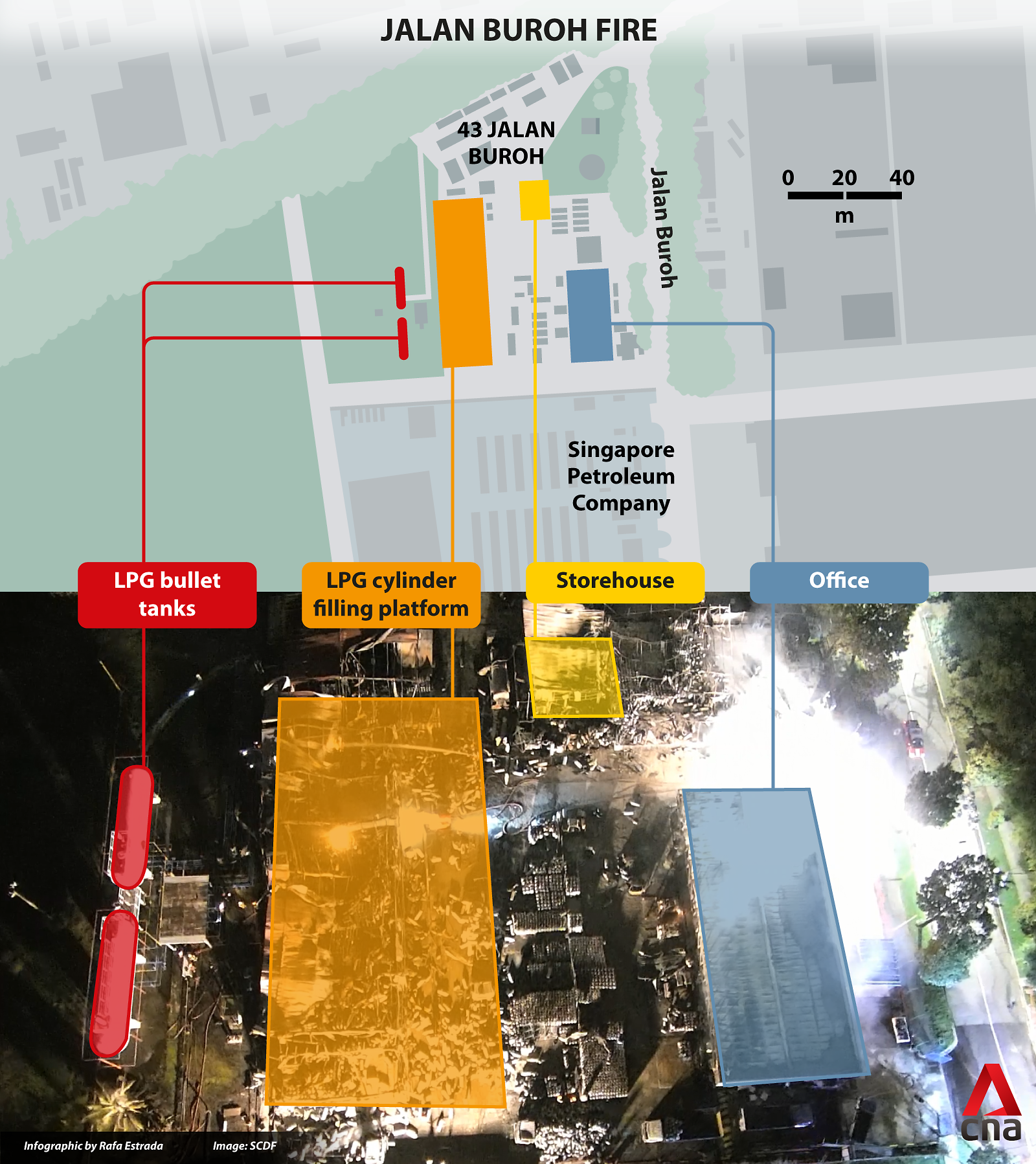
He had a crucial task – to turn off the gas supply to two large LPG “bullet” tanks, each about 60 metric tonnes in size, at the back of the facility.
If he failed to do so, the high temperature of the flames could cause the tanks to rupture, releasing a sudden burst of flammable content under high pressure. This would result in a massive vapour explosion involving the entire premises. It was an extremely risky task – and one that he took on alone.
Major Navin Balakrishnan had the crucial task of cutting of gas supply to the two bullet tanks located behind the facility. (Photo: Hanidah Amin)
“When I entered (the area with the bullet tanks), the distinct sound of hissing was everywhere,” Major Balakrishnan, who is the commander of Bukit Batok Fire Station, told reporters.
It was a “calculated risk” going in on his own first, but he wanted to assess the risks before exposing his men to them, said Major Balakrishnan.
“Safety was the first consideration, very much the first consideration,” he said.
Major Balakrishnan was one of two station commanders at 43 Jalan Buroh on the evening of Jun 21, when a massive fire engulfed the LPG facility, leaving one worker dead and two others injured.
(Infographic: Rafa Estrada)
FLYING GAS CYLINDERS
Flying gas cylinders, raging heat and huge plumes of thick black smoke were what greeted the first responders from the Singapore Civil Defence Force (SCDF) when they arrived at the scene of the fire on Friday.
According to Jurong Fire Station section commander Second Warrant Officer Syed Yazid Syed Nasiruddin, the “towering smoke” was visible all the way from Jalan Boon Lay as they drove in, with “explosions like thunder” as gas cylinders blew through the air, accompanied with a “bright orange colour every time it exploded”.
The hissing sound escaping the highly flammable gas cylinders reminded the rescue team of the need to quickly gain control of the fire.
“When we got closer, we saw projectiles flying. We saw the cylinders exploding on the scene itself – they were flying towards our vicinity so we had to come up cautiously to the area. Safety was a big concern for (an incident) of this magnitude,” said Second Warrant Officer Syed Yazid.
The heat from the flames was so intense that it radiated through the responders’ protective jackets and inner T-shirts.
For many of the first responders, the Jalan Buroh fire was one of the biggest they had ever encountered. It also involved hundreds of LPG cylinders – the largest number the force has seen in a fire.
Second Warrant Officer Syed Yazid Syed Nasiruddin is a section commander at the Jurong Fire Station and one of the first to arrive at the scene. (Photo: Hanidah Amin)
FIRST MEN ON SCENE
One of the first men on the scene, Third Sergeant Ahmad Kafee Azman recalled that he had been resting with his colleagues at Jurong Pier Fire Post when they received a call for a “fire large” at about 5pm.
He only realised how serious the fire was when he got closer to the location and saw the “thick black smoke”.
“When I heard the explosion, I (knew) that this thing was totally different from other calls,” he said.
“Honestly, I was scared, because we are only (a) four-man crew, and furthermore there are my NSF… So the first thing like I said, is safety.”
Retreating to a safe position, Third Sergeant Kafee and his crew decided to locate the nearest fire hydrants and wait for reinforcement to arrive.
Lieutenant Tan Chun Hui from Jurong Fire Station was one of the few who remained at the site overnight to keep watch. (Photo: Hanidah Amin)
Lieutenant Tan Chun Hui, Second Warrant Officer Syed Yazid and Corporal Thio Zheng Yang of Jurong Fire Station were the next group of people to arrive.
“The flames were about 20m to 30m high; I’ve never seen anything like it before,” said Lieutenant Tan.
With Singapore Petroleum Company (SPC) located right next to the burning facility, Lieutenant Tan’s first priority was to contain the fire and preventing it from spreading even further.
Employing boundary cooling measures, their task was to reduce the radiant heat and cut off the fire’s path from spreading to the SPC facility.
Third Sergeant Ahmad Kafee Azman and Lance Corporal Muhammad Fazlan Rozali were stationed at Jurong Pier Fire Post when they received the call to respond to the fire. (Photo: Hanidah Amin)
AFTERMATH
In all, a total of 35 emergency vehicles and about 120 firefighters were deployed to tackle the blaze.
At 7.30pm, SCDF managed to bring the fire under control. Six hours after receiving the call, the firefighters finally extinguished the blaze.
For many of the first responders, there was a sense of accomplishment in a job well done.
“You can see a lot of tired faces, but they were all smiling,” said Major Balakrishnan.
“We didn’t have any injuries on our side. We went in as a force and came back together as one.”
SINGAPORE: More than 389 cartons of duty-unpaid cigarettes were seized by Immigration and Checkpoints Authority (ICA) officers last Friday (Jun 21) in two attempted smuggling cases at Woodlands Checkpoint.
Two Singaporean men, aged 30 and 44 years old, were handed over to Singapore Customs for further investigation after the cigarettes were found.
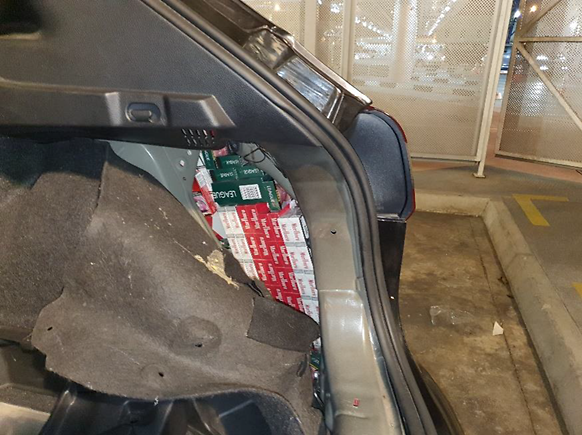
The cigarettes were hidden in various modified compartments in the arriving Singapore-registered cars, ICA said in a Facebook post on Tuesday.
Photos provided by ICA showed the cigarettes stashed in places such as the cars’ dashboard, rear-side panel, door panel and front bumper.
Duty-unpaid cigarettes concealed within modified rear-side panel (Photo: ICA)
Duty-unpaid cigarettes concealed within modified door-panel (Photo: ICA)
“The same methods of concealment used by smugglers may be used by terrorists to smuggle arms and explosives to carry out attacks in Singapore,” ICA said.
“Our borders are our first line of defence in safeguarding Singapore’s security.
“ICA will continue to conduct security checks on passengers and vehicles to prevent smuggling attempts of undesirable persons, drugs, weapons, explosives and other contrabands.”
Duty-unpaid cigarettes concealed within modified front bumper (Photo: ICA)
SINGAPORE: A faint, almost imperceptible whiff of burnt smell still lingers at 43 Jalan Buroh, four days after a massive fire gutted a liquefied petroleum gas (LPG) facility about the size of two football fields.
When CNA visited Summit Gas Systems on Tuesday morning (Jun 25), the sight of charred buildings and blackened cylinders on the ground provided visual reminders of what firefighters from the Singapore Civil Defence Force (SCDF) were up against.
The Summit Gas System building’s roof had been visibly burnt through, while charred items pepper its surroundings.
The blaze on Friday involved “hundreds” of highly flammable LPG cylinders, the largest LPG fire that the SCDF has had to deal with.
It would have been more severe if the fire had spread to larger LPG storage tanks nearby.
The compound of Summit Gas Systems has been ordered shut by the Building and Construction Authority (BCA) for safety reasons.
There was a string of police tape across its front gate, accompanied by a closure order served by BCA dated Jun 24.
“The Commissioner of Building Control is of the opinion that, due to damage by fire, the buildings at 43 Jalan Buroh, Singapore 619490, is in such condition as to be or likely to be dangerous,” read the notice, which was addressed to Summit’s CEO Ellen Teo.
A closure order, seen at the gate, was issued to Summit Gas Systems’ CEO Ellen Teo on Jun 24, 2019.
Summit Gas Systems is a supplier of Union Gas, which is one of the leading providers of bottled LPG cylinders to homes in Singapore. The site in Jurong which caught fire is a bottling and storage facility.
SCDF officers were at the scene on Tuesday morning, with a Red Rhino parked at the end of 43 Jalan Buroh. A pipe was running from a water hydrant, while other pipes from the vehicle snaked into the back entrance of Summit Gas’ premises. A fire engine crew came to take the Red Rhino’s place near noon.
An SCDF Red Rhino parked outside the back entrance of Summit Gas System’s LPG facility while officers were out and about carrying out site inspections.
An SCDF officer told CNA that he and his team are on “fire watch” and the officers would be rotated on four-hour shifts. This is seen as a precautionary measure.
A lot of attention was focused on a container truck with its back visibly charred. Men wearing hard hats were seen looking intently at the undercarriage, while water was hosed at the truck from time to time.
One of the men with hard hats inspecting closely a container truck with the Union Energy sign emblazoned over it.
When approached, one of the men in hard hats would only say that he was one of the contractors engaged by Summit Gas, and that all queries should be directed to the company.
CNA had sent queries to Summit Gas, but it has yet to reply.
A lorry loaded with what appeared to be LPG canisters parked at site, with the words “Danger Highly Flammable” written at the back.
The activities were too much to handle for some of these roaming dogs, who sought out this empty truck for some much-needed shelter.
Fuel provider Union Gas said in an SGX filing on Monday that operations at the Summit facility have been suspended and moved to the bottling and storage facility of another supplier, Semgas Supply.
Meanwhile, it appears to be business as usual for other companies around the area. RedMart-branded container trucks, among others, were seen driving in and out of the neighbouring CWT Distripark. The same was observed of the nearby Singapore Petroleum Company facility down the street.
A Lazada spokesperson told CNA on Tuesday that there were delays to its delivery services in the west of Singapore that Friday evening due to the fire, with customers advised to expect delays of up to an hour.
“We suspended certain aspects of our warehouse operations to ensure safety of our employees, but were back in full operating capacity on Friday night,” the spokesperson said.
SINGAPORE: For the second time in less than a week, operations at Changi Airport have been disrupted because of unauthorised drone activity in the area.
The Civil Aviation Authority of Singapore (CAAS) said that approximately 15 departures and three arrivals were delayed on Monday (Jun 24), while seven flights were diverted. Bad weather was also a factor in the disruptions.
Monday’s incident comes just days after 38 flights were affected when Changi Airport was forced to intermittently close one runway because of drone sightings in the vicinity.
Investigations into both incidents are continuing.
With potentially dangerous and illegal drone flights taking place in many countries, governments have been exploring a range of options to ensure that such incidents – whether malicious or accidental – can be dealt with quickly and efficiently.
1. THE DRONE DOME
The Drone Done system uses radar and laser technology to locate drones, and then jams the radio signal between the user and the device, rendering it useless. (Photo: Rafael website)
At the end of last year, operations at London’s Gatwick Airport came to a standstill when multiple reports of drone sightings grounded all flights. Hundreds of thousands of people had their travel plans disrupted as the authorities scrambled to find a way to stop the drone incursions. Commercially available equipment did not help.
In the end, the military was called in, with the British Army reported to have deployed the Israeli-developed Drone Dome. The system uses radar and laser technology to locate drones, and then jams the radio signal between the user and the device, rendering it useless.
Investigations have yet to find out who was responsible for the drone flights.
2. LASER SHOT
The US military is reported to be testing a prototype laser weapon to counter the threat from enemy drones.
The Compact Laser Weapons System – or CLaWS – is the first ground-based laser approved for use by US ground troops, Defense News reported on Friday.
A number of countries and manufacturers are developing or deploying systems that use lasers to disable drones. For instance, the Silent Hunter is an anti-drone laser weapon developed in China by Poly Technologies that was deployed in 2016 at the G20 Summit in Hangzhou.
3. EAGLE HUNTER
In a radical approach, police in the Netherlands experimented with eagles as a way of bringing down drones being flown illegally.
After a series of tests in 2015, the Dutch police said they were putting into operation a flock of the birds of prey to take down drones believed to be posing a danger to the public, such as near airports. The birds had been purchased as chicks and trained by a specialist company Guard From Above.
The experiment was short-lived as the eagles did not always do what they had been trained to do, and the initiative was grounded in 2017.
The DroneCatcher is a drone armed with a net gun. (Photo: DroneCatcher website)
DroneCatcher is a drone armed with a net gun developed by Delft Dynamics. Once the rogue drone has been detected, DroneCatcher is able to quickly approach hovering or moving threats.
The company claims that with the use of multiple onboard sensors, the net gun can be locked on the target and then launched. After the catch, DroneCatcher can carry the captured drone on a cable to a harmless place and release it there. If the caught drone is too heavy to be carried, it can be dropped with a parachute to ensure low impact on the ground.
The SkyWall 100 also uses a net to catch errant drones – in this case, from a shoulder-mounted cannon.
5. GUNNED DOWN
A man using a DroneGun Tactical. (Photo: DroneShield website)
DroneShield uses a gun to bring down a rogue drone in the final stage of its protection system.
In the initial phase, it uses multi-sensor technologies that work together to detect drones, with radar sensors tracking a moving object, separating it from the background clutter such as trees or birds. Further identification comes with cameras and thermal sensors, allowing for a visual confirmation to the user.
Once detected, a gun is used to send radio-jamming signals and frequencies to disrupt the errant drone’s flight.
SINGAPORE: When 28-year-old Amanda Poh was bitten by mosquitoes earlier this month while having after-work drinks at a bar, dengue fever was the “furthest thing from her mind”.
About a week later, she was down with a 40 degree fever and experienced bouts of nausea. Even then, she thought it was food poisoning.
But the fever refused to go away. Upon advice from a general practitioner, she went for a blood test at Changi General Hospital and the results confirmed she had dengue fever.
“Dengue always felt like a ‘it will happen to someone else but not me’ kind of thing, so it was a huge shock to find out that I had this virus,” said Ms Poh, a communications executive.
Recuperating at home, it took about a week for her fever to break, and rash to subside to a “twinge” though it is still visible on her arms and legs.
While Ms Poh believed that she had contracted the virus at the bar, she was not 100 per cent sure. “I live near a dengue hotspot (in Pasir Ris),” she said.
While her mother and neighbours also keep potted plants, her family is “disciplined” in ensuring bamboo pole holders and potted plants do not have stagnant water in them. “And we do not have buckets or pails (at home) that store water throughout the day as well,” she said.
Mosquito breeding in a porcelain cup (left) and a dish tray. (Photos: National Environment Agency)
For 64-year-old Toh Beng Chye, who lives at one of the blocks in Chai Chee Road — a high-risk dengue cluster — ensuring that there are no breeding spots has always been a priority in his household.
“I have a five-year-old grandson, so I am particularly aware of breeding spots. We always make sure to put on a mosquito patch when we are out. Sometimes, when I am walking around the neighbourhood and see containers of water left for stray dogs and cats, I will throw out the water too,” said the retiree in Mandarin.
Despite his best efforts, Mr Toh was unfortunately stricken with dengue fever last month.
For a few days, he was “bedridden with excruciating bone and joint pain”.
I had no appetite at all.
“I never thought I would be the one to get it, even buying 4D (lottery) also not that lucky,” he joked. “It just shows that you never know.”
The experiences of Ms Poh and Mr Toh reflect just how enigmatic dengue fever can be — almost impossible to trace and at times, tricky to diagnose, and hard to guard against.
Its symptoms, often in the form of a raging fever and a rash known as petechiae, usually appear days after the patient has become infectious — in that time, any mosquito which bites the infected patient will then also carry the virus.
The dengue virus also has four known strains or serotypes. While infection with one strain appears to provide immunity against that one serotype, evidence points towards increased risk of severe symptoms upon subsequent infections by the other three strains.
The existence of these strains is one reason why dengue continues to be a perennial problem, especially in places like Singapore, whose tropical climate — abundant rainfall, high humidity and temperatures — creates an ideal breeding ground for mosquitoes.
A worker fogs a community playground at a new Zika cluster area in Singapore on Sep 1, 2016. (Photo: Reuters/Edgar Su)
BACK WITH A VENGEANCE
Dengue is endemic to Southeast Asian countries. Transmitted by the striped Aedes aegypti mosquitoes, it affects thousands of people in the region each year, both in rural and urban areas.
This year, the number of infections is reaching highs across the region.
In Singapore, the dengue virus is back with a vengeance.
In 2017, dengue infections in Singapore fell to a record 16-year low with 2,772 cases. Last year was also a lull year, with a total of 3,285 cases.
The picture looks a lot different this year: As of Jun 15, there were already a total of 5,184 dengue cases, more than the whole of last year.
Dengue has also claimed five lives less than seven months into the year — the most recent one on Jun 14 — tying with the total last year.
The weekly number of dengue cases also soared to a new three-year high — a total of 467 dengue cases were reported in Singapore in the week ending Jun 15, based on the latest figures from the National Environment Agency (NEA). In March 2016, weekly number of cases peaked at 637.
The scourge shows no signs of abating, as the NEA expects more dengue cases in the warmer months ahead.
Singapore has weathered several dengue epidemics, more recently in 2005, 2007 and 2013.
A total of 14,209 and 8,826 dengue cases were recorded in 2005 and 2007 respectively. But the largest outbreak happened in 2013, when more than 22,000 people were infected, and eight died.
The number of cases so far this year is worrying as it signals that Singapore could be heading towards another dengue outbreak.
Associate Professor Ng Lee Ching, who is the director of NEA’s Environmental Health Institute (EHI), boiled down dengue transmission to three main factors: The Aedes mosquito population, the strength of the virus, and immunity of the general population.
The Aedes mosquito population has been increasing — growing 25 per cent from March to April — with the majority of breeding sites found in homes, said Assoc Prof Ng.
“Herd immunity is also generally low in Singapore, and could have further weakened given that there was a low incidence of dengue cases in the last two years,” she added.
Comparing the epidemiological trend of 2004 to 2012 (first cycle) and 2013 to 2017 (second cycle), researchers from the NEA, EHI, and the School of Biological Sciences at Nanyang Technological University observed that there is a cyclical epidemic pattern associated with a switch in dominance of the first (Den-1) and second (Den-2) strains of the virus.
The “often synchronised peaks and troughs” of dengue in the region “suggest the influence of environmental factors, among many others, in shaping the epidemiology of dengue”, the researchers wrote in a quarterly health bulletin published by the Ministry of Health (MOH).
File photo of an Aedes aegypti mosquito. (AFP/Miguel SCHINCARIOL)
HOW CLIMATE CHANGE AFFECTS DENGUE
One of these environmental factors has been in the spotlight: Temperature.
A study published about two weeks ago suggested a link between rising temperatures and an increased risk of dengue transmission.
Published in the journal Nature Microbiology and reported in The New York Times on Jun 10, the study warned that climate change will exacerbate the spread of dengue fever.
Warming temperatures help expand dengue’s range because as it gets warmer, mosquitoes can thrive in more places where they could not previously. Warming temperatures also shorten the time it takes a mosquito to become a biting adult and accelerate the time between when a mosquito picks up a disease and is able to pass it on, said experts.
“If it’s cool, (the time required) for the mosquito to become infective may be 10 days to 14 days, but if it’s warm, it could take three to four days,” said Assoc Prof Ng. “That difference may be very little, but to a mosquito, in terms of its lifespan, that is very long.”
The study predicted that dengue risk will increase in southeastern United States, coastal areas of China and Japan, and inland regions of Australia, based on researchers’ analysis of climate change data, urbanisation, as well as resources and expertise available to control the virus.
Overall, the study predicts 2.25 billion more people will be at risk of dengue in 2080 compared to 2015, bringing the total population at risk to over 6.1 billion — or 60 per cent of the world’s population.
This spike will be largely driven by population growth in already endemic areas, as opposed to the spread of the virus to new populations — emphasising the increasing public health burden which many dengue endemic countries are likely to face.
Last year, Minister for Environment and Water Resources Masagos Zulkifli also highlighted the impact of climate change on dengue.
“With global warming, we can expect the dengue situation to worsen. Higher temperatures mean more conducive conditions for the proliferation of the mosquito vector across larger land areas, and faster replication of the virus in mosquitoes,” he said at the opening ceremony of the Asean Dengue Day Workshop in June 2018. He added:
Moreover, Singapore’s position as a global hub heightens the risk of cross-border importation of other mosquito-borne diseases such as zika, chikugunya, yellow fever as well as unknown diseases that may yet emerge in future.
Some experts said the study has little relevance to Singapore, since the Republic already has “near-ideal conditions for dengue transmission”. But most of them noted that the link between climate change and dengue could still have several consequences for Singapore.
For one, the virus could evolve to be “fitter”.
Minister for the Environment and Water Resources Masagos Zulkifli. (File photo: TODAY)
“An increased circulation of dengue virus would provide even more opportunities for the virus to evolve,” said Professor Ooi Eng Eong, deputy director of the Emerging Infectious Diseases (EID) Programme at Duke-NUS Medical School.
Prof Ooi said recent research findings have shown that “even small number of genetic changes can have a large impact on the fitness of dengue virus to spread through populations”.
Strains of dengue virus with increased fitness would then spread more effectively and thus increase the likelihood of outbreaks — not only within a region but transnationally.
Taking into account “Singapore’s strategic location as a trade and travel hub”, it is only logical to expect new strains of dengue virus to be introduced here even if they had evolved in different parts of the world, Prof Ooi added.
Global warming could also change the urban environment in Singapore — which is good news for the city-loving Aedes mosquito.
It has been established that the Aedes mosquito breeds predominantly in artificial containers found in human habitats. It also rests in cool and dark places indoors, has a flight range as far as 300 metres, and can traverse high-rise buildings.
“Building design may change in response to warmer temperatures, increased risk of floods and heavy rains. Aedes aegypti is well adapted to the urban environment and some of these adaptations to global warming could be favourable for Aedes aegypti to thrive,” said Prof Ooi. “Thus, while disease forecasting is still imprecise, these possible outcomes should be taken seriously if we want to avoid even worse epidemics in the future.”
‘CLEVER’ VIRUS THAT IS TOUGH TO BEAT
There is also a possibility that a change in the strain of the dengue virus could lead to an increase in the number of cases, said Professor Tikki Pang, a visiting professor at the Lee Kuan Yew School of Public Policy (LKYSPP).
Since 2016, the current dominant strain here is Den-2.
This is a change from the dominant strain during the 2013 outbreak, when it was Den-1.
Assoc Prof Ng noted that the change in strain could mean that a section of the population is no longer immunised. But given that Den-2 has been dominant since 2016, this was not a strong factor behind this year’s spike in dengue cases.
With the multitude of factors that could influence the spread of dengue, it is not surprising that the mozzie menace remains a thorn in Singapore’s side despite the relentless efforts to combat it.
Every year, a national dengue prevention campaign is launched on the island, where mayors, grassroots advisers and volunteers engage residents to increase their awareness about dengue prevention and vigilance. This is in addition to various measures to control mosquito population and eradicate breeding spots.
But the increase in dengue cases this year prompted a lecturer to ask if Singaporeans have become indifferent to mosquito-borne public health threats, and whether efforts to tackle the dengue problem are inadequate.
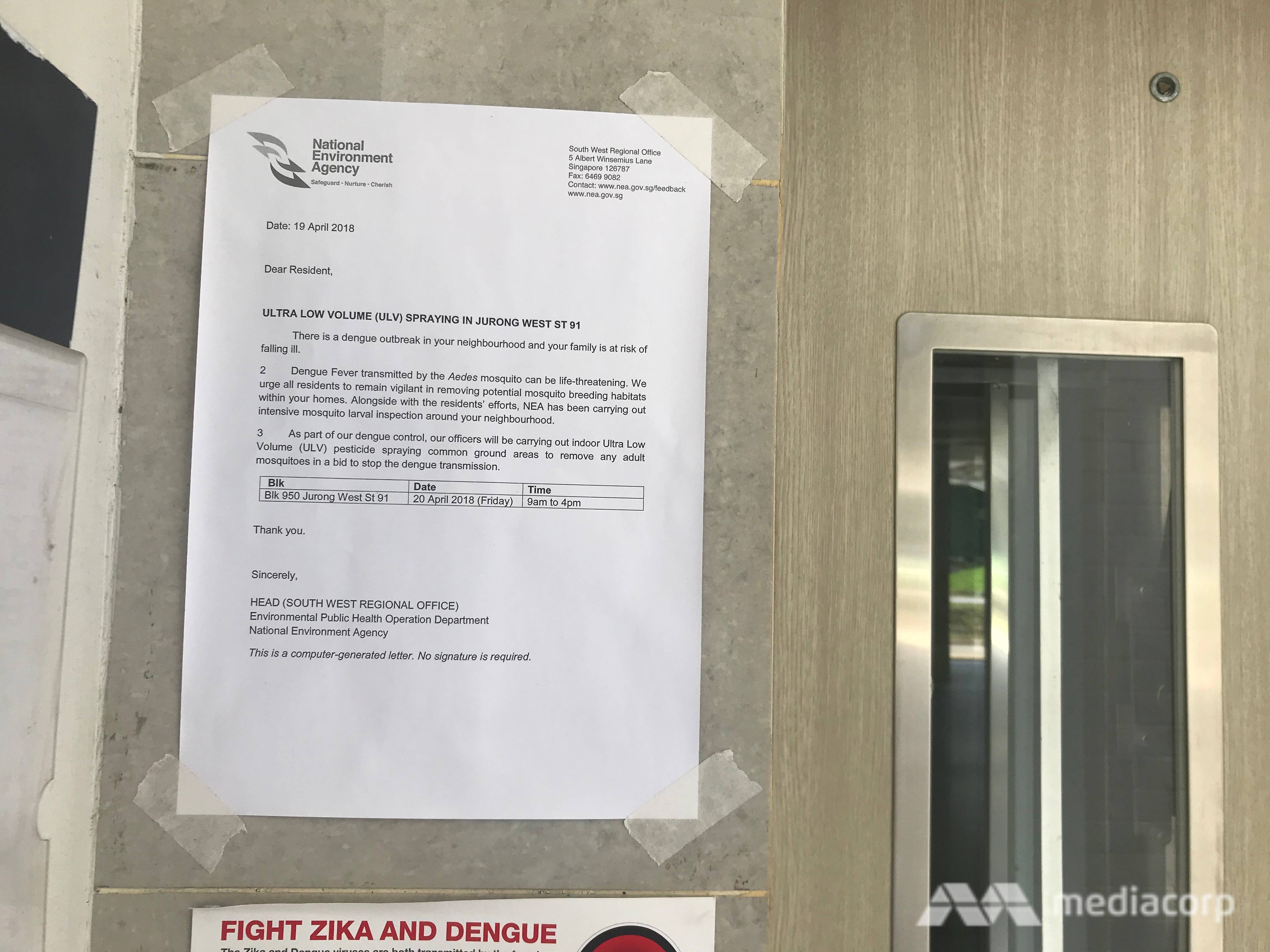
A notice informing residents of dengue control operations in the cluster. (Photo: Aqil Haziq Mahmud)
Singapore Management University law don Eugene Tan wrote in a commentary in TODAY:
Despite stepped-up inspections and having a predictive model to help forecast dengue incidence, our national pre-emptive response to impending dengue outbreaks appears to have limited effectiveness.
Nevertheless, Members of Parliament (MPs) and residents interviewed felt that dengue awareness in Singapore is not lacking.
At his Admiralty ward in Sembawang Group Representation Constituency (GRC), MP Vikram Nair spreads the message on the importance of dengue prevention during his walkabouts, and NEA also does outreach at community events.
He said that his residents were generally “aware” of dengue prevention methods and the steps to take. “Because children are reminded so often in school, they are especially familiar with the steps of the mozzie wipeout,” he said.
Mr Tan Chuan-Jin, MP for Marine Parade GRC, said the education efforts do not stop even in the “off-peak seasons”.
“There is always a fear of complacency because of fairly successful management. It is human nature,” said Mr Tan, who is also Speaker of Parliament. “Hence, the education and awareness efforts by NEA, HDB, Town Council and the grassroots have always been on-going. We know that dengue can have serious consequences and we want to remind our residents.”
For Tanjong Pagar GRC MP Chia Shi-Lu, one particular challenge which he faces at his Queenstown ward is that there are “many residents who have very green fingers and are into horticulture”.
While this means “lots of beautiful plants along the common corridors and flats, these are also a potential source of breeding for mosquitoes”, he noted, adding:
As an adviser to this community, there is a very fine balance, very tough balance sometimes … we want to make sure that we don’t expose our community to additional risk of mosquitoes breeding. And yet we do not want to (hamper) the pursuits of our residents too much.
Still, he was quick to add that dengue awareness is “quite high” in his ward. He added:
Those who have plants show me that they know how to do the mozzie wipeout … From my interactions with residents, most do know that it can be deadly, especially in elderly or perhaps the young.
But Assoc Prof Ng pointed out that there is still a gap “between awareness and action”. In the fight against dengue, “we are only as strong as our weakest link,” she stressed.
Prof Pang reiterated that it is a “very clever virus” which is always one step ahead. It is “ just impossible” to accurately predict its growth and spread, he said.
“It’s not because of a lack of effort or complacency of the people, we still don’t know enough of the virus and it seems like it always has tricks up its sleeve,” he added.
Nurses lay a mosquito tent over a hospital bed. (Photo: REUTERS/Edgar Su)
A NEVER-ENDING BATTLE
Given the obstacles Singapore faces in eliminating the mosquito menace, what more can be done in this never-ending battle against dengue?
While the ongoing Wolbachia trials are regarded as one of the most innovative methods, the NEA has previously said they do not amount to a “silver bullet”.
“Going back to the basics” is essential — individuals have to make sure they clear stagnant water and eliminate breeding spots, said Assoc Prof Ng.
“It all goes back to source control… (It is about) good housekeeping, throwing out stagnant water. These mosquitoes like (to breed in) artificial containers,” she said.
Even so, source control alone cannot eliminate dengue outbreaks, said Prof Ooi.
“History has taught us this lesson,” he added. “Even with the Aedes aegypti eradication effort in the Americas that successfully eliminated yellow fever and dengue for a brief period, Aedes aegypti rapidly re-populated tropical and subtropical regions in the Americas once the programme stopped, due partly to the high cost and hence non-sustainability of the programme.”
Prof Ooi and Prof Pang both cited the potential of a safer and “more effective” dengue vaccine to improve the population’s chances against the virus. And it will continue to be a battle on multiple fronts.
“Dengue prevention needs more effective tools to be used in concert with vector control if we are to reduce the risk of outbreaks,” said Prof Ooi. “New tools such as vaccines, drugs and introduction of to either reduce mosquito population further or render mosquitoes resistant to infection by dengue virus are all needed.”
Accelerating the development of such tools is of utmost urgency, he reiterated.
MULTI-PRONGED EFFORTS TO FIGHT DENGUE
In Singapore, a slew of measures has been rolled out by the authorities to curb the spread of the Aedes aegypti mosquito while building a robust outbreak management system. Here are some of the key initiatives:
PROJECT WOLBACHIA
Dubbed as one of the most innovative methods currently, the project involves infecting male Aedes mosquitoes with Wolbachia bacteria, so that when they mate with females, the latter’s eggs do not hatch. Wolbachia-infected males also do not bite.
The NEA first began small-scale field studies in Braddell Heights, Nee Soon East and Tampines West in 2016, which led to a 50 per cent suppression of the Aedes mosquito population.
Male Wolbachia-carrying Aedes aegypti mosquitoes are released at various sites in Singapore under Project Wolbachia. (Photo: Angela Lim)
Nevertheless, the first phase of the study threw up unexpected challenges. It was found that Aedes aegypti mosquitoes from surrounding areas moved easily into the three chosen sites, thwarting plans for Wolbachia-infected Aedes to mate with females.
Also, there were insufficient numbers of male Wolbachia-infected mosquitoes that reached higher floors of some housing blocks. This hampered suppression efforts at high-rise blocks.
Researchers went back to the drawing board, further refining their release and deployment strategies. In April last year, the NEA began its second phase of field studies, releasing male Wolbachia-Aedes mosquitoes at higher floors, in addition to releases at the ground floor.
This time, the results improved: The mosquito population in a Tampines West study site was reduced by 70 per cent, while the population in Nee Soon fell by 80 per cent.
The NEA then expanded the Tampines West and Nee Soon East study sites — with more households taking part — to suppress the mosquito population over larger areas.
Project Wolbachia is now in its third phase, where the NEA is attempting to determine if the reduction of Aedes aegypti mosquito populations can be sustained over a period of time, and in larger areas.
While successful in reducing Aedes mosquito population, a drawback of the Wolbachia method is that it could be costly and difficult to scale up.
Prof Pang said: “There is a lot of uncertainty when you try to do it islandwide, it doesn’t mean that just because it works (at the test sites) it’ll work in other parts of Singapore.”
Each area has to be studied before the release of Wolbachia-infected mosquitoes, he noted.
“Then, there is the logistical issue of where you release them. Not all HDB estates are the same… there are houses in landed areas, and areas with a lot of vegetation,” he added.
Moreover, areas in Singapore have “microclimates” where the weather in one part of the island differs from the other. This affects the timing and schedule of the release of Wolbachia mosquitoes.
On the issue of cost, Prof Pang pointed out: “You have to raise enough of these Wolbachia-infected mosquitoes.”
GRAVITRAPS
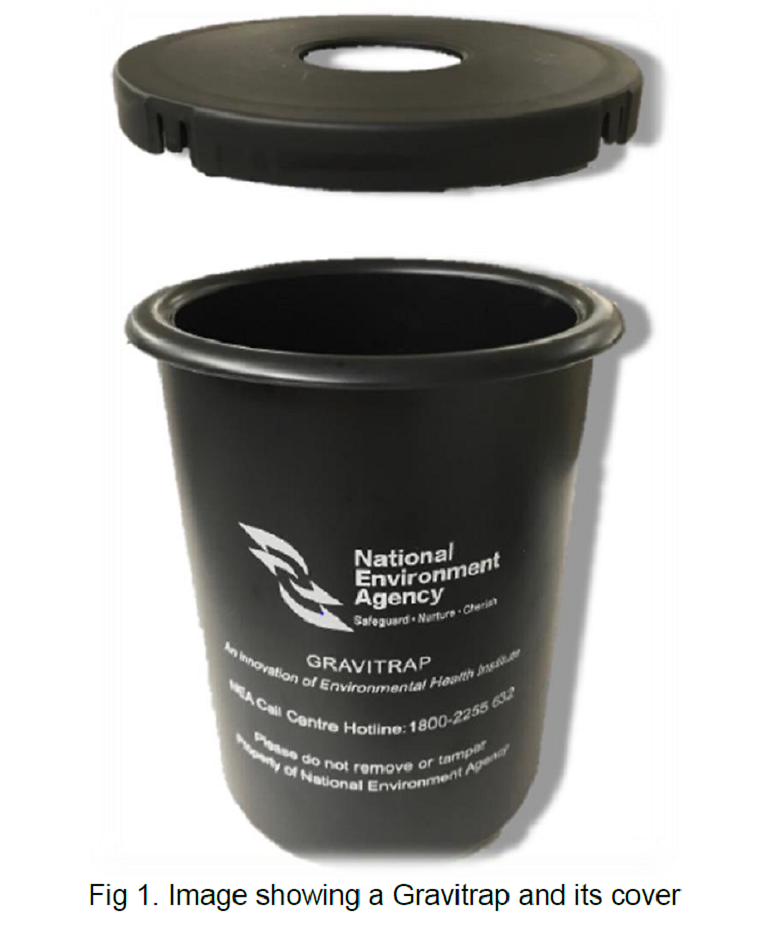
The NEA also deploys gravitraps — black cylindrical containers with sticky surfaces — which attract and trap female Aedes aegypti mosquitoes looking for water surfaces to lay their eggs.
When deployed across an area, Gravitraps can also provide an indication of the Aedes mosquito population in the vicinity.
Currently, NEA officers routinely carry out inspections for mosquito breeding at landed housing estates, but this is highly resource-intensive.
This year, the NEA will progressively deploy about 14,000 Gravitraps across the island in areas such as landed housing estates and newly completed HDB blocks. This will allow its officers to gather information on mosquito population at more locations.
The latest efforts are on top of the 50,000 Gravitraps already in place since 2017.
In 2016, the Government amended the law to allow action against households found to be breeding mosquitoes, regardless of whether they are in active dengue clusters. The penalty is a S$200 fine.
As of March this year, more than 600 households have been fined for mosquito breeding. In addition, seven Stop Work Orders have been issued to construction sites found to have breeding spots. Three contractors have also been prosecuted in court for repeat offences.
In the first three months of this year, more than 200,000 inspections were conducted by the authorities, including about 1,800 carried out at construction sites. In total, 2,900 instances of mosquito breeding habitats were uncovered.
FOGGING
This method has its limitations: It is only effective if the chemicals come into direct contact with the mosquitoes.
In addition, fogging does not only kill mosquitoes, but also reduces the number of mosquito predators, such as dragonflies. While the method is still used, the NEA advises fogging to be carried out only when there is a mosquito nuisance problem or a disease outbreak.
(Photo: Reuters/Edgar Su)
VACCINES
In October 2016, a dengue vaccine, Dengvaxia, was approved for use for those aged 12 to 45.
However, health authorities later issued advisories on its use after its manufacturer released a report showing that Dengvaxia could worsen symptoms for those not previously infected with dengue.
The Ministry of Health (MOH) subsequently worked with medical laboratories in public healthcare institutions to make serological testing available to medical practitioners. Serology testing to identify previous dengue infection was made available at the major hospitals in Singapore.
To date, Dengvaxia remains a controversial vaccine. MOH does not provide subsidies or allow the use of Medisave for the vaccine as it “would not be a clinically and cost-effective means to tackling dengue infection in Singapore”.
Dengue vaccination is not part of the national immunisation programme. The vaccine is only given to individuals where the benefits outweigh the risk, instead of the population at large.
PUBLIC EDUCATION
Every year, a national dengue prevention campaign is usually launched in mid-May, ahead of the peak dengue season which runs from June to October.
This year, a spike in the number of dengue fever cases in the first three months had prompted the early roll-out of the campaign.
After this year’s campaign was launched on Apr, 81 divisions across Singapore had organised more than 440 dengue prevention events and activities.
Mayors, grassroots advisers, community leaders and dengue prevention volunteers visited residents to heighten public awareness and vigilance against mosquito breeding and dengue. They shared dengue prevention tips, including how to identify potential mosquito breeding habitats and reminded residents to practise the 5-step Mozzie Wipeout.
SINGAPORE: Tan Whee Boon is not a man of many words, but the way he is living life after his health scare speaks volumes.
The 54-year-old former technician lost all his limbs after a plate of yusheng, a raw fish dish, caused Group B Streptococcus (GBS) infection that landed him in hospital. The drug that helped save his life also led to his hands and feet turning gangrenous, which he then decided to have amputated.
Overcoming his initial despair, Tan today can be found regularly participating in physically demanding activities like wheelchair rugby. He has also tried rock-climbing, swimming and scuba-diving.
Physical activities aside, he is also working up a sweat in the classroom. Tan told CNA in a recent interview that he signed up for a four-month course in Building Information Modelling (BIM) in April as he looks to get the skills necessary to rejoin the workforce for the first time since the health scare.
Yet even as things are falling into place for Tan, a more practical concern is standing in his way of taking the next step in reintegrating back to society: His dependency on his care-giver, a role usually taken on by his wife of nearly two decades Madam Choong Siet Mei, to get a job.
“The trainer actually asked … whether I want to take up the job (of a 3D modeller) or not. Then I told him that I’ll need a care-giver along,” he recounted.
Tan shared that while he is able to go out alone, he is unable to stay out for the whole day as he can’t perform certain activities like going to the restroom, even though he has prosthetic limbs.
“I think all the passers-by are willing to help … put on the fork, the spoon (on the prosthetic), whatever (help) I need,” he explained. “Except the washroom. That one I need to do it myself.”
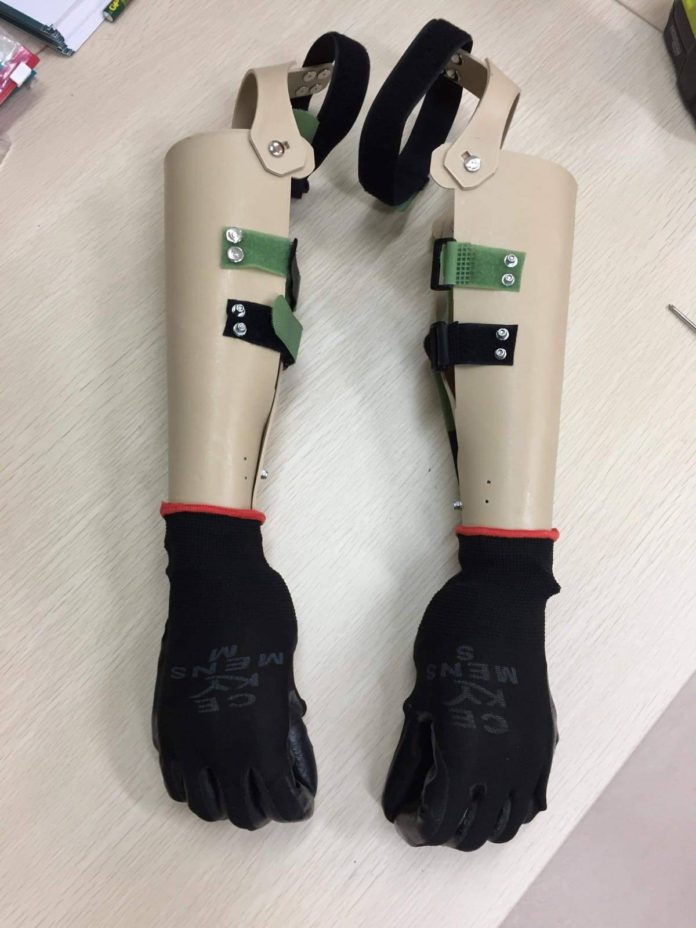
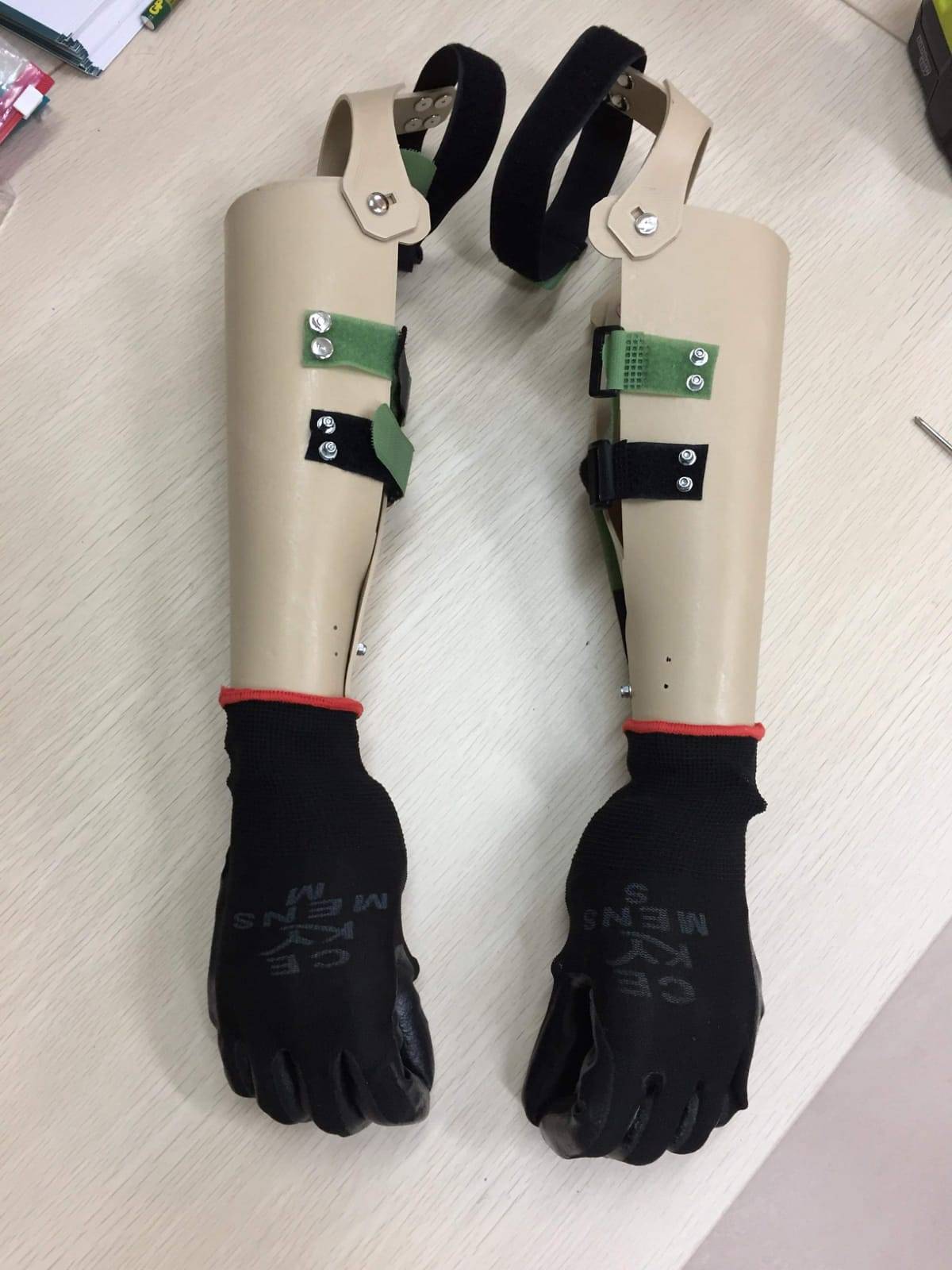
The stoic 54-year-old said he has tried two prosthetic arms so far, but both had their shortcomings. The first came from the United States, but Tan said it was “cartoonish” and not very useful as the grip was slippery and could not grab on to a wash hose he needs to use to take showers.
The prosthetic arm developed by a volunteer from Hong Kong has a decent grip, but is heavy and “troublesome” to put on, Whee Boon said. (Photo: Tan Whee Boon)
The other pair was a prototype by a “volunteer from Hong Kong” who got in touch and shipped the prosthetic arms to him this June. While the grip is “good”, Tan found that the device was “too heavy” and he needed help from someone else to put it on.
“(Even then,) it takes about 10 to 15 minutes to wear.”
TRANSCENDING BORDERS
Help, when it eventually came, was from an unexpected place.
A nonprofit organisation called Tikkun Olam Makers (“repairing the world” in Hebrew), which organised its first makeathon in Singapore from Jun 14-16, has a stated aim of bringing together dedicated individuals who are passionate about harnessing technology to solve everyday problems for people with special needs. It has an ambitious aim of impacting 250 million people through its communities worldwide.
Through the makeathon, which saw almost 80 volunteers coming up with solutions for 13 specific needs, Tan was paired with a team of six strangers who hadn’t worked together until then.
Team PJ Prosthesis members came with very different skillsets: Two of them are physiotherapist students, another two are computer science researchers and one is a teacher. They were led by D J Saravana Kumar, who has more than a decade’s experience in 3D modelling.
Kumar, who works as a senior graphics designer at Fraunhofer Singapore, recounted that the pain points that Tan faced – such as having a lightweight prosthetic – were brought up during the brainstorming session at the three-day event.
It was clear then that the main challenge they would face would be making a prosthetic that would be effective at grabbing things, specifically the washing hose that Tan requested, said Kumar.
This is Mr Tan Whee Boon, who lost his limbs after food poisoning in 2015.
As he reintegrates back into society, the need for a prosthetic with a good grip becomes more pressing. Who will answer this need?
For the 41-year-old IT veteran, the real-time feedback that Tan gave during the development process was helpful, such as letting the team know what parts need more work on and if the grip was sufficient.
More than that, the support he gave to the team was invaluable: “He was at the side cheering us on, he brought us life,” Kumar said.
Tan chimed in, saying: “Participation (in the creation process) was the best part (of the whole makeathon experience) … I felt like I had a part to play.”
The end result: A 3D-printed rotating prosthetic arm that Tan could put on without help, and with a grabbing mechanism that helps him perform household tasks. It impressed the judges enough for Team PJ Prosthesis to place joint third, earning them a S$2,000 cash prize.
Tan hopes that the new prosthetic will enable him to go out alone and be independent. “With that, then all is fine,” he said with a smile.
BUDDING FRIENDSHIP
The helping hand, it would appear, extends both ways in this friendship: The two men meandered off midway during the interview to chat about a new version of the prosthetic.
A 3D rendering of the next iteration of the prosthetic arm in development, including a more multifunctional grip to hold things like spoons and bottles, said D J. (Image: D J Saravana Kumar)
For Kumar, an Indian national who uprooted his family of three to Singapore five years ago, the commitment to help Tan is driven from a realisation that this was an outlet he could use his skills to give back to the people of his adopted homeland.
Today, his spare time is given to fine-tuning the next version of the prosthetic, such as making the grip firmer – “The (first) prosthetic is still not effective at grabbing,” Tan said – and having a variation of grips so the user can hold things of different sizes from spoons to bottles.
He is also looking to incorporate a locking mechanism that would allow the grabbing attachment to be angled differently for different needs, and intends to 3D print the prosthetic “by next week”.
The other group members continue to be involved in the development process too, Kumar revealed. A WhatsApp group, named Boon_Group 9, is alive with suggestions and feedback that he incorporates into the design. The group’s Israeli mentors from the makeathon are included in the group too, he added.
Team PJ Prosthesis leader D J Saravana Kumar (top left) with team-mates Luis Sacco, Tan Juay Yong, Zhang Xingzi, Joan Toh Yuet Meng and Chia Zhen Da. Mr Tan Whee Boon (middle) and wife Choong Siet Mei (middle row, second from left) were also present at the makeathon. (Photo: Acompany)
“Previously, I would just spend my time playing games on my computer,” Kumar shared. “I wouldn’t know what to do with my spare time.
SINGAPORE: Imagine that you’ve just be thrown into the midst of an immersive high-stakes game. You don’t know who the other players are. You don’t even know what the rules are.
You only have a few tips passed down randomly from other more experienced players, and some old instruction manuals which you suspect are obsolete.
You try out strategy after strategy, running through the maze, but every path seems to lead you to pitfalls, spiked pits and dead ends. You begin to despair that the game is rigged.
For many graduating students who are in the middle of their first job hunt, this nightmarish scenario is how they describe their first foray into the job market.
Amidst the headwinds of a slowing economy and a prospective trade war, many graduates write to me every week with similar questions: They’ve submitted dozens or hundreds of applications but only received a few, if any, replies. Why isn’t their strategy working?
Firstly, I tell them that insanity is repeating the same strategy over and over again and expecting a different outcome. Let’s zoom out first to look at the terrain that we’re entering now.
We’re currently living in an era of rapid change, called the Fourth Industrial Revolution, where new factors like Artificial Intelligence, automation and disruptive technology are changing business models in every sector of the economy.
In this hyper-competitive environment where even established companies are struggling to survive, today’s graduates need more so than ever, to be strategic and proactive about their first job search.
The truth is that even the best experts will tell you that there is no sure-fire guarantee of landing the job of your dreams, unless you have platinum family connections or other massive advantages.
A jobseeker looks at recruitment advertisements during the 2018 Japan Job Fair in Seoul, South Korea, November 7, 2018. Picture taken on November 7, 2018. (Photo: REUTERS/Kim Hong-Ji)
But there are some navigating principles that can give you an edge. Here are four strategies that may work for you.
1. THE ‘THIRD DOOR’ STRATEGY
Imagine you’re trying to get into a nightclub.
The First Door is where 99 per cent of people try to enter, waiting patiently and hoping to get to the front of the queue.
The Second Door is the VIP door – this is where celebrities and people with connections bypass the queue and get ushered in.
What no one tells you is that there is always a Third Door. This could be an unmarked door down the alleyway where you have to crack open the window and persuade a cleaner to let you in, but whatever it looks like, there is always another way in.
I first read about this Third Door theory from Alex Banayan’s book The Third Door, where Alex as an 18-year-old freshman who set out to track down some of the world’s most successful people, such as Bill Gates, Lady Gaga, Steven Spielberg and so on, to uncover how they launched their careers.
Although their paths were all different, the stories of how they broke into their careers were very similar in one regard. All of them took the Third Door, and all of them persuaded an “inside person” to let them in, whether that meant waiting for a CEO outside the door of a shareholder meeting, volunteering to work for free, or even hiding in a toilet.
Steven Spielberg is a sterling example of this strategy. As the story goes, he gets on a Universal Studios tour bus one day, jumps off midway and hides in the toilet, ends up meeting someone from the industry and strikes up a conversation with Chuck Silvers, the studio’s head of editorial, who secures him a three-day pass.
Steven spends the next month behind the scenes on set, talking to actors, sound people, understanding the industry and finally landing a job through showing Silvers a 26-minute film that he had made during his time there.
The idea is to do the reverse job search. Instead of seeing what is available on job portals and tailoring yourself to meet those needs, how about getting clear about a few opportunities that really excite you and reaching out to offer something of value?
But what could I possibly offer, you ask? That brings us to point 2.
2. THE ‘OFFER A FREE SAMPLE’ STRATEGY
My favourite example of this is a lady called Nina Mufleh, popularly known as “nina4airbnb” after the website she created to convince AirBnb to hire her went viral. Nina really wanted to work for Airbnb and tried to get in touch through emails and job listings but had no luck.
Screengrab of Nina Mufleh’s “nina4airbnb” website (Photo: Screengrab)
So she decide to take matters in her own hands, and created a beautifully crafted website that mirrored Airbnb’s own landing page, where she showcased her key recommendations for what Airbnb should do to increase sales, and what she could contribute to the company.
After her website garnered the attention of the internet, she was flooded with offers from various companies who were impressed by her creativity and initiative.
Nina may be an outstanding talent, but I have also seen this strategy work in everyday scenarios in Singapore. I have just hired an intern who wrote to me after carefully researching my work and included examples of a few initiatives and easy projects where she could immediately start work on and add value to.
It is not that difficult to do prior research on the company you’re applying for, obtain the contact details of a stakeholder and send them a simple proposal or a cover letter that has been customised for them.
Doing this demonstrates precisely the kind of problem-solving skills that companies are looking for and will give you an edge in the new economy.
But what if I don’t even know what sort of job I want? This brings me to strategy number 3.
Screengrab of Nina Mufleh’s “nina4airbnb” website (Photo: Screengrab)
3. THE ‘SELF-AWARENESS’ STRATEGY
Research suggests that 95 per cent of people believe that they are self-aware, but only 12 to 15 per cent really are. Researcher Tasha Eurich says “That means, on a good day, about 80 per cent of people are lying to themselves – about themselves.”
Early on in your career, you will not have a lot of data points from working experience to draw conclusions from, which is why it is so important to get help with from experts. This could mean an appointment with a career coach for instance.
Whenever I speak at conferences overseas, people tell me that they envy the comprehensive array of resources that Singaporeans have at their disposal.
Sadly, most of us do not fully utilise them. The vast majority of university students do not avail themselves of the free coaching appointments that are available to them, and many Singaporeans do not know that e2i and Workforce Singapore offer free sessions available by phone, email or face to face.
And before going in for your coaching appointment, rather than asking “what job should I do?” instead reflect on “what problems am I passionately curious about solving?”.
Every job is at its heart a problem that people have grouped together to solve. What causes motivate you?
Which brings me to the final strategy.
4. THE ‘FINDING YOUR TRIBE’ STRATEGY
When you are clear about what causes interest you, find your tribe and engage with the community that already exists around these causes.
This may mean attending forums, conferences, or free public talks and panel discussions. Many public speakers and experts in these topics are valuable resources and it is common for them to stay behind after the event is over to interact with the audience.
I myself have started off giving advice to many of the passionate students who approach me after talks or connect through social media, and I have introduced a few to my connections after I have gotten to know their strengths.
A job seeker talks with a corporate recruiter as he peruses the man’s resume at a job fair in Washington, June 11, 2013. (Photo: REUTERS/Jonathan Ernst/File Photo)
The real question is who is willing to put their reputation on the line for you? That doesn’t mean spamming everyone you know, but creating relationships through being an engaged, valuable, consistent part of a community.
Again, think about what that may look like for you and experiment, whether that means setting up a meetup group or even just taking the first step to making regular, thoughtful comments on social media groups on the causes or sectors that you’re passionate about.
Your community or social capital is one of the most important assets you will have in your life. It is something that no company can take away from you and will never lose relevance.
These four strategies are not conventional by any means, but we are entering uncharted waters.
Today’s graduates need bigger reserves of resilience, self-awareness and adaptability than any other generation in the history of the world to thrive in the uncertain future of work.
But most importantly, they need to believe that they have something valuable to contribute to the world and not fear being different, but fear being the same as everyone else.
Crystal Lim-Lange is the CEO of future-readiness consultancy Forest Wolf and Strategic Advisor to Minerva Project University, and her upcoming book (co-written with Dr. Gregor Lim-Lange) “Deep Human- The Secret Guide to Success in the Future” is being released in August.
SINGAPORE: Growing up, the Class of 2019 must never have imagined that this would be how their formal education journey ends.
Study hard, get good qualifications, get a good job, so went the narrative. As long as you put your mind to it, there’s nothing you couldn’t achieve.
But as they near the finishing line, they find that this narrative has very much been disrupted.
The Class of 2019 will graduate at a time of economic uncertainty, amid fears of a looming recession driven by trade tensions, compounded by the accelerating disruption sweeping across industries.
Trade tensions threaten to slow global growth (Photo: AFP/Mark RALSTON)
Students like myself, waiting in the wings for graduation in a few years, are watching these developments closely.
After all, with trade-related tensions setting in for the long-term – Trade and Industry Minister Chan Chun Sing said that “Singaporeans must be prepared for the long haul” – and disruption only set to intensify, the resulting uncertainty will not be going away anytime soon.
For fresh graduates, the need to get a job quickly leaves little room for much choice and discussion.
But what about students who still have a few years left in higher education? Should we be making any strategic adjustments? How should we cope with this disruption to our narrative?
THE TEMPTATION TO BE RECESSION-PROOF
A recent edition of The Big Read detailed the experiences faced by fresh graduates as they dealt with this new reality. These experiences include short-term contracts, multiple rejections or non-replies to job applications, lowered job and salary expectations.
Seeing their seniors having to settle for less, current students may engage in knee-jerk actions to avoid similar fates. They might be tempted to try and be “recession-proof”, especially if their desired industries will be badly hit.
Students sit at a common area in NUS. (File photo: Darius Boey)
Knee-jerk reactions may also be more likely given the anxieties many young people already face about the adequacy of their tertiary education.
In a 2018 poll by Youth.SG, a portal supported by the National Youth Council, seven in 10 youths were unsure or did not think the tertiary education they received in Singapore prepared them sufficiently to join the workforce.
In their bid to be recession-proof, or plug the perceived inadequacies in their formal education, students might employ fast ways to try and stand out from their peers – signing up for more CCAs, trying out for more leadership positions, signing up for exchange because their peers are doing so, going for internships for the sake of, volunteering for inauthentic purposes, just to name a few.
Such actions are not dissimilar to those generated by a fear of missing out (FOMO) on job opportunities and an ensuing second education arms race in which nobody can win.
The unfortunate irony would be that knee-jerk reactions to make one more “future-ready” might cause one to be less so.
WHAT REALLY MATTERS
If the knee-jerk reactions spelt out above are undesirable, then what responses might be more appropriate?
Firstly, if we truly wish to stand out from our peers, we need to focus on creating value, not merely adding value, in line with the changing expectations of Singapore’s labour force.
Soon after he became Finance Minister, Minister Heng Swee Keat, who is now also Deputy Prime Minister, had said that Singapore needed to shift from a being a value-adding economy to value-creating one.
At a Singapore Business Federation Conference in 2015, he said:
If we are simply producing what the rest of the world is producing, we will not be able to command a premium, or sustain our competitive edge. We have to produce what the rest of the world is not producing, or at least, not much of.
More CCA participation, leadership titles, exchange experiences and the like may make one’s CV look better, but it’s just incremental value-adding to existing activities, and just more of the same of what others would be putting on their CVs.
DPM Heng Swee Keat speaking at a REACH-CNA dialogue session on Jun 15, 2019. (Photo: Jeremy Long)
According to Minister Heng, a value-creating economy competes on special capabilities, by building deep capabilities and linkages.
So what might a value-creating job candidate look like? In my opinion, such a candidate would be someone who made use of both academic and non-academic insights to contribute to solving a real-world problem.
This candidate might have managed to see a gap between two fields, say, public health and climate change, and created an app to increase awareness of that gap. Or maybe it’s someone who managed to reconcile opposing community groups and put forth solutions which gained traction in the community.
There are other possibilities, but one should always start by thinking: What problem can I solve?
If this seems much harder than value-adding, it’s because it is. That is why we must be much more selective about what activities we do participate in, so that we have enough time and energy to engage in deep learning and build deep mastery.
NUS Business School graduates at their commencement ceremony. (File photo: TODAY)
Secondly, facing an uncertain, disrupted future, networks matter more than ever in seizing opportunities.
According to a 2018 LinkedIn survey of over 11,000 respondents across the Asia-Pacific region, knowing the right people or having the right connections was ranked the second most important factor overall to getting ahead in life, trailing closely behind hard work.
Such findings hit close to home, given the work I am engaged in of addressing opportunity gaps for under-served secondary school students, as part of a ground-up organisation (Access Singapore).
For students in tertiary institutions however, the issue takes on a new urgency.
As a knee-jerk reaction, would-be graduates may network excessively, believing that name cards are keys to opportunity.
Given the limited time students have, what might be more effective is finding a locksmith who can show students the way to open their own doors – a mentor.
Besides helping students navigate uncertain terrain, mentors can help them access useful networks, easing their journey of getting ahead.
To this end, students should tap on mentorship programmes their institution offers. Alternatively, they could also seek out their teachers as mentors too.
Students walk by the Singapore Management University. (Photo: Singapore Management University)
THE CONCLUDING PLOT TWIST
The final insight deals with the disorientation one might face in having their narrative disrupted.
In times of disruption, businesses and individuals alike naturally seek a new stability. But this new stability could be attained by simply reframing the way disruptive changes are perceived.
While the old narrative has been disrupted, the new narrative of constantly responding to change could be seen as not all that different.
Study hard? That’s still applicable too, but now in the context of lifelong learning. Get good qualifications? Sure, but it’s now about a far wider range of qualifications.
By seeing the links between the old and new, one can more easily cope with a disrupted narrative of life.
And with a clearer outlook, we will see that the most important part of the old narrative might yet hold true.
Maybe, just maybe, as long as we put our minds to it, with the help of mentors and by striving to create value, we could still achieve more than we ever thought possible.
Ng Chia Wee is a first-year student at the National University of Singapore’s Faculty of Arts and Social Sciences and Tembusu College. He is also Director (Strategy) at Access Singapore, a ground-up organisation which seeks to provide mentorship and externship opportunities to under-served students.
SINGAPORE: More than two million people visited the annual Geylang Serai Hari Raya Bazaar this year, the highest number recorded and surpassing the 1.8 million visitors in 2018.
The bazaar was a “huge success”, said Minister for National Development Lawrence Wong on Saturday (Jun 22) at Wisma Geylang Serai’s (WGS) Hari Raya dinner.
He added that the bazaar is an example of how WGS, a social and cultural heritage hub, has succeeded in creating a unique cultural identity for the area.
“The bazaar was visited by Singaporeans of all races, who had come to enjoy the food and festive merchandise,” Mr Wong noted.
“WGS worked closely with the bazaar operators to curate the stalls and came up with various performance and activities to supplement the bazaar and offered a full experience to the visitors.”
For the first time, all food stalls had to be either Muslim-owned or certified halal by the Islamic Religious Council of Singapore (MUIS) following feedback from the previous year.
In his speech on Saturday, Mr Wong said that a liveable city is not just about the buildings or getting the business infrastructure right.
“It is about building a city with strong culture, heritage and roots, with people at the centre,” he said. “Only then will we have a global city that is distinctively Singaporean, a place that we can all call home.”
Mr Wong called on the community to continue to support the Geylang Serai precinct development, a project helmed by Senior Minister of State for Defence and Foreign Affairs Maliki Osman.
Senior Minister of State for Defence and Foreign Affairs Maliki Osman, Minister for National Development Lawrence Wong and their wives at the Wisma Geylang Serai Hari Raya Dinner on Jun 22, 2019. (Photo: Hazlina Abdul Halim)
Dr Maliki said that WGS has had many requests from organisations to utilise the premises, contributing to the steady increase of footfall there.
He added that from January to April this year, more than 105,000 visitors from all races have visited WGS since it was officially opened by Prime Minister Lee Hsien Loong on Jan 26.
For the second half of the year, Dr Maliki said WGS has plans for a nostalgic Satay Club Bazaar, as well as a Bicentennial National Day @ Heartlands exhibition in August, where mobile columns from the Singapore Armed Forces and Home Team will be on display.
SINGAPORE: Singapore Post (SingPost) on Saturday (Jun 22) launched a special set of stamps to commemorate Singapore’s bicentennial.
The set of 10 stamps depicts key milestones in the country’s history, even before 1819 when Sir Stamford Raffles arrived in Singapore.
“The stamp set features a tapestry of Singapore’s rich and varied history, tracking Singapore’s story from settlement to nationhood,” said SingPost in a media release.
“The 10 stamps depict key milestones of Singapore’s 700-year journey beyond the bicentennial milestone, illustrating why Singapore’s early years before 1819 were also critical to its success today.”
The stamps tell a “visual story” that begins with the establishment of the Kingdom of Singapura by Sang Nila Utama in the 13th century, followed by historical milestones including the arrival of the British in Singapore, World War II and Singapore’s independence in 1965.
The set then goes on to depict “the flourishing Singapore today”, before ending with a vision of the country’s future.
Stamps to commemorate Singapore’s bicentennial. (Photo: SingPost)
They were designed by animator and illustrator Lim An-Ling.
The Singaporean was inspired by dioramas, and the stamps’ artwork encompasses a mix of clay models and digital illustration – a first for any stamp issue, according to SingPost.
“Having been around for over 160 years, SingPost is one of Singapore’s pioneer institutions that have been part of Singapore’s history in the last two centuries, from a settlement to the vibrant nation we are today,” said Mr Vincent Phang, SingPost’s CEO for postal services and Singapore.
“What better way to remember the stepping stones to Singapore today than with this set of stamps that represent our take on the events that have shaped us a country, nation and as one people.”
The stamps were unveiled by Deputy Prime Minister Heng Swee Keat and Mr Phang at a Singapore bicentennial roadshow at Our Tampines Hub.
HOW TO GET THEM
Valued between S$0.30 and S$1.30 each, the stamps will go on sale from Saturday at all post offices, the Philatelic Store @ GPO and online at shop.singpost.com.
Collectors’ sheets (S$16.80), pre-cancelled first day covers (S$8.25) and presentation packs (S$9.30) are also on sale.
The items can also be bought at the roadshow at Our Tampines Hub until Jun 30.
Stamp collectors who visit the event will also be able to collect an exclusive bicentennial catchet as well as daily themed date-stamps, with a total of nine date-stamps to be collected over the duration of the roadshow.
The stamps are the latest in a series of items launched to commemorate Singapore’s bicentennial.
Earlier this month, President Halimah Yacob launched a S$20 note depicting Singapore’s journey to nationhood.
The notes saw huge demand and were quickly snapped up, with the Monetary Authority of Singapore announcing that it would issue an additional 2 million pieces of commemorative notes and folders to meet “strong public interest”.