Home Blog Page 768

Commentary: Prams and escalator incidents – how about lift priority queues for new parents?

0

SINGAPORE: We’ve all done it before – hoist a pram holding an infant or young tot up the escalator even when warning bells go off in our head, reminding us of the dangers involved.

A CNA story highlighted that there were over 350 escalator incidents in Singapore last year, or on average one accident per day.

At KKH’s emergency department, the number of escalator–related injuries among children more than doubled between 2012 and 2016, with more than half of these occurring in shopping centres.

Parents I spoke to say that riding on escalators with prams in tow isn’t their first choice; the common push factors cited are convenience and crowded elevators.

Most would exercise caution whenever they are on the escalator, for example carrying their baby and having someone else handle the pram, or ensuring that both hands are free to hold on tightly to the pram.  

But are these strategies enough to prevent an accident from occurring?

MAKING RESPONSIBLE USE A SHARED GOAL

In MRT stations, people seem to abide by the rules more readily. I usually don’t have much trouble getting my ride or down the lift as most able-bodied passengers would give way to an elderly, a disabled person, or a parent with a pram. Also, the elevator doesn’t service as many floors and takes a shorter time to arrive.

Enter a crowded mall, however, and things shift slightly. All of a sudden, it becomes harder to find an elevator when you need it, and when you do find one, it can be chock-full with passengers who all seem to be in a rush to get somewhere.

Prams and escalator incidents

(Photo: Unsplash/Chuttersnap)

But the point of this commentary isn’t to point fingers at either able-bodied elevator users or parents who use prams on escalators.

Because if responsible use of escalators and other modes of transport is the end goal, it will take a concerted effort from all segments of society.

THE CHALLENGES OF ‘PRAMMING’ AROUND TOWN

Parents are probably familiar with the logistical challenges of getting around with a pram (plus maybe a speed-walking toddler) in tow. Particularly if you don’t drive.

While there are well-appointed pavements, ramps and sheltered walkways around most housing estates in Singapore, getting on and off the bus can be tricky, especially with multiples.

You’d typically have to fold up your pram and carry it up the bus – which is probably the reason why some of the most popular prams here tend to be lightweight and easily foldable.

Once within an air-conditioned mall, you’d need to use an escalator or lift to access different floors, and the latter can get over-crowded on weekends – making the escalator a practical albeit less safe choice.

READ: The year of trials and tribulations, as the parent of a newborn, a commentary

EDUCATION AND GRACIOUSNESS CAN WORK HAND-IN-HAND

A friend of mine mentioned that prior to a recent incident involving a stroller on an escalator, she wasn’t aware that strollers could actually get stuck in and dislodge escalator stairs.

Perhaps we need to move beyond just having small signs placed beside escalators warning us not to use prams and personal mobility devices on escalators, to more visual and engaging infographics that can help to educate users and alert them to the possible dangers.

stock mother 02

A mother pushes her child in a pram. (File photo: Francine Lim)

At the same time, apart from increasing awareness and head knowledge, we could also appeal to people’s heart and moral conscience by asking the question, “How can we show greater consideration to other passengers and shoppers, in particular those with needs?”

If the elevators within MRT stations are mostly reserved for the disabled or needy, why can’t it be possible in malls and public spaces?

Granted, one may argue that it’s also easier for people to travel up and down faster on the escalator while in the station, and less people will bother to wait for the lift if it’s just one level.

Graciousness sounds like an iffy nice-to-have concept. But in everyday life, it starts with small thoughtful acts, and spreads out from there like a ripple on a lake’s surface.

It’s been a couple of years but I still vividly recall an incident I experienced at an MRT station while pregnant with my second child. I was waiting for the train to arrive when a lady came up to me and asked for my permission to get a seat for me when the train arrives. I was stunned but nodded my approval.

Once in the train, the lady motioned to the nearest passenger in the reserved seat for the needy, indicating that I needed a seat.

I have never received such first-class treatment on an ordinary MRT train before. And the gratitude that I felt through her act of kindness has stayed with me ever since, reminding me to pay it forward. 

People get on and off a subway train at an MRT metro station in Singapore, February 15, 2007

Commuters at the Raffles Place MRT station in Singapore. (File photo: AFP/Roslan Rahman)

PRIORITY ELEVATOR QUEUES FOR THOSE IN NEED

In our modern lives, it is easy to get caught up with our never-ending to-do lists, not to mention technological distractions.

But if we wish to become an inclusive and gracious society, change must begin with us, and with the habits we practise daily.

One possible way of reminding us to be conscious of other people’s pressing needs is to establish priority queues at major shopping mall lifts. 

We’ve all experienced priority queues at some point when travelling out of the country or when boarding a plane. Most hospitals and supermarkets also practise this.

It only requires a small area to be sectioned off at every lift landing. And we can start with those malls that are frequented by parents and families, such as heartland malls and family-oriented malls like United Square, and not to forget the latest family destination in town – Jewel Changi Airport.

READ: It’s fast food galore at Jewel Changi Airport. Aren’t parents troubled by our kids’ junk food intake? A commentary

With a relatively small logistical effort, more of our seniors, disabled, and parents can get to their destinations in a faster and safer way. Parents will also have fewer reasons to ride on shopping mall escalators with fussing kids in tow.  

It is also an example of how the design of physical spaces can drive desirable user behaviour. 

marina square

Tenants at Marina Square mall have been hit by sluggish business, with some unable to make a single sale for several days. (Photo: TODAY/Kenneth Cheng)

While a potential downside is that some people may try to take advantage of such queues, this is likely to be the exception rather than the rule.

For the rest of us, we may find that it makes the user experience of malls more pleasant and less risky – with fewer prams and young children on escalators.

It could well be the first step forward in resetting some of the ground rules of responsible escalator and elevator use, and pave the way for us to become a more gracious and giving society.

June Yong is a mother of three, an educational therapist and owner of Mama Wear Papa Shirt, a blog that discusses parenting and education in Singapore.
Source link

The estate in Punggol that is keeping the kampung spirit alive

0

SINGAPORE: Kampungs may have all but disappeared in Singapore, but a group of neighbours in Punggol is working hard to keep alive the community spirit of yesteryear.

They show up with food to accompany someone who might be eating alone, provide simple handyman services and buy groceries for one another. And they keep in constant contact through chat groups – just like family. 

That sense of an extended family among neighbours was in evidence at a recent gathering of 20 people at one of the group’s flats in Waterway Cascadia HDB estate, with conversation flowing easily and a sense of camaraderie in the air. The setting was modern, but they seemed to perfectly capture the kampung spirit – a colloquial term for neighbourliness and community, harking back to the 1950s and 60s when many Singaporeans lived in such areas and knew each other well.

The gathering was held at the home of Ms Juliana Johari, who lives at her Punggol flat with her husband and two teenage children. Speaking to CNA, she said that people in the group look out for one another in all sorts of ways.

“It could be as simple as ‘I ran out of cooking oil but I have guests coming and I need to cook so can somebody spare me a cup’,” Ms Juliana said. 

Getting to the nearest shop would require a 20-minute journey as the new neighbourhood has yet to develop nearby amenities, she added. 

In fact, her neighbour, Mr Mohammad Zaki, took it one step further. Once, he decided to cook instant noodles with egg, but discovered he had run out of eggs. 

He messaged his neighbour who lives downstairs for help, and the men devised a neat system – the eggs were placed in a plastic bag and tied to a rope. One end was thrown up to Mr Zaki, and he used it to pull up the bag of eggs. 

Commentary: Kampung spirit not a wish to revert to the past, but a longing for togetherness

Mr Zaki’s wife, Ms Nurul Huda, has been on the receiving end of more than ingredients. She sometimes finds packets of food hanging on her gate. 

“Sometimes they will text and ask if anybody is home because they have extra food. Sometimes I will be paiseh (embarrassed), so I will say it’s okay, but they will still hang a packet on my door,” she said.

In fact, food seems to be the glue holding the tight-knit group together. The potluck gathering meant that tables set up outside Ms Juliana’s home were filled with food – from roti kirai to brownies to gado gado. 

And it seems that they do not stand for their neighbours being lonely at the dinner table. 

Ms Juliana recounted how once, when they knew she was alone at dinnertime with the rest of her family overseas, some of the group showed up unannounced with food so that she had some company. 

“This kind of thing makes me feel like there’s family here, instead of having to travel from Punggol to Bedok (where her parents live) to get company,” she said. 

FROM BABYSITTER TO DELIVERY DRIVER

The Punggol group helps each other in small ways like family all the time.

For instance, when Ms Juliana has not been able to make it back home on time to receive groceries being delivered, all she has had to do was call her neighbour, who lives opposite her, to receive them instead.

What helps also is that she is so close to her neighbour that she knows when she will be home.

Sometimes, the neighbours themselves turn deliverymen, helping to buy groceries or bread from the bakery for their network of friends. 

Mr Mas Siswandi Suyoto, another member of the informal group, finds his neighbours helpful when he is hosting many guests and needs items like foldable tables. At other times, he has also borrowed tools like a screwdriver and hammer. 

It is also not difficult to get help in fixing minor electrical or carpentry issues, he said.

The neighbours also dote on his two-year-old son, something Mr Mas said he is grateful for. The toddler was the star of the recent gathering, as the adults cooed over him and tried to get his attention

Mr Mas’ trust in his neighbours is implicit.

“I will have no problem entrusting my son to any of them to babysit if there is ever a need,” he said. 

His wife, Ms Elise Phong, also said she appreciated the presence of her neighbours at her son’s milestone events. 

“It does feel like we have family nearby as they are all welcoming and I feel like I can depend on them the way I would depend on my own family,” she said. 

But they are not fair-weather friends.

“If somebody is sick or in the hospital, then we will gather and visit. Or if there’s a death in the family, we will gather funds and visit the family to pass the funds,” Ms Juliana said. 

CHALLENGES TO CREATING KAMPUNG SPIRIT

Associate Professor Tan Ern Ser from the Department of Sociology at the National University of Singapore said there are clear benefits to having a community spirit among neighbours, such as creating a more friendly environment, facilitating mediation and conflict resolution, and having people on hand who are keen to reach out to offer help and support when needed.  

“Getting to know neighbours promotes ethnic and religious harmony, and contributes to community building and spirit,” he said.

However, there are challenges that could get in the way of building such communities in a modern, urban environment, Prof Tan said.

For instance, people spend more time on digital devices rather than interact face-to-face, are generally able to be self-sufficient, and spend more time at home rather than out and about in the neighbourhood, he suggested.

HOW IT ALL STARTED IN PUNGGOL

However, such challenges did not stop the neighbours in Punggol. In fact, going by Ms Juliana’s account, going digital paved the way for such bonds to be made. 

She said that it could now be even easier to rouse the kampung spirit in HDB estates, given that there is social media to get to know each other better, and it is possible to keep in touch almost all the time through chat apps. 

While her mother has also made friends around her Bedok flat, the chance to develop relationships tends to only happen when people meet at the market or other common areas. Their communication is limited to these relatively infrequent occasions. 

“I don’t think they have gatherings the way we do now. Maybe because it’s a new estate. It’s a reason to get to know each other,” she said.

The group started establishing connections even before moving into the estate because there was a Facebook group set up just for the Waterway Cascadia estate, she said. For three years, they kept in touch 

“When we knew we had got the unit here, the estate was in the building stage, so everybody was updating each other with pictures on which levels and which blocks were up,” she said.

Ms Juliana Johari

Ms Juliana Johari whipping up a dish in her kitchen for her quarterly neighbours’ gathering. (Photo: Marcus Mark Ramos)

They also visited one another’s homes for inspiration on decor once they had moved in.

“It started with us going to one another’s flats during festivals. From there, we became friends on Instagram and Facebook,” Ms Juliana said.

GOING ON A ROAD TRIP WITH NEIGHBOURS

Ms Huda highlighted how they have taken neighbourly bonding to another level by venturing beyond their block and travelling with a group of 10 families from across the entire the estate.

They bundled up in two vans, booked 10 rooms, and spent four days and three nights in Johor Bahru.

But it was not without meticulous planning. Ms Huda, who was in charge of making the hotel booking as she works in the industry, said: “We had a meeting, we discussed everything, from the location, to how many vehicles, to how many rooms. Whoever had contacts for something would help out in that,” she said.

While going on a road trip in a big group could be a recipe for disaster even for the closest of families, they all got along, and had a good time eating, shopping and having fun, Ms Huda said.

They are also there for each other in potential in emergencies.

In one instance, one resident wrote in the group chat at about 12am: “I need some help. There’s somebody at my unit, and my wife is scared to see who it is.” He was in-camp at National Service at the time.

Before he knew it, 12 men, including Mr Zaki, had turned up at the flat to make sure everyone was okay.

FRIENDS WHO MEET AT THE ROOFTOP

For Mr Zaki, it is also having close friends nearby that makes the estate a joy to live in.

“We husbands, we have also a group chat for chilling at the roof garden. Once in a while, someone will randomly message: ‘Today we lepak (relax) at the garden’. Some will bring tidbits, some bring coffee, so we would sit there, chit chat,” he said.

Ms Huda has clearly also come to treat her neighbours as family, even drawing complaints from her parents that she has no time for them.

“They ask: ‘Every weekend you have activities, even weekends after work. Then when are you going to visit me?’”she said.

She echoed Ms Juliana’s view that her neighbours feel more like family than friends, and that is exactly how she likes it. 

“I don’t want to just stay in my unit, just both of us, without interacting with others. So I think that the bonding is necessary. To me, it’s also about the kampung spirit, not only in this building, but with other blocks as well,” she said.

Source link

No ifs or butts: Cigarette rubbish is littering Singapore’s coastline

0

SINGAPORE: Mention the phrase “marine litter” and chances are that images of plastic straws or bottles would be the first things to spring to mind. 

Yet these items, while often found in local waters, pale in comparison to the number of cigarette butts littering the world’s shorelines.

Awareness of single-use plastic waste has been gaining traction in Singapore, most recently with the move by more than 270 food and beverage outlets to eliminate plastic straws.

READ: Phasing out plastic straws helps the environment, but more needs to be done, say observers

READ: Skipping plastic straws might not do much to stop marine pollution, experts say

But at a time when many other single-use plastic waste items – from plastic bags to single-use straws and cutlery – are facing growing public attention, have cigarette butts managed to slip under the radar?

For more than 20 years, Mr N Sivasothi, a senior lecturer at the National University of Singapore’s (NUS) Department of Biological Sciences, has been coordinating volunteer clean-ups along Singapore’s waterways and coastlines, including the local segment of global clean-up exercise the International Coastal Cleanup.

The annual event sees volunteers around the world collecting and documenting debris littering their respective countries’ shorelines, waterways and beaches. 

The data is then collated and published by non-profit organisation Ocean Conservancy, which coordinates the International Coastal Cleanup.

Cigarette butts have consistently been among the top items found both locally and globally, Mr Sivasothi told CNA.

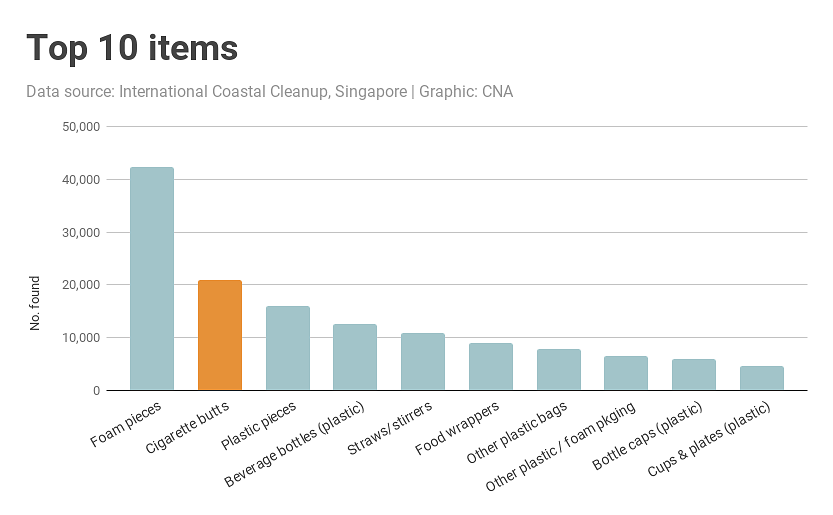
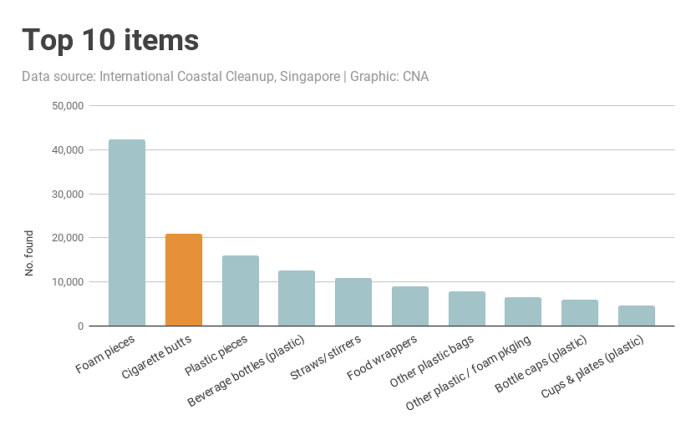
Last year 20,915 cigarette butts were found during the International Coastal Cleanup in Singapore.

This figure was nearly double the number of straws and stirrers found (10,885) and about 1.6 times the number of plastic beverage bottles (12,594). The butts were second only in numerical terms to litter from foam pieces (which have a higher propensity to break down into hundreds of smaller items).

(nc) Graph: Top 10 items, ICCS 2018

“It’s consistently a top item,” said Mr Sivasothi, who is also a research associate at the Lee Kong Chian Natural History Museum.

It is also an item which, unlike other types of shoreline litter in Singapore, is more likely to stem from local littering.

Although a lot of litter along the country’s shores is washed in from the region, the concentration of cigarette butts along certain public beaches points to their local origin, according to Mr Sivasothi.

“We always say the highest number of cigarette butts will come from East Coast and Changi (beaches), and you’re not going to find any in, say, mangroves,” he said. “Because people go to the beach and smoke.”

“The profile when you go to the non-public beaches (is that) the cigarette butts disappear,” he added. “So they’re not being floated in. So it is a local issue.”

However, Mr Sivasothi pointed out that the nature of the annual clean-up – which is normally held on the third Saturday of September – means that it only represents a single snapshot in time, and volunteer efforts across the different clean-up locations across Singapore can vary.

“It’s a single data snapshot in September. And then, the effort is quite variable,” he said. 

“Certain groups might scrutinise the trash line very closely and pick up thousands of cigarette butts. You send another group, they may focus on the larger items and miss all of that.”

Yet the prevalence of cigarette butts is consistent with the aggregated global International Coastal Cleanup tally, which has consistently seen cigarette butts topping its list of top-10 most-found items every year.

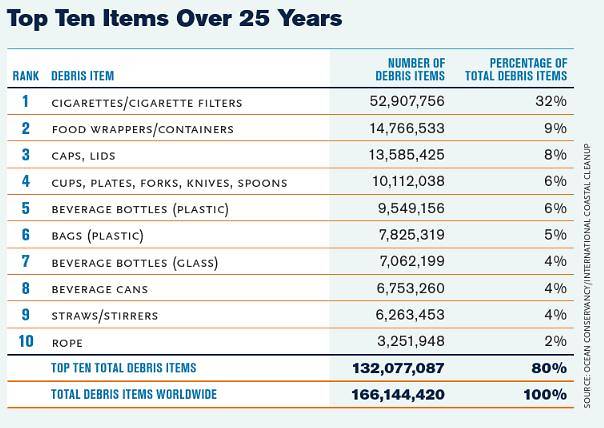
In its report for the 2010 International Coastal Cleanup, which marked the exercise’s 25th anniversary, Ocean Conservancy released data showing that about 52.9 million cigarettes/cigarette filters had been collected over the past 25 years of clean-ups – making up 32 per cent of total debris items and enough to fill 100 Olympic-sized swimming pools.

Graphic: Ocean Conservancy 2010 cleanup

Graphic: Ocean Conservancy

BUTT WHAT’S THE PROBLEM?

A lot of people might not recognise cigarette butts as containing plastic – but they do, with the filters in cigarette butts made up of cellulose acetate, a type of plastic that does not readily biodegrade.

Thin cellulose acetate fibres are packed tightly to remove harmful contaminants from smoke before it is inhaled, with a single filter possibly containing more than 12,000 such fibres, according to Associate Professor Suresh Valiyaveettil at NUS’ chemistry department.

File photo of cigarette butts in Singapore

File photo of cigarette butts in Singapore. (Photo: Gaya Chandramohan)

The large amount of cigarette butt litter as well as the fact that cigarettes contain harmful chemicals that can leach out into the environment were cited as key concerns by the academic.

“Personally, I think cigarette butts are even more dangerous than any other plastic item owing to the large amounts and the harmful chemicals leaching from them,” he told CNA.

“Usually, single-use plastic items such as straws, plastic bags etc. are hydrophobic (do not mix with water) and therefore do not degrade in a short period,” he said. “They do contain a lot of additives, but the hydrophobicity of the object slows the leaching of small molecules into the environment from common plastic items.”

“In the case of cigarette butts, the tobacco absorbs moisture readily and many chemicals are released into the environment in a short period of time.”

These chemicals can be deadly to organisms in the environment, with a study published in the BMJ’s Tobacco Control journal finding cigarette butt leachate “acutely toxic” to representative marine and freshwater fish – sometimes at a lethal concentration (LC50) of about one cigarette butt per litre of water for certain types of fish.

And as with other types of plastic pollution, cigarette filters can disintegrate and eventually break into microplastics, according to NUS PhD student Amanda Lim, who studies the sources and impact of marine debris.

“Cigarette filters are made of cellulose acetate fibers, a variant of rayon,” she said. “Filters could disintegrate into microfibres and become microplastic.”

READ: You may be eating a credit card’s worth of plastic each week: Study

FILTERING OUT POTENTIAL CAUSES

One reason for the large amount of cigarette butt litter could come down to its relative lack of visibility, especially on sandy beaches, as compared to larger items such as a plastic bottle or brightly coloured straws. 

Unlike in some other countries which have smoking bans on beaches, smoking is allowed on beaches in Singapore according to the National Environment Agency’s website.

“Singaporeans rarely talk about cigarette butts under the marine plastics issue,” said Mr Sivasothi, adding that global anti-plastic pollution campaigns also tend to focus on other items.

“I think visually it does not create as much impact. Visually they see the water bottles, the food containers and the plastic bags as the most visual component,” he said. “And then they hear about bans around the world, and bans around the world tend to be focussing on these components as well; water bottles, plastic bags, food containers.”

plastic bottle on a beach

File photo of a plastic bottle discarded along a beach.

In addition, tossing away cigarette butts might not be viewed in the same light as other forms of littering, according to a sociological study of littering in Singapore commissioned by NEA in 2009.

Calling cigarette butt littering “a confounding behaviour”, the study found that the cultural acceptability of cigarette butt littering could be contributing to the issue.

“Smokers revealed that it is culturally acceptable and expected among the smoking circle to ‘flick the cigarette butt after smoking’ or ‘stub out the cigarette under the soles of their shoes’,” said the study. “One informant even emphasised that the flicking of cigarette butts ‘is something that is universal among smokers’ and a behaviour that is constantly portrayed in popular media and culture.”

“In fact, a few mentioned that it is very ‘manly’ to do so compared to carrying the cigarette butt all the way to the nearest bin.”

People might also not see cigarette butts as litter compared to bigger items, said the study.

“Many respondents rationalise that small items are not litter, for their perceived harm to the environment and aesthetics is negligible,” it concluded. “Thus, parking coupon tabs, cigarette butts and small pieces of paper are among the items rationalised as ‘not litter’.”

But ultimately cigarette butt litter still sits within a wider, longstanding plastic pollution issue, points out Mr Sivasothi.

“The message hasn’t changed you know, for more than a decade,” he said. “It’s that single-use consumer plastic represents the highest proportion of items that are polluting our seas.”

“So really if you say what’s the single message – (it’s) how do we cut down on plastic use?”

Source link

From O-level failure to millionaire at 29, on a policy of honesty first

0

SINGAPORE: He is “Mr Toilet Man” to many, and well known for being the founder of the World Toilet Organisation.

But few know that Singaporean toilet activist Jack Sim is a shrewd businessman, retired property developer and self-made millionaire who came from a poor family, failed his O levels and went on to own 15 properties.

He was even a construction site supervisor once, but not a particularly good one. “I supervised construction workers, but I didn’t know how to do this job, so my work was really shabby,” recalled the 62-year-old.

“The foreman of the construction site told my boss to take me out of the site because I was totally unprofessional, and that was true.”

He eventually quit that job, and went on to sell building materials and develop properties — and the programme Money Mind finds out how he succeeded in business before switching roles to become a campaigner for cleaner toilets. (Watch the two episodes here and here.)

Singaporean toilet activist Jack Sim with some of the toilets he has collected.

Jack Sim also has a toilet collection.

TALKATIVE STUDENT, TOP SALESMAN

Born in 1957, he remembers growing up in “poverty-stricken Singapore”, where his family did not always have enough to buy clothes and usually had to depend on donated ones.

His mother was a housewife, and his father, a provision shop assistant who earned “very little money”.

“Life was in an attap house and … the toilet was outside. The water was (from) a shared standpipe,” Sim said. “Sometimes there was water rationing. There were a lot of cholera (outbreaks), and typhoid fever.”

Jack Sim in his current home, a far cry from the attap house he grew up in when his family was poor.

Sim in his current house.

At school, he was not a good student and was too talkative. “The teacher always asked me to stand outside the classroom, so that was why I always failed. I didn’t understand what was going on,” he said.

Having to wait for free textbooks did not help, as he would receive them only in April. “So we had to look over the shoulder of other kids, and sometimes they’d pull their book away,” he added.

So studying wasn’t one of my specialities.

In 1975, two years after he failed his O levels, he graduated from vocational school with a hotel management certificate. But he did not go into the hotel industry; instead, he joined the construction industry upon his brother’s advice.

After a year in the job, he realised he did not want to be on site and switched to sales. He became so good at it that he was the top salesman in his department.

His salesmanship caught the eye of an investor, who convinced him to set up his own company selling construction materials. Thus, in 1984, Besco Building Supplies was born.

The Besco Building was constructed in 1991, after Jack Sim set up Besco Building Supplies in 1984.

The Besco Building, in Ubi Road 4, was constructed in 1991.

But starting from scratch had its challenges; the first thing was to find suppliers. Also, while Sim was good at selling his products, he was not good at keeping track of his cash flow.

“I didn’t know how to read accounts. We only knew that we ran out of money when the bank called us to say our cheque bounced. And then we stopped doing sales and started (collecting money),” he said.

‘BLISSFUL IGNORANCE’

Then he faced one of the biggest mistakes of his life, which he still vividly recalls: He had under-priced a tender awarded by Raffles City by S$1.1 million, to the glee of his competitor.

Jack Sim faced one of the biggest mistakes of his business career when he under-priced a tender.

“I was very happy (about the contract). Then my competitor told me that I’d priced (it) wrongly and, in fact, told me which page the miscalculation was on,” said Sim. “He hoped that I’d withdraw and he’d win (the contract).

“I was very worried for about one whole week. How do I handle such a thing —just started business and immediately going bankrupt?”

He figured that honesty was the best policy. He went back to the owners of Raffles City and explained his mistake. He also confessed that he would be unable to fulfil the tender.

But his clients agreed to give him the contract at S$1.1 million more, provided that he worked with a German manufacturer for the project.

Jack Sim once under-priced a tender, but his clients gave him the contract at $1.1 million more.

“Everyone was happy” in the end, Sim said.

“It was a lot of blissful ignorance, so I didn’t really know such a thing called failure,” said Sim, who then formed a consortium of investors in 1986 to buy a brick factory across the Causeway at S$30 million.

“I just thought that the construction industry was growing so fast … everyone was enjoying good business,” he added. “In those days, we didn’t have prefabrication, so everybody needed bricks. So we just plunged into it.”

It was around this time when he dabbled in the property market, starting with 14 terrace houses in Rosyth Terrace. Although he was unfamiliar with real estate development, “it was the boom period, so (the project) sold out very quickly”.

He turned to building a 28-unit apartment block in Meyer Road, and that venture sold well too. At 29, he was already a millionaire.

WATCH: How Jack Sim made his millions before 30 (3:21)

In 1990, he was offered a business opportunity of a lifetime by his French roof tile supplier: To start a roof tile factory in Malaysia with the supplier.

After the factory was up and running, Sim managed to convince many developers in Singapore that the orange-coloured clay roof tiles would give their houses a Mediterranean look.

“I told the developers, ‘Your house will sell (for) a higher price if it looks like that’, versus the … concrete roof tiles,” he said.

“Although the clay roof tile was three times more expensive, it was actually only 2 per cent more expensive for the entire house.”

Developers changed to clay roof tiles, convinced by Jack Sim that the Mediterranean look would sell.

Developers changed to clay roof tiles.

In three years, his company became a dominant player in the market.

UPS AND DOWNS

But it all came crashing down with the 1997-98 Asian Financial crisis, and he was forced to retrench staff. “It was very traumatic emotionally,” admitted Sim. “A businessman is very attached to his business, and you start to question yourself.”

At that time, he also owned 15 properties, whose values dropped by half. “I didn’t sell; I hung on,” he said. “It was a stressful time.”

During this period, something changed in him — triggered by a speech by then Prime Minister Goh Chok Tong, who said a society’s graciousness could be measured by the cleanliness of its toilets.

That inspired Sim to create the Restroom Association of Singapore, which “a lot of” his staff and peers thought was a “crazy” idea.

Watch: Jack Sim’s toilet agenda (1.33)

“I told them that … if I do social work, at least I feel useful. When I come to the office, I don’t feel useful. I feel like a failure,” he said.

I was nourished by the spiritual reward that I had in social work.

He also told his wife that after the recession, he would quit his businesses to focus on social work “because it’s so much more fulfilling”.

In 2001, he created the World Toilet Organisation, which soon gained worldwide recognition. And in 2004, he stepped down as chief executive officer of his first company, Besco.

Currently, his most ambitious social enterprise is the Base of the Pyramid (BoP) Hub, which he established in 2011 with a mission to design business to “solve the poverty problem in the world”.

Activist Jack Sim pointing to the back of The Besco Building, where the BoP Design Centre was built.

Sim pointing to the back of The Besco Building, where the BoP Design Centre was built.

His idea is to provide professional services for social entrepreneurs catering for the base of the market pyramid — those who live in poverty round the world.

“Charity can’t get people out of poverty. We have to unlock their spirit of enterprise and their good work ethic, in the same way Singapore got out of poverty,” he said.

“We can export these best practices, public policies (and) technology, and integrate everybody.”

For him, it has been a journey of ups and downs that help to define who he is today. Looking back, he believes that his successes boil down to luck and timing.

“Keep a good reputation, stick to some principles. If you make a mistake, say so. If you’re honest, people tend to trust you,” he added. “These are the types of simple rules I think you have to know.”

Watch these episodes of Money Mind here and here. New episodes every Saturday at 10.30pm.

The entire BoP Hub project cost S$10 million, which founder Jack Sim financed mostly by a bank loan.

The entire BoP Hub project cost S$10 million, financed mostly by a bank loan.

Source link

1 dead, 2 injured in massive fire at Jurong LPG facility

0

SINGAPORE: One person died and two others were injured after a massive fire broke out at a Jurong industrial area on Friday (Jun 21), said the Singapore Civil Defence Force (SCDF). 

SCDF said it was alerted to the incident at 43 Jalan Buroh at about 5.10pm. The fire, which SCDF described as “raging and intense”, was brought under control at about 7.30pm.

The fire engulfed an LPG facility about the size of two football fields, said SCDF, adding that it involved “hundreds” of highly flammable LPG cylinders – the largest number the force has seen in a fire.

The fire spread rapidly as SCDF worked to contain its spread. 

“Firefighters faced intense heat amidst exploding LPG cylinders while preventing the fire from spreading to larger LPG storage tanks nearby,” said SCDF in a Facebook post. 

It added that a body was found at the scene by an SCDF paramedic.

Two workers suffered burn injuries and were taken to Singapore General Hospital.

A total of 35 emergency vehicles and about 120 firefighters were deployed. 

“At the height of the firefighting operations, seven water jets, including an Unmanned Firefighting Machine, were used to mitigate the fire,” said SCDF.

When CNA went down to the scene at about 6pm, two men were seen sitting by the side of the road with injuries. One had bandages on his arm and knee. The other had bandages on his arm, back and the side of his head, and was later helped into a wheelchair by emergency responders.

SGSecure mobile app users with M1, StarHub and Singtel within the immediate vicinity of the fire received a message urging them to stay away from the affected area, said SCDF.

Videos sent to CNA show flames and clouds of thick smoke rising from the area. Residents reported hearing multiple sounds of explosions.

Photo of rising black smoke seen from Bukit Batok

Photo of rising black smoke seen from Bukit Batok. (Photo: Jonan Gan)

Eyewitnesses said smoke from the fire could be seen from areas including Teban Gardens, Clementi, Cantonment Road and as far away as Bishan.

Jurong fire seen from Bishan

Smoke seen from an apartment in the Bishan area near Lornie Road. 

CNA reader Carol Lee said she was picking her husband up at the building opposite the fire, and could feel the heat from where she was about 200m away. 

“I saw the fire follow by an explosion sound a lot of times until can’t count. It was very scary. The smoke smelt like chemicals, not the normal smoke,” she said.

Another CNA reader, Muhammad Farihin, described what he saw as “balls of fire” from his apartment at Yung Kuang Road. “There were explosions too,” he added.

Lilliane Reyes was changing her toddler when she heard what she thought was “loud thunder”.

“I just thought that was just a very loud thunder then the baby said ‘ohh, what’s that?’ … Then when I stood up I saw big dark smoke.”

Michael Toh was travelling from Tuas Checkpoint towards the city when he saw the fire.

“There was thick black mushroom smoke skywards. Traffic slowed down due to the distraction and partially due to peak hours jam,” he said.

Smoke rising into the sky as seen from inside a train near Jurong East station

Smoke rising into the sky as seen from inside a train near Jurong East station. (Photo: Mrs Ong)

The cause of the fire is under investigation, said SCDF.

This story came from a reader tip-off. If you would like to send in photos or videos of something newsworthy, WhatsApp our Mediacorp news hotline at +65 8218 8281 or message us on Facebook.

Source link

Fire breaks out in Jurong industrial area, explosions heard

0

SINGAPORE: Firefighters are battling a blaze at a Jurong industrial area on Friday (Jun 21). 

The Singapore Civil Defence Force (SCDF) said in a Facebook post at about 5.45pm that it was alerted to the incident at 43 Jalan Buroh.  

“SCDF is at scene conducting firefighting operations,” it said.

Videos sent to CNA show flames and thick clouds of black smoke rising from the area. Eyewitnesses reported hearing multiple sounds of explosions.

Photo of rising black smoke seen from Bukit Batok

Photo of rising black smoke seen from Bukit Batok. (Photo: Jonan Gan)

Smoke rising into the sky as seen from inside a train near Jurong East station

Smoke rising into the sky as seen from inside a train near Jurong East station. (Photo: Mrs Ong)

This is a developing story. Please refresh for updates.

This story came from a reader tip-off. If you would like to send in photos or videos of something newsworthy, WhatsApp our Mediacorp news hotline at +65 8218 8281 or message us on Facebook.

Source link

Parents address flak over ‘irresponsible’ use of baby strollers on escalators

0

SINGAPORE: Of all the things that have angered Chow Xuanhui as a mother, one is not what most people would expect – not being able to get into lifts. 

“Those idiotic lunch crowds at Seletar Mall from nearby offices,” said the 33-year-old. “Every time the lift door opens, you see these idiots inside with no kids or strollers, and not on wheelchairs.”

“And they’re just nonchalant.”

Ms Chow’s comments came after CNA released statistics on escalator-related injuries caused by “user behaviour” such as prams on escalators, were released on Wednesday (Jun 19).

There were more than 350 incidents reported last year, with the number of escalator-related injuries among children more than doubled between 2012 and 2016 at KK Women’s and Children’s Hospital.

More than half of those who arrive at the hospital with injuries involving prams on escalators tend to be admitted.

READ: Almost an accident a day on Singapore’s escalators, and the reasons why

The news generated hundreds of shares and comments on social media, with some calling parents who use strollers on escalators – generally prohibited in Singapore – “irresponsible” and “lazy”.

But Ms Chow said: “Who will want to push (the pram) on the escalators? Only when (you’re) fed up.”

Ms Chow said she often found herself having to push her pram, with her toddler son in it, onto the escalators because she had “waited too long for the lift”. 

It appears many share her outrage. 

Other parents have spoken up online with similar complaints, with one commenting on CNA’s Facebook page: “Many parents use prams on escalators because the lifts at malls are getting smaller and crowded.”

Another said: “I saw so many ‘normal and fit’ people … waiting for lifts. Very inconsiderate.”

A commenter recalled an incident in which he had to wait more than 20 minutes for a lift at VivoCity, which led him to quarrel with “local youngsters” who “rushed in without caring”.

Several parents CNA spoke to offline admitted to pushing the pram onto the escalator with their child still in it, despite knowing the risks involved.  

“There is a possibility that the pram may lose balance, it may topple over, the wheels can get stuck,” said Mr Daryl Tng, a 24-year-old father of one.

The parents were unanimous in their rationale for it – the lifts are overcrowded. 

When asked if he had ever requested for people to give way, Mr Tng said: “I don’t dare to ask.”

“It’s like first come first serve. I don’t really think it should be, but then it’s the mentality of the people living in Singapore,” he said. 

There are nearly 7,000 escalators in Singapore, and safety-related issues have grown in importance.

There are nearly 7,000 escalators across Singapore, and issues surrounding their safety have become increasingly important. 

At the other end of the debate, some said was it “not fair to say (that) normal and fit people shouldn’t take lifts”.

“Are lifts for pram users only?” asked one Facebook user in the comments section. 

“I feel that that’s not the point of the matter because then you can say animals, the birds and the bees, also can take the lift,” 29-year-old father Badron Adnan told CNA. 

“You should have the heart and kindness to prioritise the ones who need it more. It’s not right for an able-bodied person to take the lift and then complain that an elderly or special needs person has to take the lift,” he added. 

General Secretary of the Singapore Kindness Movement, Dr William Wan, said he feels that while certain actions may show that Singaporeans are thoughtless, it may not mean that they are unkind.

“Many people use the lift as a matter of course and may not have given thought to others around them who may have a greater need.  To that extent, they have not given thought – hence literally thoughtless,” explained Dr Wan. 

“But that is not necessarily a judgement on their ability to be kind.  We are often so self-absorbed with thinking about work that we fail to give thought to the needs of those around us,” he said, adding that people just need some reminders from time to time.

SMRT Corporation chief communications officer Margaret Teo stressed that the safety of the commuters is the company’s priority.

“Our ongoing efforts encourage and educate commuters to use escalators and lifts safely, through station announcements and information on reminder signage located near our escalators and lifts.

“We also engage commuters on travel safety in our network via the latest series of animated video messages featuring the DreamWorks KouKou Buddies,” she told CNA.

One of SMRT’s escalator guidelines include using the lift if you have limited mobility, are carrying bulky items or using a pram, or are feeling unwell.

However, Mr Badron said he felt more could be done in the other direction.

“There’s a lot of push asking parents to take the lifts but there’s no campaign to tell people to give way. It’s not strong enough,” he said.

 Ms Chow’s sister, Teresa, said: “It wouldn’t hurt to raise awareness but I also feel like if we have to come to this point, it’s a bit sad.”

“It’s like every single thing (has to be pointed) out to Singaporeans,” said the 24-year-old, who often babysits. 

Dr Wan agreed that Singapore has a long way to go towards becoming a gracious society, but believes that “we have already covered some distance”. 

“We are getting there because we are reminded, nudged, inspired, and received kindness when we needed it,” he said.

“Especially (with the) fast-changing …. landscape, my best advice on getting there is that we should continue to be considerate and other-centred.”

“Lots of that is common sense,” he concluded.

Source link

Growing diversity means common spaces must be deliberately nurtured: Heng Swee Keat

0

SINGAPORE: The growing diversity in Singapore means common spaces here will be harder to maintain and must be deliberately nurtured and expanded, Deputy Prime Minister Heng Swee Keat said on Friday (Jun 21) at an international interfaith forum. 

His speech brought the four-day International Conference on Cohesive Societies to a close. It was attended by about 1,000 delegates from nearly 40 countries.

Mr Heng touched on how Singapore has sought to build cohesion over the years in a multi-cultural and multi-religious society. 

He highlighted the policy that ensures public housing estates have a balanced mix of ethnic groups, the introduction of common spaces such as hawker centres and community centres, the importance of shared experiences such as National Service, as well as the effort to conserve cultural and religious landmarks.

“But like most other countries, our demography is evolving. Life experiences and needs are also more varied. So Singapore is more diverse today than before,” he told the audience. 

“Our increasing diversity means that our common spaces will be harder to maintain, and must be deliberately nurtured and expanded.”

READ: Risk to inter-faith harmony ‘single most important threat’ to the world now: Jordan king

Racial and religious demographics are changing, Mr Heng added, pointing out that homogeneity of religion within ethnic groups is on the decline in Singapore. There are also more interfaith families here, leading to each generation possibly holding different religious beliefs.

A fifth of marriages here are between people of different ethnic groups, and a similar proportion of Singaporeans do not identify with a religion, he added.

“As our racial and religious demographics shift, so too, must our approach to building bridges and encouraging discourse,” said Mr Heng. “We should use this opportunity to deepen mutual understanding.”

Another way to promote cohesion is to address social inequality to better distribute the fruits of economic growth, he said.

THE ROLE OF YOUNG PEOPLE

The conference, an inaugural effort organised by S Rajaratnam School of International Studies (RSIS) at Nanyang Technological University with the support of the Ministry of Culture, Community and Youth, reached out to the “next generation of leaders” through the Young Leaders’ Programme (YLP), he said.

READ: Singapore’s key religious organisations affirm commitment to religious harmony

In a dialogue following his speech, which was moderated by ambassador Ong Keng Yong the executive deputy chairman at RSIS, Mr Heng elaborated on the role young people should play.

As the generation that will be inheriting the future, young people should be shaping it, he said, adding that diversity can be a strength if properly harnessed.

There are good initiatives by young people to promote harmony currently, and these are efforts should continue and grow, he said. He added that it is “very important” for young people to take a stand against extreme and intolerant views.

While it is easy to sow discord by representing religions in negative light, or picking on negative aspects, this can be combated by spreading constructive and positive messages online, he said.

“I hope our young people in particular, who are digital natives, will go out and rebut these falsehoods, or erroneous views which are being spread, and our social media space can become a constructive space,” Mr Heng added.

DEMOCRACY OF DEEDS

Apart from young people, every one has a part to play, he said, referencing the concept of “democracy of deeds”.

Mr Heng had also touched on the concept, first introduced by Singapore’s first foreign affairs minister S Rajaratnam, at a recent REACH-CNA dialogue session on how the country’s fourth generation of leaders intends to have a new social compact with its citizens.

heng swee keat

Heng Swee Keat at a dialogue at the International Conference on Cohesive Societies. 

When asked to expand on the concept on Friday, Mr Heng said that democracy was not only about free speech and being free to talk about views.

“More fundamentally it’s about what each and every one us in our society can do,” he said.

On the topic of harmony, he said that every one, in their circle of friends, contacts and daily work environment can promote racial and religious harmony by helping people understand better, and having the courage to correct those who espouse the “wrong” views.

Giving an example of how the democracy of deeds works, Mr Heng said some Muslim residents in his ward, a family who used to own a restaurant, would invite people from the neighbourhood to celebrate Hari Raya every year.

They would erect a tent out their ground-floor home for the occasion, and Mr Heng, who has attended some of these gatherings, said it was a wonderful occasion.

“It’s about what we do, not just what other people do, and how can I play a part,” he said.

Mr Heng also spoke about how young people at a pre-university seminar had raised to him their concerns that disadvantaged students in schools are not coping as well as others. He had suggested to them that students from higher levels could help younger students for 10 min a day to make a difference, another example of democracy of deeds.

In rounding up the dialogue, Mr Heng said it is very important for people in Singapore to understand the global context they are operating in, in order to understand the major forces that are shaping societies around the world.

He urged them to stay cohesive.

“I hope that through this conference, you all continue to build a community that believes deeply in harmony, that believes deeply in treating all people regardless of race, language religion or beliefs as equals, with respect and that we build trust and understanding within Singapore and across the world,” he said.  

Source link

Risk to inter-faith harmony ‘single most important threat’ to the world now: Jordan king

0

SINGAPORE: The attack on inter-faith harmony and mutual trust, especially in light of recent attacks in Christchurch and Sri Lanka, is the world’s “single most important threat”, King Abdullah II of Jordan said on Thursday (Jun 20).

Delivering the keynote speech at the inaugural International Conference of Cohesive Societies (ICCS) in Singapore, the king said there is an urgent need to tackle “the attack on inter-faith harmony, mutual respect and trust”. 

“I say ‘single most’ (threat), because every global challenge in this 21st century demands we resist hatred and exclusion,” he said. 

“Economic growth, peacemaking, protecting the environment, global security, inclusive opportunity – all these critical goals require that we cooperate, and combine our strengths to our common benefit.”

AREAS FOR SPECIAL ATTENTION

To defend social cohesion across the globe, the king suggested that special attention be paid in three areas. The first is to hold positive exchanges among the “billions of people … who seek peace and harmony”.

The second is to harness technology and connectivity to reclaim the online space and fight misinformation. The king said that he attended a high-level meeting on the Christchurch Call to Action last month, which focused on safeguarding the online environment from abuse. 

A follow-up meeting was held in Jordan a few days ago to further identify practical steps that can be taken.

READ: Commentary: Christchurch attack raises uncomfortable questions about intelligence failure

But he added that while governments and companies can lead the way, ordinary people also have a role to play in speaking up online.

“In a very real way, the Internet belongs to its users. Moderate, positive voices need to reclaim this space and redirect the dialogue away from misinformation, insults and fear, and towards understanding and respect,” he said.

“Young men and women have a vital role in speaking up on social media and social networking sites, and using their talent for innovation to promote mutual understanding and hope.”

Finally, the king said that investing in inclusive, sustainable development would help address social problems that extremists exploit. This commitment to the long term would create a foundation where all people can share in opportunities and combat divisive ideology.

The king also raised issues such as the “unprecedented refugee crisis” as well as the Palestinian-Israeli conflict as challenges the world faces.

King Abdullah II, who is in Singapore for a state visit, was invited to the conference as he is a global leader in inter-faith harmony. He has championed initiatives such as the Amman Message, the Common Word Initiative, as well as the UN World Interfaith Harmony Week.

As part of his royal duties, the king is also Hashemite Custodian of Muslim and Christian holy sites in Jerusalem.

Rejecting all acts of hate and violence, he said: “In His compassion and mercy, God requires that we, in turn, show mercy and compassion, respect others, and live in peace. These core Muslim teachings and values are at the heart of my work for mutual understanding.”

For Singapore, a call to action was unveiled on Wednesday, laying out specific ways that people can build bonds with each other.

The Commitment to Safeguard Religious Harmony was presented to President Halimah Yacob during the opening ceremony of the ICCS.

READ: Singapore’s key religious organisations affirm commitment to religious harmony

Speaking to reporters, Mdm Halimah said its use was not confined to religious settings, despite its name.

“This is a commitment that can also be used in different settings. Community settings; it can be to reinforce the values of cohesion, the need to preserve peace, harmony in schools, in workplace. So I think there is a multiplier effect and that is something that we want to see,” she said.

KING MAKES FIRST VISIT TO NTU CAMPUS, PRESENTED WITH FLOWER

On Thursday, King Abdullah IIalso made his first visit to the Nanyang Technological University (NTU) campus to learn more about the university’s research and prgorammes, particularly in the areas of education, 3D printing and air traffic management.

Jordan's king visits NTU 2

Professor Subra Suresh (left) presents King Abdullah II of Jordan with NTU’s university flower. (Photo: Nanyang Technological University)

Jordan's king visits NTU 1

King Abdullah II of Jordan was briefed on 3D printing breakthroughs during his visit to NTU. (Photo: Nanyang Technological University)

The king also signed the university guestbook and was presented with the university flower, Dendrobium Nanyang, plated in rhodium and gold.

Source link

Hidden from plain sight: The high-tech security systems that ensure guests’ safety at Jewel Changi

0

SINGAPORE: The light show at Jewel Changi has just ended on a crowded Saturday night and visitors are making their exit from the popular shopping mall and lifestyle destination at Changi Airport.

The crowd makes a smooth exit on escalators which have been programmed to move in just one direction.

This was made possible by Mozart, a platform developed by security firm Certis, which integrates and analyses data from 12 different systems with over 5,000 sensors, more than 700 CCTVs and over 200 mobile devices.

It allows officers to make quick decisions in situations like crowd control as well as dealing with security incidents. The platform is part of the Security+ suite of advanced, integrated facilities management, security and guest experience hardware and software deployed at Jewel’s Smart Operations Centre. 

“I think the escalators (are) an interesting point because nobody expected the crowd watching the (light) show to be so (big) … that kind of analytics help us make sure that you got no choice but to make both escalators go up during those timings,” said senior vice president and head of Certis Aviation Security, Benny Lim, when the suite was revealed to the media on Thursday (Jun 20).

The escalators will then be switched to travel in alternate directions when the crowds have thinned out, he added.

Mr Lim cited other pre-emptive as well as predictive operational insights that have been developed from analysing data. These include allowing Certis to better monitor carpark traffic, which has resulted in more efficient deployment of crowd control manpower.

In fact, 15 per cent fewer Certis officers are needed at Changi Jewel compared to other major attractions because of the system, which has been in place since October 2018, said Mr Lim.

Jewel Changi Smart Operations Centre 2

Jewel Changi Smart Operations Centre, where Certis’ Mozart data and security platform is deployed. (Photo: Certis)

There is also a mobile app to help the security officers and facility management crew at Jewel Changi be more efficient in their work.

For example, staff can use to app to pinpoint where an escalator has broken down or a spillage needs to be cleared.

There are also standard operating procedures pre-installed in the app for officers and crew to follow through to help with guest relations and security.

Certis argus smart mobile app

The Argus mobile app enables Certis security officers and facilities management crew to be more efficient in managing security and guest relations at Jewel Changi Airport. (Photo: Hanidah Amin)

Certis has also deployed a fully autonomous robot to ensure smooth vehicular traffic flow.

Located at the kerbside entry at level two, Certis says the “PETER” or Patrol and Traffic Enforcement Robot helps reduce human intervention by having the ability to detect vehicles that flout the no parking and waiting rule at the kerbside.

Armed with wide-screen LCD displays and speakers, PETER is able to screen traffic enforcement messages and play audio advisory alerts. The robot is also connected to the Jewel Smart Operations Centre via live video streaming.

Jewel certis robot officer PETER

Certis’ robot enforcement officer known as PETER (Patrol and Traffic Enforcement Robot), patrols the kerbside outside JEWEL Changi airport to ensure smooth traffic flow with minimal human intervention. (Photo: Hanidah Amin)

Certis said it is looking to deepen its partnership with Jewel Changi.

“By looking (after) the back end, we are looking after the safety of the visitors. Then Jewel can focus on what they do best (as) they take care of the experience of the visitors,” said the company.

Source link