SINGAPORE: Technology is shaping warfare and security globally and Singapore must stay on top of its game, Senior Minister and Coordinating Minister for National Security Teo Chee Hean said on Thursday (Jul 27).
In his keynote address on the second day of the Singapore Defence Technology Summit, Mr Teo shared how some societies are “grappling with the rapid advance of technology”, such as in artificial intelligence.
Mr Teo said: “We all want to be ahead of the game, and not be left behind.
“But in this headlong rush, we do also need to reflect on how well, and how wisely we are making use of technology, and whether we are prepared to deal with the collateral consequences of the proliferation of these new technologies.”
Senior Minister and Coordinating Minister for National Security Teo Chee Hean speaking in a keynote address on the second day of the Singapore Defence Technology Summit.
He said advances in technology mean militaries around the world are also seeing “new forms of asymmetrical or conventional warfare enabled by cyberspace”.
“It is not just the major powers that have the ability to attack enterprise or cyber-physical systems,” Mr Teo added.
“These methods allow small-scale actors to circumvent military defences to launch disproportionately damaging non-conventional attacks on much stronger adversaries.”
Cyber-attacks targeting government institutes and the spread of fake news can catalyse information warfare.
“Greater connectivity offers society many benefits. However, with each new smart device on the network, we open up more potential vulnerabilities and a much larger surface area for attack,” the senior minister said.
Mr Teo also highlighted the need for the ethical use of Artificial Intelligence. In January this year, Singapore became the first country in Asia to launch a framework on how AI can be used ethically and responsibly.
The summit, organised by Defence Science and Technology Agency, saw a panel discussion on various aspects of AI, such as whether AI can make soldiers smarter and scenarios of how AI can be used when critical infrastructure is compromised.
There was also a discussion on whether AI might make soldiers obsolete. The consensus was that soldiers are still needed, although they will play different roles from before.
Senior Minister and Coordinating Minister for National Security Teo Chee Hean speaking in a keynote address on the second day of the Singapore Defence Technology Summit.
One of the panellists, Amir Husain, founder and CEO of SparkCognition, said: “AI will take on a huge amount of the burden.
“I think that the armed forces of the future will be smaller given the current threat environment unless something drastic changes.
“What we use the soldiers for will be different, with the amount of technology that’s going in the armed services already and the effect it can have. It speaks to the need to change the nature of our training.”
Representatives from various defence ministries, such as Japan and the US, will be involved in Friday’s panel discussions.
SINGAPORE: Six people were taken to hospital after the truck they were in collided with a DHL lorry at Tanah Merah Coast Road on Thursday morning (Jun 27).
The police said they were alerted to the accident at 8am.
A video posted on Facebook group SG Kay Poh shows a large DHL lorry hitting a blue truck from behind. The impact threw six men in orange attire off the truck, which swerved and crashed into a sidewalk.
The six people, aged between 31 and 40, were conscious when taken to Changi General Hospital, said the police.
The truck swerved and crashed into a road barrier. (Screengrab: Facebook/SG Kay Poh)
In response to CNA’s queries, a DHL spokesperson said that the accident involved a subcontractor operating the vehicle on behalf of DHL Global Forwarding Singapore.
“The subcontractor has made a police report and is currently assisting the police with their investigations,” said the spokesperson.
“Road safety is of paramount importance for DHL operations, and we will be reviewing the safety standards with our partners and subcontractors.”
SINGAPORE: Two housing sites and one residential with commercial site with a combined yield of 1,545 homes were released for sale under the first half 2019 Government Land Sales (GLS) Programme on Thursday (Jun 27).
The plot of residential land with a commercial component on the first storey is located at one-north Gateway.
The 5,778.7 sq m site, launched for sale under the Confirmed List, is the smallest of the batch with a potential yield of 165 units. It has a maximum gross floor area of 14,447 sq m.
It is, however, expected to be popular among developers because of the high investment potential and rental demand in the one-north area, said analysts.
“The one-north area was designed as a business park and high-tech research and development hub. Private homes in the vicinity have high investment potential given that the area has good rental demand and healthy capital appreciation,” said Ms Christine Sun, head of research and consultancy at OrangeTee & Tie.
She expects the site to draw about eight to 10 developers, with bids at between S$1,100 and $1,200 psf ppr.
“Given that this development may attract many investors, the development may comprise of a number of smaller units which could be sold at a higher per sq foot price of between S$1,900 to S$2,000 psf,” she added.
The tender for site at one-north Gateway will close at noon on Sep 5.
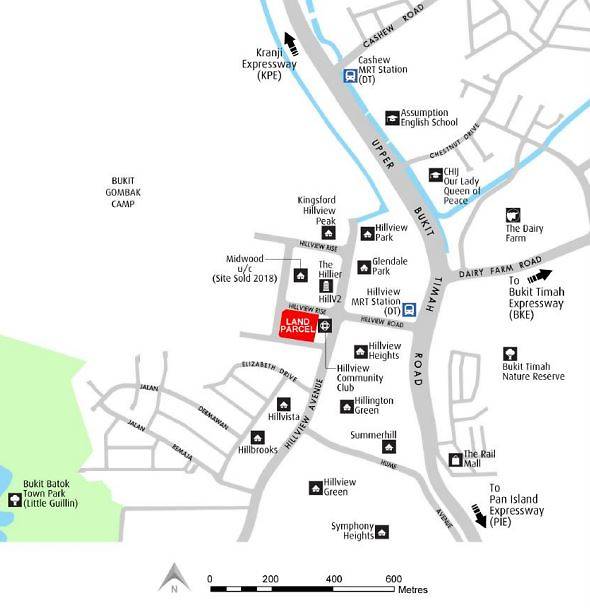
At 10,395.2 sq m, the Hillview Rise site has a maximum gross floor area of 29,107 sq m and may yield 340 units. (Image: URA)
RESIDENTIAL SITES AT HILLVIEW RISE, DUNMAN ROAD UNDER RESERVE LIST
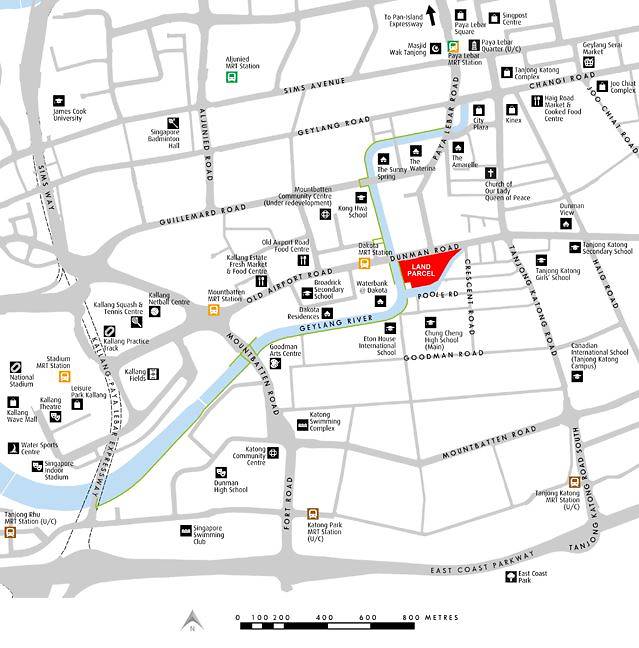
The residential sites at Hillview Rise and Dunman Road, which are located near Hillview and Dakota MRT stations respectively, are released under the Reserve List.
At 10,395.2 sq m, the Hillview Rise site has a maximum gross floor area of 29,107 sq m and may yield 340 units.
Analysts are not overly optimistic that they may be triggered for sale, given the current supply and inventory.
“Given the increasing supply of new homes, most developers may be less active in their land acquisition. Some may prefer to pare down their existing stock before expanding their current land bank,” said Ms Sun.
The residential site at Dunmad Road is released under the Reserve List. (Image: URA)
Of the two, Ms Tricia Song, head of research for Singapore at Colliers International, pointed to Dunman Road as being more attractive, given its proximity to Dakota MRT station, several well-known schools as well as views of East Coast.
SINGAPORE: Prolonged political uncertainty in Hong Kong will not be good news for Singapore, said the country’s central bank chief Ravi Menon on Thursday (Jun 27).
Singapore also has not seen any significant fund flows from Hong Kong, where millions have taken to the streets over the past weeks to protest against a controversial extradition Bill.
Mr Menon, managing director of the Monetary Authority of Singapore (MAS), was responding to a question at a press conference on whether Singapore has benefited from the recent uncertainties in Hong Kong.
Managing director of the Monetary Authority of Singapore Ravi Menon speaks during a press conference on the central bank’s annual report on Jun 27, 2019.
Some media reports, citing experts, have said that the ongoing political uncertainty could undermine Hong Kong’s reputation as a financial hub. This may in turn benefit Singapore, the reports said.
To that, Mr Menon said that based on data and engagement with financial institutions, there have been “no signs of significant shift in business or funds” to Singapore from Hong Kong.
“I think people tend to see too much through the lens of competition. There’s a lot of complementarity between the two financial centres and I think we should not lose sight of (that),” he added during the press conference on the central bank’s annual report.
SINGAPORE: The Monetary Authority of Singapore (MAS) made a net profit of S$19.2 billion for the year ended March, due to better investment returns and currency effects, according to its annual report for the 2018/19 financial year released on Thursday (Jun 27).
The figure, net of a S$3.9 billion contribution to the Consolidated Fund, is more than three times higher than last year’s net profit of S$5.3 billion even as higher investment and interest expenses increased total expenditure by 51 per cent to almost S$4 billion.
MAS made total gains of S$26.2 billion from the investments of its official foreign reserves. It was S$8.5 billion in FY2017/18.
The gains comprise an investment return of S$25.2 billion and positive currency translation effects of S$1 billion.
The latter was largely due to the depreciation of the Singdollar against the greenback, though that was offset by a stronger Singdollar against other major currencies such as the euro, MAS said.
As in previous years, the investment return for FY2018/19 came mainly from interest income and realised capital gains. It was also similar to the S$22 billion achieved in the prior two financial years, despite volatility in global markets last year, added the central bank.
The rolling 10-year investment performance of the official foreign reserves (OFR). (Graphic: Monetary Authority of Singapore)
At the end of March 2019, MAS held S$400.7 billion of foreign reserves on its balance sheet. It said that the funds are invested in a well-diversified portfolio, comprising different asset classes across various geographies, for good long-term returns and resilience across market conditions.
About three-quarters of the portfolio are denominated in the US dollar, euro, yen and British pound, with the greenback forming the bulk. Investment-grade bonds in the advanced economies form the largest allocation in the portfolio, MAS said.
Its financial statements also said the board has approved a return of S$35.2 billion – S$19.2 billion net profit from FY2018/19 and S$16 billion from the General Reserve Fund – to the Singapore Government this year. This compared with last year’s approved returns of S$2.7 billion.
The return of profit to the Government from the General Reserve Fund and/or from the net profit of each financial year is determined by the MAS. Any remainder of the net profit is credited to the General Reserve Fund in accordance with Section 6 of the MAS Act, according to the financial statements.
“In approving the amount of profit to be returned, the board ensures that the authority’s capital and reserves remain adequate for the authority to carry out its principal objects and functions. The return of S$35.2 billion bolstered the Government’s Singapore dollar deposits held with MAS,” the central bank said.
SINGAPORE: Countries need to reshape their militaries to deal with more non-conventional threats today – including terror attacks, threats from cyberspace and the effects of climate change, Singapore’s Defence Minister Ng Eng Hen said on Wednesday (Jun 26).
Speaking at the opening of the Singapore Defence Technology Summit, Dr Ng said militaries will have to work closely with the defence technology sector to respond to these newer threats.
“Whatever the changes required, one aspect is clear – our militaries will have to do more, sometimes with resource constraints. There will have to be closer interactions between the operational units and the defence technology community to optimise resources and improve responsiveness,” he added.
The summit, in its second year, will address also issues like the trade-offs between digitisation, ethical issues surrounding AI and the impact of automation on jobs in the military.
“These problems are complex, and even more so the solutions with hard trade-offs,” said Dr Ng.
“But strengthening legislation and pre-agreed OB markers will certainly form part of our tool-box to tackle these challenges. Here, it is important for leaders in defence technology to be involved in the process early, to have your views clarified and sharpened before they get caught up in the legislative and political machinations of individual countries.”
MILITARIES ADAPTING TO CHANGE
Dr Ng cited a few examples of militaries that are already adapting to change. For instance, Germany has significantly scaled up its cyber defences, investing 1.6 billion euros (S$2.5 billion) on digitalisation and IT. In 2017, the German armed forces launched a new service with more than 13,000 personnel tasked with protecting and defending critical networks and information systems.
The US Department of Defense has been given the mandate to launch cyber counterattacks against aggressors, he noted.
In Singapore, the defence ministry is working with scientists, engineers and military operators to develop new capabilities to solve problems. An example is ST Engineering’s Force on Robotic Target (FORT), a next-generation robot that can be used for urban tactical training at close quarters.
A man trying out ST Engineering’s Force on Robotic Target (FORT).
“It gives soldiers a more realistic live training scenario and enhances training effectiveness,” said Dr Wilson Oon, Division Manager, Training and Simulation Systems at ST Engineering.
Delegates from 23 countries are present at the summit. This is an increase from 17 last year, a development which Dr Ng welcomed amid a “more contested technology environment” where he said secrets are more likely to be closely guarded.
“The militaries that will serve this generation will have to deal with traditional rivalries, as well as expanded challenges related to terrorism, cyberspace, outer space and the forces of nature,” Dr Ng concluded.
“Increasingly, we will need the power of technology to amplify our efforts and improve our effectiveness to deal with such challenges.”
SINGAPORE: On Tuesday (Jun 25), the Singapore Food Agency put up a post on social media to raise awareness about African swine fever (ASF), a deadly disease sweeping across Asia, affecting hundreds of farms and leading to the death of millions of pigs.
Here are four things to know about the hog killer.
WHAT IS AFRICAN SWINE FEVER?
African swine fever (ASF) is a highly contagious virus that can be fatal for pigs, but so far cannot be transmitted to humans. With no antidote or vaccine, the only way to contain the spread is to cull the animals.
COUNTRIES AFFECTED
Historically, ASF outbreaks have been reported in Africa and parts of Europe, South America and the Caribbean.
The virus has, however, now spread to Asia, with China reporting its first cases last August. In 2019, ASF was also detected in Cambodia, Hong Kong, Laos, Mongolia, North Korea and Vietnam.
Vietnam has been one of the hardest hit by the disease, with about 10 per cent of its pig herd culled as of June this year. ASF was first detected in the Southeast Asian country in February, appearing mostly at small household farms. The virus has since started hitting large-scale industrial farms – a “worrying sign”, according to the government – and to date, 2.8 million hogs have been culled.
CURBING ITS SPREAD
Since the outbreaks in Asia first began, countries have moved to mobilise resources to help combat further spread.
Vietnam has deployed its soldiers and police to “make sure infected pigs are culled in a timely manner”, Vietnam’s deputy agriculture minister Phung Duc Tien was cited as saying.
Countries such as China, Malaysia and Thailand have announced bans on pig imports from affected countries in recent weeks.
This photograph taken on May 27, 2019 shows health officials spraying disinfectant on a dead pig at a farm in Hanoi before burying it in an isolated quarantined pit to stop the spread of African swine fever. (Photo: AFP/Manan Vatsyayana)
Malaysia, which remains free from the disease, said on Monday that its government is on the alert and taking precautionary measures, including banning the import of pigs and pork products from China, Poland and Belgium, Thailand, Vietnam and Cambodia.
Th Malaysian government also advised pig farmers to enhance the bio security of their farms by ensuring perimeter fences are in good condition and that farm hands are provided with clean, disinfected clothes and boots.
It also warned farmers not to cover up ASF cases. “Failure to report could result in a fine of not more than RM25,000,” said the Malaysian agriculture minister.
In Singapore, said SFA, the authorities require “sources exporting raw pork to Singapore to be free from ASF”. SFA has also suspended pork and pork product imports from affected sources, it said in its Facebook post.
“ASF can be inactivated with sufficient heat treatment, so sufficiently heat-treated processed pork from approved establishments is allowed for import into Singapore,” it added.
IMPACT ON PORK PRICES
Pig trotters hang inside a meat stall after pork meat sold out in the Mong Kok district in Hong Kong on June 1, 2019. (Photo: AFP/Philip Fong)
The UN’s Food and Agricultural Organization recently said that pork prices “have begun to soar”, rising by up to 50 per cent both in China and on the Chicago futures exchange.
In Europe, pork prices have risen 18 per cent since the beginning of March as Japan and South Korea, two major importing nations, have started to build up reserves in cases of disruptions to supplies, according to commodities markets research firm Cyclope.
In France and Germany, prices have “risen by 30 per cent since the start of year due to China”, said Jean-Paul Simier, an agricultural market analyst.
The widespread culling of hogs in Asia means China must now begin importing pork massively to compensate for lost production, said Simier.
“China is the decisive market for pork, you need to understand that 700 million pigs live in China, compared to 20 million in France for example,” he said.
“The outbreak of African swine fever in East Asia is likely to have a noticeable impact on meat and feed markets worldwide,” said the FAO in its latest semi-annual report on food markets that came out earlier this month.
It also warned of “challenges to maintaining adequate meat supplies in affected countries”.
Simier gave a forecast of a 10 per cent drop in Chinese pork production this year or nearly 6 million tonnes.
“That is already enormous, because the international meat trade is only some 10 million tonnes per year,” he said.
“If the disease situation gets out of control, pork could hit prices never seen before,” he added.
SINGAPORE: It was a Wednesday like any other. Jessie Goh was walking home via the overhead bridge and was stepping on to the pavement when she was hit by an electric scooter and thrown forward, injuring her head.
She was rushed to Changi General Hospital’s Accident and Emergency (A&E) department and had the first of several CT scans of her brain to ascertain her injuries.
Two hours later, her husband, who wanted only to be known as Mr Lee, was given the initial medical assessment and told that Jessie needed another scan done to further investigate the extent of her brain injuries. The 45-year-old was admitted to the high dependency ward that Wednesday night. She was found to have a blood clot at the front of her brain and a hairline fracture at the back of her skull.
A few days later on Saturday, Mr Lee found her unusually lethargic. “I feed her lunch, and she can eat until she falls asleep,” he recounted, but set aside his concerns that day.
Jessie’s condition had not improved when Mr Lee visited her the next day and this time Mr Lee requested that his wife be examined again. A CT scan was done at noon and the doctor gave the all clear. But another CT scan done in the evening had a very different outcome.
“An emergency operation was needed,” the husband recounted. “If not, she might have gone.”
An emergency operation was needed to help relieve the brain swelling up against the skull, and this meant removing a portion of her skull, Jessie Goh said. (Photo: Jessie Goh)
TIME, MANPOWER CRUNCH
According to the National Neuroscience Institute (NNI), it sees more than 1,000 patients with brain injury each year.And Jessie’s experience of needing several days and CT scans to accurately diagnose the severity of a traumatic brain injury (TBI) is not uncommon.
NNI medical director Associate Professor Ng Wai Hoe shared during a media briefing earlier this month that after a CT scan is taken, a radiologist specialising in brain scans, also known as a neuroradiologist, would analyse it to make a diagnosis.
Assoc Prof Ng shared that NNI is fortunate it has a team of neuroradiologists on call throughout the day, but this is not the case for all hospitals. Even so, the team would receive about 70 to 100 CT scans over a 24-hour period and, significantly, about 30 of these would come in between midnight and 4am.
“The response time may be slower (during this time period) … due to limited manpower, leading to a time crunch,” the NNI medical director shared.
Professor Tchoyoson Lim, a senior consultant at NNI specialising in neuroradiology, shared at the same briefing that the challenge is to find the “haystack patient” – the patient who needs urgent intervention from the symptoms shown on the scan – amid the pile doctors have to go through each day.
Prof Lim also shared that among his students, even the best trainees would flag “false alarms” in the scans they read because of the complexity of the brain.
DIGITAL BRAIN TO HELP HEAL HUMAN ONES
These challenges are also why NNI signed a three-year memorandum of understanding (MOU) with local medical technology start-up Iota Medtech, which specialises in artificial intelligence (AI) and robotics.
NNI will work with Iota Medtech to provide its database of brain scans to train the latter’s machine learning algorithms. The hope is for the start-up’s solution to be the first pair of “eyes” to look at brain scans as they come in, and alert doctors of the most pressing cases.
“With rising numbers in Singapore affected by neurological conditions, we must continue to improve and innovate care,” Assoc Prof Ng said. “A main concern for head injuries, currently the leading cause of disability and death for adults under 40 in Singapore, is time reduction in the acute treatment stage.
“Employing the use of AI technology can save critical time during diagnostics and transform care outcomes for patients,” the medical director added.
Dr Justin Ker, senior resident at NNI’s Department of Neurosurgery, who is leading the research into the use of AI, said that work done in the laboratory has proven to be “viable” and the next stage is to engage in clinical validation. This means having both the AI and human doctors analyse the same scans, and monitor the results of predictions from both camps, Dr Ker explained, adding the AI system’s predictions will only be used for research at this point.
CEO of Iota Medtech Benjamin Hong shared that the commercialisation phase is “still quite some time away”.
However, he is confident that this collaboration would bear fruit in terms of solutions to “improve on current methods through the use of cutting-edge AI”.
Such tie-ups would go a long way to address the local healthcare sector’s relatively slow pace of embracing AI, particularly in the area of diagnostics.
According to Philips’ recently released Future Health Index 2019 report, Singapore’s healthcare professionals are using AI more to improve the accuracy and efficiency of administrative tasks such as staffing and patient scheduling (37 per cent) than for diagnosis (28 per cent) and flagging patient anomalies (26 per cent).
“By primarily using AI for administrative tasks, like scheduling appointments, Singapore’s healthcare professionals risk missing out on the enormous benefits it can bring to patient outcomes,” said Ms Caroline Clarke, CEO of Philips ASEAN Pacific, in the press release.
“Technology will never replace the ‘human touch’, but AI can save time and improve diagnosis accuracy thereby having a huge potential for saving peoples’ lives.”
For Jessie, who has since physically recovered from her brain injury after many months of rehabilitation, the use of AI to aid in the analysing of brain scans can’t come soon enough.
It is “really upsetting”, not just for the patient but for surrounding loved ones, not to have a clear picture of the medical conditions and challenges they have to face. So if the use of AI will cut down the waiting time to achieve such outcomes, she said she is all for it.
As for whether there is a fear that a machine is looking at her brain, Jessie was practical in her response: “When we go for CT or MRI scan, already use computer.
“Whatever works, as long as you don’t keep people waiting,” she reiterated.
SINGAPORE: Three men aged between 22 and 38 have been arrested for allegedly stealing spectacle frames and electronic appliances from an office near Serangoon, the police said on Tuesday (Jun 25).
At about 11.30am on Monday night, the police received a report that an office along Moonstone Lane had been broken into.
Two of the suspected housebreakers were arrested on the same day at about 11pm along Ang Mo Kio Avenue 3 and Hougang Street 91.
Following their arrest, the police discovered that the stolen spectacle frames were with a third suspect, and arrested him early on Tuesday morning in Tampines.
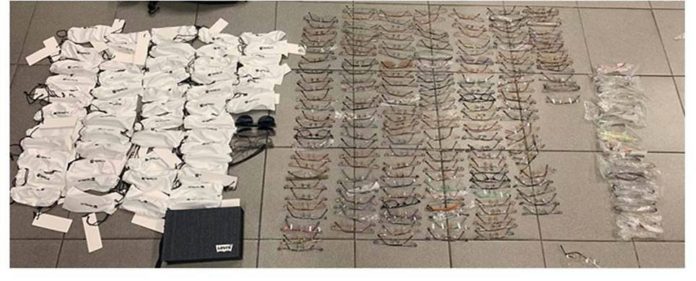
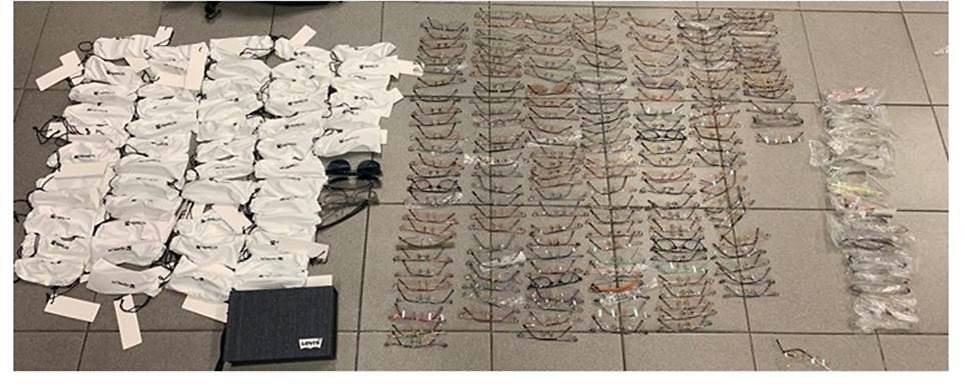
(Photo: Singapore Police Force)
About 450 stolen spectacle frames worth about S$50,000 were recovered, the police said.
The two suspected housebreakers will be charged in court on Wednesday. If found guilty, they face between two and 14 years’ jail.