Home Blog Page 758

‘Extraordinary heroes’: Brothers donate their organs to strangers, 7 years apart

0

SINGAPORE: When Mr Lin Hanwei informed his mother that he was going to donate his liver to a stranger, he was met with neither surprise nor objection. 

“That’s good,” came the answer from their mother.

This unexpected response was a stark contrast to her reaction when his brother, Dilun, told her nine years ago that he wanted to donate his kidney to a young boy.

THe brothers Lin Dulin and Lin Hanwei with their mother

Living organ donors Lin Hanwei (left) and Lin Dilun with their mother Madam Serene Neo. (Photo: Darius Boey)

Dilun, now 34, had seen an appeal for a kidney for a five-year-old boy in the newspapers. The boy’s story moved him so much that he stepped forward to donate one of his kidneys to the stranger, something no one else in Singapore had done before.

It took two years from the time Dilun made his decision for the transplant to happen, as he went for tests, and took his mother to see experts at the National University Hospital (NUH) to allay her fears.

When it was done in 2012, Dilun became the first altruistic donor here, a term used for donors who donate organs to strangers. 

READ: When it’s life or death: Family members donate livers to relatives despite risks

About two months ago, Hanwei, 35, decided to follow in his brother’s footsteps. He donated part of his liver to Mr Eddie Tan, a 59-year-old man who suffered from an acute Hepatitis B flare causing liver failure.

They shared their stories on Thursday (Jul 11) at NUH where both their transplant operations had been performed.

The Lins are also the first family to have two living organ donors, but they made light of their gifts of life.

“Some people donate blood, some people donate money, we donated organs. It’s a little bit more complicated, but it’s the same,” Hanwei said. 

IT TOOK JUST SIX DAYS

Eddie’s son had posted the call for help on Facebook. Six days later, Hanwei was in the operating theatre.

The situation was urgent as Mr Tan’s liver was failing fast, said Dr Alfred Kow, senior consultant at the National University Centre Organ Transplantation (NUCOT) who performed the operation on Hanwei.

READ: ‘When I saw this innocent baby facing death, I knew I had to do something’: Stranger who donated liver to 6-month-old baby

A mandatory one-week cooling off period that gives potential donors time to make sure they want to go ahead with the donation was waived; and the day after Hanwei was cleared by a transplant ethics committee, the transplant happened, Dr Kow said.

About 25 to 30 people came forward to be screened, of whom two others were also found suitable but they backed out, Dr Kow added.

“If we hadn’t transplanted him (Eddie) quite immediately, he may have gone into a coma. That may have been beyond salvage. So we’re quite happy that Mr Lin came forward to donate his organ,” Dr Kow said. 
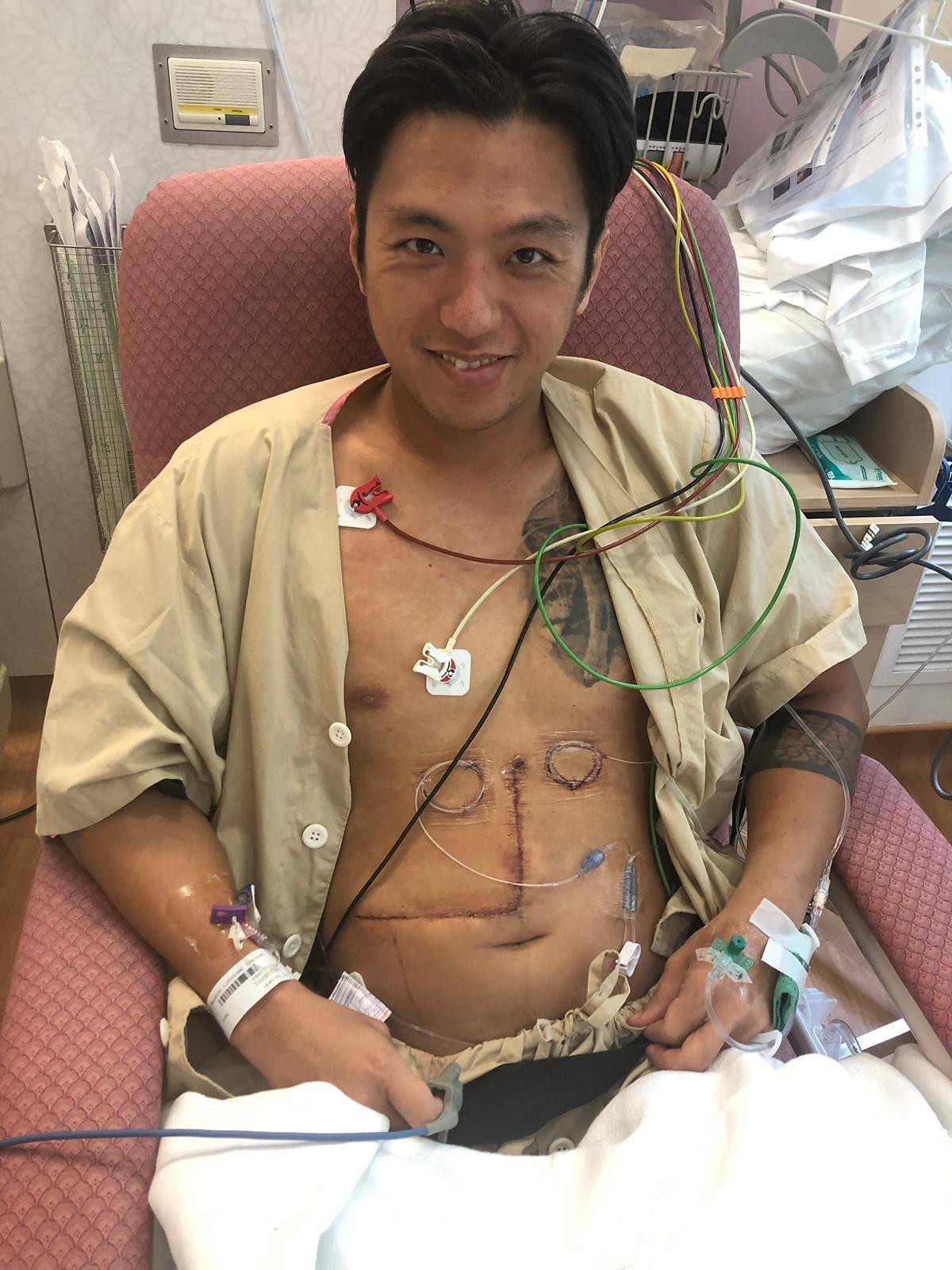
Lin Hanwei after op

Liver donor Lin Hanwei after his surgery. (Photo: Lin Hanwei)

“I knew I was in the safe hands of the doctors. I also don’t like to think for too long,” said Hanwei, a financial services director. 

READ: ‘Are you sure he is dead?’: Doctors struggle with families’ lack of understanding of HOTA

He would be “inconvenienced” for up to three months, as his liver regenerates fully. He also has to watch his diet and avoid his favourite sport, football, for some time.

“But that? In return for a life being saved? It’s a no brainer,” he said. 

When Eddie and his family visited him after the transplant, they were so grateful, he said. 

Hanwei is one of 20 altruistic liver donors who have come forward in Singapore from 2013 to June this year. A majority of such donors, 14 of them, came forward after social media appeals, NUH said.

CONVINCING LOVED ONES THE BIGGEST CHALLENGE

Hanwei said the knowledge that he would be doing a good deed was good enough for him, but he had to convince his girlfriend, who did not take his decision well.

Dilun spoke to his brother’s girlfriend, which played a part in her coming to terms with Hanwei’s decision.

Their mother, Madam Serene Neo, 54, did not need persuasion this time.

“I think I helped my brother with the precedent because my mother looks at me (and) says since I am fine, it should be okay,” Dilun said.

Seven years ago, Madam Neo was very much against his surgery, Dilun said, but she was there for him.

“My position (then) was that I don’t support him doing this, but I support him doing what he wants … because he is my son,” Madam Neo, a clinic assistant, said. 

The brothers gave credit to their mother for their kindness.

“She’s the kind of person who, if she has S$20 on her and she knows someone who needs it, she will give it all to the person,” Hanwei said.

“EXTRAORDINARY HEROES”

NUCOT co-director Professor A Vathsala called the brothers “extraordinary heroes”.

“We want to reinforce that every act of organ donation is a heroic act, but they did it for people they don’t even know. Let’s take our hats off for them,” she said. 

The brothers said they hope that their story would inspire others to come forward to donate their organs.

“When you give an organ to somebody else, you can see the good you bring about, you see the person being healthy, living a full life,” Dilun said. 

THe brothers Lin Dulin and Lin Hanwei with their mother

Living organ donors Lin Hanwei (left) and Lin Dilun with their mother Madam Serene Neo. (Photo: Darius Boey)

Bryan Liu, the recipient of Dilun’s kidney, was born with just one malformed kidney. His mother had donated a kidney to him, but a virus caused his kidneys to fail, Dilun recounted.

The child was on dialysis for six years before Dilun stepped forward. Now a Secondary 2 student, Bryan is living a normal life as a teenager. Dilun is in touch with Bryan and his family, seeing them on festive occasions, birthdays and the anniversary of Bryan’s “rebirth”, he said.

NUCOT performed a total of 48 living donor kidney and liver transplants, which make up the majority of all such transplants done last year. As of June this year, it has done 18 such transplants. 

Source link

One Pearl Bank condominium to go on sale with prices starting at S$970,000

0

SINGAPORE: Apartments at One Pearl Bank condominium will go on sale from Jul 20, with prices starting at S$970,000 for studio units.

Built on the site of the former Pearl Bank Apartments, which was one of Singapore’s architectural icons, the 99-year leasehold development is expected to be completed by 2023.

It comprises 774 units, ranging from studio apartments to penthouses of between 431 sq ft and 2,788 sq ft.

READ: CapitaLand unveils design for One Pearl Bank

According to developer CapitaLand in a news release on Thursday (Jul 11), indicative prices start from S$970,000 for a studio unit, S$1.5 million for a two-bedroom apartment, S$2.5 million for a three-bedder and from S$3.5 million for a four-bedder.

This works out to a price of above S$2,000 psf for most of the apartments.

One Pearl Bank (3)

One Pearl Bank’s Sky Oculus will be a communal space for residents to mingle. (Photo: CapitaLand)

With 39 floors, One Pearl Bank is set to be the tallest residential development in the prime Outram district, said CapitaLand.

It is close to the business district, various dining and entertainment options, and also offers panoramic views of the city.

One Pearl Bank (2)

The view from the old Pearl Bank Apartments. This would be the view for residents living on the 18th floor of One Pearl Bank. (Photo: Cindy Co)

Given these attributes, property analyst Ong Kah Seng said the pricing for One Pearl Bank can be “well supported”.

He noted that the project is priced at about 15 per cent higher than other “fairly new properties” in the area, and about 20 to 25 per cent higher than “aged resale properties” in the area.

WILL S$2,000 PSF APARTMENTS BE THE NEW NORM?

One Pearl Bank is among several new developments with units hovering above S$2,000 psf.

In May, for instance, Amber Park in East Coast sold 115 units at an average price of S$2,425 psf.

READ: New private home sales drop 15.2% year-on-year in May

Analysts remain divided over whether such prices could become a norm for private residential properties.

Propnex CEO Ismail Gafoor noted that apartments priced at above S$2,000 psf are already common for residential properties in core central locations.

“(This is) because land costs of these developments have already been high,” he said.

He added that developers tend to pay about S$1,500 psf to purchase land, and hence the need to price apartment units well above S$2,000 psf.

One Pearl Bank (4)

The allotment garden at One Pearl Bank. (Photo: CapitaLand)

OrangeTee & Tie’s head of research and consultancy Christine Sun cited data from the Urban Redevelopment Authority (URA), which showed a rise in the number of units sold at above S$2,000 psf.

For non-landed homes in the rest of central region, 178 units were sold above S$2,000 psf in June, up from 37 units in April and seven units in January, URA data showed.

“Demand for properties in Singapore is likely to remain robust,” she said.

One Pearl Bank (5)

There will be an allotment garden on every four floors. (Photo: CapitaLand)

READ: Singapore private home prices unexpectedly rise to 5-year high in Q2

Mr Ong, however, felt that property cooling measures introduced last July have dampened sentiments.

“(Apartments priced above S$2,000 psf) may not be a norm going forward as property sentiments remain cool, and buyers are highly selective,” he said.

“Only selected projects like One Pearl Bank, with unique selling points … can command such pricing and deliver the best value proposition to buyers.”

ADDITIONAL COOLING MEASURES?

Analysts do not believe that such highly-priced apartments would prompt more cooling measures by the Government.

This is because high-end homes and city fringe homes are not within the policy concerns of the government, said Mr Ong.

READ; Property market ‘more sober’ after cooling measures; no need to shift gears significantly: MAS

He pointed out that the primary purpose of cooling measures are to ensure affordable homes for the average Singaporean, rather than controlling the prices of the most expensive homes.

“The breaching of price points of branded residences, upper mid-end properties to over S$2,000 psf will not be of major policy concern and necessitate new cooling measures, Mr Ong said.

Ms Sun said that the market has already slowed in response to the latest cooling measures.

“It is not likely to have more cooling measures as price increases have already slowed down substantially,” she added.

“The government may observe the market for a while more before taking further actions.”

Source link

Orchard Towers murder: The 7 suspects and the charges they face

0

SINGAPORE: Seven people have been charged in connection with the alleged murder of 31-year-old Satheesh Noel Gobidass on Jul 2 at Orchard Towers.

The accused – six men and a woman – were initially charged with murder with common intention.

Three of them had their murder charges withdrawn on Thursday (Jul 11), and now face a charge each of consorting with a person carrying an offensive weapon.

This means the three in question no longer face the death penalty. 

Here is a breakdown of the charges the seven suspects face.

1. Tan Sen Yang, 27

Charge: Murder with common intention

Represented by: Unknown

Penalties faced: Death penalty

Current status: Remanded for investigations into other possible offences

The oldest of the group, he allegedly possessed an offensive weapon, a foldable Karambit knife, at Naughty Girl Club that morning.

Satheesh footage

Satheesh Noel Gobidass died on Jul 2, 2019. (Screengrab: Facebook/Sg-share together)

2. Ang Da Yuan, 26

Charge: Murder with common intention

Represented by: Unknown

Penalties faced: Death penalty

Current status: Remanded at Changi Medical Complex for psychiatric assessment

Satheesh Noel

Satheesh Noel Gobidass died on Jul 2, 2019. (Photo: Facebook/Mohana Anba)

3. Joel Tan Yun Sheng, 26

Charge: Murder with common intention

Represented by: Josephus Tan, Cory Wong and Shane Yeo from Invictus Law Corporation

Penalties faced: Death penalty

Current status: Remanded at Changi Medical Complex for psychiatric assessment

4. Natalie Siow Yu Zhen, 22

Charge: Murder with common intention

Represented by: Cheryl Ng from Intelleigen Legal and Amarick Gill from Amarick Gill LLC

Penalties faced: Death penalty

Current status: Remanded at Changi Women’s Prison for three weeks for psychiatric assessment

Natalie Siow

Satheesh Noel Gobidass died on Jul 2, 2019. (Screengrab: Facebook/District Singapore)

5. Loo Boon Chong, 25

Charge: Consorting with Tan Sen Yang, who possessed an offensive weapon

Represented by: Sunil Sudheesan, Diana Ngiam and Sujesh Anandan from Quahe Woo & Palmer

Penalties faced: A maximum of three years’ jail and at least six strokes of the cane

Current status: Out on bail of S$15,000

His lawyer, Ms Ngiam, had successfully argued for his bail to be lowered from S$25,000. His murder charge was withdrawn and replaced with the weapons charge

Satheesh

Satheesh Noel Gobidass died on Jul 2, 2019. (Screengrab: Facebook/Sg-share together)

6. Tan Hong Sheng, 22

Charge: Consorting with Tan Sen Yang, who possessed an offensive weapon

Represented by: Josephus Tan, Cory Wong and Shane Yeo from Invictus Law Corporation

Penalties faced: A maximum of three years’ jail and at least six strokes of the cane

Current status: Out on bail of S$15,000, which was lowered from S$25,000 after the court hearing to be in line with Loo

His murder charge was withdrawn and replaced with the weapons charge

7. Chan Jia Xing, 26

Charge: Consorting with Tan Sen Yang, who possessed an offensive weapon

Represented by: Josephus Tan, Cory Wong and Shane Yeo from Invictus Law Corporation

Penalties faced: A maximum of three years’ jail and at least six strokes of the cane

Current status: Bail of S$15,000 being processed

His murder charge was withdrawn and replaced with the weapons charge

All seven are set to return to court on Aug 1.

Source link

Taxi bursts into flames along Middle Road

0

SINGAPORE: A taxi driver made a narrow escape on Thursday afternoon (Jul 11), moments before his vehicle caught fire.

The ComfortDelGro driver, who wanted to be identified only as Mr Yeo, said he had been driving along Middle Road during his afternoon shift when he noticed smoke coming from the car.

“White smoke started pouring out of the exhaust when I was driving and I parked at the side of the road before the front of the car started emitting black smoke. I quickly left the car with my things as the smoke increased.”

Firefighters working to extinguish a blazing taxi after it caught fire along Middle Road

Screengrab from a video shows firefighters working to extinguish a blazing taxi after it caught fire along Middle Road. (Screengrab: CNA reader)

Mr Yeo added that there were no passengers in the vehicle at the time of the incident and that he was not injured.

The Singapore Civil Defence Force (SCDF) said it responded to a fire near 31 Middle Road at about 4.30pm.

“The fire involving the engine compartment of a taxi was extinguished by SCDF using two water jets,” it added. 

Mr Yeo said the fire burned for about 10 minutes before it was extinguished.

Screengrab from a video shows a smoking taxi at Middle Road.

Screengrab from a video shows a smoking taxi at Middle Road. (Screengrab: Abhishek Ravish)

Source link

India’s Vistara to launch international flights, starting with Singapore in August

0

SINGAPORE: Indian airline Vistara announced on Thursday (Jul 11) it would launch international flights in August, with Singapore as its first destination. 

The full-service carrier will operate two daily flights to Singapore, one each from Delhi and Mumbai. 

The Delhi-Singapore route will start on Aug 6 and the Mumbai-Singapore route on Aug 7. The airline said it would soon expand its international network to other destinations.

Boeing 737-800NG aircraft will ply the two new routes, with business and economy class seats.

The airline’s fares are as follows:

Table: Fares for Vistara's new India-Singapore flights

(Image: Vistara)

“We’re excited to start with Singapore as our first international destination, which we see as a very important market, given the opportunities it presents for corporate, business as well as leisure travel,” said Vistara’s chief executive officer Leslie Thng. 

“As we soon take the ‘new feeling of flying’ to more international destinations, we hope to provide our customers from overseas the finest way to experience India, and inspire travellers from across India to explore more of the world.”

Vistara is a joint venture between Tata Sons and Singapore Airlines.

Bookings for flights to Singapore are “being opened progressively” on Vistara’s website, mobile apps and through travel agencies, said the airline.

In its push to launch more international flights, Vistara said it has bought six Boeing 787-9 Dreamliner aircraft, scheduled for delivery between 2020 and 2021. The planes will be used for long-haul international operations.

Vistara has said the launch of international flights, which will give it greater scale to grow, is part of its path to profitability.

The new services could also ease pressure on international airfares from India, which rose by as much as 32 per cent after the collapse of Jet Airways earlier this year. 

Jet Airways, which halted operations on Apr 17 after running out of cash, had a market share of around 12 per cent on international flights to and from India in 2018, according to government statistics.

READ: Collapsed Jet Airways’ ex-partners, rivals scramble to fill India capacity void

Vistara met the requirement of having more than 20 jets needed for international flights in June 2018. However, it took longer than expected to receive further regulatory approvals.

Low-cost carrier AirAsia India, a joint venture between Tata Sons and AirAsia Group Bhd that operates narrowbodies, is also seeking approvals to launch international flights.

AirAsia India reached the 20 plane milestone in December and has said it wants to connect Indian passengers to destinations in Southeast Asia

Source link

NTU scientists develop luminescent probe to detect acute kidney failure early

0

SINGAPORE: Scientists from Nanyang Technological University (NTU) have developed a type of luminescent imaging probes that could allow for acute kidney failure to be detected early, NTU said in a press release on Thursday (Jul 11).

The new probes, which have been tested on mice, could potentially be used in test strips for urine samples, allowing for a non-invasive method of detecting kidney failure, NTU said.

A Singapore patent has been filed for the technology, which the scientists hope to test on critically ill patients next.

TRACKING CHANGES AT THE MOLECULAR LEVEL

Acute kidney failure – a condition when the kidneys stop working suddenly – usually occurs in a few hours or a few days and can be fatal.

Currently, there are no diagnostic platforms that are able to detect early stage, pre-morbid changes that underlie acute renal failure.

“For patients who are critically ill, like those in the intensive care unit, every minute is precious in reversing a condition like acute kidney failure, which can cause a patient’s health to deteriorate rapidly,” said NTU Associate Professor Pu Kanyi. 

The new probe is sensitive enough to track changes in the biological process triggered by the onset of the condition, said NTU.

When tested on mice with drug-induced acute kidney failure, the probes detected the onset of the condition 1.5 days earlier than current molecular imaging procedures.

“Our molecular renal probes are useful because they follow the body’s subtle changes at the molecular level and could help to arrest the development of the disease before it is too late – something current diagnostic methods are unable to do,” said Assoc Prof Pu.

READ: Kidney function worsens as people get more obese – Study

NTU scientists developed new probe that can help detect acute kidney failure early 3

Assoc Prof Pu Kanyi and his team from the NTU School of Chemical and Biomedical Engineering. (Photo: Nanyang Technological University, Singapore)

HOW IT WORKS

During their research, the NTU team injected the probes into mice who had been given cisplatin, a cancer drug, at a level destructive to the kidneys.

Twelve hours after cisplatin was injected, the probe lit up, signalling the detection of a change in the biomarkers linked to acute kidney injury.

Aside from the probe’s ability to detect signs of acute kidney failure, the scientists also found that the probes have a high renal clearance – more than 97 per cent of the probes injected into the mice flowed through the kidneys and were excreted as part of urine.

The probe’s high renal clearance efficiency means they could be used directly on urine samples, said Assoc Prof Pu.

“This opens up possibilities of developing these probes as test strips for urine samples, making it a potential non-invasive way of checking for acute kidney failure in the future”, said Assoc Prof Pu.

READ: Flu season may play a role in kidney failure deaths

In the next phase of research, the scientists plan to focus on further refining the probes with urine samples from critically ill patients. They plan to do this by collaborating with medical institutions both in Singapore and overseas.

Source link

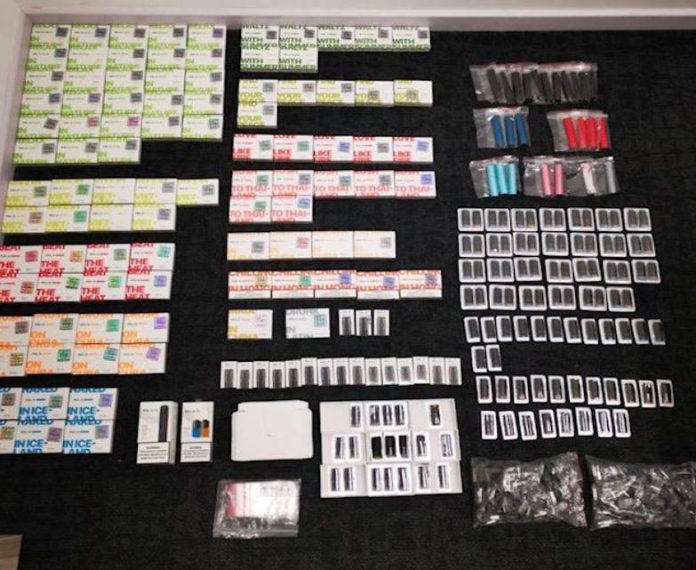
32 e-vaporisers, 635 liquid cartridges seized from car, SingPost POPStation locker

0

SINGAPORE: Thirty-two electronic vaporisers and 635 electronic liquid cartridges have been seized from a 27-year-old Singaporean man, authorities said on Thursday (Jul 11).

Six vaporisers and 223 cartridges were found hidden in the gear shift compartment of his Singapore-registered car after arriving at Woodlands Checkpoint last Friday, according to a joint press release by the Immigration and Checkpoints Authority (ICA) and the Health Sciences Authority (HSA).

READ: ICA officers seize cigarettes hidden in modified cars

The man, who was suspected to be under the influence of drugs, was referred to the Central Narcotics Bureau (CNB) and HSA for investigations.

Authorities said the suspect had hidden another 26 vaporisers and 412 liquid cartridges in a SingPost POPStation locker.

E-vaporisers and e-liquid cartridges seized from SingPost POPStation locker

E-vaporisers and e-liquid cartridges seized from SingPost POPStation locker. (Photo: HSA)

He is assisting HSA and CNB with investigations, the press release stated. If found guilty, the suspect could be fined up to S$10,000, jailed for up to six months, or both.

The use, purchase or possession of electronic vaporisers is also punishable with a fine of up to S$2,000.

READ: Man caught at Changi Airport with duty-unpaid tobacco disguised as tea leaves

READ: 7,500 sachets of chewing tobacco found hidden under curry puffs at Tuas Checkpoint

Fifteen people have been found peddling electronic vaporisers between April and June, HSA said, adding that these cases are currently under investigation.

“HSA takes a very serious view of the smuggling and peddling of e-vaporisers and will continue to clamp down on such activities,” the statement read.

“Our borders are our first line of defence in safeguarding Singapore’s security. ICA will continue to conduct security checks on passengers, cargos and vehicles at the checkpoints to prevent attempts to smuggle undesirable persons, drugs, weapons, explosives and other contrabands across our borders.

“The same methods of concealment used by contraband smugglers may be used by terrorists to smuggle arms and explosives to carry out attacks in Singapore.”

Source link

Drink water from a public toilet? Singapore’s taps put to the test

0

SINGAPORE: Esther Chia is a health-conscious homemaker — she has a water filtration system at home that cost her more than S$2,000, and it also makes her water alkaline.

When she is out with her family, she always buys them bottled water. Her eldest daughter, in particular, drinks only from mineral water brand Evian.

“She believes it’s from the French Alps. It’s spring water and … has all the good properties that’s good for the body,” said Chia.

READ: What will it take to kick Singapore’s growing multimillion-dollar addiction to bottled water?

To shower, they use their filtered water, and the family doesn’t ever drink directly from the tap. In her household, tap water is used only for general cleaning and washing dishes.

“There are so many sediments in it. You don’t even know what’s inside. So it makes you wonder: What have you been drinking?” she questioned.

She is not the only one convinced that the bottled and filtered versions are superior, as Talking Point explores why many Singaporeans resist drinking tap water, especially from public taps.

The kind of tap people won't drink from, Talking Point host Steven Chia says as he fills a bottle.

The kind of tap people won’t drink from, Talking Point host Steven Chia found.

DIRTY ENVIRONMENT, UNCLEAN WATER?

Singapore is a global hydro-hub, home to over 200 water companies and some 25 research centres. And national water agency PUB has gone to great lengths to monitor, treat and improve its drinking water supply.

So Singaporeans are aware that tap water is “clean and safe to drink”, said Erny Kartolo, one of the founders of the Drink Wise, Drink Tap campaign. “But the surroundings of the tap … affect their perception of the tap water”.

In an old building, for example, people assume that the water pipes “are also old and rusty” and therefore “contaminate the water”, which is untrue, she cited.

The Drink Wise, Drink Tap campaign found that a dirty environment affects perceptions of tap water.

Would you refill a bottle at this sink?

To find out how credible such fears are, Talking Point collected water samples from 15 taps: Five in eateries and shopping centres, five in public toilets such as at hawker centres and five in HDB flats across the island.

The samples were sent to a laboratory to investigate for bacteria and harmful metal contaminants such as lead and arsenic. And the results showed that there was no presence of bacteria in any of the samples.

As for trace metals, they ranged from 0.02 to 0.3 parts per billion (ppb), compared to the World Health Organisation’s guideline of 10 ppb.

“It’s well below the guideline … so it’s very safe,” noted Marchwood Laboratory Services’ head of quality assurance, Flordelina Umalia, who has spent the past 12 years testing water samples from various sources in Singapore.

It won’t have any significant effect on your health … Your body can easily process it.

The test results across the 15 samples were also “all quite consistent”, showing that the water from all the taps were “very clean”, even those from dirty surroundings.

Some people have observed that when they use a piece of cloth to filter their tap water, it turns brown after some time, but Umalia explained that these particulates are naturally occurring minerals in the water.

A cloth that has turned brown after some time owing to naturally occurring minerals in the water.

‘NEGLIGIBLE’ AMOUNT OF MINERALS

While Singapore’s tap water is safe to drink, many health-conscious consumers believe that bottled water — from alkaline to oxygenated water — have more health benefits.

Sales of bottled water have also increased over the years, from S$161.3 million in 2013 to S$179.4 million last year, according to research firm Euromonitor International.

Accredited dietician Jaclyn Reutens, from Aptima Nutrition and Sports Consultants, said that while many believe the minerals in mineral water will improve their nutrition, “what people don’t realise is that the levels of minerals are actually very low”.

For example, there are seven milligrammes of calcium in a bottle of mineral water, compared to 200 mg in a slice of cheese.

And to obtain the amount of potassium in a banana, one may need to drink up to 100 litres of mineral water.

The amount of calcium, magnesium and potassium in a bottle of mineral water is “so negligible” that it “doesn’t make a difference”, she said.

Accredited dietician Jaclyn Reutens shows Talking Point host Steven Chia a chart of mineral levels.

Jaclyn Reutens showing Chia a chart of mineral levels.

There are also claims that oxygenated water can help sports performance. But the way to “get more oxygen into your body” is through the respiratory system, that is, the lungs, explained Reutens.

If you drink oxygenated water, there’s no way that oxygen is going to get into your bloodstream … I don’t think that can happen physiologically.

As for alkaline water, advocates think it can neutralise an acidic body, which they believe is prone to diabetes, gout and cancer.

The stomach is meant to be acidic, however, to kill the pathogens found in food and help digestive enzymes to break down protein.

“So if you’re trying to make your stomach more alkaline, you’re defeating the purpose of your stomach,” she countered.

TASTE TEST

If it is a matter of taste, can the public tell the difference between tap and bottled water?

When Talking Point presented people with tap water and two brands of bottled water in a taste test, some people mistook tap water for mineral water.

Some people mistook tap water for mineral water in Talking Point's taste test at Our Tampines Hub.

Taking the taste test.

“By and large, people couldn’t really tell the difference,” said programme host Steven Chia. “And if I didn’t tell them where I got the water from, no one would’ve suspected it came from a toilet tap.”

Instead of paying for bottled water then, a “good solution” would be to install more dispensers like water coolers “all around Singapore”, where they can also refill their water bottles, suggested Kartolo.

“We found that people had very different perceptions about public taps compared to water dispensers or water coolers. So public taps are a complete no-no … But a water cooler is totally fine because it looks nice.”

Watch this episode of Talking Point on Channel 5 tonight at 9.30pm.

Talking Point host Steven Chia offering the lunch crowd tap water from a dispenser.

Chia offering the lunch crowd tap water from a dispenser.

Source link

James Dyson buys Singapore penthouse: What does he get for S$73.8 million?

0

SINGAPORE: Imagine going back at the end of the day to a home where you can enjoy round-the-clock butler service, stellar views of the city and even your own garden and pool, situated 62 floors above ground.

British billionaire James Dyson, the mogul behind the bagless vacuum cleaner and the Supersonic hairdryer, will soon get to enjoy these remarkable luxuries after he snapped up Singapore’s priciest penthouse for a cool S$73.8 million.

READ: British billionaire James Dyson snaps up Singapore’s priciest penthouse

Here is a look at what comes with the hefty price tag.

FULLY SERVICED THREE-STOREY LUXURY UNIT

The three-storey “super penthouse” is located on the 62nd to 64th floor of Wallich Residence.

Sprawled across 21,108 sq ft, Mr Dyson’s new abode features five bedrooms, a dining room, dry and wet kitchens, a study, a living room, an entertainment room and a utility room.

Wallich Residence super penthouse

The living room of the “super penthouse”. (Image: Wallich Residence website)

Each bedroom is equipped with an en-suite bathroom, with the master and junior master bedrooms also featuring spacious walk-in closets. He and his loved ones can unwind in the family room, from which they can access a private garden with a viewing deck that overlooks the city skyline.

Entertaining guests will be possible at the dining and lounge area on the 63rd floor or the rooftop terrace on the 64th.

The rooftop terrace of the "super penthouse" at Wallich Residence

The rooftop terrace of the “super penthouse” at Wallich Residence. (Image: Wallich Residence website)

The triplex also includes a 600-bottle wine cellar, bar facilities, a private pool, cabana and a Jacuzzi room.

As a resident of the “super penthouse”, a dedicated butler will also be on hand 24/7 to cater to Mr Dyson’s every need. Marketing materials from Wallich Residence promises that “no request is too trivial” and that “every detail will be meticulously attended to”.

Now that’s living the high life.

AMENITIES GALORE

Of course, the amenities here are also amped up to the highest quality.

Mr Dyson and his neighbours get to access landscaped gardens, an infinity pool, a gym, sky gardens and cabanas just levels from their homes.

Wallich Residence's Pool area

The pool area at Wallich Residence. (Image: Wallich Residence website)

Residents can also enjoy meals prepared by private chefs, private screenings at the theatrette, and even get lost in books at the library.

The tallest building on the island also boasts a million-dollar view of the city, which can be seen from glass viewing platforms situated about 270m above sea level.

Wallich Residence Apex

Wallich Residence’s Apex sky observatory. (Image: Wallich Residence website)

At the lobby, a concierge is on hand for requests such as amenity booking, grocery and luggage handling and laundry services. A lounge with a service bar is also located here, as well as high-speed elevators with direct access to residences.

SHOPPING, DINING DESTINATIONS WITHIN REACH

Being located in the heart of the Central Business District also means that the building is in prime location for dining and shopping.

Popular areas such as Duxton Hill, Club Street and Ang Siang Hill are within walking distance. Hawker centres, including the popular Maxwell Food Centre and Amoy Food Centre, are also nearby for those who want to try local fare, while Chinatown is about a 10-minute walk away.

Maxwell Food Centre

Maxwell Food Centre. (Photo: Tang See Kit)

The city centre can be easily accessed using public transport. The building sits right above Tanjong Pagar MRT station, and near the sites of the upcoming Maxwell and Shenton Way stations. 

However, Mr Dyson may be more inclined to drive about town in one of his new electric cars, which are currently in development and which will be built in Singapore. Of course, there’ll be no parking problems for him – the building has a car park with 567 lots. 

SINGAPORE’S TALLEST BUILDING

Wallich Residence is located on the 39th to 64th storeys of Tanjong Pagar Centre, also known as Guoco Tower.

At 290m, the 64-storey skyscraper is Singapore’s tallest, surpassing the previous 280m record jointly held by One Raffles Place Tower 1, Republic Plaza and UOB Plaza One.

Guoco Tower towers over other buildings in Singapore's CBD

Guoco Tower, formerly known as the Tanjong Pagar Centre, towers over other buildings in Singapore’s central business district. (Photo: Darren Soh)

The residential part consists of 181 exclusive units, including four penthouses and the “super penthouse” now owned by Mr Dyson.

PropertyGuru states that these residential units start at S$1.95 million.

In addition to this, the mixed-use development also houses office spaces, retail outlets and an urban park.

Source link

Programme launched to help promising Singapore firms scale up quickly

0

SINGAPORE: A new programme aimed at grooming high-growth businesses here was launched by Enterprise Singapore on Wednesday (Jul 10), with 25 companies, including household names Jumbo Group and Koufu, making the cut for the pioneer batch. 

First announced during Budget 2019, the Scale-up SG programme aims to help companies with attributes such as proven track records, the ability to create economic spin-offs for Singapore and strong growth ambitions, develop into future “global champions”, said the trade promotion agency which is running the new initiative.

Over the next two-and-a-half years, the 25 companies will go through three key phases aimed at helping them strategise and execute their acceleration plans. These include activities such as executive business programmes with leading institutes of higher learning, peer networking and industry sharing sessions.

Through that, companies are expected to benefit from peer learning and collaboration, development of the leadership team and succession planning, as well as gain access to expertise and networks to Enterprise Singapore and its partners.

Enterprise Singapore will work with partners from both the public and private sectors and for the inaugural run, consultancy firms McKinsey & Company and PwC Singapore have been selected as anchor partners.

Other suitable partners, such as relevant industry experts or agencies like the Intellectual Property Office of Singapore and Agency for Science, Technology and Research, will be roped in when necessary.

Speaking at the launch, Trade and Industry Minister Chan Chun Sing described the new initiative as a “very targeted” approach to help strengthen companies which he described as the “core”.

These are small- and medium-sized companies with revenues ranging from tens of millions to hundreds of millions or more. For Singapore to do well in its next lap of economic development, this group of businesses will need to be strengthened, said Mr Chan.

“We compare our own performance across the best around the world – are we doing as best as we should be? There’s still much to learn.

“(This is) a very focused programme where we dedicate resources to help the core to scale up (and) bulk up, so that one day they too will be competing with the best in their respective industries at the global level.”

And as these companies do so, more and better jobs will be created for Singaporeans, added Mr Chan.

Scale-up SG programme launch on Jul 10, 2019 (2)

Enterprise Singapore chairman Peter Ong (left), Minister of Trade and Industry Chan Chun Sing (middle) and Enterprise Singapore’s deputy chief executive Ted Tan at the breakfast session with the Scale-up SG companies. (Photo: Enterprise Singapore)

SCALING UP

For the inaugural run, the companies selected come from varying revenue sizes of about S$10 million to over S$300 million, and industry clusters such as lifestyle and consumer and trade and connectivity, said Enterprise Singapore chairman Peter Ong.

There is also a mix of corporate-run and family-owned businesses, with the latter accounting for about one third.

Apart from well-known F&B names Jumbo Group, Koufu and 4Fingers, other businesses include industrial vehicle leasing giant Goldbell Corporation, retailer SK Jewellery, childcare service provider EtonHouse International and precision manufacturer AEM Holdings.

This diversity will ensure peer learning and cross-pollination of ideas, said Mr Ong.

“From our kick-off sessions, I heard questions like ‘Can anyone help me with the marketing strategy for China?’ or ‘How do you share profits across senior management?’ While the participants come from very different sectors, these challenges are shared by many participating CEOs.”

Coming from varying sectors, business leaders can offer different perspectives and learn from one another, added Mr Ong.

For family-owned businesses that often face the added complexity of leadership succession, Mr Ong said a key part of the Scale-up SG programme aims to involve the CEOs of these firms and their family members.

“Family members are also involved so that leadership across more than one generation can learn and develop together under a nurturing environment,” he said.

Jumbo Group, for one, is hoping to pick up advice on a smooth leadership succession as its third generation starts to get involved in the business.

“The young people will ask why do it this way … it is different styles of thinking so we got to moderate and strike a balance,” said Group CEO and second-generation leader Ang Kiam Meng.

The seafood restaurant chain is also looking for guidance in the areas of talent management and more importantly, expansion beyond Singapore. Mr Ang told CNA that earlier headwinds like a slowdown in China’s economy have seen the company growing less quickly as it hoped.

“At a time when we are going out of Singapore, this programme is timely. We have met with headwinds and growth has not been as fast as what we wanted, so it’s good to seek answers and see how we can go faster.”

Mr Ang added: “Asia is the main region that we want to expand into, but we don’t rule out Australia, Northern America and Europe. We hope one day, our brand name can be as strong as Shake Shack and Din Tai Fung.”

Another local firm Durapower Holdings, which provides electric vehicle battery and energy storage system solutions, said it has grown rapidly from S$3 million to S$50 million in revenue over the past five years.

By joining the programme, it hopes to double its revenue to S$100 million in the next three years by entering new markets, such as India, and launching new products in the field of renewable engery, said Group CEO Kelvin Lim.

With Singapore’s economy entering a new phase and amid rising uncertainties, developing strong enterprises with real capabilities will be key, said Mr Ong from Enterprise Singapore. “We all know that during uncertain times, it is the strong and high ambition companies that survive.”

Enterprise Singapore aims to have two to three runs of the Scale-up SG programme each year, with each batch involving 20 to 30 firms. It will likely remain on an invitation-only basis, with companies selected due to their ambitions and growth trajectories, though businesses are welcomed to indicate their interest.

The agency will support up to 70 per cent of the participation cost, it said.

Source link