SINGAPORE: A 30-year leasehold site near Sembawang Park has been put up for tender to pilot a new residential care community concept for persons with dementia.
The site at Gibraltar Crescent will be specially designed to provide a safe, home-like environment where residents are assisted to live independently, the Urban Redevelopment Authority (URA) and Ministry of Health (MOH) said in a joint press release on Tuesday (Jul 16).
The dementia care village, when completed, will also have tailored services and programmes, which will help promote participation and social interactions among its residents, the release said.
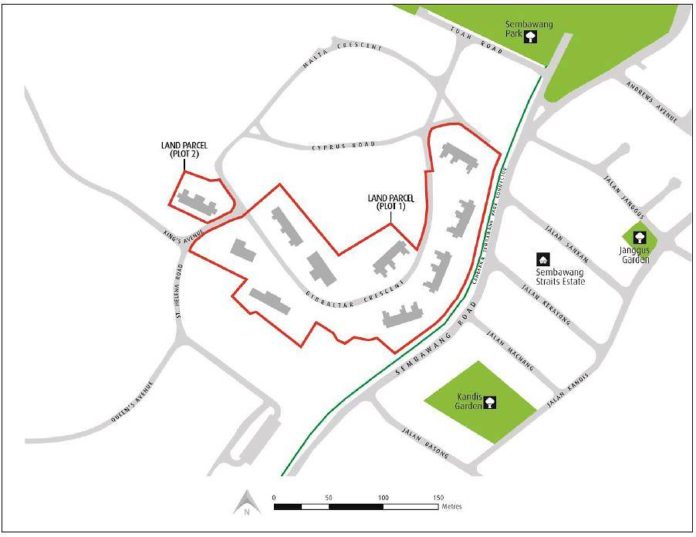
The 30-year leasehold site at Gibraltar Crescent comprises a cluster of 10 state bungalows. Photo: URA.
“As a new residential option catering to individuals with varying stages of dementia, this pilot complements the home-based care and dementia day care services available today,” URA and MOH said.
“We hope that the pilot will offer insights into market demand for such facilities and the community needs of persons with dementia, which will contribute to the development of suitable dementia care models in the future.”
The site comprises a cluster of 10 state bungalows that sit on two plots measuring 26,350.7 sqm and 1,756.3 sqm.
The maximum permissible gross floor area is 9,170 sqm, and another 900 sqm for extensions to the 10 existing bungalows.
At least 60 per cent of the gross floor area must be for residential use, while the remaining 40 per cent may be used to develop residences, health and medical care facilities such as a nursing home or centre-based aged care services, a shop and restaurant or any other ancillary institutional facility.
Serviced apartments, hostels and funeral parlours may not be built on the site.
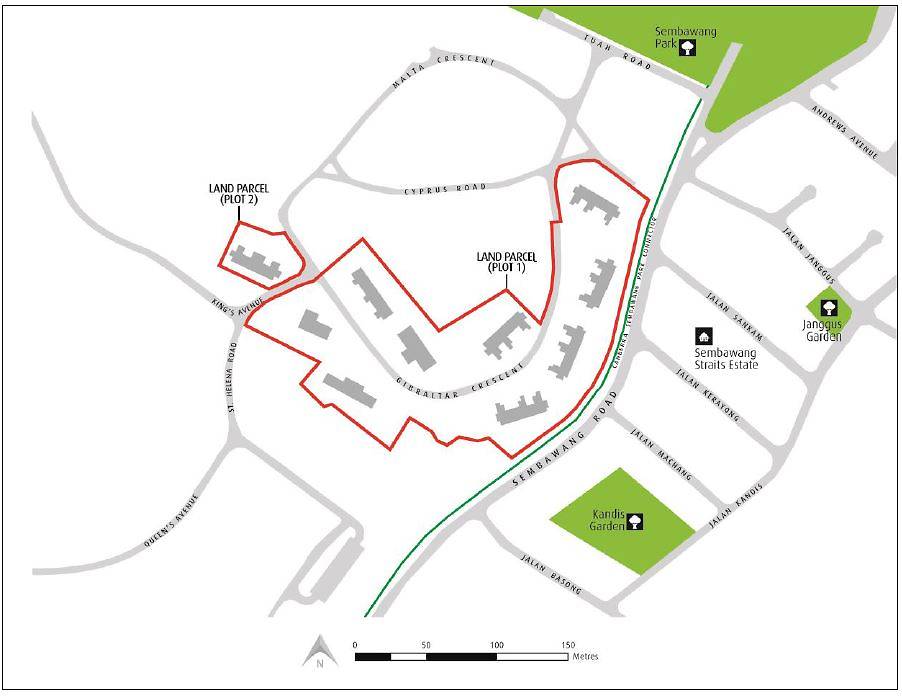
The site at Gibraltar Crescent comprises a cluster of 10 state bungalows that sit on two plots. (Photo: Google Maps)
URA and MOH said that a concept and price revenue tender will be adopted to evaluate the bids received for the site, so as to ensure that the selected concept proposal aligns with the Government’s vision for the dementia care village.
Under this system, interested parties are required to submit their concept proposals and tender prices separately.
The concept proposals will be first evaluated against a set of criteria specified in the tender, including assessment of the bidder’s proposed model of care for persons with dementia and the quality of care programme and services offered.
Concept proposals that are shortlisted will proceed to the second stage for evaluation, which will be based on price.
The site will then be awarded to the tenderer with the highest bid price among those with acceptable concept proposals.
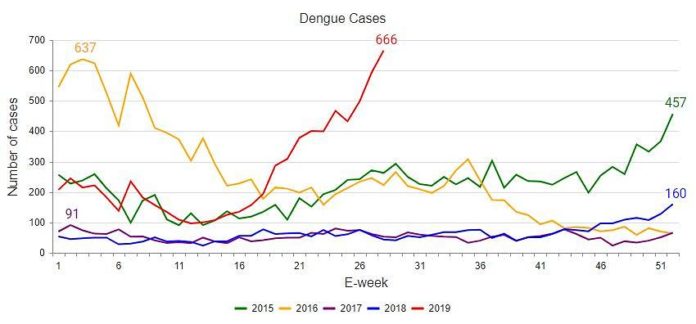
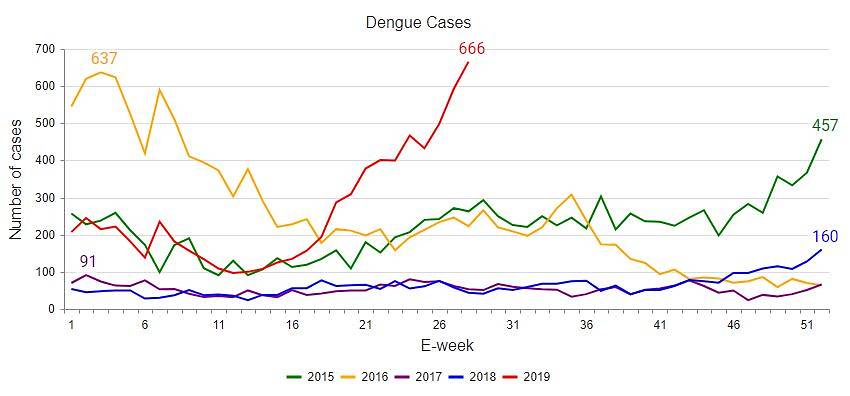
SINGAPORE: Dengue cases last week rose to 666, the highest recorded in a week since 2016, the National Environment Agency (NEA) confirmed on Tuesday (Jul 16) on its website.
The last time the weekly recorded numbers peaked was in January 2016, when there were 637 cases in one week.
As of 3pm on Monday (Jul 15), there were 7,483 recorded cases of dengue in Singapore in 2019.
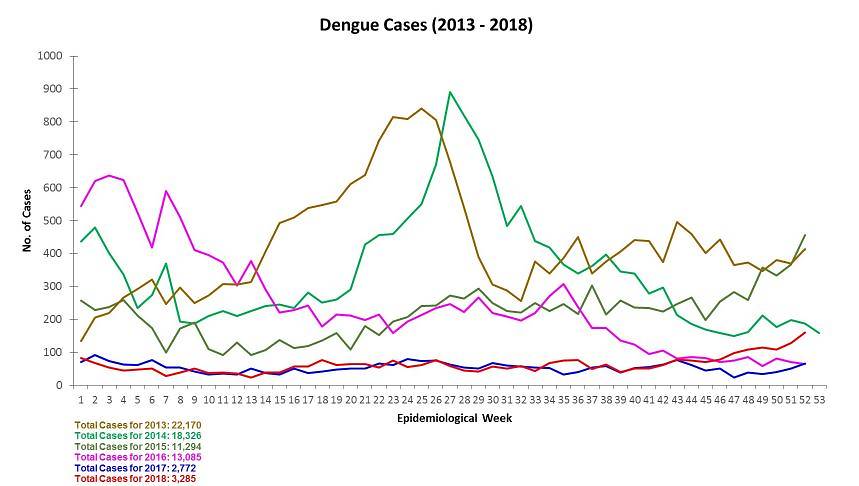
This is about five times more than the 1,481 dengue cases in the same period last year, NEA said. The number is also more than twice the 3,285 cases for the whole of 2018, and the 2,772 cases for all of 2017.
The weekly number of dengue cases in Singapore has hit a high since 2014. (Graph: NEA)
“Urgent action is needed to eliminate potential mosquito breeding habitats in the community,” the agency said.
Five people have died from dengue this year amid the spike in the number of cases.
Last month, an 84-year-old woman, who lived in an active dengue cluster at Lorong 6 Geylang, died from dengue. A 63-year-old man died of the disease in May.
In March, dengue claimed the life of a 71-year-old woman who lived in Ang Mo Kio, while two elderly men died in February.
“We are now in the warmer months of June to October, and a national collective effort is critical to prevent dengue cases from rising further,” NEA added.
“Every individual, whether living in a dengue cluster or not, needs to take action to prevent more people from being infected with the dengue virus.”
Number of dengue cases from 2013 to 2018. (Graph: NEA)
As of Jul 6, there have been 51 reported cases of dengue haemorrhagic fever – a severe form of dengue. That is more than three times the same number of cases – 16 – for the same period in 2018, according to figures from the Ministry of Health.
DENGUE CLUSTERS
As of Tuesday this week, there were 182 active dengue clusters, a spike from the 112 clusters about a month ago.
There are 48 high-risk areas with 10 or more cases, including neighbourhoods in Woodlands, Geylang, Chai Chee, Pasir Ris and Jurong East.
Parts of Joo Chiat, Bedok and Aljunied are also among the high-risk areas.
Inspections by NEA showed that 60 per cent of all Aedes aegypti breeding habitats were in homes, Environment Minister Masagos Zulkifli wrote last Monday in a reply to a parliamentary question.
In dengue clusters, that proportion goes up to 74 per cent, he said, adding that homeowners played “a crucial role” in keeping dengue at bay.
“We have observed a slowing down in transmission of dengue in the last seven weeks at the Woodlands cluster, with one case reported in the cluster area in the past two weeks, compared to 27 cases reported in a week when transmission was at its peak,” NEA said.
“With the general uptrend in dengue cases across the island, large clusters with a relatively fast rate of dengue transmission have been observed at Pasir Ris, Joo Chiat and Jurong East. Everyone has to be alert to the threat of dengue.”
A worker fogs the drains in the common areas of a public housing estate in Singapore. (Photo: Reuters/Edgar Su)
To deprive mosquitos of their breeding habitats, people should invert pails and flower pot plates and change water in vases regularly. They should also clear their roof gutters and place insecticide inside.
NEA also advised people who are unwell to seek medical attention early if they show symptoms of dengue.
These include a sudden onset of fever for two to seven days, severe headache with pain behind the eyes, joint and muscle pain and a skin rash. Nausea, vomiting and bleeding from the nose and gums are also possible symptoms.
SINGAPORE: To say that the global trade landscape has changed over the last few years would be a gross understatement.
At the founding of the World Trade Organization (WTO) in 1995, one would not have guessed, for example, that its appeal body for trade disputes would today be facing what some are calling an “existential threat”.
When China joined the same organisation in 2001 – after about years of hard negotiations– one might not have expected that the US and China would, in 2019, be locked in a bitter battle of tariffs and other trade restrictions while the WTO – an organisation established to deal with tariffs and handle trade disputes between members – looks on.
Another major development has been Britain’s decision to exit the European Union, which is already having major implications on trade relations.
NOT SO NEW
Yet, some of the present causes of economic upheaval are arguably not altogether novel.
In the last century, actions to protect domestic industries through high tariffs, tariff disputes between countries, and significant non-tariff trade barriers (such as quotas and bans) have been imposed by various countries from time to time.
Also not new are changes to trade relations due to new economic arrangements between countries (for example, in the formation of the EU, and other regional economic alliances) and the imposition of country-specific trade restrictions (such as those imposed by the US against Cuba).
The US-China trade war has spooked markets worldwide and raised concerns about the global economy. (Photo: AFP/JOE RAEDLE)
What is significant at the present time, however, is the confluence of factors contributing to global trade turbulence and uncertainty, making it a particularly potent brew.
These factors include the broad use of tariffs between two major economies – the US and China – pending a lasting resolution of economic, technology and other tensions, the reliance on national security arguments for trade restrictions, Brexit ambiguities and its trade complications, and, most recently, potential disagreements on taxes to be imposed on digital services suppliers who have no physical presence in the countries of taxation.
Against this already tense background, technological change continues to disrupt business activities at a rapid pace.
Certainly, Singapore businesses will not be altogether spared from the effects of these vicissitudes.
With Singapore’s economic growth slowing to 0.1 per cent in the last quarter, and manufacturing hit by the trade impasse between the US and China, businesses must brace themselves for stronger headwinds.
While the tariffs introduced in the last two years contributing to the so-called trade war have been troubling for many businesses, one silver lining is that tariffs are transparent when compared to non-tariff actions, which can be much more opaque and harder to challenge and deal with.
Announcements of tariffs, though unwelcome, provide businesses – such as those with affected supply chains – with measurable changes in costs.
The US has proposed tariffs on a range of European products, including cheeses, over EU subsidies for commercial aircraft. (Photo: AFP/Koen van Weel)
For many businesses, these tariffs and other trade restrictions may lead to the reshuffling of manufacturing bases and supply chain parties.
For affected states, the key would be to stay competitive, to continue to attract foreign direct investments, and to carry on forging clear and fair global rules.
NEW OPPORTUNITIES
While business costs are one challenge, Singapore has a very strong headstart by many measures to weather the trade tensions and should use this standing to seize new opportunities.
In terms of competitiveness, earlier this year, a Swiss-based think-tank IMD World Competitiveness study pronounced Singapore as the most competitive of 63 economies.
In investments, according to a 2018 World Investment report, Singapore managed to improve its standing from 8th to 6th position in the list of top ten foreign direct investment (FDI) host countries, attracting almost US$35 billion.
At the firm level, businesses which presently rely on factories in only one country need to consider diversifying their production bases. Those which do not currently have alternative supply chain partners may need to have broader networks of alternatives and flexibility in contracts.
Workers at a manufacturing facility in Singapore. (Photo: AFP/Roslan Rahman)
Second, there are opportunities for businesses, big and small, to explore new markets through ongoing initiatives, such as the ASEAN Economic Community’s activities which offer trade and e-commerce opportunities, China’s Belt and Road Initiative (and its Greater Bay Area plan), and potential trade and investment opportunities under the US’ Indo-Pacific Strategy.
Such initiatives include connectivity objectives which will introduce infrastructure projects in the region, which Singapore businesses can explore, and adjust if necessary, to participate in.
Examples of such participation may be the provision of services in finance (especially green finance), insurance, security, transport, logistics, construction, engineering and technology solutions, and other professional services.
Even a bilateral initiative like the Chongqing Connectivity Initiative has already seen about 240 Singapore companies getting involved.
Manufacturing businesses impacted by the trade war – whether producers of electronic goods, or engineering or security equipment, can also proactively explore how they may participate, particularly where smart city infrastructure is being proposed.
For instance, projects under the ASEAN Smart Cities Network will require the construction of physical, digital and social structures in various cities, such as buildings, info-communications systems, lighting, transport systems and facilities for waste and water management, just to name a few examples.
Third, markets which hitherto may have been unexplored by Singapore businesses, but which may now be more accessible and attractive thanks to new free trade agreements – such as the EU-Singapore FTA – should be carefully explored, whether such businesses are in manufacturing or in the provision of services.
Chan Chun Sing at the opening of the CCI Administrative Bureau Office in January 2016. (Photo: Jeremy Koh)
Finally, businesses which have not yet developed sustainable products or supply chains could accelerate plans to do so to cater to new customers and markets. Examples would include energy-efficient equipment and recycled construction materials.
GLOBAL RULE-MAKING FOR BUSINESS CERTAINTY IN DOUBT
While businesses can take such short-term measures to deal with the trade war, the more difficult issue is dealing with trade restrictions which are imposed for national security reasons, like when the US placed Huawei on an entity list (meaning trade by US firms with Huawei will now require US approval).
Such restrictions can in turn affect other businesses, such as Huawei’s supply chain partners.
WTO trade rules provide for a national security exception which can be invoked to impose trade restrictions, but this has been a little-used provision in its dispute settlement system.
Countries may argue that this is an area which is best decided by themselves, given the sensitivities and confidential information involved. There is some validity in such arguments.
A concern exists that national security arguments should not be used for protectionist (rather than true national security) reasons, leading to the argument that there is a need for some form of objective oversight.
In other words, the question is who should have the final say on whether there has been proper use of the exception.
A logo is pictured outside the World Trade Organization (WTO) headquarters next to a red traffic light in Geneva, Switzerland, October 2, 2018. (File photo: REUTERS/Denis Balibouse)
In a WTO case brought by Ukraine against Russia, a dispute panel decided in April that it could hear and decide on arguments under the national security exception.
As there has been no appeal to the WTO Appellate Body, whose own continuing viability is presently under question, it has not had an opportunity to state whether it agrees or disagrees with this decision.
While the WTO has aimed at a rules-based trade dispute system, politics have clearly not left the building.
THE NEED FOR CLEAR GLOBAL RULES
Businesses and economies are today intertwined in an unprecedented manner. Digitalisation has also led to much more cross-border trade activity, with the Internet and mobile devices increasingly connecting consumers with businesses far away from their own regions.
Such transactions require clear global rules. While FTAs provide some degree of regulation between partner countries, this is still relatively piecemeal compared with global rules which are agreed to by almost all trading nations.
Singapore’s continuing efforts to negotiate such rules – such as in the area of e-commerce – are therefore important, as having to navigate fragmented or piecemeal rules adds to business costs.
In the meantime, Singapore businesses would do well to be familiar with what new doors FTAs and other initiatives might open for them, while dealing with the current trade war and other economic headwinds
Locknie Hsu is Professor at the Singapore Management University’s School of Law.
SINGAPORE: He moves forward and backward, over and over again.
Beads of sweat drip from the chin of 23-year-old Akram Ramadan Misrawi as he strains every sinew, arching his body to hammer the shuttlecock back towards his coach.
Akram’s wheelchair carves neat patterns on the weathered parquet floor of Yio Chu Kang sports hall.
Being born with skeletal dysplasia, a genetic condition which affected the development of his hands and legs, hasn’t stopped Akram from pursuing his love for sports, especially badminton.
“Since young, I have been a very active person,” the Nanyang Polytechnic student explained to CNA on the sidelines of his training session. “I like badminton because it makes me move around to receive the shuttlecock.”
“I started out since young because usually my family would, especially during the holidays, invite me out to play badminton for recreation, under the void deck,” said Akram. “They have been very supportive, they are one of the reasons why I play badminton.
“If not I’d be at home doing nothing, they know how active I am, they know how I like badminton, so … they asked me to try it.”
The sport has “forced” him out of his comfort zone, admitted Akram.
For one, he has had to improvise when it comes to holding his racket.
“I can’t really hold it the way normal players do it for most of the shots, so I have to improvise in a way that it suits my disability,” he said.
Akram Ramadan Misrawi during a training session. (Photo: Matthew Mohan)
While recreational badminton satiated his desire to get active, the competitive fire within the soft-spoken Akram was lit in the process.
In 2015, he began to play badminton on a competitive basis.
“If you are competitive, you have scheduled training programmes,” he explained. “I like badminton so I want to increase my skills to more of a competitive level, instead of just hitting (the shuttlecock) around.”
FALLING AND GETTING BACK UP
But, Akram needed a new sports wheelchair.
“What’s most important in badminton is the speed,” he said. “No matter how well you play, (how good) your skills are, if your speed is not there, you wont be able to return your opponents’ shots.”
While he had a sports wheelchair, it was not built for badminton.
“It was more for basketball. There’s a different structure of the wheelchair, and that isn’t suitable for badminton”, he explained. “If you move fast and suddenly break, you might fall over because of the weight.
“There were numerous times where I fell over while playing, so that’s why I decided to get a new chair.”
But the costs of a new sports wheelchair had always been prohibitive, said Akram.
“A very good one costs S$6,000 to S$7,000,” he said. “The cheapest one you can get costs S$5,000.
“It was expensive, out of my family’s financial (reach),” he added.
Akram Ramadan Misrawi goes through his warm up session. (Photo: Matthew Mohan)
But with the help of the Mediacorp Enable Fund, this “burden” was lifted.
“It really helped to lift the burden off our shoulders and we didn’t have to worry about paying that amount of money,” explained Akram, the second of three children.
“The difference is the (element of) safety. Whenever you move around, you won’t feel like falling down. The new one is a bit lighter, you can move faster … Performance-wise I am able to focus more on the game.”
Now, a determined Akram has his sights set on the next level.
“I haven’t really been able to participate in national games, big games, so my goal with this new chair is to excel in my training and to one day participate in games such as Asean (Para) Games,” he said.
Forward, backward, he moves. Easily, smoothly. Safely.
A burden has been lifted. Akram no longer worries about falling.
Akram is a beneficiary of the Mediacorp Enable Fund (MEF), a charity between Mediacorp and SG Enable that hopes to fund the aspirations for people with disabilities. Emeritus Senior Minister Goh Chok Tong is its patron.
SINGAPORE: Would you hire someone who has an unconventional dress sense?
What if that person has a nose ring? Or tattoos?
Air New Zealand recently did away with its ban on visible tattoos for air crew and customer-facing staff, recognising that many New Zealanders with Maori heritage wear tattoos to mark their genealogy and amid growing acceptance of tattoo as a means of cultural and individual expression.
New research in 2018 on the US labour market suggests that despite perceptions, having a tattoo is less likely to give rise to employment or wage discrimination these days, as more millennials spot body ink and shrug off concerns their older counterparts in the workplace might have had.
As worldwide trends suggest a sea change in mindsets when it comes to hiring, have they taken root in Singapore?
While a New Zealand company might understandably have made such a switch on their employment policy regarding tattoos, and US hiring managers might be more open-minded, would we see a similar change in hiring practices in Singapore?
Do looks still play a role when it comes to hiring?
Does having something visibly inked on your body or how you dress hurt your job prospects?
An Air New Zealand Boeing 777-300ER plane taxis after landing at Kingsford Smith International Airport in Sydney, Australia on Feb 22, 2018. (Photo: Reuters/Daniel Munoz/File Photo)
HARD TO UNSEAT OLD PERCEPTIONS
The thing is perceptions, once formed, are difficult to change. In Singapore, tattoos have been associated with gangsterism, the use of drugs and connote, more generally, “bad company”.
To many employers, bearers of body ink are seen as non-conforming risk-takers who are more likely to flaunt rules and make poor decisions.
This perception has been passed down over time, and it will take a while for it to change, much as I don’t think it will be eradicated completely.
The preference among most employers typically is not to take the risk to hire someone with tattoos.
Don’t believe me? Nearly half of over 1,000 Singaporeans surveyed by YouGov in May said they are less likely to hire someone with a tattoo, even if they qualify for the position.
The desired situation is, of course, for hiring decisions to be based largely on individual merit and qualification for the job, rather than physical appearance as a gauge of how well the candidate might do the job.
However, so long as face-to-face interviews continue to be a recruitment tool, it will be difficult to achieve this goal. Interviewers are humans, who bring into the interview room their prejudices, bias and human judgment.
Attendees at a job fair line up for an interview carrying their resumes in leather bags. (Photo: REUTERS/Jason Reed)
It is difficult to move away from this unless replacements for the face-to-face interview, such as personality and strengths assessment tools, gain greater ground.
A more productive endeavour might be to change the mindsets of hiring managers and recruiters.
MOVE AGAINST DISCRIMINATION ON THE BASIS OF TATTOOS
My view is that it’s a personal choice – hiring managers will make the shift when they are ready to. And whether a tattoo is a deciding factor depends also on details like the look of the tattoo and the nature of the job.
Roles that might see more resistance include leadership positions, high-skilled jobs and frontline staff.
But both employers and the media can help unseat this bias.
What will it take? Not much actually. Imagine if some preferred employer in Singapore, seen by many as top of their game and recognised as a desirable brand name, like Google, Grab or LinkedIn, sets an example of having a policy of not discriminating against job seekers with tattoos.
That might cause more to think twice about ruling out potential hires with tattoos because they might be missing out on quality candidates.
Many companies are likely to have non-discriminatory hiring policies already. We could do with more of such companies that hire those with “tattoos” as examples to be upheld and praised.
The media can help by showcasing examples of such employers. The media is a powerful influencer, it can help to shift mindsets.
The Government and the tripartite movement can make subtle but powerful moves that push the envelop, as part of its efforts to work against discrimination on the basis of age, race and gender. Why not add looks, the presence of tattoos, body piercings and other forms of body art in the mix?
Daniel Ricciardo shows his hand tattooed with the number 3 and his tattoos on the thigh. (Photo: AFP/Gerard Julien)
Such efforts can help shift norms in a more accepting direction, which are already changing with the passage of time – as even colourfully dyed hair has become less of a concern with more employers.
OUR BODIES ARE JUST THAT – OUR BODIES
I have no negative perceptions of jobseekers who have body art tattooed on them as they are not openly offensive to others, when they’re not crude, vulgar or hateful expression.
Our bodies are just that – our bodies. We should choose to do whatever we want with it, and who can tell us otherwise?
What is more pertinent is the capabilities of the individual behind the body art for the job – and this ought to be take primacy in how we make hiring decisions, and not be influenced by a physical façade.
Beyond the issue of tattoos, it’s worth reconsidering also whether we’ve become fixated on how people look instead of how they perform in the workplace.
Let’s not forget that critics have pointed out that heavier people face weight stigma at work.
A final point about judging job candidates on the basis of looks is this – is the idea of an office dress code still valid. Is it time to redefine professionalism and get rid of the office dress code?
In many organisations, formal wear has given way to casual dress codes.
The remark came in response to a petition asking the government to ban workplaces from requiring female jobseekers and employees to wear high heels AFP/TOSHIFUMI KITAMURA
Start-ups, in particular, have a “dress-down” code – and they wear sneakers, jeans, even bermudas and slippers to work. What might explain this is changing norms with age: A huge percentage of employers and employees in such start-ups are millennials, and they seem to value comfort over appearances.
Some big corporations have also come onboard this bandwagon. In March, global financial giant Goldman Sachs was reported to have made suits an option for their employees. It’s not quite our idea of “dressing down”, but it’s certainly a move in that direction for sure.
Dress codes should ideally be dictated by the job one does and its context. There might be several dress norms across one company.
Employees working in a back-room function in a bank can be attired casually, whereas those facing customers (of which the numbers are dwindling) ought to be smartly attired.
I have three pieces of advice that should guide dressing sensibly for work – dress the part for the job you hold, the occasion, and the audience.
Attending a leadership role interview with Grab? If you are a guy, go attired in a plain-coloured long-sleeved shirt with dark-coloured pants. This shows respect for the occasion and your interviewers, even though Grab has a casual dress code.
By all means, dress casual after you’ve become a part of the team, but not when you are attending the job interview.
So, have some form of a dress code in your mind as a guide, but dressing such that you leave enough space for employees to agree what you wear is reasonably appropriate would be ideal.
Still, Singapore would do better if companies focus on capabilities and qualifications when thinking about who to hire, instead of valuing physical appearances where these do not interfere with the candidate’s ability to perform the role.
It’s high time companies get there, and employers, the Government and the media have roles to play.
Paul Heng is founder and managing director of Next Career Consulting Group.
SINGAPORE: From population and employment figures to white papers, government data was vital in getting business at Caregiver Asia off the ground.
The online platform, launched in 2015, links freelance caregiving professionals to those who need their services. Chief executive officer Yeo Wan Ling said it used population statistics to find out where elderly people live in Singapore, to deploy freelance carers where their services are needed most.
Through white papers and figures from the Ministry of Manpower (MOM) and the labour movement, the firm also found out that many freelancers were not protected by legal agreements or work-injury-compensation insurance. It then set out to develop products to plug these gaps in the market, Ms Yeo said.
Indeed, the availability of public data, coupled with breakneck advances in technology, has made once tortuous tasks – such as finding a freelance nurse, part-time cleaner or even a home – much easier these days.
Helpling, an online home-services platform that allows users to hire part-time cleaners, compared government demographic data of the various districts in Singapore against its ideal customer segments, such as busy professionals and millennials.
Mr James Lim, its Asia-Pacific managing director, said: “Districts with demographics that highly resemble our ideal customer profiles would be prioritised as part of our marketing strategy.
“The best insights are derived when we compare our own internal data with government data. It allows us to validate our assumptions, and find out where the gaps and opportunities are.”
At Ohmyhome, a property transaction platform, government data offers insight into past transaction figures and agent transaction records.
“We make use of all these data to make it easy for our clients,” said its co-founder Race Wong.
Mogul.sg, a property portal, launched up to two years ahead of schedule in November last year, after it approached the Singapore Land Authority (SLA) to supply it with the data it needed to map landmarks and facilities sought after by home owners.
Its CEO, Mr Gerald Sim, said the company initially embarked on the effort alone, gathering data and mapping facilities such as electric-vehicle charging points manually, but completed only 40 per cent of the job in one-and-a-half years.
It sought the SLA’s help in June last year and received the rest of the data it needed – such as the location of supermarkets, kindergartens and park connectors – in a matter of weeks.
“We had 50 categories (of data) coming into our database,” Mr Sim said.
In 2017, Cabinet minister Chan Chun Sing described data – the new currency in the digital age – as a valuable economic resource that allows Singapore to overcome its limitations on land, labour and natural resources.
The private and public sectors use data in a myriad of ways.
Telecommunications firms, for instance, feed large amounts of anonymised customer data to firms and government agencies. These include commuting patterns and what people are interested in, based on online searches.
Firms in turn use the data to make business decisions, such as where to set up stores, and government agencies tap the information to improve policies and programmes, as well as services and infrastructure.
The Government also keeps large volumes of data, some of which are still not readily available to businesses.
Nearly five years after it pledged to make more data available to get the private sector to play a big role in turning Singapore into a Smart Nation, business leaders said it could go further.
Elsewhere, academics, researchers and economists are also seeking greater access to data. The lack of data has constrained some in their research. Others have steered clear of doing research on Singapore.
The latest 2016/2017 Global Open Data Index, which benchmarks the openness of data around the world, placed Singapore 17th out of 94 economies, with a score of 60 per cent.
Taiwan (90 per cent) took first place on the index, and Australia and the United Kingdom tied for second spot (79 per cent).
Singapore was fully open when it came to data sets such as the government budget, key national demographic and economic statistics, and procurement. But the city state was not open at all in areas such as government spending, the index found.
It noted that the Government published spending data only for open-tender procurement and “at an aggregated level”.
A passer-by looks at her mobile phone as people take a selfie photo, with Singapore’s central business district skyline, on May 10, 2019. (File photo: Reuters/Kevin Lam)
The expectation is that governments publish records at a “detailed transactional level”, with data showing expenditure on a continuing basis, including transactions and subsidies.
Singapore was ranked 23rd in the 2015 index, 66th in 2014, and 47th in 2013. The index’s publisher, British non-profit organisation Open Knowledge Foundation, discontinued the annual survey from 2017 owing to a lack of funding.
Companies and academics said they have benefited somewhat from greater data openness in the last few years but noted that there is room for more granular data in areas such as population distribution, the labour market, as well as historical data.
IMPROVING EFFICIENCY WITH MORE DATA
Companies – including Caregiver Asia and Helpling – tap demographic data, such as age and income, to determine the viability of setting up operations in Singapore, as well as how to distribute their services and marketing activities.
But more data would help, business leaders said.
Helpling’s Mr Lim said more data on the distribution of holders of the Employment Pass – which allows foreign professionals to work in Singapore – based on where they live and their country of origin would help the firm’s community marketing efforts. This is because expatriates form about 40 per cent of its customers.
Such a breakdown will allow the firm to offer more “hyperlocal on-demand home services that cater to their unique needs”, he said.
Ms Yeo of Caregiver Asia said the authorities should track and release more data to help start-ups in the care-delivery industry make “real breakthroughs” in service and operational efficiency.
For instance, how much time does it take for a patient discharged from hospital to get a professional caregiver at home?
While hospitals and the Agency for Integrated Care may track the status of patients who receive social assistance, Ms Yeo said public hospitals could collect data from other patients as well, to make community care more efficient.
“If you release such data, it allows people to come in to try to provide solutions,” she said.
Ms Wong from Ohmyhome noted that parents want to buy or rent homes near the schools they hope to get their children into – Singaporeans living within 1km of a school receive priority admission.
But the authorities, she said, were unwilling to release data to the platform on residential proximity to schools via an application programming interface (API), which allows apps to talk to one another.
Nevertheless, Associate Professor Lawrence Loh of the National University of Singapore (NUS) Business School said having data does not mean it has to be released unconditionally.
Data on residential proximity to schools may “hard-code social stratification, especially since it is a known fact that prestigious schools are often close to expensive neighbourhoods”.
“We have to be clear what the rationale and impact of the data release are,” said Assoc Prof Loh, who heads the Centre for Governance, Institutions and Organisations at the school.
Away from the business world, Mr Shannon Ang, a doctoral student in sociology at the University of Michigan, said that when it comes to surveys carried out or funded by the Government, the usual and biggest challenge is that the agencies involved are not forthcoming about why data collected for the surveys has to be restricted and what needs to be done to lift these restrictions.
“Study teams outside the Government, but are funded by the Government, usually make a vague point about ‘government restrictions or funding’ to deny data requests,” he said.
“Government agencies themselves either reject requests outright or tend to take a long time to get the process of collaboration started, presumably because sharing data with researchers is not a priority for them.”
NUS sociologist Tan Ern Ser, who researches social stratification, said he would like access to anonymised income and wealth data from government sources such as the Inland Revenue Authority of Singapore and the Central Provident Fund Board, so that he may merge these with data from his own surveys.
These data include total monthly and annual individual and household incomes, as well as those comparing income, education and occupations between generations to gauge the extent of social mobility.
Assoc Prof Tan said population figures are more reliable than data from surveys, which suffer from less-than-ideal response rates. Survey questions on income also rely on self-reporting.
Access to more valid and reliable data benefits researchers. They are more likely to get an accurate picture of the extent of upward and downward mobility within and across generations, for example, he said.
“Where research findings serve as indicators of government performance, or of how specific categories of residents, by class, race, gender, age and resident status, are doing in terms of, say, education and income, they point us to where the significant gaps and problem areas are, and the social categories that require closer attention,” Assoc Prof Tan added.
MORE SPECIFIC DATA WELCOMED
When it comes to data on the economy and labour market, academics, economists and businesses said the figures provided are up-to-date but may not be sufficiently specific for their needs.
Economist Linda Lim, who has studied Singapore’s economy for more than four decades, said that in the last few years, the Government had stopped publishing data it used to put out.
These include indigenous gross domestic product (GDP) and per-capita indigenous GDP in the national income accounts, as well as racial and nationality breakdowns of manpower variables in the labour force survey.
Indigenous GDP measures the income levels of Singapore residents. As a result, Professor Lim, who is with the University of Michigan, said she could not draw the full longitudinal trend of the share of GDP and labour income that went to Singapore citizens and permanent residents.
Office workers in Singapore’s Raffles Place financial district. (File photo: AFP)
Workers’ Party Member of Parliament (MP) Chen Show Mao had in 2016 asked why the Government stopped publishing the indigenous GDP in the annual Yearbook of Statistics since 2013.
Responding, the Ministry of Trade and Industry said there was a lack of public interest, with neither online downloads nor public queries about the figures in the years leading up to the decision to stop publication.
Mr Manu Bhaskaran, CEO of Centennial Asia Advisors, which provides economic and political analysis, said that basic information on the budget, including the stock of reserves managed by Singapore’s sovereign wealth fund GIC, is unavailable, so “calculating the true fiscal stance of the budget is impossible”.
“For a developed economy with substantial capacity for data collection, Singapore does not do an adequate job,” he said.
The implications could be far-reaching. Without understanding the goings-on in the city-state with comprehensive data on society and the economy, problems cannot be anticipated and issues fully understood, Mr Bhaskaran said.
“There are no checks and balances, no capacity to question ill-thought-out policies or to tease out under-the-surface trends that could turn risky for the country,” he added.
Economist Song Seng Wun of CIMB Private Banking was concerned about the timeliness of data. He noted that monthly retail sales figures were published with a lag of about two months.
“If we want to talk about being more productive, and how we can use technology to improve workflows, an example would be more timely data releases … The lag can be improved,” Mr Song said.
Asked to respond to this suggestion, the Department of Statistics said it is committed to improving timeliness, and providing more details such as data on the proportion of online sales as a part of total retail sales.
The department added that it is releasing more statistics, as well as data at more granular levels and at higher frequency on the SingStat website, even as it rolls out safeguards to ensure data confidentiality. These include statistics on household expenditure according to the age groups of heads of households.
As the services sector forms nearly two-thirds of the economy, Dr Chua Hak Bin, an economist with Maybank Kim Eng, said there is a need to improve data on the sector.
For example, there is a dearth of official data that makes it difficult to get a picture of the growth in the information-and-communications sector, which is the fastest-growing industry here, he noted.
As for the labour market, Mr Song noted that the MOM has invested much effort in data provision by releasing preliminary quarterly figures on indicators such as employment growth and unemployment before publishing adjusted figures.
Still, Dr Chua said the MOM does not provide the foreign component of employment growth every quarter, even though this is important in ascertaining the employment situation for Singaporeans and permanent residents.
In response to queries, a MOM spokesperson said the foreign component of employment growth is excluded from the ministry’s quarterly reports because foreign workers are transient and it is “more meaningful to look at the trends over a longer term”.
The spokesperson added that users may write to the ministry’s manpower research and statistics department to request figures “at a more granular level or of a higher frequency than those published”.
“We will make available the data if it is assessed to be statistically robust and meaningful for the intended use.”
DATA GAPS FROM THE PAST
For academics in particular, looking into what the nation has done in decades past can set Singaporeans on a journey of self-reflection.
But government records, such as internal communications and memoranda, can be hard to come by.
Assoc Prof Chong Ja Ian, deputy head of NUS’ department of political science, researches foreign policy and said he would have liked to look into Singapore’s relations with China before formal diplomatic ties were established in 1990.
For instance, former prime minister Lee Kuan Yew had first visited China in 1976 to meet its then paramount leader Mao Zedong and his successor, Hua Guofeng.
Assoc Prof Chong would have liked to explore how those types of contact came about, the considerations and limitations, and what informed, complicated or limited efforts to co-operate after that initial meeting.
“We have no idea. So, in terms of understanding our own country, this becomes a big limitation,” Assoc Prof Chong said.
A man types on a computer keyboard in front of the displayed cyber code in this illustration picture taken on Mar 1, 2017. (File photo: Reuters/Kacper Pempel)
He noted that documents such as minutes of meeting and internal memoranda are readily available in places such as the United States and Taiwan. But in Singapore, the National Archives of Singapore (NAS) does not make public a detailed catalogue of the resources available, he said.
There is also no systematic process to declassify documents. Today, researchers may approach the NAS for resources, but requests are forwarded to the relevant government ministry, he said.
Each agency may have a different approach to national security, privacy and other considerations, he noted.
The absence of a systematic declassification process is a “big deterrent to doing more research on Singapore”, said Assoc Prof Chong.
“I would rather do work that I can get a clearer sense of what I can do, rather than fish around. I don’t have that much time, resources or energy to (do so),” he added.
The corollary is that there is less research on Singapore on topics that can inform the people about the goings-on of the past. “It prevents a better self-understanding of our society,” said Assoc Prof Chong.
Agreeing, Prof Lim from the University of Michigan said academics do not study what they lack data on. So, research in Singapore on those “missing-data issues lags behind that of other advanced countries and we are not represented in published international research”.
FINDING THE RIGHT BALANCE
Asked to respond to the concerns of academics and business owners, the Smart Nation and Digital Government Office said that the Government shares data with the public, including businesses and researchers, to facilitate research, develop new applications and improve services.
“This is done in a safe and secure manner, and strong safeguards are applied when sensitive individual-level data is shared,” its spokesperson added.
He added that researchers can continue to request data sets via data.gov.sg – Singapore’s open data portal housing data from 70 public agencies. It launched in 2011.
“The relevant government agency will assess such requests on a case-by-case basis. When there is strong demand and justification for a data set, the relevant government agency will endeavour to make the data set available on data.gov.sg, which will be updated on a monthly, bimonthly or yearly basis depending on the type of data,” the spokesperson said.
The Government Technology Agency of Singapore (GovTech) added that data.gov.sg – which some academics and businesses had criticised for publishing only broad, aggregate data – was refreshed in 2015 to “actively provide data visualisations and data-driven blog posts, to make government data relevant and understandable to the public”.
A developer’s portal, the agency added, was also introduced in 2016 to provide developers with easy access to real-time data from various government agencies through APIs.
As of June, the one-stop portal gives access to more than 1,600 high-quality data sets and 14 real-time APIs from 70 public agencies, said GovTech.
Ms Tin Pei Ling, deputy chairperson of the Government Parliamentary Committee for Communications and Information, said the Government has made significant and progressive steps to share more data over the years.
This, she noted, was “a far cry from a long time ago”.
A view of the central business district area. (Photo: AFP/Roslan Rahman)
The MacPherson MP said this was also a signal that the country would face more complex problems in future requiring solutions not only from the Government, but from the private sector and Singaporeans at large.
Asked how the Government can strike a balance between sharing more data and data security, Ms Tin said that some information cannot be released for strategic and security reasons.
As for requests for data from researchers and firms, these are handled “case by case” because there must be “a clear understanding of what value-add will come out of the collaboration”, she added.
Dr Kris Hartley, an assistant professor in the department of Asian and policy studies at the Education University of Hong Kong, said this balance “must be mediated through the political process, and thus, differs across political systems”.
In a 2015 commentary in The Straits Times, Dr Hartley – then a doctoral candidate at the NUS’ Lee Kuan Yew School of Public Policy – and Professor Asit Biswas, an authority on environmental and water policy, suggested that governments could provide more avenues for information access to maintain legitimacy.
Transparency not only shifts discussions about policy and governance “away from supposition and innuendo, and towards facts”, but invites creative policy solutions from society and enables a country to be compared on a wider variety of metrics internationally, they wrote in the commentary titled “Singapore can afford to be more open in sharing data”.
Dr Hartley said that access to data in most Western liberal democracies is largely seen as an entitlement because freedom-of-information policies abound.
“While Singapore makes some data openly available, it seems uninterested in embracing a wholesale approach to data sharing, particularly on issues related to elections, fiscal spending and other politically sensitive issues that arguably have little to do with national security – outside military budgets,” he said.
NEW APPROACHES NEEDED
Ultimately, even as the Government releases whatever data it can, Ms Yeo from Caregiver Asia said the community, academics and think-tanks need to discuss, share and interpret the data to make breakthroughs in service and product delivery.
The private sector in Singapore, she said, does not do enough of these.
In Singapore, the exchange of data is typically limited to companies in a commercial arrangement.
For instance, e-commerce platform ShopBack provides data insights to several of its online merchants, giving them a glimpse into the volumes of transactions and the amounts that customers spend.
In contrast, big companies in the US, for example, have teams devoted to churning out white papers as part of initiatives for the good of the community, Ms Yeo noted.
Still, she said that some non-governmental organisations, such as philanthropic house Lien Foundation, are an alternative source of data, derived from the studies they commission.
Ms Tin suggested that a single government agency or platform take the lead in acting on data requests from firms and the public, rather than have them approach various departments.
“This one-door approach would be most helpful,” she said.
As for researchers, Assistant Professor Woo Jun Jie, a Singaporean political scientist at the Education University of Hong Kong, suggested that the Government consider setting up a more comprehensive database that academics can use.
“This database could be linked to institutional accounts, such as university libraries,” said Asst Prof Woo, who was formerly from the Nanyang Technological University’s public policy and global affairs programme.
“Caveats can also be put in place for more sensitive information, such as not allowing direct quotation of such data in publications.”
Many start-ups and academics interviewed said they hoped the Government would engage them to work out ways to collaborate on data.
Economist and Nominated MP Walter Theseira, who in February called on the Government to be more transparent in sharing official data, said the authorities ought to start a “systematic conversation on how to make data publicly available”.
For some start-ups, the challenge in obtaining data is akin to the battle between David and Goliath.
Ohmyhome’s Ms Wong said her company hoped to work with the Government to make housing transactions simple and fast for home owners, although its “conversations with the HDB (Housing and Development Board) have been faced with closed doors”.
“Given that we are small and they (the HDB) are massive, it is not easy for us to approach them for a meeting or for a very open-minded conversation.
“An open conversation towards this goal would be appreciated,” she said.
SINGAPORE: A man died after falling from a height at Ngee Ann City on Sunday afternoon (Jul 14), leaving bloodstains in front of a store on the Basement 2 level.
Police said they were alerted to the case of unnatural death at 391 Orchard Road at about 2pm, where a 35-year-old man was found lying motionless.
“He was unconscious when conveyed to Tan Tock Seng Hospital (TTSH) and subsequently succumbed to his injuries,” said the police.
Police investigations are ongoing.
BREAKING: A man has fallen inside Ngee Ann City. He has been taken away. Police are on the scene. Will try to update this thread with what we know. pic.twitter.com/GwDInBt8YH
SINGAPORE: Nestled in a corner of Changi Airport, sheltered from the hubbub of one of the world’s busiest airports, is the Meterological Service’s Central Forecast Office.
It is from this nondescript space that supercomputers quietly churn out calculations, while a team of 10 operational meteorologists painstakingly go about forecasting the weather.
Contrary to what some may think, their jobs aren’t as simple as flipping a coin to predict whether it’s going to rain or shine.
“We usually start off analysing the weather and what’s going on around us,” meteorologist Darryl Boh told CNA.
“What happens around us affects Singapore itself. Other than the forecast and observations, we also monitor geophysical hazards … We take phone calls from the public and our subscribers. We either call them to update them on certain weather phenomenon or they will call us up if they have any queries.”
Mr Boh and his colleagues work in 12-hour cycles – three meteorologists on the day shift and one on the night shift. The day shift is usually led by a senior meteorologist who is assisted by two operational meteorologists.
“For the (operational) meteorologists, we are in charge of different watch areas,” he explained.”The forecaster looking after aviation will be in charge of a slightly larger area, all the way across the South China Sea and also our region. The forecaster in charge of the public will be more focused around Singapore, including looking at the lightning warnings.”
While their colleagues are on duty, the other meteorologists perform other duties such as evaluating forecasts as well as answering emails from members of the public.
A FASCINATION WITH FLIGHTS
Having studied mathematics and economics during his time in university, this gave Mr Bohthe option of choosing from a variety of jobs in different fields upon graduation.
“When I was studying, I didn’t really think about what I wanted to become, which is why what I studied was quite a broad degree – like mathematics, economics you can go into finance, teaching, science,” he recalled. “It was more of exploring what I wanted to do.”
After a short stint of two months in his first job at an insurance company, the 29-year-old decided that the corporate life was not for him.
Instead, an online job posting for the role of meteorologist caught his eye.
“All along I’ve had a little bit of interest in weather, in aviation, so it is more of a coincidence,” said Mr Boh. “I really like (watching videos of) planes landing in extreme weather because it takes a lot of skill and the understanding of the different weather phenomenon that come about and affect the flight.
“But, I didn’t really think of being a pilot.”
After he got the job in late 2016, Mr Boh was sent to Melbourne, Australia for training.
It does not take much for thundery showers to form in Singapore, said meteorologist Darryl Boh. (File photo: Jeremy Long)
“It was quite difficult especially on the physics side of things, and meteorology has a lot of physics in it – so the part I struggled quite a bit as a university graduate,” recalled Mr Boh.
“What I learnt most … is that weather phenomenon in the tropics and in the mid-latitudes are very different. Over in Australia, in the mid-latitudes, they have very big scale frontal system but in Singapore we have very small scale one – our thunderstorms are maybe one to two kilometers wide,” he added.
“So they did try to cater their training to be a bit more tropical related but still, there was a bit of difference.”
ANYTHING BUT STRAIGHTFORWARD
It is precisely Singapore’s location, as a tiny island in the tropics surrounded by the sea, which makes its weather more difficult to predict, said Mr Boh.
High amounts of moisture in the air, the constant heat and the atmospheric instability make Singapore’s weather more “dynamic”, he explained.
Mr Boh said: “Because it is so volatile, you just need a small kick and you’ll have thundery showers forming.”
These weather systems usually form and dissipate quickly, and with prevailing winds generally light, predicting the movement of localised storms can be difficult.
To prepare a weather forecast, meteorologists such as Mr Boh make use of various observation data from as far as across the region. This can consist of information gathered from satellite and radar imagery, as well as from the more than 100 weather stations across Singapore.
These observations are then plotted onto a map and analysed before a prediction is made.
For longer term predictions, observational data is used as input for numerical weather prediction models, which simulate the future behaviour of the atmosphere.
These models are powered by supercomputers which use scientific, physical laws and mathematic equations and form an assessment of what the weather could look like in the days to come.
An example of weather radar imagery. (Photo: NEA)
“A lot of my uni(versity) friends think that because the technology is so advanced, we just look at the model and decide whether it rains or not,” said Mr Boh. “They don’t quite understand that there’s the human factor in this, that at least in Singapore and the tropics, weather forecasting is not that straightforward.”
In addition, given that numerical weather prediction models have grid spaces on a scale much larger than the thunderstorms in Singapore, these weather events are often not fully reflected on the model.
“Because we are part of the team, communication is very important,” added Mr Boh. “It allows us to tap the knowledge of the senior meteorologist because in Singapore at least, local knowledge is very important, there are a lot of small-scale features that are not captured very well in the models.
“Being part of a team, we can bounce ideas off each other and can tap the experience of our senior meteorologists.”
Despite these challenges, the Met Service’s accuracy of weather forecasts range between 75 per cent for 24-hour forecasts and 90 per cent forshort-term two-hour “nowcasts”, the National Environment Agency (NEA) told CNA.
Singapore’s location in the tropics makes predicting the weather more difficult for meteorologists. (File Photo: Reuters/Edgar Su)
IN THE PUBLIC EYE
Being a meteorologist also requires people skills, as Mr Boh and his colleagues interact with members of the public regularly.
For one, they have regular callers who want to find out weather forecast specific to their location.
“They call just to confirm or check, we have some long-time callers they have been calling just to ask about the weather the next day,” he explained. “Usually the public will call and ask about the weather at their location.”
“It’s very hard to tell someone, ‘Oh that’s the weather’ and then hang up on them. Some of them can talk and go on for quite a while. We also have a lot of weird calls, they ask us if we can make it stop raining or make it rain, things like that.”
Others dial in to offer their own forecast.
“There are some guys who know their weather, they call us up and give us their forecast,” said Mr Boh, who also regularly presents the Met Service’s fortnightly weather outlook. “Then we will agree and disagree and talk a little bit. They have been observing it for so long that they probably kind of know.”
Given that meteorologists do get forecasts wrong from time to time, Mr Boh has learnt not to take complaints personally.
Mr Boh making an analysis of regional winds as part of the weather forecasting process. (Photo: Matthew Mohan)
“When you get your forecast wrong and you get public phone calls, I’ll feel like I misled them, I didn’t value add to their forecast,” he said. “Sometimes they will complain and say that it’s not very accurate.
“When that happens, I remind myself, experience really counts. So if the forecast was wrong and I review the weather, I think about how it was wrong, where it went wrong and where I could have done better.
“When you think about it, it helps you improve. You build your experience, you see more and you know more. It helps you do better the next time.”
Call it an occupational hazard, but Mr Boh even fields questions about the weather from a more familiar source. “My wife is a school teacher, when she has events, she will ask me about the weather!” he revealed.
And if he ever needs a break, Mr Boh no longer needs to rely solely on YouTube videos to watch clips of planes taking off and landing.
SINGAPORE: Orchard Road has been buzzing over the last few weeks.
Shoppers, hauling bags of bargain, filled malls as the retail district buzzed with activity.
Delightful pop-up markets, carnivals and fashion shows breathed Great-Singapore-Sale life into the streets.
Many didn’t let the scorching heat get in the way of coming out from the malls to enjoy the tune of a busker or a mug of cold beer at the food truck fiesta at a carpark.
The mood was unmistakably positive. Whatever those overseeing Orchard Road’s revamp were doing, it was working.
Shoppers enjoying beer at a Great Singapore Sale event along Orchard Road.
If this was anything to go by, Orchard Road, it seemed, is turning the corner after years of being beset by lower footfall and some shuttered shops.
MURDER AT ORCHARD TOWERS
But the news over Orchard Road the past two weeks was not about new-fangled retail concepts or booming sales.
Seven suspects were charged in connection with the death of a 31-year-old who collapsed at the foot of an escalator at Orchard Towers early last week. People were shocked.
Footage of what looked like the gruesome deed has been making its rounds online, sparking not just comments expressing outrage over the series of events, but also discussion over Orchard Towers, a place many of us would rather forget sits mere blocks away from where families just spent the weekend.
Pieces of tissue paper soaked in blood seen at the entrance of Orchard Towers on Jul 2, 2019. (Photo: 8world News/Cai Youxia)
VIOLENCE, SEX AND DRUGS
Orchard Towers has gained great infamy over the years. A history of violent episodes has rocked the establishment, including a 2002 double murder that captured the country’s imagination.
Last week’s murder was the second in three years, and there have been tales of other homicides, fights and assaults involving dangerous weapons.
The place has also earned huge notoriety for playing host to vice, sleaze and various degrees of sketchiness.
The most prominent cases over the past year involved a well-known socialite snorting ketamine given by a transsexual named Jeri on a toilet seat of the female bathroom, a man having sex in full public view on the pavement outside and a teacher who used counterfeit notes to pay for sex.
You just can’t make this Pulp Fiction stuff up.
Much of this vice has been attributed to its tenant mix, which includes seedy bars, nightclubs and at least one massage parlour that doles out “special services”.
File photo of Orchard Towers. (Photo: Jalelah Abu Baker)
Once a thriving office and retail hub, it is dimly lit discos, which have sprung up since the 1980s, that now dot the Orchard Tower landscape.
While some tenants have said Orchard Towers is still safe after the murder last week, they acknowledged that the reputation of its late-night watering holes has made other walk-in customers all but disappear.
The once-mighty Orchard Towers has fallen from quite a height. In its prime, it was buzzing with activity that attracted many visitors, and even had a cinema to boot.
SITS AWKWARDLY AMID PLANS TO REVAMP ORCHARD ROAD
There are many thoughtful, multi-year plans in the pipeline to transform Orchard Road into a “must-visit” lifestyle destination, as part of a complex cross-agency effort launched by Minister for Trade and Industry Chan Chun Sing in January, which deserve applause.
These include ambitious infrastructure works to improve connectivity like the pedestrianising of a section and the building of elevated link bridges, as well as the creation of a green corridor that would showcase lovely fauna and shrubbery.
All these efforts no doubt aim to make Orchard Road a more attractive place for all to experience and enjoy, and pull in tourism dollars. Many Singaporeans are watching how these plans will unfold with great anticipation.
A general view shows the prime district area around Orchard Road with hotels, shopping mall and residential housing on Mar 6, 2014 in Singapore. (Photo: Roslan Rahman / AFP)
Although not part of it, the move to make Orchard Road a smoke-free zone has also helped rid the place of cigarette butts and plumes of smoke, something warmly welcomed by many, especially by non-smokers like myself who look forward to the fresh breeze while walking outside.
But in my stroll across Orchard Road last week, it was incredibly difficult not to take notice of Orchard Towers or the few police officers hovering around the place.
It felt odd to walk from Shaw Centre, where many movie-goers were buying tickets to Toy Story 4, to Eton International School, and encounter Orchard Towers sitting across from family-oriented Forum The Shopping Mall. It’s not quite the same ‘hood, is it?
So while authorities look at how best to revamp Orchard Road to entice shoppers, is it time to review whether Orchard Towers should remain as is?
Should it remain so, the risk is that all the good work to breathe new life into Singapore’s famous shopping district could be somewhat undermined.
While questions have been asked about what people would like to see along Orchard Road as part of the revamp, perhaps it’s also time to ask what we don’t want to see there.
Lin Suling is executive editor at CNA Digital News where she oversees the Commentary section and hosts The Pulse podcast.
A man attempted to rob a pawn shop in Bedok on Jul 12, 2019. (Photo: Cindy Co)
The police said they received a report at about 1.50pm on Friday that a man dressed in a red top had tried to smash the glass display case at the pawn shop with a chopper.
The pawn shop manager, who wanted to be known only as Mr Choo, told CNA that the man had entered the shop wearing a mask and holding the weapon. He wore gloves and was dressed in dark clothing, Mr Choo said.
The man failed to smash the glass case. (Photo: Cindy Co)
Tha man slammed the chopper on the glass display case, but the weapon broke into two pieces, Mr Choo said.
He then picked up the broken pieces of the knife and fled. This all happened in the span of five minutes, said the manager.
“The suspect fled the scene with the chopper but did not make off with anything. No one was injured,” the police added in its news release on Saturday.
Following ground enquiries and with the aid of images from police cameras, Bedok Police Division officers identified the suspect and arrested him on Saturday along Yishun Street 22.
Deputy Assistant Commissioner of Police and Commander of Bedok Police Division, Julius Lim, said the man had taken great pains to conceal his identity by covering his face with a surgical mask.
The man had also changed his clothing multiple times after fleeing the scene.
The suspect had changed his clothes multiple time after fleeing the scene. (Photos: Singapore Police Force)
Despite that, Mr Lim said Bedok Police Division officers demonstrated “great resolve and resourcefulness” and managed to bring the suspect to justice.
“This arrest also signals how police will spare no effort to track down those who conceal their identities to commit crime,” he added.
The man will be charged in court on Monday for attempted armed robbery. If found guilty, he faces between two and seven years in jail.
The suspect’s shoes and bag. (Photo: Singapore Police Force)