SINGAPORE: Sheds with shared, reusable litter-picking tools dubbed CleanPods have been set up at three parks in Singapore, the Public Hygiene Council (PHC) and National Parks Board (NParks) said on Wednesday (Jul 17).
Volunteer groups who organise beach clean-ups will be able to reduce waste by using the tools provided in the community storage platform, the two agencies said.
The existing methods of organising such activities might potentially contribute to waste, PHC and NParks said.
“Some groups purchase new litter picking tools and materials such as metal tongs, single-use trash bags, plastic gloves and wet wipes. In most instances, these tools and materials are discarded together with the trash collected.”
A CleanPod at Pasir Ris Park. (Photo: Public Hygiene Council)
Four CleanPods have been set up at Bishan-Ang Mo Kio Park, Pasir Ris Park and East Coast Park, and are located near washing points, toilets and trash collection points.
Tools provided include buckets, metal tongs, garden carts and weighing scales.
“Single-use items such as trash bags are replaced with reusables such as buckets,” PHC and NParks said.
The CleanPods were painted by ITE student volunteers and local street artists and are adorned with messages on keeping Singapore clean.
A CleanPod at East Coast Park area C1. (Photo: Public Hygiene Council)
Three more CleanPods will be set up by the end of the year at Changi Beach Park and East Coast Park. There are also plans to include gardening tools in the units, to encourage volunteer gardeners to help maintain the greenery in the parks.
NParks group director of parks east Chia Seng Jiang said: “With the convenience of CleanPods, we hope that more organisations, groups and even individuals will utilise the shared tools to carry out beach and park clean-ups.
“This will help to enhance the experience for all our park visitors and keep our green spaces beautiful.”
A CleanPod at East Coast Park area C4. (Photo: Public Hygiene Council)
“We are heartened to see active participation from schools, private organisations and NGOs in beach clean-ups over the past few years,” said PHC chairman Edward D’Silva.
“As the CleanPods help to facilitate beach clean-ups, we strongly encourage clean-up organisers and groups to utilise them and push ahead together with us on this journey of keeping Singapore truly clean.”
SINGAPORE: Commuters taking the North East Line and Circle Line to and from HarbourFront MRT station will have to go through security screening on Aug 2.
It is part of an emergency preparedness exercise conducted by the Land Transport Authority (LTA), as well as SBS Transit and SMRT.
The exercise on Aug 2 will take place between 10am and 4pm, said LTA and the transport operators in a joint news release on Wednesday (Jul 17).
Commuters walk through a mass screening device, which can automatically detect possible threat items such as explosives and firearms. (Photo: LTA, SBS Transit, SMRT Trains)
Some commuters may be asked to go through metal detector checks and have their belongings scanned by X-ray machines.
A mass screening device will also be deployed. It can detect possible threats such as explosives and firearms in bags or concealed under clothing.
A commuter walks through a mass screening device. (Photo: LTA, SBS Transit, SMRT Trains)
Known as Exercise Station Guard, this would be the second such exercise this year, as part of efforts to strengthen the security response at Singapore’s public transport network and familiarise the public with what to do during an emergency.
Such exercises have been conducted since February 2018.
On Aug 2, a Friday, all commuters entering HarbourFront MRT station will be directed towards the fare gates near exits A, B, C and D to undergo security screening.
Commuters exiting the station will be directed to the fare gate clusters at exit E, towards VivoCity.
Commuters are advised to factor in additional time for the security screening.
SINGAPORE: A taxi driver in an accident that killed a passenger and injured three others headed to the National University of Singapore (NUS) pleaded guilty on Wednesday (Jul 17).
Yap Kok Hua, 55, pleaded guilty to one charge of a negligent act not amounting to culpable homicide and a second of causing grievous hurt to the surviving three passengers.
Another two charges were taken into consideration.
NUS undergraduate Kathy Ong, 19, died in the accident after the cabby made a discretionary right turn, and an oncoming car crashed into the taxi.
Her friends, Zon Lim Thou Jung, Lim Jin Jie and Ting Jun Heng, all 22 at the time, were taken to hospital with injuries varying from fractures to multiple lacerations and a seizure.
Yap had picked up the four students from Clementi Mall at about 7.30pm on Apr 19 last year.
PASSENGERS IN THE BACK NOT WEARING SEATBELTS WHEN SPEEDING CAR HIT TAXI
The Premier Taxi cabby did not ensure that the three rear passengers had fastened their seatbelts before starting his journey to NUS’ Tembusu College, the court heard.
He stopped at the cross junction of Commonwealth Avenue West and Clementi Road, as the traffic light was red in his direction.
When the lights turned green, but before the green right-turn arrow was lit, Yap drove into the right-turn pocket where he stopped and checked for vehicles coming from the opposite direction.
Even though he saw a car coming towards him from the opposite direction at a high speed, he decided to execute the discretionary right turn anyway.
The oncoming Nissan Presage, driven by 21-year-old Ng Li Ning, was travelling straight along Commonwealth Avenue West towards Boon Lay Way on the second lane from the left and had the right of way.
Mr Ng, who was travelling between 92kmh and 97kmh, was unable to avoid Yap’s taxi, which was going at an estimated 24kmh, and collided into it with force. Both vehicles spun from impact and the cab hit another car which had stopped at the junction.
MS ONG DIED IN HOSPITAL, OTHERS SEVERELY INJURED
Ms Kathy Ong was thrown partially out of a window after the taxi she was in collided with another vehicle. (Photos: Facebook/Roads.sg, Kathy Ong’s family)
Ms Ong, who was seated on the left rear of the taxi, was thrown partially out of the window.
She was taken to National University Hospital (NUH) where she died that night from multiple injuries.
The passenger in the front, Mr Zon Lim, suffered multiple lacerations and had glass in his wounds. He was kept on a cervical collar and hospitalised for eight days.
Mr Lim Jin Jie, who was seated at the right of the rear, bled in his brain and suffered a spine fracture. He was also hospitalised for eight days.
Mr Ting, who was seated in the middle at the back, had traumatic brain injury and broke his ribs and pelvic bones. He was in a vegetative state at first but improved, and was hospitalised for 54 days. To date, he is still undergoing rehabilitation.
Deputy Public Prosecutor Timotheus Koh asked for at least eight weeks’ jail and a five-year driving ban to be imposed, calling the case “a serious one with awful consequences”.
Yap’s negligence claimed one life and inflicted grievous injuries on three others, said the prosecutor.
CABBY HAS BAD DRIVING RECORD: PROSECUTOR
He said Yap had a bad driving record, repeatedly committing traffic offences over 24 years from 1992 to 2016, but “decided to approach traffic safety with the same nonchalance as he had in the past”.
The previous offences include careless driving, speeding and failing to conform to a red light signal.
Defence lawyers Josephus Tan and Cory Wong, who are acting pro bono for Yap, urged for not more than six weeks’ jail and a driving ban of not more than five years.
The Invictus Law Corporation lawyers said Yap had pleaded guilty and was remorseful, and that the other driver had been speeding, going up to 97kmh on a 70kmh-limit road.
They cited a Health Sciences Authority report that said the collision could have been avoided had Mr Li been going at 70kmh.
Addressing Yap’s previous traffic offences, the defence said this was not a case of beating the red lights, and that his last conviction for careless driving was almost eight years ago.
“Mr Yap is 56 years old this year and he is currently seeing a doctor for acute kidney injury and nephrotic syndrome,” said defence counsel Mr Tan.
He added that Yap was the sole breadwinner of his family and has lost his driving licence and cannot continue driving a taxi when released from jail.
District Judge Victor Yeo adjourned sentencing to Aug 2 for him to consider submissions.
For committing a negligent act not amounting to culpable homicide, Yap can be jailed for up to two years and fined.
He could be jailed for up to two years and fined S$5,000 for causing grievous hurt by a negligent act.
CHENGDU and SINGAPORE: His mid-term tests were coming up, and Wen Zi Xu’s mother wanted to know what scores her 11-year-old would try to get.
His aim: 100 marks for English; 95 and above for mathematics; and above 80 for Chinese, his weakest subject. But she had two words for him about his last target: “Not enough.”
The boy replied in consternation: “If I promise 85, you’d blame me if I can’t reach it. Can’t we go slowly?”
Welcome to the world of parenting. Or is it overparenting?
The Wen family hail from Chengdu, China. And mum Feng Jie knows of parents who “won’t tolerate even one mistake in exams”. She said: “They demand 100 marks. Some even beat their kids if they don’t achieve that.”
Feng Jie.
It is not just Chinese parents who are stuck in a rat race. In fast-changing times across Asia, parents are grappling more than ever with an age-old question: How can they set their children up for success?
By monitoring their studies 24-7? By cultivating their business smarts? Or by exposing them to coding so that they will have a place in the future job market?
To find out how far some parents are willing to go to see their children fulfil their hopes and rise above the competition, the series The Family Affair followed five families — from China, India, the Philippines, Singapore and South Korea. (Watch the series here.)
The Wen family.
Their dilemmas are ones that many parents face: How to determine what is best for children when the future is anyone’s guess? And when children are not mature enough to decide what to do, whose dream should it be anyway?
PASSION VERSUS GRADES
In the case of Zi Xu, his parents have been hothousing him since he was born. Before he was a year old, he started learning swimming. Before he turned three, he started learning English.
From three to six years old, he learnt to play the piano. In sports, he has been playing baseball “for a long time”, said his mother. And in third grade, he started coding and learning creative technology like 3-D modelling.
His parents have spent about RMB1 million (S$197,000) on just his educational activities.
“My intention was to cast a wide net when he was young, so as to find key talents to develop,” explained Feng. “Early education is a form of investment.”
The only child knows that “everyone is fussing” over him. “Everyone hopes to make me the best,” he said.
My father once said that if he didn’t invest so much money in me, we’d definitely be staying in a mansion and driving a luxury car.
His father Wen Ju, who is in the business of online advertising, wants him to go into the tech sector, believing that artificial intelligence will replace jobs “in the near future”.
Wen Ju.
“I’m guiding my son towards creative technology. I feel that this has to be done as soon as possible. If he starts late, he may not catch up with the changing times and the pace of development,” said the 41-year-old.
That is where Zi Xu’s interest lies too. Since he was eight, he has spent about 10 hours a week in technology-related classes. Grandmother Xiang Kai Rong said proudly: “He’s taken part in many competitions and won an award every time.”
He himself is proud of the inventions he constructs using his 3-D printer, such as toy swords he sold to schoolmates.
But what happens when his mother — unhappy with how much time he spends on his hobby at the expense of his schoolwork — stops his creative technology classes because his primary school leaving examinations are drawing closer?
WATCH: Which parenting style is best? Passion vs grades (4:29)
“Gaining entry into the right middle school is getting more important. Having good grades is getting more important,” she reasoned.
It is something his parents cannot agree on in today’s competitive world, with one parent wanting a more relaxed pace for him, and the other filling his time with more Chinese tuition, including on Sundays.
His father thinks that “at this stage, grades aren’t that crucial”, telling his wife: “In future, he may not get to be among the top of his class. But he can play on his strengths to gain a competitive advantage.”
But she believes she is “only stating the cruel reality” and that there should be “no excuses” for their son. “Every child starts at the same starting line,” she said. “Every child has the same amount of time.
“Our boy isn’t working hard enough. Just compare him to other kids (who) are studying hard every day … seizing every moment.”
Zi Xu had no choice but to put aside creative technology.
When his Chinese scores slipped below 80, however — his father’s baseline expectation — even Wen began to wonder if his wife had been right all along, fearing that his son would “give up”, which would “spell trouble”.
One thing was clear: Zi Xu was getting tired, and acting up because of that. “I may look lively and happy. But inside, I’m feeling the pressure from school and other stresses. It’s making me very unsettled,” he confessed.
BALANCING PLAY WITH STUDIES
Over in Singapore, nine-year-old Keane Yap knows what it is like to have a packed schedule. But it is what he wants in order to be in Band One in class and to achieve his ambition to become a celebrity.
Keane Yap.
Make that a “triple-threat” celebrity, who can sing, dance and act.
So his weekdays look something like this: Wushu on Monday; mathematics tuition and one-to-one acting class on Tuesday; one-to-one speech class and one-to-one vocal solo training on Wednesday; Chinese tuition and swimming lessons on Thursday; and vocal duet on Friday.
His mother Celine Yap, an event planner at work, has devoted herself at home to planning for his future since he was five years old.
Taking his ambition seriously, she plays the role of talent manager and “Uber driver”, helping to build up his portfolio and sending him to an array of photo shoots and fashion shows.
Celine Yap checking on Keane’s hairdo.
He has already acted in more than 35 projects, from commercials to dramas like Lion Mums, and has racked up awards in international singing competitions like the Hong Kong International Music Festival.
All in all, the family spends more than S$2,000 a month on his lessons. Yap considers this an “important” investment, and also tried to groom her elder child Dawn for singing stardom when she was younger.
“Competitions serve as a platform for building their confidence,” said the 47-year-old. “I want them to have no stage fright, and enjoy performing on stage. Those are the soft skills that I’m looking at.”
As a self-motivated child, Keane also wants to do well at school. After he once scored 80 in English, he asked for tuition in the subject. “My class is full of … smart people,” explained the Primary Four pupil.
Most of them are (scoring) 85 to 100. That’s Band One.
While not wanting any let-up in his performing arts activities, however, what happens when he gets a class paper all wrong? A five-hour quota on his game time each week, imposed by dad Alex Yap, the one who monitors the children’s studies.
“Not acceptable,” said Keane’s father when he saw his son’s work.
“Kids follow certain rules. So the underlying objective is that we don’t want to make it too extreme. And the last thing we want to do is let the kids get hurt,” reasoned the foreign exchange trader.
But it was enough to reduce Keane to tears. “That means I can (only) play one game (a day),” wailed the boy, who has a Nintendo Switch console and an X-box that is shared with his sister.
Normally, his mother does not disturb him when he is playing, until it is time to sleep at 9pm. But he sometimes stretches playtime to 11pm, which is “a bit too much”, she admitted.
“I want to stop him from being addicted, but I don’t want to paralyse him totally. I think he’s afraid that he’ll end up with no time to play, because his dad really (goes) by the rules,” she said.
In need of comfort after his father’s decision.
Enforcing the new rule was not so easy, however, leading to a tantrum once. “(Parents) don’t play the game, so they don’t understand,” an exasperated Keane said.
“They were born in 19-something when there was no technology. They played Five Stones and all those normal games … Once they understand the game, they’d know when to ask me to stop.
“Then I’d follow them. Then it would make much more sense.”
BUSINESS SMARTS OR HIGHER LEARNING?
Getting children to follow instructions is one thing — in South Korea, dad Song Doo-hak wants his children to follow in his footsteps too.
The Song family.
The 36-year-old is a self-made millionaire and the nation’s youngest head of a merchants’ association, at the Pyeongtaek International Central Market. He also owns 10 commercial properties.
His success all started with a burger shop he opened in 2007, which his family now helps to run.
Middle child Eun-ji, 16, and her 20-year-old sister Yeon-ji, who was once regarded as a prodigy at school, have been helping at the shop since young.
“When I was a second-grader in middle school, the burger shop became extremely busy … I spent more time working at the shop than studying. I didn’t even have time to be rebellious,” lamented the older girl.
And I can see my friends passing by. When I see them having a good time while I’m working, I also feel like hanging out with them. But I have to make hamburgers.
Song’s focus on earning money meant he had “paid little attention” to his children, he admitted. “I’ve never taken my daughters to an amusement park; instead, we were always at the burger shop.
“I can sense from my family members’ faces that they’re not happy even when we’re making money.”
Song Doo-hak feeling that no one is on his side during a family meeting.
Resentment began to boil over, however, when he asked his second daughter to help out more — to help achieve his dream of earning about 30 million won (S$34,500) a month from the burger shop, on top of his property rentals.
The high school sophomore was already spending all her free time at the shop. But in the evenings, she has chosen to attend cram school because her dream — of becoming a computer graphic designer — is “more important than family”.
“I need to be able to support myself financially,” she added. “I can’t expect my parents to support me forever.”
But her father, who is not shy of disclosing that he scored 100 out of 400 in his college entrance exam, believes that “doing well at school isn’t the only way to be successful”.
“I’m trying to teach you a shortcut,” he told his family. “If we work together, there’d come a time when we’d be able to … open a shop for Yeon-ji as well as Eun-ji.”
His daughters were not the only ones who disagreed; wife Kim Mi-ok thought he was “treating them as slaves” to his dream.
“Instead of teaching them shortcuts, why don’t we prepare more options for them, so they can switch between Plan A, B, C or even D. We are their parents, and that should be our duty,” she told him.
“Even if you drag your daughters to these shortcuts, how would they know these are the right ones for them?”
To Eun-ji, it is clear that going to university would give her more options to pursue her dream.
But it was only after a row with Yeon-ji about recalling her during a rare night off, coupled with his wife collapsing from exhaustion at work, that Song realised things needed to change, starting with hiring more manpower.
He also decided to take the family to Seoul, on their first trip together in nine years.
“About two years ago, my family was so exhausted, we decided to go on a family vacation,” he shared. “But it hasn’t happened till now.”
AN ‘EPIDEMIC’
Several books refer to the phenomenon of overparenting, or hyper-parenting, as “the overscheduled child”.
“Some parents want to craft the perfect childhood, to guarantee a successful adulthood in today’s competitive world,” noted The Family Affair series producer Anna Tolentino.
“It isn’t new, but it’s interesting how, years ago, this was seen as eccentric behaviour. Now, it seems to be the norm.”
The trend has even been called an “epidemic”, mainly because doctors in the United States and the United Kingdom have seen “a spike in the number of children suffering from stomach ulcers and headaches, due to exhaustion and stress”.
“Clearly, this issue no longer concerns only Asian parents but parents across the board,” she added.
Economic status, however, still has an impact on a child’s future. For example, the Filipino family in the documentary also wants to raise a celebrity, “but lacks the resources the Singaporean family has”.
“In India, we have a single mother who has the bandwidth to see only the short term, and is asking her daughter to stop school to help earn money for the family,” Tolentino also cited.
While she saw “interesting parallels” between the parents in Singapore and China who were concerned with grades, she said the Chinese parents “took hyper-parenting to another level”.
In the end, however, some things mattered more than grades.
When Keane scored 11 out of 20 on an English composition, his schoolteacher asked why he was eight marks behind a classmate going to the same tuition centre as he was. But seeing how upset he was, his parents were nothing if not encouraging.
And after speaking with his teacher, his father said she “meant well”, by trying to “bring out that competitiveness in him”, to catch up with his friends. “I’m not too worried,” he added.
“Failures are good. And to have the mindset, or the heart, to overcome failures is very important.”
Watch the series here. Or catch The Family Affair on air this month on Mondays at 9pm.
SINGAPORE: The R word has been in the headlines and conversations of late, especially in the wake of the latest gross domestic product (GDP) flash data showing almost flat growth in the second quarter of 2019.
The figures paint a grim picture. At 0.1 per cent year-on-year, the advance estimates, based on preliminary numbers from April and May, marks the slowest growth rate since the global financial crisis in 2008.
Dragged down by the manufacturing sector, it was a much sharper slowdown than expected, well below the growth estimate of 1.1 per cent put forth by private economists in a Bloomberg poll.
Retail sales figures, released the same day, showed a slide for the fourth straight month with a 2.1 per cent drop in May.
The lacklustre data sent economists scrambling to trim Singapore’s full-year growth forecasts for 2019 to as low as zero to 1 per cent, with some flagging the heightened possibility of a technical recession and even risks of a deeper recession this year.
While it’s best to leave the tricky job of recession forecasting to the economists, what is clear is that a storm is – and has been – brewing on the horizon for some time now.
Trade tensions, slowing Chinese growth, and a messy and uncertain Eurozone have cast a shadow on an increasingly strained global economy.
But as Minister for Trade and Industry Chan Chun Sing pointed out, Singapore’s current economic challenges also run deeper than the previous financial crises.
Beyond the tail-end of a mature economic cycle, Singapore is now dealing with longer-term shifts in supply chains and production patterns.
Underlying the Singapore’s slowdown may also be deeper structural issues such as declining productivity growth, slowing population growth, rising costs and weak innovation capacity.
BAD NEWS IS GOOD NEWS FOR THE PREPARED
It’s hard to tell if the slowdown will eventually lead to a recession, but the news certainly serves as a timely wake-up call for the business community not to be complacent and to persist with transformation efforts, making the most of the opportunities still abundant in the region.
As external factors play out more clearly in the next few months, I urge businesses to stay vigilant and monitor the situation closely.
Our companies should continue to innovate and transform, leveraging the various initiatives already in place, such as the Industry Transformation Programme announced in 2016.
Under the programme, Industry Transformation Maps (ITMs) have been developed for 23 industries, covering over 80 per cent of Singapore’s GDP. Taking a targeted and industry-focused approach, these roadmaps are critical in enabling our SMEs to prepare for the future.
The Government has also stepped up support through this year’s Budget measures, which are focused on helping our companies adapt and remain competitive by building deep enterprise capabilities.
Take for example the SMEs Go Digital, which aims to help companies employ digital technology, build capabilities so they can participate in the growing digital economy or the Innovation Agents Programme which supports businesses in their innovation efforts to accelerate their growth.
When it comes to tapping regional and global opportunities, companies can tap on the newly launched Scale-up SG, a 2.5-year programme that aims to help aspiring, high-growth companies to scale rapidly and expand abroad.
BRIGHT SPOTS REMAIN
In Parliament earlier this month, Minister Chan also called on our companies to see the world as their hinterland, instead of being limited by Singapore’s geographical size or location.
Trade and Industry Minister Chan Chun Sing speaking in Parliament on Jul 8, 2019.
Despite the turbulence rocking the global economy, bright spots remain in our region.
ASEAN has fared relatively well. In the first quarter of 2019, Indonesia, Malaysia and Vietnam recorded 5.1 per cent, 4.5 per cent and 6.8 per cent growth respectively.
As trade with external markets stumble, it is increasingly important for ASEAN to tap on servicing intra-regional markets and Asia’s rising middle class and strengthen its position as an attractive single market.
The ASEAN e-Commerce Agreement signed last year should also facilitate growth in ASEAN’s digital economy, valued at US$240 billion by 2025. Other measures notched under ASEAN’s belt last year also include the launch of the ASEAN Single Window for faster customs clearance regionally.
To help our companies internationalise, the Singapore Business Federation has ramped up our Free Trade Agreement outreach, education efforts and overseas markets activities in the region.
Next month, we will be organising the fifth edition of the Singapore Regional Business Forum, along with the inaugural Singapore Regional Infrastructure Summit which connects our companies to regional infrastructure opportunities.
With each crisis, Singapore has emerged stronger. We maintain robust economic fundamentals and sound strategies in the restructuring of the economy.
Stacks of containers at the Keppel terminal in Singapore. (File photo: AFP/Roslan Rahman)
Despite the overall weakness, there are still pockets of strength such as the information and communications and construction sectors. Coupled with the Government’s commitment to strong fiscal management, Singapore should be well-positioned to weather the looming storm.
But to future-proof ourselves, our businesses have to find ways to enhance our competitiveness through innovation, productivity growth and internationalisation. And there’s no better time than now.
As US President John F Kennedy once famously said, the time to repair a roof is when the sun is shining.
Ho Meng Kit is CEO at Singapore Business Federation.
The men had mobilised support for armed violence against the Myanmar government, Singapore’s Ministry of Home Affairs (MHA) said last week.
According to the ministry, one of the men has “a direct relationship” with a key leader of insurgent group Arakan Army. He actively mobilised support among the local Arakan community and coordinated the Arakan Army’s fund-raising efforts in Singapore, said MHA.
Citing the protest organisers, Burma News International reported that the demonstration was to show dissatisfaction with the actions of the Singapore government.
Photos posted on Twitter account of the Voice of Arakan group showed protesters holding placards with the names of the Myanmar nationals who were deported. Protesters also accused Singapore of “selling Arakanese to the Myanmar army”.
A protester holds a placard in front of the Singapore embassy in Washington DC on Jul 15, 2019. (Photo: Twitter/Voice of Arakan)
Another protest was held in front of the Myanmar embassy in Washington DC, and there are plans to stage a similar demonstration outside the Singapore embassy in Tokyo on Wednesday.
CNA has reached out to the Ministry of Foreign Affairs for comment.
According to MHA last week, the deported Myanmar nationals had provided financial support to the Arakan Army, with one making regular monthly contributions.
“Socio-cultural events of the local community were also used to propagate the AA’s (Arakan Army) cause and to rally support for the Rakhine ‘fatherland’,” the ministry said.
At a recent event to celebrate the 10th anniversary of the founding of the AA and its political wing, the United League of Arakan (ULA), participants depicted the AA’s armed offensive against the Myanmar Armed Forces’ actions in Rakhine state, and actors were dressed in military uniforms with replica firearms.
Most of those deported reportedly also belong to the Arakanese Association-Singapore (AAS), described as “a social welfare organisation that contributes relief aid from Singapore to the Arakanese displaced in the north of Rakhine State”.
SINGAPORE: Singapore could see more cases of dengue than usual in 2019 after a lull of a few years, but it is not clear what is causing the current spike, infectious diseases experts told CNA.
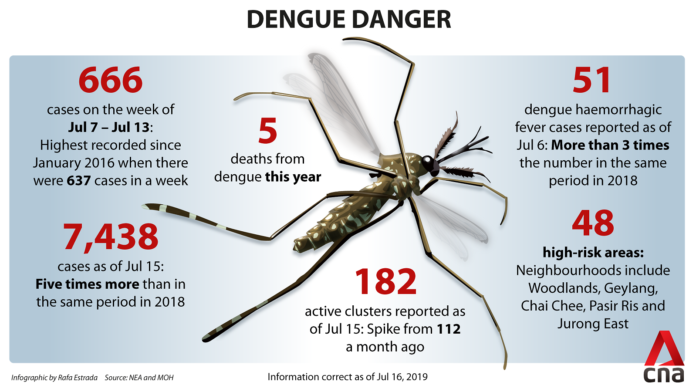
Dengue cases rose to 666 last week, which the National Environment Agency (NEA) said was the highest recorded in a week since a previous peak in January 2016, when the number of cases hit 637.
As of 3pm on Monday (Jul 15), there were 7,438 recorded cases of dengue in Singapore, about five times more than the 1,481 cases in the same period last year, NEA said. Five people have died from dengue this year.
Experts said there was insufficient information to determine the cause of this year’s jump in cases, but some pointed to the increase in the number of mosquitoes detected while a few said a different variant or mutation of the virus could be responsible.
The spike in cases this year did not come as a surprise to infectious diseases specialist Dr Leong Hoe Nam, who pointed out that the increase in dengue cases typically comes in “phases”.
“We’ve had two good years in 2017 and 2018. Dengue typically comes in phases of three to four years, so this spike is not surprising,” he said.
Singapore’s latest dengue epidemic was in 2013, with more than 22,000 infections and eight deaths. There were also dengue epidemics in 2005 and 2007.
In contrast, dengue infections in Singapore fell to a 16-year low in 2017, with just 2,772 cases. There were 3,285 cases in 2018.
Dr Leong added that lower incidences of dengue in 2017 and 2018 would have caused the immunity of the general population to fall, making Singaporean residents more susceptible to the virus.
Dr Leong said: “It’s important to note that this is happening not just in Singapore but in the region, including Indonesia, Philippines, Malaysia and Thailand.
“It is too myopic to say this trend is our own doing because it’s happening all over the region.”
Professor Tikki Pang, a visiting professor at the Lee Kuan Yew School of Public Policy said the spike may be related to recent warm weather or an increase in the number of construction sites, with many new MRT stations and Changi Airport Terminal 5 under construction.
It may also be due to changes in mosquito behaviour or the emergence of a “more virulent strain” of dengue, said the professor, who specialises in infectious diseases and other public health domains.
NO CHANGE IN PREVAILING DENGUE STRAIN
The “normal cycle of dengue epidemics” is thought to be caused by changes in the prevailing strain or serotype of the dengue virus but this does not appear to have happened this year, said Dr Paul Tambyah, infectious diseases expert and president of the Asia Pacific Society of clinical microbiology and infection.
There are four known strains, and according to experts, Dengue-2 has been the predominant strain in Singapore since 2015. Dengue-1 was the prevailing strain in the 2013 outbreak.
In an April 2019 report, the Ministry of Health noted the absence of a “serotype switch” despite predicting that Singapore may see about 50 per cent more dengue cases this year than in 2018.
Dr Tambyah said, however, that within broad serotypes, there are different genotypes or “sub-serotypes”.
It is not clear if the current spike is due to the spread of a different sub-strain of Dengue-2 or the larger number of Aedes mosquito breeding sites detected, he added.
Dr Ooi Eng Eong, deputy director at the Emerging Infectious Diseases programme at Duke-NUS Medical School said, however, that there has not been a drastic change in the Aedes mosquito population.
He also ruled out other possible reasons such as an increase in the number of Singapore residents who are not immune to dengue, or a change in the predominant serotype of the virus.
“If you look at the proportion of the population that has had dengue before and is therefore immune to at least one serotype, that number has not changed in 20 years,” he said.
Instead, he thinks virus evolution might be to blame.
The dengue virus genome is known to mutate, said Dr Ooi, and some of these mutations could have allowed the virus to better spread in Singapore’s urban environment.
“Such mutations have contributed to outbreaks in different parts of the world and may be responsible for the current rise in the number of dengue cases,” he added.
SINGAPORE: Charities and social service agencies will be able to adopt technological solutions at subsidised rates under an initiative introduced by the National Council of Social Services (NCSS) on Tuesday (Jul 16).
These include an intelligent surveillance system called SoundEye, which can alert staff when people fall or injure themselves, and an autonomous cleaning robot designed to have human-like responses.
Under the Tech Booster initiative, social service agencies can get up to 98 per cent funding, capped at S$450,000 per centre, if they adopt three or more technology solutions.
Applications to NCSS are now open and will close at the end of September.
“The initiative enables existing care workers to provide better service to more clients, raise staff morale and retention and increase client centricity. Care workers’ roles can also be upgraded to attract more Singaporeans to take up these jobs,” said NCSS in a media release.
SoundEye, an intelligent surveillance system which can alert staff when people fall or injure themselves, was one of the items showcased at the NCSS Social Service Summit.
This was among two initiatives, which will cost around S$20 million, to help social service agencies address the manpower crunch.
At the annual Social Service Summit on Tuesday, Minister for Social and Family Development Desmond Lee urged the industry to be open to digital transformation.
“We must recognise the larger picture that the manpower situation will continue to tighten, across all sectors in Singapore,” Mr Lee told a gathering of 1,000 social service professionals, corporates and donors.
“We will need to meet more needs, but we are not going to find it easier to hire people.”
NCSS president Anita Fam, in her speech. pointed out that innovation is a key challenge for the social service sector.
She cited figures from a recent social service sector survey, indicating that 26 per cent of more than 280 industry leaders said innovation was one of their agency’s top three challenges.
Ms Fam added that innovation is “critical” for those operating in the non-profit space as agencies face “growing pressure to serve more people in need and to deliver measurable results with limited resources”.
The Tech Booster initiative hopes to introduce technology at residential facilities that find it hard to hire staff, such as adult disability homes, day care centres and welfare homes. One of the key aims of the programme is to reduce operational time spent by a care worker by 30 per cent.
Social service agencies can also tap the Project Back-To-Basics initiative to streamline processes for social service professionals, so that more of their time can be freed up to serve clients instead of handling work like administrative tasks.
These professionals include speech therapists, physiotherapists, occupational therapists, social workers and youth workers.
“The professionals can have higher job satisfaction and perform upgraded functions that better use their professional skills and knowledge,” said NCSS.
A consultancy company will work with the organisations to identify areas where processes can be improved, and suggest ways to do this through technology or job redesign.
Social service agencies will get subsidies of up to 95 per cent, capped at S$100,000 for each centre. There are currently eight agencies involved in 11 projects, and the initiative will run until March 2023.
In addition, an inaugural youth leadership initiative called NCSS 40-under 40 will take place later this year in October.
The three-day two-night residential programme will give 40 participants under the age of 40, as of Dec 31, the opportunity to network with people in the sector, as well as to engage with government leaders.
SINGAPORE: Several ministries and government agencies have been flagged by the Auditor-General for lapses in three areas – IT controls, contract management and the management of social grants.
These gaps were laid out in a report by the Auditor-General’s Office (AGO) released on Tuesday (Jul 16), after its audit of government accounts for the financial year 2018/2019.
The audit covered all 16 government ministries and eight organs of state, four government funds, nine statutory boards, four government-owned companies and three other accounts.
Ministries and agencies singled out in the AGO report for lapses include the Ministry of Defence (MINDEF), the Ministry of Culture, Community and Youth (MCCY), Ministry of Health (MOH), Islamic Religious Council of Singapore (MUIS) and the Ministry of Social and Family Development (MSF).
In response to the report, the Ministry of Finance (MOF) said the Government “has accepted all the recommendations” and the agencies are “working on the necessary follow-up actions”.
The AGO said it “found weaknesses in IT controls” in the Ministry of Manpower, Singapore Customs and the MINDEF.
The lapses included: Inadequate logging and review of activities of privileged users, such as operating system and database administrators, and lapses in the management of user access rights.
In its audit of MINDEF, for example, the AGO found that a number of IT vendor employees were granted unrestricted access to read personnel and payroll information in MINDEF’s human resource system.
“The read-access was not granted on a strict, needs-only basis based on the vendor staff’s job scope and duties to be performed in the system,” the AGO said.
It also noted that since 2014, MINDEF had not reviewed the log records of access made by the IT vendor staff to information types which required controlled access.
Weaknesses like that, the AGO said, “would expose the entities to the risk of not detecting unauthorised access and activities which could compromise the integrity and confidentiality of data in the IT systems”.
LAPSES IN PROCUREMENT AND CONTRACT MANAGEMENT
The AGO also found lapses in procurement and contract management at MCCY, MUIS, and the National Council of Social Service (NCSS).
For the National Gallery development project, which is owned by MCCY and managed by the National Gallery Singapore, there were lapses in the approval of 142 contract variations amounting to S$12.4 million, said AGO.
“These lapses included obtaining approval from the approving authority only after works had commenced or had already been completed, obtaining approval from incorrect approving authority, and not seeking approval for substantial increase in variation cost,” the AGO noted.
For items with rates not listed in the contract under six contract variations, AGO said the cost was based on a single quotation obtained by the contractor for each item, and was not assessed for how reasonable the rate was.
“Failure to properly assess and manage contract variations could result in MCCY not obtaining full value from the public funds spent,” it said.
The Islamic Religious Council of Singapore’s headquarters along Braddell Road. (File photo: MUIS)
MUIS was also mentioned in the report for a “number of lapses from its test checks”. Six tenders and quotations amounting to S$4.4 million had errors in the scores awarded during the evaluation process. Some would have resulted in different vendors being awarded.
GAPS IN MANAGEMENT OF SOCIAL GRANT PROGRAMMES
The AGO also carried out a thematic audit on selected social grant programmes managed by MOH and MSF.
It pointed out that a total of S$1.59 billion was disbursed by the two ministries under their social grant programmes to 1,058 Programme-Voluntary Welfare Organisations (VWOs).
“By and large, grant programmes managed by both ministries had defined objectives and clear service deliverables which were approved by the correct approving authority,” the AGO said.
However, AGO found a significant number of instances where approval of funding was obtained or funding agreement was entered into only after the commencement of funding period.
There were also cases of grants being approved or disbursed before funding approval was obtained or before an agreement had been entered into.
It noted that “checks by both ministries for grant disbursements were inadequate”.
“Based on AGO’s test checks, there was a significant number of instances where the ministries had not carried out adequate checks on VWOs’ inputs and claims for disbursements to ensure that these were valid and correct before processing the disbursements. AGO also noted instances of errors in the computation of disbursement amounts.”
The AGO also noted gaps in MOH’s monitoring process for grants.
There was “no evidence” documents submitted by VWOs were reviewed, the ministry did not adequately follow up on anomalies detected in documents submitted and it did not follow up with VWOs for documents they had failed to submit, the AGO said.
GOVERNMENT HAS ACCEPTED ALL RECOMMENDATIONS: FINANCE MINISTRY
“Some of the lapses highlighted in this report, such as weaknesses in IT controls and lapses in procurement and contract management, are similar to those reported last year although the lapses involve different entities,” the AGO said.
“It is important that public sector entities avoid repeating similar lapses and implement effective measures to enhance governance and controls on the use of public funds.
“AGO will follow up with the public sector entities to ascertain that remedial actions are taken.”
In response to the lapses listed in the report, the Government “has accepted” all the recommendations made by the AGO, MOF said on Tuesday.
In a news release, MOF said the public service sector was “making a concerted effort to address the AGO’s findings”.
The Smart Nation and Digital Government Group will help agencies raise their level of compliance on rules of IT controls, MOF said.
The public service will also continue to strengthen its internal IT audit regime, MOF said.
MOF added the ongoing Public Service Data Security Review Committee will examine how IT measures affecting data security and third-party management may be improved.
To address the lapses in construction contract management, MOF has been working with the Building and Construction Authority (BCA) to implement several measures, such as simplifying rules on variation orders and works, as one of the areas of lapses in contract management was due to the misinterpretation of rules.
BCA also enhanced the procurement framework for consultancy services by placing greater emphasis on quality during tender.
To improve grant management, MOF said the public service is taking steps to improve grant governance after the completion of the grants management review conducted by MOF and the Accountant-General’s Department.
“As stewards of public resources, we are firmly committed to ensuring a sound governance system,” MOF said, noting the report had not identified instances of fraud or corruption among public officers.
“As we make improvements, we are mindful of the need to strike a sensible balance between strengthening controls, and maintaining efficiency and timeliness in delivering services to Singaporeans.”
SINGAPORE: Residents in parts of Yishun and Bukit Timah can now rate and provide feedback on their postmen under a new platform launched by Singapore Post (SingPost) to improve service standards.
SingPost, the country’s only public postal licensee, has come under fire for a series of high profile service lapses, including having mail thrown away by its postmen, and has been fined hundreds of thousands of dollars by the Government.
The company’s newly minted chief executive for postal services and Singapore operations Vincent Phang said last month the company would do more in the coming months to improve standards in its postal operations and win back the public’s trust.
On Tuesday (Jul 16), SingPost unveiled a MyPostman campaign to help it “foster deeper ties between residents and their postman” and improve its service standard.
Under a trial that will run until September, residents with postal codes beginning with 58, 59, 65 and 76, will be able to use the MyPostman website to find out who their deliveryman is, as well as provide a rating, feedback or words of encouragement.
A nationwide launch is slated for October, said SingPost in a media release.
“The campaign puts a face to our postman, who provides this essential service daily, whether rain or shine,” said Mr Phang.
“While primarily aimed to increase SingPost’s service standards, what we hope this campaign does is also to foster a spirit of community and to encourage residents to get to know their postman who provide a public service,” he added.
The website also features a general feedback page for customers to inform SingPost of service and letterbox-related issues and incidents. An option to upload file attachment is available.
To promote the website, SingPost will distribute almost two million sets of fridge magnets to every residential and business unit. The magnets have a QR code that users can scan to access the website on their mobile devices.
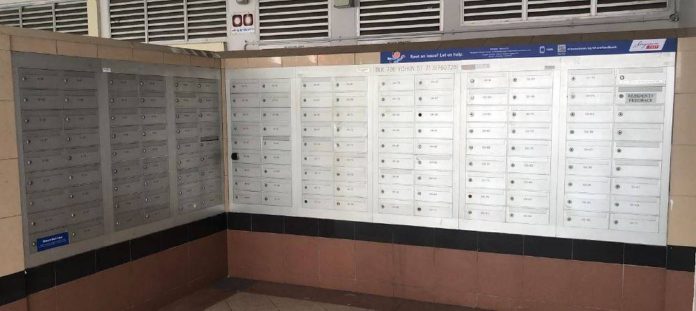
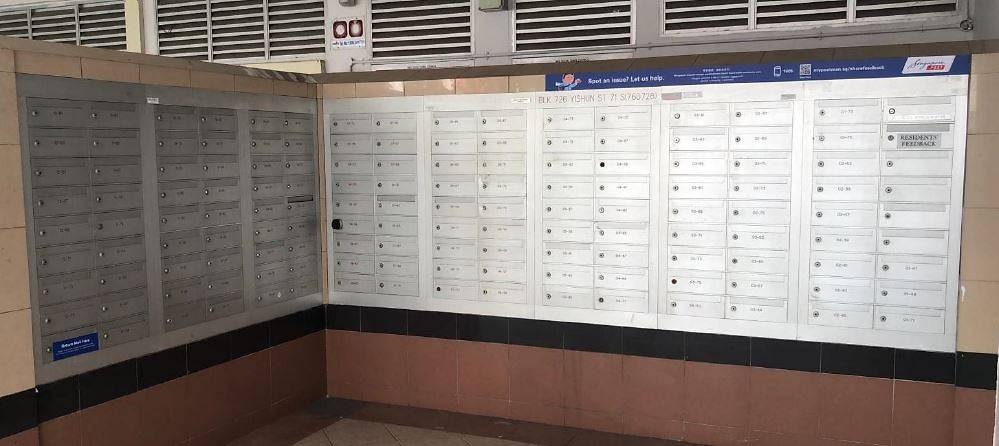
Stickers directing users to a dedicated feedback page have also been put up at HDB letterbox nests in the two trial estates.
“Service-related feedback received through the page will be attended to more quickly,” said SingPost.
New stickers have been put up on letterbox nests in the trial estates. (Photo: SingPost)
Mr Abu Talib Abdul Hamid, who has worked as a SingPost postman for 27 years, said the initiative will go some way in helping him perform his duties better.
“In the early years, I recalled meeting many residents in the area I serve and I could remember many of them. Many of them are very kind, and I’m willing to go out of my way to help them where necessary,” said Mr Abu Talib.
“However, as the years go by, the lifestyle of Singaporeans have changed, and now people are hardly at home so I don’t get to meet residents as often,” he said, adding that feedback will help him improve.