Home Blog Page 750

Rise in measles cases in Singapore: What you need to know about the infectious disease

0

SINGAPORE: Can you get measles even if you have been vaccinated? And what should you do if you come into contact with someone who has the viral disease?

Amid a spike in cases around the world, Singaporeans have been urged to be vigilant as the country is likely to see more imported cases of measles, said the Ministry of Health (MOH) on Tuesday (Jul 23). 

So far this year, there have been 116 measles cases in Singapore, although MOH said there is currently no evidence of a community spread. 

Here is what you need to know about measles and how you can protect yourself.

HOW IS MEASLES SPREAD?

Measles is a highly contagious disease that affects a person’s respiratory system and often results in a skin rash.

The virus spreads easily through direct contact with the saliva or mucus of an infected person, whether through coughing, sneezing or contact with contaminated surfaces.  

While measles is more common among children, it can be contracted at any age if a person has not had the measles, mumps and rubella (MMR) vaccination. 

SYMPTOMS OF MEASLES

Symptoms of measles usually start to appear 10 to 12 days after you come into contact with a contagious person, said MOH on its health portal.

Patient receiving measles vaccination

A child receiving measles vaccination at a hospital. (Photo: AFP/Getty Images North America/Joe Raedle) 

Early symptoms include coughing, a runny or stuffy nose, malaise, red eyes, tearing and a fever.

Two to four days later, bluish-white spots called Koplik’s spots may start to appear on the inside of cheeks. At the same time, or slightly later, a skin rash would spread across the person’s face, neck, trunk, limbs, palms and soles of the feet.

Diarrhoea, vomiting and inflammation of the eyes are also associated symptoms of measles.

HOW DANGEROUS IS IT?

Children are at high risk of developing complications.

While most patients recover completely from measles, it can also lead to ear infection and pneumonia for older patients.

In rare cases, measles may cause encephalitis – an acute inflammation of the brain – and increase the risk of seizures, epilepsy, mental disability, coma or death.

WHY IS MEASLES VACCINATION COMPULSORY IN SINGAPORE?

Measles epidemics used to occur every one to three years in Singapore during the 1960s and 1970s, and most children developed measles after the age of one.

A measles vaccination was introduced in 1976, but the acceptance rate was poor because of “cultural beliefs that measles is an innocuous and inevitable childhood infection”, said MOH in a report.

Child with measles in the Philippines 2

A rash seen on a child infected with measles in the Philippines. (Photo: Jack Board) 

In 1984, there was a record of 2,417 cases, including seven deaths. 

The following year, measles vaccination, which consists of two doses, was made compulsory for all Singaporean children aged 12 to 24 months.

Earlier this year, it was made compulsory for foreign children applying for a long-term visit pass to be fully vaccinated against measles.

IS IT POSSIBLE TO GET MEASLES EVEN AFTER VACCINATION? 

Those who have had the two doses of MMR vaccines are usually considered protected for their entire lives, said Dr Yan Shiyuan, medical director at Edgedale Medical Clinic (Cambridge).

“The two doses of MMR vaccines are 97 per cent effective against measles,” he told CNA.

Dr Yan added that while some might still get measles despite being vaccinated, this may be due to a decrease of the immune system’s ability to fight the virus over time.

“There are also some people with immune systems that may not produce sufficient antibodies to fight the virus after being vaccinated,” he explained.

Measles outbreak in Ukraine

A nurse prepares a measles vaccine to vaccinate a girl in the school of Lapaivka village near the western Ukrainian city of Lviv. (Photo: AFP/ Yuri Dyachyshyn)

SHOULD TRAVELLERS GET VACCINATED?

If you are travelling to places with a high-risk of measles infection, Dr Yan’s advice is to take the necessary vaccinations beforehand. 

“Children (below the age of 12 months) and adults with no documented evidence of measles vaccination should receive two doses of MMR vaccine at least 28 days apart,” said Dr Yan. 

Infants between six to 11 months old travelling to high-risk countries should also receive one dose of vaccination, followed by another two doses at 12 months and 15 months. 

For adults, those who have evidence of only one dose of the vaccine should receive a booster shot before travelling.

“It is important to ensure good hygiene during travel such as frequent hand washing, wearing a face mask and avoiding close contact with sick people,” he added. 

WHAT TO DO IF EXPOSED TO A PERSON WITH MEASLES 

If a person has been exposed to measles, they should talk to their doctor about vaccination, said Dr Yan.

“It is not harmful to be vaccinated after being exposed to measles,” he said.

“If a person receives MMR vaccination within 72 hours after exposure, they may be able to get some protection against the disease or have milder symptoms.”

Children below the age of 11 months should especially avoid contact with an infected person. They should also be taken to the doctor for consultation on vaccination. 
Measles Philippines

Measles has resulted in hundreds of deaths this year in the Philippines. (Photo: Jack Board)

WHY THE INCREASE IN MEASLES CASES HERE AND AROUND THE WORLD?

If most Singaporeans have been vaccinated against the disease, then what are the possible reasons for the rise in measles cases?

In May, Minister of Health Gan Kim Yong said in Parliament that the global increase in measles outbreak was due to “declining vaccination coverage in many countries”.

“This has resulted in a significant increase of non-immune individuals in the community, making it easier for the disease to spread,” said Mr Gan.

“Being a travel hub, Singapore is also exposed to imported cases.”

READ: As a measles epidemic rolls through the Philippines, blame falls on bungled vaccination programme

READ: Measles threat looms in Philippines as trust in vaccines declines: Health officials

On Tuesday, MOH said that of the 116 measles cases confirmed this year, 88 were local and 28 were imported rom Bangladesh, Dubai, Malaysia, New Zealand, Philippines, Thailand and Vietnam.

Measles cases rose 300 per cent globally through the first three months of 2019 compared to the same period last year, according to the World Health Organization.

This has been attributed to slipping vaccination rates amid a so-called anti-vax movement. The movement has been driven by claims linking the MMR vaccine to the risk of autism in children.  
Source link

From Chickenjoy to dim sum and now coffee: Jollibee’s scrumptious quest for world domination

0

SINGAPORE: In 1975, a young man named Tony Tan Ciaktong opened an ice-cream shop in Manila. 

Three years later, the Tan Ciaktong family picked up on a bigger local appetite for hot meals and sandwiches, and Jollibee – a small restaurant chain serving a Filipino take on fast food – was born.

By early 2019, Jollibee was selling its hot-favourite Chickenjoy and Jolly Spaghetti special in more than 1,000 restaurants in the Philippines – beating out Burger King and McDonald’s in both popularity and market share. 

But like its addictive fried chicken bucket, it was just not enough. 

Jollibee Foods, whose founder and chairman is now a billionaire several times over, is on a mission to conquer the world. And with a ballpark of 4,000 stores under 14 brands in 20 countries, it is well on its way. 

Here is a timeline of Jollibee’s rapid (and lip-smacking) climb towards realising its vision of becoming one of the top five restaurant companies in the world

ROAD TO CHINA

Dunkin Donuts

Jollibee has entered a joint venture to launch 1,400 Dunkin’ Donut stores in China over 20 years. (Facebook/Dunkin’ Donuts)

In January 2016, following a spate of more low-profile acquisitions, Jollibee Foods entered a joint venture to be the exclusive operator of Dunkin’ Donuts in China, reportedly with plans to launch 1,400 stores in the world’s second-largest economy over 20 years. 

DIM SUM DEAL

Baked BBQ Pork Buns Tim Ho Wan chefs

Tim Ho Wan’s signature baked barbecue pork buns. (Photo: Tim Ho Wan)

2018 marked a major boost in Jollibee’s international profile, starting with its S$45 million investment in a fund set to become the new master franchise holder of Michelin-starred dim sum chain Tim Ho Wan.

This means Jollibee now has a substantial stake in the running of all the Tim Ho Wan joints in the region, except in Hong Kong where the restaurant popular for its barbecue pork buns was founded in 2009. 

SMASHING THE BURGER MARKET

Smashburger

Owning the Smashburger brand pits Jollibee against big “better burger” names like Five Guys and Shake Shack. (Photo: Facebook/Smashburger)

In December 2018, Jollibee became the owner of classic American burger brand Smashburger, which has more than 300 outlets across the US, UK and Canada, plus a handful in Saudi Arabia. 

The move put the Filipino company in a solid position to compete with big names like Five Guys and Shake Shack in the “better burger” segment. 

GOING MEXICAN

That same month, Jollibee put on its sombrero in a bid to challenge the world’s top fast food operators, investing US$12.4 million (S$16.9 million) for a nearly 50 per cent stake in Tortas Fronterra. 

The US Mexican food brand which serves pork, beef and chicken sandwiches with sides of guacamole and salsa. 

JAVA JUMP

Coffee Bean Tea Leaf

The Coffee Bean and Tea Leaf will soon be wholly owned by Jollibee. (Photo: The Coffee Bean and Tea Leaf)

Even with its worldwide, cross-flavour expansion, Jollibee’s biggest business has always been its namesake Philippine-born brand – but that is set to change with the company’s US$350 million purchase of US-based specialty coffee and tea chain Coffee Bean and Tea Leaf

In the Philippine Stock Exchange filing, Tan Caktiong described the acquisition as Jollibee’s “largest and most multinational so far with business presence in 27 countries” – giving the Jollibee vision a massive caffeine boost.

Source link

Man fined for repositioning toy grenade near Istana to see public reaction

0

SINGAPORE: A cleaner who chanced upon a toy grenade near the Istana placed it upright to see how the public would react to it.

For his threatening behaviour, 59-year-old Elankovan Marimuthu was fined S$4,500 on Wednesday (Jul 24).

The court heard that Elankovan’s work involved cleaning Istana Park and the surrounding areas.

He was doing so at about 7am on Nov 3, 2017, when he came across a toy grenade lying on its side near a fire hydrant along Penang Lane.

He decided to position the grenade in an upright manner, said Deputy Public Prosecutor Thiagesh Sukumaran, and used a pair of tongs to do so before leaving the scene.

He did this because he wanted to see how the public would react to the item once it was discovered, said the prosecutor.

At about 2.05pm that day, two motorists were at the junction of Penang Lane and Orchard Road when they noticed the toy grenade at the fire hydrant. One of them called the police.

The incident sparked a deployment of public resources. The police cordoned off the area after they arrived at the scene.

MORE THAN 40 OFFICERS DEPLOYED

A total of 39 officers were deployed from various units of the Singapore Police Force, along with eight members of the Singapore Armed Forces Chemical, Biological, Radiological and Explosive Defence Group and other police officers who swept the surrounding areas including Dhoby Ghaut MRT station.

Penang Lane was closed for half an hour and partially cordoned off to traffic for 45 minutes, while police advisories were disseminated to advise the public to stay clear of the area.

In this time, a number of phone calls were made to the police hotline complaining of traffic congestion in the area.

It was established at about 5pm that the item was a toy and Penang Lane was subsequently reopened. It is not known who placed the toy there in the first place.

Police cars at Istana Park

A suspicious item was found near Penang Road on Nov 3, 2017. (Photo: Aqil Haziq Mahmud)

Closed-circuit television footage confirmed that Elankovan had positioned the grenade in an upright manner, and he was asked to assist in investigations the next morning when he went to the Istana Park.

He admitted that he had repositioned the toy and did so because he wanted to see how the public would react to it.

Elankovan pleaded guilty to one charge under the Protection from Harassment Act of using threatening behaviour by positioning the toy grenade in an upright manner, behaviour likely to cause alarm.

The prosecution asked for a fine of S$4,500, saying it was not unreasonable to characterise Elankovan’s behaviour as “irresponsible” in today’s security climate.

The area was filled with tourists and was adjacent to the Istana, and his act wasted public resources and created inconvenience to the public.

“The public messaging today is that everything suspicious should be reported to the authorities,” said the prosecutor, adding that Elankovan had not reported it when he first saw the object.

“He turned it into his own little game,” said the prosecutor. “He wanted to see how the public would react.”

The fine would send a message that such conduct is unacceptable and that it is not a joke nor a game, but has serious consequences, he said.

Defence lawyer Rajan Supramaniam told the court that his client was not highly educated and wishes to close this “unfortunate chapter” in his life.

He has worked with Veolia ES Singapore Industrial for 17 years and was redesignated as a senior machine operator after the incident.

“Our client has truly learnt a hard and bitter lesson as a result of his foolish and wrongful actions,” said the lawyer, asking for leniency.

District Judge May Mesenas said it was fortunate that the prosecution had reduced the charge from a more serious one under the United Nations (Anti-Terrorism Measures) Regulations, which carries maximum penalties of 10 years’ jail, a S$500,000 fine, or both.

“Hopefully this is a lesson learned for you, not to be taken lightly,” said the judge. “After this incident, look at what happened.”

The toy grenade was forfeited to the police for disposal.

Elankovan could have been fined a maximum of S$5,000 for his offence.

Source link

Injuries, evacuations, homes destroyed: PMD fires in recent months

0

SINGAPORE: A spate of fires linked to electric scooters, electric bicycles and other personal mobility devices (PMDs) in recent months has led the Land Transport Authority (LTA) to consider reviewing a deadline for the devices to meet fire safety standards.  

In September last year, Senior Minister of State for Transport Lam Pin Min announced in Parliament that all motorised PMDs must meet fire safety standards by 2021 to ensure public safety.

But on Tuesday (Jul 23), LTA said that in light of recent fires related to the charging of non-UL2272-certified devices, it is considering bringing forward the deadline. 

READ: LTA to review deadline for PMD safety certificate after spate of fire incidents

In 2017, there were 49 fires involving PMDs, according to statistics released by the Singapore Civil Defence Force (SCDF) earlier this year. This number spiked by more than 50 per cent to 74 in 2018.

Just this month alone, at least three fires that led to death, injuries and ravaged homes took place across the island. 

READ: Preventing PMD fires: Tips on charging your device safely

Here are some of the fires reported in recent months.

JUL 22: ANG MO KIO

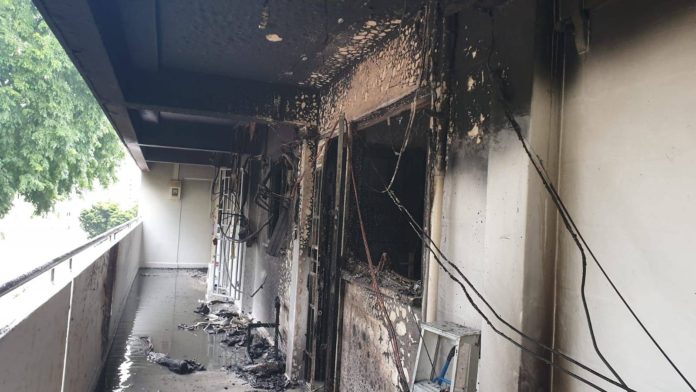
The exterior of the fourth floor unit where the fire took place.

The exterior of the fourth-floor unit at Block 224 Ang Mo Kio Avenue 1 where the fire took place. (Photo: Facebook/SCDF)

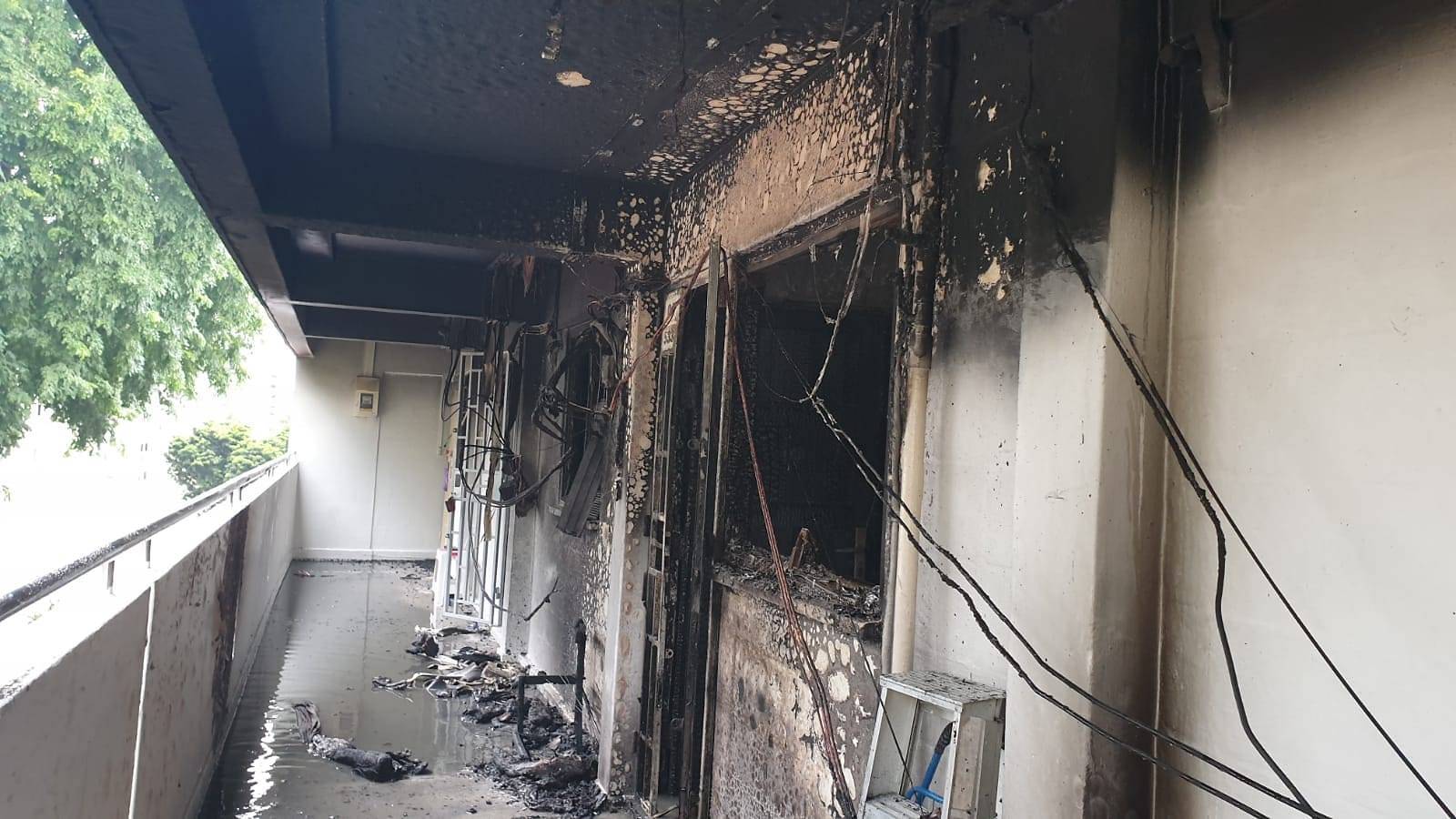
In the latest fire on Jul 22, 60 people had to be evacuated from Block 224 Ang Mo Kio Avenue 1 after a fire broke out at a flat on the fourth floor.

Four people, including three children, were rescued from a neighbouring unit by firefighters. 

SCDF’s preliminary investigation found that the fire was caused by a PMD that was placed in the kitchen.

JUL 18: BUKIT BATOK

There were three PMDs in the flat at Block 293D Bukit Batok Street 21

There were three PMDs in the flat at Block 293D Bukit Batok Street 21 where a fire broke out. (Photo: Facebook/Murali Pillai)

Just four days before the Ang Mo Kio incident, a fire broke out at a 26th-floor flat at Block 293D Bukit Batok Street 21.

There were three burnt PMDs in the unit, according to SCDF.

A man and woman who were inside the flat were injured and rescued by firefighters. About 70 residents in the block were evacuated, and an elderly man was hurt during the evacuation.

The man who was rescued from the flat died from his injuries, the police said in a statement two days later. 

READ: Fires involving e-scooters, e-bikes spike by 50% in 2018

About 70 residents were evacuated during the fire at Block 293D Bukit Batok Street 21

About 70 residents were evacuated during the fire at Block 293D Bukit Batok Street 21. (Photo: Facebook/Murali Pillai)

JUL 8: TAMPINES

Earlier this month, a fire ravaged the living room of a Tampines flat where a PMD battery was being charged.

Firefighters responded to the fire at an HDB maisonette, located on the fourth level of Block 125 Tampines Street 11.

Charred PMD tampines hdb flat fire SCDF

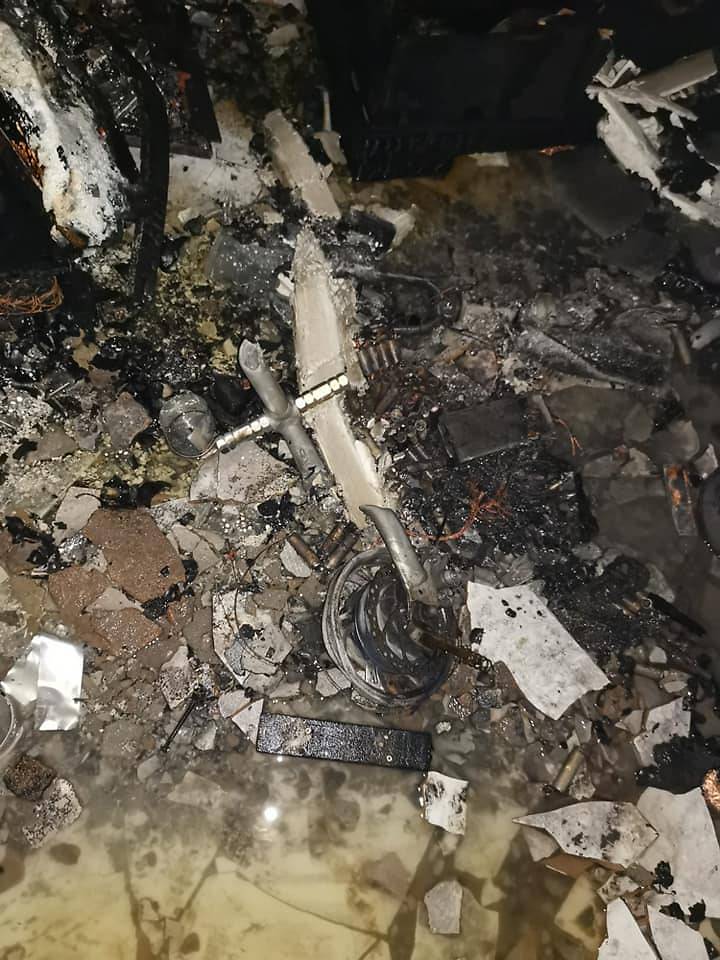
The charred remains of a PMD in a Tampines HDB flat fire. (Photo: Facebook/SCDF)

A man and a woman were rescued from the burning flat. No injuries were reported in the incident.

JUN 8: ANG MO KIO AND MARINE TERRACE

Two fires sparked by PMDs were reported on Jun 8.

One of the incidents was at Block 301 Ang Mo Kio Avenue 3, where a PMD battery being charged sparked a fire in a flat’s bedroom.

The aftermath of two fires at Block 301 Ang Mo Kio Avenue 3 and at Block 52 Marine Terrace

Photos show the aftermath of two fires at Block 301 Ang Mo Kio Avenue 3 (left) and at Block 52 Marine Terrace. (Photos: Facebook/SCDF)

Another fire took place at a flat in Block 52 Marine Terrace, similarly involving a PMD battery being charged. The fire was put out by the flat’s occupant with buckets of water. 

The occupant suffered burn injuries and was taken to a hospital, SCDF said.

APR 9: WOODLANDS

A teenager and a firefighter suffered burns after a fire broke out at a fifth-floor flat in Block 159 Woodlands Street 13 on Apr 9.

Firefighters had to break into the flat, where they rescued the teenager, a woman and two children who were trapped in the kitchen.

The living room of a Woodlands flat after a fire raged through it on Apr 9, 2019

The living room of a Woodlands flat after a fire raged through it on Apr 9, 2019. (Photo: SCDF)

Five other occupants in the neighbouring units were also evacuated.

Besides the teenager and firefighter, four people – including the two children rescued from the flat – were taken to the hospital for smoke inhalation.

Preliminary investigations found that the fire was sparked by a PMD that was left charging in a bedroom.

Source link

SCDF conducts ‘chemical attack’ operational exercise at Padang ahead of NDP

0

SINGAPORE: While the rest of the city slumbered, the wee hours of Wednesday (Jul 24) saw officers from the Singapore Civil Defence Force (SCDF) storm the grandstands at the Padang in the aftermath of a “chemical attack” to evacuate “parade-goers”.

Officers from the SCDF tend to the “casualties” in the grandstands at the Padang

Officers from the SCDF tend to the “casualties” in the grandstands at the Padang. (Photo: Gaya Chandramohan)

A “casualty” seen with a casualty hood that filters harmful chemicals

A “casualty” seen with a casualty hood that filters harmful chemicals in case of a chemical attack. (Photo: Gaya Chandramohan)

Involving 400 participants and 42 emergency vehicles, the exercise led by SCDF was meant to prepare emergency personnel for contingencies that may occur during the upcoming National Day Parade (NDP) on Aug 9.

Just after 2.30am, officers kitted out in gas masks and grey chemical agent suits made for the “casualties” with their stretchers and casualty hoods that filter harmful chemicals, while HazMat specialists decked out in fully-encapsulated orange suits arrived on the scene to locate the harmful chemical agent hidden in the stands.

HazMat specialists locate the site of a “chemical agent”

HazMat specialists locate the site of a “chemical agent”. (Photo: Gaya Chandramohan)

A mock chemical agent placed somewhere in the Padang

A mock chemical agent placed somewhere in the Padang grandstand for the operational exercise. (Photo: Gaya Chandramohan)

SCDF Padang Exercise (8)

HazMat specialists take a sample of the “chemical” used in the attack for analysis. (Photo: Gaya Chandramohan)

Within minutes, the HazMat team was able to locate the source of the harmful substance, mitigate the chemical release and decontaminate the area to remove its harmful effects before taking samples for analysis.

Meanwhile, evacuated casualties were put through the decontamination process and administered first aid.

SCDF officers carrying a “casualty“ on a stretche

SCDF officers carrying a “casualty“ on a stretcher. (Photo: Gaya Chandramohan)

“Casualties“ from the “chemical attack“ await medical attention.

“Casualties“ from the “chemical attack“ await medical attention. (Photo: Gaya Chandramohan)

Casualties undergoing contamination to remove any trace of harmful

Casualties undergoing contamination to remove any trace of harmful chemicals from their body at the Mass Decontamination Vehicle (MDV). (Photo: Gaya Chandramohan)

Working seamlessly with the Singapore Police Force (SPF), Singapore Armed Forces (SAF) and Ministry of Health (MOH), the SCDF successfully ended their multi-agency exercise at 3.30am.

Speaking to reporters after the exercise, SCDF’s director of operations Assistant Commissioner (AC) Daniel Seet said that while exercises and events held at the Padang were special due to its historical setting, challenges came with the venue due to its “spread-out terrain” and unfamiliar grounds due to rare standbys there that usually only occur once every five years.

The Padang

(Photo: Gaya Chandramohan)

“The main challenge for our personnel is to make sure that they are familiar with the place; they know where the various facilities are. We take that into account in terms of how we deploy our assets,” he said.

The emergency preparedness exercise which was done in phases saw each agency pull their weight equally – something that AC Seet believes is crucial for the success of an operation.

After casualties are cleared of the contaminants, they receive medical assistance

After casualties are cleared of the contaminants, they receive medical assistance from paramedics and doctors at the on-site first aid point. (Photo: Gaya Chandra

SAF Battalion Casualty Station set up for the SCDF exercise

The SAF Battalion Casualty Station set up for the SCDF exercise. (Photo: Gaya Chandramohan)

Casualties are brought to the Mass Decontamination Vehicle

Casualties are brought to the Mass Decontamination Vehicle, which is purpose-built to accommodate a higher capacity of walking and lying casualties exposed to chemical agents. (Photo: Gaya Chandramohan)

“Stringing a contingency response together for an event like the NDP is actually very complex … there are many, many moving parts. The SCDF handles one major component of it, but we don’t do it alone,” he said.

“The police provide the security overlay; we have our colleagues from the Ministry of Health to take care of the first aid point and the casualty treatment. We have colleagues from the SAF to support us in terms of casualty decontamination, triaging and casualty treatment. So exercises such as this are important for us to be able to string the entire process together, to make sure that it all works out.”

Source link

Commentary: The lower immunity behind the current dengue outbreak

0

SINGAPORE: To understand the current dengue outbreak, it is useful to think back to the situation in the years following independence.

Fifty years ago in Singapore, dengue was rampant. It was then a disease of childhood and most Singaporeans had been infected once, if not several times, by the time they reached adulthood. 

Imagine the situation from the perspective of a dengue virus. 

There were so many mosquitoes to infect, due to the lack of modern vector control, but most people those mosquitoes bit could not be infected, as they had been infected earlier in life and so were immune to that virus. 

Each person could thus infect many mosquitoes, but each mosquito could infect few people, and transmission was limited by the availability of people to infect.

FEWER INFECTED SINGAPOREANS OVER THE YEARS

In the decades after, Singapore developed what is probably the world’s best vector control programme, with officers hunting breeding sites and educating people through house visits, and neighbourhood and national campaigns. 

The proportion of houses in which active breeding can be found is around 1 or 2 per cent. To feel the effect this has had, you need only compare how many bites you get in other regional capitals to how many at home.

Singapore’s vector control campaign had amazing successes in its early years. People could hardly infect mosquitoes, because there were so few, and mosquitoes could infect few people, because many were immune. 

Dengue cases in Singapore Jul 16, 2019

Transmission was then limited by availability of both people and mosquitoes to infect. 

It became very difficult for the virus to spread, the number of infections dropped, and a new generation of Singaporeans who had mostly been fortunate never to have been infected with dengue grew up and replaced the older, immune population.

Over the years, imperceptibly, inexorably, when a mosquito took a blood meal, her victim was less and less likely to have been infected already.

Today, the limiting factor preventing runaway transmission is the availability of mosquitoes, not the availability of susceptible people, leaving us at a higher risk of an outbreak sparking off, like it has recently.

READ: More mosquitoes or mutating virus? Experts have different views on dengue spike

The age profile of cases has also shifted away from children, towards adults and, increasingly, older adults, who may be at a greater risk of complications or death. 

Adults present symptoms differently from children, and in the past, these symptoms might not have been diagnosed as or tested for dengue. This brings us to the second reason we see more dengue cases.

WE ARE GETTING BETTER AT DIAGNOSING INFECTIONS

As hard as it may seem to anyone who, like me, has been hospitalised with dengue, most infections are mild — so mild that you might not take time off work, or you might just get a short MC for an unspecified infection from your doctor.

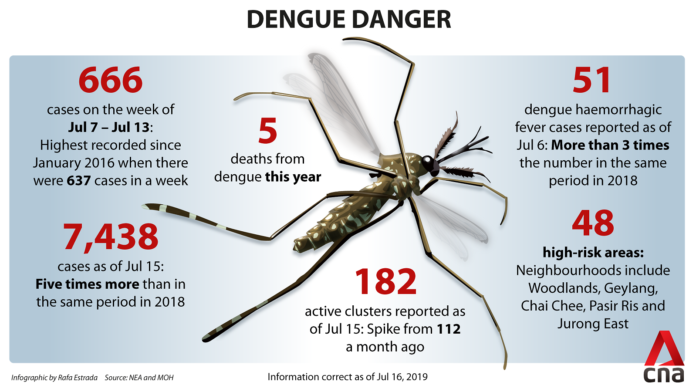
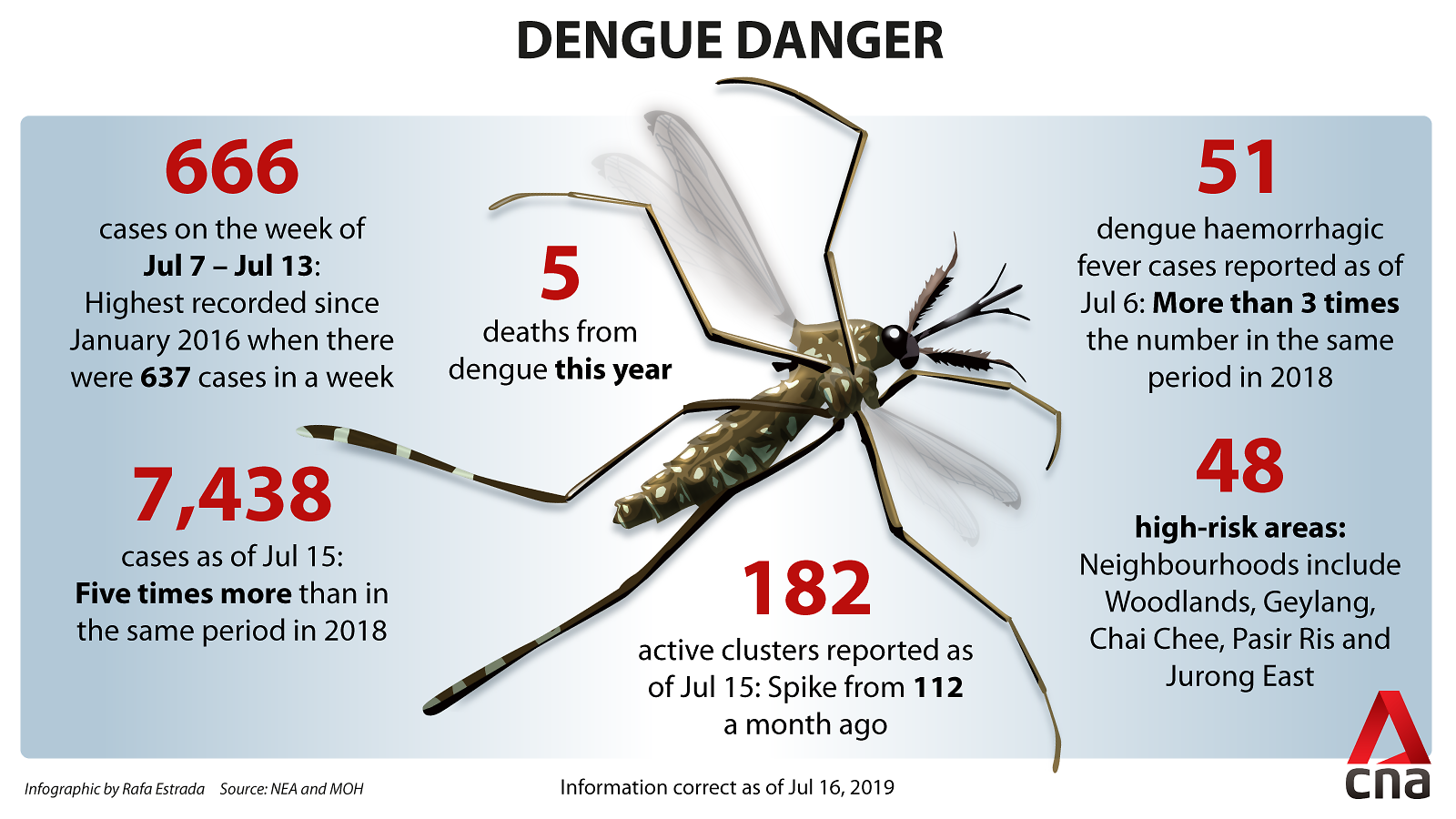
The number of reported cases — 666 last week — is thus smaller than the actual number of infections. Exactly how much smaller is hard to tell because we can’t see all these cryptic infections.

However, blood tests can tell if someone has been infected before, and by comparing how many people have been infected to how many get reported to MOH, we can make an educated guess. 

Asian tiger mosquitoes (Aedes albopictus)

Asian tiger mosquitoes (Aedes albopictus) are a major vector for potentially deadly diseases such as Zika and dengue. (AFP Photo)

A recent study by NEA, MOH and the Saw Swee Hock School of Public Health that uses this approach suggests that the total number of infections may be as many as six times higher than what is reported.

But that same study also found that recorded cases used to be just one in 14 infections, so past outbreaks were much bigger than they looked. 

Indeed, averaging over epidemic and non-epidemic years, the infection rate measured by testing blood donors has dropped markedly since the 1960s and remained low, at about 1 per cent of the population being infected per year, since the 1990s – and a similar figure emerges even after counting in last week’s 666. 

These contrasting trends imply that our doctors are getting better at diagnosing infections, through a better understanding of the signs of adult dengue and more testing of suspected cases. 

What this means is that although it looks like the dengue iceberg is getting bigger, actually all that has changed is that more lies above the surface, in plain sight.

CHALLENGES OF LOWER IMMUNITY

Since Singapore’s early successes, dengue has become ever harder to control, precisely because the effect of those early successes was to lower immunity. 

Like Alice running alongside the Red Queen, we need to run ever faster to remain in place. What new measures can we take to continue to enjoy the low risk of infection that we now take for granted?

A safe, effective and long-lasting vaccine remains the holy grail, but most Singaporeans do not fall into the group who would benefit from the only currently available vaccine, because most Singaporeans under 45 have never been infected with dengue before. 

Until a new vaccine becomes available that can be taken by those who have never been infected by dengue before, we can but maintain and enhance our vector control.

READ: Dengue cases on the rise – What you need to know to avoid mosquito bites

Promising results have emerged from NEA’s pilots of Wolbachia biocontrol in Braddell, Nee Soon and Tampines. By releasing male mosquitoes — males are vegetarian and don’t bite — which have been treated with the naturally-occurring bacterium Wolbachia, the offspring of their partnerships with wild females do not hatch. 

At Nee Soon and Tampines, there has been a 50 to 80 per cent reduction in vector density around release sites. 

The next steps are to expand releases to cover more blocks, which should start to show a drop in the number of dengue infections in those neighbourhoods. 

Collage of mosquito breeding detected in homes

Mosquito breeding in a porcelain cup (left) and a dish tray. (Photos: National Environment Agency)

If the expansion is successful, Wolbachia may become part of NEA’s routine vector control programme in the next few years.

Until then, mosquito breeding in our home is our problem, and we can do something about it by making a habit of doing the mozzie wipeout to protect ours and our neighbours’ families.

Associate Professor Alex R Cook is Vice Dean (Research) at the Saw Swee Hock School of Public Health, National University of Singapore.

Source link

War relic found at construction site near Aljunied MRT

0

SINGAPORE: A war relic was found on Tuesday (Jul 23) at a construction site at 60 Geylang Lorong 23, near Aljunied MRT station.

It was discovered by an excavator operator at about 9.30am, said Mr Subari, safety officer of Trust Build Engineering & Construction.

unexploded war relic Geylang

An unexploded ordnance was found at a construction site near Aljunied MRT. (Photo: Try Sutrisno Foo)

​​​​​​​

War relic found near Aljunied MRT

Members of the SAF Explosive Ordnance Disposal team at the scene where a war relic was found on Jul 23, 2019. 

Mr Subari told CNA that the Singapore Armed Forces’ Explosive Ordnance Disposal team has determined that the war relic is not live. It had not been removed when CNA visited the site at about 2pm.

SAF explosive ordnance team

Members of the SAF Explosive Ordnance Disposal team are seen near a Geylang construction site where an unexploded war relic was found. (Photo: Try Sutrisno Foo)

War relic found near Aljunied MRT Geylang

Members of the SAF Explosive Ordnance Disposal team at the scene where a war relic was found on Jul 23, 2019. (Photo: Try Sutrisno Foo)

Contractors have been instructed to engage a licensed third-party contractor to remove the relic, he added.

CNA has contacted the police for more information.

construction site geylang unexploded war relic

A construction site near Aljunied MRT, where an unexploded war relic was found. (Photo: Try Sutrisno Foo)

Unexploded ordnance Geylang construction site

An unexploded war relic found at a construction near Aljunied MRT.

This story came from a reader tip-off. If you would like to send in photos or videos of something newsworthy, WhatsApp our Mediacorp news hotline at +65 8218 8281 or message us on Facebook.

Source link

HDB to explore cooler homes and 3D printing for future flats

0

SINGAPORE: Cooler Housing and Development Board (HDB) flats could soon be a reality for Singaporeans.

At the Urban Sustainability R&D Congress 2019 on Tuesday (Jul 23), HDB signed a Memorandum of Understanding (MoU) with Evonik (SEA) to incorporate the firm’s new silicon-based material into the roofing of HDB flats, offering better protection against Singapore’s heat.

Called Calostat, the insulation could reduce ambient temperature in HDB flats by up to 2 degrees Celsius.

Initial trials are expected to start in the first quarter of 2020, and Calostat could also potentially be used for other parts of the building if they are successful, said HDB in a press release.

“The silicon-based material, which is sustainable, non-combustible, hydrophobic (able to repel water) and pressure resistant, has been tested and proven to have good thermal insulation properties, and adopted in developments in Germany, Switzerland and London,” HDB added.

WATCH: 10 innovations adopted to improve HDB living

READ: HDB in collaboration to develop ‘useful’ apps, services for residents

HDB and Evonik are also working on improving concrete pre-mix, to allow for 3D printing of HDB building components.

In contrast to the conventional pre-cast production process, 3D printing will reduce the time needed to build flats and will offer buyers more design options for their homes.

It will also tackle the issue of labour shortages in the construction industry, and improve workers’ productivity.

HDB also signed an MoU with V-Key to study potential enhancements to HDB’s existing smart living systems, already in place at the new Punggol Northshore flats.

The study hopes to integrate smart appliances across different brands to create a seamless experience for HDB home users. This will include features such as smart lighting, smart curtains and motion sensors.

CITIES OF TOMORROW

At the congress, Minister for National Development Lawrence Wong also announced that S$70 million of the previously allocated S$150 million will be dedicated to research and development under the Cities of Tomorrow programme.

The Urban Sustainability R&D Congress 2019

HDB signed a Memorandum of Understanding with Evonik (SEA) on Jul 23, 2019. (Photo: Cindy Co)

This money will be used to address challenges that Singapore might face in the future, including climate change, and to maintain the city’s liveability.

READ: ‘Time is running out’: Tackling climate change a priority for Singapore, says Masagos

READ: Commentary: As time runs out on the climate crisis, Singapore prepares to address the cost of adapting

He also announced a new initiative, called the Built Environment Technology Alliance (BETA), which will facilitate the access of firms in the built environment sector to new technology and reduce costs.

Five R&D awards were also given out by Mr Wong to “recognise and encourage outstanding R&D efforts from the MND Family and partners”.

Both HDB and the National Environment Agency (NEA) were given distinguished awards for the Smart Hub project and Project Wolbachia respectively.

HDB’s Smart Hub project is a centralised data platform for 10,000 HDB flats across 24 towns, which collects data from smart estate services and develops business intelligence tools for performance monitoring and data analytics.

Project Wolbachia by NEA aims to reduce the number of dengue mosquitoes in Singapore by removing the male mosquito’s ability to breed.

Three other projects by the Energy Market Authority (EMA), A*STAR and HDB also won merit awards.

Source link

Singapore seizes record haul of ivory alongside pangolin scales in S$66m shipment

0

SINGAPORE: Singapore authorities on Sunday (Jul 21) seized S$66.2 million worth of elephant ivory and pangolin scales after they intercepted a transshipment bound for Vietnam.

Officials found 11.9 tonnes of pangolin scales and 8.8 tonnes of elephant ivory in a container from the Democratic Republic of Congo, said the National Parks Board, Singapore Customs and Immigration and Checkpoints Authority in a joint release on Tuesday.

The container was part of a shipment of three being transhipped through Singapore to Vietnam, and had been declared as timber.

Seizure of pangolin scales and elephant tusks 2

Officials found 11.9 tonnes of pangolin scales. (Photo: Jeremy Long)

Seizure of pangolin scales and elephant tusks 3

Officials found 8.8 tonnes of elephant ivory. (Photo: Jeremy Long)

However “upon inspection, sacks containing pangolin scales and elephant ivory were found in one of the containers,” said the news release.

READ: Commentary: Singapore’s proposed ivory ban would help save elephants

Packed into 132 bags were 8.8 tonnes of elephant ivory estimated to be worth US$12.9 million (S$17.6 million) – the largest seizure of elephant ivory in Singapore to date, according to the release.

About 300 African elephants were killed for this shipment.

READ: Nearly 13 tonnes of pangolin scales worth S$52 million seized in Singapore

The shipment also contained 11.9 tonnes of pangolin scales, which were packed into 237 bags. They are estimated to be worth about US$35.7 million and came from 2,000 pangolins, the release said.

Seizure of pangolin scales and elephant tusks 4

The ivory is estimated to have come from about 300 African elephants. (Photo: Jeremy Long)

The scales came from the Giant Pangolin, which is native to Africa. The species is considered vulnerable by the International Union for Conservation of Nature.

Sunday’s haul marks the third major seizure of pangolin scales in Singapore this year. Since April this year, the authorities have seized a total of 37.5 tonnes of pangolin scales.

In April, Singapore also seized 177kg of cut up and carved elephant ivory worth US$88,500.

Singapore authorities seize pangolin scales, elephant ivory

The scales came from the Giant Pangolin, which is native to Africa. (Photo: Jeremy Long)

“These latest seizures are testament to Singapore’s commitment to the global effort to stem illegal trade in CITES (Convention on International Trade in Endangered Species of Wild Fauna and Flora)-listed species, including their parts and derivatives,” said the news release. 

“The seized pangolin scales and elephant ivory will be destroyed to prevent them from re-entering the market.”

Both pangolins and elephants are protected species and international trade in elephant ivory and pangolins is not allowed. They are poached and traded for ornamental and medicinal uses. 

Under the Endangered Species (Import & Export) Act, the maximum penalty for illegal import, export and re-export of wildlife is a fine of up to S$500,000 and/or 2 years’ imprisonment. 

The same penalties apply to transit or transhipment of CITES-listed species of wildlife, including their parts and derivatives.

Source link

Safety tips to prevent PMD fires

0

SINGAPORE: How can you charge your personal mobility device (PMD) safely without setting your house on fire? With the rise in the use of PMDs such as electric scooters, the number of fires caused by such devices has also grown.

A PMD placed in the kitchen of an Ang Mo Kio flat likely sparked a fire causing about 60 people to be evacuated on Monday (Jul 22). The blaze was the latest in a string of recent PMD-related fires, one of which claimed the life of a 40-year-old man just last week.

Here are some tips to prevent PMD-related fires:

IS YOUR PMD SAFE?

As PMDs have only started gaining popularity in recent years, many motorised PMDs used in Singapore do not conform to any reliable safety standards.

To prevent the PMD-related fires, SCDF advises the public to use and purchase PMDs certified with the UL2272 fire safety certification.

READ: Fires involving e-scooters, e-bikes spike by 50% in 2018

According to the Land Transport Authority (LTA), getting a UL2272 certification requires the PMD to pass a series of electrical, mechanical and environmental tests.

To be UL2272 certified, each PMD must have a certification mark, samples of which can be seen on LTA’s website.

Charred PMD tampines hdb flat fire SCDF

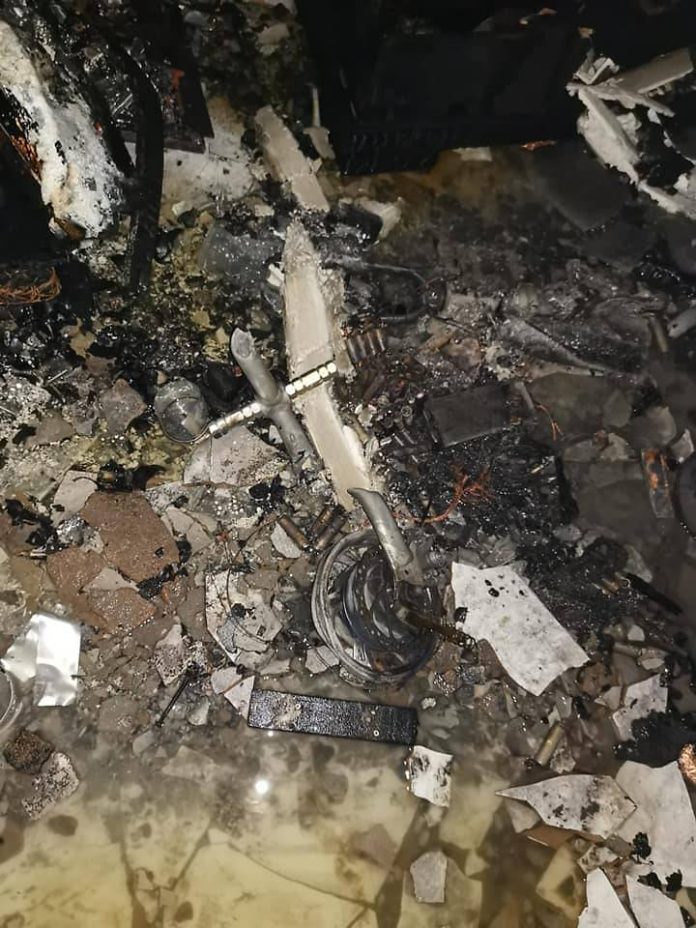
The charred remains of a PMD in a Tampines HDB flat fire. (Photo: Facebook/SCDF)

According to LTA, all PMDs used on public paths must be UL2272 certified from Jan 1, 2021, so if you are the owner of a non-UL2272 PMD, you might want to switch PMDs soon anyway.

More information on the UL2272 standard can be found on the LTA website.

CHECK FOR DAMAGE

According to the SCDF, there were a total of 74 fires involving PMDs and Power-Assisted Bicycles (PABs) in 2018. Most of these involved lithium-ion batteries and occurred during charging or shortly after.

READ: How your lithium-ion battery could be an explosive danger

Before you attempt to charge your PMD, it is advised to check the batteries for any damage or deformities such as bloated or corroded batteries or powdery residue. Such deformities indicate a damaged battery, which may lead to overheating and therefore fires.

WHEN CHARGING

Electrical devices build up heat when they are charged and PMDs are no exception. Too much heat increases the risk of damage to your device in addition to running the risk of fire. 

Therefore, you should ensure that your PMD can dissipate heat effectively while charging.

This can be done by:

  • Charging the PMD in a cool room or shaded area away from heat sources
  • Placing it on hard, open and flat surfaces
  • Not placing it near combustible materials
  • Not covering the PMD with fabric

In addition, it’s best not to charge the batteries immediately after riding the PMD. PMD batteries get hot when used and would need some time to cool down after use.

They should also not be placed near an exit in the way of your escape, in the case of a fire.

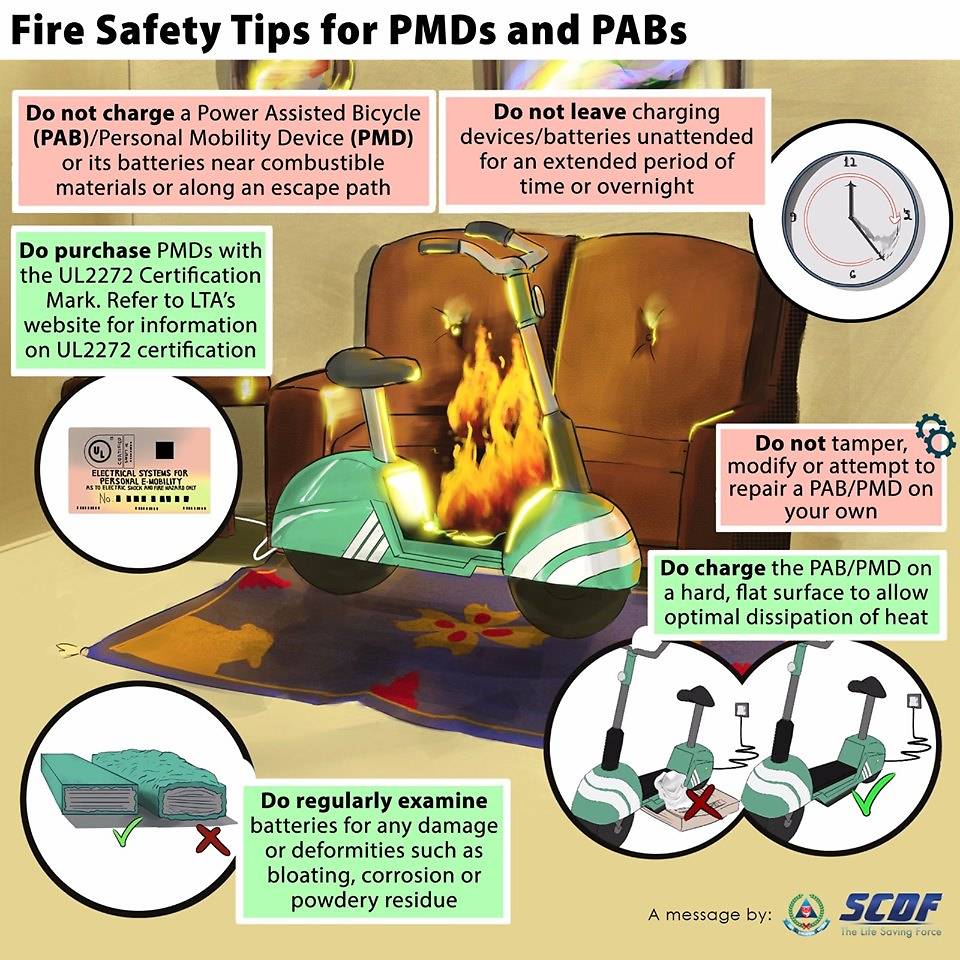
Fire safety tips on preventing PMD fires

Fire safety tips on preventing PMD fires. (Graphic: Facebook/SCDF)

AVOID OVERCHARGING

Some PMD fires started because the batteries were left charging overnight. According to SCDF, some models of batteries do not come with an automatic power cut-off function.

As such, you shouldn’t charge an already fully-charged battery or to leave it charging overnight. PMD users are also advised to follow the manufacturers’ instructions for charging their devices.

STORING BATTERIES PROPERLY

PMD batteries run the risk of catching fire when overheated. The PMD battery should be stored at room temperature away from combustible or flammable materials.

Are you storing your PMD in a kitchen? Exposure to heat sources should be minimised, so move it away from that stove or oven.

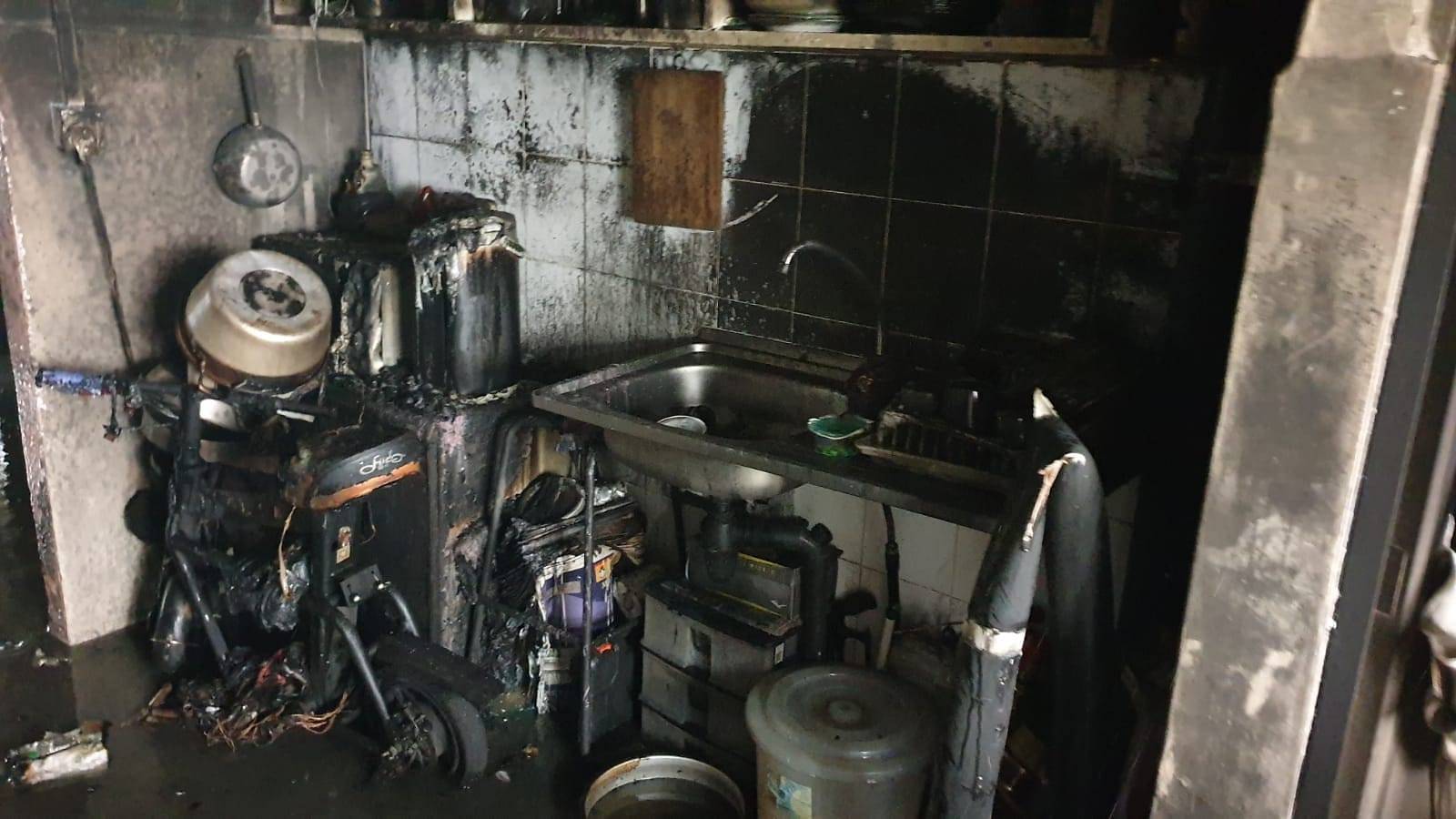
A personal mobility device (PMD) that was placed in the kitchen was the cause of the fire

A personal mobility device (PMD) that was placed in the kitchen was the cause of the fire in Ang Mo Kio on Jul 22, 2019, according to preliminary investigations. (Photo: Facebook/SCDF)

Also, SCDF advises users to tape up the charging terminals of batteries if they are not going to be used for a long time.

OTHER TIPS

Here are some other suggestions to minimise PMD fires:

When purchasing your PMD, make sure to do from reputable sources and brands. Cheaper, no-name brands may skimp on the quality of parts and therefore compromise safety. As mentioned above, make sure it is UL2272 certified.

When charging the PMD, use valid adaptors with current, voltage and wattage ratings compatible with the device.

Also, do not tamper with, modify or attempt to repair your PMD on your own. If damaged, it is better to send the PMD for repair by a qualified serviceman.

Source link