SINGAPORE: The number of babies born in Singapore fell to its lowest in eight years in 2018, according to data released by the Immigration and Checkpoints Authority (ICA).
A total of 39,039 babies were born last year, a 1.5 per cent drop from 2017, said the annual report published in June.
This was also the lowest number of births since 2010 when 37,967 births were recorded.
Within the eight-year period, the highest number of births was recorded in the year of the dragon, in 2012, with 42,663 births.
Singapore’s fertility rate last year is 1.14, according to Singapore’s Department of Statistics (SingStat), compared to 1.16 in 2017.
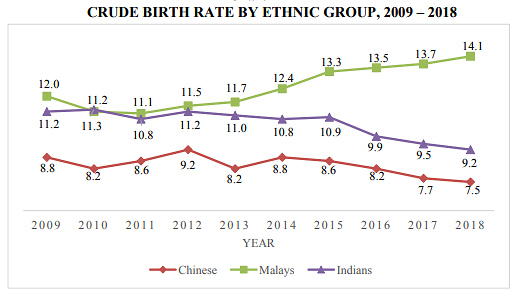
The report also showed that while the birth rate among Malays is on the rise, it was declining for other ethnic groups.
In 2018, Malays registered the highest birth rate of 14.1 per 1,000 residents, followed by Indians at 9.2, and Chinese at 7.5.
(Graph: ICA)
LOWEST NUMBER OF TEENAGE BIRTHS IN MORE THAN A DECADE
Last year’s statistics also showed that the number of babies born to teenagers aged 19 and below was the lowest in more than a decade.
A total of 289 babies were born last year to teenage mothers, which is a 6.8 per cent reduction from 2017.
In 2009, there were 678 babies born of teenage pregnancies.
There were also four babies born to teens under the age of 15 last year, showed the report.
Meanwhile, women aged 50 and above gave birth to six babies in 2018, and a further 84 babies were born to women between the age range of 45 and 49.
CANCER TOP CAUSE OF DEATH
A total of 21,282 deaths were registered last year, a 1.8 per cent increase from 2017.
ICA said that that the two most common causes of death in Singapore were “malignant neoplasm”, or cancerous tumours, and heart and hypertensive diseases.
Such conditions made up more than half of total deaths last year.
The report also showed that the median age at death has been gradually lengthening over the years.
Last year, the median age of death was 76.7, compared to 73.9 years old in 2009.
Unnatural causes such as accidents, suicides and other external causes made up 4.3 per cent of deaths.
SINGAPORE: A fire broke out in an Ang Mo Kio flat on Monday afternoon (Jul 22), causing about 60 people to be evacuated, said the Singapore Civil Defence Force (SCDF).
SCDF said it was alerted to the incident at Block 224 Ang Mo Kio Avenue 1 at about 3.05pm. The fire, which had erupted from a flat on the fourth floor of the Housing Board block, was raging when firefighters arrived.
“Upon SCDF’s arrival, the fire was raging and involved the contents of the entire unit. The fire was extinguished with one water jet,” SCDF said in a Facebook post.
Black smoke seen at Block 224 in Ang Mo Kio Ave 1. (Photo: Nuraidah Mustafa)
Ms Nuraidah Mustafa, a resident of the area, told CNA she could smell the scent of burning plastic from her flat despite living a few blocks away.
Two SCDF fire engines were at the scene to tackle the blaze, which was emitting plumes of black smoke, she added.
SCDF said it rescued four people, including three children, from the neighbouring unit while police and SCDF personnel evacuated about 60 people from the affected blocks.
Smoke rising from the unit. (Photo: Nuraidah Mustafa)
A fire engine truck infront of Block 224 at Ang Mo Kio Ave 1. (Photo: Nuraidah Mustafa)
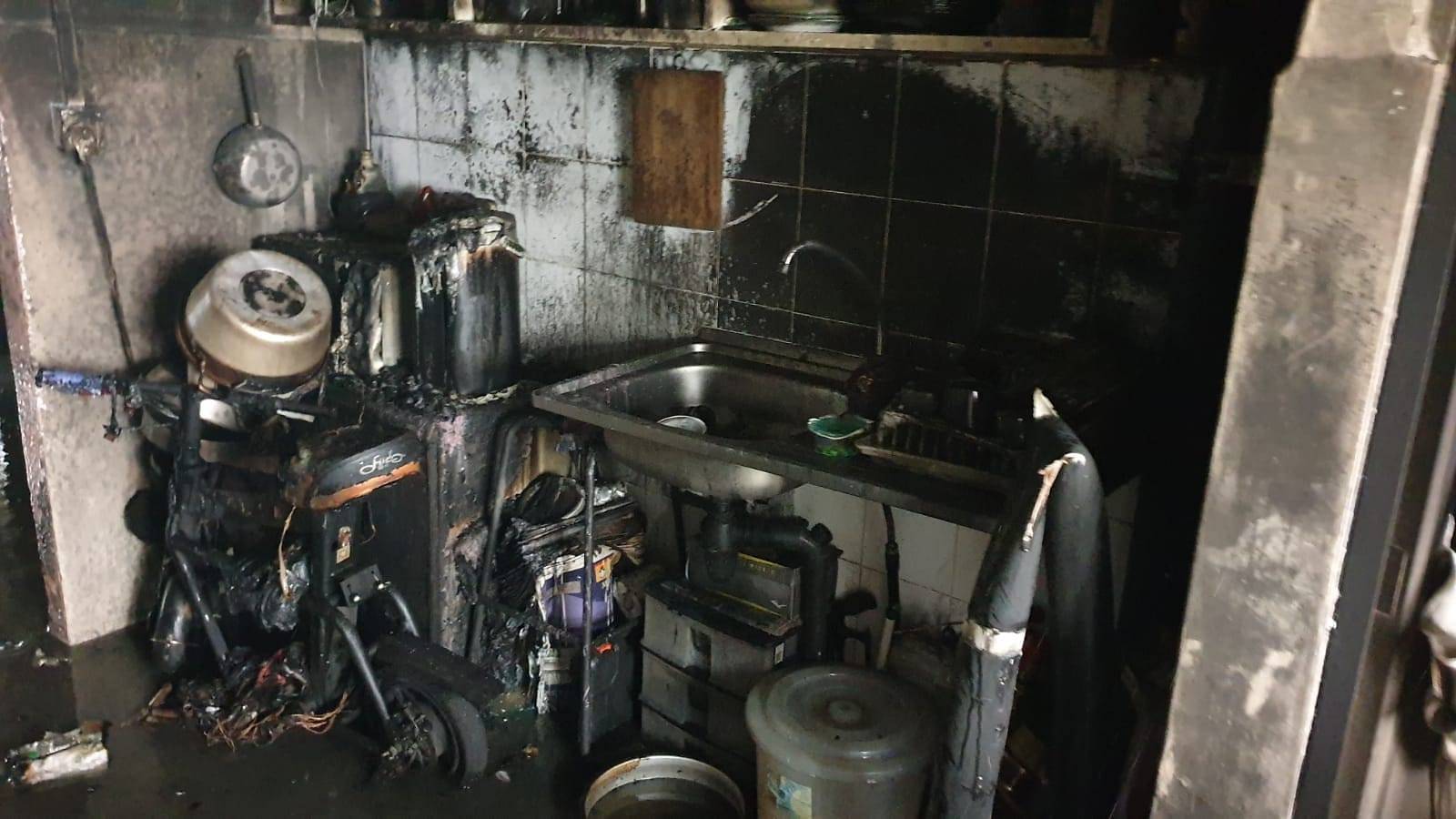
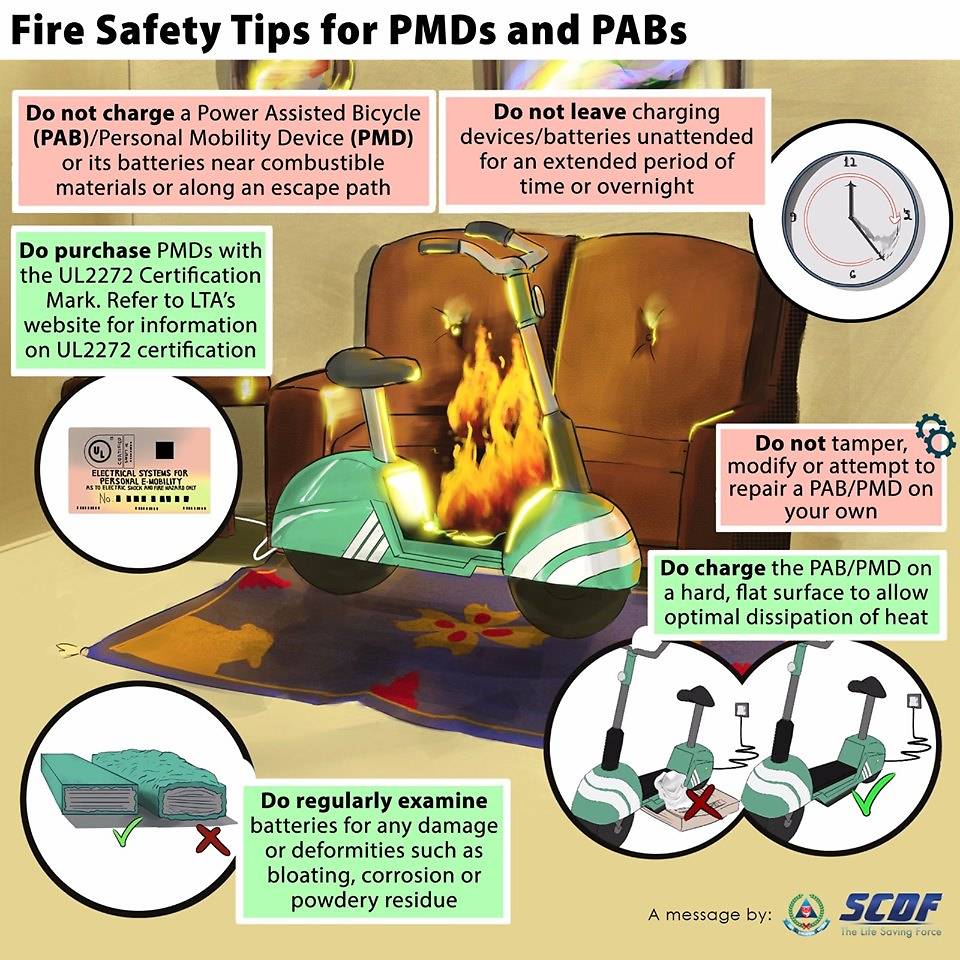
According to preliminary investigations, the cause of the fire was a personal mobility device (PMD) that was placed in the kitchen, SCDF said.
A personal mobility device (PMD) that was placed in the kitchen was the cause of the fire, according to preliminary investigations. (Photo: Facebook/SCDF)
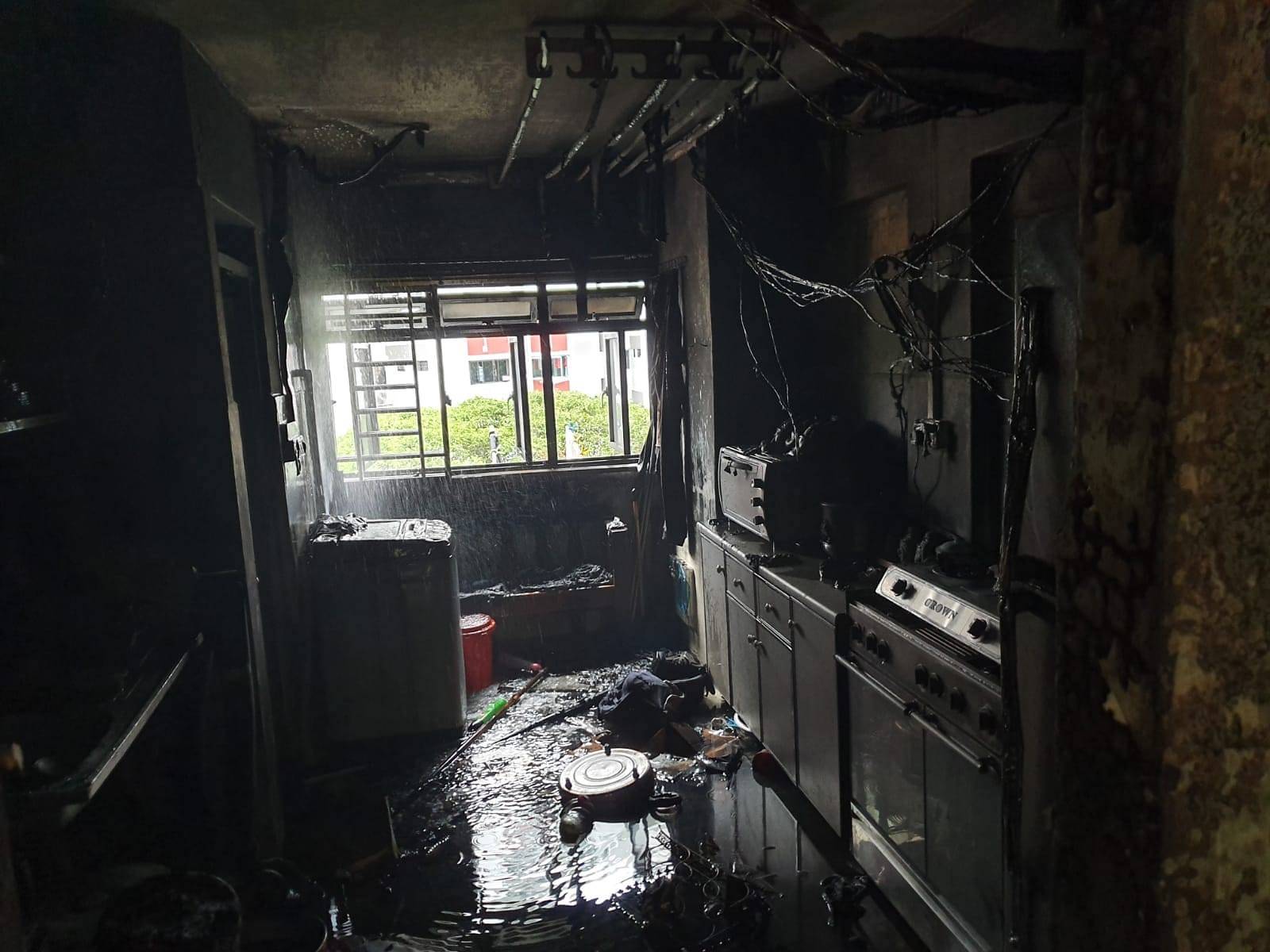
A burnt kitchen is seen after a fire erupted in Block 224 Ang Mo Kio Ave 1 on Jul 22, 2019. (Photo: Facebook/SCDF)
On Saturday, a man died in hospital two days after being rescued from a fire in Bukit Batok that started from PMDs.
Earlier this month a fire broke out in the living room in a Tampines flat after a PMD that was being charged caught fire.
SINGAPORE: There is a need for better coordination among agencies so that people who need help can access programmes for them more easily, said Minister in the Prime Minister’s Office Indranee Rajah on Monday (Jul 22).
This was “one of the biggest takeaways” from the outreach sessions held with social workers, social service agencies and student welfare officers, she added.
Ms Indranee, who is also Second Minister for Education, chairs an inter-agency task force called UPLIFT, which aims to strengthen support for under-performing students from disadvantaged families. Led by the Ministry of Education (MOE), the task force is part of the Government’s ongoing work to reduce inequality and boost social mobility.
“Many of them (agencies) have programmes that are already very good. So you don’t have to reinvent the programmes. But what we want to be able to do is connect the programmes with people who really need them,” Ms Indranee said in an interview with CNA938’s Arnold Gay and Yasmin Jonkers.
She added that those who gave feedback said that while there are community groups that want to lend a helping hand, in some cases, they were not sure how to “navigate it”.
Ms Indranee said the Government is already working on strengthening the partnership between schools and other community partners in helping disadvantaged students, through the setting up of the UPLIFT Programme Office at MOE.
“Some things might fall under Ministry of National Development (MND), for housing; some might fall under Ministry of Social and Family Development (MSF), which is financial assistance; some specialised subsections of MSF, for example, (look into) domestic violence etc. And then others may be in relation to MOE, for example, what’s happening in schools,” she said.
On MSF’s part, it has been bringing social services closer to the ground, and has improved coordination through its Social Service Offices (SSOs), Ms Indranee noted.
For instance, a resident who approaches the SSO for financial assistance, but also has housing issues, will get help in connecting with HDB so he does not have to visit multiple agencies, she said.
MOE and MSF already have their own frameworks for providing help, and more will be done to connect these efforts.
“So once we have connected the two, then hopefully it will have a seamless bridge at the ministry level. But you also need to connect at the ground level. So that’s the second piece we’ll be working on,” Ms Indranee said.
Families, on their part, must have a desire to be invested in their children’s future, she added, and have the willingness to take ownership of some of the issues they face.
PLUGGING GAPS
Social mobility and inequality were topics that Ms Indranee touched on last week at a conference held at the National University of Singapore.
During her interview with CNA938 on Monday, she said there are other gaps that need to be plugged.
One is a gap in information, she said, as some families do not know where to find the assistance they need. Another is a gap in assistance in areas like parenting.
Ms Indranee cited the Still Face experiment, which she explained shows that children respond to engagement and interaction with parents from a very young age. In the experiment, babies get more and more distressed when their mothers do not react to them.
Second Minister for Education Indranee Rajah speaks to CNA938’s Arnold Gay and Yasmin Jonkers. (Photo: Hanidah Amin)
“If the parent is not aware of this and consciously doing it, it has an impact on your child’s development. And something as simple as sharing this with young parents who may not have had children before and don’t have access to all the research will make a huge difference,” she said.
“UNINTENDED” STIGMATISATION
Ms Indranee was also asked about criticism on streaming, and whether changes to the streaming system will address issues such as stigmatisation, which have arisen from grouping students based on ability and their performance in the Primary School Leaving Examination.
By 2024, streaming in secondary schools will be replaced by subject-based banding, and following that, the O-Level and N-Level examinations will be combined into one common national examination.
Subject-based banding will do away with the Express, Normal (Academic) or Normal (Technical) streams, and use the General 1, General 2 and General 3 categories that are mapped from these streams instead.
Under the new system, students will be able to take subjects at different levels according to their abilities.
The thinking behind streaming was that different people learn at different paces, a concept that works, Ms Indranee said, pointing to a dropout rate of less than 1 per cent now, compared to nearly 45 per cent before streaming was introduced.
She acknowledged, however, that there have been unexpected consequences.
“What happened along the way, which was unintended, was that by categorising people into different groups, you had this thing about stigmatisation, and that could also lead to very self-limiting ideas that I am in this category, so I can’t go further,” she said.
Teaching according to ability, as most Singapore schools have done so far, is one way to bring out the potential of students, but that is counter-productive if it limits the student’s mindset, she added.
The change in the streaming method will aim to change this mindset.
“Hopefully, in this way, you can still retain the principle of teaching according to ability and pace, but at the same time, remove stigmatisation,” Ms Indranee said.
SINGAPORE: In Singapore, when most people picture vegetarian food, what comes to mind?
Probably, a stall in a hawker centre, staffed by middle-age hawkers who might have been doing this for a while but haven’t really focused on the nutritional value of the food.
Their education level and science knowledge might not be so high, and sometimes it’s hard to communicate what you want when many hawkers prefer to speak dialect rather than Mandarin or English.
And, what about their technology to provide these vegetarian meals, if you want to call it that?
A wok sitting over a fire, with a metal spatula, a knife and a cutting board.
(Photo: AFP/Roslan Rahman)
As to cleanliness, it might be fairly good, but how often do you see hawkers get an A from the National Environment Agency?
What about the dishes served at this vegetarian stall? The same tried and true recipes, featuring lots of SOS (Salt, Oil and Sugar), with whole-grain rice or noodles hard to find.
Not exactly what modern nutrition science would suggest as part of a healthy diet.
WHAT IS WRONG WITH VEGETARIAN FOOD
Is anything wrong with this image of vegetarian food? I’ve nothing against the age of the hawkers; I ride public transport with my senior discount.
I’ve nothing against dialects; linguists tell us that dialects are languages, it’s just that I don’t understand them.
I’ve also nothing against the hawkers’ implements; I use all of them at home. Plus, who doesn’t enjoy traditional dishes?
What’s wrong with this image is that it is inaccurate. Today, vegetarian food is taking on aspects of cutting-edge science.
For example, we can now enjoy high-tech plant-based meat substitutes from Beyond Meat (who make burgers and sausage), Omnipork (that do a plant-based “minced pork”), and Impossible Foods (who do burgers and minced beef).
Products from Beyond Meat Inc, the vegan burger maker, are shown for sale at a market in Encinitas, California, US, Jun 5, 2019. (Photo: REUTERS)
Locally, Shiok Meats is working on cell-based prawns, Life3 Biotech is perfecting a range of plant-based meat, and Sophie’s Kitchen, which already makes plant-based products similar to food from marine animals, recently won at S$1 million grant from Temasek Holdings for the development of algae-based food alternatives.
And, there’s so much more science-based vegetarian food afoot in the incubators, accelerators, pitch meetings and various funding rounds across Singapore and the world.
That’s not to mention Quorn’s foods, invented years ago, using a fungus found in a field in England and made into food using a patented fermentation process.
Quorn only arrived in Singapore a couple years ago, but it is already popular in supermarkets and a growing range of eateries including Soup Spoon, Rebel, 4 Fingers, and Ichiban Bento.
Why the sudden interest in Singapore and beyond in applying new science to the creation of goods that provide all the benefits of meat, eggs, and dairy, without the negative affects of animal-based foods? Well, that also has to do with science.
THE SCIENCE OF NUTRITION
First is the science of nutrition. More and more research supports the view that switching to plant-based and other alternative foods protects our health, especially when those foods are less processed, such as eating whole fruits, instead of sweets made from processed sweeteners.
Also, a growing body of research reports that animal fats, more than processed sugars, are our crucial opponent in the War on Diabetes.
Journalists taste test the plant-based hamburgers during a media tour of Impossible Foods labs and processing plant in Redwood City, California, US October 6, 2016. (Photo: REUTERS/Beck Diefenbach/File Photo)
Second, environmental scientists argue that moving away from meat is one of the best things we can do if we want to get serious about fighting the climate crisis.
Geography researchers predict the world’s human population will grow beyond 9 billion. As a result, new technology will be needed to produce food of the quantity and quality (read: taste) that all these people will want to eat.
Third, scientists who study the thoughts and emotions of the approximately 1 trillion animals (including marine animals) whom humans eat annually are finding more and more evidence that these fellow earthlings do engage in consciousness.
In 2012, a group of noted scientists came together to issue the Cambridge Declaration on Consciousness which states in part:
Convergent evidence indicates that non-human animals have the neuroanatomical, neurochemical and neurophysiological substrates of conscious states along with the capacity to exhibit intentional behaviours.
Consequently, the weight of evidence indicates that humans are not unique in possessing the neurological substrates that generate consciousness.
In conclusion, when we think of vegetarian food, instead of picturing it as unscientific and anti-modern, we should see moving away from meat as the modern, science-based prescription required to protect human health, to address the climate crisis and to show the deserved respect to our fellow animals.
Dr George Jacobs is president at Centre for a Responsible Future. A version of this commentary first appeared on Alliance for a Responsible Future blog. Read it here.
SINGAPORE: As Singapore’s outlook darkens with growth cooling to levels last seen a decade ago, there could be more retrenchments and fewer job vacancies ahead, said economists.
The job losses will likely come from outward-oriented sectors, which have been hit by a protracted trade spat between the United States and China.
Already for the first quarter, data from the Ministry of Manpower (MOM) showed an increase in retrenchments – from 2,510 in the previous quarter to 3,230 – on the back of a near three-fold jump in job losses in the manufacturing sector.
The economy grew 1.1 per cent year-on-year during the first quarter but amid falling factory activity and exports, growth in the second quarter slowed sharply to a decade-low 0.1 per cent on a year-on-year basis based on recent flash estimates.
DBS senior economist Irvin Seah said it is “pretty clear that the outlook for the labour market isn’t going to be great” given the “drastic” growth slowdown. “You can only expect retrenchments to pick up and job vacancies to decline in the coming quarters.”
Manufacturing will continue to shed jobs in the coming quarters, with the unpredictable trade spat coinciding with a fading global electronics cycle, experts said.
“The downturn in the electronics cluster has resulted in cutbacks in electronics sector jobs, which is expected to continue during the second half of 2019,” said Mr Rajiv Biswas, chief economist for Asia Pacific at data firm IHS Markit.
The manufacturing sector, which accounts for one-fifth of the economy, is also seeing old jobs being made obsolete by automation, added Mr Seah.
Beyond manufacturing, economists are also keeping a cautious eye on the outward-oriented services sectors.
While electronics accounted for 18 per cent of the retrenchments in the first quarter, services industries such as wholesale trade and transportation and storage followed close behind with 16 and 10 per cent, respectively, MOM’s labour report showed.
While domestic services segments can offer support, they make up relatively smaller shares of growth and “may not be enough to offset the receding tide”, said Mr Seah, referring to the sector’s 1.5 per cent quarter-on-quarter dip in the second quarter on a seasonally adjusted basis.
Further weakness in services is “the bigger worry”, added the economist, given how the sector accounts for about two-thirds of the economy and employment, although the tightening of foreign manpower quotas from January 2020 may mitigate the fallout on this front.
Meanwhile, “undercurrents” like the recent job cuts at German banking giant Deutsche Bank will add to the retrenchment figure in the third quarter, said CIMB private banking economist Song Seng Wun.
Still, even as prospects are set to sour in certain sectors and translate into higher layoffs, some economists were quick to add that job opportunities remain.
Mr Song pointed to sectors that have remained resilient thus far, such as modern services on the back of a Government-led push in digitalisation.
“We now have a strange landscape where headline growth numbers look quite discouraging but underneath, there are pockets of strength,” he said.
“This will be reflected in terms of how retrenchments will continue to edge up, reflecting the moderation in external demand, yet growth in certain pockets will continue to create jobs.”
Likewise, Mr Biswas said the structure of employment growth by sectors will remain “very uneven”, with positive growth in “new economy jobs”.
These include infocomm technology, buoyed by a digital revolution and industrial automation, as well as enhanced cybersecurity needs. Financial services is also benefiting from Singapore’s role as a leading hub for segments such as asset management, financial technology and insurance.
Manpower Minister Josephine Teo, in a Facebook post after the release of dismal second-quarter flash estimates on Jul 12, noted that there are still 60,000 unfilled vacancies despite the growth slowdown.
About half of them are for professionals, managers, executives and technicians (PMETs) in sectors like financial services and professional services.
When asked for a further breakdown, MOM said nearly 70 per cent of the PMET vacancies come from financial services (4,400), public administration and education (4,900), professional services (3,400), infocomm technology (3,300), wholesale trade (2,400), and health and social services (2,400). The other PMET roles are “distributed across many other sub-industries”, the spokesperson said.
The remaining 30,000 unfilled jobs are for non-PMETs, which are “more or less equally distributed between clerical, sales and service workers and production and related workers”.
Food and beverage services (3,100), construction (2,400), transportation and storage (2,300), retail trade (2,000), security and investigation (1,500), accommodation (1,400), health and social services (1,200), and cleaning and landscaping (1,100) made up the bulk of these positions.
About one in three vacancies are unfilled for at least six months, with non-PMET jobs generally harder to fill, according to MOM.
Office workers at Raffles Place in Singapore. (File photo: Marcus Mark Ramos)
JOBS NOT FOR EVERYONE?
Two recruitment firms – Hays and Robert Walters – that CNA approached said they have not seen a rise in jobseekers, though the former said “retrenchment has become an increasingly common reason” among its applicants.
They also have not noticed any hiring sentiment change among businesses as yet.
Demand for tech talent, in particular, has been strong across all industries and will remain so as demand outweighs supply, said Robert Walters Singapore’s managing director Rob Bryson.
However, there may be some who will have a harder time looking for jobs.
“Generally, we observe that older employees among PMETs will find it more difficult to find a job because of technological disruption and a slowing economy,” said Mr Bryson.
PMETs accounted for nearly 70 per cent of the retrenched residents in the first quarter. They continue to make up the majority of layoffs as they form a higher share of the local workforce, said MOM.
The same labour report also showed PMETs and degree holders continuing to observe below-average re-entry rates into employment, although their rates have trended up from the first quarter of 2018.
As the jobs market outlook softens in the months ahead, PMETs will likely continue to bear the brunt, economists said.
One issue is the job-skill mismatch.
Referring to the “new economy jobs” in infocomm technology and others, Mr Biswas said: “The jobs being created in these sectors are skilled and specialised, resulting in a skills mismatch for workers leaving other sectors.”
Mr Seah, who has written reports on PMETs becoming an “exceptionally vulnerable” segment in the labour market here, added that PMETs typically develop deep skillsets required for their roles. This makes it difficult for them to transit into other industries.
Those with higher financial obligations, especially middle-aged PMETs, will also find it hard to accept lower-paying jobs, he added.
In her Facebook post, the Manpower Minister had said there is no shortage of programmes to support willing workers in their transition.
She cited the more than 100 Professional Conversion Programmes in over 30 sectors, as well as Career Trial programmes that aim to help jobseekers gain experience through short-term work trials.
Mr Seah thinks there is a need for a more pre-emptive approach as the economy hits the brakes.
There can be further enhancements to existing schemes that help workers pick up relevant skills, or a review of existing guidelines concerning skilled foreign workers.
To mitigate the risk of further retrenchments, the Government could also kickstart broad-based industry consultations.
“This is just to gather feedback and be ready in case we do dip into a recession. It doesn’t mean that it must translate into immediate policies but we must step up the effort,” said Mr Seah.
On the part of workers, being up to date with new knowledge and competencies will be necessary.
“That being said, it is dangerous to carry the mindset that a three-day course in data analytics would suffice in making them a relevant candidate,” said Mr Grant Torrens, regional director at Hays Singapore.
“To make their case even stronger, job seekers need to showcase to hiring managers that they are doing everything they can to get into their field of interest.”
SINGAPORE: The big news two weeks ago was that Singapore’s economic growth had slowed to 0.1 per cent in the second quarter of this year – the slowest seen in a decade.
The main drag was manufacturing, with the electronics and precision engineering sectors especially affected.
I myself was surprised by how weak the growth data was, which was way below what even the most bearish economist was predicting.
For non-economists, let’s cut through the statistics being hurled to and fro.
Here is my take for ordinary folks out there:
QUESTION: AS AN AVERAGE SINGAPOREAN, SHOULD I BE WORRIED?
I’m with the Ministers who’ve taken to Facebook on this one. The decade-low growth has triggered some concerns that a recession is headed our way, and the possibility is indeed real. But don’t panic – yet.
There may be a potential technical recession, which is a sequential slowdown that stretches into the third quarter.
What it might possibly lead to in a worst-case scenario is a full-blown, year-long decline where annual growth contracts drastically as compared to 2018. But I don’t think we are quite there yet, although everyone does expect a softening this quarter.
Here’s what you should be worried about: Globally, all the key engines of economic growth are showing signs of misfiring.
Worryingly, China, Japan and South Korea – an important window into indications for the world’s trade outlook – have all reported year-on-year falls in exports.
This could be a reaction to the US-China trade spat. While the two parties have restarted talks, this may continue to drag on.
The US-China trade war has spooked markets worldwide and raised concerns about the global economy. (Photo: AFP/JOE RAEDLE)
Domestically, growth momentum in the construction and the services sector have also sharply moderated compared to a quarter ago. The latter suggests that both businesses and consumers are turning more cautious.
The extent of this sobering news means that Singapore, being a small and open economy, is definitely being affected by what goes on externally. The ongoing US-China trade war and China’s growth moderation, for instance, have dented Singapore’s growth prospects.
Here are the silver linings: Globally, interest rates are softening in line with the global growth slowdown, and domestic interest rates are likely to follow. This could mean less pressure for companies and individual borrowers to service their loans.
Also, given the deteriorating growth outlook and softening inflationary prospects, the Monetary Authority of Singapore (MAS) may contemplate adjusting its current monetary policy stance at its October meeting.
One possible option is that it may flatten the slope or the pace at which the trade-weighted Singapore dollar can appreciate. If the Singapore dollar is softer on a trade-weighted basis, then our exports will be priced relatively more competitively, but our imports will also cost more.
In addition, there is ample fiscal firepower to plan for a more expansionary Singapore Budget in 2020, which would help stimulate the Singapore economy.
QUESTION: AS A CONSUMER, SHOULD I TIGHTEN MY BELT?
Not yet. If you’re gainfully employed, don’t feel compelled to immediately cut back on spending on your daily necessities.
People cross a traffic junction in the Orchard Road shopping district in Singapore on May 27, 2017. (File photo: AFP/Roslan Rahman)
Where you’d like to be more cautious is on luxuries, given that we don’t know just how the third and fourth quarter growth will pan out yet.
And let’s not forget that our second quarter figures are also based on estimates premised on how things have been in the first two months of the quarter. The final verdict for that quarter could still be adjusted when the June economic data is released.
Now, there’s a double-edged sword when it comes to the question about spending. Realistically, if everyone cuts down at the same time, it could push us into a recession for real.
My advice is to be careful and to keep an eye out for what’s happening. Quiz yourself on how to recession-proof your job.
The question you must ask is how you can add value to the company you work for and remain on firm ground, which brings me to my next point.
QUESTION: AS A WORKING ADULT, SHOULD I FEAR FOR MY JOB?
My answer is two-fold. One, look at how employers typically react; two, it depends on what industry you’re in – up to a point.
First, your boss is not likely to say “wow, the GDP growth is so bad, so let’s start firing people now”. Typically, employers take a longer-term view than that.
Given the headwinds, companies – especially small and medium-sized enterprises – might be cautious and put the brakes on any new hiring or investment plans. Job-seekers should be prepared for that.
But if you already have a job and are a productive worker, your boss will know that, when things improve, looking for good talent is difficult in a still-tight labour market. That would hamper their growth and profit plans for when growth ramps up.
Ultimately, it may be “harder to rehire than fire” in a knowledge-based economy.
That said, you might want to take stock if you are in manufacturing or any other industries facing challenges – particularly those that are part of the value chain of companies that are increasingly automating production so that fewer workers are needed.
I’ve said in the past that folks in this sector must look at upgrading their skills, and even consider reskilling.
SINGAPORE: Singaporeans are hard workers. In fact, they are one of the hardest workers in the world, clocking in 44.8 hours a week on average last year.
But long hours don’t always equate to high productivity.
There’s a danger that these long hours are the result of presenteeism, a well-documented workplace culture among employees who choose to work long hours or work while unwell.
More often than not, presenteeism is the result of perceived benefits that these actions at work will be highly regarded by employers as a show of dedication and commitment.
Presenteeism is still prevalent in Singapore. A quarter of Singaporeans almost never leave work on time just to “show face” or boost their reputation and curry favour with their bosses, according to a recent YouGov survey.
(Photo: Unsplash/Annie Spratt)
What’s more, six in 10 show up at work even when they are ill.
The pressures of work are unquestionably taking a toll on employees’ well-being. While almost two-thirds of the Singapore workforce have high levels of stress, a mere 27 per cent of companies are addressing the issue, according to research by Willis Towers Watson.
And it’s affecting more than just talent retention.
Research by Virgin Pulse revealed that presenteeism can lead to 57.5 days per year in lost productivity. That’s just shy of three months, and is a staggering number compared to the four days lost on average to absenteeism. This disturbing problem can also wind up costing companies billions.
Employees who come into work despite feeling unwell are not just threats to the health of other employees around them, but are also working with diminished productivity that affects the company’s bottom line.
USING TECHNOLOGY TO IMPROVE WORKPLACE EXPERIENCES
Often, it is how a workplace works – or doesn’t – that causes frustration and a loss of productivity.
Organisations can use technology to promote healthy work-life balance, as well as boost productivity and ultimately yield long-term business gains.
The rise of technologies such as connected devices, Artificial Intelligence (AI) and cloud infrastructure mean that businesses have many ways to modernise routine work processes and help employees work more efficiently and unlock greater productivity.
For instance, DBS Bank last year launched a virtual bank recruiter powered by AI to help its recruiters hire more efficiently. The custom-built application saves the recruiters some 40 man-hours a month and enables them to dedicate more time to higher value work including interviewing applicants.
Additionally, technology can go a long way in reducing the administrative burdens workers face.
In Singapore, a study revealed that workers spend only 60 per cent of their time (versus a global average of 72 per cent) on primary tasks, and approximately 380 hours yearly or 47.5 work days completing administrative or repetitive tasks.
By leveraging intelligent technology such as AI and robotics to handle the majority of task-oriented, repetitive work, employees can focus on the more creative, value-added aspects of their jobs – and also get work done faster in less time.
FLEXIBLE WORKPLACE MAKES BETTER WORK-LIFE BALANCE
Another way to address the culture of presenteeism in the workplace is to introduce flexible work arrangements.
Thanks to technology, workers don’t always have to be in the office. More companies in Singapore are also offering employees the ability to work from home or opt for staggered start hours or part-time work.
Technology functions as a key enabler to support these flexible working practices and transform offices into connected hubs.
Web conferencing, communications apps and mobile digital workflow solutions are on-hand to facilitate efficient work processes, wherever the employee may be working from.
Companies who haven’t started embracing flexible arrangements should get cracking. Not only will this empower workers to better manage their time and attain better work-life balance, it also reflects how much employers care about their employees’ needs.
CULTIVATE A POSITIVE COMPANY CULTURE
While the culture of presenteeism might be ingrained in Singapore workplaces, we’re not far off from making a change.
Organisations can start by crafting a vision of how the workplace should function, and then identify moments that matter most to employees and make them great.
These moments include investment in the right technologies that enables organisations to place focus on their employees, allowing them to collaborate and get what they need more quickly and easily, so that they have time for more creative, innovative and meaningful work.
Additionally, offering flexible work arrangements can foster a positive company culture where employees are entrusted to make smart choices that enable them to attain balance in their lives while still being productive.
Communication is key too. It is important to nurture a safe and open workplace where dialogues are open, frequent and transparent.
Employers can organise regular catch-ups with their employees, and check in on anyone who seems demotivated or overworked.
To improve general well-being of employees, companies should offer staff support when needed and ensure that they are engaged in work that they feel is meaningful.
Ultimately, the future of work needs to be built around people – where organisations and technologies adapt to meet human needs.
Mitch Young is Senior Vice President for Asia Pacific and Japan at ServiceNow.
SINGAPORE: In the United States, drones fitted with thermal imaging cameras can be deployed to help firefighters search for survivors in a burning building.
Over in Rwanda, American firm Zipline has, since 2016, been using drones to deliver medicine to inaccessible places at a relatively low cost.
Here in Singapore, drones are being used for various purposes – ranging from documenting the country’s heritage and history and mapping out golf courses, to scouring rollercoasters in the dark for abnormalities. Other potential uses include parcel delivery, as well as inspections of buildings, trees, ships and sewage tunnels, for example.
Lately, drones have also gained infamy for causing air traffic disruption. In Britain last December, a drone sighted at London’s Gatwick Airport caused a three-day disruption to the country’s second-busiest airport.
Singapore’s Changi Airport has not been spared either, with two separate incidents of drone incursions occurring within a week recently.
On Jun 24, about 15 departures and three arrivals were delayed, while seven other flights were diverted, owing to bad weather and unauthorised drone activity. Investigations are ongoing.
The flying of drones without a permit is banned in Singapore if they are flown within 5km of airports or military airbases, or at altitudes above 61m.
Offenders could face a fine of up to S$20,000 or a jail term of up to 12 months, or both.
In May, the Civil Aviation Authority of Singapore’s (CAAS) set up an Unmanned Aircraft Systems Advisory Panel (UASAP) to review the regulatory framework for Unmanned Aircraft Systems (UAS). The panel is expected to provide its recommendations by early next year.
Nevertheless, following the Changi Airport intrusions, the Government announced during a parliamentary session on Jul 8 that it would introduce a mandatory registration regime for all drones in the Republic.
Larger, more capable drones will have to be licensed while stiffer penalties for errant drone users are also being considered.
Despite the threats that these devices could potentially pose, experts interviewed were quick to stress that an outright ban on drones is neither feasible nor ideal.
“The bad guys, they don’t care about bans. If they want to do something bad, they can easily do it,” said Dr James Wang, a professor with the Nanyang Technological University’s School of Mechanical & Aerospace Engineering.
Dr Daniel He, president of the Multirotor Association of Singapore, said that attempting to ban any technology the moment it runs into difficulties is a “sure way for Singapore to fall behind and kill off any innovation and progress that we hope to achieve”.
Drones may not always be delivering gifts AFP/AMOS GUMULIRA
The medical doctor, who sits on UASAP, added: “Drones are a fascinating amalgam of engineering, electronics, and programming, all the skills that we desperately want the next generation of Singaporeans to acquire.”
Agreeing, fellow UASAP member, Associate Professor Foong Shaohui, said he foresees that the use of drones for industrial and commercial applications “will steady gain traction in the near future”.
This creates a potential source of new jobs, said Dr Foong, who is from the Engineering Product Development pillar at the Singapore University of Technology and Design (SUTD).
RECENT ADVANCEMENTS
The concept of using unmanned aerial vehicles (UAVs) to drop a payload over a location is not new in itself. The US’ Central Intelligence Agency (CIA) had been using armed drones as part of its war against the Taliban in Afghanistan since 2001.
Drones had predominantly been considered a military asset up until 2010, when the first ready-to-fly drone hit the shelves with the release of the AR Drone by French company Parrot.
While bulky, and with a limited flight time of around 12 minutes per battery, they were still a hit with consumers.
Unlike remote-controlled model helicopters, which have been around since the 1970s and require months to learn how to fly them decently, operating a drone is simple.
“Almost anyone can buy a quadcopter drone and within five minutes, you’ll be able to fly it. No problem. Even your grandmother could fly it,” said Dr Wang, who is also the director of the eVTOL (electric vertical takeoff and landing) Research and Innovation Centre.
He added that the last five years had also seen improvements in electronics and a reduction in the cost of drone components.
All of these factors have come together to make the drone accessible to the masses, and this consumer focus has led, in turn, to rapid advancements in drone technology.
Not only have the drones gotten small enough to fit in the palm of one’s hands, they can also be modified to suit certain tasks.
Said Dr Foong:
We have flown specialised drones at many of Singapore’s historical landmarks, such as Sri Mariamman Temple, Shuang Lin Monastery and Bukit Timah Railway Station, to create highly detailed and annotated three-dimensional models which can be digitally reproduced so that they can be preserved for future generations of Singaporeans.
Dr Foong is also the principal investigator for a government-funded research project to design and develop a UAV to perform autonomous inspection of the deep tunnel sewerage system.
SUTD has also designed a prototype drone for the National Parks Board (NParks) specifically for inspecting trees.
The Tree Inspection Microdrone assists in aerial tree inspection, which traditionally requires a trained arborist to ascend the tree using ropes or using a mobile elevated work platform.
NParks says that apart from drastically reducing the amount of time required to inspect a tree – from a full day to half an hour – it is also able to gather “valuable images and videos” from perspectives which would have not been possible without a trained arborist physically climbing the tree.
SINGAPORE’S TIGHT AIRSPACE
Being a small country, airspace in Singapore is limited to begin with.
Nevertheless, as the authorities consider tightening the rules further, some drone operators and experts said that the existing framework is already making it tough for operators to pilot their UAVs without unintentionally running afoul of the laws.
If one were to just look at the CAAS’ map of areas that are off-limits to drone operators, it would look like there is still a decent-sized space in the central part of Singapore to fly the drones.
That is not the case, however, said drone hobbyist Farhan Tahir, who is also the administrator of the Facebook hobby group, Universal Drones – Singapore (UDS).
“There’s another layer (that operators need to be aware of) that comes from NParks,” said Mr Tahir.
Aside from the nature reserves, the production house owner said that a lot of recreational parks under the statutory board carry “no-drone” signs.
A file photo of a drone in Singapore. (Photo: AFP/Roslan Rahman)
Responding to queries, NPark’s group director of corporate strategy and planning, Ms Sophianne Araib, said that the flying of drones and use of remote-control flying devices are allowed in most parks in Singapore except for those areas which are designated as No Flying zones by signs.
These areas, she said, include the nature reserves, nature parks and the Singapore Botanic Gardens as they are rich in biodiversity.
The use of drones could negatively impact biodiversity such as birds, as bird strikes could happen. Some of these areas are also rich in historical significance and contain conservation structures that need to be protected.
Other locations, said Mr Tahir, belong to private property owners who are free to stop operators from flying drones over their property.
Sentosa is one such location which requires operators to apply for an activity permit if they wish to fly there.
“This really gives us less spaces where we can fly,” he said.
While the space outdoors is limited, indoor facilities, such as the sports halls at SUTD, may provide a safe space for beginner drone operators and researchers to pilot their UAVs, but they are far from ideal.
Dr Foong said it would be similar to someone learning how to drive within a circuit. But just like a circuit, it will not expose the operator to real flying conditions.
“You can’t fly fast, and you can’t fly high. It is just hard to find a big enough space in land-scarce Singapore.”
For Malaysian photojournalist David Loh, nothing would make him happier than being able to photograph Singapore in a light that few had seen before.
After all, the 51-year-old had called the city home for more than 20 years before he returned to his hometown of Penang in 2017, where he embarked on a mission to promote the north-western Malaysian state through drone photography.
Mr Loh’s work has culminated in an exhibition titled Over Penang + Beyond, and his photographs are currently on display at the Fullerton Hotel Singapore till the end of July.
He credits the drone for allowing him to capture the state’s stunning and evocative images.
People were shocked when they saw the photos and never knew these places existed. Even the chief minister (of Penang) was awestruck and didn’t realise how beautiful the island is.
Mr Loh lamented that Singapore’s strict rules on drone use have made it unconducive for him to attempt something similar here.
“In Singapore, there are too many restrictions. I cannot be applying two weeks in advance to tell (the CAAS) I want to pay to shoot in this particular location. If it rains, then I have to apply and pay again,” said the former editor-in-charge of the Reuters news agency’s photo desk.
ENHANCING USER ACCOUNTABILITY
With these tiny aircraft changing the aviation landscape, existing laws related to drones are being revised or new ones introduced in many countries, including Singapore.
Dr Paw Yew Chai, an associate professor from the Engineering Cluster at the Singapore Institute of Technology (SIT), said that the European Union Aviation Safety Agency (EASA) and the Federal Aviation Administration (FAA) are putting in more drone laws in Europe and the US respectively.
“How effective and comprehensive these laws are is still not obvious,” said Dr Paw, whose research interests includes various aspects of UAV engineering and testing.
In June this year, the EASA published a set of common rules for the use of drones across the European borders without operators having to worry about differences in regulations.
Starting from June 2020, the common rules will replace national regulations that may have already been implemented by individual European Union countries.
The main rules include requiring operators to register themselves before they start flying their drones.
In the US, the FAA also mandates that all operators register any drones that weigh between 249g and 25kg.
Dr Paw said the registration of drones can help operators become more responsible. It might mean that only certain approved drones with safety features such as geo-fencing can be registered, he added.
“This helps to control the type of drone that can be flown in Singapore, and with the geo-fencing feature, it will prevent the drone from flying into the restricted areas.”
Registration provides tracking and identification of the drone and drone users, he reiterated. “This creates user accountability and facilitates law enforcement efforts,” he said.
Agreeing, Dr Wang added: “You just have to put your registration number on the drone and if it crashes, or flies somewhere it shouldn’t be and gets tracked down, at least we know who the owner is.”
This photo taken on Sep 9, 2018 shows staff members of Singapore technology firm H3 Dynamics preparing to fly a drone to inspect a building facade in Singapore. (Photo: AFP / ROSLAN RAHMAN)
Dr Wang acknowledged that this would not prevent bad hats from committing malicious acts.
This is where anti-drone technologies can come in, said Dr He.
However, as the technologies are relatively new, experts had previously said that it is far easier to cause disruptions than to prevent them.
Dr He believes that it will take time for organisations like the air force and airports to learn how to operate an “integrated and multi-layered solution” to tackle drone incursions into restricted airspace.
“I think that when fully operational, these (regulations) will be adequate to control most drones, with the exception of (cases involving) sophisticated state actors with multiple drone swarms. However, if we do encounter such an attack, I think we have a lot of bigger problems to worry about than drone regulations.”
A MULTI-PRONG APPROACH NEEDED
While Mr Tahir agrees that there should be some form of regulations to ensure the skies are safe, he cautions against making them too onerous.
While Mr Tahir agrees that there should be some form of regulations to ensure the skies are safe, he cautions against making them too onerous.
“This will just turn away new hobbyists, or even the current ones. These people might have the potential to (produce) the next (big) thing in drone (technology) … by helping to develop digital technologies even further.”
Hobby shop owner Ronald Yong added that if drone operations are going to become part of future careers, it does not make sense to overly limit them.
The general manager of Singapore Hobby Supplies, which he describes as a one-stop shop for drone enthusiasts, said the public at large needs to focus less on the negative aspects of drone technology.
“People should be informed of the good uses of drones as well. They can have applications that will one day make a difference in your life,” said the 44-year-old.
Dr Foong said that at SUTD, drones are used to facilitate the teaching of design innovation, physics concepts and rapid prototyping.
SUTD regularly holds design workshops where students get to design, build and fly a drone from scratch during a three-day course.
“It allows these students to understand how physics theories learnt in the classroom can be used to design and operate drones. They will also learn about rapid prototyping, programming and basic flight theory,” said Dr Foong.
Dr He felt that the dilemma of drone use should be addressed with a hard-nosed approach, driven by data in analysing the risks and benefits.
“I would venture that the greater challenge is how to encourage and nurture drone use while making it as safe as possible,” he said.
I think that first and foremost, we need to have a system of education to teach people what is safe behaviour.
On his part, Mr Yong has been ensuring that customers who buy drones from him are adequately aware of Singapore’s laws by sticking informative labels on his boxes and telling them where they can or cannot fly their aircraft.
However, more can be done. Dr Foong said more prominent signage could be installed around the island to ensure that inexperienced operators are well aware of where their drones cannot fly.
A website that clearly shows where all the no-fly areas are, according to different agencies, would also be useful, he said.
Dr He also suggested having a tiered registration and licensing scheme that is proportionate to the size and capabilities of the class of drones that people want to operate.
On the one hand, you would not let anyone drive a lorry with no licence plate and no driving licence. On the other hand, you wouldn’t demand that a child register and take a licence for a remote control car. I think a similar approach should be applied to drone regulations.
Dr He added that there should be regular and effective enforcement, as well as penalties for errant behavior.
Just as certain neighbourhoods have skate parks, Dr Wang believes that the authorities could also open up more air space by designating certain areas as drone parks.
These places, which could be near the homes of the operators, provide a safe zone for them to fly their drones without any worries of breaking the law.
Ultimately, the solution would have to be multi-pronged — encompassing a strong educational and regulatory framework, said Dr He.
He added: “(We need) to create safe spaces of sufficient size for people to practise and experiment; engage young people and create interest through drone programmes and sports.”
SINGAPORE: Black pepper or Chilli crab, Pepsi or Coca-cola, Lionel Messi or Cristiano Ronaldo – these are perennial debates that will always rage on.
lt is a matter of taste for most and Juventus’ brawny superstar seems to have edged out Barcelona’s little magician as the flavour of the day in Singapore, at least.
The diminutive Messi has yet to grace the pitch here, spending nothing more than a few hours in Singapore during a 2017 visit, to the disappointment of his fans.
Ronaldo on the other hand, has seen more than his fair share of the island – take his recent visit to Yumin Primary School where he was greeted by more cellphones than at Sim Lim Square and a glorious reception fit for a king.
Cristiano Ronaldo goes for a header. (Photo: Jeremy Long)
And it wasn’t any surprise that the five-time Ballon D’Or winner was the main draw prior to the friendly match between Juventus and Tottenham Hostpur in the International Champions Cup clash on Sunday (Jul 21).
From the Grab driver who asked if this reporter was headed for the “Ronaldo game” to the scores of fans who faithfully donned their CR7 replica kits – home, away, third – there seemed only one name on the lips of many.
But it was a jaw-dropping Harry Kane winner from close to the halfway line that saw Spurs beat Juventus 3-2, despite the best efforts of Ronaldo.
Unlike the previous day’s Manchester United Inter Milan clash where there was an almost partisan crowd behind one side, there was more than a sliver of Spurs fans in the stands.
They made their voices clear from the warm-up as South Korean Son Heung-Min in particular drew the oohs and aahs.
But the loudest roar was undoubtedly for Portuguese superstar Ronaldo.
The hard-running Son caused a number of problems early on for Juventus, as Spurs put pressure on the Italian giants’ backline and in particular, goalkeeper Gianluigi Buffon.
At the other end, Son’s opposite number was not to be outmatched – attempting tricks, flicks and a bicycle kick of his own. Ronaldo’s best chance came in the 11th minute, but his shot was charged down by a host of Spurs defenders.
While Mauricio Pochettino fielded a largely second string line-up – Harry Kane, Christian Eriksen and Lucas Moura all left on the bench – his side’s Harry Winks and Oliver Skipp continued to impress with their tidy passing and stranglehold on possession.
Kyle Walker-Peters was also energetic down the left, as the youngster embarked on a number of lung-busting runs.
Unsurprisingly, it was Spurs who took the lead in the 29th minute, as a driving run by Son saw him tee up 17-year-old Troy Parrott.
Troy Parrott celebrating after scoring against Juventus. (Photo: Jeremy Long)
Buffon could only parry Parrott’s shot into the path of the onrushing Eric Lamela, and he made it 1-0 with a simple tap-in.
Ten minutes later, Ronaldo could have put his side level, but failed to place his header on target after a Blaise Matuidi cross.
Despite Son being taken off at halftime, the momentum continued to stay with Spurs – Brazilian Lucas Moura’s shot in the 53rd minute not far away from making it 2-0.
But it would be another substitute who would make an impact on the game, striker Gonzalo Higuain tucking home a finish several minutes later to bring Juventus level.
With Juventus in the ascendancy, it was none other than Ronaldo who put them in front as he smashed home a finish in the 61th minute, sending the crowd into absolute delirium.
As Ronaldo departed to take his place on the bench several minutes later, Spurs struck back. A Tanguy Ndombele pass found Lucas and the Brazilian doubled his tally.
Harry Kane and Higuain both came close to giving their team the victory but as the game wore on, penalties seemed inevitable.
But in an exceptional finale, it was Kane who thumped home a wonder goal from the halftime line, leaving Juventus goalkeeper Wojciech Szczesny stranded – a fitting end to a game which promised so much and delivered in equal measure.