SINGAPORE: The unemployment rate for Singaporeans continued its upward trend in the second quarter of 2019, according to preliminary figures released by the Ministry of Manpower (MOM) in its Labour Market Report on Friday (Jul 26).
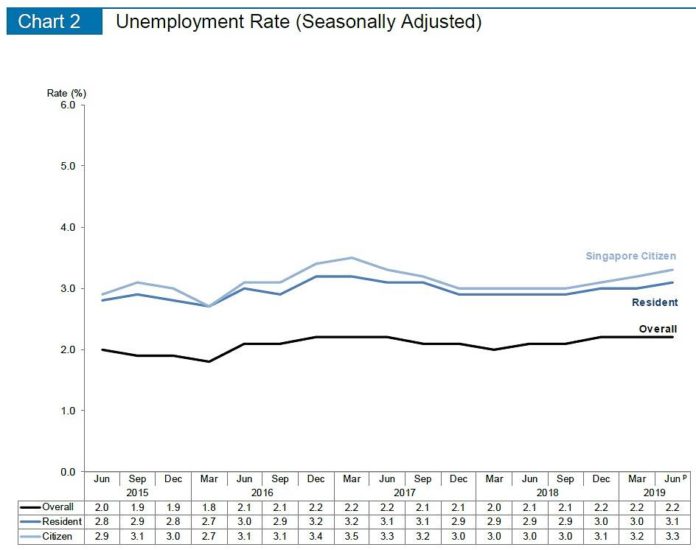
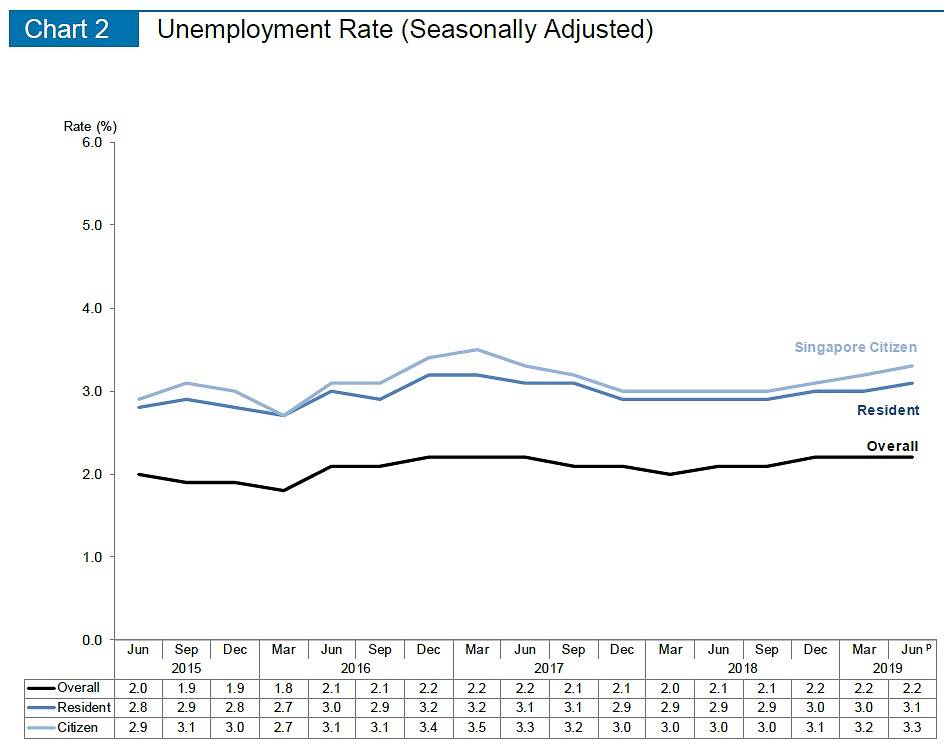
The seasonally adjusted overall unemployment rate held steady in June at 2.2 per cent, but rose slightly for residents from 3 per cent in the previous quarter to 3.1 per cent in the April to June quarter.
Manpower Minister Mrs Josephine Teo noted that while job growth slowed, it “did not stall”.
“When hiring becomes more subdued, being flexible helps jobseekers greatly,” said Mrs Teo, adding that the Government is monitoring the labour market closely.
In June, about 64,300 citizens and 72,400 residents were unemployed, compared with 62,200 citizens and 69,700 residents in March.
Total employment growth in the second quarter of 2019 (excluding foreign domestic workers) grew by 4,000, lower than the 10,700 figure in the first quarter and the same period last year (6,500).
Jobs growth was robust in several sectors, including information and communications, social and personal services and financial services, said MOM.
Employment in construction picked up, continuing from the slight uptick in the first quarter, but the manufacturing sector continued to shed workers.
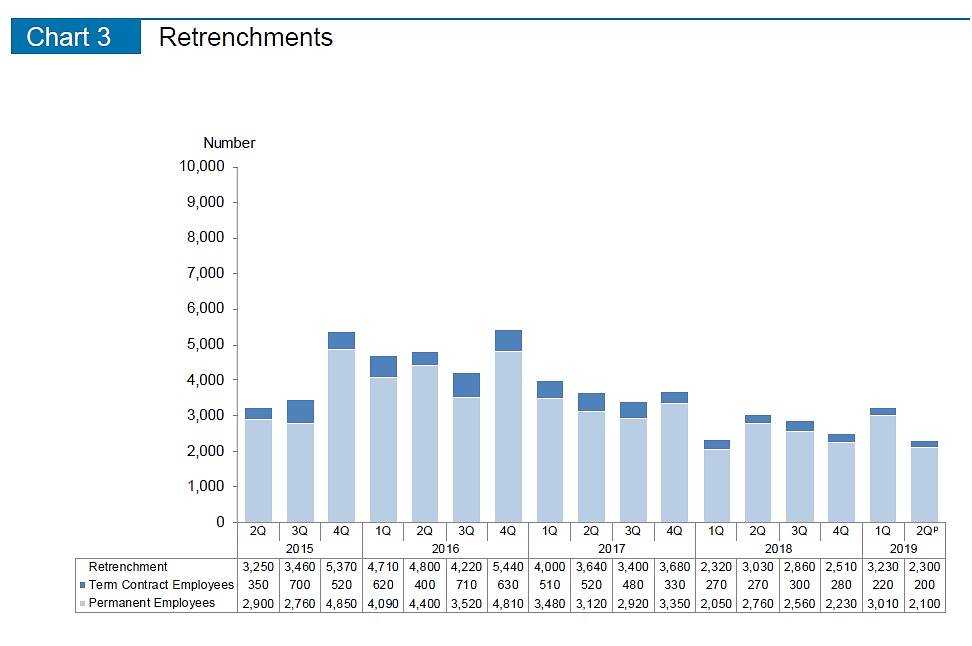
Retrenchments were lower than at 2,300 when compared with the first quarter (3,230) of 2019 and the same period (3,030) in 2018.
“This suggests that while firms had slowed down their hiring, they were not laying off existing workers,” said MOM.
Services continued to form the bulk of retrenchments (74 per cent), followed by manufacturing (22 per cent) and construction (4.3 per cent).
SINGAPORE: People turned up in droves at Huawei stores across Singapore on Friday (Jul 26) to buy a phone at a promotional price of S$54, but left angry and frustrated when they were turned away after limited stocks ran out.
The Chinese telecommunications firm had advertised the promotion for the Huawei Y6 Pro 2019 – which normally sells for S$198 – to mark Singapore’s 54th National Day. The promotion was applicable only to Singapore citizens and permanent residents aged 50 and above as of Dec 31 this year.
Long queues formed as early as 4am, and stocks of the phone ran out even before the stores opened.
Customers at Huawei stores at Jewel Changi Airport, VivoCity, NEX and Toa Payoh told CNA that they were disappointed when they were notified by Huawei employees that only 20 to 30 units were allocated to each shop.
At the VivoCity outlet, Mr Ho Chwee Beng said he only found out about the limited stock after waiting for two hours.
“I feel really angry and frustrated. Everybody angry, not me only,” said the 65-year-old.
When asked if he will be coming back again to try to get the handset, he said: “Maybe you can stay now until tomorrow, no need to go back then you get one phone.”
A sign at Huawei’s VivoCity outlet says all handsets on offer are sold out. (Photo: Ruth Smalley)
A sign at the Vivo City Huawei store says all handsets on offer are sold out. (Photo: Ruth Smalley)
A 73-year-old customer who wanted to be known as Amy said Huawei should not “cheat” or “tell lies”.
Huawei should have been prepared to sell at least “200 or 1,000 sets” at each outlet, she said, adding that it should not make people queue, “especially old people, 50 years old and above”.
“They’ll come here early, before they have breakfast, and this is what happens. They should issue an apology. This is cheating people,” she said.
Mr Alvin Tan, who was the second person in the queue at Huawei’s Jewel Changi Airport store, said he started queuing at 4am.
He said there were many angry customers who “came late and (are) making noise” at Huawei employees.
Customers queue to get their hands on a Huawei Y6 Pro 2019 smartphone at VivoCity. (Photo: Ruth Smalley)
A long queue formed outside the Huawei store at VivoCity. (Photo: Ruth Smalley)
Another customer, who was at the Huawei store at Block 190 Lorong 6 Toa Payoh, said many senior citizens were in the queue since 5am.
Huawei posted an apology on its Facebook page at about 10.30am, saying that it is unable to cater to “the vast majority of you” due to “overwhelming demand”.
“Please be advised NOT to proceed down to any of our 27 outlets as all units have been sold out,” it added.
The promotion will run from Friday to Sunday, and each customer is limited to a purchase of two units.
Police officers had to step in to control the crowd at Huawei’s VivoCity outlet. (Photo: Ruth Smalley)
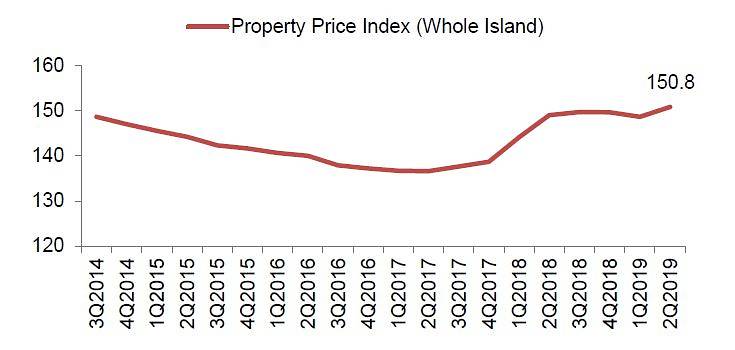
SINGAPORE: Private home prices in Singapore rose unexpectedly in the second quarter to hit their highest level in at least five years, with apartments around the central region and suburbs proving most popular with buyers.
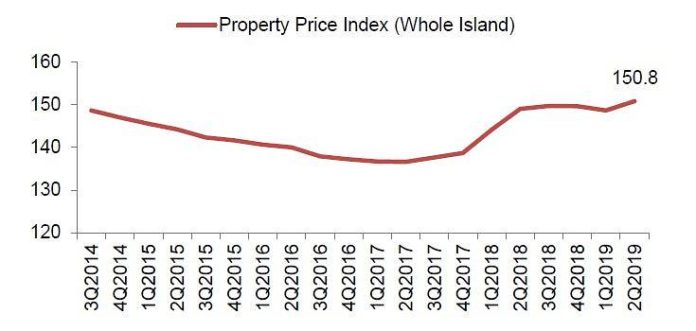
The private residential property index increased 1.5 per cent to 150.8 points in the second quarter, beating an initial estimate and reversing two consecutive quarters of decline, data from the Urban Redevelopment Authority (URA) showed on Friday (Jul 26).
Private home prices had fallen 0.7 per cent in the first quarter and 0.1 per cent in the October to December period following cooling measures implemented by the Government in the middle of last year.
Rentals increased by 1.3 per cent, nudging up slightly from the 1 per cent increase in the previous quarter.
Property price index of private residential properties. (Graph: URA)
LANDED HOMES VS APARTMENTS In the landed property segment, prices fell by 0.1 per cent in the second quarter, compared with the 1.1 per cent increase in the previous quarter.
Prices for private homes in the non-landed segment surged 2 per cent, compared with the 1.1 per cent decline in the previous quarter. Those in the Rest of Central Region (RCR) rose the most at 3.5 per cent, followed by apartments in the Core Central Region (CCR) at 2.3 per cent and those in the Outside Central Region (OCR) at 0.4 per cent.
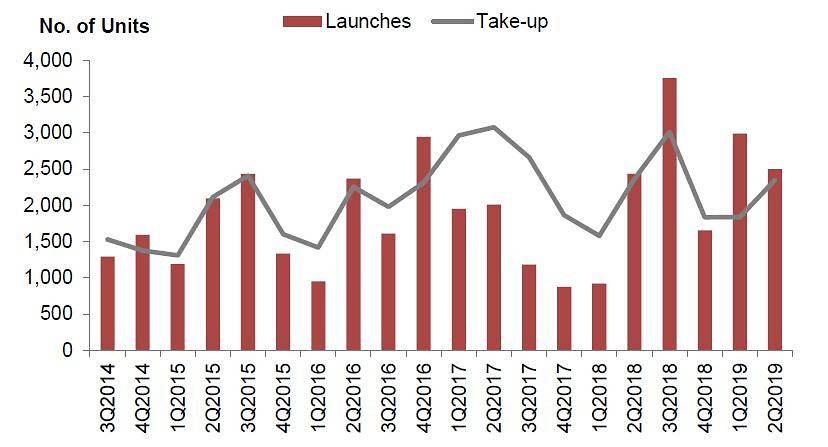
Number of private housing units launched and sold by developers, excluding Executive Condominiums. (Graph: URA)
LAUNCHES AND SALES
Between April and June, developers launched 2,502 uncompleted private residential units – excluding Executive Condominiums (ECs) – for sale, compared with 2,989 units in the previous quarter. The bulk of the new launches were in the RCR region.
They sold 2,350 apartments, up from the 1,838 units they moved in the previous quarter.
Apartments around the central region and the suburbs proved most popular with buyers, who purchased 1,156 units in RCR and 1,008 in OCR.
In the secondary market, there were 2,371 resale transactions in the second quarter, compared with the 1,858 units transacted in the previous quarter.
Resale transactions accounted for 49.7 per cent of all sales between April and June, compared with 49.6 per cent in the previous quarter.
As of end-June, there were 50,674 uncompleted private homes and 3,022 ECs in the pipeline with planning approvals. Of these, 35,538 units remained unsold.
Based on the expected completion dates reported by developers, 4,398 units (including ECs) will be completed in the second half of the year. Another 5,265 units (including ECs) will be completed in 2020.
SINGAPORE: Singapore’s resale public housing market has emerged out of its stupor, with the number of homes exchanging hands rising 29.8 per cent in the second quarter of this year.
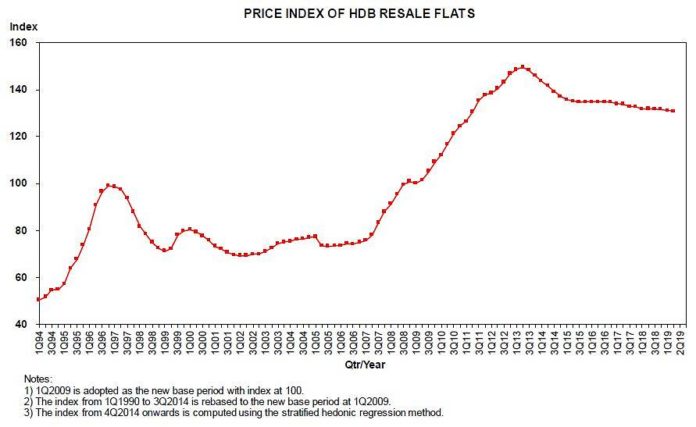
The prices of resale flats also dipped slightly, falling 0.2 per cent in the three months ending June, the Housing and Development Board (HDB) said on Friday (Jul 26), confirming flash estimates announced at the start of this month.
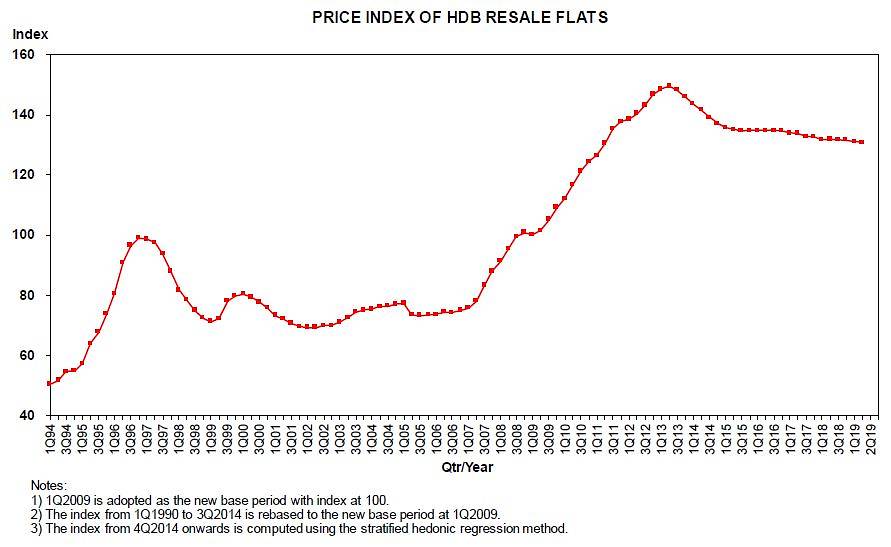
The resale price index – which provides information on the general price movements in the resale public housing market – fell from 131.0 to 130.8.
The resale price index for Housing and Development Board flats. (Graph: HDB)
Resale prices for HDB flats have been on the decline in the last three quarters. Prices declined by 0.1 per cent in the third quarter and 0.2 per cent in the fourth quarter of 2018. In the first quarter of this year, prices fell by 0.3 per cent.
Between April and June this year, the number of resale flats sold rose by more than 1,400, rising from 4,835 in the first quarter to 6,275.
On a year-on-year basis, resale transactions rose 5.6 per cent in the second quarter.
For its next sales exercise in August, HDB will offer about 3,300 Build-to-Order (BTO) flats in Punggol and Tampines. Another 4,500 BTO flats in Ang Mo Kio, Tampines and Tengah will be launched in November.
There will also be a concurrent Re-Offer of Balance Flats exercise and Sale of Balance Flats exercise in August and November respectively.
HDB RENTAL MARKET
The number of rental transactions for HDB flats rose by 4.8 per cent from 11,775 in the first three months of the year to 12,335 in the second quarter.
On a year-on-year basis, rental transactions were up 2.6 per cent.
As of Jun 30, there were 58,528 HDB flats rented out, an increase of 1.3 per cent from the previous quarter.
SINGAPORE: Four men, aged between 18 and 63, were arrested on Thursday (Jul 25) for unlawfully entering Singapore and possessing duty-unpaid cigarettes.
The police said in a news release that the Police Coast Guard (PCG) detected a “wooden craft” with the four men on board at sea off Eastern Holding Anchorage, within Singapore territorial waters, at about 1am on Thursday.
“The wooden craft was swiftly intercepted and all four men were arrested for unlawful entry into Singapore,” the police added.
A check of the wooden craft revealed an assortment of duty-unpaid cigarettes.
Duty-unpaid cigarettes were found in the wooden craft. (Photo: Singapore Police Force)
Buying, selling, conveying, delivering, storing, keeping, possessing or dealing with duty-unpaid goods are offences under the Customs Act and the GST Act.
Offenders can be fined up to 40 times the amount of duty and GST evaded, and/or jailed for up to six years.
The men will be charged with unlawful entry into Singapore.
Those found guilty face up to six months’ jail and a minimum of three strokes of the cane.
Commander of PCG, Senior Assistant Commissioner of Police Cheang Keng Keong, commended the PCG officers for their vigilance and team work.
He added that PCG will spare no effort and will continue to take firm action against such offenders.
SINGAPORE: Nearly nine in 10 (88 per cent) of working Singaporeans felt they deserved more annual leave in 2018, with 77 per cent willing to take a pay cut to get an extra day off, a survey found on Thursday (Jul 25).
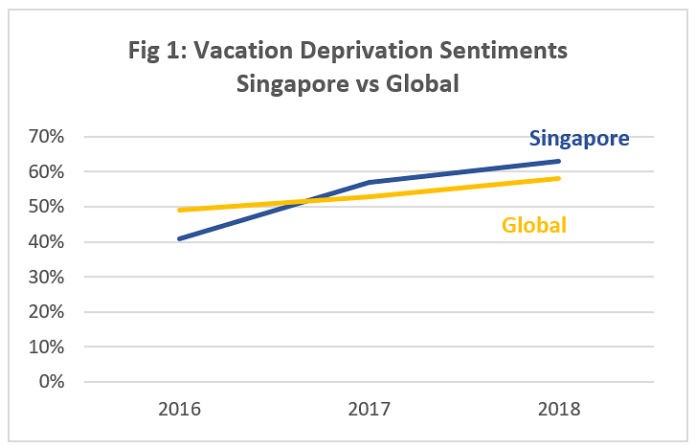
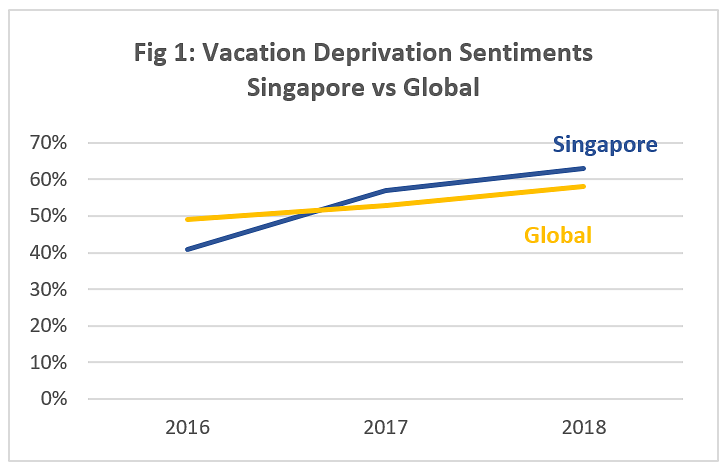
According to travel company Expedia’s latest Vacation Deprivation Survey, about six in 10 Singaporeans said they were deprived of vacations in 2018, up from 57 per cent in 2017 and 41 per cent in 2016.
The survey placed Singapore as the sixth most vacation-deprived market in the world.
(Graph: Expedia)
Conducted with 11,000 full-time working adults across 19 countries, including 300 people in Singapore, the survey uncovered workers’ sentiments on whether the number of vacation days they received in 2018 was adequate.
The top five most vacation deprived are India, South Korea, Hong Kong, Malaysia and France, the survey found.
CONNECTED TO WORK WHILE ON HOLIDAY
More than half (53 per cent) of Singaporeans surveyed said they stayed connected to work during their vacation time, with 79 per cent checking their emails or voicemail at least once.
“On top of that, Singaporeans also felt an expectation to be available constantly by their colleagues while on their break, with 30 per cent saying that they are expected to be available constantly by their supervisors – the third-highest percentage globally after India and Malaysia,” the travel agency said.
The survey also found that half of the Singaporean workers took fewer days of annual leave than the amount they received in a year.
“When asked about the reasons for not taking time off for a holiday, being unable to get time off work emerged as the top reason for doing so among 39 per cent of Singaporeans – the highest in the world,” Expedia said.
Employee working late.
Expedia’s Head of Communications for Asia Pacific Lavinia Rajaram said: “In a dynamic, fast-paced society like Singapore, it came as no surprise that workers want more annual leave to go on vacations.
“Taking regular, quality vacations is known to provide numerous positive benefits to the personal and professional well-being of workers across the globe.”
The survey also showed 70 per cent of Singaporeans had taken at least one mental health day off in the past year, the fifth-highest in the world.
On average, Singaporeans took three days off last year to care for their mental health.
Asia Pacific stood out as the most vacation-deprived region in the world, with seven in 10 most vacation-deprived countries coming from the region.
On the other hand, the least vacation-deprived countries are Australia, Canada, Japan, Mexico and New Zealand.
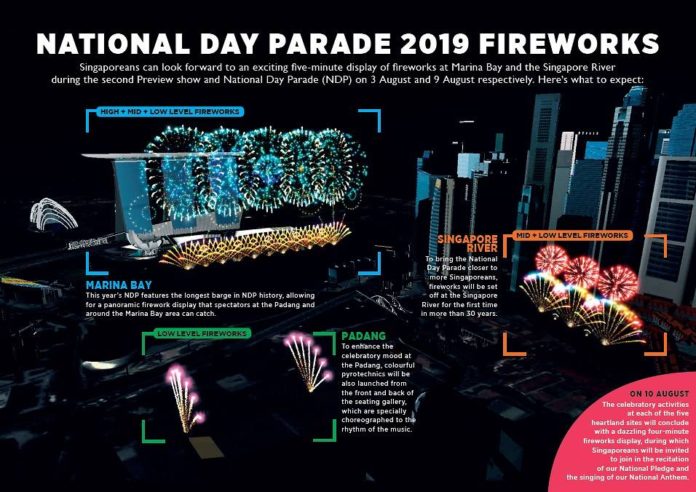
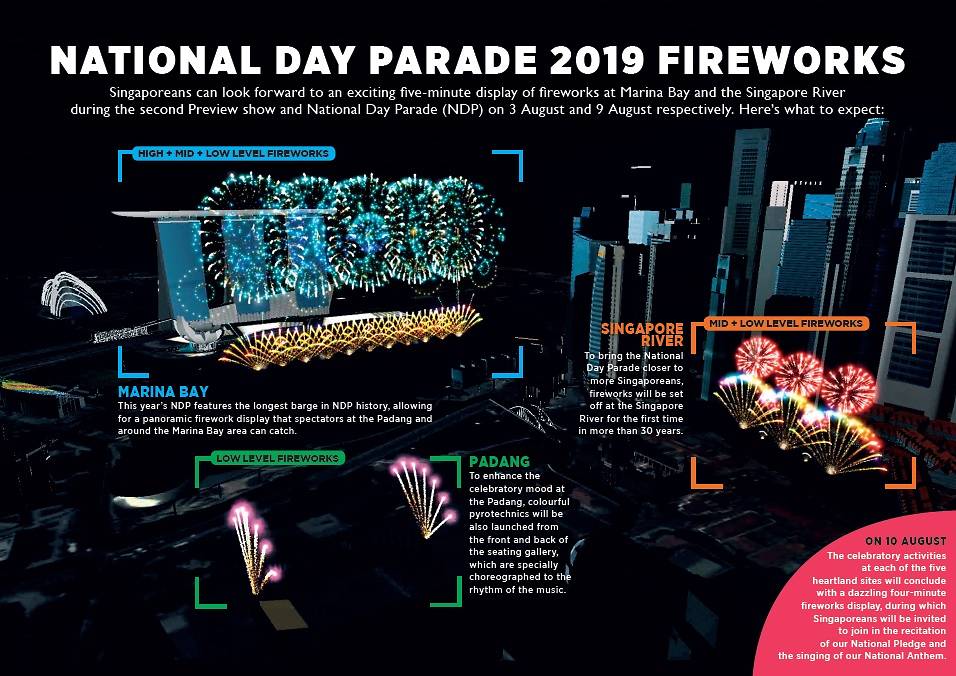
SINGAPORE: Fireworks will be set off at the Singapore River for the first time in Singapore’s National Day Parade history this August, in a move to celebrate the river’s significance as the country marks its bicentennial.
“2019 is a special year and it marks our Singapore bicentennial,” said Military Expert (ME) 6 Johnson Ling, chairman of this year’s fireworks committee.
“That’s why we selected the Singapore River as a significant site, where our forefathers and ancestors gathered and pioneered what we are today,” he added.
The 3.2km-long waterway is where many of Singapore’s ancestors began their lives and was the centre of trade, commerce and finance.
“As part of the NDP planning stages, we have understood the limitations of the Padang for the fireworks display,” said ME6 Ling said.
Mortar tubes hold the fireworks shells on the 450m-long barge. (Photo: Ang Hwee Min)
At 450m-long, ME6 Ling said, the barge allows for a wider fireworks display that “maximises the bay area” and can be seen by people in the Padang and Marina Bay area.
Separately, heartland residents in Bishan, Geylang Serai, Jurong East, Punggol and Woodlands can also look forward to their own four-minute display of National Day fireworks – on Aug 10.
The goal is to reach out to more Singaporeans by bringing NDP celebrations to the heartlands, said ME6 Ling.
“It has been more than a decade since the NDP committee last brought the fireworks display to the heartlands. And we hope that Singaporeans will like what we have prepared for them.”
The five sections of the mobile column are estimated to reach their destinations at about 6.45pm.
Residents who want to catch the mobile column can track its location on the official NDP website. There will also be a livestream of the mobile column as it makes its way along the streets of Singapore on the website.
SINGAPORE: Primary 5 students next year will be the first cohort to receive their exam results based on the new Primary School Leaving Examination (PSLE) scoring system that will be implemented from 2021, the Ministry of Education (MOE) said on Thursday (Jul 25).
They will be graded based on an Achievement Level (AL) score ranging from 1 to 8, with 1 being the best score and 8 the lowest.
In the following years, all P5 and P6 students will receive their results in that format, moving away from the T-score system which will be scrapped in 2021.
This change will not affect students from Primary 1 to 4 who will continue to receive progress reports.
The AL system will result in 29 possible scores, as opposed to the current T-score system, which has about 200 variations, according to MOE.
This aims to reduce fine differentiation at a young age and recognise the students’ level of achievement regardless of how their peers have done, it added.
At the PSLE, students’ AL score for each of the four subjects – English, mother tongue language, mathematics and science – will be added up to form a total score of between 4 and 32, which will decide which secondary school they will be posted to.
The lower the score, the better.
A PSLE score of 20 or better will qualify students for the Express stream in secondary school.
The order of school choices will also become more important from 2021 as it will be used as a tie-breaker when two students with the same score vie for a spot in a school. Currently, places in school are allotted based on results, citizenship and computerised balloting.
“Students and parents may choose schools based on a consideration of factors such as the distinctive programmes offered by the school, the school’s ethos and culture, or home-school distance,” an MOE spokesperson said.
FOUNDATION LEVEL SCORES
The ministry also unveiled details on how pupils who take subjects at the foundation level will be scored. They will be graded AL A (75 to 100), B (30 to 74) and C (below 30). These will be converted into the standard level subject equivalent scores of AL 6, 7 and 8 respectively for the purpose of working out their total PSLE score for Secondary 1 posting.
“The pegging reflects the fact that the curriculum of a foundation level subject is a subset of the standard level subject, and the assessment load at the foundation level is less demanding when compared against the standard level,” MOE said.
Students at Bendemeer Primary School after collecting their PSLE results. (Photo: MCI)
Foundation level English, science, mathematics and mother tongue language were introduced in 2008 to Primary 5 students as part of subject-based banding. MOE said that about 10 per cent of students from each cohort take one or more subjects at foundation level, which allows them to study at a pace suited to them.
A student can qualify for the respective academic courses in secondary school as long as his or her overall PSLE score meets the placement criteria, regardless of the mix of standard and foundation subjects offered, the ministry said.
SCORES FOR HIGHER MOTHER TONGUE ELIGIBILITY
MOE also said that those who score 8 and better in the PSLE will be eligible to take higher mother tongue in secondary school, while those who score 9 to 14 will be able to do so if they do well for mother tongue or higher mother tongue in the PSLE.
Schools can also offer higher mother tongue to students at their own discretion.
Students taking higher Chinese will no longer gain bonus points for entry into a Special Assistance Plan school but will continue to have an advantage over those who do not take it.
MOE said that it hopes that the reforms in education – including the phasing out of streaming in secondary schools – taken together will “lower the temperature” when it comes to concern over which stream or level a student goes to in secondary school. Going to a lower one is “not the end of the world”, it added.
Director-general of education Wong Siew Hoong said: “This new PSLE scoring system is part of a broader shift that the system needs to make to reduce the over-emphasis on examination results, examination grades, so that we can make space for the students to be developed more holistically.”
REFINEMENTS WILL BRING ABOUT POSITIVE CHANGE
Radin Mas Primary School principal Muhammad Farizal Umar Effe said that the changes show that the intention is to “blunt” the focus on PSLE results and broaden the definition of success.
“PSLE is just a snapshot of the child’s abilities at that moment of their life and we recognise that child will grow and develop at different pace and will continue as a system to focus more on the holistic growth of a child to prepare them not only for the examinations but for life as a whole,” he said.
Still, examinations have their place in the system, Mr Farizal said. “We must recognise the role and the value of the examinations as a useful checkpoint to guide the child in the next phase, especially at PSLE,” he added. That said, there have been “several refinements” to reduce the assessment load by removing examinations at several levels, he added. While any examination will lead to “inherent pressure”, making it manageable for students is key, he said.
“The new system will reduce fine differentiation with its wider bands, and recognise students abilities and performance without the reference or comparison to peers and this will lead to students feeling less pressure as the student can focus on their own learning outcomes,” Mr Farizal said.
National University of Singapore (NUS) sociologist Associate Professor Tan Ern Ser also said that the refinements will bring about positive changes.
“They will reduce unnecessary competition and stress among students going through the education system, enhance their learning experience, equip them to be more future-ready, and engender a more equal society characterised by multiple pathways to success,” he said.
Dr Kelvin Seah, lecturer in NUS’ Department of Economics said the changes to the education system, including PSLE scoring, may even have wider repercussions.
“In doing this, it is sending a signal to employers that academic grades should not be the be-all and end-all and that they should broaden the way hiring and promotion decisions are made so as to recognise other strengths and talents,” he said.
SINGAPORE: A series of upgrading works has begun on the Circle Line (CCL) to prepare for the opening of Circle Line Stage 6 (CCL6), the Land Transport Authority (LTA) and SMRT said in a joint news release on Thursday (Jul 25).
The enhancements will allow the decade-old CCL to support a larger CCL network and train fleet when three new CCL6 stations start operating in 2025.
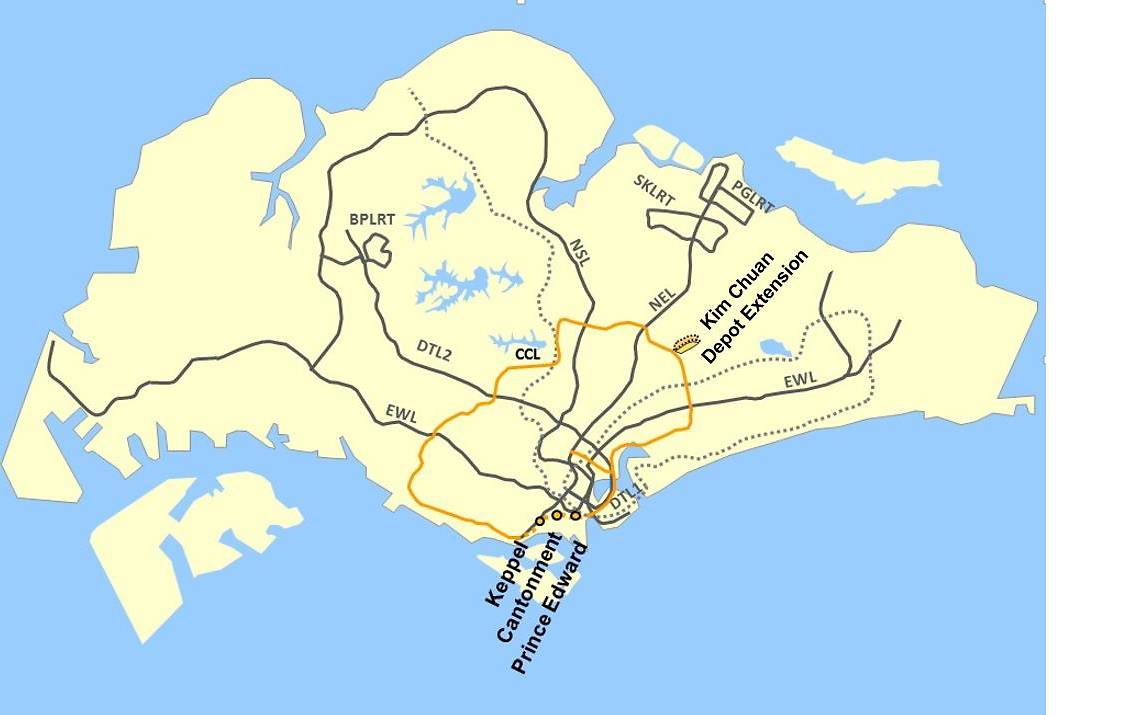
The stations will also close the loop for the CCL by connecting HarbourFront Station to Marina Bay Station.
Construction of the three new CCL6 stations – Keppel, Cantonment and Prince Edward Road stations – commenced in 2017. Works are progressing smoothly and are expected to be completed on schedule, said LTA and SMRT.
Tunnelling for the new stations also began on Thursday.
“With the network reaching the 10-year mark, it is essential that we start the renewal process early and apply the lessons learnt from the renewal of the North-South and East-West Lines network to improve rail reliability,” said SMRT Corporation Group Chief Executive Officer Neo Kian Hong.
Artist’s impression of the concourse of the upcoming Cantonment MRT station. (Image: LTA)
LTA Chief Executive Ngien Hoon Ping added that “daily operations will not be impacted” as they carry out the upgrading works on the 30-station network.
“With the completion of the upgrading works, we can look forward to the smooth integration of the existing CCL system with the three new CCL6 stations when they are ready.”
The ongoing enhancements to the existing Circle Line network include upgrading the signalling system to monitor and support the larger number of CCL trains.
The power supply system will also be upgraded to improve system availability and resiliency. The installation of an additional hardware component called the load break switch at substations will help to maintain continuity of power supply in the event of a power outage.
The three new stations that will close the loop on the Circle Line. (Image: LTA)
TUNNELLING WORKS BEGIN
Tunnelling works for CCL6 began on Thursday with the launch of the tunnel boring machine (TBM) at Keppel Station.
This tunnelling machine will tunnel from Keppel Station to CCL HarbourFront Station. Two other TBMs are expected to be launched in September and October this year.
Foundation and excavation works are also in progress for the expansion of Kim Chuan Depot.
The expanded integrated Kim Chuan Depot will provide additional stabling facilities to support the larger CCL network and train fleet of 133 trains, and the above-ground bus depot will house 550 buses.
Map of Circle Line 6. (Image: LTA)
LTA is also purchasing 12 new trains from Alstom to cater for the expected increase in passengers when the CCL is fully operational. These trains will be delivered progressively from 2024.
In addition to the 11 trains that were bought in April 2018 for CCL6, these 23 trains will increase the total CCL fleet size by 36 per cent to 87.
When CCL6 opens in 2025, CCL will have a total of 33 stations with 12 interchanges to connect to all existing MRT lines and the future Thomson-East Coast Line.