SINGAPORE: The People’s Action Party (PAP) takes governance and governing Singapore very seriously, and has worked hard to improve the lives of Singaporeans, said Deputy Prime Minister Heng Swee Keat on Saturday (Jul 27).
Speaking to the media on the sidelines of a ministerial community walkabout in Bedok, Mr Heng said PAP leaders “fundamentally disagree” with Dr Tan Cheng Bock’s assertion that there has been an “erosion” of transparency and accountability within the Government.
“We fundamentally disagree with Dr Tan. But of course he is entitled to his opinions just as all Singaporeans are entitled to opinions,” said Mr Heng, who is the PAP’s first assistant secretary-general.
East Coast GRC MP Lim Swee Say and Deputy Prime Minister Heng Swee Keat speaking to residents during a ministerial community walkabout in Bedok on Jul 27, 2019. (Photo: Brandon Tanoto)
Dr Tan, leader of the new Progress Singapore Party, said on Friday that “the processes of good governance have gone astray”.
At a press conference to officially introduce his party, the former PAP Member of Parliament had also raised the issue of how Parliament was not the right place to debate the fate of founding Prime Minister Lee Kuan Yew’s house at 38 Oxley Road.
“In some ways, Dr Tan contradicted himself. He said that there’s no transparency but at the same time he attacked the fact that the issue of Oxley Road was raised in Parliament,” Mr Heng said on Saturday.
“Now that is transparency, the fact that the Prime Minister was prepared to have this issue debated in Parliament, clarified in Parliament, is a very important aspect of our governance.”
The PAP has proven that it has worked hard for Singaporeans, Mr Heng said, including tackling the challenges that the country faces in a rapidly changing global environment, creating jobs as the economy restructures, as well as taking care of an ageing population.
Mr Heng said many residents he spoke to during the community visit had expressed support for government policies and how they have improved their lives.
“At the end of the day, the test is which party, which group of candidates have better ideas and better ability to deliver results for Singaporeans,” he added.
Mr Heng said Singaporeans are fair-minded, and will look at the quality of ideas and the ability to deliver results when they decide which political party or candidate can best serve them and take Singapore forward.
He noted that Dr Tan has yet to articulate any policies for Singapore.
Echoing Mr Heng’s comments, Trade and Industry Minister Chan Chun Sing said that the PAP is not distracted by other political parties as its focus is to work hard to meet Singaporeans’ needs and to ensure that the country stands out among its competitors.
Trade and Industry Minister Chan Chun Sing speaks to a resident during a ministerial community walkabout in Bedok on Jul 27, 2019. (Photo: Brandon Tanoto)
“We are not here to worry about politics and what not. That can take care of itself. But if Singapore and Singaporeans are well taken care of, I’m sure Singaporeans will know who to place their trust in,” said Mr Chan, who is PAP’s second assistant secretary-general.
“So let’s start with focusing on the substantive issues that really matter to fellow Singaporeans, and at this point in time, I think, on the minds of most Singaporeans will be the direction of economy and the jobs. Whether, is it election or non-election time, we must make sure that fellow Singaporeans are well taken care of.”
NEW ANCHOR MINISTER AT EAST COAST GRC?
Mr Heng and Mr Chan’s walkabout in Bedok, together with East Coast GRC MP Lim Swee Say, is part of the PAP’s ministerial community visits. So far, party leaders have made 40 of such visits.
Mr Heng said it is not the first time both he and Mr Chan have done a joint walkabout, adding that they have done so twice previously in other GRCs, and will do more if their schedules allow.
East Coast GRC was hotly contested in previous elections.
In the 2015 polls, the PAP won nearly 61 per cent of votes in the GRC, while the Workers’ Party (WP) secured 39 per cent of the votes. In the 2011 General Election, the PAP won 54.8 per cent of the votes, with WP clinching 45 per cent.
Trade and Industry Minister Chan Chun Sing greets a resident during a ministerial community walkabout in Bedok on Jul 27, 2019. (Photo: Brandon Tanoto)
With Mr Lim retiring from Cabinet last May, the PAP does not have an anchor minister in East Coast GRC.
When asked if another minister would be deployed to East Coast, Mr Heng declined to share details, saying only that the party will make a decision in time to come.
SINGAPORE: More than 365,000 Singaporeans will benefit from higher healthcare subsidies, after the Ministry of Health (MOH) announced on Saturday (Jul 27) that it has revised the means-tested income criteria.
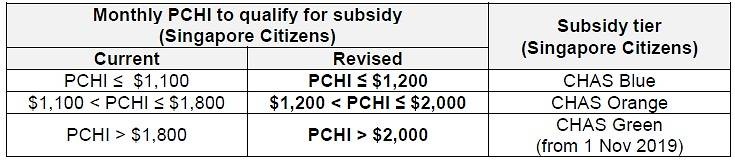
The income ceiling will be raised for each subsidy tier, with increases ranging from S$100 to S$300.
This will be implemented by October, said MOH.
Eligible Singaporeans will be able to get subsidies for schemes and services such as MediShield Life premiums, drugs at polyclinics and public specialist outpatient clinics, as well as the Seniors’ Mobility and Enabling Fund.
The revised income criteria also applies to the Community Health Assist Scheme (CHAS).
“No action is needed on the part of existing or new patients and beneficiaries when they use the services and apply for the subsidies,” said MOH in a press release.
“The various service providers and scheme administrators will automatically extend the corresponding subsidies to those who are eligible.”
MOH added that it will issue replacement cards for existing CHAS cardholders who quality for a higher tier by October.
Under means testing, the ministry extends higher subsidies to lower income groups based on their monthly per-capita household income (PCHI).
To qualify for subsidies under CHAS Blue, for instance, the PCHI is currently S$1,100. This will be raised to S$1,200. For CHAS Orange cardholders, the ceiling will be raised from S$1,800 to S$2,000.
MOH said it revised the means-tested income criteria taking into consideration changes in household incomes and healthcare expenditure.
“MOH will continually review our healthcare financing frameworks to ensure that they meet the needs of Singapore residents,” it said.
SHIFT TOWARDS UNIVERSAL SUBSIDIES FOR CHRONIC CONDITIONS
Speaking at the CHAS carnival at Toa Payoh HDB Hub on Saturday, Minister for Health Gan Kim Yong highlighted the introduction of CHAS Green, which aims to help all Singaporeans with chronic conditions – regardless of their income.
CHAS Green will provide up to S$160 in annual subsidies for selected chronic conditions.
“The introduction of CHAS Green is a major shift towards universal subsidies for chronic conditions under GP care,” said Mr Gan.
“As our population ages, more Singaporeans will require support to manage their chronic conditions, with many requiring continued treatments. Much of chronic disease management should take place in the community,” he added.
“Our private GPs, which serve 80 per cent of the primary care needs of Singaporeans, are our key partners in this.”
Mr Gan also said that his ministry is working to make CHAS application easier.
From September, Singaporeans will be able to complete and submit their CHAS application entirely online, using their SingPass account.
For those who choose to submit their application in person, only one household member will be required to fill in and sign the form on behalf of their family.
SINGAPORE: Whenever her 10-year-old son Daniel has his monthly haircut, mum Sara Khafi is always standing by to ensure that an important rule is followed: That his sideburns are not cut — just trimmed a little.
Orthodox Jewish males are not allowed to shave their sideburns. “And very orthodox Jews don’t cut the sideburns at all,” explained Sara, who belongs to Singapore’s Jewish community.
Until the age of three, boys cannot have their hair cut either. This is instructed in the Torah, the Jewish holy writings.
When it is time for National Service, however, Daniel will have to do as his elder brother David did.
“The only time (David) shaved off his sideburns was when he enlisted … He had to shave all his hair off,” their mother recalled with a smile.
Sara Khafi and husband, with David when he was in National Service.
There are roughly 2,500 Jewish residents here, from lifelong citizens to those who have made Singapore their home more recently, for example Sara.
The 50-year-old was born in Germany and has been living in Singapore for 30 years, giving birth to five children here.
“People still think we’re tourists because we don’t look Asian. And they don’t want to believe us at first — that we’re from Singapore,” she said. “This is home.”
It has been home to Jews for 200 years, since the first Jewish settlers — originally from Baghdad, Iraq — came via India as traders.
And they continue to integrate while preserving their own cultural identity, as the series Singapore Mosaic illustrates with a peek into the lives of four communities: The Jews, the Parsis, the Arabs and the Armenians. (Watch this episode here.)
A bat mitzvah ceremony — held when a Jewish girl reaches the age of 12 — in Singapore.
HOW THEY EAT
One aspect of the Jewish identity is food, kosher food to be precise. For many Jews, that means following strict dietary laws.
“We don’t eat pork, fish without fins and scales, and our beef and chicken has to be slaughtered differently … We don’t eat the blood of the animal; we let the blood come out,” explained Sara.
“Even if it’s vegetarian (food), do they put any ingredients or preservatives inside that might be from an animal? So all these make it not kosher.”
Sara points to a kosher sign on a box of crackers she found in a grocery shop.
She buys her products from “all over Singapore”. But for major kosher products like meat, which are difficult to obtain in supermarkets, she goes to the kosher shop in the Jewish community centre at Waterloo Street.
Poultry is slaughtered locally for the community and provided at a “decent and affordable price”, said Chief Rabbi of Singapore Mordechai Abergel. Even finding something like kosher chocolate spread would be a challenge if not for the shop.
Eating kosher, however, goes beyond shopping for the right ingredients; how food is handled is equally important.
“We don’t cook meat and dairy together,” explained Sara, whose kosher kitchen has one sink for meat and another for dairy, as well as two ovens, two fridges and separate utensils for the two kinds of food.
In the multicultural home of Yoni Garbourg, kosher laws are not kept so strictly. The 42-year-old was born in Israel, while his wife Connie was born in China.
“There’s no dinner here without some Asian flavour,” he said at one of their meals, pointing to some kang kong (water spinach) and bok choy (a Chinese cabbage).
Even a traditional Jewish bread like challah can be given a Singaporean twist: Kaya filling, which their children love. “The food in both cultures (Jewish and Asian) is great. So it’s a tasty relationship,” he added with a smile.
KEEPING THE SABBATH
While the Garbourgs are not strictly observant Jews, they “make a better effort” to keep Shabbat, or the Sabbath — from sunset on Friday to sunset on Saturday.
It starts with the lighting of candles, which is traditionally done by the women of the family, and prayers being said. “We try to arrive home earlier on Shabbat, making sure our dinner preparations are finished,” said Yoni.
And while they have more of an Asian diet throughout the week, their Shabbat dinner at home is mostly Jewish, with dishes like matzo ball soup and a stew prepared to his grandmother’s recipe.
Preparations must start early because there should be no cooking on Shabbat itself.
“One of the things observant Jews have in their kosher kitchen is a hotplate … that we turn on before Shabbat,” said Sara. “We cook everything before Shabbat comes and … we’d just warm it up.”
Her adherence to the Jewish day of rest means she also switches off her phone.
“Being a real estate agent in Singapore, I do face challenges, especially when I have a client who’s impatient. I have to make sure my colleague can cover (for me),” she admitted.
“So far, I’ve been lucky. Sometimes my colleagues would say, ‘you’re crazy’, because I might not successfully close a deal, right? But no, I’m Jewish. So I have to do it.”
Her family also does not use electricity on Shabbat, which means “no television with the kids”.
“We get more quality time,” she said. “So it became a habit not to use a digital device. It’s not the end of the world to keep, (for) one day, away from the digital world.”
Even getting to the synagogue is different on Shabbat, as observant Jews do not drive on that day. Fortunately for her family, they are within walking distance of Singapore’s two synagogues.
She is also thankful to her helpers, who help her to “get everything done” on Shabbat. “Many Jews who are even more observant … won’t let the maid do anything for them,” she said.
WHAT THEY SPEAK
As a Jewish mother, Sara feels she also has a responsibility to ensure that her grandchildren will be Jewish. This means her children must first “understand who they are (and) where they came from”, she said.
One way for that to happen is through the Hebrew language. Daniel, for example, attends weekly classes with other Jewish children at the synagogue, where he gets to sing in Hebrew too.
“That gets them more connected to the roots of their Jewish identity,” said his mother. “He’ll then be able to continue his Jewish belief.”
Yoni, too, is making sure his children — three girls and a boy — “feel comfortable” with the language. “They go to my community’s Sunday school, where they get a couple of hours of Hebrew,” he said.
To him, Hebrew is important for “at least saying certain prayers and being able to participate in some of the services”.
His children also go to local schools, where they study Mandarin. “It’s important … because it’s my wife’s culture. And of course, we live in Singapore and in Asia, and it’s important to have Mandarin skills,” he said.
As with food, the family incorporates both parents’ cultures, and it is one of their traditions to sing Happy Birthday in English, Mandarin and Hebrew.
“It’s not either-or. We feel very comfortable bringing them up in both the Chinese and the Jewish way,” said Connie, 40.
“Especially in Singapore, when it’s such a diverse and inclusive culture — different ethnicities, different religions — they blend together. So for us, it’s very easy to be Chinese and Jewish at the same time.”
That includes visiting a Buddhist temple during the Qing Ming festival, and celebrating Chinese New Year. “We have a reunion dinner with friends or family,” said Yoni.
“After our babies were born, we’ve had the 30-day, (full) moon celebrations with our friends. It’s a very Chinese tradition.”
JEWISH ROOTS, SINGAPORE SOIL
Yoni, who runs a technology start-up, has been part of Singapore’s Jewish community for 10 years now. Three of his children were born here.
And even as their life in Singapore embraces a cultural melting pot, part of his Jewish identity was also “created here”.
“It’s funny to hear myself say it, but it’s true,” said the president of the United Hebrew Congregation (Singapore), which comes under the umbrella of progressive Judaism.
“In Israel, one doesn’t need to be too Jewish. You’re surrounded by Jews, it’s just part of life, and you don’t need to make a conscious decision to participate.
“When I first got here, I wasn’t looking for synagogues (nor) Jewish landmarks. It wasn’t the first thought in my mind. In fact, I was happily surprised that there was Jewish infrastructure here.”
He called the Chesed-El Synagogue, in Oxley Rise, a “beautiful edifice” and an “awesome national monument”. They would also go to the Maghain Aboth Synagogue at Waterloo Street on Friday nights.
And in the Central Business District, where he and his wife worked, one of the roads was Synagogue Street, he pointed out. In the east, Meyer Road was named after one of Southeast Asia’s wealthiest merchants, Jewish philanthropist Manasseh Meyer.
“It feels as if I’m surrounded by Jewish street names and Jewish monuments. It took me coming to Singapore to really find my Jewish roots and my Jewish soul,” said Yoni.
Every year, there is also a Jewish community celebration at Sentosa, and he finds it “marvellous” how they are “free to congregate in a big way and … celebrate freely”.
It is something that strikes Sara too. For example, in Europe, she would not allow Daniel to wear the kippah, the cap that Jewish males wear, so publicly.
“Whereas here, it’s fine,” she said. “We don’t feel any threat or any anti-Semitism that we feel in other countries.”
The Jewish community here has never been big, but their cultural heritage continues to be part of the Singapore mosaic.
For Yoni and Connie, who have “moved around a lot”, this is the longest they have lived in one place. “And we’ve made it our home now,” he said.
As has Sara’s family. Recalling the day her son David finished NS, she said: “We were proud to be part of Singapore. It was a special moment. I think that made him feel he belongs here.”
Younger brother Daniel is already finding that “growing up here is special”, even if being Jewish is “very hard because we have to keep many laws”.
“(What) I love best in Singapore is that there are so many cultures,” he said. “So we can tell them, ‘Oh, we’re Jewish. Oh, I’m Indian. Oh, I’m Muslim.’ And it just all goes together.”
Watch this episode of Singapore Mosaic here. The second part of the series airs on Sunday, July 28, at 9pm.
SINGAPORE: The commentary “As time runs out on the climate crisis, Singapore prepares to address the cost of adapting” adopts the kind of urgent language appropriate to the climate crisis we are facing now.
It emphasises the importance of adaptation measures, which lower the risks posed by the consequences of climatic changes. One such example is recent measure to build Changi Airport Terminal 5 5.5 metres above mean sea level to deal with rising sea levels.
It is highly disappointing, however, that it downplays the pressing need to adopt more substantial mitigating measures that address root causes, by reducing greenhouse gas emissions.
A worker uses a lawn mover to cut bushes next to the financial district in Singapore on June 2, 2014. (Photo: AFP / Roslan Rahman)
The commentary notes that the question of mitigation in Singapore has been far simpler and less politically fraught than in other countries, and that Singaporeans have already worked towards more climate-friendly consumption patterns.
This obscures a few important facts about mitigation, unlike what the commentary posits, as the cost of climate change mitigation is very much “inextricably linked to political to political questions of cost, economic restructuring, decline and job losses”.
LOOK AT INDUSTRY’S ENERGY CONSUMPTION
Firstly, the source of much of Singapore’s emissions is not consumers, but industry.
As Singapore’s Energy Statistics indicate, of 2016’s total final energy consumption of 14,714.6 kilotonne of oil equivalent (ktoe), over 65 per cent (9,670.3 ktoe) was consumed by industry, far dwarfing the 5 per cent (739.2 ktoe) from household consumption and less than 18 per cent (2,587.1 ktoe) from transport.
Furthermore, Singapore’s Intended Nationally Determined Contribution states that a reduction of 36 per cent in Emissions Intensity (EI) from 2005 levels is intended by 2030.
As EI is measured by greenhouse gas emissions per dollar of GDP, this means that Singapore’s emissions could continue to rise during this period, as long as our GDP continues to grow.
This contradicts the recommendations of the United Nations Intergovernmental Panel on Climate Change special report on 1.5 degrees Celsius of warming, a consensus of the best available scientific evidence, which makes it crystal clear that mitigation is necessary.
Participants attend a panel at the COP21, United Nations Climate Change Conference, in Le Bourget, north of Paris on Dec 8, 2015. (Photo: AP/Michel Euler)
According to the report, global emissions need to be cut in half by 2030 and reach net-zero in 2050 in order to stay below 1.5 degrees of warming and avoid the worst consequences of global warming to human life.
Singapore, on the other hand, rather than mitigating total absolute emissions, is actively growing them.
For a commentary that calls for us to be clear-eyed in our assessment, it is a shame that its argument is ultimately detached from these realities.
TAKE A HARDER LOOK AT DIRTY INDUSTRIES
Secondly, if we are to be serious about the climate crisis, we should not overlook the need to engage in much more substantial mitigation measures that address the root causes of carbon emissions.
This includes focusing on the emissions of the dirtier industries, such as the oil and gas industry where Singapore plays host to one of the world’s largest petrochemical complexes that also contributes to the majority of emissions from industry as at 2014, according to the Government’s most recent published statistics in the Biennial Update Report to the UN Framework on Climate Change Convention.
This is not to say that adaptation, which is the focus of the Government’s existing efforts, is not important.
In fact, mitigation and adaptation need to come hand-in-hand.
As philosopher Dale Jamieson has pointed out, adaptation without mitigation is futile. This is because the less mitigation is done, the worse warming will be, and the more adaptation will be required.
FILE PHOTO: Gas flares from an ExxonMobil oil refinery in Singapore, February 26, 2019. (Photo: REUTERS/Edgar Su)
Reducing emissions to remain within 1.5 degrees Celsius of warming gives adaptation measures higher chances of success. Indeed, failure to mitigate might bring climate beyond tipping points, from which it might not even be possible for us to adapt.
SINGAPORE IS PART OF THE PROBLEM
Thirdly, while it is true that Singapore only represents a small proportion of global emissions, we should not pretend that we are not part of the problem.
A study by the Carnegie Institution for Science’s Steven Davis and Ken Caldeira published in 2010 showed that Singapore ranked in the top three countries for net imported emissions per capita and consumption emissions per capita.
In addition, being a small nation has not kept Singapore from tackling ambitious challenges such as social housing and smart city planning, with our successful outcomes modelled as positive policy examples by the global community.
Reducing emissions at the scale and speed required could also bolster our expertise offering to other developing cities in the region and be a new opportunity to demonstrate to the world a Singaporean model of true sustainability.
In order to bring about the collective understanding and meaningful action the commentary calls for, these are the facts we must first be clear-eyed about.
The authors are volunteers with 350 Singapore, a grassroots group that aims to inspire the public, policymakers, and industry to get Singapore on track to a world within 1.5 degrees Celsius of warming, through a just transition to a net-zero carbon future by 2050.
SINGAPORE: The number of reported fires involving power-assisted bicycles (PAB) and personal mobility devices (PMDs) has more than doubled in the first half of 2019, compared to the same period last year.
The Singapore Civil Defence Force (SCDF) said in a Facebook post on Friday (Jul 26) that there were a total of 54 reported fires involving such mobility devices from January to June this year.
That is more than double compared to the same period last year, when there were 24 such reported fires.
“The number of such fires in residential premises in the first half of 2019 increased to 36, with 31 people injured, from 23 fires in the same period in 2018 where 11 people were injured,” SCDF added.
Preliminary findings indicate the fire at a unit at HDB block 636C Senja Road originated from the battery pack of a Personal Mobility Device (PMD). (Photo: SCDF)
SCDF said the majority of PAB and PMD-related fires involved lithium-ion batteries, and occurred while the batteries were being charged or shortly after they had been fully charged.
“Fires can result from faulty electrical circuitry in batteries that causes short circuiting or overheating, and the risk of this increases with over-charging. Users of PABs or PMDs should be vigilant when charging their devices, as improper charging methods or use of unapproved equipment can endanger lives and damage property,” the force said.
A fire broke out at a Tampines HDB flat when a PMD battery was being charged. (Photo: Facebook/SCDF)
SCDF added that the overall fire situation in Singapore remains safe and the number of fire incidents remains stable.
“PAB and PMD fires continue to form a small percentage of the total number of fire incidents, with 2,231 fire incidents in the first half of this year,” the force said.
SINGAPORE: Drivers will soon see new road signs in Singapore as part of the ASEAN Highway Network, said the Land Transport Authority (LTA) in a news release on Friday (Jul 26).
The signs, which will indicate the transit transport routes for ASEAN goods vehicles operating in Singapore, will go up at three locations from August.
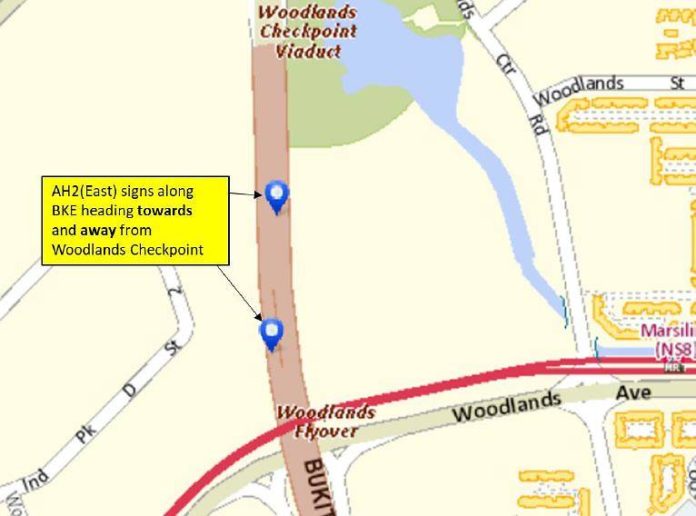
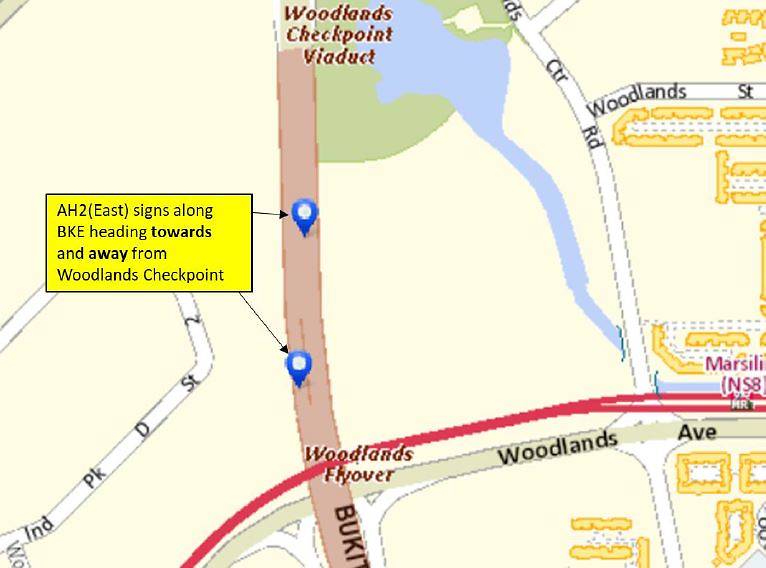
The first sign will be located along the Bukit Timah Expressway (BKE) heading towards and away from Woodlands Checkpoint. It will read AH2 (E), which stands for ASEAN Highway 2 (East).
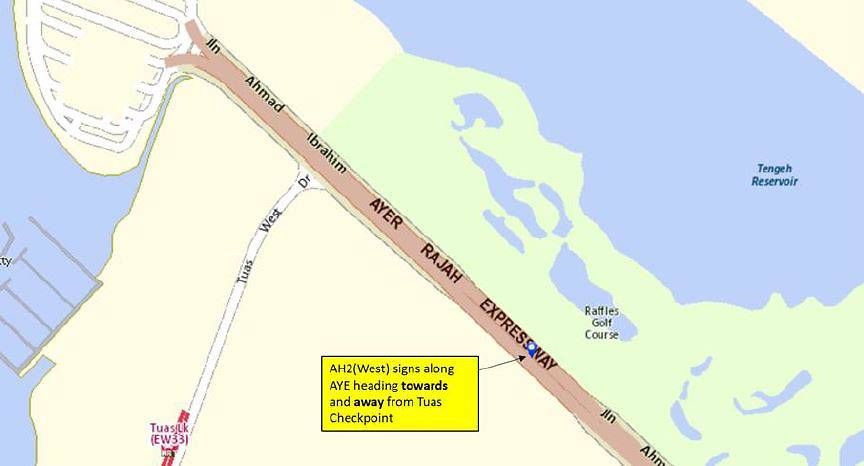
The second sign AH2 (W), which stands for ASEAN Highway 2 (West), will be placed along the Ayer Rajah Expressway (AYE), heading towards and away from Tuas Checkpoint.
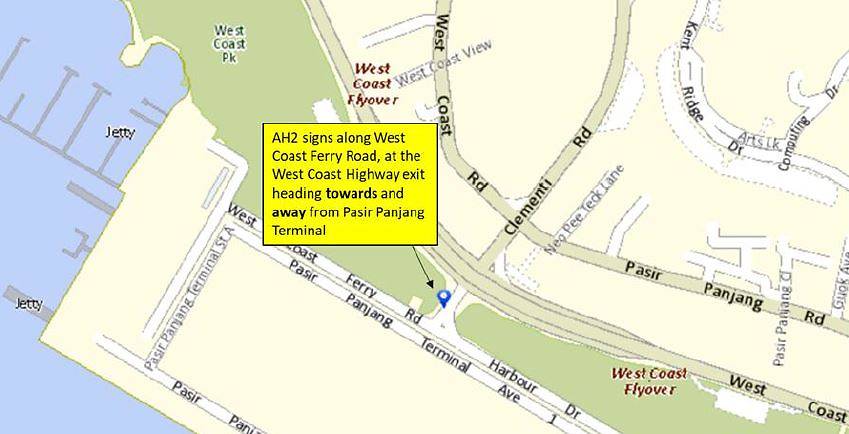
It will also be installed along West Coast Ferry Road, at the West Coast Highway exit heading towards and away from Pasir Panjang Terminal.
Map of AH2(E) signs along the BKE. (Image: LTA)
Map of signage indicating AH2(W) along the AYE. (Image: LTA)
Singapore’s roads form part of the ASEAN Highway 2, which spans from Muse at the border between Myanmar and China, to Denpasar in the Indonesian island of Bali, according to the ASEAN website.
“These transit transport routes are part of the ASEAN Highway Network, which enhances connectivity by linking land transport corridors across all ASEAN member states, to facilitate the movement of vehicles within ASEAN,” said LTA.
Map of AH2 signs along West Coast Ferry Road. (Image: LTA)
The road signs will be installed after the Government last month fully ratified nine protocols under the ASEAN Framework Agreement on the Facilitation of Goods in Transit, which “aims to establish an effective, efficient, integrated and harmonised regional transport system” within ASEAN.
“This marks Singapore’s commitment to the ASEAN Economic Community’s vision of deepening regional economic integration and improving intra-ASEAN connectivity,” LTA added.
SINGAPORE: The Consumers Association of Singapore (CASE) on Friday (Jul 26) warned consumers about companies in the beauty industry that use aggressive “pressure sales tactics” on customers.
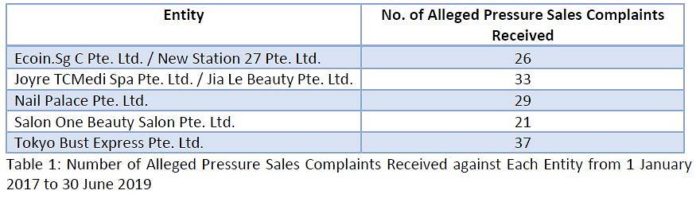
CASE said it continued to receive complaints about five businesses – Ecoin, Joyre, Nail Palace, Salon One Beauty and Tokyo Bust Express – even after it had issued warning letters to remind them that exerting undue pressure or influence on customers is an unfair practice.
CASE received 1,829 complaints against the beauty industry in 2018 and of these, 344 were about pressure sales tactics. This is an 18 per cent increase from the previous year.
“CASE takes a serious view against entities who persist in egregious conduct in their push for a sale transaction,” it said.
Of the five businesses highlighted, Tokyo Bust Express had the most complaints lodged against them between Jan 1, 2017 to Jun 30, 2019, with 37.
Warning letters were issued to the companies that had complaints lodged against them. CASE has also entered into Voluntary Compliance Agreements with some entities, where they agree to cease pressuring customers.
CASE said it is monitoring them and will refer errant retailers to the Competition and Consumer Commission of Singapore for investigation.
In its advisory, the association also reminded customers that they have the right to decline and walk away when pressured to purchase products or services.
CASE advised customers to beware of “special discount” or “one-time only” offers, as staff may use these to push packages.
“Consumers who encounter such pressure sales tactics can approach CASE for assistance,” it added.
SINGAPORE: Pathlight School, an autism-focused institution, will open its second permanent campus in 2023, announced Second Minister for Education Indranee Rajah on Friday (Jul 26).
The new campus at Tampines Street 91 will be able to take in 500 primary level students, helping the Ministry of Education (MOE) meet demand for places in special education schools.
Pathlight, which started operations in 2004 with just 41 students, now has about 1,400 primary, secondary and vocational-track students.
The school currently has one permanent campus at Ang Mo Kio Ave 10 that caters to Primary 1 and 2 students, and an interim campus at Ang Mo Kio Stree 44 that caters to Primary 3 to 6 students.
The interim campus will remain open even after the new permanent facility begins operations in January 2023.
Ms Indranee said that the location of the new campus – which used to house East View Primary School – was chosen based on the geographical distribution of Pathlight’s current demand and the site’s proximity to mainstream schools such as Junyuan Primary and St Hilda’s Primary.
“In deciding where to site special education schools and campuses, one very important consideration that we take into account is whether the location will facilitate interaction with mainstream schools,” said Ms Indranee.
“This is important because such interaction and integration will give our youth a better understanding of special needs and equip them to interact with each other,” she added.
The new campus will also feature an indoor sports hall, computer labs and specialised facilities to cater to the students’ needs, including a daily living skills room and therapy rooms.
Speaking at the launch of Professor Brawn Cafe, Pathlight’s first inclusive worksite, Ms Indranee cited research conducted by the National Council of Social Service, noting that persons with disabilities who are employed have a better quality of life.
“That is true for anyone, but more so for a person with an invisible disability like autism, as they can be frequently misunderstood or excluded,” said Ms Indranee.
“A person with a special need or a disability is no different from any other person in terms of having hopes, aspirations and feelings,” she added.
The cafe, located at Pathlight’s Ang Mo Kio Avenue 10 campus, will be open to the public from Saturday.
President of the Autism Resource Centre and MP Denise Phua said: “As a school, we know the importance of literacy, numeracy and vocational skills. Equally important, is a set of transferable skills that are useful for all jobs and across industries.”
Highlighting skills such as managing work expectations, customer needs, stamina, pace and quality standards, and hygiene and emotional management, Ms Phua added: “Once these work habits are cultivated from young, the chances of landing a job and keeping it are then much higher.”
Pathlight principal Linda Koh said that the cafe seeks to provide an authentic work experience for the students.
“The fact that the cafe’s workforce comprises staff on the autism spectrum is testament to our belief that with training and support, many people on the autism spectrum and other special needs can work.”
The cafe will provide training for up to 50 students each year. On-site job training is incorporated into the school curriculum for students in the final year of the vocational track.
The cafe will provide training for up to 50 Pathlight School students each year. (Photo: Ang Hwee Min)
There are also plans to extend this to Secondary 3 and 4 students preparing to take O-Levels at Pathlight.
Similar inclusive worksites and open community spaces will also be a feature at the new campus.
Mdm Violet Poh, parent of a Pathlight alumnus, said her son has benefited greatly from Pathlight’s support.
Her son Chester, now 19, recently graduated with a diploma in visual communications from Singapore Polytechnic and will be enlisting for National Service in October.
Chester’s artworks have been turned into products that are now on sale at the Arts Faculty shop next to Professor Brawn Cafe.
“My son loves to draw, and at Pathlight, they always look out for what they have, their talents. So it was developed and it was encouraged, and now I see his drawings selling as products.
“When he got his first cheque, he was really very happy. It’s not about the money. He’s able to work and gain income for himself, which is what Professor Brawn is about. It’s not just a cafe that serves food. It’s actually hope for all parents like me.”
SINGAPORE: More than 700 students from four special education schools will learn how to make e-payments, use emails and online chats by next year, as basic digital skills are incorporated into their academic curriculum.
The students with mild intellectual disabilities and autism spectrum disorder are from the Association for Persons with Special Needs (APSN) Delta Senior School, APSN Tanglin School, Grace Orchard School and Metta School.
The initiative follows positive feedback from a pilot conducted earlier this year involving 70 students, said the Infocomm Media Development Authority (IMDA) on Friday (Jul 26).
Principal of Grace Orchard School Lisa Goh said the skills have enabled students to be more independent. “They will be able to access government websites – where they can book amenities. They can also buy their groceries online and actually access the community more than they are able to do now,” she added.
“If they don’t catch up with this, if they are not taught … I think as a nation moving to Smart Nation, they will be even more left out.”
A virtual reality game will also be introduced, to help students learn about setting strong passwords, identifying fake news and managing cyberbullies.
It will be offered at APSN Tanglin School for a start, and other interested schools can apply to IMDA to have the programme included.
These were among the initiatives announced by Minister for Communications and Information S Iswaran on Friday at the launch of a three-day festival on digital inclusion at the Lifelong Learning Institute in Paya Lebar.
Minister for Communications and Information S Iswaran at the launch of a three-day festival on digital inclusion on Jul 26, 2019.
Mr Iswaran said technology has allowed people to do a lot more, and access to technology is a key determinant of the quality of life.
“It falls upon us all therefore to make sure that every Singaporean is able to enjoy the benefits brought by technology, and to help everyone to be digitally ready, especially our seniors and persons with disabilities,” he said.
“Building a digitally ready society is not just about ensuring that technology is accessible to all. It is also about equipping people with the skills to use the technology in ways that will enrich their lives.”
Minister for Communication and Information S Iswaran poses with the seniors who received their certificates. (Photo: Elizabeth Neo)
At Friday’s event, 40 seniors also received certificates for their completion of a digital course by TOUCH Cyber Wellness, Facebook and IMDA, where they picked up skills such as scanning QR codes and making e-payments.
Participant Chew Poh Ngee, 71, said learning to master applications like WhatsApp has made it easier for him to stay in touch with friends and family. “WhatsApp is much easier than talking, can send pictures and videos,” he said.
Other initiatives announced at the event include a collaboration between IMDA and CreativesAtWork, called STOREYS. The project calls on independent content creators to submit videos on the community, elderly, the environment, family, youth or the underprivileged. With the theme “Framing a Better Home”, the aim is to use digital platforms to drive meaningful conversations on these issues.
The three-day IMDA Digital Inclusion Festival 2019 is expected to draw 15,000 Singaporeans.
SINGAPORE: There has been an “erosion” of transparency, independence and accountability within the Government, said Dr Tan Cheng Bock on Friday (Jul 26), explaining the reasons behind his decision to set up a new political party.
“I believe the processes of good governance have gone astray,” said Dr Tan, the secretary-general of the new Progress Singapore Party (PSP), at a press conference held at Swissotel Merchant Court on Friday.
“I worry because I see the foundations of good governance eroding. Specifically, there is an erosion of transparency, independence and accountability.
“Yet these are the three foundations for creating trust between the Government and the people … This means a robust system of checks and balances. This is what the people of Singapore want and this is what they should have – so that we can continue to hold our heads high and be proud of our system of Government.”
Dr Tan Cheng Bock walks out after the press conference at Swissotel Merchant Court in Singapore on Jul 26, 2019. (Photo: Jeremy Long)
Dr Tan had announced his return to politics earlier this year, filing an application with the Registry of Societies to form a new political party on 16 Jan. His party was officially registered at the end of March.
A Member of Parliament for 26 years, Dr Tan ran for President in 2011 and narrowly lost to Dr Tony Tan.
In March 2016, Dr Tan announced his intention to run again. But he was unable to do so as the next election was reserved for Malay candidates, following changes to the Constitution that stated that if there is no President from a particular racial community for five consecutive terms, the next term will be reserved for a President from that community.
Dr Tan had also mounted a legal challenge to the reserved election. The Court of Appeal dismissed his application.
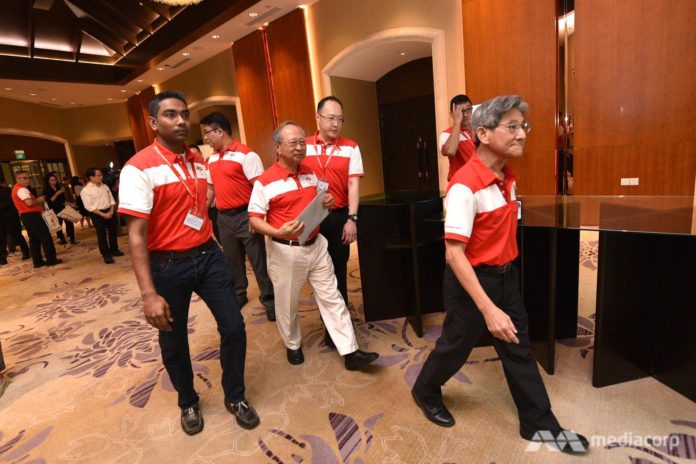
Also present at the press conference alongside Dr Tan were other members of the party’s central executive committee, namely chairman Wang Swee Chuang, assistant secretary-general Anthony Lee, treasurer S Nallakaruppan, assistant treasurer Hazel Poa and member Abdul Rahman Mohamad.
Members of the Progress Singapore Party at a media conference on Jul 26, 2019. (Photo: Jeremy Long)
During the press conference’s question and answer segment, Dr Tan declined to go into further details on specific policy proposals which will be put forth by the PSP, some of these he said will be revealed by the party during their official public launch on Aug 3 at the same venue.
“Over the years, inequality has grown and we have become more polarised,” said Dr Tan. “We need to bridge that divide.
“I want PSP to serve as a unifying catalyst, to bring people together, from all corners of society, working towards a better system for Singapore, united by a common cause – the love of our country and our fellow countrymen and women.”