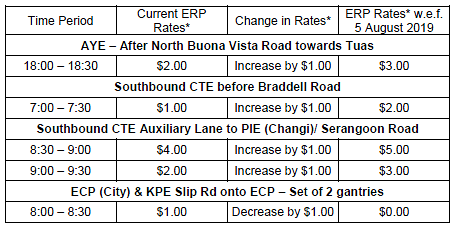
SINGAPORE: From Aug 5, the Electronic Road Pricing (ERP) charges at three gantries will be increased by S$1, announced the Land Transport Authority on Monday (Jul 29).
One of the affected gantries is on the Ayer Rajah Expressway (AYE) after North Buona Vista Road, in the direction of Tuas.
The other two are on southbound Central Expressway (CTE) – one before Braddell Road and another at the auxiliary lane leading to Pan-Island Expressway (PIE) Changi and Serangoon Road.
The affected gantries and new rates are as shown below:
The rate for the set of two gantries at East Coast Parkway (ECP) towards the city and Kallang-Paya Lebar Expressway slip road onto ECP, however, will decrease by S$1.
The next quarterly ERP review will take place in October, said LTA.
SINGAPORE: When 25-year-old fresh graduate Jared Tay received a full-time job offer, he turned it down for a 3-month contract at an e-commerce start-up.
The firm couldn’t hire me initially because their business case for an additional headcount was rejected. So they offered me a 3-month contract position. They plan to submit another full-time headcount application after.
“But they said no promises it would get approved.” he explained.
While the other full-time job offered certainty of employment, the contract position was in an industry he was more passionate about, the job scope suggested better exposure, and had more experienced people on the team he could learn from.
A job seeker holds a “We’re Hiring” card while talking to a representative from Target at a City of Boston Neighborhood Career Fair on May Day in Boston, Massachusetts, US, May 1, 2017. (File Photo: REUTERS/Brian Snyder)
I rather spend three months for a shot at a job I really wanted, than to settle for something I wasn’t as passionate about and be stuck in that role.
With impending economic headwinds, the struggle is real for many fresh graduates who must adjust their job expectations – including embracing short-term contracts, instead of seamlessly hopping into a dream job of their choice.
Understanding employer’s expectations, and managing some of their own aspirations can also help their employability.
But it takes two hands to clap. Employers also have an important role to play in aligning expectations between both sides.
CAN YOU HIT THE GROUND RUNNING?
Many top companies are adopting a cautious hiring approach this year while running on lean teams. They have limited capacity to train someone with zero experience or expertise.
They expect fresh graduates to come in with a certain base level of relevant skills or past internship experiences and be able to hit the ground running. But not many graduates can deliver on that.
One local digital marketing agency told me they found that many fresh graduates were not equipped with the skills needed to do a marketing job, despite majoring in marketing. They found a huge gap in what graduates learnt in university and they needed practical knowledge.
Attendees at a job fair line up for an interview carrying their resumes in leather bags. (Photo: REUTERS/Jason Reed)
For example, many candidates understand marketing concepts but have never run a Facebook advertising campaign or do not know how to go about implementing Search Engine Optimisation (SEO) – basic skills that many marketing roles require.
Taking a proactive approach to solving the problem, this company turned to running hands-on marketing workshops for undergraduates and fresh graduates on practical marketing skills. Fast-learning students who excelled in these programmes were shortlisted for their hiring pipeline.
HOW MANY INTERNSHIPS DO YOU NEED?
Students themselves can take action to appeal to employers. The wisdom passed down from university seniors to juniors on the best strategy to meet employer expectations is to – you guessed it – do more internships. But how many is enough?
Just a few years back, completing at least one internship before graduation used to be enough.
Fast forward to today. In a 2019 study of 274 local undergraduates ran by my company TalentTribe, a Singapore-based millennial job search platform, four in 10 said they have done or plan to do three or more internships before graduation.
Last month, I asked a first-year student from Nanyang Technological University (NTU) interning at a local startup if it was common among his friends to do an internship so soon in their university journey.
“It’s a sensitive issue”, he said.
(Photo: Unsplash/Christin Hume)
Most of my friends want to do internships starting from their first summer break. But not everyone manages to find one. So we don’t really talk about this.
Another undergraduate told me: “If you don’t do an internship during summer, even in your first or second year, most people will feel like you’re losing out to others.”
Undergraduates recognise the high stakes in getting more industry experience.
While fresh graduates are doing more to meet employer expectations, they also must manage their own ambitions to avoid getting disillusioned with what tasks they’re given when starting on their first job – some which might seem mundane.
DON’T HAVE EXPECTATIONS OF DOING ‘STRATEGY’ WORK
One of the most common frustrations employers have – and the number one expectation jobseekers should manage – is this desire fresh graduates have to “do strategy”.
Many fresh graduates enter a job thinking they will do exciting “strategic” work, only to get an unpleasant reality check after their first week on the job. Many find their job “operational” and beneath them.
Instead of developing strategies and charting new pathways for their organisations, they find themselves doing grunt work, churning slide decks or sending out email newsletters.
Many do not realise these tasks help them build knowledge of the company’s modus operandi and gain exposure to the key departments and people whose buy-in will be needed for their line of work, a baseline knowledge essential to any higher-order work they may undertake in the future.
Employers are often perplexed at their unrealistic sense of urgency to get started on strategic work.
Why? “You need to understand how the business works and get your hands dirty, before you can even understand or develop the strategy”, as a HR head of a large technology multi-national company (MNC) lamented to me.
But it’s hard to blame graduates.
One of the biggest illusions universities have seeded in fresh graduates is the idea that they are qualified to jump into strategic work from day one.
Many university modules today involve project work based on real-world business problems that aim to better prepare them for working life. But these can create false expectations.
The reality is graduates may have good grasp of frameworks to think through a problem. They are often asked on business case studies to “develop a marketing strategy for this SME’s product launch” or “analyse the supply chain data for this MNC and develop recommendations on how they can streamline costs”.
But what they’re missing out on is context. Many strategy-based roles require years of work experience precisely because they require the candidate to have a mastery of the industry and its complexities.
Employers must recognise these aspirations, and manage candidate expectations from the hiring phase.
They must communicate clearly the job responsibilities and refrain from painting an overly rosy picture to jobseekers who might otherwise feel “scammed” when they start work.
LOOK TO POST-GRADUATION INTERNSHIPS
For many fresh graduates struggling to find a job, my advice is to take up an internship after graduation to gain work experience, explore if a certain career path is right for them, and better adapt to employer expectations.
Jobseekers themselves are picking up on the utility of these post-graduation internships.
In a 2019 poll of 176 fresh graduates and undergraduates ran by a local early-jobseeker Telegram community WerkWerk SG, nine in 10 recommend doing an internship after graduation, though more than six in 10 recommended doing so only if the internship offers a conversion.
David Leong, a fresh graduate from National University of Singapore (NUS), has a job in a venture capital firm lined up in August, but opted to do an internship between his graduation and his new role to gain more real-world work experience and better evaluate if this industry is right for him.
Communications major Jennifer Ong did two PR internships during her undergraduate days in MNCs, but didn’t feel this career path was a good fit.
After she graduated, she did a six-month internship at a local advertising agency – before eventually converting that into a full-time position after she and her employer felt there was a good fit.
Employees work inside an office in San Francisco, California January 7, 2014. (Photo: REUTERS/Stephen Lam)
It is easier to land a post-graduation internship than a full-time job or short-term contract. Post-graduation internships help companies alleviate their manpower crunch during the post-August season, when undergraduate interns return to school.
Fresh graduates are typically also able to commit for longer periods, with the possibility of extending this employment, giving companies flexibility they value.
In this tough job market, the silver lining is that short-term contracts and post-graduation internships allow jobseekers and employers to explore if there is a mutual fit before committing to a longer-term relationship.
Just like how Jared eventually got converted to a full-time position after proving his worth to the company – and gaining the confidence this was a career path he wanted to pursue.
Sharon Yeo is the co-founder of TalentTribe, a millennial job search platform that provides an inside look into different companies and careers.
SINGAPORE: Eight hours on TikTok, seven hours on Instagram, and two hours on YouTube.
This is a snapshot of a day in the life of 21-year-old full-time model Lukas Koshy, who has been losing sleep since he got sucked into the latest social media craze, TikTok, a video-sharing app filled with 15-second lip-syncing videos, memes, and all things amusing to a Generation Z’er like him.
Five hours of sleep is all that he is mostly getting these days.
“It’s unhealthy,” the Singaporean admits, but he doesn’t see a need to change his ways.
Mr Koshy feels gainfully occupied when thinking up the next viral post, and putting out at least one to two TikTok posts a day. He has over 13,600 followers and a “like” count of more than 95,000.
“Superficial as it may seem, ‘likes’ are important to me,” he said. “It is validation for the content I put out.”
Then, there is Primary 5 pupil Aina Sofia Sirajuddin who confessed to being previously “addicted” to TikTok to a point of publishing as many as 15 posts a day when she first got started on the platform in the middle of last year.
“I just couldn’t stop doing it,” the 11-year-old said of the TikTok fad in school, which had her friends performing trendy dance moves such as “Hit the woah”, and lip-synced to music. “I get more ‘likes’ (than on Instagram), which made me feel like I was getting popular,” she added.
Although she has learnt that it is meaningless to tie her self-worth to a number on a platform such as TikTok, she would be lying if she said that her “like” count (which numbers around 6,000) and her more than 270 followers mean nothing to her.
Adding that more than half her class is on TikTok, she said that if she could have it her way, she wants one million “likes” because “a lot of people have been getting millions and millions”.
“Sometimes I am bored, so I just do it to increase my ‘likes’,” Sofia said.
FILE PHOTO: A Facebook like button is pictured at the Facebook’s France headquarters in Paris, France, November 27, 2017. REUTERS/Benoit Tessier/File Photo
The pursuit of “likes”, along with the affirmation culture that social media platforms such as TikTok have created, is in the spotlight following Instagram’s recent announcement that it would be expanding its test to hide “like” counts on posts.
In explaining the move – which began in Canada and will now be expanded to six other countries – Mr Adam Mosseri, the new head of Instagram, said: “We don’t want Instagram to feel like a competition. We want people to worry a little bit less about how many ‘likes’ they’re getting on Instagram and spend a bit more time connecting with the people they care about.”
However, many have questioned if the Facebook-owned platform’s attempt to undo the culture where users, especially teenagers, become concern or even obsessed about what others think of them is a case of too little, too late.
In response to queries, an Instagram spokesperson said: “We want Instagram to be a place where people feel comfortable expressing themselves. That includes helping people to focus on the photos and videos they share, not how many ‘likes’ they get.”
Instagram’s trial is being conducted in New Zealand, Australia, Brazil, Ireland, Italy, and Japan – in addition to Canada, where testing began in May. “We chose these markets to get a better sense of how the experience resonates with Instagram’s global community. We don’t have any specific timing to share right now about other countries,” the spokesperson added.
While Singapore is not one of the countries picked for Instagram’s trial, many social media users here are also not immune from the “likes” chase, with even children as young as eight years old jumping on the bandwagon.
MOVE OVER, FACEBOOK
At 11, Zave Phua is already an active citizen of the social media world – a self-professed YouTuber and livestreamer with more than 50 subscribers across YouTube and Twitch, a live-streaming platform for gamers.
“Every day when I wake up, I think of how many subscribers I am getting now, how many views I am getting now, and also how much homework I have now,” the boy said.
To him, every “like” is a sign of affirmation that online users have “either enjoyed my content or my personality”. “It makes me strive to be better,” he said.
Facebook is absent from his world because it is “irrelevant” and “for old people”, Zave said with a grin, as he echoed Sofia’s thoughts. Nobody pays attention to what children post on Facebook.
On YouTube and Twitch, however, he could be a star or a hero.
His first YouTube videos showed him folding paper boomerangs and ninja stars, which “did not really work out” in attracting an audience. He then moved on to levitating using a camera trick and reacting to eating really spicy food, “which gave me a lot of views and gave me the courage to keep continuing”.
Among his exploits was a clickbait video which he titled “Porn at its finest XD” and contains only shots of the ceiling and his face. The Internet fell for it, with the video drawing 100 views in a short time. It prompted him to make a reaction video out of it, titled “Clickbait is too powerful”.
Zave is now into live-streaming his game plays on the wildly popular Fortnite Battle Royale during which a sign, “Streaming in process. Please do not come in”, will be hung on his bedroom door to keep away family members.
He would also record his game plays and cut them up to make video compilations for the YouTube platform.
This illustration picture shows the video game Fortnite logo displayed on a tablet in Paris, on February 18, 2019. (Photo: AFP/Lionel Bonaventure)
Zave now depends on these “better quality content” to build a proper viewer base, or fanbase as he would like to call it.
“My first milestone will be 100 YouTube subs (subscriptions) and 100 Twitch followers,” he said. “My second milestone will be 1,000 on both Twitch and YouTube, and third would be 10,000. And it would just be going on from there.”
On Instagram, Generation Z (those born between 1995 and 2015) co-exist with the general population, and some of their ways bewilder even millennials in the slightly older age bracket.
For example, millennials interviewed said that they mostly treat their Instagram profile as a visual diary, but Generation Z members tend to heavily curate their profiles as an extension of their identity.
Fresh graduate Ili Nadhirah Mansor, 25, said that this could be seen by how younger users post statuses such as, “Be right back. Deleting stuff” or “Rearranging feed.”
Mr Samuel Zhu, 35, youth coordinator at Tabernacle of Joy church, observed that some young people are keeping at least two Instagram accounts – a “main” account and a “private” account.
The main account usually comprises a well-curated series of photos and is made public, while the private account is a “controversial” space where “no parent, pastor, or teacher” could exist and only trusted individuals are let in.
Some have a third “spam” account, where they dump random posts of things that might not be the prettiest but caught their attention, Mr Zhu noted.
He added that for these younger set, keeping separate Instagram accounts is – among other objectives – a way of managing their public profiles by putting their best self forward.
Conversely, the youth tend to reveal their true feelings or states of mind in their private accounts or Instagram stories which disappear after 24 hours.
Ms Ili recalled how she discovered two of her friends were struggling with depression: “It’s always the ‘Insta story’. Their profiles are always fine. You always have to watch ‘Insta story’ to find out what is wrong.”
Mr Zhu believes that over time, young people learn to pose in a certain way – looking down at a certain angle, for instance – or create specific types of content that would give them the “likes” that they are seeking.
Fashion student Gigi Soh, 22, recalled that when she was in Secondary 3, she used to head outside to take pictures which she will post on Instagram just to show that she “has a life”.
She also followed Instagram trends such as adding white borders or drawing white lines on the photos using third-party apps.
“I was hypersensitive in the first two years (of using Instagram),” Ms Soh said, noting how the feeds of her and her friends would turn out similar.
These days, she is more relaxed about what she puts up on Instagram.
Women pose for a selfie in Shanghai on Jan 8, 2017. (Photo: AFP/Johannes Eisele)
Ms Soh is now a fashion communications and promotion undergraduate at the Norwich University of the Arts in the United Kingdom.
These days, she uses her Instagram account as an extension of her portfolio, which she believes would be taken into consideration by prospective employers in her industry.
DANGERS THAT LURK
Sociologist Tan Ern Ser from the National University of Singapore (NUS) said that for many young people who grew up with social media, life online “can constitute a big part of their social environment”.
He added: “I reckon some of these kids imagine themselves to be social media sensations.”
Indeed, some parents said that they knew of cases where children as young as four were starting to speak with a “YouTube slang”.
One parent, who declined to be named, caught her five-year-old daughter pretending to be a “vlogger” in front of the mirror by saying: “Click here to subscribe. Click here for more.”
Sofia, the Primary 5 student who used to be addicted to Tik Tok, recalled how she taught herself singing via YouTube.
Three months ago, she started performing song covers and uploading the videos on YouTube.
With the praises she started getting for her singing, she felt encouraged to put herself out on social media even more.
Dr Vincent Chua, an associate professor in sociology at NUS, said that social media’s “liking culture” latches on young people’s desires for affirmation – especially from friends – and popularity, as well as the need to be noticed.
Any young person would want to be “cool” and popular growing up, but taken to the extreme, such a desire breeds superficiality, insecurity, and most of all, a culture of unhealthy comparison, sociologists said.
Dr Chua said: “When all of life is mediated by a screen, and marked by portrayals of the idealised self, we learn to see others for their appearance and not for their substance. And the youth – and all of us – must learn to tell the difference.”
Experts interviewed reiterated that even if Instagram were to eventually hide its “like” count for all users around the world, people can still turn to other social media platforms to satisfy their need for affirmation.
Mr Chong Ee Jay from Focus on the Family Singapore, a non-profit group that works to strengthen family ties, said that the social media landscape has evolved to such an extent that mobile applications are going all out to capture the limited pool of users and attention span.
Assoc Prof Tan from NUS said: “Feeding people’s ego is good for business and banning (‘likes’) is not an effective tool … If people are addicted to affirmation, they would likely look for other alternatives, and there will be platforms, existing or future, willing to oblige, if in more subtle ways.”
Eventually, these platforms could “produce a generation inclined to instant gratification, unrealistic expectations, perpetually experiencing a satisfaction gap, and treating others in a rather superficial and instrumental way”, Assoc Prof Tan warned.
Mr Koshy noted that users are already drawn by how they can gain followers faster on TikTok compared with Instagram.
With short videos of up to 15 seconds, TikTok has become a major rival to Facebook, Instagram and other social network sites. (AFP/SANJAY KANOJIA)
However, he agreed that TikTok is “a messed-up place”, with trolls and bullies liking posts of people who are disabled or not good-looking, for example, as a way to mock them and help their posts go viral.
There are also concerns that such platforms could be exploited by paedophiles as tools for sexual grooming, the experts said.
Users are known to leave suggestive comments on posts put up by children, usually in the confines of their bedrooms.
Responding to the concerns, TikTok’s user and content operations manager Doreen Tan noted that its growing popularity “lies in the fact that it is a global platform that champions positive, authentic expression”.
Ms Tan stressed that TikTok is “absolutely committed to promoting a positive in-app environment” and ensures that “the community remains positive by fully empowering TikTok users to filter out negativity in their comments through the app”.
She added: “We also have built-in features like restricted viewing mode, in-app reporting, and our moderation team removes inappropriate content and terminates accounts that violate our terms of service.”
There are also policies and tools such as its community guidelines to “help people understand how to use the platform in a positive and appropriate way”.
MORE YOUTH STRUGGLING WITH SELF-ESTEEM ISSUES
Youth counselling centres and clinics said that they are seeing more cases of youths struggling with self-esteem issues due to their exposure to social media.
AMP, previously known as the Association of Muslim Professionals, cited as an example a 13-year-old boy who enjoyed the attention from posting videos of himself dancing on Instagram so much that he put up a video of himself dancing half-naked – and this later went viral on another platform and caused him much distress.
Psychologist Joel Yang from Mind What Matters clinic said that among the cases which he has seen was a 16-year-old student from an all-girls school. The girl checks Instagram every hour, takes up to an hour to craft a post, and will delete posts that do not reach a minimum number of “likes” after half a day, Dr Yang said.
“The teens I see are usually depressed, self-harming, or anxious. Social media exacerbates their condition. Already depressed, they start to compare themselves to impossible social media standards, and this further enhances their sense of hopelessness,” Dr Yang added.
The youngest person who had consulted him was a nine-year-old who was grappling with social media comparison and cyber-bullying issues.
For these children, society needs to encourage them to limit their social media time, and educate them about how social media can be used as a way to stay connected socially and “not as a means of social mobility”, he said.
Dr Rebecca Giess, a clinical psychologist with Promises Healthcare, pointed out that although social media is “second nature” to teens, they need to be reminded that it can bring increased exposure to harm, such as cyber-bullying, social isolation, and a fear of missing out.
ROLE OF PARENTS AND SOCIETY
When it comes to exposing young children to social media, parents interviewed appear to have contrasting approaches.
At one end of the spectrum, some parents prohibit their children from using social media until they enter secondary school. At the other end, some parents are eager to expose their children early on when they are more receptive to parental advice and guidance.
Mr Muhammad Asraf, a father of four, said that his oldest son, who is now 11, had asked for access to Facebook and Instagram when he was in Primary 4 because most of his classmates had their own mobile phones.
But the 35-year-old technician wants his boy to wait until he completes primary school.
Housewife Kerri Tan, 38, said that she would let her son – who is eight years old – have “limited” access to social media only when he enters Primary 5, while freelance photographer Koh Mui Fong, 39, said that she now allows her girls aged seven and 10 to play pre-downloaded mobile games and watch music videos on YouTube.
“There are too many things on social media that are fake,” she said. She added that instead of spending time on social media, her girls occupy themselves with activities such as playing dress-up, drawing and singing.
A child uses a mobile phone as she takes a bus in Beijing on Jun 26, 2019. (Photo: AFP/Wang Zhao)
Ms Angie Chew, an adjunct associate professor at NUS who is also a mindfulness trainer, took a different approach. The 55-year-old had allowed her children, who are now 21 and 23, to go on social media when they were just eight years old.
She added: “I’d rather teach them young – at an age when they’re willing to learn from parents. As they grow older, they don’t want to learn from parents. They want to learn from friends. The earlier you teach them, the more receptive they are.”
She pointed out that social media is a new fact of life through which many life lessons could be gleaned – even when a child could start off looking to social media as a way to gain popularity.
“How do we stop (children from craving to be popular)? It’s like how can you stop a kid from talking?” she said. “You can’t say, ‘I’d keep them at home because they should not be socialising with anybody at this age.’ You cannot isolate them. If anything, social media is not going to go away. It has become part and parcel of our world today. So, teach them.”
If parents are “too strict” about their children’s use of social media, they could do things behind their backs, she said. Unsupervised, they are exposed to greater dangers, she reiterated.
Sofia’s mother sees it the same way: Madam Amisah Bahrom, 45, a clinical manager at Gleneagles Hospital, said that parents should allow their children to do as they wish on social media “as long as they know the limits”.
Sofia’s 25-year-old brother, Mr Muhd Shahfieudin Sirajuddin, finds his sister’s TikTok obsession “annoying” but normal. “Children today play through technology and their social networks,” he said.
Through TikTok, he has seen his sister “mature”. “I know she can defend herself (against online bullies). She knows what to reply.”
When she has problems, she knows that her family will always give her the best advice, he added.
With the help of TikTok, Sofia, who used to be shy about expressing herself, had also plucked up the courage to join her school’s speech and drama club.
Zave’s father Albert Lam, 51, chief executive officer of a spa and beauty salon, said that it is good for children to dream, referring to his son’s ambition to be a YouTuber with many subscribers.
“I do not want to hold him back. As long as he is not overdoing it (by neglecting his studies or family time), it is fine,” Mr Lam said.
“Social media is a must. I don’t mind (Zave being on it) because everybody is doing it. You must keep up with the times or be left out,” he added.
Mr Brian Poh, a senior clinical psychologist in the Department of Developmental Psychiatry at the Institute of Mental Health, reiterated that it is impossible to eradicate the use of social media among youth.
“(Parents) can prepare them for stressful situations by solving problems together and rehearsing how to handle specific situations like cyber-bullying.” he said.
Dr Vinti Mittal, director of SACAC Counselling, which offers counselling and psychotherapy services, said that apart from parents, other parties – such as educators, medical professionals, Internet experts and governments – should also play their part in recognising and mitigating the dangers.
“Unfortunately, it is only recently that the effects (of social media) are catching (society’s) attention,” she said.
Educational institutions and governments need to join hands to “ensure there are appropriate laws and guidelines for adults, children’s safety and privacy protection online”, she added.
SINGAPORE: A multi-agency task force charged with driving efforts to promote healthy living in Singapore on Sunday (Jul 28) proposed that vaccination subsidies be given to Singaporean adults and Permanent Residents to protect themselves against vaccine-preventable diseases.
The HealthySG taskforce said subsidies for vaccinations against the seven illnesses and diseases covered by the National Adult Immunisation Schedule (NAIS) including influenza, chicken pox, measles as well as pneumococcal disease, would make them more affordable.
Vaccinations against the flu and pneumococcal infections such as pneumonia and meningitis are encouraged for adults with medical conditions like asthma and diabetes, the task force said.
“These are people who are more prone to the complications, and therefore, it is all the more recommended for them,” it said.
In an addendum on the recommendations, the Ministry of Health (MOH) said the subsidies are expected to be rolled out before the end of 2020 and would help improve the current take up rate of about 12 to 14 per cent among adults.
MOH said it aims to have more than 50 per cent of adults vaccinated against diseases under the NAIS within five years of the rollout.
The subsidy was one of 11 recommendations made by the task force which said: “Collectively, the recommendations aim to promote the health of Singaporeans of all ages and backgrounds, building upon the health promotion work carried out by the Health Promotion Board (HPB) over the years.”
SUBSIDIES FOR PEOPLE TO QUIT SMOKING
The task force also recommended subsidies for smoking cessation programmes in public healthcare institutions.
New pilot programmes to test out various care models will run for a year from March 2020, targeting smokers in and out of the hospital setting, as well as pregnant smokers and their spouses.
“Different people can try out slightly different approaches, so we can compare, see what are the best practices,” the task force said.
“We will systematically reach out to all smokers who receive treatment at the PHIs (public healthcare institutions) and offer fully subsidised nicotine replacement therapy tied to these pilots, such as nicotine gum and patches, to complement existing cessation counselling,” MOH said.
This would enhance their chances of success in quitting, it added.
An employee holds several no-smoking signs. (Photo: Reuters/Leonhard Foeger)
“One in six smokers contemplates quitting, but only three in 100 actually take action. We believe we can do more to enhance the success of cessation programmes in Singapore by nudging smokers towards taking action,” MOH said.
The pilot programmes are expected to reach at least 10,000 smokers over the next two years, and contribute to existing efforts towards lowering smoking prevalence to below 10 per cent, from the current 12 per cent.
An initial S$5 million will be allocated for these programmes, MOH said.
To help individuals track their personal health status, the task force recommended a lifelong virtual health booklet be developed. It will be hosted on the Health Hub portal and can also be accessed through a mobile app.
“This extends the benefits of the child health booklet into adulthood by creating a comprehensive and reliable health repository,” the task force said.
Users will see a personalised dashboard with relevant information to help them manage their own health as well as reminders on medical appointments and follow-ups, the taskforce said.
The virtual booklet is expected to be rolled out in the last quarter of next year, with those aged 40 to 59 the first to use it.
The task force said the booklet will benefit them the most, given that risks for chronic diseases start to present themselves from age 40 onwards.
Information from public healthcare institutions are already accessible on Health Hub, but the inclusion of other health information and test results, including from private sector healthcare providers would make it a comprehensive and reliable personal health repository, said the task force.
“One of the big steps we want to take is to be quite agnostic about the source of the data, so it means using data wherever it’s available to help the individual collate,” it said.
For the lower-income who may not use the portal, the HPB will have outreach activities, it added.
To encourage better eating habits, HPB will increase the number of hawker stalls offering at least two healthier choices by 400 under the Healthier Dining Programme over the next two years. This would increase the number of healthier meals sold by six million per year, the task force said.
TARGETING THE LOWER INCOME, YOUNG WORKING ADULTS
HPB will also customise a support programme to encourage disadvantaged Singaporeans to live more healthily, the task force said.
This involves a “passport scheme” to encourage them to take part in activities such as guided healthier eating trails, cooking classes and nutrition workshops. Local volunteers such as trained “Health Ambassadors” will also be on hand to help them.
They will receive incentives for their participation, the task force said.
In explaining the focus on this group, the task force said that that based on MOH surveys, lower-income individuals smoke more, are more overweight, and have poorer diets. This, it said, is not unique to Singapore.
“This is a shift in approach as HPB’s efforts to date are mostly developed for the general public, taking into consideration cultural and ethnic nuances where relevant. For the first time we are customising health promotion messages and efforts to the needs and circumstances of the lower-income groups,” MOH said.
“A preview of the initiative will begin in the third quarter of 2019. We aim to launch the full programme in the second quarter of 2020 and reach at least 15,000 residents,” the ministry added.
A pilot programme to encourage Professionals, Managers, Executives and Technicians (PMETs) between 25 and 40 years of age to be more physically active will be rolled out in the last quarter of next year. It will involve three companies for a start.
“In this demographic profile, usually they are starting out in their career, they have family, young children, older parents to take care of. So in our health and National Sports Participation Survey, there is a general dip in physical activity,” the task force said, adding that it is important to intervene at the workplace, where they spend a lot of their time.
More broadly, the task force said it aims to shift 200,000 people from sedentary to occasional or regular physical activity by 2024.
With this in mind, it also recommended the use of Healthpoints as payment at designated ActiveSG facilities.
Individuals earn these Healthpoints through HPB-driven activities such as taking part in the National Steps Challenge. They can already be used to redeem eVouchers from a variety of lifestyle retailers, F&B outlets and supermarkets.
To make it easier for Singaporeans to book facilities for sports and community activities, the taskforce recommended that a one-stop booking platform be created. This is targeted to be rolled out in the second quarter next year.
The task force also recommended the Government co-fund the provision of shower facilities and lockers at workplaces to encourage more people to choose active options for commuting such as cycling.
Focusing on the older segment of the population, it said that it will promote active ageing for Singaporeans aged 50 and above.
The task force chaired by Senior Parliamentary Secretary for Health Amrin Amin had engaged about 300 Singaporeans aged between 18 and 60 since November last year prior to making the recommendations.
“We believe that the key success factor to the transformation of health promotion is to work with each and every Singaporean, from individuals to health practitioners, community and
SINGAPORE: A stroll around most supermarkets reveals how important plastic seems to be in the sale of fresh food.
Fruit and vegetables are often wrapped in plastic while meat and fish usually comes in a tray encased in clingwrap. There are also usually plenty of plastic bags on hand for those loose items that shoppers select before they’re weighed and priced.
Such scenes are repeated at supermarkets around the world.
But questions are starting to be raised about whether more should be done to reduce the reliance of supermarkets on plastic packaging, as the debate extends beyond cutting down on plastic shopping bags.
For instance, Sainsbury’s in the UK recently announced that they will be trialing plastic packaging-free fruit and vegetable aisles in their grocery stores. Two superstores will give customers the option of bringing their own containers or buying a reusable drawstring bag for loose produce.
But experts and industry players think a similar move in Singapore is unlikely.
Workers sort through trashed plastic at a recycling plant in Singapore. (File photo: TODAY/Jason Quah)
Professor of environmental economics at Nanyang Technological University Euston Quah believes eliminating plastic packaging completely in supermarkets is not practical and could cause problems elsewhere. “Paper for wrapping can tear easily and hygiene could be compromised.
“Bringing your own bags can also result in contamination, especially when people do not wash their bags often, which is also at the expense of water resources.”
Mr Jonas Kor, director of corporate communications at NTUC FairPrice, told CNA that while the brand remains committed to environmental sustainability, food safety and quality remains a priority.
“To reduce damage and minimise cross-contamination particularly for fresh produce, we use a variety of packaging including cling wrap, foam nets and trays and bags, depending on each type of fruit and vegetable.”
He cited white radish, corn and leafy vegetables as some examples of fresh produce that is typically pre-packaged by suppliers to protect them from damage while in transit, noting that this reduces food waste.
“Nonetheless, where possible, we sell produce ‘loose’, such as hardier fruits like oranges, apples and avocados.”
MP for Nee Soon GRC Louis Ng told CNA that he agrees that there is a hygiene concern in eliminating plastic packaging or plastic bags for fresh produce.
“Unlike a lot of other countries where it’s more temperate, when you bring meat out here, it defrosts and gets a bit sticky in the bag. Same goes for vegetables. I do think we can draw the line there.”
Mr Ng, who called for a surcharge on all single-use bags, except those used for fresh produce, in an adjournment motion in Parliament in October last year, thinks Singapore cannot go completely plastic bag-free, especially for those who stay in HDB estates and use plastic bags to dispose of their waste.
“Unlike other countries where they might not need it, in Singapore, if you don’t use it, that creates a real hygiene concern in our public estates.
Singapore uses about 1.76 billion plastic items each year, according to the Singapore Environment Council’s position paper published in 2018. This includes 820 million plastic bags from supermarkets, 467 million PET bottles and 473 million plastic disposable items.
According to NEA, packaging waste, including plastics, make up about one-third of domestic waste disposed of in Singapore.
Dairy Farm Group, which manages supermarkets Cold Storage and Giant, said it is “constantly looking at ways to reduce single-use plastic waste”, and is working with local government agencies and packaging industry groups to find long-term solutions.
REDUCING EXCESSIVE PACKAGING
Manager of Zero Waste SG Pek Hai Lin said: “We are aware that most foods are imported and packaging can increase the shelf-life of certain food types, but we can reduce excessive packaging of certain items.
“Supermarkets might have more information on how much packaging is needed to increase shelf life of food.”
Nonetheless, environmental expert and founder of Plastic-Lite Singapore Aarti Giri thinks local supermarket chains could do more to reduce plastic packaging on fresh produce.
“Better differentiation needs to be made between minimally packaging delicate produce and more robust ones like capsicums and bananas,” she said.
By 2020, businesses will have to report the type and amount of packaging they put into the market to the NEA, and outline their plans for reducing it. This applies to brand owners, manufacturers, importers of packaging and packaged goods, as well as supermarkets with an annual turnover of more than $10 million.
Ms Giri urged local supermarkets to adopt packaging-free aisles for fresh produce and pass on the cost savings from the packaging reduction to consumers, to encourage them towards packaging-free produce.
She outlined two other solutions – alternative biodegradable packaging materials such as banana leaves or bio-plastics, and working closely with suppliers to reduce retail-level packaging.
Mr Kor said FairPrice works closely with its suppliers to maintain the quality of its produce while avoiding excessive packaging when transporting and retailing these products.
MORE CIVIC MINDEDNESS NEEDED
In the past year, several smaller, zero-waste grocery shops like Unpackt and Reprovisions have opened across the island, where customers bring their own containers for a wide variety of groceries. But founders say even they foresee problems in selling packaging-free fresh produce.
Founder of Unpackt Ms Florence Tay said while the initiative may be good for the environment, it may create another set of problems such as food waste.
She ran a short trial selling fresh produce at Unpackt, located in Jalan Kurau, but found that shoppers lacked “civic mindedness” and “were more keen to play with the fresh produce”.
“Some shoppers are not considerate and may poke and rummage through the produce,” adding that large chain supermarkets would have to employ more manpower to man the packaging-free aisles.
Co-founder of Reprovisions Mr Allann Tay agreed that customers are likely to abuse packaging-free fresh produce, because Singaporeans tend to try and pick the nicer looking fruits and vegetables, which may damage others lost in the shuffle.
The store, located in Jurong Point, sells mostly dried foods that are easy to store in bulk. Mr Tay said they have yet to bring in fresh produce due to space constraints, but are looking at a second, bigger location that can provide more product
Mr Tay also pointed out that most of the products sold in supermarkets are packaged by suppliers or manufacturers, making it less practical for supermarkets to enforce packaging-free standards. “There isn’t much brand differentiation once there is no packaging. Supermarkets cater to people who want the branding and packaging, whereas shops like us caters to those who can do without it.”
THE COST OF CONVENIENCE
Prof Quah believes there would be backlash if such measures are implemented because there are “no clear alternatives” to plastic bags and packaging.
He added that most Singaporeans still value plastic packaging and plastic bags for their convenience and multiple uses, and supermarkets must establish “a clear return” for reducing plastic use.
“Supermarkets must offer clear incentives to entice consumers to behave accordingly. There must be a connection that consumers can see, that their efforts are translated to gains other than environmental gains.
“Worse still, consumers might perceive environmental gains coming at their expense, along with cost-savings and higher profits for the supermarkets.”
Instead of cutting out packaging entirely, supermarkets can instead look at where packaging can be reduced, he said. For example, discouraging the purchase of individually packed items.
ALTERNATIVE OPTIONS STILL GROWING
Despite their troubles, zero-waste grocery stores remain positive that Singaporeans are making the shift towards bringing their own bags.
Mr Tay said customer feedback at Reprovisions has been positive.
“We encounter people who are quite open to the concept once they know they are doing something good for the environment and future generations.”
Zero-waste grocery stores are not a new concept, said Ms Tay, who opened Unpackt in May last year.
A wet market in Singapore. (Photo: AFP/Roslan Rahman)
“We have shopping alternatives in traditional provision stores that still sell food in bulk. The local wet markets are also a good place to look for packaging-free fresh produce.”
Ms Tay noted that shopping package-free takes a lot of discipline and mindfulness.
“Most people are already conscious of the environmental issues. They just need a few more nudges to action.”
However, Ms Giri said while most consumers are aware of the detrimental effects of plastic pollution, not all see the urgency in choosing sustainable options.
“The resistance from shoppers should not be taken as an excuse to prolong a problem. That would be very short-sighted of us and at the expense of the health of our future generations and our biodiversity.
“The urgency to address climate change and enforce mitigating solutions is much akin to that of controlling an on-going infectious epidemic. Efforts need to be relentless and continuous.”
And while others might be content enjoying their off-days in the comfort of air-conditioned shopping centres, Mdm Tan Lian Hua is having the time of her life on a sweltering Saturday afternoon at a hawker centre.
The 76-year-old’s memory is foggy – she can’t always remember the names of people, places and dates.
But when she sees the plate on the table before her, her eyes light up in recognition.
It’s chicken rice – her favourite.
A resident of Thong Teck Home for Senior Citizens, Mdm Tan is unable to leave the home on her own to enjoy her favourite meals.
But with the help of a group of volunteers from the Jiak Simi (hokkien for ‘What are we eating?’) project, she can.
Mdm Tan Lian Hua savours a spoonful of chicken rice. (Photo: Matthew Mohan)
Founded by volunteer Owen Tan in 2016, Jiak Simi aims to bring seniors to food places which they would otherwise not be able to visit on their own.
“I started as a food technologist so I worked to develop food for older adults with swallowing difficulties,” 29-year-old Mr Tan told CNA. “So when I was doing this, I thought: For those uncles and aunties who still can eat, why don’t they have the right to choose the food they want? So I decided – why don’t I form a small group with my friends and we can bring a small group of aunties and uncles to go hawker centres to eat?”
The ability to choose one’s food is a basic right, suggested Mr Tan, and he wanted to return that back to the seniors.
“Being able to choose what you eat is a right, but in a nursing home … you lose the dignity to choose the food that you like,” he explained. “If one day I told you that you can no longer choose the food that you like, how would you feel?”
A member of Youth Corps Singapore, Mr Tan had already been volunteering at the home prior to the setting up of the project.
“Normally we would go there to organize Christmas parties, Chinese New Year parties or birthday parties,” he recalled. “I had already developed a strong relationship with the home … So I thought why don’t I open this idea to them – and they were quite open to it.”
As part of Youth Corps Leaders Programme, Mr Tan was given S$2,000 under the Pay It Forward award to kickstart the project. He recruited others through the Youth Corp portal, as well as neighbours, polytechnic friends, university friends and working colleagues.
Caregivers help Mr Nani Ahmad cut up his briyani. (Photo: Matthew Mohan)
Today, the group has over 50 volunteers, with outings held once every two months.
The group is now self-sustaining. They make use of their own money to charter buses to bring the seniors on outings, and pay for the lunches of the accompanying caregivers.
“Youth Corps has featured us before so some of the public have gotten to know us and are aware of us, they don’t mind contributing money for the buses,” said Mr Tan. “For the food, we encourage the volunteers themselves to treat the residents.
“Normally the caregivers eat in the home, so if we want them to go out with the volunteers and us, we have to pay for their lunch. They skip their lunch in the home to join us, so its good for us to ask them to eat lunch together, but we’ll pay for them.
“The most important thing is that the home is very supportive – this home is currently providing one caregiver to one resident (on outings) hence if we don’t really get the numbers from the volunteer side, we still can go ahead. Sometimes if the volunteers are busy, if we get eight to 10, we will still proceed.”
From Maxwell Hawker Centre to Jewel Changi Airport, Chinatown Complex Food Centre to Changi Village Hawker Centre, the seniors have seen their share – and eaten their share.
“We should thank them very much for this,” said 92-year-old Lee Kim Cheng, who estimates that he has been on three different outings. “They are so young and doing volunteer work, we should appreciate them because not all young people would volunteer to do this.
“We are at the home all the time and when there’s somebody to bring you to a new place, you should be thankful.”
Seniors are not just brought out for a meal, the Jiak Simi Project volunteers also bring them for walks at places such as at Changi. (Photo: Matthew Mohan)
Mr Tan is also keen to point out that the seemingly small action of paying for these seniors’ meals goes a long way.
“A plate of chicken rice that costs three dollars can bring so many smiles to the aunties and uncles,” he explained. “Some might say that the people we bring out are only a few but … you don’t have to help many people.
“If you can help one, then help one. If you can help a few, just help a few.”
“As we celebrate Youth Corps Singapore’s fifth anniversary this year, I am heartened to see youths like Owen continue to give back to society and engage with the senior citizens,” chairman for Youth Corps Singapore’s advisory committee Amrin Amin told CNA.
“Through my interactions with Owen, you can see his passion for volunteerism shining through. We need more youths like him to reach out to the rest of Singapore to make volunteerism a way of life.”
Mdm Tan Lian Hua shares a laugh with volunteers. (Photo: Matthew Mohan)
And with meals at the home being vegetarian only, there is added reason for the seniors’ cheer when they get to go on outings.
“I like eating meat, but they don’t serve meat,” said Mdm Tan with a laugh. “Any kind of meat will do. Today’s the first day I’ve eaten meat this year.
“I liked everything about today’s outing but if I had to choose something I liked the best, it would be the chicken rice. Our stroll to the beach is not going to make me full you know?”
But it is not just all about the food – the company of the volunteers remains something the seniors hold very dear.
“Every time I see them walk through the door, I know it’s a chance to go out. With them here, I’m happy,” added Mdm Tan.
“They have good hearts. When I come back and go back to my room, I will feel a bit sad and wonder: ‘When will be the next time we go out again?'”
SINGAPORE: The number of babies born last year was the lowest in eight years, setting off alarm bells for Singapore’s future demographic profile.
The decline in birth numbers has been tied to the rise in the median age of first-time mothers, from 29.7 in 2009 to 30.6 last year, suggesting that more women are putting off childbearing.
By contrast, a number of European countries witnessed a baby bump earlier this decade after the age at childbearing stopped climbing, as more women get around to having the children they had earlier postponed.
Why hasn’t the age at childbearing stopped climbing in Singapore? Three factors are driving fertility delay: Inconsistent messaging, constraints and overconfidence.
YOUNG SINGAPOREANS FACE INCONSISTENT MESSAGING
For many young Singaporeans, both men and women, the life script from early adolescence to our early twenties is guided by a clear consensus from parents, schools and the larger society on how to live your best life: Study hard to secure your best possible future prospects, romantic relationships can wait, and avoid an unintended pregnancy at all costs.
The messaging becomes much less tidy in the mid-twenties, when most people have completed their formal schooling. The pressure and drive to succeed have not slackened. Indeed, early career is often the time when workers face most scrutiny and evaluation, as organisations seek to pick out the most promising candidates to groom.
At the same time, young people are also suddenly expected to have an active dating life, with an eye towards marriage in the not-so-distant future.
The abrupt switch in messaging can be jarring and difficult to reconcile with the notion that success comes through hard work and personal sacrifice, which may have been interpreted as putting a pause on family formation.
(Photo: Unsplash/Matt Wildbore)
In 2017, a survey of 2,940 singles aged 21 to 45 found that nearly six in 10 were not dating with a view towards marriage. Moreover, among those not dating, around 40 per cent cited wanting to focus on their career or studies, in line with the familiar earlier life script most Singaporeans grew up with.
Beyond the sudden changes in expectations, young people today are also exposed to alternative viewpoints which argue that traditional marriage is unnecessary or even undesirable in an age of personal autonomy and expression, and which associate parenthood with overpopulation, environmental degradation and climate change.
In the absence of a clear authoritative social or scientific consensus, these viewpoints diminish any personal desire to get married or have children.
Although around two-thirds of Singapore residents will eventually get married by their early thirties, this inconsistent messaging results in a weak impetus to do so at younger ages, producing median ages at first marriage of 28.4 among women and 30 among men in 2017.
COUPLES FACE PRACTICAL CONSTRAINTS
Even couples who have made the decision to settle down and have children early might find their plans stymied by practical constraints.
Eligible Singaporeans have a strong financial incentive to apply for subsidised Built-to-Order flats, which come with up to three years of waiting time even after successful balloting. Although rental options for married couples waiting to collect their keys have expanded, couples may prefer to give birth only after their flat is ready.
File photo of a HDB BTO under construction (Photo: Jeremy Long)
Apart from housing considerations, a climate of economic insecurity and the large salary chasm between top-tier and mid-level employees can create excessively competitive work environments, especially among those who have already invested heavily in their education.
To prove themselves, employees may feel pressured to put in more hours and remain mentally engaged with their jobs at all times.
Such high demands on worker physical and mental health can take a toll on family life and even interest in marital sex. A recent survey released in July found that working hours and work-related stress were the top reasons for lack of interest in sex among Singapore newlyweds.
Since the probability of conception per cycle is twice as high among couples who have unprotected sex every other day compared to those only have sex once a week, these factors can substantially lengthen the interval from marriage to parenthood.
OVERCONFIDENCE IN TECHNOLOGY AND BIOLOGY
Many Singaporeans may also be overly sanguine when it comes to risks associated with postponing marriage and childbearing.
The same survey estimates that nearly 70 per cent of couples see assistive reproductive technologies as a panacea for fertility issues. Nearly 75 per cent did not know that success rates are lower than 50 per cent, or that the rates are highly age dependent.
The tendency to be overly optimistic regarding one’s chances of successful pregnancy is by no means peculiar to Singaporeans.
A pregnant woman, in the last trimester of her pregnancy, poses in this illustration photo in Sete, South France, March 26, 2016. REUTERS/Regis Duvignau
Multiple studies in developed countries document that women tend to greatly overestimate the probability of pregnancy at all ages, especially after age 40. The evidence suggests that men are even less informed about the effects of age on fertility.
Apart from the risks of involuntary infertility, there is also low awareness of the increased risks of birth defects, complications during pregnancy, births associated with delayed childbearing, or the health risks of in-vitro fertilisation to both mother and child
We all love to hear what we already believe. Stories about celebrities who achieve motherhood in their forties or even fifties are popular. The hype is selectively played up in mainstream and social media.
This narrative sends a positive and reassuring message which seems more consistent with notions of modern womanhood.
Beyonce announced her pregnancy on Instagram. (Photo: Beyonce’s Instagram)
As a result, many put their faith in the unfounded fertility myth that age is no obstacle to fertility, since a woman is in good health and has access to the latest reproductive technologies.
By contrast, public education campaigns can come across as insensitive, akin to asking an older woman her age, or even appear coercive, by pushing a deadline on those not yet ready or able to conceive. To others who remain optimistic, the messages can seem irrelevant (“It won’t happen to me”).
Mass campaigns can also lack a personal touch. Ultimately, it’s important to be able to trust that the messenger is not simply interested in improving the outlook for population ageing, but truly has each individual’s best interests at heart.
CHILDBEARING IN A CARING SOCIETY
The decision to have a child is a personal choice that involves not only practical considerations, but also brings into question the meaning of life itself.
In a competitive world where success is defined by one’s relative ranking in academics or career achievement, couples may feel compelled to delay parenthood because it would be irresponsible to do otherwise.
What can help turn this corner on marriage and parenthood? We need Singaporeans in their 20s and 30s to make dating, marriage and family a priority, rather than take a backseat to career success.
In fact we need Singaporeans to have that attitude at all ages, where parents can enjoy their children and impart critical family values beyond that of individual achievement. Helping our children reach their full potential as creative individuals is a laudable goal, but should not be synonymous with loading their schedules with tuition and enrichment lessons.
Why make childbearing a priority earlier in life, if it is going to be burdensome and fraught with uncertainty?
A caring society goes beyond signalling a willingness to merely accommodate parenthood – it recognises a broader definition of success and advocates for children of all academic ability levels.
The caring goes both ways: Parents should emphasise that a meaningful life involves not only personal achievement, but also enjoying family time and serving society to the best of their ability.
Tan Poh Lin is an assistant professor at the Lee Kuan Yew School of Public Policy, National University of Singapore.
SINGAPORE: The Singapore Armed Forces (SAF) and the People’s Liberation Army (PLA) will conduct a 10-day bilateral exercise that started on Saturday (Jul 27).
Both armies will engage in professional exchanges and tactical training such as rappelling and urban operations training, said the Ministry of Defence (MINDEF) in a news release.
This will culminate in a combined urban raid as part of the final mission exercise, the ministry added.
Called Exercise Cooperation, this year’s edition will involve about 240 personnel from the SAF’s 3rd Singapore Division and 1st Commando Battalion, as well as the PLA STCA’s 74th Army Group.
Troops from the Singapore Armed Forces’ 3rd Singapore Division and 1st Commando Battalion pose for a group photo with the People’s Liberation Army STCA on Jul 27, 2019. (Photo: Ministry of Defence)
This is the fourth edition of Exercise Cooperation, which started in 2009. It exercise underscores the warm and friendly bilateral relations between Singapore and China, said MINDEF.
“Besides bilateral exercises, the two armed forces also interact regularly through high-level exchanges, mutual visits, cross-attendance of courses and port calls,” it added.
The opening ceremony of the exercise at Jurong Camp was attended by Brigadier-General Frederick Choo, commander of the 3rd Singapore Division, and Major-General Liu Jia, Deputy Political Commissar of the Southern Theater Command Army.
“Exercise Cooperation is one of the cornerstones of our strong bilateral defence ties and defence relations between our two countries,” said BG Choo at the ceremony.
“Besides sharing operational experiences, one key highlight of exercise cooperation has always been the cultural exchange that takes place between our two peoples and the deep friendships that we forge along the way.”
MG Liu added that the exercise will help both militaries “enhance counter-terrorism capability, deepen communication, cooperation and traditional friendship”.