Home Blog Page 746

Singapore rapper comes out in song

0

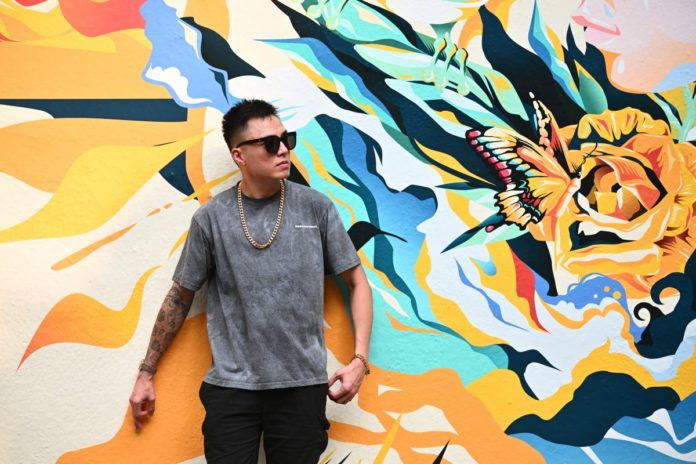
WHEN Singaporean musician Joshua Su came out to his parents, he decided to use an unconventional method — he released a new track where he raps: “G-A-Y-B-O-Y OK”.

His song “I’m OK” recounts his struggles growing up in the conservative city-state, where depictions of homosexuality are censored and sex between men is technically illegal under a colonial-era law.

Su descended into depression and attempted suicide, highlighting the challenges of coming out in a country where public acceptance of homosexuality is increasing but activists say official policies perpetuate discrimination.

“At the time I felt that it was wrong for whatever reason,” the 34-year-old told AFP.

“Maybe it could be my Christian upbringing, or that society at that time depicted that it was wrong to like guys, or that there’s no such thing as liking guys in textbooks or magazines.”

SEE ALSO: Singapore’s Pink Dot marks 10 years of calling for LGBT rights

A song with a gay theme is particularly unusual for Singapore. While the city is modern in many ways, attitudes towards homosexuality are often criticised as outdated including when it comes to portrayals in the media and arts.

Films focusing on homosexuality may be hit with a 21 and over age rating while official guidelines on radio broadcasts forbid the promotion of gay “lifestyles”.

Su, known as The G3sha, believes his latest track will not air on Singapore radio. Instead his fans have accessed it online and through social media.

‘Am I sick?’

Despite the censorship, the government is tolerant of the LGBT community, with the city-state hosting a large gay pride rally every year.

Officials nevertheless maintain that Singaporeans are at root conservative and most would not be in favour of repealing the ban on sex between men, even though it is no longer actively enforced.

“This is a society which is not that liberal on these matters,” said Prime Minister Lee Hsien Loong in a 2017 interview.

Su blames the lack of representation of gay characters in the media in part for his struggles — he recalled not knowing how to handle his attraction to boys growing up, or even “what being gay was”.

Three questions that he would ask himself every day became part of his track: “Am I sick? Is this a disease? Can I be cured?”

000_1J361A

Source: Anthony WALLACE / AFP

Su released the three-minute song through his own record label, accompanied by a music video shot in Singapore that featured his childhood photos and depicts the rapper holding his thumb and index finger in front of his eye in the “OK” sign during the chorus.

He went to an all-boys Catholic school, where he said going along with his classmates while they made fun of effeminate boys became part of his “defence mechanism”.

“Used to think that being gay was not okay/We laughed at all the boys, sissy, Ah Gua and gay,” he raps.

His attempts to hide his sexuality from everyone around him created a growing sense of isolation, which he says contributed to years of depression.

“There was no one for me to confide in and it became a very bad downward spiral,” he said.

“There was one day… I actually took maybe 20 pills, then I just went to sleep. So next thing I know I’m already in the hospital.”

‘No positive role models’

Su is not alone in his experiences.

Leow Yangfa, the director of Singaporean NGO Oogachaga, which provides counselling and support services to the LGBT community, says young people questioning their sexuality may have trouble finding support.

“For a lot of young people, there will be issues of invisibility, meaning that there will not be many or any positive role models of LGBT adults, whether in their community or in local media,” he said.

“In our local mainstream schools there is very minimal or insufficient appropriate sexuality education that covers LGBT issues.”

Su, whose day job is in marketing, has been based in Hong Kong for the last five years, where he said a more open society made him feel free to be himself.

SEE ALSO: Singapore: LGBT rally Pink Dot smashes local sponsorship target

After meeting others in the LGBT community, Su was able to accept his sexuality though he only told a small group of friends, who encouraged him to release his coming out track.

It was released earlier this month.

Su admitted being “quite anxious and nervous” about how his relatives would take it, especially members of his large extended family.

His parents messaged him and acknowledged that they had heard the song — but quickly changed the subject.

“So maybe (they’re) still not very ready to talk about it,” he said, adding:  “But for me, I feel that in their own way they kind of accept it.”

Source link

ASEAN working towards regional payments system

0

BANGKOK: The Association of Southeast Asian Nations (ASEAN) is working towards facilitating a regional payments system, as the digital economy becomes the next key driver for economic growth.

“As a digital economy becomes more important, more rampant, I think there is more interest in having a payment gateway,” Secretary-General of ASEAN Lim Jock Hoi told CNA at the sidelines of the 3rd ASEAN Media Forum in Bangkok on Monday (Jul 29).

Mr Lim was responding to questions from CNA on comments made by Singapore Deputy Prime Minister Heng Swee Keat over the weekend about ASEAN states working together to facilitate a payment system for regional trade.

Mr Lim said that finance ministers of the 10-member bloc and central banks were working towards such a system, but that certain difficulties still needed to be worked through.

“I cannot tell you when (we can expect such a system), but we are working towards that,” said Mr Lim.

“Each country has its own systems and regulations. We need to make sure the regulations are similar,” he added.

Secretary-General of ASEAN Lim Jock Hoi

Secretary-General of ASEAN Lim Jock Hoi at the 3rd ASEAN Media Forum in Bangkok on Monday Jul 29, 2019. (Photo: ASEAN)

The media forum was attended by more than 20 media professionals from the 10-member countries. The topics discussed included ASEAN’s response to the China-US trade spat and current global challenges as well as digital transformation and ASEAN economic integration.

During a dialogue session earlier in the day, Mr Lim expressed confidence in the health of ASEAN nations, saying that their economic performances “are quite positive” in spite of the current challenges.

“Trade is still positive though it is going a bit down. Investment is still coming in from within the ASEAN member states as well as from foreign direct investment. These are still very positive trajectory,” said Mr Lim.

“Coupled with digital economy which we are promoting very highly in ASEAN. This will further spur the next driver for economic growth in ASEAN,” he added.

Source link

‘You don’t know our pain’: Helping the homeless find their way home

0

SINGAPORE: When you live on the streets, a shower is one of the hardest things to come by. 

When it rains, you can take shelter in the nooks and crannies of a building. When you are hungry, temples will serve you hot food, for free.

But when you have been living in your own sweat and grime for days, there is nowhere to go.

“The smell from your body and clothes can be unbearable,” said 41-year-old “Annie”, who declined to give her real name. 

She spent two years sleeping rough with her boyfriend near the Singapore Management University in the heart of the city. 

They were living together at her place, but left after frequent arguments with her younger brother.

“He wanted to chase my boyfriend out. There was no warmth of family … so we’d rather be outside,” she said in Mandarin.

But that independence, of living without a fixed abode, came with its own set of issues. “People will point and stare,” said Annie. 

Once, she told someone off. 

“I told them not to (call us names) … I said: ‘You don’t know our pain, so why do you judge? You think we want this?’” 

They are not the only ones seeking refuge out in the open under the stars.

A 73-year-old cleaner, who only wanted to be known as Mr Yeo, spent 20 years on the streets after his wife sold their flat when he was overseas. 

He could not afford to rent on the open market, and ended up spending his nights on the streets of Chinatown. 

Mr Yeo said it is hard to get a good night’s rest out in the open, as there are often police checks.

“I’ve had my identity card (IC) details copied over 30 times,” he said in Mandarin.

FINDING THE HOMELESS A HOME

The plight of destitute people like these moved 54-year-old Brian Monteiro to seek out more members of this invisible group. 

The programme executive of the Catholic Welfare Services (CWS) took to the streets to give food and drink to the homeless in May 2014, and has never looked back. 

Today, the charity’s 150 volunteers work in four neighbourhoods, where they have befriended nearly 120 homeless persons.

Another organisation, Homeless Hearts of Singapore (HHOS) has been on the same befriending mission since July 2014. Volunteers meet fortnightly to reach out to the homeless in the city centre.

A rough sleeper gets a health checkup at a free healthcare event at Mt Alvernia hospital.

A rough sleeper gets a health checkup at a free healthcare event at Mt Alvernia hospital.

Recently, HHOS held a free healthcare event for the homeless after teaming up with private hospital Mt Alvernia. 

“Because you’re in constant survival mode every day, healthcare is the last thing on your mind,” said Claire, HHOS volunteer.  

About 15 people turned up. Volunteer doctor Eileen Soon said some of the homeless were found to have undiagnosed conditions like high blood pressure and diabetes.

The hospital gives subsidised treatments for homeless patients referred to by their outreach clinics at Toa Payoh and Redhill.

But since May 2018 – ­­­through a Government collaboration called Partners Engaging and Empowering Rough Sleepers or PEERS – the homeless have better hope of finding a forever home.

Of the 65 homeless engaged so far, 28 have been moved off the streets. Seventeen have either returned home or have moved into rental flats, while 11 are in interim accommodations such as transitional shelters.

This initiative sees officers from agencies like Ministry of Social and Family Development (MSF) and Housing Development Board (HDB) doing night walks alongside befrienders in Toa Payoh and Kreta Ayer.

The agencies tap on the volunteers’ strong ties with the rough sleepers to gain their trust and render them help. 

With the permission of the homeless person, officers are able to check if the homeless are eligible for financial aid or rental housing while on the ground. This reduces the need for them to repeat themselves to the different agencies.

“We try to bring the systems closer to the rough sleepers,” said assistant director at MSF Jaslyn Goh. 

Many rough sleepers have had negative experiences with the authorities. 

Many rough sleepers have had negative experiences with the authorities. 

PERILS OF SLEEPING ROUGH

CNA was given an exclusive invite to one of the night walks.

We met Mr Monteiro and MSF officers in the middle of a housing estate in central Singapore at 10pm. 

We began the walk after a quick briefing. As the bustle of the heartland crowd slowly thinned, it became obvious that the homeless were just hidden in plain sight all along.

One man was barely visible behind a haphazard tumble of stained plastic bags – likely holding his life’s possessions. Inches away from his bare feet, a cockroach scuttled away. 

Another slouched over a chair in the corner of a dim car park, where rubbish was strewn by the staircase landing.

In the darkness, the homeless tossed and turned in uneasy rest. Dangers abound in the streets – especially when pranksters, itching for a fight, pick on them; or when criminals eye what little valuables they have.

Annie learnt that the hard way. 

Once, her bag containing all her clothes and toiletries, was stolen when she was asleep. Luckily, she knew of organisations that give out second-hand clothes to the homeless.

During the walk, volunteers told CNA that many rough sleepers lose their ICs to thieves. This then hinders their process of applying for financial aid or housing. 

A replacement can cost up to S$300, a sum the homeless most likely cannot afford. Ms Goh said that MSF is working with the Immigration and Checkpoints Authority for fee waivers or for them to issue temporary ICs.

A rough sleeper is seen sleeping on a flight of stairs. 

A rough sleeper is seen sleeping on a flight of stairs. 

MSF says rough sleeping is complex issue involving multiple underlying social needs – from family violence to financial issues.

During the walk, the group chatted with an elderly man who was struggling with his hoarding habit. His home has become so “uncomfortable” that some nights, he sleeps by the corridor right outside his flat.

“I just cannot stop myself … so I know I need psychiatric help,” he said. 

He also told an MSF officer that he wants to find a job so he “doesn’t become a parasite to society”.

The officer persuaded him to seek help at a nearby Social Service Office (SSO), and we were told later on that he kept his appointment. 

Ms Goh added that in similar cases, the process of getting help as already been fast-tracked as the SSOs are ready to receive them, having gotten their details from the walk.

But not everyone is as forthcoming. 

“Some of (the homeless) have had negative experiences with the system,” said Ms Goh.

For those who are not ready to receive help, organisations like New Hope Community Services (NCHS), Buddha Tooth Relic Temple, and Masjid Sultan mosque have set aside part of their premises as Safe Sound Sleeping Places or S3Ps, where the homeless can spend the night, but they will have to leave in the morning.

Mr Yeo was approached and offered the temporary shelter during a night walk in May. 

He was told he was eligible for a rental flat, and being at the shelter would help HDB facilitate his request in a timely manner as they know where to reach him. 

He has since been transferred to a transitional shelter, and is now just months away from a getting his flat.

“Now I don’t have to be at the mercy of the weather,” said Mr Yeo.

MSF hopes more organisations will step up to offer the homeless temporary shelters. 

Some rough sleepers have been moved to interim accommodations such as transitional shelters

Some rough sleepers have been moved to interim accommodations such as transitional shelters, while others have moved to rental flats or returned home.

Last year, Annie found her way home after family members stepped in and her relationship with her brother improved. With the help of HHOS, her boyfriend was also successfully allocated a public rental flat. 

“I was tired,” she said. “No matter what, you need a roof over your head.”

But for many others, a happy ending remains elusive.

After the walk ended at 1am, we strolled by a sleeping man at a void deck. A gust of wind made him move under the cardboard pieces he was lying on, to get away from the chilly wind. All that separated him from the cold floor was his shirt.

In the units upstairs, many are snug in their beds. 

For him, all he had was the cardboard and perhaps the warmth of the sun in a few hours.

Source link

Confusion over definition of fire-safe PMDs as LTA reconsiders ban deadline

0

SINGAPORE: Most personal mobility device (PMD) owners remained unclear over the definition of a certified device, even as the Land Transport Authority’s (LTA) considers bringing forward the end-2020 deadline to ban PMDs which do not meet the UL2272 standard.

Last week, LTA said the deadline was being reviewed in light of recent fire incidents related to the charging of non-UL2272-certified PMDs.

The Singapore Civil Defence Force (SCDF) said in a Facebook post on Friday (Jul 26) that there were 54 PMD-related fires from January to July this year, more than double the same period last year.

READ: 54 fires involving PMDs and power-assisted bicycles reported in first half of 2019

According to LTA’s website, a PMD is given the certification after a series of electrical, mechanical and environmental tests. It will be tested as a whole system, which the authority said “better anticipates the full spectrum of usage conditions of the entire PMD, instead of just assessing individual components of a device”.

Freelance despatcher Muhd Sufian, 38, has been using his non-UL2272 compliant PMD for several years. He said that it was “ridiculous” to ban them, as he believed that they could be made compliant by putting in a better quality battery.

Owner of PMD retailer Mighty Velo, Vivian Yuan, said that there has also been confusion in the market over installing the more powerful UL2271 batteries in scooters which already meet the safety standard.

“Ongoing chatter online with some retailers is that they have a scooter UL2272 (certified), but for the scooter to go further (they will) put a UL2271 battery inside,” she said.

UL2271 is a certification used in battery products meant for light electric vehicles.

She added that she was concerned about whether changing the battery to something that is not part of the original certification would make the PMD still UL2272 certified.

A check online by CNA found at least one retailer advertising UL2271 batteries as a fire safety certified battery.

But according to LTA, any tampering with the device will nullify its UL2272 certification.

In response to queries by CNA, an LTA spokesperson said that the majority of the 85,000 registered e-scooters as of Jul 1 were not up to fire safety standards.

“Singapore is the first country to have mandated the UL2272 standard for e-scooters used on public paths. As we introduced the new standard in September 2018, the majority of e-scooters registered to date are non-UL2272-certified,” said the spokesperson.

READ: Preventing PMD fires: Tips on charging your device safely

‘NOT REALISTIC’ TO BRING FORWARD DEADLINE

Other members of the PMD community cited reduced lifespans for PMDs as a problem should LTA decide to bring the deadline for the ban forward.

Jeffrey Chan, owner of PMD retailer The Wheelies, said that bringing forward the timeline was “not realistic”.

He said some customers would have bought non-certified PMDs shortly before retailers were required to stop selling them from Jul 1 onwards.

“Customers may buy (non-UL2272 e-scooters) before the cut-off. This will shorten the PMD lifespan, (as the e-scooter will) expire immediately,” he said.

He noted that most PMDs have a natural lifespan of about two years.

man rides an e-scooter in Germany

File photo of a man riding an e-scooter. (File photo: AFP/Tobias Schwarz)

Members of the PMD community whom CNA spoke to noted that this would be an issue particularly for food delivery riders.

“Especially for low income people starting their jobs within this period, (we) need to have some allowance for them. Imagine they have a (non-UL2272-certified) device, and no money to buy a (UL2272 certified) device,” said marketing manager Khoo Chia Ching.

Full-time GrabFood delivery rider Muhd Suhaimi, 27, has been using his non-UL2272 compliant scooter for almost a year. While he is aware of the end-2020 ban for such devices, he was not aware that LTA was considering bringing the deadline forward.

“(It’s) actually a big problem, because UL2272 (PMDs) is a bit expensive compared to non-UL2272 (PMDs),” he said.

“If I cannot afford a UL2272 (PMD), I have to find another full-time job.”

Source link

Commentary: These PSLE changes won’t fix our national obsession with academic achievement

0

SINGAPORE: A few days ago, Minister for Education Ong Ye Kung said that the new Primary School Leaving Examination (PSLE) scoring model might not be the silver bullet to de-emphasise grades, but was part of a “significant reform” of the entire education system that would achieve this goal.

He was speaking in response to parental concerns that this new scoring model did not appear to bring significant changes as students would still be sorted and differentiated according to their examination results.

Is the education system evolving fast enough in order to better equip our students for the future?

SWEEPING REFORMS INTRODUCED OVER THE YEARS

The Ministry of Education has introduced a series of reforms to the education system over the past two decades with the intention of de-emphasising the primacy of academic grades and placing more emphasis on other goals such as character development, the development of 21st century competencies, fostering the joy of learning and encouraging lifelong learning.

READ: What we gain and lose in moving away from streaming, a commentary

For instance, various integrated programmes were introduced in 2004 for top-performing secondary school students to free them from the pressure of preparing for the high-stakes General Certificate of Education Ordinary-Level examinations.

The idea was that these students would then be better able to develop other non-academic attributes such as creativity and leadership.

That same year, the Direct School Admission scheme was introduced to accord priority to non-academic talents during admission exercises for secondary schools and junior colleges, and subsequently, polytechnics too.

In addition, in 2012 the Ministry of Education stopped announcing the names of top PSLE scorers and banding secondary schools according to their academic results.

More recently, the number of tests and examinations in primary and secondary schools has been reduced.

READ: Parents, don’t shy away from a competitive education system, a commentary

A NUDGE TO MOVE AWAY FROM GRADE CONSCIOUSNESS

The aim of this new PSLE scoring model appears to align with the broader intent of these other reforms. 

Among other objectives, it seeks to narrow the range of PSLE scores and move away from the current norm-referenced system where students’ scores are calculated with reference to how well their peers have done.

Classroom

File photo of a classroom. (Photo: AFP/Charly Triballeau)

In addition, there will be a narrower spread of cut-off admission scores for secondary schools in order to reduce the differentiation among secondary schools in terms of these scores.

Furthermore, parents and students are being encouraged to consider a basket of factors, such as school culture, co-curricular activities and niche programmes, when selecting a secondary school, instead of basing their choice largely on a school’s admission score range.

But how far can these existing and future reforms go in terms of pushing the education system further in the direction of moving away from our national obsession with academic grades in the direction of better preparing students for the future?

REVIEW OUR NATIONAL OBSESSION WITH GRADES

Attitudes, beliefs and behaviours are proving rather difficult to dislodge despite almost two decades of reforms.

For instance, Prime Minister Lee Hsien Loong acknowledged in his 2013 National Day Rally speech that many parents still had strong preferences for schools that they perceived to be strong in terms of academic results. 

He acknowledged that competition was intensifying and the focus on examination performance had come at the detriment to a focus on learning.

Reflecting this obsession is the fact that the private tutoring industry continues to thrive and morph in direct response to various policy reforms.

Students attending a mathematics class at a primary school

Students attending a mathematics class at a primary school. (File photo: TODAY)

READ: What is lost when we spend more on tuition, a commentary

It is clear that many parents still view education as a positional good, and that different schools and educational pathways offer different chances of “success” in life.

It is natural for parents to view education policies more in terms of what they mean for their children’s life-chances than the policy implications for macro-level goals such as equity and providing a common space for social mixing.

This tendency therefore lends itself to considerable anxiety over a host of issues such as admission criteria, assessment load, and greater permeability across various educational pathways.

The reality is that the education system is still very much a mechanism for sorting students into different schools and bands. 

There is nothing intrinsically wrong with this if one holds the belief that students have different talents and that schools ought to best cater to these differences and nurture students to their fullest potential.

READ: A hyper-competitive culture is breeding severe test anxiety among many students, a commentary

A child studying

(Photo: Pixabay)

Another reality parents must also come to terms with is that it is impossible and undesirable to expect identical educational outcomes for every student.

The active strategising by some parents to help their children gain a competitive edge in school and secure the best possible academic outcomes stands at odds with other policy objectives such as fostering the joy of learning, promoting greater inclusivity and social mixing in schools, and inculcating 21st century competencies so as to better prepare students for the workplace and for life in general.

The Ministry of Education has already tried reforms to curricula, assessment, admission systems and permeability of educational pathways.

What more might need to be done in order to truly move towards de-emphasising grades?

THE VALUE OF ACADEMIC ACHIEVEMENT

Many parents have seen in their own lives and in the lives of others the importance of academic achievement in securing access to higher incomes and more prestigious jobs. 

It is probably impossible to expect any overnight changes in this way of thinking, especially when hiring practices continue to accord great importance to academic achievement.

READ: Here’s what Singapore’s human capital index in a world of disruption should look like, a commentary

At the same time, it is obvious that many top figures in politics, business and other professions are drawn from the ranks of those who have excelled in school.

In addition, academic grades have for far too long been commonly viewed as the prime or even sole criterion of individual “merit” in the context of the national meritocratic ideal.  

PSLE results 2018 students 3

Students in Singapore receive their PSLE results. 

READ: Is academic competition really necessary to be the best than we can be? A commentary

Previous efforts to give more weight to other forms of merit in the education system have not been entirely successful. 

For instance, the Direct School Admission scheme led to some parents helping their child to develop stellar individual portfolios in non-academic talents, evidence that the scheme is fuelling an increase in the admission stakes for prestigious secondary schools, without any let-up in the pressure to succeed academically.

This side-effect led the Ministry of Education recently to revise the scheme to downplay the impact of portfolios during admission interviews.

There are arguments in favour of keeping academic grades as a key criterion of merit on the grounds that this is fairer to all students as they are judged on their performance in key national examinations and can demonstrate their hard work and individual effort.

Another argument is that de-emphasising grades will devalue the importance of doing well academically.

READ: Scrap PSLE? The Singapore education system is not a free lunch, a commentary

Generic preschool image. Photo: TODAY

A child in pre-school. (File photo: TODAY)

But then again, it has become increasingly clear that academic performance is to some extent dependent on home-based factors such as parental support.

Singapore continues to wrestle with the issue of how best to determine merit and success within an education system characterised by competitive examinations that function as sorting and gate-keeping mechanisms.

The path towards the goal of de-emphasising grades will likely continue to be a slow one.

Jason Tan is associate professor at the National Institute of Education.

Source link

Police seize S$1.74 million in illegal remote gambling bust

0

SINGAPORE: Around S$1.74 million of cash was seized during an illegal remote gambling bust, said the Singapore Police Force (SPF) on Monday (Jul 29). 

Thirty-three men and three women, aged between 26 and 75, were arrested. 

Officers raided multiple locations simultaneously on Sunday. They included Bedok, Pasir Ris, Toa Payoh, Rivervale and Chinatown. 

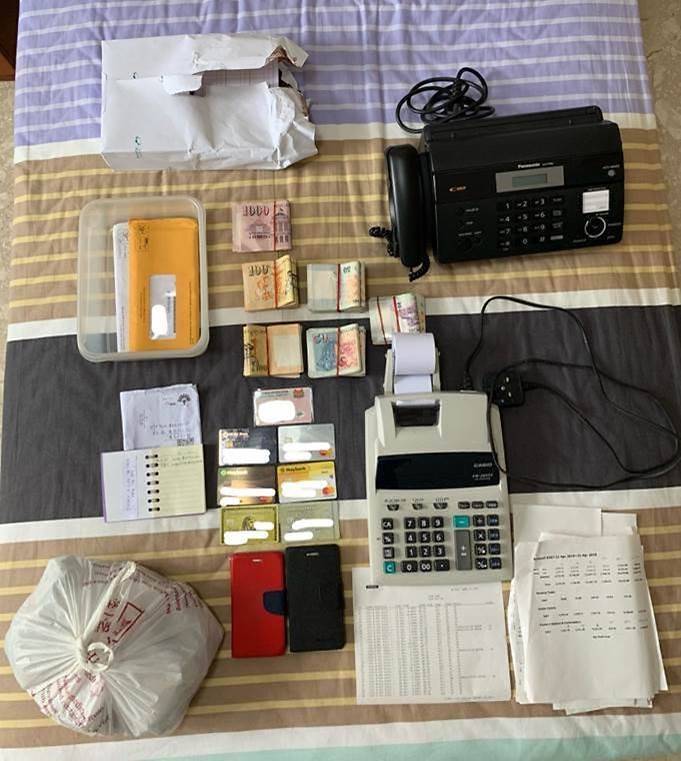
Along with the cash, items such as computers, mobile phones and other documents such as electronic betting records were also seized. 

Items seized during the raid.

Some of the items seized during the raid. (Photo: SPF) 

Money seized during the raid

Some of the money which was seized. (Photo: SPF) 

The police also initiated the freezing of the suspects’ bank accounts. 

Eleven men, aged between 26 and 40, will be charged on Tuesday for offences under the Remote Gambling Act. 

Investigations against the remaining suspects are ongoing, said police. 

More cash seized during the raid

Part of the S$1.7 million which was seized. (Photo: SPF) 

Police did not give any details on whether the suspects belonged to the same syndicate or the type of illegal gambling operation they ran.

Criminal Investigation Department director Florence Chua said that police have zero tolerance against those involved in unlawful remote gambling activities. 

“We will continue to take tough enforcement actions against those who flout the law and deprive them of their ill-gotten gains,” said Ms Chua, who is also deputy commissioner of police, investigation and intelligence. 

Source link

Man jailed, fined S$8,000 for arranging sham marriage

0

SINGAPORE: A 64-year-old Singaporean man has been sentenced to 11 months’ jail for arranging a sham marriage between a Singaporean man and a woman from China. 

Lim Peng Boon was also fined S$8,000, which in default is two months’ jail. 

According to the Immigration and Checkpoints Authority (ICA) in a news release on Monday (Jul 29), the Chinese national, 40-year-old Zheng Guiling, was on a 30-day Visit Pass when she was introduced to Lim through a friend in September 2014. 

When Zheng told him that she wanted to stay and work in Singapore, Lim offered to help her find a local man to enter into a marriage of convenience. 

Lim told Zheng to pay S$8,000 for the arrangements, of which S$6,000 would be given to her prospective husband.  

Sham marriage couple

Both Zheng Guiling and Loh Chee Wai were arrested by ICA officers on May 30. (Photos: ICA) 

Later that month, Lim introduced Zheng to 54-year-old Singaporean Loh Chee Wai, who agreed to the sham marriage. 

The couple solemnised their marriage on Oct 22, 2014. 

Zheng paid the S$8,000 to Lim, who in turn gave S$3,000 to Loh. He told Loh that the remaining S$3,000 would be paid by Zheng in instalments. 

Loh and Zheng were arrested by ICA officers on May 30 last year, and sentenced to six months’ jail each. 

Lim was arrested on Jan 14, 2019.  

“ICA takes a serious view of individuals trying to circumvent our system by engaging in or arranging/assisting to arrange marriages of convenience to obtain immigration facilities in Singapore,” said the agency.

A sham marriage, or marriage of convenience, is a ruse to help foreigners enter Singapore or extend their stay here. The act was criminalised in 2012.

Those convicted may be fined up to S$10,000 and jailed a maximum of 10 years.

Source link

First phase of Jurong Port Tank Terminals officially open

0

SINGAPORE: Jurong Port and German tank operator Oiltanking opened the new Jurong Port Tank Terminals (JPTT) in Singapore on Monday (Jul 29).

The terminal is supported by four deep-water berths, with drafts of up to 17.6m, and can handle vessels up weighing to 180,000 deadweight tonnes.

In the first phase of development, the terminal occupies about 12 ha and is able to store 252 cubic metres of clean petroleum and product storage. This number is expected to reach 550,000 cubic metres upon completion of Phase 2.

JPTT chief executive Ooi Boon Ho said that the company and its partners are in “deep discussions” on Phase 2 of the terminal. PetroChina, one of the world’s largest petroleum companies, has signed up to be the anchor customer for Phase 1.

Opening of the new Jurong Port Tank Terminals on Jul 29, 2019

Senior Minister of State for Trade and Industry Chee Hong Tat (centre) attended the opening of the new Jurong Port Tank Terminals on Jul 29, 2019. (Photo: Jurong Port)

Since Apr 1, the terminal has received, blended and discharged more than 1 million tonnes of product. It is expected to handle about 7 million tonnes of clean petroleum products a year.

STRENGTHENING SINGAPORE’S PETROCHEMICAL SECTOR  

Senior Minister of State for Trade and Industry Chee Hong Tat said that the opening of JPTT is an important part of Jurong Port’s transformation.

Chee Hong Tat at the Jurong Port Tank Terminals Central Control Room

Senior Minister of State for Trade and Industry Chee Hong Tat at the Jurong Port Tank Terminals Central Control Room. (Photo: Michelle Teo)

“JPTT had been designed with a direct pipeline connection to Jurong Island’s petroleum and petrochemical network,” he said. “This allows products to flow seamlessly between companies on Jurong Island, storage tanks at JPTT and ships berthed at the terminal.

“Companies can enjoy up to 30 per cent savings in transportation and handling costs with the pipeline construction, as they no longer need to charter vessels when transferring products from Jurong Island to Jurong Port.”

Ship loading and unloading will be up to 50 per cent faster due to the use of large-capacity pumps and jetty arms, which translate into reduced port stay times for ships and cost savings for companies, he added.

Low-sulphur fuels that comply with the International Maritime Organisation’s 2020 requirements will also be stored at JPTT. It will have a dedicated tank inlet and outlet lines to prevent contamination.

Source link

Sephora online users in Southeast Asia, Australia, New Zealand hit by data breach

0

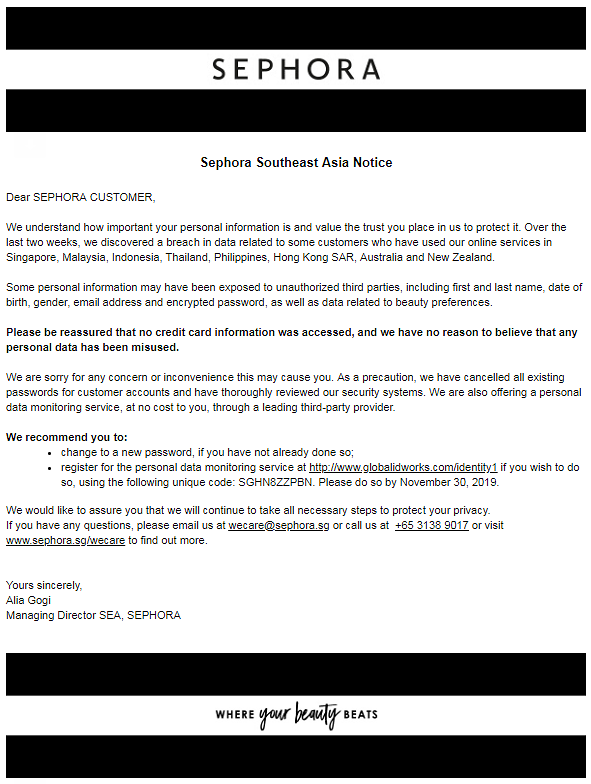
SINGAPORE: Personal details of Sephora’s online customers in Singapore, Malaysia, Indonesia, Thailand, the Philippines, Hong Kong, Australia and New Zealand have been leaked, the international beauty retailer said on Monday (Jul 29).

Sephora said in a notice to customers that the data breach, which involved “some customers”, had resulted in the exposure of personal information to unauthorised third parties.

Sephora did not elaborate on the number of users affected. 

The personal information compromised includes the user’s first and last name, date of birth, gender, email address, encrypted password, as well as data related to beauty preferences.

“Please be reassured that no credit card information was accessed, and we have no reason to believe that any personal data has been misused,” it added.

Sephora data breach Singapore Malaysia Hong Kong email

A screenshot of an email sent out to Sephora online users, Jul 29, 2019. 

Managing director for Sephora Southeast Asia, Alia Gogi said in an email to customers that all existing passwords for customer accounts have been cancelled as a precaution.

“We are also offering a personal data monitoring service, at no cost to you, through a leading third-party provider,” she added.

The French beauty giant also said that it has “thoroughly reviewed” its security systems.

Sephora’s online users are advised to change their password if they have not already done so. They should also register for the personal data monitoring service online by Nov 30.

None of the physical stores were affected, said the cosmetic retailer on its frequently asked questions page. 

“The security incident was limited to a database serving our Southeast Asia, Hong Kong SAR and Australia/New Zealand customers who used our online services,” Sephora stated, adding that it was safe for customers to continue using its website and mobile app. 

The company also said it detected the data breach “over the last two weeks” and immediately appointed independent experts to investigate. Affected customers were notified as soon as the details of the incident had been verified. 

Source link

More adversarial political system won’t be good for Singapore, says Heng Swee Keat

0

“The country cannot be going in 10 different directions because then we go nowhere,” says the Deputy Prime Minister.

dpm heng swee keat

Deputy Prime Minister Heng Swee Keat speaking to participants from the 14th Malaysian Journalists Visit Programme on Jul 27, 2019. (Photo: MCI)

SINGAPORE: A more “adversarial” system of politics with “plenty of disagreements” will not be good for Singapore, Deputy Prime Minister Heng Swee Keat told visiting journalists from Malaysia on Saturday (Jul 27).  

He was asked if he thought Singapore should evolve into a more politically evolved system with more team rivalry even within the same party. 

“I will say that even across the world, the systems which have operated well in delivering a better life for their people have been systems in which people are prepared to deal with differences, but not in an adversarial way,” the minister said. 

heng swee keat 2

Deputy Prime Minister Heng Swee Keat speaking to participants from the 14th Malaysian Journalists Visit Programme on Jul 27, 2019. (Photo: MCI)

​​​​​​​​​​​​​​

Mr Heng, who is also Finance Minister, said there needs to be a certain political maturity where people are encouraged to come up with different ideas of doing things.

“But at the end of the day, the country cannot be going in 10 different directions because then we go nowhere,” he said. 

What is important, he said, is for people to have debated the options and agree on a course of action. It does not mean everyone will agree on everything all the time, but they must find as many areas as possible that are in agreement and work on these, he added.

“I think that it is very important that our energy is not frittered with plenty of disagreements and, in fact, going into an adversarial system because that does not solve the problem,” Mr Heng reiterated, adding he prefers to be a “constructive problem solver”. 

BRACING FOR ECONOMIC DOWNTURN

This collective problem-solving ethos can be seen in how the Government has been working to mitigate the impact of the global economic slowdown.

Mr Heng said global economic uncertainty has increased and the trade tensions between China and the United States is “casting a pall” on the worldwide economy. It is not clear if the situation will get better or worse, but he hopes that “good sense will prevail” and the two major superpowers can reach some agreement. 

WATCH: Is Singapore on the brink of a recession? A look at headwinds facing Singapore’s economy | Video

However, he noted that that the lessons learnt from the 1997 Asian financial crisis and the 2008 global financial crisis were that “none of us can predict the future”. 

The Government can do its best to take the right course of action and advocate for it, but if things turn bad, it must be prepared to respond. This is why he has been discussing the issue with Trade and Industry Minister Chan Chun Sing, as well as with other ministers to find solutions, he said.

“We are ready with a package to help our businesses and help our workers should the global economy take a sharp downturn,” Mr Heng revealed. 

He added that Singapore’s financial regulators are also watching the global financial markets very closely, as investors appear “a lot more jittery than before”. 

“We just have to be alert to all these changes that are happening, and be prepared to hope for the best but be prepared for the worst,” he said. 

Singapore’s exports fell more than expected in June, marking their biggest decline in six years even as the country tackles the challenges of tepid global demand and the US-China trade war. 

READ: Singapore exports drop most in 6 years as electronics slump

This came after official estimates showed that the country’s economy grew by 0.1 per cent year-on-year in the second quarter, which was the lowest in a decade.

Source link