Home Blog Page 733

CPF contribution rates for older workers: Tripartite group releases details

0

SINGAPORE: In a long-term move aimed at helping older Singaporeans build up their retirement funds, the Central Provident Fund (CPF) contributions for those aged above 55 to 60 will be raised by 11 percentage points to 37 per cent – on par with that of the younger workers – over the next 10 years or so.

This follows the Government’s acceptance “in full” of the 22 recommendations put out by a tripartite workgroup on older workers.

NDR 2019: New retirement, re-employment ages of 65 and 70 by 2030; higher CPF contributions for older workers

Providing details of its recommendations, the workgroup on Monday (Aug 19) said rates for those aged above 60 to 70 should go up by “smaller but meaningful” amounts over the same period, with a stepped reduction by age bands remaining in place.

This means an increase of 9.5 percentage points to 26 per cent for those aged above 60 to 65, and a rise of 4 percentage points to 16.5 per cent for those above 65 to 70.

The total CPF contribution rate remains unchanged at 12.5 per cent for workers above 70 years old.
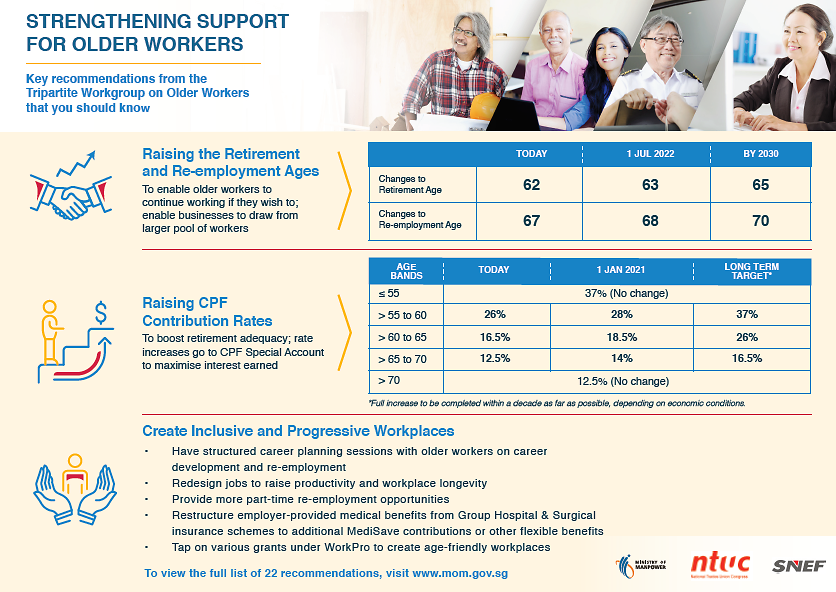
CPF contribution rates for older workers

(Infographic: Tripartite workgroup) 


READ: PSD to raise retirement, re-employment ages in 2021; more than 2,000 public officers to benefit

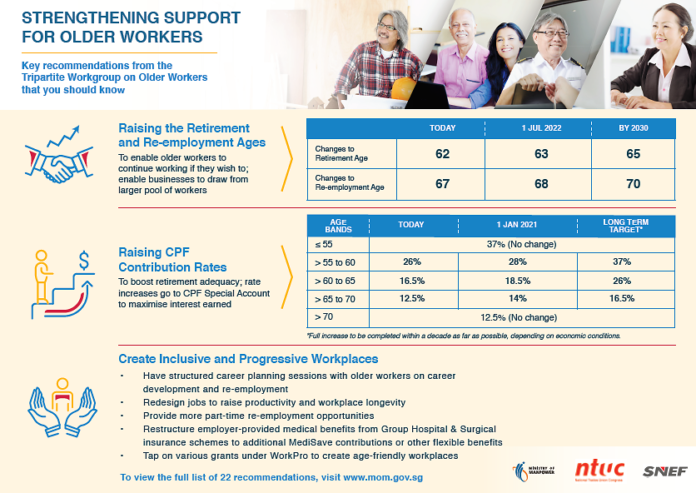
The workgroup, comprising representatives from the Government, employers and unions, also suggested raising the statutory retirement age from 62 to 65, and the re-employment age from 67 to 70, gradually by 2030.

HOW FAST: FIRST CHANGE IN 2021

Currently, the total CPF contribution rate – including those from employers and employees – is 37 per cent for workers up to 55 years old.

It drops progressively as the age band increases – 26 per cent for workers aged 55 to 60, 16.5 per cent for those aged 60 to 65, and 12.5 per cent for those beyond 65.

READ: SBF calls on firms to support new retirement, re-employment ages and CPF contributions

To boost retirement adequacy for older workers, the first incremental adjustment in CPF rates should kick in on Jan 1, 2021, the workgroup said.

This will see contributions go up to 28 per cent for workers aged above 55 to 60. Workers in the next age band – above 60 to 65 – will see their rates go up to 18.5 per cent, while those above 65 to 70 will have a higher rate of 14 per cent. There will be no change for those above 70.

Employers and workers will each have to increase their contributions by 1 percentage point, except for the age band of above 65 to 70. For this group, employee contribution is set to rise by 1 percentage point while that from the employer will go up by just 0.5 percentage point.

This change in 2021 will apply to cohorts born on or after January 1951.
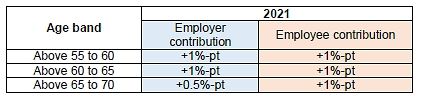
Proposed increase in CPF contributions

Proposed increase in CPF contribution rates. (Table: Tripartite Workgroup) 


Subsequent increases should be made gradually, with each move kept within 1 percentage point for either workers or employers, the workgroup said in its report.

And while the full adjustment is set to be rolled out within a decade, there should also be “flexibility to stretch the timeline beyond 2030 if necessary”.

It suggested monitoring the outcomes before finalising subsequent hikes, taking into account prevailing economic and labour market conditions.

“In some years, there may be a need to defer the contribution rate increases in order to relief pressure on business and moderate the impact on workers’ take-home pay,” it added in the report.

Mr Lee, in his NDR speech, had mentioned that employers were concerned about costs given the uncertain economic outlook.

HOW MUCH TO RAISE RATES

The workgroup has suggested all additional contributions to be “fully allocated” to the Special Account (SA), which has higher interest rates than the Ordinary Account (OA).

Based on “conservative estimates” of 4 per cent and 2.5 per cent base interest rates for savings in the SA and OA respectively, a worker earning S$2,900 from age 55 to 65 will have an additional S$47,300 in the SA.

NDR 2019: Labour movement MPs, NMPs give their views on higher CPF contribution rates for older workers

This is S$3,600 more than if the contributions were allocated to the OA, it said.

As for the quantum of increases, the workgroup said it recommended a steeper hike in rates for those aged above 55 to 60 as the employment rate for this group of workers has improved “significantly” to 72.7 per cent last year, from 64.2 per cent in 2008.

A rise in CPF rates is hence not expected to reduce the employability of these workers.

However, “smaller but meaningful” increases will be necessary for those aged 60 to 70, so that there is “lower risk of reduced employability and take-home pay”, it said.

As to why CPF rates are levelled off above 70 years old, the report wrote: “This as employers have no obligation to re-employ workers beyond the age of 70. Raising CPF contributions risks making these workers less employable with no significant gains in retirement adequacy.”

The workgroup also explained why it did not recommend equalising CPF contribution rates to 37 per cent for all age groups.

 “Such a large increase would severely affect the take-home pay for the worker, and raise business costs for the employer,” the report said.

 “It will be more practical to maintain different rates for different age bands but start tapering CPF contribution rates at a later age than 55,” it added.

Prior to 1988, all workers in Singapore received the same CPF contribution rates regardless of age.

Rates for older workers were reduced in 1988 to improve their employability at a time when seniority-based wage practices were prevalent. The rates became tiered according to age, with CPF rates lowered for older age groups.

In response to economic conditions and to protect employability, contribution rates were also reduced in 1999 for workers aged 55 to 65, and in 2005 for those aged 50 to 65.

The last adjustment was in 2016, when the CPF rates for workers aged 50 to 55 were equalised with that of younger age groups as their employability improved.

Source link

Malaysian authorities call off search for missing Singaporean kayaker Tan Eng Soon

0

MERSING: Malaysian authorities have called off the search and rescue operation for missing Singaporean kayaker Tan Eng Soon, the Malaysian Maritime Enforcement Agency said in a press release on Monday (Aug 19).

The search operation was stopped at about 9pm on Sunday, the agency added. Mr Tan had gone missing along with fellow Singaporean Puah Geok Tin while kayaking off the coast of Mersing on Aug 8.

“The search and rescue operation was halted as no more new clues were found following the discovery of the female victim on Aug 14. However, the search operation will be started again if there are new (leads),” said Johor Maritime chief Aminuddin Haji Abdul Rashid.

The body of Ms Puah was found last week in the waters off Kemaman, Terengganu. The two were separated from their group while kayaking near the Endau islands.

READ: ‘I love you and I always will’: Family, friends pay tribute to Singaporean kayaker who died in Malaysia

A kayak belonging to the missing Singaporean duo

A kayak was found near Kuantan Port by fishermen. (Photo: Bernama)

The maritime chief added that the search operation involved a total of 155 people, five aviation assets and 11 maritime assets. The operation also cost a total of RM431,380 (S$143,130). 

Source link

Commentary: The impact of growing US-China tensions on Singapore

0

This is the second of three commentaries by Prime Minister Lee Hsien Loong based on the Chinese speech he delivered at National Day Rally on Aug 19, 2019.

Read the first on the Singapore identity and the third on the outlook for the Singapore economy.

SINGAPORE: We are all worried about the growing tensions between the United States and China. Their disputes have placed other countries in a dilemma.

No country wants to take sides, and Singapore is no exception. This is why I want to discuss US-China tensions, and their impact on us.

Since its reform and opening up, China has developed rapidly to become the world’s second-largest economy. This has significantly benefited both China and the world, in many ways. It has also reshaped the world order.

As the world’s pre-eminent power today, the US has to accommodate an increasingly powerful and influential China. This is by no means an easy adjustment for the US. But the US needs to accept that China’s rise is inevitable, and that it is neither possible nor wise to prevent it.

READ: US-China face-off is not a ‘strategic inevitability’, says PM Lee Hsien Loong

Instead, the US should seek to build constructive bilateral relations, including economic cooperation, with China.

At the same time, as a rising global power, China needs to put itself in other countries’ shoes, and take greater account of their interests and viewpoints.

By doing so, it will enhance prospects for peaceful and harmonious relations with other countries. It is also more likely to be viewed as a magnanimous country, and a partner willing to work for mutual benefit.

Naturally, the US and China will compete for influence and power in the world. But amidst this competition, both parties also need to strengthen mutual trust, and develop appropriate mechanisms to manage the inevitable frictions between them.

READ: Why this US-China trade war is harder to resolve, a commentary

Regrettably, both the US and China have yet to find a way to manage their differences. Their tensions will persist for some time, and this will impact the whole world.

The US-China trade dispute already is inflicting collateral damage

The world’s two largest economies have engaged in a tit-for-tat tariff war. (Photo: AFP/Fred Dufour)

IMPLICATIONS FOR SINGAPORE’S EXTERNAL RELATIONS

There are two major implications for Singapore. First, on the external front, in our relations with the US and China. And second, on the domestic front, the impact on our economy.

Singapore is a good friend of both the US and China, and we want to remain so. The US is our major security partner. We buy advanced military equipment from them, including fighter aircraft and missiles. Our troops train extensively with US forces. We also cooperate closely on counter-terrorism.

We hope the US will continue to remain engaged in the Asia Pacific. The US’ presence in the region has helped to underwrite regional peace and stability since World War II, and we hope it will continue to remain a presence in the region.

The US is also our important economic partner. The size and scale of US investments in Singapore far out-strip any other country’s. These investments create many quality jobs for Singaporeans.

We also have many collaborative endeavours with US institutions, companies and experts, in the fields of innovation, research, and development.

With China, Singapore has established an “All-Round Cooperative Partnership Progressing with the Times”. We have extensive economic cooperation with China, including three government-to-government initiatives in Suzhou, Tianjin and now in Chongqing.

China is also our largest export market. Singapore companies have sizeable investments there, as do Chinese companies in Singapore.

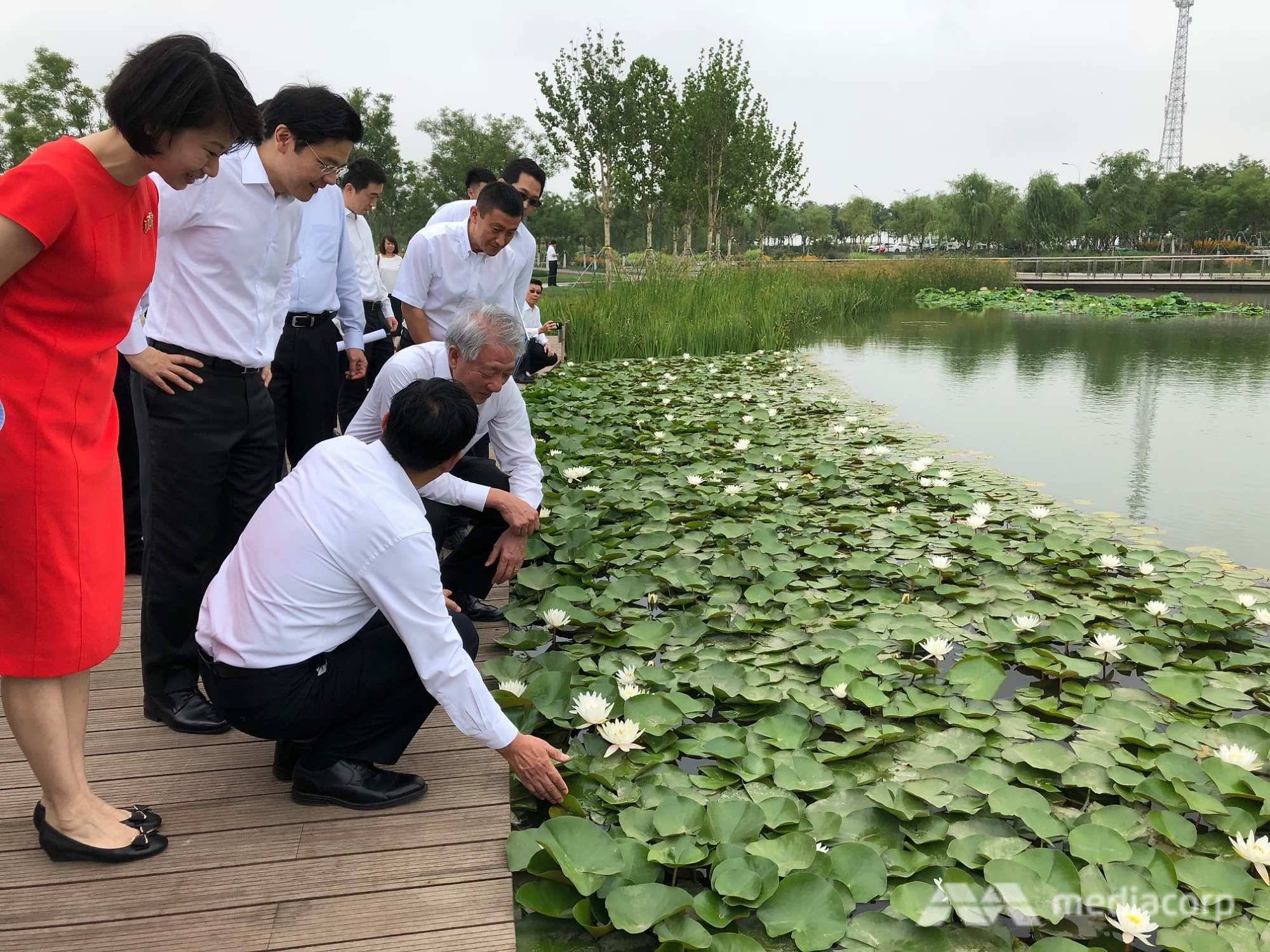
Teo Chee Hean and Lawrence Wong visit Tianjin Eco-City

Former Deputy Prime Minister Teo Chee Hean, National Development Minister Lawrence Wong, Senior Parliamentary Secretary for National Development Sun Xueling and other members of the Singapore delegation at the Ganluxi Waterway in Tianjin Eco-City. (Photo: Olivia Siong)

Our relations with China are unique. Apart from China itself, Singapore is the only sovereign country in the world with a majority ethnic Chinese population.

This shared cultural heritage is an advantage, for it helps us deepen people-to-people ties and strengthen cultural exchanges with China. All this helps to build good relations between our two countries, promoting understanding and partnerships between our peoples, companies and institutions.

But we must always remember to engage and cooperate with China as Singaporeans. We have our own history and culture. Hence we have our own perspectives on various issues, and must take our own stand.

Being a Chinese-majority country presents its own challenges for us in foreign affairs, because it makes it easy for other countries to misunderstand us.

This is especially so when the US and China are at odds. If we support China, the US and other countries may think we do so because we are a majority Chinese country, and therefore automatically defer to China. And if we support the US, China may misunderstand our motivations.

READ: The US, China, a security dilemma and a way out in Singapore, a commentary

Sometimes, when Singapore and China take different positions on some issue or other, our PRC friends ask us: Since we share a common heritage, a common ancestry and a common language, why does Singapore not share our common view?

Our position is this: On any issue, our views and actions will always be based on principles, and not sentiment. Regardless of who our audience is, whether it is in Singapore, Washington or Beijing, we always express the same views.

When we can agree, we will do so. When we cannot, we must maintain our principled position and explain our stand.

We hope other countries will understand that Singapore is a multiracial, independent and sovereign country, with our own position on issues. And of course, Singaporeans ourselves must fully understand this as well.

We must be clear-eyed about our own national interests and understand the Government’s considerations when we adopt principled positions on bilateral, regional or international issues.

IMPLICATIONS FOR SINGAPORE: ECONOMY

Aside from international relations, US-China tensions will also adversely impact the global economy. Supply chains will be disrupted, investments and R&D restricted, and people-to-people exchanges constrained.

Let me give you an example. The smartphones in your hands contain many components designed, produced and assembled in many different countries. It is so for Apple phones and Huawei phones alike.

A Huawei logo is seen on a cell phone screen in their store at Vina del Mar

A Huawei logo is seen on a mobile phone screen. (File photo: Reuters/Rodrigo Garrido)

However, if the US does not allow Chinese companies like Huawei to use American microchips, and US companies to use components manufactured in China, and if China does likewise, then, Chinese and American companies will each have to develop their own microchips, smartphones and telecommunication systems.

When we go overseas, we may have to carry multiple phones, just as we did years ago when we visited Japan, because Japan used the CDMA system while Singapore used GSM.

Notwithstanding such a bifurcated world, we still hope we can communicate with all our friends conveniently. So, the big headache for us is this: Which telecommunication system should we install in Singapore?

Singapore is a small open economy that has benefited greatly from globalisation. If US-China relations continue to worsen, the world will continue to bifurcate.

READ: The end of unrestricted commerce and the dawn of the great US-China disentanglement, a commentary

This augurs a more troubled future for us. Our growth will be affected. Singapore companies that export to China, and those that export to the US from factories in China, will be hit.

Some hope that manufacturers that decide not to set up in China may come to Singapore. A few may come, but most will not, given the nature of the industries and their primary considerations of cost and proximity to markets.

For example, clothing manufacturers will likely move their factories to Vietnam or Bangladesh; electronics to Mexico; furniture manufacturers to the Philippines. 

These companies will not prefer to locate in Singapore. Overall, deteriorating US-China relations is bad news for the world economy, and a definite minus for Singapore.

US-China tensions have already hurt confidence worldwide. But the deeper and wider structural effects I have described will only be felt over time.

Nevertheless, we must begin preparing for these consequences, and adapt ourselves quickly to the new international realities.

Lee Hsien Loong is Prime Minister of Singapore.

Source link

Commentary: While external environment may be adverse, Singapore has many important strengths

0

This is the third of three commentaries by Prime Minister Lee Hsien Loong based on the Chinese speech he delivered at National Day Rally on Aug 19, 2019.

Read the first on the Singapore identity and the second on the impact of US-China tensions on Singapore.

SINGAPORE: This year, our economy has slowed down significantly. This is primarily due to weakening global demand and international trade, which have impacted our manufacturing sector and trade-related services.

A cyclical downswing in electronics has affected our broader economic performance, especially in related sectors such as precision engineering and wholesale trade. The retail sector also continues to be under pressure from online shopping.

READ: What slowing growth means for the man in the street, a commentary

Thankfully, other sectors have so far not been very much affected. Retrenchment and unemployment rates remain low. Recently, I discussed these issues with NTUC secretary-general Ng Chee Meng and with union leaders. They reported that while workers are worried, the slowdown has so far not significantly affected jobs.

Thus, the current situation does not warrant immediate stimulus measures. But if the situation worsens significantly, we will intervene promptly and appropriately to sustain our economy and the livelihoods of our workers.

The Government and union leaders are watching trends closely, and are fully prepared. We have experienced cyclical downturns like this in the past, and we are confident we can take this in our stride.

READ: Singapore and the dreaded R word – recession, a commentary

IMPORTANT STRENGTHS

Though the external environment may be adverse, we do have important strengths. This year, we attracted several major investments.

One of these is by Finnish energy company, Neste, which is investing more than S$2 billion to expand its renewable energy plant here. This is a huge project which will create quality jobs for Singaporeans.

Neste’s CEO, Peter Vanacker, explained that his company chose Singapore because of our technological capabilities, our excellent business environment including infrastructure and logistics, and our extensive trade relations. And more importantly, they were looking for the best workforce in the world.

Neste Oil Singapore refinery

A view of the Neste Oil NExtBTL renewable diesel plant in Singapore. (Photo: AFP/Roslan Rahman)

Neste also had high praise for the Economic Development Board (EDB). In sum, they chose us because they trusted EDB, our workers and Singapore.

As the Neste CEO said: “The most valuable resource in the world is trust. But to find trust one must earn it first. And to keep trust, one must continue to earn it. And here in Singapore, we have found the right people.”

This shows Singapore’s high reputation among investors. Facing economic uncertainties as we do, it is all the more crucial to work hard to protect this trust that investors have in us.

SUPPORTING BUSINESSES AND WORKERS

Meanwhile, we must keep on strengthening our economic fundamentals to secure our longer-term competitiveness. Deputy Prime Minister Heng Swee Keat and the younger ministers are leading our economic transformation efforts. Their efforts are beginning to bear fruit. 

With the support of the Government, our companies are innovating, digitalising their operations, expanding in overseas markets, and training their employees.

The Jumbo Group is a good example. Well known for their chilli crabs, Jumbo started in 1987 and is now a listed company that has expanded internationally.

Jumbo’s success is in large part due to its emphasis on training and development. This has helped it to retain Singaporean staff, in an industry that typically has a high turnover rate. By tailoring training to employees’ individual potentials and providing good mentorship, Jumbo has enabled its staff to upskill and grow with the company.

JUMBO seafood restaurant exterior

A JUMBO Seafood restaurant in Beijing. (Photo: Jumbo Group)

Like 31-year-old Ng Zi Yang, who became an executive chef overseeing a cluster of restaurants today, only 10 years after entering the industry as a complete greenhorn.

Jumbo has joined Enterprise Singapore’s Scale-up SG programme. This new programme helps promising local companies grow rapidly and stand out in their fields.

Jumbo’s CEO Ang Kiam Meng himself recently attended a leadership programme in the US. The participants were all from the pioneer batch of 25 companies on Scale-Up SG.

They are a diverse group, ranging from F&B to education, from furniture and maintenance to hospital and dental. If they came together, they could provide comprehensive services for an HDB township. On the course, they made friends, shared experiences and discovered potential opportunities to collaborate.

I mention Jumbo for several reasons. Firstly, to remind employees to upskill and retrain, to remain relevant and employable. Secondly, to encourage companies in their transformation efforts. And thirdly, to assure both employers and employees of the Government’s full support in their upskilling and upgrading journey.

There are many Government support schemes to help local enterprises develop and expand their businesses. This means more good jobs for Singaporeans.

UPHOLDING TRUST AND UNITY

The Government is paying close attention to how the international situation is impacting us externally and domestically.

PM Lee NDR (13)

Prime Minister Lee Hsien Loong delivers his National Day Rally speech on Aug 18, 2019. (Photo: Gaya Chandramohan)

The high trust that other countries and investors have in Singapore is a vital advantage and our precious asset. We must uphold this trust, so that we can pass it on to future generations. Then Singapore can continue to prosper and our livelihoods can be assured.

LISTEN: The Pulse: A rougher ride ahead? The outlook for the Singapore economy

I worry greatly that the coming decade will be more troubled than the last. Like the weather that is ever-changing – sweltering one minute, pouring rain the next – we will be buffeted by unexpected developments.

We must prepare for this future, and with the same intrepid spirit and drive of our forebears, work together to overcome the difficulties ahead.

I firmly believe that if the Government and people are united, Singaporeans can continue to enjoy ever better lives, and Singapore will continue to shine in the world.

Lee Hsien Loong is Prime Minister of Singapore.

Source link

Commentary: From Singapore to Singaporeans, the making of a national identity

0

This is the first of three commentaries by Prime Minister Lee Hsien Loong based on the Chinese speech he delivered at National Day Rally on Aug 19, 2019

Read the second on US-China relations and the third on the outlook for the Singapore economy.

SINGAPORE: We are commemorating Singapore’s bicentennial – 1819 was a turning point in our history.

That year, Raffles landed in Singapore and established a free port here. This attracted migrants from Southeast Asia, India and China, who came to seek their fortunes.

Many Chinese came from Guangdong, Chaoshan and Fujian. Some came from nearer places like Penang, Malacca and the Riau Islands.

Many started as labourers – “coolies” – barely able to make ends meet. They strove hard to eke out a living. Some started small businesses.

The more educated ones took up professions like teaching and journalism. Others developed plantations, set up banks, or went into trading. Ultimately, many settled down and built their lives here.

A FOUNDING GENERATION

They were our “founding generation” who contributed much to Singapore. The leaders among them set up clan and trade associations to help their fellow countrymen integrate and establish themselves. These “towkays” rallied the Chinese community to build hospitals, schools and temples.

Most of our forefathers maintained close links with their motherland. They arrived here in Nanyang as sojourners, intending to return to China one day.

They still saw themselves as people of China, and were passionate about their homeland. Many participated in the political movements and revolutions in China, and some gave their lives.

Over a hundred years ago, Sun Yat Sen set up the Tongmenghui (United League of China, the predecessor of the Kuomintang) to overthrow China’s Qing Dynasty.

Sun Yat Sen Nanyang Memorial Hall

Artefacts displayed at the Sun Yat Sen Nanyang Memorial Hall.

Tongmenghui’s Southeast Asian headquarters was established in Singapore, at Wanqingyuan (today’s Sun Yat Sen Nanyang Memorial Hall), where the revolutionaries planned several uprisings in China.

In the 1930s, after Japan invaded China, the Singapore Chinese were once again roused to arms. An eminent community leader, Tan Kah Kee, led the efforts to raise funds and organise volunteers to support China.

These included the “nanqiao jigong” (Nanyang Transport Volunteers), who returned to China to fight the Japanese. This was one reason why the Japanese carried out the Sook Ching Operation here after they captured Singapore in World War II, massacring tens of thousands of Chinese people in Singapore.

After World War II, the Chinese Communist Party defeated the Kuomintang in the civil war, and founded the People’s Republic of China (PRC) in 1949. This made a deep impression on many passionate, idealistic young Chinese in Southeast Asia, inspiring them to join local anti-colonial struggles.

A CRITICAL LIFE DECISION

But the identity of the Chinese in Southeast Asia was ambiguous. The influence that the new PRC had over the hearts and minds of these young people engendered distrust of their motives, and of China, among Southeast Asian countries.

It was in this context that China in the 1950s started to distinguish between overseas Chinese who were “haiwai huaqiao” (海外华侨) and those who were “huaren” (华人). “Haiwai huaqiao” referred to overseas Chinese nationals who retained their Chinese nationality, while “huaren” referred to overseas ethnic Chinese who had taken up their host country’s citizenship.

None other than then-Premier Zhou Enlai stated clearly that once “huaren” took up citizenship in their country of residence, they could no longer be considered Chinese nationals, and should be loyal to their new home country.

READ: The growing importance of China studies with Singapore characteristics, a commentary

Our forebears had to make a critical life decision: To remain in Singapore, or to return to the motherland. In the end, the majority chose to remain in Singapore. And together with the other races, they went on to build a multicultural society and country here.

BECOMING SINGAPORE CITIZENS

In the 1960s, as Singapore progressed towards independence, Chinese community groups worked with the Government to support Singapore’s social and economic progress, and our national defence.

When we introduced National Service in 1967, the Singapore Chinese Chamber of Commerce and Industry (SCCCI) presented the first two batches of enlistees with medallions engraved with the words “National Service” and “尽忠报国” (dedication and loyalty to the country). 

And in the following year, when the Government created the National Defence Fund with a target of raising S$10 million, the SCCCI raised more than S$1 million for the fund.

SCCCI outstanding Chinese business pioneers awards

Winners of the 2015 SCCCI Outstanding Business Pioneers awards. (Photo: Calvin Hui)

As these examples show, the Chinese population had by then transferred their loyalty to Singapore, and had started identifying themselves as Singapore citizens.

The Chinese Singaporean identity formed gradually over the last 200 years. We honour and commemorate our forefathers’ dedication to their motherland, as China was then. This was part of our journey to becoming Singaporeans.

Thus we made Wanqingyuan a national monument, and also erected a memorial there to the Nanyang Transport Volunteers.

Similarly, every year on Feb 15, Singaporeans of all races and faiths attend a solemn ceremony at the Civilian War Memorial to remember and honour those who perished in World War II.

The Japanese Occupation was a tragic experience for all in Singapore. But it was also a bonding experience, for it crystallised and aroused a national consciousness among the different races here, and made us determined to become masters of our own fate.

FROM SINGAPORE TO SINGAPOREANS

The Malay and Indian communities have similar stories to tell about the evolution of their own identities here. They, too, came to Singapore as sojourners.

During the anti-colonial struggle, many Indians here were inspired by India’s own struggle for independence, and the Malays by the nationalist movements in Indonesia and Malaya. Indeed, our own battle cry then – Merdeka! – was originally the slogan of the Indonesian and Malayan independence struggles.

Just like the Chinese, the local Malays, Indians and Eurasians progressively sank their roots here. We may have first been politically awakened by world-stirring events in different, distant lands. But we all came to see this island-nation as the country where our loyalty and our future lay.

HDB flats

File photo of HDB flats. (Photo: Hester Tan)

This historical arc – in the words of the Bicentennial Experience, “From Singapore, To Singaporean” – is what makes us uniquely us. Even today, new immigrants have to go through this process, before gradually integrating themselves into Singapore society and becoming fully Singaporean.

READ: Bicentennial can be a worthwhile endeavour, a commentary

Now, as the world enters troubled times, Singapore faces new and daunting challenges. 

Being aware of our history, of how we became Singaporean, will help us understand the development of our national consciousness. This in turn will lend us a perspective as we navigate the turbulent voyage ahead.

Lee Hsien Loong is Prime Minister of Singapore.

Source link

Shell debuts electric vehicle chargers in Singapore, first in Southeast Asia

0

SINGAPORE: Royal Dutch Shell is launching electric vehicle chargers at petrol stations in Singapore, its first such foray in Southeast Asia, the company said on Monday (Aug 19). 

The electric vehicle charging service, Shell Recharge, will be available at 10 Shell petrol stations in Singapore by October, this year or about 20 per cent of its retail network in the city-state, the company said in a statement.

The stations will be at the following locations: Newton Hooper, Alexandra, Yishun, Ang Mo Kio, Paya Lebar PIE, Choa Chu Kang, Boon Lay, Sengkang, Havelock and Bukit Batok West. 

Locations of Shell Recharge

(Graphic: Shell) 

For S$0.55per kWh, the chargers typically provide from 0 per cent to 80 per cent charge in about 30 minutes, and are compatible with most electric vehicles in Singapore.

A Shell-commissioned study on electric vehicle consumer behaviour showed that 52 per cent of Singaporeans are deterred to buy or use an electric car as they think there are not enough charging stations in Singapore, the company said.

“To meet the country’s climate action goals, Singapore needs more and cleaner energy solutions to power lives, businesses and transport sustainably,” said Aw Kah Peng, country chairperson of Shell Companies in Singapore.

Shell plans to make more of such low-carbon energy solutions available in Singapore in the following months and years, she added.

Source link

National Day Rally 2019: Reduced university and polytechnic fees for lower-income students

0

SINGAPORE: New and existing lower-income students will pay reduced university and polytechnic school fees from the next academic year with the Ministry of Education (MOE) set to increase government bursaries.

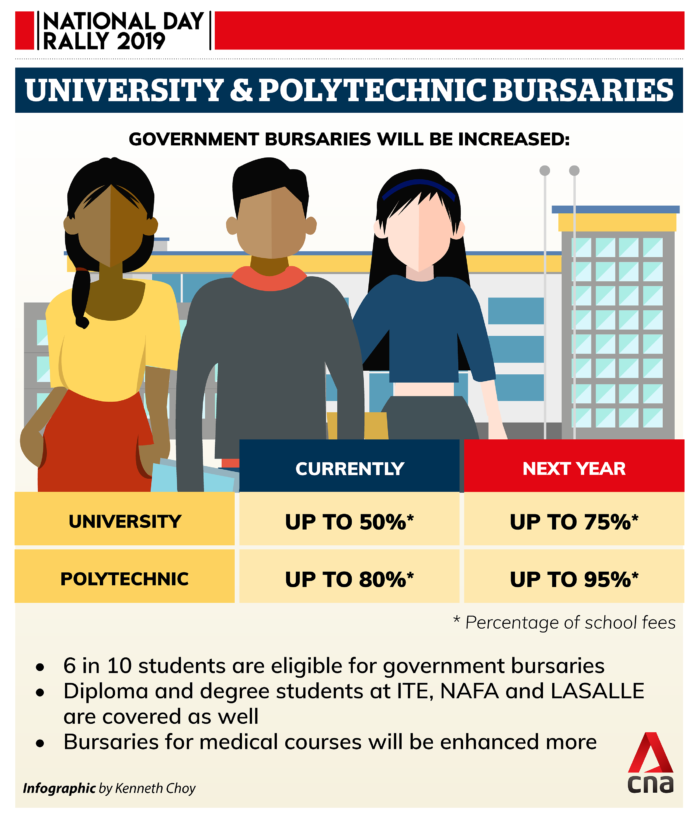
In his National Day Rally speech on Sunday (Aug 18), Prime Minister Lee Hsien Loong announced that for university students, MOE will increase bursaries from up to 50 per cent of general degree fees, to up to 75 per cent.

This means a lower-income university student will pay S$2,000 a year, as compared to the previous S$4,000 a year, if he fully uses the bursary on his school fees. The full fees for a general degree programme in the National University of Singapore (NUS) are about S$8,000 a year.

For polytechnic students, MOE will increase the bursary coverage from up to 80 per cent of fees to up to 95 per cent.

This means a lower-income polytechnic student will pay S$150 a year, as compared to the previous S$600 a year, with a bursary. The full fees for a polytechnic diploma are around S$3,000 a year.

READ: NDR 2019: More pre-school subsidies as Singapore set to spend more on early childhood education

NDR2019 - Uni and poly bursaries infographic

Mr Lee said the move is aimed at making Singapore’s education system “as accessible as possible”.

“We want every Singaporean son and daughter to have the opportunity to receive a good education and start well in life, regardless of family circumstances,” he said.

“Students from less privileged backgrounds … should neither feel disadvantaged nor inferior comparing themselves to better off classmates, nor should they be deterred from pursuing a course just because of money.”

This is fundamental to maintaining Singapore as an open meritocracy, he said.

Mr Lee said the move will also benefit students from middle-income families, with six in 10 university and polytechnic students eligible for government bursaries.

To qualify for the MOE bursary at the post-secondary level, Singapore citizens must have a gross monthly household income (GHI) of S$9,000 and below, or gross monthly household per capita income (PCI) of S$2,250 and below.

To qualify for the Community Development Councils/Citizens’ Consultative Committees bursary, Singapore citizens must have a GHI of S$4,000 and below, or PCI of S$1,000 and below.

READ: NDR 2019: Singapore Malays ‘distinct’ from others in region with inclusive religious practice, emphasis on education, PM Lee says

Mr Lee added that the increased bursaries will cover diploma and degree students at the Institute of Technical Education (ITE), Nanyang Academy of Fine Arts and LASALLE College of the Arts.

INCREASED BURSARIES FOR MEDICAL STUDENTS

Lower-income medical students will also see their hefty school fees slashed with increased bursaries that are “significantly more generous” than those for other university courses, Mr Lee said.

Together with other university bursaries, he stated that these students will now pay at most S$5,000 a year. Currently, medical school fees at NUS and the Nanyang Technological University cost almost S$29,000 and S$35,000 a year, respectively, after government subsidies.

“We should not let the cost of medical school deter good students from studying medicine,” Mr Lee added. “In fact, we want doctors to have diverse educational and family backgrounds.”

READ: Budget 2018: More financial support for students, particularly from lower-income families

Mr Lee also expressed hopes that universities, polytechnics and ITE will set up more of their own bursaries to complement Government bursaries, with alumni and the community contributing “generously”.

He pointed out that the Government will match up to three times of donations to newer universities and up to 1.5 times for the rest.

“Our institutions often raise funds for new building and professorships, and this is always meritorious,” Mr Lee added.

“But bursaries can make a crucial difference to the recipients – and they have the extra human touch. If you donate towards a bursary, you enable some promising young person to get a good start in life.”

READ: NDR 2019: Bicentennial Experience to stay open for an extra 3 months in response to many requests

LOWER FEES AT SIT AND SUSS

Beyond bursaries, Mr Lee announced that MOE will lower annual school fees for full-time general degree programmes at the Singapore Institute of Technology (SIT) and Singapore University of Social Sciences (SUSS) from about S$8,000 to S$7,500.

This comes after a recent MOE review of tertiary fees and how universities can “operate more economically”, Mr Lee said.

“Two of them, SIT and SUSS, are more applied and do more industry attachments and internships,” he explained. “Their operating costs per student can be lower, especially as student intakes grow.”

Source link

National Day Rally 2019: Pre-school subsidies to be enhanced

0

SINGAPORE: Singapore’s annual spending of about S$1 billion on early childhood education will “more than double” over the next few years, as the Government looks to make pre-schools more affordable for parents here, said Prime Minister Lee Hsien Loong on Sunday (Aug 18).

This includes plans to increase the number of government-supported pre-schools to 80 per cent over time.

At the moment, just over half of all pre-school places are government-supported.

Citing a recent survey by the People’s Action Party Women’s Wing, Mr Lee said young parents remained concerned about the affordability of pre-schools.

He added that he agreed with a point made by the MPs involved in the survey, in that “pre-schools should be like housing and healthcare” where there are good and affordable government-funded options for all Singaporeans.

“For housing we have HDB. For healthcare, we have the restructured hospitals,” said Mr Lee.

“Similarly, for pre-school, we should have good quality, government-supported choices available to all Singaporeans,” he added.

HELP FOR MIDDLE-INCOME FAMILIES

Pre-school subsidies will also be enhanced, announced Mr Lee in his National Day Rally speech.

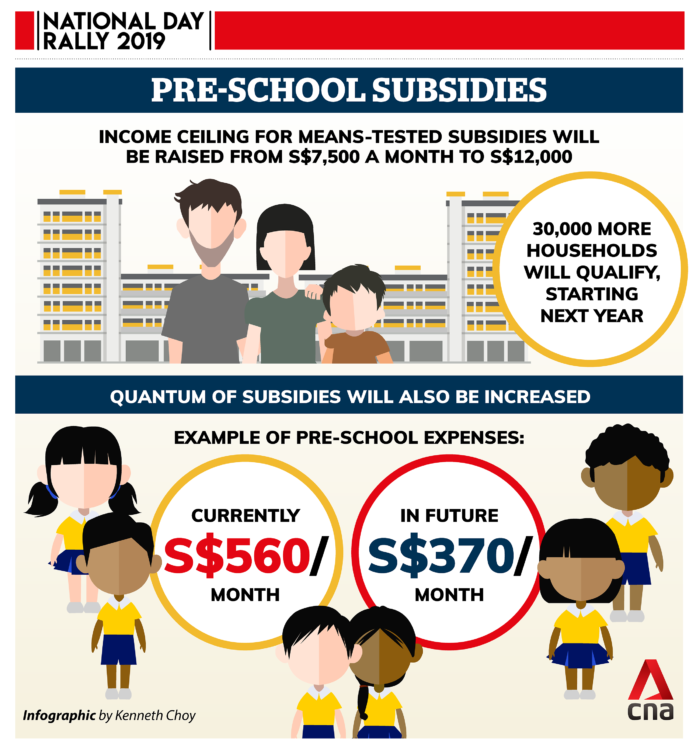
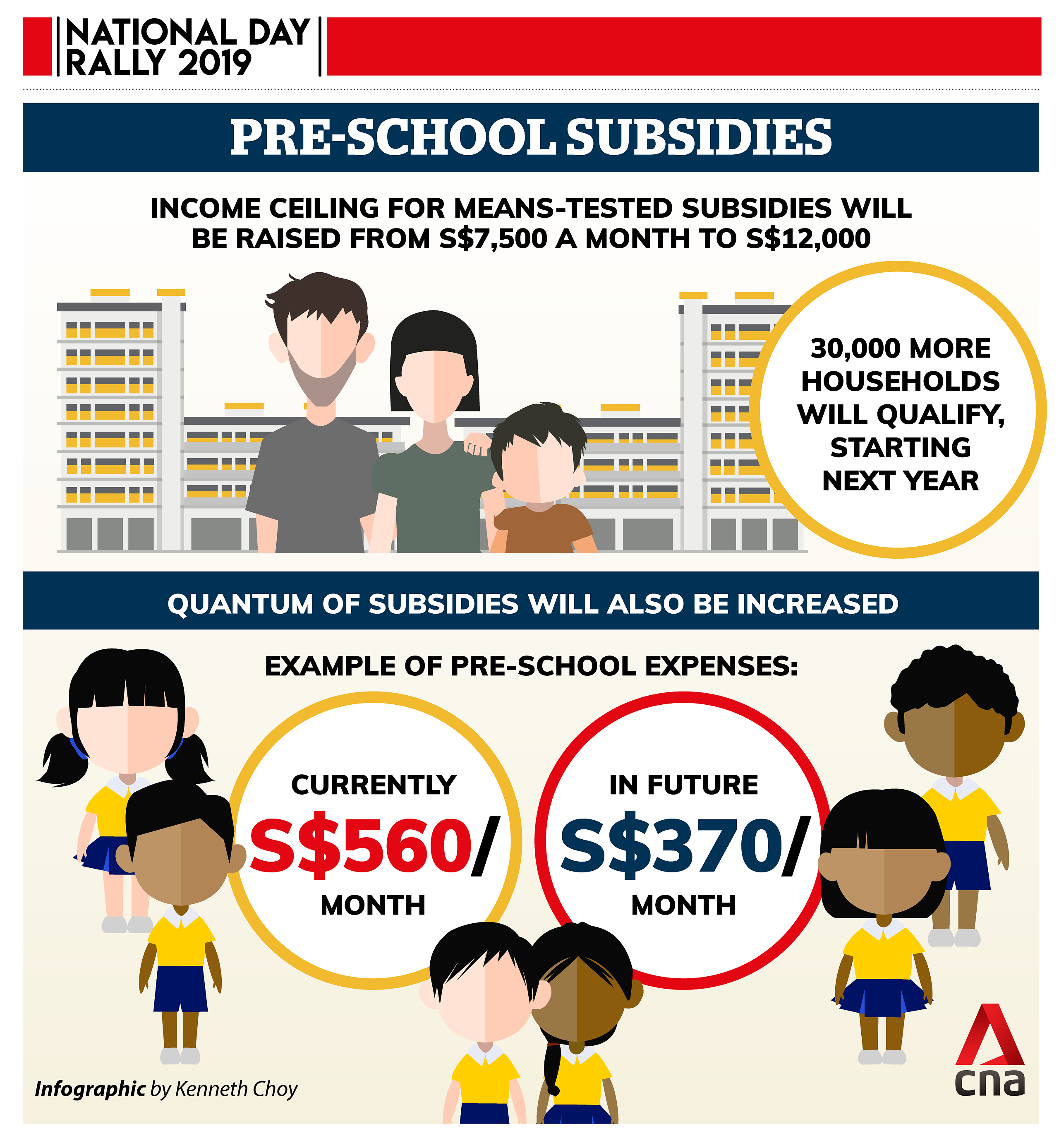
At the moment, families are only eligible for additional means-tested subsidies if their monthly household incomes do not exceed S$7,500.

To offer more help to those from the middle-income, this income ceiling will be raised to S$12,000 per month.

This will extend the means-tested subsidies to 30,000 more households.

“For middle-income parents, pre-school fees can take up a chunk of their household budget, especially if two or more kids are in pre-school at the same time,” he pointed out.

READ: NDR 2019: Singapore will be ‘principled’ in approach to China-US trade dispute; ready to help workers

NDR2019 - Preschool subsidies infographic

There will also be an increase in the quantum of pre-school subsidies across the board, said Mr Lee.

In his speech, he raised the example of the Lows – a middle-income family with two children, Kaylen and Kyler, enrolled in a government-supported pre-school.

At the moment, the Lows do not qualify for additional subsidies and are paying about S$560 per month for each child’s pre-school education.

The enhanced subsidy will knock off one-third of the pre-school expenses to around S$370 per child, according to Mr Lee.

“Later on, when Kaylen and Kyler enter primary school, the family’s expenses will go down even further,” he said, adding that primary school is almost free and even if after-school student care is needed, it will come up to S$300 per child.

This – the addition of primary school fees and student care fees – is lower than the family’s pre-school expenses, Mr Lee noted.

This will be the goal that the Government has for the medium term.

“In the medium term, we aim to bring down full-day pre-school expenses to around that level – the cost of primary school plus after-school student care,” Mr Lee said. 

“We need a while to get there, but we are working towards that.” 

He added: “Hopefully with all these improvements, parents will no longer think of pre-schools as an expensive phase of bringing up their children.”

READ: Remove IVF age limit, reduce pre-school costs for young families: PAP Women’s Wing

READ: More support in pre-schools for children with developmental needs

In recent years, Mr Lee noted that a “major shift” has been made to improve pre-school education here.

“We want to start earlier in a child’s life because these years make a big difference to his development,” he explained. 

“A good pre-school education can make a crucial difference.”

Apart from ensuring affordability, other efforts include the doubling of full-day pre-school capacity to almost 180,000 places since 2012.

Pre-schools here have also been upgraded, with better-designed HDB void deck centres and mega centres such as the PCF Sparkletots at Punggol.

The number of kindergartens run by the Ministry of Education – currently at 24 – will more than double in the next few years, while the set-up of the National Institute of Early Childhood Development will give pre-school teachers better training and career progression, the prime minister said.

READ: NDR 2019: Singapore Malays ‘distinct’ from others in region with inclusive religious practice, emphasis on education, PM Lee says

READ: NDR 2019: Bicentennial Experience to stay open for an extra 3 months in response to many requests

EXPANSION OF KidSTART PROGRAMME

Mr Lee on Sunday also announced the expansion of the KidSTART programme to another 5,000 children over the next three years.

The initiative was piloted in July 2016 with the aim of helping 1,000 children from disadvantaged families.

“We are very happy with the results, and so are the parents,” he said.

While the exact benefits will need to be tracked over a few more years, “there is no time to lose” for each new cohort of babies.

The Government will hence widen the programme over the next three years, before taking stock again on how to expand it further, said Mr Lee.

Source link

National Day Rally 2019: 9 things you need to know

0

SINGAPORE: Prime Minister Lee Hsien Loong unveiled plans to raise the retirement age and re-employment age by 2030, and to increase CPF contributions for older workers in the National Day Rally on Sunday (Aug 18).

He also announced measures to make education affordable – from pre-schoolers to students in tertiary institutions.

READ: Highlights: National Day Rally 2019

Mr Lee touched on current global issues as well, such as climate change and the US-China trade tensions, and how they affect Singapore.

Here are the main takeaways from his speech: 

1. RETIREMENT AGE TO INCREASE TO 65 BY 2030

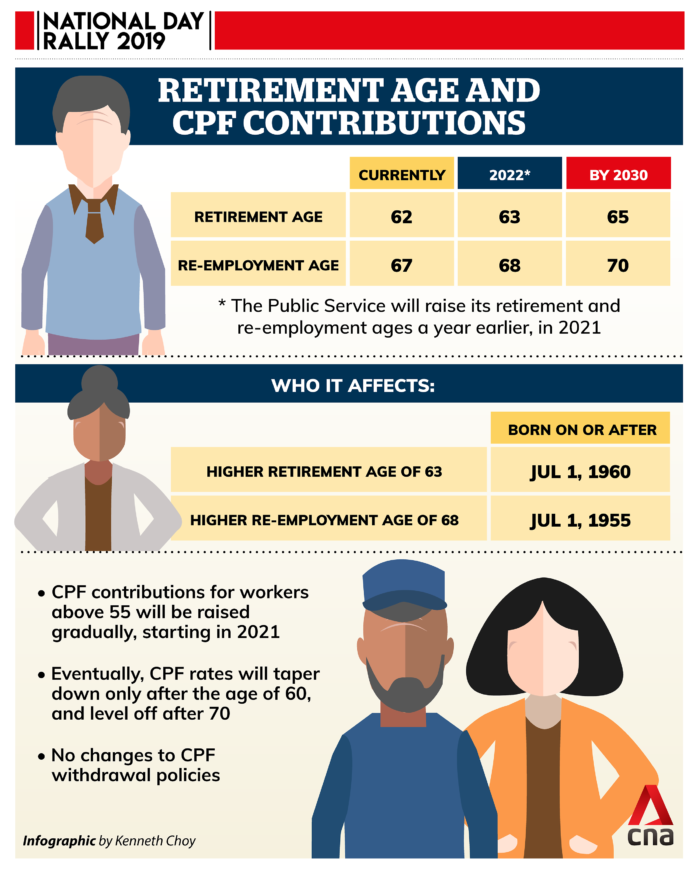
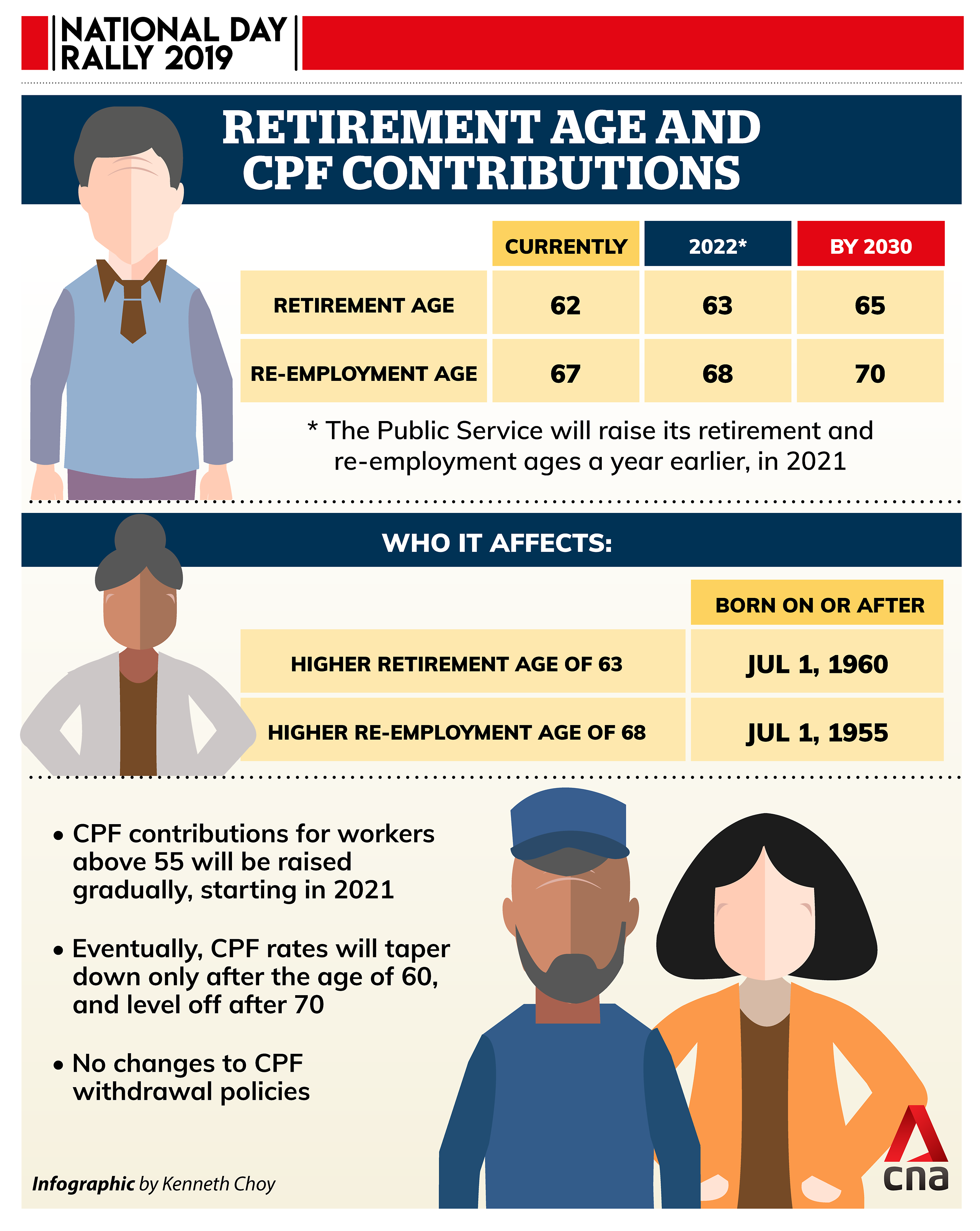
By 2030, the retirement age and re-employment age will be raised to 65 and 70 respectively.

The retirement age, which is currently 62, will go up to 63 in 2022. This will further be raised to 65 by 2030.

Meanwhile, the re-employment age, which is currently 67, will go up to 68 in 2022, before being raised further to 70 by 2030.

NDR2019 - Retirement age and CPF infographic

2.  HIGHER CPF CONTRIBUTIONS

On a similar note, Mr Lee also announced that Central Provident Fund (CPF) contribution rates will be raised for workers above the age of 55.

The first adjustment will roll out in 2021, with the whole process taking about 10 years, depending on economic conditions.  

READ: NDR 2019: New retirement, re-employment ages of 65 and 70 by 2030; higher CPF contributions for older workers

By the time the changes are completed, workers aged 60 and below will be able to “enjoy the full CPF rates”, Mr Lee said.  

He also stressed that there will be no changes to CPF withdrawal policies or ages in light of such rumours earlier this year.

3. REDUCED UNIVERSITY, POLYTECHNIC FEES FOR LOWER-INCOME STUDENTS 

On the education front, Mr Lee announced several measures aimed at helping lower-income students in tertiary-level institutions:

  • Bursaries for university courses to increase from up to 50 per cent of fees, to up to 75 per cent
  • Bursaries for polytechnic diploma programmes to increase from up to 80 per cent of fees, to up to 95 per cent 
  • Increased bursaries for students at the Institute of Technical Education (ITE), Nanyang Academy of Fine Arts and LASALLE College of the Arts 

Students at Singapore Institute of Technology (SIT) and Singapore University of Social Sciences will also pay lower school fees from around the current S$8,000 to S$7,500.

NDR2019 - Uni and poly bursaries infographic

4. MORE PRE-SCHOOL SUBSIDIES  

Singapore’s annual spending on early childhood education will more than double over the next few years

The Government also will raise the income ceiling of households eligible for pre-school subsidies to S$12,000 per month, up from the current S$7,500.

This will result to an additional 30,000 more households in Singapore, who will qualify for preschool subsidies.

There are also plans to increase the percentage of Government-supported pre-schools from 50 per cent to 80 per cent eventually.

NDR2019 - Preschool subsidies infographic

5. “GRAVE” CHALLENGE OF CLIMATE CHANGE  

Singapore is already feeling the impact of climate change with hotter weather and heavier rainstorms, said Mr Lee.

“This will very likely worsen over the next few decades, within the lifetimes of many of us,” he added.

According to a Swiss study, by 2050, several cities in the world will experience “unprecedented” climate shifts, with Singapore being one of them.

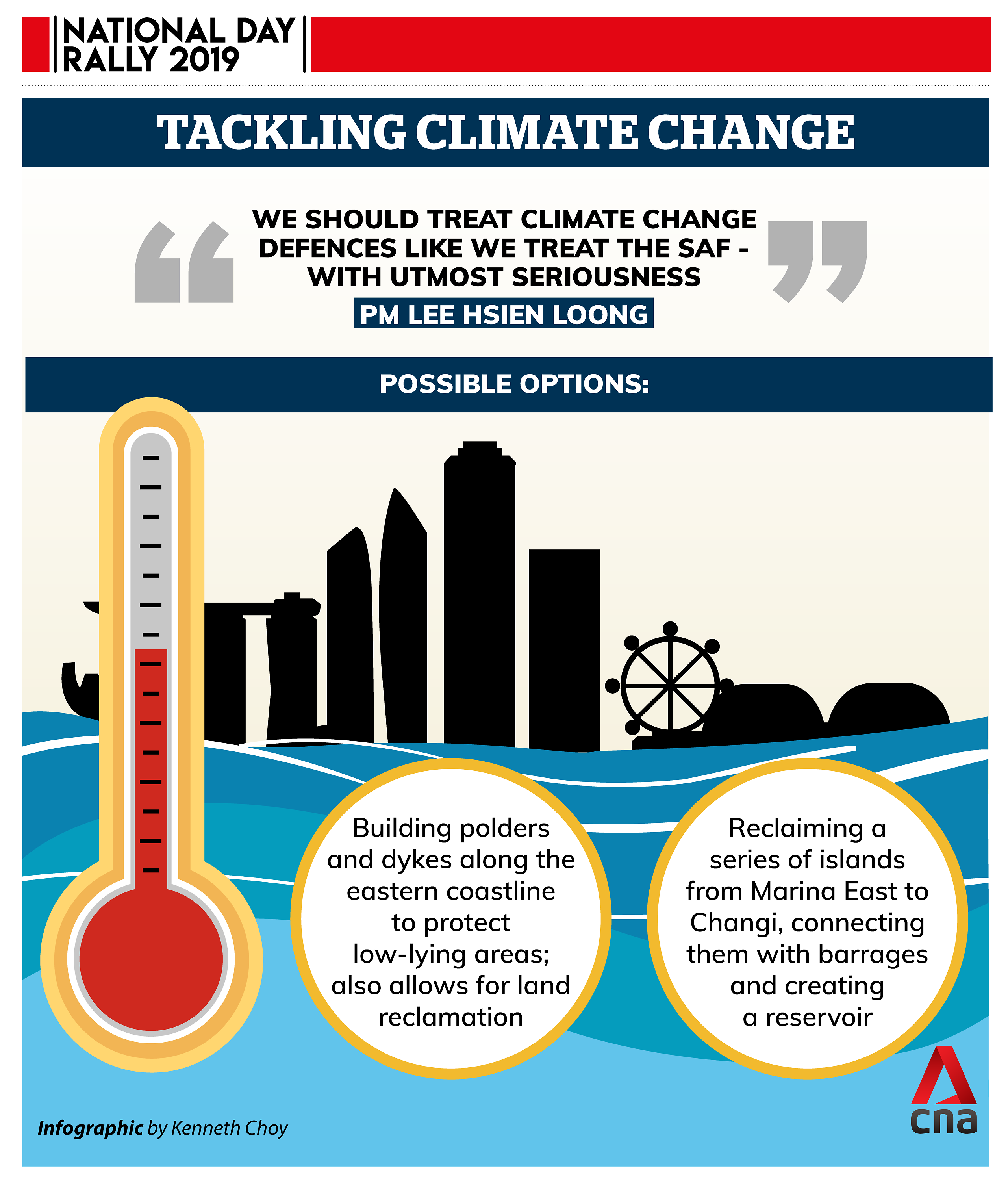
It would cost low-lying Singapore about S$100 billion or more to protect itself from rising sea levels, said Mr Lee. 

NDR2019 - Climate change infographic

 6.  SO WHAT NEEDS TO BE DONE?

Mr Lee said that coastal defences would be needed to protect Singapore against rising sea levels, specifically pointing to critical areas such as East Coast and Jurong Island.

A plan for a second pump house on the opposite end of Marina Barrage is also in the works, while a small polder is being built at Pulau Tekong.

Mr Lee then highlighted that Singaporeans can do their part by reducing waste and being sustainable in their everyday habits. 

“Although Singapore may not be able to stop climate change by ourselves, we can contribute solutions, and we must do our part.”

7. ANOTHER UNIVERSAL STUDIOS SINGAPORE?  

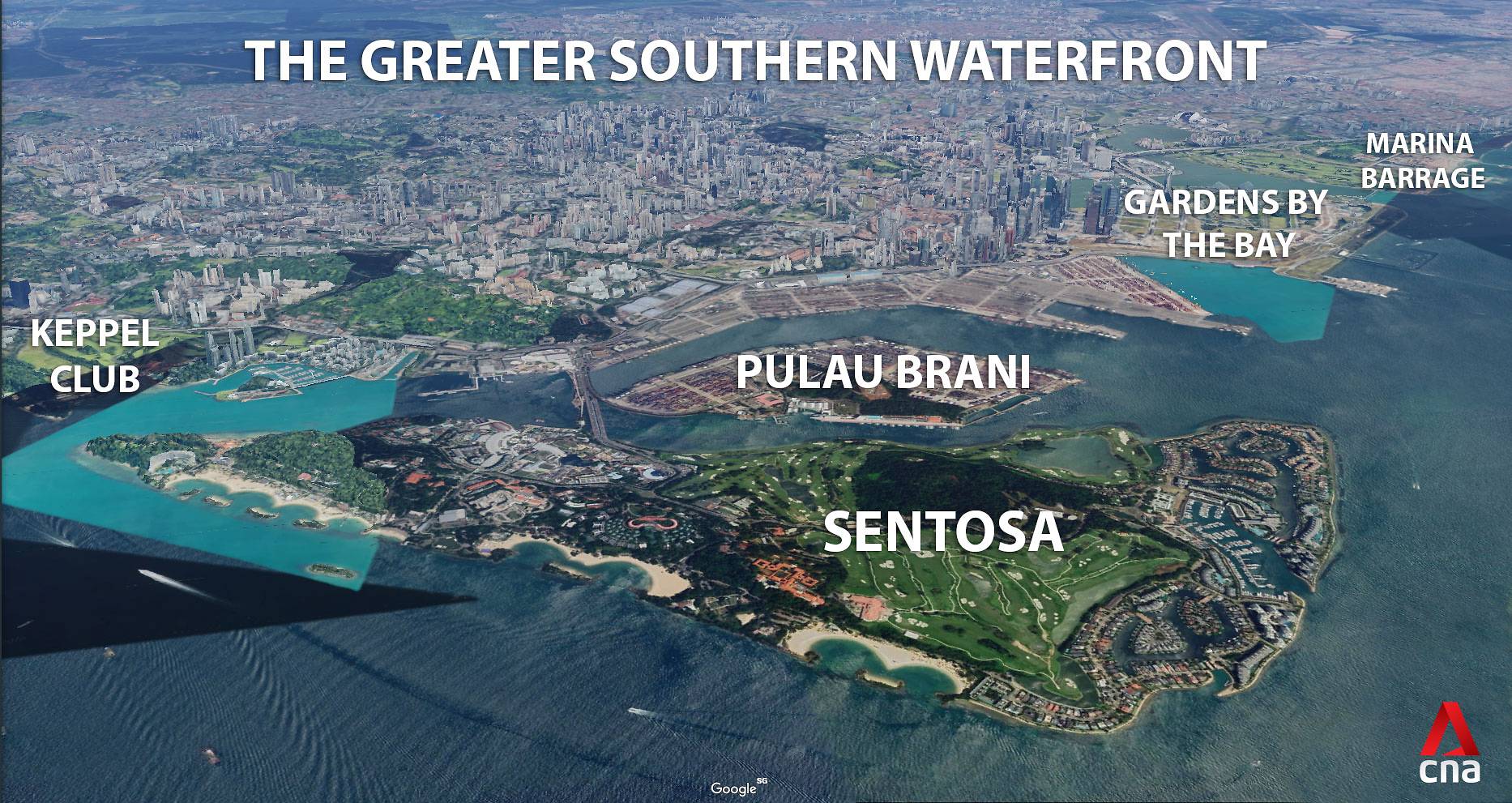
In his speech, Mr Lee laid out his vision for the Greater Southern Waterfront (GSW). The area will be redeveloped as a new place to live, work and play.

READ: NDR 2019: New attractions, housing and office spaces to be developed in Greater Southern Waterfront

Twice the size of Punggol, the GSW will also have new attractions, similar to Universal Studios Singapore, as well as a “Downtown South” resort to be built by NTUC, likely on Pulau Brani.

Other than Pulau Brani, the Government also has plans to rejuvenate Sentosa and redevelop two decommissioned power stations in Pasir Panjang.

NDR2019 - Greater Southern Waterfront map

8. SINGAPORE APPROACH TO US-CHINA TENSIONS “PRINCIPLED”

Addressing the ongoing US-China trade dispute, Mr Lee said that while it had economic implications for Singapore, it did not warrant immediate stimulate measures.

In his Chinese speech, Mr Lee also pointed out that if the situation does get worse, the Government would “promptly respond with appropriate interventions to sustain the livelihoods of our workers”.

READ: NDR 2019: Singapore will be ‘principled’ in approach to China-US trade dispute; ready to help workers

With Singapore being the only other sovereign country besides China to have a majority ethnic Chinese population, this makes bilateral relations “unique”, said Mr Lee.

This is why Singapore must always be principled in its approach and not be swayed by emotions, he added. 

9. MALAYS IN SINGAPORE HAVE “UNIQUE IDENTITY”

Malays in Singapore have developed a “unique identity” compared to their regional counterparts, said Mr Lee in his Malay rally speech.

READ: NDR 2019: Singapore Malays ‘distinct’ from others in region with inclusive religious practice, emphasis on education, PM Lee says

He noted that the Malay community practices religion “in a spirit of mutual respect, tolerance and inclusiveness” in Singapore’s multicultural society.

He also touched on how the community has been enhanced through its emphasis of education, citing the increase of Mendaki Awards recipients who graduated with first-class honours in university and the example of this year’s Malay President’s Scholar, Muhammad Dhafer Muhammad Faishal.

Source link

4 taken to hospital after fire breaks out in Jurong flat

0

SINGAPORE: Four people were taken to hospital after a fire broke out in a flat in Jurong on Sunday (Aug 18) evening. 

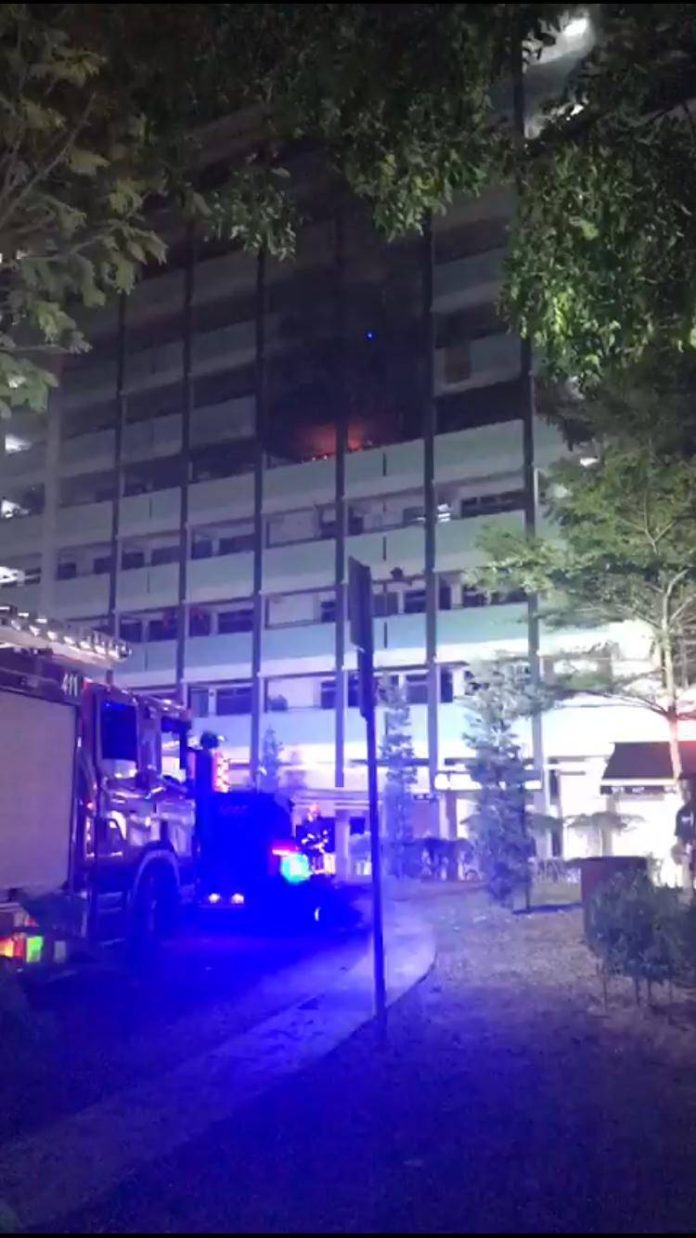
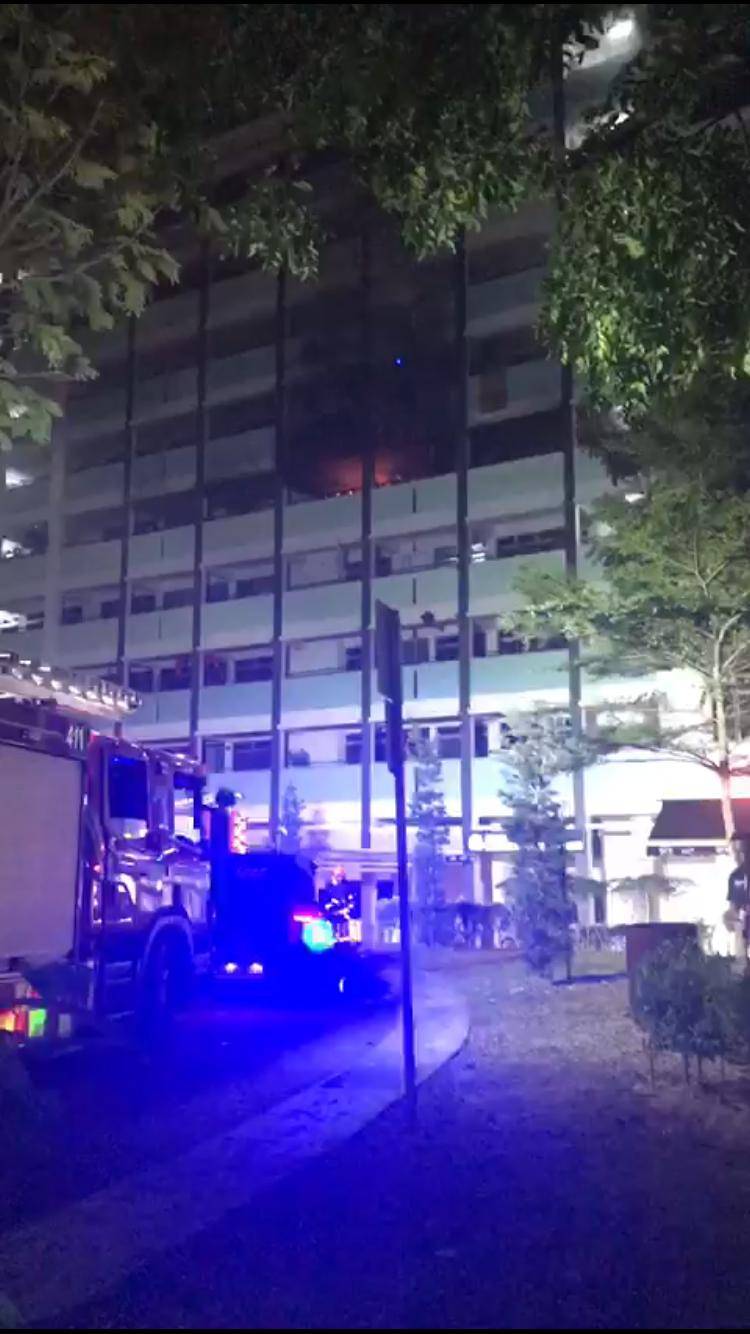
The fire broke out at a fifth floor unit of Blk 158 Yung Loh Road on Sunday at about 7.45pm, the Singapore Civil Defence Force (SCDF) said. 

A video sent to CNA showed firefighters at the scene, with flames coming from within the flat. A woman could be seen standing on a kitchen ledge to try and escape the flames.

jurong fire

Screengrab of SCDF at the scene of the fire in Jurong on Aug 18, 2019. ((Video: Amanraj Singh)

fire jurong flat scdf on site

Screengrab of a video showing a woman being wheeled to an ambulance after a fire broke out in a Jurong flat on Aug 18, 2019. (Video: Amanraj Singh)

The fire involved the contents of the living room and was put out using a water jet, SCDF said.

Four people were taken to Singapore General Hospital and Ng Teng Fong General Hospital, the force added. The cause of fire is under investigation.

Source link