SINGAPORE: New attractions are being planned for Pulau Brani, similar to Universal Studios Singapore on Sentosa, announced Prime Minister Lee Hsien Loong on Sunday (Aug 18).
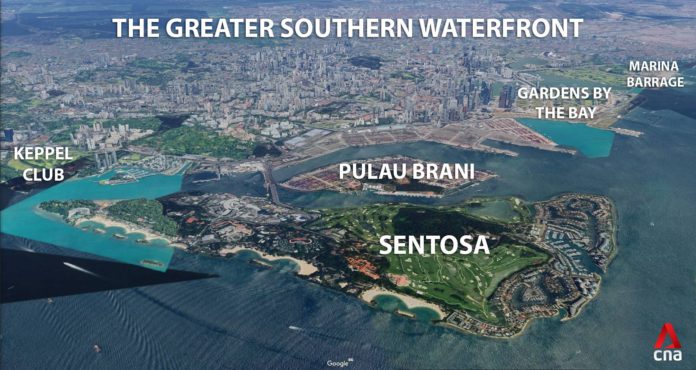
The island, currently home to Brani Terminal, will be set aside for “fun and recreation” as part of the Government’s plans to remake Singapore’s Greater Southern Waterfront (GSW), he said in his National Day Rally speech.
Mr Lee added that a resort could also be built on Pulau Brani, with land set aside for the Labour Movement.
“When we discussed these plans in Cabinet, Ng Chee Meng put his hand up. He said: ‘NTUC is very grateful to the Government for Downtown East. How about a Downtown South?’
He said this gesture was to thank workers for their contribution to the nation.
Other than Pulau Brani, the Government also has plans to rejuvenate Sentosa Island, and redevelop two decommissioned power stations in Pasir Panjang.
Entrance to Sentosa. (Photo: Gaya Chandramohan)
“We will also revitalise Sentosa’s beach areas and expand its nature and heritage trails, to keep its island character,” said Mr Lee at the rally.
He added that the Government will “find creative new uses” for the two power stations.
In addition, there are plans to improve Singapore’s greenery by linking the GSW with the surrounding green areas. West Coast Park and East Coast Park will be connected, and so will the Rail Corridor and Sentosa Island.
“With a new green heart at the centre, Singapore will be even more of a City in a Garden,” he said.
“WORK NEAR WHERE THEY LIVE, AND LIVE NEAR WHERE THEY WORK”
Apart from recreation, the Government also hopes to develop residential and commercial properties in the GSW, said Mr Lee.
One of the first developments will be on the plot occupied by the Keppel Club, whose lease will expire in two years’ time.
It will be remade into a residential quarter with both public and private housing.
“There is enough land here to build 9,000 housing units… HDB and private housing with waterfront promenades, with greenery and open spaces,” said Mr Lee.
“And that is just the start, because there’s space and land for public and private housing elsewhere in the GSW too.”
He added: “With GSW the size of two Punggols, you get a sense of the possibilities. Think of it as Punggol by the Bay!”
While several large corporations such as Google, Cisco and Unilever already have offices near Labrador Park, the Government “will develop more office space in the GSW, like this one, which will bring in more jobs,” said the Prime Minister.
“People can work near where they live, and live near where they work. This will create life and activity during the day and at night.”
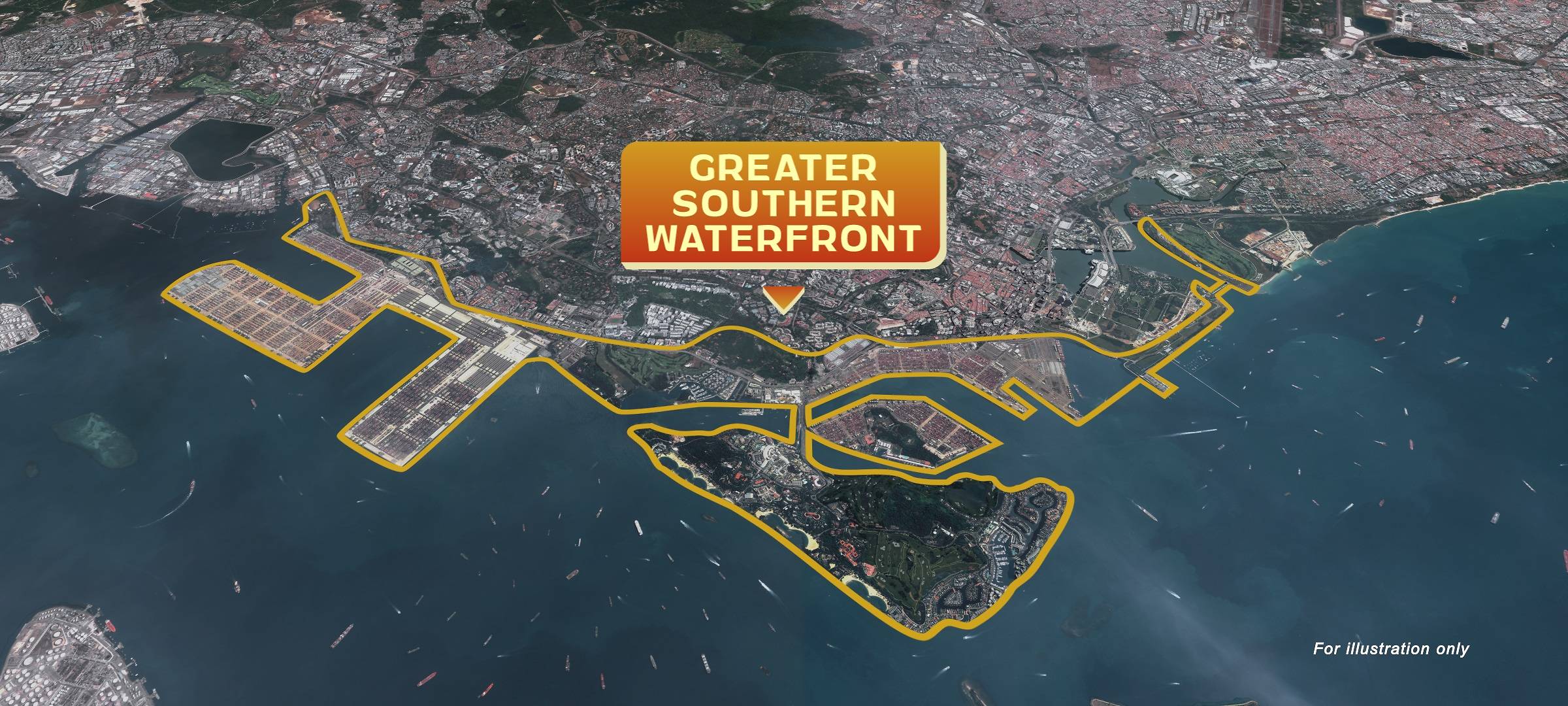
Stretching from Gardens by the Bay East area to Pasir Panjang, the GSW covers 30km of Singapore’s southern coastline. With 2,000 hectares of land, its overall area is six times the size of Marina Bay, and includes PSA city terminals at Tanjong Pagar, Keppel, Brani and Pasir Panjang.
Source: PMO
“By 2027, the city terminals will go to Tuas where we are building a new port, and later on in 2040, the Pasir Panjang Terminal will also go to Tuas Port,” said Mr Lee.
“This will free up prime land for re-development. It will be an opportunity to reshape the GSW into a new place to live, work and play.”
Modern Singapore consists of “multiple layers and imprints of different eras”, of which the GSW would add another layer, he said.
While there are many major projects ongoing, such as the Punggol Digital District, Tuas Port, Jurong Lake District, Changi Terminal 5, Paya Lebar Airbase and the GSW, “all these will not be done in a decade, or even in one generation”, he added.
“There will be space for successive generations to fill with their hopes and dreams. Each new generation will leave their mark on our city, as their predecessors have done,” Mr Lee said.
SINGAPORE: Tackling the “50 to 100-year problem” of rising sea levels could cost Singapore around S$100 billion or more, said Prime Minister Lee Hsien Loong on Sunday (Aug 18).
In his National Day Rally English speech, Mr Lee highlighted that Singapore is susceptible to the effects of climate change and especially vulnerable to rising sea levels.
“How much will it cost, to protect ourselves against rising sea levels? My guess is probably $100 billion dollars over 100 years, quite possibly more,” said Mr Lee.
“If we only have 10 years to solve the problem, we won’t have enough time or resources to do it. But because this is a 50 to 100-year problem, we can implement a 50 to 100-year solution.”
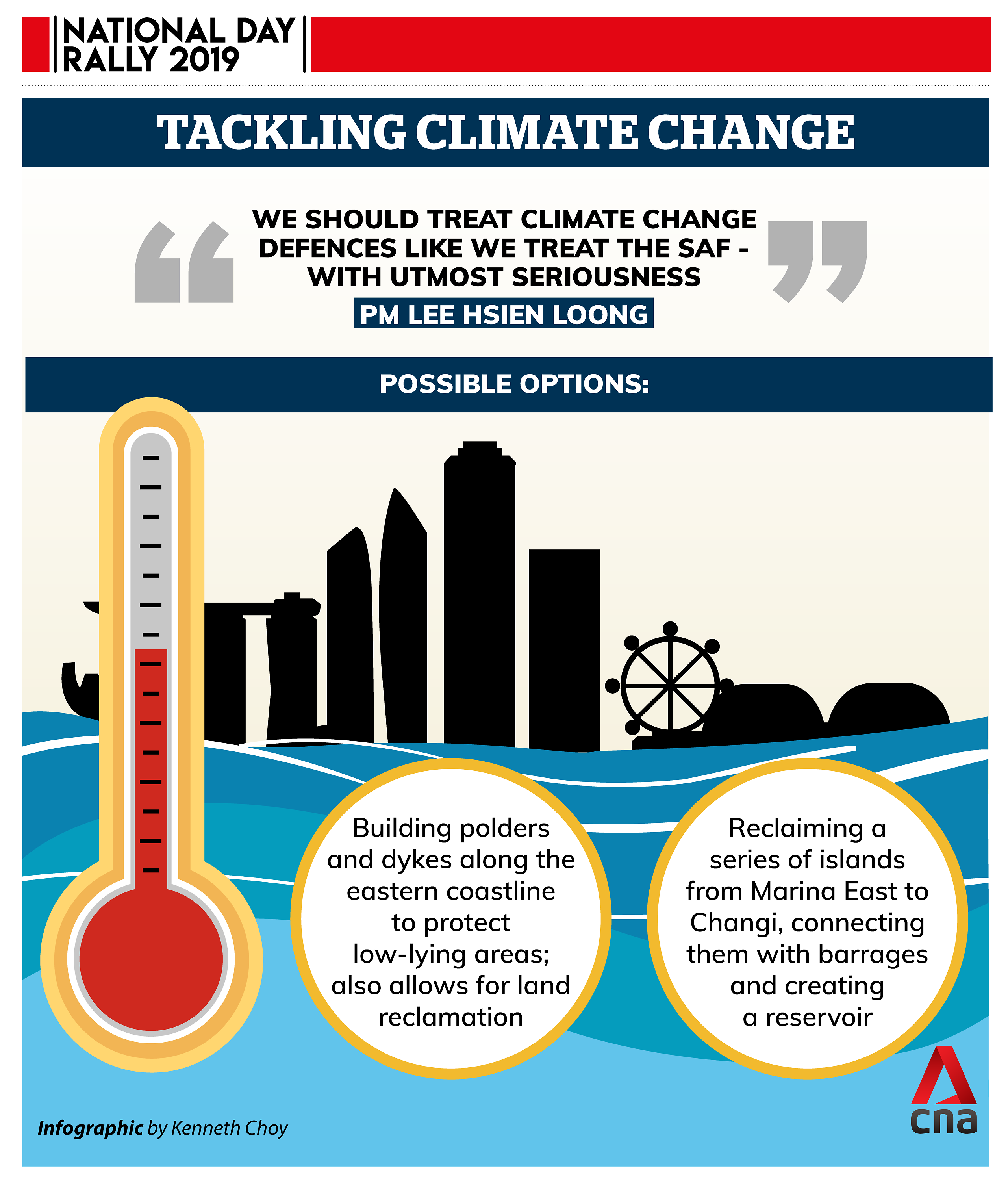
Climate change defences should be treated with utmost seriousness, just like the Singapore Armed Forces (SAF), said Mr Lee.
He said there is a need to “work steadily at it, maintain a stable budget year after year, keep your eye on the target and do it over many years and many generations”.
While Singapore has implemented localised measures to protect individual buildings and developments – new developments are required to be built at least 4m above sea level, and this requirement is even higher for critical infrastructure – these solutions will not be enough, said Mr Lee.
“We have many older buildings. These cannot be lifted up, or transported to higher ground,” explained Mr Lee.
“In fact, large parts of Singapore are low-lying, and we need to protect these low-lying areas as a whole.”
As such, coastal defences need to be built, said Mr Lee.
“We have studied our whole coastline in detail, and we’ve divided it into different segments,” he said.
Work will be prioritised for more “critical” areas such as the City-East Coast and Jurong Island segments.
In the city area for instance, there are plans to build a second pump house at the Marina Barrage. The current pump house contains seven giant pumps, said Mr Lee.
“We built the Marina Reservoir and Marina Barrage, to protect the city area from flooding,” added Mr Lee. “When it rains heavily during high tide, water is pumped out of Marina Reservoir into the sea, so that rain falling in the city area can drain into reservoir. When sea levels rise, one pump house will not be enough.”
Other solutions are required for the eastern coastline of Singapore, pointed out Mr Lee.
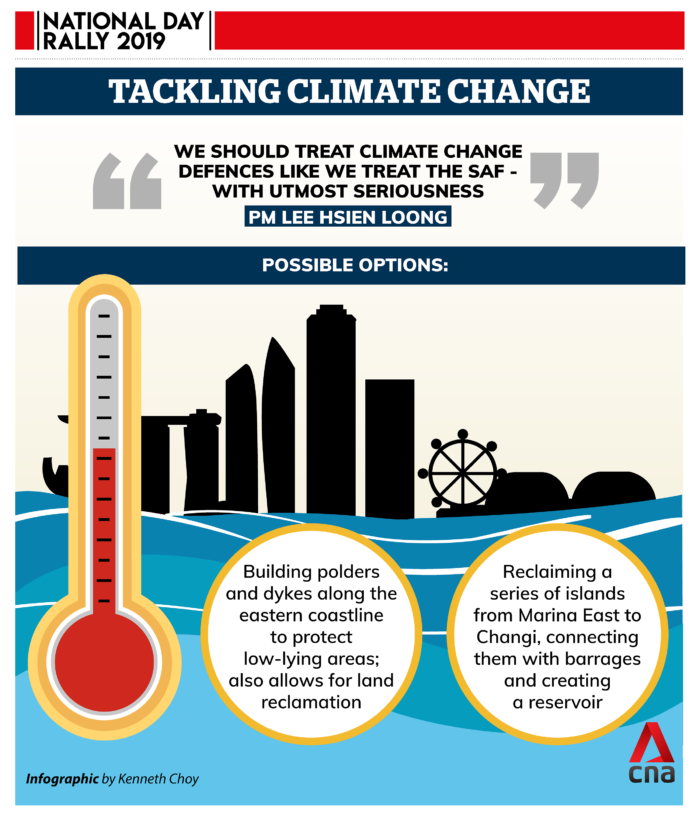
One option – implemented by the Netherlands – is the construction of what the Dutch call “polders”, which is land that is reclaimed from the sea.
Polders are created by first building a seawall in the water, before pumping out the water behind the seawall to create dry land. This land can be lower than sea level, but water has to continually pumped out.
This is a “serious option” for the Republic, said Mr Lee.
A small polder is currently being built at Pulau Tekong, added Mr Lee, to gain some “experience” operating one. The new land will be used for Singapore Armed Forces training.
Another alternative is to reclaim a series of islands offshore, from Marina East to Changi, said Mr Lee.
They can be connected by barrages, and a freshwater reservoir similar to Marina Reservoir could be created, he explained.
“We will examine all the options carefully, and when the time comes, we will decide what is the best way to do it,” said Mr Lee. “This problem has good engineering solutions, although they will all cost money.”
What matters is that Singapore’s climate change plans must be implemented “progressively” and kept “flexible”, emphasised Mr Lee.
“But we must start now and sustain the effort, as the Dutch have done over centuries, and as we have done with the SAF,” he said. “We must make this effort. Otherwise one day, our children and grandchildren will be ashamed of what our generation did not do.”
SINGAPORE: Singapore will raise the retirement age and re-employment age to 65 and 70 respectively by 2030, alongside increases in the Central Provident Fund (CPF) contribution rates for older workers.
This, announced by Prime Minister Lee Hsien Loong on Sunday (Aug 18), comes after the Government accepted “in full” the recommendations put forward by a tripartite workgroup studying the country’s ageing workforce.
These changes will be done in “gradual steps”, said Mr Lee in his National Day Rally speech.
The retirement age, which is currently at 62, will go up to 63 in 2022 before being raised further to 65 by 2030.
Similarly, the re-employment age of 67 will go up to 68 in three years’ time, and then to 70 by 2030.
Those born on or after Jul 1, 1960 will benefit from the higher retirement age of 63 in 2022, while the first tweak in the re-employment age to 68 will apply to those born on or after Jul 1, 1955, according to the Ministry of Manpower.
CPF contribution rates will also be raised for workers above the age of 55, announced Mr Lee.
Currently, the total CPF contribution rate is 37 per cent for workers up to 55 years old. It drops progressively as the age band increases – 26 per cent for workers aged 55 to 60, 16.5 per cent for those aged 60 to 65, and 12.5 per cent for those above 65.
By the time the changes are completed, workers aged 60 and below will enjoy full CPF rates, said the prime minister.
The CPF rates will only begin to taper down after 60 and level off after 70, he added.
The first adjustment in the CPF contribution rates is set for 2021 and will be followed by subsequent increases gradually.
According to Mr Lee, the whole process will take “10 years or so … but it will depend on economic conditions”.
File photo of the CPF building. (Photo: TODAY)
Overall, the changes will support older workers to continue working longer and help them be more financially independent, said the prime minister.
He stressed that these newly announced adjustments do not affect CPF withdrawal policies or withdrawal ages.
“We are not making any changes to CPF withdrawal policies or withdrawal ages,” he said.
“You can still take out some money at age 55 and you can still start your CPF payouts from age 65. All of that remains exactly the same.”
SUPPORT PACKAGE FOR BUSINESSES
These announcements come nearly 15 months after the formation of the Tripartite Workgroup on Older Workers. Comprising representatives from the Government, employers and unions, it was tasked to look into the concerns of older workers here and earlier this year, agreed on the need to raise the country’s retirement and re-employment ages.
Citing feedback from the workgroup, Mr Lee said there had been “intense discussions”.
“Older workers wanted to be certain of continued employment for longer … but employers were worried about business costs and the uncertain economic outlook,” he said. “In the end, the workgroup reached consensus.”
With an average life expectancy of nearly 85 years, Singaporeans are now healthy for longer and living longer, with most seniors preferring not to stop working.
“We don’t want to spend more years in retirement,” he said.
“We want to stay active and engaged, to feel a sense of worth and purpose … Also, many of us want to build up bigger nest eggs for when we eventually retire. Therefore, many of us have multiple careers in a lifetime,” he added.
Mr Lee said it will take a “joint effort” to enable seniors to continue working productively.
This includes having employers re-design their training, jobs and careers around the abilities and strengths of older workers.
Workers will also need to have the right mindset as jobs change or disappear.
“We must be ready to adapt, learn new things, and take on different responsibilities … Re-skilling ourselves must start early even when we are in our 40s and 50s, if not even earlier,” he elaborated.
This is so that workers can have useful skills as they near retirement age, and they can keep improving even in their 60s, added Mr Lee.
Support from the Government will be given to both employers and employees in this area.
As such, Mr Lee said businesses can expect a “support package” to help them adjust to the changes in the retirement age, re-employment age and CPF contribution rates.
This will be announced by Deputy Prime Minister Heng Swee Keat in next year’s Budget.
And as a major employer, the Public Service will take the lead by raising its retirement and re-employment ages earlier in 2021, instead of 2022.
“I encourage private sector companies which can do the same, also to do so,” said Mr Lee.
PATGRAM, Bangladesh: Mohammed Mukul Hossine’s passion for poetry began with a small transistor radio.
As a boy, home for his family of 10 was a small tin shed in the middle of a lush floodplain. In the fields around it, his father grew rice, jute or beans and potatoes, depending on the season, while the family’s milk goats and cows roamed freely.
Almost everyone in this county at the northern border of Bangladesh was – and still is – a farmer. Barely one in four could read or write. Little Mukul knew nothing about music and art.
So when his older brother passed him a small black radio and, for the first time, he heard Bengali folk songs playing on the local station, Mukul was shaken to his soul.
Patgram, where Mukul grew up.
He stopped kicking balls or going to the river with his friends. Instead, the six-year-old would sit in the shade with his sister, listening and singing along to all his favourite songs.
Sometimes, when he got bored of singing the same lyrics, he would make up his own. And his sister would tell him: “Mukul, you’re not singing. You’re making poems.”
GOING TO SINGAPORE
The first time Mukul had a poem published in the school magazine, he was in Primary 4. He was a bright student, but being only interested in the arts – singing, drawing, writing – he did poorly in other subjects.
His parents were not pleased, but mostly they let him be. As their second-youngest child, Mukul was doted on.
Throughout primary and secondary school, Mukul was always performing on stage at school events. As he got older, he wanted to make singing his career. So he enrolled himself in an arts school.
But life as a college student came to an abrupt end seven months into the school year, when his father pulled him aside one day and presented the 18-year-old with a choice.
Mohammed Kapil Uddin had a friend who was earning good money in Singapore. Wanting to give one of his sons the same opportunity, Kapil had paid a job agent by selling a part of his farm. All that was left was to decide which of his sons to send – and as his Kapil’s favourite child, Mukul was first in line.
In 2008, Mukul arrived in Singapore and became one of the few hundred thousand foreign construction workers on the island. No one had told him what working here actually meant.
“I thought by going there, I could carry on my passion for singing and writing,” the 29-year-old told CNA Insider. “That’s why I decided to go there.”
Where Mukul grew up. These days he goes to the river to draw when he’s feeling troubled.
‘LIKE A PRISON’
Dr Tan Lai Yong first met Mukul in 2015 at a workers’ dormitory in Mandai.
A volunteer doctor at HealthServe, a non-profit organisation that provides medical care and counselling to migrant workers, the 58-year-old Singaporean was there to play sepak takraw and football with the workers, hoping to recruit some as volunteers for the clinic.
After the game, he asked the men what they did in their spare time. Most gave answers like playing cricket or watching movies. One response was unexpected: Writing poems. It came from Mukul.
“I said, ‘Oh, interesting’,” Lai Yong recalled. He had not taken note of the young man dressed in a bright flowery t-shirt until this point. But the more he probed, the more intrigued he became. “He told me that he writes poetry on scraps of paper and cement packaging and so on.”
By then, Mukul had been in construction for seven years, but he was still struggling to come to terms with being a labourer.
“When I first went to Singapore, I didn’t know that I would work as a construction worker and that I had to work hard,” Mukul said.
Singapore felt like a prison. Because I had to abide by many rules and regulations.
“I tried to adjust to the new environment, and tried to make myself like the people,” he added.
But it was evident that Mukul had issues that affected his performance at work.
In seven years, he had already switched employers four times, due to either a “situation” or a “problem”. Job-hopping like this is rare among foreign workers.
(File photo: Reuters)
Every time he was let go and went back to Bangladesh, his parents would borrow more money to send him back to Singapore – racking up more debt paying agents who charge anywhere from S$2,000 to S$5,000.
“There was a time when my father told me not to go back to Singapore anymore. He even told our relatives not to give me money,” Mukul recalled. “But my mother loves me too much. So she sold her jewellery for me. And my friends in Singapore helped, too.”
Meeting Lai Yong gave Mukul a place to escape to, at least on the weekends. He volunteered as a translator at HealthServe where he easily made friends with both Singaporeans and other foreign workers.
During the week, however, writing verses about loneliness, missing his family, and the hardships of a migrant worker was still his main outlet for venting his internal turmoil.
Over the years, he’d written a large number of poems, some of which he managed to publish in a book in Bangladesh. But he told Lai Yong that his wish was to have them translated into English and published in Singapore, reaching a wider audience.
“Since childhood, I’ve wanted to be different and prove myself to the world,” Mukul said.
In fact, he had been earnestly attending literary events around Singapore, immersing himself in the scene.
TRANSLATING MUKUL
In 2014, Mukul participated in the inaugural migrant worker poetry competition organised in conjunction with the Singapore Writers Festival. He did not win, but it was at that event that he approached Cyril Wong, an award-winning poet and writer from Singapore.
When Mukul met Cyril.
“He was talking a lot in his poetry about how much he was struggling with prejudice in Singapore, and I thought these topics were so powerful,” Cyril said of his first impressions of Mukul.
Sensing Cyril’s interest in his work, Mukul asked for help to recreate his poems in English. It didn’t take much to convince Cyril.
“These things had to be talked about in order to start some kind of literary, political or cultural conversation about what it means to be a migrant worker in Singapore,” said the 42-year-old known for his poems on love and sexuality.
And the poetry was very raw and honest; very tender and painful, but also optimistic. And I found that to be a worthwhile project to do.
The two got to work right away. But Cyril soon realised the amount of work it would take to get Mukul’s poems transcreated and made book-worthy.
“Mukul would send me the poems on WhatsApp and it was really exhausting to read like 60 poems on WhatsApp, just scrolling and scrolling,” Cyril said of their collaborative process.
Cyril at work.
“A lot of it was Google-translated, so it didn’t make any sense, it was basically gibberish. I would retranslate the English translations into poems that were more literary, more dramatic and more sensible; and then I would talk to him to see whether he was okay with them,” Cyril said.
For months, the two met every few weeks to talk through poems and about life in general.
“I was getting a lot of context from him and that was how I knew how to translate the poems,” said Cyril, who occasionally expressed reservations about recreating Mukul’s poems this way.
“The English poems, they are basically poems in my own voice,” he said. “There’s a certain ethical consideration here.”
Cyril said he would ask Mukul, “Are you sure that you want to do this, because the end product will just be mostly in my voice, trying to imitate what I think is you. Are you okay with that kind of distance?”
Mukul was not at all concerned. “I think he was just happy to see his name in print,” said Cyril.
In 2016, the book Me Migrant was published, and its first print run sold out very quickly.
What no one expected was how Mukul became a media sensation overnight.
LIVING TWO LIVES
Within weeks of the release of Me Migrant, Mukul was on television shows such as CNA’s Singapore Tonight. Even international publications like Bloomberg, Newsweek and The Economist wanted to feature him in their stories.
“I don’t think I could have done something like this in my life if I had just lived in Bangladesh,” said Mukul, reflecting on how that book changed his life. “I presented my lifestyle and honesty to (people) and they appreciated my work.”
HealthServe’s Lai Yong (left) with Mukul on CNA’s Singapore Tonight, to promote Me Migrant.
He was also invited to give talks at schools, one of which was the National University of Singapore. “I cannot make you understand how I felt, as a construction worker getting to speak in front of such brilliant students,” he said.
While Mukul basked in the whirlwind of attention, his collaborator Cyril felt uneasy with the hype.
“A lot of international media were trying to contact me to talk about the experience of working with Mukul, about Mukul himself,” Cyril recalled. “I was thinking to myself, ‘Why is everyone suddenly so hung up about migrant workers?’
It wasn’t about the poetry anymore, it was about the personality.
“Everyone wanted to talk about the suffering, the suffering, the suffering.”
Cyril did not think that this kind of media attention would result in real changes that would elevate migrant workers from their plight.
“I think we are in a phase of culture, regionally and internationally, in which people are very obsessed with poverty porn in order to feel good about themselves,” he said.
But Mukul did not mind. His weekends were packed with invitations to speak at events where he signed books for fans and got to rub shoulders and take pictures with dignitaries.
When Monday arrived, and he had to return to slogging on the construction site, his mood would crash.
“I had two lives in Singapore. One is bright, the other is dull. As a construction worker, there was a pain in me that became worse over time,” Mukul said.
He only wanted to live his “second life” in which “ministers, ambassadors and the high commissioners would come”. “They appreciated me.”
Cyril saw Mukul’s transformation thus: “The moment the fame got to him, he became very much imprisoned in this bubble of delusion about what it meant to be an author or a poet.
“He had this innocence, but also a kind of childish delusion that as long as he was famous, somehow everything else – economically and practically speaking – would fall into place for him: He would be rich; he would be able to take care of his parents; he would be able to build a bigger home in Bangladesh.”
Cyril’s concerns were not unfounded. Mukul’s fame was about to cost him his fifth job in Singapore.
WATCH: Mukul pays a price (13:24)
‘THEY’RE JEALOUS’
One man who wasn’t surprised at how easily Mukul became a media darling was Cai Yinzhou. When he first met Mukul at HealthServe in 2015, he noticed him right off because the Bangladeshi was “super-friendly”.
The 28-year-old who founded Geylang Adventures, a community group that reaches out to migrant workers, didn’t even know that Mukul was one – because he carried himself so differently. “He was wearing these bright-coloured shirt and pants. And he was always in the centre of a few people, talking.”
“He loves to perform, he loves to hold the microphone. That is him in his natural element… It was a matter of time, you know, when he’s so ‘diva’ as I call it,” Yinzhou added, jokingly.
However, as one of Mukul’s confidantes in Singapore, Yinzhou also quickly realised that while Mukul enjoyed all the attention he was getting, he was also deeply troubled.
Mukul told CNA Insider he felt misunderstood at work, and was particularly hurt by his co-workers’ reactions. “When I did my first live interview, they saw me on TV and they were so jealous,” he said.
They would ask why a poor person like me was busy with writing and stuff? I felt pained.
Mukul also believed that his supervisors made things difficult for him on purpose.
“They would find fault all the time,” said Mukul, who thought that he was an above-average worker and deserved to be promoted. “They would tell me I did not have enough experience, that I needed to go in the field to learn my job before becoming a supervisor.”
However, as a Singaporean, Yinzhou could see why an employer would take issue with Mukul, especially with all his extracurricular activities. “He was always busy on weekends when typically workers would be trying to work overtime, or sometimes being exploited to work overtime.
“But he’d be like, ‘I can’t because I’m the guest-of-honour.’ So it was this power imbalance that would cause tension.”
Mukul at the Singapore Writers Festival
He also noticed that Mukul would sometimes stretch himself too thin with his social activities, and sacrificed proper rest.
“I don’t know about the rate of sick leave for other workers but for Mukul, he was letting the burden of the lack of rest catch up with him,” Yizhou said.
“If your heart’s not in your work, I think it shows.”
THE OTHER SIDE OF FAME
As Mukul got into more trouble at work, his Singaporean friends tried to talk sense into him. They could all see that if nothing was done, things would not end well for Mukul.
“I was very aware of the realities of his family back home – how they were depending on his income, and what his parents had to sacrifice for him to be here,” said Yizhou.
“Being conscious of that, I spoke to him about what he could do to upskill himself, how he could be more serious at work.”
Cyril offered Mukul similar advice. “I tried my best to tell him that being a poet will not pay the bills. It will not necessarily make you a better human being.
You have to learn how to take care of others. Stop thinking about yourself as the famous artist poet.
But their words went unheeded by Mukul. And at the end of 2017, he was once again sent packing from his job, and returned home to Bangladesh.
Back home again in Patgram.
When CNA Insider caught up with Mukul in Patgram in April this year, he’d been jobless for more than a year, waiting for the “right” job in Singapore to come along.
He’d been keeping himself busy, though: His frequently-updated Facebook page had photos of him performing at or attending events, rubbing elbows with local politicians.
He also took up a small bank loan to rebuild his home that was destroyed by monsoon floods. The new place with four bedrooms looked fancier than the houses on the same street, with colourful murals and a front garden with exotic flowers.
Mukul’s house.
Mukul said that while his family was broke, he felt the need to maintain a certain image in a town where everyone knew him as a “famous poet”. He did not even go grocery-shopping – because he has no money.
“I have completely hidden my pain from others,” he said. “In order to deal with the pain, I distract myself by singing and writing.”
He also gave motivational talks at schools and, while CNA Insider was there, held an exhibition of his paintings which he said he financed by selling off a gold figurine.
Mukul getting the village boys to help with his exhibition.
DOING THE SAME THING, OVER AND OVER
While waiting for a new (and to him suitable) job to materialise, Mukul managed to get HealthServe to help fund the printing of Braving Life, his second book of poems, in Singapore.
This time, however, Mukul had to plead with Cyril to transcreate the poems for him. The latter eventually agreed – which he came to regret.
“I felt like (the book) wasn’t really going anywhere because I kept telling him, as a poet, you need to grow. That is the most repeated advice I gave him that he never heeded,” said the Singaporean writer.
“Mukul just wanted to talk about the same things again and again. He wanted to talk about them in the same way, which is the worst.
“If every poem starts to look like each other, and you don’t care about the artistic process, but more about the fame that accompanies the artistic process, then we have a problem.”
Mukul reading from his second volume of poems, Braving Life.
That experience soured their friendship.
“I feel like I’m enabling his delusion about what he can achieve, and should achieve in life. I don’t want to be the person responsible for that,” said Cyril.
Indeed there was a sense of déjà vu about events – right after the Braving Life was published in 2018, when Mukul travelled back to Singapore to do publicity for the book, he actually lost yet another opportunity to work there.
His 56-year-old father, who borrowed S$4,000 for Mukul to make this job happen through an agent, does not know what happened.
“I just know that there were problems,” Kapil said. “He came back after just 24 days. It definitely felt bad. If he had stayed I could have asked money from him. Now I cannot do that anymore.”
Mukul with his mum and dad, who have borrowed thousands over nine years to keep sending their son to Singapore.
Reflecting on Mukul’s repeated attempts – and failure – to lead a double life as a migrant worker and poet in Singapore, Lai Yong wonders if Mukul should keep trying.
“Is Singapore the right fit for him as a construction worker, I really don’t know,” he mused.
“It’s 33 degrees out there. A cement bag is 30kg. You can write poetry on it, but it doesn’t lighten it. So, can he get a supervisor role? But he doesn’t have the years of construction foreman experience. So it’s tough.”
ONE LAST CHANCE?
But reality sometimes forces hard choices to be made. With Kapil falling chronically ill, Mukul was finally feeling the pressure of being the family’s breadwinner.
Helping his father fold dried tobacco leaves, which they sell for income. But Mukul’s heart is not in such work.
“I really never thought about my family before. Now I have to think about it,” he confessed to CNA Insider.
In July, three months after CNA Insider first met him in a state of limbo, Mukul finally got his wish of returning to Singapore.
He’d snared the post of safety coordinator with a construction firm. This would be his seventh job in eleven years.
“They promised to give me an opportunity to study, that’s why I came,” said Mukul, who is now attending weekend classes on workplace safety and health.
With his hair cropped short, he now looks younger, but he speaks with noticeably less self-assurance. And there is an air of seriousness that was not here before.
Mukul back in Singapore, in August.
He said that all those months of idling at home waiting for a job had finally made him realise how important qualifications are. As much as his Singaporean friends tried to help him find a job, every time they asked for a CV, he felt ashamed that he had nothing to put on it.
When told he was back in Singapore, Dr Tan had this advice for Mukul: “Just do one thing, and do it well. The bells, the hoops, the whistles can come later, because if you don’t do it well, you’ll be sent back.”
For now, Mukul says he will use his spare time only for studies. He is going to try to get a part-time diploma in civil engineering so that he can progress further in the construction industry.
A new start for Mukul, now a safety supervisor.
As for the social events he used to attend and the volunteer work he used to do, they took up too much time and did not really add up to anything that would improve his life, he told CNA Insider – so he is going to give them a miss for now.
But that doesn’t mean he’ll give up writing.
He’s planning to get a book of short stories published in Singapore, he says. “I have 13 short stories so far. When I have around 15, I will publish.”
More on CNA Insider’s Life After Singapore series:
DENVER, Colorado: Minster for the Environment and Water Resources Masagos Zulkifli highlighted in Parliament in early August that while 60 per cent of the nation’s waste generated is recycled, Singapore must continue building its recycling capabilities.
“NEA is currently studying e-waste and plastics recycling solutions and technologies available in the market, and assessing their suitability in Singapore,” he said, suggesting that Singapore has a recycling problem.
But this focus on improving recycling rates obscures the real problem surrounding waste because the intuitive policy response is to focus on marginally increasing recycling rates, where the gains are unclear.
LOOKING AT RECYCLING PROGRAMMES AROUND THE WORLD
Lessons learnt from around the world show how costly, inefficient and unimpactful current recycling programmes have been.
In the developing world, recycling programmes take the form of dedicated waste pickers, like those in India who go through city trash and collect discarded waste that can be recycled and composted, or broad-based incentive programmes, like those in Surabaya, where people get a free ride on a city bus if they recycle plastic bottles.
While they make wonderful, feel-good stories, the reality is neither gets plastic recycling rates to where they need to be.
Even in Sweden, the most widely acknowledged environmentally friendly country on earth, the recycling programme is highly regarded as zero-waste but its waste separation system is very expensive, requires complete adherence by all households, and does not even include plastic, the biggest scourge in our waste problem.
Dozens of people clutching bags full of plastic bottles and disposable cups queue at a busy bus terminal in the Indonesian city of Surabaya — where passengers can swap trash for travel tickets (Photo: AFP/Juni Kriswanto)
In fact, there is no nation on earth that is solving this plastic problem through recycling effectively.
Consider this: There are 380 million tonnes of plastic produced with an 8 to 9 per cent annual growth rate, and an average national plastic recycling rate of 7 to 8 per cent. At these rates, we are losing ground in the war on plastic.
Any incremental efforts through recycling programmes would be considered wildly successful if they pushed plastic recycling rates to 10 to 15 per cent but even then, the amount of plastic trash continues to grow.
Good is the enemy of great when it comes to addressing this problem worldwide. In the US, plastic growth is flat, and land is abundant, so the approach has often been to literally bury the problem through efficient waste management techniques.
However, in Asia, where land is scarce, and population and consumption growth continue to rise, most economies have no such luxury.
While policymakers have doubled down on improving recycling, which is good, a great approach is to shift away from the goal of increasing plastic recycling rates in favour of reducing plastic waste across the entire supply chain system.
A bold vision that breaks out of current flatlining recycling rates is what is needed.
Rather than policies to mitigate the use of plastics such as banning straws and other plastic disposables, we must more courageously and wholeheartedly look at developing closed-loop systems leveraging advanced chemical recycling technologies to produce recyclable, reusable plastics.
(File photo: TODAY/Chng Shao Kai)
These newly adopted technologies to break down synthetic plastics to create new materials are currently in use today in laboratories and start-ups around the world.
Early fruit of such efforts are bearing out across the world. There are roads off Melbourne paved with recycled materials, including 200,000 plastic bags, over 60,000 glass bottles and toner from 4,5000 printer cartridges.
Nearly 2,000 tonnes of discarded fishnets are turned into high-end surfboards by engineering company DSM and watersports firm Starboard.
There is huge corporate and political backing behind this move to reduce waste. Unilever, the consumer good behemoth, had announced commitments to have all plastic packaging be reusable, recyclable or compostable by 2025 and halving the environmental footprint in the making and use of their products by 2030.
A circular economy also provides a small country like Singapore with more heft to make use of limited resources. The development of this sector could also provide an engine of growth, as the circular economy could unlock US$4.5 trillion of additional global economic output by 2030, according to research by Accenture.
A VISION FOR PLASTICS
Imagine a vision for the nation to increase plastic recycling rates from the current 4 per cent to 60 or even 70 per cent.
Here’s the math on how it would be possible: In early plastic recycling efforts, scientists and entrepreneurs can achieve 65 to 85 per cent yields from a commingled feedstock of plastic and turn them into fuel for energy or other forms of plastic.
A man shovels shredded plastic litter to be recycled into roofing tiles at the Envirogreen recycling plant in Mogadishu, Somalia January 13, 2019. (Photo: REUTERS/Feisal Omar)
Different methodologies focus on different mixes of plastic that can be used, but if on average, about 80 per cent of a nation’s plastic can be chemically recycled using this technology and supply chain system, my study suggests recycling rates could be ramped up to 60 to 70 per cent, a target impossible through conventional means.
More waste management companies are moving into this greenfield sector. Brightmark Energy just broke ground on the first ever plant in the United States that turns single-use plastics into fuel in May and raised a whopping US$260 million in the process.
There is no question that a lot of work must go into designing a solution for a densely populated region of 6 million inhabitants, especially around the logistics of developing, collecting and processing these materials in a cost-effective manner.
What this first needs is a refocus on research and development, as well as the commercialisation and scaling-up of new innovations in material design and recovery, as part of Singapore’s drive to become a zero-waste nation.
In this regard, it would be interesting to see what results the National Environmental Agency’s programme Closing the Waste Loop, launched in 2017, has borne in its efforts to foster collaboration between the industry and research institutes to recover value from waste streams.
The facts are clear across the world. We cannot afford to continue with initiatives that only result in a marginal increase in recycling rates but do not shift the paradigm on plastics and waste.
Environment Minister Masagos Zulkifli speaking at MEWR’s 2019 Partners for the Environment forum. (Photo: Matthew Mohan)
Time is running out, Mr Masagos said last month as he emphasised that tackling climate change is a national priority.
As part of this effort, it’s worth refocusing on the groundbreaking solutions in labs that can bring about the transformation of our business supply chain system, and Singapore stands in a good position to lead that charge.
Jack Buffington is a professor at the University of Denver and expert in supply chains and material science.
SINGAPORE: “It’s difficult to cope. At the start, I really couldn’t sleep,” said Kathy Ong’s mum Jacqueline Ng, describing the loss of her 19-year-old daughter after a taxi driver’s negligent actions caused her death.
“I feel that what is missing is all her laughter. When she was at home, she laughed a lot,” Jacqueline recalled. “We don’t know what we’re going to do moving forward, without her.”
Taxi driver Yap Kok Hua was sentenced to eight weeks’ jail and banned from driving for five years on Aug 2, but for Kathy’s family, it is a life sentence.
Her parents Jacqueline and Keith feel the pain of losing Kathy as strongly as the day she died on Apr 19 last year.
Kathy Ong was described by her friends as someone who loved life and who made deep connections with those around her. (Photo: Family)
She had been in a taxi with three friends, going from Clementi to the National University of Singapore (NUS), where they were studying.
Yap decided to make a discretionary right turn from Commonwealth Avenue West into Clementi Road despite seeing a car coming towards him.
The other driver Ng Li Ning – who has since been charged with dangerous driving – was going at a speed between 92kmh and 97kmh, a court heard, but Yap decided to try and clear the junction.
He did not, and the collision threw Kathy out of her seat. She suffered serious injuries, together with three others in the taxi. One of them suffered a brain injury, and the other was left in a vegetative state after the smash. All four were rushed to hospital.
Jacqueline said she vividly remembered the moment she received a call from Kathy’s friend.
Taxi driver Yap Kok Hua was jailed for eight weeks after the crash killed NUS undergraduate Kathy Ong. (Photo: Roads.sg/Facebook, Najeer Yusof/TODAY)
“We were told by her friend, who was staying at NUS Tembusu College (where Kathy was staying),” her mum explained.
“She called me at about 7.50pm to tell her they can’t reach her (Kathy) at all. They kept calling her hand phone, and someone picked up to say they’re the traffic police and that Kathy was involved in an accident and sent to NUH (National University Hospital).”
Hours later, Kathy died of her injuries.
During Yap’s trial, it was revealed that he had previously committed a string of serious traffic offences – including running red lights on three occasions. He had also been fined twice for careless driving and twice for speeding.
The judge and prosecution said it reflected his attitude to road safety and his unwillingness to comply with traffic laws.
Two weeks after Yap was sentenced, Kathy’s family and friends shared their memories of her, paying tribute to an affectionate girl who would always take time out for loved ones.
“Every weekend I will fetch her from Tembusu, bring her home and then end of the day, we will do laundry together, fold her clothes … that’s when we spend time to talk and then, I will send her back,” Kathy’s dad Keith recalled.
Kathy Ong celebrating Christmas with her family. (Photo: Family)
“I’ve been doing this (since she started uni), and suddenly, now, the whole weekend (has) become so quiet and empty for us.
“You’re literally lost … before that, you’re looking whether to work hard, earn more money, provide better for the family. But it’s like, suddenly, with the loss of her, both of us are like ‘What are we working for? What are we slogging for?’”
Her mum added: “To me, she was not just a daughter. We would go shopping together, go for high tea together, drink coffee together, we shared clothes, shoes – so suddenly, it has become so meaningless.
“It’s difficult to cope. (At the start), I really couldn’t sleep. I can hear the doctor’s conversation to me, to tell me they can’t save my daughter.
“I can remember – word for word – I can exactly hear his voice, every night … it was really very tough for me.”
As a young girl, Kathy was outspoken, warm and loving. The former Juying Primary, Nan Hua Secondary and Anglo-Chinese JC student was popular among her peers, drawing friends from different walks of life.
Kathy Ong playing the harp. (Photo: Family)
Growing up, she was a proficient musician – playing the piano, harp and guitar. Pitch perfect and with a keen musical ear, she could listen to a song and reproduce it.
But it wasn’t only music which drew people to her.
“‘Are you okay?’ That’s what she would always ask,” her secondary school friend Ming Qian said.
“She would always remember what’s the last thing you were worried about, and she would check back with you.”
Childhood friend and neighbour Eunice Liew had known Kathy since they were six years old. They went to the same schools growing up.
NUS undergraduate Kathy Ong. (Photo: Family)
“Kathy was a very affectionate person. Every time I (saw) her, she would get really excited,” Eunice explained.
“She would run to you and hug you. It happened every time – even if I saw her three times a week. She’s very bubbly, a people person and made a lot of friends everywhere she went.”
That caring nature was well known among her friends. For university mate Chloe Lim, it was the little things Kathy did for those around her, such as leaving food and notes for her friends in Tembusu College, or giving them hugs as a form of encouragement.
“She’s a very warm person. You could always look for her when you’re going through something difficult, and she would always comfort you,” Chloe recounted.
Kathy Ong celebrating her last birthday with her friends. (Photo: Family)
Those friendships extended beyond her personal circle to include her parents.
“Her friends would come over even when Kathy was not at home,” Jacqueline said with a smile.
“Sometimes, they’ll come over and stay and ask Kathy if she’s coming back for dinner.
“And she would ask, “Why am I invited to my own house for dinner?’”
Keith added: “We are a very open family. She would just jump onto the bed and squeeze between the two of us … and the three of us would just squeeze together in the bed.
“When we’re sleeping, she would just come up on top and squeeze between us – even when she’s in secondary school, JC.”
KEY PILLAR OF SUPPORT
Since Kathy’s death, her friends have become a key pillar of support for her parents.
“They are amazing. They are always with us, on weekends and holidays. Even weekday evenings, they will come,” Keith explained.
“There are a lot of people who we don’t know who showed us a lot of concern. Every now and then we will receive a hamper from (people we don’t know).”
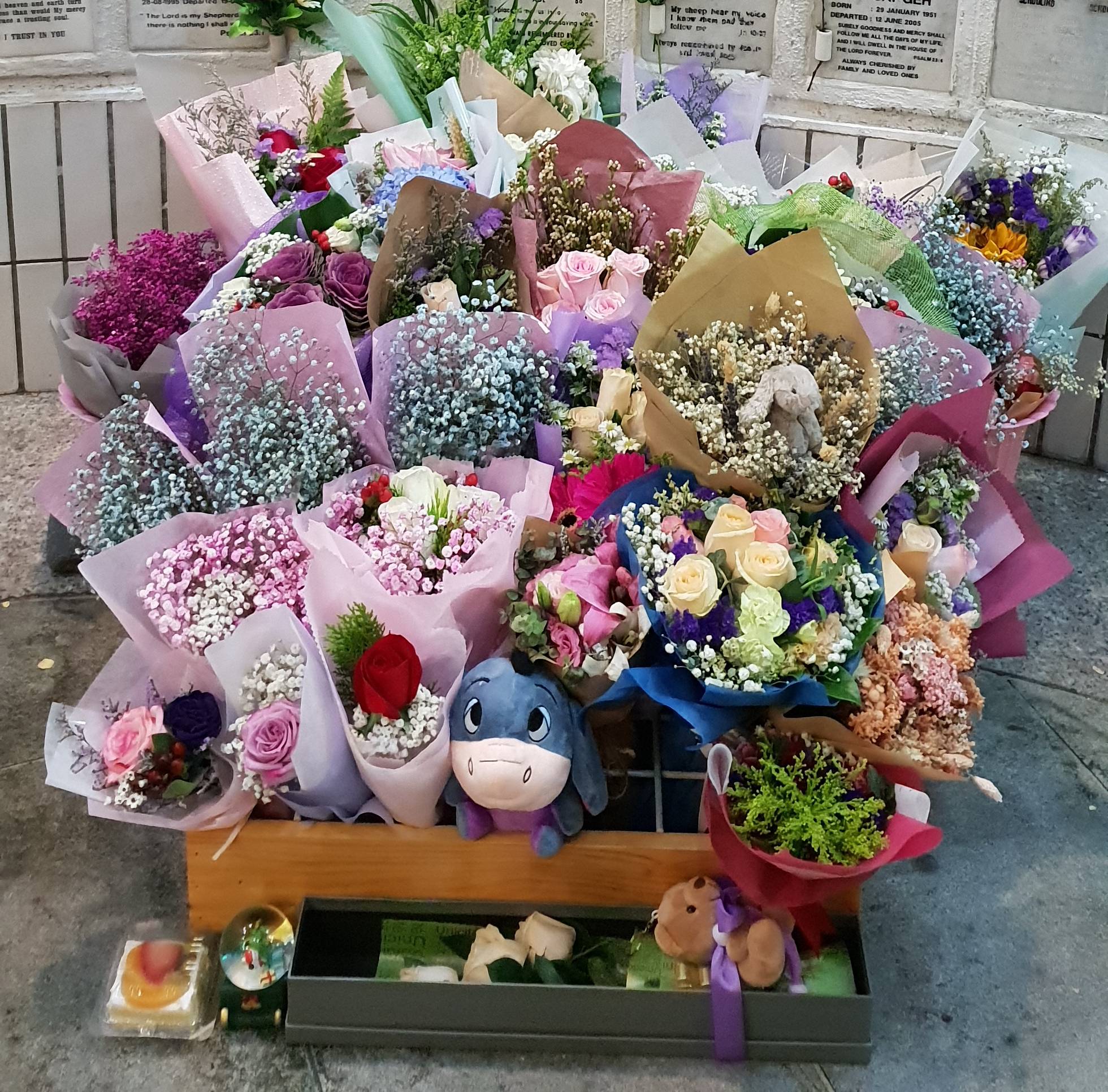
Flowers left in memory of Kathy Ong, who died in a taxi crash on Apr 19, 2018. (Photo: Family)
Since Kathy’s death, special occasions – such as anniversaries, Christmas and birthdays – have been especially hard. Kathy, her parents’ only child, died on the anniversary of her baptism, an important date for her family.
“Every special day that will be painful for us, (herfriends) will make sure we are well taken care of, like celebrate with us. They will come and spend time with us,” Jacqueline said.
“Like mother’s day, father’s day … we can feel a lot of people showering us with a lot of love.”
For the couple, the memory of Kathy is something they hold fast to. Every three or four times a week, they will spend evenings at St Teresa church, Kathy’s final resting place.
“It was the loving care she showed towards the both of us. Every time she saw us, it’s hugs – even after she went to university, every time she saw us, she (would) hug us,” Keith said.
His wife added: “When we went shopping, she would hold your hand, wrap herself around your arms.
Kathy Ong with her family. (Photo: Family)
“There was a period I fell ill, and was in and out of hospital. No matter what, she would bring her homework, no matter how tired she was, she would come and lie with me in bed, you know? That’s the part I feel most precious.”
Kathy’s death has hit her family friends hard. Hundreds came to say their final farewells at her funeral. As her mum recalled Kathy’s sensitive nature, a smile formed on her lips.
“I remember there was once, my husband said, ‘I wish we could own a bigger house’. She said, ‘Daddy, we don’t need a bigger house. We only need a home’.
SINGAPORE: This week marked the end of a long wait for Singapore to stop the sale of ivory and ivory products and a victory for those working to put this in place.
Over the last six months, Singapore authorities seized an unprecedented amount of 38 tonnes of pangolin scales and almost 10 tonnes of elephant ivory worth more than S$170 million – with some close to the largest seizures the world has seen.
Led by the National Parks Board (NParks), these acts of enforcement were a true testament of the country’s zero-tolerance to illegal wildlife trade.
Just two days after the most recent seizure of 15 baskets containing 815 birds over the National Day weekend, Singapore announced the latest highlight of our fight against illegal wildlife trade: An ivory ban.
THE WORK IS FAR FROM COMPLETE
It is generally estimated that customs intercepts 10 per cent of all contraband including drugs, weapons, and presumably ivory.
Although the massive seizures highlighted what effective law enforcement looks like in Singapore, it also revealed the sheer size of the problem. So the work is far from complete.
This week will be the start of the Convention on International Trade in Endangered Species of Wild Fauna and Flora (CITES) in Geneva, where 183 governments will meet to make critical decisions on wildlife protection.
With the ban announcement and the enforcement successes, this is a timely opportunity for Singapore to send a renewed urgent signal to global governments to interrupt trade routes and strengthen enforcement measures. What’s currently at stake: About 1,045 threatened species and subspecies, including pangolins and marine turtles.
Officials found 11.9 tonnes of pangolin scales and 8.8 tonnes of elephant ivory in a container from the Democratic Republic of Congo being transshipped through Singapore to Vietnam. (Photo: NParks)
The hope is that at CITES, Singapore’s leadership will spur more Southeast Asian governments into action, to close their domestic markets and step up enforcement efforts.
While the most iconic animal in our conservation fight has often been the elephant, given the high-profile poaching crisis this gentle creature has faced in recent years, the illegal wildlife trade is more than just in ivory.
Wildlife populations continue to dwindle as the overexploitation of many other key wildlife including pangolins, sharks, saiga antelopes and songbirds remain widespread today.
These latest large-scale seizures had one thing in common: Africa was the leading source country, Singapore the transit point and Vietnam the destination. Case in point: Our little red dot has unwillingly facilitated the trade of the species and its products as the largest transshipment hub in the world.
So while we rejoice in Singapore’s ban on ivory domestic trade, we now also need to look at protecting the other 1,044 species and subspecies threatened with extinction and urgently advance measures to shut down any illegal trade via Singapore.
Here are three we need to do to further disrupt wildlife crime:
1. MAKE SURE THE IVORY BAN DOESN’T SHIFT SUPPLY AND DEMAND SOMEWHERE ELSE
An immediate suspension of the issuance of import and export licences for pre-convention ivory can ensure that the ban will not lead to stockpiling of new ivory or increased supply or demand in other countries.
I also recommend making it compulsory for retailers to declare their inventory immediately.
A herd of elephants is seen at the Singita Grumeti Game Reserve, Tanzania, October 7, 2018. Picture taken October 7, 2018. (File photo:REUTERS/Baz Ratner)
2. INCREASE PENALTIES TO DETER ALL WILDLIFE CRIME
The punishment must be a real deterrent that outweighs the benefit of the crime. WWF is proposing a minimum of four-year to maximum 10-year sentences aligned to the definition of a “serious crime” under the UN Convention against Transnational Organised Crime.
To find the kingpins, illegal wildlife trade must be linked to money laundering and cybercrime investigations. We recommend the seizure of assets and an increase in the maximum fine per shipment from S$500,000 to S$5 million to tackle the huge monetary incentive for retailers to continue trading ivory on the black market. For example, the current maximum penalty of S$500,000 is pocket change compared to the S$66 million the recent large-scale seizure was valued at.
3. DEVELOP STRONGER COOPERATION WITH OTHER GOVERNMENTS
We have seen great work in the Singapore enforcement departments across the police, border controls, customs units and NParks over the last six months. But what’s next for traffickers?
The trade operates outside the confines of the law, taking advantage of loopholes to move around the world. Likely, they will start re-routing to other countries with weaker enforcement.
Many Southeast Asia countries, including Malaysia, Myanmar, Cambodia, Laos and Vietnam have already banned all domestic sale and display of ivory products. So, to curb the illegal trade to an extent that wild populations will bounce back will also require more strategic inter-agency and inter-governmental cooperation
Wildlife populations will only recover if all of us take action. While governments need to set stronger laws, regulations, enforcement and work together, businesses need to stop the shipments and sales of wildlife products.
In Vietnam pangolin meat is considered high-end and hard to find and their scales are used in traditional medicine to treat allergies and impotence. (Photo: AFP/Handout)
We, too, as individuals can play our part. Just like we rejected ivory, we have to be continuously vocal that any products contributing to the extinction of species are a taboo and socially unacceptable.
We should be excited about this new chapter that begins, it has opened a real opportunity to stop illegal wildlife trade. Let’s continue the momentum and ensure that no further species will fall victim to this trade on our watch.
Kim Stengert is Chief, Strategic Communication and External Relations at WWF-Singapore.
SINGAPORE: Recently, Institute of Policy Studies senior research fellow Faizal Yahya proposed that in view of the incidence of ageism and the emerging challenges posed by technological disruptions, resulting in the displacement of many older workers, a new Ministry of Ageing, coordinating closely with the Manpower and Education Ministries, should be set up.
Indeed, the time is ripe for the creation of such a Ministry.
Today, the life expectancy in Singapore has risen to 84.79 years, from 76.1 years in 1990. By 2030, one in four Singaporeans will be aged 65 and above.
Singapore’s workforce will age rapidly. The median age is expected to rise from 40.6 in 2010 to 53.7 in 2050.
Expectations have also risen. A recent study revealed that today’s seniors aged 65 and above consider an amount of at least S$1,379 each month to be necessary to meet basic needs.
File photo of an elderly worker in Singapore. (Photo: TODAY)
This figure includes a short break to the region, clothes for festivities, red packets during Chinese New Year, but not the costs of treatment for chronic conditions and major illnesses.
THREE PROFILES OF SENIORS
Beyond demographics and rising expectations, policymakers should be mindful seniors are a very diverse group, not least in terms of educational levels, preferences, capacities, capabilities, and life experiences. These individual differences increase with age.
The needs of our seniors straddle multiple ministries and meeting them requires a comprehensive and coordinated approach to give them autonomy and allow them to age-in-place.
Broadly, seniors can be classified into three groups, based on functional age – which is a person’s ability to perform tasks, such as bathing, dressing and eating.
This classification can be a guide when formulating policies and programmes for seniors.
The three groups are: The Go-Go seniors, the Go-Slow seniors and the No-Go seniors. While presented as distinct categories, in reality, they are a continuum and are often overlapping.
Elderly in Singapore (File photo: TODAY)
GO-GO SENIORS
This group, likely to be their 50s and 60s, is healthier, wealthier and more educated, compared to their predecessors from 20 years ago. In fact, with medical advances and healthy lifestyles, physically, some of these seniors may be as fit as those in their 30s or 40s.
At this life-stage, freed from the constraints of raising children and with fewer obligations to work, many may begin to engage in a variety of enrichment or learning programmes, leisure pursuits and recreational activities. Some wish to contribute back to the community by volunteering.
However, segments of this group may be a “sandwiched” generation. Due to late marriages, they may have children in their teens to support, as well as infirmed elderly parents or relatives to care for. Others may be required to care for grandchildren.
They may thus be experiencing substantial physical, emotional or financial stress. These pressures are set to increase, since by 2030, only two working adults aged 20 to 64 will support one senior aged 65 plus, suggesting an urgent need for more community services for caregivers.
Although this group are likely to be financially more well-to-do compared to previous cohorts, local surveys, such as the National Survey on Senior Citizens and the Tripartite Alliance for Fair and Progressive Employment Practices’ research, reveal financial security and retirement adequacy remain a top concern for them, so many desire to remain gainfully employed.
An elderly woman and a child in Singapore. (Photo: Gaya Chandramohan)
However, with rapid technological advancement in workplaces, they need to be reskilled and upskilled to remain employed.
As some seniors may have to juggle the demands of work and caregiving roles, flexible work arrangements, whether part-time work or tele-commuting, may be required.
The above implies the need for close coordination by the Ministries of Health, Social and Family Development, Manpower, Education, Communications and Information, Trade and Industry.
GO-SLOW SENIORS
The Go-Slow seniors are likely to between their late 60s to 80s. As chronic illnesses such as hypertension, diabetics and heart diseases, tend to increase with age, this group may be plagued by health conditions.
Compounded with age-associated sensory decrements, such as hearing impairment, as well as changes in posture and balance, various modifications to their environment will be needed so that they can access amenities such as markets, community clubs, clinics, hospitals.
Public transport must be adapted to accommodate their needs.
Two elderly men walking at a void deck in Singapore. (File photo: Gaya Chandramohan)
Public housing flats and their vicinities must be designed with elder-friendly features including ramps, railings, grab-bars. A variety of housing options, schemes and grants would be needed, given their financial constraints.
Many Ministries and Statutory Boards will have to collaborate to meet their needs, not least, the Ministry of National Development, and the Housing & Development Board and the Ministry of Transport.
NO-GO SENIORS
This final group comprises seniors with multiple care needs, who may be non-ambulant, bed-bound, or highly dependent on caregivers. They may reside in their own homes, nursing homes, or are often in hospitals.
Besides debilitating illnesses, such as stroke, late-stage cancer, they may be suffering from psychological disorders, such as dementia or depression.
They require a suite of support services: Home care, meal services, counselling, befriending, transportation, escort services for medical appointments, financial assistance, end-of-life care and other therapeutic interventions for themselves and their families.
An elderly woman in a wheelchair, pushed by her caregiver. (Photo: Gaya Chandramohan)
If they live in their own homes, their housing may require further modifications, more than for the Go-Slow group.
In Singapore, the suicide rates among the elderly have, for many years, been the highest across all age groups. Research has revealed that this group of seniors, with poor physical and mental health, are likely to be at higher risk of suicide.
For these reasons, close coordination amongst the Ministries of Health, Social and Family Development, National Development and Transport, is crucial.
IMPLICATIONS AND RECOMMENDATIONS
Ageing issues are multi-faceted and multi-dimensional, straddling multiple ministries. A multi-pronged, whole-of-government approach is required, to effectively deal with them.
While there have been efforts to target last-mile policy implementation and communications to seniors, such as through the establishment of a Silver Generation Office, and there have been piecemeal changes to set up departments in various ministries that focus on ageing, such as the Ageing Planning Office in the Ministry of Health, there is now huge demographic imperative to bring into sharper focus at the policymaking stage the challenges, concerns, issues and aspirations of our seniors.
An elderly man in Singapore (File Photo: Francine Lim)
In the same way that the Ministry of Culture, Community and Youth examines issues close to the hearts of young Singaporeans, more intellectual muscle must be brought to bear to look at the preoccupations of Singapore seniors holistically.
The proposed Ministry should not merely be a coordinating body on ageing, but should critically analyse the current and future ageing-related issues, and lead in formulating a coherent, comprehensive and forward-looking national policy on ageing, while working in concert with other ministries, agencies and civil society groups.
Such a policy should incorporate concrete legislative frameworks, programmes and schemes that benefit seniors as Singapore shifts into the next phase of her development.
Following from the above, the critical need for appropriately trained manpower who understands senior concerns cannot be over-emphasised. Gerontology, the multi-disciplinary study on ageing, should be a required course for all involved in the formulation of policies and programmes for seniors.
While population ageing has often been portrayed as a challenge and viewed negatively, it also presents many opportunities.
Silver industries such as senior tourism, devices and tools may be expanded. Indeed, by leveraging technology, such as artificial intelligence, robotics and virtual reality, the possibilities are boundless.
Exoskeletons could help seniors be more independent. Motion sensors and wearable technology could help seniors alert medical services to a fall or a heart attack.
File photo of an elderly driver in Singapore. (Photo:
With improvements in health status, many seniors can remain in the workforce, and continue to contribute to the economy. Indeed, recent statistics has shown that Singaporeans have the longest healthy years. Their strengths and potentials should be proactively harnessed.
The ongoing rhetoric of the Government has been on building a caring and inclusive society, where no one gets left behind. Seniors are an integral part of society. Very soon, this group will constitute an extremely significant proportion of society.
Seniors should be valued for their intrinsic worth as human beings, have their concerns tackled in a more focused fashion and be recognised for their potential. The time is ripe to establish a Ministry on Ageing Issues.
Dr Helen Ko is Senior Lecturer at the Graduate Gerontology Programmes, Singapore University of Social Sciences and concurrently Executive Director, Beyond Age. She has served in the sector for over 30 years and has sat in various inter-ministerial committees on ageing population.
SINGAPORE: The Singapore National Eye Centre (SNEC) on Friday (Aug 16) launched a new centre to tackle myopia.
Myopia rates in Singapore are among the highest in the world, with one in five children having the condition by the time they enter primary school. That will rise to seven in 10 children by the time those children reach 18 years old.
The new centre, based in Bedok, is Singapore’s first.
“SNEC’s Myopia Centre is one such national effort to bring together healthcare professionals to not just provide care and early detection for myopia, but also educate the public on preventive measures, as well as collaborate with relevant stakeholders to advance clinical research in this area,” said Senior Minister of State for Health Dr Lam Pin Min at the centre’s opening.
Singapore National Eye Centre (SNEC) on Friday (Aug 16) launched Singapore’s first Myopia centre.
e added that an over-reliance on specialist care to manage myopia “will not be sustainable” against the backdrop of myopia numbers, coupled with the increasing eye care needs of an ageing population.
As such, optometrists will play a larger role at SNEC’s Myopia Centre.
The one-stop hub, led mainly by optometrists, provides screening services and treatments for patients with myopia.
Treatments offered include Myopine, a type of eye drop used to slow myopia progression in children.
The centre expects to see up to 5,000 patients every year.
Apart from clinical services, the Myopia Centre will work with industry partners on myopia-related intervention and prevention research.
A Memorandum of Understanding (MOU) was also signed between SNEC and Singapore Polytechnic to groom more eye care professionals through clinical attachments and internships at the Myopia Centre.
The first batch of optometry students will begin their four-month stint in October.
“The students will benefit from the exposure to the myopic patients and how the optometrists and ophthalmologists manage myopia control and myopia progression,” said Mr Dylan Eng, course chairman of Singapore Polytechnic’s Diploma in Optometry.
Optometry students from Singapore Polytechnic can undergo a four-month internship at the Myopia Centre.
The SNEC also launched an illustrated picture book aimed at children between the ages of three and eight as part of outreach efforts on myopia prevention.
Co-authored by the centre’s clinical directors, it encourages children to play outdoors rather than on electronic devices to reduce the chances of being shortsighted.
The book will be made available at primary schools and libraries, and can also be found at local bookstores.
CHUKAI, Terengganu: The search area for missing Singaporean kayaker Tan Eng Soon has been narrowed after the reported sighting of a body with a life jacket strapped to it in Dungun waters on Thursday (Aug 15).
Mr Tan, 62, went missing along with Singaporean Puah Geok Tin, 57, last Thursday. The two were separated from their group while kayaking near the Endau islands.
According to a local fishermen’s WhatsApp group, a body with a life jacket strapped on it was spotted 40 nautical miles from the search area, said Kemaman zone maritime director Maritime Commander Rashidilhadi Abd Rashid as the search and rescue operation entered into the eighth day.
A kayak was found near Kuantan Port by fishermen. (Photo: Bernama)
“Unfortunately, the body was not tied or marked,” he told reporters. “For the time being, we are depending on this information to narrow down the search area.”
Friday’s search was focused on the waters between Kemanan and Merchang in Marang after the reported sighting.
“Today’s search involved six boats, four from the Malaysian Maritime Enforcement Agency, and one each from the Marine Police and the Civil Defence Force,” said the maritime commander.
Personal belongings of the two Singaporeans who went missing while kayaking off Mersing in Johor is seen on Aug 13, 2019. (Photo: Johor Maritime Agency)
“Although the weather today is better than yesterday’s, the current haze restricted the use of our assets. That is why the search involved maritime assets only.”
“So far up to this point, we are very grateful for all the help and support by the MFA (Ministry of Foreign Affairs), by the Malaysia maritime police department. We hope that in the coming days, they can continue to maintain the search effort as my father is still missing,” he had said.