SINGAPORE: Singapore must “always dare to try” and achieve its sporting dreams, even if it does not succeed at everything, Emeritus Senior Minister Goh Chok Tong said on Thursday (Aug 22).
Mr Goh, who was speaking at the Chiam See Tong Sports Fund gala dinner, said that he has always believed in the power of sport and what it can do for a “young nation” like Singapore.
He highlighted some examples of moments that have united the country, including the Malaysia Cup heyday in the 1970s, swimmer Ang Peng Siong bringing Toa Payoh Swimming Complex “to its feet” in 1993 and, more recently, when Joseph Schooling clinched the country’s first Olympic gold medal at Rio 2016.
Emeritus Senior Minister Goh Chok Tong spoke at the Chiam See Tong Sports Fund gala dinner on Aug 22, 2019. (Photo: Kevin Kwang)
He said he believed the country should try to produce athletes who can compete in the global arena.
He highlighted how, when he was prime minister, he had set goals such as qualifying for the World Cup by 2010, winning an Olympic gold in sailing by 2008 and qualifying for the Thomas Cup final in 2012.
“While we did not succeed, we must always dare to try,” Mr Goh said.
He added that while Singapore might not be at the very top today, it continues to produce globally competitive athletes in sports like swimming, sailing, table tennis, bowling and silat.
He said that Senior Minister of State for Law and Health Edwin Tong, who is also vice-president at the Football Association of Singapore, was “foolish enough” to set the goal for Singapore to qualify for the World Cup in 2034.
“But that’s the spirit … Good luck to you, Edwin,” Mr Goh said.
The long-time politician also paid tribute to the Chiam See Tong, the man behind the fund.
Mr Goh also explained why he supports the fund: “I respect Mr Chiam as a well-meaning, decent and honest politician and Member of Parliament. He entered politics not for selfish reasons or because the People Action’s Party was not doing a good job.
“Despite our differences in views … Chiam practised constructive politics. He helped set the tone for civil parliamentary debate in Singapore,” he said.
He also gave his best wishes and warmest regards to Mr Chiam, who was not able to attend the dinner. His wife Lina Chiam, who is a co-patron of the fund, was present.
POWER OF COLLABORATION
In a separate press release, the organiser of the gala dinner said it raised S$160,000 to help under-resourced athletes going forward.
“This is what the power of collaboration looks like,” said Mr Jose Raymond, chairman of the organising committee for the gala dinner.
“Our emphasis has to be plugging gaps in the arena of sports which will reduce or eradicate the instances and probability of inequality in sports.”
Since the fund was launched in March 2017, it has supported more than 30 athletes including sailor Olivia Chen, modern pentathlete Kok Kiat Xuan and national powerlifters Mathew and Matthias Yap, the release said.
SINGAPORE: A total of 1,127 packets of duty-unpaid cigarettes have been found hidden in the tyres of two cars at Woodlands Checkpoint, said the Immigration and Checkpoints Authority (ICA) on Thursday (Aug 22).
The contraband was discovered on Aug 19 and 20, in two separate cases.
Two Malaysian men, aged 19 and 35, were referred to Singapore Customs for investigations, said ICA.
The Malaysia-registered car used to carry 585 packets of duty-unpaid cigarettes. (Photo: Immigration and Checkpoints Authority)
In both cases, the duty-unpaid cigarettes were found wrapped in plastic trunking and tape, and concealed within the tyres of the cars.
(Photo: Immigration and Checkpoints Authority)
Authorities conducted checks after noticing anomalies in the spare tyres and the scanned images of the cars.
A total of 585 packets of duty-unpaid cigarettes were seized from a Malaysia-registered car, while 542 packets were found in a Singapore-registered car.
“These methods of concealment are a cause for concern as similar methods may be used by people with ill-intent to smuggle security items into Singapore,” said ICA in a Facebook post.
“The ICA will continue to conduct security checks on passengers and vehicles so as to safeguard Singapore’s security.”
SINGAPORE: About 55,000 undergraduate and diploma students will stand to benefit from the Government’s enhanced bursary scheme, which will be rolled out to students from the next academic year onwards.
Of these 55,000 students, about 30,000 of them come from families with incomes at the 30th percentile and below, said Education Minister Ong Ye Kung on Thursday (Aug 22).
The details of these bursaries were announced by the Ministry of Education (MOE), following Prime Minister Lee Hsien Loong’s National Day Rally speech where he said that the Government would increase its spending on bursaries.
Mr Lee said that university undergraduates will receive more financial aid, from 50 per cent currently to up to 75 per cent of general degree fees. For polytechnic students, their bursaries will increase from 80 per cent of school fees to up to 95 per cent.
“The Government will be investing approximately S$44 million more per year for these enhancements, or a 36 per cent increase from the current S$123 million,” said MOE in a press release.
This S$44 million will go to students with a gross household income of S$9,000 or less, with bursaries “heavily weighed towards benefiting” families from the 30th percentile and below, said Mr Ong.
This will mean that families from the lowest income bracket could pay fees as low as S$150 a year for polytechnics, from the current S$550. University undergraduates in this bracket will only need to pay S$2,000 a year from the current S$4,200.
More than 33,000 diploma students and 21,000 undergraduates will stand to gain from this enhanced bursary scheme, which will include students enrolled in the Institute for Technical Education (ITE), the National Institute of Early Childhood Development, Nanyang Academy of Fine Arts and Laselle College of the Arts.
Two bursaries will also be renamed to better reflect their intended use: The MOE Bursary will be known as the Higher Education Bursary and the CCC/CDC Bursary will be called the Higher Education Community Bursary, said Mr Ong.
INCREASED BURSARIES FOR MEDICINE AND DENTISTRY STUDENTS
Students enrolled in medicine and dentistry courses at the National University of Singapore (NUS) and National Technological University (NTU) will also receive enhanced bursaries.
The Government will now subsidise up to SS20,700 in school fees for these students, which could see students from the lowest income bracket paying S$5,000 or less for their degree.
Previously, the Government only subsidised up to S$4,000 in school fees, which meant that students from the lowest income bracket would have to pay S$24,900 at NUS and S$30,700 at NTU.
“Today, 11 per cent of our medicine and dentistry students come from (households with incomes in the 30th percentile) and below. And we want to make sure of all them can have sufficient support,” said Mr Ong.
This will ensure that students from lower-income families are not deterred from studying medicine and dentistry, he added.
While the fees for medicine and dentistry degrees differ across the two universities, students in both schools will now pay the same fees, said Mr Ong.
He added that the bursaries for medical and dentistry students are higher because these students have to serve a bond by working in the public healthcare system after graduation.
File photo of students at Nanyang Technological University (NTU). (Photo: Alif Amsyar)
LOWER SCHOOL FEES FOR SIT, SUSS STUDENTS
Students taking full-time general courses at the Singapore Institute of Technology (SIT) and the Singapore University of Social Sciences (SUSS) will also pay lower school fees.
Currently, the cost for a general course is S$7,860 at SUSS and S$8,190 at SIT. Both fees will be revised to S$7,500.
Eighty per cent of SUSS students and 20 per cent of SIT students are expected to benefit from the lower tuition fees.
The other 80 per cent of SIT students are studying in programmes with partner universities, which is why the lower tuition fees will not apply to them, explained Mr Ong.
If these degrees become SIT-conferred general degree courses, the students will similarly benefit from the reduced fees, he added.
MORE UPGRADING OPPORTUNITIES FOR ITE GRADUATES
There will also be more opportunities for ITE graduates to upgrade their skills, with about 1,700 students benefiting from the increased number of upgrading pathways by 2030.
Currently, seven in 10 ITE graduates continue to upgrade themselves over the course of their careers, said Mr Ong.
These opportunities come in the form of more places for full-time and part-time Higher National Institute of Technical Education Certificate (NITEC) and diploma pathways, with 860 more spots in the Higher NITEC programmes and 580 more places in ITE’s SkillsFuture Work-Study Diplomas, he added.
Working adults will also have 290 more places in full-time polytechnic diploma programmes, “recognising their competencies gained through related work experience, in addition to academic grades”, said MOE.
SINGAPORE: The Government needs to move decisively to accelerate the rail industry’s transformation, said Senior Minister of State for Transport Dr Janil Puthucheary on Thursday (Aug 22), citing the “unprecedented pace” in which the MRT network is expanding.
With several new rail lines including the Thomson-East Coast and Jurong Region Lines coming over the next decade or so, the authorities are working with rail operators and the National Transport Workers’ Union on manpower development plans, which will be finalised later this year.
“Over the next 10 years, as a result of all these new lines and all these new services, and these new service standards, we will need more than 2,000 new engineers and technicians … As we build this more extensive rail network to serve Singaporeans, we will need to equip rail workers with the skills to help them excel in their role,” he said.
Dr Janil was speaking at the inaugural Land Transport Industry Day, which brought together about 300 leaders from the public transport and point-to-point operators, unions and associations.
The event aims to promote greater engagement and foster stronger partnerships between stakeholders in the industry.
CLOSE PARTNERSHIP WITH STAKEHOLDERS
Dr Janil said the close partnership the Government has with the labour movement and industry partners has laid a strong foundation for transformation efforts.
For example, a tripartite platform was set up to look at strategic and regulatory issues in the point-to-point sector as part of the larger Land Transport Industry Transformation Map.
Dr Janil speaking with participants at the Land Transport Industry Day. (Photo: Jeraldine Yap)
“Apart from just dispute management, I hope these platforms will also help to catalyse the development of best practices among operators to better safeguard the interests of commuters and drivers.
“This is a model of close collaboration that can and should be extended to other parts of our land transport landscape,” he said.
COMPANIES RECOGNISED FOR INNOVATION
At the event, three companies were recognised for providing innovative ways to meet the needs of the land transport sector.
The top three winners of the Singapore Mobility Challenge walked away with cash prizes and project funding of between S$5,000 and S$15,000.
The competition was launched in June this year by the Land Transport Authority (LTA) and public transport operators SMRT and SBS Transit. It attracted 112 submissions from 21 countries.
Taking the top prize was local company Azendium, which proposed a customised, integrated manpower planning system, which uses data analytics to assign staff to train and bus operations and maintenance schedules.
For example, the system will allocate more experienced staff to handle more difficult tasks. This could increase the efficiency of operations and potentially reduce train delays.
Dr Janil presenting the top prize of the Singapore Mobility Challenge to Singapore-based company Azendian. (Photo: Jeraldine Yap)
The second prize went to Israel-based company Silentium, whose technology can reduce the noise from the LRT network by up to 90 per cent using predictive cancelling waves.
Another Singapore company, Carmen Automotive, won the third prize for its system, which can predict when vehicles need to be maintained, in turn minimising service disruptions.
A new programme was also launched to encourage small- and medium-sized enterprises to come up with innovative solutions for problems in the land transport sector.
Under the Gov-PACT programme, companies will propose solutions in various areas, for example detecting corrosion in lamp posts, measuring street lighting levels and maintaining bus tyres.
Shortlisted proposals will get support from LTA and Enterprise Singapore to develop their products, conduct pilot runs and commercialise their projects.
This article has been published as part of World News Day, which celebrates the stories, the people, the reporting and the news organisations that are dedicated to changing lives and challenging the status quo. To be held on Sep 28, it aims to create public awareness about the value of journalism.
SINGAPORE: There are almost a million unskilled and semi-skilled foreign workers in Singapore, and those from Bangladesh form a large percentage of the group. They build our homes, clean our streets and take up essential roles in our plants and factories.
Yet, other than occupying the same crowded MRT trains on Sundays or shopping in Little India, Singaporeans hardly cross paths with migrant workers who mostly live on worksites and dormitories away from residential estates.
The lack of interaction does little to help counter stereotypes of the community which tend to make the news only when laws have been broken.
But how much do we actually know about the lives and struggles of these foreign workers?
AN INSIGHT INTO MIGRANT WORKERS’ LIVES
When property developer Lendlease approached CNA Insider in April 2018 for a collaboration to highlight the lives of foreign workers during Ramadan – a time for family and reflection – the team saw an opportunity to challenge public perceptions that are often biased due to a lack of insight.
The workers on their way to work in the company bus. (Photo: Ruth Smalley)
A group of four men aged between 26 and 33 was introduced to CNA Insider. They came from different parts of Bangladesh but shared a similar narrative – working in Singapore was their ticket out of a tough life back home.
At first shy and reticent, and self-conscious of their poor grasp of English, they were not the easiest subjects to work with. It took CNA Insider journalists several rounds of chat over home-cooked meals at their Mandai dormitory to get them to drop their guard and open up.
One of them clearly stood out.
Kadir Mohammad Abdul, 33, wore the taqiyah and kept a large beard. His appearance may intimidate strangers, but after getting to know him, the CNA Insider journalists were won over by his infectious smile and optimistic outlook in life.
Kadir Mohammad Abdul, 33. (Photo: Ray Yeh)
They were also drawn to his story of perseverance. Starting out as a general worker who was berated daily by his supervisor, he climbed his way up the ladder to become a construction safety supervisor highly valued by his employer.
OPENING EYES AND BUILDING A BRIDGE
The first part of the Ramadan Diaries series offered a glimpse into the daily lives of Kadir and his colleagues during Ramadan – the hardships, sacrifices and the support that they received at work.
The accompanying video story received almost a million combined views on CNA Insider’s Facebook and YouTube pages, and prompted comments like this:
“Heartbreaking. Thank you CNA Insider for opening our eyes to the lives of unsung heroes who build the very homes that Singaporeans live in,” wrote Facebook user Grace Sun.
To maximise the series’ social impact, part 2 focused on what Singaporeans could do to reach out to migrant workers.
It featured a husband and wife pair, Fadzullah Hassan and Siti Zawiyah, who invited Kadir and friends – who had never been in a Housing & Development Board flat – to their home.
“We’ve been breaking fast at the mosque with them (foreign workers), and we’ve always wanted them at our house but we just don’t know how to approach them,” she said.
Being invited to dinner with the family was a “heart pain” experience for Kadir who, having spent six consecutive Ramadans away from his wife and three children, broke down crying.
He later said: “My family is just the same. We would break fast like this. I am very happy.”
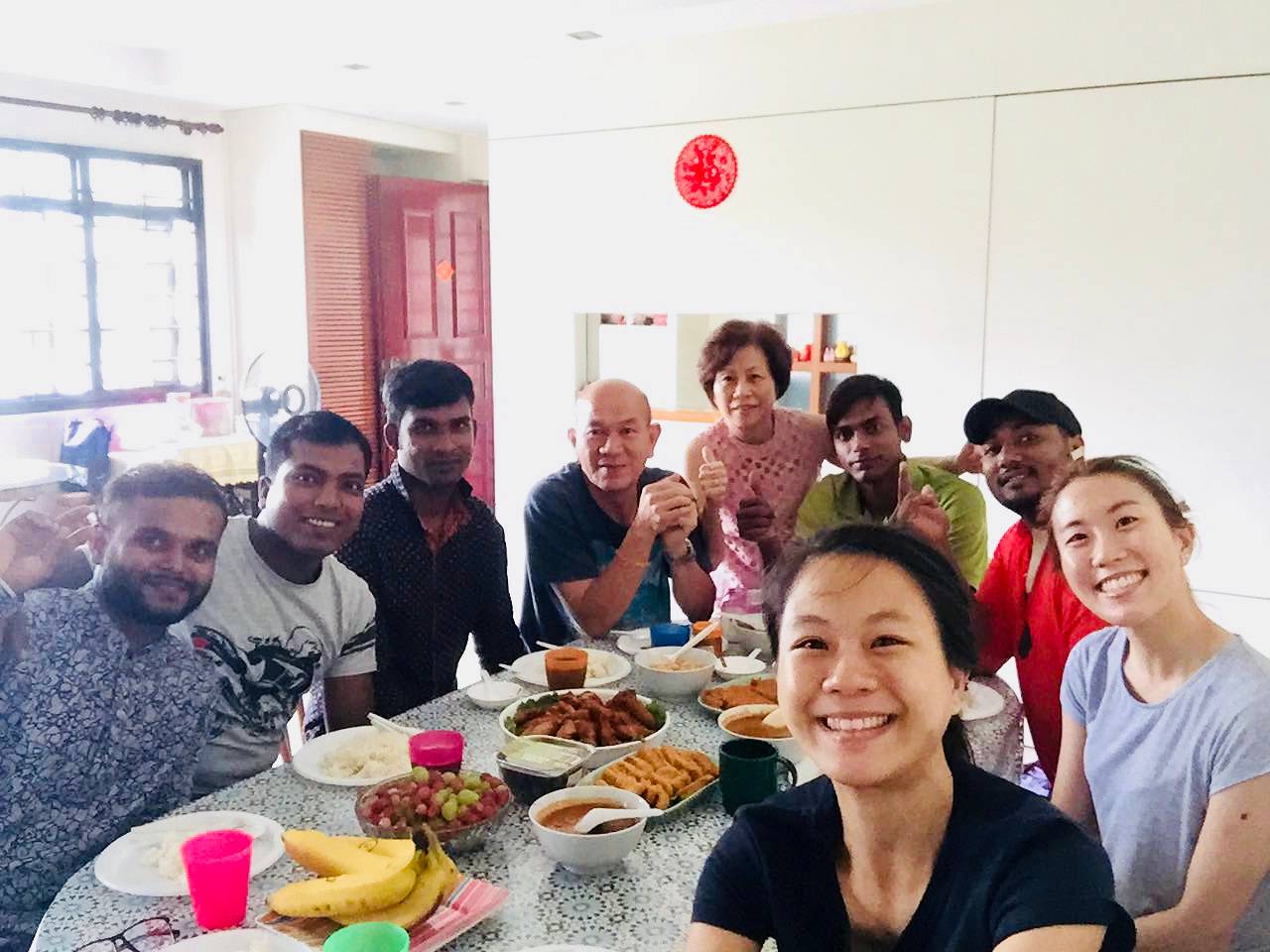
Kadir and friends sharing the iftar meal with Siti Zawiyah’s family. (Photo: Ruth Smalley)
REAL WORLD IMPACT
The Ramadan series on Kadir and his co-workers touched the hearts of many viewers and readers, as seen from comments they left on CNA Insider’s social media pages.
To keep up the momentum, CNA Insider posed a simple question on Facebook: Would you invite migrant workers to your home for dinner?
An avalanche of responses followed. More than 50 families – both Muslims and non-Muslims – contacted the team to express interest in hosting foreign workers at their homes.
With facilitation by CNA Insider, eight families opened up their homes to migrant workers over two weekends.
The experience turned out to be more than hosts or guests had imagined – and the start of friendships for some.
One family prepared a special Bengali delicacy for their Bangladeshi migrant worker guests.
Another, not content with just a home-cooked meal, gave their guests Hari Raya gifts and food to take back to their dormitory.
“I come this house, I feel like it’s my house,” said migrant worker Shariful Islam who was hosted by Fatimah Sawifi, a teacher, and her husband Mohammad Hamim.
Mdm Fatimah said: “It was so very enlightening, we were wondering what held us back (from talking to them) in the past.”
At the home of Mohammad Hamim and Fatimah Sawifi. (Photo: Fatimah Sawifi)
Nicholas Yeo, who is not Muslim, got a Muslim friend to whip up a home-cooked spread.
“We were able to relate with one another over many common experiences, despite being so seemingly different,” he said, adding that he would consider inviting the migrant workers over on other festive occasions.
Another host, Ms Marlene Chua, said “it is like having friends over”. “Migrant workers make up a huge part of our society and life, and yet we know so little about them,” she added.
Marlene Chua (extreme right) and her sister with their guests on Jun 17, 2018. (Photo: Marlene Chua)
The difficulty, Mr Hamim said, is: “I think Singaporeans are very open, but we don’t know how to go about reaching out.”
But some viewers pointed out on CNA Insider’s Facebook page that one could easily do what one can, such as Noraini Khodri-Siebley who wrote that during Ramadan, she cooked an extra portion every weekend “for the Bangladeshi boy who cleans my block. He’s just like my son. Maybe he’s not comfortable sitting with my family … at least he would take his iftar which we prepared.”
The stories resonated for a long time, with readers sending questions and compliments for many months after publication.
“The response to this series highlighted how good journalism has the power to challenge stereotypes and be a positive force,” said Yvonne Lim, Supervising Editor of CNA Insider.
CNA Insider journalists breaking fast with Kadir and his co-workers. (Photo: Ray Yeh)
This article is part of World News Day, which celebrates the stories, the people, the reporting and the news organisations that are dedicated to changing lives and challenging the status quo. To be held on Sep 28, it aims to create public awareness about the value of journalism.
SINGAPORE: Founder of City Harvest Church (CHC) Kong Hee was released from prison on Thursday (Aug 22) after serving a jail sentence of three-and-a-half years.
Kong Hee, who is 55 this year, received the longest jail term among the six church leaders that had been involved in the marathon CHC case, in which S$50 million of church funds had been misused.
But the pastor walked free from Changi Prison just two years and four months after he surrendered himself to the State Courts in April 2017. Inmates typically serve two-thirds of their sentences before being released on remission.
What started in May 2010 – when an investigation was launched into the megachurch’s accounts – dragged on until February 2018, when the Court of Appeal upheld the High Court’s decision to convict the church leaders of less serious criminal breach of trust charges.
But another twist to the case emerged when one of them, former fund manager Chew Eng Han, made headlines again last year.
Chew was arrested for trying to flee Singapore on a boat, just as most others were serving their jail sentences. Former finance manager Sharon Tan had already completed hers.
A timeline of events:
May 2010: The Commissioner of Charities and Commercial Affairs Department launches investigations into CHC accounts.
June 2012: The Commissioner of Charities releases a press statement that there was misconduct and mismanagement in the CHC administration. Five church leaders, including Chew, are arrested and charged in court for their offences.
July 2012: Former finance manager SerinaWee is charged in court.
May 2013: The trial begins. It will go on for more than 142 days over two years.
October 2015: All six CHC leaders are found guilty of misappropriating about S$50 million of church funds. They are convicted of the most aggravated form of criminal breach of trust under section 409 of the Penal Code and sentenced to jail terms of between eight years and 21 months. Chew is given a sentence of six years.
November 2015: All six CHC leaders are sentenced to jail. However, later in the month, the prosecution appeals against the sentences, saying they are “manifestly inadequate”.
December 2015: All six church leaders decide to appeal against their convictions.
July 2016: Chew files a police report against eight CHC members for “fraudulent misrepresentation of vital facts about the church which induced me and other members to give our donations” and for use of funds for purposes other than what was represented to the members of the church.
September 2016: The appeals of the six CHC leaders are heard by a three-judge panel over five days. During his appeal, Chew says the sentencing judge had “gravely erred” in his ruling, and used a flawed definition of misappropriation. He added he had been “brainwashed” into supporting the Crossover Project as Kong Hee regularly played up Sun Ho’s music success.
April 2017: In a two-to-one split decision, the High Court convicts the six CHC leaders of reduced criminal breach of trust charges under section 406 of the Penal Code, slashing their jail terms significantly.
The prosecution applies for a criminal reference, seeking clarification on how the law has been applied in the case, looking for a definitive ruling from the Court of Appeal and to reinstate the original convictions.
Chew appeals to the High Court to defer his sentence until after the Court of Appeal decides on the prosecution’s application for a criminal reference, and says he plans to take his case to the Court of Appeal.
The High Court grants the deferment to allow Chew, who is representing himself, time to conduct research and access the resources to conduct his own defence.
Kong Hee apologises to his church and the public for “unwise decisions” he had made in the past in a Facebook post. Adds that he is at peace with serving his three-and-a-half-year jail term that begins on Friday.
July 2017: In his first attempt to challenge his conviction, Chew refers 58 questions to the Court of Appeal, including whether a person can be convicted of misappropriation if he used the money not for himself but for the owner. The appeal is rejected.
August 2017: The Court of Appeal reserves judgement on the prosecutor’s bid to seek clarification on the High Court’s April ruling and says it will deliver its judgement “in due course”.
Chew files a criminal motion seeking permission to refer a question of law of public interest to the Court of Appeal, in his second bid to fight his conviction.
September 2017: Court of Appeal judges throw out Chew’s application after an hour-long hearing, calling it an “abuse of process” and saying that the High Court’s judgement to uphold Chew’s conviction is “final and authoritative on these issues”.
February 2018: The Court of Appeal upholds the High Court’s decision in April 2017 to convict the six City Harvest leaders of less serious criminal breach of trust charges. Chew is allowed his request to start serving his sentence on Feb 22, after the Chinese New Year holiday.
The motorised sampan in which Chew Eng Han tried to flee Singapore. (Photo: Gaya Chandramohan)
Twenty days later, Chew is caught while attempting to flee Singapore. His boat was intercepted by Police Coast Guard vessels off Pulau Ubin at about 8.45am, after authorities received a tip-off.
It is believed Chew and the man piloting the sampan said they were going fishing. However, preliminary investigations suggest that the boat was heading to Malaysia.
December 2018: Chew Eng Han is found guilty on Dec 12 of trying to escape Singapore and defeat justice. District Judge Victor Yeo finds Chew guilty, saying he is not persuaded by the defence’s arguments that the accused was apprehended too early, and that his actions up to the point of his arrest did not amount to embarking on a crime proper.
City Harvest Church founder Kong Hee leaves prison, on Aug 22, 2019. (Photo: Hanidah Amin)
SINGAPORE: The founder of City Harvest Church was released from jail on Thursday (Aug 22) after doing time for his role in misusing millions of church funds, a day ahead of his 55th birthday.
The pastor walked free from Changi Prison in the late morning, looking thinner and sporting a cap on his shorn hair, about two years and four months after surrendering himself at the State Courts to begin his jail term.
Inmates typically serve two-thirds of their sentences before being released on remission.
City Harvest Church founder Kong Hee leaves Changi Prison after serving two years and four months of his sentence. (Photo: Darius Boey)
A small group had gathered outside the prison to wait for him minutes before his release.
When asked by CNA if he had anything to say, he shook his head and smiled before swiftly entering a black vehicle waiting for him.
Mr Kong was sentenced to three-and-a-half years’ jail, the longest term meted out to six church leaders for their involvement in misappropriating S$50 million in church funds.
The other five are: Former deputy senior pastor Tan Ye Peng, former finance managers Serina Wee and Sharon Tan, former finance committee member John Lam and former fund manager Chew Eng Han.
The six of them were convicted in 2015 after a trial spanning 140 days and were originally sentenced to between 21 months and eight years’ jail, terms that were later reduced significantly upon appeal.
The case was unprecedented in two ways: First, it was the largest case of misuse of charitable funds in Singapore to date, and second, because the millions were “replaced” through a series of sham investments and shady transactions, with the church ultimately suffering no financial loss.
About S$24 million was used to bankroll the secular music career of Mr Kong’s wife Sun Ho and her lifestyle, while the remaining S$26 million was used to cover up the first amount to fool auditors and to conceal the unauthorised use of the money from the church’s building fund.
Mr Kong began serving his sentence on Apr 21, 2017, along with four of his co-accused. In his last message on social media before surrendering at the State Courts, he said he had reflected deeply and was at peace with what was ahead.
He said then that he was “extremely saddened” by the prospect of having to leave his family and church, but was ready to face what was to come “with the peace and grace of God in my heart”.
Ms Sharon Tan was first to complete her seven-month jail term, followed by Mr Lam, who received one-and-a-half years’ jail; Ms Wee, who was given two-and-a-half-years’ jail; and Mr Tan Ye Peng, who was sentenced to three years and two months in prison.
Chew was the last to begin his prison sentence of three years and four months.
However, a day before he was set to enter prison, he tried to flee the country on a sampan and was given an additional 13 months’ jail. He will be the last of the six involved to finish his sentence.
SINGAPORE: From the popular boy band The Jonas Brothers to celebrity chef Gordon Ramsay, users of FaceApp around the world have been having a blast sharing their AI-altered photos on the Internet.
The photo filtering app which has been around since 2017, had only recently become the latest social media craze as photos with its filter that transform one’s look younger or older had gone viral.
It was all good fun until users and experts began to notice the red flags.
IT’S NOT JUST FACEAPP THAT YOU SHOULD BE WARY OF
Last month, Prime Minister Lee Hsien Loong issued a note of caution urging Singaporeans to “be careful with what apps [they] download and use”. One point he alluded to is the potential criminal use of users’ personal data.
In this incident, that data refers to images of users’ faces.
Photo sharing has become second nature to many people with the rise of social media. But as more solutions leverage biometric data – which includes our facial features – for authorisation and authentication, careless sharing can put people at risk of identity-based attacks.
The reality is, some digital platforms expose users to more risks than others do. When users agree to the terms of service of an app, they may unwillingly give the app permission to use their photos for other purposes.
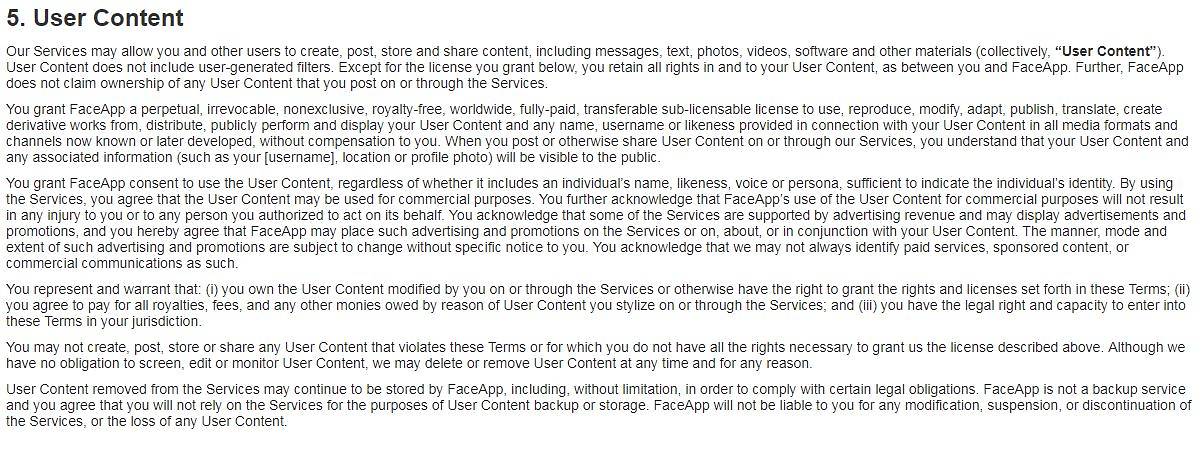
For instance, clauses in the FaceApp’s terms and conditions notes that the app reserves the rights to “use, reproduce, modify, adapt, publish, translate, create derivative works from, distribute, publicly perform and display” users’ photos and personal information “in all media formats and channels now known or later developed” without having to compensate or notify users.
This means that user identities could potentially be used for various works without them knowing, and even altered, exploited, and reproduced in something that did not, in fact, exist or occur.
The Jonas Brothers the way they look now. (Photo: Instagram/jonasbrothers)
It may seem far-fetched, but with access to high-resolution pictures of users’ faces, cybercriminals can easily create deepfakes – high-fidelity images that are indistinguishable from the original – from just a few images or even a single one.
If these images and data fell into the wrong hands, bad actors have the ability to impersonate just about anyone.
A THREAT TO BIOMETRIC AUTHENTICATION
This poses an obvious threat to Singapore, which announced plans to adopt a centralised biometrics identification system as part of its National Digital Identity system.
A key security issue associated with biometric authentication is susceptibility to spoofing – the act of posing as valid users to gain access to critical networks. Scenarios in which fraudsters successfully spoof verification measures using a doctored photo or video are now entirely possible with the rise of deepfake technology.
This is a pressing cause for concern as Singapore looks to roll out its centralised biometric platform to sectors that will include banking and finance.
As such, Internet users need to be more discerning with what they share, and whom they share it with.
FIGHTING DEEPFAKES
Terms and Conditions are a good place to start when using social media and photo-sharing apps.
While more established platforms such as Instagram and Snapchat have more upfront and transparent terms of service, this may not be necessarily the case for lesser-known apps.
Going through the Terms and Conditions can be a hassle, but it is a good first step to help users know their data is in safe hands.
Screengrab of FaceApp’s terms.
Users can also protect their digital identities by opting for online services with more stringent authentication and verification processes, especially when biometric login is quickly gaining traction across both public and private sectors.
You may want to think about setting up two-factor authentication, by adding fingerprint verification on those apps that you use. Additional checks and balances like requiring a passcode might seem cumbersome but provides one more layer of assurance.
Companies, on the other hand, can help prevent sham logins by implementing better security components such as “liveness detection” – a technology that allows service providers to determine the user’s physical presence.
Liveness detection requires users to take a selfie of themselves holding a handwritten note – often containing a custom phrase, such as a company date, and the current date – to ensure that there is a real person is performing the transaction.
Users may also be prompted to perform other actions that cannot be easily replicated with a spoof as the technology captures the user’s patterns of rhythm, tracks their eyeball movement or flash lights on their face to ensure that the user is a three-dimensional object.
LOOKING FORWARD
Already, Singapore’s Info-communications Media Development Authority (IMDA) listed liveness detection earlier this year as one of the necessary measures in its new cybersecurity guide for telecom companies.
This shows that regulators in Singapore are taking a more stringent approach towards identity verification and authentication, and we can expect other critical sectors to follow suit.
A man going through the immigration multi-modal biometric screening process. (Photo: Marcus Ramos)
Proving liveness, particularly during enrolment, establishes the chain of trust. It anchors the digital identity of a real person and strengthens the entire trust chain, especially if the biometric data is stored centrally.
As Singapore continues to extend the national biometric ID system to more sectors, the “trust but verify” approach will serve as the foundation for future efforts to protect citizen’s online identities.
IMDA’s recognition and inclusion of liveness detection in its guidelines is a great first step towards that direction, but it must be complemented by better cyber hygiene from Internet users around how image data is captured, stored, shared, and used.
Frederic Ho is APAC Vice President at Jumio Corporation.