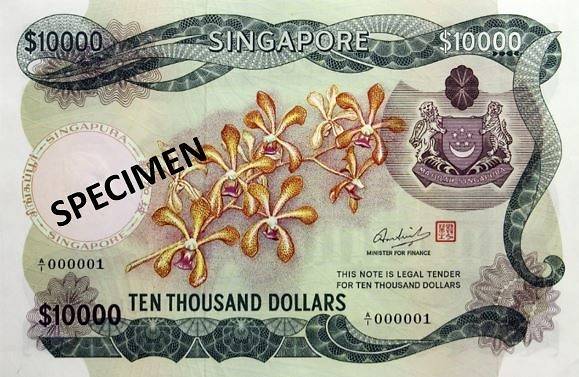
SINGAPORE: Two men have been arrested for their suspected involvement in using a counterfeit S$10,000 Orchid Series note, police said on Saturday (Aug 24).
The police said they had received a report on Tuesday from a victim who discovered that a piece of S$10,000 note, which he had bought from an online seller, was fake.
Officers then established the identities of the two suspects, aged 34 and 55, and arrested them on Thursday, police said in a news release.
According to initial investigations, the 34-year-old is believed to have bought the counterfeit S$10,000 note from an unknown man in Batam, Indonesia. He and the 55-year-old suspect later sold it to the victim for S$11,500.
The counterfeit note has been seized as a case exhibit, in addition to two T-shirts, a receipt, three mobile phones and cash amounting to S$1,200, police said. Investigations are ongoing.
If convicted of using counterfeit notes as genuine currency, the two suspects could face a jail term of up to 20 years as well as a fine.
The Orchid Series was first introduced in 1967 and consisted of nine denominations, according to the Monetary Authority of Singapore’s website. The notes feature a spray of orchids on the front and a scene of Singapore on the back. The series was discontinued in 1976.
The front of a S$10,000 Orchid Series note. (Photo: Monetary Authority of Singapore website)
“Members of the public are reminded to be vigilant and to examine any S$10,000 Orchid Series notes as they are not commonly available and in circulation,” said the police on Saturday.
In recent months, there have been cases involving the use of counterfeit notes, with police advising people to be on the alert after fake S$100 and S$50 notes were used at convenience stores, restaurants and retail outlets.
Members of the public are urged to make a police report should they receive a suspected counterfeit note.
“Limit the handling of the suspected counterfeit note and place it in a protective covering, such as an envelope, to prevent further tampering,” police added.
SINGAPORE: Since the arrival of ride-hailing apps on our smartphones in Singapore less than a decade back, the way we’ve managed to get a ride to bring us from one point to another has vastly changed.
Gone are the days of waiting for a taxi to come by and hoping no one in front of you flags the cab down first.
More private-hire cars have spilled onto the scene as apps like Grab, Go-Jek and at one point, Uber, ignited demand. Although their arrival has been welcomed by commuters and drivers, the future of ride-hailing has sparked fresh concerns about competition, fairness and the protection of the public interest.
In this context, Parliament’s recent passing of the Point-to-Point Passenger Transport Industry Bill will change how taxis and ride-hailing services are regulated in Singapore to the benefit of commuters and drivers.
These regulatory changes will ensure robust competition between operators supplying point-to-point services when they come into effect next year although the changes may not be immediately noticeable to riders.
Grab app advertisement at a train station in Singapore on Feb 10, 2016. (File photo: REUTERS/Edgar Su)
The Singapore Government’s approach to licensing is a first in the world to the best of our knowledge. The bill introduces new licensing of operators based on how they match riders and drivers, by street-hailing or ride-hailing.
This is in contrast to treating operators differently based on whether they have historically been labelled taxi operators or ride-hailing platforms, or whether the vehicle type they service are labelled taxis or private hire cars.
The new rules close a vital gap in regulation when it comes to levelling the playing field between street-hail and ride-hailing companies by requiring the latter to obtain a ride-hailing license.
Prior to this bill, the Government only issued taxi operator licenses to traditional taxi companies, allowing their drivers to street-hail and ride-hail, while ride-hailing firms did not need licenses to operate.
Operators that employ the same way of matching riders and drivers will face essentially the same regulation.
Once these rules kick in, a taxi company that also offers a ride-hailing app, such as ComfortDelGro, must apply for an additional ride-hailing license since they have an app-based booking service. Regulators can require compliance with safety and other standards they might set going forward.
TACKLING A LACK OF CONSUMER INFORMATION IN STREET-HAILING
The new rules also recognise the vastly different market failures that can arise for the two different ways riders and drivers are matched.
Under street-hailing, in a completely unregulated market, drivers would be able to take advantage of riders when passengers hop into a street-hailed cab.
Drivers can take a circuitous route or add unexpected surcharges at the end of the trip. This quickly erases the efficiencies from quick matching via street-hailing.
The Government will use street-hail licenses to ensure that operators price rides transparently and drivers are trustworthy, as it has done with the current taxi operator’s license scheme.
Ride-hailing operators use technology to address some of these problems. When booking a ride, riders get upfront information about the driver, car, and the price of the trip. Operators can screen out unscrupulous drivers based on rider feedback and ratings.
DEALING WITH THE RIDE-HAILING INDUSTRY’S MONOPOLISTIC TENDENCIES
However, ride-hail trips require other forms of regulation, given the industry’s tendencies for domination owing to the “network effects” of ride-hailing services.
A private-hire driver. (Photo: Unsplash)
Riders prefer a ride-hailing operator with more drivers on the road, compared to waiting to flag a cab since waiting times to get matched bookings are shorter given the higher chance of a driver being nearby.
Likewise, drivers prefer an operator whose app is used by many riders since it increases the chance of a rider being nearby, minimising drivers’ idle time and time spent getting to the next commuter.
Such preferences give operators with larger networks an edge over competitors with smaller networks.
The same is not true for street-hailing operators since riders typically choose whichever taxi they see first. They do not care about how many other drivers are signed up with the same operator.
What this means is that ride-hailing services are more susceptible to monopolisation, raising concerns of market power and barriers to entry.
TACKLING EXCLUSIVITY CLAUSES
One way that a dominant ride-hailing operator can exploit these network effects is by making exclusive deals with drivers or the taxi operators they drive for, disallowing these drivers from operating on other networks.
Indeed, this has been a problem, for example, when Grab previously prohibited drivers from also driving for any rival operator. With existing drivers all tied up under exclusivity clauses, this made it challenging for any new entrant to grow.
File picture of taxis in Singapore. (Photo: TODAY)
In this regard, the Government’s new ride-hailing licenses prohibiting such exclusive contracts ensures contestability in the ride-hailing market and is to be welcomed.
As long as drivers can operate on multiple networks at once, riders can reach these drivers regardless of which app they use. For instance, drivers of ComfortDelGro taxis will then be able to ride-hail for Grab, Gojek and other ride-hailing operators since ComfortDelGro will no longer be able to apply ride-hailing exclusivity to its drivers.
Prohibiting exclusive contracts will lead operators to refocus competition on other dimensions such as price and service levels, to the benefit of riders.
There will be less of a need for price regulation with competition constraining operators’ ability to charge excessive prices.
So, it is no surprise that although the Public Transport Council will be given powers to ensure fares are clear and transparent, they have also highlighted their intention to “leave market forces to set appropriate fares”.
LOOK AT HIDDEN EXCLUSIVITY MEASURES
Notwithstanding the successful passage of this bill, regulators cannot let up. They must apply the prohibition on exclusivity widely.
They must also identify de facto exclusive arrangements hidden from plain sight, such as an operator using partnerships with car rental companies or insurance companies to limit drivers from other operators.
Indeed, a dominant operator, facing a ban on exclusive arrangements, may make greater use of loyalty schemes that give incentives for drivers to do most or all of their driving on its platform. Such arrangements need to be carefully monitored to see if they are creating de facto exclusivity, in which case authorities may have to step in.
A LEVEL PLAYING FIELD
With these new regulations in place, commuters could be picked up by a ComfortDelgro taxi when booking a ride on Gojek.
It is also possible that commuters could be picked up by a taxi dispatched by Grab when they hail a cab on the street. This reflects that applying for a street-hail license for Grab will be more attractive, for instance, because of the removal of taxi availability standards by 2020 that street-hail licensed operators previously needed to meet.
Such scenarios will blur the current distinction between traditional taxi operators and ride-hailing platforms, and in our view, that is for the better.
The key to a competitive and efficient point-to-point transport industry is targeted regulations for street-hailing and ride-hailing services, to address the distinct market failures arising in each case, but at the same time, a level playing field across the different types of operators.
That also puts power back in the hands of drivers, so they can choose from a wider range of operators, and are not tied down to any particular operator.
The good news is the approach taken in the recently passed Point-to-Point Passenger Transport Industry Bill does exactly this.
Julian Wright is the Lim Chong Yah Professor at the National University of Singapore’s Department of Economics. Timothy Wong is a lecturer in the same department.
SINGAPORE: Prime Minister Lee Hsien Loong made a significant announcement during his National Day Rally on Sunday (Aug 18), to raise both the retirement and re-employment ages in 2022 and 2030.
The Singapore Business Federation backed the move and called on its 26,100 member-companies to give their support.
The public service also committed to making these shifts a year ahead of the timelines set by PM Lee.
The news was quickly followed up by Manpower Minister Josephine Teo, who dished out details of the increases to the total contribution rates older workers can look forward to in their Central Provident Fund (CPF), which was another announcement that PM Lee made on Sunday.
ATTITUDES ON AGE HAVE SOME WAY TO GO
Taken altogether, this past week must seem like a win for employment advocates.
This was a milestone to be celebrated, after the tripartite workgroup’s efforts since last May to build consensus on the way forward on keeping older workers employed and helping them achieve retirement adequacy as Singaporeans lead longer lives.
But numerous comments online paint a different picture, suggesting that our attitudes about work in old age have some way to go.
“Can try but no company will employ older workers except in security and cleaning,” said one reader.
It’ll make older workers more expensive to companies, added another.
And why that would be an especially difficult problem? “Older workers are obsolete,” said a third.
File photo of an office employee.
One can appreciate how these changes may be a challenge for some businesses, especially small and medium-sized enterprises that may have practical concerns about being able to pay their older workers additional CPF contributions while battling global headwinds.
But it will be disconcerting if, after being given some time to adjust, we see many companies continue to highlight unease over these changes as cost pressures, suggesting that older workers as a whole contribute less than their fair share and are not worth the extra money compared to younger workers.
CUES OF AGEISM
At the heart of concerns this week may be our assumptions about old age.
It doesn’t help that we are regularly bombarded with images and language about disease and disability that might have reinforced the notion that life after 60 can only go downhill.
But it’s troubling if these lead us to internalise the idea that one inevitably becomes frailer, less productive and eventually, a drain on society – or worse, the belief that older workers are inherently worth less.
Such attitudes can manifest in small ways, when we paint seniors with a broad brush and single them out, like when we say condescending things like older workers have to be lifelong learners who have to adapt better.
That must surely apply to every worker in an age of disruption.
Employers and supervisors should also watch for when such attitudes morph into a negative bias against older workers, which goes against the spirit of the lifting of the retirement and re-employment ages that the Tripartite Alliance for Fair and Progressive Employment Practices (TAFEP) might have to look into.
An elderly worker in Singapore. (File photo: TODAY)
We ourselves also have to look out for other subtle but just as unhealthy cues of ageist mindsets in our day-to-day actions – for instance, if we subconsciously exclude an older team mate from work projects or social activities.
Although such acts might not cross the threshold of workplace discrimination warranting action by TAFEP, the poisonous sentiment behind them is precisely what that can fuel a larger disenfranchisement of seniors.
TACKLE THAT DANGEROUS NARRATIVE OF AGEISM
Ageism is that dangerous narrative that frames a future of longevity as a tsunami of a problem instead of the remarkable achievement and potential that longer lives present.
Casual ageism cuts both ways when we think there are some tasks that we might be too old for and some responsibilities that we might be too young to assume.
For all the talk about the importance of removing divisions concerning class, race and gender, ageism is the one social divide we have ignored yet need to tackle decisively. After all, we will all suffer the brunt of it when we cross into that later stage in life.
The World Health Organisation (WHO) recognises how huge a challenge it poses. It is pouring resources into research to understand ageism and its causes, consequences, as well as how to measure and combat it, with results to be out next year.
The WHO also recognises the flipside of the coin – that positive views about ageing lead to better “healthspans” because people lead longer lives, recover faster from illness and are less susceptible to cognitive decline.
GOOD MOVES TO MOVE AGEISM NEEDLE
Massive effort will be needed to move that attitude needle of ageism.
It will take companies making that gesture of confidence to raise the retirement and re-employment age beyond statutory requirements to catalyse that shift, like those 50 that put up their hands which NTUC Secretary-General Ng Chee Meng talked about.
Here, Prudential’s moves to scrap the notion of a retirement age altogether and allow employers to continue working past 62 under the same terms and conditions until they decide to call it a day, as well as to raise their CPF contributions above mandated levels, are bold moves that deserve special mention worth considering emulating.
It will also take employers relooking flexible work arrangements and wage structures that reflect varying needs in life stages, like what Nominated Member of Parliament and Associate Professor Walter Theseira suggested, so that older works can work at their own pace, in the same way many parents, people with family commitments and other priorities in life would like to.
A family walking in Singapore. (Photo: Gaya Chandramohan)
But most importantly, it will take every one of us to re-examine our attitudes about age.
And a constructive first step is to be wary of grouping people by age and reducing them to a faceless, homogenous group.
Lin Suling is executive editor at CNA Digital News where she oversees the Commentary section and produces The Pulse podcast.
SINGAPORE: A total of 110 suspected drug offenders were arrested during a four-day islandwide operation that ended on Friday (Aug 23). The youngest among them is a 15-year-old boy.
A variety of drugs worth about S$163,000 were seized.
According to the Central Narcotics Bureau (CNB), these included 1,274g of Ice, 218g of heroin, 173g of cannabis, 133g of new psychoactive substances, 506 ecstasy tablets, 5g of ketamine, 98 Erimin-5 tablets and 43 bottles of liquid suspected to contain Gamma-Hydroxybutyrate (GHB).
The CNB operation covered areas such as Ang Mo Kio, Buangkok, Clementi, Hougang, Jurong, Punggol and Tampines.
LARGE SEIZURE OF ICE
In one of the cases on Aug 20, large amounts of Ice were seized and seven Singapore suspects were arrested, said CNB.
Officers first arrested a 34-year-old man in the vicinity of Yishun Avenue 4. About 25g of Ice was found on him, and another 575g was seized when they searched his rented room in the area. About 447g of Ice and other drugs were later found in his car, along with a taser and a baton.
Two other suspects were arrested at the Yishun unit. One of them, a 28-year-old man, was found to have three parangs and a baton in his car.
A baton and taser recovered during a CNB operation on Aug 20. (Photo: Central Narcotics Bureau)
A baton and flick knife recovered during a CNB operation on Aug 20. (Photo: Central Narcotics Bureau)
Parangs recovered during a CNB operation on Aug 20. (Photo: Central Narcotics Bureau)
CNB officers later arrested a man in Jurong who is believed to be linked to the first suspect arrested in Yishun.
Two other suspects were arrested in the Jurong flat.
A total of about 161g of Ice, 97 Erimin-5 tablets, 83 ecstasy tablets, as well as a small amount of cannabis and heroin were recovered from the unit, said CNB.
During the operation, a man seen behaving suspiciously at the void deck in the area was arrested. A small packet of Ice, as well as other drug utensils and paraphernalia were found on him.
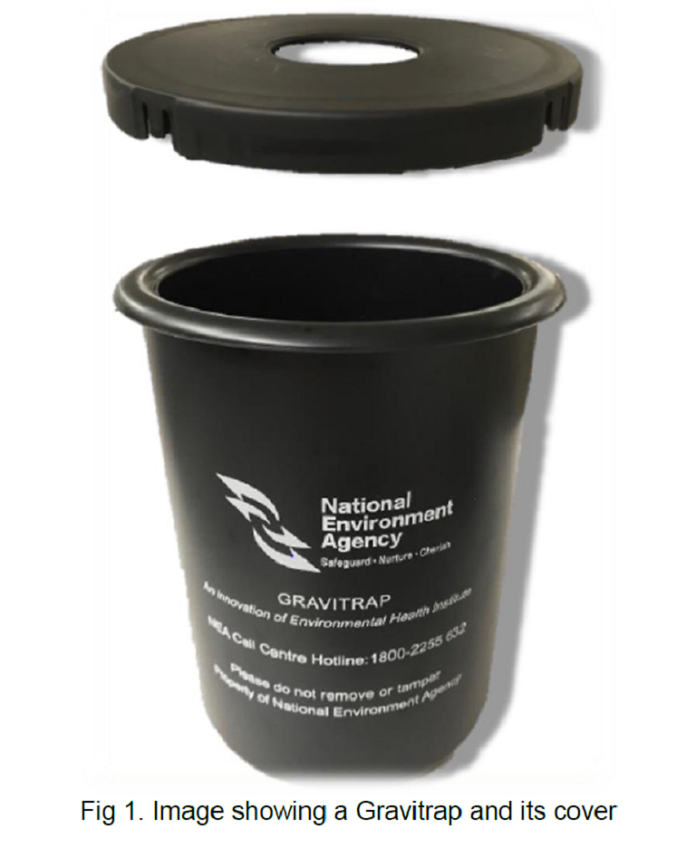
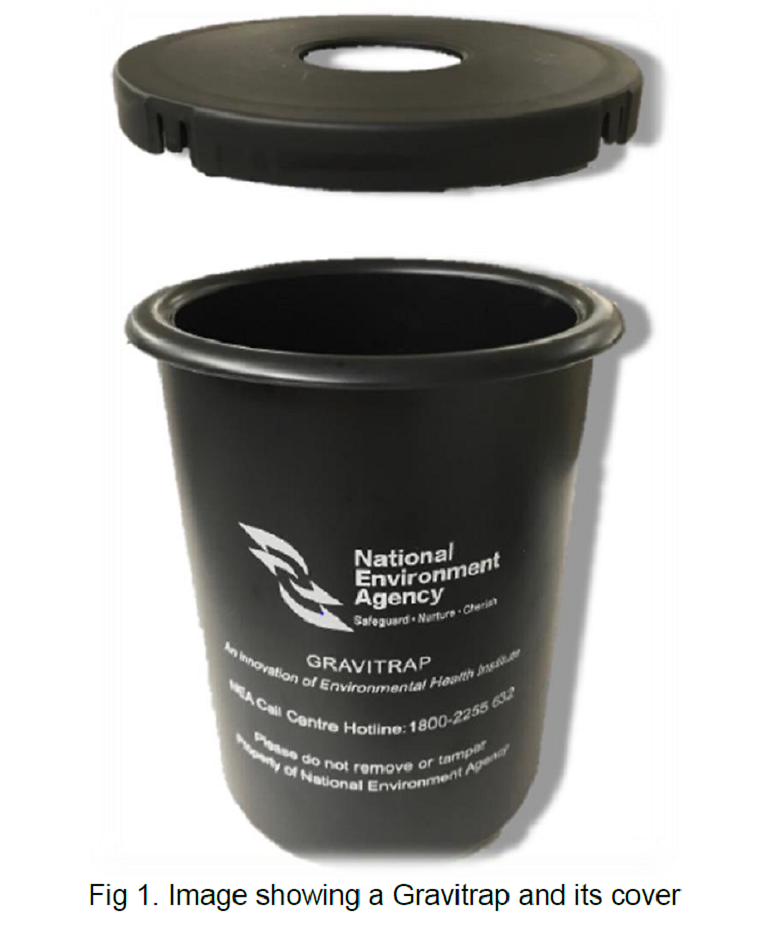
SINGAPORE: The National Environment Agency (NEA) on Friday (Aug 23) said that its Gravitrap system – which is designed to attract and trap female Aedes mosquitoes looking for sites to lay their eggs – enabled it to detect and destroy 21 per cent more breeding habitats in 2018 compared to the previous year.
Gravitraps have also been useful in helping NEA remove a large number of Aedes aegypti adult mosquitoes, including infected female mosquitoes, the agency said in a media release.
About 50,000 Gravitraps have been deployed at Housing and Development Board (HDB) estates islandwide since NEA began using the system in 2017.
Another 14,000 traps will be rolled out at landed estates and newly completed HDB areas from the second half of this year, NEA said.
“Resource optimisation from such a data-driven surveillance system has also allowed NEA to re-deploy manpower for other urgent dengue prevention tasks,” it added.
NEW INDICATOR ON AREAS WITH HIGHER MOSQUITO POPULATION
NEA also said on Friday that it has launched a new initiative to share information on areas with relatively higher Aedes aegypti adult mosquito population.
This information, gathered from the Gravitrap surveillance system, will be shared on their website from Friday and updated monthly.
The new mosquito indicator aims to heighten the awareness of the risk of dengue and guide the public in taking more proactive prevention measures, according to NEA’s release.
The additional Gravitrap surveillance data can also help Town Councils priorities their dengue prevention and control measures, as well as target areas with higher mosquito population, it added.
NUMBER OF WEEKLY DENGUE CASES REMAINS “PERSISTENTLY HIGH”
Over the past six months, NEA said that it has been working intensively with stakeholders from various government agencies in the Inter-Agency Dengue Task Force (IADTF), town councils, construction site management, community partners and residents, in order to strengthen collective efforts in the fight against dengue.
These efforts have enabled NEA to close 854 of the 1,013 dengue clusters this year.
The number of weekly dengue cases has also declined from a high of 664 in the second week of July, to 525 in the second week of August.
Some of the largest dengue clusters in Woodlands, Upper Thomson, Chai Chee and Pasir Ris have also closed, with some still under close surveillance, NEA said.
Despite this progress, NEA said that the number of weekly dengue cases remains “persistently high” at above 500.
A worker fogs the drains in the common areas of a public housing estate in Singapore. (Photo: Reuters/Edgar Su)
“Even as clusters are progressively closed, we still have some rather persistent clusters, such as at Aljunied Road and Changi Road, as well as newer clusters being formed, in Choa Chu Kang Avenue 2 and 4 and Jalan Eunos,” NEA said.
NEA’s director-general of public health, Mr Chew Ming Fai said: “With the high number of dengue cases this year, we need to take a holistic whole-of-community approach to fighting dengue, focusing on both dengue cluster areas as well as non-dengue cluster areas, which may be at risk of becoming dengue cluster areas in the future.
“We hope that the sharing of information on areas with relatively higher mosquito population will serve as a useful lead indicator for our stakeholders to take pre-emptive measures in reducing potential mosquito breeding habitats, thus lowering the risk of dengue transmission and future clusters from being formed.”
Singapore’s high Aedes aegypti mosquito population has been identified as one of the key reasons for the high dengue cases experienced this year, in addition to lowered population immunity and warmer weather.
“Climate change is anticipated to worsen the spread of dengue, as higher temperatures facilitate faster development of the Aedes aegypti mosquito vector and faster replication of the dengue virus,” NEA said.
The agency urged members of the public to play their part in preventing and stopping dengue transmission, adding that vigilance and action is needed by all to eliminate potential mosquito breeding habitats.
SINGAPORE: It seemed like every other Sunday when Loo King Keong, 59, and his daughter Alethea Luo Jiayi, 24, were on their way to church.
But on Jun 23, as they were walking down the stairs of an overhead bridge near 154 West Coast Road, they noticed a man “behaving peculiarly” behind a woman on an adjacent escalator that was going upwards.
The suspect was trying to take an upskirt photo and the father-and-daughter duo swiftly intervened to nab him.
For their efforts, Mr Loo and Ms Luo received the Singapore Police Force’s Public Spiritedness Award on Friday (Aug 23).
At the awards presentation, Mr Loo recalled the events which led to the upskirt photo suspect’s apprehension. (Ms Luo could not attend the ceremony; she was instead represented by her brother Augustine Luo.)
“(The suspect) was in a very awkward position, holding his mobile phone at a very low angle,” said Mr Loo.
Immediately, Mr Loo shouted across to the man: “What are you doing!”
Stunned, the man withdrew his phone and walked quickly up the escalator as he tried to delete the photos.
Both Mr Loo and Ms Luo turned around and ran up the stairs to stop the man, who appeared to be in his 40s.
“My daughter kind of took over of course, she ran faster than me. For me, I just kind of bounced after her,” said Mr Loo.
When they confronted the man, Ms Luo demanded the man turn over his phone.
“He bravely surrendered the phone and said there was nothing,” said Mr Loo.
But Ms Luo managed to recover the photos from the “recently deleted” folder.
By that time, a group of passers-by turned up and helped keep the man at bay while the police came.
Realising that he had no way out, the suspect started to plead for forgiveness.
“He said, ‘Please forgive me, I have a wife and daughter at home’,” said Mr Loo.
This angered some of the ladies at the scene, who reprimanded the suspect. “All the more you shouldn’t be doing this! Imagine if this happened to your family.”
The victim, a lady in her 30s, was “shaking” and “burst out crying” after the ordeal, said Mr Loo.
The police arrived at the scene within 10 to 15 minutes and the man was detained.
Mr Mohamed Juhairi being awarded the Public Spiritedness Award by AC Jarrod Pereira. (Photo: Singapore Police Force)
MAN STOPS SENIOR CITIZEN FROM COMMITTING SUICIDE
In a separate case, Mohamed Juhairi Juma’at was also commended for stopping an elderly man from committing suicide at Blk 58 Lengkok Bahru.
On May 23 at 5.30pm, Mr Juhairi was coming home from work when he saw a man, who appeared to be in his 80s, standing on a stool near the parapet outside his unit on the fifth floor.
He did not think much of it and went on to unlock his door, but when he turned around, the elderly man already had one leg over the parapet.
Mr Juhairi reacted swiftly and managed to bring the man to safety.
“I think if I didn’t manage to pull him down within three or five seconds, he would have already jumped down,” said Mr Juhairi.
Mr Juhairi stayed with the man until the police arrived.
“Singapore is one of the safest places in the world, and the community plays a big part in making this possible,” said Assistant Commissioner of Police Jarrod Pereira, Commander of Clementi Police Division.
“These individuals have acted courageously, and their actions have resulted in a safer community for all.”
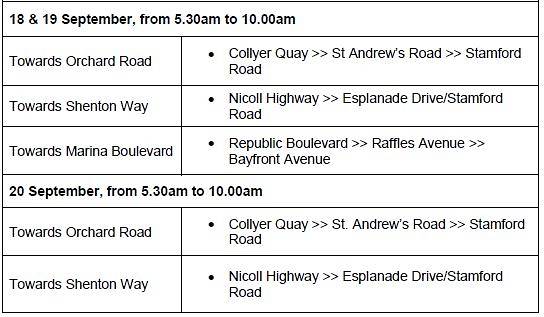
SINGAPORE: Roads around the Marine Centre area and the Padang will be closed for seven days next month for the Formula 1 Singapore Grand Prix, the Land Transport Authority (LTA) said in a news release on Friday (Aug 23).
The 12th edition of the Formula 1 Singapore Grand Prix will take place from Sep 20 to 22.
The road closures will take effect at 12.01am on Sep 18 to facilitate set-up of race infrastructure, and will go on until 5.30am on Sep 24.
Affected roads will be progressively re-opened after the race to enable earlier traffic access, added LTA.
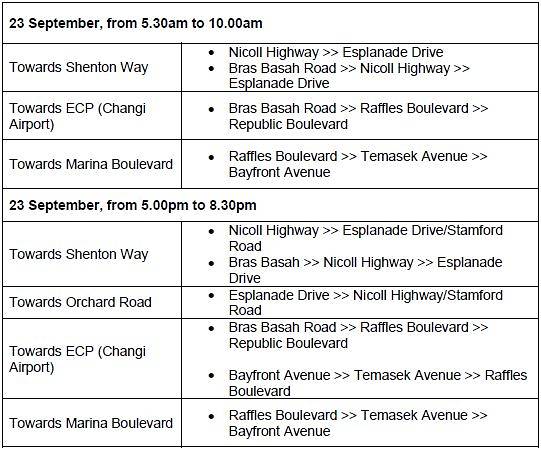
During this period, road corridors will be open at selected hours:
Those driving can access the Marina Centre area via a single lane along Raffles Boulevard via Nicoll Highway or Temasek Boulevard (except for buses and vehicles with W, X and Y plates) from 12am to 1pm on Sep 21 and 22.
Taxis will be able to use the single-lane access at all times, except when the race is on.
Traffic wardens will be on site to direct traffic and assist the public, while directional signs will also be put up in the area.
Car parks at the nearby Suntec City, Millenia Walk and Marina Square will remain open.
MRT HOURS EXTENDED ON RACE DAYS
MRT operating hours will be extended on race days (Sep 20 to 22), LTA said. Select feeder buses services will also be extended to match the last train services.
Free shuttle buses will be available between Lavender MRT station and Gate 1 of the circuit park on race days. These will run from 2.30pm to 12.30am on Sep 20 and 21, and from 3.30pm and 12.45am on Sep 22.
SINGAPORE: If a racist rap video was allowed to remain online, it could normalise offensive speech and such attacks against other races could become mainstream, said Law and Home Affairs Minister K Shanmugam.
Speaking at the CNM Leaders Summit organised by the National University of Singapore on Thursday (Aug 22), Mr Shanmugam expanded on why the Government acted to remove the rap video by YouTuber Preetipls and her brother Subhas Nair, which came in response to a controversial “brownface” advertisement.
In the advertisement, Chinese actor Dennis Chew appeared in “brownface” to portray an Indian man. He also cross-dressed as a Malay woman and a Chinese woman.
The rap video by the Nair siblings was laced with vulgar language targeting the Chinese community.
“The reason why we drew a line in the sand is that one video can lead to more videos,” Mr Shanmugam said.
“It can lead to videos across races, majority versus minority. It worsens racism, not reduces it.”
Home Affairs Minister K. Shanmugam speaking to mostly students and staff at the biannual CNM Leaders’ Summit organised by the National University of Singapore. (Photo: Melissa Goh)
Mr Shanmugam emphasised that the law must be applied equally.
“If I don’t apply Section 298 of the Penal Code, and say you cannot do this, then I must equally allow the Chinese to do the same,” he said.
“In any society, 95 per cent of the people would not do these things and attack other races. But if you allow the 5 per cent to do it, over time it would become 10 per cent to 15 per cent.
“Once it becomes normalised, it’s perfectly normal to talk about each other along these lines.”
He added: “To what extent, do you think we would have the kind of interactions we have today? Where, by and large, the races co-exist and conduct relationships on a certain basis of respect and trust?”
The minister also spoke about other countries that have allowed offensive speech to become mainstream.
In Germany, he said, that in the name of free speech, hate speech was brought in along racial lines.
“People say it is in the fringe, and will always be in the fringe. Let them say it,” he said.
Their reasoning was that “by allowing them to express these things, you actually defang them”.
However, Mr Shanmugam cautioned that “in the guise of discussion, it gives (some people) the licence to propagate these ideas and values … and be strident about it”.
“Such discussion is today mainstream in Germany. You have verbal attacks, you have extremist violence that has increased by 25 per cent,” he said.
“The free speech, which insofar includes hate speech and offensive speech, because it has no boundaries, has led to this situation even in Germany, let alone France, UK and the US.
“Who thinks that it will be different in Singapore?”
In the dialogue that lasted more than two hours, he cited results from a poll by government feedback portal REACH that said many Singaporeans were aware of the controversy but only one in 10 people had watched the video.
The majority, or 76 per cent of the 1,155 respondents, supported the Government’s move to remove such videos online.
SINGAPORE: Prime Minister Lee Hsien Loong’s National Day Rally speech on Sunday (Aug 18) warned of a future where East Coast Park and the beach was no more. It was totally gone and in its place was nothing but seawater.
Why is the Prime Minister so concerned? Global sea level rose faster in the 20th century than in any of the 27 previous centuries, and observations and projections suggest that it will rise at a higher rate during the 21st century.
THE CONSEQUENCES OF RISING SEA LEVELS
At this rate, the ocean could be above 1m higher than today by 2100. Here’s what that amount of extra water could mean in terms of probable events unfolding over the next 80 years:
As many as 216 million people displaced.
Seawater moving inland, contaminating aquifers and agricultural soil.
Fish, bird and plants losing their habitats.
Floods on a scale that once occurred every 500 years averaging every five years instead.
Bigger storms with more powerful storm surges.
Low-lying islands completely submerged.
Weather patterns becoming more unpredictable.
Increased shortages of food and water.
Low-lying Pacific island nations such as the Marshall Islands are threatened by rising seas and storms that have become more powerful and regular due to climate change AFP/GIFF JOHNSON
THE CRISIS WE FACE
I am very worried about climate change and sea-level rise. I have spent the last 25 years studying the mechanisms that have determined sea-level changes in the past, and how they will shape such changes in the future.
Fundamental to this aim is bridging the gap between short-term instrumental records and long-term geological reconstructions and model predictions.
We have unequivocally shown that the rate of sea-level rise is greater now than at any time in the past 2,700 years.
What’s more, the Earth Observatory of Singapore has found a consistent link between changes in the average global surface temperature and sea level over the same period.
Climate isn’t a pendulum and Earth has had periods of ice and heat before, but this is different. Our Earth, the only place we have to live, is being altered by our fossil-fuel-driven industry. We are creating a planet where flooding will become more common and more destructive for the world’s coastal cities.
The Earth’s average global temperature has risen by 1 degrees Celsius since the 1880s. Decades of data show a long-term uptick in the release and build-up of carbon dioxide and other greenhouse gases in the atmosphere which is trapping heat and warming up the land, oceans, and atmosphere and the sea levels are rising.
Global sea-level rise is one of the more certain impacts of human-induced global warming. Rising seas are posing a threat in the Maldives, where more than 90 inhabited islands are experiencing annual flooding.
In the Pacific, five of the Solomon Islands have disappeared already, swallowed up by the ocean.
Closer to home, Cua Dai Beach near the magical Vietnamese town of Hoi An reportedly has several resorts on the brink of collapse and two newly-built resorts never opened because of erosion.
Low-lying Pacific island nations are threatened by rising seas, while others are pummelled by cyclones that have become more powerful due to climate change. (Photo: AFP/Fred Payet)
Global warming affects sea level in two ways. About a third of its current rise comes from thermal expansion — when water grows in volume as it warms. The rest comes from the melting of ice on land.
So far it’s been mostly mountain glaciers, but the big concern for the future is the giant ice sheets in Greenland and Antarctica. If all the ice in Greenland melted, it would raise sea levels by 7m.
Antarctica has enough water to raise sea-levels 65m. That’s more than a third of the height of the Singapore flyer and 7 times the height of the Merlion statue. And you only need to melt a few per cent of the Antarctic ice sheet to cause devastating impact.
Satellite-based measurements of the Greenland and Antarctic ice sheets show that this melting is accelerating.
For example, Greenland’s glaciers went from dumping only about 51 billion tonnes of ice into the ocean between 1980 and 1990, to losing 286 billion tonnes between 2010 and 2018.
SINGAPORE A HOT SPOT FOR SEA-LEVEL RISE
The amount of sea-level rise will vary from place to place. Regional sea-level trends include land subsidence or uplift due to geological processes, the influence of ocean currents and gravity.
The relative influence of these regional factors determines whether rates of local sea-level change are higher or lower than the global average, and by how much.
Jakarta is one of the world’s fastest-sinking cities and is at risk from earthquakes and floods AFP/ADEK BERRY
One of these hotspots is Singapore. Because Greenland and Antarctica are so large they exert a significant gravitational pull on water, which means that all the water on the planet is drawn towards the poles.
As the ice melts, however, the force of this pull to the poles weakens. This means more water is drawn to the equator instead.
So, when ice caps melt, a place such as Singapore, which sits almost on the equator, will actually get much more than its regular share of water – about 30 per cent more.
As PM Lee said, Singapore has already taken action to reduce carbon emissions, introducing a wide variety of efforts.
The Government also announced in March that it will start a National Sea Level Programme this year to bring together research expertise and better understand how rising sea levels will impact Singapore.
TIME TO ACT BOLDLY
Individual governments, although signed up to various international agreements, still show reluctance to take actions on the scale and with the urgency necessary. Hopefully PM Lee’s speech will change the dialogue.
But for Singapore to decide on the path forward requires robust accurate local projection of sea-level rise. Singapore must invest in the science of sea-level rise before it spends S$100 billion on adaptation measures.
The Asian School of Environment and the Earth Observatory of Singapore at NTU will be a leading research unit in this endeavour.
Authorities seen conducting an underwater search for a man whom eyewitnesses said walked into the waters and did not resurface. (Photo: Nevin Jacob Thomas)
At NTU, we believe if we act boldly and swiftly, if we set aside our political interests in favour of the air that our young people will breathe, and the food they will eat, and the water they will drink, if we think about them and their hopes and dreams, then we will act, and it won’t be too late.
We can leave behind a world that is worthy of our children, where there’s reduced conflict and greater cooperation – a world marked not by human suffering, but by human progress.
Benjamin Horton is Principal Investigator at the Earth Observatory of Singapore and Chair of the Asian School of the Environment at Nanyang Technological University.
SINGAPORE: Prime Minister Lee Hsien Loong has announced bold changes to raise the retirement and re-employment ages at the National Day Rally on Sunday (Aug 18).
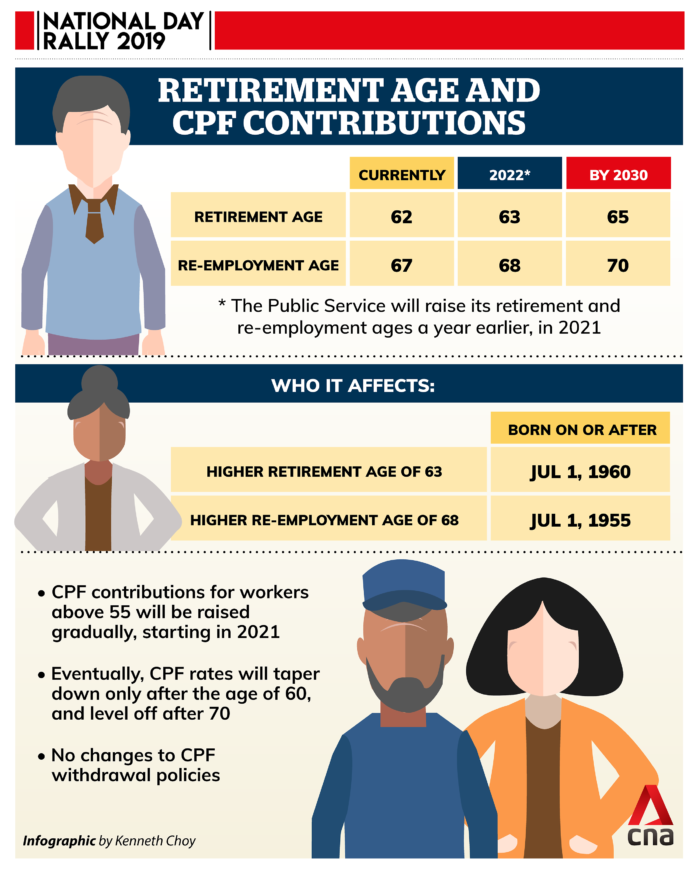
While the retirement age will be raised from age 62 to 63 in 2022, and 65 by 2030, the re-employment age will be raised from 67 to 68 in 2022, and 70 by 2030.
Manpower Minister Josephine Teo moved quickly to announce details of the changes to the Central Provident Fund (CPF) rates for older workers the following day, to help them build up their retirement nest egg.
But the current CPF withdrawal ages remain unchanged. This has been warmly welcomed by most workers who want to continue to have the option of enjoying the fruits of their labour early.
SLOW AND STEADY APPROACH
While the moves were swift and decisive, the overall approach has been gradual and steady, coming on the back of a 15-month consultation with unions and employers.
The Government has also taken a pragmatic approach to spread out the changes over more than a decade, giving sufficient time for both employers and workers to prepare and adjust to the impending changes.
The way the Government has handled this issue is reminiscent of how it took pains to make an early announcement at Budget 2018 a GST hike sometime between 2021 and 2025, so that households can be psychologically prepared.
The overall signal received is very clear: That the shift of the retirement and re-employment age is a necessary, long-term move for a greying population with an ageing workforce.
Singapore will see vast untapped resources if retirement and re-employment ages remain unchanged. A quarter of the total Singapore population will be aged 65 and above by 2030.
This is a reality both employers and workers must adapt to. There is still time, but action must be taken now.
Those aged above 65 may want options for work. A recent study revealed that individuals aged 65 and above require S$1,379 each month to meet basic living needs.
Seniors can depend on CPF Life to meet their financial needs, provided they have the Full Retirement Sum. Currently, based on the default Standard Plan, a senior can expect to receive between $1,350 to S$1,450.
How will the rise in retirement age and re-employment age impact us?
Older employees can be expected to work longer, into their sixties. Under the Employment Act, no employer can dismiss worker without just cause.
This legal framework has been strengthened in April when the Tripartite Alliance for Fair and Progressive Employment Practices issued explicit guidelines stipulating that age, among other reasons, is not fair grounds for dismissal.
These guidelines protect workers from wrongful dismissal before that golden number. It gives workers a greater sense of job security and clarity.
Workers too can then plan in peace. Knowing that we can be re-employed until age 70, we have a time frame to work on.
We can make the necessary adjustments to our retirement plan, to lead the lifestyle we hope to have beyond 70, barring unforeseen circumstances, such as illnesses, accidents or severe economic downturns that might affect returns on investments.
Working for a living aside, the reality also is that most individuals find joy in work. They welcome recognition in the work they do. Their job title is a source of pride that means a lot to them.
Raising the retirement and re-employment ages could have psychological benefits as well.
Those who have left their positions may sometimes experience a sense of loss, and go through flux trying to re-establish their identities. After building and consolidating their capabilities that are relevant to the positions they have held all these years, they feel that they still have more to give.
Practically speaking, Singapore’s only and most precious resource is our people. Early retirement and having such workers exit the workforce can be detrimental to our nation.
In the same way that we should be helping women to stay in the workforce, we must find ways to maximise economic participation.
A woman walks through the Central Business District in Raffles Place. (File Photo)
But we have to make a distinction between work and toil, for the last thing we want to encourage is a culture of endless work, where seniors slave away at a job that gives them barely any satisfaction, with little family time, because work is what they are used to.
VALUABLE CONTRIBUTIONS SENIORS CAN MAKE
Here’s another reality to consider: What our seniors have that we do not.
With decades of work experience, seniors have vast expertise, technical know-how, and valued skillsets, and they can make meaningful contribution to the economy and society at large. It would be a great waste not to tap into their strengths.
Most older employees are more than happy to share their experiences and skillsets with youths. In fact, we have seen men who make great mentors, who help younger workers move up their learning curve and master the trade faster.
What these old mentors have, is patience, passion and perspective, which can complement the strengths of young people.
Older women also show great understanding when it comes to roles that require time and effort, especially childcare. They can be coaches to help younger childcare teachers.
Their maternal instincts can enrich our pre-school sector, where nurturing kids aged 3 to 6 needs composure, confidence and a firm understanding of kids’ motivations and behaviour.
Pre-school teachers. (Photo: PCF Sparkletots)
Indeed, old age is a period of time where Singaporeans should be encouraged to pursue their passions, after a pragmatic lifetime of work to save up for their retirement.
HELPING COMPANIES AND WORKERS COPE WITH THIS PARADIGM SHIFT
As the median age for workers is set to rise even further by 2050, we must expect to see more elderly in the workforce in the coming years. This is already happening globally.
In a world of disruption, employers would like seniors to keep up with productivity, and be comfortable with the use of new technologies.
However, this is easier said than done. Many elderly employees may find catching up with the rapid changes in technology overwhelming.
What this shift in the retirement and re-employment ages entail is also job redesign that leverages the strengths of older workers. But the roles in most companies have been created with youth in mind.
Where PM Lee had said more initiatives to aid companies to deal with this shift will be announced at Budget 2020, it would be interesting to see what measures to nudge companies towards job redesign will be announced by DPM Heng Swee Keat.
Overall, there are benefits to raising both the retirement and re-employment ages, with valid concerns, including the rising business costs of employing older workers.
But the irreversible trend of an ageing workforce and longer lifespans makes doing so the way to go.
The Government has placed a bold bet on seniors and wagered that they can bring value to the table for their companies. The more important task that lies ahead is for companies and works to get ready.
Patrick Chang is a Certified Financial Planner and author of the book The A To Z Guide to Retirement Planning.