Home Blog Page 726

New laws needed to regulate ‘novel’ gambling products such as loot boxes in video games: Josephine Teo

0

SINGAPORE: Regulators around the world need to figure out how to regulate “novel” gambling products such as loot boxes in video games that are designed to appeal to younger audiences, said Second Minister for Home Affairs Josephine Teo on Thursday (Aug 29).

Speaking at the 5th Singapore Symposium on Gambling Regulation and Crime, Mrs Teo noted how gambling preferences have changed, with the younger generation less interested in traditional gambling products such as jackpot machines and horse racing.

To attract this demographic, companies have developed “novel products” such as loot boxes, which are virtual mystery boxes gamers buy in the hope of gaining powerful weapons or skins to enhance the game experience.

Others have reinvented traditional gambling products and added skills-based elements in an effort to have them resemble computer gaming products, the minister said, citing slot machines with joysticks or other features that allow users to make choices during the game.

“Such new products across various modes of gambling will require new laws to regulate,” said Mrs Teo, who is also Manpower Minister.

“Regulators and law enforcement agencies need to keep up to date with these developments and make sure our policies and rules remain effective,” she added.

During her speech, Mrs Teo also spoke about the challenges regulators face because of online technology.

“Everyone now has a smartphone with mobile broadband access. From their smartphones, punters can access gambling products anywhere, anytime,” she said.

Citing figures from PwC, Mrs Teo noted how global remote gambling revenue has grown 10 per cent annually from 2009 to 2016, almost doubling the revenue to US$39 billion. 

In Singapore, online gambling has also risen, said Mrs Teo.

About 60 per cent of Singapore Pools’ sports betting turnover is now done through remote channels – double that of the 30 per cent seen three years ago, she noted, adding this trend is expected to continue. 

READ: Good to have safeguards on online gambling, but public education important: Experts

Singapore Pools and the Singapore Turf Club are the only two operators allowed to run online betting services after the introduction of the Remote Gambling Act in 2016, which bans all online and phone betting activities.

In turn, the two organisations have to implement various social safeguards such as ensuring that only those aged 21 and above can open player accounts and that they do not gamble on credit.

NEW IDEAS TO PROMOTE RESPONSIBLE GAMBLING

Josephine Teo Symposium on Gambling Regulation and Crime Aug 29, 2019

Second Minister for Home Affairs Josephine Teo speaking at the Symposium on Gambling Regulation and Crime on Aug 29, 2019. (Photo: Casino Regulatory Authority)

In addition to the challenges mentioned above, Mrs Teo said there are several areas in which gambling regulators in Singapore and its global counterparts can learn from one another.

The first area is in improving responsible gambling, which is “critical” for mitigating the risk of problem gambling, said Mrs Teo.

She cited several innovative initiatives by the Massachusetts Gaming Commission, including a PlayMyWay tool that allows customers to set their gambling budget.

This is something done here as well, she noted, saying that individual who gamble online with Singapore Pools are required to set their expenditure and loss limits.

Additionally, authorities are working closely with casinos here to implement measures to help gamblers make informed choices, said Mrs Teo. Some measures being studied include providing people with notifications on amount and time spent in the casinos, she added.

The second area is on law and order concerns, particularly money laundering and terrorism financing, the minister said. 

While regulators have put in place strict controls to manage law and order concerns related to gambling operations and prevent infiltration of criminal elements, more can still be done, such as making better use of data.

READ: S$1.3 billion in casino entry fees paid by Singaporeans, PRs since 2010

The French Online Gaming Regulatory Authority, she pointed out, uses data to detect money laundering, match fixing and study players’ behaviour.

Similarly, the Casino Regulatory Authority (CRA) is exploring how data analytics can be used to understand the risk profiles of patrons and identity those who pose regulatory risks, the minister said. 

“Such insights can be used to support policy development and enhance CRA’s risk management,” Mrs Teo said. 
Source link

Singapore ranked second-safest city in the world: EIU index

0

SINGAPORE: Singapore is the second-safest city in the world, according to an index by the Economist Intelligence Unit (EIU).

The third edition of the Safe Cities Index was released on Thursday (Aug 29), with Tokyo ranking first out of 60 cities across five continents for the third time in a row. Other Asia-Pacific cities in the top 10 are Osaka (3rd), Sydney (5th), Seoul (tied 8th) and Melbourne (10th). 

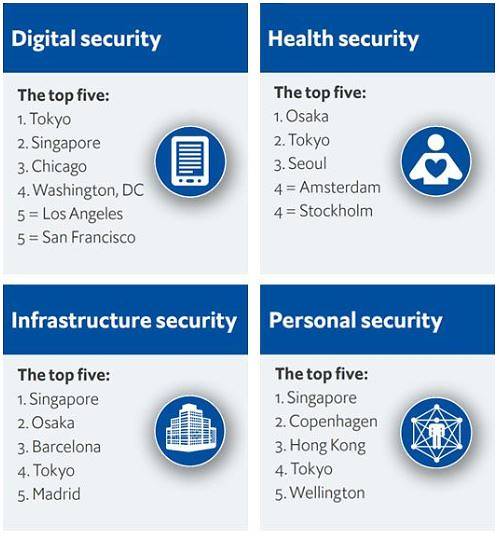
Cities are ranked according to their performance in 57 indicators across four pillars – digital, infrastructure, health and personal security. 

Singapore ranked first in the world for both infrastructure and personal security, coming in second for digital security.

EIU safe cities

Source: EIU

Tokyo recorded the strongest performance in the digital security category, and also rose eight places in the infrastructure security category from the previous edition of the index in 2017.

READ: Singapore, Hong Kong and Paris named world’s most expensive cities for expats: EIU survey

“Overall, while wealth is among the most important determinants of safety, the levels of transparency – and governance – correlate as closely as income with index scores,” said EIU senior editor Naka Kondo, editor of this year’s report on the Safe Cities Index.

The research also shows how different types of safety are intertwined, said Ms Kondo, pointing out that it is rare to have a city with good results in one safety pillar and lagging in others.

Six of the top 10 safest cities are in the Asia-Pacific region – however, the EIU says that a city’s region does not have any statistically significant relationship with its performance in the index.

“Although APAC cities such as Tokyo, Singapore and Osaka continue to rank within the top three cities in the Index, the region also hosts some of the lowest-scoring cities in the world, with Yangon, Karachi and Dhaka close to the bottom of the list,” said Ms Kondo.

She added that although Asia-Pacific cities perform well in the health security, infrastructure security and personal security categories, North American cities generally fare better in digital security, accounting for seven of the top 10 cities in this category. 

READ: Singapore ranks 32 out of 40 for work-life balance, second most overworked city

The EIU index, sponsored by NEC this year, was revised to better capture “urban resilience” – defined as the ability of cities to absorb and bounce back from shocks – as the concept has had an increasing influence on thinking in urban safety over the last decade, especially as policymakers worry about the implications of climate change.

In the index’s previous editions in 2017 and 2015, Singapore also ranked second both times.

EIU Safe Cities Index 2019:

1. Tokyo
2. Singapore
3. Osaka
4. Amsterdam
5. Sydney
6. Toronto
7. Washington, DC
8. Copenhagen
9. Seoul
10. Melbourne

Source link

Heavy traffic at Tuas Checkpoint due to ‘intermittent slowness’ of immigration clearance system

0

SINGAPORE: Motorists at Tuas Checkpoint experienced heavy traffic on Thursday (Aug 29) morning due to “intermittent slowness” of the immigration clearance system, the Immigration and Checkpoints Authority (ICA) said.

In a Facebook post, ICA said both arrival and departure traffic was affected.

“Delays are expected,” it added. “The Immigration and Checkpoints Authority regrets the inconvenience caused to travellers and seeks their understanding and patience.”

Traffic camera images on the OneMotoring website showed long lines of vehicles in both directions at the checkpoint.

Heavy traffic at Tuas Checkpoint on Aug 29, 2019

OneMotoring camera footage showed long lines of vehicles in both directions at Tuas Checkpoint on the morning of Aug 29, 2019. 

In an earlier post, ICA asked motorists to check the traffic situation at the checkpoint on OneMotoring before embarking on their journey.

Many motorists and commuters posted photos of the heavy traffic at the checkpoints on social media.

Some said they were stuck in traffic for hours, with the traffic buildup starting from 6.30am. 

Tuas Checkpoint traffic on Aug 29, 2019 (1)

The delay was due to “intermittent slowness” of ICA’s immigration clearance system. (Photo: Teo Wee Kian)

Tuas Checkpoint traffic on Aug 29, 2019 (3)

Some motorists and commuters say they were stuck in traffic for hours. (Photo: Facebook/Chang Boonlong)

Facebook user Mini Yen posted on a Tuas Checkpoint group at 9.10am saying that it took her three hours to reach the immigration counters.

Another Facebook user Xie Huiwen posted photos of an ambulance with its lights and siren switched on, trying to edge past traffic on the road shoulder but being blocked by some vehicles.

Ms Boey Lee, who was travelling to Singapore on a motorcycle, told CNA she was stuck in traffic for two-and-a-half hours but made it to her office before work started at 9am. 

“Today is really bad, and many people just made a U-turn back to Malaysia,” she said. “As for me, I arrived at my company at 8.50am … Fortunately I was not late, just missed time to eat breakfast.”

Source link

Choa Chu Kang Waterworks upgrade to help tackle climate change

0

SINGAPORE: Choa Chu Kang Waterworks (CCKWW) has completed a S$162 million upgrade that will help it tackle challenges in processing raw water as a result of “the negative impacts of climate change”.

The upgrades, which include a ceramic membrane filtration system, were unveiled by Minister for Environment and Water Resources Masagos Zulkifli on Thursday (Aug 29).

Mr Masagos said the quality of Singapore’s catchment water may deteriorate with climate change.

“For instance, rising temperatures could result in warmer waters while intense rainfall may lead to an excessive amount of nutrient runoff being washed into our waterways and reservoirs,” the minister stated.

“These conditions are likely to fuel algae growth in the reservoirs, which will need to be removed as part of the water treatment process.

“In anticipation of such challenges, (national water agency) PUB has to continuously invest in new water treatment technologies and upgrade our water treatment plants, as we have done in Choa Chu Kang.”

One of Singapore’s oldest water treatment plants, CCKWW was built in two phases in 1975 and 1981. The three-year upgrade from June 2016 to June 2019 saw the construction of a new facility, installation of ceramic membranes and the inclusion of ozone-biological activated carbon (BAC) treatment for the plant.

The ceramic membrane system, the world’s largest in a single plant, will treat up to 40 million gallons of water per day. Filtering out particles as minute as 0.1 micrometres in size, there will be 12 vessels with 90 ceramic membrane elements in each vessel.

biological activated carbon tanks

There are 14 biological activated carbon tanks in Choa Chu Kang Waterworks. (Photo: Ang Hwee Min) 

It is more energy and cost efficient than polymeric membranes, said Mr Masagos, adding that the ceramic membrane system only sees 1 per cent of water loss, compared to 5 per cent for a polymeric membrane system. The new membranes are expected to last for 20 years, compared to polymeric membranes that have to be replaced every five years.

Besides the ceramic membranes, the upgrade will also see the implementation of ozone-BAC treatment at the plant.

Ozone, one of the strongest disinfectants in drinking water treatment, kills germs in the water, while activated carbon removes other natural organic impurities, said the minister.

“The installation of the ceramic membranes together with the ozone-BAC system means that Choa Chu Kang Waterworks possesses one of the most advanced water treatment processes in the world,” Mr Masagos added.

NEGATIVE EFFECTS OF CLIMATE CHANGE

“That we are able to deploy this new technology on such a large scale is the result of years of research, experimentation and rigorous testing,” said Mr Ng Joo Hee, chief executive of PUB.

“Advanced treatment technologies will allow us to cope with the impact of an increasingly urbanised catchment and the negative effects of climate change on Singapore’s raw water quality.”

CCKWW is Singapore’s second-largest waterworks, and treats 80 million gallons of water from Kranji, Pandan and Tengeh reservoirs, equivalent to 145 Olympic-sized swimming pools.

PUB said it has plans to progressively incorporate advanced water treatment processes in the other five water treatment plants in Singapore – Bedok Avenue, Bukit Timah, Chestnut Avenue, Lower Seletar, and Woodleigh Waterworks – when they are “due for upgrade”.

Chestnut Avenue Waterworks and Woodleigh Waterworks are currently being upgraded to include ozone-BAC steps in the water treatment process, PUB said. This is expected to be completed by the end of this year.

PUB also signed a memorandum of understanding (MoU) with PWN from the Netherlands and South West Water from the United Kingdom to share knowledge of the latest innovations, as well as operational data and best practices on ceramic membrane systems for the next five years. 

All three utilities are currently deploying ceramic membrane systems in their water treatment plants.

“Our rigorous water treatment processes and quality monitoring programme from source to tap allow all Singaporeans to drink tap water safely without the need for boiling or extra filtration – a privilege not enjoyed by the vast majority of the world’s population,” said Mr Masagos.

“Climate change has made water an issue every country will have to grapple with in the near future. I am glad that Singapore has been on a quest to address our water issues for the longest time, and am confident that we will continue to address our water supply needs.”

Source link

Mindset change needed on how society views exams: Ong Ye Kung

0

SINGAPORE: Examination grades should be not be the sole means of defining a person – and societal mindsets need to shift to reflect this, said Education Minister Ong Ye Kung on Friday (Aug 23).

He was speaking at a forum with parents and students that was filmed for Talking Point, with hosts Steven Chia and Diana Ser moderating the discussion.

The forum touched on the greatest source of educational stress for students, and the impact of subject-based banding, following several announcements from the Ministry of Education (MOE).

These include having fewer exams and assessments in schools starting this year. 

Primary 1 and 2 students will no longer have weighted assessments and examinations, while Primary 3, Primary 5, Secondary 1 and Secondary 3 students will no longer have mid-year exams.

The Government also said in March that subject-based banding will replace streaming in secondary schools, and a common national exam will replace the O-Levels and N-Levels.

Subject-based banding allows students to take subjects at a higher or lower level, based on their strengths.

READ: Current approach to streaming in secondary schools to be phased out by 2024

“It is a societal mindset,” said Mr Ong, responding to a question on where the biggest source of stress came from. 

“Because we value meritocracy so much … but I think we have reached a stage where we might be overdoing it, and I think it is time to unwind without losing the fundamental principles of meritocracy.”

With that in mind, he pointed out that MOE is gradually making adjustments such as revamping the Primary School Leaving Examination (PSLE) scoring system, cutting the number of exams and phasing out streaming in secondary schools.

“That means I don’t boil you down to one number, I try my best to judge and evaluate the talent of this child and give admission places to the child at secondary school through Direct School Admission (DSA), as well as poly, ITE and university,” he said.

READ: Fewer exams, assessments in schools to reduce emphasis on academic results: MOE

When Mr Chia pointed out that some employers still hire based on grades, Mr Ong said: “Every time I spot any ministry, any private sector company that still hires based on minimum B3 in Math, minimum five O-Levels, I always tell them – can you remove that? Why do you want that?”

He added that it was “reasonable to ask for qualifications”, but not “for every grade” unless the job requires particular subject knowledge.

FEWER EXAMS MEANS LESS STRESS?

Before Mr Ong took part in the discussions, the parents and students were already engaged in a lively discussion on whether having fewer exams equate to less stress.

A poll conducted showed divided opinions: 54 per cent of parents and children said yes, while 48 per cent disagreed.

“School should be a place to not really stress, to have fun, to make friends, to learn something, rather than just go there and – I’m so stressed about – exam is coming,” said actor and presenter Ben Yeo, 40.

However, some parents felt that exams were necessary to instil character values in children.

“If you don’t have exams, you need some other way to teach children discipline and resilience,” said principal founder of Learning Journey Grace Tan, 38.

The children also admitted that there was value to having exams.

“It helps me to know which subject I need to work on more to improve,” said Vera, 10.

“If there’s more exams, it’s easier to balance out if you do very average for one exam,” said Kyana Chainani, 13.

primary school students

File photo of students at a primary school.

In response, Mr Ong said reducing stress was not the aim behind the decision to do away with some exams.

“For every exam we remove, we have three weeks of freed up curriculum time, which is very useful for teachers to then teach better and for students learn better,” said Mr Ong.

SUBJECT-BASED BANDING

During the programme, parents were also polled on whether subject-based banding would increase social mixing. This time, it was an even 50-50 split.

Some parents cautioned that social mixing would not come about automatically, and that schools would have a part to play too.

“You could have a situation where they’re even more split because there is nobody to facilitate the understanding, the inclusion. So I think the teachers really have to play a central role in helping the students and setting the culture and the tone,” said writer June Young, 39.

However, manager Lu Jiahui, 44, who went through subject-based banding during her time in school, found it to be a good experience: “I got to mix with lots of other people in the same cohort, so the social mixing was very real.”

Ong Ye Kung on Talking Point

Education Minister Ong Ye Kung, Ms Diana Ser and Mr Steven Chia speaking to parents and students at the special episode of Talking Point on Aug 23, 2019. (Photo: Hanidah Amin)

This is exactly the point of the policy, said Mr Ong.

“You move from class to class, and you’re not in the same class because you belong to a certain stream or certain course and I can only study at a lower or less difficult level,” he said.

“TELL ME I HAD A WONDERFUL CHILDHOOD”

In the final minutes of the show, Mr Ong invited the parents to reflect on what yardstick they would use to measure their success as parents.

Most of the parents pointed to qualities other than academic success.

“How I gauge would be – will they be living their dreams or will they be living our dreams?” asked entrepreneur Khalid Awang, 51.

Mr Yeo said: “I just hope that he can come and tell me that I had a wonderful childhood. That’s all.”

Talking Point’s Special Forum with Education Minister Ong Ye Kung airs Thursday (Aug 29), 9.30pm on Channel 5.

Source link

Two artworks unveiled to commemorate Singapore’s bicentennial

0

SINGAPORE: If you are visiting East Coast Park, look out for a 4m-high sculpture of a giant body with many faces.

Called Crossing Shores, it was one of two artworks unveiled on Wednesday (Aug 28) to commemorate Singapore’s bicentennial. 

The second artwork is a 3D-printed installation called The Time Tree, featuring a giant tree stump and a fallen part of the tree. 

“As we commemorate Singapore’s bicentennial, the launch of these new public art will help showcase the different facets of our Singapore Story while revitalising public spaces around Singapore,” said Minister for Culture, Community and Youth Grace Fu. 

CROSSING SHORES

The sculpture Crossing Shores, with its many faces, pays homage to the diversity of early migrants who crossed Singapore’s shores in search of better futures and made Singapore their home, said the National Arts Council (NAC) in a media release. 

“Set against the backdrop of the sea at East Coast Park, in a space that many Singaporeans have shared memories of, the artwork serves to remind us of how a nation of diverse faces from different lands worked together to build a home, and calls for stronger social integration in contemporary times,” it added. 

The sculpture was created by Singaporean artist Farizwan Fajari, professionally known as Speak Cryptic. 

launch of Crossing Shores by Speak Cryptic

Minister Grace Fu and students from a PCF Sparkletots pre-school at the launch of Crossing Shores at East Coast Park. (Photo: NAC)

THE TIME TREE

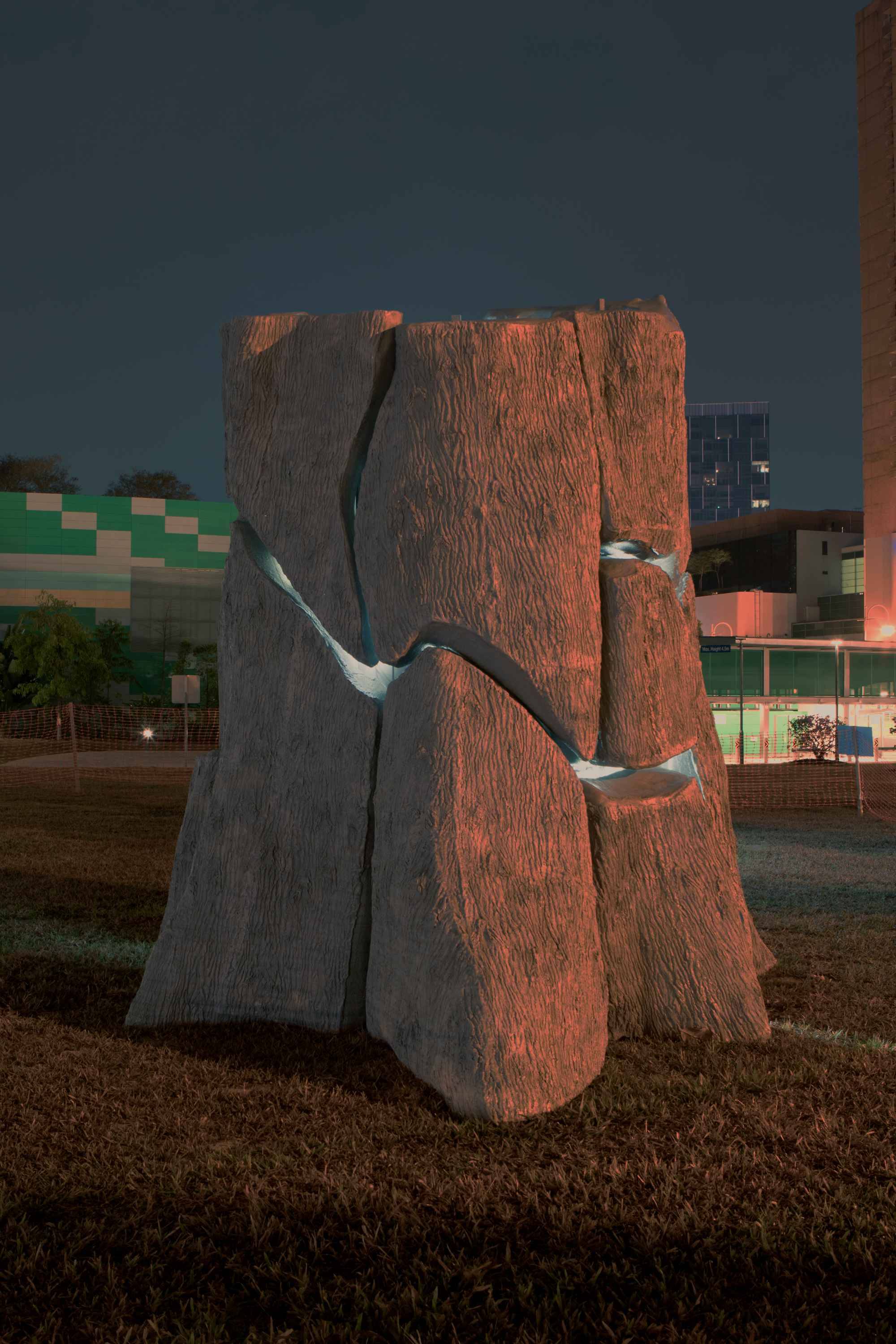
The Time Tree by Robert Zhao imagines what a tree older than 200 years might look like in Singapore, and is modelled after the dimensions of the Changi Tree – Singapore’s tallest tree recorded which stood at about 76.2m. It was also the tree which the British feared would serve as a ranging point for enemy artillery during World War II. 

The Time Tree by Robert Zhao_Day shot

The Time Tree by Robert Zhao will be displayed at three public sites starting with Fort Canning Park. (Photo: Robert Zhao)

The artwork, which lights up at night, is one of the largest 3D-printed public art installation in Singapore, said NAC.

“The age of the imagined tree, beyond the 200 years of Singapore’s bicentenary, is an acknowledgement of Singapore’s pre-modern history and the plurality of narratives that go beyond the colonial era – reflecting the tenacity and resilience of Singapore, and the myriad of possibilities in imagining a nation through the lens of natural history,” it added. 

The installation will be displayed at three public sites, starting with Fort Canning Park this month before moving to Jurong Lake Gardens in November and finally at Raffles Place Central Square in January. 

The Time Tree by Robert Zhao Iluminated from within at night Photo courtesy of artist_mod

Robert Zhao’s installation The Time Tree illuminates at night. (Photo: Robert Zhao)

The Time Tree by Robert Zhao Iluminated from within at night

Robert Zhao’s installation The Time Tree illuminates at night. (Photo: Robert Zhao)

“The challenge put forth to the commissioned artists was not only to push their artistic boundaries and further their craft through a different medium, but to also draw reference from bicentennial themes such as multi-culturalism, openness and self-determination to commemorate this historical milestone,” said NAC’s chief executive Rosa Daniel. 

“We are confident the public artworks will enliven community sites, stimulate imaginations and delight visitors of all ages with their sense of play.”

The artworks were commissioned by the Public Art Trust, an initiative by NAC. 

A third artwork will be launched in Punggol in November.

Source link

Woman who gave birth in Gojek car describes ‘scary, terrifying’ experience

0

SINGAPORE: A woman who recently gave birth in a Gojek car on the way to hospital described her “terrifying” ordeal in an interview on Wednesday (Aug 28).

Ms Nurisah Mohamed was taken by surprise when she started experiencing light contractions in the morning on Aug 23. Her due date was not until Sep 1.

She called her husband – who was at work – and the pair decided to book a Gojek car to KKH Women’s and Children’s Hospital (KKH), said the 29-year-old, who first detailed the incident in a Facebook post on Monday.

“(My husband) called my sister-in-law, who stays nearby, and she came … and accompanied me to the hospital,” said Ms Nurisah. 

“But before we could reach the hospital, I was in labour! It was such a chaotic moment. I was shouting so badly (sic) with all the pain as my water bag burst and my sister-in-law said she could see the baby’s head coming out,” she wrote on Facebook. 

Her sister-in-law, Ms Norhafizah Nijam Mohamed, told CNA that the baby was born just 10 minutes after they had boarded the car at Punggol East.   

She also said that her brother, who was at the hospital when they arrived, wanted to pay the driver cash so he could clean his vehicle, but the driver refused. 

The family paid the driver the cab fare, which amounted to about S$22, and thanked him for his help.  

“SCARY BUT ALSO TERRIFYING”

Recounting the incident on Wednesday, Ms Nurisah said the experience was scary and terrifying as her baby did not cry during the journey to hospital.

“The experience was scary but also terrifying because when I gave birth to her in the Gojek car, she didn’t cry or move during the journey to KK Hospital,” she said. “When the nurse arrived and cut the umbilical cord, then she started crying and I felt relieved.”

This is the couple’s second child. 

Baby born in Gojek car

The baby girl was born in a Gojek car on Aug 23, 2019.

Ms Nurisah also thanked the Gojek driver, Mr Leng Khee Kwong, for remaining calm. 

“Throughout the journey to KKH, Mr Leng told me to be calm, and when my sister-in-law said the baby was already coming out, the baby’s head could be seen, then Mr Leng said, ‘one, two, three, push!’,” she said. 

“I held my sister-in-law’s hand and the car door handle and pushed twice, and the baby came out,” she added.

“Thank you to Mr Leng. He tried to reach the hospital as fast as he could.”

Ms Nurisahsaid she felt guilty as the whole car “was such a mess with blood and all”, but that the driver did not get angry.

On his part, Mr Leng said he felt very anxious during the journey. 

“In my mind, first thing I (was) very anxious and tried to send them to the hospital as fast as possible,” he said.

“I just tried to drive and tried to comfort them, saying, we are reaching the hospital soon, and then (kept) updating them (on) the time of arrival.”

He said it took about four hours to clean his car after the incident.

When asked about his decision not to accept more money for the trouble, Mr Leng said: “I want to share the joy with the parents also.”

He added that Gojek rewarded him with a holiday trip.

Source link

Additional subsidies for pre-schools to increase from January 2020

0

SINGAPORE: Parents can look forward to paying less for pre-school from January 2020, as subsidy amounts will be increased across all eligible income tiers, announced Minister for Manpower Josephine Teo on Wednesday (Aug 28).

The increased subsidies were announced as part of measures to support marriage and parenthood. 

READ: All childhood vaccinations to be subsidised at polyclinics and CHAS GPs by end of 2020

READ: Singapore to remove age limit for IVF treatments, introduce new subsidies

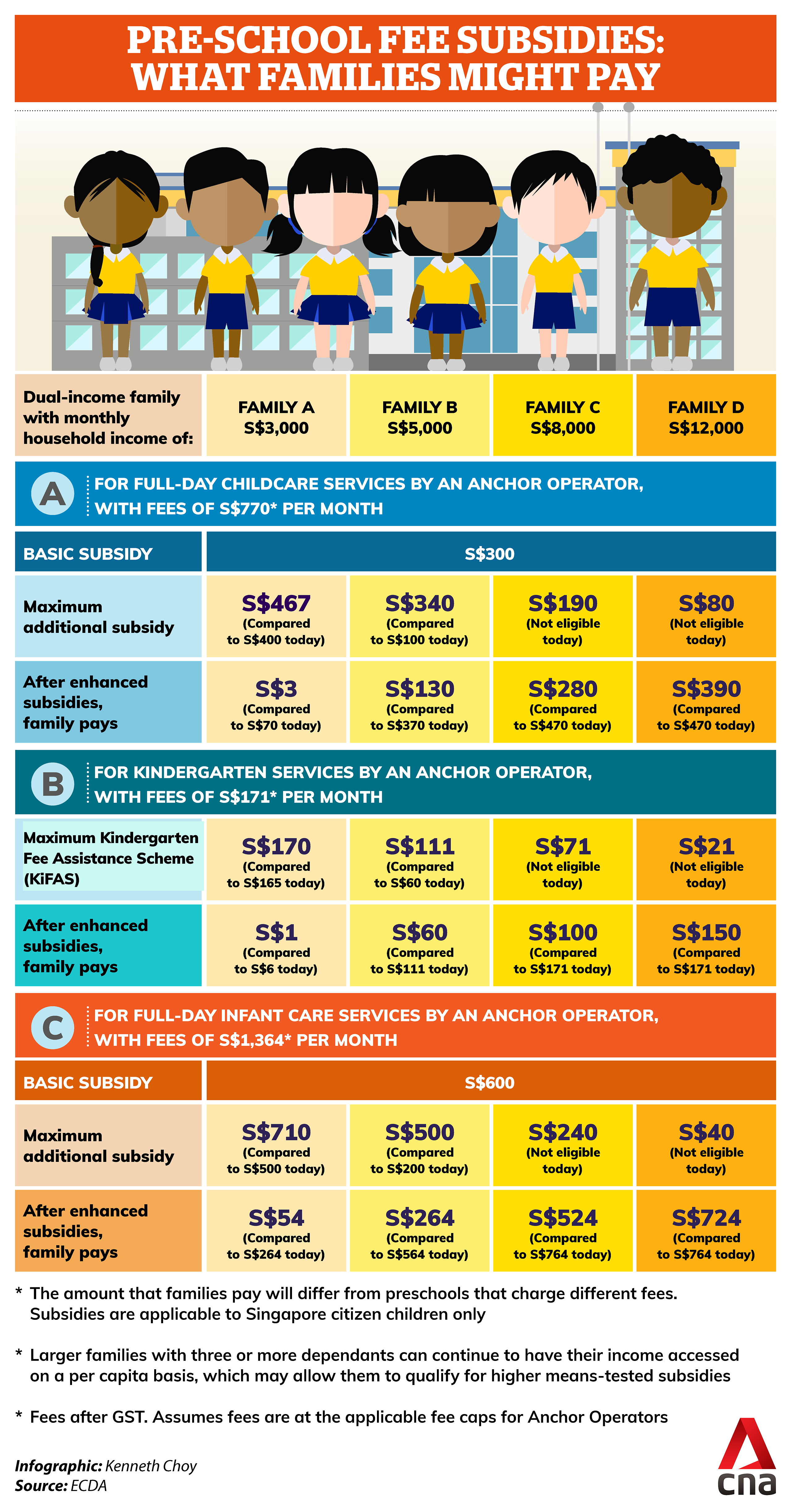
Under the new scheme, families with a gross monthly income of S$3,000 will pay S$3 a month per child at anchor operator pre-schools, as the maximum additional subsidy will be increased from S$400 to S$467. 

This is on top of the S$300 basic subsidy.

Today, families with a gross monthly income of S$3,000 pay about S$70 a month per child at anchor operator pre-schools.

Families with a gross monthly income of S$5,000 qualify for a maximum additional subsidy of S$340 – an increase of S$240.

READ: NDR 2019: More pre-school subsidies as Singapore set to spend more on early childhood education

READ: More support in pre-schools for children with developmental needs

Those with a gross monthly income above S$5,000, who are currently not eligible for the additional subsidy, will also qualify.  

Families with a gross monthly income of S$8,000, will be eligible for a maximum additional subsidy of S$190.

And for those with a gross monthly income of S$12,000. they qualify for a maximum additional subsidy of S$80.

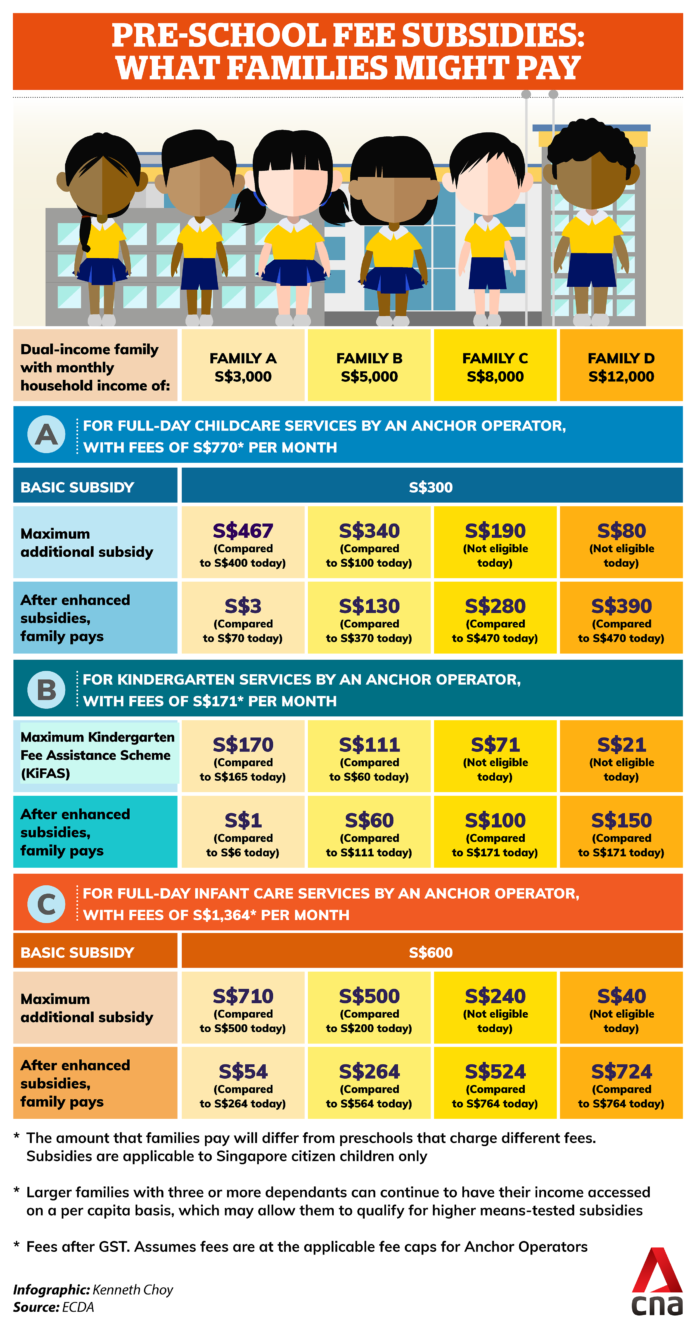
Pre-school fee subsidies: What families might pay

Mrs Teo said pre-school education is “prominent” on the minds of Singaporean parents. 

“All of us would like our children to do well. We want to provide as best as possible for the children, that’s number one.” 

She also stressed the growing importance of full-day childcare services for working parents, and improving the affordability and accessibility of such services. 

Those who are still unable to pay can apply for further financial assistance, said Minister for Social and Family Development Desmond Lee. 

“For instance, start-up grants are available to defray the initial costs of enrolling in pre-school, such as uniforms and deposit.” 

READ: Why it’s still so hard to have more early childhood educators in Singapore

READ: Too scared for pre-school: A young mum’s struggle with her daughter’s fears

In his National Day Rally speech, Prime Minister Lee Hsien Loong announced that Singapore’s annual spending of about S$1 billion on early childhood education will “more than double” over the next few years, as the Government looks to make pre-schools more affordable.

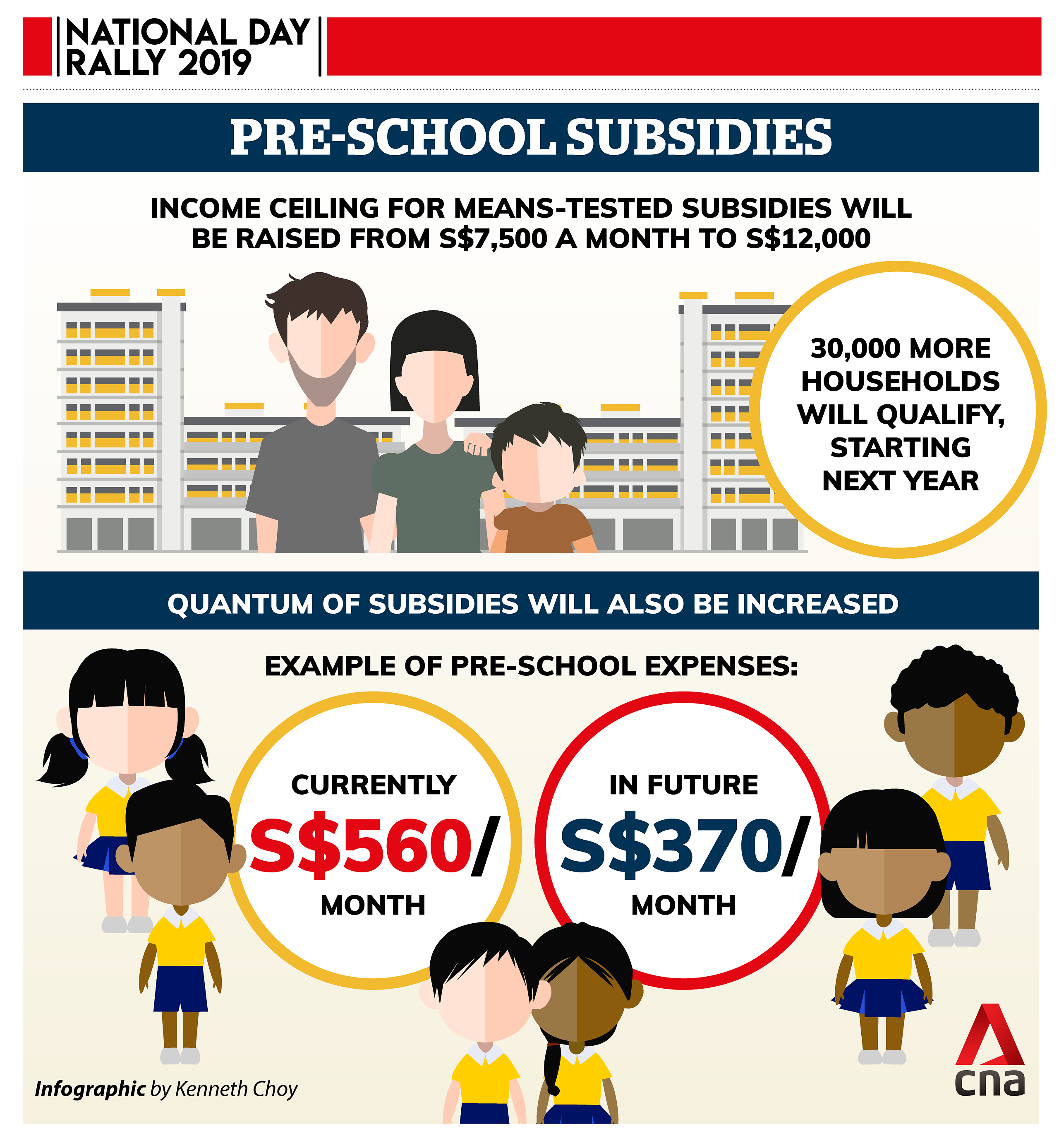
He also announced that the gross monthly household income ceiling will be raised to S$12,000, up from S$7,500 for additional subsidy and S$6,000 for the Kindergarten Fee Assistance Scheme (KiFAS).

This will extend the means-tested subsidies to 30,000 more households, or over 60 per cent of households in Singapore.

NDR2019 - Preschool subsidies infographic

Mr Desmond Lee also announced that ECDA will expand the partner operator scheme for childcare operators and a small number of quality kindergartens in 2021, as the current term for partner operator centres ends in 2020. 

The fee cap for childcare partner operators will also be slightly lowered from January 2021. The current fee cap for full-day childcare partner operators is S$856 after GST. 

“Kindergartens that join as partner operators will have to meet conditions to ensure accessibility, quality and affordability for all segments of the public.” 

There are currently five anchor operators and 23 partner operators. As of August, they manage a total of 822 infant care centres, childcare centres and kindergartens.

Mr Desmond Lee also said the Government aims to lower fee caps at government-supported pre-schools to around S$300 per month “in the medium term”, to match that of primary school fees plus after-school student care fees. 

“Lower- to middle-income working families will continue to receive more help, and pay even less with means-tested preschool subsidies.” 

He added that 80 per cent of pre-schoolers will have a place in government-supported pre-schools by 2025. This includes anchor operators, partner operators and MOE-run kindergartens, which account for just over 50 per cent of pre-school places today. 

More anchor operator pre-schools will be built in areas of demand, especially estates with young families, he added, and void deck space will continue to be set aside for pre-schools.

“By ensuring access to affordable, good quality preschool, we will give every child a good start in life, regardless of their background,” said Mr Desmond Lee. 

“With these enhancements, we hope to reduce concerns about the cost of putting children through preschool,and that working parents will have greater peace of mind knowing they are supported in their parenthood journey.”

Source link

All childhood vaccinations to be subsidised at polyclinics and CHAS GPs by end of 2020

0

SINGAPORE: All polyclinics vaccinations under the National Childhood Immunisation Schedule (NCIS) will be subsidised for Singaporeans by the end of 2020, and the subsidies will be extended to general practitioner clinics under the Community Health Assist Scheme (CHAS).

This was announced by the Ministry of Health (MOH) on Wednesday (Aug 28), as part of efforts to make childhood preventive healthcare more affordable and accessible.

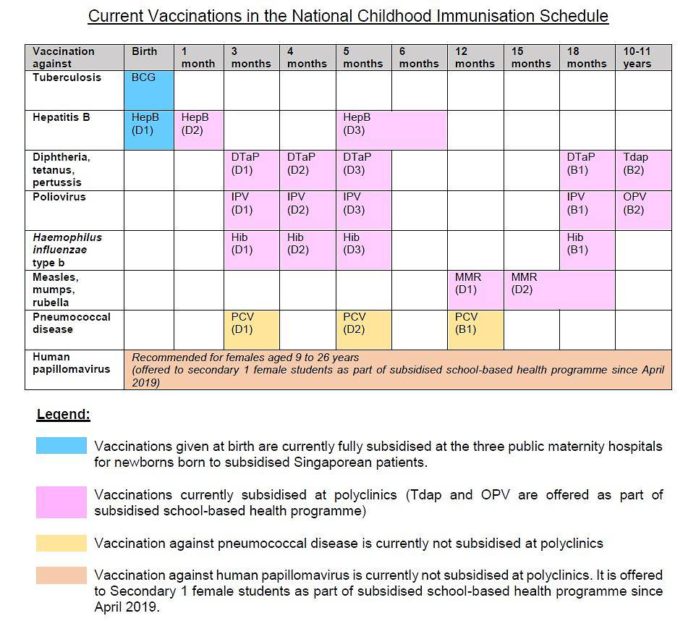
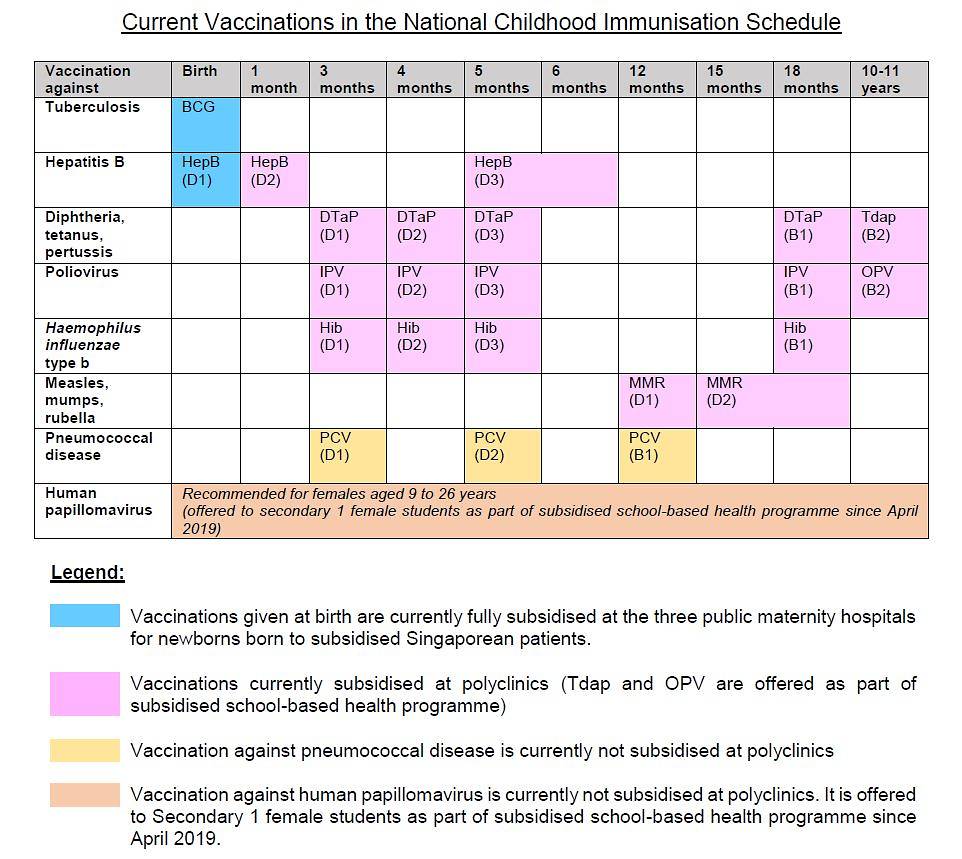
Currently, most vaccinations under NCIS, such as Hepatitis B as well as measles, mumps and rubella, are fully subsidised at polyclinics.

With the changes, vaccinations for pneumococcal disease and human papillomavirus (HPV) will be subsidised as well.

vaccinations table

The NCIS lists childhood vaccinations recommended for protection against common vaccine-preventable diseases in Singapore.

Subsidies currently apply to vaccinations for diseases that have a high outbreak potential, such as measles.

For vaccinations recommended for personal protection, such as the one against pneumococcal disease, take-up rates are “much lower”, said MOH, although they offer significant protection against disease.

READ: Government to consult Singaporeans on concerns over marriage and parenthood

Apart from vaccinations, the ministry announced that childhood developmental screenings will also be subsidised at the more than 1,000 CHAS GPs. They are currently only subsidised at polyclinics.

Source link