SINGAPORE: A sky park is set to be built above the Bukit Timah canal, National Development Minister Lawrence Wong announced on Saturday (Aug 31).
Construction works for the first phase of the new park, a 1.4km elevated stretch that runs from the Rail Corridor to Elm Avenue, will start in 2021 and is expected to be completed within two to three years.
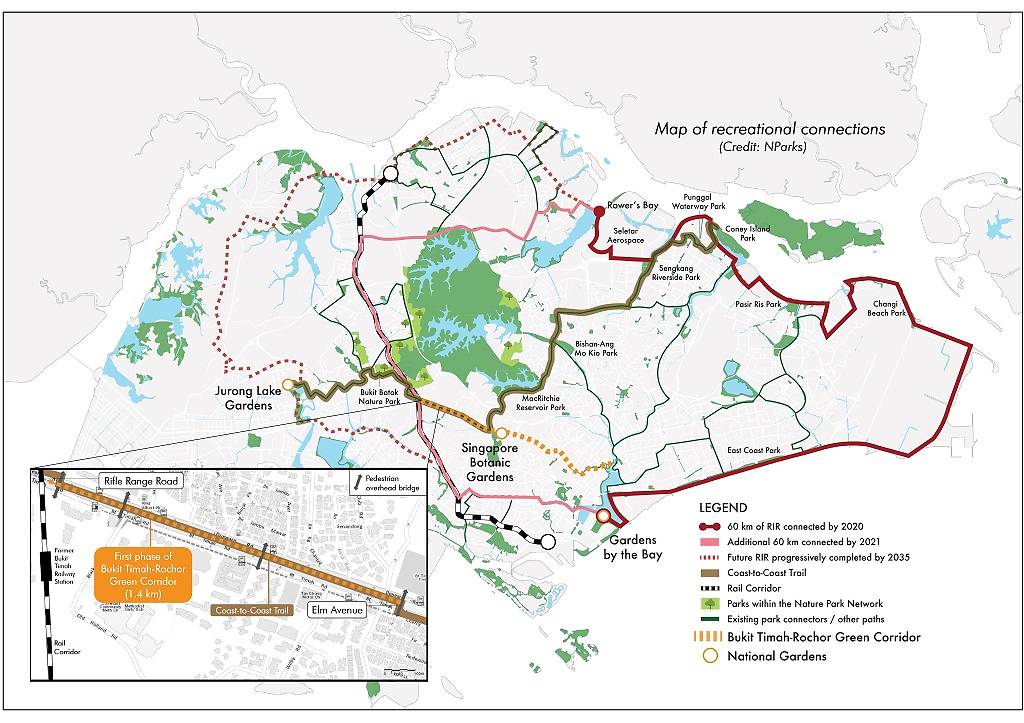
The sky park is part of the National Parks Board (NParks) plan to develop the Bukit Timah-Rochor Green Corridor, a linear park that lies between Bukit Timah Road and Dunearn Road.
In future, this green corridor may be extended all the way to Kallang Riverside, totalling 11km.
Mr Wong said the new green corridor will serve as a crucial green link connecting the three national gardens – Jurong Lake Gardens, Singapore Botanic Gardens and Gardens by the Bay – and help to optimise space.
“This space is part of our drainage reserves, which we usually don’t touch, but now we’re developing a linear park above the canal so users will be separated from the traffic below,” said Mr Wong.
Speaking at the former Bukit Timah railway station, Mr Wong also announced that works to restore the conserved station and its surroundings have begun.
File photo of Bukit Timah railway station (Photo: NParks)
The former station is at one end of the 4km central part of the Rail Corridor. The other end is at Hillview MRT station.
According to the Urban Redevelopment Authority (URA) and NParks, the building will retain its original railway features but will be repurposed as a heritage gallery for visitors to learn about the history of the railway station and the Rail Corridor. The agencies say that restoration works will be carried out in line with conservation guidelines.
The area will also see the building of a new entrance garden at King Albert Park, an orchard inspired by a 1960s Kampung, as well as new fruit trees such as cempedak, binjai and belimbing.
In October last year, NParks and URA started works to enhance the central part of the Rail Corridor. This includes improvements to trails, restoration works for the truss bridges, construction of a new pedestrian underpass at Hindhede Drive, and habitat enhancements.
Mr Wong also announced that several stretches, totalling 4.2km, of the southern half of the Rail Corridor have been reopened to the public.
The 11km stretch from Bukit Timah to Tanjong Pagar was closed in 2016 due to pipe works carried out by PUB.
By 2020, the whole southern half of the Rail Corridor will be opened.
SINGAPORE: If you’re a regular flier with Singapore Airlines (SIA), you may have noticed that salt and pepper packets are no longer included in the meal trays served in economy class.
In fact, the airline removed salt, pepper and sugar packets in November 2018.
This is one of the many initiatives taken by the carrier to contribute to “greener skies” by reducing food wastage on board and cut back on the use of in-flight items, a company spokesman told CNA in response to queries.
“SIA has embarked on many new initiatives in the last financial year to continue offering our customers the best travel experience while operating more sustainably,” the spokesman said.
The carrier is also taking steps to reduce single-use plastics and replace them with more sustainable materials.
(Photo: Siti Rohani)
Those travelling in business class are still offered the condiments, as these are served in shakers instead of disposable packets. That is not to say passengers in economy class don’t have to miss out on that extra kick of flavour – salt and pepper are still available, but passengers need to ask for the packets.
This is not the only environmental initiative that SIA has brought in.
“We aim to become entirely plastic straw-free this financial year,” the spokesman said. “During the last financial year, we began the process of removing plastic straws onboard, and the remaining, children’s straws, are to be substituted with environmentally friendly paper straws by September 2019.”
Becoming more sustainable is not an uncommon move in the aviation industry.
The Qantas Group, which includes Jetstar Asia, announced a plan in February to become the first airline to cut 100 million single-use plastics by the end of 2020 and eliminate at least three-quarters of its general waste by the end of 2021.
FILE PHOTO: A Qantas plane taxis at Kingsford Smith International Airport in Sydney, Australia, February 22, 2018. REUTERS/Daniel Munoz
For a start, Qantas Airways operated what is said was the “world’s first zero waste flight” on May 8 from Sydney to Adelaide, with all in-flight products reused or recycled, or disposed of through composting.
AirAsia claims to be the only airline in Malaysia to perform onboard cabin recycling since 2015, where recyclable items are handed over to certified recycling partners after every flight.
“Everybody is cognisant of the benefit of aviation but we also have to be mindful of all the risks we create, and that’s why airlines all over the world have come very strong in promoting sustainability efforts,” said AirAsia’s group head of global affairs and sustainability Shasha Ridzam.
While experts agree that these initiatives are a step in the right direction, they can be a distraction from the bigger picture.
“It can be hard to know from the outside whether these efforts are in done earnest or if the companies are greenwashing,” said Assistant Professor Sonny Ben Rosenthal at the Wee Kim Wee School of Communication and Information.
Greenwashing is a term used to describe businesses that implement strategies designed to create a false impression about their environmental credentials.
“Waste minimisation is a good one to choose from a PR standpoint because it is relatively easy to implement and show to the public. It’s like the anti-straw movement. When consumers bring their own straws to drink from plastic cups with plastic lids, they’ve still wasted a lot of plastic.”
“Would anyone want to take a train from Europe to Asia as it is purported to be the most environmentally least impactful? I don’t think so,” he said.
“The only real thing for airlines to do really is to buy the latest aircraft model there is, because it has the best fuel efficiency and lowest carbon footprint. But that is not always possible because of the long aircraft lifecycle.”
(Source: Transition Pathway Initiative at the London School of Economics’ Grantham Research Institute)
A report published in March from the London School of Economics (LSE) suggests that twenty of the world’s largest airlines do not have strategies in place to help meet the Paris Agreement goal of limiting global warming to below 2 degree Celsius in the long term.
None of the twenty airlines has a target that clearly specifies how it will reduce its own flight emissions after 2025.
The report also says that only the UK’s EasyJet is meeting those aviation targets so far, with companies named as having the weakest plans to cut emissions including Air China, China Southern, Korean Air, Singapore Airlines and Turkish Airlines.
However, there are some limitations to the LSE research, as pointed out by Korean Airlines in a BBC article. It doesn’t take into account that some airlines carry much more baggage and freight than others.
In response to queries on its efforts to cut down on carbon emissions, SIA said that the average age of its fleet is “just over six years”, which allows them to benefit from new, fuel-efficient technology.
“In addition, SIA has since 2011 been an active member of Sustainable Aviation Fuel Users Group, which was established to accelerate the development and commercialisation of sustainable aviation fuels,” the company spokesman told CNA.
“SIA sees sustainable aviation fuel as a long-term measure to support the aviation industry’s carbon-neutral growth goal beyond 2020.”
Meanwhile, an anti-flying movement is catching on in Europe.
Fueled by activists in Sweden, “flygskam” which translates to “flight shame” is the name of the movement which encourages people to stop taking flights to lower carbon emissions.
Wind in her sails: Greta Thunberg is heading to North America to continue her climate campaign (Photo: AFP/Ben STANSALL)
On Wednesday (Aug 29), 16-year-old activist Greta Thunberg arrived in Manhattan after a two-week journey on a zero-emissions sailboat to take part in a United Nations summit.
The two-week journey from Britain to New York would have taken just eight hours by flight – but she refuses to fly because of the carbon emissions generated by the aviation industry.
SHOULD AIRLINES BE CONCERNED?
Although anti-flying campaigns have yet to generate mass interest, environmental activist and founder of Green Drinks Singapore Oliva Choong said that this is something that airlines should keep an eye on: “While this group may be small right now, there is a need to cater to concerns towards the climate because it is a pressing issue that their existing customers feel or may do so with greater environmental awareness.”
“SIA’s biofuel flights are a step in a greener direction although there is still a large amount of carbon emissions generated through flying,” she added.
SIA launched its first biofuel flight in May 2017. The flights are powered by a combination of hydro-processed esters and fatty acids, a sustainable biofuel produced from used cooking oils, and conventional jet fuel.
“Aviation companies should adopt greener practices because it’s the right thing to do, and in some cases, it will save them money in the long run,” said Ms Choong.
FILE PHOTO: A student holds a placard during a protest against climate change in front of the Parliament building in Oslo, Norway March 22, 2019. REUTERS/Nerijus Adomaitis
Echoing this, Flightglobal’s Asia managing editor Greg Waldron said: “Airlines have always been talking about and looking at ways of cutting fuel and thereby cutting emissions because fuel is a significantly big cost.
“They have a very real economic incentive to reduce the amount of fuel that they consume simply because that’s where their profitability comes in.”
He pointed out that governments and regulators can also have a hand in this.
“When there’s major (air) traffic and planes have to circle over the airport for twenty to thirty minutes because of congestion, that’s wasting a lot of fuel that doesn’t need to be wasted.”
Ultimately, while “flight-shaming” remains confined to Europe, air travel may come increasingly under the spotlight regarding its negative environmental impact.
“If it’s a movement that was to gain momentum, I think airlines will be very concerned about it,” said Mr Waldron.
“They have to recognise that there’s certainly a sentiment out there and that’s why you’re seeing this.”
SINGAPORE: During his recent National Day Rally speech, Prime Minister Lee Hsien Loong highlighted that the defence against climate change must be given as much emphasis as the military defence provided by the Singapore Armed Forces because climate change threatens the existence of our nation in the 21st century.
Many Singaporeans who have paid only cursory attention to environmental issues may be surprised by the gravity of this message.
Sure, there are the occasional flash floods and yes, we do remember the days when the island was shrouded in haze. But have we come to the point where the climate has turned into such a monstrosity that our city-state has to “go to war” against this gargantuan enemy for generations ahead?
Two aspects of the problem help us appreciate our nation’s long-term commitment to mitigate and adapt to climate change. First, the observation and scientific understanding of climate change, especially how headline global trends compare in relation to Singapore. Second, the rational basis for addressing other suspected effects of climate change.
Clothes drying in the sun during a spell of hot weather in Singapore. (File photo: Gaya Chandramohan)
WHEN CLIMATE CHANGE WAS KNOWN AS GLOBAL WARMING
Do you recall when climate change was known mainly as global warming? That was because rising temperatures were the earliest signal to be detected.
The world’s average surface temperature has been rising since the first Industrial Revolution, with a rate of increase of 0.1 degree Celsius per decade from 1950 onwards.
For Singapore, the warming was twice as fast because land heats up more easily than the sea and urbanisation replaced self-cooling vegetation with heat-retaining concrete buildings and bitumen roads.
The top 10 hottest years in Singapore since 1950 all occurred within the last 22 years. The elevated temperature baseline brought on by the combined effects of excessive greenhouse gases and urbanisation led to the observed clustering of the hottest years.
This means that Singaporeans are more at risk than ever from heat illnesses, like heat exhaustion.
STRESS ON WATER SUPPLIES IN 2015
Two of the hottest years, 1997 and 2015, are also respectively the driest and second driest years in Singapore on record, from data that dates back to 1869.
These years witnessed strong El Nino events whereby the central equatorial Pacific Ocean is unusually warm and attract convective clouds and rain away from Southeast Asia, leading to intensified solar heating and drought in this region.
Global warming added to the strength of the naturally occurring El Nino, with significant impact on our region.
A water dam in Johor. (File photo: Bernama)
Three districts in neighbouring Johor underwent water-rationing in August to September 2015, affecting more than 640,000 industrial and household consumers for a month.
In Singapore, the desalination and NEWater plants under Public Utilities Board increased freshwater production to tide us over, so few people noticed the water shortage.
But water supply was not the only challenge we faced that year. We were sitting ducks for the transboundary haze that hit us repeatedly from late August to end October.
The 24-hour Pollutant Standards Index (PSI) broke 300 and stayed in the Hazardous range for several hours on Sep 25, 2015. Schools were closed that day to minimise our children’s exposure to the unhealthy air.
The haze was produced by man-made forest fires in Sumatra made worse by the hot, dry weather. Many Singaporeans would recall a severe haze episode similarly aggravated by El Nino back in Oct 1997.
The sombre realisation is that hot, dry years are becoming more often because of climate change.
Haze in central Singapore. (Photo: Calvin Oh)
RISING SEA LEVELS
The past is a guide but let’s look at the future and what could impact us most. The science underlying climate change is easy to grasp.
We learnt as a kid that things expand when heated. The ocean is no exception: Global warming has caused the upper ocean to increase its volume, raising the mean sea level.
This rise is exacerbated by melting ice caps in Greenland and Antarctica as well as glaciers around the world. Tidal gauges in Singapore Strait and Johor Strait show our local sea level has risen at a rate of 2 to 4 cm per decade in the last 25 years.
The rate of increase will accelerate as the world burns more fossil fuels to provide energy. The carbon dioxide gas emitted enhances downward infrared radiation at the surface, akin to using infrared lamps to keep food warm, except that we overdo the warming by our incessant consumption of the non-renewable energy.
By 2100, Singapore may experience between half to 1m of mean sea level rise, according to the Second National Climate Change Study published by Meteorological Services Singapore. It’s no wonder the threat of coastal inundation posed by rising sea levels was a key issue PM Lee raised last week.
As a low-lying island, Singapore is especially vulnerable to the “grave threat” of rising sea levels, Prime Minister Lee Hsien Loong warned. (File photo: AFP/Roslan RAHMAN)
UNANSWERED QUESTIONS WHEN CLIMATE CHANGES
Still, there are open questions about climate change that science has not answered or cannot answer.
Here are two examples that impact Singapore: How the frequency, intensity and duration of tropical storms like Sumatra squalls would change is still unknown. How Aedes mosquitoes which transmit dengue would breed in a changing climate is a matter of research.
The “tipping point” beyond which the world’s climate is irreversibly altered is hard to quantify as a threshold on a measureable index. Future warming also depends on the global collective decision on energy production and consumption, the latter contributed much by urban centres like Singapore. This is an indeterministic problem at the core.
So climate scientists cannot foretell which climate-change scenario the Earth will follow or map out all the details. But should these uncertainties hold us back from action?
The rational response to meet grave risks arising from uncertainty is to “purchase insurance”, like the way we protect our loved ones in buying life policies. For a nation, “insurance” means coordinated mitigation and adaptation policies.
For example, the Ministry of Finance introduced this year the carbon tax to dis-incentivise greenhouse gas emissions. The Ministry of Environment and Water Resources has planned for a second pump house at the Marina Barrage to reduce flash-flood risk during a thunderstorm for low-lying areas of central Singapore.
Flash floods reported in various parts of Singapore on Jun 3. (Photos: Telegram/@sgroad)
The fact is ironically in 2015, the second driest year on record, on Dec 10 and 11, heavy downpours brought flash floods to Kallang and Boon Lay areas.
This is the kind of unpredictable risks that we seek to defend ourselves against when we face a changing climate in Singapore. There is still time but the stakes are high. We have to act now.
Associate Professor Koh Tieh Yong is a climate scientist at the Singapore University of Social Sciences.
GEORGE TOWN, Penang: Singapore and Malaysia are permanent neighbours and the destiny of both countries depends on the ability to have a constructive bilateral relationship, said Minister for Foreign Affairs Vivian Balakrishnan on Friday (Aug 30).
Dr Balakrishnan, who was speaking to journalists as he wrapped up his visit to Kedah and Penang, was reflecting on the relationship between the sides, a day before Malaysia’s national day celebrations.
“Tomorrow is Merdeka Day, and on behalf of Singapore and Singaporeans, I want to wish all Malaysians all the very best on this special day,” he said.
He added that Merdeka Day was an opportunity for both sides to reflect on their close history and look forward to candid, constructive dialogue.
“We will always have differences from time to time, sometimes even prickly issues. But the future and the destiny for both our sovereign nations depends so much more on what we share and our ability to have a constructive relationship, based on mutual respect and trust,” added Dr Balakrishnan.
His visit to northern Malaysia was part of initial steps taken by Singapore leaders to deepen engagement with their counterparts at the state level, and beyond just the federal level.
Dr Balakrishnan noted that this was “just the first of many trips to come” with him looking to visit states on the east coast of peninsular Malaysia, Borneo states Sabah and Sarawak, as well as Johor.
MALAYSIA “BLESSED TO HAVE LEADERS” FROM DIFFERENT COMMUNITIES
During his trip, the minister met various politicians from both Kedah and Penang. He noted that Malaysia was “blessed to have many leaders” from different communities with varying perspectives.
He lauded the young political leaders he met, including Kedah’s chief minister Mukhriz Mahathir and Permatang Pauh lawmaker Nurul Izzah Anwar.
Dr Balakrishnan noted that Mr Mukhriz was a man “in a hurry to uplift livelihoods and standards of living in Kedah”, while Ms Nurul Izzah was a “charismatic” and “dynamic leader” eager to make a difference in her constituency.
Dr Vivian Balakrishnan with Kedah Chief Minister Mukhriz Mahathir (centre). (Photo: Facebook/Mukhriz Mahathir FC)
Mr Mukhriz is the son of Prime Minister Mahathir Mohamad while Ms Nurul Izzah is the daughter of prime minister-in-waiting Anwar Ibrahim.
Dr Vivian Balakrishnan with MP for Permatang Pauh Nurul Izzah Anwar. (Photo: Ministry of Foreign Affairs)
“I think both of them want to be judged on their own merits … Both of them also have the weight of enormous expectations on them.,” he said.
“Give them time and space, give them time to prove their worth and get the support from their own people. In due course, we hope to have good constructive relations as neighbours.”
“INTERESTING PARALLELS” BETWEEN SINGAPORE AND PENANG
Following his meeting with Penang Governor Abdul Rahman Abbas and Chief Minister Chow Kon Yeow, Dr Balakrishnan noted on Friday that Penang and Singapore shared “interesting parallels”. There is also room to beef up exchanges between the two sides, he added.
As former Straits Settlements, Singapore and Penang share a similar culture, food and even street names, he said.
“Having said that, of course one big difference is that Penang is part of Malaysia, whereas Singapore is an independent sovereign nation,” said the minister. “Obviously, we have the advantage of making our own decisions and being a single layer of government.”
He noted that both Singapore and Penang are manufacturing and logistics hubs.
He said that Penang and Singapore could collaborate in areas such as tackling climate change and maintaining cultural heritage.
Pulau Pinang and Singapore are both islands, and thus have facilities and residential areas near the sea that could be impacted by rising sea levels, said Dr Balakrishnan.
Turning to cultural heritage, he noted that Penang has the right balance between infrastructural projects and maintaining its unique charm and identity.
“I think that he (Mr Chow) is doing a great job. I pointed out to him that similarly if you visit Singapore and go to Chinatown or Little India or even some of our shophouses, there is a way in which you can preserve the beauty and charm of the past and yet still ensure that it remains up to date. The activities are sustainable both economically and from an environmental point of view.”
Dr Vivian Balakrishnan meeting Penang Chief Minister Chow Kon Yeow on Aug 30, 2019. (Photo: Ministry of Foreign Affairs)
In a statement issued on Friday, the Ministry of Foreign Affairs said Dr Balakrishnan and Mr Chow had a “fruitful discussion on ways to expand collaboration between Singapore and Penang across various sectors”.
The minister also invited Mr Chow to visit Singapore at a mutually convenient time.
Dr Balakrishnan also hosted tea for several Penang State Executive Council members, said the statement.
“He was updated on developments in Penang, and explored new areas of mutually beneficial cooperation between Singapore and Penang. Minister Balakrishnan welcomed further exchanges of visits by officials on both sides in the future.”
SINGAPORE: A 30-year-old Malaysian driver has been arrested after trying to smuggle nearly 6,000 cartons of contraband cigarettes hidden in a cargo of mattresses into Singapore.
The Immigration and Checkpoints Authority (ICA) said in a news release that an arriving Malaysia-registered lorry was stopped for further checks just before 6am at Tuas Checkpoint on Thursday (Aug 29).
The cigarettes were found in a Malaysia-registered lorry. (Photos: Immigration and Checkpoints Authority)
“During the course of checks, the vigilant ICA officers uncovered a total of 5,599 cartons and nine packets of assorted duty-unpaid cigarettes, hidden in boxes and concealed in the cargo of fibre sponge mattresses,” it said in the release on Friday.
The male driver was immediately arrested, said ICA, adding that the case has been handed over to Singapore Customs for further investigation.
A total of 5,599 cartons and 9 packets of assorted duty-unpaid cigarettes were found in the cargo. (Photos: Immigration and Checkpoints Authority)
About S$540,570 in total duty and S$39,560 in Goods and Services Tax were evaded.
SINGAPORE: Singapore plans to reduce the waste sent to its only landfill by 30 per cent each day, under the country’s first Zero Waste Master Plan.
The Pulau Semakau landfill is the world’s first offshore landfill created entirely from sea space. The landfill was opened in 1999 and is expected to run out of space by 2035.
Reducing the waste being dumped at Semakau by 30 per cent by the year 2030 will extend the landfill’s lifespan beyond 2035, said Senior Minister of State for the Ministry of Environment and Water Resources Amy Khor on Friday (Aug 30).
According to the ministry, the amount of waste disposed of in Singapore has increased seven-fold over the last 40 years.
“There is limited land for building new incineration plants or landfills in Singapore. Further, the incineration of waste, while efficient and avoids the problems of land and marine contamination, generates carbon emissions, which contribute to climate change,” it said.
Waste being dumped at Tuas South Incineration Plant. (Photo: Nisha Karyn)
Dr Khor said Singapore needs to move towards a sustainable economy “that is good for both businesses and the environment”.
“We can no longer afford to operate ‘business-as-usual’,” she added.
As part of the master plan, Dr Khor also outlined a new regulatory framework as part of the Resource Sustainability Bill targeting electronic waste, packaging waste and food waste. The Bill is due for a second reading in Parliament next month.
ELECTRONICS PRODUCERS TO BE RESPONSIBLE FOR E-WASTE
An extended producer responsibility framework for e-waste will be launched by 2021, said Mr Lee Wei Yang, deputy director of the ministry’s environmental policy division.
This will include items like batteries, phones, computers, lamps, large appliances and solar panels, covering about 90 per cent of consumer e-waste in Singapore.
The framework will ensure that producers are responsible for the collection and recycling of electronic products, said Mr Lee.
Producers of consumer electronic products must join a producer responsibility scheme, and producers of non-consumer electronic products will be required to provide free take-back services for all end-of-life equipment upon request, he added.
Retailers will also be required to provide free take-back services upon delivery of new products, and large retailers with floor space above 300 sq m must provide in-store collection points, which is already common today, noted Mr Lee.
Incinerated ash being tipped into Semakau landfill. (Photo: Nisha Karyn)
CLOSING THE PACKAGING LOOP
A similar extended producer responsibility framework for packaging waste will also be launched by 2025, said Mr Lee.
He noted that the voluntary Singapore Packaging Agreement has reduced packaging waste by 54,000 tonnes and saved S$130 million in packaging material costs since its inception in 2007.
From 2021, it will also be mandatory for large food waste generators to segregate and treat their food waste.
Developers of new large commercial and industrial spaces must allocate and set aside space for on-site food waste treatment systems. And from 2024, existing spaces will have to do the same.
The Resource Sustainability Bill is a distinct shift in Singapore’s approach towards resource management, said Dr Khor.
The regulatory framework also sends an “economic signal” to producers to take into account their impact on the environment, she added.
NEW LABELS FOR RECYCLING BINS
New labels for the blue recycling bins placed around Singapore have also been launched in a bid to reduce contamination of recyclables.
Recycling bins with the old (left) and new label. (Photo: Darius Boey)
Singapore’s blue recycling bins get new labels to remind users to keep recyclables clean and free from food or liquid waste. (Photo: Darius Boey)
The new labels aim to make it clearer what can and cannot be deposited in the bins. The current labels will be replaced with the new ones by mid-2020.
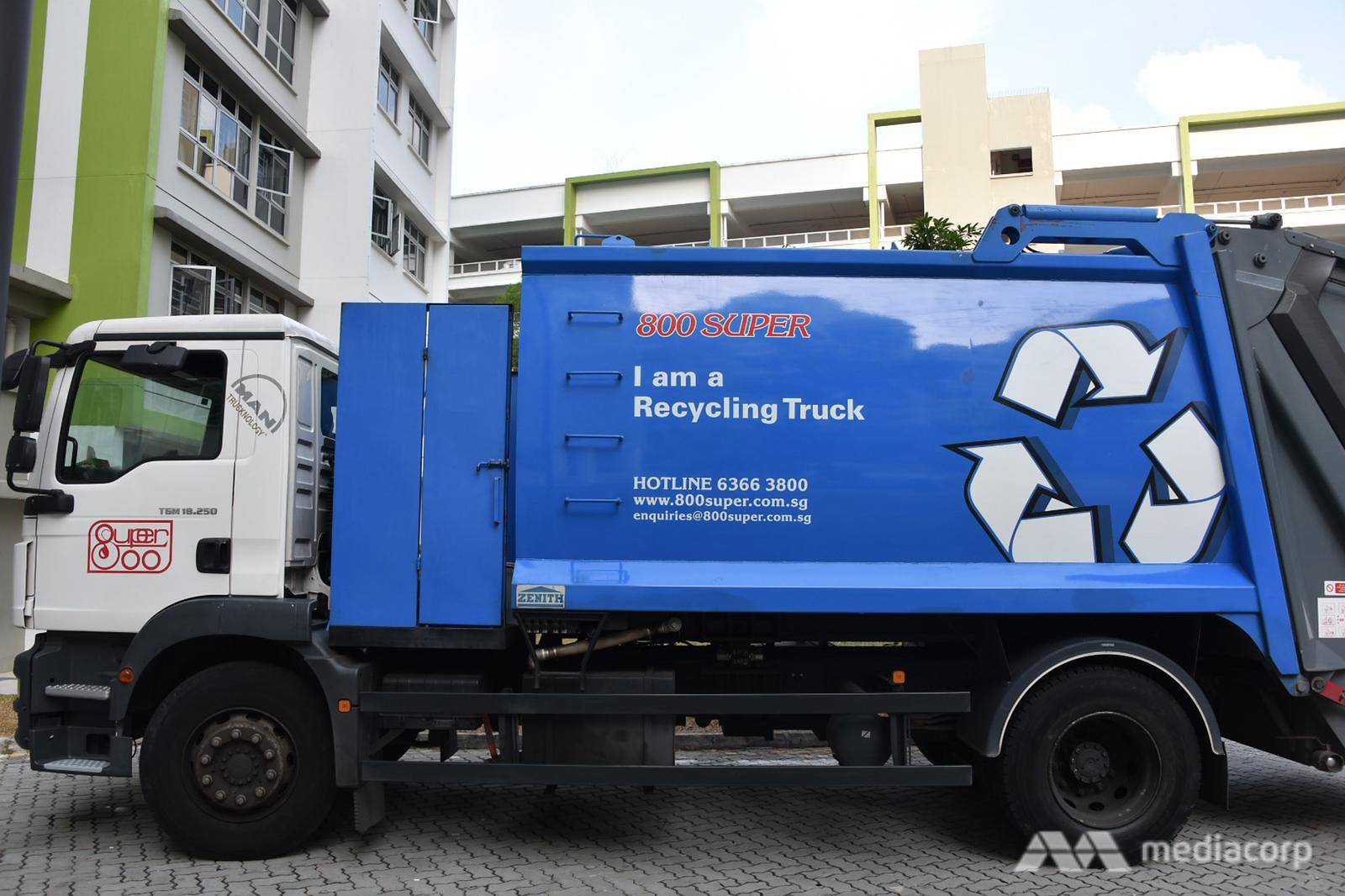
All recycling trucks from the public waste collectors will also have new identical livery to help the public identify recycling trucks and differentiate them from waste collection vehicles, said the ministry.
800 Super’s blue recycling truck. (Photo: Darius Boey)
Dr Khor said a citizen’s workgroup will be launched next month to focus on other ways to improve household recycling and reduce contamination in the blue recycling bins.
“Our pioneer generation worked hard to leave us with the clean and liveable Singapore that we enjoy today,” she said.
“It is now our turn to take action together to ensure that our children and grandchildren will inherit the shining jewel that is Singapore.”
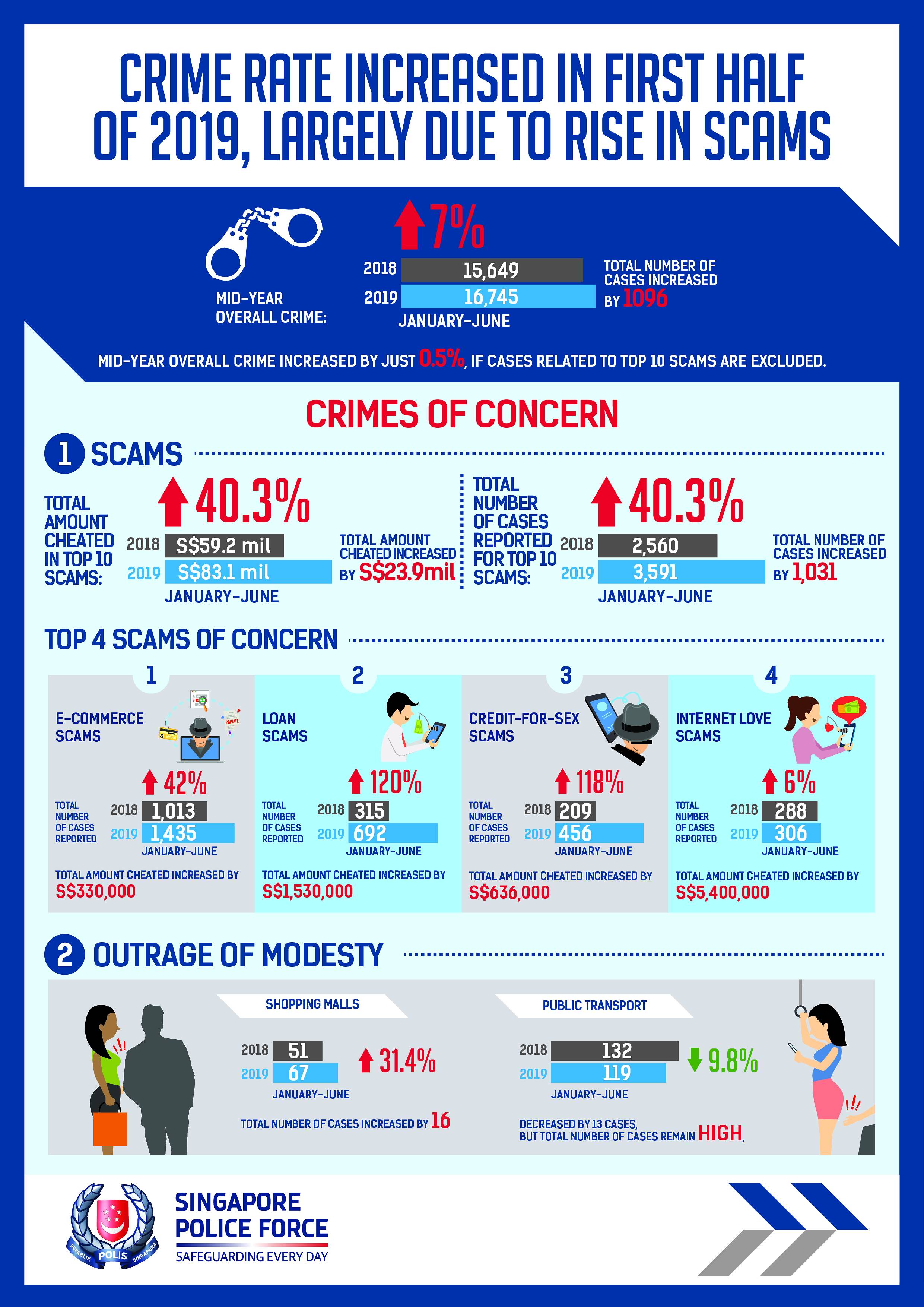
SINGAPORE: The total number of reported crimes in Singapore increased by 7 per cent in the first half of 2019 to 16,745 cases, compared to 15,649 cases for the same period in 2018, the police said on Friday (Aug 30).
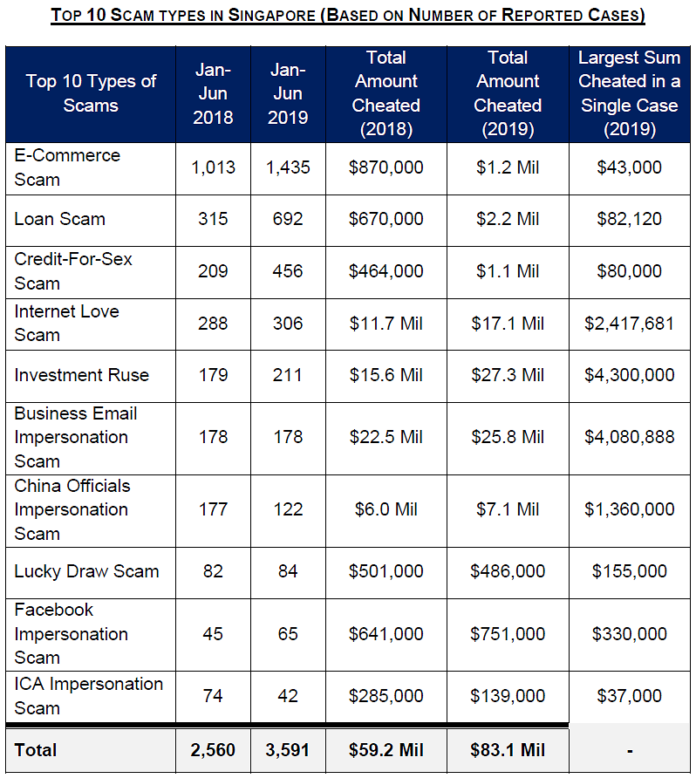
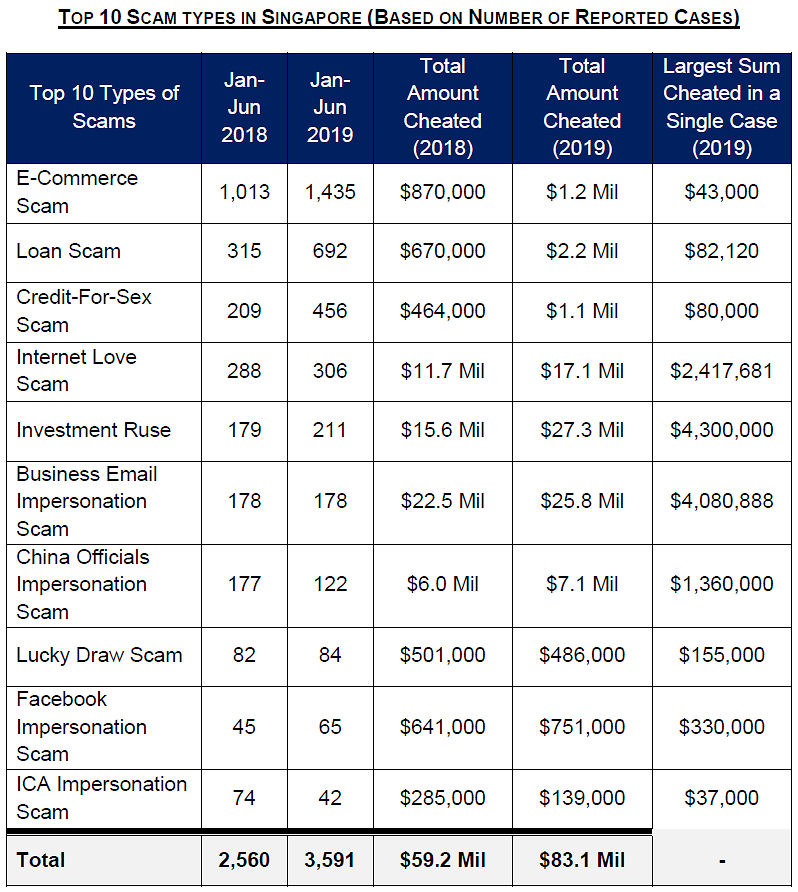
The increase was largely due to a rise in scam cases, with e-commerce scams, loan scams, credit-for-sex scams and Internet love scams collectively making up 80 per cent of the top ten scam types reported in the first half of 2019, the police said in its news release.
The total number of reported cases for these four types of scams increased by almost 60 per cent compared to the same period in 2018.
The police added that if cases related to the ten main types of scams were excluded, the increase in the total number of reported crimes for the first half of 2019 would be just 0.5 per cent when compared to the same period last year.
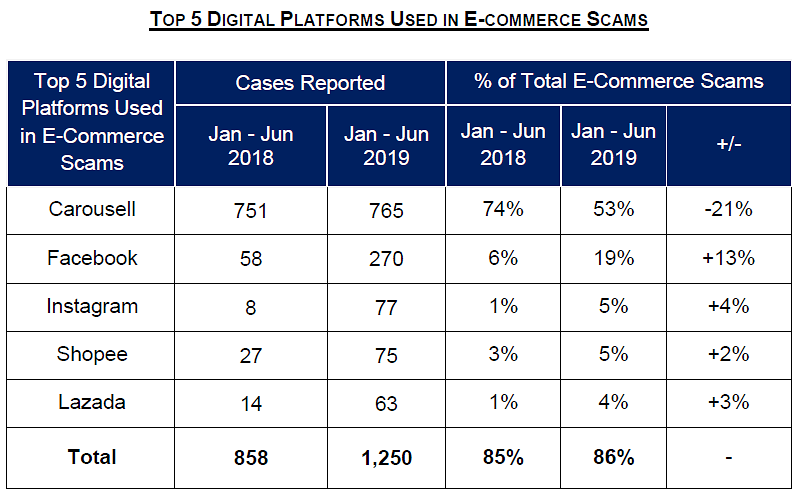
E-commerce scams had the highest number of reported cases among all types of scams in the first half of the year, with an increase of 42 per cent to 1,435 cases, and a total of S$1.2 million cheated from victims.
The largest sum cheated in a single case in the first half of 2019 was S$43,000.
The police attributed this drop to anti-scam initiatives that Carousell has pushed out on its platform. However, there was a rise in e-commerce scams on other digital platforms.
SURGE IN LOAN, CREDIT-FOR-SEX AND INTERNET LOVE SCAMS
Loan scams saw a jump of 120 per cent to 692 cases, with the total amount cheated increasing to S$2.2 million in the first half of 2019, from S$670,000 in the same period in 2018.
Credit-for-sex scams increased by 118 per cent to 456 cases, with the total amount cheated increased to S$1.1 million in the first half of 2019, from S$464,000 in the same period in 2018. The most common platforms used in these scams were iTunes cards and Alipay.
Internet love scams increased slightly by 6 per cent to 306 cases.
The total amount of money cheated from these online love scams surged 46 per cent, with an increase of S$5.4 million to S$17.1 million, up from S$11.7 million in the same period in 2018. The largest sum cheated in a single case in the first half of 2019 was S$2,417,681.
Police have set up a new Anti-Scam Centre (ASC) within the Commercial Affairs Department, focused on disrupting scammers’ operations and helping to mitigate victims’ losses.
INCREASE IN OUTRAGE OF MODESTY CASES
The number of outrage of modesty (OM) cases rose by 5 per cent to 837 in the first half of this year, up from 797 in the same period in 2018.
OM cases on the public transport system dipped by 9.8 per cent to 119, with OM cases on public buses and LRT/MRT trains decreasing by 20.6 per cent to 81.
The police attributed the drop in such cases to increased public awareness and vigilance, police patrols and the presence of advisories on buses and trains.
However, the amount of OM cases reported at bus interchanges and LRT/MRT stations jumped by 26.7 per cent to 38, up from 30 in the same period in 2018.
OM cases at shopping malls increased by 31.4 per cent to 67, up from 51 in the same period in 2018.
The Riders-on-Watch (ROW) scheme, launched by the Public Transport Security Command, engages members of the public as ROW volunteers to be first responders to potential threats on public transport.
These volunteers keep a lookout for suspicious characters or items, and alerting the police for follow-up.
A specially curated group of the world’s most popular cafes and eateries from Melbourne, Bangkok and more are setting up shop in Singapore at the four-day Cafe Culture, which runs from now till Sep 1.
Singapore-inspired dessert Gardens By The Bay by Reynold Poernomo. (Photo: Joyee Koo)
(Updated: )
Bookmark
It’s been dubbed “the world’s best croissant” by The New York Times and it’s original Melbourne outpost opens to a queue every morning. This weekend, Singapore will be able to decide for themselves if Lune Croissanterie’s world famous croissants are really worth the wait.
The cult patisserie is in Singapore for Cafe Culture – the inaugural cafe festival which is running at Marina Bay Sands convention center till Sep 1. Lune Croissanterie’s founder Kate Reid herself is in the kitchen throughout the festival, checking on and churning out her“classic beurre” croissants for her Singapore fans.
Diehard devotees of coffees and teas will be pleased to know that they are plenty of roasts and blends to choose from, sourced from the likes of Copenhagen’s Coffee Collective to Tokyo’s Switch Coffee.
ALOR SETAR, Kedah: Leaders from Singapore and Malaysia need to develop personal ties to achieve win-win outcomes and forge a positive relationship between both countries, Minister of Foreign Affairs Vivian Balakrishnan said on Thursday (Aug 29).
Dr Balakrishnan was speaking to Singapore media in Alor Setar after an audience with Kedah’s ruler Sultan Sallehuddin Sultan Badlishah.
He also met Kedah’s chief minister Mukhriz Mahathir – the son of Malaysian prime minister Mahathir Mohamad – as well as several state executive council members.
Dr Balakrishnan highlighted that his visit to the northern state is part of initial steps being taken by Singapore leaders to ramp up efforts to engage Malaysian leaders at the state level, and beyond just the federal level.
The minister said: “Both in Malaysia and in Singapore, there’s a generational change occurring at all levels, including the political one.
“It is very important that leaders, politicians meet one another, get to know one another at a personal level, understand our different perspectives, our common challenges.”
Minister for Foreign Affairs Dr Vivian Balakrishnan’s audience with the Sultan of Kedah Sallehuddin Sultan Badlishah. (Photo: Ministry of Foreign Affairs)
“Relationships have to be built one on one. Trust comes about by doing things together, explaining different perspectives,” he added.
Experienced leaders – like Malaysian Prime Minister Mahathir Mohamad – made friends with Singapore leaders from his days studying in Singapore, Dr Balakrishnan noted.
Younger leaders have had fewer opportunities to study and work with one another, he continued.
“Having said that, I think we need to make the effort to meet, to interact, to explain, to plan and to collaborate. I think if we can do that, that’s win-win and that is good for our relationship,” he said.
COLLABORATION WITH KEDAH
Following discussions with the Kedah ruler and senior politicians, Dr Balakrishnan outlined how Singapore and Kedah could collaborate further in areas such as agriculture, tourism and technology.
He added that they discussed the possibility of a high tech park, as Kedah businesses are engaged in areas like solar panels, electronics, specialised parts for aircraft.
The leaders also talked about ways to raise awareness of Kedah as a tourist destination, and how to boost two-way-flow of people between Singapore and Kedah.
“Most people are familiar with Langkawi, I think (fewer) people are familiar with Alor Setar and the mainland part of Kedah itself and all that it offers,” Dr Balakrishnan said.
He also expressed appreciation for the warm reception from Kedah leaders, and extended an invitation to Sultan Sallehuddin, Mr Mukhriz and his state exco members to visit Singapore.
“We had sincere, candid open discussions … It’s not just about personalities, although personal ties are important, but a mutual recognition that there’s so much more out there,” he added.
“The opportunities are ripe for harvesting. We need to focus on those.
“Frankly, from my interactions (with Malaysian leaders) both at the federal level and the state level, the positive aspects far outweigh the differences.”
Later on Thursday evening, Dr Balakrishnan met Permatang Pauh MP Nurul Izzah Anwar, thedaughter of Malaysia’s prime minister-in-waiting Anwar Ibrahim.
Ms Nurul Izzah and her team briefed Dr Balakrishnan on the Pauh Agenda – a social impact programme in her constituency aimed at addressing needs on the ground.
“I really appreciate that the minister was very down to earth and willing to hear us out … because I wanted so much for this area, which is rural, to be able to take up the latest technological advances to improve their livelihood. So I think it is important to engage at this level, more so than the politics,” she said.
“So of course we continue to learn from Singapore, we also just want to bridge divides.”
Singapore’s Minister for Foreign Affairs Dr Vivian Balakrishnan poses for a picture with officials from Permatang Pauh and Singapore’s Ministry of Foreign Affairs. (Photo: Amir Yusof)
Dr Balakrishnan thanked her for the “open and candid” discussion and lauded her efforts.
On Friday, he will be in Penang to meet the Governor Abdul Rahman Abbas, Chief Minister Chow Kon Yeow and several members of his state executive council.
The meetings are part of Dr Balakrishnan’s visit to the Malaysian states of Kedah and Penang this week to deepen Singapore’s overall engagement with Malaysia at all levels.
Both Penang and Kedah are governed by the Pakatan Harapan coalition, which came into power after a historic win at Malaysia’s 2018 General Election.
SINGAPORE: Getting pregnant through in-vitro fertilisation (IVF) treatments is now safer for older women because of better management of possible age-related complications for mothers and their babies, say doctors.
But advancements in healthcare does not mean women above 45 years old can conceive easily.
Singapore currently imposes an age limit of 45 years old for women undergoing assisted reproduction technology (ART) procedures, including IVF treatments. That cap will be removed from Jan 1, 2020, as part of Government measures announced on Wednesday (Aug 28) to support marriage and parenthood.
Doctors CNA spoke to said that the age limit exists because medical conditions, such as diabetes and high blood pressure, may be more common in older women and their chances of conceiving are lower.
However, advances in the treatment of these conditions have led to good outcomes in complicated pregnancies, said senior consultant at KK Women’s and Children’s Hospital’s Reproductive Medicine department Dr Sadhana Nadarajah.
“Neonatal care has also improved significantly over the years, leading to good outcomes even in high-risk pregnancies,” added Dr Sadhana, who is part of a Ministry of Health committee that looks at assisted reproduction regulations.
Head of Obstetrics and Gynaecology at the Singapore General Hospital (SGH) Associate Professor Yong Tze Tein said complicated pregnancies for older women are handled by multidisciplinary specialists – including those outside her department – such as cardiologists.
They would discuss how to reduce the potential risks for the mother and the baby before starting treatment.
“We are medically better. We can look after older patients better, and deal with the possible complications they may face,” she explained.
“Older women have higher risk of miscarriage and they are more likely to have still birth. We can offer good detection (and) good support to look after them.”
“EXTREMELY RARE” FOR WOMEN ABOVE 45 TO CONCEIVE
Despite the change in regulations, doctors cautioned that the chances of conceiving through IVF are low for women above 45.
Assoc Prof Yong said that after the age of 43, the chances of conceiving through IVF are “a few per cent, a single digit”. In comparison, the chances of success are close to 40 per cent for women below the age of 35, she added.
“We recognise that we have all types of women and we do know that with age, our fertility drops, but it’s not the same for everyone,” she explained.
Sometimes, potential mothers are mistaken about their chances of having a baby through IVF when news of elderly women becoming pregnant is published.
In some of these cases, the women get pregnant through egg donors, she said. The older a woman, the lower the number and quality of her eggs, and conceiving through IVF after the age of 50 could be “unrealistic”, she added.
“Sometimes we worry about giving false hope,” she said.
Similarly, Dr Sadhana said that although women are generally healthier and live longer, it is “extremely rare” for women above 45 to conceive.
“However, lifting the age limit will allow women to use frozen embryos that they may have created before and did not get a chance to use due to personal or health reasons,” she said.
Medical director of Virtus Fertility Centre Dr Ann Tan warned that if a miscarriage occurs, it may then lead to the need for invasive procedures to remove the pregnancy tissue. Those procedures could potentially damage the uterine environment, further decreasing the women’s chance for fertility.
The doctors encouraged couples to start trying younger.
“We don’t want the public to be lulled into complacency. It’s safer and better for women to get pregnant earlier. They do better, and the babies do better, and their chances of getting pregnant are higher,” Assoc Prof Yong said.
HELP FOR IUI PROCEDURE
Couples going through the less invasive IUI procedure at public assisted reproduction centres – the Singapore General Hospital, KK Women’s and Children’s Hospital and National University Hospital – will receive new subsidies from 2020.
Doctors said that it is likely that couples may start trying IUI earlier.
Singaporean couples can get up to S$1,000 co-funding per cycle for three cycles of procedure at a public assisted reproduction centre.
The procedure involves taking ejaculated semen, enhancing its physical features and inserting the semen into the uterus around the time of ovulation.
The co-funding could offset a large bulk of the cost of a IUI cycle, which typically costs about S$1,300 – cheaper than an IVF cycle.
National University Hospital Obstetrics and Gynaecology consultant Dr Shakina Rauff said that without such co-funding, many patients have chosen to bypass IUI and go straight to IVF treatments, which currently have co-funding.
“Now, they don’t have to hold back on doing so or be reluctant to do IUI first anymore just because of cost issues,” she said.
Dr Tan said that the financial help will nudge couples to start on their fertility journey earlier. This will be especially useful when the female is still ovulating and has healthy fallopian tubes, while their partner has semen issues.
Ms Sumitha Nair with her son Arjun Dev, who was conceived through IVF, and husband Vijay Kumar. (Photo: Sumitha Nair)
For Ms Sumitha Nair, who had her child in 2017 with the help of IVF, the changes signal more support for older women who are still trying.
Ms Sumitha’s four-year journey towards pregnancy was not an easy one, involving oral medications, IUI and IVF.
“I wanted to try IUI first because it was not as invasive and involved fewer injections, but after my second one, I got really dejected. I stopped all procedures and medications,” she said.
Ms Sumitha went for two IUI cycles at a private clinic that set her back by about S$6,000. She took a break, and was recommended to another doctor across the border in Malaysia.
“It was long, painful and expensive, but it was all worth it.”
The 37-year-old manager said the new subsidies are a good move. “I think it would help those couples trying the IUI route greatly, especially if they need more than one cycle.”
Dr Sadhana said it is always best to have a family as early as possible, but acknowledged that the vast majority of patients in their 40s who manage to carry a child to full-term will have a relatively uncomplicated pregnancy, largely due to access to good medical care.
“Couples who are above 40 years should not be discouraged from having children,” she said.
“Having said that, it is imperative that the couple understand their risks and chances, so that they can make an informed decision.”