Home Blog Page 724

The Big Read: Re-employment protects older workers but leaves some with bitter taste in their mouths

0

SINGAPORE: Her workload would remain the same. But as Margaret (not her real name) approached the statutory retirement age of 62 in 2012 – the same year that re-employment laws took effect in Singapore – the then-civil servant had to sign a new one-year contract with her employer. It entailed a pay cut, a downgrading by one job grade, and a S$500 medical claim limit annually.

While she felt that the terms were not well justified, she felt satisfied enough with them to sign the contract, mindful of the horror stories which she had been hearing about re-employment terms being offered to other employees of her age.

Margaret, now 69, said that at that time, she knew of older workers in the public service who had to take a more drastic pay cut after being downgraded by several rungs, and of supervisors having to step down and work under subordinates although they had not expressed any plans for retirement.

Much has changed since in the public service: Since Jul 1, 2017, wage adjustments were done away with, and the large majority of re-employed public officers received “no pay cut”, the Public Service Division (PSD) said in response to queries. 

Public officers will continue to receive their last drawn salary if they are re-employed at the same grade, and those who are re-employed are also offered the “prevailing leave and medical benefits schemes, which are aligned to market practice”, PSD added. 

READ: PSD to raise retirement, re-employment ages in 2021; more than 2,000 public officers to benefit

READ: Conversations about re-employment should start when workers are in their 40s: Josephine Teo

In the private sector, however, some older workers continue to get the short end of the stick.

Take Pamela (not her real name), 67, for example.

Until last year, she had worked as a head of department at a local bank.

Strictly speaking, her employer had abided by the Government’s re-employment rules, which require organisations to offer re-employment up to a stipulated age to eligible employees who reach their retirement age.

But it was the way she was treated towards the end of her second one-year contract with the bank – she was asked when she would be “calling it a day” – that left a sour taste in her mouth.

While the question was “subtly and politely put across”, the “hint was pretty strong”, she said. She left the bank as she felt unwanted by her employers. 

For some older workers, subtle discouragement may come in the form of new employment terms.

A 61-year-old working at a multinational manufacturing firm, who declined to be named, said that despite having worked at the company for more than four decades, the number of days for her annual leave will be halved from 24 days to 12 days – same as what a fresh hire gets – under her new contract which will take effect in a few months when she turns 62.

Similarly, a 67-year-old who worked in port operations said he was given a S$200 cap for yearly medical claims under his re-employment contract. Previously, there was no such limit as far as he knows.

These employees were among more than a dozen older workers interviewed.

READ: Full restoration of CPF contributions for those aged 55 to 60; higher rates for workers above 60

READ: New retirement, re-employment ages of 65 and 70 by 2030; higher CPF contributions for older workers

To be sure, the employment rate of older workers has gone up since re-employment laws came into force, based on government data. 

Still, the experiences of those interviewed suggest that mandating employers to rehire eligible workers once they reach retirement age is a work in progress, and it is more often than not an unpleasant experience for these workers – even though the policies aim to protect them and allow them to continue working if they wish to do so.

This is especially so when the older workers feel that they remain healthy and able to perform at the same – if not higher – levels compared with their younger colleagues.

In this regard, the public sector, as well as a few private sector firms, are leading the way by re-hiring older workers, without any changes to their roles and employment terms including salaries.

But the positive examples are too few and far between, as interviews with older workers show.

Still, experts pointed out the constraints faced by businesses – in particular, the seniority-based wage system that is entrenched in many companies in Singapore.

Workers here expect wages to go up with each passing year, noted Assoc Prof Walter Theseira, a Nominated Member of Parliament (NMP) and economist with the Singapore University of Social Sciences.

As a result, over time, there could be a “mismatch between pay and work output” among older workers, he said.

“At some point, work output may plateau or even fall, but pay keeps going up,” he added.

“It is common to paint this as a problem of unfair employers … It is also unfair to younger workers if they produce more output but they are paid much less than a more senior worker,” said Assoc Prof Theseira.

But is there scope to finetune the re-employment laws – say, for example, mandating that the terms offered to the older workers must take into account their health and work performance?

It would be unwise to make the laws more rigid, said several MPs who cautioned that doing so could backfire and put businesses off from hiring older workers.

Pasir Ris-Punggol GRC MP Zainal Sapari, who is also assistant secretary-general of the National Trades Union Congress (NTUC), reiterated that the signing of a new contract during re-employment “gives the flexibility for companies to offer a package that is sustainable for them and at the same time, allow workers to continue”.

READ: Labour movement MPs, NMPs give their views on higher CPF contribution rates for older workers

Businessman Douglas Foo, who is the founder and executive chairman of Sakae Holdings, noted that should the flexibility be taken away from employers, operational costs could rise.

“That makes our country much less attractive for others to come and invest in the backdrop of a tight workforce,” said Mr Foo, who is also an NMP.

Singapore’s retirement and re-employment ages are back in the spotlight following Prime Minister Lee Hsien Loong’s announcement in his National Day Rally speech that the retirement age will be raised to 63 in 2022, and eventually to 65 by 2030.

The re-employment age will be increased from 67 to 68 in 2022, and eventually to 70 by 2030.

With Singaporeans having the world’s longest life expectancy in 2017 with an expected lifespan at birth of 84.8 years, the changes are aimed at helping older workers to continue working and to be more financially independent.

WHAT OLDER WORKERS WISH FOR

The re-employment age – a concept pioneered in Japan – is viewed as a better alternative to raising the retirement age, given the concerns by businesses that a higher retirement age might affect costs and productivity.

When it was introduced in Singapore seven years ago, the objective was not only to protect the interests of older workers but also to create a pro-business environment that would ultimately safeguard jobs.

Older workers, however, said that they wish their employers can implement the re-employment policies with “a little more heart”.

Pamela said: “Do companies really subscribe to the Government’s thinking and the spirit of re-employing workers, or do they just do it because they are obliged to?”

She could sense the bank’s half-heartedness when it did not offer her any alternative positions, or at least seek out her preferences on continued employment, even though she had worked in the bank for nearly 30 years.

“They only think about crafting career paths for the young ones, but we (older workers) deserve a bit of attention too. The attachment (to the bank) is there. We have a proven track record,” she said, adding that the bank’s human resource (HR) department should have been more proactive in looking for alternative roles for her.

She also lamented how older workers in the bank would only find out whether their yearly contracts would be renewed for another year on their birthday month.

READ: Commentary: Seniors do well at their jobs yet ageist myths and negative stereotypes persist

Tripartite guidelines encourage employers to inform employees who do not qualify for re-employment at least three months before retirement, so they can better prepare for retirement or seek other employment opportunities. However, this procedure is not always followed, based on our interviews with older workers.

Unsurprisingly, those who were re-hired by their organisations on the same terms, with their roles unchanged, are happy to continue working as long as their health permits.

One of them is Mr Abdul Aziz Abdullah, 64. The head of the logistics and hospitality team at Maybank has been working with the bank for 41 years and counting.

Despite reaching the retirement age a couple of years ago, he continues to lead a team of six relationship managers to manage a loan portfolio comprising hotels, foreign worker dormitories, and office buildings.

“It has never crossed my mind to retire from work when I turned 62 because I still have the passion for my job,” he said.

Likewise, Madam Noreen Wee, 63, is still going strong as the lead writer of insurance policy contracts at Prudential.

In October last year, the insurer abolished the retirement age for its employees, allowing its 1,100 workers to decide when they want to retire.

Mdm Wee, who intends to work until 70, described it as liberating not having to fear when she would be made to call it a day because of her age.

The Big Read: Noreen Wee

Madam Noreen Wee, 63, policy writer with Prudential Singapore. She intends to work till she is 70. (Photo: TODAY/Nuria Ling)

​​​​​​​HOW RE-EMPLOYMENT CAME ABOUT  

Given the demographic changes and increasing life expectancy, Singapore’s policymakers first started talking about re-employment in 2007.

It took five years before it became law in 2012, making it mandatory for employers to offer re-employment for workers who have reached the retirement age until they turn 65. This was raised to 67 in 2017.

Meanwhile, since its legislation in 1993, Singapore’s retirement age has been raised only once, from 60 to 62, in 1999.

Back in 2010, then-Manpower Minister Gan Kim Yong said the aim of Singapore’s re-employment laws was to raise the employment rate of older workers, by giving them a “flexible and effective” way to work for as long as they are able to.

At the same time, the laws have also been designed to be pro-business.

READ: Commentary: It is high time for a Ministry on Ageing Issues

Mr Lim Swee Say, who was appointed Manpower Minister in 2015, said in 2017 that tripartite partners – the Government, employers and the unions – had hit the wall after raising the retirement age in 1999. Employers were objecting to a further increase due to the impact on their businesses, and younger workers were also against it because they did not want their career progression to be stalled, Mr Lim said.

So, Singapore began looking to Japan and its re-employment age. “When you raise the retirement age, the expectation is ‘same job, same pay’ … When Japan introduced the idea of re-employment age, the concept is ‘not necessarily the same job, not necessarily the same pay’,” Mr Lim told Parliament during the 2017 debate to raise the re-employment age from 65 to 67.

VARIED PRACTICES

Observers said that some employers have taken advantage of the flexibility accorded to them, to the detriment of older workers.

Mr Foo criticised such a practice as “an abuse of the whole spirit of what this policy is about”.

Employers should instead make use of the flexibility to tide over an economic downturn or stay agile in the face of disruptive innovations, said Mr Foo, who is also a vice-president of the Singapore National Employers Federation (SNEF).

Still, Mr Alexander Melchers – Mr Foo’s fellow vice president at SNEF – felt that the adjustment of some employee benefits such as annual leave days is fair.

These benefits may be tied to seniority, and some employers may adjust it to make it more equitable with other employees, he said.

“It is not about ageism but about ensuring the employability of our workers in an ageing society,” he added.

Checks with several employers revealed varying approaches when it comes to their re-employment policies.

Prior to the re-employment laws coming into force in 2012, the public service had taken the lead by first introducing the Public Service Re-employment Guidelines a year earlier.

Back then, the Public Service had made provisions for wage adjustments in order to encourage private sector employers to re-employ their employees, PSD said.

This was aligned with the national tripartite guidelines on re-employment at that time, it added.

Over the years, it monitored market practices and gathered feedback from public agencies and public service unions. Subsequently, PSD decided to remove wage adjustments for all officers by Jul 1, 2017.

Nevertheless, PSD said that officers “may or may not do the same job when they are re-employed”, citing changes to job scope or the agencies’ needs as the public service transforms itself and builds new capabilities.

Under the PSD’s re-employment guidelines, public agencies will consult officers on re-employment at least six months before retirement in an “open discussion” between supervisors and officers. This is to help “manage expectations as well as understand officers’ concerns and preferences on job arrangements, training opportunities, wages and benefits”, PSD said.

It added: “Any work arrangement, including any changes, are mutually agreed to by the officers and their agencies taking into consideration the officers’ preferences and the availability of suitable positions.”

READ: More than 50 firms voluntarily raise retirement, re-employment ages: Ng Chee Meng

In cases where the jobs are no longer available, public agencies will provide support to affected officers in terms of reskilling, redeployment, and employment facilitation.

Over in the private sector, TÜV SÜD PSB said it is committed to not cut the pay of any re-employed worker. It also offers options such as part-time employment should older workers wish to reduce their workload.

At CapitaLand Group, its head of group human resources Angeline Oh said its older workers could either work in the same capacity or take on a redesigned role which comes with flexible hours or reduced scope.

CapitaLand, which is a real estate developer, currently re-employs more than 30 individuals. About five employees stayed beyond the mandated re-employment age of 67, Ms Oh added.

Mencast Marine, which makes and repairs ship propellers, re-employ older workers on one-year contracts, renewable up to age 67, with the same employment terms as before. They comprise 7 per cent of the firm’s employees. Nevertheless, the firm noted that the older workers’ ability to pick up new skills, such as advanced technical training, “remains a challenge”.

READ: Commentary: Watch for casual ageism and other signs of caustic attitudes about older workers

Deloitte’s talent leader Seah Gek Choo said the big-four accounting firm will first hold discussions with interested retirement-age employees on their role, salary, benefits and other employment terms.

Following that, the firm “will look at our business needs and the interests and skills of the individual”, she said. Eligible employees will be offered a yearly contract until they reach 67, or beyond, provided that they show “good work performance” and are certified “fit for work”.

Deloitte currently has about 25 employees on re-employment contracts. Three of them are above 67.

While Ms Seah believes most employers do see the advantage of re-employing older employees, “cost is a consideration”, she said. Government schemes such as the Special Employment Credit provide employers with support to hire older Singaporean workers, but these are “temporary”, she pointed out.

Group insurance for employees also stops at age 70, so organisations “do not have the incentive to employ older workers beyond that age”, she added.

Over at DBS Bank, workers seeking re-employment can choose between working full-time with no pay adjustments, working part time, and taking up a different role with the bank.

Since 2012, the bank has seen a “three-fold increase” in the number of workers aged 62 and above, said Ms Theresa Phua, DBS’ Singapore HR Head.

More than 95 per cent of the bank’s older workers chose to work full-time, while the others opted for flexible work arrangements.

OCBC, meanwhile, said it takes a “long-term view” on employees. It initiates conversations about retirement much earlier, compared to most companies, through a programme catered to employees aged 40 and above.

Through the programme, the older workers are given the option to participate in workshops on financial planning or health and wellness. They can also take part in reskilling or upskilling courses, which could potentially help transition them to other areas of interest, OCBC head of HR planning Jacinta Low said.

OLDER, BUT ‘ABLE AND WILLING’ 

The number of older workers in Singapore who are able and willing to continue working is set to increase, experts have said.

There is a gap of 12.2 years between the average number of years which Singaporeans are expected to lead healthy lives – known as the Health-Adjusted Life Expectancy (Hale) – and the current retirement age of 62.

Before the recent announcements, retirement age – meant to prohibit employers from dismissing workers younger than 62 due to their age – had remained unchanged for two decades. But based on the Hale benchmark, the average Singaporean can now typically work up till 74.2 of age, an increase of more than seven years from 67.1 in 1990.

For example, Mdm Pow Soh Liew, who turns 62 next month, cannot see herself stopping work at her age.

The production executive at Panasonic Appliances Refrigeration Devices Singapore said she would “not be able to take it” if she had to sit around at home for more than two days.

Mdm Pow, who has three grown-up children, said that if she were to leave her current employers, she would look for work in a supermarket to earn “pocket money” so that she can go on holidays.

Dr Danny Ker, 62, who graduated top of his class last month with a specialist diploma in advanced digital manufacturing at German Institute of Science and Technology – TUM Asia, also has no plans to stop working.

READ: Commentary: Navigating the new road to modern elderhood

“Sixty-two is still an active working age in my case … 67 years old is also still too young to retire,” said the vice-president for quality management at TÜV SÜD PSB, a testing, inspection and certification service provider.

Adding that his father retired at the age of 85, he said that he would look to start his own business if the day comes that nobody is willing to hire him because of his age.

The Big Read: Dr Danny Ker

Dr Danny Ker, 62, VP for ASEAN Quality Management at TUV SUD PSB Pte Ltd. He went back to school and got a specialist diploma before turning 62. (Photo: TODAY/Nuria Ling)

FIRMS AND WORKERS ‘NEED TO BE OPEN WITH EACH OTHER’

Despite the negative experiences of some older workers, experts and observers believe that the re-employment and retirement ages are here to stay, and they serve as important safeguards – even though they are not foolproof.

Senior Minister of State Heng Chee How, who is the deputy secretary-general of NTUC, reiterated that without legislation, firms can unilaterally set lower retirement ages.

“For the foreseeable future, the view of the tripartite partners is that having a statutory retirement age remains a valid and significant safeguard,” said Mr Heng, stressing that there are avenues for older workers – whether they are union members or not – to lodge complaints against errant employers. 

Assoc Prof Theseira also stressed the need for retirement and re-employment laws.

And he believes that older workers need to adjust their expectations. “If wages and work responsibility are inflexible, this could lead to more unemployment among older workers,” he said.

He noted that it is unrealistic for workers in Singapore to expect wages to keep going up.

He sees re-employment as an opportunity for employers to reset the relationship between pay and work output. “It is just that we do not accept… that wages can go down,” he added.

CIMB Private Banking economist Song Seng Wun felt the key is for employers and older workers to have open communications, even if these entail uncomfortable discussions on changes to wages and job roles.

Such discussions could centre around the contributions that the older worker can continue making, with an eye perhaps on gradually scaling back his or her involvement with the firm.

Citing himself as an example, Mr Song, 59, said he would not mind taking a hefty pay cut if this comes up for discussion with his employers. “(For some people,) it’s not really a case of you needing the money, but something to do,” he said.

“It is not a right that because I ended up, at 60, with this amount of salary … I am entitled to that forever and even more, just because I am still working,” he said.

Source link

Commentary: How should maid abusers be punished?

0

SINGAPORE: I feel anger and disgust towards the horrific deeds of Tay Wee Kiat, Chia Yun Ling, Zariah Mohd Ali and Mohamad Dahlan, who seriously abused their foreign domestic workers (FDWs) and were convicted or had their sentences enhanced in August.

A firm response to their acts – and similar acts by others – is entirely warranted.

But in determining what our response is, we must not forget that “the only justice that can be attained by mortals, who are fallible and are not omniscient, is justice according to law; the justice which flows from the application of sure and settled principles to proved or admitted facts”, as English judge William Bagnall put it.

Paradoxically, even as criminal law embodies society’s revulsion at certain crimes, it must do so in a dispassionate, principled manner.

When we are faced with the most egregious acts, the adherence to established principle can be challenging, but remains important to the service of justice.

Tay Wee Kiat and Chia Yun Ling

Tay Wee Kiat and his wife Chia Yun Ling seen outside the State Courts. (Photo: TODAY/Nuria Ling)

PROPORTIONALITY IN SCREENING

We often see comments in response to news reports of serious crimes involving FDW abuse calling for offenders to be caned repeatedly, jailed for life, or even executed. The comments are often the same regardless of the severity of the crime.

But does a person who slaps a domestic worker once and then shows genuine remorse deserve the same consequences as one who repeatedly causes severe physical injuries?

The law would make no sense if both receive equally severe sentences. And if domestic worker abuse deserves the death penalty, how are we to punish murderers?

READ: Commentary: Instead of robots or commodities, why not treat foreign domestic workers like fellow human beings?

One key principle we must keep in mind is proportionality: The punishment must fit the crime.

The label “maid abuse” is useful shorthand. But there can be degrees of abuse, each warranting a different response. In order to respond to criminal conduct sensibly, we must first recognise the conduct for what it is, and for what it is not.

Consider the case of Lim Choon Hong and Chong Sui Foon (who starved an FDW). Even as Chief Justice Sundaresh Menon described their conduct as a “deplorable” violation of “human dignity”, he refused to pass the maximum possible sentence.

(ll) Ei Phyu Tun maid abuse

Ms Ei Phyu Tun was left with lacerations on her back and bruising on her legs. (Photo: Ei Phyu Tun)

This was because, as cruel as the acts were, at least the offenders had not “act[ed] cruelly purely out of the gratification that one derives from inflicting such cruelty. That … would be an even more egregious case”.

Even heinous crimes must be treated in a proportionate manner.

RETRIBUTION, DETERRENCE AND REHABILITATION

The next step in determining the punishment is to ask why punish? The law recognises four aims of sentencing: Retribution, deterrence, rehabilitation and incapacitation.

Retribution refers to how punishment signals society’s intolerance for crime. Deterrence refers to the fact that punishment teaches both the offender and the general public a lesson, thereby dissuading people from offending.

In addition, a sentence often has rehabilitative effect. In the case of imprisonment, this is achieved by strict regimentation as well as programmes organised by the Singapore Prison Service.

One might suppose that only a long term of imprisonment can deter or rehabilitate a person. But this is not necessarily so.

READ: Commentary: Maids’ overtime pay is long overdue

LISTEN: The Pulse – Why foreign domestic workers are borrowing money

In 2017, Chong Yee Ka was convicted of beating a domestic worker. But the court recognised this was due in part to psychiatric disorders which caused her to act irrationally.

Justice See Kee Oon found she had shown genuine remorse and commitment to seeking treatment, making it unlikely that she would re-offend.

Therefore, all that was needed to deter her was a large fine. The need for retribution did not outweigh this.

So there are other ways to meet the goals of sentencing which can replace or supplement imprisonment when it comes to FDW abuse.

Maid - Foreign Domestic Workers

File photo of foreign domestic workers undergoing a training programme at an employment agency in Singapore.

Besides fines, another possibility is a large compliance bond – a sum of money paid by an employer with a relevant criminal history, which will be forfeited if the employer re-offends.

The sum may need to be very large to be effective as some have pointed out. Nonetheless, a compliance bond can still be a useful tool in principle.

INCAPACITATION

Incapacitation refers to making it impossible to offend. Imprisonment incapacitates a person by making it physically impossible for him to commit most crimes.

The difficult question is: Should incapacitation last beyond imprisonment? After serving his sentence, should a convicted abuser be prohibited from hiring a domestic worker?

The general rule is that incapacitation ends upon release from prison. A former burglar is free to enter any residential estate; a convicted molester is not banned from taking the train. So there must be something to justify incapacitating measures that last even after imprisonment.

One justification is that some crimes involve the abuse of one’s privileges in a manner that poses an especially high degree of harm to others. Hence, drink-drivers are disqualified from driving, and a lawyer convicted of corruption or dishonesty is prohibited from practising law.

But even then, the prohibition is not indefinite. The offenders eventually get a chance to prove that they have repented and rehabilitated themselves.

READ: Commentary: We need a breakthrough in the conversation on labour rights for foreign domestic workers

Returning to the context of domestic worker abuse – should a convicted abuser be subsequently prohibited from hiring a domestic worker, and, if so, for how long?

The argument for a prohibition is that domestic worker abuse exploits an especially large power imbalance between employer and employee.

I do not disagree but wonder whether we can also approach the problem from another angle: By seeking to reduce the imbalance.

The Ministry of Manpower already attempts this by interviewing domestic workers whose employers have a history of abuse. Provided that these employers are not allowed to interfere in these interviews, and the interviews take place sufficiently frequently, this can be useful.

maid file photo

File photo of a foreign domestic worker.

In addition, domestic workers could be apprised of prospective employers’ criminal histories that involve FDW abuse.

These two measures would put more power into the hands of domestic workers. The first would allow them to report abuse more effectively. The second would enable them to make a more informed choice as to whom to work for.

To be sure, these steps can only reduce, and not necessarily eliminate, the power imbalance. For example, FDWs may still face systemic socio-economic pressure to stay with abusive employers. Therefore, hiring bans will remain a useful tool.

Nonetheless, we should not see incapacitation as the only way to tackle the problem of domestic worker abuse.

THE GOALS OF CRIMINAL LAW

Ultimately, the uncomfortable truth is that criminal law exists not only to protect us from crime, but also to protect criminals from us – from our basest desires for vengeance – even as we recognise and respect victims’ suffering.

This is not to deny that long prison sentences and subsequent incapacitation will always be a useful tool of criminal law – in some cases, the only viable tool.

READ: Commentary: Can young working parents survive without a maid?

Nonetheless, such tools must be deployed in a principled manner. Further, we should not rule out other measures to prevent abuse in other cases.

Finally, we must remember that the hope that offenders can improve themselves – as dim as it may seem – is a key principle of our criminal justice system.

Benjamin Joshua Ong is an Assistant Professor of Law at the Singapore Management University School of Law.

Source link

HDB to launch BTO projects in Punggol inspired by early zoo, fishing village

0

SINGAPORE: Two new Punggol Build-To-Order (BTO) housing estates will pay tribute to Punggol’s history as a fishing village and to one of Singapore’s earliest zoos, the Housing and Development Board (HDB) announced on Sunday (Sep 1).

The 2,274 flats within Punggol Point Crown and Punggol Point Cove will be launched for sale in September, and are expected to be completed by 2024.

“Tailored to capitalise on Punggol’s distinct character, history and local flavour, these projects will fuse heritage elements in their designs which allow residents to appreciate their town’s roots,” HDB said.

Interested applicants can apply for two-room Flexi to five-room flats in these projects, HDB said, adding that more information on these projects will be made available during the sales exercise.

DEVELOPMENT INSPIRED BY ZOO

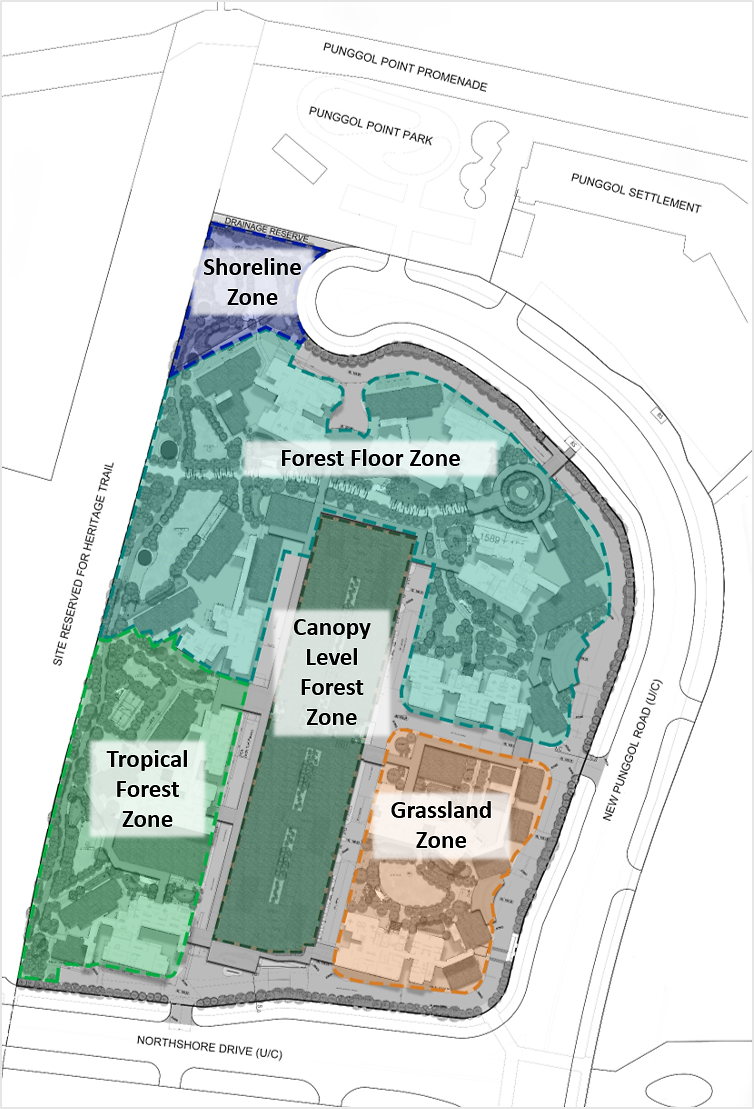
Punggol Point Crown, which is inspired by the old Ponggol Zoo, will be divided into five thematic zones based on natural habitats such as the forest, grassland and shoreline, HDB said.

The designs on signs, community spaces and outdoor furniture in the precinct will reflect the animal and bird species that once lived in the old Ponggol Zoo.

EMB! SEP 1, 1PM Punggol Point Crown zone

Punggol Point Crown will have five thematic zones inspired by various habitats (Photo: HDB)

The zoo was home to about 200 animals and 2,000 birds, including exotic animals from South Africa, America and Australia. 

It was owned by William Lawrence Soma Basapa who moved the animals to Punggol from his family’s Serangoon Road residence in 1928, to accommodate his growing collection.

William Basapa and his tiger, Apay

William Basapa and his tiger, Apay. (Photo: Indian Heritage Centre)

The old Ponggol Zoo was a major attraction in pre-war Singapore and was popular among locals and foreign visitors, HDB said, adding that the zoo was also the set for a 1933 American film, Dyak.

At the start of World War II when the British moved their forces to the north of Singapore and occupied the site of the zoo, he was forced to relocate.

Flamingos and waterfowls at Ponggol Zoo

Flamingos and waterfowls at Ponggol Zoo (Photo: Indian Heritage Centre)

A special heritage walk inspired by the zoo will weave through the precinct.

“A first in new BTO projects, the animal-themed heritage walk will feature storyboards with interesting facts about the zoo’s history, animals and significant visitors, so residents will be able to appreciate the significance of the zoo in the rich history of Punggol Town,” HDB said.

EMB!! SEP 1, 1PM punggol heritage walk

HDB’s first animal-themed heritage walk in a new housing project aims to share the vibrant history of the Ponggol Zoo with residents (Image: HDB)

“Other unique design elements along the lushly landscaped walk include the tiger stripes and animal footprints on the floor, as well as junction markers celebrating the zoo’s milestone years.”

FISHING VILLAGE

Punggol Point Cove, which is located along the eastern shoreline of Punggol Point, is inspired by Punggol’s past as a fishing village, HDB said.

“The seafront project draws reference from Punggol’s humble beginnings as a fishing village, and later as a fishing port,” it said.

Punggol Point Cove, HDB

Punggol Point Cove (Image: HDB)

“In paying homage to its past, the precinct’s design was conceptualised using elements related to the sea such as fishing nets and waves,” HDB said, adding that the new development will incorporate a “kampong life” concept.

“Similar to kampongs of the past, each block has its own courtyards. The kampong life concept is also brought to the higher floors, with a series of sky bridges at the 10th storey linking blocks together and providing more avenues for community interaction.”

Punggol Point Cove, HDB 2

Punggol Point Cove. (Image: HDB)

HDB added that the precinct’s landscaped areas will include three distinct zones, namely Beach, Contemporary, and Forest. Thematic gardens with native plants would also be included, HDB added.

WATERFRONT TOWN

Last year, HDB launched 2,112 flats in Punggol waterfront district with a take-up rate of 98 per cent, according to HDB.

EMB!! SEP 1, 1PM Punggol Map

Punggol Town comprises 11 districts, including seven waterfront housing districts (Photo: HDB)

Punggol Town consists of 11 districts, seven of which – Waterway East, Waterway West, Northshore, Matilda, Punggol Point, Canal and Crescent – are waterfront housing districts.

Source link

Ivory, rifles and opium: NLB’s rare collection reveals Singapore’s 19th-century shopping list

0

SINGAPORE: It’s hard to imagine Singapore as a scene straight out of an 18th-century pirate movie: A murky port where swashbuckling sailors traded in arms, drugs and animal parts.

But 1834 editions of the Singapore Chronicle and Commercial Register – the country’s first newspaper established a decade earlier – show just that.

The newspaper focused on trade news, with ship arrivals and import inventories dominating its densely filled pages.

There’s the usual rattan and rice from Palembang, and soap and butter from Batavia (present-day Jakarta). Then there’s the unusual: Elephant teeth from Siam, rifles from Liverpool and opium from Calcutta.

While these were valuable commodities those days – ivory was used to make jewelry and religious objects, while rifles were used to hunt game – the opium trade is far more intertwined with Singapore’s past.

“Why is this newspaper so important?” asked senior librarian Gracie Lee, who works in the National Library Board’s (NLB) rare materials collection where original editions of the Singapore Chronicle are kept.

“I think we often hear that newspapers are like the first rough drafts of history. This contains a treasure trove of historical information on early Singapore.”

READ: Finding yourself – and your roots – in the National Archives

NLB rare materials collection Chinese opium smokers

Chinese opium smokers in the 1880s. (Photo: National Archives of Singapore)

Ms Lee said opium was cultivated in British India, rolled into balls and stored in chests, then brought to Singapore to be processed into different grades. Chinese coolies in Singapore usually got the poorest quality, she added.

With the establishment of Singapore as a free port, the opium tax-farming system was introduced as one way to raise revenue, according to NLB’s infopedia on Singapore. Shopkeepers would also recover ash from smoked opium and sell it at cheaper prices.

The colonial government passed the Opium Regulation in 1830, and until 1910, the annual revenue from opium accounted for an average of 30 to 55 per cent of its total income.

NLB rare materials collection opium commission

The Opium Commission of the Straits Settlements in the Federated Malay States seen in this 1908 photo. (Photo: National Archives of Singapore)

But the Singapore Chronicle is just one of some 15,000 items in the rare collection that tell different stories of Singapore’s history. It contains significant materials on Singapore and the region dating as far back as the 15th century.

“These materials are inherited from the Raffles Library collection, but also recent acquisitions and donations,” Ms Lee, 44, told CNA, referring to Singapore’s first public library which opened in 1845 under a different name.

“So they would be things like travel accounts, European travel writings on Southeast Asia, remittance letters or maps. Yeah, all sorts of things that you can imagine.”

NLB rare collection opium newspaper

An original Feb 20, 1834 issue of the Singapore Chronicle. (Photo: Aqil Haziq Mahmud)

As the name of the collection suggests, these things also have some degree of rarity.

The oldest artefact in the collection is a 1478 map of Southeast Asia based on work by the famed astronomer and geographer Claudius Ptolemy.

And only three other libraries in the world are believed to hold early issues of the Singapore Chronicle in original hard copies: The British Library, Leiden University Libraries and the National Library of the Netherlands.

“John Crawfurd believed that having such a paper would increase the respectability of Singapore as a port,” Ms Lee explained, referring to the newspaper’s endorser who succeeded William Farquhar as the second British resident of Singapore.

“This was meant to be a mercantile newspaper to facilitate trade,” she added, extremely reluctant to turn its yellowed pages to protect it.

The bound collection of the newspaper looked more like a fragile tome, with its hard cover, narrow columns and dozens of large portrait pages. It rested on a piece of archival black foam designed to support and not contaminate such treasures.

THE RARE GALLERY

While the rare gallery isn’t exactly a tomb of lost treasures – it’s on level 13 of the National Library Building in Bugis, guarded by a lone no-entry sign and two layers of locked doors – access is still restricted.

NLB rare collection entrance

Entrance to the rare materials collection. (Photo: Aqil Haziq Mahmud)

Public tours are conducted only once a month. Larger exhibitions are held on level 10 once a year. And Ms Lee might as well be your modern-day Indiana Jones.

She might be petite, with a bob cut and kind eyes, but beneath this veneer lies a somewhat more steely side to her personality – as a keeper of some of the most valuable artefacts from Singapore’s history.

When asked where exactly the original items were kept, she replied jokingly: “If I tell you, I’ll have to kill you.”

CNA was given a private tour on a quiet weekday morning in early August, when there was barely a soul around. The almost eerie silence was broken when Ms Lee beeped open both layers of locked doors.

NLB rare materials collection gallery

Public tours of the rare gallery are conducted only once a month. (Photo: Aqil Haziq Mahmud)

The rare gallery is no bigger than a children’s section in one of Singapore’s public libraries. But unlike the children’s section, it is gloomy with dark colours and dim lighting. The air is stale and sterile, with the room being kept at a constant cool temperature.

Light, heat and humidity can destroy the rare items, Ms Lee explained.

NLB rare collection Gracie Lee librarian

NLB senior librarian Gracie Lee with Ptolemy’s map behind her. (Photo: Aqil Haziq Mahmud)

In one corner hung Ptolemy’s map, encased in a glass panel fitted with small lights and a hygrometer measuring humidity. But this was just a replica.

The originals that could be shown were laid out on three separate tables, and Ms Lee proceeded to tell their stories.

DESTINED TO BE A TRADING HUB

Even before the Singapore Chronicle and the arrival of the British in 1819, there is proof in the rare gallery that Singapore was already slated as a strategic gateway for ships travelling from the West to East.

NLB rare materials collection hydrographic chart

A 1755 hydrographic chart of the Strait of Malacca. (Photo: Aqil Haziq Mahmud)

A 1755 hydrographic chart, by the prominent 18th century French mapmaker Bellin, depicted three important sea passages around Singapore linking the Indian Ocean and South China Sea: The Singapore Straits, New Straits and Governor’s Straits.

Ms Lee said the map is one of the few to describe Singapore by its local Malay name Pulau Panjang, which means Long Island. It also shows the navigational route ships would take along the Malacca and Singapore Straits.

NLB rare materials collection Pulau Panjang

The map showed a stunning level of detail. (Photo: Hanidah Amin)

While the map was detailed and intricate – it even had small numbers indicating the depths of waters around Singapore – it didn’t exactly get the geography right. Singapore is shaped more like a banana instead of the four-sided island commonly seen today.

Ms Lee offered an explanation: “Because this is a hydrographic chart, the importance is really how to safely navigate the waters, and not an accurate representation of the shape of the island.”

COAL COOLIES

On a more micro level, another item showed how Singapore was trying to solidify its status as a trading hub, with the opening of the Suez Canal creating a much shorter route for ships travelling from Europe to Asia.

NLB rare materials collection Tanjong Pagar Dock

The Tanjong Pagar Dock plan was donated by Mr Koh Seow Chuan, founder and senior consultant of DP Architects who worked on the Esplanade. (Photo: National Library Board)

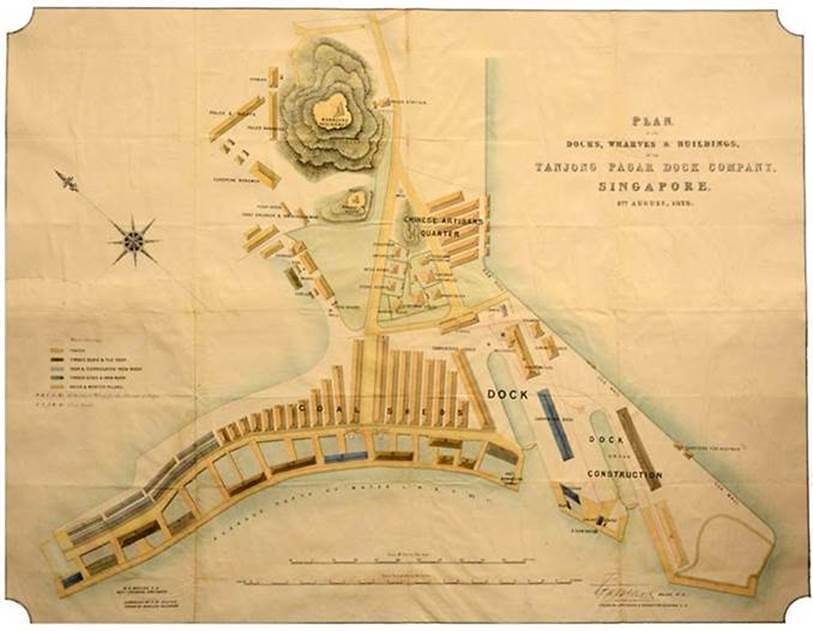
An 1878 plan by the Tanjong Pagar Dock Company showed an additional dock being constructed to support an increased demand for shipping services like repairs, Ms Lee said. This would later become today’s Albert Dock.

“The Tanjong Pagar dock was a major player in the development of Singapore’s history as a port,” Ms Lee said, pointing to dozens of coal sheds in the plan.

“Singapore then was a major coaling station; steamships along voyages from the West to the East would call in Singapore and have their coal and water refilled.”

NLB rare materials collection coal coolies

Dockworkers comprising mainly of Chinese coolies unloading coal from a ship at the wharves of the Tanjong Pagar Dock Company in 1910. (Photo: Andrew Tan collection/National Archives of Singapore)

The plan indicated that the coal sheds, previously made of wood and attap, were constructed with materials like brick and mortar. This is because the plan was produced a year after a huge fire destroyed most of the coal.

“The fire was so major, it took two weeks for it to be brought under control,” Ms Lee added. “So, the company was galvanised to build these coal sheds with more durable materials.”

NLB rare materials collection Chinese artisans quarter

Near the “Chinese artisans quarter” was a joss house for the coolies. (Photo: Hanidah Amin)

The plan also showed accommodation for the Chinese coolies who toiled through the day transporting coal. In 1874, there were about 300 coal coolies working for the company, with the Chinese forming a majority of its labour force.

“What’s interesting is nearby you see a joss house or Chinese temple to perhaps meet their spiritual and protection needs at the time,” Ms Lee stated.

PRESERVING RARE ITEMS

The rare and often fragile materials in the gallery also have their needs.

In the secret storage room, the temperature is kept at around 18 degrees Celsius and the humidity at about 55 per cent, lower than the levels in Singapore. There is no light.

“These are the factors that would accelerate the deterioration of paper-based materials,” Ms Lee explained. “Materials are also digitised so we can provide access while minimising direct handling of the original.”

Clean and dry hands are a must before any handling, although there’s also a misconception that gloves are required. Gloves actually get in the way of proper handling, she added.

NLB rare materials collection polyester film

Protective polyester film is also cut to size at the National Archives of Singapore. (Photo: Aqil Haziq Mahmud)

The items themselves are kept in plastic folders or paper boxes that protect the items during moving and storage, and allow for non-destructive pasting of important information like the title and barcode. Pens are a no-no in the room.

But these more expensive protective layers cannot be found in your neighbourhood bookshop. They are made from non-reactive materials like polyester or acid-free paper.

They are also customised for shape and size at the NLB’s supply centre in Changi South, which is also where rare items first brought in are fumigated to remove pests, repaired if there are structural damages and catalogued for online searches.

NLB rare materials collection brushing

Brushing dirt off an old newspaper. (Photo: Aqil Haziq Mahmud)

Some conservation techniques include removing dirt using goat hair brushes or Staedtler erasers, and repairing holes through infilling. This refers to filling the hole with a torn-off piece of similar thickness paper and applying wheat starch paste to make it stick.

MAKE IT NEW OR KEEP IT ANTIQUE?

But do conservators always have to do their best to restore an item to its former glory? National Archives of Singapore conservator Ong Fang Zheng, 30, said there’s a “thin line” between restoration and conservation.

“A restorer will take a 200-year-old work and give it back to you like it’s 20 years old,” she said. “As a conservator, I will return it to you and it still looks 200 years old. But it’s structurally stable.”

NLB rare materials collection NAS

Similar conservation techniques are used in this bright and spacious lab on the third floor of the National Archives of Singapore building. (Photo: Aqil Haziq Mahmud)

Ms Ong acknowledged that conservators do restore items that are badly damaged, but said it’s ultimately a question of purpose.

“Restorers are more for the art market – things need to look good. For us, it’s about the historical, cultural aspect. And the authenticity and integrity of the object,” she added.

“Conservators are not magicians. Basically, all we’re doing is trying to retard the degradation process so our things can last centuries for future generations to enjoy.”

A THIRST FOR KNOWLEDGE

Back at NLB’s rare gallery, Ms Lee’s job is also to somewhat immortalise the rare items – by learning as much as possible about them and spreading the knowledge through tours, workshops and online blogs.

“As I work through and research a collection, I also begin to discover new aspects of Singapore history that I didn’t know before,” she said.

“I enjoy meeting patrons or researchers who come to look at this collection because they will be able to share with me things that I’ve not discovered from these materials.”

NLB rare materials collection archival box

Ms Lee putting the Singapore Chronicle back in its archival box for storage. (Photo: Aqil Haziq Mahmud)

The ever-curious Ms Lee has been with NLB for 13 years, previously working in the public libraries and also at the supply centre. About five years ago, an opportunity to work with the rare collection came up. She didn’t need to think twice.

“I’ve always had an interest in history, so being able to work with these original materials is really very fascinating,” she added, smiling. “It’s a different side of librarianship.”

NLB rare materials collection shelves

Ms Lee’s favourite item in the collection is a 1930s notebook that recorded the items, expenses and guests of a Peranakan wedding. (Photo: Aqil Haziq Mahmud)

Ms Lee works with a team to research and write about the rare items, as well as search for others that can be bought and added to the collection.

A committee will evaluate the item based on criteria like market availability and how it fits into the collection. Prices range widely – something found on eBay could be considered rare too.

“We might select from catalogues that we have received from dealers, or online alerts that we’ve set up,” Ms Lee said. “We also scour the Internet and look through auction sites to see if there are relevant materials we can acquire.”

LONG HOURS AND LANGUAGES

It’s clear that Ms Lee loves her job. She even spoke at length about items that help prop up or hold down rare items during viewing. There are foam pieces in different shapes, a bean bag that looks like a pillow, and a long, thin weight which she fondly calls “snake”.

But the job has its challenges as well.

Ms Lee works nine-and-a-half-hour shifts from Mondays to Fridays and sometimes on the weekends, when she conducts tours or helps customers with enquiries.

NLB rare materials collection

An old photo album placed on the foam support, next to the bean bag and “snake”. (Photo: Hanidah Amin)

She might also not be able to fully understand the rare items, which might contain foreign languages like French or Portuguese. But she was quick to explain the Japanese characters on the cover of another rare item, an album containing photos of early 19th-century Singapore.

“Shashin, meaning photo album,” she said, noting that she has colleagues who can understand different languages.

NLB rare materials collection photo album

In the album are old photos of Singapore, including this one of a Chinese temple at Kim Keat Road. (Photo: Hanidah Amin)

Ms Lee is eager to learn and even more eager to teach. She’s heartened when the 45-minute public tours become an hour or longer because “people are just so interested to find out new things about Singapore”.

“I think the universe of knowledge is very wide,” she stated. “So sometimes it’s not possible to know everything, but I think we try our best.”

Source link

Ivory, rifles and opium: NLB’s rare collection reveals Singapore’s 18th-century shopping list

0

SINGAPORE: It’s hard to imagine Singapore as a scene straight out of an 18th-century pirate movie: A murky port where swashbuckling sailors traded in arms, drugs and animal parts.

But 1834 editions of the Singapore Chronicle and Commercial Register – the country’s first newspaper established a decade earlier – show just that.

The newspaper focused on trade news, with ship arrivals and import inventories dominating its densely filled pages.

There’s the usual rattan and rice from Palembang, and soap and butter from Batavia (present-day Jakarta). Then there’s the unusual: Elephant teeth from Siam, rifles from Liverpool and opium from Calcutta.

While these were valuable commodities those days – ivory was used to make jewelry and religious objects, while rifles were used to hunt game – the opium trade is far more intertwined with Singapore’s past.

“Why is this newspaper so important?” asked senior librarian Gracie Lee, who works in the National Library Board’s (NLB) rare materials collection where original editions of the Singapore Chronicle are kept.

“I think we often hear that newspapers are like the first rough drafts of history. This contains a treasure trove of historical information on early Singapore.”

READ: Finding yourself – and your roots – in the National Archives

NLB rare materials collection Chinese opium smokers

Chinese opium smokers in the 1880s. (Photo: National Archives of Singapore)

Ms Lee said opium was cultivated in British India, rolled into balls and stored in chests, then brought to Singapore to be processed into different grades. Chinese coolies in Singapore usually got the poorest quality, she added.

With the establishment of Singapore as a free port, the opium tax-farming system was introduced as one way to raise revenue, according to NLB’s infopedia on Singapore. Shopkeepers would also recover ash from smoked opium and sell it at cheaper prices.

The colonial government passed the Opium Regulation in 1830, and until 1910, the annual revenue from opium accounted for an average of 30 to 55 per cent of its total income.

NLB rare materials collection opium commission

The Opium Commission of the Straits Settlements in the Federated Malay States seen in this 1908 photo. (Photo: National Archives of Singapore)

But the Singapore Chronicle is just one of some 15,000 items in the rare collection that tell different stories of Singapore’s history. It contains significant materials on Singapore and the region dating as far back as the 15th century.

“These materials are inherited from the Raffles Library collection, but also recent acquisitions and donations,” Ms Lee, 44, told CNA, referring to Singapore’s first public library which opened in 1845 under a different name.

“So they would be things like travel accounts, European travel writings on Southeast Asia, remittance letters or maps. Yeah, all sorts of things that you can imagine.”

NLB rare collection opium newspaper

An original Feb 20, 1834 issue of the Singapore Chronicle. (Photo: Aqil Haziq Mahmud)

As the name of the collection suggests, these things also have some degree of rarity.

The oldest artefact in the collection is a 1478 map of Southeast Asia based on work by the famed astronomer and geographer Claudius Ptolemy.

And only three other libraries in the world are believed to hold early issues of the Singapore Chronicle in original hard copies: The British Library, Leiden University Libraries and the National Library of the Netherlands.

“John Crawfurd believed that having such a paper would increase the respectability of Singapore as a port,” Ms Lee explained, referring to the newspaper’s endorser who succeeded William Farquhar as the second British resident of Singapore.

“This was meant to be a mercantile newspaper to facilitate trade,” she added, extremely reluctant to turn its yellowed pages to protect it.

The bound collection of the newspaper looked more like a fragile tome, with its hard cover, narrow columns and dozens of large portrait pages. It rested on a piece of archival black foam designed to support and not contaminate such treasures.

THE RARE GALLERY

While the rare gallery isn’t exactly a tomb of lost treasures – it’s on level 13 of the National Library Building in Bugis, guarded by a lone no-entry sign and two layers of locked doors – access is still restricted.

NLB rare collection entrance

Entrance to the rare materials collection. (Photo: Aqil Haziq Mahmud)

Public tours are conducted only once a month. Larger exhibitions are held on level 10 once a year. And Ms Lee might as well be your modern-day Indiana Jones.

She might be petite, with a bob cut and kind eyes, but beneath this veneer lies a somewhat more steely side to her personality – as a keeper of some of the most valuable artefacts from Singapore’s history.

When asked where exactly the original items were kept, she replied jokingly: “If I tell you, I’ll have to kill you.”

CNA was given a private tour on a quiet weekday morning in early August, when there was barely a soul around. The almost eerie silence was broken when Ms Lee beeped open both layers of locked doors.

NLB rare materials collection gallery

Public tours of the rare gallery are conducted only once a month. (Photo: Aqil Haziq Mahmud)

The rare gallery is no bigger than a children’s section in one of Singapore’s public libraries. But unlike the children’s section, it is gloomy with dark colours and dim lighting. The air is stale and sterile, with the room being kept at a constant cool temperature.

Light, heat and humidity can destroy the rare items, Ms Lee explained.

NLB rare collection Gracie Lee librarian

NLB senior librarian Gracie Lee with Ptolemy’s map behind her. (Photo: Aqil Haziq Mahmud)

In one corner hung Ptolemy’s map, encased in a glass panel fitted with small lights and a hygrometer measuring humidity. But this was just a replica.

The originals that could be shown were laid out on three separate tables, and Ms Lee proceeded to tell their stories.

DESTINED TO BE A TRADING HUB

Even before the Singapore Chronicle and the arrival of the British in 1819, there is proof in the rare gallery that Singapore was already slated as a strategic gateway for ships travelling from the West to East.

NLB rare materials collection hydrographic chart

A 1755 hydrographic chart of the Strait of Malacca. (Photo: Aqil Haziq Mahmud)

A 1755 hydrographic chart, by the prominent 18th century French mapmaker Bellin, depicted three important sea passages around Singapore linking the Indian Ocean and South China Sea: The Singapore Straits, New Straits and Governor’s Straits.

Ms Lee said the map is one of the few to describe Singapore by its local Malay name Pulau Panjang, which means Long Island. It also shows the navigational route ships would take along the Malacca and Singapore Straits.

NLB rare materials collection Pulau Panjang

The map showed a stunning level of detail. (Photo: Hanidah Amin)

While the map was detailed and intricate – it even had small numbers indicating the depths of waters around Singapore – it didn’t exactly get the geography right. Singapore is shaped more like a banana instead of the four-sided island commonly seen today.

Ms Lee offered an explanation: “Because this is a hydrographic chart, the importance is really how to safely navigate the waters, and not an accurate representation of the shape of the island.”

COAL COOLIES

On a more micro level, another item showed how Singapore was trying to solidify its status as a trading hub, with the opening of the Suez Canal creating a much shorter route for ships travelling from Europe to Asia.

NLB rare materials collection Tanjong Pagar Dock

The Tanjong Pagar Dock plan was donated by Mr Koh Seow Chuan, founder and senior consultant of DP Architects who worked on the Esplanade. (Photo: National Library Board)

An 1878 plan by the Tanjong Pagar Dock Company showed an additional dock being constructed to support an increased demand for shipping services like repairs, Ms Lee said. This would later become today’s Albert Dock.

“The Tanjong Pagar dock was a major player in the development of Singapore’s history as a port,” Ms Lee said, pointing to dozens of coal sheds in the plan.

“Singapore then was a major coaling station; steamships along voyages from the West to the East would call in Singapore and have their coal and water refilled.”

NLB rare materials collection coal coolies

Dockworkers comprising mainly of Chinese coolies unloading coal from a ship at the wharves of the Tanjong Pagar Dock Company in 1910. (Photo: Andrew Tan collection/National Archives of Singapore)

The plan indicated that the coal sheds, previously made of wood and attap, were constructed with materials like brick and mortar. This is because the plan was produced a year after a huge fire destroyed most of the coal.

“The fire was so major, it took two weeks for it to be brought under control,” Ms Lee added. “So, the company was galvanised to build these coal sheds with more durable materials.”

NLB rare materials collection Chinese artisans quarter

Near the “Chinese artisans quarter” was a joss house for the coolies. (Photo: Hanidah Amin)

The plan also showed accommodation for the Chinese coolies who toiled through the day transporting coal. In 1874, there were about 300 coal coolies working for the company, with the Chinese forming a majority of its labour force.

“What’s interesting is nearby you see a joss house or Chinese temple to perhaps meet their spiritual and protection needs at the time,” Ms Lee stated.

PRESERVING RARE ITEMS

The rare and often fragile materials in the gallery also have their needs.

In the secret storage room, the temperature is kept at around 18 degrees Celsius and the humidity at about 55 per cent, lower than the levels in Singapore. There is no light.

“These are the factors that would accelerate the deterioration of paper-based materials,” Ms Lee explained. “Materials are also digitised so we can provide access while minimising direct handling of the original.”

Clean and dry hands are a must before any handling, although there’s also a misconception that gloves are required. Gloves actually get in the way of proper handling, she added.

NLB rare materials collection polyester film

Protective polyester film is also cut to size at the National Archives of Singapore. (Photo: Aqil Haziq Mahmud)

The items themselves are kept in plastic folders or paper boxes that protect the items during moving and storage, and allow for non-destructive pasting of important information like the title and barcode. Pens are a no-no in the room.

But these more expensive protective layers cannot be found in your neighbourhood bookshop. They are made from non-reactive materials like polyester or acid-free paper.

They are also customised for shape and size at the NLB’s supply centre in Changi South, which is also where rare items first brought in are fumigated to remove pests, repaired if there are structural damages and catalogued for online searches.

NLB rare materials collection brushing

Brushing dirt off an old newspaper. (Photo: Aqil Haziq Mahmud)

Some conservation techniques include removing dirt using goat hair brushes or Staedtler erasers, and repairing holes through infilling. This refers to filling the hole with a torn-off piece of similar thickness paper and applying wheat starch paste to make it stick.

MAKE IT NEW OR KEEP IT ANTIQUE?

But do conservators always have to do their best to restore an item to its former glory? National Archives of Singapore conservator Ong Fang Zheng, 30, said there’s a “thin line” between restoration and conservation.

“A restorer will take a 200-year-old work and give it back to you like it’s 20 years old,” she said. “As a conservator, I will return it to you and it still looks 200 years old. But it’s structurally stable.”

NLB rare materials collection NAS

Similar conservation techniques are used in this bright and spacious lab on the third floor of the National Archives of Singapore building. (Photo: Aqil Haziq Mahmud)

Ms Ong acknowledged that conservators do restore items that are badly damaged, but said it’s ultimately a question of purpose.

“Restorers are more for the art market – things need to look good. For us, it’s about the historical, cultural aspect. And the authenticity and integrity of the object,” she added.

“Conservators are not magicians. Basically, all we’re doing is trying to retard the degradation process so our things can last centuries for future generations to enjoy.”

A THIRST FOR KNOWLEDGE

Back at NLB’s rare gallery, Ms Lee’s job is also to somewhat immortalise the rare items – by learning as much as possible about them and spreading the knowledge through tours, workshops and online blogs.

“As I work through and research a collection, I also begin to discover new aspects of Singapore history that I didn’t know before,” she said.

“I enjoy meeting patrons or researchers who come to look at this collection because they will be able to share with me things that I’ve not discovered from these materials.”

NLB rare materials collection archival box

Ms Lee putting the Singapore Chronicle back in its archival box for storage. (Photo: Aqil Haziq Mahmud)

The ever-curious Ms Lee has been with NLB for 13 years, previously working in the public libraries and also at the supply centre. About five years ago, an opportunity to work with the rare collection came up. She didn’t need to think twice.

“I’ve always had an interest in history, so being able to work with these original materials is really very fascinating,” she added, smiling. “It’s a different side of librarianship.”

NLB rare materials collection shelves

Ms Lee’s favourite item in the collection is a 1930s notebook that recorded the items, expenses and guests of a Peranakan wedding. (Photo: Aqil Haziq Mahmud)

Ms Lee works with a team to research and write about the rare items, as well as search for others that can be bought and added to the collection.

A committee will evaluate the item based on criteria like market availability and how it fits into the collection. Prices range widely – something found on eBay could be considered rare too.

“We might select from catalogues that we have received from dealers, or online alerts that we’ve set up,” Ms Lee said. “We also scour the Internet and look through auction sites to see if there are relevant materials we can acquire.”

LONG HOURS AND LANGUAGES

It’s clear that Ms Lee loves her job. She even spoke at length about items that help prop up or hold down rare items during viewing. There are foam pieces in different shapes, a bean bag that looks like a pillow, and a long, thin weight which she fondly calls “snake”.

But the job has its challenges as well.

Ms Lee works nine-and-a-half-hour shifts from Mondays to Fridays and sometimes on the weekends, when she conducts tours or helps customers with enquiries.

NLB rare materials collection

An old photo album placed on the foam support, next to the bean bag and “snake”. (Photo: Hanidah Amin)

She might also not be able to fully understand the rare items, which might contain foreign languages like French or Portuguese. But she was quick to explain the Japanese characters on the cover of another rare item, an album containing photos of early 19th-century Singapore.

“Shashin, meaning photo album,” she said, noting that she has colleagues who can understand different languages.

NLB rare materials collection photo album

In the album are old photos of Singapore, including this one of a Chinese temple at Kim Keat Road. (Photo: Hanidah Amin)

Ms Lee is eager to learn and even more eager to teach. She’s heartened when the 45-minute public tours become an hour or longer because “people are just so interested to find out new things about Singapore”.

“I think the universe of knowledge is very wide,” she stated. “So sometimes it’s not possible to know everything, but I think we try our best.”

Source link

Finding yourself – and your roots – in the National Archives

0

SINGAPORE: If you have ever been curious about your family history, consider taking a trip down to the National Archives, tucked away in the heart of the city just beside the Registry of Marriages.

There, you can sift through old marriage records, school records, and maybe even find a mention of a relative or two in the prisoners-of-war records.

Friendly archivists, such as Ms Fiona Tay, 30, will be more than happy to assist.

“I think two years ago, three years ago, there was a Masterchef Australia (participant) – Adam Liaw – he was down in Singapore for a filming for Destination Flavour,” said Ms Tay.

“He wanted to try to find out his family history because he had some ancestors who were based in Penang and Singapore. So the producers came to us and said that (they) found these things in the newspapers, is there anything more in the archives?

“Some had to do with prisoners of war records. Because we did acquire some of these overseas archives prisoners-of-war records, we were able to help identify his great-grandfather’s name in one of the name lists,” she added.

READ: Ivory, rifles and opium: NLB’s rare collection reveals Singapore’s 18th-century shopping list

NAS archivist

Ms Fiona Tay is an archivist at the National Archives of Singapore, who helps users navigate the archives. (Photo: Darius Boey)

Wearing spectacles and a long-sleeved shirt rolled up to her elbows, Ms Tay looked every part the dedicated researcher.

“I’d like to say that the skill I do is to answer questions, which means questions that comes from members of the public,” said Ms Tay with a laugh.

And it is a task that she carries out with verve and passion. Taking CNA on a tour of the reference room, she explained what the room contains and the work of the archivists with a casual confidence.

Not only can visitors search existing records to trace their ancestry, they can also look at microfilms of old newspapers, find some of the oldest photographs of Singaporeand even superimpose older maps on top of current ones with the Archives’ computers.

“It’s always very rewarding to be able to help people find the information that they need,” said Ms Tay.

“Sometimes it involves going down this rabbit hole whereby we’re trying to find new leads, the leads may not exist, or the archival sources may not even be around, or it may not even have been created in the first place. 

“But when we do manage to help people find what they require, then it’s always very rewarding experience,” she added.

FAMILY AND PERSONAL STORIES

According to Ms Tay, almost anything can be a source for family history research – even coroners’ records.

“There was one case in which this person came in and she had a newspaper article that stated that one of her ancestors had died … by his own hand, I think that was what the newspaper article said,” said Ms Tay.

“She was very curious as to why this ancestor decided to take his own life. So we were like, maybe the coroners’ records would have it, and indeed it did.

“It included the kinds of interviews that they had with his family, his colleague – so his business was failing, and therefore he had depression.”

NAS archivist (1)

Users can superimpose old maps of Singapore on top of a recent map to compare Singapore’s development over time. (Photo: Darius Boey)

While coroners’ records are already well-known to academics and history students as a rich source of information, Ms Tay said she never expected these records to be useful to people looking for pieces of their family histories.

“Because it was an unnatural death (and) because he wasn’t a colonial employee, so we wouldn’t have any colonial accounts on him. He was just a business owner – and it wasn’t a very prominent business, so we were unlikely to have records.

“It was a bit of trial and error.”

But family history research is not the only reason why people might visit the archives. Sometimes, she said, they look for old school records to apply for courses or employment.

“There was once this gentleman who came in on Saturday morning,” said Ms Tay. “I was alone – with another colleague who happened to be away doing something else. So I was alone at the counter, and he came in to ask to look for his primary school records, but he didn’t remember what school he was studying at.”

Ms Tay spent at least one hour with him, asking questions just to triangulate the location of the school, including any landmarks that he would see walking to and from school every day.

“He started to say that ‘I will wake up at this time and then I will reach school at 6.20am. So it took me about 20 minutes to (walk) to school,’” she said.

“So okay, that’s helpful. So it’s within walkable distance, you’re not travelling by a bus or anything. We had to call up old street directories, try to identify – and then finally we managed to find that particular school location.”

NAS archivist (2)

A microfilm with a reproduction of some colonial building plans. (Photo: Darius Boey)

It’s a process of detective work, she explained, and it often means that she will end up asking questions about even the colour of the user’s school uniform to piece together information about the particular school.

“COULDN’T DO ENOUGH TO HELP”

But do not be mistaken in thinking that each rabbit hole leads to a happy ending. Sometimes, the records can’t be found simply because there were no records kept at all, or certain parts of the records are missing.

“There are certain cases whereby we may not be able to help them, but we often do try our best,” said Ms Tay.

“I think there will always be those sorts of moments, whereby you feel that you couldn’t do enough to help a certain person to locate their information. But at the same time, it’s always useful to learn from the experience and then know what to look out for in the future.”

NAS conservator (2)

One of the earliest photographs of Singapore, dating from the 1870s is an aerial view from Fort Canning towards the sea, showing High Street (left) and Singapore River (right). Courtesy of National Archives Singapore.

She added that searching for information in the archives is not Google: “It’s not a simple case of just typing in certain keywords or questions and you’ll be able to get the answers immediately. In certain cases, you will have to go to page and pages of records.”

Although archivists may not be able to help everyone seeking information, sometimes their efforts are all that’s needed to make an impression.

“It’s surprising how sometimes they would still remember us for the effort of helping – they will still come back and thank us,” said Ms Tay.

She remembered one user who came in looking for schooling records for her night class, which the archives was unable to locate as the school did not keep track of students who studied part-time.

Even after approaching the Institute of Technical Education and the Ministry of Education, Ms Tay could still find no trace of her education history.

“But she did manage to appeal to get into that course of choice,” said Ms Tay. “And then, six months later, when she was done with her first major exam, she came back and she was like ‘Oh, I just happened to be in the area, and just wanted to pop by to thank you.’

“So I thought that was very heartwarming that even though we weren’t able to give her what she required, I think she appreciated the efforts we took to try to help her with it.”

CONSERVING SINGAPORE’S RECORDS

All historical documents have to be conserved for future use. Inside a lab on the third floor of the building, conservators were hard at work preserving records kept in NAS’s repository.

Conservator Ong Fang Zheng, 30, was cheerful and enthusiastic when she greeted CNA at the door to the lab. She spoke with machine-gun rapidity, explaining the various functions of the lab, from the rack of archival polyester used to protect old documents to the sleek white workbenches at the back.

NAS conservator (1)

Conservator Ong Fang Zheng examines the paper damage to a map. (Photo: Hanidah Amin)

“You need to have good motor skills, good dexterity, that’s for sure,” she said. “A fine arts background would be helpful… A science background would be very helpful as well to understand the different kinds of… chemical reactions that we can have.

“And of course… having a real and keen interest in the arts and heritage. Because you can’t really do this work if you do not have love for it.”

Ms Ong’s task is to preserve paper-based records: maps, books, building plans, posters and even photographs, doing both repair work and preventive care.

Documentation is the first step when conserving historical items. Ms Ong will make note of the item’s condition – what it is about and what needs repairing. Only after writing this down will she begin with surface cleaning, using a soft and delicate goat-hair brush to sweep away dirt.

To ensure that she is precise and careful with her work, Ms Ong also uses a microscope to get a closer view of the item – in this case, a map.

Any other repairs will be done based on the condition of the item.

NAS conservator

Conservator Ong Fang Zheng uses the microscope to examine a map. (Photo: Hanidah Amin)

“Maps are a bit like prints. By prints we mean engraving, etching, wood cut. Ink is usually oil based, so you can wash it,” said Ms Ong. Other items, like newspapers and photographs, need to be treated with more care.

“So that’s when knowledge is important,” she said.

“WEIGHT OF THE RESPONSIBILITY”

But no matter how experienced you are, there is always a inherent worry when handling the item, said Ms Ong.

“The most difficult part of it is the weight of the responsibility,” she said. “Because I know that I’m working on something that is historical and cultural and it has lived on for centuries. And my job is to make sure it lasts for centuries more.”

As much as it feels like an immense responsibility, the archives are very much deeply personal too.

“On the national level, the archives is the custodian of official records. But of course, on the individual level, the archives is also a place whereby people can come to try to find out their connection to other people,” said Ms Tay.

“They can come here to try to trace back their roots, they can come here to try to understand how life was different or how life was similar today.”

Ms Ong added: “I remember this article I came across. It describes very aptly why we need to save our culture.

“Because without our culture and our history, we have no identity. Without our identity, then who are we?”

Source link

Commentary: Navigating the new road to modern elderhood

0

SINGAPORE: The national conversation about keeping older people in the workforce habitually zeroes in on the accompanying gyrations in Central Provident Fund (CPF) rules and rates. It’s not about to change in a hurry.

But are these numbers, driven and decided by humans, the be-all and end-all of an employment future that wiser people have long seen coming?

When I started work in the 1970s, a retirement age of 55 seemed immutable and all but carved in stone. My contemporaries and I could never have imagined what’s happening now.

We’re now pushing the statutory retirement age to 63 by 2022, and 65 by 2030. It means that workers can’t legally be forced out of a job simply because their employers want to replace them with younger and cheaper hires, at least not until those already on the payroll hit the statutory retirement age.

Think about it: That “sell-by date” has advanced an entire decade from the starting point.

Even more pertinent to some may be the rise in re-employment age from the current 67 for employees born on July 1, 1955, or later. By 2022, that re-employment age will be 68, and it will rise to 70 by 2030.

Seventy.

But here’s the catch. While the rules require employers to offer jobs to existing employees eligible for re-employment, employers can adjust the terms of their employment.

Adjust is a frustratingly flexible word. This leaves employers free to use that as a get-out clause to arbitrarily cut the pay of workers who hit that “retirement” age. Slashing annual leave and benefits is also a doddle.

For those who stay on and continue doing exactly the same work as before that arbitrary pay cut was imposed, such clever corporate craftiness can be a marvelous morale killer and a no-brainer performance disincentive because they totally ignore the human factor.

back to school qistina 5

Well-travelled Yeo Chwee fong, who retired almost 20 years ago, spends most of her time volunteering at a wellness centre for the elderly and tending to her garden.

A DIFFERENT WAY OF LOOKING AT RETIREMENT

There is another way to look at the benefits of sustaining an age-diverse workforce.

A couple of days after the changes were announced at the National Day Rally, I caught up with a couple of friends, a session which quickly turned into an extended but impromptu sharing.

It started with Clement, a self-declared IG newbie, wanting our thoughts on something he’d just posted “on IG”. On what? I was totally at a loss.

Jeanette, 40 years younger than I, and maybe 20 years younger than Clement, and more skilled in things digital than either, delivered a quickie capsule lesson on the ways of IG, that is, Instagram.

In between, I suggested story ideas to Jeanette and Clement shared insights into the music industry and the new work he’s been doing. We all also took away one another’s insights from what we had shared about the recent National Day Rally.

READ: Commentary: The awkwardness of using Instagram as a 50-something 

READ: Commentary: Watch for casual ageism and other signs of caustic attitudes about older workers

Uncannily, the next morning, a link to a TED talk by former boutique hotel wunderkind and visionary author Chip Conley popped up on my Google home page. Google’s algorithms must have eavesdropped on my email and WhatsApp messages!

Conley’s advice on exploiting the blessings of a five-generation workforce and “opening up the intergenerational pipelines of wisdom” struck a chord. He said:

… the one thing that can never be automated or left to artificial intelligence is the human element of business. You may not be a software developer, but you are a soft skills developer – and soft skills are the ones that will matter most in the organisation of the future.

In retrospect, it reflected what my friends and I had been doing a day earlier.

Conley’s own awakening began when he was invited by AirBnB’s co-founders to help them take their start-up global, and to mentor CEO Brian Chesky.

Conley admits he foundered at first, surrounded by engineers at least two decades his younger. Until he realised he could match his “wise eyes with their fresh eyes”, like “a modern-day Margaret Mead among these millennials,” he said. (Mead was a famed cultural anthropologist.)

office colleagues

Two colleagues in a discussion. (Photo: Unsplash)

You and I may have no such ambitions. But we all have experience. And most of us must surely have acquired some wisdom over the years that is worth sharing.

THE MODERN ELDER IN THE WORKPLACE

What baby boomers like Conley have which millennials lack is wisdom earned and learnt through years of experience.

But we don’t necessarily trust each other enough to share that wisdom, he observed. We don’t speak the same lingo, as he put it. And we each need to get inside the other’s mind.

To achieve this, those artificial age barriers so constantly and relentlessly reinforced by statistical tables, must be breached before we can reclaim and revitalise the notion of elderhood, and learn to mentor and be mentored at the same time.

In the United States, nearly four in 10 employees have a boss younger than they are, said Conley. I have no similar stats to offer but Singapore is clearly getting there.

READ: Commentary: Seniors do well at their jobs yet ageist myths and negative stereotypes persist

READ: Commentary: Singapore’s bold bet on seniors and valuable years of life experience

But simply because these younger folk are parachuting into positions of power, or as he puts it, power is “cascading to the young”  because of their digital intelligence or DQ, doesn’t mean they can be expected to embody all the skills they need, particularly dealing with people in order to get things done.

As Conley sums it up: “It’s hard to microwave your emotional intelligence.” EQ is what older folk like the boomers have been slow cooking for years. Having life lessons boiled, baked and burnt into us was an essential part of the process.

Period hormone menstrual cycle office woman

(Photo: Unsplash/rawpixel)

A more compelling reason for keeping older workers on the job may be that an ageing workforce can positively impact company performance.

One such study published in 2009 on the impact of ageing and age diversity on company performance authored by Uschi Backes-Gellner of the University of Zurich, and Stephen Veen of Disney Research used an employee-employer dataset covering more than 18,000 German firms and two million employees.

It found that organisational productivity doesn’t necessarily dip as the workforce ages, and that “greater age diversity can have substantial positive productivity effects, particularly in innovative and creative companies.

Another example is offered by the HR in Asia website. It cited a survey of 1,700 companies that globally age-diverse companies were more innovative, more likely to produce unconventional solutions, and also to generate more and better ideas.

READ: Commentary: A tale of two bankers and modern parenting

READ: Commentary: The sadness felt when your work spouse leaves the company

While so-called experts have turned experience from asset to liability, Conley argues that in a “60 is the new 40” age, the new world of work calls for renewed regard for wisdom and what he calls the Modern Elder.

SHARING COLLECTIVE WISDOM

Take that tiny circle of Jeanette, Clement and me, for example. We weren’t even trying and we were learning from one another. Imagine what could be achieved if we all consciously and systematically shared our collective wisdom, reach and abilities.

Social media has greatly facilitated my staying in touch with many friends, former colleagues, students and trainees, among others, some of whom still occasionally pose questions to me, seek my advice or ask my help to edit their writing.

Two person shaking hands at job interview, work meeting

(Photo: Unsplash/rawpixel)

Some have gone on to become university dons, entrepreneurs, senior civil servants and newsmakers of one kind or another. Among them are those who have nudged me towards opportunities in training, writing and editing.

So I’m learning how I can be a Modern Elder. Starting with reading Chip Conley’s book, Wisdom at Work: The Making of a Modern Elder.

Just as soon as I undo the unwisdom of stuffing that brand new paperback into a bag with a water bottle whose cap hadn’t been properly secured.

Irene Hoe is a writer, editor and coach and has been a journalist for many decades.

Source link

Commentary: Climate action is our generation’s 1965

0

SINGAPORE: Prime Minister Lee Hsien Loong this National Day Rally publicly acknowledged climate change as an existential threat to Singapore – and aced it.

He unflinchingly positioned the threat dead-centre in the Singaporean psyche – and mentioned housing price risks in the East Coast and waterfront areas. Yet, he also managed to sound upbeat and forward-looking.

This marks the defining moment for Singapore’s climate war. It is a clarion call for us to understand the climate impact reverberating through our society, economy and geopolitics. Singapore’s Total Defence strategy surely welcomes its missing seventh pillar.

WHY WE MUST

At “just” 1.1 degrees Celsius increase in warming, climate change will cost millions of lives and homes, lead to acidic oceans challenging sealife, droughts, floods, heatwaves ravaging crop yields, as well as mosquitoes reproducing faster and propagating Zika, dengue and other pandemics.

READ: Commentary: Climate change in Singapore and what the future brings

READ: Commentary: As ice caps melt, Singapore a hot spot for sea-level rise

Our Sovereign Wealth Fund (SWF) climate analysis last year, recommended 4 degrees Celsius warming as the baseline planning parameter going forward, different from the 1.5 to 2 degrees Celsius future discussed then.

It was a tough call that endangered our credibility, but the United Nations Intergovernmental Panel on Climate Change (IPCC) vindicated our prediction months later, leveraging 200 scientists over two years.

Singapore’s economy has a carbon bent. We emitted 50.9 million tonnes of greenhouse gases in 2014, 27th highest among 142 countries.

Studies have shown if everyone lived like Singaporeans, the amount of resources the Earth produces in 2018 would have been used up by Apr 2018.

FILE PHOTO: FILE PHOTO: NASA's Earth Polychromatic Imaging Camera image of earth

This color image of Earth, taken by NASA’s Earth Polychromatic Imaging Camera, a four megapixel CCD camera and telescope was released on July 20, 2015. (File photo: REUTERS/NASA/Handout via Reuters)

The paradigm shift required to save our homeland and the world, offers exciting opportunities in green growth. Global heating will transform the destinies of most countries and companies, on par with Artificial Intelligence.

YES WE CAN

PM Lee declared that everything must “bend at the knee” to protect our homeland, and that we do not want our descendants ashamed of us.

Our implemented mitigation measures already ensure that we overachieve our promised Nationally Determined Contributions of reducing emissions intensity by 36 per cent from 2005 levels by 2030. Kudos to our civil servants.

With PM Lee affirming that “Singapore must do its part”, will we raise our ambition? Forty-nine countries, representing 40 per cent of global greenhouse gas emissions, have capped emissions, while 10 countries will reach net zero by 2050.

Optimal mitigation requires the Government, corporates and all individuals doing our utmost. Collaborating with the global community to constrain emissions while protecting carbon-rich rainforests is crucial.

A circular economy can almost halve global industry emissions by 2050. Sustainable finance will mushroom, from SWFs and other smart investors divesting fossil fuels and others with carbon exposure, to protect financial returns.

READ: Commentary: We are on the cusp of a plastic recycling revolution

READ: ‘Calamity may come’ if Singapore doesn’t take care of its coastlines now: Masagos Zulkifli

Singapore as a global financial hub should accelerate efforts to leverage and support the essential global transition to a clean, decarbonised economy. Investors and companies that protect the planet, while catering to lives worth living, will be rewarded.

Singapore financial centre

A view of Singapore’s financial district. (Photo: AFP/Roslan Rahman)

An Asian SWF sustainability executive told me they plan to become carbon-neutral next year, and recommended each corporate devise a carbon-neutral strategy. Climate literacy will support boards in understanding the new climate economy, as fundamental to fiduciary duty.

The carbon intensity of industries, and the carbon differential within sectors, will shape the competitive landscape and economy.

The top 10 per cent of households in rich countries such as the US, consumed four to five times more carbon on average compared to the bottom half, in Oxfam’s analysis. That bears consideration in our tax policy.

I have six suggestions on how to re-engineer Singapore for that greener future.

1. HOW ABOUT CHEAPER COES TO DRIVE ELECTRIC MOBILITY?

A car is our largest carbon purchase, if one flies less than one Singapore-London return trip annually. Cheaper Electric Vehicles (EVs), with well-distributed and bookable charging infrastructure, can equalise the playing field. Though EVs here burn fossil fuels and are not zero emission, they remain a cleaner alternative.

READ: Commentary: Where are all the electric vehicle charging points?

Property developers that support our national imperative, could incorporate charging spots in their buildings. We can reciprocate with more Greenmark points.

2. HOW ABOUT CHEAPER, MORE RELIBALE PUBLIC TRANSPORT?

The wider the differential between holistic public transportation costs and private car ownership, the more people would lower their carbon footprint. Our Smart Nation prowess can support by improving the accuracy of bus arrival predictions and journey duration.

Public transport bus

File picture of people queuing to board a bus in Singapore. (Photo: Joey Liew)

Design thinking, with better traffic light algorithms, could rebalance the time cost, heat stress and inconvenience borne by pedestrians and public transit users.

4. LET’S STOP WASTING FOOD

We can all do this, by buying the right portions and storing it well. Supermarkets should sell perishables in small portions so that consumers do not overpurchase.

The Government can consider policies such as France’s law banning supermarkets from dumping food, a Good Samaritan Law shielding F&B donors from liability, and research into cold chain management best-practices.

3. MORE ENERGY-EFFICIENT BUILDINGS

Construction is one of the biggest emitters. Architects and property developers are hence key partners in Singapore’s climate war. 

Given the gap between Singapore’s carbon tax and IPCC’s recommendation, judicious boards and management may choose to future-proof their business models amid different global carbon tax scenarios, but it’s worth reviewing our carbon tax rate.

A key test of Singapore’s climate conviction, is frigid office temperatures in our tropical country.

Does our involuntary chill stem from cheap, poorly-functioning air-conditioners that cannot circulate cold air around the entire floor properly? So they blast frigid air to ensure it remains cold when it reaches the furthest person? Whatever it is, our failure to have sane temperatures strains the credibility of our climate change fight.

Solar panel windows can help address our lack of surface area for installations, while reducing the buildings’ net carbon footprint. Otherwise, we should use at least insulated windows to minimise cooling needed.

Solar panels Sembcorp

Solar panels on the rooftop of an HDB block in Singapore. (Photo: Sembcorp Industries)

The future of energy is decarbonised, distributed and digital. Locating power generators closer to users reduces the significant 30 per cent energy transmission loss. With solar power offering deployment at various capacities, is this not viable for Singapore?

4. EMBRACE RESPONSIBLE CONSUMPTION

Production and shipping to Singapore incur carbon costs, every step of the way. Those who shop as if there is no tomorrow will indeed lead us to having no tomorrow.

Consuming fewer, quality and durable products would reduce the strain on our Earth. Singapore’s average per capita emission was about double that of small, rich nations such as Denmark and Switzerland.

Wildfires are ravaging our world. While we are not the ones burning the Amazon, or abetting farmers, our clamour for Brazilian pork, beef and soy effectively endorses the burning. Platform giants could help with filters for the relative carbon intensity of each product type.

5. CHOOSE FUEL-EFFICIENT APPLIANCES

These often help you save money over its lifecycle. The National Environment Agency’s app has a great fuel-efficiency function for key energy sinks. Corporates could support by sourcing quality, energy-efficient appliances.

6. CALL TO ACTION

Concerned for us? Discuss global heating with your friends. Discover your carbon footprint, and support our future at the SG Climate Rally in September.

READ: Want to do more to fight climate change? Cut down on driving, buying stuff and eating meat

Sustainable lifestyle Sprout Farmers Market CNA Lifestyle Comcrop-7

Comcrop supplies homegrown, pesticide-free produce to restaurants, bars and supermarkets. (Photo: Comcrop)

Global heating strikes at humanity’s Achilles’ heel. The top risk to our planet for this generation carries implications that make it painful to understand and address, turbocharged by the tragedy of the commons.

Yet, this is our watch. Whether the scales fell from our eyes at or before NDR, we must act now to constrain carbon emissions. How can we sell our next generation into carbon debt?

So run a carbon-neutral comany, fly less, and eat less (meat)?  The choice is yours, and your action matters. On that, hangs the fate of Singapore and our world.

Vivian Claire Liew is a global sustainability expert and CEO of PhilanthropyWorks, which advises leading investors and corporates on the new climate economy.

Source link

He went blind at 47 – company Firmenich helped get his life back

0

SINGAPORE: Bernard Chew still remembers when his world went dark.

It was August 3, 2017, and the then-47 year-old had returned home from his job teaching speech and drama to preschool children. It had been a long day at work, and he was tired.

He noticed that his surroundings seemed a bit blurry, but he wrote it off as simply a sign of exhaustion. It was August, which was a busy time of the year with rehearsals for preschool graduation concerts starting to intensify. 

He had his dinner and went to sleep, grateful to call it a day. But the next morning when he woke up and tried to look at his phone, he realised that his vision was still blurry. 

On his way to the bathroom to wash up, he collided with the wall. And as he found himself fumbling to find his toothbrush and toothpaste, he knew something was wrong. 

It would just be a quick check-up at the hospital, he told himself, and he would be ready to teach his scheduled class that same afternoon. But the doctors dashed his hopes: Both his retinas were detached, causing his optic nerves to be damaged.

An emergency operation did not help.

He was blind.

DARK DEPRESSION

It was a double whammy for Bernard. He was still in the process of picking up the pieces from the breakdown of his marriage two years before, and was living alone in a rented room, away from his two sons, one in his twenties and the other still a teenager.

He loved his job, which he had been doing for more than 12 years. In his free time, he enjoyed running marathons, bowling and swimming. 

He could no longer do all this, he realised, and things that he once did unthinkingly – instinctively, in fact – were things he could no longer do without assistance.

“How could I lead a normal life when I can’t use my phone, use a computer, and even walk around without bumping into things?” he said.

MSF Firmenich Bernard emotional

Waking up in sudden and permanent darkness just about devastated Bernard.

For the five days he was warded in hospital following the operation, questions ran through his mind. 

Was it something he had done, some symptom he had overlooked over the years? Yes, he had been diagnosed with glaucoma in 2009, but he had faithfully gone for checkups every six months, and the condition was under control with medication.

Doctors told him that early symptoms included floaters and black spots. But prior to that fateful day, he had showed no symptoms.

Every time he opened his eyes, the blackness surrounding him drove him to despair.

I told the doctor, let me just jump down and kill myself.

“They had to tie me down to the bed and give me anti-depression pills,” he said.

GETTING BACK ON HIS FEET

It was the constant reminders from those around him – particularly his two sisters and children – that he had the support of those dear to him, which changed Bernard’s mindset.

“I had a good talk with my boys, and they told me … ‘Dad, what about us? Isn’t it very selfish if you end your life?’” he said. “That got me thinking. Am I going to be selfish when there are people who still love me?”

“I decided that I didn’t want to be a disappointment to my boys and family members, and that’s when I made up my mind.”

He moved in with his second sister, Teresa, and her family, and with their help, he began to adjust to life. 

It was Teresa, he said, who despite her busy schedule, made an appointment with the Singapore Association of the Visually Handicapped (SAVH), and drove him there to meet a social worker.

He was surprised to find out about the extent of help available for people with visual impairment to live their lives as independently as possible; and that there were people who were born blind walking around freely in the association without a cane.

With technology such as the voice-over function in mobile phones, he could also use his phone again. 

“That really got my attention,” he said. “I said quick, quick – what’s next for me? I wanted to get back on my feet fast.”

MSF Firmenich bernard at playground

A REALITY CHECK

Filled with fresh enthusiasm and determined to regain his independence as soon as possible, Bernard completed as many training courses as he could: He learnt Braille, how to move around by himself with a mobility cane, and how to use a computer with a screen reader.

Barely a week after he was discharged from the hospital, he was spending almost eight hours a day at the association, determined to soak up as much new information as he could. 

In fact, he completed mobility training – which involves aspects like using the white mobility cane, moving around the house safely, and taking public transport – in just three days, well in advance of the three to six weeks a typical adult would need to complete the training.

MSF Firmenich Bernard and cane

At the SAVH, Bernard learnt how to navigate using a white cane and audio cues from his surroundings. 

With each course he took, he gained confidence. Impatient to start earning an income again, he asked his social worker about employment opportunities for the visually impaired. But that was when reality struck.

“I found out there were generally two types of jobs a blind person could do: Telemarketing, or massage,” he said ruefully.

He was crushed. For someone who had once served in the police force and even rowed at a national level, it was demoralising to think of his now limited job options.

“I think we can do so much more than that.”

MSF Firmenich police and army medals

Bernard’s medals from his uniformed service days are some of the few mementos he still keeps around his spartan flat.

But that was reality, and Bernard signed up for a massage course, which after subsidies, would cost him about S$1,200. 

He was willing to try, but he soon learnt that the course would take more than two months, during which he would not receive an income. His name was the second on the list, and they needed six participants to start a course, which meant an even longer delay before he could start work.

“I tried to explore the idea, but inside me…” he said, trailing off. “I thought, oh well. I can’t go back to teaching drama.”

But one day, his social worker at the association approached him. A company named Firmenich was looking for professional sensory panellists to assess fragrances.

At that point in time, he knew nothing about the company besides what a cursory Google search turned up. But it was something different, so why not?

There were rounds of selection tests he had to go for, where he was required to smell and describe different fragrances. He knew that there were many others who had applied, and only a few could get through.

MSF Firmenich  smelling bottle

When he received a phone call telling him he had been selected for the position, he remembered tears coming to his eyes.

“After losing my sight and going through all the training… I felt my confidence come back to me,” he said.

Just a few short weeks ago, he had considered ending his life. But on that day, he felt alive.

WHY NOT IN SINGAPORE?

The wheels for this life-changing opportunity were set in motion even before Bernard lost his sight.

It started in late 2015, when Seah Siau Choon, a senior regional sensory manager at Firmenich Asia’s perfumery department, heard about an initiative her Mexico-based colleague had worked on. Visually impaired folks were employed as sensory panellists in the flavours department in Mexico.

They helped to taste and analyse the various flavour characteristics in food products. It was working well, and the team did not need to make many changes to their workplace to accommodate them.

The thought excited her. 

MSF Firmenich Siau choon

Seah Siau Choon.

At that time, the company was on the lookout in Singapore for an external panel of people to smell and profile the different fragrances, considering aspects like how a fragrance lingers on different surfaces and conditions. All this information would help the company’s fragrance development team improve their technologies.

So why couldn’t visually impaired people become part of that panel?

“I always thought that as long as those with disabilities can rationalise, think logically, to understand basic fundamentals … they can still work,” she said. 

It’s really just about whether you want to receive them, and open up the opportunity for them.

PREPARING THE WAY

On her own, Siau Choon decided to approach the SAVH in 2016 to gauge their interest. Worried about being turned down by the association, she thought it best to get their buy-in before bringing up the idea to her bosses.

“The SAVH was surprised,” she recalled. “Firmenich was the first corporate company that approached them about employment, and the job was also something very different – usually it would be in the hotel line or call centres.”

Besides, she added, Firmenich would provide the training for them to become professional sensory panellists, and the association felt that this would be a good chance to develop their skills.

MSF Firmenich Asia office

Firmenich is the world’s largest privately-owned fragrance and flavour company.

Her boss, Firmenich Asia general manager and vice president of perfumery Lourds Rajan Arul,  admitted to having several doubts when he first found out about the idea, largely because, he said, there was no structure in place to accommodate people with visual impairment. 

But the company was due to move to a new site – and he took the opportunity to make sure the new facility would be disabled-friendly.

“We had them in mind right from the very beginning,” he said, explaining that the office building they chose – Ascent at the Singapore Science Park – has ramps and wide lift lobbies to help those with disabilities get around. 

As for the Firmenich offices, there was a special washroom, flat floors without steps or kerbs, and sliding doors, which were chosen over normal doors to make it more user-friendly for his new employees.

“I wouldn’t say it was difficult to accommodate their needs, but with proper training and dedication, we can give them the opportunity to be an instrumental part of our organisation,” he added.

MSF Firmenich office corridors

Firmenich’s new office in Singapore.

Beyond that, it was also important to Siau Choon that the visually impaired job applicants be comfortable and at ease. 

Before the interview sessions, she looked up ways to communicate with them and tried to put herself in their shoes – such as by blindfolding herself and assessing different fragrances.

She also attended a two-day workshop by SG Enable on job accommodation. “It was eye opening because you get to see other what organisations have done,” she said.

A SURPRISING FIRST MEETING

Bernard still remembers the woman who surprised him at his job interview. 

After a bus journey from SAVH with other visually impaired applicants, he was ushered into a room to wait for the Firmenich staff to begin the interview and selection process.

He heard the faint sound of footsteps approaching, which was normal. Part of his mobility training involved using sounds of the surroundings, such as escalators and air-conditioning vents, to navigate. He could guess that someone was about to enter the room.

Then, he heard a woman’s voice: “Hello, I’m Siau Choon, and I’m coming into the room.”

MSF Firmenich Bernard and siau choon

Siau Choon and Bernard at work.

He was surprised. For people like him who are totally unable to see, every little detail – such as who is entering the room – is important in helping them build mental pictures of their surroundings. But while most people are willing to help, they may not know how to do it.

When he received her name card, he got another surprise: There were Braille markings on it.

“To me, that was like super thumbs up from me!” he quipped. “This woman knows her stuff.”

Bernard was amazed at how comfortable Siau Choon made him feel. From the way she announced her presence every time she entered or left a room, to the instinctive way in which she offered her elbow to sight-guide him, he knew he was in good hands.

She did an awesome job. It gave me the assurance that this would be a good place to work.

Twenty-six visually impaired candidates applied for the job. But only six made it through. A roughly similar number of sighted people also applied, with similar results.

As Siau Choon explained, the job was not for everyone.

“We’re hiring them as a descriptive panel, so when they’re asked to smell something, they have to be able to describe or verbalise the fragrance – not just that the smell is pleasant or not,” she said. “They also need to be able to smell and identify different intensities of the same fragrance.”

WATCH: What hope smells like, to a blind man (8:33)

SMALL CHANGES THAT GO A LONG WAY

On the Tuesday morning that CNA Insider observed them at work, the Firmenich board room was filled with the chatter of people as the panellists waited for the day’s session to start.

Bernard’s white mobility cane was folded and placed carefully at the side of the room. Apart from the sunglasses some of them were wearing, it was hard to tell the difference between the sighted and visually impaired panellists as they laughed and joked with each other.

All 11 panellists – six with visual impairment and another five sighted – had gone through rigorous training by the company, where they learnt how to smell and identify more than 150 raw materials used in fragrances.

MSF Firmenich VI panellists

The visually impaired and sighted panellists work side by side.

The door swung open, and Thibault Nouffert, a sensory scientist, entered the room, followed closely by Siau Choon and two assistants in lab coats. “Good morning!” he said loudly and cheerfully, and the panellists responded enthusiastically.

The day’s task involved them smelling the fragrances in different bottles wrapped in aluminium foil, before rating the intensity of the various notes in the fragrance using an iPad.

As Siau Choon and Thibault moved around the board room guiding the panellists, little changes began to stand out: Each bottle had Braille markings pasted on the side to help visually impaired people identify which sample they were profiling.

MSF Firmenich braille dots on bottles

Bottle marked with numerical zero in braille.

A brown board with long cut-outs and stick-on googly eyes was on the large table near Bernard. 

It looked almost comical, but it was there for practical reasons: Each board fits snugly on top of an iPad, working as a touch-template to help panellists like Bernard rank the intensity of each fragrance with minimal assistance.

The idea, it seemed, came from a credit card-sized template that Bernard had with windows to help him indicate where to sign documents. Bernard explained that initially, the panellists were given paper and pencils to write down their rankings, but being blind, he was unable to do so.

“I showed it to Siau Choon, and she took it upon herself to expand the idea, creating the board with four cut-outs,” he said. 

MSF Firmenich how it used to be done

The cut-outs helped the partially sighted panellists to write notes. But their writing was often illegible and needed a trainer’s assistance to read back.

“We still wrote manually then and used a lot of paper,” he added. “But then Thibault came along and improved it even more by adding the iPad.” 

The iPad allowed them to enter their observations more easily, instead of having to painstakingly write out their observations in often-illegible handwriting and depend on the trainers for help. 

These might seem minor adjustments – but they went a long way in helping the visually impaired panellists do their job independently.

For this, Firmenich Asia won the Innovation Award at the 5th Enabling Employers Awards in July, which recognises those that have showed commitment towards hiring and integrating persons with disabilities in the workforce.

MSF Firmenich ipad

The tactile cut-out, coupled with the iPad, allows the panellists to more easily record their observations of smell notes in a fragrance.

Thibault, who joined the Singapore team in March 2018 and had previously worked with visually impaired people in London, said the goal was to help such panellists become as independent as their sighted counterparts.

“The sense of independence is really important to them. Perhaps explain a bit or guide them at the start, but manage them as you would manage any other panellist,” he said.

Indeed, when sighted panellist Elson Tan first walked into the board room, he remembered being surprised that some of his new colleagues were visually impaired.

“I can’t deny that there was a bit of a stereotype – I thought they would struggle to lead a normal life,” he said. “But when I saw them, I realised they’re quite independent and able to manage really well on their own.”

MSF Firmenich Bernard at work

Fellow sighted panellists also learnt a thing or two about the visually impaired and what they were capable of.

Nonetheless, he learnt how to make them more comfortable by watching Siau Choon and Thibault.

“I realised that Siau Choon and Thibault tended to verbalise their actions around them,” he said. “It wasn’t instinctive or natural for me at first, but I picked it up as I worked here.”

DASHING STEREOTYPES

Siau Choon is a natural with them, the panellists agree. But it was not always the case: Prior to meeting the panellists and doing her research, she admits, she had several misconceptions about people with visual impairment.

For one, she had thought that having lost their sight, they would have a heightened sense of smell. But when she started to work with them, she realised that this was not always the case.

“It was good news to us, though,” she said. “In sensory work, we want things that are consistent and objective.”

MSF Firmenich diffusion booths

The panellists also test the fragrances on their own skin, because the smells can differ on different surfaces.

What she did notice was that the visually impaired panellists tended to have very good memories. During their training, for instance, she realised that although everyone received a booklet of training materials, blind panellists like Bernard had to rely on their memory to retain the information.

“That’s when I realised, it’s their strength,” she said.

Another thing she has learnt – there are different levels of visual impairment. One of the panellists, Iskandar Ibrahim, who is more commonly known to friends as Shawn,  can identify. 

A former makeup artist diagnosed with low vision in 2013, Shawn requires special red-lensed glasses to see in bright light. He cannot make out details such as a person’s facial features, and needs words to be in large font so he doesn’t strain his eyes.

There are so many different kinds of blind. We don’t all carry white canes.

“There are people who can’t see at night, and there are people like me, scared of the light like a vampire,” he joked, laughing loudly. 

“I just want people to know that people like me – half-blind, half-sighted – we exist.”

MSF Firmenich Shawn bernard

Shawn (left) had to give up his job with a cosmetics company when his sight worsened.

COMING FULL CIRCLE  

Indeed, having people like Bernard and Shawn walking around in the vicinity of the office has had an added benefit: It has increased others’ awareness that visually impaired people can lead independent lives.

As he navigates his way around the crowded roads and MRT station, Bernard says, passers-by do tend to offer their help. 

“When they ask me what I’m doing here, I tell them that I work with Firmenich, and what I do,” he said. 

They often say, wow, I didn’t know you guys can do this!

MSF Firmenich sight guide

In his quest to return to as independent a life as possible, Bernard has achieved much: Apart from getting the part-time position at Firmenich, he also scored a full-time job as a waiter at NOX – Dine In The Dark, which he does in tandem with his job at Firmenich.

In 2018, he decided it was time to move out on his own, and with his sister’s help, bought a flat in Toa Payoh. He lives by himself, with an important bonus – there’s now room for his two sons to stay over when they like.

His flat is clean and neat, with few knick-knacks or mementoes. All he has are a few medals – things which he says bring back good memories from his time in the army, police force, and at dragon boating.

He enjoys cooking, which he is able to do on his own, and he is an expert at ironing his clothes.

MSF Firmenich dragon boat team

The SAVH dragon boat team.

​​​​​​​

He has even started rowing competitively again, and has competed in dragon boat races with an SAVH team made up partially of visually impaired people.

“What was constantly on my mind was that I wanted my family members and my two boys to be proud of me,” he said. “For my boys to say, ‘Dad, thumbs up’.”

“I want for them to see a transformation, from being helpless and blind, to someone who can do things by himself, and who is independent.”

Almost exactly two years ago, when his world went dark, he had never imagined that it would one day regain the richness and texture of a life lived with purpose and meaning, relationships and family.

But today, it is his reality once more.

MSF Firmenich medal

This story by CNA Insider was done in partnership with the Ministry of Social and Family Development, which has set up two workgroups with the private, public and people sectors to look at employability and independent living of persons with special needs. 

Employers keen on inclusive hiring, or jobseekers with disabilities, can approach SG Enable for more information at employment.sgenable.sg/

Source link

2 people rescued from waters near Pedra Branca

0

SINGAPORE: Two people have been rescued from waters near Pedra Branca in a search and rescue operation that involved Singapore and Indonesian authorities. 

In a media release on Saturday (Aug 31), the Maritime and Port Authority of Singapore (MPA) said it received a report on Friday morning that two people wearing life jackets had been spotted about 4.3 nautical miles from Horsburgh Lighthouse. 

This is within the Singapore Maritime Search and Rescue Region, said MPA. 

2 people rescued from waters near Pedra Branca

The duo were spotted in waters about 4.3 nautical miles from Horsburgh Lighthouse. (Image: Maritime and Port Authority of Singapore)

Singapore coordinated the search and rescue operation, said MPA, adding that it involved the Police Coast Guard and the Republic of Singapore Navy. The Republic of Singapore Air Force also deployed a Super Puma helicopter.

In addition, navigational broadcasts were issued for ships to look for the missing pair.

The Indonesian National Search and Rescue Agency (BASARNAS) assisted in the search and rescue efforts by deploying a surface craft, said MPA. 

The missing pair were eventually rescued by an Indonesian coaster vessel. Both survivors were given medical attention in Batam, it added.

Source link