Leadership Series: Unconscious Bias – FranklinCovey’s Approach to Diversity & Inclusion
Friday, July 17, 2020 at 9:00 AM
Friday, July 17, 2020 at 9:00 AM
Keppel Bay Tower
1 Harbourfront Avenue , #06-12, Singapore, Singapore
SINGAPORE: The lifting of the age limit for assisted reproduction technology for women has been heartening.
This move is in line with changing patterns of marriages where the median age of marriage for women has reached 28.5, the median age of women giving birth for the first time has risen to 30.3, and the number of babies born to Singaporean parents is also at its lowest for almost a decade.
Clearly, the changes have been made with much consideration over advances in medical technology and care of the older women in pregnancy.
Although IVF success rates fall sharply after 40, these changes will still see some measure of success for women who have tried to conceive for some time to no avail.
LEGISLATION SHOULD SUPPORT NOT LIMIT FAMILY PLANNING
Without this choice in Singapore, some women attempt to undertake the treatment in other countries which adds to the difficulties they face as IVF treatment requires many visits.
This could impact their jobs and careers, and act as a source of pressure on the marriage.
Fertility treatment and assisted reproduction is a stressful and expensive process. Having a time limit imposed on treatments and having to make appeals add to an already fraught process.
A woman going down this path already has so many obstacles in her way that legislation should not be yet another thing to worry about. Taking away the age limit will take away a key stressor.

File photo of in-vitro fertilisation, in which eggs were harvested from a woman’s ovaries, fertilised, and then cryogenically preserved. (Photo: AFP)
The cost involved in the process also adds to the psychological burden which will have an impact on the success of the procedure. So co-funding of the less invasive intra-uterine insemination (IUI) is similarly to be welcomed, to dis-incentivise women to go straight for a subsidised but more invasive treatment.
The liberalisation and enhanced subsidy of IVF treatments is a good move but for women above 45 the number of healthy eggs they have is significantly fewer. In order for a significant difference to be made, social egg freezing as well as embryo and oocyte generic screening may need to be available.
NO SILVER BULLET
These changes in rules will also necessitate greater support for couples in making the right decisions.
With the lifting of the age cap on IVF, the restrictions will now be solely determined by their medical specialist in discussion with the couple. Suitability of these procedures in terms of the potential risks must be clearly and carefully explained by their fertility specialist.
(Photo: Unsplash/Arvin Chingcuangco)
Age also ultimately imposes inherent challenges for conception, even if fertility procedures have gotten safer over time. Women must be aware of possible risks of multiple hormonal stimulations on breast and ovarian tissues, and discuss the need for screening or follow-up with their medical specialist.
There is also a small risk of congenital problems for women conceiving after the age of 45, for example Down’s syndrome, however there are tests to detect this.
The best medical expertise and facilities available together with all the information that can aid couples in this area is a necessary supporting infrastructure. So we need to continue good training for our doctors, do high-quality research and fund the facilities and technology required.
If demand for such procedures rise, and funding is only available at assisted reproduction centres in Singapore public hospitals, we must also ensure that the number of medical specialists in this field and the supporting medical ecosystem increase in tandem with needs.
SCIENCE ALONE CANNOT SOLVE OUR LOW BIRTH RATES
Ultimately, these changes can feel like a chicken before egg situation. After all, despite this greater access to fertility treatments, there are other causes of infertility, some that cannot be solved by technology.
While the move to lift the age limit for assisted reproduction technology is crucial, much more is needed to address the other issues that lead to our low birth rate in the first place, and encourage couples to have kids earlier so that they do not need these fertility treatments.
Priority should be placed on ensuring that couples are well supported to start families – and promoting family-friendly work will remain critical. Helpful work policies such as flexible work arrangements can go a long way towards supporting parents who have to juggle the numerous demands of parenthood with their careers.
(Photo: Unsplash/Wu Jianxiong)
Another critical thrust is the provision of accessible and affordable, high-quality childcare for peace of mind while parents continue with their jobs. I am heartened to see more being done on this front, such as increasing the subsidies for childcare and expanding the available places.
However, much needs to be done to make a paradigm shift. While supportive government policies are essential, it also falls on society as a whole to create an inclusive and encouraging environment for parenthood.
Fathers have to be more involved. Shared parenting responsibilities should be a norm and not the rarity. We must make a concerted effort to break stereotypes and show that an equal partnership is beneficial.
These changes will encourage couples to start on their journey to parenthood sooner rather than later. After all, the number of viable eggs drops with age.
Therefore although these changes over the last week are to be lauded for the choice these will give couples, it must not detract from the message of encouraging couples to put family as a priority and for employers to pursue family-friendly work policies.
Dr June Goh is President of the Singapore Council for Women’s Organisations.
SINGAPORE: From next year, Singaporeans born in 1980 or later will be enrolled in compulsory long-term disability insurance, after Parliament passed the CareShield Life and Long-term Care Bill on Monday (Sep 2).
At S$600 per month, starting payouts for Singaporeans with severe disability will be significantly higher than under the existing ElderShield scheme, and will increase over time, said the Ministry of Health (MOH).
Severe disability is defined as being unable to perform three or more Activities of Daily Living (ADLs). These include washing, feeding, dressing, toileting, mobility and transferring independently.
The new CareShield Life scheme will be launched around mid-2020 for Singaporeans born from 1980 onwards, said Health Minister Gan Kim Yong in Parliament on Monday.
While ElderShield pays out S$300 or S$400 per month, for up to six years, CareShield Life’s higher payout lasts potentially for life and as long as the person remains severely disabled.
“This provides universal coverage for future generations of Singaporeans, ensuring Careshield Life coverage for them regardless of their health, pre-existing disability, or financial status,” said Mr Gan.
MOH aims to progressively launch the scheme for Singaporeans born in 1979 or earlier, from mid-2021. The scheme is optional for them.
Mr Gan highlighted that the payouts of CareShield Life and ElderShield will be in cash to give claimants more flexibility when choosing their care arrangement.
For policyholders who lack mental capacity, a caregiver can receive the payout on their behalf.
Healthcare institutions, such as nursing homes, can also be nominated to get the payouts, ensuring continuity of care.
MOH said Singaporeans can use MediSave to pay for their own premiums and that of immediate family members, and up to two-thirds of households will be eligible for premium subsidies of up to 30 per cent.
Mr Gan also said ElderFund, a government assistance scheme for low-income, severely disabled Singapore citizens aged 30 and above, will be launched in Jan 2020.
Members of Parliament (MPs) who spoke during Tuesday’s debate supported the Bill, noting that the additional support will benefit severely disabled Singaporeans who need long-term care.
During the debate, MPs brought up several concerns, including the affordability of premiums and the conditions that must be met before qualifying for a payout.
CALLS FOR GENDER-EQUAL PREMIUMS
Many MPs raised questions about the rationalefor women to pay higher premiums. Not including subsidies, the annual premium for a man turning 30 in 2020 is expected to be S$206, while the premium for a woman would be S$253.
While CareShield Life premiums are gender-differentiated due to “actuarial assessments”, NMP Anthea Ong argued that society “should not be defined by these numbers solely”.
NMP Anthea Ong raised concerns about the difference in premiums for men and women.
“I believe that designing a mandatory and national long-term care insurance scheme with a framework that discriminates based on gender will set us back a long way in pursuing gender equality,” she said.
Highlighting the principle of risk-pooling in insurance, NMP Irene Quay suggested that gender-differentiated premiums could “start the trend of potentially differentiating premiums in future by race or other genetic risk factors as we advance into precision medicine”.
Speaking for the Workers’ Party, MP Leon Perera reiterated the party’s call for premiums to be equal for men and women.
“The advantage of sending the signal about gender equality in major public policy formation outweighs the disadvantages explained by the Government,” he said.
In response, Senior Minister of State for Health Edwin Tong explained that averaging out premiums between men and women could only work in a fully universal scheme.
As CareShield Life is only compulsory for those born in 1980 and after, the optional nature of CareShield for existing cohorts would increase the risk of “gender skewing” in the risk pool.
“Gender-neutral premiums could well encourage male policyholders to stay on ElderShield and buy gender-differentiated premiums from the private insurers, which may now appear cheaper.
“Conversely, female policyholders would now find CareShield Life a much better deal than the existing gender-differentiated ElderShield.
“The gender-neutral premiums would become increasingly unsustainable and premiums would have to increase, possibly approaching the level women would have had to pay anyway under a gender-differentiated scheme, but without covering a significant proportion of men,” said Mr Tong.
CURRENT ADL REQUIREMENTS “STRICT”
The current definition of severe disability was also a hot topic, with many MPs calling for support for those who fall outside of it.
Describing the current definition as “somewhat strict”, MP Jessica Tan said: “When one is already in the unfortunate position of being afflicted with disability, what help will there be to ensure that the process for disability assessment and eligibility will not be onerous?”
“For those with two ADLs who are already participating in the CareShield Life scheme and they are not eligible for the claim payouts, do they need to continue to pay future premiums for CareShield Life if they’re unable to work?”
MP Fatimah Lateef noted that the current definition does not cover mental or psychological incapacity and disability.
“We know that for people who have very severe psychological and psychiatric problems, they may not be able to perform the activities of daily living.”
MP Fatima Lateef noted that the current definition of sever disability does not cover mental or psychological incapacity and disability.
She called on MOH to review this alongside the Ministry of Social and Family Development and other ministries.
Several MPs also questioned the rationale of setting the age of eligibility at 30, citing that disaster could strike even before an individual turns 30. They also raised concerns for individuals who are born with mental or physical disabilities.
MP Cheryl Chan said: “Parents that I met, with children of special needs, are genuinely concerned … What more can they do to have a peace of mind that their children will not be left to fend for themselves when they are unable to take care of them in the long run?”
Ms Chan suggested that MOH consider including coverage for all individuals born in and after 1980, who by birth have a physical disability and or lack the mental capacity to function in their daily activities.
Mr Tong said in response that there are other schemes with no age criterion that can support younger severely disabled Singaporeans.
AFFORDABILITY OF PREMIUMS
MPs also raised concerns about the affordability of the premiums given the higher payouts, and whether they would be competitive compared to those provided by private insurers.
Chairman of the Government Parliamentary Committee (GPC) for Health Chia Shi-Lu said while enrolling older Singaporeans into the expanded benefits would be costly, the Government could consider further measures to financially support older cohorts to encourage them to take up CareShield Life.
“How will the Government support older Singaporeans who are unable or unwilling to enrol in CareShield Life, should they become significantly disabled in the future?” he added.
Quoting the GPC’s recommendations on CareShield Life, Dr Chia noted that a balance has to be struck between increasing and expanding benefits so that the programme remains relevant and useful, while keeping the scheme both affordable and sustainable for the long term.
MP Lily Neo argued that $600 may not be enough to cover the basic long-term care costs of severely disabled individuals.
MPs Lily Neo and Chen Show Mao also noted that S$600 may not be enough to cover the basic long-term care costs of severely handicapped individuals.
Ms Neo suggested that the Government could provide “riders” for individuals who want better payouts, instead of depending on private insurers.
Mr Tong noted that increasing the payout or expanding coverage for the scheme would result in higher premiums.
Senior Minister of State for the Ministry of Health Edwin Tong said that Singapore’s healthcare system has to evolve to better serve the needs of Singaporeans.
He assured MPs that MOH will reach out to vulnerable Singaporeans who may not understand the different schemes available.
“As Singaporeans live longer, our healthcare system has to evolve to better serve the needs of Singaporeans,” he said.
“We have put in place measures to help Singaporeans remain healthy for as long as possible … At the same time, we will continue to invest in infrastructure and the services … to support those who fall into disability.”
The PSLE scoring system for MTL-exempt students will produce similar outcomes to the current T-score system in terms of secondary school choice and admission.
Students attending a mathematics class at a primary school. (File photo: TODAY)
SINGAPORE: The new Primary School Leaving Examination (PSLE) scoring system for students exempted from taking mother tongue languages (MTLs) will produce similar outcomes to the current T-score system in terms of secondary school choice and admission, said Ms Indranee Rajah on Monday (Sep 2).
Speaking in Parliament, the Second Minister for Education said that any student that scores 22 or below will qualify for the Express course and this applies to either scoring system.
Simulations based on the most recent PSLE results showed students with special educational needs that are exempted from MTL, for instance, would qualify for the Express course under both systems, she said.
Ms Indranee was responding to questions on the new PSLE scoring system for MTL-exempt students by MPs like Ms Denise Phua, Mr Murali Pillai and Ms Rahayu Mahzam.
Ms Indranee’s speech also came after a member of the public started an online petition asking Education Minister Ong Ye Kung to postpone and reconsider the new scoring system, which kicks in from 2021.
The petitioners said that the new system of allocating a grade from the range of Achievement Level (AL) 6 to AL8 placed the MTL-exempt students among the lowest scoring students in the subject and would have a knock-on effect on their secondary school education.
However, Ms Indranee said the scoring system was decided on after considering the vast majority of students that offer an official MTL either at the Standard or Foundation level.
About 90 per cent of returning Singaporean students study an official MTL while 70 per cent of students with special educational needs in mainstream schools also take MTL, she said.
“As the score range for those taking Foundation MTL is AL6 to AL8, it would be difficult to justify to those offering it why another student who did not sit for the exam could be assigned a higher score,” the minister explained.
ALTERNATIVE SYSTEM FOR STUDENTS WITH SPECIAL NEEDS?
Ms Indranee also addressed questions on delaying the implementation of the new scoring system for existing cohorts and considering another system for students with special educational needs.
The minister, who is also Minister in the Prime Minister’s Office, said that the Ministry of Education (MOE) is going to change the national exam scoring system and it would “not be feasible” for a small group of students to remain under the existing T-score system or use an aggregate score of three subject scores as this would not be comparable with others.
To illustrate the size of this group of students, Ms Indranee said in reply to Ms Phua’s follow-up question that about 4.5 per cent of students a year are exempted from taking MTL and 3 per cent of these include those with special educational needs.
She pointed out that MOE recognises that students with special educational needs put in “tremendous effort” to cope with their learning and has increased resources to help these students, as well as those in special education schools.
“Ultimately in grading, scores have to reflect standards instead of effort or circumstances,” she said.
“They are relevant factors, but we should exercise (that) judgement during admission mechanisms like the Direct School Admission (DSA), instead of compromising the consistency and integrity of the assessment and grading system.”

SINGAPORE: Users of OneMap can now get more information about a location, including eateries, supermarkets and other amenities in an area.
The map has been enhanced under a partnership with technology company Foursquare, announced the Singapore Land Authority (SLA) on Monday (Sep 2).
“Users will now be able to find food and beverage stores, supermarkets, cafes and other lifestyle locations in addition to OneMap’s existing information of key locations such as government buildings, properties, schools, childcare centres and services including ATMs,” said SLA.
“This partnership will bring about a richer set of location information to better service Singapore businesses and citizens.”
OneMap, developed by SLA, is touted as “the authoritative national map of Singapore with the most detailed and timely updated information”.
The new features are available for Android users, and will be rolled out to iOS devices later this month.
OneMap with Foursquare integration. (Image: Singapore Land Authority)
Foursquare’s data is largely updated by the company’s user base, but it also works with other third-party sources.
The platform has about 300,000 to 350,000 points of interest in Singapore, according to managing director for Foursquare Asia-Pacific Tyler Simmons.
It also sees a varying number of interactions and edits of around 20,000 to 30,000 each month, he added.
FROM 2D TO 3D
The partnership is among the initiatives announced at the inaugural Singapore Geospatial Week, a five-day series of events centred around geospatial technology, applications and data.
OneMap is also set to get an upgrade from 2D to 3D, and may soon be Asia’s first open-source 3D nationwide map, said SLA.
Called OneMap 3D, the new map will be available for developers and the public by end-2020.
The 3D map will let users take on first-person views of different areas and find their way around landmarks, walkways and even void deck spaces in 3D.
The platform also has a shadow casting feature, through which users can understand the way sunlight will fall on buildings.
“Users will be able to navigate themselves in a 3D representation of the real world”, said Minister in the Prime Minister’s Office Indranee Rajah at the event.
The first potential users of the 3D platform would likely come from the real estate sector, said SLA. Other interested developers can also register their interest in OneMap 3D at www.geoworks.sg.
Singapore Geospatial Week was organised by GeoWorks, Singapore’s sole geospatial industry centre managed by SLA.
There will be a series of events such as the Regional Geospatial Youth Forum and a “create your own maps” workshop, reaching out to more than 1,000 geospatial professionals and enthusiasts.
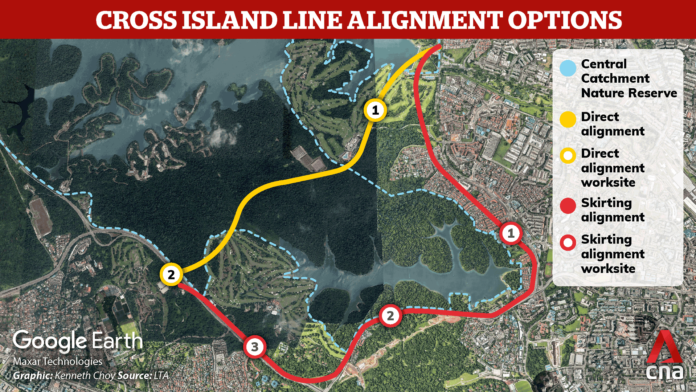
SINGAPORE: The environmental impact of both proposed routes for the Cross Island Line (CRL) near the Central Catchment Nature Reserve (CCNR) can be “adequately managed” with “comprehensive” mitigation and monitoring plans, a study commissioned by the Land Transport Authority (LTA) has found.
The direct route involves building a 2km tunnel about 70m deep under the CCNR, worrying green groups who want Singapore’s wildlife and nature preserved.
The other route is a 9km stretch going around the reserve and under homes and businesses, increasing end-to-end travel time by about four minutes. This option adds an estimated S$2 billion in costs, and the Government said it may also need to acquire land.
Both routes will not involve surface works in the nature reserve. The direct route will have two worksites outside the CCNR, while the skirting route will have three worksites outside the CCNR, one of which will be located next to a residential estate on Upper Thomson Road. The worksites will be converted to permanent facility buildings for the CRL.
Proposed alignment options for Singapore’s Cross Island Line.
LTA said in a statement on Monday (Sep 2) that the expected environmental impact of both routes is “largely confined” to parts of the tunnel and construction worksites outside the CCNR, adding that this can be managed by “robust” mitigation measures, citing the study.
“This can be achieved through locating the worksites as far as possible from the CCNR and the implementation of a comprehensive Environmental Monitoring and Management Plan (EMMP) to protect flora and fauna,” it stated.
“This EMMP will also help to mitigate any disamenities to nearby residents.”
An independent panel of international advisers, comprising industry experts in tunnelling and underground construction, has also reviewed engineering schemes for both routes and concluded that tunnelling along both options is safe with control measures in place.
These findings are part of the second phase of the Environmental Impact Assessment (EIA) for the underground stretch of the CRL near the CCNR. The first phase, completed in February 2016, had evaluated the environmental impact of site investigation works in the CCNR.
However, LTA has not made a decision on the final route of the CRL.
“In addition to the EIA findings, the Government will consider other factors, such as transport connectivity, travel times, costs and impact on home owners and commuters, when deciding on the final route of the CRL,” it added.
LTA has not set a timeline on when it will make a decision on the final route. The public can give feedback on the report for one month, before LTA starts advanced engineering studies on one or both routes next year, a process that can take two years.
“LTA will mitigate the environmental impact of the chosen alignment, and put in place a robust EMMP as laid out in the EIA report,” the agency said. “The EMMP will also be further assessed and strengthened as the project progresses.
The CRL, a roughly 50km fully underground MRT line with about 30 stations spanning Jurong to Changi, is expected to open in 2030. Commuters are expected to make at least 600,000 trips daily on the CRL, more than the existing North-East Line.
It will also connect existing radial MRT lines with almost half of its stations being interchange stations, and is part of a plan to almost double Singapore’s rail network by 2030 and put eight out of 10 households within a 10-minute walk of a train station.
IMPACT OF DIRECT ALIGNMENT
For the direct route, the impact to people during the construction phase includes an impact on nearby water resources and noise pollution to Windsor Park residents due to construction activities, the study found.
The study noted that this impact can be reduced to “negligible to minor” significance with mitigation measures like the diversion of water discharge points from the worksites to drains that are not connected to nearby streams, and the installation of visually compatible noise barriers.
The impact on plants and animals during the construction phase include the clearing of forest habitats and impact on a stream system within Windsor Nature Park due to sedimentation during construction, the study found.
The study noted that this impact can be reduced to “moderate” significance with mitigation measures like wildlife shepherding and hoarding during worksite clearance, and artificial crossing aids to reduce the impact of habitat separation.
The study added that the residual impact of vibration at the surface of the CCNR during tunelling works can be reduced to negligible through the monitoring, assessing and reviewing of vibration in advance of the works. This will allow the implementation of further mitigation measures to reduce vibration levels to below background levels.
Graphic: LTA
The impact during the operation phase include an impact on surface water bodies due to an increase in surface runoff from the permanent facility buildings, and the potential risk of wildlife changing their behaviour and getting trapped in the buildings, the study found.
The study noted that this impact can be reduced to “moderate” significance with mitigating measures like the “sensitive design and location” of the buildings and proper removal of roosts found within their premises.
According to the study, a “moderate” significance indicates “small effects” that are comparable to existing conditions and/or accepted standards.
IMPACT OF SKIRTING ROUTE
For the skirting route, the impact on people during the construction phase will include increased dust around the worksites and increased noise levels during night-time works. High-rise residents near Upper Thomson Road will also have a view of the construction work.
The study noted that this impact can be reduced to “moderate” significance with mitigation measures like the installation of visually compatible noise barriers and advanced notification of tunnelling operations to affected residents.
However, the study pointed out that the residual impact will remain of “major” significance for high-rise residents in three blocks overlooking one of the worksites.
(Graphic: LTA)
The impact on plants and animals during the construction phase will include worksite clearance and construction works, the study found, adding that the ecological impact at one worksite is negligible due to its highly urbanised location.
It noted that this impact can be reduced to “moderate” significance with mitigation measures like wildlife shepherding and hoarding (what does this mean?? hoarding of what?) during worksite clearance and the enforcement of speed limits along access roads.
The impact during the operation phase would be similar to that in the direct route option, the study found, adding that the impact can be reduced to “moderate” significance with similar mitigation measures.
NATURE GROUP “HAPPY” LTA COMMITTED TO MITIGATION MEASURES
Nature Society Singapore president Shawn Lum said he is “happy” that LTA is committed to implementing the proposed mitigation measures, adding that the agency had met members of the nature community over several “deep dive” sessions since June 2013.
“We sought to highlight potential environmental impacts as accurately and objectively as possible, with everyone committed to ensuring that the diversity and ecological integrity of CCNR is not impaired,” he stated.
“Finding a way to carry out vital infrastructure work without diminishing our precious natural heritage remains important common ground to all of us.”
SINGAPORE: Nearly three in 10 persons with disabilities (PWDs) who are of working age are employed, Minister of State for Manpower Zaqy Mohamad told Parliament on Monday (Sep 2).
The resident employment rate was 28.6 per cent among PWDs in the working ages of 15 to 64, Mr Zaqy said as part of his response to a Parliamentary question by Member of Parliament Chong Kee Hiong regarding employment rates of the disabled.
Another 4.2 per cent of PWDs in this age range were without a job and actively looking for one, translating to a resident unemployment rate of 12.9 per cent.
“The remaining two-thirds of PWDs in this age group were outside the labour force, with most of them citing poor health or disability as the main reason,” added Mr Zaqy.
The Ministry of Manpower (MOM) has started collecting data on the employment outcomes of PWDs through the annual Comprehensive Labour Force Survey, and data is available from 2018 onwards.
Mr Chong also asked for a breakdown of employment rates by age bands.
In response, Mr Zaqy said that the resident employment rate for PWDs aged 15 to 39 years old was 27.6 per cent. For those aged between 40 and 49 years old, the resident employment rate was 37.8 per cent.
That rate was 26.1 per cent of PWDs aged between 50 and 64 years old, and 5.9 per cent for those aged 65 and above.
The sectors employing the most resident PWDs are community, social and personal services, food services, administrative and support services and manufacturing, which together account for more than half of PWD employment.
Ms Roszana Ali (right) has her best friend, Ms Juni Syafiqah Jumat, to thank for introducing her to her first job.
INACCURATE FIGURES FROM STRAITS TIMES
In a supplementary question, Mr Chong called for an explanation for the figures published by newspaper The Straits Times (ST) in February, which reported that “just 5 in 100 people here disabilities have jobs”.
Mr Zaqy replied that the figures cited are “erroneous”.
“The incorrect data was derived by ST using different sources of publicly available data,” the minister said.
“Back then we have done our comprehensive labour force survey for PWDs so therefore understandably they had patched together some data from different sources.”
“For the total number of PWDs in the population, ST applied the estimated prevalence rate from an NCSS survey of 2,000 persons,” Mr Zaqy added.
“This is different from what we have from the Comprehensive Labour Force Survey, which covers about 100,000 persons from 33,000 households so it’s a more accurate view.”
He also pointed out that ST took certain lump numbers that included those above 65.
“And above 65, you’ll find a higher prevalence of disability not just because of conditions that you were born with but also because of old age, so you have deterioration of health,” said Mr Zaqy. “So typically for employment rates, we look at 15 to 64.”
SCHEMES TO HELP COMPANIES HIRE PWDS
Member of Parliament Intan Azura Mokhtar also raised another question on the effectiveness of government schemes in helping companies or employers hire PWDs.
She cited the Special Employment Credit (SEC), Open Door Programme (ODP) and Workfare.
In response, Mr Zaqy said that MOM in 2012 extended SEC to employers that hire Singaporeans with disabilities of all ages earning up to S$4,000 a month.
SEC provides an automatic wage offset of up to 16 per cent of the employee’s monthly income for PWDs aged below 67, and up to 22 per cent for PWDs aged 67 and over.
“Last year, more than 5,700 employers hiring over 8,600 Singaporeans with disabilities benefited from SEC,” added the minister.
“This number has increased from 2012, when SEC was paid to around 3,200 employers hiring about 5,000 Singaporeans with disabilities.”
Employers and PwDs can tap on the employment support services and programmes under the Adapt and Grow initiative, and this includes the ODP and Career Trial, Mr Zaqy said.
The ODP Training Grant provides a subsidy of up to 90 per cent of course fees to support the training of PWDs and their co-workers. The ODP Job Redesign Grant provides employers with funding of up to 90 per cent of the job redesign costs, capped at S$20,000 per employee with disability, to help integrate PWDs at the workplace.
“Some employers and PwDs may have reservations about job fit and the suitability of the work environment,” said Mr Zaqy.
“To address these concerns, Career Trial provides an opportunity for jobseekers and employers to try out each other and assess job fit through a trial. During the trial, which can be up to three months, jobseekers receive a training allowance from the Government.”
He stated that close to 780 companies have hired more than 2,000 PWDs with support from the Adapt and Grow initiative, with at least 60 per cent of these PWDs remaining employed after six months.
The minister mentioned that the Workfare Income Supplement (WIS) and Workfare Training Support (WTS) were extended to lower-wage PWDs of all ages in 2012 and 2017 respectively.
WIS tops up the salaries and CPF savings of lower-wage PWDs, with up to S$3,600 in cash and CPF contributions annually while WTS provides support such as course fee subsidies and training allowances.
“Last year, more than 6,400 Singaporeans with disabilities benefited from WIS, up from more than 3,500 in 2012,” said Mr Zaqy.
“The number of Singaporeans with disabilities who benefited from WTS training also increased last year to about 860, up from about 640 in 2017.”
In March this year, the Ministry of Social and Family Development announced the formation of a new workgroup to look at enhancing access to learning opportunities and employment pathways for PWDs.
The workgroup aims to release their recommendations early next year, Mr Zaqy said.
SINGAPORE: Four men were arrested and 1,390 cartons of duty-unpaid cigarettes were seized during an operation in an industrial building in Tuas, Singapore Customs said in a statement released on Monday (Sep 2).
During the operation at Tuas Bay Close last Tuesday, officers noticed a Malaysia-registered tipper truck, which was suspected to be used to transport duty-unpaid cigarettes, parked in a warehouse unit.
Officers found 768 cartons of duty-unpaid cigarettes concealed in the hidden compartments under the cargo floorboard of the truck and 622 cartons in the warehouse unit.
The Malaysia-registered tipper truck used to convey duty unpaid cigarettes parked in the warehouse unit. (Photo: Singapore Customs)
Singapore Customs said that the duty and Goods and Services Tax (GST) evaded amounted to about S$118,700 and S$8,750 respectively.
Cash of various currencies amounting to more than S$14,000 was also seized by the officers during the operation, it added.
Four men, a 37-year-old Malaysian driver and three Singaporeans aged between 41 and 67, were arrested, Singapore Customs said, adding that the Malaysian man and one of the Singaporeans were charged in court on Aug 29.
Investigations are ongoing for the remaining two Singaporean men.
Singapore Customs officers found 622 cartons of duty-unpaid cigarettes in the warehouse unit. (Photo: Singapore Customs)
Singapore Customs seized 1,390 cartons of duty-unpaid cigarettes during an operation in an industrial building in Tuas Bay Close on Aug 27, 2019. (Photo: Singapore Customs)
“Buying, selling, conveying, delivering, storing, keeping, having in possession or dealing with duty-unpaid goods are serious offences under the Customs Act and the GST Act,” Singapore Customs said.
Offenders can be fined up to 40 times the amount of duty and GST evaded and/or jailed for up to six years. Vehicles used in the commission of such offences and proceeds of sales of duty-unpaid cigarettes are also liable to be forfeited.
Members of public with information on smuggling activities or evasion of Customs duty or GST can call the Singapore Customs hotline on 1800-233-0000, email customs_intelligence@customs.gov.sg or use Customs@SG mobile app to report these illegal activities.