SINGAPORE: The “biggest challenge” facing Singapore’s education landscape today is creating a system that would be fit for purpose to enable continued learning, Prime Minister Lee Hsien Loong said on Wednesday (Sep 4).
Speaking at a dialogue session of the inaugural Singapore University of Social Sciences (SUSS) Ministerial Forum, Mr Lee said there is existing capability to run a system for students before they enter the workforce, whether through polytechnics, universities or Institutes of Technical Education (ITEs).
However, to make a system that would be effective to educate adults, Generation X and those older than Generation X is a challenge, he said in response to a question from the audience.
“If Generation X says can’t remember so many things, better (to) do open-book exams, imagine people in their 50s, 60s or maybe sometimes 70-year-olds who want to come back for a refresher, who want to learn something,” Mr Lee pointed out.
“How do we run a course … an education system that can meet their needs and suit their style of learning?”
Mr Lee said this is “not easy at all”. It is not an issue of just money or running the courses, he added, but to have people with experience to operate these, as well as a support system for older workers when they decide to go back to school.
“I must have the whole support system for them so that when they come in, their employers understand and they can focus on their jobs as well as on their studies and keep the balance,” the Prime Minister said.
“Employers will have to make adjustments because all employees will have to go through this at some stage in their lives,” he added.
He is confident that Singapore will have such a system.
“We will do it, we’ve got (SkillsFuture) SG. But we’re still early on in the journey,” Mr Lee said.
Prime Minister Lee Hsien Loong speaking during the dialogue session at the inaugural SUSS Ministerial Forum on Sep 4, 2019.
“BE HUNGRY TOO”
The Prime Minister also urged Singaporeans to be as “hungry” as their Asian counterparts, who may be perceived sometimes as hungry and willing to accept lower salary to get jobs here.
“I think that we have to be hungry too, because if we are not hungry then somebody will steal our lunch,” Mr Lee said.
Such competition is managed here, he added, as the authorities track the numbers of foreigners who come here to work, their standards and their proportions. This is so they “don’t crowd Singaporeans out” and locals will have job opportunities, he added.
However, he warned that Singaporeans will have to play their part and be competitive in order for jobs to remain here.
“The reality is if Singaporeans are not up to scratch, the jobs will not come here to look for Singaporeans,” Mr Lee warned. “The jobs will leave here to go to the places where the talent and the enterprise and the hard-working people are.”
Indonesia, Malaysia, Vietnam, China and India were cited as possible alternatives for companies to bring their jobs to, he added.
That said, there are not enough Singaporeans entering the workforce even as the birth rates here continue to drop, he pointed out.
This is why there is a need to “top up” on foreign talent, whether these are engineers, IT professionals managers and even workers, the Prime Minister explained, adding if this is not done, Singapore will not be able to take up all the opportunities that are available.
Trade and Industry Minister Chan Chun Sing had in Parliament this week defended the need for the Tech@SG scheme, which makes it easier for qualifying tech firms to import highly skilled foreign workers amid a global talent crunch.
“We open the door, they come, they complement us,” Mr Lee said. “We have to work hard, yes, but we work hard and we hold our own.”
SINGAPORE: The proposal for the use of restraints in rehabilitation homes for youth offenders and the possible undermining of parental rights and status were among the concerns raised during the debate on the amendments to the Children and Young Persons Act (CYPA).
Members of Parliaments (MPs) took to the floor to give their views on the Bill over two days starting on Tuesday (Sep 3).
One concern was on the use of restraints in Ministry of Social and Family Development’s (MSF) Youth Homes and whether these could create more psychological damage to the children.
The use of restraints “could add to the trauma faced by the children and such actions seem anti-thesis to the spirit of rehabilitation”, said Jurong GRC MP Rahayu Mazam.
Similarly, Nominated MP Anthea Ong questioned the intent of using restraints, pointing to the existing use of padded rooms and calming rooms to manage self-harm and aggressive or violent behaviour through therapeutic means.
Nominated MP Anthea Ong speaking in Parliament on Tuesday, September 3, 2019.
In response, Minister for Social and Family Development Desmond Lee on Wednesday cited the case of a burly and well-built (about 1.83m) 15-year-old Boys’ Home resident who held his dormitory mate by the neck and lifted him off the ground.
“This is one of the many scenarios where our officers find it essential to be able to deploy the use of restraints and other measures quickly, to safeguard other residents,” he said.
He stressed that the restraints “will not be used as a punitive measure”.
“But members will appreciate that there are indeed real-life situations where the use of such restraints is necessary to prevent escalation, escape or harm,” Mr Lee said.
He explained that MSF will put in place “stringent procedures and processes” when it comes to using restraints.
“This includes recording each use of the restraints, and removing the restraints once the need has passed,” the minister said.
“Rehabilitation of the youth is important. After the restraints are removed, an MSF officer will help the resident to process his feelings. Where necessary, a multi-disciplinary team comprising the caseworker, psychologist and psychiatrist will also support the youth through this process,” he added.
REFORMATIVE TRAINING
Workers’ Party (WP) MP Sylvia Lim asked about the basis for determining a first-time youth offender’s suitability for Reformative Training (RT).
Workers’ Party MP Sylvia Lim speaking in Parliament on Tuesday, September 3, 2019.
“RT is a tough regime that emphasis military-style discipline and involves participants who are older. With these amendments, RT will usually be ordered for offenders between 18 to 21 years of age,” she said.
“On what basis would a youth court conclude that he would be a failure at a JRC (juvenile rehabilitation centre) if he has never been sent there. Is there a danger of overreach here?”
Mr Lee noted that youths would only be sent for RT after careful consideration by the Youth Court.
“The court will call for a suitability report to determine whether the youth’s physical and mental condition is suitable for reformative training,” he said.
He added that demonstrations of aggressive or violent behaviour would factor into the decision to send the youth for RT.
“The assessment of individual risk levels and needs of the youth determines the regime and environment that best supports his rehabilitation,” he said.
UNDERMINING PARENTAL RIGHTS?
MP for Bishan-Toa Payoh GRC Saktiandi Supaat also raised questions on whether the Enhanced Care and Protection Order (ECPO) would undermine parent-child relationships.
“We could compromise the structure and integrity of families by being overzealous in interfering with the discipline and care of children,” he said in Malay.
He also asked if MSF would protect children from being coerced into joining another religion under their caregiver.
“There may be caregivers who are over-enthusiastic in trying to promote their own religion, and perhaps this is with all good intentions, but they should respect that the child should be allowed to make his/her own decision after reaching 18 years of age,” he said.
Minister for Social and Family Development Desmond Lee in Parliament on Wednesday, September 4, 2019.
Mr Lee explained that MSF aims to return children in out-of-home care back to their family as soon as possible, if it is safe to do so.
He added that the ECPO does not allow MSF or caregivers to make decisions on religion on behalf of the child.
“Our practice is to try to place children with foster families of the same race and religion as far as possible, or if that is not possible due to fostering constraints, we will seek parental consent,” he said.
SUPPORT FOR EXPANDED RIGHTS OF CHILDREN AND CAREGIVERS
Several MPs spoke up in support of replacing the term “emotional injury” with “emotional harm”, which gives stakeholders like the ministry, social service agencies and the court more clarity on when to intervene in the care of children.
MP for Ang Mo Kio GRC Intan Azura Mokhtar said: “Injury tends to suggest that the abuse is rather tangible, explicit and is visible, while harm is more all-encompassing and suggests that while it may not necessarily be visible, the damage the abuse has caused is much more far-reaching and may manifest itself in ways other than that which is visible.”
Dr Intan added that some parents or guardians may end up subjecting their child to “emotional abuse or acts of degradation” in their “fervour” to bring out the best in their children.
“Some parents see the scolding or nagging, or even acts of punishment as necessary acts of discipline for their children. Where and how do we draw the line?”
Dr Intan Azura Mokhtar speaking in Parliament on Wednesday, September 4, 2019.
WP’s Ms Lim also placed her support behind a new amendment made to the Passport Act to “allow the Director-General, a protector or a foster parent to give consent for a child to be issued with a passport for international travel”.
She raised a case where a child’s parent refused to give permission for their child to travel to Malaysia with his foster family, as the parent was highly critical of the care given by the foster parent despite evidence that the child was happy and doing well.
Citing her overall support for the amendments, Ms Lim said: “The changes in this Bill are overall steps in the right direction and bring our law in line with international norms.”
The Bill was passed in Parliament on Wednesday, following the debate during which 13 MPs spoke on the proposed amendments.
SINGAPORE: More than 250 participants took part in the third and largest multi-sector exercise aimed at improving Singapore’s crisis response capabilities and readiness to respond effectively to a cyberattack.
Called Exercise Cyber Star, participants from both the public and private sectors were tested on their response to more complex cyberattacks such as Internet connectivity disruption and the compromise of industrial control systems.
“It’s a constantly evolving set of capabilities that they need, because the threat is constantly evolving,” said Senior Minister and Coordinating Minister for National Security Teo Chee Hean, who observed the exercise.
“And because of the nature of the Internet, we have to face the most sophisticated threats in the world. And whatever we can think, the attackers out there can think of things which are also more sophisticated and more ingenious. So it’s a constant battle.”
Exercise Cyber Star brought together representatives from 11 critical information infrastructure agencies, including healthcare, energy and aviation. (Photo: Ahmad Khan)
Eleven critical information infrastructure were involved in the exercise. They are: government, infocomm , energy, aviation, maritime, land transport, healthcare, banking & finance, water, security and emergency, and media.
Exercise Cyber Star, a multi-sector exercise aimed at improving Singapore’s crisis response capabilities and readiness to respond effectively to a cyberattack. (Photo: Ahmad Khan)
This is the first time the exercise has been held since the SingHealth cyberattack last year. The breach saw the personal information of 1.5 million people stolen.
While the exercise is one way the nation is strengthening its capabilities collectively as a country, individual companies have to boost their own cyber defences.
Mr Teo said: “Every organisation in Singapore, every individual actually has to look after his own hygiene. So the CSA (Cybersecurity Agency of Singapore) cannot be protecting everyone. So even the non-critical information infrastructure sectors, every company must realise that it can be an existential threat for their company if they get attacked.”
Mr Teo was accompanied by Minister for Communications and Information and Minister-in-Charge of Cybersecurity S Iswaran, as well as Dr Janil Puthucheary, Senior Minister of State for Communications and Information and Senior Minister of State in-Charge of Cybersecurity.
HONG KONG: Two men were in a stable condition in hospital on Wednesday (Sep 4) after Hong Kong police clashed with protesters overnight, as unrest that has gripped the Chinese-ruled city for months showed little sign of abating.
Riot police fired beanbag guns and used pepper spray – both anti-riot weapons – to clear demonstrators from outside the Mong Kok police station and in Prince Edward metro station, with one man taken out on a stretcher with an oxygen mask over his face, television footage showed.
Videos showing the man being apprehended by the police in the station have been widely shared on social media with protest groups and activists saying it is evidence of the police brutality they say is widespread and needs to be investigated.
The police, who have repeatedly denied using excessive force, did not immediately respond to a request for comment. Hong Kong police are due to hold a news conference at 4pm (0800 GMT).
Three men, aged between 21 and 42, were taken to Kwong Wa Hospital late on Tuesday, a hospital authority spokeswoman said.
Two, including the man stretchered out of Prince Edward station, were in a stable condition and one had been discharged, she said.
Hundreds of thousands of people have taken to the streets since mid-June in sometimes violent protests calling for greater democracy in the former British colony, posing a direct challenge to the central Chinese government in Beijing.
Police have arrested more than 1,100 people since the protests started.
Metro stations have often become the front line in battles between masked protesters and police, deepening the biggest political crisis in the Asian financial hub since its handover from Britain to China in 1997.
IMPASSE
The unrest is piling pressure on Hong Kong’s leader Carrie Lam, who told a group of business people last week that she had “very, very limited” ability to end the crisis and it had been elevated “to a national level”, a reference to the leadership in Beijing. Her comments in an audio recording of the meeting were reported by Reuters on Tuesday.
Lam also said in the recording that she would step down if she had a choice, fuelling protesters’ complaints that the partial autonomy granted to Hong Kong in 1997 under a “one country, two systems” agreement is being slowly eroded by Beijing.
Hong Kong Chief Executive Carrie Lam triggered the protests with her attempt to push through a law allowing extradition to mainland China AFP/Anthony WALLACE
Beijing denies that and says it is committed to the formula.
China denies it is meddling in Hong Kong’s affairs but warned again on Tuesday that it would not sit idly by if the unrest threatened Chinese security and sovereignty.
Protests that began over a now-suspended extradition bill have evolved into a push for greater democracy, including the right to elect its own leaders. Beijing has said giving Hong Kong universal suffrage is out of the question.
China has denounced the protests and warned about the impact on Hong Kong’s economy. China has also accused Western countries of stirring up the unrest.
With protesters and Lam’s government at an impasse there are concerns the city’s economy could go into a tailspin, with signs already that money is moving out to other financial centres, including Singapore.
Hong Kong’s private sector activity declined at the fastest pace in more than a decade in August as the protests and an escalating trade war between China and the United States hit demand, data showed on Wednesday.
SINGAPORE: ComfortDelGro announced on Wednesday (Sep 4) it has launched a three-month trial of an on-demand bus service in the eastern part of Singapore.
Called ComfortConnect, the service has been available for residents in Tanjong Rhu and Meyer Road since Aug 15.
Fares will not be collected during the trial.
The bus service operates between 10am and 4pm on weekdays and serves 16 stops, including the majority of the condominiums in the Tanjong Rhu/Meyer Road area, Parkway Parade, the Singapore Swimming Club as well as Dunman High School.
“We believe that on-demand services have the potential to supplement conventional public transport services,” said Mr Pang Weng Heng, CEO of ComfortDelGro Bus.
“Through this trial, we hope to gauge the commercial viability of on-demand services which will help us plan for new services in the future,” he added.
To book an on-demand bus ride, passengers have to download ComfortDelGro’s ComfortConnect App from the Apple App Store or Google Play store. (Screenshot: Apple App Store)
To book an on-demand bus ride, passengers have to download ComfortDelGro’s ComfortConnect App from the Apple App Store or Google Play store.
They can then select a stop as a pick-up point and another as a drop-off point, indicate the date and time of pick-up before selecting book.
They will receive an in-app notification once the ride is confirmed and another notification at least two minutes before the bus arrives.
The bus will complete the ride even if there is only a single booking.
Although the trial saw mileage savings, LTA said in a news release in May that it was currently “less cost-effective” for on-demand public buses to be scaled up due to high technology costs.
SINGAPORE: Two live hedgehogs were found hidden in a Singapore-registered car at the Woodlands Checkpoint by Immigration and Checkpoints Authority (ICA) officers on Saturday (Aug 31).
The animals were wrapped in camouflage netting and hidden in the spare tyre compartment of the vehicle.
ICA said a 42-year-old Singaporean man was referred to the National Parks Board (NParks) for further investigation and that the hedgehogs are now under the care of Wildlife Reserves Singapore.
“Animals like hedgehogs are not suitable as pets as they may transmit zoonotic diseases to humans and can be a public safety risk if mishandled or if they escape.
“These non-native animals may also pose a threat to local biodiversity if released into the environment,” ICA said in a Facebook post on Tuesday.
Several attempts to smuggle animals into Singapore via the land checkpoints have been made in recent months.
A total of 15 containers of 815 birds were uncovered in a Malaysia-registered bus at Woodlands Checkpoint. (Photo: ICA)
The birds were found in 15 containers hidden in modified compartments above the rear tyres of a Malaysia-registered bus. Only about 600 of the birds survived and are being cared for and quarantined at NParks’ facilities.
SINGAPORE: Local e-commerce firm Shopee opened its new regional headquarters on Tuesday (Sep 3) as it leverages strong growth in Southeast Asia.
The six-storey building in Kent Ridge, spanning 244,000 sq ft, is nearly six times larger than its previous office across the street. It can house up to 3,000 employees.
Shopee has seen “tremendous” growth since it was founded four years ago, said Deputy Prime Minister Heng Swee Keat at the opening ceremony.
He noted that the company is now one of the top three e-commerce players in Southeast Asia. It has a presence in seven markets.
According to Shopee, it saw a record gross merchandise volume of US$3.8 billion (S$5.3 billion) in the second quarter of 2019. Adjusted revenue in the same period was US$177.4 million, up by more than 200 per cent year-on-year.
The firm said its decision to sink its roots in Singapore reflects its long-term commitment to investing in the country, which includes hiring more locals.
“As we grow, we will continue to offer exciting new roles to Singaporeans,” said Mr Forrest Li, chairman and Group CEO of Sea – Shopee’s “decacorn” parent company valued at more than US$10 billion.
In particular, these roles would be for data scientists or software engineers.
Shopee’s new headquarters features an in-house masseuse. (Photo: Shopee)
Shopee will continue to focus on “expanding the tech talent pipeline”, said its chief commercial officer Zhou Jun Jie.
For example, the firm has committed to training more than 100 employees under the Infocomm Media Development Authority’s (IMDA) TechSkills Accelerator (TeSA) initiative to become software engineers and data analysts.
The company has also hosted events such as Singapore’s largest national data science challenge, which took place in February.
Shopee’s growth is “aligned” with Singapore’s plans to serve as a regional hub and harness new opportunities in the Southeast Asian digital economy, said Mr Heng.
Deputy Prime Minister and Minister for Finance Heng Swee Keat tests out Shopee’s chatbot and machine translation engine during the launch of its new headquarters on Sep 3, 2019. (Photo: Shopee)
“The rise of Southeast Asian and Asian economies brings opportunities, and we must position Singapore well to harness them,” he said.
“We have to constantly strive to ensure that companies like Shopee, doing business across the region, will continue to see Singapore as an ideal base for serving the region.”
Mr Heng, who is also Finance Minister, added that the opening of Shopee’s new headquarters is “a vote of confidence” in the strengths of Singapore’s economy.
Shopee said its new office was designed to “maximise comfort” for all employees.
It features a dinner catering service where employees can pre-order their meals, naps pods at every floor, a mini arcade, as well as an in-house masseuse.
SINGAPORE: Members of Parliament (MP) have urged employers of migrant workers who sustain injuries while on the job to promptly pay for their medical treatment, and provide proper food and accommodation during the compensation process.
The Ministry of Manpower (MOM) should also notify these workers when employers file an accident report, the MPs said, adding that the ministry should increase outreach efforts to ensure the workers are aware of their rights and changes to the law.
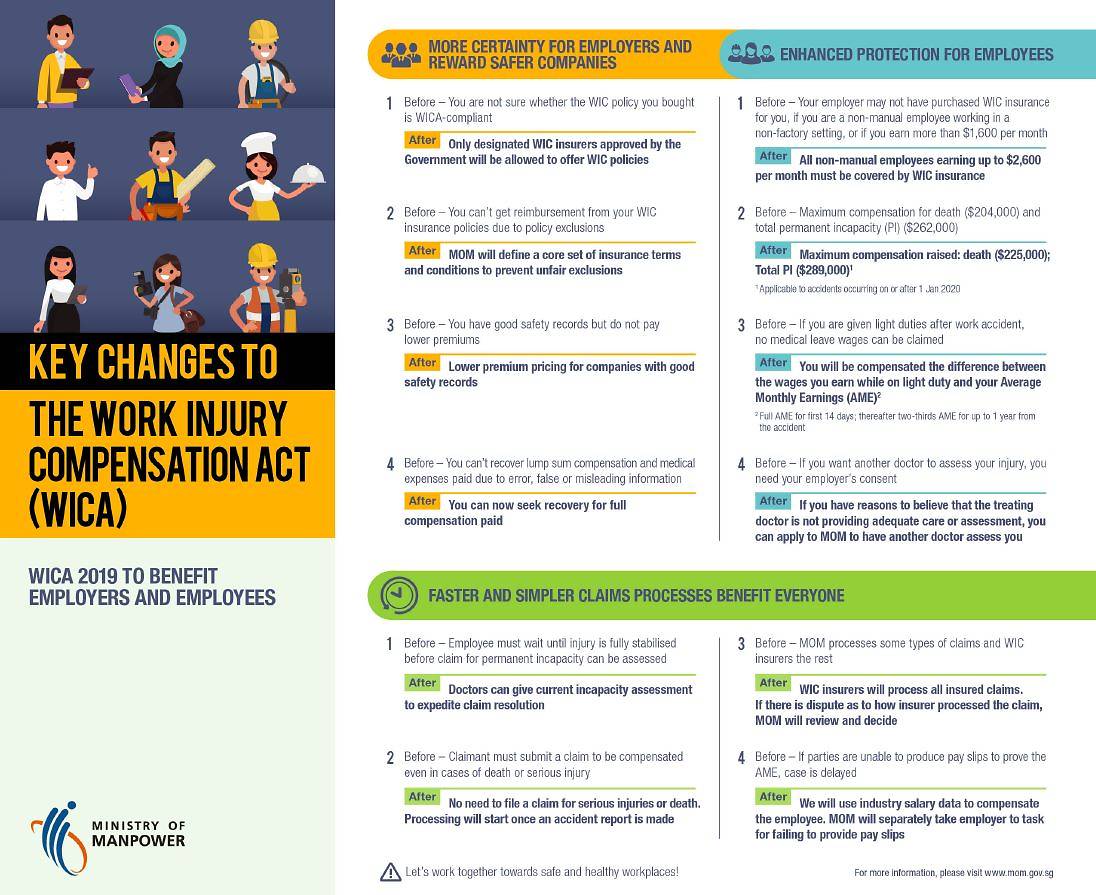
The call came as Parliament on Tuesday (Sep 3) passed the amended Work Injury Compensation Act (WICA), which protects more workers, and allows for faster and simpler work injury claims.
For instance, workers on light duty (LD) due to a work injury, who might be paid significantly less because they cannot work overtime or get certain allowances, will receive equal compensation to those with medical certificates (MC).
Previously, compensation only covered those with MCs.
Employers must also now compensate workers for any shortfall between their average monthly earnings and earned salary for the first 14 days of MC and/or LD, and two-thirds of their average monthly earnings for one year thereafter.
The amended Work Injury Compensation Act. (Graphic: MOM)
Furthermore, employers will be required to report all instances of work-related MCs and LDs to MOM, preventing errant employers from trying to influence doctors to prescribe fewer MC or LD days.
Previously, there was no requirement to report work-related LD.
Workers will be allowed to switch doctors without employers’ permission on a case-by-case basis, for instance, when there is evidence to show that the doctor’s assessment is biased or inadequate. This will ensure workers get fair and sufficient treatment.
“MOM has received feedback that some errant employers may attempt to influence doctors to give inadequate medical leave or some doctors may be overly conservative and underestimate the percentage of permanent incapacity (PI),” Minister of State for Manpower Zaqy Mohamad said in his opening speech before the Bill was debated.
FASTER AND SIMPLER CLAIMS
The amendments will also allow PI claims to be settled faster as compensation can be made at the first opportunity six months – called the current incapacity (CI) assessment – from the date of an accident.
MOM said the Work Injury Compensation Medical Board observed that in most cases, the six-month timeframe offers a close approximation to the eventual state of PI.
According to MOM, 80 per cent of permanent injury cases are resolved within six months. The remaining 20 per cent, or 1,300 claims per year, take a longer time.
The change reduces the waiting time for an assessment and allows workers to receive compensation earlier, MOM said, adding that a delayed assessment could increase outlays for employers.
“Nonetheless, doctors will still have the professional discretion to assess for PI at a later date if they believe that the extent of incapacity will change further for more complex injuries,” Mr Zaqy said.
DELAY IN PAYING FOR MEDICAL TREATMENT
But Nominated MP Anthea Ong said some migrant workers who get injured at work experience a delay in getting medical treatment because their employers refuse to pay for it.
She spoke of two migrant workers from Bangladesh and China who suffered injuries in the past five months – one hurting his back after carrying heavy construction material and another rupturing his cornea after getting hit by a large metal hook – but could not get follow-up treatment because their employers did not settle outstanding medical bills.
“In case we think these are just a couple of odd cases recently, it’s far more common than we think because more than a considerable number of migrant workers are affected,” she said.
Labour MP Patrick Tay said there have been reports in which injured workers could not seek medical treatment because employers did not provide them with a Letter of Guarantee (LOG), adding that they then had to go without treatment as they were unable to afford it.
In response, Mr Zaqy said no worker will be deprived of treatment for a work injury regardless of an ability to pay or if an LOG was provided.
“Employers are already required under the WICA to pay for their employees’ medical treatment for any work injuries. This includes for diagnostic work like MRI scans to assess the extent of injury,” he said in his round-up speech after the debate.
“Workers should report to MOM if their employers are not willing to furnish an LOG for work injuries. We will take action against employers who fail to meet their obligation to pay for medical expenses under the Act.
“In addition, the new WICA will allow the ministry to order insurers to pay medical expenses directly to the healthcare institution if necessary,” said Mr Zaqy.
Under the new WICA, employers must pay for their workers’ medical expenses up to S$45,000 or one year from accident, whichever comes first.
This amount was raised from S$36,000 and is part of a review once every four years to keep pace with wage growth and healthcare costs.
Labour MP Zainal Sapari pointed out that there are good reasons to suspect that some employers or insurers might deliberately drag cases to put themselves in a better bargaining position.
“They are aware the migrant worker will run into hardship and put the employers or insurers at an advantage to negotiate a lower quantum which the worker has little choice but to accept,” he said, noting that the CI assessment at six months will help overcome this.
“This (S$45,000 maximum) entitlement is independent of the medical assessment of either PI or CI,” said Mr Zaqy. “The introduction of CI assessment therefore allows foreign workers to recuperate and be with their loved ones earlier in their home countries.”
FOOD AND ACCOMMODATION DURING COMPENSATION PROCESS
Another issue facing injured migrant workers is the issue of food and accommodation during the compensation process.
Nee Soon GRC MP Louis Ng said non-governmental organisations have shared “horror stories” of migrant workers being housed in “appalling conditions” or travelling long distances to their work sites to get food when they should be resting.
“Employers are currently required to provide adequate food and acceptable housing for migrant workers during the entire work injury compensation process,” he added. “However, it is not clear what adequate food and acceptable housing means.”
Inside a migrant worker dormitory in Singapore.
Mr Zaqy reminded employers that they are still responsible for looking after their workers while they are in Singapore even after their work permits have been cancelled.
“They have to provide acceptable housing and adequate food – for example, three meals a day – for workers whose work injury claims are still pending,” he said.
Mr Zaqy noted that before Aug 1, MOM had permitted workers who do not want to stay at employer-provided accommodation to stay elsewhere.
“However, this has caused other problems, such as no control over the housing conditions where the workers stayed,” he added.
“From Aug 1, we have established higher standards for injured workers’ housing. Employers have to continue housing the workers at their dorms or pay for housing and upkeep in other MOM-approved dorms.”
NOTIFYING WORKERS OF ACCIDENT REPORTS
When it comes to incident reporting, Ms Ong and Mr Ng said it is unclear how workers will be notified once employers file an accident report.
While letters addressed to migrant workers are usually sent to the office address of their employer, Ms Ong noted that there have been cases where the employer had failed to pass the letters on. Mr Ng also asked if these workers could receive accident reports through existing mobile applications.
Mr Zaqy clarified that once an employer submits an accident report, the employee will receive a letter informing them that an accident report has been made, their rights and the steps they need to take to receive compensation.
“The ministry or insurer will verify important information such as injury sites and salary information with them, and conduct fact-finding if there are any disputes,” he said, highlighting that workers who do not receive such a letter within three weeks can approach MOM for assistance.
“Claimants or anyone assisting them can obtain information about the claims status through our website or text messages. For the latter, they come in four languages and claimants can subscribe to our text messaging service to receive notifications when the claims status changes.”
When it comes to migrant workers, Mr Zaqy said MOM will explore how to provide other forms of notifications.
“The content of accident reports will not affect employees’ amount of compensation under the WICA, so workers would not need their actual reports,” he added.
Mr Zaqy said that MOM will also be able to address under-reporting of work injuries by referencing third-party data, which will be possible under the new WICA.
Under the amendments, insurers will be required to share work policy and claims information with MOM by Sep 1, 2020. MOM will in turn share this data with other insurers so they can price premiums more accurately. This practice is well-established in the motor insurance industry.
“With greater information transparency, employers with good safety records would be able to enjoy lower premiums, while those with poor safety records would face significantly higher premiums,” MOM said in a statement on Tuesday.
“This will provide a stronger commercial incentive for employers to prevent their employees from getting injured in the first place.”
INCREASING OUTREACH
Finally, Workers’ Party MP Pritam Singh said the amendments represent a “good opportunity” to review how WICA is communicated to employers and workers, citing reports that have shown how migrant workers are “ill-informed” about choosing between a WICA claim or common remedy, and the legal costs involved.
“The reality is that workers need enough information to assess how best to purse their injury claims, as not all are highly-educated and informed or know of their rights and responsibilities,” he added.
Mr Zaqy agreed that it is important for workers to understand what counts as a work injury, noting that over the years, MOM has expanded its outreach to educate employees, such as through the foreign workers’ Settling-in Programme.
“Mr Tay has also shared the assistance and support that unions and the Migrant Workers’ Centre can provide to those with work injury compensation claims,” he said. “For employers, MOM has and will conduct briefings to clarify any doubts.”
SINGAPORE: A total of 28 secondary schools will start piloting full subject-based banding next year, before it is rolled out to all schools by 2024.
The pilot schools will implement new ways of organising students from different academic courses into the same form class, said the Ministry of Education (MOE) on Tuesday (Sep 3).
They will also offer humanities subjects – geography, history and English literature – at a more demanding level from Secondary 2, for Normal (Academic) and Normal (Technical) students.
Subject-based banding was announced earlier this year to replace the existing system of streaming students into Express, Normal (Academic) or Normal (Technical) based on their PSLE results.
Under the new system, students will take subjects at a higher or lower level based on their strengths.
Normal (Academic) student Ian Chan initially thought it would be difficult to mingle with his friends from other streams when Bowen Secondary conducted a trial where Secondary 2 students attended Character and Citizenship Education (CCE) lessons together.
But it turned out a lot easier than what he had imagined, especially since they were grouped according to their Co-Curricular Activities (CCA).
Ian, whose CCA is the National Civil Defence Cadet Corps, said: “Sometimes when we don’t talk about school work, we’re talking about drilling. And we get to know what each other’s feelings are like, so that helps us to strengthen our friendship.
“As I got to know them better, I realised that they don’t actually care about our streams.”
Bowen Secondary is one of the 28 schools that will start piloting aspects of full subject-based banding from 2020.
Bowen Secondary School conducted a trial grouping Secondary 2 students in their CCA groups.
“The pilot schools were selected based on their readiness to participate in the pilot. Factors considered include their involvement in the earlier phases of SBB (subject-based banding) and their experience in supporting different profiles of learners,” said MOE.
Students in these schools will take a set of subjects at a common level such as art, design and technology, as well as music. For other subjects, students will be grouped in classes according to the level at which they take each subject.
Bowen Secondary teacher Dorothy Lim said it took up the offer to be a pilot school because of its experience implementing subject-based banding since 2017.
“We were able to stretch some of our students from the Normal (Academic) and Normal (Technical) streams,” she said.
“By doing so, we can provide all our students a keener set of social emotional skills and on top of that, allow them to pursue subjects that are pitched at their level, to the best of their ability.”
Ian Chan (left) initially thought it would be difficult to mingle with friends from other streams.
In preparation for full subject-based banding, the school reorganised Secondary 2 students according to their CCAs for CCE lessons, and conducted a trial over five sessions in April.
Express student Nur Faraha Faeaz, who is part of the military band, said that the experience during the trial was initially “awkward” because she did not know a lot of people in her batch despite being in the same CCA.
“Sometimes we judge each other by which stream we are from. For example, I’m from Express and I don’t really know this person from Normal (Technical) and I feel a little bit uncomfortable,” she added.
“But after getting to know them better, I feel a lot more comfortable and I get to know that despite their weaknesses, they also have strengths.”
Ms Lim said the main challenge encountered by teachers was catering to all students in the three different streams.
The colour guards are part of Bowen Secondary School’s military band and they were grouped in the same class as part of the trial.
The school has since given teachers learning opportunities with the ministry, teachers from other schools, as well as sessions for professional development.
While Bowen Secondary will not reorganise form classes according to CCAs next year, it will be conducting another trial for Secondary 1 students after the September school holidays.
The aim is to prepare at least half of the school’s teachers for the pilot next year when Secondary 1 students from different academic courses attend form classes together.
BUILDING MULTI-PURPOSE ROOMS FOR MORE FLEXIBILITY IN GROUPING STUDENTS
St Andrew’s Secondary School will also be piloting full subject-based banding next year.
Teacher Valerie Yeo said it was a “natural” move for them since the school was already conducting lessons using differentiated instruction.
Its Secondary 1 classes will have a mix of students from the different academic courses.
“We’re hoping to do a random mix, because that’s what the society is like out there. So we are not going to specifically engineer because our goal is to provide authenticity,” she said.
The school is also looking at building multi-purpose rooms to encourage more “versatility and flexibility” in grouping students.
St Andrew’s Secondary first implemented subject-based banding last year, and currently has a total of 52 Normal (Academic) and Normal (Technical) students under the new system.
Andre Khurana took three SBB subjects last year and made the jump to Express stream this year.
Secondary 2 student Andre Khurana, who made the jump from Normal (Academic) to Express stream, did subject-based banding for three subjects last year.
He still keeps in contact with his Normal (Academic) friends and wants to pay it forward, after receiving support from his friends in the Express stream.
“Because of them helping me last year to get into Express, and helping me with research like history, geography or maths, I’ll try to do the same for my Normal (Academic) friends so that they will have a better future,” he said.
More secondary schools will progressively introduce aspects of full subject-based banding from 2022 to 2024.
These are the 28 schools piloting full subject-based banding from 2020:
SINGAPORE: The Public Transport Council (PTC) has said that public transport fares could increase by up to 7 per cent in the 2019 Fare Review Exercise, which began on Tuesday (Sep 2).
The annual fare review is based on a formula that takes into account energy prices, inflation and manpower costs. The formula, tweaked last year, also takes into account commuter demand and enhancements and growth in public transport capacity.
“Based on the fare formula applicable from 2018 to 2022, the maximum allowable fare adjustment quantum for the 2019 FRE is 7 per cent,” PTC said.
The operators may submit their fare applications to the PTC by Sep 23. Last year, there was a fee hike of 4.3 per cent after three years of fare reductions.
Fare review exercise is based on a fare formula that seeks to balance fare affordability for commuters and financial sustainability of public transport operators at the same time. (Graphic: Public Transport Council)
The council added that the recent increase in energy prices has largely contributed to the potential fare increase.
“The largest contributing factor for the fare formula output quantum is the double-digit increase in energy prices, having rebounded 26.2 per cent in 2017, and 32.3 per cent in 2018.”
PTC noted that other costs have also increased over the past year.
“The Wage Index, a proxy for the wage growth of public transport workers, went up by 3.5 per cent, while the core Consumer Price Index rose by 1.7 per cent, the highest in four years.
“The Network Capacity Factor of 1.6 per cent, which measures capacity provision relative to passenger demand for the entire public transport system, reflects the effort to provide commuters with less crowded rides over the last year,” it added.
IMPROVED PUBLIC TRANSPORT SYSTEM
PTC said on Tuesday that over the last five years, more than 1,000 buses and 200 trains were added to Singapore’s public transport network.
It added that Singapore’s rail reliability has also improved significantly.
“The MRT network has achieved an MKBF (Mean Kilometres Between Failure) of over 1,000,000 train-km, a more than seven-fold jump from 2015.”
However, due to the bus and rail service enhancements, the cost of operating public transport has also been increasing, PTC said. Yet, average fares today are lower than in 2015.
“In tandem with bus and rail service enhancements, the cost of operating public transport has been increasing.
“In contract, average fares today are four to seven cents lower than in 2015, just before fares were reduced 8.3 per cent for three consecutive years, in part due to the dip in energy prices from 2015 to 2017.”
The “widening” gap between costs and fares over the past five years has been funded by the Government together with the rail operators, PTC added.
On Tuesday, PTC said that it will consider the views of commuters and relevant stakeholders in its deliberations of fare adjustments applications, adding that it “will continue to strike a fair balance between fare affordability and the financial sustainability of the public transport system”.
“In considering fare affordability, the PTC will pay special attention to concession groups and needy commuters.”
PTC will announce its decision on the fare adjustment quantum in the last quarter of 2019.