Don’t waste it away by spending it at home because there are lots of activities happening around the island to enjoy with your friends and family. Weekends will never be the same again with this weekend planner.
1. PAY WITH PLASTIC AT TIONG BAHRU MARKET
When we say we’ll be recycling the plastic bottles we collect at our ‘Pay With Plastic’ event, we mean it. All the…
SINGAPORE: A total of 159 suspected drug offenders were arrested by the Central Narcotics Bureau (CNB), including a 13-year-old boy, the authority said in a news release on Friday (Sep 13).
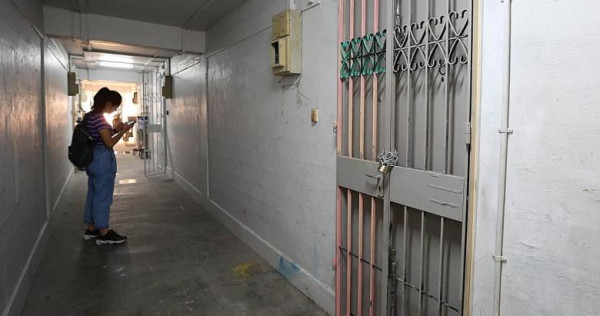
In a raid at a flat at Blk 454 Fajar Road, CNB officers arrested a suspect, her 13-year-old brother and their mother at a drug party.
Despite repeated warnings, the occupants in the unit refused to comply with the officers’ orders to open the door.
Two of the occupants tried to escape by climbing out of the flat onto the aircon ledge, but gave up and retreated back to the apartment, CNB added.
Syringes found on grass patch, in CNB raid on a unit at Fajar Road on Sep 11, 2019. (Photos: CNB)
Eventually, one of the occupants opened the flat door. CNB officers arrested eight suspected drug offenders there, including seven youths aged 13 to 18 years old.
One of the invited suspects, a 16-year-old teenager, had brought her 13-year-old brother and her 38-year-old mother.
CNB officers also recovered a small packet of Ice, a cut straw, two syringes, three lighters and a lighter refiller on the grass patch below the block. These were earlier thrown from the unit, the authority said.
Investigations showed that one of the suspects, a 17-year-old male foreign national, had invited four other suspects to his flat to take drugs.
DRUG RAID WITH CHILDREN PRESENT
During another operation, the suspects’ children were present when CNB officers raided the apartment.
On Sep 2, CNB officers arrested two suspected drug offenders – a 33-year-old man and a 28-year-old woman, both Singaporeans – from a unit in Edgefield Walk. Here, about 5g of Ice and drug paraphernalia were found.
During the raid, the couple’s children – aged three months, 19 months and six years old, were present, CNB said. The couple’s eldest child, who is six years and nine months old, was in school during the raid.
“CNB is working closely with the Ministry of Social and Family Development to care for the children,” the authority said.
“The children will be looked after by extended family members, with ComCare assistance and support from a Family Service Centre.”
The 11-day islandwide operation that took place between Sep 2 and Sep 13 covered areas like Buangkok, Geylang, Jurong, Sembawang, Serangoon, Simei, Telok Blangah, Toa Payoh, Woodlands and Yishun.
About 124g of heroin, 91g of Ice, 15g of new psychoactive substances, 8g of ketamine as well as Ecstasy pills, Erimin-5 tablets, three bottles containing methadone and two LSD stamps were seized.
Investigations into the drug activities of all the arrested suspects are ongoing, CNB said.
SINGAPORE: Work to expand the Bukit Timah First Diversion Canal has been completed after seven years, and it will better protect the flood-prone area.
The S$300 million project is one of Singapore’s most expensive and complex drainage improvement works.
The 3.2km canal can now take in 30 per cent more rainwater than before, said national water agency PUB on Friday (Sep 13), easing the risk of floods along Bukit Timah Road and Dunearn Road.
This area includes places such as Ngee Ann Polytechnic, Beauty World Plaza, King Albert Park and Sime Darby Centre.
First built in 1972, the canal diverts stormwater from the upstream section of the Bukit Timah Canal to Sungei Ulu Pandan.
However, areas around it experienced frequent flooding due to rapid urbanisation and the “under-sized” canal, said PUB.
In November 2009, it was overwhelmed by the equivalent of 115 Olympic-size pools of water which drained into the canal after intense rainfall. Knee-level floodwaters caused major traffic congestion and partially submerged basement car parks.
Last year, another bout of intense rainfall caused flashfloods in Bukit Timah, affecting the stretch from Blackmore Drive to Wilby Road.
A screenshot of a video taken of a flood at Toh Tuck Avenue after Pan Island Expressway exit on Tuesday (Jun 26). (Screengrab: YouTube/Vins & Annette Singh)
The reconstruction of the canal has freed up about four hectares of land – the size of seven football fields – as two-thirds of the canal is now covered.
Previously, the Bukit Timah First Diversion Canal consisted mainly of an open drain along its entire 3.2km length. According to PUB, some of the land has already been used for recreational purposes.
View of the completed tunnel underneath Military Hill. (Photo: PUB)
“IMPORTANT AND NECESSARY INVESTMENT”
At a ceremony on Friday to mark the completion of the upgrading works, Environment and Water Resources Minister Masagos Zulkifli said the project was an “important and necessary investment”, as climate change is expected to bring about more extreme weather in future.
He highlighted a recent study by Swiss-based research group Crowther Lab, which identified Singapore as one of the major cities that could experience a dramatically different climate by 2050.
“You have probably already noticed some of the impacts of climate change such as more intense rainfall and prolonged dry spells,” said Mr Masagos.
“By 2100, we could experience mean sea level rise of up to 1 metre, an increase in daily mean temperatures as high as 4.6 degree Celsius, and more extreme and intense weather events which may lead to more frequent floods,” he said, adding that the upgraded diversion canal will help Singapore to better prepare for this.
A view of Railway Corridor after construction. (Photo: PUB)
The project, which was carried out over three phases, started in 2012. It was originally expected to be completed in 2016 but the date was pushed back three times due to engineering challenges and difficult ground conditions.
As parts of the canal pass through hilly terrain and forested areas, more than 10,000 reinforcing bars of at least 10m in length were inserted into the slope along an 825m stretch of the canal.
Aerial view of Military Hill tunnelling. (Photo: PUB)
This helped to stabilise the slope and ensure that it did not collapse during construction works. It is the first time PUB has used this “Soil Nail” method in a drainage improvement project.
“This was a complex and challenging drainage project that required PUB’s engineers and contractors to surmount several tough obstacles throughout the three construction phases,” said Mr Yeo Keng Soon, PUB’s director of Catchment and Waterways.
“Extensive efforts such as multi-stage traffic diversions were also needed to minimise inconvenience and disruption to motorists and the public,” he added.
MORE UPGRADING WORK
Other flood protection measures for the area are in the pipeline.
In October, PUB will start upgrading works on a 900m upstream section of the Bukit Timah Canal.
The section, which stretches from Rifle Range road to Jalan Kampong Chantek, will be widened to around 12m, up from its current width of about 10m. It will also be deepened by an additional 1m to 2m.
Further downstream, work will be carried out along a 300m stretch to raise the road on either side of the canal by up to 20cm.
The project was awarded to Chan & Chan Engineering at a contract sum of S$53.2 million and works are expected to be completed by 2023.
A view of Garlick Avenue after construction. (Photo: PUB)
PUB said this will further boost flood protection in the area, preventing a repeat of the flash floods that occurred in recent years.
Since 2011, the Government has invested S$1.8 billion on drainage improvement works. Another S$400 million will be spent over the next two years.
So! You’ve made up your mind already to get one of those new iPhones you keep hearing about. In case you’re not interested at all in getting shackled to a two-year phone contract with the major telcos, the iPhone 11 series are available for purchase directly from Apple.
To ensure that you’ll be able to flex the trypophobia-inducing phones when it drops on Sept 20, it’s best that you camp by your computers this evening (Sept 13) when the pre-orders kick off at 8pm.
Some pros and cons when you purchase from Apple instead of telcos. You’ll be getting a SIM-free iPhone with the freedom to use and change carriers at any time without having to pay the — at times — exorbitant monthly fees when locked in a contract.
The downside is having to fork out the device’s full price upon purchase, though DBS/POSB, OCBC and Citi credit card owners can apply to pay the cost across a 12-month instalment period at 0 per cent interest.
SINGAPORE: Paper medical certificates (MC) issued by SingHealth institutions are expected to be replaced by digital MCs by 2020, the Government Technology Agency (GovTech) said.
Writing on its media platform TechNews on Monday (Sep 9), GovTech said patients will receive digital MCs under a new system called DigiMC.
The system has been piloted at the Singapore General Hospital and the National Heart Centre Singapore. Product manager Chong Zi Xin said 95 per cent of the 179 patients surveyed over a four-month period said they were satisfied with the new system.
GovTech said it plans to implement digital MCs across all SingHealth institutions by early 2020. They will be issued in parallel with hard copy MCs for a few months before the latter is eventually phased out.
About 1 million hard copy MCs were generated in 2017 by SingHealth, Singapore’s largest healthcare cluster.
RECEIVING A DIGITAL MC
Patients who are issued digital MCs will receive an SMS text message containing a URL for accessing the digital MC.
They can forward the SMS or the URL to their employers, said product manager Annabelle Ng.
Digital MCs are less likely to be misplaced, she added, as SMS messages can be backed up on commercial Cloud services for later reference. The URL to the digital MCs does not expire.
Patients that are issued digital medical certificate (MC) via DigiMC will receive an SMS text message containing a URL which they can use to access theire digital MC. (Image: MC.GOV.SG)
SECURITY FEATURES
To prevent unauthorised access, digital MCs will be locked with the patient’s date of birth, GovTech said. This serves as an “additional safeguard” on the off chance the information is sent to the wrong phone number or a wrong mobile number was registered, it added.
“For now, it is a one-time unlock. Once the digital MC is unlocked, it can be forwarded, and subsequent users would not have to unlock it again,” said Ms Ng.
In the future, the development team may add more security features, GovTech said. The team plans to implement a relock with the patient’s date of birth seven days after it is issued to avoid exposure in the long run.
The digital MC will also need to be unlocked using the patient’s date of birth for every subsequent view.
GovTech said patients will still be able to request for paper MCs after it has been phased out, should they require it.
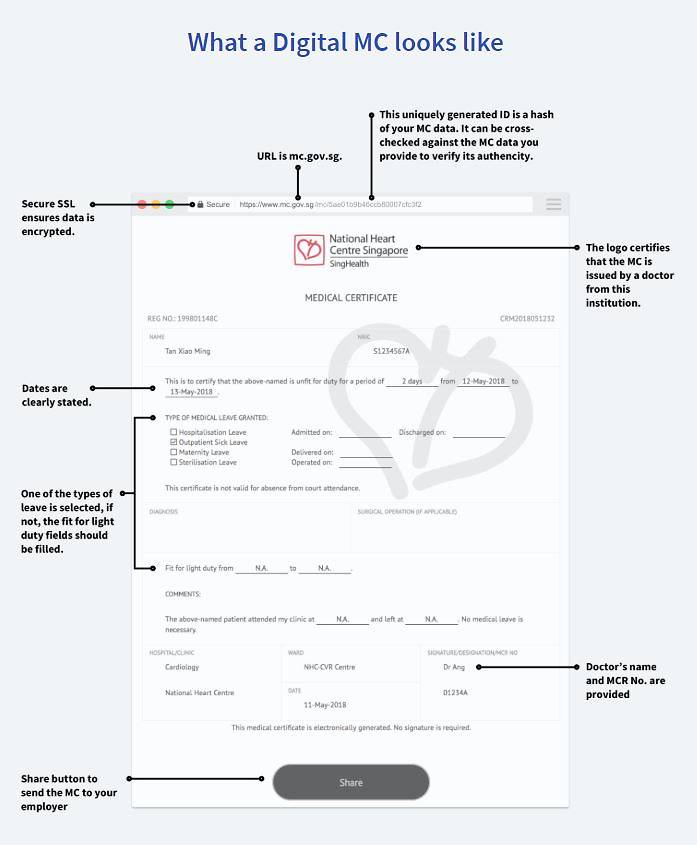
DigiMC will be hosted on a government-affiliated web domain with URLs will containing a unique string of alphanumeric characters to ensure that each digital MC has a uniquely identifiable key. (Graphics: MC.GOV.SG)
CAN DIGITAL MCs BE DOCTORED?
To ally concerns about the authenticity of digital MCs, GovTech said that each of the documents generated via DigiMC will be hosted on a government-affiliated web domain.
The URL will also contain a unique string of alphanumeric characters to ensure that each digital MC has a uniquely identifiable key, making it harder for the digital MC to be altered.
“Even if the digital MC is downloaded and saved as a PDF, employers can still validate the document using the URL printed at the bottom of the digital MC,” said Mr Chong.
SINGAPORE: The sole proprietor of Hiap Seng Lorry Enterprises (Hiap Seng) has been fined a record amount under the Workplace Safety and Health (WSH) Act for his role in a fatal workplace incident.
Ong Chin Chong was fined S$140,000 on Sep 2 after one of his employees died while unloading a bundle of wire mesh from a Hiap Seng lorry, the Ministry of Manpower (MOM) said in a press release on Friday (Sep 13).
Venugopal Sarath Kumar died while unloading a bundle of wire mesh at a Sunway Concrete Products (Sunway) worksite on Apr 26, 2016.
He had been helping to unload the bundle along with Ong and another worker, Dhatchinamoorthy Karthik, using the vehicle’s hydraulic crane arm.
Ong operated the lorry crane and supervised the lifting operation, while the workers were tasked to rig and align the bundle of wire mesh during lifting.
The bundle, which weighed about 1.57 tonnes, slanted while in transit, prompting the two workers to align it with their bare hands.
However it suddenly became dislodged from the lifting chain and struck Venugopal.
He was pronounced dead at the scene by attending paramedics.
LARGEST FINE IMPOSED ON INDIVIDUAL UNDER WSH ACT
In its press release, MOM listed a number of failings by Ong to ensure the safety of his workers.
Investigations revealed that Ong had failed to ensure the lifting chain was adequate and in good condition before telling his workers to use it.
Although the lifting chain had been used for similar operations earlier in the day, it was later found that a steel wire used to secure the chain had become dislodged during the lifting operation at Sunway.
Ong also did not make sure the two men were trained to perform lifting operations and both of them, who were employed as technicians, had not attended relevant courses or been briefed on proper methods, said MOM.
The Hiap Seng lorry loader with hydraulic crane arm. (Photo: Ministry of Manpower)
He also did not appoint required trained personnel (a lifting supervisor, rigger and signalman) for the operation, and failed to conduct a specific risk assessment to identify potential hazards and reduce risks to workers.
As such he was fined S$140,000 over the incident – the largest imposed on an individual under the WSH Act, according to MOM.
Unipac Transport Service, which contracted Ong to deliver the materials to Sunway, was fined S$60,000 for failing to ensure its contractor had conducted an adequate risk assessment and developed appropriate control measures.
Sunway, the occupier of the worksite at 4 Tampines Industrial Street 62, was fined S$160,000 for failing to ensure that the lifting works carried by external parties at its premises had followed a set of procedures, and that the lifting chain used by Hiap Seng was certified by an authorised examiner.
“As the employer, Ong disregarded his workers’ safety and essentially left them to their own devices to manage the lifting activities,” said MOM’s Director of Occupational Safety and Health Inspectorate Sebastian Tan.
“He failed to establish basic requirements such as a lifting plan and did not ensure that his workers were trained to conduct lifting operations.
“Tragic accidents such as this can be averted if we all play our part in managing the hazards associated with high risk operations such as lifting.”
Members of Parliament have called for better treatment of injured migrant workers, as Parliament passed the amended Work Injury Compensation Act on Sep 3.
HTC has finally given us a release date for its next VR headset. The Vive Cosmos drops 8 October in Singapore at S$1,229, but the best part is that it will work with your PC without you needing to set up any external sensors at all.
Unlike the original Vive, which relied on separate Lighthouse base stations, the Vive Cosmos features six inside-out tracking cameras built into it.
One benefit of this is that there aren’t any minimum space requirements if you’re standing or seated, although you’ll still need a 2 x 1.5m area for room-scale mode.
The Cosmos also has flip-up goggles so you don’t need to take the entire headset off when you need to dip back into the real world.
There’s even an integrated passthrough camera that lets you see the outside world without having to flip up the headset. It’s enabled by stepping outside the bounds of the virtual world or double-tapping the Vive button on the controller.
A wound that needed 30 stitches to close, and a dent in her head are the permanent reminders of a painful encounter Madam Yeo Eng Koong had with an e-scooter last year.
The 53-year-old compliance executive suffered a fractured skull and needed surgery after falling backwards when the e-scooter rider came close to colliding with her.
“After opening my skull, the doctor had to use the stapling method to seal the wound. I had a total of 30 stitches on my head and it was all the way down to my ears. I was shocked when I saw it.”
The e-scooter rider, Tham Chee Boon, 36, pleaded guilty on Wednesday to causing grievous hurt to Madam Yeo by riding an e-scooter in a negligent manner.
He was fined $3,500.
Tham, a paramedic for a private firm, was riding his e-scooter home on March 29 last year at about 9.30pm.
He was approaching a traffic light junction near Block 362 in Woodlands Avenue 5 when he almost ran into Madam Yeo.
In an interview with Shin Min Daily News, Madam Yeo said that after she had crossed the traffic junction, she heard loud music approaching.