The US company is partnering AI Singapore to boost the online search accuracy for languages such as Japanese and a basic product is expected to be rolled out “within nine months”.
A woman looking at a computer while answering a call.
(Updated: )
Bookmark
SINGAPORE: Singapore’s efforts to grow its artificial intelligence (AI) capabilities are bearing fruit, with global travel giant Expedia Group the latest to announce a partnership with AI Singapore (AISG) to develop a more accurate search engine for Asian languages like Japanese.
Both parties will work to develop an AI tool for Expedia’s online properties to transform the online search experience for Asian travellers, according to a joint press release on Monday (Sep 9).
Mr Laurence Liew, director of AI Industry Innovation at AISG, told CNA in an email that it is pumping S$180,000 into the project and will assemble an engineering team that is staffed by full-time mentors, project managers and apprentices from its AI Apprenticeship Programme.
On its end, Expedia will match AISG’s funding through cash and in-kind manpower and resource contributions, said its senior director for Product and Technology Kevin Ng.
Mr Ng, in an email reply, shared that travel searches on their platforms do not always give accurate returns with native Asian languages and, in particular, Japanese.
“While the accuracy of English search results is near perfect, travel searches conducted in the Japanese language yield accurate results only about more than half the time,” he explained.
This is why the project will look at using natural language processing and machine learning tools to develop an AI-based model to enhance the online search accuracy in Japanese, before extending it to the other languages like Korean, simplified Chinese and traditional Chinese, the release said.
Explaining what could be the reason for the less-than-accurate returns on searches, AISG’s Mr Liew said Asian languages are “fundamentally different” from European languages. He said some Asian characters, for example, do not have spaces between words and it is a “significant challenge” to differentiate words without explicit word boundaries.
As such, part of the solution it is co-developing via its 100 Experiments (100E) programme would be to incorporate better pre-processing methods for word segmentation, he said, adding a minimum viable product is expected to be rolled out within nine months.
The US travel giant would certainly benefit from making bigger inroads into the Japanese market.
Mr Ng, citing figures from Statista, said online travel spending is growing at a rapid pace and by 2020, the Asia-Pacific region will account for more than 40 per cent of global online travel sales, surpassing North America and Western Europe.
Given that Japan is one of the largest travel markets in Asia, by improving search accuracy and efficiency in the language “presents huge potential for (Expedia) to tap into this vast market”, the executive added.
AISG is a national programme set up to enhance Singapore’s AI capabilities and to power the country’s digital economy.
Its 100E programme, which matches companies keen to use AI with local researchers, has received strong industry interest and more than 300 companies have stated their interest since the launch in 2017. Of these, 40 projects have been approved, the press release said.
SINGAPORE: The Ministry of Education (MOE) has reiterated that it expects teachers to conduct themselves in a manner befitting the trust placed in them when interacting with students, following a series of sexual abuse cases in recent months.
“We continue to emphasise these high expectations to all educators regularly throughout their career – starting from the appointment and teacher training,” MOE deputy director-general of education (schools) and director of schools Liew Wei Li said in response to queries from CNA.
“School leaders also continually engage their staff on the Code of Professional Conduct for Educators.”
This comes after a 35-year-old male teacher was on Sep 3 jailed for six months for kissing a 14-year-old student twice on her lips.
In August, a 41-year-old male teacher was jailed for eight years after fathering a child with a 15-year-old student. July saw a 34-year-old male teacher jailed for 16 months for having an indecent relationship with his 15-year-old female student.
“Despite our best efforts of selection, screening, training and collective commitment to our mission, there may be a handful of black sheep,” Ms Liew said.
“All staff have been reminded to practise peer vigilance so as to immediately report cases of wrongful practices or misconduct they come across.”
REPORTING OF ABUSE
Ms Liew said there are systems in place for students to report “unsafe encounters” to school management, adding that school counsellors are present to support them.
Students who have been abused can also approach a trusted adult, like a parent or another teacher, for support and to stop further abuse, said Ms Laika Jumabhoy, assistant manager at the Association of Women for Action and Research’s (AWARE) Sexual Assault Care Centre (SACC).
Ms Liew said parents are encouraged to raise issues and feedback directly to school leaders or MOE officials, after which a “thorough and independent” investigation will be conducted.
“Disciplinary action will be taken if there is wrongdoing and a police report made if any criminal offence is revealed,” she added.
“It is through such processes that we are able to keep our students safe and maintain the integrity of our profession and system.”
Still, Ms Jumabhoy said it’s crucial for adults to believe children when they speak up about abuse, noting that some adults have responded with disbelief, judgment or resentment.
“Parents or guardians may struggle to accept that their child is a survivor of sexual abuse. Some may blame themselves for not being able to protect their child. They may also be at a loss as to what do next, both practically and emotionally, for the child,” she added.
“They might dismiss children’s disclosures as the child being confused, attention-seeking or misbehaving, especially as the children themselves might not clearly communicate exactly what has happened to them.
“So, we need more public education promoting honest, informed and non-judgmental understanding of the reality of sexual violence, especially in schools, institutions and organisations.”
This is especially as many victims are less willing to report incidents when the perpetrator is known to them, such as when he or she is a teacher, Ms Jumabhoy said. Her experience at SACC has shown that close to seven in 10 clients don’t report their experiences to authorities.
Ms Jumabhoy pointed to one case reported to SACC last year where a primary school teacher holding a senior position in the school had molested several of his students for about a year. One student eventually reported it to a trusted teacher, but was concerned about how it would impact the perpetrator’s family.
“She was afraid that the authorities and other teachers would question her,” Ms Jumabhoy said. “She was also worried about how her peers and other teachers would react.”
EFFECTS OF ABUSE
Ms Jumabhoy said children who have been sexually abused can have long-term issues with self-esteem, anxiety, depression, self-harm and difficulty building and maintaining trusting relationships.
She said victims might view themselves as shameful, unworthy and dirty; adults as not trustworthy; and the world as an unsafe and volatile place, adding that they typically experience a lot of guilt and self-blame.
(Photo: Unsplash/MMPR)
In such cases seen by SACC, family members and acquaintances – including teachers, tuition teachers, coaches and religious teachers – are the most common type of perpetrator.
“The perpetrator is in a position of trust. He intentionally builds up an image of being an upstanding member of the community, which facilitates the process of sexual grooming and subsequent perpetration of abuse,” Ms Jumabhoy stated.
“This power has a strong hold on children, silencing them and making it difficult for them to speak up. Often they feel like no one will believe them as it is their word against the word of a person in a position of authority.”
When it comes to counselling victims, Ms Jumabhoy said it’s important to tell them it’s not their fault and that they can choose how they want to move forward. Statements like “it’s your experience, not anybody else’s” and “I’m here to support you” also help.
“We do not prescribe disclosure to all survivors,” she added, noting that whether they should speak up, when, how or with whom are all “very personal” decisions dependent on their situation.
“A survivor’s main responsibility is to themselves. They should prioritise their physical and emotional well-being, and do what they need to do for recovery.”
HOW STUDENTS CAN PROTECT THEMSELVES
In the bigger picture, Ms Liew said students are also taught to protect themselves.
Lower primary students learn how to differentiate between a “good and bad touch”, while upper primary and secondary school students learn to protect themselves from sexual advances and set clear physical boundaries in a relationship, she said.
“Our students also learn about treating others with respect and how they themselves should be similarly treated with respect,” she added.
Dr Lim Boon Leng, a psychiatrist at Gleneagles Hospital, said boundaries between students and teachers should be observed and the relationship “should stay as such”.
“Teachers should treat all their students alike,” he said, noting that the onus to uphold boundaries lies with the teacher as the student is “always the vulnerable subject”.
Ms Liew said MOE is committed to ensure that its schools are “safe places for students to learn and thrive”.
MANILA/DAVAO: Singapore and the Philippines can collaborate in many areas, Singapore President Halimah Yacob said as she concluded on Thursday (Sep 12) a five-day state visit to the Philippines, during which she met Philippines President Rodrigo Duterte in Manila and headed to his home city of Davao in Mindanao.
Madam Halimah said that as founding members of ASEAN, the two countries’ close ties, resulting in public and private collaboration, is ultimately about raising the quality of life for people in the region.
Singapore and the Philippines can collaborate in human capital development, innovation and infrastructure, not just in the megacities but also in the provinces, she added.
“I think that our businesses which have niche core capabilities in the areas of sustainable town development, urban development will find opportunities, particularly in the areas of smart city, waste management, water supply and other areas related to urban town development,” she said.
In his opening remarks during a meeting between Singapore and Philippines officials, Mr Duterte admitted there is much to learn from Singapore.
“The Singapore story dating back to its beginning as a trading port in 1819 is truly remarkable. It is by itself an inspiration for many nations around the world,” said Mr Duterte.
STOP IN DAVAO
Among the highlights of Madam Halimah’s trip was a stop in Davao, Mr Duterte’s hometown.
The southern Philippine islands of Mindanao are home to dozens of tribes and to most of the Muslim population in the Philippines, a country where 80 per cent are Roman Catholics.
Madam Halimah and her spouse, Mr Mohamed Abdullah Alhabshee, were welcomed at the Davao airport by performers dancing to tribal rhythms that she said showcased the diversity of the country’s south, where not many heads of state have set foot. The southern part of the Philippines houses the country’s poorest provinces.
“Diversity is also something that teaches us tolerance, teaches us magnanimity, teaches us understanding … It makes you a better human being. And it makes the whole society better,” she said.
She is the third head of state to visit Mindanao since Mr Duterte took power, after Japanese Prime Minister Shinzo Abe and Indonesian President Joko Widodo in 2017.
Singapore President Halimah Yacob speaks during a dialogue with Mindanao youth. (Photo: MCI)
In a dialogue with Mindanaoan youth of different religious backgrounds, Madam Halimah emphasised the need for engagement to counter ignorance and prejudice.
“A society is fragile if one group views another as a threat. It is important to overcome the forces of division, and build bridges instead of walls,” she said.
Prejudice against the Philippines’ Muslim minority is a flashpoint in Mindanao, which saw an armed Muslim rebellion half a century ago after decades of land-grabbing, marginalisation and even massacre of their kin.
Bangsamoros, Muslim natives in the country’s south, now have greater autonomy after a law resulting from a peace deal with the country’s largest Muslim rebel group was ratified.
In their meeting, Philippines President Rodrigo Duterte told Madam Halimah about the ratification of this law that is seen to help end decades-long conflict and open up the region to outside investments.
“It was my pleasure to share with President Yacob our gains in peace and development in Mindanao, particularly our progress in establishing the Bangsamoro Autonomous Region in Muslim Mindanao,” said Mr Duterte in a joint press conference with Madam Halimah after their meeting.
“We discussed ways by which our cooperation could help contribute in bringing just and lasting peace and meaningful progress and development in Mindanao.”
Mindanaoan youth of different religious backgrounds are pictured during a dialogue with Singapore President Halimah Yacob. (Photo: MCI)
At Davao City, Madame Halimah also visited an eagle centre where she saw up close the critically endangered bird of prey known as the Philippine Eagle.
The rare biological heritage can only be found in the Philippines and only lays a single egg every two years. Its numbers are dwindling due to the clearing of forests that destroy their habitat.
A pair of Philippines Eagles are on a 10-year loan to Singapore. or conservation and breeding.
Singapore President Halimah Yacob (right) and her spouse, Mr Mohamed Abdullah Alhabshee (left), pose for a photo with a Philippine Eagle at the Philippine Eagle Center in Davao in Davao City. (Photo: MCI)
SINGAPORE BUSINESSES IN THE PHILIPPINES
High on the agenda of President Halimah’s visit was for Singapore corporations as well as its small and medium enterprises (SMEs) to venture and expand in the Philippines.
Eight memoranda of understanding between the Philippines and Singapore were exchanged during Madam Halimah’s state visit, ranging from agri-tech, water management and electricity supply in rural areas, to arts and culture, data protection, and training people for the next industrial revolution.
Madam Halimah also graced the opening of The Podium, an office and retail complex in Metro Manila developed by Singapore and Philippine firms Keppel Land and BDO Unibank.
“We also like to see more integrated mixed use development happening in Philippines. This is applying the concept that we learned in our Singapore Marina Bay financial centres where we incorporate office, residences and retail together so that’s fulfilling the live, work, play scenarios,” Keppel Land CEO Tan Swee Yiow told CNA.
Madam Halimah cited the Philippines’ young, tech-savvy population as a reason to venture into the country.
“There is a strong consumer demand for goods and services. Our Singapore brand – in terms of our products and services – do have a reputation, largely also because we have a large Filipino community in Singapore. They have had opportunities to try out our Singapore brand, and they like it,” she told Singapore media.
Singapore was the Philippines’ largest foreign investor among Southeast Asian countries and the second largest worldwide last year. Bilateral trade between the two countries grew by 18.6 per cent compared with the previous year.
Moving forward, Madam Halimah says she hopes to see progress in two particular areas – updating an existing agreement to avoid double taxation, as well as expanding a bilateral air transport deal.
APEX OF 50 YEARS OF DIPLOMATIC TIES
Singapore’s President Halimah Yacob adjusts the wreath at the foot of the monument of Dr Jose Rizal, the country’s National Hero, in ceremony on Sep 9, 2019 in Manila, Philippines. (Photo: AP/Bullit Marquez)
Prior to her meeting with Mr Duterte, Madam Halimah also paid her respects to the late Philippine national hero Jose Rizal, the novelist who believed in the power of words to help liberate the Southeast Asian nation from colonial powers.
It is customary for visiting heads of state to the Philippines to offer flowers at the monument of Rizal.
The Philippines foreign ministry described Madam Halimah’s state visit to the Philippines as an apex in the two countries’ celebration of 50 years of diplomatic ties this year.
What’s holding you back from taking your family to Canopy Park at Jewel Changi Airport’s top level, if you’ve not? Featuring a mix of play attractions and gorgeous garden trails, the 14,000 sq m space – about the size of 11 Olympic-size swimming pools – opened on June 10 to much fanfare.
You’ve probably heard about the thrilling suspended net playgrounds and mazes – albeit occasional stories about visitors who hurt themselves during playtime. So, before going to Canopy Park, you’ll want to know which are safe and suitable for you, your kids and the grandparents.
After all, entry isn’t free. You can choose to buy tickets to respective play attractions in a la carte style or bundle packages.
PHOTO: Young Parents
Here’s a handy guide for you, as we explore Canopy Park from the mildest to the most challenging attraction.
SINGAPORE: A bus caught fire as it was travelling along a flyover in Jurong East on Thursday (Sep 12) evening, sending dark plumes of smoke into the air.
The Singapore Civil Defence Force (SCDF) said it received a call about the incident at around 8.20pm, adding that it happened in Jurong East Central, near the junction of Bukit Batok Avenue 1.
The fire was extinguished using two water jets. No injuries were reported.
The bus caught on fire along a flyover in Jurong East. (Photo: CNA reader)
A Bukit Batok resident told CNA that she was alerted to the blaze by her neighbours at about 8.30pm.
“We saw a private coach on the flyover on fire on the roof area of the bus. It spread slowly to the entire bus,” said Ms Joanna Peng, adding that there was thick black smoke and a “loud explosion”.
Ms Peng also said that she did not see any passengers inside the vehicle and that SCDF later arrived with a Red Rhino and a fire engine.
The fire seemed under control in about five minutes with some small flames remaining, she said.
SINGAPORE – Seven residents of the Singapore Boys’ Home were arrested on Tuesday night (Sept 10) by the police for unruly behaviour and vandalism after they damaged furniture, threw objects out of their rooms, and created a ruckus at the home in Jurong West.
It took two hours for the situation to be stabilised, police said in a statement on Thursday.
The Ministry of Social and Family Development, which runs the home, said nobody was injured in the incident.
The ages of the boys arrested at the home, which houses at-risk youths aged between 12 and 19, were not revealed.
The news comes on the same day as a court appearance by two 17-year-olds who were involved in a riot at the Singapore Boys’ Home in September last year.
The two were part of a group that attacked three adults working at the home, and damaged property as well.
The brutal assault left a 44-year-old auxiliary police officer with an eye injury that is most likely permanent.
SINGAPORE: A doctor who was caught taking drugs, including methamphetamine and depressants, has been demoted and ordered by a disciplinary tribunal to undergo supervision and rehabilitation.
Dr Damian Yeo Eng Hui was arrested by Central Narcotics Bureau (CNB) officers on Aug 1, 2017 for taking meth, being in possession of 2.69g of meth and three tablets of depressant Nimetazepam, and possessing drug-taking utensils, including a lighter, cut straws and a syringe.
According to the National Council Against Drug Abuse, Nimetazepam is also known as Erimin-5 and excessive use can lead to harmful effects.
In its grounds of decision published on Tuesday (Sep 10), the disciplinary tribunal found that Dr Yeo had “brought disrepute to the medical profession” through his misconduct.
But the doctor, who is now a resident physician at the Emergency Medicine Department at Tan Tock Seng Hospital (TTSH), was deemed suitable for rehabilitation.
He had spent four months in a Drug Rehabilitation Centre (DRC) and was given a stern warning in lieu of prosecution for the drug offences.
Dr Yeo was demoted by the tribunal and has to undergo supervision at work and attend treatment with an addictions specialist.
In considering its punishment, the tribunal said: “The respondent (Dr Yeo) is young, and from all accounts in the positive testimonials tendered in mitigation, has a promising medical career ahead of him.
“For the past year and a half, he has been compliant with the informal conditions and restrictions imposed on him by TTSH, with no reports of any incidents since then.”
In mitigation, Dr Yeo’s lawyer said his client had committed the offences “in a moment of folly due to the pressures of work”.
CAUGHT WITH DRUGS ON DAY OFF
The tribunal heard that Dr Yeo had been committed to the DRC for treatment and rehabilitation after he pleaded guilty to the drug offences. The doctor said he had been off-duty the day before and on the day of his arrest.
His employment with TTSH had been terminated by MOH Holdings – the holding company of Singapore’s public healthcare clusters – on Aug 1, 2017 due to “gross misconduct”.
After finishing four-month treatment at the DRC, he was re-employed as a resident physician by TTSH. He completed his probation there and on Sep 12 last year, had his employment renewed until Dec 28, 2021, the tribunal noted.
File photo of Tan Tock Seng Hospital. (Photo: Tan Tock Seng Hospital/Facebook)
The Singapore Medical Council (SMC) submitted that the drug offences were “extremely serious”, and that Dr Yeo had been arrested for not just one, but multiple drug offences.
“As the conduct of the respondent fell short of the standard of care, integrity and conduct expected of medical practitioners, and violated the trust the public places in the medical profession, such professional lapses must be policed and deterred,” SMC argued.
It said Dr Yeo should be demoted from a fully-registered doctor to one with conditions and restrictions under a supervisory framework, before he can apply to be re-registered.
The SMC also called for Dr Yeo to be put under supervision for at least two years at work and to undergo treatment with a specialist.
MAKING GOOD PROGRESS IN REHAB
Dr Yeo’s lawyer said his client had committed the offences in a moment of folly due to work pressures, pleaded guilty at the earliest occasion and fully cooperated with SMC.
He had complied with his treatment and rehabilitation requirements, making good progress in his rehabilitation regime, the tribunal heard.
“He had been honest with and made himself accountable to his superiors and colleagues at TTSH. This insight gained by the respondent should be a mitigating factor,” his lawyer said, according to court documents.
He said since Dr Yeo had been re-employed by TTSH, he had voluntarily submitted to supervision by his colleagues and there have been no untoward incidents for the last year and a half.
Dr Yeo had also completed CNB’s supervised urine test regime.
“So to place the respondent in a further regime of supervision would be demoralising for him, as it would fail to take into account what the respondent had already gone through, and his efforts for taking responsibility and being accountable to his colleagues and superiors,” Dr Yeo’s lawyer said, according to the grounds.
The disciplinary tribunal ruled that they did not have evidence to show he had taken drugs while on the job, and made no findings in that regard.
“PROMISING MEDICAL CAREER”
In its findings, the tribunal said Dr Yeo had “eroded the faith and confidence of the public in relation to the medical profession”.
“Being a doctor practising emergency medicine in a major hospital, the professional competence of the respondent in treating and not doing harm to patients would be placed in question,” the tribunal added.
“The duty to act with the highest standards of integrity is also lacking.”
It said that its orders have a “deterrent effect”, but should also be “balanced and not unduly onerous”.
Corridor in Tan Tock Seng Hospital.
They found Dr Yeo has a “promising medical career” and that he “appears to have a good level of support from his colleagues and supervisors”.
“The disciplinary tribunal is therefore of the view that the rehabilitation of (Dr Yeo), given the facts of this particular case, is appropriate and indeed, necessary,” the panel wrote in its grounds.
In imposing the conditions and supervision on him, the tribunal said: “The sanction can be seen as a ‘demotion’ of the respondent’s status from a doctor with full registration and all the privileges it entails, to one with conditional registration where conditions and restrictions upon his practice are imposed.”
Dr Yeo has been ordered to undergo supervision at work for a period of 18 months. During that time, he is to attend drug rehabilitation and treatment sessions regularly with an SMC approved addictions specialist.
He was also ordered to pay the costs of the proceedings, including SMC’s.
If he meets the conditions, he may apply to be a fully-registered doctor again.
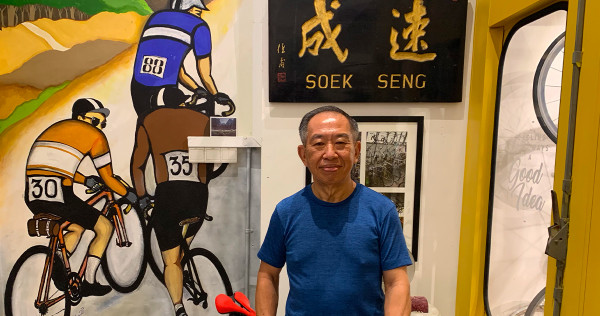
For many of us, hitting our golden years probably means slowing down our pace of life, focusing on loved ones and contemplating whether it’s time to hand over the reins and retire.
For 64-year-old Poon Kng Joo (better known as Ah Joo in the cycling community), retirement is the last thing on his agile mind.
The ambitious risk-taker is not afraid to show it, jumping headfirst into opening his own bike cafe the year he turned 60, and four years on, Soek Seng 1954 Bicycle Cafe is still going strong.
THE BEGINNINGS OF SOEK SENG 1954 BICYCLE CAFE
While most entrepreneurs shun the idea of setting up shop in an ulu (remote) area, Ah Joo embraced that challenge and located his cafe beside Seletar Airport, where diners can have an unparalleled view of planes taking off and landing.
SINGAPORE: The air quality in Singapore could enter the Unhealthy range in the next 24 hours “if the winds turn unfavourable and the haze situation in Sumatra persists”, said the National Environment Agency (NEA) on Thursday (Sep 12).
NEA said it was “slightly hazy” in Singapore on Thursday, with the 24-hour Pollutant Standards Index (PSI) reading falling in the Moderate range of between 75 and 87 at 7pm.
A PSI reading of between 101 and 200 falls in the Unhealthy range.
“The haziness is due to smoke haze from hotspots in central and southern Sumatra being blown in by the prevailing winds,” said the agency, adding that slightly hazy conditions were expected for the rest of the day.
A total of 222 hotspots were detected in Sumatra, mostly in the Riau, Jambi and South Sumatra provinces.
“Moderate to dense smoke haze continued to emanate from persistent hotspots there. Some haze has been blown by the prevailing winds across the Strait of Malacca to affect Singapore and some parts of Peninsular Malaysia,” said NEA.
For the next 24 hours, the one-hour PM2.5 concentration readings are expected to range between Normal and Elevated, said NEA.
“The 24-hr PSI is forecast to be in the Moderate range, and may enter the Unhealthy range if the winds turn unfavourable and the haze situation in Sumatra persists.”
NEA advised those who are healthy to reduce prolonged or strenuous outdoor physical exertion, while the elderly, pregnant women and children should minimise such activities.
Those with chronic lung or heart disease should avoid them.
Haze shrouds the aerial view around Sarawak Legislative Assembly building (left) in Kuching, Sarawak on Sep 9, 2019. (Photo: AFP/Abdul Hakim)
The fires are usually started during operations to clear land for palm oil and pulp plantations.
Malaysia said last Friday a diplomatic note would be sent to Indonesia to call for immediate action against the raging fires.
This drew a rebuttal from Indonesia’s environmental affairs and forestry minister, who said there has been no recurrence of transboundary haze from Indonesia to neighbouring countries as the number of hotspots has dropped.