SINGAPORE: There is a need for “stronger resolve and cooperation” among ASEAN countries to tackle the issue of transboudary haze, said Singapore’s Minister for the Environment and Water Resources Masagos Zulkifli on Saturday (Sat 14) amid the worsening air quality in the country.
Singapore’s 24-hour Pollutant Standards Index (PSI) on Saturday hit unhealthy levels for the first time since August 2016, with the reading going beyond the 100 mark at 4pm.
“The return of the haze is a reminder of the seriousness of the problem, which has affected the ASEAN region for years. It both pollutes the air we breathe and emits greenhouse gases that cause climate change,” Mr Masagos wrote in a Facebook post.
“This is why there is need for stronger resolve and cooperation amongst ASEAN countries and stakeholders, in order to achieve our vision of a haze-free ASEAN by 2020.”
Mr Masagos added that Singapore has offered help to Indonesia to fight forest fires there.
“As always, we stand ready to help suppress the fires on the ground. Singapore has offered technical firefighting assistance to Indonesia and is prepared to deploy them if requested by Indonesia,” he said.
FILE PHOTO: Public housing apartment blocks are shrouded by haze in Singapore September 13, 2019. REUTERS/Feline Lim/File Photo
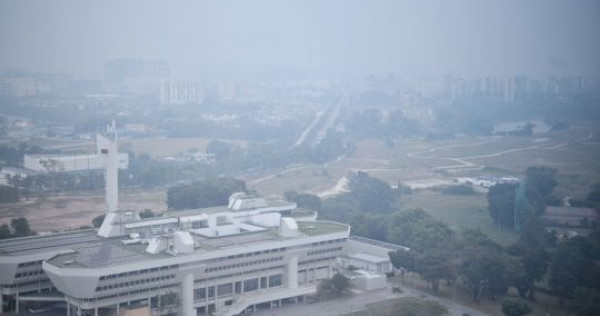
Hazy skies seen from Serangoon on Sep 14, 2019.
Malaysia had also offered to help Indonesia put out the forest fires in Kalimantan and Sumatra, with environment minister Yeo Bee Yin earlier this week reiterating her country’s concern over the impact of persistent transboundary haze.
According to Singapore’s National Environment Agency (NEA), the haze worsened on Saturday afternoon due to the convergence of winds over the nearby region, leading to more smoke haze blowing from Sumatra.
Hazy conditions are expected for the rest of the day, NEA added.
It said 450 hotspots were detected mostly in Indonesia’s Riau, Jambi and South Sumatra provinces, a “sharp increase” from the 156 hotspots on Friday.
A view of Kuala Lumpur’s skyline shrouded in haze on Sep 14, 2019. (Photo: Nadhrah Darke)
Forest fires have raged through parts of Sumatra and Kalimantan in recent weeks, prompting the Indonesian government to send in military and police to douse the flames.
Air quality in Indonesian towns closest to the fires have risen to hazardous levels and earlier this week, thousands held mass prayers for rain.
SINGAPORE – Air quality took a sharp turn for the worse on Saturday (Sept 14), with the PSI reading crossing the unhealthy level for the first time in three years.
The 24-hour PSI readings ranged between 88 and 108 at 6pm, with the highest recorded reading in western Singapore.
The National Environment Agency (NEA) warned that the PSI for the next 24 hours is forecase to range between the high-end of the moderate and the low-end of the unhealthy range, and may enter the mid-section of the unhealthy range if denser haze is blown in.
NEA said that the worsening conditions was due to wind patterns over the nearby region that led to more smoke haze from Sumatra being blown towards Singapore. For the rest of the day, hazy conditions are expected to persist and the prevailing winds are forecast to blow from the south-southeast or south-southwest.
Rejoice, Final Fantasy VII fans in Singapore! Square Enix has confirmed the release of all physical editions of the Final Fantasy VII Remake, including the Deluxe Edition and 1st Class Edition for PlayStation 4.
Previously, your only chance of getting your hands on either collector’s edition was via Square Enix online store.
But you can now pre-order a copy at your nearest video game store as well.
PHOTO: Square Enix
The Deluxe Edition will include the following items:
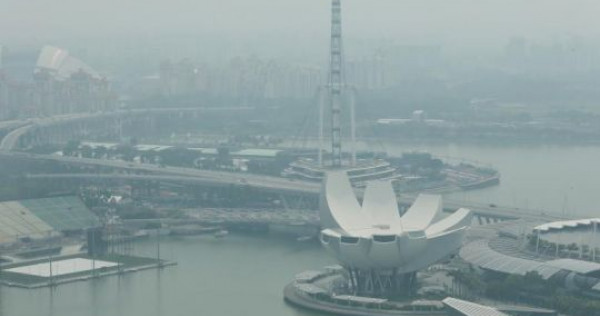
SINGAPORE: Hazy conditions were seen in Singapore on Saturday (Sep 14) as the Pollutant Standards Index (PSI) approached unhealthy levels.
As of 3pm, the 24-hour PSI reading was 85-98, with the west of Singapore seeing the highest reading of 98. The PSI reading in the southern part of Singapore was 95, 87 in the north and 85 in both the eastern and central regions.
HDB blocks in Jurong East shrouded in haze on Sep 14, 2019. (Photo: Kevin Kwang)
A view of MacRitchie Reservoir seen from Bishan on Sep 14, 2019. (Photo: Gladys Ow)
According to the National Environment Agency (NEA), PSI readings of 50 and below denote “good” air quality, “moderate” for 51-100 and “unhealthy” for 101-200.
Although the air quality remained in the moderate range, people in many parts of Singapore reported hazy skies and a burning smell in the air.
Hazy skies seen from Serangoon on Sep 14, 2019.
Buildings in Singapore’s central business district shrouded in haze on Sep 14, 2019. (Photo: Chung Lyn-yi)
Hazy skies seen in Clementi on Sep 14, 2019. (Photo: Diane Leow)
On Friday, NEA said 156 hotspots were detected in Sumatra, mostly in the central and southern parts of the island.
“Moderate to dense smoke haze continued to emanate from persistent hotspots there, and hazy conditions persisted in Singapore and some parts of Peninsular Malaysia,” it said.
In Kalimantan, 1,043 hotspots were detected on Friday, with “widespread smoke haze” seen in many areas, and some haze blown by prevailing winds to western Sarawak and surrounding sea areas, NEA said.
The environment agency said there may be brief showers in Singapore over the next few days but the weather in Sumatra and Kalimantan is expected to remain generally dry.
“With the prevailing winds blowing from the south or southwest, this may bring increased haziness to Singapore,” it said.
Forest fires have raged through parts of Sumatra and Kalimantan in recent weeks, prompting the Indonesian government to send in military and police to douse the flames.
In Malaysia, air quality dropped to “unhealthy” levels in and around Kuala Lumpur, according to the government’s air pollutant index, and the skyline has been shrouded in thick smog.
A view of Kuala Lumpur’s skyline shrouded in haze on Sep 14, 2019. (Photo: Nadhrah Darke)
When air quality is at the unhealthy range, people – especially children, the elderly, pregnant women and those with heart or lung conditions – should reduce prolonged or strenuous outdoor activities. Those who are not feeling well should seek medical attention, NEA said.
The last time the PSI breached the 100 mark in Singapore was on Aug 29, 2016, when the 24-hour reading hit 109 in the north.
The worst haze episode in Singapore in recent years was in 2015, when rampant forest fires in Indonesia choked the region in haze for weeks. PSI readings in Singapore climbed above the hazardous level of 300, forcing schools to close.
SINGAPORE – The Central Narcotics Bureau (CNB) arrested 159 suspected drug offenders in a 12-day islandwide operation, the agency said on Friday (Sept 13).
Those arrested include seven teenagers – aged between 13 and 18 – caught at a drug party in Fajar Road, as well as a couple with four children under the age of seven, the CNB added.
A total of 124g of heroin, 91g of Ice, 15g of new psychoactive substances, 8g of ketamine, three Ecstasy tablets, three Erimin-5 tablets, three bottles containing methadone and two LSD stamps – a hallucinogenic drug – were seized.
The operation took place from the morning of Sept 2 to Friday morning, covering areas including Geylang, Serangoon, Toa Payoh and Woodlands.
CNB said it raided a ninth-floor residential unit at Block 454 Fajar Road, where a drug party was in full swing, on Wednesday.
SINGAPORE – Air quality worsened to nearly unhealthy levels on Friday (Sept 13), marking the start to a weekend that would likely remain hazy, forecasts by the weatherman show.
At 6pm, the 24-hour Pollutant Standards Index (PSI), a measure of air quality here, was 98 in southern Singapore – just shy of the 101 threshold indicating unhealthy air quality.
As of 7am on Saturday, it improved slightly to 92 in the south. The PSI was 84 in the central region, 86 in the north and east, and 91 in the west.
The National Environment Agency (NEA) said on Friday evening that it detected hot spots in both Sumatra and Kalimantan in Indonesia. But based on wind direction, it is smoke haze from Sumatra that has been affecting Singapore.
Said the NEA: “Slightly hazy conditions have been persisting in Singapore today as smoke haze from central and southern Sumatra continues to be blown in by the prevailing winds.”
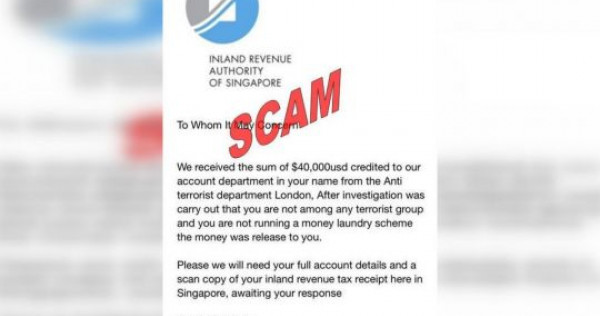
SINGAPORE – The Inland Revenue Authority of Singapore (Iras) issued a warning on Friday (Sept 13) regarding a scam e-mail and advised the public not to share personal or financial information.
In the e-mail, the sender claims to be the chairman of the Ministry of Finance. Written with grammatical mistakes, it asks recipients for their full account details and a scanned copy of their tax receipts, so that US$40,000 (S$54,935) can be credited to them.
Iras said members of the public should not respond to the e-mail. If they shared their personal or financial information, they should lodge a police report, change the passwords on their online accounts and contact their banks to stop any transactions.
The comes after Iras warned last month of a tax refund scam circulating on WhatsApp. Members of the public were advised to avoid responding or circulating the scam e-mail image with the header “Inland Revenue Authority of Singapore-Refund-Online-Confirmation”.
The scam e-mail instructed the receiver to download and complete a tax refund form from a link provided, before submitting it.
SINGAPORE: National swimmer Yip Pin Xiu claimed her second gold medal at the 2019 World Para Swimming Championships on Friday (Sep 13) by winning the 50m backstroke S2.
Yip finished the race in London more than 9 seconds ahead of runner-up Italian Angela Procida, the Singapore Disability Sports Council said in a media release on Saturday.
She clocked a time of 1 minute and 4.43 seconds, just 0.25 seconds shy of her season best. Procida finished at 1 minute and 13.98 seconds, with Canada’s Aly Van Wyck-Smart finishing in 1 minute and 17.76 seconds.
Singapore national swimmer Yip Pin Xiu poses with her gold medal. (Photo: Marc Morris/SportsNewsAgency)
Yip on Wednesday clinched Singapore’s first medal at the championships, taking gold in the women’s 100m backstroke S2.
“I’m pretty excited. Being a double-world champion makes me really happy,” she said of her victory.
“It’s been nine years since I had my last World Championship title, so it’s really been a bonus [to come here and win two medals]. Yesterday was my day to recover, but today I was doing my stretches and to try and recover to my fullest, and really just race.”
Yip, a three-time Paralympic gold medallist, holds the world record in the 50m backstroke S2 and the 100m backstroke S2. She also won a gold medal in the women’s 50m backstroke S4 (1-4) at the 2018 Asian Para Games last year.
Other athletes like Sophie Soon Jin Wen and Toh Wei Soong will represent Singapore on Saturday. Soon will compete in the 100m butterfly S13, while Toh, in his fourth event of the championships, will take part in the 100m freestyle S7.
SINGAPORE: Since the watershed election of 2011 and an exciting SG50 election of 2015, General Elections in Singapore have become the biggest talk of the town.
It was therefore no surprise that election chatter began as soon as news came from the Elections Department last Wednesday (Sep 4) that the Electoral Boundaries Review Committee (EBRC) had been convened last month.
The statement sparked speculative conversations. We were told that one of the committee’s key task is to review the current electoral boundaries and recommend the number and boundaries of group representation constituencies (GRCs) and single-member constituencies (SMCs) in view of Singapore’s demographic changes since the last General Election.
If this direction is followed, Singaporeans can expect to see more political contests as there will almost certainly be more smaller GRCs, and more SMCs than the current 13, in keeping with the direction to reduce the average GRC size and have more SMCs, which Prime Minister Lee Hsien Loong articulated in 2016.
The bottom line here? Singaporeans will go to the polls again in a matter of months, maybe sooner than we know, for only the 13th time in Singapore’s history.
File photo of the Elections Department headquarters located along Prinsep Link.
The more significant question is what will this General Election be about?
An election is about choosing the best possible team to lead the country. It is about political leadership expressed through the formation of a government.
This time, however, the spotlight will be on the Fourth Generation (4G) People’s Action Party (PAP) leadership.
Singapore is about to enter a political transition, only the third in her modern history.
THE 4G LEADERSHIP – ARE THEY UP FOR IT?
As Singaporean political analyst Dr Lam Peng Er portended in the concluding chapter in the book that analysed the 2015 General Election, Change in Voting: Singapore’s 2015 General Election:
The PAP in the next general election may have a leadership issue. If Lee Hsien Loong were to lead the PAP again in the next GE, he would be older and less energetic, and would probably be fine-tuning the status quo which he and his father (Lee Kuan Yew) had painstakingly built rather than offer a slew of new initiatives or a relook at the fundamental of governance.
Although PM Lee will lead the Government to this election, he has already made it clear it will be his last, and he will pass the baton to the next PM as soon as practical, after the next General Election, or by the time he turns 70 (in February 2022).
The coming General Election will be transitional because Singaporeans will be electing – and indeed, endorsing – a slate of prospective leaders, comprising both incumbent and new candidates, who will collectively be key players in Singapore’s Changing of the Guard 3.0.
(After the election, while we may expect several 3G leaders to remain in Cabinet positions either in a key portfolio (such as home affairs, health and defence) or in a senior, coordinating ministerial role, it is likely most other positions will be filled by 4G members.)
All eyes will on the “new man” in the form of our current Deputy PM Heng Swee Keat, as the leader of the 4G team. Among many other attributes, he will be closely examined for how well he can connect with the electorate.
PAP’s second assistant secretary-general Chan Chun Sing and first assistant secretary-general Heng Swee Keat at a news conference on Nov 23, 2018. (Photo: Hanidah Amin)
As Dr Lam had previously highlighted, the nation would be transitioning from the status quo that the much-revered founding PM Lee Kuan Yew had established – and his successor Goh Chok Tong and current PM Lee Hsien Loong built on – to one that remains promising but is perhaps less certain.
Mr Heng has had a shorter runway compared to both ESM Goh and PM Lee, who had almost six and 15 years of political leadership experience as DPM respectively before assuming the role of PM.
Given this scenario, to use a nautical analogy, PM Lee’s primary task would be to pilot the PAP vessel through the upcoming electoral challenge, and ensure that all key crew members remain shipshape and ready to take control thereafter.
His secondary task is to clear the policy decks to give PM-in-waiting Heng Swee Keat a clean slate from which to start well. Only then would the new man be given a chance to become his own man to lead his team.
In fact PM Lee and his 3G team have focused on this second role over the past year. Transport woes, especially peak hour crowds and train breakdowns, have mostly subsided. There is some help to manage healthcare costs for Merdeka Generation seniors. Even the contentious Protection from Online Falsehoods and Manipulation Act (POFMA) has been passed into law.
So the question that many Singaporeans will be asking in the lead-up to the polls is, “Is the 4G up to it?”
It will be the same question that opposition candidates, regardless of their party affiliations, will also be asking while spruiking their points of difference.
APPEALING TO PRAGMATISM AMID A TRANSITION
PM Lee’s efforts to steady the PAP ship had also already started more than a year ago when Singaporeans were sizing up their next PM.
PAP Secretary-General Lee Hsien Loong speaks at the PAP Conference and Awards Ceremony at Singapore Expo on Nov 11, 2018. (Photo: Jeremy Long)
Before the PAP elected Mr Heng as the First Assistant Secretary-General in its central executive committee (CEC) – which made him the obvious successor to the Prime Ministership – PM Lee spoke openly about how he expected the group of 16 next-generation office holders to select a leader from among themselves.
Having now selected their first-among-equals, the 4G leaders must convince the electorate to endorse their choice and to throw their support behind them, though they are likely not to make this the explicit election issue but focus on the pragmatics.
Why? We need to remember that Singaporeans have been conditioned to be a pragmatic lot.
They want to know that their lives will get better in the coming years. Singapore voters will protest if policies are left wanting (as they did at the 2011 general election when housing, transport and the influx of foreigners lit a fuse), and reward if their concerns are addressed (as in 2015).
Appealing to how this PAP government has made significant achievements that have served Singaporeans’ interests best might work best, and also help the PAP focus on a message of continuity of this track record as the 4G leaders take over.
A new slate of members, including several 4G leaders, have been elected into the PAP’s Central Executive Committee – the party’s highest decision-making body. (Photo: Jeremy Long)
ARE WE READY?
Although there are dark clouds on the horizon with the nation’s GDP for 2019 recently revised down to a narrow range of 0 to 1 per cent growth – given primarily the worsening effects of the US-China trade war – the domestic economy has largely been steady over the past few years, with fewer than usual gripes about job losses and retrenchments.
In any case, a worsening economic outlook typically leads voters to hunker down and stick with a tried-and-tested PAP leadership, instead of risking change.
But if this coming election does not centre on the economy or policy responses under the current Lee administration, it is likely to focus on the readiness of our 4G leaders, led by our new man Heng Swee Keat, even if the PAP does not intend so.
Terence Lee is Associate Professor of Communication and Media at Murdoch University, Australia. He is co-editor with Professor Kevin Y L Tan of Voting in Change: Politics of Singapore’s 2011 General Election and Change in Voting: Singapore’s 2015 General Election, both published by Ethos Books.
SINGAPORE: The Resource Sustainability Bill, passed in Parliament last week, is a landmark legislation that will put into action better upstream management of waste that underpins the Zero Waste Masterplan.
Yet, the Masterplan should not be designed and implemented in silo to our social challenges.
Mitigating food loss presents a tremendous opportunity for us to resolve food security issues for vulnerable groups, an impassioned plea I made during the debate.
Time is not on our side. We must urgently encourage food-loss-reducing behaviours through food labelling policies and expeditiously enacting Good Samaritan or Best Practice Laws.
The National Environmental Agency and Singapore Food Agency, as assured by the Senior Minister of State for Environment and Water Resources Dr Amy Khor in response to my call, are exploring Good Samaritan laws to ease business concerns over donation of excess food – similar to those already implemented in Italy and the United States.
Currently, the Singapore Food Agency does not distinguish between “use by” or “best before” and “expiry date”, resulting in huge food wastage because products are not allowed to be sold or distributed beyond expiry dates.
However, in many countries, including the United Kingdom, Hong Kong, Australia and New Zealand, use of all these different terms mean that after the food reaches its “use-by” date, the quality and flavour of the food is lowered but it is still fit for consumption.
We must be clear in our policy on different date labels and begin to educate consumers on the meaning of each to reduce waste. Studies have shown that when consumers are clearly shown on the food label that “use by” and “best before” means lower food quality but not food safety, and how food waste results in negative environmental impact, they are more willing to pay for food that’s past its use-by/best-before dates.
Shoppers at a supermarket in Singapore (Photo: Ruyi Wong)
Conscious labelling coupled with Good Samaritan laws will also clearly foster an environment that allows and encourages more food (which has gone past its ”best before” date but not exceeding say six months to ensure food safety) to be donated to charities.
In addition, the underused Business-IPC Partnership Scheme or BIPs, which gives 2.5 times tax-deduction to businesses for donations in kind, can be extended to include donation of edible food surplus to charities.
I have no doubt businesses can take the lead on food waste redistribution because I know many like Samsui Supplies through the Company of Good, a corporate giving initiative by National Volunteer & Philanthropy Centre – which I am also involved with.
TACKLE FOOD INSECURITY
A lay estimation from the Household Expenditure Survey 2017/2018 comparing the expenditures of the lowest quintile Singaporeans suggests nearly 49 per cent of their income is spent on food.
Madam Gopal who lives in Toa Payoh is one such Singaporean. In her 70s, she has zero income and survives on a S$500 per month from her social service organisation. She saves a minimum of S$100 per month as a beneficiary of Free Food for All, a charity that receives and redistributes donated food.
ONE Singapore, a charity working on eradicating poverty, estimated there could be as many as 400,000 people in Singapore unable to meet basic needs like food, clothes, derived by examining how many among the lowest-quintile income groups are spending more than they are earning.
A 2018 study by the Lien Centre for Social Innovation also found one in five low-income households face severe food insecurity.
Vegetables thrown away. (File photo.)
Yet every year, we generate 763,000 tonnes of food waste as a country. Let’s assume conservatively that only half of this or 382,000 tonnes can be redistributed.
This could make a total of 382 million meals, based on 1 kg per meal.
On average, three meals a day are taken so each person consumes 1,095 daily meals per year, feeding 390,000 people for an entire year.
I’m not under any illusion that it’s as simple as I’ve made out to be but I think we will agree this prospect is far from impossible.
A NEEDED NATIONAL EFFORT
There are several community groups that are already doing good work on the ground in this regard although clearly a national strategy is needed to optimise systemic impact and avoid duplication.
SG Food Rescue is one such group that have demonstrated there is much in our food value chain to be saved and redistributed. Its volunteers collect a staggering 1,500kg of unsold fresh produce once a week from Pasir Panjang Wholesale Centre.
Sometimes they even collect twice a week. About 500 to 700kg of that goes to charities, namely, Free Food For All, Beyond Social Services and St Theresa’s Home that feed the needy, while the rest is sent to a soup kitchen in Little India, Krishna’s Kitchen.
The soup kitchen turns the vegetables into meals to feed the hungry, especially migrant workers. About 200kg ends up with a community initiative in Marine Terrace, and one of the six public community fridges, benefiting low-income residents.
A man preparing food for the elderly at Samsui Supplies by Soup Kitchen.
Not only will we drive food resource sustainability by reducing waste, such a national effort will also significantly relieve financially strapped households of a huge burden.
In addition, based on estimated costs for programmes like Meals-on-Wheels and Willing Hearts that provide more than 10,000 daily meals in total, close to S$15 million could be freed up and redirected to other aspects of social support for beneficiaries. They need more support because needs are changing with higher living standards and higher temperatures (requiring air-conditioning and more fans).
SUSTAINABILITY IS A FUTURE INVESTMENT
Engaging the business community must be a top priority because sustainability is a future investment for economic growth, new market opportunities and job creation.
Companies must be nudged out of their comfort zones into a greener and more innovative direction as we work towards building a circular economy.
This circular economy we strive for must include a virtuous food cycle because sustainability is also a social parameter to secure a more inclusive society.
The Zero Waste Masterplan must not be a wasted opportunity to bring the conversations of climate change and social impact to the same table.
If a small group of citizen volunteers like SG Food Rescue can move hundreds of tonnes of food loss every year to where they are needed most, imagine what we can do if we – government, business and community – truly commit our will and resources to a national vision of getting all Singaporeans who are food-insecure fed?
We can and must do this.
Anthea Ong is a Nominated Member of Parliament, a social entrepreneur and Author of 50 Shades of Love.