SINGAPORE – Food delivery rider Shahrulnizam Ramli, 32, used to take his two children, aged four and five, out cycling around his Tampines Housing Board estate every weekend.
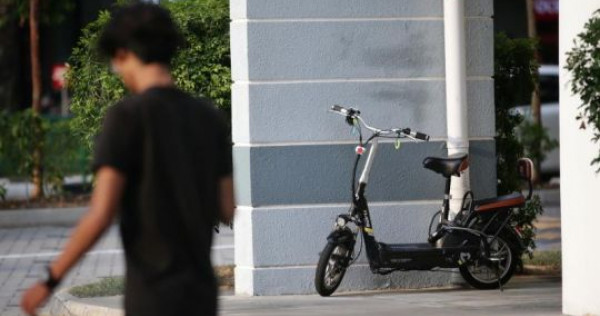
But he is worried that doing so now would risk a fine of up to $5,000, after the introduction of a rule banning personal mobility devices (PMDs), bicycles and power-assisted bicycles from all common properties in HDB estates.
“I am frustrated by this new rule because the actions of some inconsiderate PMD users affected the rest of us,” said Mr Shahrulnizam, who uses an e-scooter to carry out deliveries.
The ban covers common areas such as void decks, playgrounds, common corridors and play courts in estates.
SINGAPORE: The Housing and Development Board (HDB) has rolled out the use of artificial intelligence (AI) to enhance worker safety at its construction sites.
This AI system will focus on two scenarios which are common causes of worksite accidents, based on data from the Ministry of Manpower, HDB said in a media briefing on Thursday (Sep 12).
The system will monitor workers who come within one metre of a non-barricaded edge with a drop of more than two metres and those who are under the path of heavy loads lifted by tower cranes.
Currently, construction work sites rely on manual supervision by site supervisors and Workplace, Safety and Health Officers (WSHO) to ensure compliance with safety standards. According to HDB, this is a “resource intensive endeavour”, requiring multiple WSHOs and supervisors.
Connected to CCTVs in the worksite, the AI system will help identify high-risk zones and monitor it in real time. When workers enter these high-risk zones, the AI will send a Telegram alert and a photograph of the situation to site safety supervisors, prompting them to take action.
“A centralised and automated surveillance system will enable safety personnel to simultaneously monitor different work sites round-the-clock, thus allowing greater coverage with less manpower,” said HDB in its press release.
It added: “The automated system will reduce the risk of inconsistent safety standards across different supervising personnel, as well as human errors that could occur due to fatigue.”
Trials have been carried out at the Clementi Peaks Build-to-Order (BTO) site since September, and are expected to end by the fourth quarter of 2020.
If the trials are successful, HDB said it could potentially scale up the tool to cover other areas to enhance worksite safety, such as workers standing in the way of vehicle pathways, site traffic management and workers entering confined spaces without permission.
When fully developed in the longer term, the tool could also be shared with other developers and agencies to improve construction worksite safety in Singapore on a larger scale, it added.
HDB collaborated with the National University of Singapore’s (NUS) School of Design and Environment on the system supported by AI Singapore (under its 100 Experiments (100E) Programme).
3D CONCRETE PRINTING
HDB said the AI system is one example of how it has stepped up its investment in technology to uncover newer, better ways of working, amid the pressures and challenges in manpower and resources faced by the built environment sector.
One other way it is doing so is exploring the use of 3D concrete printing technology to expand its design capabilities.
The process removes the need for moulds or formworks, allowing objects with “intricate detail or geometric forms that would be near impossible to create with traditional methods”, said HDB.
A staff member demonstrates the use of a 3D concrete printer. (Photo: Cindy Co)
This will give construction architects and designers “greater flexibility and free play in their designs”, said deputy director of building design & precast system Heru Santoso Soedarsono.
“And since the printing process is highly automated, this reduces their reliance on manual labour,” he added.
While traditional methods could take up to several months to build a room-sized component, it would take just 13 hours – not including steel reinforcement bars – to complete with 3D printing.
There are plans use 3D printing for smaller components used in precinct designs, such as landscape furniture or architectural designs in common areas for some projects in Tengah and Bidadari.
DRONE INSPECTORS
It is also looking at the feasibility of using drones to inspect the facades of HDB blocks for cracks, spalling concrete and even corrosion, said HDB.
Currently, town councils use manual methods such as suspended gondolas, scaffolds, boom lifts or rope access which requires inspectors to work at height.
While manual inspections for one block usually takes a few days, drone inspections can reduce the time taken to a day or less.
AI paired with the drones will also allow HDB to tag the detected defects to a digital model of the building, and the system will deliver a report with the severity of the defects and recommended solutions.
In anticipation of residents’ concerns, HDB said residents will be notified in advance, the area below flights paths will be cordoned off for safety and that “any images of residents captured during (the) scanning process would be masked out, before the captured data is used for analysis”.
The drones were first piloted at Yuhua and Sembawang from July to October 2018.
SINGAPORE – The air quality in Singapore worsened on Sunday (Sept 15) morning as Pollutant Standards Index (PSI) readings crossed the unhealthy level in all parts of the island.
The 24-hour PSI reading for the north, south, east, central and west entered the unhealthy range at 1am.
At 8am, the 24-hour PSI readings ranged between 107 in the east and 124 in western Singapore. At 9am, the reading was between 107 and 123.
A PSI reading of 101 to 200 is in the unhealthy range, for which the National Environment Agency (NEA) advises the public to cut down on outdoor activities.
Air quality in Singapore hit unhealthy levels for the first time in three years on Saturday (Sept 14), with many parts of the island shrouded in haze.
As of 7pm, the 24-hour Pollutant Standards Index (PSI) reading ranged from 89 in the east to 109 in the west.
The 1-hour PM2.5 concentration reading also crossed into the high band earlier at 3pm at 159 in the west.
Hot spots have been detected in both Sumatra and Kalimantan in Indonesia over the past week, although based on prevailing winds from the south-southeast or south-southwest, it is haze from Sumatra that has been affecting Singapore.
SINGAPORE: Air quality in Singapore remained at unhealthy levels on Sunday (Sep 15) morning.
The 24-hour PSI stood at 124 in the west, 121 in the south, 107 in the east, 111 in the north and 108 in the central region as at 8am.
According to the National Environment Agency (NEA), PSI readings of 50 and below denote “good” air quality, “moderate” for 51-100 and “unhealthy” for 101-200.
The one-hour PM2.5 concentration reading ranged from 26-37µg/m3 at 8am, within the normal range.
PM2.5 is a measure of tiny particles less than 2.5 micrometres in diameter in the air. When the PM2.5 reading is in the elevated range, haze particles can affect the heart and lungs, especially in people who have chronic heart or lung conditions. Those with such conditions should ensure that they have their medication on hand, NEA said.
According to NEA, one-hour PM2.5 readings are a “good indicator of current air quality”, and can be used for those deciding whether to go for immediate outdoor activities, such as a jog.
Readings inched up throughout the evening and by midnight.
When air quality is at the unhealthy range, people – especially children, the elderly, pregnant women and those with heart or lung conditions – should reduce prolonged or strenuous outdoor activities. Those who are not feeling well should seek medical attention, NEA said.
NEA has assured the public that there are sufficient stocks of the N95 masks.
“We would like to assure the public that there are sufficient stocks in the warehouses and Government stockpiles,” said the agency on Facebook.
HDB blocks in Jurong East shrouded in haze on Sep 14, 2019. (Photo: Kevin Kwang)
“We are working with the retailers to move available stocks to the retail shops, and stocks will be available progressively from today (Sunday).”
HAZY CONDITIONS EXPECTED TO PERSIST
In its media advisory on Saturday evening, NEA said that the air quality worsened in the afternoon due to a confluence of winds over the nearby region that led to more smoke haze from Sumatra being blown towards Singapore.
Hazy conditions are expected to persist for the rest of the day, it added.
And over the next 24 hours, the PSI could enter the mid-section of the unhealthy range if denser haze is blown in.
A total of 450 hotspots were detected mostly in the Riau, Jambi and South Sumatra provinces, said NEA, a sharp increase from the 156 hotpots detected on Friday.
“Moderate to dense smoke haze from persistent hotspots in Riau and Jambi has been blown by the prevailing winds to affect Singapore and the southern parts of Peninsular Malaysia,” it noted.
Forest fires have raged through parts of Sumatra and Kalimantan in recent weeks, prompting the Indonesian government to send in military and police to douse the flames.
In Malaysia, air quality dropped to “unhealthy” levels in and around Kuala Lumpur, according to the government’s air pollutant index, and the skyline has been shrouded in thick smog.
SINGAPORE: Bill Gates once said that the leading indicator of where a nation is going to be in 20 years’ time is reflected in how well its education system is doing.
It is a pragmatic view of human potential as capital investment, and one that is reflective of Singapore’s journey.
CONTINUED COMMITMENT TO PRE-SCHOOL SECTOR
Singapore has been highly committed to investing in the development of its primary, secondary and post-secondary education system. It has been spending about 3 to 4 per cent of its annual GDP on education, amounting to about S$12 billion a year.
While increasing government spending on early childhood care and education (ECCE) to S$1 billion dollars annually is a fraction of what Singapore normally spends on its education system, the latest National Day Rally (NDR) nevertheless signals the Government’s continued commitment to the pre-school sector’s development even when it is an almost entirely privatised industry.
This announcement follows from the initial 2017 NDR, which was seen as a welcome spotlight on a long-neglected segment of the educational fraternity.
The ECCE sector has a part to play in nation and community-building, supporting child development, gender equality and an active workforce.
It is not made up of an association of childminders with qualifications, nor is it an industry providing pseudo-parenting services to cute young human beings.
ENSURING EQUITABLE ACCESS TO EARLY CHILDHOOD EDUCATION
Globally, an important priority for many governments is to ensure that every child has access to an inclusive and good-quality ECCE.
This has a lasting effect on children’s early brain development, holistic growth and learning potential, more than any other societal intervention that can be provided in their later lives.
This benefit is especially impactful for children growing up in vulnerable families and disadvantaged homes.
A file photo of a pre-school teacher with her class. (Photo: AFP)
This year’s NDR has yet again signalled the Singapore Government’s continued commitment towards supporting lower-and-middle-income families’ access to such services through demand-side subsidies as well as increasing the proportion of government-supported services in a sector that has more than 1,800 childcare centres and kindergartens.
In most European and OECD member states, ECCE forms part of a mixed economy in which public programmes co-exist with private-for-profit and private-not-for-profit providers. Globally, the growth of the private-for-profit sector within such mixed markets has been rapid, becoming the default option in most low-and middle-income countries.
However, there is a possibility of increased social stratification and elite formation within such marketised systems, such as what’s been highlighted in reports comparing 27 EU countries.
An increase in private-for-profit ECCE provision poses risks to accessibility, affordability and possibly, even service quality depending on how government regulations are applied.
Social stratification could be created when there is a plethora of corporatised childcare services and niche-programmes charging exorbitant fees.
Is there a risk of that happening in Singapore? On one hand, there is a cost disparity. The country’s median full-day childcare fees is at about S$850. At the higher end of the range, centres charge more than S$2,000 per month.
Dreamkids Kindergarten principal Dawn Choy shows how a smart board is used for educational games in class as teachers plan their lessons in an Angry Birds-inspired classroom environment in Singapore in 2015. (File photo: REUTERS/Edgar Su)
In Germany, however, where the ECCE market is dominated by not-for-profits, it is parent-run establishments that most likely contributed to social stratification and elite formation.
A similar trend has not been reported in Singapore. Families here still have the option of home-schooling their pre-schoolers and sending their children to faith-based settings, which are usually more affordable.
GOVERNMENT INTERVENTION OVER THE YEARS
Many OECD governments typically intervene given concerns in two areas: First, when levels of inequality among citizens become a threat to social cohesion and the nation’s equity goals.
Second, when mothers cannot access the labour market easily because there is a lack of childcare in the family and community, and this becomes an inefficient waste of resources (given women’s education and potential labour contribution).
Government interventions usually take a few forms: Regulation, the provision of demand-side (family) subsidies, supply-side grants or price controls, and the government’s direct provision of ECCE.
The increasing family subsidies, setting up of MOE Kindergartens in selected sites, the Anchor Operator (AOP) and Partner Operator (POP) schemes are all examples of how Singapore’s ECCE market is being steered to ensure greater accessibility and affordability of services.
Parents dropping their kids off at a kindergarten. (Photo: Sherlyn Goh)
Up until 2014, the ECCE industry has been entirely private-for-profit or not-for-profit. To date, there are now 24 MOE (public) kindergartens in a landscape of 1,800 plus childcare centres and kindergartens.
Even then, about half of the remaining privately-run sector are in the AOP and POP schemes receiving government grants. They are obligated to maintain affordable fees, monitor quality and be located in accessible sites.
Programmes such as KidSTART are also resource-efficient way to support at-risk groups of children and their caregivers at a time when it matters most.
FOCUS ON DEVELOPING THE PROFESSION
As a nation that relies on the quality of its human resource and societal cohesion, we must forge ahead to build quality ECCE services. This requires a strong, knowledge-driven profession that will advocate for children’s best interests – physical, emotional and cognitive.
The business of educating young ones must be provided by thinking professionals who are responsive to young children’s unpredictable curiosity and enthusiasm, and can develop their unique capabilities and motivation to learn.
But this aim is less of a priority compared to other national objectives, including providing access.
In 2013, Germany introduced reforms guaranteeing a place in childcare for every child aged 1 and above.
Its purpose was to influence peoples’ decision to have children in a rapidly ageing society and tackle the nation’s long-term demographic change. While welcomed by some, this policy move has also raised many questions about the realistic possibility of providing high-quality childcare for every child.
FOCUS ON THE LONGER-TERM HUMAN CAPITAL ASPECTS
There are two ways to look at the purpose of ECCE within any nation – a more short-sighted view is to create such services so as to meet the practical needs of working adults by providing custodial care.
A longer-term view of ECCE is to go beyond meeting families’ logistical needs, to be part of the “whole village” that raises children for a better society, where professionals work together with parents to support children’s learning and development, not simply for primary school.
American studies have shown that poor quality childcare can have harmful effects on their social and emotional development.
The UK’s large scale, longitudinal Effective Provision of Pre-school Education study has shown that children who attend low-quality pre-schools receive little to no added benefit in terms of socio-emotional and cognitive development and may be less resilient in the face of negative encounters in primary and secondary school.
In contrast, the developmental benefits of high-quality programmes can have lasting effects on children even beyond secondary school.
WHAT QUALITY ECCE LOOKS LIKE
Quality provision is characterised by the warm and supportive relationships that teachers and children have, their sustained conversations through enriched and authentic play and learning experiences.
Students at the Our Lady Kindergarten in Hong Kong queue before being let out for recess. (Photo: AFP Photo/Stephen Shaver)
High-quality pre-school classrooms have a distinct mark of intellectual curiosity and keen inquiry that is shared by both children and teachers, and do not resemble a watered-down primary school curriculum with its typically disconnected subject disciplines.
In any ECCE system, it would be presumptuous to assume correlation between quality and fees or other structural factors such as group size, adult-child ratio and teachers’ qualifications.
Instead, it has been found that quality ECCE is dependent on the competencies and everyday decision-making of leaders and staff within each centre, whose actions and words directly determine the experience children have within a given site.
The last time that Singapore’s ECCE was compared with other nations was in the EIU’s Starting Well report in 2012, in which Singapore ranked 29 overall out of 45 countries (30 for the quality indicator and 21 for affordability).
Singapore has chosen to respond by providing stronger support to pre-schools in their quality improvement efforts, and applying a more developmental and less punitive approach.
Since that report, one in two ECCE centres have been quality rated by ECDA’s quality assurance assessors under the Singapore Pre-school Accreditation Framework (SPARK) even though it is not mandatory.
Centres are rated on a scale of 1 to 6 (rated “emerging”, “performing”, or “mastering”) in five areas across more than 40 indicators, and as long as centres obtain an “emerging” score, they receive SPARK-certification. SPARK-certified centres are to undergo quality rating every few years while they continue to use the rating instrument for in-house self-evaluation.
Quality ECCE cannot be bought. It requires a profession to attract capable, sincere people who can be retained.
And over time, these professionals must be supported as critically reflective practitioners who will develop quality ECCE practices grounded in contemporary theories and research-based knowledge about how young children grow and learn.
Associate Professor Sirene Lim is Academic Lead for the Early Childhood Education Programme at the Singapore University of Social Sciences.
SINGAPORE: The Michelin Bib Gourmand list has expanded this year but instead of there being something for everyone, it seems many are not entirely pleased with what’s on it.
From huffy declarations about how some joints do not deserve their place on the list to smugly cryptic asides from those who are glad their favourite spots remain undiscovered, we’ve all got something to say.
Of course, food and taste is highly subjective. So it is natural that when it comes to rankings on food guides like the Michelin Guide or The World’s 50 Best Restaurants, there is invariably chatter over whether the awardees are deserving, or not.
Still, there is something about the Bib Gourmand category that is particularly controversial. Since it spotlights eateries that offer diners a “complete and high quality menu priced at a maximum of S$45”, our beloved affordable local food is naturally heavily featured. In fact, of the 58 recognised establishments, 33 are hawker stalls and six are street food outlets.
Now, it is common knowledge that Singaporeans are incredibly proud of our local cuisine – the Michelin Guide even believes people here get into fist fights over where the best versions of various dishes can be found.
Char siew sold at Hawker Chan..
While there hasn’t been a recorded incident of foodies exchanging blows yet, the passion for food is real. So, when a bunch of anonymous inspectors compile a list like this, it can feel like outsiders are parachuting in to make pronouncements about what is our “best” chow.
Cue widespread displeasure.
A VIBRANT HAWKER SCENE
This cacophony of dissent bodes well for Singapore’s food scene. So much has been said about the dying street food culture that it sometimes seems like there aren’t many worthwhile hawker stalls to dine at anymore.
Instead, the Bib Gourmand has ignited a vibrant debate about who our top hawkers ought to be, with just about every person having his or her own list of favourites. It is a good sign that our hawker culture is thriving with enough breadth and depth to satisfy all our varied palates.
Then there are the pragmatists who are happy that their favourite spots have been left out the Guide. Why? They do not want to deal with longer queues should these places become wildly popular or worse, have to pay more if prices increase.
Personally, I wish that these good finds are shared with more people, but maybe I’m just a glutton.
More broadly speaking, in a country where a disproportionate amount of significance is placed on rankings of all sorts, this “couldn’t care less” attitude points collectively to our growing confidence in our food choices that we do not need the affirmation of a guide to know where the good stuff is.
A GUIDE FOR TOURISTS
At this point, it is worth taking a moment to remember the origins of the Michelin Guide, which now has editions in many cities around the world. The guidebook was started by the founders of the tyre company to encourage motorists to drive more frequently by providing travellers with useful tips like where to stay and places to eat.
Until today, it is still predominantly targeted at tourists, with the Bib Gourmand’s affordable listings complementing its main star system which typically spotlights fine dining restaurants. (Why some hawker stalls have been awarded one star, while others get a Bib Gourmand is another debate for another commentary.)
What is interesting though, is that in many foodie destination cities, locals tend to have a different opinion on what should make the cut, compared to what travellers might think.
For example, on a recent trip to Thailand, I happened to wax lyrical about my meal at the one-Michelin starred Paste Bangkok.
A new entrant to the Bib Gourmand selection is Chef Kang’s Noodle House, a casual offshoot of one-Michelin-starred restaurant Chef Kang’s (Photo: Michelin)
My Thai companions gave me what I can only describe as a sympathetic “poor clueless tourist” look before telling me that some locals do not feel the same way about that particular restaurant. The next time you are here, we will bring you out for authentic Thai food, they reassured me.
Sound familiar?
Regardless, my mouth still waters when I think of my excellent meal. The chef’s fluffy souffle-like omelette topped with generous chunks of crab meat and the wondrously umami pomelo salad, resplendent with the flavour of fresh, juicy prawns, were revelations and, I think, well-deserving of a star.
And while it is always a treat to have friends who will bring you to their secret haunts and neighbourhood treasures, as a traveller I am glad for such guides which offer a decent shortlist of places that have at least met a range of standards consistently.
In Singapore, the Michelin Guide’s presence here is in part due to the efforts of the Singapore Tourism Board to elevate the country as an international dining destination.
This is a similar case to a number of other cities where it has launched in recent years. When viewed through this lens, the Guide has certainly achieved this aim.
And even if there is disagreement on what should make it onto the Bib Gourmand list, it is good to know that there is an element within this international publication where our local hawkers and chefs are honoured for their humble but delicious fare.
Timbre+ at one-north. (Photo: Facebook/Timbre+)
Perhaps, the next step will be to promote a locally generated guide like Makansutra or review sites like HungryGoWhere or Burpple – all of which have a plethora of foodie content but come with their own set of pros and cons – to tourists who wish to deep dive into our multi-faceted hawker culture.
In the meantime, it would be churlish to dismiss the Bib Gourmand entirely just because of some differences in opinion.
Instead, the next time you are looking for a new place to grab a meal at why not look through the list to see if there’s anything you haven’t heard of and give it a try? After all, it never hurts to discover a new gem.
Karen Tee is a freelance travel and lifestyle writer. Six years ago, people thought she was crazy to leave the security of her full-time job. Today, most want to know how she does it.
HARARE: Zimbabwe’s founder Robert Mugabe was honoured as an icon, principled leader and African intellectual giant at a state funeral on Saturday (Sep 14), after a week of disputes over his burial threatened to embarrass President Emmerson Mnangagwa.
Mugabe led Zimbabwe for 37 years, from independence until he was ousted by the army in November 2017, by which time he was viewed by many at home and abroad as a power-obsessed autocrat who unleashed death squads, rigged elections and ruined the economy to keep control.
He died in a Singapore hospital on Sep 6 aged 95, far away from a country he left polarised by a raging political rivalry between its two largest political parties, ZANU-PF and the opposition MDC.
His remains will be interred in a mausoleum at the National Heroes Acre in the capital Harare in about 30 days, his nephew said on Friday, contradicting earlier comments that a burial would be held on Sunday.
Zimbabwean President Emmerson Mnangagwa looks on next to his wife Auxillia Mnangagwa during the state funeral of the country’s founder and longtime ruler Robert Mugabe, at the national sports stadium in Harare, Zimbabwe, September 14, 2019. REUTERS/Siphiwe Sibeko
On Saturday, Mnangagwa walked behind the casket carrying Mugabe’s body as it was wheeled into the centre of Harare’s National Sports Stadium and placed on a podium decorated with flowers so that heads of state could say their farewells. Senior army generals and Mugabe’s wife and children followed, as a brass band played.
In a tribute to his predecessor, Mnangagwa said Mugabe stood in defence of Africans. He urged the West to remove sanctions that were imposed during Mugabe’s rule.
“We who remain shall continue to hear his rich, brave, defiant and inspiring voice … encouraging and warning us to be vigilant and astute,” Mnangagwa said in a speech.
“A giant tree of Africa has fallen. Today Africa weeps.”
Mnangagwa and the ruling ZANU-PF party wanted Mugabe buried at the national shrine to heroes of the 15-year liberation war against white minority rule. But some relatives, expressing bitterness at the way former comrades ousted Mugabe, had pushed for him to be buried in his home village.
A general view of the National Heroes Acre where former Zimbabwean President Robert Mugabe will eventually be buried in Harare, Zimbabwe, September 14, 2019. REUTERS/Philimon Bulawayo
Walter Chidhakwa, who spoke on behalf of Mugabe’s family, said Mugabe was an icon who was determined and unflinching in pursuing policies like land reform and later the black economic empowerment programme.
Mugabe left behind a country wrecked by hyperinflation, dollarisation and deeply entrenched corruption.
But many Zimbabweans also remember Mugabe as their country’s liberator from white minority rule and for broadening people’s access to education and land.
The body of Zimbabwe’s founder and longtime ruler Robert Mugabe is brought to the national sports stadium for a state funeral in Harare, Zimbabwe, September 14, 2019. REUTERS/Siphiwe Sibeko
RAMAPHOSA BOOED
South African President Cyril Ramaphosa was booed by the crowd in the stadium after a wave of deadly riots and xenophobic attacks in South Africa earlier this month that triggered international anger. The attacks mainly targeted shops owned by African migrants.
The master of ceremony was forced to appeal to the crowd to give Ramaphosa a chance to speak.
“I stand before you as a fellow African to express my regret and to apologise for what has happened in our country,” Ramaphosa said, to cheering from the crowd.
Military members stand guard before the arrival of Zimbabwe’s founder and longtime ruler Robert Mugabe’s coffin at the national sports stadium for a state funeral in Harare, Zimbabwe, September 14, 2019. REUTERS/Siphiwe Sibeko
Kenya’s Uhuru Kenyatta called Mugabe an intellectual giant, “a visionary leader and a relentless champion of African dignity.”
Other heads of state who attended Saturday’s funeral included long-ruling leaders from Equatorial Guinea and Congo while China, Russia and Cuba, which supported Zimbabwe’s liberation movements that fought white minority rule, were represented by officials.
Prominent officials from Western countries, which were critical of Mugabe’s rule, did not feature in the official funeral programme.
Mnangagwa led heads of state in viewing Mugabe’s body, which was followed by a military 21-gun salute to honour Mugabe.
Banners at the stadium where Mugabe’s body lay in state read “Hamba kahle, Gushungo,” (go well, Gushungo)”, a reference to his clan name, and “Go well our revolutionary icon”.
Cleo Mapuranga, a caterer, told Reuters that Mugabe fought to give land and economic freedom to blacks and provided non-racial education.
“Now, people are suffering. No one is controlling the prices in the shops. Our finance minister is trying to implement first-world policies which don’t work in third-world countries.”
Mugabe’s death has made some Zimbabweans question what Mnangagwa has achieved in his two years in power.
His government has taken steps to cut the budget deficit, remove subsidies on fuel and power and repeal laws curbing public and media freedoms, but those reforms and austerity measures have compounded ordinary people’s hardships.
(Reporting by Alexander Winning; Writing by MacDonald Dzirutwe; Editing by Olivia Kumwenda-Mtambo, Catherine Evans and Mark Potter)
SINGAPORE: A flavour of Ritter Sport chocolate bar is being recalled due to an undeclared milk allergen, the Singapore Food Agency (SFA) said on Saturday (Sep 14).
The affected product is Ritter Sport – KAFFEESPLITTER from Germany, at 100g and with a product UPC (universal product code) of 000417 927002.
The recall follows similar action by the US Food and Drug Administration (FDA), which said a milk ingredient was not declared on the product label.
Back of implicated product package. (Photo: SFA)
SFA said it has directed the local importer to recall the implicated product.
“Consumers who have purchased the affected product, and who are allergic to milk, should not consume it,” said the agency.
For enquiries and exchanges, consumers may contact the importer Radha Exports at 6220 2777.
SINGAPORE: A day after Singapore confirmed its first Zika cluster of the year, those living along Hemsley Avenue in Serangoon Gardens are doing what they can to prevent mosquitoes from breeding.
All three cases of Zika announced on Friday involved residents at Hemsley Avenue.
“I’m staying indoors and keeping my fingers crossed,” said resident Sabrina Lim on Saturday (Sep 14).
The 48-year-old housewife also told her three children, who occasionally go to the nearby park, to stay home.
Hemsley Avenue is close to an existing eight-case dengue cluster at Bridport Avenue/Cowdray Avenue/Huddington Avenue/Portchester Avenue/Tavistock Avenue, which was notified on Aug 20.
Both Zika and dengue are spread by the aedes aegypti mosquito.
Another resident, Ms Genevieve Chabot, told CNA she has asked her privately contracted insect control company to come twice a month instead of once a month.
Resident Bryan Lincoln doesn’t use pot holders, and keeps fish in his pond to prevent stagnant water in his home. (Photo: Jalelah Abu Baker)
Her neighbour, Mr Bryan Lincoln, said that while he makes sure his many plants and three fountains do not contain stagnant water, he is still worried.
“There’s always worry. You might clean your place, but aedes mosquitoes can come from the nearby park, from the next road,” said the 78-year-old retiree.
He added that he is also concerned about a small puddle of stagnant water in the neighbouring home that is being renovated.
According to Mr Lincoln, officers from the National Environment Agency (NEA) visited his home on Saturday, and said the matter comes under the officers in charge of construction sites.
A small puddle that worries resident Bryan Lincoln. (Photo: Jalelah Abu Baker)
Other residents have also bought mosquito repellent to protect themselves, and have taken to wearing long pants when they go out.
At the start and end of the row of houses along Hemsley Avenue, there were two large banners urging residents to get rid of stagnant water to fight dengue and Zika.
NEA said it started operations in the area to kill mosquito breeding habitats since the dengue cluster was notified in August. As of Friday, five breeding habitats in this dengue cluster have been destroyed, the agency added.
Residents said officers checked their homes for mosquito breeding sties on Saturday. They also noticed men opening manhole covers to treat drainwater.
Notices put up in the area said fogging will be done on Sunday.
A notice on fogging in the area. (Photo: Jalelah Abu Baker)
The Zika virus has been associated with neurological diseases such as microcephaly, which causes babies to be born with a smaller head due to abnormalities in the development of the brain.
There have been a total of 10 Zika cases in Singapore this year, according to NEA’s website. Last year, one case of Zika was reported.
Singapore had its very first imported case of Zika in May 2016, and the first locally transmitted case came a few months later in August. By the end of that year, more than 450 people had been infected.