Home Blog Page 690

Healthcare institutions, nursing homes take “multi-pronged” measures to protect vulnerable from haze

0

SINGAPORE: As the haze continues to persist, healthcare institutions and nursing homes across Singapore say they are taking steps to protect those under their care, especially those in wards and rooms without air-conditioning.

At Changi General Hospital (CGH) for instance,  a “multi-pronged” approach has been put into place to ensure the safety of patients and staff, CGH’s service operations director Dr Goh Min Liong told CNA.

Said Dr Goh: “In wards without air conditioning, portable air cooling units and air purifiers are deployed, and screens to prevent the inflow of haze are fitted where necessary.”

CGH’s ventilation systems are also fitted with HEPA (high-efficiency particulate air) filters, added Dr Goh. These are filters that trap harmful particles in the air.

In addition, CGH is monitoring the number of patients with respiratory-related conditions, explained Dr Goh, and patients who have medical conditions that make them susceptible to the haze have been given suitable respirators for support where advised by doctors.

READ: Understand the haze: What do Singapore’s air quality readings mean and how do they differ from others?

The National University Health System (NUHS) – which manages several hospitals, including National University Hospital, Ng Teng Fong General Hospital, Alexandra Hospital and Jurong Community Hospital – has also implemented measures to maintain indoor air quality, an NUHS spokesperson told CNA.

This includes shutting windows in the naturally-ventilated patient areas and deploying portable air cooling and purifying units.

“Filters are installed to the air-conditioning systems in the buildings to minimise pollutants and smell in the air. We have a good supply of essential supplies … medicine, eye drops, inhalers, surgical masks and N95 masks,” said the spokesperson. “Staff who are susceptible to the haze condition will be redeployed to work indoors.”   

For instance at Alexandra Hospital, security personnel wear masks when deployed outdoors for patrolling, while the daily frequency for groundskeeping such portering and landscaping has been reduced. 

At NUHS polyclinics, the elderly, pregnant women, children and those with existing chronic respiratory and heart diseases will be given priority for consultations and treatment, its spokesperson added.

While Tan Tock Seng Hospital (TTSH) did not respond to CNA’s queries, a visit to one of its wards last Wednesday also found that windows were shut, with all fans switched on for ventilation. 

“The healthcare institutions take reference from the National Environment Agency’s guidelines on indoor air quality, in managing the particulate matter (PM) levels in indoor spaces,” said the Ministry of Health in response from CNA’s queries.

AN EYE ON THE SITUATION

Nursing homes have also been proactive in battling the haze.

At Thong Teck Home for Senior Citizens, steps are taken to ensure that residents in the non air-conditioned nursing home are protected when the Pollutant Standards Index (PSI) exceeds 100.

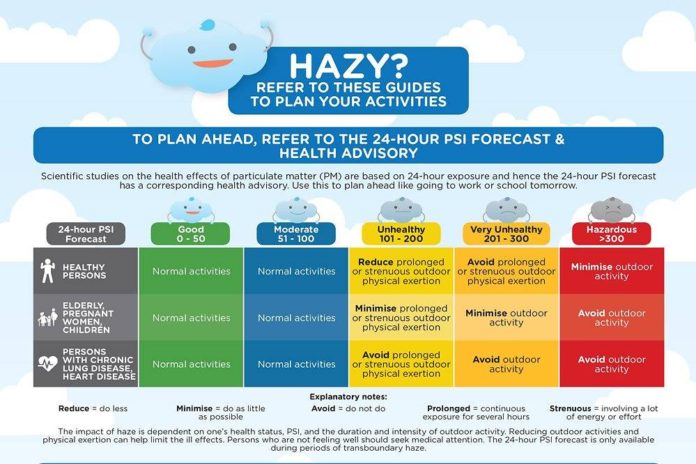
According to the National Environment Agency (NEA), PSI readings of 50 and below denote “good” air quality, “moderate” for 51-100 and “unhealthy” for 101-200.
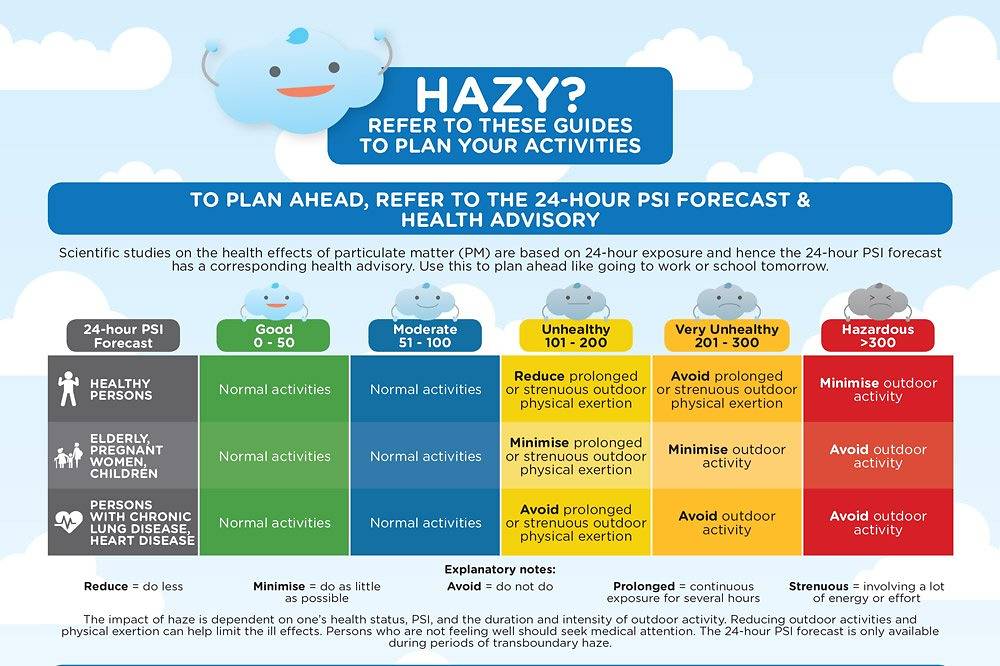
NEA haze health advisory

National Environment Agency’s health advisory. (Image: National Environment Agency)

Haze updates are disseminated to all key personnel every two hours through a central information kiosk, said the home’s deputy nursing officer, SN Santie Antonio Soria, with fans being turned on at all times, and face masks being made available to residents, staff and visitors.

When the 24-hr PSI reading crosses into the unhealthy range, Ren Ci Hospital’s haze management plan also kicks in at its nursing homes, it told CNA.

In addition to making use of air purifiers and monitoring residents for adverse reactions to the haze, it also conducts less intensive rehabilitation activities in air-conditioned areas.

READ: 16 million N95 masks available in national stockpile as haze covers Singapore

“We placed emphasis on hydration for patients/ residents and have been brewing drinks like barley water for them and staff as well,” added Ren Ci. 

At Thye Hwa Kwan’s nursing home, two-hourly rounds in “designated areas” are also  conducted to check on residents’ well- being, it told CNA.

All outdoor activities in the nursing home have also been cancelled till further notice. 

Standby inhalers, eye drops and heart-related medications for emergency use are also readily available, it added.

Source link

To mitigate climate change, UN member states must redouble efforts: PM Lee

0

NEW YORK: Member states of the United Nations need to redouble their efforts to mitigate climate change, said Singapore Prime Minister Lee Hsien Loong on Monday (Sep 23), calling climate change the “ultimate global commons challenge”.

“As leaders, we all have the responsibility to do our part to rally our people’s support for sustainable development; to convince and educate our people that these efforts are important, and to safeguard our future, and the futures of our children and grandchildren,” Mr Lee said.

Mr Lee was speaking at the UN secretary-general’s Climate Action Summit – where governments shared plans and examples of how they are cutting emissions and boosting resilience to the impact of climate change.

PM Lee at UN climate summit

Prime Minister Lee Hsien Loong addressing delegates at the UN Climate Action Summit.

He is in New York on a week-long working visit where he is to meet US President Donald Trump and will receive the 2019 World Statesman Award.

READ: PM Lee to meet President Trump, deliver speech at United Nations during visit to New York

“The consequences of climate change are catastrophic and affect all countries. New diseases, more extreme weather events, food shortages, forced migration and even wars,” Mr Lee said.

Mr Lee said Singapore will not be able to stop climate change on its own, however hard the country tries.

As such, Singapore is cooperating with other countries through initiatives such as the Southeast Asia Disaster Risk Insurance Facility, with the support of Japan and the World Bank.

The facility provides flood risk-pooling for the region, and the risk pool is meant to provide immediate liquidity to cover emergency response costs in the aftermath of regional catastrophes.

Singapore has also contributed S$5 million to the ASEAN Specialised Meteorological Centre, based in Singapore, for a five-year regional capacity development programme for Southeast Asia.

The programme aims share technical knowledge and skills in weather and climate prediction, to help the region better adapt its policies to climate change.

Apart from these steps, Singapore has also played its part by switching to a cleaner fuel mix, and deploying cleaner energy solutions, Mr Lee said.

For instance, Singapore has implemented a carbon tax set at a rate of S$5 per tonne of greenhouse gas emissions from 2019 to 2023. 

The country will review the carbon tax rate by 2023, with plans to increase it to between S$10 and S$15 per tonne of greenhouse gas emissions by 2030.

READ: NDR 2019: Climate change one of the ‘gravest challenges facing mankind’, impact on Singapore to worsen, says PM Lee

The country is also installing large-scale solar panels that float in its reservoirs and off its shores.

“Being small and highly urbanised, we are disadvantaged in terms of alternative energy, but we are developing creative solutions within our constraints,” Mr Lee said.

Mr Lee’s comments at the summit come after he spoke at the National Day Rally about the “50 to 100-year problem” of rising sea levels, an issue which could cost Singapore around S$100 billion or more to tackle. He had called climate change “one of the gravest challenges facing humankind”.

Source link

International Conference on Nanosensors and Electronic Instruments

0

International Conference on Nanosensors and Electronic Instruments
from Monday, February 17, 2020 at 9:30 AM to Monday, February 17, 2020 at 5:00 PM

Thailand

Singapore, Singapore

Source link

Visibility in Singapore drops to as low as 3km on Monday amid hazy conditions: NEA

0

SINGAPORE: Visibility in some parts of Singapore was reduced to between 3km and 5km on Monday morning (Sep 23) due to hazy conditions and increased moisture in the atmosphere, said the National Environment Agency (NEA). 

This gradually improved to a visibility of between 7km and 8km over most areas in the afternoon, the agency added. 

Air quality improved slightly as well compared to Sunday, after showers over Singapore and the surrounding sea areas. 

At 8pm, the 24-hour Pollutant Standards Index (PSI) was 92 in the north, 97 in the central region, 98 in the west, 99 in the east and 107 in the south – mostly in the moderate range. 

PSI readings of 50 and below denote “good” air quality, “moderate” for 51-100 and “unhealthy” for 101-200.

The one-hour PM2.5 concentration readings at 8pm ranged between 39-57µg/m3. It was in the normal band for most parts of Singapore.

READ: Regional rain forecast over next few days, haze situation may improve: NEA

READ: Understand the haze – What do Singapore’s air quality readings mean?

Showers fell over northern and central Sumatra as well as western Kalimantan on Monday, NEA noted. 

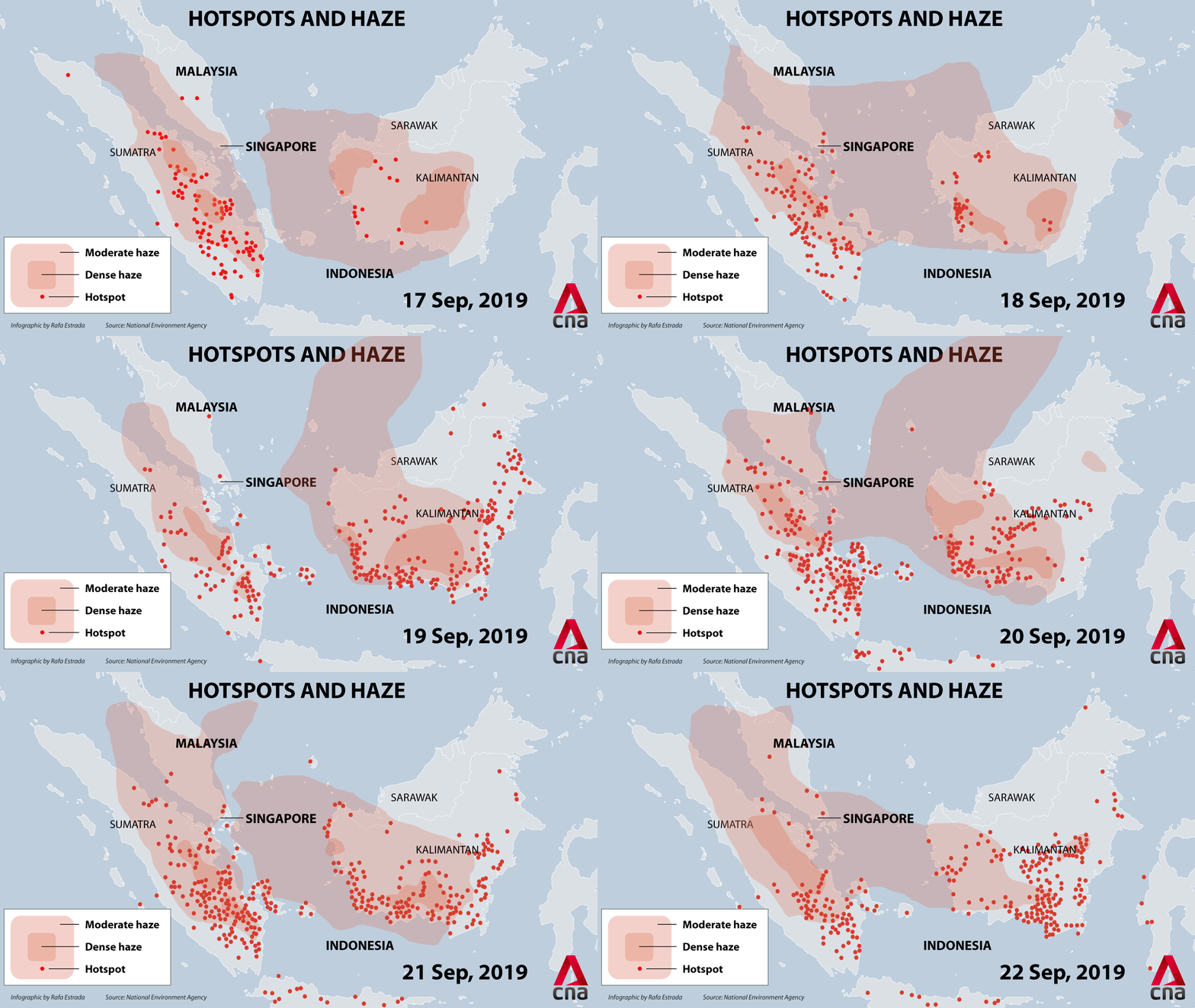
Sixty hotspots were detected in Sumatra, mostly in the provinces of Riau, Jambi and South Sumatra, down sharply from the 246 detected on Sunday due to cloud cover over Sumatra, the agency added.

In Kalimantan, however, a total of 1,006 hotspots were detected.

“Some showers over western Kalimantan have helped to improve the hazy conditions there, but smoke haze continued to be observed in southern Kalimantan,” said NEA.

On Tuesday, the air quality is expected to further improve as thundery showers are forecast in the late morning and early afternoon.

READ: Cutting through the haze: When do you need an N95 mask?

For the next 24 hours, the one-hr PM2.5 concentration readings are expected to be in the normal band but may occasionally enter the elevated band under light wind conditions, said NEA.

It added that the 24-hr PSI is forecast to be in the low end of unhealthy range and is expected to gradually improve to the high end of moderate range.

Source link

Slow start to LTA’s early disposal incentive for e-scooters that don’t meet fire safety standards

0

SINGAPORE: About 450 applications were received as of 5pm from registered e-scooter owners looking to dispose of their devices that do not meet new fire safety standards, said the Land Transport Authority (LTA) on Monday (Sep 23). 

This is a fraction of the 90,000 e-scooters registered with LTA, of which 90 per cent do not meet the UL2272 safety requirement. 

Monday was the first day of LTA’s S$100 incentive scheme for e-scooter owners who agree to dispose of their devices early, ahead of next July’s ban on the use of such devices here. 

To qualify for the S$100, the e-scooters must have been registered, and owners have to bring the devices to a designated disposal point. 

READ: LTA’s S$100 incentive for early disposal of non-compliant e-scooters: What you need to know

Only two of these disposal points were opened on Monday, according to LTA’s list of the 181 locations and their opening hours. 

At LTA’s Sin Ming office, the first e-scooter user arrived just after 11am. By noon, five people had turned up to surrender their devices but two were not eligible for the cash incentive.

One of them was a woman with a non-registered e-scooter, who demanded to know why she did not qualify for the S$100.

PMD early disposal follow-up (1)

PMD users at Boon Lay Place on Sep 23, 2019. (Photo: Corine Tiah)

Another user who was not eligible for the incentive said he had bought the device secondhand from his friend for S$200.

“I will give it back to my friend and take my money back,” he said.

While the ban on non-compliant personal mobility devices (PMD) kicks in only next July, a user said he would rather “get rid of it early” and “spend (the money) on some drinks”.

The man, who declined to be named, turned up at LTA’s Sin Ming office with a one-wheel scooter he bought two years ago.

“I bought this two years ago on a Kickstarter project it just got delivered to me two years later. It is not UL2272 certified but now I can’t do anything about it so I am not happy,” he said.

READ: Preventing PMD fires: Tips on charging your device safely

At the other designated disposal point near Block 209 Boon Lay Place, there was a short queue of PMD users waiting for the collection point to open at 5pm.

A 57-year-old who wanted to be known as Eric Lim came with two registered e-scooters, which he had bought for S$1,000 and S$600.

PMD early disposal follow-up (1)

The first PMD owner to arrive at the office handling early disposal on Sep 23, 2019. (Photo: Corine Tiah)

When asked how he felt about the ban and the early disposal incentive, he said he had “no choice”, but that he understood LTA’s decision to ban non-UL2272 scooters due to the spate of fires caused by such devices. 

“I don’t blame the government because there is no choice,” said Mr Lim, adding that he will not buy any more e-scooters after this. 

“Now that there are so many rules to follow, this thing (scooter) gives you so much stress and worry. Will you keep it or not? No right,” he said. “You buy a certain thing is to make your life easier but now it became like this.”

READ: Fires involving e-scooters, e-bikes spike by 50% in 2018

READ: How your lithium-ion battery could be an explosive danger

Another user, who only wanted to be known as Mr Lim, had similar sentiments.

“I think it is a good thing. Because of the high capacity batteries, so many fires have occurred. So it is good to be more regulated in that sense,” he said.

PMD early disposal follow-up

The office handling PMD disposal in Sin Ming on Sep 23, 2019. (Photo: Corine Tiah)

The 35-year-old, who lives across from the Boon Lay Place disposal point, had been using his S$500 scooter for more than two years.

As he had been looking at ways to dispose of it, he welcomed LTA’s S$100 early disposal incentive.

“Previously I was actually looking at recyclers who would take it in but then I have to go all the way to Tuas which is very inconvenient,” said Mr Lim.

“The S$100 is an additional bonus for me because I was already thinking of how to dispose of it for free,” he added. “From what I heard, I may even need to pay for it to be recycled.”

Mr Lim plans to get a new e-scooter that meets the new safety standard, to travel to work like he used to.

The S$100 incentive goes on until Nov 30. 

Those who dispose of their e-scooters after Nov 30 don’t qualify for the S$100 incentive, but they can still drop off their devices at the designated points until Mar 31, 2020.

Source link

"The Experiment" by Amity Chamber Orchestra

0

“The Experiment” by Amity Chamber Orchestra
from Saturday, November 2, 2019 at 5:00 PM to Saturday, November 2, 2019 at 6:30 PM

10 Square @ Orchard Central

181 Orchard Road, Level 10, Singapore, 238896 Singapore

Source link

Cheaper fares on Scoot, $40 buffet-karaoke, McDonald's 1-for-1 Big Breakfast & other deals this week

0

[ad_1]

We scour the island for the best deals to help you stretch your dollar, and keep you in the loop on the hottest shopping and dining trends.

‘Cos good things must share.


SCOOT SCRAPS PAYMENT PROCESSING FEE

Your fares on Scoot will now be cheaper, after the airline announced that it has scrapped payment processing fees globally for all bookings made on its direct channels like the website and app.

The changes are effectively immediately.

Previously, a charge of $20 applied to customers paying for tickets with their credit card, while choosing to pay via AXS incurred a charge of $6.

Other payment methods available to Singapore customers include Apple Pay, Goole Pay, PayNow and PayPal.

Travel deal-seekers can also visit www.flyscoot.com/gtg for deets on their weekly Got-To-Go promotion, commencing Tuesday (Sept 24).

MCDONALD’S 1-FOR-1 BIG BREAKFASTS

McDonald’s is giving away ’40 days of 1-for-1 deals’ to celebrate the launch of its new app.

[ad_2]

Source link

Oil edges further above US$64 on doubts over Saudi supply

0

Oil prices rose to their highest in two sessions on Monday amid concerns about oil supply disruptions from Saudi Arabia and elevated tensions in Middle East.

FILE PHOTO: General view of the Fos-Lavera oil hub near Marseille

FILE PHOTO: General view of the Fos-Lavera oil hub near Marseille, France, September 17. REUTERS/Jean-Paul Pelissier

LONDON: Oil rose further above US$64 a barrel on Monday, supported by doubts about how quickly Saudi Arabia can restore output after a crippling attack this month and a resulting greater focus by investors on supply risks.

Despite efforts by the top crude exporter to reassure the market it can resume full production by the end of September, state oil company Saudi Aramco has asked some customers to switch crude grades and delay shipments.

“The geopolitical risk premium has returned with a vengeance and supply-side developments have been thrust back into the spotlight,” Stephen Brennock of oil broker PVM said.

“While Saudi oil facilities smoulder, the potential for fresh outages in Nigeria, Libya and Venezuela continues to hang over the market.”

Brent crude was up 31 cents at US$64.59 a barrel at 0911 GMT, having risen as high as US$65.50. U.S. West Texas Intermediate crude rose 28 cents to US$58.37.

Brent has gained 18per cent this year, helped by a supply-limiting pact led by the Organization of the Petroleum Exporting Countries, although concern about slowing economic growth has limited the advance.

A survey on Monday showed euro zone business growth stalled this month, and the latest U.S.-China talks have failed to produce signs of a breakthrough in the two countries’ prolonged trade dispute.

“Investors remain unconvinced that a trade deal is about to see the light of day soon,” said Hussein Sayed, analyst at broker FXTM. “That’s likely to put a cap on any further gains in risk assets.”

Tension in the Middle East has escalated since the Saudi attack, also lending oil some support. The Pentagon has ordered additional U.S. troops to be deployed in the Gulf region to strengthen Saudi Arabia’s air and missile defences.

Britain believes Iran was responsible for the attack and will work with the United States and European allies on a joint response, Prime Minister Boris Johnson said on Monday. The United States and Saudi Arabia have already blamed Iran, which denies responsibility.

(Additional reporting by Florence Tan; Editing by Dale Hudson)

Source link

36 years and spicy as ever, Red Hot Chili Peppers turn the heat up at F1 finale

0

[ad_1]

The time was 10.12 pm on Sunday (Sept 22) and the crowd at the Padang erupted into a chorus of cheers and whistles as Ferrari’s Sebastian Vettel bagged a win at the 2019 Formula 1 race.

But there was another reason for the pulsating excitement in the air. 

After 17 long years, Red Hot Chili Peppers returned to Singapore’s stage and boy, were they as spicy as ever.

With tensions running high and adrenaline thrumming through everyone’s veins, the American rock band kicked it off on a high note with an intro jam.

Bassist Flea. PHOTO: Rainer Cheung/AsiaOne

Needless to say, in true classic Red Hot Chili Peppers fashion, bassist Flea was already shirtless from the get-go.

[ad_2]

Source link

Haze in Singapore: Why babies, toddlers, preschoolers and primary school children need not wear N95 mask

0

[ad_1]

Do not make your young child wear an N95 mask, says Dr Natalie Epton, specialist paediatrician and neonatologist at SBCC Baby & Child Clinic (Mount Elizabeth Novena).

There is currently no N95 mask that is approved for use in young children, she says.

Those that are available may make breathing more laboured, potentially worsening breathing in children already affected.

As a general rule, the N95 mask is appropriate for teens, but it also depends on the size of the child, and his or her face. Surgical masks are, of course, useless, Dr Epton adds.

This view is echoed by the Ministry of Education (MOE), noting that there is currently no international certification standards for the use of masks on children.

WHAT MOE IS DOING TO PROTECT KIDS

MOE says that N95 masks would not be required for short-term exposure, like commuting from home to school, or when students are in an indoor environment, such as classrooms.

[ad_2]

Source link