In one commercial, a young office worker has to take care of his family and meet the demands of his parents.
In another, elderly commuters click their tongues in disapproval at an inconsiderate teenager on a bus.
Meant to encourage early retirement planning, the two advertisements have instead drawn flak for their portrayal of the older generation.
The first, by insurance firm NTUC Income, titled The Promise, has gone viral since it was launched on Sept 5.
Racking up more than three million views in two weeks, the video, almost four minutes long, has been praised by many for being relatable, touching and thought-provoking.
SINGAPORE – Many celebrities flew into Singapore this weekend for the Singapore Airlines Singapore Grand Prix and more are expected to arrive here even after the race ends on Sunday (Sept 22).
On Monday, South Korean actor Yeo Jin-goo, the male lead in popular Korean drama Hotel Del Luna, is meeting fans at an invite-only event to promote the show, which also stars South Korean singer IU, who is in turn holding a concert in Singapore on Dec 7.
On Tuesday, Chinese actress Vicki Zhao will be in town to promote the wines from her Chateau Monlot vineyard at Grand Cru at The Fullerton Hotel. Zhao and her husband, businessman Huang Youlong, bought the Chateau Monlot in the Saint-Emilion region of south-west France for more than 4 million euros in 2011.
From Wednesday to Saturday, Hong Kong Heavenly King Andy Lau will hold four concerts at the Singapore Indoor Stadium, as part of his latest My Love Andy Lau World Tour. He will be celebrating his 58th birthday with his fans on Friday, Shin Min Evening News reported.
SINGAPORE: A lorry driver in an altercation with a cyclist had swerved to avoid a taxi, and did not injure the cyclist, his defence lawyer claimed on Monday (Sep 23).
Teo Seng Tiong, 58, claimed trial to one charge of causing hurt to cyclist Eric Cheung Hoyu by a rash act, and another of failing to make a police report within 24 hours of the accident.
The incident occurred along Pasir Ris Drive 3 towards New Loyang Link at about 11.55am on Dec 22 last year.
Teo is accused of failing to keep a proper lookout while overtaking the cyclist on his right. As a result, he purportedly encroached into the path of a taxi on his right and swerved left, colliding into the cyclist.
The cyclist, a 35-year-old British national, jumped off the bicycle and rolled onto the grass verge, the court heard.
The trial opened on Monday with a series of witnesses taking the stand, beginning with traffic police investigation officer Tan Jun Yan.
Teo’s defence lawyer Chia Boon Teck told Mr Tan that his client had swerved left into the cyclist as he had heard a honk on the right, that he thought came from a taxi beside him.
“At the same time he heard a crushing sound and he thought there was contact between him and the taxi so he instinctively swerved to the left,” said the lawyer.
Mr Tan acknowledged hearing this version of events from Teo.
Lorry driver Teo Seng Tiong at the State Courts on Monday Sep 23, 2019. (Photo: Rauf Khan)
NO PHYSICAL CONTACT: DEFENCE
The lawyer added that there was “never any physical contact between the lorry and the bicycle”, with the cyclist managing to jump off his bike, but Mr Tan said this was his first time hearing this.
Teo’s defence counsel added that it was clear to Teo at the scene that the cyclist did not appear injured and declined treatment when the ambulance arrived, but Mr Tan corrected him to say Cheung was treated for abrasions.
Other eyewitnesses that took the stand include a woman who was in a vehicle at the scene, and the taxi driver.
The woman, Ms Yvonne Lim Yi Wen, said the lorry had initially sounded its horn at her vehicle, as the driver “thought we were hogging the road”.
Instead, there were cyclists in front of her vehicle driven by her husband, she said.
“After he passed us, he sounded (his horn) at the cyclists,” she said.
FELLOW CYCLIST TAKES STAND
Another cyclist who was with Cheung took the stand as well, describing how he heard “a crashing noise” and looked back to see Cheung falling from his bicycle and rolling onto the grass verge.
Cheung looked shaken, while the lorry driver “looked upset and quite angry that his mirror had been broken”, and “did not look particularly concerned with Eric himself”, said cyclist Nigel Harper.
Teo’s lawyer said his client had driven off as he thought Cheung was not injured, and also because Cheung had no particulars on him, or “did not want to exchange particulars”.
Mr Harper acknowledged that Cheung had no particulars on him, and that Teo had difficulty communicating with the cyclists.
However, Teo’s decision to drive away was “a complete surprise to us”, he said.
Cheung, who was also charged over the case, is expected to take the stand on Tuesday afternoon. He was fined S$2,800 in April for mischief and not cycling in an orderly and careful manner.
If found guilty of causing hurt by a rash act, Teo faces up to a year’s jail and a maximum S$5,000 fine.
The penalty for a first-time offender who fails to make a police report within 24 hours of a traffic accident is a maximum jail term of three months and a fine of up to S$1,000.
The term social media influencer might not tickle everyone’s fancy, but there is still some truth to it. The larger your social media follower base, the more influential you’d be. To secure potential sponsorships or even flourish their appeal, countless media influencers will do anything to artificially inflate their growth, including manufacture fake followers.
That’d be the case for Instagram influencers in Singapore, where US firm HypeAuditor exposed that over 47 per cent of them increased their Instagram data analytics through various techniques.
As at August this year, Instagram had more than 1.9 million users (33 per cent of the population) in Singapore and the influencer marketing industry is projected to be valued at US$10 billion (S$13.8 billion), as per HypeAuditor.
SINGAPORE: From seeking outpatient treatment at a polyclinic to purchasing hawker food, Yew Tee residents need not go the distance after a new integrated development is ready.
Plans for the Yew Tee Integrated Development – estimated for completion around 2026 – were announced by Minister of National Development Lawrence Wong on Sunday (Sep 22) during Yew Tee Town Day.
The multi-agency effort involves the Housing Development Board (HDB) and partner agencies like the People’s Association (PA), Health Ministry (MOH) and National Environmental Agency (NEA).
“After Kampung Admiralty, we have been looking at where we can do the next project. It is very hard to find good sites because we want a site that is conveniently located next to MRT stations, and can serve residents well,” Mr Wong said.
Located at the Hardcourt @ Yew Tee Close, the integrated development will have 2-room Flexi flats for seniors, a community club facility, a polyclinic and a kidney dialysis centre co-located with the first Hawker Centre within the constituency.
The new polyclinic is expected to reduce the demands on the Choa Chu Kang polyclinic.
“One of the reasons why we are looking at this new polyclinic at Yew Tee is because of the feedback of residents, as well as patients that the polyclinic at Choa Chu Kang polyclinic is actually quite crowded,” said Senior Minister of State for the Ministry of Health, Dr Lam Pin Min.
“So with this new polyclinic, we’ll be able to ease the crowdedness at Choa Chu Kang polyclinic, as well as to strengthen the primary care delivery in the community.”
Another amenity that Yew Tee residents can look forward to is a hawker centre which was first announced in 2015.
Now, there are plans for another one – to be located in the Choa Chu Kang town centre.
This was announced by Minister of State for National Development and Manpower Zaqy Mohamad at the event.
“We are going to have another hawker centre in Choa Chu Kang town centre and that will be done after the Jurong Region Line Construction works are completed in 2026,” he said.
Senior Minister of State Lam Pin Min, Minister for National Development Lawrence Wong, Minister of State Zaqy Mohamad and Member of Parliament Alex Yam at Yew Tee Town Day. (Photo: Ministry of Health)
The Choa Chu Kang GRC MP, also added that the hawker centre will be part of a mixed-use development and that residential, commercial or other forms of integrated developments are being considered.
Marsiling-Yew Tee GRC MP Alex Yam, who is in charge of the Yew Tee ward hopes that the hawker centres will address concerns raised by residents.
“Part of the issue that our residents face in the West, is that we were at a development phase where we no longer built hawker centres, so cost of living in terms of food is always a perennial issue,” he said.
These hawker centres are among the 20 new hawker centres to be developed across the island to better serve residents’ needs, NEA had announced.
The hawker centres are part of an ambitious upgrade of Choa Chu Kang with other improvements in the works.
At Sunday’s event, Minister Wong also spoke about upcoming plans for the other estates in the area.
He mentioned the creation of the “green spine” under the MRT viaduct, announced earlier this year, where residents frequently walk to get to and from the station.
“Under the MRT viaduct, there is a lot of space. We will create a green spine, which will connect residents from Keat Hong to Limbang to Yew Tee. It will provide more greenery and more park facilities for our residents,” he said.
Residents will also have a voice in the improvements for the area. Mr Wong added that grassroots leaders will be seeking feedback on how to improve the town.
SINGAPORE – Two months after closing its last outlet in Singapore, MPH Bookstores will make a comeback with a new concept store at SingPost Centre in Paya Lebar, expected to open in November.
Besides books, the 1,900 sq ft store will sell stationery and gifts from international lifestyle brands, snacks and beverages as well as offer services such as printing, computer rental and courier drop-off. In comparison, MPH’s Raffles City outlet was 6,500 sq ft when it opened on the chain’s centenary in 2006.
MPH had shut its outlets at Raffles City on July 28 and at Parkway Parade on Sept 1, citing high rental costs.
The closures were part of a wave that has hit nearly every major bookstore chain in Singapore this year, including Books Kinokuniya at Liang Court in April, Popular at Thomson Plaza in June and Times at Centrepoint today.
MPH group chief executive Donald Kee told The Straits Times: “We would like to reassure all our customers and business partners that MPH is still very much in the game. We still believe in the retailing of books and our passion in curating the best selection for our customers is still intact.
SINGAPORE – A 65-year-old woman is in a coma after her bicycle collided with an e-scooter in Bedok North on Saturday night (Sept 21).
Madam Ong Bee Eng, a logistics assistant packer, suffered a serious brain injury as well as fractures in her ribs and collar bone after she collided with the 20-year-old e-scooter rider.
Madam Ong was unconscious when she was taken to Changi General Hospital (CGH).
The police confirmed that the man, who was conscious when he was taken also to CGH, was subsequently arrested for causing grievous hurt by rash act.
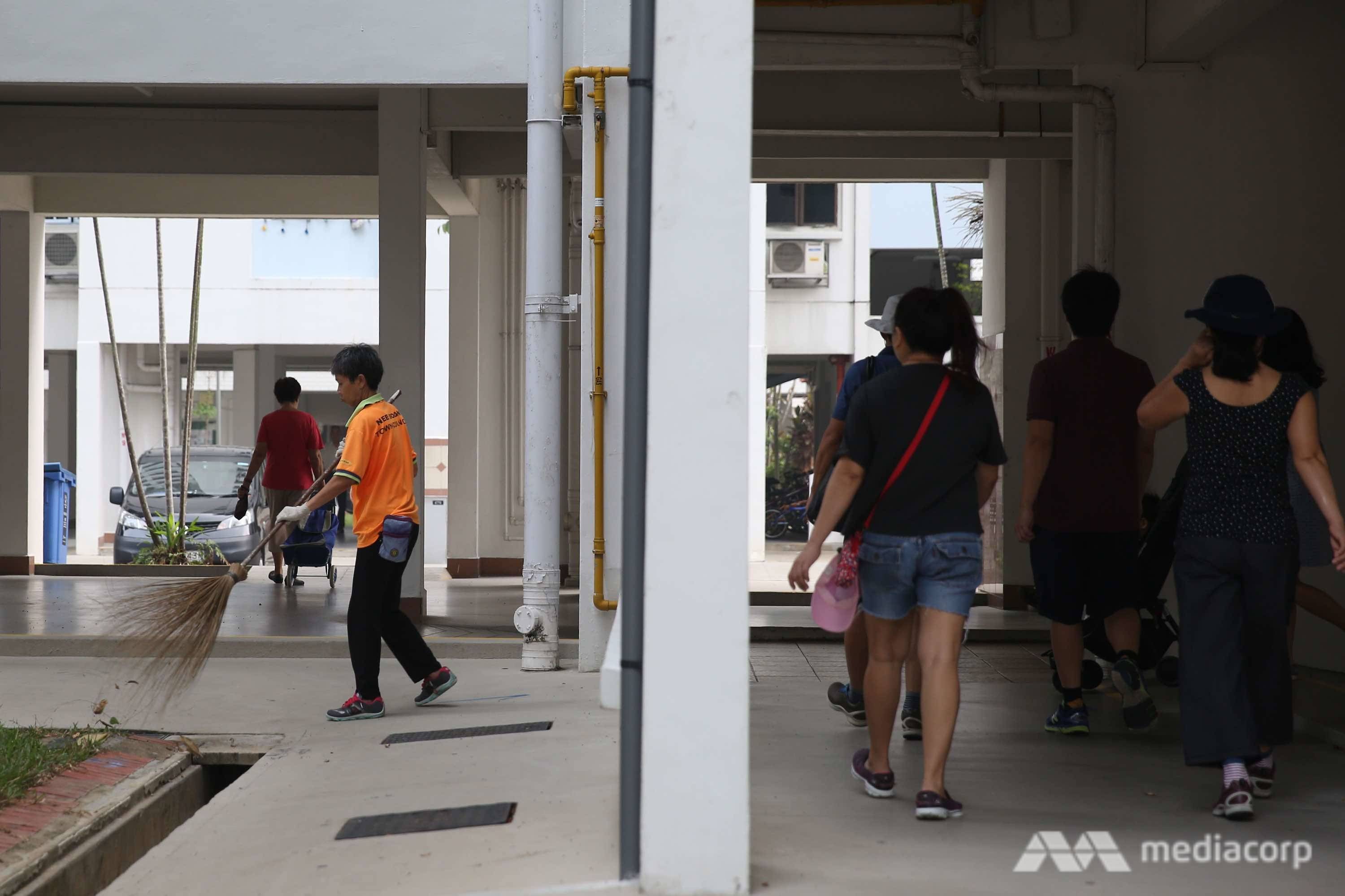
SINGAPORE: For the past 10 years or so, Madam Tan Mgeok Moi wakes up at the crack of dawn to get ready for work. Mercifully, for the part-time estate cleaner, her workplace is not far from home.
By 7am, Mdm Tan is already sweeping up whatever rubbish she finds at the four Housing and Development Board (HDB) blocks under her care around Yishun Street 81.
It is hard, laborious work, and at 60, she is no longer as spry as she used to be.
“I’m old and getting older, and my legs get a little sore sometimes when I work,” she said in Mandarin as she sat down to rub medicated oil on her knees.
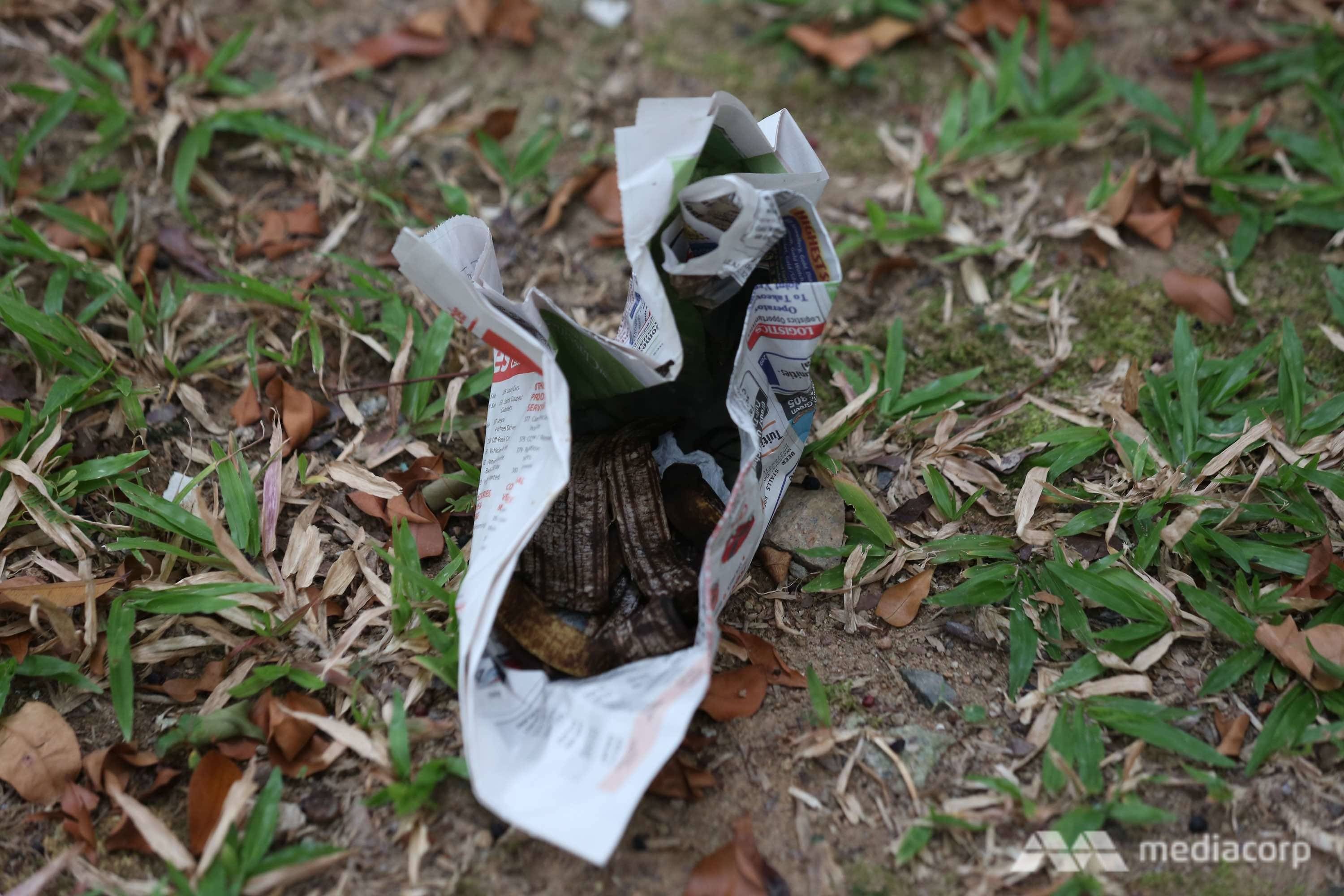
Mdm Tan also has to deal with a daily job hazard – mindless littering in its various forms, from dirty water being thrown out of flat windows to discarded banana peels strewn on grass patches. She was almost hit recently by leftover food wrapped in newspaper that was thrown from one of the upper floors.
She acknowledged that some residents who litter may be mentally unwell. But she noted that there are others, including children, who “just like to make trouble for no reason”.
“What’s the use of having a good education and driving a nice car if you can’t teach your children the value of respect?” she said.
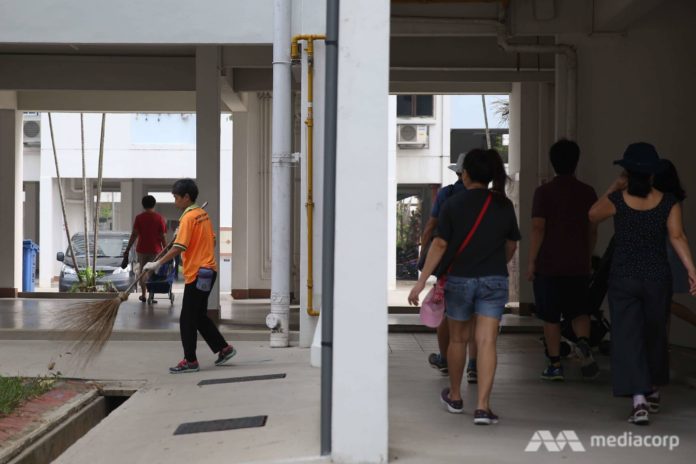
Madam Tan Mgeok Moi sweeping the floor of a block of flats along Yishun Street 81. She has been a part-time estate cleaner for 10 years. (Photo: Najeer Yusof/TODAY)
Mdm Tan’s experience is not unusual – her other cleaner-colleagues in Nee Soon South also have to grapple with the littering problem.
Not that most Singaporeans realise the extent of the problem. The cleaners take it upon themselves to make sure residents do not see the litter when they leave for school or work in the morning, and likewise, when they return home in the evening.
Mr Arthur Tan, an estate cleaner at Choa Chu Kang Crescent said in a mixture of Mandarin and English that it can be quite frustrating to come to work at 6am only to find the ground littered with tissue, bags of fast food leftovers and even sanitary pads.
“I don’t understand why they need to do this as they can easily throw their rubbish down the chute,” said the 62-year-old. “Singaporeans are used to littering. Not like the Japanese or the Taiwanese.”
Banana skin and other rubbish seen wrapped in a newspaper and discarded on the ground floor near a block of flats along Yishun Street 81 which, according to Madam Tan Mgeok Moi, is the most notorious for high-rise littering. (Photo: Najeer Yusof/TODAY)
More than 30 years after “killer litter” first entered the lexicon of heartlanders amid cases of people being injured by objects thrown from HDB flats, the issue of high-rise littering is back in the spotlight after it was raised in Parliament recently. This came on the heels of the death of an elderly man who was hit by a bottle thrown from a condominium unit.
During the House sitting earlier this month, Dr Lee Bee Wah, a Member of Parliament (MP) for Nee Soon Group Representation Constituency (GRC), even lamented how some of her residents had to deal with the unhygienic problem of used sanitary pads thrown from one of the flats in her Nee Soon South ward.
Other MPs also spoke of the problems they were having with high-rise litter in their own constituencies.
But as Aljunied GRC’s MP Pritam Singh said: “This is not a new issue, and has been around for many years across the country.”
The Workers’ Party chief added: “Unfortunately, the lack of civic consciousness by some has a disproportionately large impact on the majority of residents who take the effort to bin their waste and (dispose of) litter responsibly.”
Similarly, National University of Singapore (NUS) sociologist Tan Ern Ser believes that most Singaporeans are civic-minded. However, the actions of a small proportion of black sheep are “highly visible and salient”, he pointed out.
THINGS THAT ARE THROWN OUT OF THE WINDOW
More than 7,700 cases of high-rise littering were reported between 2016 and last year to the National Environment Agency (NEA).
On average, the number of cases ranged between 2,300 and 2,800 each year. This worked out to an average of six to eight cases a day.
The three most common things which people throw out of their HDB flat windows are cigarette butts, used tissues and food waste, said Mr Ravindran Nair, the head of the agency’s Western Regional Office. He added that his officers had also encountered cases where people were tossing urine and even faeces out of the window.
“It’s not as common, but we do get it.”
Cigarette butts seen at the foot of a block of flats along Yishun Ring Road. (Photo: Najeer Yusof/TODAY)
Several HDB residents spoken to said they have personally been affected by incidents of food waste being thrown out of the window.
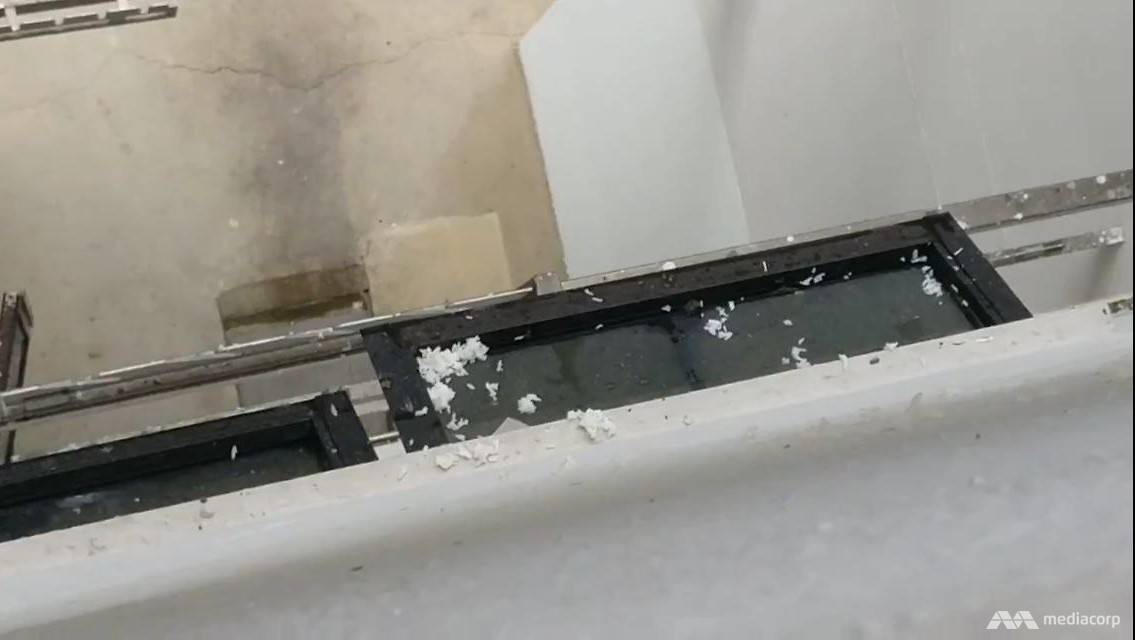
Mr Victor Loh, a 32-year-old resident of Marine Crescent, said he and his neighbours in his 18-storey block had to deal with the problem of a resident throwing leftover rice out of the window earlier this year.
“I came home and I saw rice on my windows, the window frame, the ledges and even the galah (pole) where you hang your laundry,” said Mr Loh, who is married without children.
He said he was furious as the discarded rice had even gotten into his kitchen, which was located on the fifth floor.
“I straight away went up, one by one, all the way to the top floor and questioned my neighbours.”
Mr Loh was never able to uncover the culprit, but learnt from his neighbours that such an inconsiderate act had happened several times over the years, before he moved in last year.
Nevertheless, it has stopped since he went knocking on the doors of those living above him.
Earlier in January, Mr Victor Loh and his neighbours were plagued by a neighbour who threw a pack of briyani out of the window. He said the rice got stuck in some hard-to-reach areas, which made him worry about pests. (Photo: TODAY/Victor Loh)
What was frustrating for him was that while most of the rice could be easily cleared away, the same could not be said for the bits that were stuck on the laundry-pole supports.
“I had to wait for the rain to clear them (the rice bits) away because they’re so far (out of reach). It’s also a nuisance because you are worried that cockroaches and birds will eat them, and then get inside your house.”
Over in Bukit Purmei, Mr Jack Sim said he had encountered at least 10 instances of high-rise littering over the past year.
The 37-year-old said there was an occasion where he even found a barbecued chicken wing on top of the air-conditioning unit for his apartment on the sixth floor of Block 101.
Most recently, he noticed that a number of the older folk living across him in Block 103 had been throwing rice out of their windows to feed the pigeons.
While there was not much litter observed within the estate during our recent visit, there was a flock of pigeons that were milling around the foot of Block 103, just under the column where the kitchens are located.
The issue of objects being thrown out of high-rise buildings is not just about sanitation, but also about safety.
Mr Edward D’Silva, the chairman of the Public Hygiene Council, stressed that it could be a potential cause of death if the object thrown is of a sufficient mass, such as the most recent case in August where deliveryman Nasiari Sunee, 73, died after being struck on the head by a wine bottle.
The bottle was allegedly tossed out of the seventh floor of a condominium along Spottiswoode Park Road by 47-year-old Andrew Gosling. The Australian has since been charged with causing death by a rash act. The penalty for committing a rash act that results in death is a jail term of up to five years and a fine.
A PERENNIAL PROBLEM FOR DECADES
On Oct 1, 1968, Singapore’s founding prime minister, the late Lee Kuan Yew, launched the inaugural Keep Singapore Clean campaign that has been running every year since.
The campaign message has been so successful that Singapore is now regarded as one of the cleanest countries in the world.
However, Mr Nair said it is also largely because Singapore is a “cleaned society, rather than clean”.
“We have to give credit to the cleaners and the town councils for doing their part,” he said.
Singapore currently has an army of 58,000 workers “who clean up our housing estates, roads, public walkways and waterways every day”, Minister for the Environment and Water Resources Masagos Zulkifli noted in a speech in late April.
Their presence has proven to be a double-edged sword, since the reliance on cleaners is now “entrenched” in Singaporeans’ mentality, said Mr D’Silva.
“This is the crux of the problem,” he said, adding that too many people “just don’t see the consequences”.
WHO ARE THE LITTERBUGS AND HOW TO STOP THEM
When it comes to the issue of high-rise littering caused by those with anti-social behaviour, Singapore Management University sociologist Paulin Straughan said there is a need to “dissect” their profiles to allow for targeted intervention.
The group could include those who are suffering from mental health issues, and are not in control of their behaviour.
“There is not much else to say, except to get them to treatment,” Prof Straughan said.
She added that It could also include those who are impulsive and throwing things out of their windows because they are angry.
A possible solution for this could involve redesigning homes “so that it’s not so easy to throw things out”, she said.
Prof Straughan said that it could also consist of people who just do it “simply because they can, and they can get away with it”.
“To address this, you’ll need to have a lot of stick. This is where law enforcement steps up, and then you watch to reduce the probability that (litterbugs) will be able to get away with it,” she said.
To that end, Mr D’Silva suggested heftier fines, for example.
“To be very frank with you, if it doesn’t hurt their pockets, Singaporeans will just (not care),” he said.
However, Dr Emily Ortega, the head of the psychology programme at the School of Humanities & Behavioural Sciences at the Singapore University of Social Sciences (SUSS), disagreed.
“Increasing fines will not deter people because they believe they cannot be caught,” she said.
Dr Ortega noted that high-rise littering is difficult to curb because of the lack of accountability.
She said that when people litter from high-rise buildings, they may feel that no one knows they are throwing something out of the window, compared to littering on the streets and getting spotted by someone.
“Thorndike’s law of effect states that if the behaviour is followed by positive consequences, it will be repeated. Since it is hard to catch people for high-rise littering, this could be the reason why it is still happening,” Dr Ortega said.
Some residents have suggested installing canopies or safety nets under high rise buildings. This is being done in some countries such as Malaysia. In January last year, the Malaysian media reported that the Kuala Lumpur City Hall had installed such nets near the ground level at some flats, after a student was killed by a chair that was tossed from a high floor.
Nee Soon GRC MP Louis Ng, who also spoke on the issue of high-rise littering in Parliament, said that surveillance cameras would be the best way to prevent offenders from believing they could get away with it.
The trouble, he said, is that the cameras are currently too large and too noticeable, and no one would commit an offence in front of them.
But when the cameras are taken away, the culprits reoffend.
“Surely we can invest in better technology that will help our enforcers on the ground catch these people more quickly and efficiently,” he said.
TAPPING TECHNOLOGY – AND THE LIMITATIONS
Indeed, as old anti-social habits die hard, the authorities have turned to technology to catch litterbugs in the act.
Since August 2012 till last year, the NEA had deployed more than 6,900 surveillance cameras, and took more than 6,200 enforcement actions, such as issuing fines, against offenders.
In 2018 alone, the NEA said it deployed cameras at 1,000 sites, and took more than 1,200 enforcement actions against offenders.
Mr Nair credited the cameras for increasing the agency’s “successful enforcement action” by 120 times from 2012 to 2018.
The veteran public servant, who has served the agency for 43 years and gone through the “whole scope” of the NEA’s processes, said the cameras were first introduced in 2012 as the reported number of high-rise littering incidences had been increasing since 2010.
“Something needed to be done. If we didn’t do it, the situation would probably be much worse off today,” said Mr Nair.
However, he noted that it can be challenging to catch culprits as oftentimes, his officers are working with very little information beyond the fact that an object has been thrown out from a high-rise building.
This will require them to head to the location to interview residents in order to ascertain where the litter may have originated.
Mr Ravindran Nair, the head of NEA’s Western Regional Office, said the high-rise littering situation would be “much worse off today” if it didn’t implement the deployment of its surveillance cameras. (Photo: Low Youjin/TODAY)
Even then, Mr Nair noted that high-rise littering is a “very transient offence”, and it may not occur when his officers are around.
“You cannot have our officers there, omnipresent (and watching),” he added.
To compound the problem, he said, the littering often happens at night, which requires the use of special cameras that can record offences in low-light conditions.
Technology has its limits too, said Mr Nair. Nevertheless, the NEA is always on a look out for better versions for their equipment, he added.
Currently, surveillance cameras can only capture a few floors at a time, assuming they can be deployed in the first place – the structural design of some high-rise flats can make it challenging for them to set up the cameras, Mr Nair pointed out.
Even if someone is caught in the act, he or she may not be immediately identifiable as the image captured may just be a hand, Mr Nair said.
Furthermore, the flat unit may have been occupied by several people at the time the offence is committed, which would require the NEA to interview all the suspects to pinpoint the culprit.
“This is very labour intensive,” said Mr Nair, as he explained why it can take a long time to resolve high-rise littering cases.
Urging residents to provide the NEA with as much useful information as possible when they spot litterbugs, he added: “The more intelligence we have on the suspect, the faster we can address the issue. Otherwise, it’s a lot of footwork.”
NEW COMMUNITY APPROACHES NEEDED
While continued awareness campaigns may seem the ideal solution, they also have their limitations, several experts said.
Dr Brian Lee, the head of SUSS’ communication programme, said that exposure to campaign messages “can be passive”.
“Communication campaigns always need to compete with many factors, which include changing media consumption patterns (and) behaviours driven by habit.”
Agreeing, Mr D’Silva said he felt that advocacy through mainstream and social media would not be effective, “as long as the individual (resident) is not affected personally”.
Instead, he suggested getting down to the grassroots level to “highlight the dire negative consequences of littering” such as the resultant health issues.
Mr D’Silva said that his council might consider a new approach to raising awareness next year.
“I would like to (organise) a getai-equivalent event and have all these senior citizens and heartlanders shown the consequences of (high-rise littering) through the emcees.”
Others, such as Dr Tan and Prof Straughan, said they hope that as residents in a neighbourhood evolve into a community, there is the option of the community applying social sanctions on litterbugs.
“This whole idea of keeping Singapore clean doesn’t just involve each of us binning our trash,” said Prof Straughan.
PILOT PROJECT IN ANG MO KIO
One such community-centric approach was piloted at Blocks 601 and 602 at Ang Mo Kio Avenue 5.
Dr Koh Poh Koon, an MP for Ang Mo Kio GRC, said the pilot project was conducted from May to October last year to tackle high-rise littering and pigeon feeding at the two HDB blocks.
“Various residents had spoken to me about the big flocks of pigeons in the area, and frequent littering of food from the units in the blocks, as some pigeon feeders were just throwing food out of the windows for the pigeons to feast on,” he said.
Dr Koh, who is also the Senior Minister of State for Trade and Industry, said the leftover food not only dirtied the surroundings, but also led to a growing pigeon population.
“We realised that both problems could only be minimised if more residents are aware of why it is not desirable to feed the pigeons,” he said.
The solution was a set of educational materials jointly developed by grassroots leaders, the Ang Mo Kio Town Council (AMKTC) and government agencies.
Dr Koh said the posters and flyers informed residents about the dangers of high-rise littering, as well as the potential diseases that could be spread through pigeon droppings. They also warned that throwing litter or food out of the window could risk a cockroach or rat infestation.
Apart from going door-to-door with his grassroots leaders to “disseminate this knowledge” among the residents, Dr Koh said that government agencies and AMKTC also increased enforcement efforts and took recalcitrant high-rise litterers to task.
Residents were warned that anyone caught feeding pigeons or throwing litter from their windows could be fined up to S$500 and S$2,000 respectively.
A poster advising against high-rise littering, seen on the notice board of one of the flats along Yishun Street 81. (Photo: Najeer Yusof/TODAY)
“I am very pleased to observe that even now, nearly a year after the pilot, the pigeon population in this area has remained low,” Dr Koh said.
“I believe that neither enforcement nor education alone could have achieved these results. Both are necessary in encouraging the pigeon feeders to stop doing so.”
He added that there are plans to conduct the educational project in another zone in his constituency by this year.
NEW SOCIAL NORMS, EMPATHY FOR CLEANERS NEEDED TOO
In tandem with a community-centric approach, Prof Straughan suggested that new social norms have to be created too.
“We have to be busybodies. We have to be willing to step out of our comfort zone to do two things,” she said.
The first is to have the courage to tell someone who has just littered that what the person did is wrong. The second is to pick up litter, even if it was thrown by someone else, and dispose of it properly, she said.
“You have to move towards these two acts if you want a super clean nation.”
Prof Straughan said there could also be opportunities for residents to get to know better the cleaners in their housing estates, as it could help foster a stronger community spirit and empathy for those who keep the neighbourhoods clean.
She said: “We shouldn’t treat cleaners as nobodies. It could be a good idea for the supervisor to walk through the estate to introduce the cleaner. This way, we can put a name to the face.”
An estate cleaner seen sweeping at a block of flats along Yishun Avenue 2. (Photo: Najeer Yusof/TODAY)
Prof Straughan also suggested having an exercise where residents work alongside cleaners to keep their estates clean.
She said that it is important that the estate is first cleaned inside-out.
“Residents can see this is what you can strive for – now maintain it,” she added.
Over at Nee Soon South, about 200 residents will come together each month and pick up litter at various parts of the constituency. This has been in place since 2012, said Dr Lee.
And since 2013, the residents will clean up the entire constituency themselves once a year, with cleaning in public areas halted for 24-hours before the exercise. The weight of rubbish collected has gone down from over 1,000kg in 2013 to around 200kg in this year’s exercise, said Dr Lee.
“This shows fewer people are littering. I also see residents picking up litter on their own accord. We just need to spread the mindset further,” she said.
For elderly cleaners like Mr Tan and Mdm Tan, their earnest hope is that people can be more considerate – not just to the cleaners but others in general.
Urging Singaporeans to stop relying on cleaners like himself to clear up their mess, Mr Tan said: “If you want to mess up your house, that’s fine. But spare a thought for your neighbours. If your rubbish is heavy, and the impact hurts someone, then how?”
SINGAPORE – Sebastian Vettel emerged as the surprise winner of the Singapore Airlines Singapore Grand Prix on Sunday night (Sept 22), after he pipped Ferrari teammate Charles Leclerc to the chequered flag for his first win this season.
Max Verstappen of Red Bull finished third in the 12th edition of the night race at the Marina Bay Circuit.
Vettel, 32, had started the race from third but benefited after a Ferrari strategy that called for him to pit slightly earlier than his teammate.
This move saw 21-year-old Leclerc – who had started on pole and was gunning to be the youngest winner in Singapore – re-join the race in second place.
A furious Leclerc, who was gunning for his third Grand Prix win in a row after wins in Belgium and Italy, made his displeasure of losing the lead in Lap 21 known to his team. After all, eight of the 11 winners in Singapore started from pole.
The experienced four-time world champion Vettel, however, kept his cool to see out the rest of the race and secure a record fifth Singapore GP title.
The win in Singapore is also his first for Ferrari since the Belgian Grand Prix in August last year.
SINGAPORE – A motorcyclist was taken to hospital after hitting a deer in Upper Thomson Road.
The police said they were alerted to an accident on Saturday night (Sept 21) involving a motorcycle in Upper Thomson Road towards Thomson Road at 9.23pm.
The 25-year-old motorcyclist was conscious when taken to Ng Teng Fong General Hospital after the accident, the police said.
The police said the deer’s condition was not confirmed, as it retreated back into the forest after it was hit.
In December 2018, a motorcyclist was injured in an accident involving a Sambar deer at Mandai Road.
The motorcyclist, who had minor abrasions, was not taken to the hospital after the accident.
In June 2018, a Sambar deer was put down due to severe injuries after a three-vehicle accident on the Bukit Timah Expressway.
A 46-year-old taxi driver who had cuts on his head was conscious when taken to Ng Teng Fong General Hospital after the accident.