SINGAPORE – The Aljunied-Hougang Town Council issued a warning on Tuesday (Nov 5) to a 67-year-old woman to clear up the rubbish in her flat within a week, or risk having town council staff move her possessions for her.
The woman’s executive maisonette flat at Block 522 Hougang 6 Avenue has been piled high with stuff for more than a year, with objects sometimes spilling into the shared corridor or in front of her neighbours’ doors.
Residents said town council staff had paid her several visits, but each time she would move the objects into her flat, only for the problem to recur in a few days.
Chinese evening daily Shinmin Daily reported on Saturday that the woman, referred to only as Ms Wang, no longer lived in the flat, but told reporters that she intends to move back in the future.
She told Shinmin: “I come back to pack up my things every day, but can only do so slowly because I’m quite old.”
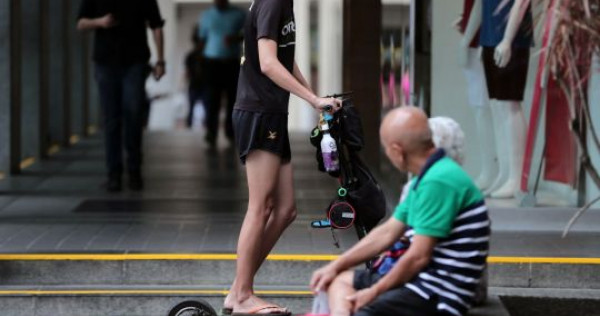
SINGAPORE – A $7-million package that has been rolled out will help food delivery riders with electric scooters switch to bicycles, electric bicycles or personal mobility aids, but e-scooter retailers are still left high and dry.
One such retailer told The Sunday Times he has $1.5 million worth of e-scooters that he suddenly cannot sell.
Another company has been hit so hard, it is closing its three sales outlets, while yet another retailer said he may have to retrench staff.
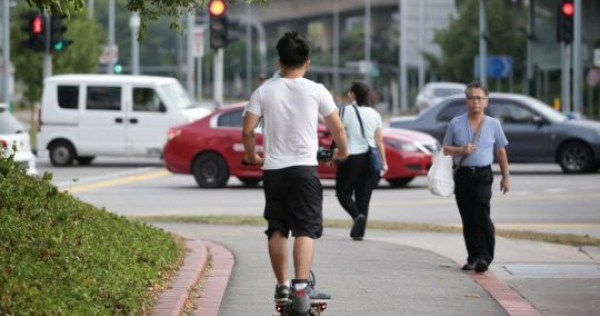
They told of their surprise at the ban on e-scooters being ridden on footpaths that was announced last Monday (Nov 4) and took effect the next day.
“This is all very sudden, we are in shock,” said Mr Ifrey Lai, managing director of retailer Mobot, one of the major e-scooter retailers here.
About 3,000 e-scooters, worth $1.5 million, now languish in Mobot’s warehouse in Ubi.
SINGAPORE – E-scooter users should not ride their devices on drain gratings as they try to find a loophole around the ban on personal mobility devices (PMDs) on footpaths.
That is the recommendation of the national water agency PUB, which is responsible for drains, in response to queries by The Straits Times.
“PUB does not recommend riding PMDs on drain gratings, which are an essential part of the drainage system that ensure effective stormwater management,” the agency said on Friday (Nov 8).
“Damaging any drain or stormwater drainage system is considered an offence under the Sewerage and Drainage Act. Those convicted may be fined up to $40,000 or jailed up to three months, or both,” it added.
A 23-second-long video posted on Facebook by user Leonardo Clyde Alfonso following the ban’s implementation on Tuesday (Nov 5) shows a PMD rider riding on the drain gratings that line the footpath.
When the rider is stopped for riding on a footpath by the person filming him, he says: “Government never say drain cannot”.
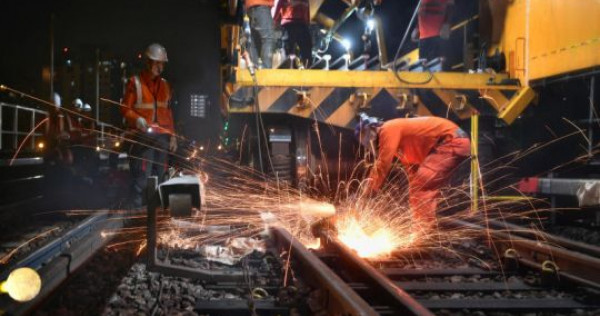
SINGAPORE – The Government is injecting $100 million to better train rail workers here, easing rail operators’ cost burden as the industry strives to meet Singapore’s 21st century transport needs.
The Rail Manpower Development Package (RMDP), announced by Transport Minister Khaw Boon Wan at a transport workers’ appreciation event on Saturday (Nov 9), will become the main source of training funds for MRT and LRT workers in the next five years.
“Operators are financially not the most healthy at the moment… In order not to hold back such investments, the Government, through the Land Transport Authority (LTA), will co-invest,” said Mr Khaw in his speech at the event.
“That way, the worker will have the tools to do what is necessary to raise their productivity and do their job better… The bottom line is we want to improve service levels for the commuters.”
In the 12 months to end-March this year, SMRT Trains’ losses hit $155 million – almost double from a year ago – with spending on repairs and maintenance accounting for about 71 per cent of rail-fare revenue.
SINGAPORE: The People’s Action Party (PAP) “must never, ever be afraid to do what is right for Singapore”, said Prime Minister Lee Hsien Loong on Sunday (Nov 10) at the PAP convention, a gathering of the party’s members and activists.
Citing the Government’s decision to amend the Constitution to allow for a Presidential Election to be reserved for a particular racial group if no one from that group has been president for five continuous terms, Mr Lee acknowledged that not all Singaporeans agreed with the decision.
“Overall, in the short term, this issue is a political minus for the government, for the PAP. But this is part of governing. I am convinced that we did the right thing,” he added.
Mr Lee, the secretary-general of the ruling PAP, said the change was made for the “long-term good” of Singapore, noting that fault lines of race, language and religion “have not really disappeared”.
“We have to continue managing racial and religious issues closely and sensitively. When something happens to cause offence, like people making reckless remarks or offensive posts, we have to take action,” he said.
“At the same time, we must proactively strengthen our structures and institutions that support our multiracial and multi-religious society.”
Adding that the President is “the unifying symbol” of multiracial Singapore, Mr Lee highlighted that it would be more difficult for a non-Chinese candidate to be elected if the President is elected by a national vote.
“How would the minorities feel if the president of Singapore were almost always Chinese? In the long term, such a scenario will foment deep unhappiness, and erode the founding values of our nation.”
Aside from ensuring unity and social cohesion in the society, Mr Lee said the PAP will also have to maintain trust in the party and give people hope for the future to keep Singaporeans’ faith.
PAP DOES NOT “SUGERCOAT REALITY”: PM LEE
Mr Lee said the PAP has “built up a deep reservoir of trust” among Singaporeans over the years because of its high standards of honesty and integrity, its upfront and frank approach, and its ability to deliver on its promises.
Adding that every party member, from the Prime Minister to party members on the ground, must work on behalf of the people, he said: “You may be putting together the government’s budget, you may be awarding town council contracts, you may be looking after branch funds. It’s on behalf of the people, it’s the people’s resources, you are looking after it, you must do it honestly and in the interest of the people.
“We must always do things honestly, transparently, with integrity.”
Mr Lee also stressed that the PAP does not gloss over difficulties or “sugarcoat the reality”.
“We explain clearly the challenges, and the choices available, so that Singaporeans understand there are good reasons for what we do. And even if the decision is unpopular, we work very hard to persuade people that this is something we have to do together.”
Addressing the GST increase also raised by Deputy Prime Minister Heng Swee Keat in his speech, Mr Lee said: “ Few governments in the world tell you before an election that they plan to raise taxes. I could have kicked the can down the road, and left this to the future PM and his team.
“But we had to do the right and responsible thing: Be upfront with voters, explain why the GST increase is unavoidable, and to give lots of advance notice.”
By announcing the GST hike and the corresponding support package early, this helps to make sure that “the opposition cannot stir this up”, said Mr Lee.
“You can be sure they’ll try,” he added.
People’s Action Party Secretary-General Lee Hsien Loong speaks at the PAP65 Awards and Convention on Nov 10, 2019. (Photo: Gaya Chandramohan)
PAP policies have also improved the lives of Singaporeans “in concrete and visible ways”, said Mr Lee, noting that healthcare, education, housing and public transportation in Singapore are affordable and high quality.
“Unlike other political parties, we cannot afford to woo voters with empty words because we do not want them to come back to haunt us,” he added.
DELIVERING ON PLANS FOR SINGAPORE’S FUTURE
The Government must help people “feel confident that there is a bright future” for themselves and their children, said Mr Lee.
This depends on three factors: Opportunities for Singaporeans, delivering on plans for Singapore’s future and tackling future problems.
Addressing the Government’s heavy investment in education, Mr Lee said opportunities for Singaporeans does not refer to just opportunities for the country to prosper, but also opportunities for individual citizens and their families.
“Therefore, we are spending on pre-school, so that all children, regardless of background, have a good start in life. We’re making heavy investments in a good education at every level for every Singaporean, to enable you to grow to your full potential,” he added.
Mr Lee also said the ITE colleges, polytechnics, universities and the SkillsFuture programme enable Singaporeans to participate fully in Singapore’s growth and progress.
“And to leave no one behind to walk alone,” he added.
Mr Lee also addressed the Government’s “bold plans” to transform Singapore and enhance the standard of living.
He noted that the new MRT lines, HDB townships and Jewel at Changi Airport are the results of similar plans over the years.
“But building Singapore is a never-ending project, and we always have new plans progressively taking shape,” he said, listing examples like Changi Terminal 5, Tuas Port and the Greater Southern Waterfront.
“We will never reach the limit of what we can do in Singapore. The only constraint is our imagination and our daring. Every new generation will have the opportunity to shape Singapore to what they want it to be.”
Mr Lee also stressed that the government must tackle serious future problems “vigorously”, to show Singaporeans that “there is a way forward”.
Citing Singapore’s efforts against climate change, he said: “We are starting preparations, we are setting aside money, we are building our defences. Unlike many cities, we are able to do something about it.
“With good forward planning, we can even reclaim land from the sea, and turn adversity into opportunity.”
DISCONNECT BETWEEN THE MASSES AND THE ELITE
Mr Lee also acknowledged that there are several potential fault lines that Singapore is vulnerable to, between rich and poor, conservative and liberal, old citizens and new.
“Beyond race and religion, we must also prevent new rifts from opening up in our society. Being open and diverse, Singapore is constantly vulnerable to divisive forces that have sown discord elsewhere,” he said.
Addressing “a split between the people and the elite”, Mr Lee said that in other countries, the masses no longer trust the society’s elite.
“People feel that their interests are no longer looked after. The entire political class has lost their respect, and support. Traditional societies have become feeble. Even socialist parties, which are supposed to care for the common man, have lost their base,” he said.
“And in place of them, populist movements have arisen, which explicitly want to upend the system, turn things upside down, but are not necessarily able to offer anything better.
Referring to the United States as an example, Mr Lee said that the white working class used to be core supporters of the Democratic Party. But as the Democratic Party drifted away from this group, Donald Trump as a candidate spotted this opportunity, championed the cause of the white working class. His supporters then voted for the Republicans, making him President.
“As president, his political base is not moderate voters in the middle ground, but these hardcore supporters in the white working class who are very unhappy with the way things are going,” said Mr Lee.
Stressing that a similar disconnect between the masses and the elite cannot happen in Singapore, Mr Lee said the PAP “must always remain a party of the people”.
People’s Action Party leaders at the PAP65 Awards and Convention on Nov 10, 2019. (Photo: Gaya Chandramohan)
Acknowledging that the PAP was “born from unions”, Mr Lee added that every party member must identify with the people and serve them.
“We must make sure that our system always works for ordinary Singaporeans, so that they will embrace it as their system,” he said.
“We have never forgotten that the whole purpose of economic and social development is to improve the lives of our workers and the workers’ families.”
Adding that the relationship between PAP and NTUC will be even more crucial in the coming years, Mr Lee said: “We will not be able to protect every job. But we will look after every worker.”
In conclusion, Mr Lee noted that the 4G team knows what is expected of them and what they must do.
“They have a very difficult task, and they deserve the support of all of us, all those older than them and all those younger than them. Back them, they are our team, they are Singapore’s team,” said Mr Lee.
Warning that the PAP must be prepared for a “tough fight” at the next General Election, Mr Lee said “a lot is at stake”.
“This election is not just about the PAP doing a bit better or a bit worse. This election will decide if Singapore can sustain good and stable government, to be different from other countries for a long time to come,” he said.
Police said yesterday that they are investigating 278 scam cases, mainly involving online purchases, where victims were cheated of more than $247,000.
In a separate statement, also released yesterday, police said that between January and September, they received at least 192 reports of scams involving fake lucky draws purportedly run by online shopping sites Lazada and Shopee.
Victims were cheated of at least $194,000.
The police verified that there were no such lucky draws conducted by Lazada and Shopee.
For the 278 scam cases, police said that a two-week operation was conducted between Oct 29 and Thursday by the Commercial Affairs Department and seven police divisions.
A total of 140 scammers and money mules were rounded up – 80 men and 60 women aged between 14 and 70 – and they are assisting with further investigations over their suspected involvement in cheating or money laundering.
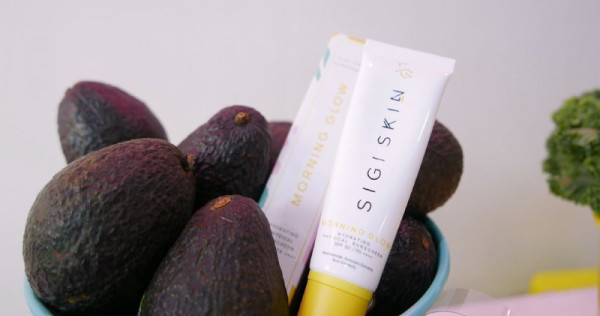
Living in Singapore means we have more sunny days than not. And you’ve probably heard it a million times, but here’s one more for the record: you should be wearing sunscreen every day, even when it’s raining or the sky is cloudy.
But with so many sunscreens out there, how do you know which is the right Sun Protection Factor or SPF you should be wearing?
Singaporean’s are exposed to high levels of UV radiation because Singapore has one of the highest UV Index scores year round.
Ranging from zero-being the least harmful-to 10+ which indicates a very high risk, UV Index scores tell us the expected risk of overexposure to the sun.
According to Amanda Baldwin, President at Supergoop!, there are a few things we need to keep in mind when choosing a sunscreen and the Sun Protection Factor it offers. Here are a few:
Knowing that most people don’t apply enough sunscreen to begin with, it’s probably a better idea to use a higher SPF rating than 30 especially if you’re spending any time outdoors to provide better protection against high UV radiation levels.
Four men, aged between 26 and 45, have been arrested for circulating obscene materials in yet another Telegram chat group, the police said yesterday.
The police were alerted to the chat group on Oct 24. Three of the men have been established as the group administrators, while the fourth, a 26-year-old, was found to have advertised the sale of obscene materials in the chat, police said.
On Wednesday, when the four men were arrested, the police seized more than 15 electronic devices, including a central processing unit, several laptops, hard-disk drives and mobile phones.
In their statement, the police advised the public to stop joining such illegal chat groups.
“The police take a serious view of anyone involved in criminal activities and will continue to take tough enforcement actions against those breaking the law,” the police said.
This is the latest incident involving Telegram chat groups circulating obscene materials that the police are investigating.
SINGAPORE: No one in her family knows of her past as a trafficked sex worker in Singapore.
Leah (not her real name) was punished at the hands of traffickers. She says she was physically abused and her phone was confiscated while being made to work long hours until she met a quota of clients for the day.
In Indonesia, Leah had marital issues with her then-husband, and she had a young son to take care of. So when a trusted friend offered her a job in Singapore working at a restaurant, she jumped at the chance for a better life.
That was a lie. Leah soon found herself being forced into sex work and held against her will in Singapore.
Traffickers like those who brought Leah to Singapore will face stiffer punishments with the amendments to the Women’s Charter – Singapore’s law to keep women and children safe – that were debated and passedin Parliament on Monday (Nov 4).
But how do you catch a criminal with no name, no face and who routinely finds ways to escape getting caught?
With the changes, someone found trafficking women or girls, or tricking them into sex work, will face a maximum jail term of up to seven years and a maximum fine of S$100,000 – a ten-fold increase from the current amount.
However, while the stiffer punishments may act as a deterrent, legal experts said there may still be challenges in bring perpetrators to justice, Ms Gloria James-Civetta, head lawyer at Gloria James-Civetta & Co said.
For instance, the prosecution still needs to prove the act of trafficking occurred and that the accused knew they were bringing women in illegally, Ms James told CNA.
There were also questions raised in Parliament during Monday’s session if changes to the Charter are enough.
Can simply raising penalties curb exploitation, especially if perpetrators know how to circumvent the law, asked Nominated Member of Parliament (NMP) Ms Anthea Ong.
Alongside more severe punishment, women who are exploited are the “most powerful ally” who can help authorities bring abusers to task, she said. More can be done to protect those in the sex industry, Ms Ong and MP Mr Louis Ng suggested.
HARSHER PENALTIES, BUT PROSECUTING REMAINS TOUGH
Women like Leah are the “perfect” targets for traffickers, according to Lynette Lim, director of development and communications in Hagar, an organisation that helps victims of human trafficking, and youths.
“Because of their inherent vulnerabilities, they are obviously a perfect prey for traffickers. They prey on them and promise them all the false job offers and a good salary.
“A lot of the time, they come from very impoverished backgrounds with at least five to seven dependents. That’s the reason why they have to look overseas for work opportunities so they can provide financially for the families back home.
“All of them who are classified as trafficked victims – they’ve all been tricked. There is a level of deception between what they were told and what the real situation really is.
“By the time they come here, it is too late for all of them. They pay lots of money to the ‘agents’ in their home countries. When they realise quickly that they are in this situation, almost all the time they no longer have the ability to say no or to come out of it,” she explained.
Leah was made to walk to Lorong 12 Geylang on the first day of her job. (Photo: Ainslee Asokan)
For Leah, it was the lies of her “close friend” that convinced her.
“My friend wanted to help me. I agreed because I needed money for living costs because I have a son,” Leah said.
“I met with her – I’m still not thinking about anything – this is my closest friend. She wants to help me.”
Arrangements were made for Leah to travel to Batam, where she took a ferry to Singapore. Along the way, she was meticulously coached by traffickers to avoid raising suspicion when questioned by immigration officers.
An hour after Leah arrived in Singapore, she was taken to a flat in Aljunied Crescent, where she had her passport, ID and documents stripped from her.
From Leah’s “friend” in Indonesia to the runners in Singapore who took her to the flat, there were middlemen involved.
The amendments could help arrest and deter those who help facilitate trafficking as well as those who are directly involved, said Ms James.
“The laws are doing their best, as many runners doing the groundwork are being apprehended and in turn, deterring future runners from conducting the groundwork for the masterminds.”
“This may assist in making operation of the syndicate even more difficult for the masterminds with fewer runners.”
She explained the increased penalties may assist victims of sex trafficking indirectly by deterring potential offenders.
However, lawyers CNA spoke to said prosecuting criminals who dupe and traffic remains difficult. This is because of how the syndicates work, with the ringleaders elusive.
“Sex traffickers operate as a syndicate – there are usually many runners conducting the groundwork and there are many layers of hierarchy within the syndicate before reaching the mastermind”, said Ms James.
Even runners are sometimes unaware of the ringleaders’ identities.
“It is also unlikely these runners would take special care and find out who the mastermind is since these runners are doing their job and just wish to get paid upon completion of the job. It is also not uncommon for the masterminds to move their operations and cover their tracks so as to avoid detection by the authorities.”
The “many layers of hierarchy” could make it difficult for the law to tackle the problem, especially in cross-border sex trafficking, Ms James explained.
File photo of man threatening a woman. (Photo: Try Sutrisno Foo)
Obtaining key witnesses for court proceedings can be difficult because of fears of the consequences.
“Naturally, the more powerful the syndicate, the harder it is for such witnesses – including the victims themselves – to come forward and testify in court for fear of backlash which can take many forms,” said Mr Cory Wong, senior associate at Invictus Law Corporation.
“Sometimes victims might not tell the truth for fear of repercussions. This is especially where victims have suffered psychological or emotional trauma as a result of being trafficked and are doubtful and are unable to trust others,” Ms James added.
For Leah, she feared the revenge against her son and family.
“DON’T SHOW YOU’RE CRYING. JUST ENJOY IT”
When Leah realised she had been duped into sex work, she tried to escape. In desperation, she turned to one of the other women working with her for answers.
But she was met with a curt response: “Don’t complain. Here you just work, here you just smell nice and speak nicely with the customers so the men will come to you and they will book you.”
“Don’t run away or you will be in trouble. Don’t show you’re crying, don’t show you’re sad. Just enjoy it,” the runners warned her.
The traffickers knew where she lived in Indonesia. To keep her family safe, Leah felt she had to go along with what was asked of her.
“I want to run away – but how to run away – because I don’t know anybody in Singapore and I don’t know how to go anywhere,” Leah recounted.
File photo of woman standing along Geylang’s main street. (Photo: Sutrisno Abdul Rahman)
Women like Leah are “trapped” and hesitate to report these crimes to the authorities because of fear of repatriation, lawyers said.
“These women are in Singapore as illegal immigrants without a valid work pass and approaching the authorities would risk the women being prosecuted or given a stern warning or fined under the Immigration Act and being repatriated back to their home country,” Ms Gloria explained.
“They also risk their families back home being put in danger by the middlemen in the event the women or girls decide to report to the relevant Singapore authorities.”
There is also a possibility they may not be able to work while investigations are ongoing.
“The authorities might allow them to but it is done on a case by case basis and the lack of certainty makes victims reluctant to report,” said Ms Jaya Anil Kumar, casework manager at the Humanitarian Organisation for Migration Economics (HOME).
“We need to put in place a better support system to rescue these (trafficked) women from vice syndicates,” MP Mr Darryl David said in Parliament on Monday as well.
The Government and authorities should work with local NGOs to support victims before they are repatriated and work with respective agencies in the women’s home countries to ensure their welfare is settled before they are sent back, he said.
A woman bows her head in pain. (Photo: Unsplash/Volkan Olmez)
Some women still struggle to escape the clutches of their traffickers even with more punitive measures in place. They still face dangers when they return home.
“Those that may have outstanding loans with the agents in their home countries may be forced to continue working in exploitative conditions to pay off their loans. They may also be harassed by their recruiters for failing to pay off their debt,” Ms Jaya said.
“If we send (these women) away with debt, we are implicitly pushing them to reenter into risky business arrangements and fall prey to other dangerous agents,” Ms Ong said in Parliament.
WHEN THE TRAFFICKED BECOME TRAFFICKERS
For some women who are trafficked into Singapore, they eventually become traffickers themselves in hopes of getting more money, explained Sylvia Lee, founder of NGO EmancipAsia.
“Some of the girls are turned into traffickers … They are actually offered more money if they can bring in more girls. They are incentivised to recruit,“ she revealed.
“They can’t get out, and it is difficult to get out. So if you can’t beat them, join them. At least they can earn more money.”
Leah escaped entirely. “The last time when I was in Singapore, I saw the pimp still there, but he did not recognise me,” she said.
“My heart (was) beating so fast, because I remember the first time I (stood) there waiting for customers.”
SINGAPORE: Some time ago, at a wedding dinner, a male acquaintance on the same table asked when my turn was.
“Maybe you’ll find the right guy and your life will change,” he said.
“Sure but what if I find the wrong guy and my life changes?” I replied tongue-in-cheek. He laughed and turned to another guest for the rest of that evening.
Fast forward to the present. This tale came to mind after news of Mediacorp artiste Belinda Lee’s marriage broke and scores of online netizens expressed how glad they were she found lifelong bliss.
“She no longer lives alone!” said one reader. “I rejoice that God has given you the man who will love you and be there for you,” said another.
“Congrats girl on your happily ever after,” added a third.
MARRIAGE A TEST, NOT A BED OF ROSES
Lee’s wedding was no doubt a joyous occasion that must have brought the couple, their guests and many readers huge joy but most of us surely know marriage is not all a bed of roses.
Friends who have tied the knot tell me it is a lifelong commitment accompanied by constant tests of character, compromise and clarity of values. Throw in kids, aged parents and work responsibilities, and you have a combustible mix.
Marriage as a merging of two potentially very different lives, family backgrounds and priorities is a massive enough challenge.
File photo of wedding rings. (Photo: AFP/Jay Directo)
Yet, there’s plenty of people out there banking on marriage to deliver happiness instead of finding life satisfaction from within, which I find problematic.
If anyone tells you they’re looking for someone to make them whole, I would advise you to run for the hills and don’t look back.
Indeed, what bothered me most about the comments in this episode was the underlying assumption that marriage is some sort of a golden ticket to a lifetime of happiness, that finding a husband will somehow automatically open up the gates to paradise for a woman.
Part of this might be our familiarity with a Singapore narrative we’ve been raised to believe in: Study hard, get a good job, get married and have kids.
Miss one step in this natural order of things and there’s no guarantee what horrible fate lies ahead.
Surely we have to acknowledge that, for some people, marriage is not the silver bullet that can instantly transform a life that seems to be lacking that special something to one that is completely, and permanently gratifying.
Pamela Chng, who was on a SMU panel I moderated last year, gets fired up whenever she speaks of her leaving a high-flying role to found Bettr Barista, a social enterprise that hires women with disadvantaged backgrounds and at-risk youths and gives them a shot at a long-term career in the coffee industry.
OCBC’s Selena Ling, who was at a Bloomberg event I attended last week, speaks fondly of learning and overcoming her newfound challenge of mastering geopolitics in a complex global economy dominated by the US-China strategic rivalry.
Why aren’t we seeing more women heading boards? (Image: Rafa Estrada)
Singapore Council of Women’s Organisations president and full-time doctor June Goh, says she finds satisfaction in activities outside work which challenges her to move out of her comfort zone.
The proud smiles on their faces when they talk about what brings them fulfillment tell me that happiness can come from doing well at work, contributing back to society and more.
THE CONVERSATION TO BE HAD BEFORE TYING THE KNOT
Could marriage in fact be an obstacle to all the other good things in life one might want to achieve?
Can women have it all? (Image: Rafa Estrada)
We all know partnership comes with sacrifice but when I talk to many households, sometimes it can feel skewed, as if one gender is paying the price more than the other, especially when women shoulder greater family responsibilities.
That doesn’t sound like a good bargain to me at all.
Does it mean those dreams can only be achieved with the right, worthy life partner who champions personal success and shares a vision of what a life together entails, when one is hitched? Perhaps.
Experts say you should have a few important conversations when a relationship gets serious. Figure out how your dual-income life is going to work, says INSEAD Professor Jennifer Petriglieri, in Harvard Business Review’s Idea Cast podcast in October.
“If you think back to the early days of your relationship, you’re still on parallel tracks right? You have this career, a friend at work and you just added on top this wonderful relationship,” she says.
“It’s wonderful, but it never lasts. Eventually, we face some kind of hard choice in a couple … how do we make this work? How do we structure our lives so that we can have two careers and a good relationship?”
(Photo: Unsplash/Alejandra Quiroz)
“The couples who really worked saw their lives as a joint project. They seemed to be as invested in each other’s success as they were as their own. Their relationship moved away from tit-for-tat – like I sacrifice this, you sacrifice that – to looking at like how we can grow the pie for both of us.”
Even before walking down the aisle, in the course of getting into a serious relationship, do we discuss our joint objectives?
Do we negotiate whether we get a shot at pursuing our ambitions or lay out the trade-offs we are willing to make for each other?
A WIDER RANGE OF ROLE MODELS
Back to Selena, Pamela and June, with huge credentials to their names, these women have led life on their own terms.
They are proud of their accomplishments and feel gratified by their contribution to society. They don’t let their marital status define them.
Let’s hope girls find them to be role models worth emulating.
Here, it is important to clarify one should be happy for Belinda Lee. It is not easy finding someone suitable to commit the rest of your life to.
But I long for the day when we watch a woman in her 40s get married and not have to witness an online collective sigh of relief as if some tsunami had been avoided.
Lin Suling is executive editor at CNA Digital News where she oversees the Commentary section.