SINGAPORE – The Singapore Police Force has come out to defend a series of crime prevention posters warning against outrage of modesty after the posters were called out for being insensitive to molest victims.
The posters, which are displayed across the public transport network, feature the hand of a man seemingly about to molest a woman. On his wrist is a tag with the words “2 years’ imprisonment: It is not worth it”.
The Association of Women for Action and Research (Aware) called out these posters in a Facebook post on Thursday (Nov 14), criticising them for focusing only on the punishment but not the harm suffered by the victim.
“Why are we putting a price on sexual violence at all, like it’s a commodity to purchase and consume?” said the post.
In a statement released on Saturday night (Nov 16), a police spokesman said that Aware may have misunderstood the purpose of the posters.
“The posters are designed to warn would-be offenders who are unable to exercise self discipline or control themselves,” the spokesman said, adding that the visuals were designed to influence their behaviour, by telling them what punishment they will face.
SINGAPORE – An Indian national fell to his death while carrying out housekeeping works on Thursday (Nov 14), the Ministry of Manpower (MOM) said on Saturday.
MOM said the 30-year-old man went through a partition board, falling from level 1 to basement 1 at 360 Balestier Road – the address for Shaw Plaza.
The worker, who was not identified, was employed by Express 21. The company works on electrical engineering and structured cabling projects for buildings, among other things.
MOM said investigations are ongoing and all work within the worksite has been stopped.
The number of workers who died as a result of a fall from height declined from 24 in 2009 to eight last year, partly due to the Government’s and industry partners’ concerted efforts to raise awareness and train workers.
SINGAPORE: You’re sitting down in a restaurant with some friends, looking at the menu of finely curated steaks, fish dishes and salads.
The ingredients for these dishes would likely come from countries like New Zealand, Indonesia and Malaysia. This is given that Singapore imports most of its food.
But for guests at the Fairmont Singapore and Swissotel The Stamford, some of the ingredients could come from a place much closer – the hotels’ rooftop, where an aquaponics farm was recently installed.
Aquaponics is a combination of aquaculture and hydroponics, where fish and plants are grown together in a closed system.
“Quite simply, you feed the fish, the fish eat the food, pass the food, and then all the nitrates from that go through the different towers and the different beds within the garden.
“The vegetables absorb the nitrates from the water, and grow, in a circular system,” said chef Robert Stirrup, who is also the director of culinary operations at the hotels. He oversees the farm’s daily operations.
Six rows of modular infinity tanks hold the plants, which float on top of a nitrate-rich solution. (Photo: Try Sutrisno Foo)
The hotels said the farm will be able to produce about 1,200 kg of vegetables and 350 kg of fish monthly for the hotels’ kitchens once it’s fully operational.
The farm is the brainchild of the hotels’ general manager Marcus Hanna.
“I was at a friend’s place for dinner, and he had this hydroponics tower in this living room, where he was growing numerous types of lettuce. I was quite intrigued by that, because as you know, 90 per cent of the produce in Singapore is imported, so to have something in the living room – you’re not going to find anything fresher to eat,” he said.
He wanted to replicate this freshness for the hotels’ guests, and raised the idea with Mr Stirrup and Mr Ahmed Disokey, the area director of technology and business innovation at Accor Luxury Hotels. The Accor Group operates both hotels.
They bought into the idea quickly as it will also boost the hotels’ sustainability efforts and four months later, they had turned it into an operational aquaponics set-up.
Nestled between the hotels’ two buildings, the 450 sq m rooftop farm is deceptively small.
Yet, that’s enough space for thousands of leafy vegetables – from kangkong (water spinach) to several kinds of lettuce – to grow on two rows of densely packed white towers and six rows of green plastic half-cylinders, also known as module infinity tanks (MITs).
Five fish tanks in the back, each containing about 400 little red tilapias, complete the system.
Five fish tanks at the back of the farm contain 400 red tilapias each. (Photo: Try Sutrisno Foo)
In 10 months’ time, the farm will produce 30 per cent and 10 per cent of the hotel’s daily requirement for greens and fish respectively, estimated Mr Hanna.
Two gardeners perform the day-to-day maintenance.
“It’s very difficult to sustain something up here under this kind of conditions.
“We don’t have enough light, we don’t have enough sunshine, we don’t have water, we have extremely strong winds coming through. So this is not a very ideal location,” said Mr James Lam who was hired about five years ago to tend to a tiny herb garden which used to occupy the space.
There is also the issue of regulating the temperature and moisture in the farm, said Mr Stirrup.
“We had to work out a way of dropping the temperature so we put the tentage and the coverage over the aquaponics itself and it helps us to bring the temperature down by about six degrees which makes it more of an ultimate temperature to grow a lot of those vegetables,” he said.
HOW THE PRODUCE ARE GROWN
The farm is outfitted with features that provides an optimum environment for the plants to grow rapidly – a shelter protects the plants from direct sunlight and cools the area to between 24 and 25 degrees Celsius during the day.
LED lights hung above the plants are switched on from 6pm to 8pm to boost their growth.
Gardener James Lam has been working with the hotel for five years, as a gardener for the previous herb garden, and now the aquaponics farm. (Photo: Try Sutrisno Foo)
They help shave off 50 to 60 per cent of the time needed to grow the vegetables, said Mr Disokey.
Fast-growing vegetables and fish are grown in different batches for a constant supply of produce. A collection of herbs completes the farm.
“We have one of the largest collection of mints,” said Mr Lam, counting them off on his fingers. Some choice mints include: chocolate, pineapple, ginger, orange, lime, grapefruit and apple, which are specially curated for use in the hotels’ bars.
The gardeners work closely with the chefs in the kitchen so that what is grown is tailored to their needs.
Describing how vegetables are grown on the aquaponics system, Mr Lam said the seeds have to be individually placed into a floating block by hand. Sometimes he and fellow gardener, Ms Jenny Kang, will put two seeds into the same cross-shaped opening as an assurance that at least one of them will grow. Each block contains between 60 and 96 such openings, depending on its size.
Gardener Jenny Kang puts the seedlings into pots, which will be placed onto the MITs later. (Photo: Rauf Khan)
These blocks will go into the nursery for one to two weeks, until the seeds germinate. They would then be transferred into individual pots and are left to grow either in the green MITs or towers. The vegetables would take three to four weeks to be fully grown.
The hotels are looking to incorporate them in special menus in several of their restaurants.
“The idea will be that we will do dishes on the menus where we will use initially… the vegetables, and then long-term, the idea is obviously we will incorporate the fish into the dish, so we will have a completely sustainable dish from the garden,” said Mr Stirrup.
Seedlings are placed into individual pots and placed onto the MITs to grow to maturity. (Photo: Rauf Khan)
While the farm can only produce 30 per cent of all vegetables needed, Mr Stirrup is optimistic that in time it will be able to produce enough of some varieties to fully meet their requirements.
The hotels are also hoping to experiment with growing fruits including a variety of strawberries which have grown well in Thailand.
“Just working through the whole process, to actually see what vegetables work well and grow in the best way, that we would shorten it down to the products that we would select long-term,” said Mr Stirrup.
To see the farm grow from an idea to a reality is “very exciting”, he added.
“I’ve only seen this done on a very small scale within a hotel before. Not as aquaponics, but as hydroponics.
“So for us to actually build on the scale that it is, to see it actually being very close to where we can actually go to pick and use it, and to actually just taste some of the product and how fresh it is, in comparison to some of those products that we’ve been buying… it’s very different.”
’30 BY 30′ VISION
The aquaponics farm is the hotels’ way of helping Singapore attain its ’30 by 30′ vision, said Mr Hanna.
Upward-growing plants are placed into towers until they are ready for harvesting. (Photo: Rauf Khan)
Aquaponics is only one prong of the hotels’ sustainability drive.
There are several initiatives, among which are: the Eco-Wizz digester, which turns leftover food into water and compost; the Treatsure App, which sells the buffet food at reduced prices just before closing; and a partnership with local charity ‘Food from the Heart’ which collects leftover food from the hotel to support families in need.
As a champion of several sustainability initiatives, Mr Stirrup is extremely conscious of the impact of the efforts in promoting sustainability.
“Honestly, we have a huge impact, being such a big property, on the volumes and quantities that we use. So even making a small change… obviously has a huge impact on how much we’re actually producing in terms of waste and what can be recyclable instead,” he said.
SINGAPORE: As a race jockey, Shamri Samsudin’s eyes were set on only one thing: The winning post.
Everything else – from the pounding of hooves, to the shouts of other riders as their mounts jostled past one another – faded into a blur around him, his horse, and the finish line. “When you win, the happiness is something I cannot describe,” he said.
But these days, after almost 30 years on the racecourse, 52-year-old Shamri’s eyes are fixed on a different kind of prize.
It’s the delighted smile of a young child from a troubled family. The spark of wonder in the tired eyes of an elderly nursing home resident, as he strokes a horse’s mane for the first time. The stroke victim who gets up from her wheelchair to kiss an equine muzzle.
Shamri bringing Kary, a former riding school horse, to meet an elderly nursing home resident.
The charity EQUAL brings horse-assisted therapy to youths at risk, families and the elderly in the community, to help them deal emotionally and socially.
But beyond that, it has granted a fulfilling new purpose in life to old jockeys like Shamri – as well as a second chance for horses retired from service as polo, riding or race mounts, and with nowhere else to go.
LIFE AS A JOCKEY
Ever since he was a young boy, Shamri had loved horses. He’d often hang around the old Bukit Timah racecourse after school to watch them.
When he was 16, an instructor at the jockey apprenticeship school noticed the slightly-built young man, and asked if he wanted to be a jockey. “I didn’t think twice,” said Shamri. “I just took the opportunity.”
The training was tough, involving grueling physical work that Shamri likened to army training, and a strict diet to keep his weight between 45kg and 52kg. He was allowed to eat meat only on Mondays, he remembers. The rest of the time, it was salad.
Shamri (bottom row, third from left) with his course mates during jockey training.
But he liked being close to the horses, and spent huge amounts of time with them to understand their characters and personalities. Part of his training involved eating and sleeping with the horses.
“We had to develop a bond with them,” he said. “Horses can feel your heartbeat, your smell, if you’re nervous or confident with them.”
And then there was the racing. He remembers being at one with his mount, how his blood surged exultantly when they flashed past the post first, the adulatory roar of the crowd in his ears.
Shamri as a jockey.
But though Shamri loved the glamour and the adrenaline, as the years passed, the stress and the high-risk environment became too much for him.
The turning point came one day, when right in front of him, a horse collapsed on his best friend during a training run.
“He was paralysed from the waist down,” he said. “It really scared me. I have a family and two kids … any second you can fall and get hurt very badly.
“So I thought about my family, and I decided I had to put a stop (to racing).”
Shamri with his wife and two sons.
In 2010, Shamri stopped racing horses, but continued working as a track rider exercising the horses until December 2017, when he left the life entirely.
Even though he knew it was for the better, he was crushed. All his life, he had been working with horses. It was as if he had lost his identity.
“Without horses, I didn’t know what to do,” he said.
WHEN HORSES NEED A NEW HOME, TOO
Around the same time Shamri left the track, a racehorse named Galaxy Express was also reaching the end of his racing life.
He was feisty and mischievous, and when he first came to the Kranji course as a young racehorse, Shamri rode him almost every day. “He couldn’t stand still,” the ex-jockey recalled. “He was always curious about what we had in our hand. Always sniffing me.
“He didn’t really concentrate until we put some blinkers on him, then he’d focus on racing.”
When Galaxy passed his eighth birthday in 2018, and was starting to get too old to race, his owner wanted to give him away, said Shamri.
A photo of Galaxy in his racing days is attached to the door of his stable stall.
While horses typically live about 25 to 30 years, according to EQUAL’s chief executive Ng Tze Yong, those in the racing line tend to reach the end of their careers by age 5 to 7.
“By that age, you’re on the decline in terms of your horse racing career,” Tze Yong said.
You can’t make the money, you can’t win the races, and that’s when you might be replaced.
“They need to be fed, vet bills need to be paid, they need a stable stall to occupy – all that is money, and if the horse doesn’t generate an equivalent return in economic value, I think it’s very hard for them to keep the horses,” he added.
Ng Tze Yong, CEO of EQUAL.
Tze Yong estimates that about 2,000 horses come to Singapore every year for use in various purposes such as equestrian sports or riding schools.
And about 300 need a new home every year.
“The lucky ones find a home overseas if they have owners wealthy enough,” he said. “But for the others, we don’t really know.”
HOW EQUAL SAVED THEM BOTH
What is known, is that a fortunate few have found a home at EQUAL. Of the charity’s 10 horses, eight are rescues.
There is Kary, for example, an affable, laid-back former riding school horse whose black and white coat makes him resemble a cow. Matahari, a brown mare with a white marking on her forehead, used to be a polo pony.
Shamri bringing Kary and Matahari for an early morning warm-up.
“If, in the course of our work, we find that we’re able to save these horses rather than buying a new horse, why not?” said Tze Yong.
The charity uses horses to develop social and emotional skills in their beneficiaries. Through grooming the horses and performing activities with them, young and old alike can build their self-esteem, social awareness and confidence.
“It takes a lot of time for people to open up (to other people), and a lot of rapport building,” Tze Yong explained. “But when you work with therapy animals, it’s a lot faster and some people open up a bit more.”
A therapy session for elderly residents at St Theresa’s Home.
It was this charity that Shamri joined in April 2018.
With no other skills apart from managing horses, he had drifted from one odd job to another. He worked in a friend’s printing shop for a while, then as a banquet manager. As a jockey, he’d easily earned about S$4,000 a month, but after he left, he struggled to hit S$2,000.
Most painfully of all, he missed the horses.
Then one day, an old friend who now worked as an equine manager at EQUAL reached out to him. “He asked me, do you still like horses?” Shamri said. “I said: Of course, it’s in my blood.”
With his instinctive ability to understand the horses, the veteran jockey was a big asset to EQUAL. Said Tze Yong: “We have staff members who used to be counsellors or social workers. But those who used to work with horses are a little harder to come by.”
WATCH: Horses that heal – a second chance at life (6:10)
There are now four former race riders working at EQUAL. As an equine specialist, Shamri takes care of the horses and exercises them.
But, while he started out as a groom, he turned out – with some surprise – to have a knack for relating to the beneficiaries too.
“Sometimes the best counsellors don’t have a counselling certificate. They have a good heart, and have a good listening ear,” said Tze Yong. “And that was what Shamri was to a lot of the youth.
He’s an uncle who’s so kind. and who knows how to speak to these giant creatures – and the youth look up to that.
These days, ‘Uncle Sham’, as he’s affectionately known, has also started bringing the horses out to nursing homes and into the heartlands, as part of EQUAL’s new programmes.
A resident at St Theresa’s Home meets the horses.
Tze Yong believes demand for these will grow, and he hopes to bring the horses to more schools, nursing homes and HDB estates.
“If we can get more donors, more supporters, we can rescue more horses, we can hire more former jockeys.”
TAMING GALAXY
Just a few months after he started work at EQUAL, Shamri was in for a pleasant surprise: The arrival of his former racing buddy Galaxy Express. “I was so excited, I got to see my baby again,” he said.
The first ex-racehorse to be taken in by the charity, the gelding is now in training to be a therapy horse. But acclimating may take some time, for the racetrack and EQUAL are two different worlds.
Shamri with his former racing buddy, Galaxy.
“As a racehorse, you are like Usain Bolt, an elite athlete,” said Tze Yong. “Every day, you eat high energy food, and you’re running kilometres every day at top speed.
“As a therapy horse, it’s the complete opposite.”
Therapy horses require a temperament that makes them suitable to be around humans, such as being calm. EQUAL assesses prospective horses based on a checklist covering aspects of the horse’s appearance, movement analysis, and temperament, including its response to stimulation and how it behaves around people.
Selected horses will then go through a trial period of four weeks where their mental steadiness and aptitude to working with people. In total, it takes about three months to train a horse into a therapy horse.
“Once they are deemed suitable from the trial, we take them in and we commit to working with them,” said Tze Yong.
Learning to relax is a challenge for a horse like Galaxy Express (known simply as Galaxy to the staff) who was bred and conditioned to be always keyed up to compete.
Shamri leading Galaxy through an obstacle course.
To calm Galaxy down, his workouts are now very different, explained Shamri. Where once an intense morning workout might involve galloping, the treadmill or swimming, these days, Galaxy gets taken on a morning stroll to warm up.
Despite the reduced exercise and a lower-energy diet, the former racehorse still shows flashes of impatience. He pawed the ground as Shamri checked his legs, and resisted Shamri’s efforts to lead him around the stables, kicking out at one point.
Even the way Shamri talks to Galaxy today has changed. Where he was once stern, today he is a lot more calm and measured in his tone.
“See your mates, they’re riding now,” he told Galaxy as they walked past the other horses being prepared for their programme. “You’ll be there one day.”
Shamri bringing Galaxy for a walk.
THE HORSES THAT HEAL
Meanwhile, EQUAL’s other horses are bringing joy and motivation to the lives of human beneficiaries, such as a group of elderly residents at St Theresa’s Home.
As the float carrying Kary and Matahari trundled up the road, a line of elderly folks in wheelchairs waited expectantly for their therapy session. Some were waving, and there were smiles on their faces.
“Hello horses!” called 61-year-old Valerie De Cruz, blowing a kiss to the horses as Shamri helped with their unloading.
Shamri and St Theresa’s Home resident Valerie De Cruz bringing Kary for a walk.
Joshua Chui, the home’s deputy executive director, said: “We try to engage residents with activities every day. But within an hour, most of them are awake just from the pure presence of the horses.”
Interacting with the horses encourages the elderly folks to move and exercise their limbs. Even residents who might lack the motivation to feed themselves will, during the therapy sessions, use their hands to groom the horses.
“When they are with the horses, they are in a good mood, and then we can push them a bit,” said Joshua.
And push the residents, they did. Excited by Kary’s inquisitive sniffing, Valery rallied to get up from her wheelchair with assistance, and actually managed to take a few steps with Kary.
The smile on Valerie’s face was matched only by the one on Shamri’s. “As a race jockey, we went only for the money. But in EQUAL, the goal we want cannot be bought,” he said.
LIVERPOOL: Those of you who have read previous commentaries I have penned for CNA will know that much of what I say is based on my research in two areas – wedding rituals, and death and spirituality.
So when I read news about how bridal photographs were being taken in a cemetery in Kluang, Malaysia (hence stirring up controversy), I figured I must have hit some kind of sociological, analytical jackpot.
To be clear, in no way am I advocating that you do the same or that you should make light of what sensitivities were ignored in that attempt to get a unique bridal shot. Feelings were hurt, the bridal shop owner herself has come out to issue an apology video, and forgiveness was given.
But the news surely gives us pause for reflection. After all, weddings and death are not all that dissimilar – they are both rites of passage and as such demand commemoration, celebration, commiseration, or a combination of the three.
Although weddings evoke ideas of new beginnings, more often than not, they are also an opportunity for remembrance – honouring family members both present and absent in speeches and rituals alike.
But that’s another topic for another commentary.
THIS OBSESSION WITH PRE-WEDDING PHOTOGRAPHIES
Although the news was about a bridal shop photoshoot, it reminded me of the lengths we go to for weddings, particularly pre-wedding photoshoots, or sometimes also known as engagement photography.
For the uninitiated, these are the kinds of photos taken before one gets married to display on huge screens during the wedding dinner.
File photo of a bride and a groom by a pond. (Photo: Unsplash/freestocks.org)
This type of wedding photography has grown significantly in popularity over the last 20 years. Where couples used to pose for a few images in a studio, on-location pre-wedding photography has become a global phenomenon.
What used to be an hour or two spent indoors looking lovingly at each other (or the photographer) has been replaced by day-long shoots in exotic and increasingly outlandish locations.
If the 1990s in Singapore saw photoshoots at the Chinese and Japanese gardens, or that tree nook on Sentosa Island, today we see a reflection of globalisation and increasing GDP per capita in The Eiffel Tower, glaciers in New Zealand, Las Vegas or “Winter Sonata” Korea.
Nothing is safe from bride/groom/photographer-zilla.
A PERFORMANCE
This should not be surprising to anyone who has had to go through a wedding. Weddings are intensely consumptive and performative events, as I pointed out in a previous commentary about people overspending on nuptials.
They are an opportunity to display all kinds of capital – economic, social and cultural – how much money one has, what social connections one possesses, or what levels of taste one can invoke. All these are all fair game in a wedding.
To extend that performance in pre-wedding photography is only logical.
The act of travelling overseas to have your photographs taken satisfies a number of performances – it shows that one can afford to travel overseas, and that one is “cosmopolitan”, even if neither of these were the conscious intention of the individuals involved.
But with cheaper airfare, and even cheaper photography packages in some places like Taiwan and Malaysia, couples must increasingly find other ways to differentiate themselves.
It is not enough to pose in front of a famous landmark, because there are probably 16 other couples doing exactly the same thing there.
File photo of a bride and groom by the East River, New York City. (Photo: Unsplash/Anton)
Instead, photographs must continuously be “something else” – a unique or at least a differentiating aesthetic.
To paraphrase Thorstein Veblen’s notions of conspicuous consumption – when one sets the trend, and others emulate that trend, then one is no longer a trend-setter, and must find new trends.
AN ARMS RACE
What we then have is an arms race of performed uniqueness, an ever-escalating series of actions that attempt to make one wedding different from another. (But to be honest, if you have photographed as many weddings as I have, they do tend to begin to look the same, no thanks to increasing commercialisation.)
This arms race manifests itself all around the world. Goaded on by social media and the wedding industry, couples spend both money and time trying to create a unique selling point in their wedding.
So yes, you can have a zombie-themed wedding if you want. More brains for you sir?
Let’s be fair – there is nothing wrong with making your special day different in whichever way you want.
But the advice I used to give to couples (as the obnoxious know-it-all photographer) was always this – do the things and go to the places that have meaning and history to you. So when you show others the photographs of those things and places, there’s a story to tell, a connection to be made.
A STORY, A MEMORY
More than a decade ago, I photographed a Singaporean couple who had spent a number of years working in London. We went all around the city, and finished the shoot at a pub. Over dinner, the groom made mention that their old home was just down the street.
File photo of London. (Unsplash/William Santos)
It was nothing special, but it was certainly something memorable. “Come on, let’s go!” I roared, ignoring the bemused looks from my client-friends.
We strolled over to the low-rise terraced house converted into flats, but a large rubbish bin was parked square in front of the house.
“I don’t care, you need this photograph to show your grandchildren”.
I took what was my favourite image of the day, a happy couple in wedding gown and suit, smiling (and holding their breath) in front of a non-descript building with a green rubbish bin.
So when you do take those wedding photographs, or think about the arrangements for your wedding, do the things and go to the places that have meaning and history to you.
Terence Heng is a lecturer in Sociology at the University of Liverpool, UK, where he is also an associate at the Centre for Architecture and the Visual Arts. He studies the changing identities of Chinese Singaporeans through ritual, religion and place-making.
SINGAPORE: Police on Saturday (Nov 16) issued a statement in response to comments by AWARE about its crime prevention posters, saying the women’s rights group had misunderstood the purpose of the campaign.
On Thursday, AWARE put up photos on Facebook of two posters it said were taken in an MRT train, warning would-be perpetrators about the penalties for outrage of modesty.
Each poster featured the messages “Don’t Do It” and “2 years’ imprisonment. It’s not worth it”.
“What about the price that she will have to pay in this scenario, which the poster makes no mention of? Why are we putting a price on sexual violence at all, like it’s a commodity to purchase and consume?
“Would one year’s imprisonment be ‘worth it’? Or six months? What is inflicting harm and trauma upon another human being worth?” said AWARE in its Facebook post.
“We desperately need a shift in the way we talk about and frame sexual violence,” the group added.
In their statement, police said that the visuals were meant to target potential perpetrators and “specifically highlight the punishments for committing the criminal acts, in order to send a strong deterrent message”.
“AWARE has criticised the posters on the basis that they focus on the punishment and do not refer to the harm suffered by the victim. AWARE does not seem to have understood the purpose of the posters,” said police.
Police added that the posters were designed to “warn would-be offenders who were unable to exercise self-discipline or control themselves, regardless of their knowledge of the harm that their act will cause to the victim”.
(Image: Singapore Police Force)
“The visuals were designed to influence their behaviour by telling them what punishment they will face. AWARE’s suggestion, on the other hand, is unlikely to have the intended deterrent effect on such offenders,” the authorities said.
Police also said they “fully acknowledge” that victims of outrage of modesty suffer from trauma and other consequences.
“For this reason, the objective of these visuals is to prevent such harmful actions in the first place by driving home the point that outrage of modesty is an egregious offence with serious penalties,” they said, adding that such crime prevention messages are “carefully curated based on our understanding of the profile of offenders”.
“It is unfortunate that AWARE has chosen to make these public judgments against the police without any attempt to contact us to understand our perspective, despite having worked with us in the past to enhance support to victims of sexual offences,” the statement read.
SINGAPORE: An on-site controlled disposal of a World War II bomb found in a construction site along Jiak Kim Street will be carried out next week, police said in an advisory on Saturday (Nov 16).
The authorities said they first learned of the war relic at about 2.30pm on Nov 12, after it was discovered during excavation works on the construction site.
The Singapore Armed Forces (SAF) Explosive Ordnance Disposal (EOD) team determined the war relic to be a 50kg WWII aerial bomb. The team assessed it as being unsafe to move and and that it had to be disposed of on-site.
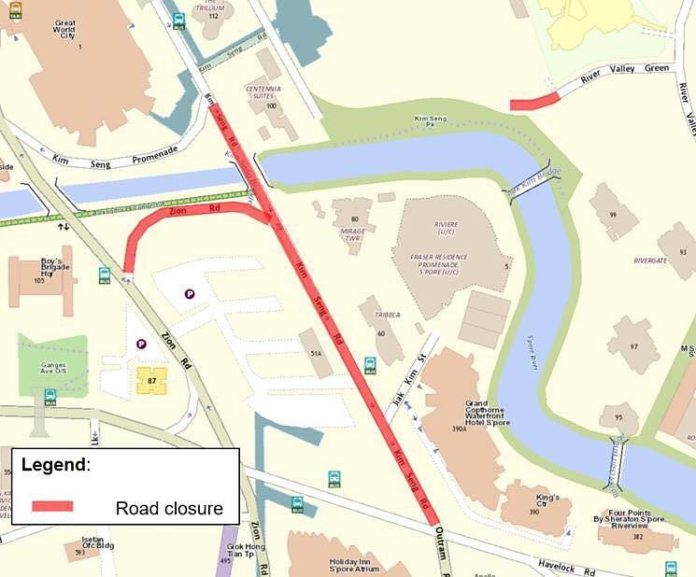
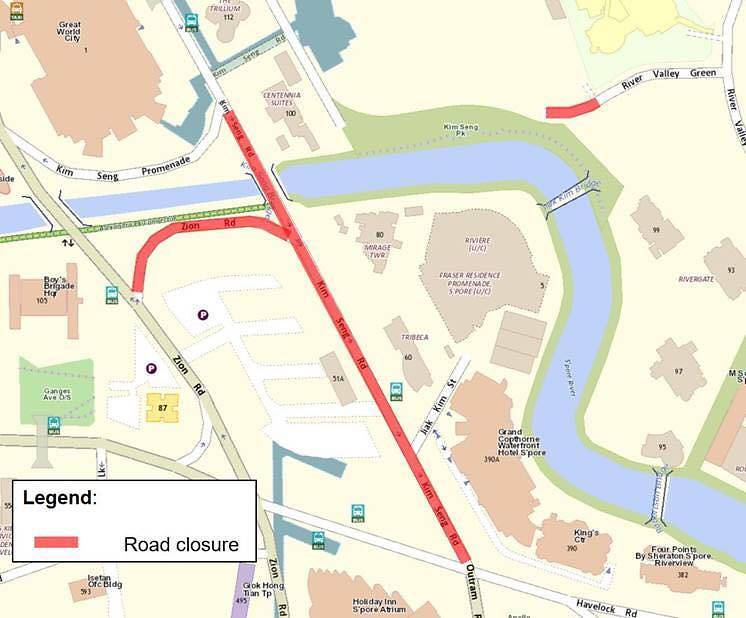
Map indicating the roads affected by the on-site disposal of a World War II bomb on Nov 18, 2019. (Image: Singapore Police Force)
The disposal will be carried out on Monday between 8am and 6pm.
Police said a 200m safety cordon will be put up around the war relic during this period. Loud sounds can be expected during the operation and the public is advised not to be alarmed and to avoid the area.
Police also said they have engaged residents from nearby condominiums Mirage Tower, Rivergate and Tribeca by the Waterfront, who will have to “temporarily vacate” their buildings.
Staff from Grand Copthorne Waterfront hotel will also arrange for guests to be moved temporarily from the area of the hotel that will be affected by the operation.
Several roads and a portion of the Singapore River will be closed during the disposal period. These include parts of River Valley Green, Kim Seng Road and Jiak Kim Street.
“Please do not enter the above areas during this period,” said police, adding that they will provide an update on their social media pages once the affected areas are reopened.
During the road closures, access will only be granted to police, SAF and emergency vehicles. Traffic police officers will be deployed along the affected roads to assist and redirect motorists.
Parking restrictions will be enforced as well, said police. Vehicles found parked and causing obstruction will be towed away.
Drone activities are prohibited in the area of the operation, the authorities said.
SINGAPORE – A century-old Buddhist temple in Race Course Road on Friday (Nov 15) denied allegations that its abbot had been having sex with multiple men on its premises.
The 102-year-old Leong San See temple has lodged a police report against a Facebook user who on Thursday posted photos and descriptions allegedly of the Venerable Tuan Boon engaging in sex acts with men.
The Facebook user, whose page uses the temple’s name in Chinese, said that he was a temple devotee and that he wanted to expose the truth to protect the religion.
Buddhist monks are generally expected to be celibate.
When The Straits Times visited the temple on Friday afternoon, Ven Tuan Boon was not present, and a caretaker, who did not wish to be named, said that the abbot was recuperating from a stroke.
The caretaker, who is in her 70s, denied the Facebook allegations.
“Everything on that Facebook page is false rumours. The (Facebook) profile is not operated by the temple. We have no idea who is behind it,” she said in Mandarin.
She and other temple staff said that the police visited the temple yesterday.
SINGAPORE – Popular outdoor market Artbox Singapore has returned for its third edition here, with light projections and a much larger venue.
The event, an offshoot of Artbox in Bangkok, was launched on Friday (Nov 15) at the Singapore Turf Club in Kranji. It will be held for two consecutive weekends.
At 200,000 sq ft, Artbox Singapore’s new event space is about a third larger than the one at Bayfront last year, which was around 140,000 sq ft.
The event’s organiser, Mr Kent Teo, 34, told The Straits Times: “After receiving feedback about space constraints, we hope to comfortably accommodate a larger crowd by having a bigger venue and wider walkways between booths.”
He is expecting more than half a million visitors to Artbox 2019, which has more than 300 retailers, food stalls, craft workshops and entertainment acts.
Visitors will get the chance to see an idyllic garden projected onto four 12m-tall shipping containers in a showcase of the event’s theme of Eden this year.
The art display by local creative company Ionix.Lab is the attraction that Mr Teo is most excited for the public to see.
SINGAPORE – The female victim injured in the Bukit Batok fire which erupted two weeks ago is still undergoing medical treatment in Singapore General Hospital’s Intensive Care Unit (ICU).
A spokesman for SGH confirmed this, and that two male victims who were also rescued from the fire have been discharged.
The woman, who is in her 60s, was rescued from a 13th-floor unit of Block 210A, Bukit Batok Street 21, along with her husband and son, on Nov 1.
The woman’s husband, believed to be in his 60s, was discharged from the hospital last week, while her son, in his 30s, was discharged on Friday (Nov 15).
They were taken to SGH for smoke inhalation and burn injuries after the fire, which began at about 4am.
The woman had taken refuge inside the toilet of her one-room flat and was taken to safety by first responders.
Officers from the Singapore Civil Defence Force (SCDF) rescued the two men from a ledge of the burning flat using a 60m-long ladder with a rescue cage.
After the incident, SCDF issued a warning to Jurong-Clementi Town Council as its officers were unable to use the fire hoses during the fire.