SINGAPORE: A man on trial along with his co-accused wife for murdering their five-year-old son had allegedly hit his spouse, kicked the family cat, and escalated violence against the victim in a pattern of what was meant to be “discipline”.
Ridzuan Mega Abdul Rahman and his wife Azlin Arujunah, both 27, are contesting charges including murder with common intention, by scalding their five-year-old son to his death.
Taking the stand on Monday (Nov 18) to a packed court was the prosecution’s psychiatrist, Dr Cheow Enquan, an associate consultant with the Department of General and Forensic Psychiatry at the Institute of Mental Health (IMH).
Dr Cheow disagreed with a psychiatric report the defence is relying on, which found that Ridzuan was suffering from Attention Deficit Hyperactivity Disorder (ADHD), Intermittent Explosive Disorder (IED) and hypnotic use disorder at the time of the offences.
The boy was allegedly scalded with hot water on four occasions in the week leading up to his death in late October 2016.
His parents, who took him back into the home from foster parents when he was about four, are accused of abusing him in a variety of ways including striking him with a broom, pinching him with pliers and confining him in a cat cage.
Dr Cheow told the court that he disagreed with the ADHD diagnosis as well as the IED, saying the criteria did not seem to be fulfilled.
While Ridzuan did give examples of his aggressive behaviour, there was no evidence to show that it was out of proportion to any provocation or stressors, said Dr Cheow.
Dr Cheow said Ridzuan’s account of the events shows that there was a clear escalation of disciplinary acts and not a sudden impulsive reaction as characterised by IED.
FATHER TRIED HITTING BOY FIRST, ESCALATED TO OTHER PUNISHMENTS
“In the accused’s account of the alleged offences, he clearly described an escalating pattern of physical punishment in response to persistent bad behaviour,” said Dr Cheow.
“He emphasised to me that it was not something out of proportion. Initially, he just tried hitting the deceased with his hands. But when the deceased’s bad behaviour persisted, that angered him,” said the psychiatrist.
Photos from court documents of he cage allegedly used to confine the boy, and the hot water dispenser purportedly used in the offences.
“So he decided to take things further. A hanger first, then pliers, then he came up with the idea of a heated spoon. He said the heated spoon was to punish his thieving hands, so he won’t open tins of milo and milk powder meant for his siblings,” said Dr Cheow.
The court had previously heard that the boy, who had burns on 70 per cent of his body, had one hand entirely burnt.
“When this didn’t work as well, he took more drastic actions, splashing boiling water on him, locking him in the cage meant for the cat,” said Dr Cheow. “It’s clearly a calculated, escalated pattern of violence, and not something out of proportion.”
The boy collapsed on Oct 22, 2016 after his father allegedly splashed hot water over his back and calf, and was taken to hospital only hours later, where he died the next day.
TROUBLED CHILDHOOD, BUT DID NOT BEAT OTHER KIDS AS MUCH
Ridzuan has certain traits consistent with someone with an anti-social personality, but not enough to amount to a formal diagnosis, said the psychiatrist.
“Such aggressive behaviour since childhood could be better explained with conduct issues,” he said.
Evidence from his childhood include being sent to a boys’ home for possessing pornography and abusing drugs at a young age, several instances of theft, misconduct in school, relations to gangs and fights with classmates.
Ridzuan told Dr Cheow that he had sniffed glue and taken methamphetamine before, but completely denied any recent use of drugs or alcohol.
He said Ridzuan was angered when the victim told his uncle that he was being beaten up for no reason.
“He felt that statement was not fair, he felt there was a reason, he was trying to discipline the deceased for his behaviour,” said the psychiatrist.
The couple allegedly “had violent tempers”, took drugs together and tended to quarrel frequently over many issues, the court heard.
Ridzuan said he hit his wife a few times a week out of frustration as she tried to stop him from going out, said Dr Cheow. The pair were both jobless, relying on financial aid and with Ridzuan selling some items on Carousell like love potions and old currencies.
He also kicked the family cat, because it urinated on the sofa.
“So it wasn’t something done without a reason,” said Dr Cheow, explaining how someone with IED would react angrily out of proportion even to minor provocation.
Ridzuan admitted using physical punishment to his other children, but not to the same extent, as they did not get into trouble as much as the victim, and “weren’t as difficult” or “misbehaving” as much.
“Clearly the information here I’ve stated is not consistent with IED, because if he had, he would get angry and blow up out of proportion even to minor provocation,” said Dr Cheow. “So he should have been indiscriminately violent to his other children even if they didn’t provoke him as much.”
A person with IED would have the condition affecting his ability to work, but Ridzuan said he had not worked for six months as he had lost his IC.
He also admitted that it was not so much that he was unable to work, but that he preferred not to work and instead rely on others.
The trial resumes in the afternoon, with the defence cross-examining Dr Cheow.
The penalty for murder is death, or life with caning.
Residents have been given instructions on how to vacate their units for a controlled on-site disposal of a 50kg World War II aerial bomb war relic today.
The bomb, which was found at a construction site in Jiak Kim Street last Tuesday, will be disposed of between 8am and 6pm, by the Singapore Armed Forces Explosive Ordnance Disposal team.
A 200m cordon will be set up around the area during the operation.
The Singapore Police Force (SPF) said that all residents living in the affected area – which will include around 600 units – will be required to leave their homes before 8am and return only after 6pm.
Roads in the vicinity will be closed and residents, as well as guests and staff of a hotel, will be asked to evacuate.
The police will set up a temporary holding area for affected residents at River Valley Primary School at 2 River Valley Green.
SINGAPORE: Condominium residents and hotel guests staying along Jiak Kim Street, where an unexploded World War II bomb was found last week, have vacated the area ahead of a planned detonation of the war relic on Monday (Nov 18).
The authorities said they first learned of the bomb on Nov 12, after it was discovered during excavation works at the construction site.
The Singapore Armed Forces (SAF) Explosive Ordnance Disposal team determined the war relic to be a 50kg WWII aerial bomb. The team assessed it as being unsafe to move and and that it had to be disposed of on-site.
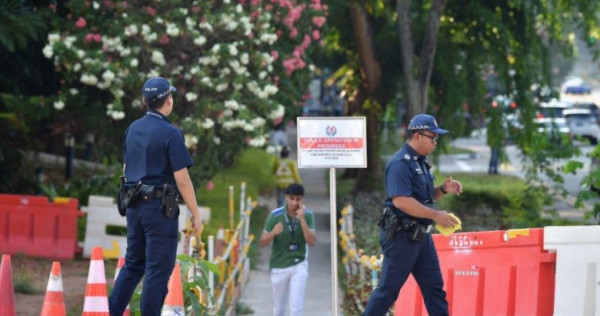
Police cordon seen at Jiak Kim Street on Nov 18, 2019. (Photo: Try Sutrisno Foo)
All residents at Mirage Tower, Rivergate and Tribeca by the Waterfront condominiums and guests staying in selected rooms at the Grand Copthorne Waterfront hotel were told to vacate their homes and rooms from 8am to 6pm.
Condo residents were seen leaving their buildings ahead of the 8am deadline.
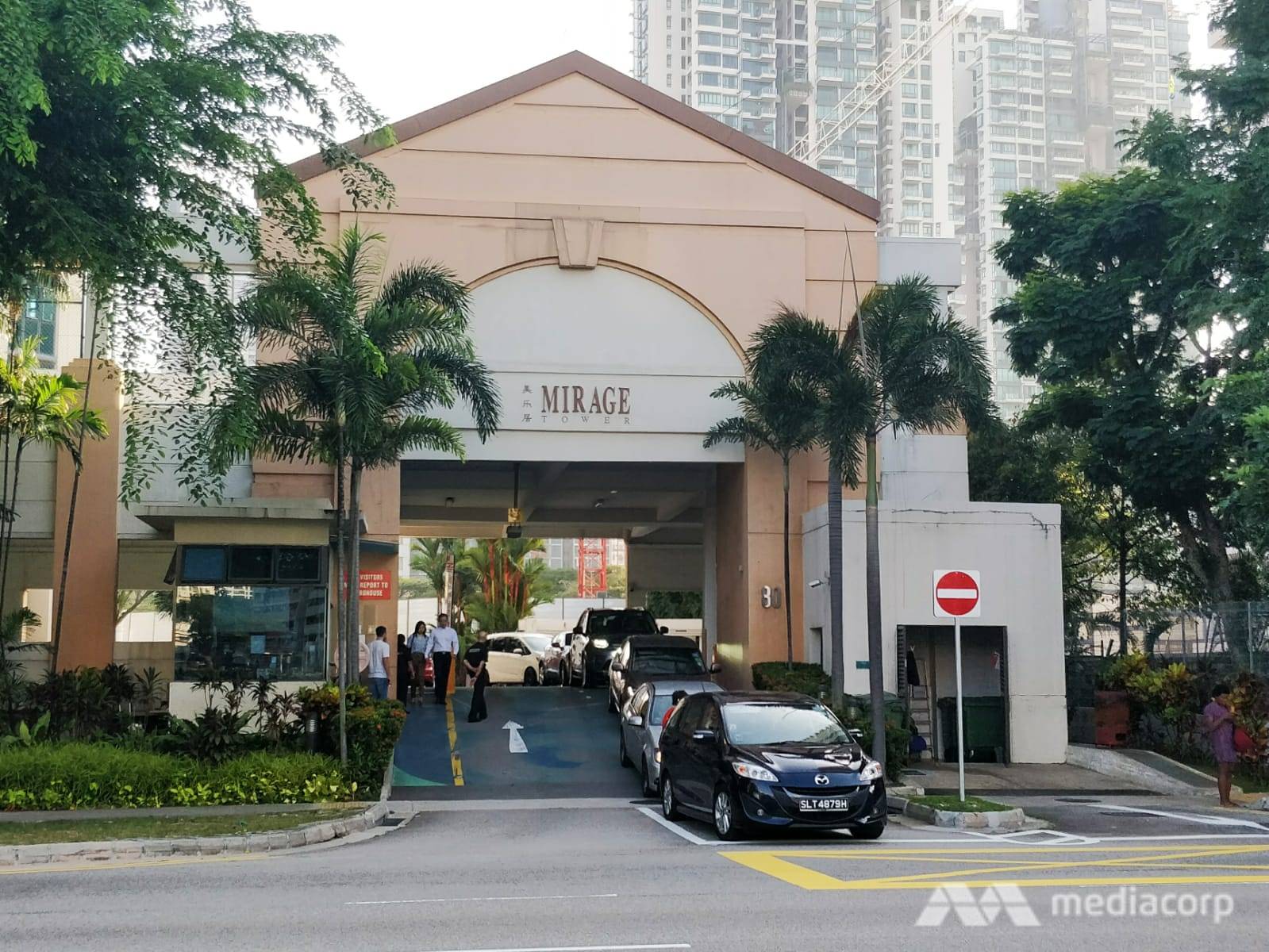
Residents exit the Mirage Tower condominium along Jiak Kim Street on Nov 18, 2019. (Photo: Try Sutrisno Foo)
The police informed affected residents that a temporary holding area had been set up at the nearby River Valley Primary School. They said residents would be informed when they could return home.
The police also told residents to leave their windows open, or slightly ajar, and to secure items in their home.
“This is a precautionary measure as the possibility of windows shattering due to pressure differences is unlikely,” they said.
Loud sounds may also be heard in the area during the controlled explosion, the police added.
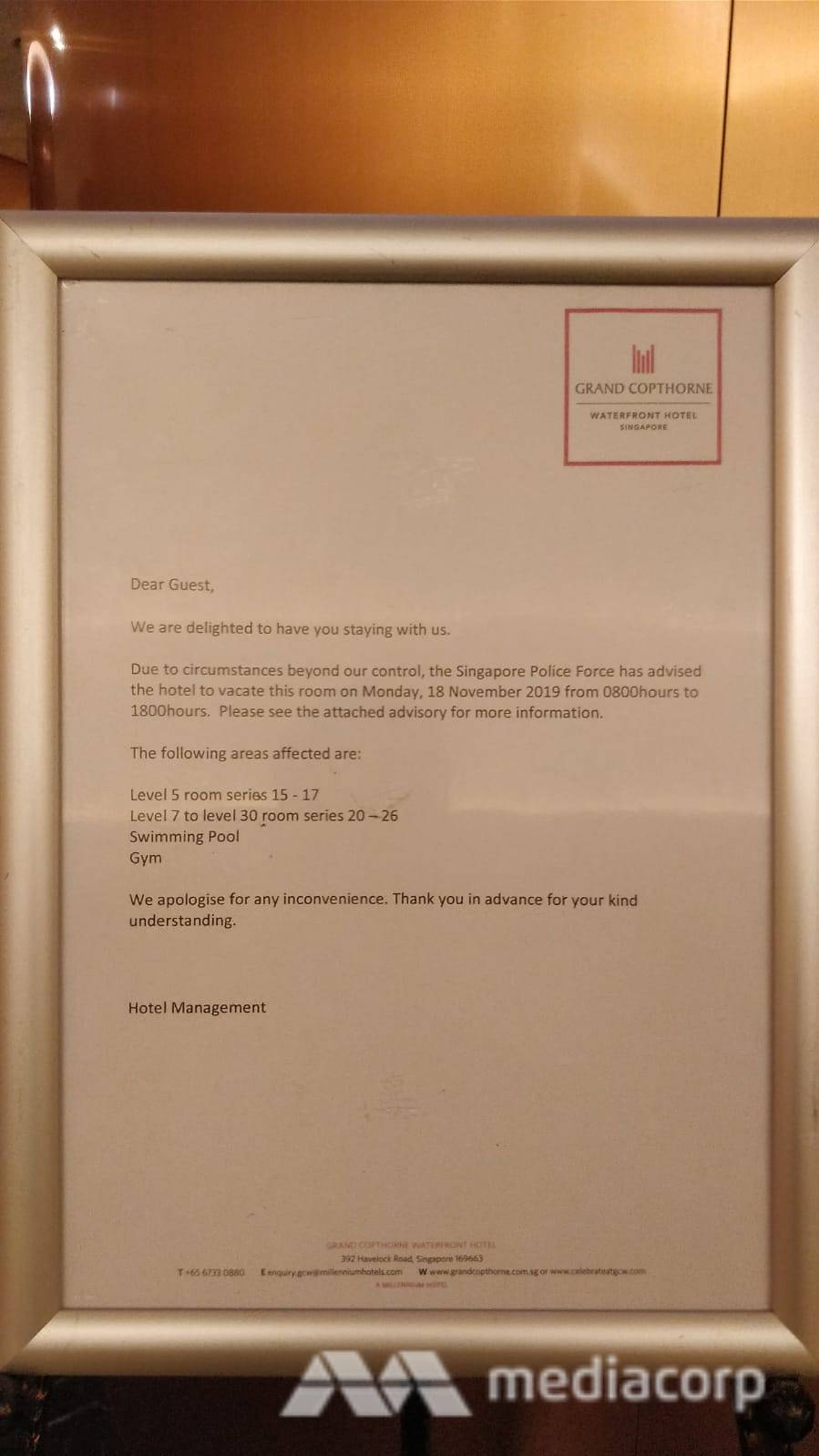
A notice at Grand Copthorne Waterfront lobby advising guests to vacate their rooms. (Photo: Try Sutrisno Foo)
In a notice posted at its lobby, the Grand Copthorne Waterfront hotel informed guests staying on the fifth floor (room series 15-17) and seventh to 30th floors (room series 20-26) to vacate the building from 8am to 6pm.
Police close off Kim Seng Road, near Jiak Kim Street, on Nov 18, 2019. (Photo: Try Sutrisno Foo)
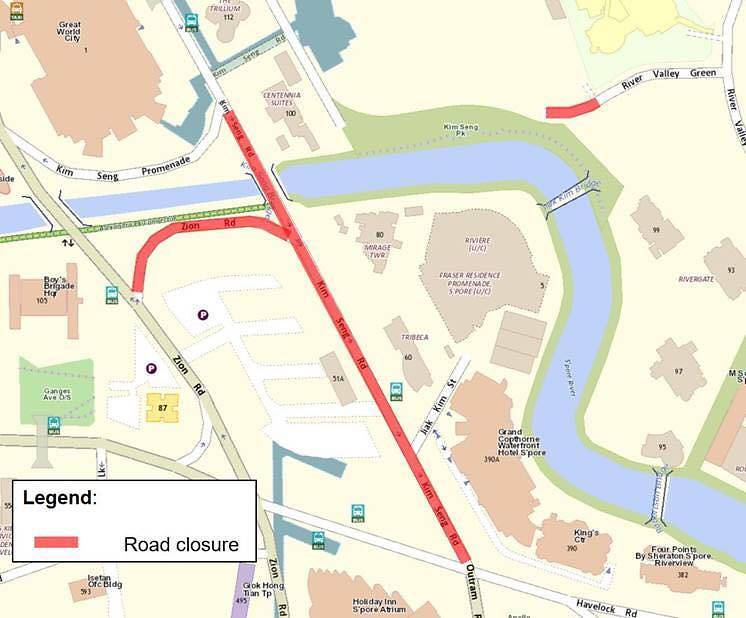
Several roads and a portion of the Singapore River were closed during the disposal period. These include parts of River Valley Green, Kim Seng Road and Jiak Kim Street.
“Please do not enter the above areas during this period,” said the police, adding that they will provide an update on their social media pages once the affected areas have been reopened.
During the road closures, access will only be granted to police, SAF and emergency vehicles. Traffic police officers will be deployed along the affected roads to assist and redirect motorists, the police said.
Map indicating the roads affected by the on-site disposal of a World War II bomb on Nov 18, 2019. (Image: Singapore Police Force)
Sports superstar David Beckham was spotted enjoying a plate of mee goreng.
Several Stompers shared with Stomp a video circulating online of Beckham sitting with food blogger Aun Koh, better known as as his online moniker Chubby Hubby.
Netizens were amused that the biggest name in football was using chopsticks to eat the local dish.
In photos and videos posted on Twitter, Beckham was also seen checking out stalls at the market as throngs of people crowded around him.
The Singapore Police Force have come out to defend crime prevention posters being criticised for the way molestation is being portrayed.
The Association of Women for Action and Research (Aware) had called out two posters on the MRT, both depicting a man about to molest a woman and a tag on his wrist with the words “2 years’ imprisonment. It is not worth it”.
On social media last Thursday, the gender equality advocacy group criticised the posters for putting a price on sexual violence and neglecting to mention the harm suffered by victims.
‘DETERRENT MESSAGE’
But in a statement issued on Saturday night, the police said Aware misunderstood the purpose of the posters, which are part of a series featuring other crimes such as theft and rioting.
The posters, displayed on the public transport network, specifically highlight the punishments for committing the crimes to send a strong deterrent message, said a police spokesman, who added that it was unfortunate Aware made public judgments without first contacting them to understand their perspective.
SINGAPORE: It came swiftly and with little warning.
On Nov 4, the authorities declared that electric scooters – which have become a fixture of Singapore’s streets in recent years – would be barred from footpaths the next day.
Even as pedestrians cheered, the news set off a furore among many users of the ubiquitous “e-scooters”, as they are known in the city-state. The loudest protests came from 7,000 or so food-delivery riders whose jobs depended on these vehicles.
In the past fortnight, they have taken their objections to Members of Parliament (MPs) – with riders turning up in the hundreds on at least one occasion – venting their frustrations at meet-the-people and dialogue sessions. Petitions against the ban have also been started, with one drawing more than 25,000 signatures.
In an effort to soothe concerns, the Government, along with three major food-delivery firms, unveiled a S$7 million grant to help riders switch to other vehicles.
Those who trade in their e-scooters will each receive up to S$1,000 to switch to electric bicycles (or e-bikes) or personal mobility aids meant for the less mobile, such as mobility scooters. For those wishing to switch to a bicycle, the grant is up to S$600.
Even as pedestrians cheered, the news set off a furore among many users of the ubiquitous “e-scooters”, as they are known in the city-state. The loudest protests came from 7,000 or so food-delivery riders whose jobs depended on these vehicles. (Photo: TODAY/Najeer Yusof)
E-bikes may be used on roads, while bicycles are allowed on footpaths and roads. By contrast, e-scooters are now confined to bicycle tracks, paths shared by pedestrians and cyclists, and park connectors.
The grant, announced four days after the ban was made public, did little to mollify riders, who argued that those with health problems cannot cycle for hours on end. As bicycles are slower than e-scooters, their takings would also be hit.
In response to queries, the Land Transport Authority (LTA) said there was no “one-size-fits-all” solution to managing different technologies and business models, and it sought to strike a balance between “facilitating and minimising” public disamenities.
“Ensuring the safety of pedestrians, commuters and all users of Singapore’s land-transport system is the LTA’s top priority,” its spokesperson said.
The events of the past fortnight have, nevertheless, raised questions on whether the issue could have been managed better.
With the benefit of hindsight, analysts, MPs and industry players said there were lessons to be gleaned not only from what unfolded in recent weeks, but from the time when personal mobility devices (PMDs) started becoming popular.
Still, they pointed out that no matter the path policymakers had chosen, there would be trade-offs and challenges.
And while the boat may have sailed for some of the options that were previously available to the authorities, they could offer clues on the way forward – given that the problems and opportunities arising from the proliferation of PMDs would not go away anytime soon.
1. COULD IMPORTS HAVE BEEN RESTRICTED?
From an estimated several thousand units four years ago, the number of e-scooters has ballooned to nearly 100,000 at last count, buoyed by their convenience for daily commutes and food-delivery services.
But dangers lurked as e-scooters snowballed. In the past year, e-scooters and other mobility vehicles left charging overnight in public-housing flats had caught fire, destroyed homes, triggered evacuations, and caused injuries and a death.
On footpaths, riders going at high speed and using overweight scooters had ploughed into pedestrians. In September, cyclist Ong Bee Eng became the first fatality from a collision with an e-scooter rider, who was using a non-compliant and unregistered vehicle.
In hindsight, the authorities should have controlled the types of PMDs that were imported and sold in Singapore, said Mountbatten MP Lim Biow Chuan, a member of the Government Parliamentary Committee for Transport.
In the past year, e-scooters and other mobility vehicles left charging overnight in public-housing flats had caught fire, destroyed homes, triggered evacuations, and caused injuries and a death. (Photo: SCDF)
“None of us would know that people would import illegally modified PMDs such that they speed and operate almost like a motorbike,” added Mr Lim.
Import controls would entail the Singapore Customs checking these vehicles, their battery power and weight, but then again, Mr Lim conceded that users could modify them illegally, making enforcement difficult.
Transport economist Walter Theseira, from the Singapore University of Social Sciences, said that unlike for motorcycles and cars from established manufacturers, standards for PMDs would have to be developed from scratch.
Two or three years ago, when these devices began to gain popularity, Singapore would not have been able to learn how other countries were dealing with the issue, as there was “very little practice elsewhere of regulating the construction and safety standards of these devices”, said Associate Professor Theseira.
Mr Denis Koh, chairman of Big Wheel Scooters Singapore (BWSS) – the largest online community of e-scooter enthusiasts here with about 26,600 members – said the LTA’s speed, width and weight restrictions for devices allowed in public spaces had achieved the same effects as import controls.
The requirements, passed into law last year, meant that it was no longer feasible for retailers to bring in non-compliant devices, said Mr Koh, who is also a member of the Active Mobility Advisory Panel.
The panel, set up in 2015, looks into rules governing the use of PMDs, bicycles and other equipment.
He added that the requirement for all mobility vehicles to meet UL2272, a safety standard that reduces the risk of fires, by July next year also weeds out illegal modification.
Asked in Parliament last month if the Government would stop the sale and imports of PMDs to curb the problem, Dr Janil Puthucheary, Senior Minister of State for Transport, said it could be considered.
But he noted that the measures in place would already “mean that new devices and new imports need to be compliant and … registered”.
“Given the number of these devices that are already here in Singapore, on our footpaths and on our roads, I think there are other steps that we need to consider for early intervention in the first place,” he said, without elaborating.
2. WOULD LIMITED TRIALS HAVE BEEN USEFUL?
Besides stemming the flow of PMDs into Singapore, analysts and industry players suggested that the Government could have explored small-scale trials in selected towns to assess the risks and benefits of these vehicles, before subjecting them to tougher rules or allowing wider adoption.
Assoc Prof Theseira said the challenge for PMDs and shared bicycles was that they had no “regulatory sandbox” or controlled trial environment that would allow the Government to assess the benefits and risks before deciding on the next moves.
This is unlike the financial sector, which has sandbox regulations that allow financial-technology firms to test products and services in a live environment within certain boundaries before becoming subject to greater regulation, he said.
Analysts and industry players suggested that the Government could have explored small-scale trials in selected towns to assess the risks and benefits of PMDs, before subjecting them to tougher rules or allowing wider adoption. (Photo: TODAY/ Ooi Boon Keong)
Mr Navin Kumar, head of supply chain at micro-mobility firm Helbiz – one of 14 applicants that were vying for a licence to operate shared PMDs in Singapore – said his firm believed a smaller-scale pilot sandbox licence could have been done in areas such as the Central Business District with “strict regulations on usage and safety”.
“A shorter-term (test) could have been given to service providers, to study the impact and determine a wider decision upon the end of that term,” he said.
Still, such trials are not without downsides.
If they were to be done, Assoc Prof Theseira said towns best suited to PMDs, based on their cycling networks, would naturally be picked and the results might not be the same when applied elsewhere.
While a trial may have been possible several years ago, it is difficult today as residents of a town earmarked for it would question why they are being victimised, said Assoc Prof Theseira.
On the other end, PMD users from another town would ask: “Why is that town so lucky?”
Transport consultant Gopinath Menon noted that trials had been conducted before in Tampines town on how pedestrians and cyclists could share footpaths, and this concept was expanded only after it was found to be working satisfactorily, in tandem with improvements to pathways.
“It would have been reasonable to assume that PMD riders would behave more or less as most cyclists did,” said Mr Menon.
Assoc Prof Theseira added: “Unfortunately, in the case of PMDs… their growth was so rapid that it became difficult to introduce the concept as a trial… Events really overtook the Government in this case.”
Mr Lim, the Mountbatten MP, said restricting riding to certain towns would be difficult to manage.
Nevertheless, Mr Steven Lim, president of the Safe Cycling Task Force (SCTF), said such trials could still be considered in future as an avenue to allow e-scooters to run on a wider scale again with appropriate controls.
3. WOULD LICENSING RIDERS HAVE HELPED?
Another move that could have been explored was to subject riders to a licensing regime: Just as motorcyclists and drivers need licences to operate their vehicles, so should PMD users.
In a letter last month, reader Kenneth Tan Sheng Han suggested that short of a ban, the authorities could create a class of driver’s licence for such users. He also proposed that the Road Safety Community Park in the East Coast Park be redeveloped to accommodate testing for users.
The idea was also mooted in Parliament. But Dr Lam Pin Min, Senior Minister of State for Transport, said last week in response to a question from MP Lee Bee Wah (Nee Soon Group Representation Constituency) that the Government had no intention to roll out mandatory licensing at this point.
Another move that could have been explored was to subject riders to a licensing regime: Just as motorcyclists and drivers need licences to operate their vehicles, so should PMD users. (Photo: TODAY/Najeer Yusof)
Mr Lim Biow Chuan said that subjecting riders to a licensing regime would promote responsible behaviour, as users risk being punished or losing their licence if they flout the rules.
BWSS’ Mr Koh agreed that the Government could have studied the licensing option, complete with training and insurance for those who use these vehicles for work, such as delivery riders.
Still, Mr Lim Biow Chuan acknowledged that a licensing regime – which had been discussed among some MPs – would take time, as the Government would have to study the structure of traffic rules for PMDs, and lay out the criteria for licences as well as insurance requirements where necessary.
With a licensing regime for e-scooter riders, Assoc Prof Theseira said some would ask if it should also apply to users of e-bikes and bicycles, since these devices could harm pedestrians, too.
PMDs also come in a myriad of forms and devising a practical test that would apply to all types of PMDs would require some thought, he said.
The authorities, while designing the test, may also find certain types of PMDs safer than others in, say, braking and manoeuvring capabilities. As it would not make sense for a licensing regime to ensure safe riders when vehicles themselves were poorly made, the Government would then have to devise criteria for the safe design and operation of all devices, and work with the market to ensure that these were reasonable and followed.
This, said Assoc Prof Theseira, would be an “expensive and arduous undertaking” that would receive pushback from importers who may have to dip into their pockets to have their PMDs tested.
4. COULD MORE CYCLING AND SHARED PATHS BE BUILT EARLIER?
Singapore could also have built paths needed to accommodate e-scooters and other innovative transport modes earlier, said those interviewed.
Professor Sam Park, who heads the division of strategy, international business and entrepreneurship at the Nanyang Business School, said Singapore does not have the proper infrastructure to make e-scooters valuable for people.
“Companies pushed out the products with little concern about public safety. Other than their profit-making effort, they did not exert any effort to address the potential public hazard,” he said.
At the same time, the Government was for a while not ready for this innovation and did not provide the necessary infrastructure, Prof Park added.
Singapore could also have built paths needed to accommodate e-scooters and other innovative transport modes earlier, said those interviewed by TODAY. (Photo: TODAY/Raj Nadarajan)
Assistant Professor He Long of the National University of Singapore (NUS) Business School, whose research covers shared-transport systems, said the Government could have proactively studied the impact of scooter use two years ago, at an early stage of rising adoption, and built the necessary infrastructure earlier.
Singapore’s network of cycling paths is set to be expanded from 440km to 750km by 2025. By 2030, the network will be thrice the present distance, and all Housing and Development Board (HDB) towns will have a cycling-path network.
Speaking to reporters this week after a dialogue session with more than 300 food-delivery riders and retailers, Dr Lam reiterated that ramping up the infrastructure was a work in progress and it was the Government’s “long-term vision to promote active mobility”.
Yet former Nominated MP Calvin Cheng believed that the Government needed to speed things up, as he argued that building “a comprehensive network of cycling lanes is… a matter of political will and budget”.
“Singapore is a compact, urbanised city… If (the Government) can build the Marina Coastal Expressway in five years, they can do this,” he said on Facebook.
A transport consultant, who declined to be named because of the “sensitive” nature of the issue, said that much more needed to be done on the infrastructural front.
Existing cycling paths and park connectors need to be complemented with “a network of local cycling paths and connectors” to improve connectivity, he said.
The footpath ban, along with an earlier move by town councils of the ruling People’s Action Party to keep HDB void decks and common areas off-limits to PMDs, has removed “this very important connectivity factor”, he said.
5. COULD BAN HAVE BEEN EXECUTED BETTER?
The abruptness of the ban – announced less than 24 hours before it set in – was stark, with riders and industry insiders saying that it left riders with little room to react.
Mr Koh said the PMD community respected the decision, but he felt that the authorities could have given riders more heads-up, since their livelihoods were at stake.
The authorities could have studied the situation on the ground and considered giving the 7,000 or so food-delivery riders longer leeway – say, three or six months – depending on the conditions, he said.
More than one in three GrabFood delivery riders relied on e-scooters to fulfil orders. For its two rivals, 5 per cent of Deliveroo riders used PMDs, and for Foodpanda, it was 12 per cent.
The abruptness of the PMD ban — announced less than 24 hours before it set in — was stark, with riders and industry insiders saying that it left riders with little room to react. (Photo: TODAY/ Raj Nadarajan)
Agreeing, Mr Lim Biow Chuan said that ideally, the Government could have given users more advance notice, but this carried risks.
“If someone else dies in between … people will say ‘why did you wait’ or ‘why did you give them so much time’?” said Mr Lim. “It is an unenviable situation.”
Alongside the decision to ban e-scooters from footpaths, the Government also scrapped plans to award licences to companies hoping to run shared e-scooters.
Firms said that they felt the Government could have engaged them more deeply and worked together to resolve safety issues.
Mr Christopher Hilton, vice-president for corporate affairs at Beam, said: “If there was a real chance of these regulatory changes happening, (the Government) would have been better served to both engage operators earlier on in a more robust way and also be frank in saying that.
“It feels somewhat knee-jerk that we were moving towards licensing and then moved away from it.”
Ms Gan Jin Ni, chief executive officer of Telepod, felt that there could have been greater engagement by the authorities to brainstorm solutions to solve the issues facing the industry.
To this, an LTA spokesperson replied that the agency had engaged licence applicants regularly to tell them about the safety concerns with PMD use.
“LTA is open to technological solutions to improve path safety, and has consulted other government agencies, institutes of higher learning and companies,” added the spokesperson.
Some licence applicants, nevertheless, said the writing was on the wall.
Anywheel’s chief executive officer Htay Aung said the two delays in awarding licences this year were signs that e-scooters might be banned. “It was not sudden. There were already so many signals.”
As recently as last month, Dr Puthucheary had warned that the Government would have no choice but to ban PMDs in Singapore if user behaviour did not improve.
Ang Mo Kio Group Representation Constituency MP Ang Hin Kee, deputy chairperson of the Government Parliamentary Committee for Transport, said food-delivery riders would have been more assured had the Government announced the footpath ban and the S$7 million trade-in grant at the same time, rather than several days apart.
This delay caused anxiety among riders about their livelihoods.
“It would be much more reassuring if the authorities had worked with food-delivery companies to engage the riders and give them some form of reassurance, so that when the ban is made known, people immediately know what to do,” said Mr Ang, who is also assistant director-general of the National Trades Union Congress.
“You have to both preserve lives and preserve livelihoods.”
HOW TO MOVE FORWARD
As food-delivery riders scramble to find alternatives and the Government grapples with the fallout, analysts, industry players and MPs suggested ways to move forward on the matter, both in the immediate and longer term.
Restricted use on minor roads, public-housing car parks, and footpaths: Assoc Prof Theseira said the authorities could consider whether PMDs might be allowed on minor roads and in car parks in HDB towns, as well as on roads in private-housing estates.
These areas have less vehicular traffic, and allowing riders on smaller roads would reduce the need for them to dismount and push their vehicles.
Mr Koh agreed that allowing users on minor roads would help, but he said HDB car parks have blind spots, which make the commingling of cars and PMD users unsafe for motorists leaving their parking spots.
Instead, he suggested that certain e-scooter users, such as those who use the devices to commute to work or take their children to school, could be permitted on footpaths within restricted hours at the start and end of each day, when there are fewer pedestrians.
As food-delivery riders scramble to find alternatives and the Government grapples with the fallout, analysts, industry players and MPs suggested ways to move forward on the matter, both in the immediate and longer term. (Photo: TODAY/Najeer Yusof)
SCTF’s Mr Steven Lim, who is also a member of the Active Mobility Advisory Panel, said extensive studies must be done before designating roads with fewer vehicles and blind spots for PMD use.
Others begged to differ.
Mr Lim Biow Chuan said the idea would not go down well with residents in private and public residential estates. “All you need are a few reckless guys to do it again,” he said. “Do we have enough people to enforce the rules on private roads and in HDB car parks?”
Infrastructural changes and improvements: On the infrastructural front, observers suggested that larger footpaths could be converted into shared tracks.
Assoc Prof Theseira said that such larger paths could be segregated for pedestrians and PMD users with obvious markings.
Mr Koh suggested that footpaths wider than 2m could be reclassified as shared paths. This would add to the “connectivity to the major shared paths”, such as park connectors. As for existing footpaths that are narrower and have room to be widened, he said the authorities could speed up the process.
There will be trade-offs, though. For one, roads will become narrower, Mr Lim Biow Chuan said.
Assoc Prof Theseira said that reclaiming road space could increase congestion for motorists. Widening paths could also entail felling mature trees, he added.
But over the longer term, industry observers said PMD use would become more feasible as the Government pushes ahead with its cycling-path upgrades.
Licensing riders: The idea of a licensing regime could still be considered, said MPs and analysts.
But Assoc Prof Theseira said that while it is a good idea, licensing is unlikely to be an immediate solution.
“It took decades for motor vehicles and drivers to be fully licensed for safety, standards and operator behaviour,” he said.
“To have Singapore come up with those rules from scratch is quite difficult in the short term.”
THE BIG PICTURE: KEEPING PACE WITH INNOVATIONS
The task of tackling the PMD scourge is the latest regulatory headache confronting Singapore’s transport policymakers.
In recent years, technological disruption and innovations have kept policymakers on their toes.
First, it was the ride-sharing sector, as American firm Uber and regional company Grab revolutionised point-to-point transport and disrupted incumbent taxi firms.
As the Government tightens its reins on the industry, larger operators of street-hail and ride-hailing services are set to be licensed under a new regulatory framework from June next year.
The authorities have also had to deal with other conundrums, including the proliferation of shared bicycles strewn irresponsibly across the island, for which a licensing regime was instituted last year.
There is “no single approach to transport innovation and disruption”, said Assoc Prof Theseira. “The principle has to be what are the benefits of innovation, balanced against the risks or harm that it poses.”
Singapore’s approach, he said, has been consistent: It has allowed innovations to establish themselves and flourish to the extent that it can determine their costs and benefits, and put in place regulations where necessary.
Transport Minister Khaw Boon Wan said as much earlier this month when he weighed in on the footpath ban. “Technological progress and continuing innovations have been a boon for the transport sector… As regulators, we try to facilitate innovations so that responsible consumers can enjoy the benefits. But we cannot be sure of how the devices may be abused.”
Indeed, Associate Professor Lawrence Loh of the NUS Business School said that there cannot be an unbridled allowance of business and innovation. “There are often overriding concerns like public safety that are immutable,” he said.
LTA’s spokesperson said the agency keeps an open mind to innovations that can benefit the public. Where necessary, it tightens measures to ensure responsible use.
“This is why we license bicycle-sharing operators, and have decided to limit motorised PMDs to cycling paths and park-connector networks,” said the spokesperson.
“Adapting policies in the light of implementation experience is important, given that technology and business models are rapidly evolving.
“Our regulations must also evolve alongside the readiness of society to accept such innovations,” added the spokesperson, citing the “careful approach” to autonomous vehicles as an example.
Still, Assoc Prof Theseira said the Government would err less on the side of permissiveness in the transport arena moving ahead.
For some time, the implicit approach has been that the whole of Singapore is a sandbox for new transport concepts.
“One thing we would learn… going forward is we cannot quite do this anymore with transport innovations, even for off-road use,” he said.
“We have to think more carefully about whether we should design a sandbox environment for us to evaluate such things in the future.”
SINGAPORE: Used for everything from unlocking smartphones to boarding flights, the use of facial recognition technology is becoming increasingly ubiquitous.
But even as it becomes more commonplace, care must be taken to ensure it is not misused, say experts.
Facial recognition is increasingly being employed in Singapore. Earlier this month, it was announced that hotels here will be able to use an automated system which employs facial recognition to speed up the check-in process for visitors.
There are also plans to use facial recognition to track the attendance of MPs in Parliament.
Around the world, the technology has been used for an increasing variety of purposes, ranging from law enforcement to checking into flights at airports.
Associate Professor Terence Sim from the National University of Singapore’s (NUS) School of Computing said the increasing use of facial recognition can be pinned down to several reasons.
These include advancements in computer vision, the branch of computer science that deals with analysing and processing images.
Facial recognition software works by using face detection to located the exact position and size of a face in an image captured by a camera, said Associate Professor Sim.
Features – such as the location of the eyes and the shapes of the jaw, lips and nose – are matched against a database, he noted, adding this is achieved using an artificial intelligence technique called machine learning.
“Given the recent advances in facial recognition algorithms, recognition accuracy is getting much better and thus leading to the wider adoption of the technology,” said Association of Information Security Professionals president Steven Wong.
As a security measure, facial recognition does not have the high accuracy of fingerprint or iris scans, he noted.
However it has the advantage of not requiring physical contact – unlike fingerprint recognition – and can be cheaper than iris scans as normal cameras can be used for facial recognition, said Dr Wong.
For example, some facial recognition solutions struggle to differentiate between twins, noted Dr Wong, adding that lighting and other cosmetic changes can prevent a person from being accurately identified.
Holding a photo or a video up to a camera has also been known to fool the technology, said Associate Professor Sim, adding that “active research” is being done to prevent this.
“One type of defense is called ‘liveness detection’, which attempts to determine if the face being presented is indeed from a living person, as opposed to a photograph, a mask or a mannequin.”
Some facial recognition software acquires the shape of the face in 3D to distinguish it from a photograph, he said, noting this is how the Face ID function in the iPhone works.
China has been using facial recognition technology for everything from fast-food orders to catching criminals AFP/NICOLAS ASFOURI
NEED FOR GREATER REGULATION
However, experts told CNA there needs to be greater legislation on the use of facial recognition for surveillance purposes, pointing to privacy concerns.
Associate Professor Sim pointed to the potential implications of having facial recognition being deployed in areas such as shopping malls or even in homes.
“If I put a camera with facial recognition in my house, but it captures passers-by on the street, is this legal?” he asked, adding the covert use of the technology in such a way should be illegal.
NUS Law School dean Simon Chesterman notes that the same qualities that make facial recognition useful for identification purposes like checking passports could turn it into a tool for mass surveillance.
Professor Chesterman – who has written about artificial intelligence, big data and the use of surveillance – suggests restrictions could be put into place on the use of facial recognition data, pointing to the more stringent regulations on the use of NRIC details that came into effect in September.
Data privacy is another concern, said Associate Professor Sim, noting facial recognition systems – and the data they collect – must be properly secured against cyber-attacks.
“Given that facial recognition and other biometric systems are increasingly being used to protect valuable resources such as bank accounts and access to buildings, hackers will be attracted to break them.”
There is a “fine balance” between security and privacy, said Dr Wong.
“However, as facial recognition becomes increasingly adopted, both overseas and locally, it is inevitable that people will just have to be accustomed to it.”
SINGAPORE: The case for working from home remains unclear.
On one hand, employees who work remotely have been shown to experience increased mental health risk, primarily due to feelings of isolation and loneliness.
On the other hand, a number of studies have found that employees working in modern open-plan offices are so easily distracted and constantly interrupted, they cannot concentrate on their tasks.
Furthermore, open-plan offices do not necessarily increase face-to-face interactions and collaboration, as employees prefer e-mail and messaging.
Given the changing family arrangements in Singapore and the complex, cross-cutting nature of work today, working from home may help to alleviate some of the common work and family demands and stress experienced by employees.
REMOTE WORKING CAN LEAD TO IMPROVED WORK AND FAMILY LIFE
For a start, working from home enables employees with home responsibilities to continue earning a stable income, instead of forcing them into an either-or situation.
The prevalence of dual-income households and a rapidly ageing population have meant that many Singaporean employees shoulder both childcare and eldercare responsibilities.
While many Singaporean households can now afford to hire foreign domestic workers to help out with their household chores and care-giving responsibilities, working long hours and the neglect of family life have led many to feel guilty about not spending quality time with family.
Office professionals at work. (File photo: Unsplash/Mimi Thian)
Although research has found that the amount of time spent with family has little impact on family satisfaction and mental health, remote working generally provides more opportunities for quality time with family.
Additionally, when employees are given the flexibility to attend to their work and home responsibilities without any time or spatial restrictions, they are more likely to engage in their work and family responsibilities effectively and efficiently.
As a result, employees report feeling less stressed and experience enhanced health and well-being. This increases employee retention, and may also attract a more diverse range of employees to organisations.
OPEN-PLAN OFFICES KILL COLLABORATION AND PRODUCTIVITY BUT ARE STILL COMMON
Over the years, offices around the world have seen the shift from private cubicles to open-plan layouts, to encourage collaboration and socialisation among employees.
However, employees often find open-plan offices distracting, and because they are not able to concentrate on their work, they tend to communicate and collaborate less frequently with their colleagues.
Moreover, there is often little privacy in open-plan offices. The shared desks and spaces usually mean overhearing phone calls or catching your colleagues engaging in online shopping.
Further, studies have shown that employees in open-plan offices take nearly two-thirds more sick leave and report higher levels of unhappiness and stress, and lower levels of productivity.
Yet companies continue to build open-plan offices because they require less space and are thus more cost-effective. To save more on office space, some companies even introduce hot-desking, where employees either share a desk with others or are not assigned a permanent desk and must find one when needed.
Needless to say, hot-desking exacerbates the lack of privacy and concentration for employees. Desk shortages, difficulty finding colleagues, and wasted time create tensions among employees, and severely impact employee well-being and productivity.
Given that office space is typically costly for companies, remote working may alleviate the situation since fewer desks are needed for employees.
As one of the most densely populated countries in the world, Singapore could also benefit from more remote working as not all employees will need to commute to work.
Commuters at the Raffles Place MRT station in Singapore. (File photo: AFP/Roslan Rahman)
CREATIVITY AND INNOVATION REQUIRE CRITICAL THINKING AND FOCUS
It is widely believed that collaboration fosters creativity and innovation, enabling organisations to stay ahead of the curve. But the same can be said about focus and deep cognitive skills.
First, being able to concentrate on tasks without interruption or distraction lays the foundation for any type of work to occur.
Job tasks such as processing and synthesising information, analysing data, or even responding to e-mails all require some level of concentration.
Second, employees need creative thinking skills to produce innovative work. To foster creative thinking skills, critical thinking is just as important as collaboration.
When these cognitive processes are disrupted due to distractions in the workplace, collaboration alone will not produce creativity or innovation.
DEMAND FOR REMOTE WORKING WILL CONTINUE TO RISE
Admittedly, remote working is not for everyone.
Employees who thrive on feedback and encouragement struggle to work from home, as they require regular social interaction and connection with their supervisors and colleagues.
Many employees also struggle to “switch off” these days. Remote working is known to aggravate this issue as it erodes the boundaries between work and life.
Woman speaking to a colleague in the office. (Photo: Unsplash/Mimi Thian)
Organisations have also found it hard to manage large groups of employees taking on remote working, as studies have shown a decrease in productivity and firm performance due to bad planning and inefficient work re-allocation.
But at the very least, workplaces should be designed to support employees’ well-being and productivity. Also, each employee’s work and non-work needs are a lot more complex these days. Catering to employees’ needs requires a more nuanced approach.
Although it may be hard to monitor employees when they work from home, making employees work in the office throughout the week may not be any more beneficial.
At the end of the day, employees are generally motivated when they feel connected to their workplace and are afforded the same opportunities as their colleagues.
So this demand for remote working will continue to increase, and companies must find a way to navigate its costs and benefits.
Carys Chan is Lecturer/Assistant Professor at RMIT University’s School of Management.
Stomp understands former businessman Zeng Guoyuan, who is better known as ‘Parrot Man’, was found dead at the foot of Block 68 Geylang Bahru on Saturday night (Nov 16).
Stompers Fitzy and Sri alerted Stomp to the incident.
Sri said she saw a police death tent set up at the foot of the block at about 11pm.
Fitzy, who was neighbours with Zeng and often saw him in the neighbourhood, said that she saw a stain on the ground near the block.
In response to a Stomp query the police said they were alerted to a case of unnatural death at about. 9.54pm.
“A 66-year-old man was found lying motionless at the foot of the said block and was pronounced dead at the scene by a paramedic,” a police spokesman said.
Police investigations are ongoing.
“I hope that our fellow Singaporeans will pray he rests in peace instead of making him a laughing stock,” Fitzy said.
Zeng made headlines over the years for his several run-ins with the law.
He earned his nickname ‘Parrot Man’ in 2008 after blaming his pet parrot for getting him arrested and charged with abusive language on two police officers. He was fined $2,500.
SINGAPORE – An elderly personal mobility aid (PMA) rider was taken to hospital after his device collided with a taxi in Choa Chu Kang on Saturday (Nov 16).
The police said they were alerted to the accident, which occurred at the junction of Choa Chu Kang Way and Choa Chu Kang Avenue 1, at 3.53pm that day.
A video of the aftermath of the accident, posted by a Facebook user, shows a man lying on the road being tended to by paramedics.
Several people, including some food delivery riders wearing GrabFood shirts, are gathered around the scene. The PMA appears to be stuck to the front of a blue taxi.
In the video, witnesses can also be seen asking a man, believed to be a taxi driver, how fast he was driving the vehicle.
PMAs are devices designed to improve the mobility of handicapped and elderly users.