Home Blog Page 614

Life on the outside, after 35 years in a mental ward

0

SINGAPORE: Like clockwork, he is up by 7am daily and spends most of his day in his sister’s flat, catching up on his Channel 8 dramas, reading or writing his diary.

It sounds like a mundane life, but these are the best of times for a man who, for 35 years, had only known the routine of life behind the walls of a mental institution.

Until recently, you see, Sim Kah Lim was one of the longest-staying patients in the Institute of Mental Health (IMH) — those who have been warded for more than a year, where all possible discharge options have been explored and had failed.

There are now about 1,000 long-stay patients, who mostly have major mental health conditions “that interfere with their ability to lead independent lives or integrate well into the community”, said the IMH’s advanced practice nurse, Goh Ai Sze.

Kah Lim, however, received an unexpected reprieve and was partially discharged late last year — free to return to the world he left behind in 1983. He was 15 years old when he was institutionalised for schizophrenia.

Sim Kah Lim was 15 years old when he was institutionalised for schizophrenia.

Sim Kah Lim.

“Got freedom, very happy … Like a pigeon, I can fly away,” he mumbled with a grin to CNA Insider. “I take my bag. I can bring it all around Singapore to go and paint, like (the painter) Vincent van Gogh.”

The 51-year-old is something of an anomaly now, as it is not common for long-stay patients to be discharged.

“I felt that he should come out and see the outside world more,” said younger sister Cindy Sim. “The day when (the IMH) told me that he could go out, I was very happy for him because he wanted this to happen for many years.”

ROAD TO RECOVERY

Since young, Kah Lim loved painting, and his father used to take him to the Singapore River and Kampong Glam to paint and learn from the artists who gathered there.

Long-staying IMH patient Sim Kah Lim is back to painting on the banks of the Singapore River.

Back to painting on the banks of the Singapore River.

His behaviour started to change, however, when he became a teenager. He started talking to himself and refused to leave home. He was subsequently admitted to the IMH, but he never stopped painting.

READ: In a mental ward for nearly 35 years, he paints old Singapore from memory – and he dreams

His sister understood the importance of family support and made sure that she remained a constant in his life. She even moved to Hougang, to be nearer to the IMH so that she could visit him regularly.

“Family members play a big role in a patient’s recovery,” she said, adding that she visited him almost weekly over the 35 years, unless she had to travel for work.

“Everybody needs family members to visit them. They want to talk about their daily life … (and) about the old days.”

Cindy Sim visited her brother Sim Kah Lim almost weekly over the 35 years he was in the IMH.

Cindy Sim with her brother.

She remembered that he constantly reminisced about his childhood then. “Family members are the ones who bring back their memory and help them to think, ‘I still have a sister, a brother, a father, a mother,’” she said.

Mental health patients do need family support to experience kinship, bonding and to help them towards recovery, said Dr Lim Boon Leng, a psychiatrist at Gleneagles Medical Centre.

Cindy also thinks her brother’s recovery was partly thanks to his dream of showcasing his art coming true.

In July last year, some of his works were selected for an exhibition highlighting the importance of mental health. Two months later, he held his own exhibition, organised by Goshen Art Gallery.

That people appreciated and bought his paintings helped him to regain his confidence, said Cindy.

One of .Sim Kah Lim's paintings. That people bought his artworks helped him to regain his confidence

One of his paintings.

“Since young, he wanted to show his art to many people. But his dream wasn’t fulfilled for so many years, so his condition also didn’t really improve,” she added.

Goshen co-founder Faith Lum-Yu had hoped his solo exhibition would help him reintegrate into society. And during the event, she saw how excited he was — talking to people, shaking their hands and taking selfies with them.

“It means a lot to him that people admire his work and ask questions about it,” she said. “We could see the change in him as well. He was definitely connecting with people more.”

When Cindy noticed the changes in her brother, she explored with the IMH the possibility of his release.

“When he got his art exhibition, he felt good — he felt that he was useful. That’s how he got his confidence back,” she said.

“To him, everything is about art. When his art is appreciated … he doesn’t think about other things, like his unhappiness.”

PERIOD OF ADJUSTMENT

But before a patient can be discharged, a multidisciplinary team from the IMH must assess his or her mental health condition and rehabilitation potential.

They draw up rehabilitation goals and care plans, including teaching the patient about independent living and vocational skills such as money management.

“It’s not easy for them, as society has changed so quickly. A lot of things were previously done for them (in the ward),” said Lim.

“They have to take care of themselves and get used to a new environment and technology. When staying with family, it’s unavoidable that there’ll be conflict.”

Cindy admitted that her family had to make some adjustments, as they were not used to having Kah Lim around. He sleeps in the living room, so that they can keep an eye on him.

“His behaviour is a bit different — he likes to sing. At home, we’re always very quiet, except for the dogs,” she said.

“We told him not to make so much noise. He’s very co-operative and knows he isn’t allowed to sing so loud.”

What he has struggled with is money. Cindy once gave him S$100, as he wanted to “feel rich”, but he blew it all in one day on his meals, chocolates and shampoo for the family.

He now gets between S$5 and S$10 daily pocket money, enough for some of his meals outside. He once even sneaked out for supper at midnight and got lost. It was only in the morning when he was discovered missing.

Thankfully, a Grab driver called to say he had found Kah Lim in the Upper Serangoon area, about 20 bus stops away from home. Cindy now keeps the house keys at night.

These days, her brother is home for about three weeks each time and returns to the IMH for about a week.

“I don’t want him to have hopes (of) … doing anything he wishes. I’m afraid he may relapse,” she said. “I’ve seen some cases where, after years of integration, they relapse.”

A businesswoman, she usually schedules her overseas work trips when he is back in the IMH.

Meanwhile, he makes it a point to buy snacks for his friends inside when he returns. “Once in a while, (I) must go back, (for a) change in environment and (to) see friends,” he said.

THE CHANGING TIMES

Community support is also important for mental health patients who are trying to reintegrate. The IMH said its multidisciplinary team works with family members to support patients, and also links them up with the relevant community resources.

Cindy is heartened to have a nurse call her every night to check on her brother.

In the past, Lim noted, even when institutionalisation was not necessary, “there weren’t enough services in the community to support (people with mental illness)”.

“Family members may not have been familiar with that (illness). If a person was noisy, for example, the neighbours may have discriminated,” he said.

“Now we have much better community services to help this group, and that allows them to go back home.”

Medication for schizophrenia patients also has lesser side effects these days which “makes it easier for them to integrate back to society,” he added.

But these patients must remember to take their medication or they may suffer a relapse.

However, relapses can also happen because of work and relationship stress, poor coping mechanisms to stressors and the inability to adjust to community living, said IMH. In such cases, the patient may have to be re-admitted.

Kah Lim’s relatives had gotten him acquainted with the neighbours and shop owners when he first moved back.

“My neighbours, they don’t feel that (having) Kah Lim around is strange or weird, they accept him for who he is,” said Cindy. “He’s not the only one with such a condition.”

He has become so familiar with the area that he walks alone to a nearby coffee-shop for his char kway teow, char siew rice or nasi lemak almost every day.

And since leaving IMH, he has put on some 12 kg, complained Cindy.

“He has been eating a lot, one day at least four, five meals,” she said. “In his mind is either painting or food.”

He replied matter-of-factly: “If you don’t eat now, die already cannot eat.”

He also helps out with the housework, walks the dogs and runs errands for the family, such as buying groceries from the wet market.

For patients with schizophrenia, engaging them to run errands or house chores helps to improve their confidence and their mental functioning, said Lim.

“They tend not to do much at home … They don’t talk much, and given the choice, they’d sit in a corner and not do anything,” he said.

ANOTHER EXHIBITION

These days, Kah Lim is free to paint as much as he wants and every Sunday morning, he heads to eminent artist Choo Keng Kwang house where the latter mentors him.

Choo used to give Kah Lim painting tips along the Singapore River when he was a boy.

“The two men like to talk about art and they click. They enjoyed each other’s company. Both of them share about what is good to draw, and how to improve Kah Lim’s painting,” said Cindy.

In fact, Kah Lim is holding another art exhibition from today (Nov 16), organised by Goshen Art Gallery.

Going forward, Cindy wants him to learn to how to take public transport to her office nearby to help her out.

She appreciates that she has more time with her brother these days – she chats with him every morning before work and makes it a point to be home early in the evening.

Cindy thinks that for some mental health patients, giving them a chance to return home may be helpful.  

But she acknowledged that not all families would able to do that due to work commitments or old age.

“That’s why I don’t want to do it (bring him home) when I am older. I want him to learn to live by himself in case I can’t take care of him,” she said.

“At least he has experienced life outside rather than inside the hospital his whole life. He has already stayed there for 35 years.”

Source link

Commentary: Underwhelming AirPods Pro? Here’s why Apple users remain incredibly loyal

0

SINGAPORE: We all know the story of Apple, and how so many of us have become an integral part of this tale.

Apple Inc is a 43-year-old company that is at least one generation older than Amazon, Netflix, Alibaba, Tencent, and Facebook – all of which are 25 years old or younger.

It was founded by Steve Jobs and Steve Wozniak in a garage in Los Altos, California, on Crist Drive.

READ: iPhone 11, TV+ and Apple Watch: All you need to know about Apple’s latest launches

Some 40 years later, it is headquartered at One Apple Park Way in Cupertino at the US$5 billion “spaceship,” a four-story circular complex that houses 12,000 employees and spans 2.8 million square feet.

Topped with 805,000 square feet of solar arrays on its roof, the circular ring is made entirely of curved glass without the annoying green hue.

Last summer, when I visited the Apple campus, the lush canopy of 9,000 native and drought-resistant trees embraced the ring’s inner courtyard, which itself is wider than St Peter’s Square in Rome.

The orchard, meadow, and pond were laced with trails where I walked and chatted with an Apple employee. 

And in my mind, that spaceship, that “mothership” of the Apple empire, is the last “insanely great” product from Cupertino.

In many ways, it is exactly that.

The Steve Jobs Theater on Apple's campus in Cupertino, Calif., hosting the company's annu

The Steve Jobs Theater on Apple’s campus in Cupertino, Calif., hosting the company’s annual rollout of new products, Sept. 10, 2019. (Jim Wilson/The New York Times)

IS APPLE LOSING ITS SHINE?

By the law of large numbers, Apple has found it hard to sustain the same growth rate for its iPhone in 2019. It saw phenomenal growth in 2014, when the iPhone 6 and 6 Plus were released and became the best-selling iPhone models of all time, with more than 220 million units sold worldwide.

Their successors, in comparison, the iPhone 7 and 7 Plus, have sold less than 80 million units to date.

READ: Commentary: With iPhone 11, Apple is playing catch-up

READ: Commentary: The iPhone 11 and Apple’s most ambitious play ever

It’s hard to know how many iPhone Xs and X Maxes are being sold today; Apple hasn’t disclosed sales volumes since the fourth quarter of last year, but data from research firm Kantar Worldpanel indicates that people are waiting longer before upgrading.

That’s because people don’t actually need to pay over US$999 for features like facial ID, wireless headphones, 12-megapixel cameras, telephoto lenses, wide-angle lenses, and super wide-angle lenses, which were extolled for iPhone 11 Pro, to get through their daily routines.

LISTEN: The Pulse podcast: The iPhone 11 and the outlook for Apple

My own daily routines are no more than texting and calling, checking my email and the weather, scrolling through social media, and listening to music on Spotify.

So, the leaps in smartphone innovation no longer feel as necessary and big as they used to.

WHY FANBOYS AND GIRLS REMAIN FANS

But I would be wrong to prophesise an imminent exodus of iPhone users away from Apple’s orbit.

New iPhone 11 models

The new Apple iPhone 11 (left) and iPhone 11 Pro (right) are displayed during an Apple event at its Cupertino, California campus on Sep 10, 2019. (Photo: AFP/Getty Images/Justin Sullivan)

If anything, Apple has now been presented with an enormous opportunity to move away from being a one-device company to a lifestyle conglomerate, slowly but steadily, with Apple Watch soon to outsell the entire Swiss watch industry.

Slowly but steadily, AirPods are becoming the best-selling wireless headphones. Apple is not doing so with its “magic innovation dust” – it is simply good at delivering the mundane.

READ: Apple tunes out trade war as new AirPods, services lift holiday outlook

Apple’s retail stores, for instance, with their airy interiors, winding staircases, and sharp-framed modern furniture, are known as meccas for its fan base. Apple employees also display a fair dose of real empathy.

One employee reportedly saw a woman in tears, obviously upset at having dropped her phone in the water earlier.

It wasn’t that her phone couldn’t be replaced under warranty; it was that she had lost the last voice message from her son, who had died in a car accident.

His final words, “I love you, Mom,” now desperately called out to be saved.

Screen displaying an advertisement for iPhone 11 Pro is seen outside an Apple store in Beijing

A screen displaying an advertisement for iPhone 11 Pro is seen outside an Apple store in Beijing, China October 31, 2019. REUTERS/Florence Lo

What the employee working at the genius bar did next was truly ingenious.

He carefully took out the motherboard, transplanted it into another phone and retrieved the voicemail. He then saved it as an audio file to avoid losing it in the future.

Imagine the level of customer loyalty this single employee was able to generate.

WHAT LOYALTY LOOKS LIKE

I’ve had my own share of tech rescues at the Apple store too.

Last September, when I flew from Switzerland to Singapore for a board meeting, my Mac book pro crashed during my flight at the moment I was about to finalise the presentation deck.

READ: Commentary: The glorious magic of Apple’s buzz machine

But I knew there was a new Apple Store that just opened at Changi Airport. I found myself sitting down with a brand new Mac with all the needed file transferred over two hours later.

“Just return it before you fly out from Singapore this weekend,” said the Apple employee.

“What?”

“Yes, since your school will repair your old machine by the time you get back home, you just need to return this new Mac before you leave Singapore. No charge and no questions asked. You will get the full refund on your credit card.”

Apple Store at Jewel Changi Airport

The Apple Store at Jewel Changi Airport. (Photo: Apple)

It took me a moment to realise Apple had essentially loaned me a new Mac in a foreign country for free just because my own wasn’t working.

Apple’s laptop may be more expensive than a Lenovo ThinkPad or a Microsoft Surface Pro. But there is no way I would ditch the Mac after.

IT’S GOT YOUR BACK

So when Apple’s credit card was announced, commentators noticed, in addition to the card’s “subtle off-white colouring” and “tasteful thickness”, the Apple logo emblazoned in all its minimalist glory.

The card promised breakthrough features such as no fees of any kind and artificial software that would actively encourage users to avoid debt, providing recommendations to pay it off quickly.

None of these features could compare to the excitement when the first iPad was launched. But then again, people know whatever Apple offers always works. It’s got your back.

READ: Commentary: How the Apple world is quietly changing

With Apple Card, Apple TV+, Apple News+, Apple Music, and the iPhone upgrade program, where customers pay a fixed monthly fee in order to get a new iPhone every year, CEO Tim Cook is turning Apple into a lifestyle company based on recurring subscriptions rather than selling devices alone.

While I myself have been an Apple skeptic ever since Steve Jobs left, the company’s stock has only gone up since 2012.

Breakthrough ideas are perhaps overrated. Getting the details right is hard work.

Howard Yu is the author of LEAP: How to Thrive in a World Where Everything Can Be Copied, LEGO professor of management and innovation at the IMD Business School in Switzerland and Singapore, and director of IMD’s signature Advanced Management Programme.

Source link

‘Not enough for coffee’: Karung guni men, cardboard collectors hit hard as scrap prices and volume fall

0

SINGAPORE: In the sweltering heat, karung guni (rag and bone) man Goh Joi Kim hauled a variety of junk off his lorry and into a metal cage. There were old standing fans, newspapers and the usual cardboard boxes.

The 71-year-old collects these items from housing estates in Hougang and Sengkang. And every two days, he goes to an industrial estate in Ang Mo Kio to sell them. It is backbreaking work that comes with little reward.

For instance, 1kg of newspapers gets him S$0.14, while the same amount of cardboard is worth a paltry S$0.05. “It’s very difficult now,” he told CNA, sweat dripping off his face. “Five cents is not enough to even buy a cup of coffee.”

Karung guni man lorry Ang Mo Kio industrial estate

Karung guni man Goh Joi Kim removing junk from his lorry. (Photo: Aqil Haziq Mahmud)

Informal recyclers, who already contend with rising fuel prices, said newspapers and cardboard used to be worth at least S$0.20 and S$0.10 per kg, respectively.

The sector has been hit hard by falling prices of scrap material in Singapore after China banned imports of “foreign garbage” like unsorted scrap paper and plastic waste since January 2018.

The ban has led to an oversupply of scrap material like cardboard and newspapers, industry players told CNA, adding that the US-China trade war has made matters worse.

The volume of scrap material collected has also gone down, karung guni men said, citing lifestyle changes like increasing consumption of news online and a greater awareness of official recycling efforts.

PLUMMETING PRICES

Upstream, traders that buy scrap material from informal recyclers before selling them on to larger players are likewise finding things more difficult.

Tay Paper Recycling, which runs a collection point at the Ang Mo Kio industrial estate and exports the scrap to paper mills overseas, has had to slash the buying price of used cardboard by about 60 per cent to S$0.04 per kg, in tandem with falling export prices.

Scrap paper being weighed for sale karang guni

Scrap paper being weighed for sale at an industrial estate in Ang Mo Kio. (Photo: Aqil Haziq Mahmud)

“Our export price for carton boxes is about 11 to 12 cents, fluctuating more on the lower side,” its business development manager Andrew Tay told CNA. “So as any business, how much can you buy your raw material?

Mr Tay said the company was only making a S$0.01 profit on the used cardboard per kg, adding that he still needs to factor in transport and labour costs. “So, it’s really tough for us,” he stated.

READ: Sent packing: Hong Kong’s elderly cardboard collectors

He attributed the falling prices to China’s ban, pointing out that the recyclables “still have to go somewhere”.

“Everybody has so much inventory and they want to sell it off. Buyers can pick and choose the cheapest and best,” he explained. “That has caused an oversupply situation (which means) prices will go down,”

READ: Why doesn’t recycling rope in the karung guni? A commentary

Furthermore, Mr Tay said China – one of the world’s major producers of finished products like plastic bottles and paper – is producing less as a result of the trade war with the US. This means there is lesser demand for scrap material as well.

“Because of the export restrictions, the need to buy scrap material reduces,” he said. “So, that causes prices to go down.”

Mr Tay called the situation a “double whammy” adding: “I assume all my competitors are in the same situation.”

Karang guni man selling to trader

Mr Goh having a discussion about his latest transaction with Ms L K Tan. (Photo: Aqil Haziq Mahmud)

Nearby, Huat Seng Cleaning Company – a trader which sells on the scrap to larger recyclers – said the selling price for used cardboard has gone down from S$0.20 a year ago to S$0.09 now. The price of old newspapers has also fallen from S$0.20 to S$0.15.

“I have to decrease my price, or else I cannot sustain the business,” its sales development manager L K Tan told CNA, adding that profits have gone down 80 per cent over the past year. The firm now buys cardboard and newspapers at S$0.05 and S$0.14 per kg, respectively.

DECREASING VOLUME AND NEWSPRINT

Ms Tan similarly attributed the falling prices to China’s ban, adding that the slowdown in Singapore’s trade environment means the volume of scrap material collected has also gone down.

According to the latest official data, total trade decreased in September on a year-on-year basis, while both imports and exports declined in the same month.

“The market volume has gone down,” Ms Tan said, noting that business is not good. “Import and export is down, so (companies) are buying less and throwing less.”

Karang guni selling point Ang Mo Kio industrial estate

Ms Tan using a forklift to dump metal scrap into a large container. (Photo: Aqil Haziq Mahmud)

Ms Tan said another reason for the decreasing volume of scrap is the decreasing circulation of newspapers as news consumers shift online.

According to publisher Singapore Press Holdings, the daily average print circulation of The Straits Times newspaper went down from 263,200 in August 2017 to 232,500 in August 2018. In contrast, its digital circulation went up from 120,400 to 138,200 in the same period.

“People use the computer to see the news already,” Ms Tan said. “They never buy the newspaper, so the volume becomes less.”

Karang guni worker weighing scale scrap

A worker looks an as scrap is weighed at Huat Seng Cleaning Company. (Photo: Aqil Haziq Mahmud)

One karung guni man who only gave his name as Mr Tan said he used to be able to collect up to 800kg of newspapers from HDB blocks in a day. Now he only manages about 100kg.

“Now where got newspaper? All online,” he said as he hurried into his lorry before driving off.

SHIFTING TO FORMAL RECYCLING

Other karung guni men said the volume collected has gone down as companies and individuals seem to be embracing formal recycling.

Karang guni man discarding waste Ang Mo Kio industrial estate

A karung guni man walks past a bin for waste that cannot be recycled. (Photo: Aqil Haziq Mahmud)

Mr Peter Shia, who collects newspapers and magazines from businesses, said he could collect 100kg of the material previously but only 10kg now a day.

“They are wrapping it up as a parcel then sending it to other countries,” the 64-year-old said. “They recycle it themselves.”

READ: 60% of Singaporean households recycle regularly, but many not doing it right: Surveys

This comes as Singapore moves to make recycling easier for the masses, with recycling bins and collection services provided at HDB estates, private landed properties and private apartments.

From April 2018, new public housing developments and non-landed private residential developments have also been equipped with individual household chutes for recyclables, while reverse vending machines have increasingly sprung up islandwide.

Karang guni selling clothes and cans

Mr Goh watches on as a worker picks out old clothes that can be recycled. E-waste and drink cans can be sold too. (Photo: Aqil Haziq Mahmud)

Mr Goh said he is collecting less scrap now too. “Last time, people throw away more,” he lamented. “Now, people put it in the recycling bin.”

STIFFER COMPETITION

The challenges don’t stop there.

Cardboard collectors are facing stiffer competition from others like foreign workers who similarly collect scrap material from stores and dumpsters before selling them to traders and recyclers, said Mr Nafiz Kamarudin, founder of Happy People Helping People.

Cardboard collector motorcycle

Informal recyclers turn up in lorries and motorcycles packed with collected scrap. (Photo: Aqil Haziq Mahmud)

The volunteer-run group supports those in need, including cardboard collectors, with meal vouchers at different eateries and outings to places like Gardens by the Bay.

“Although the shops keep the cardboard boxes at the back, it’s first-come, first-served,” Mr Nafiz told CNA. “So, a lot of these old folks will lose out if the younger ones get it first.”

Mr Nafiz said the elderly cardboard collectors he’s met include an 89-year-old woman who pushes her cart from her Whampoa neighbourhood to a selling point in Toa Payoh, a 45-minute journey, every day.

Some have conditions like Alzheimer’s, he said, while others travel along busy roads and jaywalk with their goods.

“You ask them: ‘Aunty, why are you doing this? Isn’t it dangerous?’ A lot of them will tell you: ‘I live so long already, I die also no problem,'” he added.

Cardboard collector small trolley

A cardboard collector waits for her scrap to be weighed and valued. (Photo: Aqil Haziq Mahmud)

Mr Nafiz said they still do it because “even a few cents make a lot of difference”, although they have rued the measly price of used cardboard now.

“They said it’s very low,” he said. “Obviously, 4 cents per kg is ridiculously low for anyone.”

READ: Ploughing on: The faces and insecurities of Singapore’s elderly working poor

But he acknowledged that traders and recyclers had to consider market conditions when deciding their rates.

“We cannot force (them) to increase the price,” he stated. “I don’t think it’s right because they are doing business.

“If they are not earning enough, we cannot do anything about it.”

Source link

Food delivery riders opt in to trade their e-scooters for LTA-approved devices

0

SINGAPORE: Food delivery riders began trading in their e-scooters on Friday (Nov 15), setting in motion a S$7 million e-scooter Trade-in Grant (eTG) scheme that was announced a week ago.

The grant, funded equally by the Government and the three main food delivery companies in Singapore, is aimed at getting food delivery riders who have been using personal mobility devices (PMDs) to switch to devices that are approved by the Land Transport Authority. 

The initiative came after the Government banned the use of e-scooters on footpaths due to safety, sparking those who rely on such devices to make a living to gather at Meet-the-People sessions across Singapore to speak to Members of Parliament. 

The scheme, which was announced on Nov 8, allows each rider to get up to S$1,000 to trade their e-scooter in for an e-bike or up to S$600 for a bicycle. Those eligible to use personal mobility aids such as motorised wheelchairs can get up to S$1,000 as well.

There are about 7,000 food delivery riders in Singapore who use e-scooters. 

READ: E-scooter ban on footpaths: 5 things you need to know

Commentary: What’s next for e-scooters after the footpath ban?

A Foodpanda spokesperson said that a third of its riders who were eligible had signed up for the grant “within the first few hours” of the scheme being launched. 

GrabFood said about 20 per cent of its delivery riders who use PMDs, which it previously said made up about a third of its riders, had applied for the scheme as of 4pm Friday.   

Five per cent of Deliveroo riders use either a PMD or an e-bike. The company said it received applications for the grant, but did not say how many. 

“All applications will be shared with the Land Transport Authority (LTA) for their approval and we expect more applications in the coming days,” said a Deliveroo spokesperson.

GRANT ELIGIBILITY

The companies have tied the eligibility of the grant to the productivity of their riders.

Foodpanda riders who managed to hit more than 100 hours of deliveries between Oct 9 and Nov 7 are eligible for a free e-bike if they trade their e-scooters in, though the e-bikes will only be available from Dec 31.

Those who completed fewer than 100 hours during that time are eligible for reimbursements.

A Deliveroo spokesperson said riders who completed at least 20 orders between Oct 9 and Nov 7 are immediately eligible for 100 per cent of the grant.

READ: PMD retailers worried about impact of footpath ban that came ‘without warning’

READ: Demand for e-bikes expected to increase, but retailers taking it slow

Those who completed fewer than 20 orders during that time will immediately be able to get 80 per cent of the grant, with the remaining 20 per cent to be available once they complete another 20 deliveries within a month of getting their new vehicle.

GrabFood delivery riders must have completed at least 20 deliveries between Oct 9 and Nov 7 in order to receive the full grant.

Those with fewer than 20 rides will receive 80 per cent of the grant first, with the remainder disbursed after completing 20 rides within 30 days after submitting the claims.

Delivery riders working with Foodpanda and GrabFood will also be able to rent bicycles for free from local bike-sharing operator SG Bikes until the end of the year.

(az) Grab e-scooter

An e-scooter parked outside Grab’s offices at Midview City on Sin Ming Lane on Friday, Nov 15 2019. (Photo: Zhaki Abdullah)

UNION ASSISTANCE

On Friday, the National Trades Union Congress (NTUC) also announced that it was offering food delivery riders affected by the footpath ban vouchers and training programmes.

Delivery riders who are union members will enjoy three months of membership reimbursement, sponsored by NTUC, Foodpanda and GrabFood.

Riders who are existing NTUC members will also be able to apply for S$200 worth of Kopitiam or NTUC FairPrice gift cards for food and groceries, while new union members can apply for S$100 gift cards.

Those who wish to continue as food delivery riders will be able to go for training programmes in areas such as safety, service management and first aid, offered by NTUC LearningHub.

The NTUC’s Employment and Employability Institute will recommend suitable programmes for those who wish to switch to other professions.

“Having heard their concerns on the ground, I urge riders who are not members to join us so that they can access our suite of services that address their needs,” said NTUC’s Freelancers and Self-Employed Unit acting director Jean See.

“We know that some riders are facing financial hardship and hope that the fund will provide them with some immediate relief. I also strongly encourage riders to take up the training programmes that will be rolled out soon.”

NOT ALL RIDERS SATISFIED

Despite the initiatives, some riders remain dissatisfied. 

Ms Mastura Mas’od, who had gone to Grab’s premises at Midview City at Sin Ming on Friday afternoon, said she had spent more than S$900 on an e-scooter just a month earlier in order to deliver for GrabFood.

The 31-year-old is one of the riders who had attended Meet-the-People sessions over the past two weeks hoping to air their grievances.

READ: Government’s main priority is to return safety to pedestrians on footpaths, says Dr Lam Pin Min

Ms Mastura said she was resigned to the footpath ban, but suggested that a vocational licence be introduced so delivery riders could continue using their e-scooters. 

Though she is now resigned to the ban, she suggests a vocational licence could be introduced to allow delivery riders to continue using their e-scooters.

She also said thought riding a bicycle or e-bike alongside traffic would be unsafe. 

Another rider, 57-year-old Salim, said cycling for long hours to make deliveries would be too taxing at his age.

He spent more than S$1,400 on an e-scooter to do food deliveries.

Mr Salim, who previously worked as a forklift driver, said he was considering going back into the logistics line after e-scooters were banned on footpaths. 

“I understand the ban is to stop reckless riders from flooding the footpath, but it makes doing my job almost impossible.”

Source link

HDB car washing bays get sweet tech upgrade with coin-operated water jets and vacuums

0

[ad_1]

Washing your car with a bucket of water and a lot of elbow grease? Them’s the old days. 

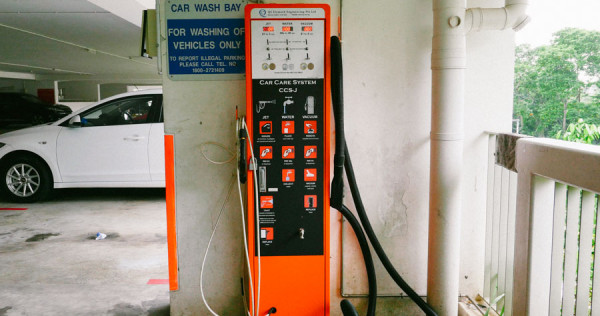
It’s 2019, and the humble HDB multi-storey carpark washing bay deserves a glow-up worthy of a new age. Ditch thy visits to professional vehicle cleaners, auto-owning friends — the proper tools of the trade are readily available in the heartlands. 

Just be prepared to have a decent amount of coins on you. 

Since sometime in late September, “Car Care Systems” have popped up in select HDB estates, replacing the humble coin-operated water dispenser. 

[ad_2]

Source link

What most couples look for in their wedding venues & why you should too

0

[ad_1]

Apart from settling on a budget, any great wedding journey starts with deciding on your choice of venue/s.

We aren’t going to lie, the process of going for wedding showcases and meeting hotel co-ordinators can get pretty tedious.

What would make the process less painful is knowing what you’d want in a wedding venue.

Here’s a general (but still rather extensive) list of things that couples take into consideration when paying sites visits.

1. BALLROOM CONFIGURATION

While the general atmosphere and environment of the entire hotel should also be taken into consideration, how a ballroom looks will probably be at the top of your concerns.

PHOTO: Park Royal at Beach Road

This includes:

Shape of the ballroom

Most couples prefer a square or wide rectangular ballroom as that would lend an air of expansiveness and openness to the venue.

[ad_2]

Source link

Woman accused of murdering five-year-old son: 'How can I kill a child? Look at my small body'

0

[ad_1]

SINGAPORE – Three days after her severely scalded five-year-old son died in hospital, a woman told police that she had no intention to kill the child.

“How am I able to kill a child? Just look at my small body,” Azlin Arujunah said in a statement that was read out in court on Thursday (Nov 14) in her ongoing trial for scalding the boy to death.

In another statement, she said: “I do not have the intention to pour the hot water on him if he did not show any attitude towards me”.

Azlin and her husband, Ridzuan Mega Abdul Rahman, both 27, are being tried for murder by common intention for inflicting severe scald injuries on the boy.

Each of them also faces several charges for other abusive acts, including confining the boy in a cage meant for the family’s pet cat, pinching him with a pair of pliers, and hitting him with a broom.

Between Oct 15 and Oct 22, 2016, the couple splashed hot water on him on at least four occasions, using water from a hot water dispenser in the kitchen.

Scientific tests show that the temperature of the water in the dispenser averaged 92.6 deg C.

[ad_2]

Source link

Woman loses $300k to 'Singtel customer service' caller helping her solve Wi-Fi connectivity problem

0

[ad_1]

SINGAPORE – When 65-year-old Madam Lee picked up a call on her land line on Wednesday (Nov 13), she thought it was a Singtel customer service personnel who was contacting her about problems with her broadband connection.

The caller said he would rectify any problems with her Wi-Fi connection if she followed his instructions, and Madam Lee believed him.

This resulted in her staying on the call for over two hours, following the man’s detailed instructions on what to do on her computer.

This included her having to give the man – who she said did not sound Singaporean – remote access to the computer.

Over a two-hour period, the caller also had Madam Lee open her Internet banking account and give him some very personal information – including a one-time password and her latest transactions.

The caller even told Madam Lee that he would connect her to the “cyber police”. She was then connected to another scammer, who told her that her IP address was being used in various countries.

[ad_2]

Source link

October private home sales down 27% from previous month

0

SINGAPORE: Sales of private homes by developers in Singapore fell 27 per cent in October from the previous month, official data released on Friday (Nov 15) showed.

Data compiled by the Urban Redevelopment Authority (URA) showed developers sold 928 units last month, compared with 1,270 units in September. Including executive condominiums, 955 units were sold.

Compared to the year ago period, the number of units sold represents an 84.9 per cent increase.

READ: New private home sales see best September sales in 7 years

READ: Singapore private home prices climb 0.9% in Q3

The number of new homes sold in the Core Central Region (CCR) in October tripled to 182 units from the month before, the highest since March 2016.

Singaporeans accounted for 133 of the 182 units bought in the CCR.

The improved performance was mainly driven by three new launches in the area – Neu at Novena, Midtown Bay Residences and Royalgreen, analysts noted.

The only other new launch this month was Midwood, located in the Outside of Central Region (OCR). The lack of major launches in the city fringe and mass-market segments like the OCR could have contributed to the sales decline, said OrangeTee and Tie head of research and consultancy Christine Sun.

“Sales volumes tend to be lower when more luxury projects are being launched in a particular month, owing to the higher price tags and lower affordability,” the analyst said.

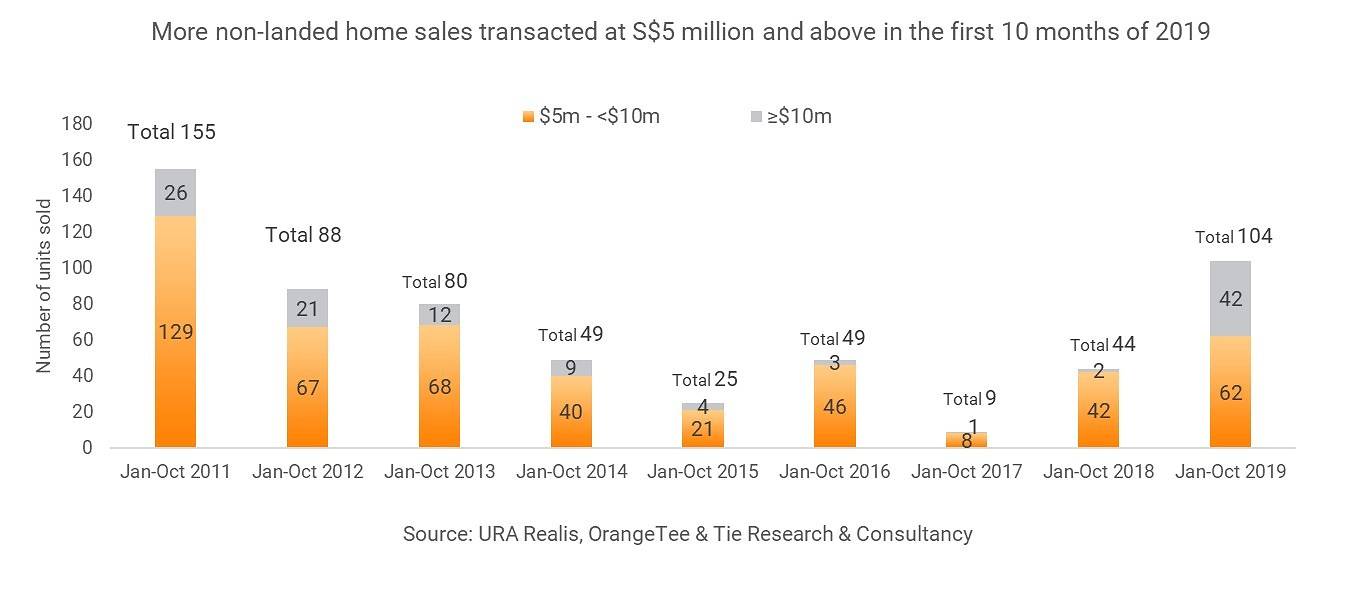
In October, there were five non-landed new home sales worth above S$5 million, three of which were transacted at S$10 million and above. The three homes were all large-sized (above 250 sqm) units at luxury condo Boulevard 88.

2019 has seen 104 non-landed new home sales at S$5 million and above so far, the highest tally since 155 units were sold in Jan-Oct 2011, Ms Sun said, citing URA Realis data.

october private sales 2019

High-profile transactions such as British billionaire James Dyson’s purchase of the most expensive apartment in Singapore contributed to “significant positive sentiments for developer sales,” said property analyst Ong Kah Seng.

More luxury homes are expected to be sold in 2020 with the launch of high-profile projects such as One Holland Village, The Avenir, The Atelier, Van Holland and a new project at Kampong Java Road.

“Despite the global trade and geopolitical uncertainties, we believe demand for Singapore private homes is still relatively stable given the tight labour market, favourable interest rate environment, and relatively healthy household balance sheet,” said Ms Tricia Song, head of research for Singapore, Colliers International.

Mr Ong predicted that Singaporean properties will become increasingly attractive for foreign buyers seeking stable investments. 

“There’s increasing international attractiveness of Singapore residential properties as offering longer term stability to all profiles of buyers, including from foreigners who are eschewing investments in Hong Kong due to that city’s heightening social turbulence,” he said.

Source link

5 things I wished I knew before I married a foreigner

0

[ad_1]

My marriage isn’t particularly extraordinary, at least to me.

Like other couples, we have our good days and bad, complete with the occasional petty quarrels — though never over who controls the TV remote.

But perhaps the one thing that makes us slightly more unique than the average Singaporean couple though is our ethnicity and nationality — I’m Singaporean-Chinese and he’s Thai, born and bred.

But then again, in present-day Singapore, that might not be particularly unusual. According to 2017 statistics, about one in three citizen marriages in Singapore are transnational.

Sure, dating a foreigner sounds exotic and exciting, but settling down is a whole other story.

Marriage is hard work on many levels — but toss in language and cultural differences, and you’ll have your work cut out.

Here are some things to be aware of before taking the plunge:

[ad_2]

Source link