SINGAPORE – A male secondary school teacher in charge of a uniformed group CCA molested one of its teenage members in 2015 before telling the 14-year-old boy: “Play play only. Don’t tell any teacher.”
The 37-year-old man also molested six other boys from the same co-curricular activity (CCA), a district court heard on Thursday (Dec 5).
He pleaded guilty to three molestation charges involving three boys.
Six similar charges involving four other teenagers will be considered during sentencing.
The man committed the offences between 2015 and 2017.
He was with the 14-year-old boy after school hours some time in 2015 when he offered to drive the student home. The boy accepted the offer and sat in the front seat of the teacher’s car.
During the ride, the man asked him if he watched pornography. Shocked by the question, the boy replied that he did not.
When they arrived outside the teenager’s home, the teacher suddenly slipped his hand into the boy’s shorts and touched him inappropriately.
SINGAPORE – The police have arrested five men for getting into a brawl along Lorong 1 Geylang on Wednesday (Dec 4).
The men, aged 21 to 47, were arrested in a case of affray, the police said in a statement on Thursday.
In a 50-second video shared on Facebook group Sg Chinese Community, about 10 men and one woman in a pink dress are seen fighting on the road as others watch. Several of the men use yellow chairs to attack each other at the pedestrian crossing.
The woman can be heard shouting in Mandarin: “You hit my husband!”
The police were called at about 11.40pm on Wednesday.
Officers from Bedok Police Division were able to identify the men and arrest them within four hours through investigations and ground inquiries.
Preliminary investigations revealed the same group had a dispute at a restaurant in the vicinity earlier that night.
SINGAPORE: When Sasa announced closure of its Taiwan outlets in February 2018, I asked its Singapore office if Singapore would be affected.
The official statement brushed off the idea, pointing to the opening of a new concept store, modelled after its “successful predecessor” at Causeway Point that opened in October 2017.
This week, less than two years later, the house of cards came crashing down. The cosmetics retailer announced it will be closing all 22 stores in Singapore, citing “less than satisfactory” performance of six-year losses.
As a beauty editor and an industry observer, I was not surprised by the closure at all.
NOT BECAUSE OF THE RISE OF E-COMMERCE When the news broke, many netizens pointed to high rental rates as the main cause.
But while Singapore’s retail malls charge notoriously high prices, I don’t think these are the chief culprits in this saga.
After all, successful beauty retailers take up huge physical retail spaces in upscale districts. Sephora opened a 5,300 sq ft outlet in Westgate in 2018 and, after a two-month renovation, re-opened its Ngee Ann City outlet.
Screengrab from Google Maps showing the exterior of Westgate mall.
Watsons also recently revamped its 7,000 sq ft flagship store in Ngee Ann City, with most of the space dedicated to displaying beauty products.
So what were other retailers doing right? Where did Sasa come up short?
1. NO FUN EXPERIENCES
The beauty landscape in Singapore is competitive. Consumers are exposed to international trends, savvy about how to get hold of products to achieve trending looks, and have enough to set aside a substantial budget.
The discerning beauty shopper now looks for more hands-on experiences with brands and products.
With so many options at their fingertips, consumers are inclined towards retailers they can try on and experiment with – and will return for more if they have a good experience.
This is why retail spaces are still important as far as cosmetics is concerned.
The reopened Sephora Ngee Ann City, for instance, introduces new features such as a fragrance discovery bar, a beauty studio that offers personalised consultations, including a skin analysis app.
People walking in front of Sephora at ION Orchard. (File photo: Tang See Kit)
Guardian also opened a concept store at Ang Mo Kio Hub, with a layout that highlights the beauty brands it stocks. Featuring lit-up mirrors, wider aisles, and tissues and cotton pads to facilitate trials, the retailer is definitely trying to please beauty consumers.
In comparison, Sasa’s traditional layout with narrow aisles doesn’t make it easy to explore the offerings in-store. Store assistants are more pushy sales representatives than beauty consultants who can help consumers discover and find the right products.
2. BRANDS THAT DO NOT EXCITE CONSUMERS
Given that beauty consumers in Singapore are savvy, the line-up a beauty retailer offers can be a make-or-break. Bringing in trendy brands encourages consumers to visit more frequently.
Sephora brings in new Western brands regularly. Most recently, it introduced Charlotte Tilbury Beauty, one of the most sought-after international brands well-loved by celebrities.
Earlier this year, Sephora also introduced a good mix of brands with cult followings worldwide, including luxury brands (e.g. Pat McGrath), clean beauty brands (e.g. Biossance), and up-and-coming indie brands (e.g. BYBI Beauty).
Sasa had a good opportunity to corner the Asian brand market, particularly since Korean beauty is such a big trend in Singapore.
However, while it has managed to stock popular Korean brands like Banila Co. and Chosungah22, the retailer failed to drive marketing and ride on the hype.
In fact, if you were to ask around, most people wouldn’t know Sasa carries these brands.
A makeup line for men on display in a South Korean store. (Photo: Lim Yun Suk)
Guardian, however, recognised this gap and is eagerly filling it. In the last few years, the retailer has been turning its focus on bringing in exciting K-beauty brands to Singapore.
In September alone, it announced the availability of 14 new, popular Korean brands in its stores including By Wishtrend, Huxley, Dear, Klairs, and I’m Meme.
Just last month, Guardian also announced a partnership with Olive Young, the largest health and beauty retailer in South Korea, to bring a “Myeongdong Street” beauty shopping experience to local consumers.
Guardian launched this collaboration with a pop-up event in ION Orchard featuring four Olive Young house brands previously unavailable in Singapore.
If you ask me, Guardian is definitely playing its cards right.
3. POOR CUSTOMER RELATIONS
Given the wide variety of options in Singapore, retailers are out of mind when they are out of sight.
Successful beauty brands and retailers are investing in public relations (PR) and marketing to amplify their messages on different platforms – especially online ones – so that their target audience always has them in mind.
Compared to many beauty brands and retailers in Singapore, Sasa is awfully quiet in the digital space, where a lot of product discovery, conversations, and purchase decisions are made.
File photo of a Sasa storefront. (Photo: Facebook/Sasa Singapore)
PR and marketing can also come in the form of strong loyalty programmes.
Sephora, for instance, offers more than loyalty points for its members. Members in the highest tiers are also given birthday gifts, early access to private sales, invitations to exclusive events and launches, and custom makeovers.
4. POOR ONLINE PRESENCE
Sasa also has a weak online presence. Case in point: Watsons Singapore has more than 50,000 followers on Instagram.
That’s almost four times more than Sasa, which only has 13,900 followers.
Brands exclusive to Sasa such as Suisse Programme, Dr. G and Cyber Colors also do not seem to draw online discussions.
Almost 63 per cent of respondents said that they will not consider buying a product if they are unable to find online reviews, according to the Daily Vanity Consumer Survey 2019. Respondents specifically mentioned Google and Instagram as two of the top online platforms they search for product reviews on.
5. OLD MARKETING TECHNIQUES
Sasa had focused more on tactical marketing – through attractive prices and regular promotions.
However, price-sensitive consumers attracted by these can turn to other retailers like Venus Beauty, which offers competitive pricing with parallel imports, or even platforms like Carousell for budget buys.
(Photo: rawpixel/ Unsplash)
Sasa did not manage to read the writing on the wall early enough to evolve with the times, build on its strengths, and seize opportunities.
The beauty retail space is changing so rapidly, it can be a boon for some but a bane for others like Sasa.
Complacency can be terminal. They must constantly keep up with the evolving preferences of consumers.
SINGAPORE: In with the new, out with the old. Singapore’s early successes at the 30th Southeast Asia (SEA) Games provide an interesting peek into where the country’s sporting future could lie.
We said goodbye to water polo gold – and hello to an ice-skating one.
Once the regional queens of netball, we failed for the second time in succession at the Games. Instead, our women are floorball champs.
It’s a pity that there’s no indoor skydiving competition in the Philippines; we would’ve been a shoo-in seeing how we already have a world champion.
Cheyenne Goh in action at the 30th SEA Games. (Photo: SNOC)
To say that this edition of the SEA Games is a bloated one would be an understatement.
There are 56 sports in total. Some new, some there for demonstration purposes and some there to showcase the traditions of not just the region, but also of wider Asia.
This isn’t a slight on the Philippines as organisers. Previous editions also have had sports running into the dozens. It is unnecessary and wasteful and, as seen in the build-up to the Games, only adds to the logistical overload.
Going forward, as sports organisers mull over how to lessen the ecological impact of multi-event competitions, they must also put more thought into the types of sports to have.
While it makes sense to have arnis – the national martial arts of the Philippines – at this Games, it is silly to include kurash, a type of folk wrestling from Central Asia and sambo, a Soviet-era combat sport.
By that token, why not have kabbadi? Its Indian origins are a lot closer to this region.
With elements of judo, karate, boxing, Greco-Roman wrestling and more, sambo was created to train the forces of the Soviet Union and is still taught in the Russian army. (Photo: AFP/Sergei Gapon)
The absurdity does not end there.
At this Games, there is underwater hockey, indoor hockey and floorball. Indoor hockey has just five countries competing. Floorball has five now too – at its last appearance in 2015, there were only two sides.
Singapore may be ruling the waves at the underwater hockey arena, but is it too niche a sport to have at a major sporting competition?
The sad thing is, there is no place for hockey at these Games. Yes, the regular version – played outdoors … on a (synthetic) field. Table-tennis and badminton apart, not many Southeast Asian countries qualify for team sports at the Olympics.
But field hockey is a sport that both Malaysia and Singapore have participated in at the Olympics; the 2019 SEA Games snub is a curious one.
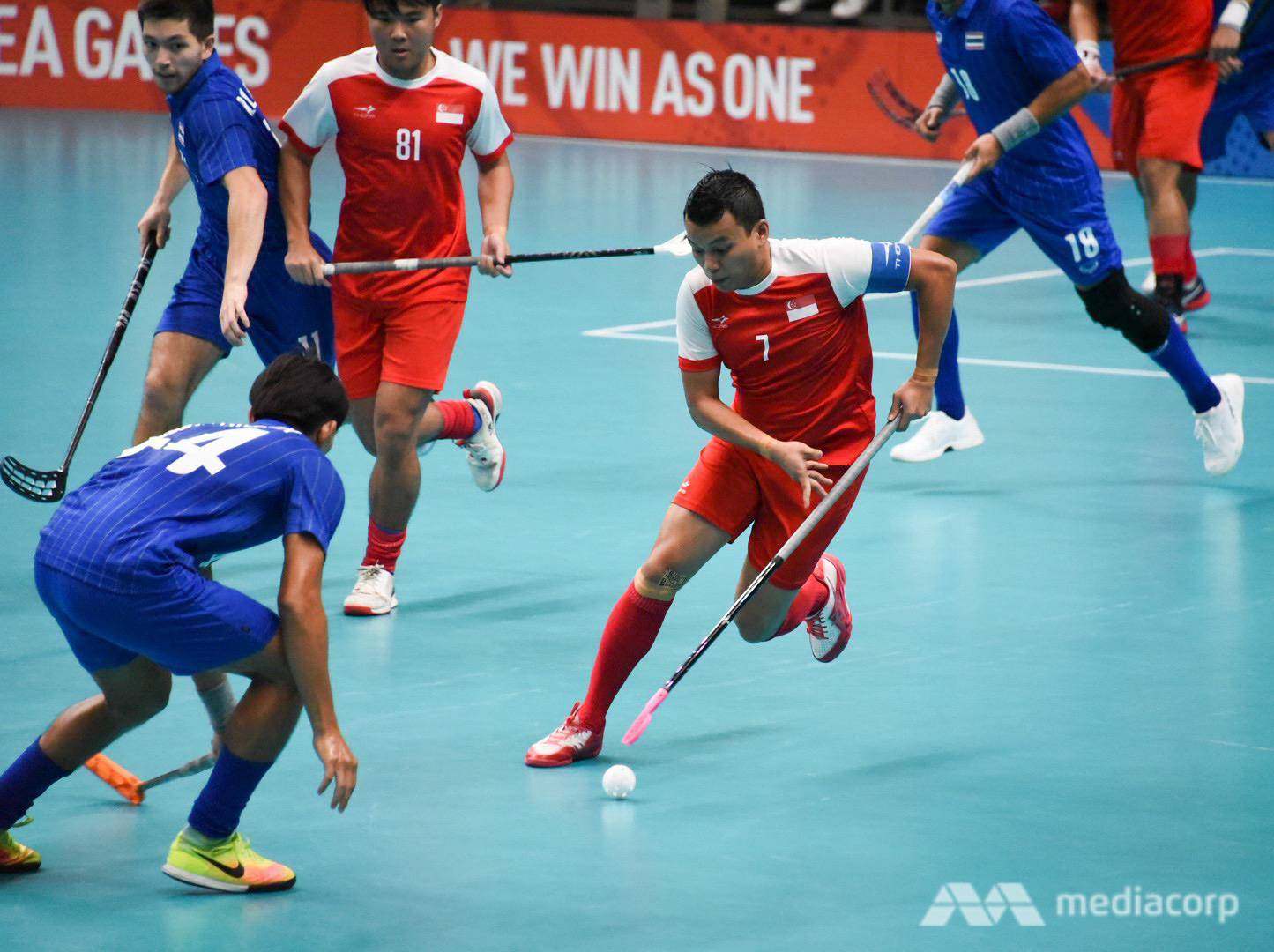
Singapore’s Syazni Ramlee dribbles past a Thai player in their floorball match at SEA Games 2019. (Photo: Matthew Mohan)
And then there is chess. We’ve all asked the question at some point in our lives, haven’t we? Is it a game or is it a sport? Well, I’ll tell you this much: A sport it ain’t.
When bridge turned up at the Asian Games in Indonesia last year, I wrote a commentary saying card games (or board games for that matter) have their own competitions where participants can vie for glory.
If we accept that a sport should generally have a level of athleticism involved, then the lack of physical emphasis in such games mean that they really shouldn’t be taking their place alongside sports.
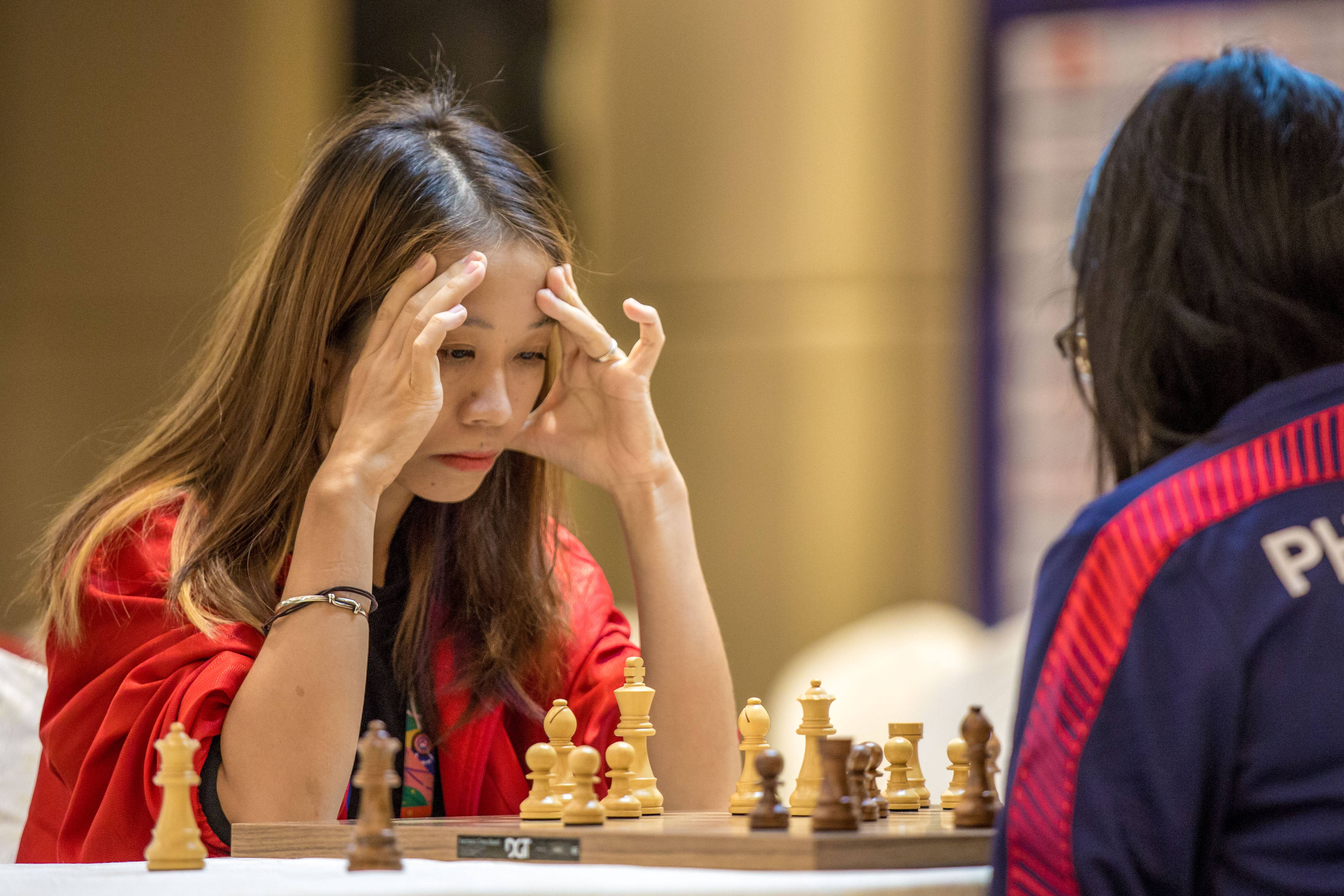
Gong Qianyun in action at the SEA Games 2019 women’s rapid chess category. (Photo: SNOC)
Same goes for chess. End of story.
JUST PLAIN COMMON SENSE
We know there are all these behind-the-scenes jockeying and horse trading – motivated by self-interest, politics, etc. – for getting a sport included at the SEA Games or even at the Asian Games.
But if you insist on shoehorning a random sport into a multi-event games, at least make it telegenic.
One of the reasons why I’m so against underwater hockey is that no one can see what’s going on unless they look at a screen. And that’s provided there is a screen, of which there is no guarantee.
It’s telling when the photos sent by Sport Singapore from the underwater hockey venue consists solely of competitors standing in, or by, the pool. There are no action shots.
Players from the Singapore men’s underwater hockey team. (Photo: SNOC)
Wouldn’t it have been better to have ultimate Frisbee? Now, that’s an absorbing, visually appealing pursuit we can all get behind – one which has a lot more weekend warriors than say kurash or indoor hockey.
The thinking of the organisers these days would seem to suggest: Find a sport that at least one country is good at, so they can get to go home with something.
Southeast Asian nations will never progress if they continue to take short-sighted approaches. Surely the purpose of the SEA Games is for it to be a launchpad to bigger and more prestigious competitions.
THE SINGAPORE QUESTION
And where does Singapore fit into all of this? This brave new world of chessboards, wetsuits and plastic “hockey” sticks.
Coach Fandi Ahmad’s comments after Singapore’s woeful showing in football gives an insight into how sporting talent is viewed here.
“I don’t think we have much talent in Singapore,” he reportedly said.
“We have numbers but not really big numbers … Our players are mainly part-timers, students and national servicemen. So we can’t ask for more.”
He’s right. And his comments are applicable to sports beyond football.
There is very little talent to go around, especially when youths are also pursuing activities like floorball, skateboarding and sitting behind games consoles.
Sport is not just an expression of athleticism, it is also a reaction to one’s environment. Floorball, one can argue is safer than hockey and it can be held in schools’ multi-purpose halls and not be subject to the whims of the weather; you can see why it has this broad appeal.
Underwater hockey is a novelty, and there will always be people looking out to pursue different sports.
And when the reach of such sports broadens, its proponents and gatekeepers will always want it included in big events, like the Asiad or the Olympics. For them, it’s all about clout – which in turn brings in funding and commercial revenue.
Then there’s also the elephant in the room: E-sports.
Again, gamers have their own events and competitions where they can take part in. They are part of a multi-billion dollar industry, and are by no means a niche endeavour.
I mean, we don’t see swimming and squash knocking on the e-sports’ Fortnite World Cup door – begging to be included as some sideshow.
Teenage gamers worldwide are shunning mainstream education for a booming e-sports scene with millions of dollars in prize money on offer. (Photo: AFP/Roslan Rahman)
But with many now actively into gaming, is it any wonder that national sports bodies don’t mind having them enter the sporting mainstream. Their line of thinking: If we are not going to get swimmers, runners and footballers, at least we should use our couch warriors!
And like indoor skydiving, this could be the way to beat a new path to glory: Participate in a niche, newfangled “sport” where there is narrow competition. Then, as the Singapore saying goes: “We sure win one!”
MANILA: It’s been a wait that has spanned close to four decades, but in the space of just two days, underwater hockey player Christina Tham has finally struck gold – not once, but twice.
“Victory felt unbelievable,” Tham told CNA after winning her first gold on Wednesday (Dec 4).
“Winning the (first) gold in the third SEA Games after winning two silvers – unbelievable.”
A former national swimmer, she represented Singapore at the 1981 SEA Games, aged 12, and the next Games two years later.
At her first Games, she claimed a silver in the 4×100 medley relay and followed that up with a silver in the 200m breaststroke in 1983.
Underwater hockey player Christina Tham was a former swimmer for Singapore. (Photo: Elvie Hau)
But a gold eluded her until 36 years later, when Singapore claimed victory in the women’s underwater hockey 4×4 competition on Wednesday.
“It feels incredible, awesome, unbelievable. I don’t know if anyone else has done or is doing what I’m doing,” said Tham, now 50.
“I hope that it also sends a message out to everyone that age is really just a number and that you are only as old as you feel.”
She would follow up the 4×4 gold with another one in the 6×6 event on Thursday as Singapore beat Philippines 3-0.
Tham was fresh off completing her Primary School Leaving Examinations when she competed in her first Games in Manila.
“I made it to the team because I was the fastest breaststroker in Singapore,” recalled Tham.
“I was in awe of the then golden girl Junie Sng. We stayed – all of us – in the same dormitory in the Games village.”
Two years later, Tham competed in front of her home crowd at the 1983 Games.
The underwater hockey team celebrates winning their second gold medal on Thursday. (Photo: Lau Mun Hoi)
“When you’re on home ground, the stakes become a lot higher,” she said. “I was swimming, and swimming is one of those sports which are expected to always push up the medal tally. All eyes are on it.”
It was not till 2005 that Tham picked up underwater hockey, after reading an advertisement in a local newspaper.
“I decided to pick it up because it would leverage on my swimming ability plus it would challenge me in a team sport, as opposed to an individual sport,” she explained.
“I think it’s usually quite difficult for individual sportspeople to go into a team sport and I wanted to do that because I felt that in life, it’s really about getting success by learning to work with people.
“There’s that saying that if you want to go fast, you go on your own, but if you want to go long, then you go with your team.”
Christina Tham (centre) with members of her underwater hockey team. (Photo: Christina Tham)
Despite being a swimmer, picking up underwater hockey was not simple, she explained.
“Making the transition is actually not very easy – as hard as swimming is – all those laps and all those hours going to the gym, underwater hockey was really difficult to pick up,” she said.
“It has taken many years of refining the skill because it’s really a combination of fitness – both aerobic and anaerobic, as well as skills … speed teamwork, knowing how each of your other teammate plays so that you can just predict the move and follow up that move.”
This is the first time the sport has featured in the SEA Games, and Tham called it a “dream come true” to be able to compete in the Philippines.
“It was absolutely awesome when we found out that underwater hockey would feature in this Games. It was like a dream come true – I always wanted underwater hockey to be in SEA Games,” she said.
“We have played underwater hockey in the world championships but, I think, to get the recognition of the SNOC for this sport was something that I thought was a dream and would not happen.
“And when it did happen, nothing would stop us from working hard to compete in it and to get the gold.”
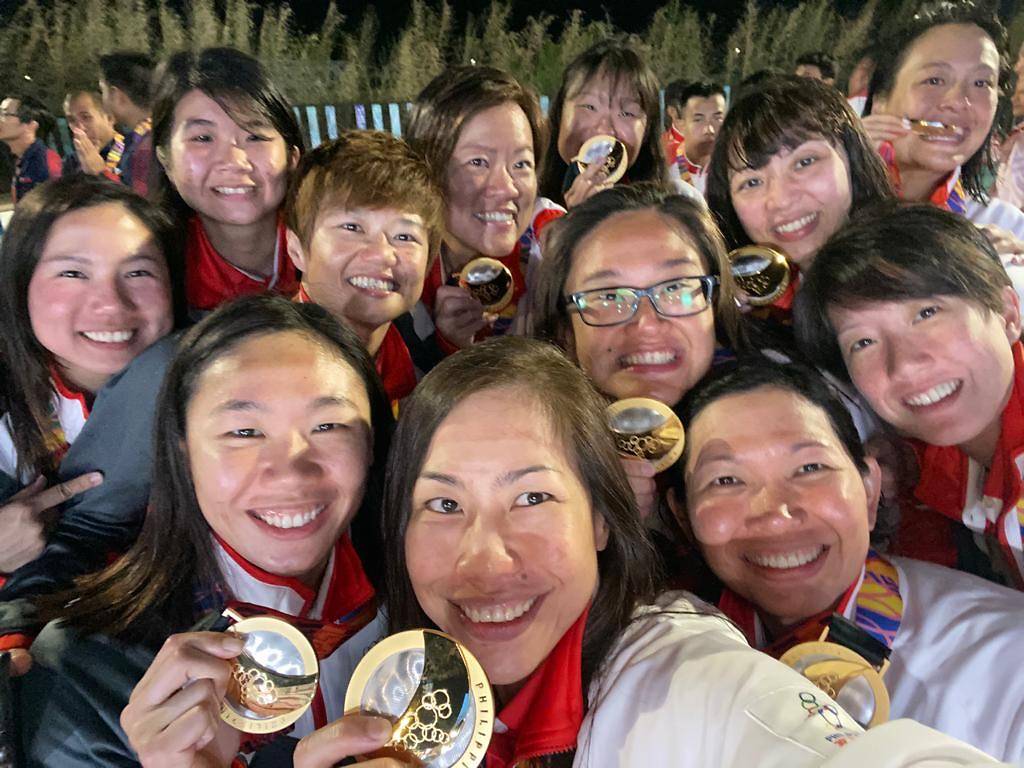
The Singapore women’s underwater hockey team won gold at the SEA Games 2019. (Photo: SNOC)
Prior to returning to the Philippines, Tham – who is the oldest member of the women’s underwater hockey side – would get stunned reactions from most when told she would be competing at the Games again.
“Ninety-nine per cent of the reactions is one of incredulity. People take a while to get it, that I’m actually doing this,” Tham, who works as a lawyer, said.
“My company Cromwell Property Group has been very supportive of my time away training. My family, my mum – she’s still the swimmer’s mum – asking questions like how swimmers’ parents do.
“My husband, of course, is incredibly proud of me and all my old swimmer friends are just so stoked.”
The competition gave Tham an opportunity to test herself.
“Last year when I knew I was going to turn 50 this year, I wanted to prove to myself that I’m still fit, I’m still strong and I thought that there’s no better benchmark than to compete at the SEA Games in a very tough sport like underwater hockey,” she said.
“I’m so stoked that my level of fitness and my level of speed is very high, can’t really tell much of a difference between now and say, 10 years ago. But I would the recovery time is a little bit longer.”
Underwater hockey was nvented in the 1950s in Britain – where it is known as “Octopush”. (Photo: AFP/Mohd Rasfan)
She is also hoping that the win will raise the profile of the sport in Singapore.
“I hope everybody in Singapore now knows what underwater hockey is about,” she explained.
“And I hope we can get more support for the sport because you will not believe how much work, hard work, all of us have made, how much sacrifices all of us have made to get the gold.”
Having now won gold twice, Tham counts herself “third time lucky”.
“I’m really, really just over the moon, getting this gold, being able to go back to Singapore, go back to my office, go back to my family, my friends, to show them the fruits of the hard work that myself and my team have reaped,” she said.
“Coming on to this Games, my hockey mates were teasing me, saying that maybe I would be third time lucky.
As Singapore enters the year-end festive season, YouTube has taken the opportunity to release its yearly YouTube Rewind list to look back at the top trending videos that got Singaporeans hooked for hours.
For starters, YouTube Rewind is an annual summation of the site’s biggest content creators and internet trends across the year. According to the data, Google found out that local viewers were really excited about the opening of Jewel Changi Airport and this year’s star-studded National Day Parade theme song music video.
“YouTube is a platform that brings people together and connects them with the content they love,” said Angeline Leow, Head of Communications in Google Singapore.
“Over the past year, we’ve seen the hours of content uploaded from YouTube channels in Singapore growing by over 50 per cent. This is a testament of a dynamic creator community in Singapore and the magic they create every day to keep viewers coming back for more.”
The Seedly Team went to Johor Bahru last weekend, where we hired a Lok Lok van and ate close to 1,000 sticks of deep-fried mushrooms, bacon, meatballs, and man tous.
While most of us shop for a variety of cakes, tau sa pia, and Eureka popcorns to bring home during the trip, our content strategist Sudhan was out on a different mission.
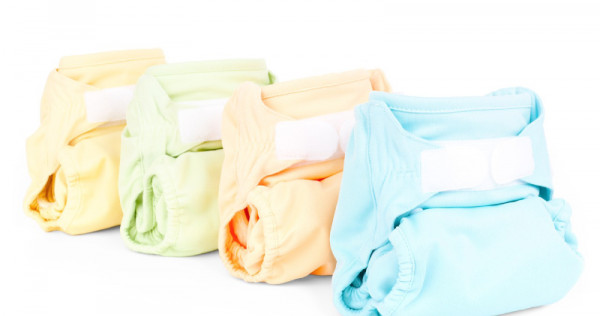
With a large, field-pack bag in tow, Sudhan piled his bag to the brim with baby food and snacks. Before this, he was considering bringing a huge suitcase in tow, to buy diapers for his cute 7 month-old baby boy.
To him, it was worth making the trip across the causeway, as it means saving a few bucks on expensive baby products.
Yet, is the effort worth it? How much do you actually save by doing so?
I decided to compare the prices of diapers, baby food, snacks, and formula milk, to find out where to get the best deals: Whether it’s Online, Retail, or in Johor Bahru.
TL;DR: WHERE TO GET THE CHEAPEST DIAPERS, BABY FOOD, BITES, AND FORMULA MILK
Every mum longs to hear her newborn baby’s first cry. But the birth of Michelle Kee’s firstborn, Vera, was met with a deafening silence.
“My baby didn’t even cry when the doctor tried giving her oxygen to help her breathe. I noticed her skin was all blue [from the lack of oxygen],” shares the first-time mother, 30, a nurse.
Having breathed in some meconium before birth, Vera was whisked away to the Neonatal Intensive Care Unit (NICU) even before Michelle could hold her.
Meconium is the sticky greenish black stool that a newborn baby first passes after birth. The faeces had entered Vera’s airways and lungs.
Most babies pass their first stool in the first 24 hours after delivery, says Dr Joseph Manuel Gomez, head and senior consultant at NICU at KK Women’s and Children’s Hospital.
But some babies who experience stress before or during birth may pass meconium into the amniotic fluid before they are born, he adds.
Amniotic fluid is the clear, colourless liquid surrounding the baby in the womb.
SINGAPORE: A personal mobility device (PMD) caught fire on Thursday (Dec 5), exactly one month after e-scooters were banned from Singapore’s pathways over safety concerns.
The Singapore Civil Defence Force (SCDF) said the fire took place at about 12.45pm outside a 14th floor flat at Block 715 Clementi West Street 2.
The fire, which was sparked by a PMD that was left charging along the common corridor, was extinguished by firefighters with one water jet.
The burnt wreck of a personal mobility device (PMD) that caught fire while it was charging at Block 715 Clementi West Street 2 on Dec 5, 2019. (Photo: Facebook/Singapore Civil Defence Force)
There were no reported injuries, though three occupants from the affected unit had to be evacuated by SCDF.
In July, the government banned the sale of non-UL2272 certified PMDs over fires and other concerns. The UL2272 standard refers to a set of safety requirements which cover the electrical drive train system of PMDs, including the battery system.
Fire safety tips on preventing PMD fires. (Graphic: Facebook/SCDF)
The authorities have extended the early disposal incentive scheme – where S$100 is given for the disposal of non-UL2272 compliant registered e-scooters – to the end of the year.
“All owners of non-UL2272 certified PMDs are strongly encouraged to dispose of their devices at designated disposal points as soon as possible,” SCDF reminded on Thursday.