SINGAPORE: Where there used to be just drains, taps and buckets of very hot water, the Sembawang Hot Spring is now a park that boasts a cascading pool, cafe as well as a floral walk.
The park, the only natural hot spring in Singapore, reopened to the public on Saturday (Jan 4).
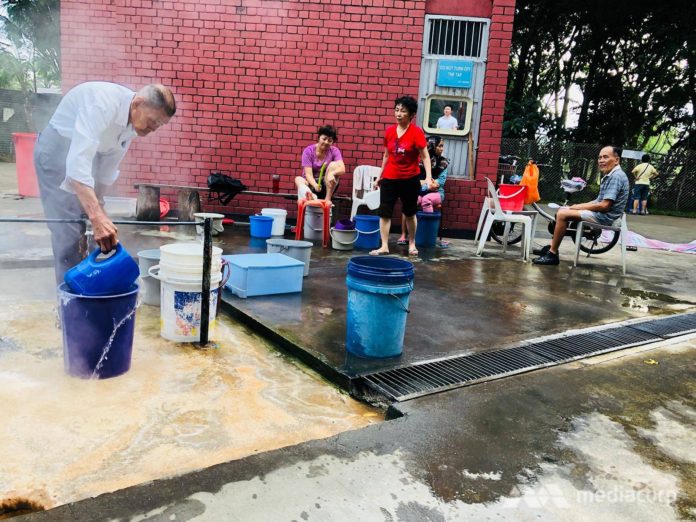
Before: People collecting pails of water at the Sembawang Hot Spring in 2017. (Photo: Vannesa Paige Chelvan)
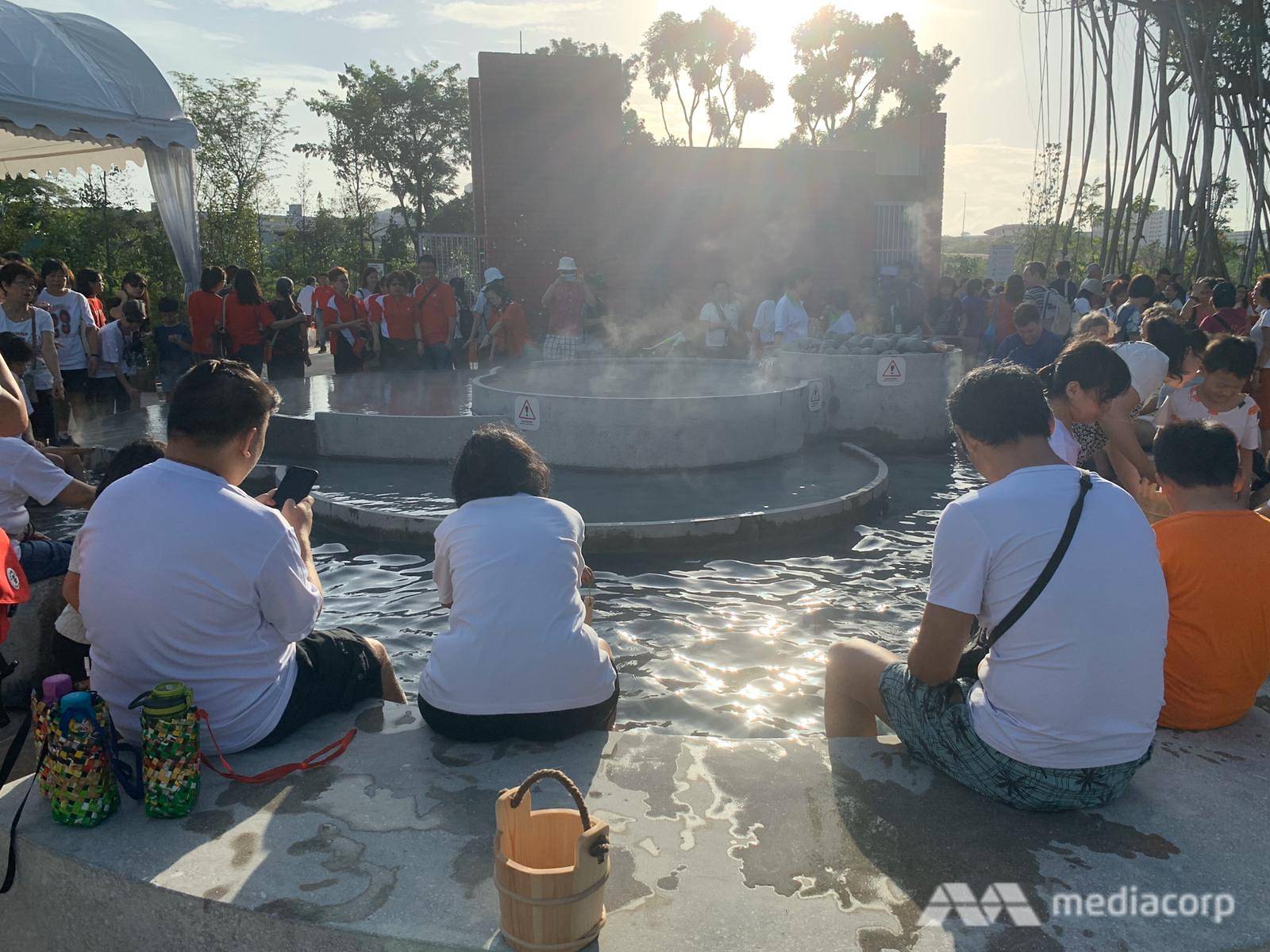
Now: Visitors having a foot bath at the new Sembawang Hot Spring Park on Jan 4, 2020. (Photo: Jeremy Long)
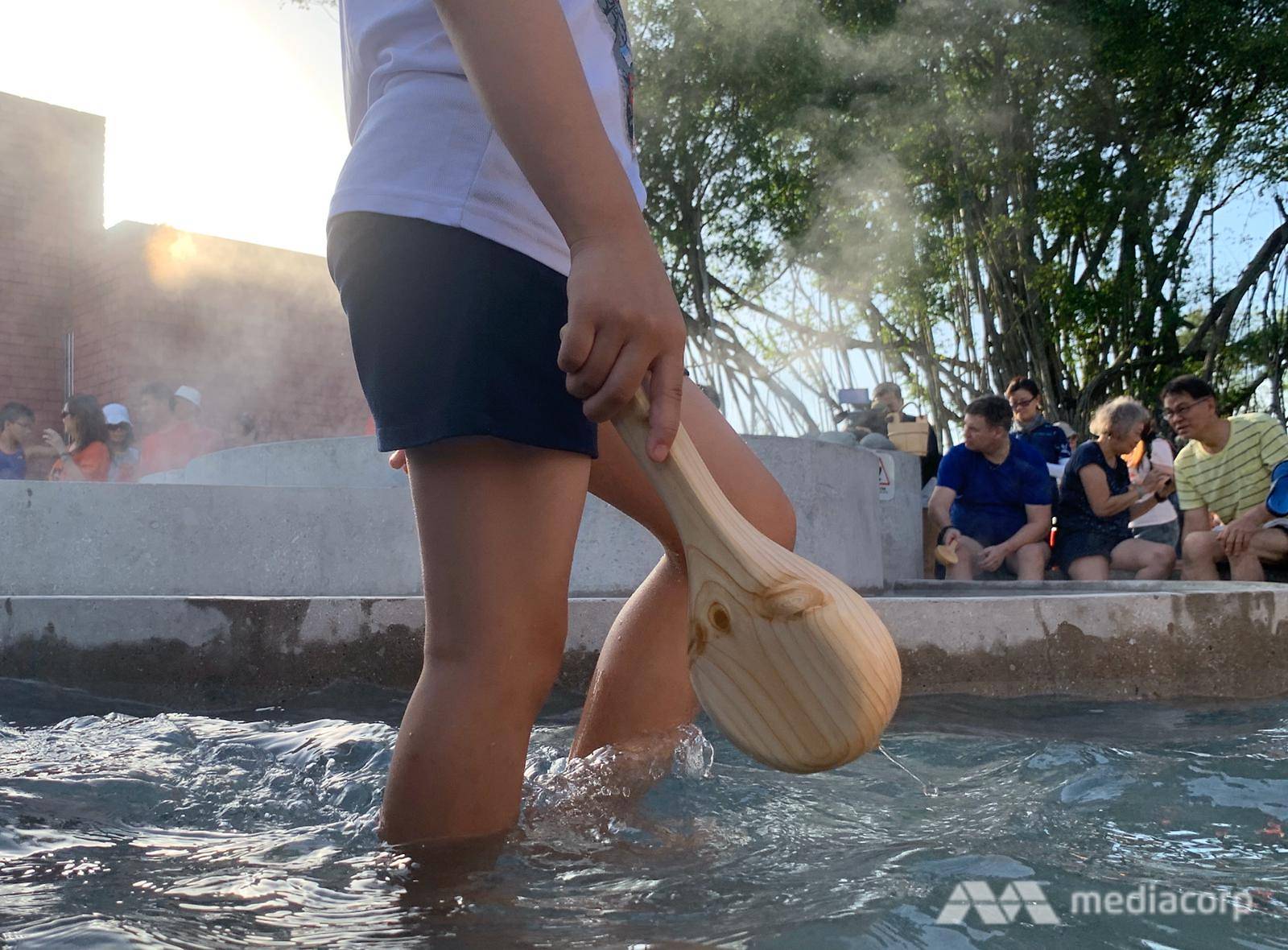
The 1.1-hectare park – nearly the size of one-and-a-half football fields – now has features such as a cascading pool, where water cools naturally as it flows down four tiers. Members of the public can enjoy a foot bath at the pool.
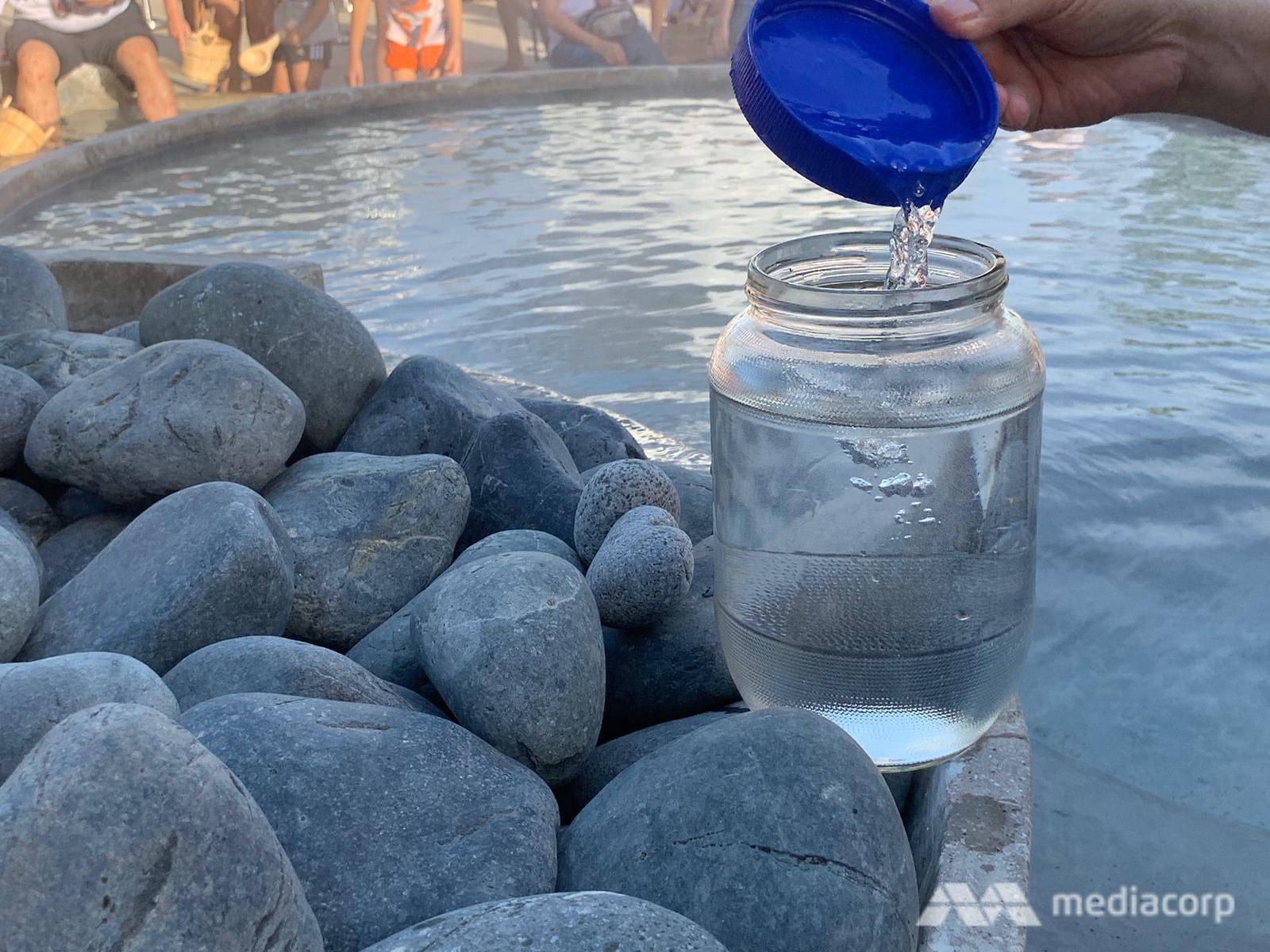
Visitors can also collect water and even cook eggs at a water collection point. Children can play with warm spring water at an educational zone, where they can learn about the groundwater cycle through interpretative panels.
The park is the only natural hot spring in Singapore. (Photo: Jeremy Long)
(Photo: Jeremy Long)
At the entrance of the park, visitors are greeted by a floral walkway with fruit trees and edible plants such as ginger, rambutan and chiku as well as flowers commonly seen in the 1960s and 1990s.
The park’s amenities have also been improved and there are now toilets, an activity lawn and a cafe.
The park is open daily from 7am to 7pm. (Photo: Jeremy Long)
Members of Parliament for Sembawang and Nee Soon constituencies Khaw Boon Wan, Ong Ye Kung, Amrin Amin, Lim Wee Kiak, Lee Bee Wah and Faishal Ibrahim opened the park on Saturday with the planting of lychee and rambutan trees.
In designing the park, the National Parks Board (NParks) said it incorporated feedback and suggestions from the community after a public consultation in end-2017.
“This is the only natural hot spring park in Singapore today and it holds many collective memories for the community. It has a ‘kampung-like’ environment and a community spirit which NParks has tapped on and retained in the design of this unique park,” it said in a press release.
The Sembawang Hot Spring was discovered in the early 1900s on the grounds owned by a Chinese merchant, Seah Eng Keong.
It was once a thermal bathhouse for Japanese soldiers, after their occupation of Singapore during World War II. Later in the 1960s, local media reported suggestions were made to develop the area into a tourist spa resort, restaurant, miniature golf course or nature reserve – but none came to fruition.
The land changed hands several times, before the Ministry of Defence returned the land to the state and renovation works began in August 2018.
Sembawang Hot Spring Park is open daily from 7am to 7pm. It is accessible via Gambas Avenue, and from the nearest bus stops 400m away at Sembawang Road. The nearest car park is located 400m away at 114 Yishun Ring Road.
SINGAPORE: The tears welled up in the corners of Sarah Pang’s eyes midway through the interview.
Hers is a story of gut-wrenching lows and glorious highs. Hours on the car, bus, train, plane. The emotions are raw, and the struggle is real.
So don’t tell Sarah Pang what she can’t do – she’s the best judge of that.
And after putting in so much effort, 2019 turned out to be a breakthrough year for the 34-year-old.
In August, she broke into the Women’s Tennis Association (WTA) singles’ rankings, after more than four years of being on the tour full time. She is only the eighth Singaporean woman to have done so. Last month, Pang also made the WTA doubles’ rankings.
But her incredible journey is far from over.
“I want to play in a Grand Slam. And to the normal mind, that’s not possible or that’s a very much longer journey,” she told CNA. “But for me, it’s the same story told to me when I said I wanted to make (the WTA) ranking.”
BADMINTON AND BLASPHEMY
Newspapers at the Pang household weren’t just for reading.
The crumpled pages also served to soak up the water on a Bukit Merah badminton court after it poured. A slick court wasn’t going to stop Pang’s father, secondary English teacher Roger Pang, from putting his children through the paces.
“We would hit on the badminton court every night (from) nine to 10 o’clock,” recalled Pang. “Even if it rained and the court was soaking wet, he would make us bring newspapers downstairs and lay on the floor soak it up, and then start.”
While performing exercises, Pang would gaze at the stars. The idea of being one was planted.
“We would like be looking at the sky and then he will start to seed the ideas. ‘Would it be cool if you won S$1 million dollars, (or) win the Olympics?'” Pang recalled. “Obviously coming from very humble beginnings, it was a motivation.”
Pang’s father had been trained by All-England champion Wong Peng Soon, but he suggested that his daughter consider tennis – an idea the twelve-year-old could not imagine.
“The first time he broached the topic, I remember I thought it was blasphemy,” said Pang, the fifth of six siblings.
But there was a lack of opportunities for Pang, one of the nation’s top junior players, to pursue her love for the sport.
“There were no avenues to pursue my love for badminton,” she explained. “My dad pulled me aside after my A Levels and he said: ‘Sarah, Papa has always known that you want to play professional sports.
“I’ll only let you do it if you choose golf or tennis because they are the only two sports in the world that you can play independently,” he said to her.
Pang picked tennis.
At the National University of Singapore tennis courts, Pang, an English Literature student, would approach “random strangers”. Pang needed hitting partners for her training sessions – sometimes they would come in the form of the “uncles” who frequented these courts.
She had to use old rackets – new ones cost too much – but Pang played with a new passion.
She juggled studies and tennis – electing to complete her honours year, despite it being optional.
“It was the recognition that one more year of training my mind will last me infinitely longer than one more year of training my body,” she said. “I think when you when you reach high enough level in any field, the tenets of excellence and the pursuit of them are the same.”
SOME PAIN IN SPAIN
Two hundred euros – the price-tag on the Gucci shoes owned by a 12-year-old who lived in the dormitory Pang managed was identical to the Singaporean’s monthly expenditure in Barcelona.
But unlike the youngster, Pang had to scrimp and save to get to the Sanchez-Casal Tennis Academy.
Sarah Pang in action. (Photo: Justin Koh)
It had taken Pang one year, two loans and three jobs to fund her three weeks of training camp.
The three weeks became three months, but on top of practice, Pang would work as a dormitory warden – all to supplement her living expenses.
“When I started working in the dorm, it was really very tough,” Pang said. “I would go back to my dorm crying every night in the first three months because I’d be feverish and super tired … It was very,very overwhelming.”
“I spoke to the coaches and I said, do you think it’s possible (for me to play pro)?” she recalled. “And the verdict was: ‘It is possible Sarah, but you are carbon right now, to play pro you need to be diamond’.
“I was like: ‘The answer is not no! I can use this to go back and find sponsors in Singapore.'”
But Pang was unable to. Taking a leap of faith, she decided to return to Spain.
“I had only one friend (at the airport), my family didn’t send me off,” she recalled, composing herself. “I had one friend who sent me to the airport, and I remember hugging him and telling him I was so scared. I don’t know what to expect.
“When I went back, I sat down with the owner and I said: ‘Emilio, I have no money’,” she recalled.
“‘I know I would like to stay here and train, will you give me that chance? If you need (me) to wash the dishes, clean the toilet, whatever … I want to stay here and train.'”
Braving rat infestations, fatigue, as well as the lack of proper heating, Pang’s second stint in Spain lasted a year.
“The conclusion was that I was good enough, I needed to compete more but I had no financial setup or options to compete. Working six days a week, fifteen hour shifts was not going to set me up for success in any way,” she said.
Returning home, Pang spent three years working at Sport Singapore, before taking the “leap of faith” to play tennis on the professional circuit in 2015.
At that point of time, her savings could sustain her being on tour for about six months.
“It was very stressful … Being on tour itself is a mentally, physically, emotionally spiritually, draining exercise.”
Sarah Pang made the leap to the professional circuit in 2015. (Photo: Sarah Pang)
In order to obtain a WTA ranking, players have to win three points on the International Tennis Federation (ITF) circuit within a calendar year.
They earn one point when they win a match in the main draw of a US$15,000 (S$20,280) tournament in the ITF Women’s Circuit or if they qualify for the main draw of a US$25,000 event.
“Getting points when you’re starting out is actually very difficult,” said Pang, who has been one point short on two occasions, unable to compete further due to financial constraints.
“If you choose the wrong tournaments or you play the wrong strategy, you have to beat four girls to get one point.”
In her quest for points, Pang has played in tournaments around the world. It is not a life of luxury – Pang puts up in hostels while on tour, and has even couch surfed when the need arose.
“A lot of places that I’ve stayed in in Thailand, in India, in Indonesia, they can look very ratty outside, but I also realised the power of human plasticity, and we can get used to any environment that we get into,” she said.
Apart from her own savings, Pang has had to crowdfund as well as rely on the generosity of backers.
“At the start of 2015 I knew that if I wanted to do this pro thing full time, I need to share my story,” Pang explained. “That’s how it started … And then at the end of 2015, I crowdfunded.
“I think the responsibility I felt first and foremost was emotional. In a sense of duty – great duty and gratitude to people who are putting faith in me when technically there was nothing for them to.”
One of her lowest points came in 2017, when Pang was left with S$1.87 in her bank account.
“I sat at the bottom of my void deck and didn’t want to go up. I didn’t want my parents to see me like that,” she explained. “As I was crying and my body was shaking from grief and frustration, I knew … I was exactly meant to be experiencing that point,” said Pang, who is a Christian.
And there have been unexpected sources of support.
From a lady in church who handed her a cheque for S$50,000 to the sole supporter who cheered her on as she earned a long-awaited point which led to a WTA singles ranking, Pang has had many in her corner.
“The beautiful thing about this journey is that people who started off as supporters, as fans or even as sponsors, they always end up friends and that’s something that sports has the power to do,” she said.
Throughout her career, Pang has had to deal with criticism – from all quarters.
“My sister told me straight up that she’d never make my life choices,” she said. It’s just too high risk.”
While on tour, a doubles partner told her: “Sarah seeing you play is like seeing a bathroom singer trying to be a professional singer.” But still Pang soldiers on.
She said: “Everyone has difficulties, everyone faces challenges, but the true champions … are the one who have extraordinary responses to normal situations.
“At the start, I would lose, walk off court and think to myself: ‘What the hell are you doing Sarah, you are the biggest joke alive … But those moments always only lasted for a while,” she added.
“Today when I lose, I’ve come to a point where I realise that there is no such thing as lose. There’s only win or learn.”
Pang aims to continue chasing her Grand Slam dream – raising money which will allow her to continue to pay for a coach and compete on the circuit.
“It’s a lot cheaper funding one athlete than funding a whole team – and the potential rewards for a nation and building communities together are great,” she said. “And the beautiful thing is that when it’s focused on one athlete, is or her story has the power to reflect the journey of the many, everyday Singaporeans. And that’s really powerful.
“We have to remember, that our country was birthed and flourished under impossible odds. Why can’t we recognise the same in our own talent?”
SINGAPORE: If a loved one told you they wanted to take their own life, would your immediate reaction be to stop them from committing a crime?
That is unlikely to be the case for many of us but for the family of one 72-year-old woman who tried to kill herself in September last year, it must seem like an odd frame of reality they had to wrestle with.
Arrested by police officers for a case of attempted suicide, she was subsequently released with a formal warning.
Hers is not a story that you read about often – but it happened to hundreds here every year.
In 2015, 1,096 cases of attempted suicide were reported to the Singapore Police Force, out of which 837 people were arrested.
The stigma around suicide is etched in archaic societal thinking.
Even the phrase that someone had “committed” suicide is now frowned upon by charities working with survivors.
According to the Penal Code Reform Committee (PCRC), attempted suicide was made a crime in Singapore because it was thought that society should oppose people from taking their own lives.
Some were led away in front of their loved ones, or handcuffed to their hospital beds – in view of other patients or medical staff.
And after they were released, they had to go through investigations and other aspects of due process a crime would warrant.
Sometimes, that meant giving police statements, speaking to police officers, and experiencing everything that criminal suspects go through.
The penalties for attempted suicide were severe – a maximum of a year in jail and a fine of S$10,000 or both. But only in a handful of cases (0.6 per cent on average every year) did arrests lead to prosecution. In most cases, they were given formal warnings.
For someone to reach a stage where they think about ending it all, experts have pointed out that being treated as a criminal might only make things worse.
In this context, brandishing incredibly low prosecution numbers to try to reassure them could do little for someone who has thought about taking their own life.
If a person is handcuffed, then put in a holding cell, would telling them that “prosecution is rare” have helped?
Decriminalising attempted suicide now allows survivors to focus on healing and recovery, with help from healthcare and social assistance systems, rather than worry about punitive actions.
(Photo: Unsplash/Volkan Olmez)
As the World Health Organization (WHO) puts it: “Suicide is a complex issue and therefore suicide prevention efforts require coordination and collaboration among multiple sectors of society, including the health sector and other sectors such as education, labour, agriculture, business, justice, law, defense, politics, and the media.
“These efforts must be comprehensive and integrated as no single approach alone can make an impact on an issue as complex as suicide.”
CAN POLICE OFFICERS STILL HELP PEOPLE?
The decriminalisation of suicide does not mean emergency services now have no recourse to stop suicide attempts.
The Penal Code Reform Committee, in its report that helped form the Criminal Law Reform Bill, recommended powers for police officers under the Police Force Act to stop suicide attempts.
In fact, NGOs AWARE and Silver Ribbon also want police officers to be trained to respond to a case of attempted suicide.
Survivors will not have to undergo the criminal investigation process but may still be referred to health and other support networks, rather than go through the criminal investigation process.
Treatment can also be made mandatory. The committee also recommended new legislation under the Mental Health (Care and Treatment) Act to allow courts to make that call, with advice from experts from various sectors – mental health, physical health, social support – before making its judgment.
This move takes that decision away from police officers, who can focus on law enforcement, rather than be bogged down with deciding what should be next for people who tried to take their own lives.
Police officers on patrol at a shopping mall in Singapore. (Photo: Hanidah Amin)
There are, rightly, concerns about mandatory treatment, but it should always be carefully considered.
Senior Parliamentary Secretary for the Ministry of Home Affairs and Ministry of Health Amrin Amin told Parliament: “We will have to enforce the need to go for counselling and are likely to do so on the pain of punishment.”
“Again, we are trying to move away in this area – from criminalisation to help. So we should tread carefully in this respect.”
NUMBERS, NUMBERS?
Will discriminalisation lead to lower suicide rates? The jury is out on that.
According to a WHO study of 192 countries and states, suicide rates “tend to decline in countries after decriminalisation”. The organisation adds that no data or case reports indicate that decriminalisation increases suicides.
(Photo: Unsplash/Maranatha Pizarras)
However, there are studies that show the decriminalisation of suicide has led to an increase in the number of suicides.
Irrespective of whether discriminalisation impacts suicide rates, it is more productive to focus on the causes behind each case and aid each survivor.
Every suicide is a tragedy. Every suicide attempt is a cry for help.
In 2018, nearly 400 people in Singapore killed themselves. Nearly every age group saw an increase in the number of suicides.
Society needs to provide help, not the threat of punishment, to survivors.
Decriminalising attempted suicide also means we are forced to look for a more holistic approach – one that might involve mental health support, physical support, or social help – instead of thinking that deterrence can be effective prevention.
SINGAPORE: Banu Partiban’s daughter was in her first month at primary school when she and her husband received a WhatsApp message from another parent.
“It was a picture message. This parent circled my child. The parent wrote, ‘Can I know who’s the parent of this child?’” she recounted.
It was sent to a parents’ group chat, which was “not a very nice thing to (do)”. An upset Banu had parents approaching her, thinking something was wrong, to ask what happened and why her girl was singled out.
She reached out to the parent privately — the better approach in the first place, she thought. It turned out that their children had a minor dispute, which they eventually resolved.
The incident came as a “shock”, occurring within days of her joining the WhatsApp group. But she remained in the group because, as a working parent, she did not want to miss anything important for her child’s schooling.
Chances are parents today are in a parents’ group chat or even a few groups. But not all see the need for this.
Some parents — and children — describe these WhatsApp groups as “competitive”, and as the question of whether to stay or leave arises, the programme Talking Point investigates whether parents’ group chats are even becoming toxic or inadvertently hurting children. (Watch the episode here.)
THE 90-9-1 TYPES OF PARENTS
Winston Tay, for one, was in a group chat when his child was in Primary One to Primary Three, but he left because the parents had “a lot of idiosyncrasies”.
“On Sunday nights especially, there’d be a flurry of messages,” he recalled, citing queries about homework for the weekend.
“And we realised that we had certain parents who’d … ask, ‘How have your kids’ results been? My kids’ results are this.’ So after a while, it started getting a little bit annoying.”
On the other hand, these WhatsApp groups have been “very useful” for mother of two, Serene Seah, who admitted to being “forgetful” and needing reminders.
Parents discuss the pros and cons of being in their children’s class WhatsApp group chats.
The two parents belong to two of the three types of people generally in online communities, which are what parents’ WhatsApp groups are.
Research by the Nielsen Norman Group found that 90 per cent of users are quiet observers who only read the messages, 9 per cent are active in the conversations, and 1 per cent are very active users who provide a lot of information.
While that is a general view of online communities, Talking Point found specific descriptors associated with people in parents’ WhatsApp groups: The blur sotong; the know-it-all; the chat-a-lot; the show-off; the life coach; and the lurker, who does not contribute.
With such parents in these WhatsApp groups, chat administrators such as William Choo must play the role of “policeman” to ensure that the chats stay civil.
“(Some parents) try to dig out information like … your kid’s score,” said the father of three. “I’d try to tell them, ‘Please don’t compare.’
“We need to have someone (as) the neutral party, to let every member of the group chat have peace of mind, for example (through) simple rules like ‘No messaging after, say, 11pm’ … no sensitive issues (and) no bad-mouthing each other.”
IMPACT ON TEACHERS
The use of WhatsApp could also expose teachers to disparaging remarks, insults and contempt shown by parents.
For example, one of the reasons Lenny Syafawatie Abdul Rahman gave up teaching at primary school after 14 years was she had to manage difficult parents, offline and online, even when she was not part of these group chats.
“You’d think twice about what you say in class because you’re afraid that whatever you say would be misinterpreted by the kids,” said the full-time tutor. “Parents would spread it among themselves (and) change the whole story.
Parents are quicker to share the negatives rather than the positives.
In one incident when she had a class of 40 pupils, a parent took a snapshot of her marking and put it in the group chat.
“She said, ‘You all better check your kid’s work. This teacher just anyhow marks.’ It was actually one (mathematics answer) marked wrongly,” Lenny related.
“Nowadays (parents) are a bit kiasu, they get a bit kancheong (anxious), so they all panicked, and they started checking each and every one of their kid’s work … I was a bit upset because it was a small matter.”
The 35-year-old agreed with Talking Point host Diana Ser that, from a parent’s perspective, WhatsApp group chats “allow for some kind of checks and balances” in that parents should know what happens within a school and the issues at stake.
But she suggested checking with the teacher involved rather than making “a mountain out of a molehill” by, for example, “going straight to school leaders”.
In these situations, Seah tries to “send positive vibes” in her group chats. “When you feel that the tension is building up, like resentment against the teachers, someone’s got to be there to put out the fire,” she said.
CREATING A CRUTCH?
As a tool to improve parental involvement and keep up with what goes on at school, WhatsApp group chats work a treat, especially for parents worried about their children not paying attention in class or forgetting to take notes.
But if parents rely on others for information to fill in gaps like test dates, does this not make their children less self-reliant?
Diana Ser finds out from a group of pupils whether they’re too reliant on their parents’ group chats.
Xavier Chua is one who “often” forgets to do his homework, but parents in his mother’s group chat would keep her informed, and then he gets scolded.
To him, however, that is not the trouble with these groups. “The bad part comes when the parents share other people’s results,” said the 11-year-old, whose parents may sometimes point out those with higher marks to him.
Manassvi Arora, who is also 11 years old, agreed. “Sometimes when you compare results in the chat, like when everybody (scores) better than you … you can take it positively if it (happens) the first or second time,” she said.
“But when it always happens, you feel kind of bad that you can’t be better than the rest of your classmates.”
Despite the competition encountered, the five pupils Talking Point had gathered did not want their parents to leave these group chats — as that would mean, said 10-year-old Belinda Low, that “we have to pay more attention at school”.
Digital literacy trainer Carol Loi, who runs workshops on parenting in the digital age, said parents may not be supporting their children’s learning if they “provide them with a crutch all the time”.
She recommends helping children to see the consequences of “some of the things that they’ve forgotten” and what they can “learn from the whole experience”.
“That’s more important than going straight to … get the information for them and just give it to them,” said the 49-year-old.
For parents evaluating whether to leave their group chats, Choo has this piece of advice: “If you can 100 per cent depend on your kids — that means you don’t rely on this ‘information centre’ — (then) you can do it.”
Watch this episode of Talking Point here. New episodes on Channel 5 every Thursday at 9.30pm.
As an experiment, Ser muted her daughters’ class group chats for a week.
“Lucky” and “grateful” were words that Singaporean Felice Ang, 23, used to describe her state of mind when she’s with her boyfriend.
And the expensive gifts and experiences that he showers on her? They are a “privilege” of their relationship.
The gifts include hotel stays, the latest gadgets and custom jewellery. That, as well as cold, hard cash.
If this all sounds a little odd, that’s because these are perks that Felice enjoys as a “sugar baby” to her 35-year-old “sugar daddy”.
Felice, a member of controversial Malaysian-based sugar dating site Sugar Book, shared with AsiaOne how she entered sugar dating, the process of finding her sugar daddy, and if providing sexual services is part of the job.
SINGAPORE: Flight and tour bookings from Singapore to Australia have not been affected by the bushfires that have ravaged the country’s Southeastern coast, according to tour operators CNA spoke to on Friday (Jan 3).
None of the 1,074 travellers that went with Dynasty Travel during the peak holiday season in November and December cancelled their trips to New South Wales and Victoria, said Ms Alicia Seah, the director of public relations and communications at the travel agency.
About 40 people have booked trips with Dynasty Travel to visit New South Wales and Victoria this month and the tour operator has yet to receive any cancellations, she added.
The agency has seen a drop of about 30 to 40 per cent in the number of enquiries for March holiday bookings to the area as families take a “wait and see approach”, she said, adding that the travel agency normally receives about five to 10 queries for Australian tours every day.
An Australian firefighter on New Year’s Eve. (AFP/SAEED KHAN)
The agency will cancel tours only if the destination’s airport is not in operation, said Ms Seah.
In areas with air pollution, the guide may issue masks or cancel visits to outdoor sites if there are calls from local authorities to evacuate or avoid the area.
Indoor programmes, such as visits to museums and shopping malls, will be arranged instead.
If customers choose to opt out of their holiday, her team will “offer their full assistance” to see if airlines and hotels will allow reservations to be postponed or refunded, she said.
Similarly, Chan Brothers said that although some groups in Australia had to hold off plans to visit the Hunter Valley region, no customers had cancelled their bookings to Australia in November and December last year.
There were “only a handful of calls” asking if the itinerary would be affected by the bushfires, the tour operator said.
Burning embers cover the ground as firefighters battle against bushfires around the town of Nowra in the Australian state of New South Wales. (AFP/Saeed KHAN)
A Jetabout Holidays spokesperson said that out of almost 1,000 bookings to Australia in December, about 10 customers cancelled.
The holiday agencies recommended that potential travellers keep track of bushfire updates on the Australia tourism website and MyFireWatch – a map that provides the locations of bushfires – and look out for advisories published on the Singapore Ministry of Foreign Affairs’ (MFA) website.
Singaporeans are also recommended to e-register with MFA and record their travel itinerary with the ministry in case of an emergency.
Since September last year, bushfires in the Australian states of New South Wales and Victoria have claimed at least 18 lives. Dozens more are missing and tens of thousands have been forced to evacuate.
The wildfires have ravaged some of the country’s most popular tourism spots, including the Blue Mountains in New South Wales and East Gippsland in Victoria.
Smoke from the bushfires has blanketed the major cities of Sydney, Canberra and Melbourne, causing air quality conditions to plummet across the urban centres.
A view shows light and smoke from wild bushfires in Mallacoota, Victoria, Australia December 31, 2019, in this image taken from the Goodwin Sands sandbar in the lake. Courtesy of George Mills/Social Media via REUTERS
On Friday, the Singapore High Commission in Canberra told Singaporeans in Australia “to exercise vigilance” and stay up to date on the crisis due to the “fast changing bushfire and air quality situation”.
NO IMPACT ON FLIGHTS, INSURANCE CLAIMS
Budget carrier Scoot said there has been no “noticeable increase” in flight cancellations to Australia so far.
Insurers Etiqa said they did not observe a spike in claims from customers who had travelled to Australia.
Customers can file a claim with Etiqa if MFA issues an advisory to defer non-essential travel to the planned destination, the company added.
However, several insurance companies have stated in their clauses that they will not cover “known events” – or well-publicised incidents – such as the Hong Kong protests. In these cases, the insurers will not process claims arising from these events if they happened before the customer bought the policy.
SINGAPORE: An application by States Times Review (STR) to cancel a correction direction has been rejected by the Minister of Home Affairs K Shanmugam, said the Ministry of Home Affairs (MHA) in a statement on Friday (Jan 3).
The correction direction was issued on Nov 28, 2019, to Mr Alex Tan Zhi Xiang, a 32-year-old Singaporean who runs the States Times Review website and Facebook page.
“STR’s Application, sent on Jan 1 2020, simply restated the false statements and provided no evidence to disprove the grounds on which the Correction Direction was issued,” said MHA.
“After having carefully considered the Application, the Minister for Home Affairs has decided to reject it. Alex Tan has been notified of the rejection.”
MHA also noted that as of Jan 3, 2020, Mr Tan still has not complied with the Correction Direction.
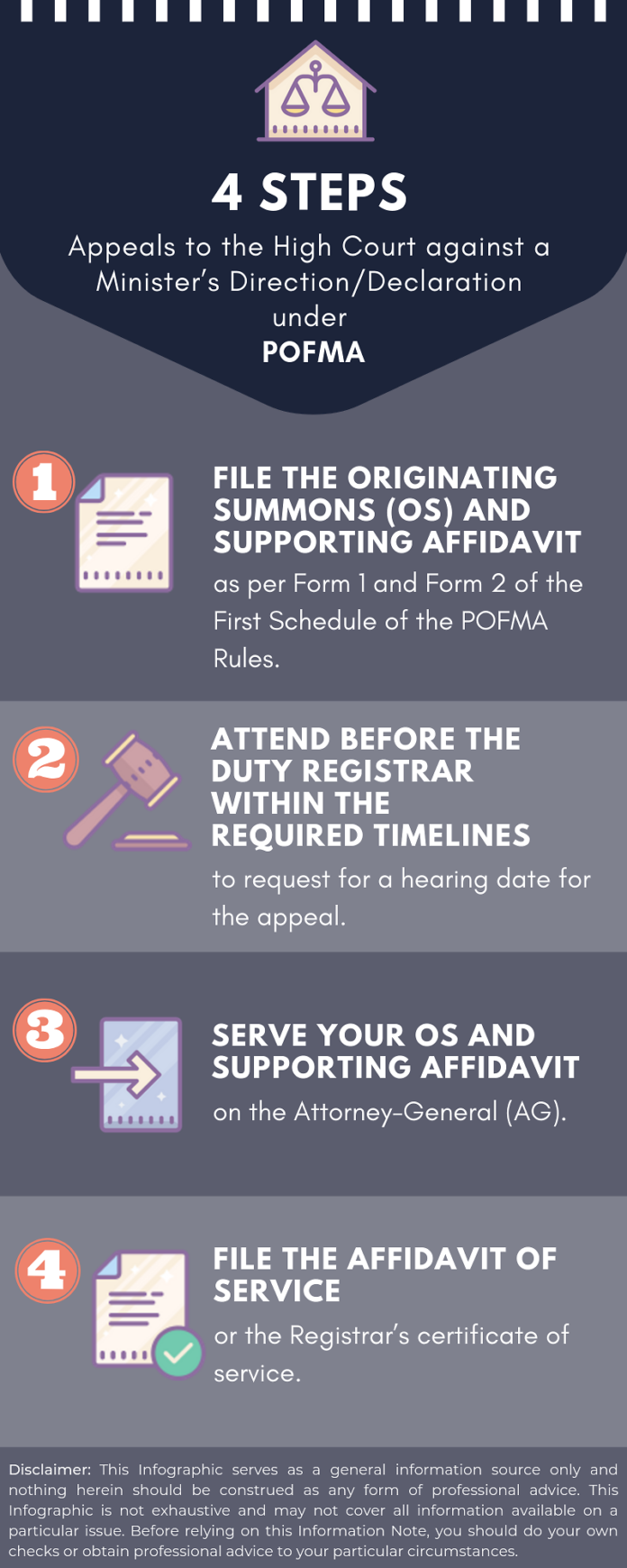
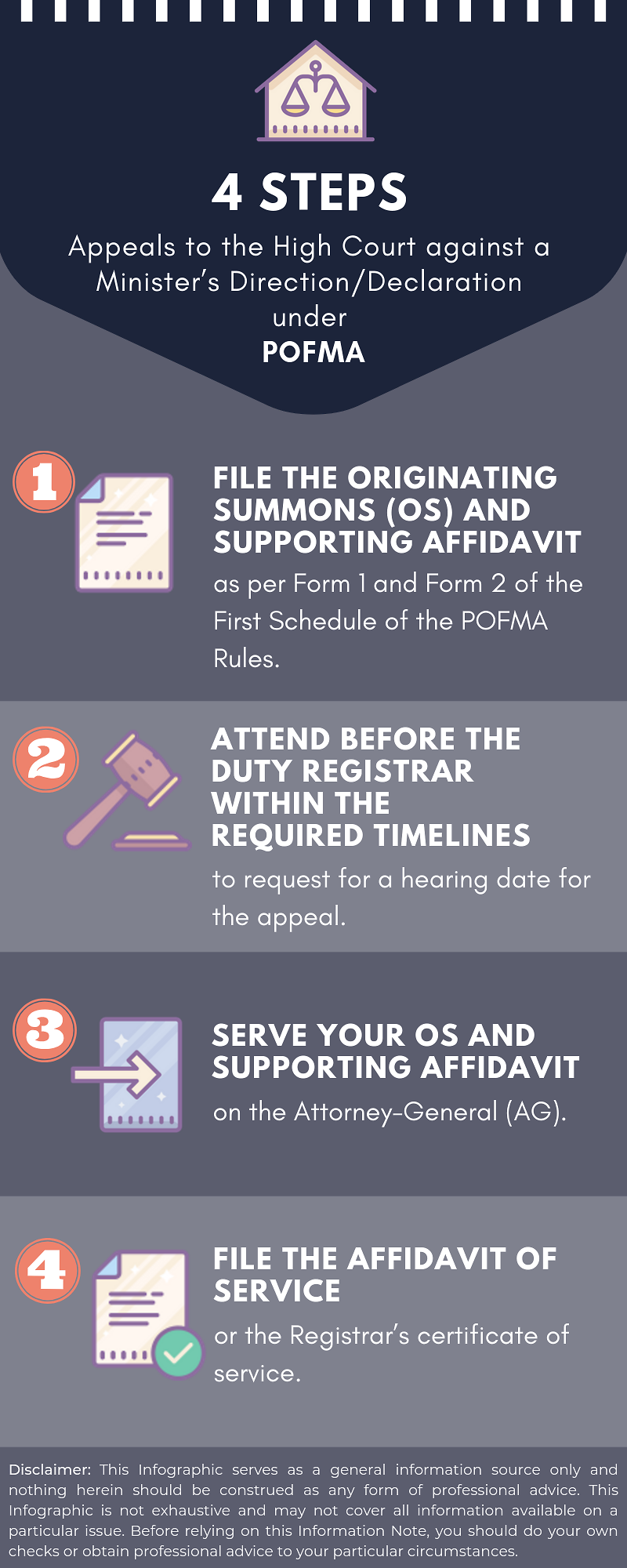
According to the Supreme Court, if an application to vary or cancel a direction or declaration has been refused in whole or in part, an appeal can be filed against the decision made by the relevant minister in the High Court within 14 days.
(Graphic: Supreme Court)
A Facebook post on Nov 23, 2019, by the States Times Review alleged that a “whistleblower who exposed a People’s Action Party (PAP) candidate’s Christian affiliations” has been arrested and that the owner of the NUSSU – NUS Students United Facebook page, which published the claims about the PAP candidate, is under police investigation.
A correction direction is issued to a person who has communicated a falsehood that affects the public interest, according to the POFMA Office.
It requires the recipient to publish a correction notice with the facts, but does not require the post to be taken down or edits made. The order also does not impose criminal sanctions.
It’s TikTok’s world and we’re just living in it. Who knew that a Chinese-owned app — a platform with the simple function of recording and sharing 15-second video clips — would be such a phenomenal and supposedly dangerous global cultural force.
If you still can’t understand the appeal of TikTok, it’s totally fine. It’s overwhelming, it’s chaotic, it’s surreal, it’s odd, it’s laconic — basically everything that defines Gen Z. There’s a vast music library to lip-sync to, there’re dance challenges to execute, there are filters to play around with, there’re new memes to grow into dank, viral heights.