She confided in her former boyfriend about explicit videos she found on her boyfriend’s hard disk involving herself, his former girlfriend and other women.
But instead of complying with her request to pass the hard disk to the police, the man, 27, used it to blackmail the boyfriend.
In what a district judge called an elaborate ploy, the man, who works in a recruitment company, even made up three different personas for the ruse.
Yesterday, the man was jailed for 16 weeks and fined $10,000 for criminal intimidation, impersonating a Corrupt Practices Investigation Bureau (CPIB) officer, and for an unrelated offence of publicising an illegal poker game on Facebook.
The man cannot be named to protect the identities of the victims – the boyfriend, 28, identified in court documents as V1, and his former girlfriend, 27, identified as V2. V1’s then girlfriend, 26, was identified as V3.
The court heard V3 had found the hard disk in V1’s home and discovered the videos in December 2017.
SINGAPORE – Gaming company Razer has submitted an application to secure a digital full bank licence, the news coming just days after telco Singtel and technology company Grab announced that they had applied for a licence together.
Razer said in a statement on Thursday (Jan 2) that its fintech arm will build Razer Youth Bank if it receives approval from the Monetary Authority of Singapore (MAS).
The application was submitted before Dec 31 last year, the last day for firms to apply for a digital full bank licence.
The MAS had said in June last year that it will issue up to five new digital bank licences for both full and wholesale banks to players who may not have an established record in banking.
Wholesale banks serve primarily companies, including small and medium-sized enterprises.
Razer’s endeavour into the banking sector is via a consortium comprising Sheng Siong Holdings, technology company LinkSure Global, automotive marketplace Carro, insurance services firm FWD and Insignia Ventures Partners.
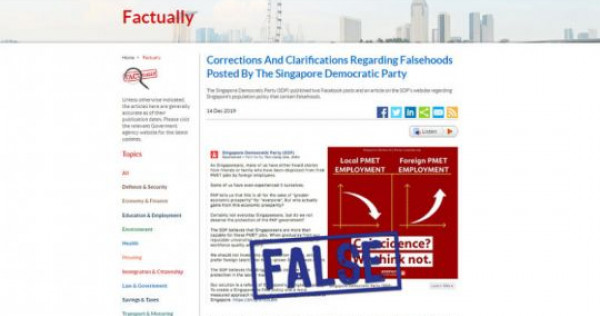
SINGAPORE – The Singapore Democratic Party (SDP) on Thursday (Jan 2) defended two Facebook posts and an article that drew correction orders under Singapore’s fake news law, saying the statements it made “are, in fact, true and correct”.
A party spokesman said the SDP will file an application to the Ministry of Manpower (MOM) on Friday to cancel the correction notices issued under the Protection from Online Falsehoods and Manipulation Act (Pofma).
In a media statement, the party also called on Manpower Minister Josephine Teo, who had initiated the corrections last month, to retract the direction and issue a public apology.
Responding to the SDP’s statement, the ministry said it has not received any application from the party to vary or cancel the correction directions.
“If SDP takes the position that the correction directions were wrongly issued, there is a process under Pofma for them to follow,” said a ministry spokesman. “The facts remain that SDP published specific falsehoods.”
There is no deadline for the party to submit an application.
SINGAPORE: Plastic has developed a bad reputation for the impact it has on the environment. Ocean conservancy groups have estimated that about eight million tonnes of plastic-based products from bags to bottles and straws end up in the sea each year harming marine life. Plastic items also choke landfills.
This has led some businesses here to switch to alternative materials such as paper for their packaging in the belief that they are better for the environment.
At eateries, paper boxes, straws and cups are becoming common. Some retailers are also switching to paper bags to pack items for their customers.
Optician Eyewear Optics made the switch in October last year in the interest of the environment, the firm’s director Alex Chong told CNA.
“All along, for two decades, we were using plastic, and realised it’s harmful, toxic. We are given a choice – spend a bit more and save the earth, so we decided to do that,” he said.
Plain Vanilla bakery also swapped its plastic straws for metal ones, and switched to paper cups lined with polylactic acid (PLA) a plant-based plastic alternative.
But some experts say that packaging products made from paper are not necessarily more eco-friendly. They are in fact more resource intensive to produce.
PAPER BAGS GET CONTAMINATED EASILY
Environmental expert and founder of non-profit group Plastic-Lite Singapore Ms Aarti Giri said: “Plastic seems to have become the punching bag in society.”
But paper bags are likely to fill up a landfill faster as they take up more space, she added.
The use of paper also leads to deforestation, one of the primary causes of climate change, Ms Giri said.
Mr Liow Chean Siang, head of Environmental Certifications at the Singapore Environment Council (SEC) said that even if paper products like bags are “100 per cent recyclable”, once they are contaminated by items such as food, they will need to be disposed of as general waste.
“Depending on the degree of contamination, the full contents of the blue recycling bins may be unfit for recycling and require incineration as general waste,” he said.
“Paper bags are generally heavier than plastic bags. This increases their carbon footprint in transportation. The paper bags have to be reused at least a few times to be more environmentally friendly than plastic bags. Thus, if the paper bag becomes a single-use one, its environmental footprint might be bigger,” Mr Liong said.
According to the “Life Cycle Assessment of grocery carrier bags” report published by the Danish Environmental Protection Agency last year, common supermarket plastic bags “are the carriers providing the overall lowest environmental impacts” even when they are not reused.
A paper bag would need to be re-used up to 43 times before having a net environmental benefit, as opposed to the common plastic bag that needs to be re-used once to have the same benefit.
However, reusing these paper bags can be challenging as they tend to tear, the experts said.
NO FACILITIES HERE FOR BIODEGRADABLE PRODUCTS
Some firms pride themselves in using biodegradable paper products, which by definition are capable of being decomposed by bacteria or other living organisms. They see that as an eco-friendly solution. However, such items have no benefit for the environment in Singapore’s context, the experts said.
“It doesn’t make much difference in Singapore that paper products are biodegradable when most of the waste is incinerated,” said co-founder of zero-waste store Florence Tay.
She explained that biodegradable paper breaks down in very specific conditions when mixed with other materials, which means that left in a landfill, they will not decompose.
They will likely need to be broken down in a facility, which Singapore does not have, she said. On the other hand, standard paper cups and boxes are typically lined with plastic and therefore neither recyclable nor compostable.
PLA-LINED PRODUCTS COME WITH THEIR OWN PROBLEMS
While PLA-lined products may appear to be a better solution, Ms Giri said that they present their own problems.
PLA is derived from renewable resources such as corn, tapioca and sugarcane.
“Corn is commonly used, and because it is modified to be hardy, higher quantities of fertilisers and chemical pesticides tend to be used during their growth which results in water and soil pollution,” she said.
Ms Giri said the PLA industry may worsen another urgent problem- food shortage, because PLA is usually cultivated on land that could be better used to grow food.
“Agricultural land has always been a very precious commodity, more so now, especially now as we may be seeing more acute food shortages worldwide stemming from global warming, she said.
“It’s like a soothing balm but the wound stemming from our single-use or disposable lifestyle may not really heal,” Ms Giri said.
When asked why Plain Vanilla settled on PLA-lined paper cups, chief executive Vanessa Kenchington said: “Of all the available materials available in the Singapore market now, PLA is the most environmentally-friendly option material that meet our requirements.”
She added that the firm did thorough research and spoke to people in the single-use food packaging industry to understand its options before committing to PLA-lined paper cups in February this year.
Another factor the firm had to consider was that a water-resistant lining is required for cups to hold liquids, Ms Kenchington said. The PLA-lined cups cost almost double that of the plastic cups the eatery previously used.
The firm also adopts other eco-friendly practices such as using beeswax wrap instead of cling wrap to store food.
“We have learnt that often the best we can do to be environmentally responsible is to go with the lesser of the two available evils,and at the moment, this means that we cannot fully close the loop due to the lack of existing infrastructure in this regard,“ she said.
While businesses want to show that they are doing something good for the environment, the solution does not lie with choosing one material over another, experts said.
They should avoid single-use items altogether in favour of reusables, added the experts.
Businesses can start making their customers question their need for a bag regardless of what material it is made of, suggested Ms Tay.
“Instead of asking if customers need a bag, they could suggest that they put the item in their own bag.”
Several Stompers alerted Stomp to a video showing the cabby doing the deed near an MRT station.
It is unclear when this happened but according to social media posts, this was outside Marsiling MRT Station.
Some netizens sympathised with the driver not being able to hold it in but many slammed him for not using a toilet at the station or even keeping an empty plastic bottle on standby.