SINGAPORE: The Islamic Religious Council of Singapore (MUIS) announced on Thursday (Jan 9) the appointment of a new Mufti, who will assume office on Mar 1.
Ustaz Dr Mohamed Fatris Bakaram will step down after completing his current term of appointment and Ustaz Dr Nazirudin Mohd Nasir will be appointed the new Mufti, a press statement from MUIS said.
Dr Naziruddin is currently the deputy Mufti.
Ustaz Dr Nazirudin Mohd Nasir will be appointed the new Mufti. (Photo: MUIS)
The appointment is made by the President of Singapore in consultation with the council.
The role of Mufti is significant to the Muslim community in Singapore.
“(It) is a position that is accorded significant respect by Singaporean Muslims, including the Asatizah fraternity, as well as by the religious leaders of other communities, and from around the world,” MUIS said.
“The Mufti sets the tone for the Islamic religious leadership fraternity in Singapore, and plays a vital role in strengthening social cohesion by fostering the community’s integration in the wider multi-religious society.
“As chair of the Fatwa Committee, Mufti also oversees key religious rulings that guide the Muslim community in Singapore.”
Dr Fatris is stepping down after nine years as Mufti to “give new leaders the opportunity to lead the community”.
During his tenure, Dr Fatris, 49, strengthened the Office of The Mufti as well as the development of religious teachers, officers and scholars in Singapore, MUIS said.
He led the development of many religious policies, it added.
“His forethought also includes guiding the younger associate members of the Fatwa Committee (and) developing the Asatizah Recognition Scheme.”
He currently serves as member of the Appeal Board for Syariah Court in Singapore, and is a member of the Presidential Council for Religious Harmony.
Dr Fatris will continue to serve as a senior associate member of the fatwa committee and chair the Quran steering committee, MUIS said.
As an elder, he will continue to mentor and guide the new team as well as younger members of the asatizah fraternity in Singapore, it added.
MUIS said Dr Nazirudin, 43, has “extensive experience in the Office of Mufti, and has made significant contributions in supporting Mufti to advance religious policies”.
As the deputy Mufti, he directly support the Mufti in providing guidance for the Muslim community’s religious life.
On his appointment, Dr Nazirudin said: “I am deeply humbled to accept this responsibility, and pledge to further advance the good work of my predecessors. I consider myself blessed to have benefited from the guidance of Dr Fatris for more than ten years.
“I will be working very closely with a strong team in the Office of the Mufti to serve the Singapore Muslim community and the wider society in achieving greater progress and social cohesion.”
Dr Nazirudin will be supported by two deputy Muftis, Ustaz Mohd Murat Md Aris and Ustaz Dr Mohammad Hannan Hassan.
Ustaz Murat will oversee religious policies and Ustaz Dr Hannan will oversee asatizah development and madrasah curriculum, MUIS said.
SINGAPORE – A maid assaulted an elderly woman suffering from dementia under her care, less than a month after working for a household in Choa Chu Kang, a district court heard on Thursday (Jan 9).
Eis Atikah repeatedly rapped 76-year-old Madam Fatimah Kassim’s head with her fist and pinched her arms in their shared bedroom.
Eis, 38, committed the offence as she felt frustrated that the elderly woman refused to sleep when she was supposed to.
The Indonesian pleaded guilty on Thursday (Jan 9) to an assault charge involving a vulnerable adult and was sentenced to five months’ jail.
Madam Fatimah’s grandson, IT analyst Mohammad Farhan Mohammad Sam, 32, employed Eis, who started working for his family on May 12 last year.
The maid started abusing the elderly woman soon after.
Deputy Public Prosecutor Amanda Han told District Judge John Ng: “There were several occasions where the victim did not wish to sleep even though she was supposed to do so, and the lights in the bedroom were already switched off.
“As the accused was already tired by that time, she pinched the victim on both arms several times in frustration.
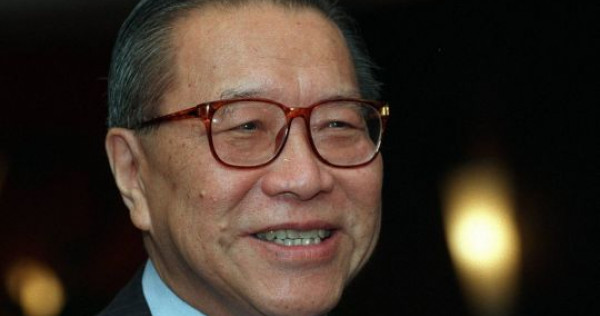
SINGAPORE: Chief Justice Sundaresh Menon on Thursday (Jan 9) described the death of Singapore’s former top judge Yong Pung How as “truly this nation’s loss”, saying that his 16-year tenure as chief justice was the “most consequential in our history”.
Mr Yong, whose career included stints as a banker and a university chancellor, served as Singapore’s second chief justice from 1990 to 2006. He died on Thursday aged 93.
In a written statement on behalf of the Singapore judiciary, Chief Justice Menon called Mr Yong a “prodigiously talented individual” and a “foundational figure” in Singapore’s legal and national history.
“He leaves behind a legacy that is nothing less than the modern and progressive judiciary and legal system that Singapore has today,” said Chief Justice Menon.
Chief Justice Sundaresh Menon speaks at the Opening of the Legal Year 2020 on Jan 6. (Photo: Nuria Ling/TODAY)
FROM CEO OF OCBC TO SINGAPORE’S SECOND CHIEF JUSTICE
Mr Yong was born on Apr 11, 1926, in Kuala Lumpur, Malaysia.
He spent almost two decades in legal practice before deciding to enter the finance industry in 1971. During that time, he became the first managing director of the Government of Singapore Investment Corporation (GIC) and later, the CEO and chairman of OCBC Bank.
At the age of 63, Mr Yong returned to the law as a Supreme Court judge in 1989 and was appointed chief justice the following year.
“Mr Yong was a prodigiously talented individual whose diverse gifts and interests brought him beyond the law into business, finance and public administration,” Chief Justice Menon said in his statement.
“In each field he entered, Mr Yong reached its pinnacle,” he added.
Former chief justice Yong Pung How dies aged 93. (File photo: AFP/Roslan Rahman)
BOUNDLESS ENERGY
As chief justice, Mr Yong proved himself “not only to be an eminent jurist but also a visionary leader, an astute administrator, and a reformer of boundless energy”, said Chief Justice Menon.
When Mr Yong first became Singapore’s top judge, the courts “groaned” under a backlog of 2,000 suits, said Chief Justice Menon, adding that it would have taken many years for the courts to clear.
Mr Yong, however, tackled the challenge with “steely resolve”.
“He set to work immediately, implementing a suite of changes that transformed the judiciary and the legal system,” said Chief Justice Menon.
This included introducing the system of pretrial conferences, streamlining court procedures, establishing night courts, expanding the bench, increasing the number of court sittings and daily hearing hours and redesigning policies to attract legal talent, said Chief Justice Menon.
Aside from those, Mr Yong also launched the electronic filing system, established the Singapore Law Reports, and opened the Singapore Mediation Centre.
By 1994, the backlog had “largely been reduced to a footnote in our legal history”, said Chief Justice Menon.
“In successfully modernising the justice system and expeditiously clearing the backlog, Mr Yong’s tenure as chief justice perhaps stands as the most consequential in our history.”
A BELIEVER OF SECOND CHANCES
Mr Yong also believed in second chances and rehabilitation, which continues to guide Singapore’s judicial system 20 years later.
“Mr Yong saw the first responsibility of the courts as the protection of the public, tempered by a sensitivity to the individual’s potential for rehabilitation,” said Chief Justice Menon.
“While his emphasis on deterrence as a principle of criminal justice is well-known, Mr Yong never overlooked those who deserved a second chance.
“He famously observed that for young offenders in their formative years, rehabilitation would generally be the dominant sentencing consideration, which became a hallowed principle that continues to guide us two decades later.”
LEADERS HERE AND ABROAD SANG HIS PRAISES
When he retired on Apr 10, 2006, accolades for Mr Yong poured in.
“At a farewell dinner hosted at the Istana, (former) President S R Nathan spoke of how Mr Yong had always ‘impressed (him) as a clear-minded individual, forthright, principled, fair-minded and above all a warm and humorous person’,” Chief Justice Menon recalled.
From the United Kingdom, Right Honourable Lord Bingham of Cornhill, then Senior Lord of Appeal in Ordinary also praised Mr Yong.
“(He) remarked that Singapore’s ‘legal and judicial systems (had) flourished as never before under his leadership’,” the chief justice said.
Former Singapore Prime Minister Lee Kuan Yew smiles as he attends the LKY School of Public Policy 7th anniversary dialogue session in Singapore September 14, 2011. (Photo: REUTERS/Tim Chong/File Photo)
Singapore’s founding Prime Minister Mr Lee Kuan Yew, however, had the “highest and most moving accolade” for Mr Yong, said Chief Justice Menon.
“Appointing you as chief justice was one of my best decisions. … You have done Singapore a service,” Chief Justice Menon cited Mr Lee as saying then.
The chief justice concluded: “All of us – the judiciary, the legal profession, and indeed every Singapore citizen – owe Mr Yong an immense debt of gratitude: for his heart of service, his sense of justice, and for dedicating his life, wholly and without reserve, to the nation he loved.
“His passing is truly this nation’s loss.”
YONG PUNG HOW WAS A “SELFLESS TITAN”: K SHANMUGAM
Minister for Law and Home Affairs K Shanmugam on Thursday also paid tribute to Mr Yong on Thursday, describing him as someone who was “sharp, immensely practical, and formidable to appear before”.
“(Mr Yong) was a great man. A selfless titan, who dedicated himself to building up Singapore, and her institutions. His achievements are well recorded in multiple spheres, beyond the law,” Mr Shanmugam said.
He wrote about his experiences with Mr Yong over the years and how he had introduced “close to 1,000 initiatives” in the former Subordinate Courts, now known as the State Courts.
“His efforts contributed greatly to Singapore now being regarded as a trusted international legal centre, with a strong judiciary,” he said.
“Our system is what it is today, because of his unparalleled vision and foresight.”
SINGAPORE: Banks in Singapore announced on Wednesday (Jan 8) that they will be offering new notes to their customers for their Chinese New Year celebrations.
DBS/POSB customers can obtain new or good-as-new notes from Thursday to the eve of Chinese New Year (Jan 24) at 40 POSB pop-up ATMs across 20 community clubs islandwide.
UOB and OCBC customers can also start collecting their new notes from Thursday.
FOR DBS/POSB CUSTOMERS
At the pop-up ATMs, DBS/POSB customers can withdraw the new or good-as-new notes in sums of S$100 (S$2 x 50), S$300 (S$10 x 30), $500 (S$50 x 10) and S$600 (S$10 x 20 or S$50 x 8).
The pop-up ATMs are accessible 24 hours a day, except for those at Chong Pang and Teck Ghee Community Club, the bank said. Their locations can be found here.
POSB ambassadors will be available to help customers at various pop-up ATM locations from 9am to 9pm.
DBS/POSB customers can also reserve the notes online and collect them from any full-service branch at their preferred dates and times through the bank’s online reservation system. The denominations available are S$2, S$10 and S$50.
Alternatively, they may walk in to any DBS/POSB full-service branch – except for DBS Marina Bay Sands branch and DBS Woodlands Service Centre branch – to collect or exchange the notes, subject to availability.
Customers collecting or withdrawing the new or good-as-new notes at DBS/POSB pop-up ATMs or branches will receive two sets of red packets, “made from environmentally friendly paper derived from sustainable sources”, the bank said.
DBS/POSB branches will also have recycling bins for used red packets from Jan 28. The bins will be available all year so customers can also recycle packets from Hari Raya and Deepavali.
DBS and POSB red packets designs for Chinese New Year 2020. (Photo: DBS/POSB)
FOR UOB CUSTOMERS
UOB customers can reserve their new notes online through UOB Personal Internet Banking from Jan 9 to Jan 19, the bank said. The new notes come in denominations of S$2, S$10 and S$50, and exchanges are capped at S$1,400 in total.
Customers can choose their preferred date and branch to collect their new notes, with the last day for collection on Jan 21.
Walk-in customers can exchange new notes at any UOB branch – except the Hangout@SP, Sengkang Express and Tampines One branches – from Thursday to Chinese New Year’s Eve (Jan 24), subject to availability.
FOR OCBC CUSTOMERS
OCBC customers can walk in to any branch to obtain new the notes. For quicker service, customers can choose pre-packed OCBC Fortune Packs which contain 100 S$2 notes and 30 S$10 notes.
Customers can also use the OCBC Mobile Banking app’s digital Chinese New Year queue service to view the availability of new notes across OCBC’s branch network in real time and get a digital queue number before heading to the branch, minimising waiting time.
Each customer can only exchange up to S$500 a day, OCBC said.
“To ensure that our customers do not wait unnecessarily in the queue, our service ambassadors will try to obtain each individual’s request while they are queuing, and customers – whose request cannot be met on that day – will be asked to return the next day and not wait further,” said OCBC’s Singapore head of consumer financial services Sunny Quek.
In addition, customers can get new and good-as-new notes from selected ATMs, although stocks are also limited.
Don’t waste it away by spending it at home because there are lots of activities happening around the island to enjoy with your friends and family. Weekends will never be the same again with this weekend planner.
THOMSON-EAST COAST LINE 1 (TEL1) OPEN HOUSE
PHOTO: Facebook/WeKeepYourWorldMoving
With the upcoming opening of the Thomson-East Coast Line 1 (TEL1) on Jan 31, the Land Transport Authority is organising an open house event this weekend.
Visitors can explore the first phase of the TEL and enjoy unlimited free rides between three stations — Woodlands North, Woodlands and Woodlands South.
From carnival games to meet-and-greet sessions with the Thoughtful Bunch, you can expect lots of activities, as well as public transport-inspired merchandise from the Knackstop pop-up store.
SINGAPORE – Former chief justice Yong Pung How, who implemented rigorous reforms to transform the Singapore court system into a model of efficiency, died on Thursday (Jan 9) morning, the Supreme Court has confirmed.
He was 93.
Mr Yong’s work in the legal field started as early as 1953, when he was appointed by the Singapore Government as arbitrator to resolve a dispute between the Government and a union. The union was represented by a young lawyer, Mr Lee Kuan Yew, who would go on to become the country’s prime minister in 1959.
Mr Yong was admitted to the Bar in 1964 and became a senior partner with the law firm of Shook Lin and Bok, until 1970. He then went into merchant banking and finance, ending up as chairman and chief executive of OCBC Bank.
On a secondment from OCBC Bank from 1981 to 1983, Mr Yong helped form the Government Investment Corporation, which manages Singapore’s foreign reserves, and became its managing director. He later became the managing director of the Monetary Authority of Singapore.
When he took the helm at the judiciary in September 1990, there was a backlog of more than 2,000 cases.
A student from Outram Secondary School was knocked down by a car at the junction of Clemenceau Avenue and Havelock Road on Monday.
A video depicting the incident which was circulated online shows the 15-year-old boy in white trousers crossing the junction while the green man is still flashing.
The car nearest to him slows down to let him cross, but a red Honda car on the next lane is seen driving ahead, colliding with the boy, causing him to flip and fall to the ground.
As seen in the video, the boy stands up moments after falling.
The police were alerted to the scene at about 7.10am and said the boy was conscious when he was taken to KK Women’s and Children’s Hospital.
Police investigations are still ongoing.
Outram Secondary School vice-principal Ellen Tan, 45, told The New Paper that the teenager has been discharged from the hospital and will be returning to school today.
She added that the school has arranged for a counsellor to tend to the boy during his recovery and will conduct a road safety talk during assembly as a reminder for students.
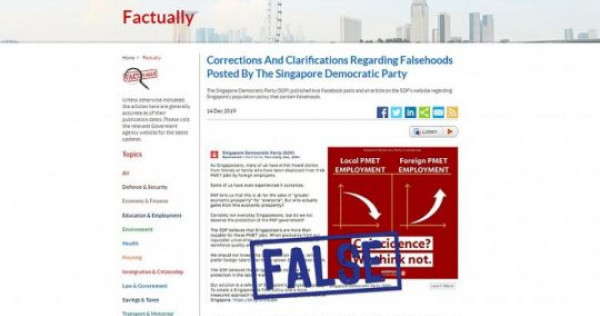
SINGAPORE – The Singapore Democratic Party (SDP) has filed an appeal in the High Court against correction notices issued by the Manpower Ministry – the first court challenge of the fake news law.
The party’s appeal comes after Manpower Minister Josephine Teo on Monday (Jan 6) rejected its application to cancel three correction directions issued under the Protection from Online Falsehoods and Manipulation Act (Pofma).
A hearing is scheduled to take place at 10am on Jan 16, said the SDP on Wednesday (Jan 8).
It added that it will not be engaging lawyers to argue the case.
The Ministry of Manpower (MOM) said it has been informed of the SDP’s appeal.
In a statement posted on its website, the SDP said it had set out its case for the cancellation of the notices in a detailed submission, and accused Mrs Teo of failing to back up her allegations in her rejection of the party’s application.
“We are therefore left with no choice but to pursue the matter in the High Court. We look forward to Ms Teo explaining her decision on the witness stand,” said the SDP.
SINGAPORE – GrabFood has become the latest food delivery operator to launch a kitchen space housing multiple restaurant brands, turning the heat up on competition among Singapore’s three major food delivery services.
Residents in the Upper Bukit Timah, Bukit Batok and Bukit Gombak areas can now order food items from more than 10 brands, including Wolf Burgers and PlayMade, in a single order through the app. Orders can also be made for pick-up or consumption in the kitchen’s dine-in area in Hillview.
Deliveroo and Foodpanda already operate their own shared kitchen spaces, also known as ghost or cloud kitchens, in Singapore. The concept has been catching fire as demand for food delivery grows and eateries use it as a way to expand or create new brands without the costs of setting up a dine-in establishment.
Former Grab Singapore head Lim Kell Jay, who now heads GrabFood’s regional operations, said at a media briefing on Wednesday (Jan 8) that the GrabKitchen launch in Singapore brings its network of cloud kitchens to 50 across five countries in the South-east Asian region.