Home Blog Page 535

When policemen wore shorts: Singapore’s oldest living retired officer recounts the early years of the force

0

SINGAPORE: For many Singaporeans, the phrase “last time policemen wear shorts” may just be a way of saying that something happened a long time ago.  

But for retired police officer Mr Yusof Mohammad, it is not just a saying – he lived it, serving as one of the shorts-wearing police officers during Singapore’s post-war era. Comparing the khaki shirt and shorts he wore back in the day to the uniforms worn by today’s police officers, he said: “They look smarter now.” 

At 98, Mr Yusof is the oldest retired police officer alive in Singapore. 

Mr Yusof was speaking to reporters at his home in Taman Jurong, where he lives with one of his daughters, on Wednesday (Jan 8), ahead of the launch of SPF200, the year-long celebrations marking the bicentennial of the Singapore Police Force (SPF).

Although just two years shy of his hundredth birthday, he is still active, able to walk unaided for some distance. 

When CNA met him, he had just returned home, having travelled by bus to the mosque for prayers and then to the clinic and back home unaccompanied. 

Yusof Mohammad Old Police Memorabilia_Bicentennial

Mr Yusof Mohammad is only left with old photos and police badges as keepsakes from his time as a police officer. (Photo: Try Sutrisno Foo)

Mr Yusof joined the police in 1946 at the age of 25.

He said it was a tumultuous time, with the Japanese occupation of Singapore during World War II having ended just a year earlier. During the war years, he recalled scenes of bombs going off and people running for shelter. Mr Yusof was a hospital porter at the time, and saw patients who had been injured and disfigured during such attacks.

When the war ended, he wanted to play his part in keeping the peace and chose to join the police. After passing the physical test, Mr Yusof had to learn the laws as well as how to handle his weapons before becoming a patrol officer.

He was stationed in the Queenstown area, which he patrolled on foot as well as bicycle. During his rounds he would sometimes encounter gamblers and thieves, and be forced to give chase. He also had to intervene in domestic disputes that ended in slashings. 

The worst cases happened at night, he recalled. “No matter how late it was, if there were robberies and kidnappings or other crimes, we had to go down.”

Though he mostly did his rounds in Queenstown, he had to attend to cases in other areas as well. “If we got called to go down to Woodlands or Tanjong Pagar, we would go down.”

During the post-war period, Singapore was threatened by secret societies and communists, he said. 

One of the darkest periods in Singapore’s history also happened while Mr Yusof was in the force – the Maria Hertogh riots of December 1950. Mr Yusof said he was not called to the frontlines – a job left to the riot squad in their “ang chia”, or red buses – though he knew  of colleagues who were caught up in the riots and had bottles thrown at them.

“We were at the police station, waiting on standby if needed.”

Still, Mr Yusof recalled much of his time was occupied by the mundane day-to-day matters like registering births and deaths, and the change of addresses.

Yusof Mohammad Police Days Photos Oil Refinery

One of the few photos Mr Yusof Mohammad still keeps from his policing days.

During the last four years of his service, Mr Yusof was transferred to the Marine Police – the predecessor of today’s Police Coast Guard.

He would make his rounds in a boat around Singapore’s waters, particularly in the northeast in areas such as Pulau Ubin and Pulau Tekong. He and his colleagues would board vessels to look for smuggled goods or people who were trying to enter Singapore illegally.

“Occasionally we would encounter pirate vessels, and we would have to fire warning shots to scare them out of Singapore waters.”

He would also come across dead bodies in the waters – which occasionally would be found mangled by the propellers of boats. One of the victims was even the crew of the patrol vessels, he recalled.

Yusof Mohammad Old Police Photos Oil Refinery Patrol

An old photo of Mr Yusof Mohammad working as a police officer at an oil refinery. 

Though Mr Yusof had seven children with his late wife, he did not encourage them to join the police, allowing them to choose their own paths. 

He noted though being a police officer put a strain on his marriage – his wife often complained about the long hours and dangerous nature of the job. 

But he stuck it out and only left the force in 1969 when he was 48 – the age of retirement for the police then to become a security officer for a number of years. It was the same year the police uniform changed to feature long pants.

Today, Mr Yusof is long-retired. 

He is proud about his career as a police officer, though he has a sense of humour about it.

“When I was in the uniform, I had pride. Now I am out of uniform, I don’t have pride,” he quipped. 

He also has a sense of pragmatism about the job, noting it was one of the better career opportunities available at the time. 

“It was enough to put food on the table for my family,” he said. 

Still, he keeps mementos to remind him of his time with the police – like old photos and badges – and notes the important job the police continue to play in keeping the peace. 

“The uniform might be different but the responsibilities are the same.”
Source link

Huge Himalayan griffon vulture spotted at Peck Seah Street in rare sighting

0

[ad_1]

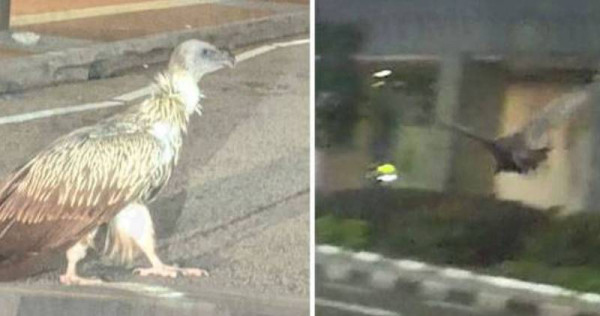
Motorists travelling along Peck Seah Street towards Maxwell Road were treated to a rare sight of a Himalayan griffon vulture on Wednesday evening (Jan 8).

Stomp contributor Win alerted Stomp to the sighting and shared a photo and video his girlfriend took of the huge bird that she posted on her Facebook page Kirari Labo.

“It was near 72 Peck Seah Street towards Maxwell Road at about 7pm,” said the Stomp contributor who was driving at the time.

“I’m not sure why the bird just stayed in the middle of the road.

“It seemed lost.

“Luckily, there was not much traffic in the area so most of us just slowed down to pass by it.”

Win said the vulture later flew towards Chinatown.

Mr Kalai Vanan, Acres’ deputy chief executive officer told Stomp: “The bird in the video looks like a Himalayan griffon vulture.

“They are rare visitors to our island.

[ad_2]

Source link

French-Malaysian TikToker effortlessly imitates Singaporean ah lians and aunties

0

[ad_1]

Bow down and recognise your new TikTok queen: a wisecracking Malaysian lady of French and Chinese descent who can effortlessly code-switch between her usual American accent and the patois of Chinese Singaporeans. 

Madeleine Breteche-Lo — a Lasalle graduate based in Singapore as a host, actress, and all-round artiste — has been putting out some pretty dank content on her TikTok account for some time, but her focus has been on dialect comedy lately. 

In particular, the mannerisms of good ol’ Singaporean matriarchs. And they’re actually damn accurate. 

[ad_2]

Source link

Military law and how it affects every Singaporean son

0

[ad_1]

Every able-bodied male citizen will be conscripted when he turns 18. Most of them will end up serving in the Singapore Armed Forces (SAF). The Singapore Armed Forces Act is the main piece of legislation that defines military law in Singapore.

First and foremost, who is subjected to military law? Subsection 3 of the SAF Act provides guidance on this issue:

[ad_2]

Source link

Girl, 13, dies after falling from Pasir Ris multi-storey carpark

0

[ad_1]

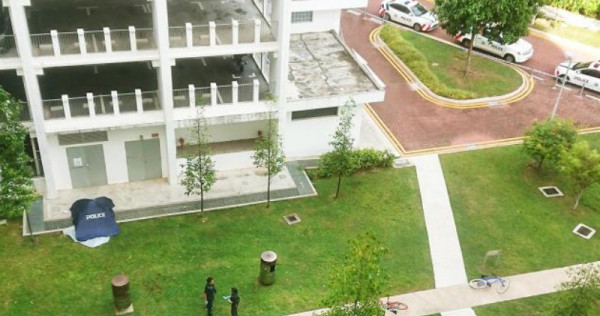
A 13-year-old student fell to her death from a multi-storey carpark along Pasir Ris Street 51 on Wednesday (Jan 8).

She was said to be cycling on the sixth storey of the carpark with her friends that afternoon when tragedy struck.

The exact cause of the accident remains unclear, Shin Min Daily News reported.

A photo taken by a resident showed a police tent at the ground floor of the carpark, with two bicycles lying on the footpath.

According to the police, the girl was found motionless at the foot of the block and later pronounced dead by Singapore Civil Defence Force paramedics.

PHOTO: Shin Min Daily News

Some residents noted that youths have been cycling at the upper levels of the carpark since there were fewer vehicles parked there.

[ad_2]

Source link

Xinyao lyricist Jo Heng, who wrote lyrics for singers like Jacky Cheung and Eric Moo, dies at 59

0

[ad_1]

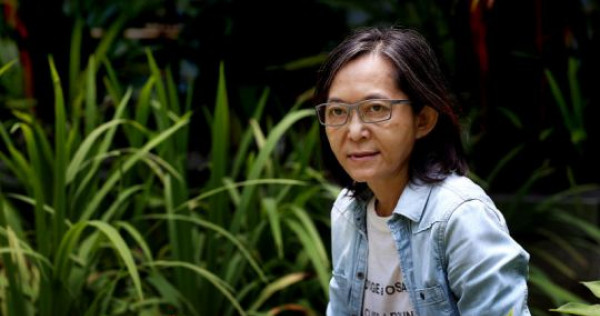
SINGAPORE – Jo Heng, an award-winning Singapore lyricist known for penning the lyrics to hits like singer Eric Moo’s You Are My Only One, has died at the age of 59.

Reports say she had suffered from lymphoma, a type of blood cancer, and died on Thursday (Jan 9) morning.

Heng, also known as Xing Zenghua, wrote the lyrics to Hong Kong Heavenly King Jacky Cheung’s 1995 song A Thousand Sad Reasons, which won the Top Local Chinese Song at the third Composers and Authors Society of Singapore (Compass) awards in 1997.

In addition, she wrote the lyrics to Hong Kong singer Andy Lau’s The Path Winds Through High Peaks, which was released in 1994.

She had studied in Bukit Panjang Government High School and Thomson Secondary School, and was good at Chinese composition.

She read novels by Chinese writer Lu Xun, liked the works of Taiwanese writer San Mao, and listened to the songs of Taiwanese singers Feng Fei Fei and Lo Ta-yu.

[ad_2]

Source link

Xinyao lyricist Jo Heng, who wrote lyrics for singers like Jacky Cheung and Eric Moo, dies at 59

0

[ad_1]

SINGAPORE – Jo Heng, an award-winning Singapore lyricist known for penning the lyrics to hits like singer Eric Moo’s You Are My Only One, has died at the age of 59.

Reports say she had suffered from lymphoma, a type of blood cancer, and died on Thursday (Jan 9) morning.

Heng, also known as Xing Zenghua, wrote the lyrics to Hong Kong Heavenly King Jacky Cheung’s 1995 song A Thousand Sad Reasons, which won the Top Local Chinese Song at the third Composers and Authors Society of Singapore (Compass) awards in 1997.

In addition, she wrote the lyrics to Hong Kong singer Andy Lau’s The Path Winds Through High Peaks, which was released in 1994.

She had studied in Bukit Panjang Government High School and Thomson Secondary School, and was good at Chinese composition.

She read novels by Chinese writer Lu Xun, liked the works of Taiwanese writer San Mao, and listened to the songs of Taiwanese singers Feng Fei Fei and Lo Ta-yu.

[ad_2]

Source link

Bachelor in Singapore scolded by date for bringing canned drinks to restaurant, wanting to split bill

0

[ad_1]

While frugality is a good trait to have in the most expensive city in the world, there are appropriate times and places to save money and a first date shouldn’t be one of them.

According to Lianhe Wanbao, a reader surnamed Wang wrote in to the paper to give his account of a nightmarish blind date where he was scolded for being “ungentlemanly”.

On Dec 11 last year, the self-confessed “lonely” 37-year-old man paid $50 to a matchmaking agency in Eunos and was paired with a woman around his age, Wanbao reported.

A few weeks later on Dec 29, the couple met at a restaurant.

Here’s how the night unfolded, according to Wang:

On the evening of the date, he arrived at the arranged venue only to realise that it was a Western restaurant. He was shocked by the prices on the menu as it was out of his budget.

[ad_2]

Source link

'Ashamed of being Singaporean': Blogger highlights bad behaviour at Sembawang Hot Spring Park

0

[ad_1]

The hype over the new Sembawang Hot Spring Park has yet to die down but complaints of unsavoury behaviour have already begun to emerge, just days after its reopening on Jan 4.

For blogger Petunia Lee, her experience at the park was marred by the sight of a domestic helper being made to wash her employers’ feet.

Lee wrote in a blogpost published on Jan 7: “She fetched water. She bent down and splashed water over her employers’ feet and calves. Those people did not look handicapped. They probably have delusions of royalty.”

“At times like this, I am so ashamed of being Singaporean,” she added.

Besides soaking their feet in the geothermally heated groundwater at the four-tier cascading pool, visitors can also cook eggs at the park using the hot water dispensed at water collection points.

[ad_2]

Source link

Women in Singapore earn 6% less than men for similar work: MOM study

0

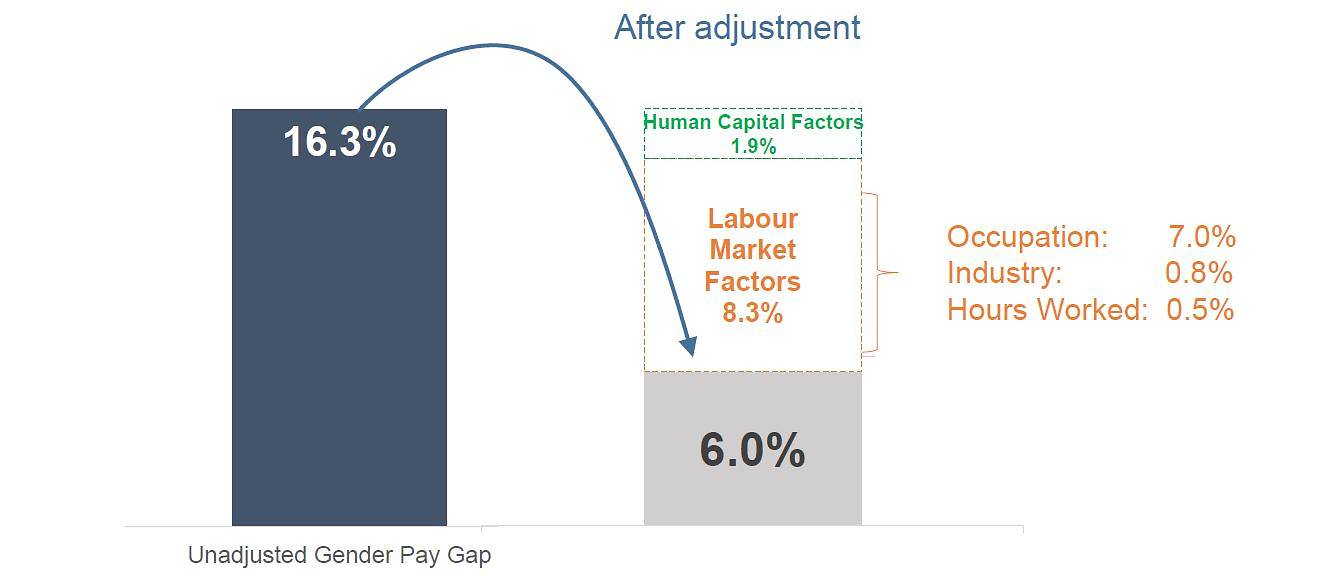
SINGAPORE: Women in Singapore earned 6 per cent less than their male peers in 2018, according to a study conducted by the Ministry of Manpower (MOM) released on Thursday (Jan 9).

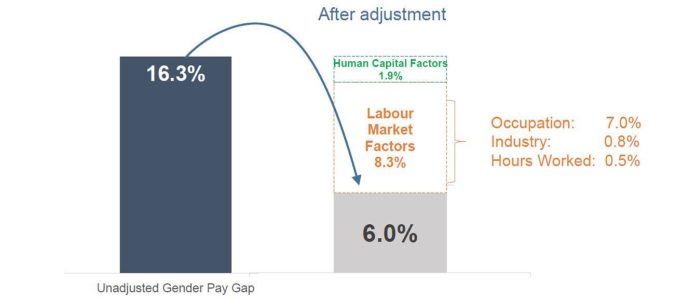
The 6 per cent adjusted gender pay gap is the wage difference that remains after taking into account factors such as the worker’s industry, occupation, age and education.

However, when just comparing the median pay between both genders, women in Singapore earned 16.3 per cent less than men in 2018.

This unadjusted figure, which is often used in international comparisons by the likes of the OECD, inched up by 0.3 percentage point from 2002.

The 16.3 per cent pay gap is largely driven by the tendency for men and women to work in different occupations, the study said, as women tend to be in lower-paying jobs compared to men, who continue to be over-represented in higher-paying occupations.

Women tend to end up in the educational, healthcare and administrative fields, while men dominate top executive and technical roles.

MOM chart gender pay gap

(Source: Ministry of Manpower)

The adjusted gender pay gap is a “better measure of whether men and women are paid equally for doing similar work”, said MOM in a press release.

The study, which was done in collaboration with the Associate Professor Jessica Pan from the National University of Singapore, looked at the data of full-time workers aged between 25 and 64 from 33,000 households compiled from MOM’s Comprehensive Labour Force Survey.

The 6 per cent wage gap that remains could be due to factors such as the firm type, position within the industry, work experience, caregiving responsibilities and discrimination. 

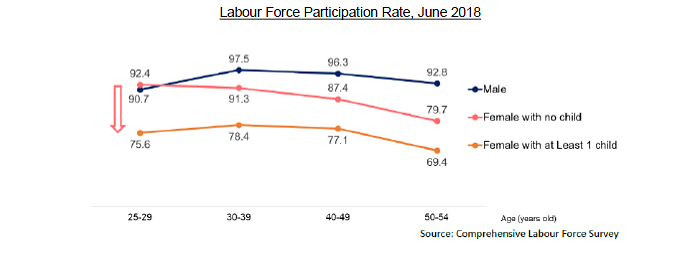
Based on other available data such as the difference in the labour force participation rate, the researchers believe that parenting plays a large role in the adjusted pay gap.

As more women end up as caregivers and take time off to look after their children, they are likely to lag behind in work experience and career progression, the study said.

Labour force participation rate of women, women with children, men

According to the study’s researchers, Singapore has a lower adjusted gender pay gap compared to countries with similar studies, such as the US (8 per cent), Canada (7.7 per cent to 8.3 per cent) and China (18.3 per cent).

CHANGE OVER TIME

While the median wage gap has risen slightly from 16 per cent in 2002 to 16.3 per cent in 2018, the adjusted gender pay gap has fallen by 2.8 percentage points since 2002.

Explaining the increase of 0.3 percentage points, an MOM spokesperson said that gender segregation among occupations has widened and plays a bigger role today than in 2002.

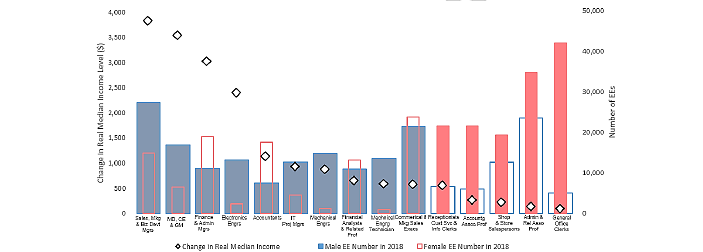
The report found that among the occupations that women stay in, the change in the monthly real median income has fallen behind.

For example, there was almost no increase in the income of general office clerks, a position filled mostly by women. 

On the flipside, the income of sales, marketing and business development managers, a role that sees a larger proportion of men, spiked by nearly S$4,000 a month over the 16-year period.

Occupation real wage growth

(Source: Ministry of Manpower’s Comprehensive Labour Force Survey).

According to research cited by this report, women lean towards certain occupations due to reasons like being more averse to risk, being less competitive and conforming to gender social norms.    

FIRST SUCH STUDY 

This is the first time the ministry has delved into the adjusted gender pay gap, MOM said. They started research at the beginning of 2019.

The ministry chose to compare the data to 2002’s in order to find out how the wage gap has progressed in the long-run. 

Wages tend to fluctuate from year to year, and it is difficult to measure how cultural shifts affect the gender wage gap in the short-term, a MOM spokesperson said during a media briefing on Thursday.

Data from 2002 was used because this was earliest available comparable data based on industry and occupational classification, an MOM spokesperson said.

Given the latest findings, the ministry might do a follow-up study on how caregiving and parenthood affect wages, the spokesperson added.

As for whether gender discrimination has contributed to the adjusted gender wage gap, a MOM spokesman said it is unrealistic to say that employer bias does not exist.

“(But) the part where the employer (decides) to pay the man higher than the woman is unlikely to play a very big portion in that 6 per cent,” the spokesman added.

The drop in the adjusted gender pay gap shows that the Government has made progress in helping women choose both work and family as far as possible, he added.

He cited government initiatives aimed at addressing the disadvantages working women face, including the Work-Life Grant, which are monetary incentives for companies to implement flexible work arrangements, as well as the availability of shared parental leave.

Source link