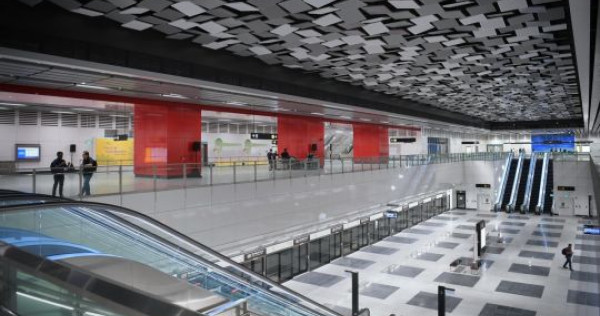
SINGAPORE – The Woodlands North MRT station, meant to connect to the delayed cross-border Rapid Transit System (RTS) Link between Singapore and Johor Bahru, welcomed visitors on Saturday (Jan 11) when Singapore’s newest MRT line opened for preview.
The MRT station will be adjacent to the RTS Link Station “if and when” it materialises, said Minister for Transport Khaw Boon Wan on Saturday.
He made the remarks as he opened up three stations on the Thomson-East Coast Line (TEL) a few weeks before passenger service starts on Jan 31.
For now, people will be able to visit the Woodlands North, Woodlands and Woodlands South stations so that they can familiarise themselves with the various entrances and exits and amenities.
The Woodlands North station is among the biggest of the 32 stations on the new MRT line and was designed with the RTS Link in mind.
Mr Khaw said it was “sized accordingly, to accommodate the peak hour traffic travelling between Singapore and JB via the RTS Link”, and will be connected seamlessly to the RTS Link station at the basement concourse level.
SINGAPORE – A Singaporean student was arrested in Australia on Thursday (Jan 9) and charged for importing a child-like sex doll, said Australian Border Force (ABF) in a statement on its website.
The 26-year-old, who was not identified, was nabbed after border officials intercepted a parcel sent to him from China at a Perth air cargo depot on Christmas Eve last year, it added.
The man, who is in Australia on a student visa, will appear in the Perth Magistrates Court next Friday, the border force said.
If found guilty of importing child abuse material, he can be jailed up to 10 years, fined up to AUD$525,000 (S$487,159), or given both punishments.
ABF Investigations Acting Commander Nicholas Walker said an increasing number of people are importing such sex dolls through international mail and air cargo streams into Australia.
They are an emerging form of child abuse material, he noted.
“Dolls that are manufactured for a sexual purpose that depict a child under the age of 18 are classified as ‘objectionable goods’ and are prohibited from being imported into Australia,” he said.
LONDON: The world is already grappling with its first emerging disease of the decade. Dozens of people in Wuhan, a city in central China, have been hit by an unexplained pneumonia.
There are no recorded deaths but, among 59 who have fallen sick, seven are reported to be in a critical condition with breathing difficulties. The authorities have ruled out seasonal flu, bird flu, severe acute respiratory syndrome (SARS) and Middle East respiratory syndrome (MERS).
Singapore and Hong Kong are now screening air passengers for fever.
The outbreak, which began in December, has been traced back to a market selling seafood and live animals such as bats and marmots. It has since been closed and disinfected.
The possibility that yet another malign microorganism has hurdled the species barrier to infect humans is likely to boost calls for a global catalogue of animal pathogens.
AN EXPENSIVE PROJECT
Experts are divided over whether one such proposal, the Global Virome Project, dedicated to viruses, merits its US$3 billion price tag.
Prof Leo Poon, a virologist at Hong Kong University who helped to sequence the SARS virus in 2003, is watching events keenly. With no deaths, no hospital outbreaks and a market clean-up, he told me, the situation is encouraging.
(Photo: Unsplash/Chromatograph)
But the possibility of human-to-human transmission remains a concern.
“If it does pass between humans, then people in Wuhan can take the disease anywhere,” he said. “We don’t know the incubation period – it could be days or weeks. If more cases turn up in the next few days, this would be bad news.”
The Lunar New Year looms; millions will travel for the Jan 25 holiday.
As to the pathogen itself, he speculates that it is a virus (China has not yet released any details). The next steps would be sequencing the viral genome, developing a diagnostic test and identifying the host species.
Some of the most virulent diseases of recent years have crossed from animals into humans. So-called zoonoses include SARS, traced back to civet cats in 2003; MERS, from camels; and Ebola, found in bats.
While these viruses seldom trouble their animal hosts, they proved deadly in humans. The 260 or so viruses known to infect people are dwarfed by the estimated 1.6 million harboured by mammals and waterfowl.
The outbreak of pneumonia comes just a few weeks before China’s busiest travel season of the year. (Photo: AFP/PETER PARKS)
That extensive viral pool, plus a lack of knowledge about which pathogens might spill over, has prompted the talk of a Global Virome Project, first proposed in 2016. The decade-long international effort would document animal viruses across the world.
The US Agency for International Development has funded similar work at a smaller scale, uncovering SARS-like viruses among more than 1,000 novel pathogens.
A WISE INVESTMENT?
The Global Virome Project’s upper cost estimate of US$3.4 billion is eye-watering but perhaps a wise investment given the toll of epidemics it is designed to head off. The 2014-2016 Ebola outbreak in West Africa topped US$50 billion in economic, health and social costs.
Prof Poon is enthusiastic, suggesting the project would help to prioritise pathogens and could bring unanticipated benefits.
Michael Osterholm, who directs the Centre for Infectious Disease Research and Policy at the University of Minnesota, complains it will uncover information that nobody can practically use and distract from existing challenges:
The viral hunter mindset sounds exciting, like something from a movie. There’s an outbreak, you get a helicopter in, take blood and turn up the next day with a vaccine. But that’s science fiction . . . We already have viruses like MERS, SARS, Zika and Nipah that we don’t have countermeasures for.
It is a pragmatic assessment: Humanity lacks weapons for the threats it already faces, perils exacerbated by global traffic and climate change.
Meanwhile, to the east, in central China, another foe rises.
SINGAPORE: This week, students and staff of Eunoia Junior College kicked off their academic year by moving into their new high-rise campus at Sin Ming Place.
The complex, which includes a 10- and 12-storey block was built at a cost of about S$100 million.
That amount immediately prompted a wave of social media comments that questioned the need for a new junior college (JC) campus, particularly because eight other JCs had just merged into four last year.
A further point, about two-thirds of Eunoia’s 1,250-strong student body are from the Integrated Programme (IP) of Catholic High School, CHIJ St Nicholas Girls’ School and Singapore Chinese Girls’ School.
This led to some questioning if elitism was at play with some JC students gaining access to a new school building while others saw their schools being merged.
However, Eunoia was set up as a new educational model back in 2010, as there was no suitable JC at that time to partner these three secondary schools for the IP.
This was long before the merger decision was made in 2017, when a study determined enrollment rates for JC would fall in the long term.
Still, S$100 million is no small amount by any measure so it is worth asking if the spending on this campus has been prudent.
The Ministry of Education’s 2019 budget documents reveals an estimated project cost of almost S$144 million, which puts this amount for construction well within budget.
The Ministry of Education building. (File photo: Ngau Kai Yan)
IN LINE WITH OVERALL EXPENDITURE ON EDUCATION INFRASTRUCTURE UPGRADING
It is useful to regard the new Eunoia campus in a wider context.
The Government has long been investing heavily in multiple aspects of the country’s education infrastructure – and it is timely for this to include JC upgrading. This includes major spending on polytechnics and ITE.
In 2013, about S$1 billion was allocated to upgrading the various polytechnics with new classrooms, laboratories and sports and recreation facilities.
Vocational and technical education has not been neglected either. The Government had opened three ITE campuses over 2006 to 2013, and had announced plans to spend S$2 billion on ITE in 2011.
On the contrary, a majority of JCs have not received such attention of late, having been built or upgraded before 2002. Many of their premises, such as those currently occupied by Temasek, Jurong Pioneer and Anderson Serangoon, are at least 35 years old.
TIME FOR JUNIOR COLLEGES TO BE UPGRADED
It cannot be denied that some of the older JC buildings have become rather outdated and could do with significant refurbishment.
For instance, Eunoia’s interim location since 2017 has been the former Raffles Junior College (RJC) premises on Mount Sinai Road, which was built in 1984.
File photo of Eunoia Junior College’s temporary campus, Dec 2015.
When I attended RJC at this campus in the early 2000s, the school was already bursting at its seams with multiple repurposed shipping containers used as temporary classrooms.
Years later, I can only imagine that the Mount Sinai complex, while well-loved by many of us during our time, is now even less suited to cater to today’s students with its limited facilities and space.
As Minister for Education Ong Ye Kung said in announcing the JC Rejuvenation Programme in 2019: “I think our JCs deserve new campuses too.”
Up next from 2022 to 2025, four other JCs, including three of the merged schools – Anderson Serangoon, Jurong Pioneer, Yishun Innova – and Temasek, will either be rebuilt or upgraded.
If Eunoia’s new campus, which includes thoughtful student-friendly amenities such as a two-storey library, performance stage, activity deck and eight-lane track, is anything to go by, students of these upcoming JCs are in for a treat.
After all, all students, regardless of whether they choose to pursue academic, technical or vocational modes of education, can benefit from having access to well-planned facilities from labs for science lessons to studios for the performing arts.
Singapore thrives as a knowledge-based economy. In a world of automation and disruption where more will be demanded of every unit of human capital, investing in the education of every Singaporean is serious business.
The multiple floors of Eunoia Junior College are separated with green spaces that are accessible for staff and students. (Photo: Rauf Khan)
Surely, it is heartening for parents – and the general population – to know that the Government is taking a thorough approach to revamping educational infrastructure and investing in education.
LOOK BEYOND THE FANCY CAMPUS
Let’s also look beyond multi-million dollar school campuses and consider whether this spending on a large cohort of IP students might be entrenching elitism.
Some have speculated that the IP programme would further entrench social stratification but some MOE findings indicate that the mix of students in IP schools is actually better compared to non-IP schools.
To get a gauge of diversity, MOE’s guide is that every 100 Secondary 1 students in a school should come from 20 or more primary schools.
In 2019, 88 per cent of IP schools (15 in total) have hit that target with students. At prestigious schools like Hwa Chong Institution, Raffles Institution and Raffles Girls School, students hailed from over 100 different primary schools.
It is important to keep this up and to encourage students to mix among themselves regardless of their backgrounds.
As for interactions with the community at large, most would probably agree that more can always be done.
The multiple floors of Eunoia Junior College are separated with green spaces that are accessible for staff and students. (Photo: Rauf Khan)
At Eunoia, where the Bishan North Community Club is integrated into the new campus, there are plans for students to take part in community activities with residents, including children and the elderly.
Let’s hope these ideas come to fruition and that more of such activities are implemented in a sustainable way in other schools too.
MORE THAN BRICK AND MORTAR
We can have these discussions about campuses but the essence of education is about so much more.
It goes without saying that teachers who care about their students’ academic and personal growth are irreplaceable. At my alma mater, being the bunch of nerds that we were, we would sometimes cajole our teachers into sacrificing their personal time by holding extra classes after school hours.
These teachers were invaluable in inspiring many of us to aim for possibilities beyond our then-limited imaginations by telling us about scholarship opportunities and institutes of higher learning abroad.
With the benefit of hindsight, I would like to thank all the teachers who have gone above and beyond the call of duty for my education. May the relevant authorities as well as students and parents recognise and appreciate the contributions that teachers continue to make.
Above all, I have fond memories of huddling with my classmates at study tables placed along the school’s corridors as we revised and worked out tricky science and math problems together.
File photo of secondary school students in Singapore.
I credit my much smarter friends for helping me understand how to put these blackboard theories to practice.
I also have equally fond memories of being a part of the school’s drama club where I spent many hours at performance rehearsals as part of the operations and backstage crew.
Do I wish I could have studied with my friends in air-conditioned comfort and that we had nicer, more modern equipment and facilities for our co-curricular activities? Definitely, yes.
But none of these indulgences would have mattered if not for the people who made these experiences so rich that they have become memories to last a lifetime.
And that, more than anything else, should be what those lucky enough to spend time in these shiny, fancy new schools and every student who might study elsewhere instead, aspire towards.
SINGAPORE: Pasta, cookies and wine are comfort food to some Singaporeans. But what if the pasta and cookies are made of crickets, and the wine actually made from tofu “waste water”? Would that be hard to swallow?
At a time when tastes are changing, with global trends such as the rise in plant-based meat substitutes, some local food start-ups are looking to come up with breakthroughs like these.
They are part of a new food technology wave about to sweep against climate change and food insecurity as the world population and global food demand shoots up.
Even plant-based meat is no better than chicken in terms of carbon footprint, producing about five times the emissions of legumes and vegetables, scientists have said.
Meatballs made from jackfruit.
The newer alternatives, including foods processed in laboratories, are on the horizon and not just a distant dream, the programme Why It Matters finds. But how receptive would people be? And taste aside, how healthy is such a diet? (Watch the episode here.)
INSECT BITES OF A DIFFERENT SORT
Raavee Shanker, for one, wants to change mindsets about insects as a food source. He co-founded Asia Insect Farm Solutions, which has cricket farm tie-ups across Malaysia, Indonesia and Thailand, after finding that insects were better than plant-based options.
“I can claim that (insects) are more nutrient-dense than any other plant- or animal-based product,” he said.
“Plant-based options have to go through very extensive processing in terms of isolating the protein so that it’s high enough for us to consume and fulfil our nutritious needs.”
Raavee Shanker.
Crickets are his insect of choice because they multiply quickly, are more likely to be toxin-free and are already consumed in some parts of the world.
Farming crickets is also kinder to the environment. Their greenhouse gas emissions average 1 gramme per kilogramme of weight gain, compared with 2,850 g for cattle, 1,300 g for pigs and 300 g for chickens.
“(Crickets) are very efficient in converting the feed they eat into body and muscle mass. For example, 2 kg of feed … contributes to 1 kg of body mass,” Raavee said, adding that water sources are not needed in their enclosures.
“All the water they need is obtained from their feed diet. In terms of land space, about 1 square metre is able to produce about 10 kg of crickets.”
Once they have reached a certain size, that’s when his start-up powderises them into a flour of sorts.
“We pack them in the freezer for them to go into a state of deep sleep, and then once they’re ready … we put them through a heating process (which) dehydrates them. At the same time, it kills any bacteria,” he explained. “We then put them through a grinding process.”
The result is a flour-like texture, which he said is “naturally much more nutritious” than beef, with about twice as much protein per 100g and all the essential amino acids.
“Humans need about 20 amino acids in general. But nine of them can’t be produced naturally by our body. Crickets deliver all nine that we need,” he cited.
Cricket flour.
The idea is to create a versatile product that could work well with any flour-based recipe. And so that consumers do not “detect a very distinct difference in flavour”, his company had to get the cricket feed and processing right.
Still, there may be a yuck factor in most people’s minds, he acknowledged. “So we’re going to focus on creating tasty food products that people can get on board with,” he said.
Because we want consumers to get a higher level of nutrition, but at the same time, enjoy the taste they’re familiar with.
As far as Ethan Nava is concerned, he could not tell that the cricket-based pasta and cookies he had on the show was anything unconventional.
“Crickets aren’t so bad. If it were cockroaches, I’d feel like it may be a different story, whereas crickets are just in the grass, hopping around,” he said.
LIKE GRIME ON FISH TANKS
Another organic material that can be added to flour-based ingredients is microalgae. It is considered plant protein, and the man who created Singapore’s first microalgae food thinks that growing such an alternative protein source here is “quite logical”.
“Because we can’t rely on imported legumes or plants,” said Ricky Lin, the founder of Life3 Biotech.
The government is on a “30 by 30” drive — to have 30 per cent of Singapore’s nutritional needs produced locally by 2030, up from less than 10 per cent.
To this end, Lin’s firm is using equipment called bioreactors to grow and harvest microalgae, single-cell organisms that live in water. The controlled conditions induce photosynthesis, prompting the cells to split and multiply.
Ricky Lin and his bioreactors.
Compared with agricultural crops, microalgae production requires only a tenth of the space. They can grow up to 20 times faster. And a little could go a long way at the dining table.
“If we’re able to formulate food using maybe 30 per cent of microalgae (dried into a powder) as a raw ingredient, then … about 30 g is good enough for a portion (size),” Lin reckoned.
He acknowledged that “the grime you see in your fish tank” comes to mind when thinking about food made from microalgae. But he added that humans have been eating algal products for a “few thousand years”.
He compared seaweeds, which are macroalgae, to their micro-organic cousins. “At the cellular level, (living things) are pretty much the same. We eat animals caught in the wild, for example fish. And the fish feed on this microorganism,” he said.
“So why don’t we go directly to the food chain itself at the base level?”
A biomass of microalgae.
As for the taste test, Why It Matters host Joshua Lim tried microalgal noodles, and they reminded him of noodles with soya bean paste or even green tea soba. “Very tasty noodles,” he said in between mouthfuls. “Very light.”
TOFU TIPPLE
Singapore’s reliance on imported food could be reduced also if food waste is turned into desirable food, considering that 640,000 tonnes were thrown away in 2018. And that is what makes the brainchild of Chua Jian Yong special.
The PhD student at the National University of Singapore has created an alcoholic beverage whose base ingredient comes from soya bean. It tastes somewhat like white wine but is made from a liquid whey that is otherwise discarded.
The production of tofu generates two by-products: Okara, the soya bean pulp; and the whey. Both are commonly thrown away by tofu manufacturers, but Chua has been taking the whey and converting it into what he calls Sachi.
Chua Jian Yong watches as Why It Matters host Joshua Lim tastes the soya whey.
“Soy whey itself contains nutrients. So if you dispose of soy whey into the drainage without processing, it can result in water pollution in the long run,” he said.
So rather than spend energy and resources to process the whey, “why not convert this by-product into a consumer beverage”, he figured.
Sugar and fruit acid, which is commonly found in beverages, are added to the whey and mixed well before the fermentation process starts. They provide nutrients and an optimum condition for yeast to grow as part of the alcohol production.
After fermentation, the yeast is centrifuged out, leaving behind a clear beverage. “The alcohol (content) for this drink is about 7 per cent, which is similar to moscato,” added Chua, the chief technology officer of NUS spin-off SinFooTech.
A bottle of Sachi.
Lim enjoyed the Sachi “maybe a bit too much”, while it also fared well among the bar patrons he approached to give it a go. And it is sold in a nice-looking bottle, he noted.
BIG MONEY
Any novel food product to be launched in Singapore must first go through an approval process, so that should allay any consumer concern about “having Frankenstein food being fed to us”, said food scientist Christiani Jeyakumar Henry.
But there is still the question of the effects of the latest sustainable foods on human health in the long run. There is lack of research evidence, he pointed out — even though products like cricket flour can be tested.
The professor’s tests, for example, found that the flour was made of 49 per cent protein and 19 per cent fat, whereas wheat flour has about 11 per cent protein and 2 per cent fat.
Prof Henry going to test cricket flour.
While the product’s nutritional content was “pretty impressive”, he pointed out that “it’s a bit of an oxymoron” to call it cricket “flour”, because “in our vocabulary, flour normally comes from a cereal”.
“The point made was that cricket has got more protein than a beef steak, and I think that’s true,” said the director of the Clinical Nutrition Research Centre under the Agency for Science, Technology and Research.
When it comes to “regular and prolonged consumption”, however, there is no “hard and fast data on … the long-term consequence”. But his prediction for the future is that these food technologies will be “unstoppable”.
“In 20 years’ time, we’ll need to look at alternative sources of protein to match what we currently have,” he said. “(And) there’s an incredible amount of venture capital coming into food technology.”
Lab-grown food from Shiok Meats, a cellular aquaculture and cell-based clean meat company, the first of its kind in Singapore.
Agri-food start-up companies raised about US$17 billion (S$23 billion) globally in 2018, up by 43 per cent from 2017 and by up to sixfold since 2012.
“These are exciting times, incredible times — no parallel in human history. But at the same time, we’re trying to ask the question: What are they health benefits? If they’re good, bravo!” said Henry.
“If you’re a venture capitalist, you want — in the long term — to be a surviving capitalist. And to do that, you have to tell the consumer what’s the added value … I’m arguing that it’s nutrition that will win the day.”
One Michelin-starred Peranakan restaurant Candlenut is on the lo hei train this year too, with a festive salad featuring Southeast Asian touches like green mango slices, arrowhead chips, and a gula melaka and ginger flower-infused plum dressing. $68.
Additional $28 for Norweigan salmon slices, and $48 for abalone slices.
Stomp contributor Pra alerted Stomp to the incident and shared what happened.
“My husband found two bicycle locks on our gate on Wed (Jan 8) at about 2.30pm,” she said.
“We were locked inside and couldn’t get out.
“We called the police who came with tools to cut the locks.”
She told Stomp that a similar incident happened the next day (Jan 9) when her husband found a padlock that did not belong to them on their gate at about 6.50am.
“Somebody must have done it at night or in the early hours of the morning,” she said.
This time, they called a locksmith to cut the lock. They reported the matter to the police again.
Singapore’s only hot spring park reopened last Saturday (Jan 4) after a revamp that cost the country $4.3 million (dayum), attracting folks across the island to soak their feet and their eggs in geothermally-heated groundwater.
Who better to review the Sembawang Hot Spring Park than an actual Japanese person who’s more than familiar with onsens? Even better if that person is a popular vlogger who managed to show that Yishun is not as dangerous as local netizens (jokingly) make it out to be.
Ghib Ojisan made a return to the heartlands of Yishun recently to check out the refurbished park — partly to see how it compares to the hot spring facilities he’s used to back home, and partly to try his hand at boiling an egg using the heated spring water. Which is totally a thing there.
SINGAPORE: Malaysia and Singapore are committed to concluding the agreement on the Johor Bahru-Singapore Rapid Transit System (RTS) Link project by April this year, said the former’s Transport Minister Anthony Loke on Friday (Jan 10).
In a Facebook post, Mr Loke said he had “paid a visit” to his Singapore counterpart Khaw Boon Wan, during which they “discussed the progress on the RTS project between JB and Woodlands”.
“It was a fruitful discussion and both of us are committed to concluding the agreement by April this year,” he added.
There had been uncertainty over the RTS Link project in the wake of the 2018 Malaysian general election, as the new government reviewed agreements signed by the previous administration.
The RTS aims to connect Bukit Chagar in Johor Bahru to Woodlands in Singapore, serving 10,000 passengers per hour each way and helping to address the traffic congestion on the Causeway.
It was meant to be completed in 2024, but is now behind schedule.
Mr Loke had called the suspension, which was to end in April 2020, the “implementation phase”.
The suspension followed Malaysian Prime Minister Mahathir Mohamad’s announcement that the country had agreed to proceed with the construction of the RTS Link, but with a 36 per cent cost cut.
Mr Khaw also wrote on Facebook on Friday, saying that he had met Mr Loke and wished him happy Chinese New Year and “further progress on bilateral transport cooperation”.
As Chinese New Year approaches, many of us scramble to Marie Kondo the last vestiges of our belongings that don’t spark joy.
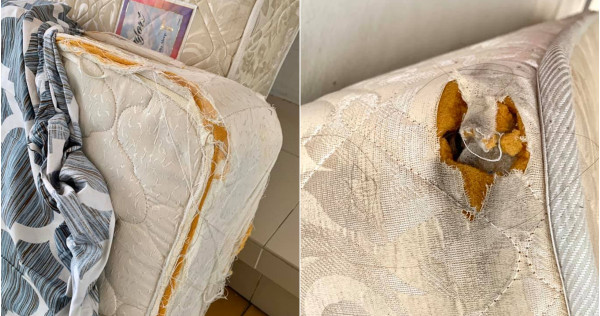
While donating pre-loved items to those in need sounds like a noble cause, not all items are meant to have a second lease of life, especially broken and damaged goods that look like they’re on the verge of disintegration.
Lee Siew Yian had chanced upon a donor giving away a couple of mattresses on Carousell for free, so long as she collected it from their apartment in Ang Mo Kio. Seeing that the listing showed a rather pristine looking mattress, Lee agreed and hired two movers to help transport them to some elderly folks in Geylang Bahru.