SINGAPORE – All public hospital emergency departments here are on “outbreak response mode” as Singapore raises its defences against a mysterious virus that is spreading in China.
“We cannot rule out the possibility that the new (Wuhan) virus will reach Singapore,” Professor Leo Yee Sin, executive director of the National Centre for Infectious Diseases (NCID), told The Straits Times. The stakes are higher now that the virus has started spreading from human to human.
All patients at emergency departments are screened, and those with fever and travel history are isolated. All general practice doctors have also been told what to look out for and given a number to call if there are any suspected patients.
Any such call from a doctor will activate a special ambulance which will transport the suspected patient straight to the NCID. This is to nip the spread of the virus in the bud. The ambulance will then be properly cleaned before it is used again.
At the NCID, the patients will be placed in special negative-pressure isolation rooms, where air flows only into the rooms, not out of them.
SINGAPORE: Prime Minister Lee Hsien Loong met Hong Kong Chief Executive Carrie Lam on the sidelines of the World Economic Forum (WEF) in Davos, Switzerland on Tuesday (Jan 21).
Both leaders reaffirmed the close and friendly relations between Singapore and Hong Kong.
They also exchanged views on regional and international developments, said the Prime Minister’s Office.
Mr Lee wished Hong Kong well, and expressed confidence that the city will overcome its current challenges and find a way forward under the “One Country, Two Systems” framework.
PM Lee Hsien Loong met Hong Kong Chief Executive Carrie Lam in Davos on Jan 21, 2020. (Photo: Prime Minister’s Office)
Hong Kong has been embroiled in more than seven months of turmoil sparked by a now withdrawn extradition Bill which has dented confidence in the financial hub.
Mrs Lam is at the Swiss conference to meet global business and political leaders accompanied by Hong Kong’s trade secretary, top officials from the stock exchange, airport authority, MTR Corp and the head of Swire Group.
Mr Lee is attending with Senior Minister Tharman Shanmugaratnam and Communications and Information Minister S Iswaran.
He will be speaking at a dialogue session entitled “A Conversation with Lee Hsien Loong, Prime Minister of Singapore”, and will also meet other political and business leaders on the margins of the WEF meetings.
SINGAPORE: The National Centre for Infectious Diseases (NCID) is poised to be the first line of defence against the Wuhan virus, should it land in Singapore.
The centre, which opened in September last year, has begun conducting pre-screening for patients and designated a special precaution area for suspected cases.
On Tuesday (Jan 21), the Ministry of Health broadened the criteria for suspected cases, a day after announcing temperature screening for all travellers arriving at Changi Airport from China.
A notice placed outside the National Centre for Infectious Diseases.
Travellers with pneumonia who were in China within the two weeks before symptoms started showing will be isolated. Those with acute respiratory infection who have been to any hospital in China in the 14 days before symptoms surfaced will also be isolated.
NCID has more than 330 isolation rooms within its Jalan Tan Tock Seng facility, where suspected cases may be housed until they are determined to no longer be infectious.
There is no specific medication or treatment for the novel coronavirus, but patients can expect to receive all necessary supportive treatment such as oxygen therapy to support the lungs.
NCID executive director Professor Leo Yee Sin said the centre is working closely with MOH to monitor and prepare for the situation.
The negative pressure isolation room at NCID.
“Singapore is very well-connected regionally as well as globally. We need to be ready, because we cannot confidently rule out the possibility of receiving a case of this novel coronavirus.
“So the healthcare system is now being put on alert… We have such capacity in terms of the availability of the isolation beds, as well as trained individuals to be able to step up to the role, to be able to support the ministry in outbreak readiness … We will do our best,” said Prof Leo.
China has confirmed the virus can spread between humans and Prof Leo noted there have been other interesting observations.
“We have received reports indicating that there are more male than female (individuals) coming down with this novel coronavirus, and those older individuals as well as those with comorbidities tend to have more severe disease,” she said.
The NCID is also key in determining and confirming if a patient has the virus, which it does by looking for distinct sequencing patterns in a laboratory.
The seven suspected cases in Singapore had their respiratory secretion samples sent there and all were tested negative for the Wuhan virus.
Testing for the virus is done in-house under strict protocol.
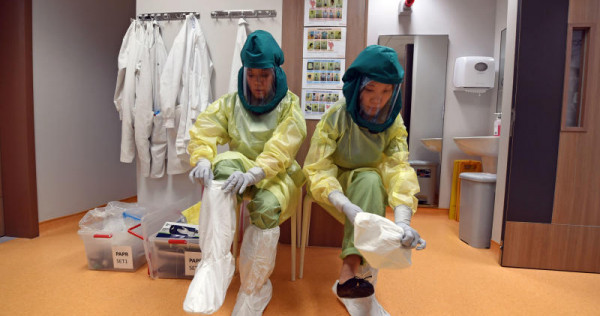
The testing is done in-house at the National Public Health Laboratory under strict protocol to ensure staff are well-protected. Any staff testing for the virus will need to wear the full personal protective equipment (PPE), which include double-layer gloves, and breathe through a Powered Air-Purifying Respirator.
“The novel coronavirus shares certain things that are common to other coronaviruses like the SARS coronavirus, the MERS coronavirus from the Middle East and actually even from our normal common colds. We must find that part of virus that is unique to the new coronavirus and then we design our test to target only that,” said laboratory director Associate Professor Raymond Lin.
Assoc Prof Lin said this testing technique is common around the world, but because it is a new virus, various institutions may design the test slightly differently.
“Which is the best design, we can only tell with time … or whether there’s a need to improve or refine the test,” he said.
Community doctors including general practitioners (GPs) and polyclinic doctors are also on alert, especially since patients usually seek help from them first.
Dr Chung Wing Hong, a GP at Finest Health Medical Centre in Toa Payoh, said the standard protocol would be to check the patients’ travel history. Symptoms such as high fever and breathlessness are also tell-tale signs of suspected cases.
NCID employees wear protective gear before carrying out in-house testing for the virus.
“If the patient is stable enough, then a dedicated ambulance service will be called upon to divert these patients to the relevant hospitals. If the patient is unstable, means (they are) in very severe respiratory distress, then the SCDF 995 will be activated,” he said.
Patients above 16 years old will be taken to Tan Tock Seng Hospital’s emergency department, while children below 16 years will be taken to the emergency department at KK Women’s and Children’s Hospital.
If necessary, they will then be transferred to NCID.
Dr Chung said most clinics will stock up on PPE for staff, including items like N95 masks, surgical gowns and gloves. These will likely be deployed when a confirmed case is reported.
As for the general public, Prof Leo said defence against the virus really comes down to maintaining good personal hygiene.
“For those individuals who need to travel overseas, it is important that they first do adequate homework to find out the situational changes in locations they are going to go to and avoid crowded areas as well as at-risk areas such as markets,” she said.
SINGAPORE: From Wednesday (Jan 22), Singapore will place all pneumonia patients who have been to China in recent weeks under isolation, the Ministry of Health (MOH) said on Tuesday.
People who have pneumonia and have travelled to China in the 14 days before their symptoms surfaced will be isolated in hospital as a precaution to prevent transmission, MOH said.
Those who have acute respiratory infection and had visited any hospital in China in the 14 days before they fell ill will also be isolated.
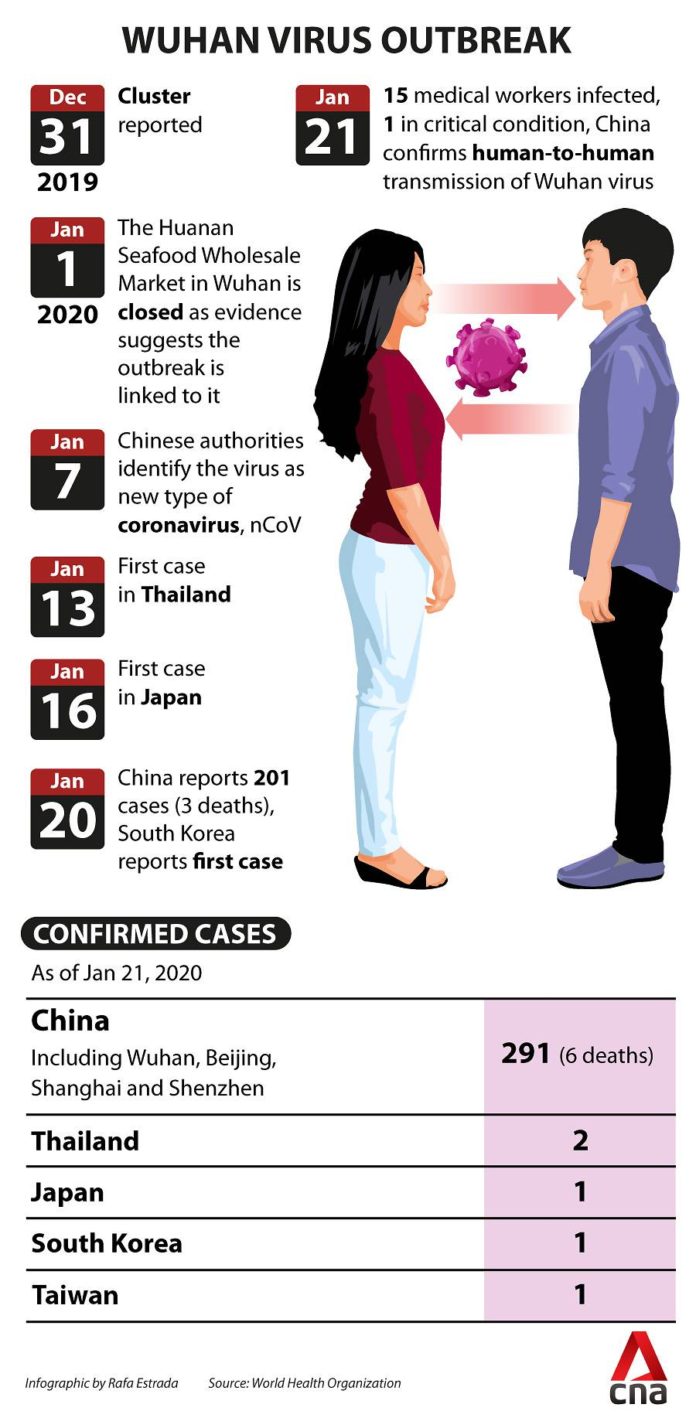
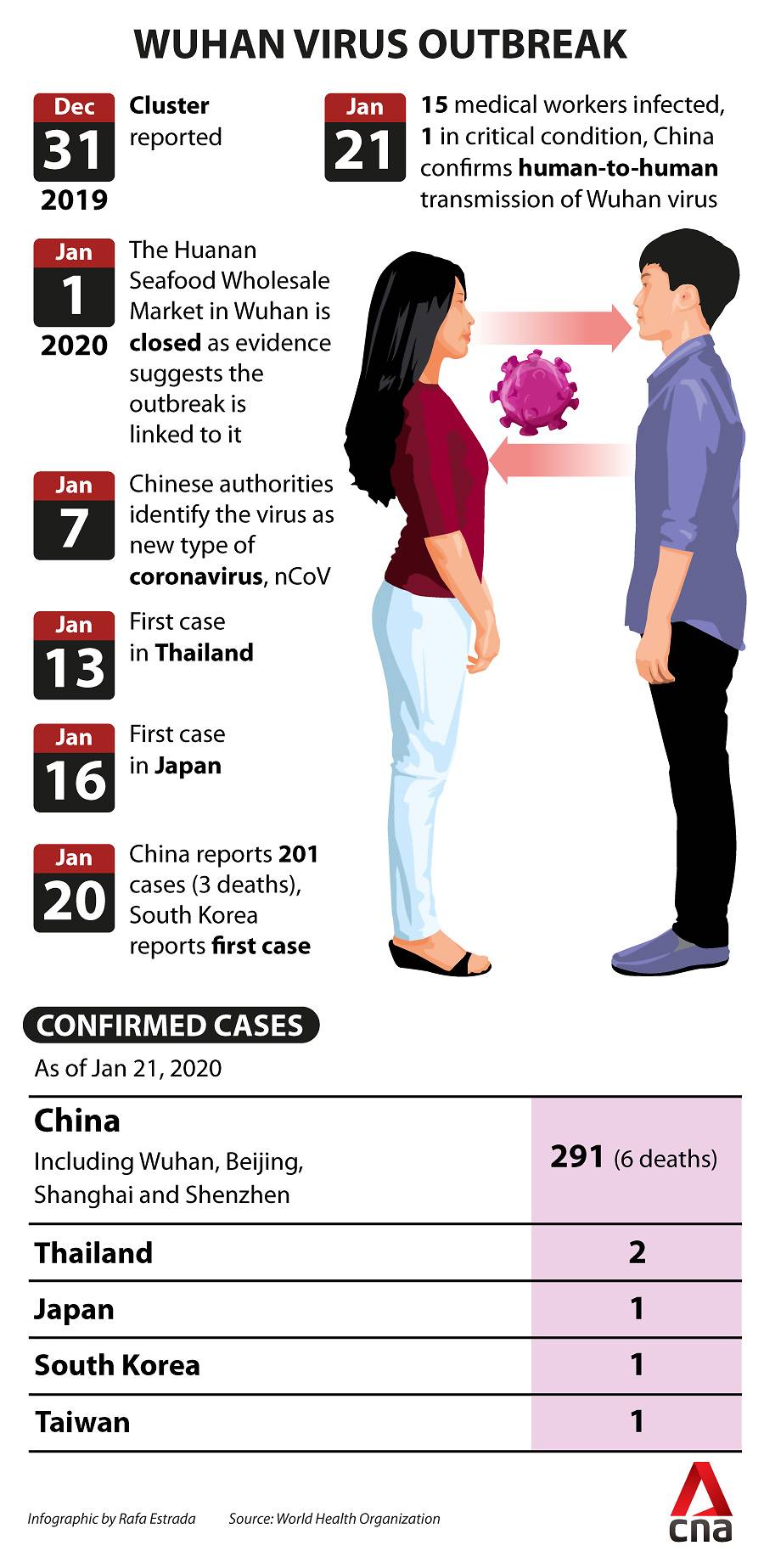
The additional measures come after the confirmation of human-to-human transmission by the Chinese authorities.
From Australia to Thailand and as far as Nepal, nations stepped up fever checks of passengers at airports to detect the SARS-like coronavirus.
The death toll in China has risen to six and the number of cases jumped to 291, raising concerns in the middle of a Chinese New Year holiday travel rush.
The virus was confirmed to have spread to more parts of China, with the eastern province of Zhejiang reporting five cases, and the northern city of Tianjin reporting two.
There were also 14 cases reported in Guangdong, five in the capital Beijing and another two in Shanghai by the end of Monday.
Two cases have already been identified in Thailand, one in Japan and one in South Korea. Taiwan also confirmed its first case, a woman who had returned from working in Wuhan, on Tuesday.
TEMPERATURE SCREENING
Singapore’s MOH also updated that temperature screening at Changi Airport for all travellers on flights arriving from China will start on Wednesday.
Suspect cases will be referred to hospitals for further assessment.
“To date, there have been no confirmed cases of the novel coronavirus reported in Singapore,” it said.
“However, given the high volume of international travel to Singapore, we expect to see more suspect cases and possibly imported cases.”
Once a case is confirmed, contact tracing will be initiated. Authorities will implement strict isolation, quarantine, and infection control and prevention measures to prevent further transmission, MOH said.
Since the start of the year, seven people in Singapore have been warded and tested after they were found to have pneumonia and travelled to Wuhan.
All of the cases tested negative for coronavirus and were not linked to the cluster in Wuhan, MOH said.
I’m 30 and life has just begun. More than a year ago though, I was in a rut. The “me” today is a different person, but that didn’t happen until after I quit my dream job as a music editor, packed my bags, and travelled around the world for a year on a mission to reinvent myself and reclaim my happiness.
At that time, my career had reached a culmination point. There was no room left to grow in the company, and I was craving new challenges. Sure, I could’ve just moved on to another job with better prospects, but it wasn’t enough to make me “whole” as a person. Deep down, I knew that embarking on this journey would be life-changing, one that would open my mind, heart and soul.
You could say that my whirlwind trip was a self-investment of sorts. Still, I was scared as hell. With no stable income, I had to survive on my hard-earned savings, which lasted through the year-long trip.
Read on to find out how you can win a personalised ‘ba zi’ consultation with Master David Goh from Imperial Harvest and download a free fengshui guide for 2020.
For many of us cubicle Rats (hello 2020!), the office is a space where we spend as much time in as our home, if not more for some.
So it probably makes sense that if we believe in fengshui for the home, then having good fengshui for the office is just as important.
Master David Goh, a third-generation fengshui master at Imperial Harvest, told AsiaOne: “Yes, home and office fengshui are critical for success for 2020, because these are the two places where we spend the bulk of our time.”
One of the basic actions he would usually advise homeowners to take is to shift their furniture around or to sleep in the direction that corresponds to their favourable elements. This is based on the Four Pillars of Destiny (destiny chart) and Home Flying Star Chart (energy chart of the house).
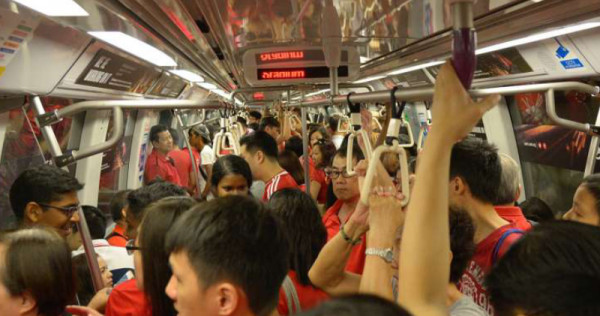
SINGAPORE – It was the peak-hour travel time on a Monday and the MRT train was likely crowded, but it did not stop Mohamad Rasid Mohamad Sani from molesting a woman with his exposed genitals.
The technical support officer stood close to a 31-year-old woman, pulled his underwear down and exposed himself through the zipper of his pants, before rubbing his member against the victim.
The 55-year-old was on Tuesday (Jan 21) sentenced to five months’ jail after earlier pleading guilty to one count of molestation.
The incident happened on May 13 last year at about 8.17am.
Court documents showed that Mohamad Rasid became “sexually aroused” when his groin made contact with the victim, who was standing in front of him in an MRT train heading towards Dhoby Ghaut station.
He then exposed himself and molested her.
After about three to four seconds, the victim turned around and realised what was happening.
She immediately shouted at Mohamad Rasid and took a photograph of the suspect.
The incident was reported to the Dhoby Ghaut MRT control station and he was arrested on the same day.
According to a study done by the Institute of Mental Health last year, one in seven people in Singapore has experienced a mental disorder in their lifetime.
Yet, a 2016 study showed that more than three-quarters of people with a mental health condition in Singapore did not seek any professional help—this was described as a “treatment gap”.
In 2014, a nationwide study examining mental health literacy by the Institute of Mental Health found that a majority of people believed that those with mental health issues could just get better if they wanted to.
This misconception can prevent those who need help from coming forward. But when IMH opened their Mental Health Helpline to the public in 2015, call numbers surged by 70%. So clearly there is a need to discuss this more openly.
Some of the greatest difficulties facing those with mental health issues are mistrust and fear—and these are often unfounded.
Some are afraid that they would have to declare their condition to a prospective employer if they sought treatment, and this might affect their chances of securing a job interview. This is false.
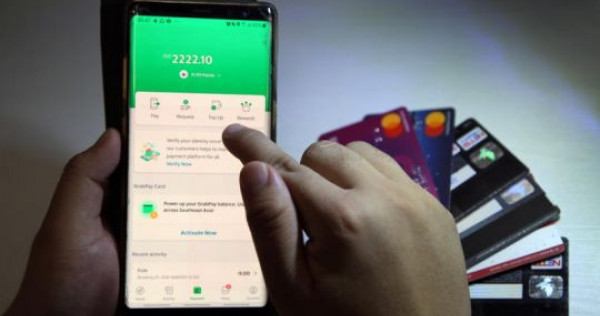
SINGAPORE – In an apparent cost-cutting move, Grab is set to reduce the number of points users can earn on a transaction, in some cases by up to 60 per cent, while raising the number of points needed to redeem certain rewards from March 2.
The revamp of the GrabRewards programme comes after the super-app player unveiled its GrabPay Card in December, which can be used with all merchants which accept Mastercard, while also giving users GrabRewards points.
At present, Grab users earn points according to various tiers, differentiated by product.
For instance, a user in the platinum tier, the highest level, can earn 10 points for every $1 when using GrabPay in stores, and six points for every $1 spent on ride hailing and food delivery.
But from March 2, platinum users will earn only four points for every $1 spent across all products.
Similarly, users on the lowest “member” tier will earn only two points per $1 spent, down from being able to earn five points per $1 for in-store GrabPay transactions and three points per $1 for GrabFood and ride hailing.
The camera pans, and a statuesque woman looks up with expressive eyes.
“My name is Sharul Channa, and no, I’m not a Malay boy. I’m an Indian woman with a Malay boy’s name,” she introduces herself in her signature opener, holding the silence in an amiable manner before flashing a warm smile.
With that, Sharul breaks the ice in the studio. Her flamboyance has a distancing effect – yet she baits the audience with what she has to say next.
Tall and elegant, with sculpted features, Sharul appears too poised to be a stand-up comic on first impression.
Yet it is the same funny girl who gamely – and boldly took on an invitation to perform her first comedy act in a bar eight years ago.
Her first (spontaneous) line was about her proximity to the front-row audience: “Wow, this is the first time a white man has been so close to my vagina.”
The amused crowd chortled – a triumphant moment when the then-theatre actor realised comedy was her calling.
“Being able to script, produce and act out my own show makes me happy,” she tells Her World.

.jpg "HerWorld01-1.jpg")