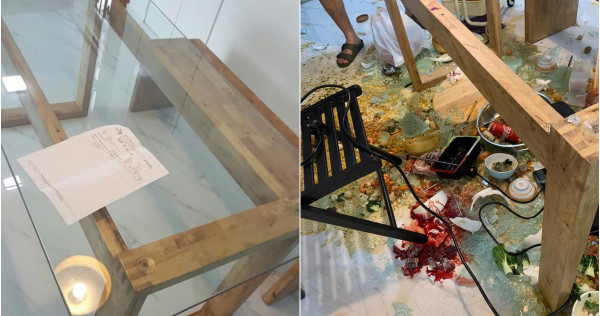
What was meant to be a joyous hotpot dinner between friends last Sunday (Jan 19) immediately turned into a horror scene.
The floor was covered in blood, soup, broken crockery and food, while everyone present suffered various degrees of burns and cuts.
Traumatised by the harrowing turn of events, homeowner and host of the party Stephanie Chu recounted her story in a post on Facebook yesterday (Jan 20). She also hoped her post would serve as a warning to others about using tempered glass table tops.
Screengrab: Facebook/Stephanie Chu
Wrote Chu: “My friends and I were having steamboat at my place. About 30 minutes into the dinner, my dining table “EXPLODED” and the entire tempered glass top shattered into pieces.
SINGAPORE: Grab’s loyalty programme GrabRewards will soon undergo a revamp that will see fewer points earned per transaction, the company announced on its website on Monday (Jan 20).
Starting Mar 2, the ride-hailing operator will reduce the number of points users can earn per transaction to between two and four points for every S$1 spent using GrabPay or GrabPay Mastercard.
Currently users earn up to 10 points for every S$1 spent though Grab-related transactions.
In the announcement, Grab said it would increase the number of places customers can earn points at.
(Image: Grab.com)
There will also be changes to the number of points needed for discount vouchers for Grab rides or GrabFood deliveries.
Under the current rewards system, users need 500 points to redeem a S$1 voucher, 2,200 points for a S$5 voucher, and 4,200 points for a S$10 voucher.
But starting from Mar 2, the points needed per voucher will increase.
(Image: Grab.com)
“The GrabRewards catalogue will undergo a revamp that revises points needed for redemption, while offering a larger variety of rewards,” Grab said.
“We’ll be expanding the rewards selection and revising the pricing structure for redemptions. We’ll also be introducing GrabRewards Flash Sale events so you can save up to 50 per cent on your redemptions.”
GrabRewards was launched in 2016, with users earning points when they take Grab rides.
In a clip that was posted on Facebook, a youth could be heard saying “We’re here in the mall, enjoying some Burger King…” as two teenage boys whizzed past him on their bicycles.
As they paddled up the travellator from basement one, he told them: “No cycling allowed in the mall.”
One of the boys dismounted and pushed his bicycle as the youth reiterated his point, saying: “Cannot bring bike into the mall, brother.”
Once the cyclist reached level one, however, he hopped back onto his ride to make a hasty exit with his friend.
It is unclear if the boys’ antics were filmed by someone they know.
For the past seven years, 70-year-old Singaporean Julia Lee has rarely travelled overseas. Her most recent trip was one night away, in neighbouring Malaysia.
Since being diagnosed with kidney disease, Lee has spent 10 hours each day hooked up to a 20-kilogram machine, making it difficult to move around.
Chronic renal disease results in a loss of kidney function, meaning the patient’s body is unable to clear the blood of waste and excess fluids. Dialysis – the treatment Lee goes through which involves machines removing excess water and toxins from the patient’s blood – is the only option for those whose kidneys are no longer able to perform their function, save for a kidney transplant.
Some like Lee, whose heart problems make her unsuitable for a transplant, have to rely on the treatment permanently.
“If there was a portable device that could be carried around and used at home, it would be more convenient for me,” Lee said. “Maybe I would be able to travel more.”
A former scholar at Nanyang Technological University (NTU) was given a short detention order (SDO) of two weeks for trespassing into a female toilet at a hall to film a fellow student showering.
Han Shiyu, 18, a Chinese national, yesterday pleaded guilty to one charge each of criminal trespass and insulting the modesty of the woman.
Another two similar charges were taken into consideration.
An SDO is a jail term of up to 14 days with no criminal record.
Last Aug 12, at about 9.20pm, the victim was showering in a toilet at the NTU hall.
Han, who lived there, used his girlfriend’s access card to gain entry and went into an adjacent cubicle. He then used his phone to take a six-second video of her showering.
She saw the phone but was too afraid to confront Han. She messaged a friend and got dressed before meeting the friend outside.
CAMPUS SECURITY
The victim later alerted campus security, and the police were called at 10.10pm.
The New Paper understands that Han’s girlfriend had given him her access card to collect some of her belongings from the hall when she was hospitalised.
SINGAPORE – The Ministry of Health (MOH) said on Monday (Jan 20) that it is stepping up precautionary measures against the mysterious Wuhan virus in anticipation of more travellers in the lead-up to the Chinese New Year holidays.
The expanded measures include temperature screening for all travellers arriving from China at Changi Airport and issuing health advisory notices to them from Wednesday.
Previously, only travellers from the Chinese city of Wuhan were screened, and the advisory notices were not issued.
Together with the National Centre for Infectious Diseases, the MOH has also developed a joint clinical guidance about the disease and given them out to emergency department and infectious diseases physicians, as well as public sector hospital laboratories, to better prepare them for cases here.
The moves come even as the seventh suspected case in Singapore was identified on Monday, and more than 200 people have already been diagnosed with the new Sars-like virus in China, with cases also reported in Beijing and the southern Chinese province of Guangdong.
INDIANAPOLIS, Indiana: If you’re like most workers, you don’t spend 100 per cent of your time at the office doing what you’re supposed to be doing.
In fact, on average, US workers spend about 10 per cent of their work day surfing the internet, emailing friends or shopping online. This so-called cyberloafing costs employers up to US$85 billion a year.
But it turns out, these behaviors may not be a sign a worker is lazy or just wasting time. New research I conducted with several colleagues suggests cyberloafing can help workers cope with an exceptionally stressful work environment.
CYBERLOAFING AND STRESS
Existing research on cyberloafing, a term first coined in 2002 by researchers from the National University of Singapore, typically assumes that this behavior is problematic and counterproductive.
Therefore, the majority of cyberloafing research focuses on ways to deter employees from engaging in this behavior through interventions such as internet monitoring and computer use policies.
However, more recent research has found that using the internet at work for personal purposes may also have some positive outcomes. For instance, social media use at work has been linked to higher levels of employee engagement and job satisfaction.
And other studies indicate that cyberloafing may provide a way for employees to manage workplace stress. For instance, empirical research suggest that employees surf the web as a response to boredom and unclear instructions.
IMPACT ON EMPLOYEE STRESS
But is cyberloafing actually effective at reducing employee stress levels? That’s the question Stacey Kessler, Shani Pindek, Gary Kleinman, Paul Spector and I wanted to answer in our new study.
(Photo: Unsplash/CoWomen)
Our hypothesis was that cyberloafing may serve as a mini break during the workday, giving employees an opportunity to recover from stressful work situations.
To test this, we recruited 258 university students who also worked at least 20 hours per week to complete an online survey about their experiences on the job.
Specifically, we asked them to rank how much time they spent doing a variety of cyberloafing behaviors such as checking non-work email and shopping, ranking them from “never” to “constantly”.
We also asked participants to rank job satisfaction, their desire to quit and how often they’ve experienced mistreatment at work, such as being bullied, threatened or yelled at.
As you might expect, we found that participants who reported more workplace mistreatment had lower levels of job satisfaction and were more likely to want to leave their companies.
More interestingly, we found that cyberloafing effectively buffered this connection. That is, mistreated workers who spent more time surfing the web and checking emails reported higher job satisfaction and were less likely to want to quit than similar participants who didn’t cyberloaf as much.
This suggests that cyberloafing acts as a sort of relief valve for workers, helping them recover from stressful experiences.
Overall, about 65 per cent of participants reported spending at least some time at work cyberloafing, in mostly moderate amounts, with the most common form being the use of personal email.
(Photo: Unsplash/Matt Wildbore)
While we did not directly assess how cyberloafing affects worker performance, we believe that by relieving stress this buffering effect may ultimately help employees be more productive.
This fits with other recent research that suggests taking short breaks throughout the work day is indirectly associated with higher levels of daily job performance.
That isn’t to say that cyberloafing is always good. Too much time spent on non-work activities likely causes performance to suffer.
CUT THEM SOME SLACK
All in all, managers should cut workers a bit of slack when it comes to cyberloafing.
Our results do not mean, however, that they should simply let employees cyberloaf instead of directly addressing workplace problems like bullying. If managers only focus on cyberloafing, they would be addressing a symptom rather than the root of the problem.
And of course, there are other reasons workers cyberloaf. For instance, some individuals do it to “get back” at their organisations for a perceived slight or simply because they see coworkers cyberloaf.
Future research needs to be done to better understand the factors that motivate employees to cyberloaf. But maybe, just maybe, a little bit of shopping or surfing at work could make you more productive in the long run.
Stephanie Andel is Assistant Professor of Psychology at Indiana University – Purdue University Indianapolis. This article first appeared on The Conversation.
Pirates on sampans struck in the Singapore Strait again on Saturday, targeting a barge pulled by the tug boat Kim Hock Tug 9 twice in five hours.
While the pirates did not confront the crew members, they were able to escape with several pieces of scrap metal.
In an incident alert yesterday, the Regional Cooperation Agreement on Combating Piracy and Armed Robbery against Ships in Asia’s Information Sharing Centre (ReCAAP ISC) said the same barge laden with scrap metal was targeted twice in the east-bound lane of the strait.
At about 11.30am, seven pirates were spotted on the barge being towed from Singapore to Vietnam.
When another tug boat approached the barge, the pirates fled in three sampans with some scrap metal.
A few hours later at about 4pm, seven pirates were again spotted on the same barge, and two Singapore Police Coast Guard craft were dispatched to intercept them.
But the pirates again evaded capture, escaping on their sampans with more scrap metal.
Both incidents happened about 20km apart in the waters between Singapore and Batam.
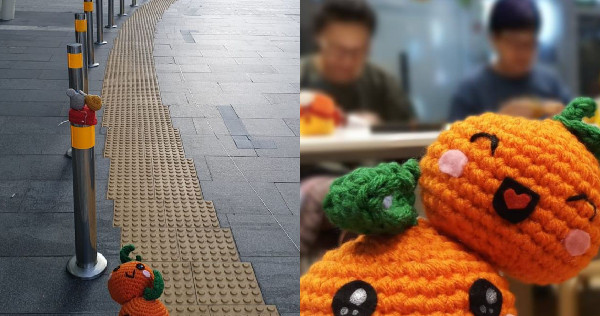
Public art installations or a free-for-all? Unfortunately, it seems like some can’t tell the difference.
A recent outdoor art initiative was derailed when most of the crocheted art pieces on display were stolen, organisers Yarn Bombing Singapore wrote in a Facebook post on Jan 19.
The Chinese New Year-themed decorations, which included anthropomorphic ingots, mandarin oranges and mice, had been put up at the taxi stand at Fusionopolis One on Jan 17.
The adorable characters were created by volunteers as part of a partnership between Yarn Bombing Singapore, a community of yarn-enthusiasts, and JTC Corporation, which manages Fusionopolis.
While there was no signage on-site, the Yarn Bombing Singapore logo was displayed on the centre topper, a Despicable Me minion dressed in red overalls.
By the next morning, however, only five of the 16 toppers which had adorned the bollards at the taxi stand remained.





.jpg "21012020_KidneyChief_SCMP-1.jpg")