SINGAPORE: A second flight bringing Singaporeans and their family members back from Wuhan, Hubei landed at Changi Airport on Sunday morning (Feb 9).
There were 174 Singaporeans and their family members on the flight, the Ministry of Foreign Affairs (MFA) said in its statement on Sunday, adding that its Consular Officers and medical personnel accompanied the Scoot flight to facilitate the operations.
“The returning passengers will undergo medical screening upon arrival at Changi Airport,” the statement added.
Those with fever or respiratory symptoms will be taken to designated hospitals for further examination, while the remaining passengers will be quarantined for 14 days.
“The Singapore Government expresses its appreciation to the PRC government, Hubei provincial government, Wuhan city government, and the PRC Embassy in Singapore for facilitating their safe return,” the MFA said in the statement.
The flight also brought some Chinese nationals back home to Wuhan, it added.
Foreign Affairs Minister Vivian Balakrishnan welcomed the passengers on the flight in a Facebook post.
“The MFA crisis response team, medical personnel, pilots, and crew of Scoot TR5121 who volunteered for this operation deserve our deepest admiration for their courage and sense of duty. They exemplify the best of humanity in tough times,” he said.
In a press statement on Saturday, MFA said that the Chinese authorities agreed to its request to launch the second flight to bring Singaporeans and their families home.
Scoot flight TR5120 departed from Singapore on Saturday afternoon.
The plane delivered humanitarian assistance from the Singapore Government, including medical supplies and about 10,000 diagnostic test kits.
On Saturday night, Singapore confirmed seven new cases of novel coronavirus, including a taxi driver and a private-hire car driver, taking the country’s tally to 40.
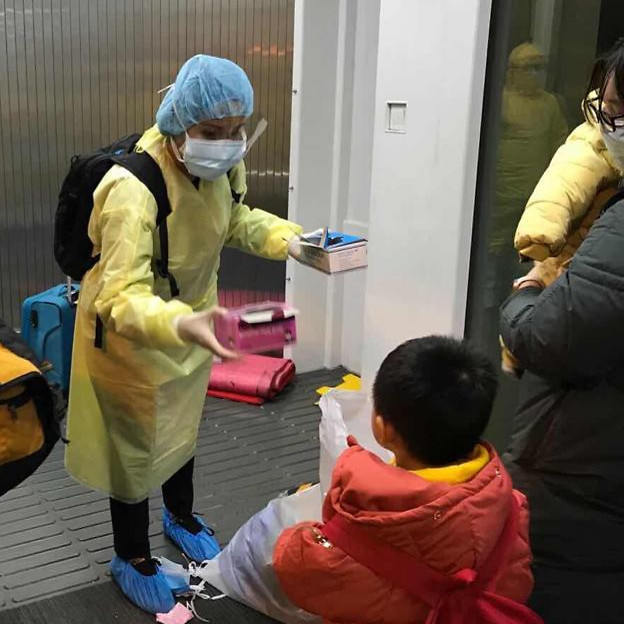
An official from the Ministry of Foreign Affairs (MFA) handing out masks to returning Singaporeans and their family members before they boarded the flight home. (Photo: MFA)
Of the confirmed cases, four are in critical condition, with one requiring additional oxygen support.
Two have been discharged, and the remaining are mostly “stable or improving”, said the Ministry of Health (MOH) in a press release.
Last week, Singapore flew 92 Singaporeans home from Wuhan, four of whom have since been diagnosed with the coronavirus.
Minister for National Development Lawrence Wong said at the time that some Singaporeans were unable to come back because they were already symptomatic.
Foreign Affairs Minister Vivian Balakrishnan said in Parliament on Monday that Singapore will not leave any overseas citizen behind, in the wake of the novel coronavirus outbreak that has since killed more than 700 people and infected more than 35,000, mostly in China.
On Saturday, the Ministry of Health confirmed seven new cases of the novel coronavirus, taking the total number of cases in Singapore to 40. Two of the new cases involved a taxi driver and a private-hire car driver.
Of the 40 confirmed cases, four are in critical condition, with one requiring additional oxygen support. Two have since been discharged, MOH said.
SINGAPORE: The question of whether Singapore can or, more interestingly, should strive toward low-carbon energy transition has been raised recently in climate debates.
In an opinion piece by The Straits Times titled Can Singapore really transit to a post-oil economy?, economists Dr Tilak Doshi and Professor Euston Quah responded to a CNA commentary by Yale-NUS climate data scientist Angel Hsu and attempted to make a case against what they call “an over-hasty transition to newer but less efficient technologies”.
The opinion piece made a strong statement: “Policies fashioned by green ideology will lead to Singapore collapsing economically first before it may drown in sea level rise”.
However, we find the narrative of green ideology posing risk for Singapore’s development rather unbalanced.
The authors argue that Singapore’s legacy as a major petrochemical and refining hub must be central to climate policy discussions, which is indeed undeniable. Oil refining, petrochemicals and specialty chemicals production is one of the key pillars of Singapore’s economy, contributing around 22 per cent of nominal gross domestic product in 2018.
But a green economy does not preclude the petrochemical and refining industry altogether, and there are multiple scenarios of a low-carbon transition for Singapore.
For example, adopting technologies for carbon capture, storage and utilisation could cut carbon emissions of the petroleum refinery and chemical industries without significantly affecting economic output.
However, the technology’s cost and energy efficiency have to be improved first, which is why Singapore needs to focus on research and development in that area.
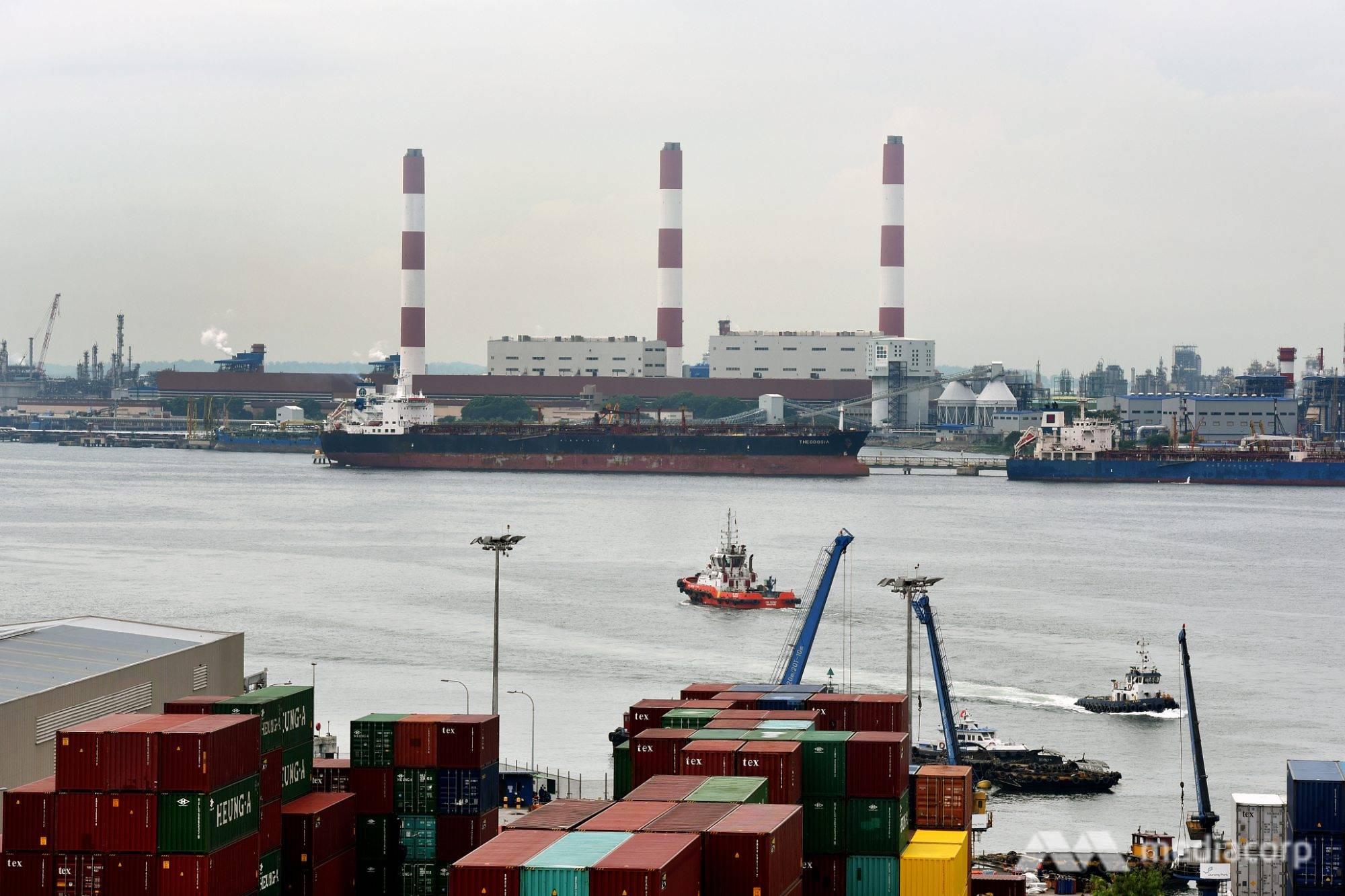
File photo of infrastructure on Jurong Island. (Photo: AFP)
It is fair to argue that pace of energy transition is critical – rapid transition might bring devastating consequences. But there are solid reasons to suggest that achieving a greener economy deserves to be an end-goal for Singapore.
A TRANSITION TOWARDS RENEWABLES IS ON THE HORIZON
One of the criticisms that the green energy transition received in the opinion piece concerned its slow pace.
But oil giant BP’s 2019 Energy Outlook suggests that renewable energy’s penetration into the global energy system is poised to be the quickest compared to any other fuel in history.
While oil and gas took around 40 to 50 years to rise from 1 per cent to 10 per cent in the global energy mix, renewables can take less than 25 years to achieve the same share.
Further data from BP and the US Department of Energy indicate that renewable energy would comprise around a third of global electricity generation by 2040. At the same time, in Southeast Asia, the share of renewables in electricity supply would be around 15 per cent in 2040.
Although that seems to be mild progress, a higher share of renewable electricity paves the way for deeper decarbonisation of Singapore. To really understand the island’s low-carbon transition, we must take a closer look at the ongoing moves toward a greener economy and the opportunities these afford.
HOW THE CLEAN ENERGY TRANSITION IS HAPPENING
At the recent Institute of Policy Studies Perspectives 2020 conference, Minister for Trade and Industry Chan Chun Sing said that Singapore is looking at a post-fossil fuel future given the global trends in decarbonisation.
He said however, that this was dependent on how fast Singapore is able to adopt the necessary technologies and address the shift in economic structure that decarbonisation would bring.
Minister for Trade and Industry Mr Chan Chun Sing speaking at the Institute of Policy Studies’ Singapore Perspectives Conference 2020 on Jan 20, 2020.
Last year, Mr Chan also announced that Singapore would develop “four switches”: Natural gas, solar power and energy storage, regional power grid and low-carbon energy options.
NATURAL GAS
Despite the growth in solar photovoltaic (PV) capacity, Singapore will continue to rely on natural gas over the next 50 years. Natural gas is the cleanest form of fossil fuels, at 50 per cent of carbon intensity of coal and 70 per cent that of oil.
Singapore, like all countries, is concerned about threats to energy security, such as supply disruptions and price increases.
Because we are still studying how much solar electricity Singapore’s grid can take while still ensuring stability and reliability of supply, natural gas is a compromise between more polluting fossil fuels and renewable energy.
SOLAR POWER AND STORAGE
Singapore’s total electricity generation capacity is around 1.9 times the peak system demand, according to the Energy Market Authority’s Singapore Energy Statistics 2019.
Solar PVs contributed 174.3 MW, or 1.3 per cent of total electricity capacity in 2019 but more information on solar energy demand can help inform Singapore’s energy transition.
The lack of technical need for additional capacity, and a limited understanding of the percentage of solar energy in Singapore’s current energy mix could also be a reason for the inertia in adopting solar energy at a faster pace.
This shift towards solar energy should focus on both reducing peak demand and consuming less electricity all around.
Greater transparency in data and better understanding of energy terminologies could be helpful for an assessment of how Singapore’s electricity mix could become greener.
Additionally, the traditionally vertically integrated power generation utilities were fully divested from Temasek Holdings in December 2008.
But corporate ownership of utilities in Singapore could add to delays in decision-making on adoption of renewables, especially when Singapore’s Nationally Determined Contribution or climate pledge currently does not include a specific renewable energy target.
Solar panels on the rooftop of an HDB block in Singapore. (Photo: Sembcorp Industries)
However, recent initiatives by the Singapore Government inspire optimism for the future of solar PV on the island.
The second “switch”, solar power, sets ambitious targets of reaching at least 2 gigawatt peak (GWp) of installed capacity by 2030, or around 4 per cent of current electricity demand.
Knowing that intermittency of generation is one of the key barriers to solar power development, the Singapore Government is planning to deploy energy storage capacity of 200 megawatts beyond 2025.
This way the power can be accumulated when the sun is shining and used later to minimise potential interruptions in electricity supply.
Among measures to achieve the solar target is the installation of decentralised solar power in residential sector.
A significant progress in that area was made by the SolarNova programme launched in 2014 by HDB and EDB of Singapore.
Since its launch, the programme has installed solar panels on rooftops of about 2,000 HDB blocks, with the installation at additional 2,370 HDB blocks ongoing.
It is worth noting that large-scale solar power in Singapore achieved “grid parity” in 2013, meaning that the cost of solar electricity generation has become equal to or less than that of conventional energy.
Government-led energy storage deployment, falling costs for utility-scale battery storage and grid parity of solar energy build strong prospects for the solar power as commercially feasible and promising industry in Singapore.
A REGIONAL POWER GRID
The Government is also exploring the possibility of creating a regional power grid as the third switch. Creation of such a grid can open vast opportunities for renewable energy trade.
File photo of a power station in Singapore. (Photo: Jeremy Long)
For instance, companies in Singapore could invest in regional renewable energy projects and use renewable energy certificates (RECs) to receive the same amount of electricity from the grid.
RECs are proof of electricity generation from renewable sources, and can be bought and sold by companies to achieve their green targets. In 2019, Singapore utility firm SP Group became the first authorised issuer of renewable energy certificates (REC) in the Asia Pacific.
HYDROGEN AND CARBON CAPTUREAND UTILISATION
Besides solar power, Singapore is also tapping into low-carbon energy alternatives, named a fourth switch.
Hydrogen as a clean fuel is gaining attention in Singapore’s energy agenda. Last year, the National Climate Change Secretariat, housed under the Strategy Group in the Prime Minister’s Office announced a tender for a feasibility study of hydrogen imports and downstream applications.
Development of hydrogen in Singapore’s energy system could allow to significantly reduce carbon emissions and boost production of valuable chemicals, provided that hydrogen is generated using renewable energy. Currently, the vast majority of hydrogen is generated using natural gas.
Another strategic opportunity pursued by the government is carbon capture and utilisation (CCU).
Singapore has a number of stationary sources of carbon emissions including refineries, power plants and petrochemical facilities. Carbon capture technology traps the emitted carbon, which then can either be transported to a geographical storage or converted to other valuable products.
Lack of available storage sites in Singapore makes utilisation of captured carbon, for example to produce methanol or mineral aggregates, a meaningful option to reduce the island’s emissions and capitalise on its economic value.
Carbon dioxide storage tanks are seen at a cement plant and carbon capture facility in Wuhu, Anhui province, China September 11, 2019. Picture taken September 11, 2019. REUTERS/David Stanway
With access to hydrogen, carbon dioxide could be used to produce fuel and chemical feedstock, which can supply domestic needs or sold internationally. Carbon dioxide can also be utilised in production of construction materials.
WHAT CAN BE DONE NEXT?
Singapore should continue its commitment to decarbonising its economy outside of the energy generation sector.
Solar power, hydrogen, carbon capture and utilisation and other energy efficiency technologies have a strong potential to reduce Singapore’s emissions while contributing to its economy.
Energy security cannot be the last concern for Singapore given its heavy reliance on natural gas imports for power generation. Rising demand for liquefied natural gas (LNG), mostly driven by Asia, renders Singapore’s energy sector potentially vulnerable to volatility and price shocks.
By diversifying its energy mix, Singapore can reduce its dependence on imported LNG and strengthen its energy resilience.
Therefore, the focus should be on controlling the growth of natural gas consumption. It doesn’t matter how laudable Singapore’s solar targets are if the growth in energy consumption offsets renewable energy capacity additions. Singapore should strive toward meeting new energy demand through expansion of solar power deployment and energy efficiency measures.
One critical way to facilitate that is setting a more ambitious Nationally Determined Contribution (NDC) for 2030.
At the Madrid COP25 climate conference last December, Singapore’s Minister for the Environment and Water Resources Masagos Zulkifli announced in his speech that Singapore will update its NDC and communicate a long-term low emissions strategy soon.
Singapore’s updated NDC should translate into more specific targets for long-term energy mix of Singapore.
Having specific targets for solar and hydrogen will indeed send a market signal and galvanise action toward a greener future in Singapore.
Magzhan Sovetbek is a Research Associate at the Energy Studies Institute, National University of Singapore. Melissa Low is a Research Fellow at the Energy Studies Institute, National University of Singapore.
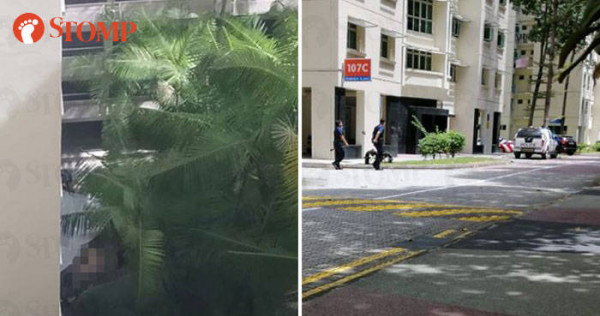
A 47-year-old man was found motionless at the foot of Block 109B Edgefield Plains in Punggol on Thursday morning (Feb 6).
The man was subsequently pronounced dead by paramedics at the scene.
The police told Stomp they were alerted to a case of unnatural death at 9.06am.
Another man, 43, was found in a unit at the said block and was arrested for suspected consumption of drugs and wrongful confinement in relation to the case, a police spokesman said.
Stomp understands the 43-year-old had confined the 47-year-old in a room.
Stomp contributor Serene alerted Stomp to the incident and shared photos she took at the scene.
In the photos, a half-naked man is seen lying at the foot of the block. The area is cordoned off by the police.
SINGAPORE – There are seven new coronavirus cases in Singapore, the Ministry of Health announced on Saturday (Feb 8).
Of these, five are linked to previously announced cases.
Among the new confirmed cases are a taxi driver and a private-hire car driver, it said.
There is also a possible new cluster comprising five cases, linked to The Life Church and Missions Singapore in Paya Lebar.
The total number of people infected here has grown to 40.
Two of the patients have been discharged, but four are now in critical condition and in the intensive care unit, said MOH in its latest update.
ABOUT THE SEVEN NEW CASES
1. Case 34 is a 40-year-old female Singapore citizen with no recent travel history to China. She is currently warded in an isolation room at the National Centre for Infectious Diseases (NCID).
SINGAPORE: Ride-hailing operator Grab will suspend its GrabShare service in Singapore with effect from 1am on Sunday (Feb 9), amid concerns over a novel coronavirus outbreak.
“Due to the latest developments, GrabShare services will be temporarily unavailable from Feb 9, 1am until further notice,” the company said in a statement on Saturday. “We appreciate your understanding while we work closely with the relevant authorities to monitor the situation,” it added in a notice to app users.
Grab’s other ride-hailing services, including JustGrab, will remain available.
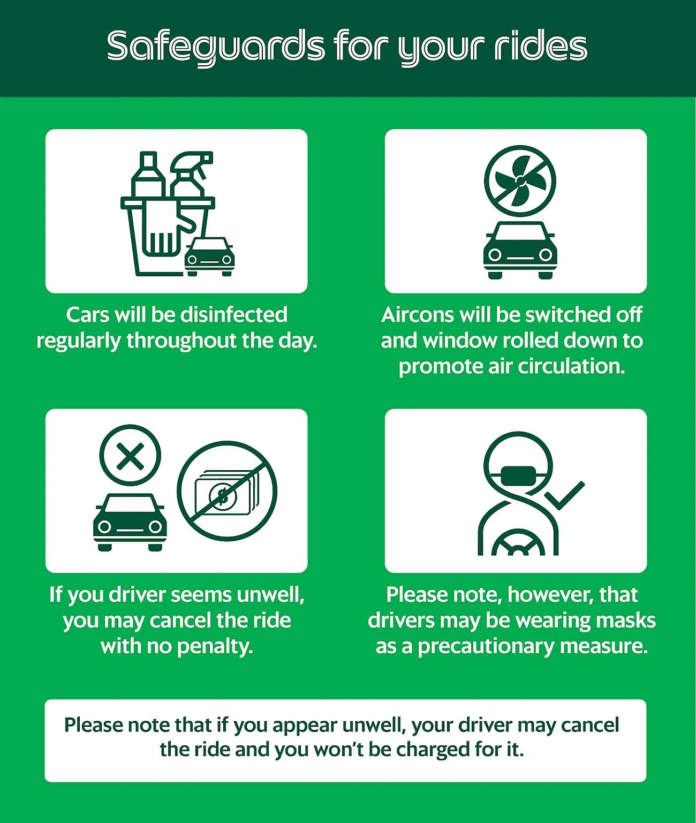
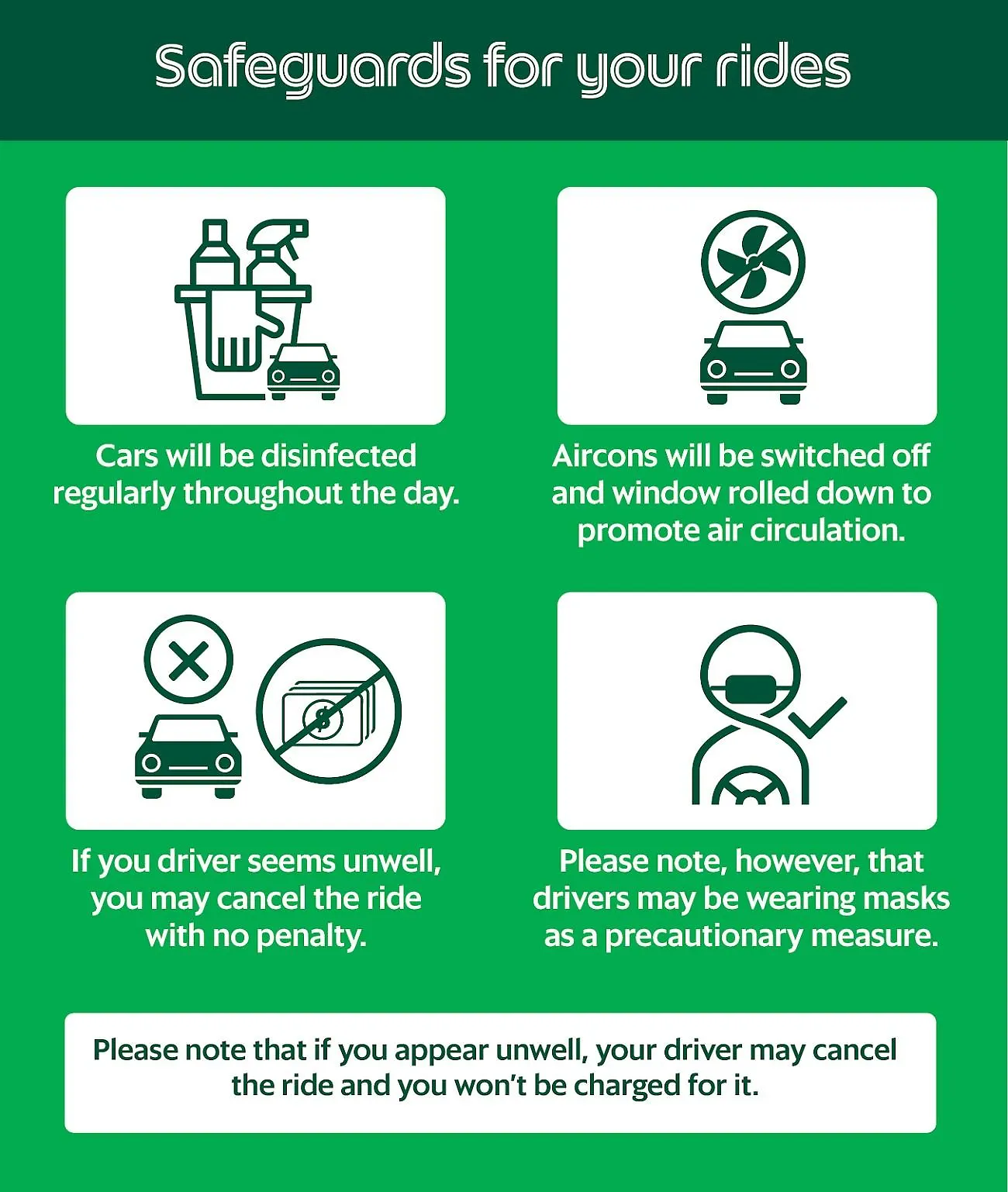
The company said that it will implement several safeguards for riders and drivers, including regularly disinfecting cars through the day, switching off air-conditioning and rolling down the windows for air circulation. It will also allow customers to cancel rides without penalty if their driver seems unwell.
Grab will suspend its GrabShare services as of 1am on Feb 9 until further notice. (Image: Grab)Grab will suspend its GrabShare services as of 1am on Feb 9 until further notice. (Image: Grab)
The Ministry of Health (MOH) late Saturday confirmed seven new cases of the novel coronavirus – including a taxi driver and a private-hire car driver. Singapore now has 40 cases of the virus.
Of the 40 confirmed cases, four are in critical condition – up from two on Friday.
SINGAPORE: A second flight bringing Singaporeans and their family members back from Wuhan, Hubei is expected to arrive in Singapore on Sunday (Feb 9) morning.
“Appropriate quarantine arrangements have been made for all of them,” said the Ministry of Foreign Affairs (MFA).
Singapore flew 92 Singaporeans home from Wuhan last week, four of whom have since been diagnosed with the coronavirus.
Minister for National Development Lawrence Wong said at the time that some Singaporeans were unable to come back because they were already symptomatic.
Foreign Affairs Minister Vivian Balakrishnan said in Parliament on Monday that Singapore will not leave any overseas citizen behind, in the wake of the novel coronavirus outbreak that has since killed more than 700 people and infected more than 35,000, mostly in China.
In a press statement on Saturday, MFA said that the Chinese authorities agreed to its request to launch another flight to bring Singaporeans and their families home.
Scoot flight TR5120 departed from Singapore on Saturday afternoon.
The plane will deliver humanitarian assistance from the Singapore Government, including medical supplies and about 10,000 diagnostic test kits.
“Today is chap goh mei, which is another traditional evening for family reunion. So, for us to be able to launch this flight to bring our Singaporeans back on this day is extra special,” said Dr Balakrishnan, at the handing over of Singapore’s humanitarian assistance to Ambassador of the People’s Republic of China Hong Xiaoyong at Changi Airport on Saturday.
Dr Balakrishnan also thanked the airline crew, pilots and cabin crew for continuing to fly.
“We are maintaining links between Singapore, Beijing, Shanghai, Guangzhou and Chongqing and the fact that these links are available for essential services is a very important point, especially in a time of crisis,” he said.
Foreign Minister Dr Vivian Balakrishnan speaking to the press after handing over Singapore’s humanitarian assistance to Ambassador of the People’s Republic of China Hong Xiaoyong. (Photo: MFA)
On Friday, Singapore raised the DORSCON level following several cases of novel coronavirus without any links to previous cases or travel history to mainland China. The number of cases in Singapore is 33, with at least four patients with no recent travel history to China or links to the other cases.
SINGAPORE: NTUC FairPrice has sufficient supply of rice, noodles and toilet paper, said the head of the supermarket chain on Saturday (Feb 8), as he urged the public to buy only what they need.
“At this point in time, we have over 9 million toilet rolls. We have about 1.2 million packs of instant noodles. We have over 4 million kilos of rice, presently. And stocks continue to come in,” said FairPrice Group CEO Seah Kian Peng.
Three new cases of novel coronavirus were confirmed on Friday, taking the total number of cases in Singapore to 33. Globally, the virus has killed more than 700 people and infected more than 34,000.
FairPrice has increased the volume of its daily essentials being sent to its stores by three times, Mr Seah told reporters at one of the chain’s distribution centres in Joo Koon. The number of delivery trips has also doubled.
FairPrice had built up its stock in preparation for Chinese New Year as per its usual practice, and decided to continue doing so, said Mr Seah.
FairPrice Group CEO Seah Kian Peng at the supermarket chain’s warehouse and distribution centre on Feb 8, 2020. (Photo: Gaya Chandramohan)
FIVES TIMES THE USUAL DEMAND FOR RICE
On Friday, the supermarket chain saw five times the usual demand for rice, four times the usual demand for noodles and more than two-and-a-half times the usual demand for toilet paper, he said.
Over 4 million kg of rice is stockpiled in NTUC FairPrice distribution centres, said Mr Seah Kian Peng. (Photo: Gaya Chandramohan)
A worker moves products at an NTUC FairPrice distribution centre on Feb 8, 2020. (Photo: Gaya Chandramohan)
“This sudden surge was one that, I would say, caught us by surprise. But I want to assure everyone out there, as you have seen at one of our three warehouses here, we do have stock available. But it does take us time to replenish the stocks, of which we are trying our best,” said Mr Seah.
He urged shoppers to only “buy what you need”, saying that there’s no need for them to “create your own little stockpile at home”.
“Because when you do that and everyone’s trying to get it on the same day and at the same time buying more things, you just add strain to the system.”
Ms Toh Hui Leng, FairPrice’s chief supply chain officer said its distribution centre at 1 Joo Koon Circle can hold more than 52,000 pallets of dry goods. It is currently at about 70 per cent capacity, up from the usual 60 to 65 per cent.
Another dry distribution centre that FairPrice has in Joo Koon can hold about 28,000 pallets of goods. It also has a fresh distribution centre in Upper Thomson that can store up to 15,000 pallets of fresh food.
NTUC FairPrice’s distribution centre at 1 Joo Koon Circle can store over 52,000 pallets of dry items. (Photo: Gaya Chandramohan)
About 53,000kg of rice was delivered by four 40 foot-long container trucks to the distribution centre at 1 Joo Koon Circle on Saturday, said Ms Toh.
This is roughly the high end of their usual daily delivery of about two to four container trucks worth of rice.
PRICES TO BE KEPT “AS AFFORDABLE AS WE CAN”
Despite the higher demand for goods, Mr Seah stressed that prices will be kept “as stable and as affordable as we can”.
“So far there has been no need for us to make any changes,” said Mr Seah, adding that suppliers have not increased their prices.
“So far so good. We hope things don’t change. But we have had very good working relationships with all our suppliers.”
NTUC FairPrice has over 1.2 million packets of instant noodles stockpiled, said Mr Seah Kian Peng. (Photo: Gaya Chandramohan)
FairPrice has imposed a S$50 limit on the amount of vegetables each shopper can buy.
When asked if FairPrice would set a ceiling for the number of products per customer, Mr Seah acknowledged that there have been calls from customers to do so.
“If we really do introduce any of this, it’s really to make sure (that customers) pace (their) buying, because there are stocks. If we do introduce limits it is not because we don’t have stocks,” he said.
“By and large the buying has been quite calm. But at the same time, we also don’t want overbuying. So this S$50 (limit) is something that we have asked our staff to look out for and tell customers. I think with S$50 you can buy a lot of vegetables.”
CALLS FOR CALM
Dairy Farm Group, which runs Giant and Cold Storage supermarkets in Singapore, said it will not be placing purchase limits on products.
“Like other food retailers we have seen a spike in demand for fresh produce along with household cleaning and hygiene products,” Mr Christopher Bush, CEO of Southeast Asia Food at Dairy Farm Group, said in response to queries from CNA.
“We would like to assure our customers we are working hard to swiftly restock our stores in addition to working closely with our partners for continued supply. We ask for calm as we have a stable supply with no need to purchase in bulk.”
Prime Supermarket said it has prepared ahead and has “more than sufficient supplies to restock all shelves”.
Aside from rice and instant noodles, items such as bread, milk, biscuits, vegetables, eggs, fish and meat have also seen an increase in sales by 20 to 50 per cent, said a Prime Supermarket spokesperson.
“Our staff have been monitoring and restocking every shelf since the rush buy started. Our warehouse is well-stocked (with) daily necessities items and we will monitor closely on stock level. Our suppliers are well prepared and have been on standby on any delivery request,” the spokesperson added.
SINGAPORE: Prime Minister Lee Hsien Loong on Saturday (Feb 8) urged Singapore to “take courage” amid an ongoing novel coronavirus outbreak and “see through this stressful time together”.
The real test of the outbreak is to Singapore’s social cohesion and psychological resilience, he said in a recorded message on the novel coronavirus situation in Singapore.
PM Lee highlighted the efforts of many Singaporeansstepping up during this period, including grassroots leaders and Team Nila volunteers helping to distribute masks to households, university students delivering food to schoolmates confined to their dorms on leave of absence, and healthcare workers treating patients.
Face masks being distributed at Hougang Community Club on Feb 1, 2020. (Photo: Rauf Khan)
PM Lee also lauded the efforts of business federations, unions, public transport workers, noting how they have gone the extra mile to maintain services, take care of workers, and keep Singapore running.
“They are inspirations to all of us. This is what it means to be Singaporean. This is who we are,” he said.
However, PM Lee said that the situation is still evolving, with each day bringing new developments, which Singapore has to respond to promptly and dynamically.
“NO NEED TO PANIC”
PM Lee noted that while most of the coronavirus cases in Singapore have either been imported, or linked to imported cases, there have been some that cannot be traced to the source of infection.
“These worried us, because it showed that the virus is probably already circulating in our own population,” said Mr Lee.
As a result of the local transmissions, Singapore raised its Disease Outbreak Response System Condition (DORSCON) level to Orange on Friday.
DORSCON takes into account the current disease situation overseas, how transmissible the disease is, how likely it is to arrive in Singapore and what impact it may have on the local community.
It was also raised to Orange during the H1N1 swine flu pandemic in 2009.
Near-empty shelves seen at NEX shopping mall’s NTUC FairPrice on Feb 7, 2020. (Photo: Henry Yin)
“So there is no need to panic. We are not locking down the city or confining everybody to stay at home. We have ample supplies, so there is no need to stock up with instant noodles, tinned food, or toilet paper, as some people did yesterday,” he said.
If the number of cases of infection continues to grow, however, Singapore will have to reconsider its strategy, said PM Lee, as it is “futile to try to trace every contact” if the virus is widespread. Hospitals would be overwhelmed if every suspect case is hospitalised and isolated, he said.
At that point, provide the fatality rate is low, Singapore could shift its approach to encourage those with mild symptoms to see their family GP instead of going to the hospital. This way, he said, hospitals and healthcare workers would be able to focus on the most vulnerable patients instead.
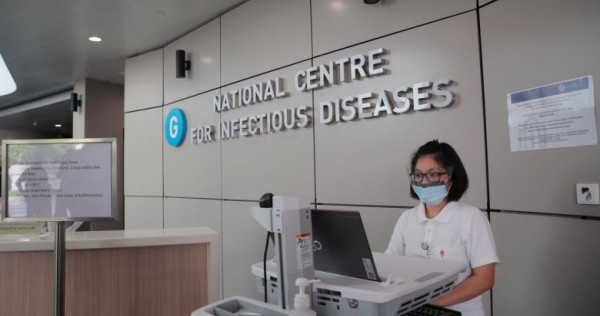
An employee stands at the entrance of the National Centre for Infectious Diseases on Jan 31. (Photo: Gaya Chandramohan)
However, Singapore is not at that point yet, said PM Lee.
“It may or may not happen, but we are thinking ahead and anticipating the next few steps,” he said.
“And I am sharing these possibilities with you, so that we are all mentally prepared for what may come.”
“WE CAN EACH DO OUR PART”
Whatever the situation, we can each do our part, said PM Lee.
People should observe personal hygiene, take their temperature twice daily, and if they are unwell, avoid crowded places and see a doctor immediately.
“These simple steps do not take much effort, but if we all do them, they will go a long way towards containing the spread of the virus,” he said.
PM Lee said that he is confident of the medical outcome of the outbreak, and that most Singaporeans should remain well.
Those who fall ill should expect to recover, said PM Lee – among those who have been hospitalised so far, despite a few remaining in critical condition, most are stable or improving, with some having already been discharged after recovering.
Ms Jiang (in yellow) poses for a photo with the nurses at the National Centre for Infectious Diseases. (Photo: Ms Jiang)
“Fear and anxiety are natural human reactions. We all want to protect ourselves and our families from what is still a new and unknown disease. But fear can do more harm than the virus itself,” he said.
“It can make us panic, or do things which make matters worse, like circulating rumours online, hoarding facemasks or food, or blaming particular groups for the outbreak.
“We should take courage and see through this stressful time together.”
PM Lee concluded by urging Singaporeans to stay united and resolute during the outbreak.
“Take sensible precautions, help one another, stay calm, and carry on with our lives,” he said.
SINGAPORE – There is no need to suspend school, Education Minister Ong Ye Kung stressed on Friday (Feb 7), after some parents expressed concern about their children’s safety even as Singapore raised its response to the coronavirus outbreak to Orange.
“Some parents have suggested suspending school. But this is a drastic move that will disrupt life for many families, and it is also not realistic to expect older children to stay home the whole time school is closed,” he said in a Facebook post on Friday night (Feb 7).
System-wide, the Ministry of Education (MOE) has implemented enhanced measures, including suspending inter-school activities and external activities until the end of the March school holidays.
“This is to reduce the mixing of students across schools and exposure to large crowds at public places”, said Mr Ong.
“We have also put in place a stringent hygiene regime, ensuring students and staff practise good personal hygiene, and also social hygiene protocols such as wiping down surfaces after use,” he added.
As concern over the deadly coronavirus grows, fake news and scams capitalising on people’s fears are also spreading.
Nearly 32,000 people have been infected and more than 630 have died in China, with the majority of the cases in Hubei province. Outside of China, more than 216 people in 24 countries have been infected.
Here are ways to stem cyber infection and mass panic:
Beware of e-mail scams
An e-mail with the logo of the World Health Organisation has been making the rounds, inviting Internet users to visit a dubious website for information on safety measures. A pop-up screen then asks for the user’s e-mail address and password.
Do not click on the link as the website could contain malware. Also, do not enter e-mail credentials as this will allow hackers to harvest sensitive information.
Giving hackers access to one’s account may also compromise other online accounts as many people still use the same password for all their online accounts – although experts advise against it.