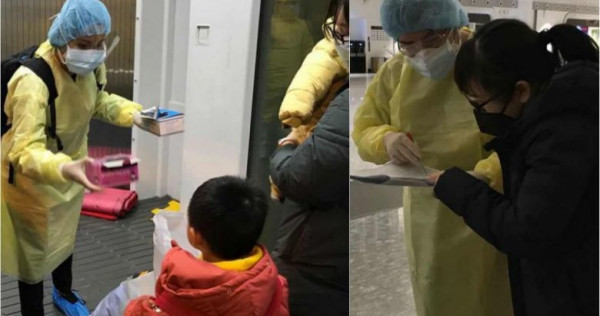
According to a statement from the Ministry of Foreign Affairs (MFA), the returning passengers will undergo a medical screening upon arrival at Changi Airport.
“Those with fever or respiratory symptoms will be taken to designated hospitals for further examination. The remaining passengers will be quarantined for 14 days,” said the MFA.
It’s unrecognisable now, but Baghdad in the 8th to 13th centuries was an intellectual centre, a hub of learning that hosted the greatest collection of knowledge in a grand library known as the House of Wisdom. Muslim scholars gave the world devices that could read the stars, surgical instruments, and algebra, named after the Arabic word “al-jabr”, which translates to the “reunion of broken parts” in English.
SINGAPORE: Scientists from the United States to Australia are using new technology in an ambitious, multi-million-dollar drive to develop a vaccine in record time to tackle China’s coronavirus outbreak.
The new virus has spread rapidly since emerging late last year in China, killing more than 800 people in the mainland and infecting over 37,000. Cases have been reported in two dozen other countries.
Coming up with any vaccine typically takes years, and involves a lengthy process of testing on animals, clinical trials on humans and regulatory approvals.
But several teams of experts are racing to develop one quicker, backed by an international coalition that aims to combat emerging diseases, and Australian scientists hope theirs could be ready in six months.
“It is a high-pressure situation and there is a lot of weight on us,” said senior researcher Keith Chappell, part of the group from Australia’s University of Queensland.
But the scientist added he took “some solace” knowing several teams around the world were engaged in the same mission.
“The hope is that one of these will be successful and can contain this outbreak,” he said.
The new coronavirus emerged at a market selling wild animals in the central Chinese city of Wuhan. (Photo: AFP/Hector Retamal)
But even a timeframe of six months looks agonisingly slow with the virus, believed to have emerged from a market selling wild animals, killing close to 100 people every day in mainland China.
Efforts are being led by the Coalition for Epidemic Preparedness Innovations (CEPI), a body established in 2017 to finance costly biotechnology research in the wake of an Ebola outbreak in West Africa that killed more than 11,000 people.
With a mission to speed up the development of vaccines, CEPI is pouring millions of dollars into four projects around the world and has put out a call for more proposals.
ATTACK OF THE VIRUS
The projects hope to use new technology to develop vaccines that can be tested in the near future.
The body’s CEO, Richard Hatchett, said the aim was to start clinical testing in just 16 weeks.
German biopharmaceutical company CureVac and US-based Moderna Therapeutics are developing vaccines based on “messenger RNA” – instructions that tell the body to produce proteins – while Inovio, another American firm, is using DNA-based technology.
DNA- and RNA-based vaccines use the genetic coding of the virus to trick the body’s cells into producing proteins identical to those on the surface of the pathogen, explained Ooi Eng Eong, deputy director of the emerging infectious diseases programme at the Duke-NUS Medical School in Singapore.
The new coronavirus has killed more than 800 people and infected tens of thousands across China. (Photo: AFP/STR)
The immune system learns to recognise the proteins so that it is ready to find and attack the virus when it enters the body.
The Australian researchers are using “molecular clamp” technology invented by the university’s scientists that allows them to rapidly develop new vaccines based solely on a virus DNA sequence.
French scientists at the Pasteur Institute are modifying the measles vaccine to work against the coronavirus, but do not expect it to be ready for about 20 months.
Meanwhile, the Chinese Center for Disease Control and Prevention has also started developing vaccines, according to the state-run Xinhua news agency.
RISKS VERSUS BENEFITS
Health authorities weigh the risks and benefits in vaccine approvals and if there is a public health emergency, the process could be shortened, said Ooi of the Duke-NUS Medical School.
But he added that “paradoxically, if the situation improves, then actually the pathway for vaccines would be longer”.
“If there’s a lot of these new coronavirus cases around, then you accept some risk, because of the tremendous amount of benefit you can derive, whereas if there are not many cases, the tolerance for risk would be very low.”
While there is no vaccine for the coronavirus, some doctors are trying out a potent brew of anti-retroviral and flu drugs to treat those infected, but the science is inconclusive as to whether they are effective.
Ultimately, scientists may end up in the same situation they were during the 2002-2003 outbreak of Severe Acute Respiratory Syndrome (SARS) – it died out before a vaccine could be fully developed.
A close cousin of the new coronavirus, SARS spread around the world and killed nearly 800.
But Ong Siew Hwa, the director of Acumen Research Laboratories, a biotech company in Singapore, said efforts to develop a vaccine for the new virus should continue even if the outbreak ends.
“I think a vaccine will definitely be important,” she said. “If it’s not in time for this round, it is important for the next time.”
SINGAPORE: The organiser of the Singapore Airshow plans to sell fewer tickets to the public as part of measures against the novel coronavirus, as it confirmed more than 70 participating companies have pulled out.
Experia Events managing director Lek Chet Lam said he expects ticket sales to be “significantly less than half” compared to the previous edition of the airshow in 2018, which attracted about 60,000 public visitors over two days.
“We are looking at how we can have a smaller public day attendance,” he told reporters on Sunday (Feb 9), adding that there is also an idea to sell less tickets “so that the attendance will be controlled.”
He did not say how many public day tickets have currently been sold or what the allocation is.
When asked what will happen to existing ticket holders if the limit is exceeded, Mr Lek said the organiser will “work it out” with them.
“That’s also part of looking at the situation and making sure we take care of the well-being of people who are attending the show,” he added.
Mr Lek also revealed that more than 70 participating companies have pulled out of attending the airshow, although he said this represents less than eight per cent of the initial turnout.
Nineteen exhibitors have confirmed they are not attending, including US defence contractor Lockheed Martin. This means there will be 10 to 15 fewer static aircraft displays than the 45 in 2018, Mr Lek said.
This comes after Singapore on Friday raised its Disease Outbreak Response System Condition (DORSCON) level to Orange, as authorities announced three new cases of the virus, bringing the total to 33.
Under the new DORSCON level, organisers of large events should take necessary precautions such as carrying out temperature screening, looking out for respiratory symptoms like cough or runny nose, and denying entry to unwell individuals.
The Ministry of Health had also urged organisers to cancel or defer non-essential large-scale events.
When asked if the airshow will be cancelled if the DORSCON level was raised to the maximum Red, Mr Lek said the organiser will refer to guidelines by the relevant authorities.
As for now, Mr Lek said the airshow – which he described as an “important node” in the global aviation industry – will go on.
“Our responsibility is to still carry on with the show so exhibitors and trade visitors continue to have a platform to meet and talk about business opportunities,” he said.
“Those who have pulled out, we respect their decision. Those who chose to come, we also respect it, and how we respect that is we put all the necessary preventive measures on site to make sure their well-being is taken care of.”
The Singapore Airshow organiser has implemented seat tagging to facilitate contact tracing. (Photo: Aqil Haziq)
As part of measures against the outbreak, the organiser has implemented seat tagging for all seated events to facilitate contact tracing, and temperature screening at Singapore Expo and Changi Exhibition Centre access points.
The organiser also encourages alternative greetings among attendees like waving or bowing, instead of the conventional handshake.
This is in addition to measures like more frequent cleaning, having doctors and medics on site, and making hand sanitisers available.
Mr Lek said the public will have to “make their own decisions” on whether they should buy a ticket.
“But if they choose to come to the show, we have put all the precautionary measures in place,” he added.
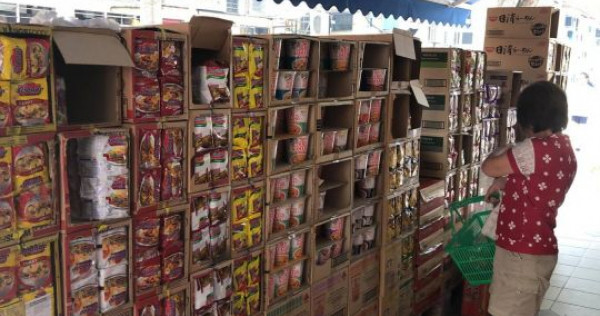
SINGAPORE – Supermarket chain FairPrice on Sunday (Feb 9) said it will be limiting the number of essential items that customers can buy, to ensure that more people have access to these items even as shelves continue to be re-stocked.
Each customer will be allowed to buy only up to four packs of paper products such as toilet paper and tissue paper, two bags of rice and four pillow packets of instant noodles. Each person can also buy up to $50 worth of vegetables.
Customers were informed about these limits via a notice posted at FairPrice outlets.
In the notice, customers were assured that the supply of daily essentials remain available despite the surge in demand, and that the supermarket chain was stepping up delivery runs between its warehouse and outlets.
“We urge customers to buy only what they need and not to stockpile,” read the notice.
This comes after people were seen bulk-buying essentials such as rice and toilet paper over the weekend, after the authorities on Friday evening (Feb 7) said Singapore will be ramping up its disease outbreak response.
Singapore – Over the past two weeks since the first case was reported here, 40 people in Singapore have been infected with the novel coronavirus. Here is a look at who they are.
Case No 1: Man from Wuhan
The Chinese national flew into Singapore on Jan 20. Then, he had a sore throat but no fever. The next day, he developed a fever and a cough, and on Jan 22, went to Singapore General Hospital’s (SGH) Emergency Department.
He was classified as a suspect case and immediately isolated, in view of his clinical symptoms and recent travel history from Wuhan. He was diagnosed to have pneumonia.
The Ministry of Health (MOH) was notified at about 10pm the same day. He was confirmed to have the novel coronavirus at 6pm on Jan 23.
Prior to hospital admission, he stayed at Shangri-La’s Rasa Sentosa Resort & Spa in Sentosa and said that he had kept to the vicinity of the hotel.
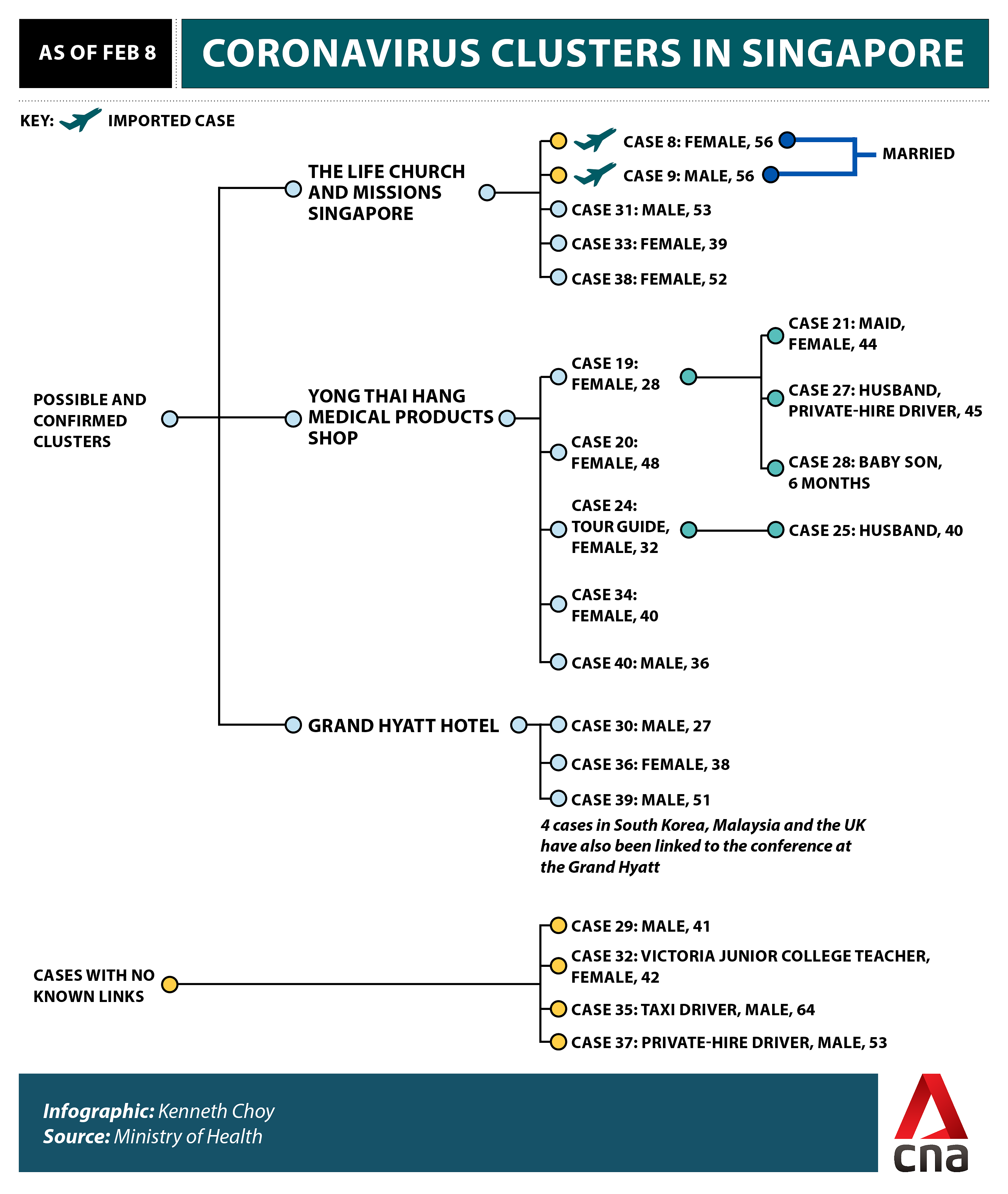
SINGAPORE: The authorities have named three clusters of locally transmitted coronavirus cases in Singapore, including a possible cluster associated with The Life Church and Missions Singapore.
The other two clusters are linked to health products shop Yong Thai Hang in Cavan Road and a private business meeting held at Grand Hyatt Singapore respectively.
Together, the clusters involve at least 17 people including three families.
Investigations on these clusters are ongoing, according to a daily update from the Ministry of Health (MOH) on Saturday (Feb 8) night, which also said that the total number of people infected here has grown to 40.
WHERE: The Life Church and Missions Singapore at 146B Paya Lebar Road
WHO: 5 people, comprising a married couple from Wuhan (cases 8 and 9) and three Singaporeans (cases 31, 33 and 38) who had visited the church
DETAILS: MOH announced on Feb 8 that cases 8, 9 and 33 had links to the church, following further epidemiological investigations and contact tracing.
They include the married couple – both 56-year-old Chinese nationals from Wuhan – who arrived in Singapore together on Jan 19.
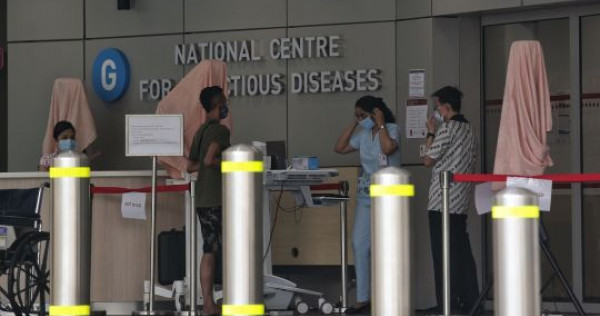
They did not show symptoms during their flight to Singapore. They only developed symptoms on Jan 24 and took a taxi to Tan Tock Seng Hospital (TTSH) three days later. They tested positive on Jan 28 and 29 and remain warded in isolation rooms at the National Centre for Infectious Diseases (NCID).
Before that, the couple had stayed with their family at their home at Lorong Lew Lian in Upper Serangoon.
The third is a 39-year-old Singaporean woman who did not have recent travel history to China, but had been in Malaysia Jan 22 to 29.
She developed symptoms on Jan 30 and went to the emergency department at the Sengkang General Hospital (SKH) on Feb 2 and was admitted. Test results confirmed the infection on Feb 6. She is currently warded in isolation at SKH.
The other two Singaporeans – cases 31 and 38 – also have no recent travel history to China. But prior to hospital admission, both had been to The Life Church and Missions Singapore.
The former is a 53 year-old Singaporean man who reported symptoms on Jan 23 and visited a general practitioner (GP) on the same day. He then visited another clinic on Jan 28 and was admitted to the Changi General Hospital on Feb 1.
Before that, the man, who stays at Tampines Street 24, had been to Malaysia on Jan 6, 11 and 17, as well as visited family and friends during Chinese New Year. He was confirmed positive for the virus on Feb 6.
The 38th confirmed case is a 52-year-old Singaporean woman who reported symptoms on Feb 3 and visited the Choa Chu Kang Polyclinic the next day. She was admitted to NCID on Feb 7 and tested positive for the infection a day later.
Apart from the church, she had also visited Marina Bay Sands, Chinatown and Plaza Singapura and had travelled by public transport.
View of Yong Thai Hang at 24 Cavan Road. (Photo: Gaya Chandramohan)
CLUSTER 2
WHERE: Yong Thai Hang at 24 Cavan Road, where a tour group from Guangxi, China, had visited last month. Two travellers in the Chinese tour group have tested positive for the virus, MOH said on Feb 5 citing confirmation from Chinese health authorities.
WHO: Nine people including a family of three (cases 19, 27 and 28) and their foreign domestic helper (case 21). Three others (cases 20, 34 and 40) are employees of the shop, while the remaining two (cases 24 and 25) are a tour guide and her husband. All nine did not recently travel to China.
DETAILS: This was the first local transmission cluster announced by authorities on Feb 4 after some of the infected people had “prolonged interactions” with the travellers from China.
One of them, case 19, is a 28-year-old female Singapore resident who works as a salesperson at Yong Thai Hang and reported having a sore throat and fever on Jan 29. She sought treatment at a GP clinic on the same day.
The next day, she went to TTSH’s emergency department and was discharged after a chest X-ray came back negative for pneumonia. She did not leave her home at Jalan Bukit Merah from Jan 31 to Feb 2.
On Feb 3, she was admitted to the Singapore General Hospital (SGH) and tested positive for the novel coronavirus on the same day. She is currently warded in an isolation room at SGH.
A graphic shows the clusters of locally transmitted cases in Singapore as of Feb 8, 2020.
Her husband and son – cases 27 and 28 – were announced to have come down with the novel coronavirus on Feb 5.
The former, a 45-year-old Singaporean, had developed symptoms on Feb 1. He visited a GP the next day and was subsequently isolated at the NCID on Feb 4. He remains warded at the NCID.
Prior to hospital admission, he stayed at his home at Jalan Bukit Merah and worked as a private hire driver. He also visited Tiong Bahru Plaza, Tiong Bahru Market and Beo Crescent Market and Food Centre.
The couple’s six-month-old baby boy is now in an isolation room at KK Women’s and Children’s Hospital. Prior to hospital admission, he was not in any infant care facility and was cared for at home, MOH said.
The family’s foreign domestic helper was the 21st confirmed case.
The 44-year-old Indonesian woman reported onset of symptoms on Feb 2 and did not leave her place of residence at Jalan Bukit Merah. She was admitted to SGH on Feb 3 and tested positive the next day.
Three employees at the shop have also come down with the virus and are currently warded in isolation rooms at the NCID.
One, case 20, is a 48-year-old female Singapore resident who reported symptoms on Jan 25 and was tested positive on Feb 4. She had gone to NCID on Feb 3 and was immediately isolated “given that she is a colleague of Case 19”, according to MOH’s media release on Feb 4.
The other two – cases 34 and 40 – are a 40-year-old Singaporean woman and a 36-year-old Singaporean man. Both employees had been identified as close contacts of cases 19 and 20, and were placed under home quarantine on Feb 4.
The former, who stays at Sin Ming Road, had reported symptoms on Jan 27 and visited two GP clinics on Jan 27 and Feb 1. She was admitted to NCID two days after being placed under home quarantine, and tested positive for the coronavirus on Feb 7.
The man, who stays at Bedok North Street, developed symptoms on Jan 30 and visited a GP on the same day. He was admitted to NCID on Feb 7 and confirmed as an infected case on Feb 8.
A 32-year-old Singaporean woman who works as a tour guide and has brought groups of tourists to Yong Thai Hang, was the 24th confirmed case.
She had gone to NCID on Feb 3 with no symptoms – although she subsequently informed NCID on Feb 4 night that she had developed a fever on Jan 30, according to MOH – and was confirmed positive on Feb 4 at about 2pm.
Prior to admission to NCID, the tour guide stayed at her home at Buangkok Green and worked at Jalan Besar. She had visited Hougang Polyclinic on Jan 30 and went to a supermarket near her home.
Her husband also tested positive on Feb 4.
The 40-year-old Singaporean had developed a fever on Jan 24. He visited the same polyclinic as his wife on Jan 30 and self-presented at NCID four days later where he was immediately isolated. Prior to being admitted, the man had stayed at home. He worked at Diamond Industries Jewellery Company at Harbour Drive, which the tour group from China had visited as well.
Both are currently warded in isolation rooms at NCID.
Cars at the Grand Hyatt Singapore lobby. (Photo: Jeremy Long)
CLUSTER 3
WHERE: A private business meeting held at the Grand Hyatt Singapore from Jan 20 to 22, which had included participants from China, including Hubei province. Confirmed cases from Malaysia, South Korea and Britain have also been linked to this meeting.
WHO: Three people – a 27-year-old Singaporean man (case 30), 38 year-old female Singapore Permanent Resident (case 36) and a 51 year-old Singaporean man (case 39) – who are currently warded in isolation rooms at NCID. All three do not have recent travel history to China, but two of them were in Malaysia between Jan 23 and Feb 2.
DETAILS: The first Singaporean case with links to the meeting at the Grand Hyatt is a 27-year-old who reported onset of fever on Jan 21. He visited a GP a week later and sought treatment at another GP clinic on Feb 3.
He was admitted to NCID on Feb 6 and confirmed as infected with the virus the same day, making him the country’s 30th confirmed case.
Before being admitted, the man, who stays at Shunfu Road, had been to Far East Square and Junction 8.
The 38 year-old woman – case 36 – reported symptoms on Jan 24 and visited a GP on Feb 1. She was isolated and admitted to KK Women’s and Children’s Hospital on Feb 4 and was confirmed as infected three days later.
Apart from attending the business meeting at Grand Hyatt, the woman, who stays at Bukit Batok Street 31, had also visited a family member at Ng Teng Fong General Hospital prior to hospital admission.
The third Singaporean individual with links to this cluster is a 51 year-old Singaporean man who reported symptoms on Jan 29. He visited two GP clinics on Feb 3 and 5, respectively, before being admitted to NCID on Feb 6.
Subsequent tests confirmed the man, who stays at Jurong West Central, as being down with the virus on Feb 8.
SINGAPORE: The last few days have seen snaking queues, frenzied shopping and panic buying at supermarkets and shops across the island as Singaporeans stocked up amid the coronavirus outbreak.
But on Sunday (Feb 9), some shopkeepers and residents told ministers that a “sense of normalcy” has returned at the counter.
Minister for Trade and Industry Chan Chun Sing and Minister for Social and Family Development Desmond Lee spoke to the media after a community walkabout at Jurong West.
They visited Jurong West 505 Market and Food Centre, and the shops and eateries to gather feedback from patrons and stallholders, particularly on the situation of panic buying.
There have been multiple reports of people stocking up on groceries and personal hygiene items since the Singapore government raised its Disease Outbreak Response System Condition (DORSCON) level to Orange over the global coronavirus outbreak on Friday.
Government authorities, including Prime Minister Lee Hsien Loong, and supermarkets came out to assure the public that Singapore had ample stockpile of essentials.
Mr Desmond Lee said that residents told him that they have since felt assured there is enough stock of household essentials. Shopowners and supermarket representative have also told him they are able to meet demand.
“Major suppliers like NTUC Fairprice and Sheng Siong, they have doubled, if not tripled the number of supply runs that they’re doing,” said Mr Chan.
“So today, you can see that actually most of the essential items are back on the shelves.”
In a notice put up in stores across Singapore on Sunday morning, FairPrice said the purchase limits were put in place “to ensure more customers have access to high demand items”.
The S$50 limit for vegetables also remained in place.
Ministers Chan Chun Sing, Desmond Lee and Tharman Shanmugaratnam during a community walkabout at Jurong West on Sunday Feb 9, 2020. (Photo Rachel Phua)
IMPORTANT TO REMAIN CALM: CHAN CHUN SING
Mr Chan reiterated Singapore’s four-pronged stockpile strategy, which includes having sufficient reserve of food items that can “last us quite some time in an emergency”, diversifying food sources, having local production capabilities, and working with regional partners to secure supply lines.
He also said that it is important for residents to remain calm at this juncture.
Singaporeans must take care of the vulnerable and not just themselves, he said.
As of Saturday evening, Singapore had seven new cases of novel coronavirus, taking the country’s tally to 40.
Globally, more than 37,000 have been infected and at least 800 have been killed by the coronavirus outbreak, surpassing the death toll of the the Severe Acute Respiratory Syndrome (SARS) epidemic.
“If in a crisis all of us only care for ourselves, and it’s only the strong taking care of themselves, then I think it will be a bad testimony to the kind of society that we want,” Mr Chan said.
On bad behaviour spotted among some shoppers, he said that it “undermine(s) our reputation in the international community” as other countries are looking at how Singapore is responding to the situation.
“If we don’t do this collectively, we undermine the international confidence in our system, in our society, and that will have long term implications,” he said.
One of the priorities right now is to make sure that the vulnerable and the old are able to meet their needs, particularly on securing medical supplies, Mr Chan said, sharing an example of diabetic patients who are not able to purchase alcohol swabs for their insulin jabs.
Giving an update on the collection of masks, Mr Lee said that nationwide, about 54 per cent of households have collected theirs so far. Remaining stock after the end-February collection deadline will be given to vulnerable communities.
If gluten just doesn’t agree with you and every meal out leaves you stressed and upset, check out these places that are not only gluten-free but delicious.
SINGAPORE: Singapore’s toll charges for cars, buses and taxis at the Woodlands and Tuas checkpoints will be reduced from Mar 2, the Land Transport Authority (LTA) said in a news release on Sunday (Feb 9).
This is in response to Malaysia’s reduction of toll charges for cars, buses and taxis at the Sultan Iskandar Building Toll Plaza (Causeway) and Tanjung Kupang Toll Plaza (Second Link) on Feb 1, LTA said.
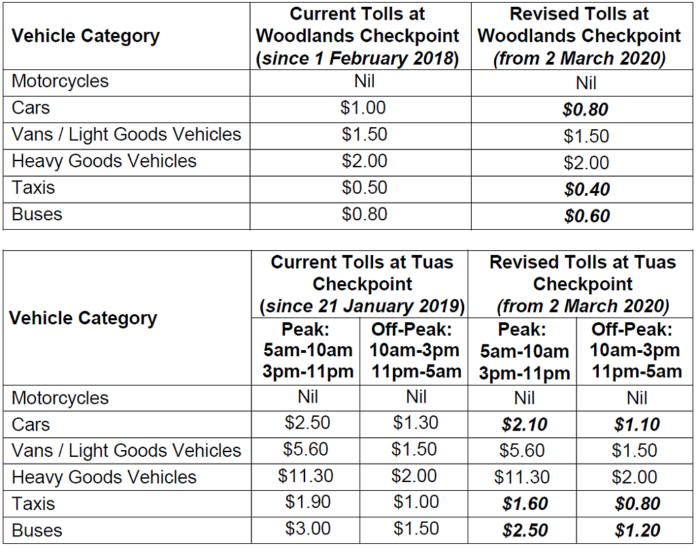
The revised toll charges are as follows:
Singapore’s revised toll charges with effect from March 2, 2020. (Table: LTA)
NEW DIGITAL SERVICE FOR ASEAN PUBLIC SERVICE VEHICLES
Singapore is also set to roll out a new digital service to enable owners of public service vehicles such as buses and taxis registered in ASEAN countries to apply for a permit through the OneMotoring website.
This initiative will be implemented from Feb 10, LTA said.
It is aimed at making it more convenient for vehicle owners and will add to the suite of digital services currently available for foreign-registered vehicles.
Vehicle owners can look forward to online payment for and delivery of VEP and Autopass cards in the near future, LTA said.
Vehicle owners may refer to the online video guides on the OneMotoring website on the use of these digital services.
Those who require assistance may also approach LTA’s Service Centre located in Johor where digital kiosks are available for motorists to submit their applications.