For most Singaporeans, the Chinese New Year period is known for a great many things – reunion dinners, mandarin oranges, a spot of gambling but most notably, the gifting of red packets (or “ang baos”, as the Chinese call them).
And for a practice that’s so deeply rooted in tradition, you’d expect people to keep doing it the way it has been for hundreds of years.
Wrong. According to DBS, it seems that Singaporeans, even the older generation, are slowly opening up to using digital alternatives for a lot of things, including red packets.
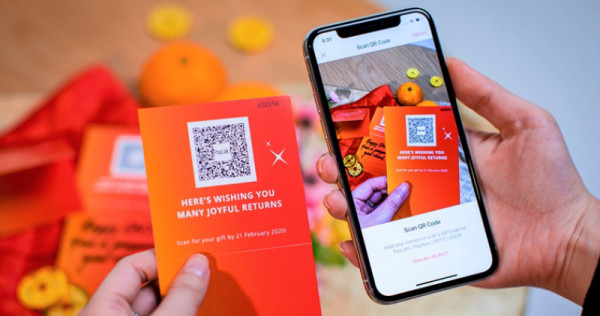
In fact, as of 4 February, we’ve given out almost $2.7 million dollars worth of money via DBS’ QR Gift cards over CNY 2020. That’s almost double last year’s $1.5 million!
Meanwhile, the DBS eGift, or eAng Bao as it was formerly known, drew over 16,000 new users this CNY, coupled with an almost 20 per cent increase in the total transacted amount from last year.
Such statistics are a good sign, as they show Singaporeans are becoming increasingly receptive to digital methods. Of course, there are other potential benefits from going cashless in this regard.
More than 70 exhibitors including US aerospace giant Lockheed Martin have pulled out of the Singapore Airshow over concerns about the coronavirus outbreak, but organisers insisted Sunday that Asia’s biggest aviation event would still go ahead.
Precautionary measures — including a major reduction in public attendance and temperature screenings — have been imposed ahead of the opening of the event which opens Tuesday in the city-state, which has reported 40 coronavirus infections.
Organisers were also encouraging attendees to greet each other by bowing or waving instead of shaking hands.
Leck Chet Lam, the managing director of organiser Experia Events, confirmed that more than 70 exhibitors have decided not to participate, but said there was “still strong presence” at the show.
The biggest names in aerospace participate in the Singapore Airshow, and often massive deals — such as aircraft orders from major carriers — are announced at the event.
The outbreak, which has killed more than 800 people and infected tens of thousands across China, has spread to nearly more than two dozen other countries and sparked global concern.
SINGAPORE – Officials should not spread information prematurely as this could cause confusion and alarm during a crisis situation, said Minister-in-charge of the Public Service Chan Chun Sing on Sunday (Feb 9).
“Internally we will make sure that our processes are strengthened and our people involved in all these know their roles well,” said Mr Chan, who is part of the multi-ministry coronavirus task force.
Mr Chan was responding to questions from reporters about a Health Ministry press release on Friday announcing Singapore was moving to the orange disease outbreak status.
While the news officially broke after about 5.20pm that day, an earlier version of the release had been leaked to the public several hours before and was circulating widely on WhatsApp and other channels.
Mr Chan, who is also Trade and Industry Minister, said officials should have the discipline and maturity not to share information prematurely.
But at the same time, in order to work fast during a crisis situation, information needs to be shared simultaneously with multiple agencies, he said.
SINGAPORE: The built-environment industry has been going through a steady transformation in recent years in a bid to improve productivity, reduce costs, improve safety and create better jobs. These efforts are part of the Building and Construction Authority’s (BCA) Construction Industry Transformation Map launched in 2017, with digitalisation as its key plank.
One main thrust is a process called Integrated Digital Delivery (IDD) which leverages data and digital technologies to connect the different parties involved in a project.
At the BCA-REDAS Built Environment and Property Prospects Seminar in January, BCA CEO Hugh Lim noted that the industry was “making steady progress” towards the agency’s 2020 target. BCA hopes to have 40 to 60 IDD projects and IDD capabilities in 150 to 180 firms by 2020. Currently, there are 35 public and private sector projects piloting IDD.
WHAT IS INTEGRATED DIGITAL DELIVERY?
With IDD, firms use digital technology to integrate the entire construction process, from building design to operations and maintenance. IDD uses a collaborative 3D modelling technology called Building Information Modelling (BIM), advanced infocomm and smart technologies.
Some of the projects piloting IDD include: the Land Transport Authority’s Kim Chuan Depot, PSA Corp’s Tuas Port Maintenance Base, and CapitaLand’s Rochester Commons mixed development.
EFFECTS OF DIGITALISATION
Construction firms which have embraced digitalisation reaped increased time and resource savings, they told CNA.
One of them is BHCC Construction, which has been using BIM technology for more than 10 years, a spokesperson said.
It has allowed the firm to shave the time spent in the construction stage by 25 per cent by providing real-time updates to all project partners, including status tracking of precast components, the spokesperson added.
The firm also aims to save more time using other technologies. It hopes to cut the time spent in the design stage by 30 per cent through a Virtual Reality (VR) collaboration system. VR will allow clients and contractors to see the building design in 3D through goggles.
And by digitalising its management of site safety records, the firm hopes to shave 25 per cent of the time spent updating those documents.
BHCC Construction uses virtual reality in its design stage. (Photo: BHCC Construction)
Pan-United Corporation Ltd, a concrete and logistics firm, has seen cost and manpower savings after developing their own digital platform in 2014, said CEO May Ng.
The company reaped 45 per cent in costs and manpower savings since using AiR, said Ms Ng.
AiR (Artificial Intelligence for Ready-Mix Concrete) is a centralised operation system for ready-mix concrete companies that manages ready-mix concrete batching plant production, oversee trucking fleet management, quality control and inventory management.
It also helps ready-mix concrete customers to place orders, track deliveries and manage their data electronically.
The system is deployed in Pan-United’s entire supply chain of business operations, said Ms Ng, including replenishing raw materials for concrete production, taking customer orders, deploying plant equipment and fleet management and automating back-end processes.
“It allows us to eliminate the manual work and to upskill our employees, enhancing their career development. The AiR System also promotes transparency and timeliness of information, resulting in more cohesive teamwork among employees and our service providers,” she said.
Replacing paper documents with electronic delivery orders and e-invoices also allowed the firm to save 13 tonnes of paper annually, she added.
Still, there is a “considerable time lag” of digitalisation in actual industry practice, noted, Associate Professor Robert Tiong.
Citing a 2019 study, Assoc Prof Tiong, who is from the National Technological University’s School of Civil & Environmental Engineering, said the results could imply that IT usage was low in most construction projects.
“In other words, traditional approaches still dominate information transmission and collection,” he said.
One reason for this is the challenges which have to be ovecome when implementing digital technologies, firms which CNA spoke to said.
BHCC Construction found that there were many different kinds of software in the market, and the firm encountered problems in merging software and using it properly.
For Pan-United, a big challenge was “going the way of technology – into the digital space – in a traditionally brick-and-mortar industry,” said Ms Ng.
“One example is changing the mindsets of heavy vehicle drivers such as drivers of concrete mixer trucks, and tipper truck drivers of raw materials,” she said.
A man uses Pan-United’s AiR system. (Photo: Pan-United Corporation Ltd)
“Most of the drivers are more used to walkie-talkies, basic mobile phones and hard copy delivery order, rather than using apps in smartphones and ipads.”
Experts highlighted other challenges, such as the lack of collaboration across the industry, the affordability of technology and the lack of expertise.
Different parties in the construction industry may use different IT systems, said Assoc Prof Tiong.
“Such standalone systems usually have their specific interfaces and data formats that inevitably leads to information inconsistency, which may bring about inefficient communication and hamper collaboration in any construction project,” he said.
This ties in with the highcost of developing base technology and infrastructure, said Assoc Prof Goh Yang Ming from the National University of Singapore School of Design and Environment.
“There is a need for the industry to work together to accumulate useful data or basic IT infrastructure that can bring the industry forward in its digitalisation process.
“There should be deliberate effort to develop open source datasets and affordable IT infrastructure for the industry,” said Assoc Prof Goh.
Nevertheless, the digitalisation of the the built-environment sector is necessary not only to improve construction processes but also create new and better jobs for Singaporeans, said Minister of State for National Development Zaqy Mohamad at the BCA-REDAS Built Environment and Property Prospects Seminar.
Already it has created positions such as ‘Digital Delivery Manager’ or ‘Buildings Digital Lead’, which will attract more local professionals, managers, executives and technicians (PMETs to join the sector.
Their proportion in in the local construction industry has fallen over the past decade despite the rising population of local PMETs.
“It is important for firms to invest in a local core in order for their business growth to be sustainable for the future,” said Mr Zaqy.
In March 2020, the inaugural CNA Digital Economy Leadership Summit 2020 will bring together some 200 key decision makers from Government, diplomatic circles and the private sector from around Asia, to explore key issues that include: How to grow and innovate in a digital economy, as well as how to manage talent and ensure sustainability in the digital economy.
BANGKOK: Back in 2015, the member-states of the United Nations adopted its most ambitious, all-encompassing agenda ever attempted: To guide the advancement of humankind for the next 15 years.
Collectively known as the 2030 Agenda for Sustainable Development, the agreements called on all countries to positively advance economies, societies and the environment.
An overarching principle of these agreements was to “leave no one behind”. However, currently in the Asia-Pacific region, we are. Inequality is on the rise.
THE RISE OF INEQUALITY IN THE ASIA-PACIFIC
Since the early 1990s, the Asia-Pacific region has experienced a tremendous socio-economic transformation, facilitated by strong and sustained economic growth.
Unfortunately, the gains from this remarkable performance have not always benefited those most in need.
The region’s combined income inequality, measured by the Gini coefficient, has increased by over 5 percentage points in the last 20 years. Income inequality has grown in almost 40 per cent of all countries.
Could technology be part of the solution? In 2015 the answer was emphatically yes. Back then, technology was heralded as key accelerator to meet the ambitions of the Sustainable Development Goals.
Demonstrators take part in a global protest campaigning against inequality ahead of the Davos World Economic Forum, in Nairobi, Kenya on Jan 17, 2020. (Photo: REUTERS/Baz Ratner)
As the Fourth Industrial Revolution progresses, technologies – such as AI, robotics, 3D printing, and the Internet of Things – are reshaping our economies, societies and the environment.
Digital trade and finance are opening economic opportunities through financial inclusion. For example, innovations such as Aadhaar – the digital identification system in India – have enabled the financial inclusion of 1.2 billion people.
From a social perspective, digital healthcare and education are providing cost-effective solutions to people in rural communities.
However, the wave of optimism surrounding the transformative potential of frontier technologies has been tempered by increasing concerns about potential negative impact, the future of work being the one gaining most attention.
GOVERNMENT VERSUS INNOVATION
As the Chief of Technology and Innovation at the United Nations Economic and Social Commission for Asia and the Pacific, my role is to provide policy advice to governments on what they should do.
To many whom I meet, government and innovation is somewhat of an oxymoron. However, history has shown us that the state is more entrepreneurial than we think.
The economist Marianna Mazzucato brought this to light when analysing Apple’s iPhone and Google’s search engine. Both these innovations benefited from state intervention.
For the iPhone, many of the technologies – such as GPS, the touchscreen, and Siri – were funded by the US government. Equally for Google, the creation of its algorithm was funded by the National Science Foundation.
And, of course, there’s the Internet, another government funded technology, which backs up both these products.
The Twitter App loads on an iPhone in this illustration photograph taken in Los Angeles, California, U.S. on Jul 22, 2019. (Photo: REUTERS/Mike Blake)
However, in Asia, the current technological revolution is accelerating at an exponential pace, fuelled by private sector investment, particularly from the tech titans. Will these companies protect workers likely to be displaced by more productive machines? Will they develop cost-effective technologies for the very poorest people to benefit?
In a market system where maximising shareholder wealth is king, the answer is maybe not. So, what could governments do to manage this technological transition?
SOME GOVERNMENTS ARE TAKING ACTION AGAINST TECH-DRIVEN INEQUALITY
Already we are seeing bold, innovative and practical policy responses to this challenge.
In Bangladesh, the government has committed to embracing this new direction and has made digitisation a national priority. The government has also called for greater digital skills development of the youth to ensure their employability in any industry.
The Government of Singapore offers adults personal SkillsFuture credit accounts which they can use to buy training.
It also uses a mix of grant programmes and tax incentives to encourage firms to invest more in low-wage workers, those most at risk from technological job displacement.
Minister for Education Ong Ye Kung speaking to participants at a lifelong learning event where he unveiled details of the SkillsFuture Credit system. (Photo: Leong Wai Kit)
Governments in the region are also strengthening their social protection systems to protect the workers that are vulnerable to job loss.
In my mind, the biggest innovation that could mitigate tech-driven inequality happens when businesses ingrain social purpose and inclusion into the heart of their business models alongside profit objectives.
Governments in Asia have been at the forefront of policy development on this agenda. As examples, the Social Enterprise Act in Thailand provides support to enterprises with a core social objective, while in the Philippines, an inclusive business accreditation system has been developed – the first of its kind in the world – which provides tax incentives to business that provide valuable goods and services at affordable prices to poor and low-income people.
AN EVOLUTION IN THOUGHT
While it is still too early to assess the impact of these policies, it is encouraging to see governments innovating in this space.
As to whether these policies will move the needle in terms of transitioning from traditional to more inclusive and “impactful” economies, only time will tell. It’s important to note that economies are only at the start of this impact journey.
As the Fourth Industrial Revolution evolves, the number and power of tech companies will inevitably increase.
As we enter the Decade of Action to achieve the Sustainable Development Goals, policies that incentivise them to do good as well as do well, and put inclusion at the heart of their business models, may just be an evolution in thought, but could be the revolution in impact we need, as we strive to mitigate the potential inequalities that technology could exacerbate.
In March 2020, the inaugural CNA Digital Economy Leadership Summit 2020 will bring together some 200 key decision makers from Government, diplomatic circles and the private sector from around Asia, to explore key issues that include: How to grow and innovate in a digital economy, as well as how to manage talent and ensure sustainability in the digital economy.
SINGAPORE: When Jocelyn Chia scored an aggregate of 181 for her Primary School Leaving Examination (PSLE), she left the school hall, result slip in hand, feeling disappointed.
The annual national examination taken by students at the end of their primary school education determines the stream and secondary school they move on to.
“I was aiming for the Express stream and I had expected to do better,” said the 16-year-old of her PSLE results four years ago.
However, within a year after starting her secondary school education, Jocelyn found herself taking up two subjects — mother tongue and mathematics — at the Express level.
The opportunity to do these subjects at a higher level despite being streamed into the Normal (Academic) course has allowed her to feel better about herself.
“I don’t feel so bad being in N(A) anymore because I am still taking Express subjects,” said Jocelyn, who is currently a Secondary 4 N(A) stream student at Clementi Town Secondary School.
File photo of secondary school students in Singapore.
Since 2014, the opportunity for Normal stream students like Jocelyn to take certain subjects at higher levels has become a reality – starting as a pilot in a dozen secondary schools, before being rolled out to all secondary schools across the island two years ago.
As of this year, the subjects offered will be extended to the humanities at 25 pilot schools. This means that Sec 2 N(A) students in these schools who have performed well in literature, history or geography in Sec 1 may take these subjects at an Express level.
For many previous cohorts, their memory of secondary school would have been one of being streamed into either Express, N(A) or Normal (Technical), and then remaining in their respective streams throughout their secondary school years.
While the initial intent of streaming was to reduce dropout rates by ensuring that students could keep up with their lessons, it has also resulted in stereotypes attached to students depending on the streams they are in.
Express students, for instance, are viewed as being more studious, while those in N(A) or N(T) are assumed to be less academically capable or not as well-disciplined.
However, amid a long-running national debate on the merits or otherwise of the streaming system, the education scene has seen a shift over the past decade, with various changes introduced to give students more flexibility in what they wish to learn.
These include the introduction of subject-based banding, which lets students such as Jocelyn to take a subject at a more demanding level even though they may be from a “lower” stream.
For these students, the initiatives have not only boosted their confidence and helped them shed the negative labels associated with their streams, they have also opened up more educational pathways.
FROM STREAMING TO SUBJECT-BASED BANDING
In 2014, subject-based banding was introduced in 12 secondary schools here to allow N(A) and N(T) students in lower secondary to take English, mother tongue, mathematics and science at a more rigorous standard.
Following the healthy take-up rate of subjects at more demanding levels in these schools — about half of N(A) students took up Express stream subjects — subject-based banding was introduced to all secondary schools in Singapore in 2018.
With the option extended to humanities, the Ministry of Education (MOE) said that about two-thirds of this year’s eligible Sec 2 N(A) students took up the offer to study humanities at the Express level. This represents about 10 per cent of this year’s cohort of Sec 2 N(A) students in the pilot schools.
The figure excludes 4 per cent of the N(A) cohort in these schools who laterally transferred to the Express course.
The latest changes are part of the transition towards full subject-based banding, which will be implemented across secondary schools by 2024, when the decades-old streaming system will be scrapped.
Secondary school students in a classroom in Singapore. (File photo: MOE)
In full subject-based banding, subjects will be taught at three levels — General 1 (G1), G2 and G3. The three levels will roughly correspond to today’s N(T), N(A) and Express streams respectively.
Students can take a range of G1, G2 and G3 subjects based on their abilities.
They will then sit for a common examination in Sec 4 and graduate with a common secondary school certificate that is co-branded by Singapore and Cambridge. This will kick in for Sec 4 students from 2027.
The other aspect of full subject-based banding is mixed-stream form classes, where students are drawn from a mix of Express, N(A) and N(T) streams.
This is a departure from the current format of having students of the same streams in the same form class.
Currently, 4,000 Sec 1 students are part of mixed-stream form classes that are being piloted in 15 secondary schools.
Another 13 schools will introduce mixed-stream form classes by 2021, with the rest of the secondary schools here following suit in 2024.
The move towards full subject-based banding is part of the Government’s efforts to overcome some drawbacks of school streaming, such as pinning negative labels on students.
Education Minister Ong Ye Kung made this point during his ministry’s Committee of Supply debate in March last year, when he acknowledged that entering a stream such as N(A) or N(T) can “carry a certain stigma that becomes fulfilling or self-limiting”.
“Students can develop a mindset where they tell themselves, ‘I am only a Normal stream student, so this is as good as I can be’,” he said.
Mr Ong noted that while some students are strong in every subject, most have uneven strengths. Subject-based banding will allow students to take subjects based on their capabilities and encourage them to find their strengths. This will, in turn, minimise the downsides of labelling, he said.
HOLDING THEIR OWN AGAINST EXPRESS STREAM PEERS
Secondary students taking subjects at a higher level we spoke to said that subject-based banding has given them the belief that they can hold their own against their peers from more academically demanding streams.
One of them is Pei Hwa Secondary School student Maldaa Abdul Aziz. Despite topping her N(A) class for history in Sec 1, she was initially hesitant to take up the subject at an Express level in Sec 2 when offered to do so by her school.
File photo of students receiving their GCE O-Level results. (File photo: Marcus Mark Ramos)
“I’m the only one (from N(A) stream) to take history at an Express level, in a class of 40, so there is a lot of pressure. I was also concerned that I could not keep up,” said the 14-year-old.
Her concerns, said Maldaa, were compounded by comments from her family members who said that Express stream students “have higher IQ then the rest” and that they will “look down” on those from other streams.
But after three weeks of taking history lessons at the Express level, Maldaa said with a sense of pride that she is “better” than her classmates at the subject, and this has given her the confidence to take on more subjects at a higher level.
Maldaa’s uplifting experience is not uncommon. Exam results from the first two batches of students who took part in subject-based banding showed that they can hold their own against their Express stream peers.
In 2018, 25 per cent of Sec 4 N(A) students who took O-level English scored A1 or A2, compared to 24 per cent for Express students.
For O-level maths, 26 per cent of N(A) students got A1 or A2, compared to 50 per cent for Express students.
For O-level combined science, it was 33 per cent for N(A), compared to 34 per cent for Express students.
REMOVING THE SHACKLES OF STREAMING
The students’ strong showing in the national examinations aside, subject-based banding has also helped to debunk stereotypes associated with individual streams.
Aldrick Au Khin Hon, a Sec 3 student from Evergreen Secondary School, said that while his parents were not disappointed that he got into the N(T) stream after PSLE, some of his friends’ parents felt let down by their children.
However, having the opportunity to take subjects at a higher level in secondary school helped these friends to prove to their parents that they were academically capable too.
“That’s why I think subject-based banding is a quite a good thing,” said Aldrick, 15, who takes English and science at a N(A) level. “People won’t judge you for being a N(T) student. They won’t keep looking down on you.”
“They will be surprised that I can take Normal (Academic) subjects, rather than say I’m from N(T) and a troublemaker,” he added, alluding to the perception among some quarters that N(T) students are unmotivated and ill-disciplined.
Aldrick Au Khin Hon, a Secendory 3 student from Evergreen Secondary School is from the N(T) stream but takes English and Science at the N(A) level. (Photo: TODAY/Yong Jun Yuan)
Ms Claudia Toh, who is teaching mathematics to a class of Sec 1 N(A) and N(T) students this year, said that she consciously avoids checking out the streams of her students.
“I haven’t actually seen the names of the students that are from N(T). I feel like if I do that, I would go in with the prejudice that maybe this person needs more help,” said the teacher from Greendale Secondary School.
When asked if it may be better for her to know so she that would be more aware of her students’ capabilities, Ms Toh pointed out that doing so would mean that she is already assuming that a child will perform poorly, even though he or she had already met the minimum requirement to be in the class.
SPILLOVER EFFECT ACROSS OTHER SUBJECTS
In his speech during the Ministry of Education’s (MOE) Committee of Supply debate last year, Mr Ong said about half of the N(A) students from 12 secondary schools, where subject-based banding has been adopted since 2014, had taken up subjects at an Express level.
A quarter of N(A) students in these schools took up one Express level subject either in English, mathematics or science, while 11 per cent took two subjects, and over 10 per cent took three subjects or were transferred to the Express stream.
The numbers were similar for N(T) students taking up N(A) subjects, Mr Ong added.
In response to queries, MOE said that since subject-based banding was introduced in 2018, about 60 per cent of Sec 1 N(T) students and 40 per cent of Sec 1 N(A) students took up subjects at a higher level.
Of these, about 6 per cent proceeded to take up more subjects at a demanding level in Sec 2. This does not include those who are laterally transferred to a more academically demanding course.
MOE added that schools look at each student’s abilities carefully before offering them the opportunity to take up higher level subjects. They are also mindful that students need time to adjust to the demands of these subjects, the ministry added.
As a result, only a small number of students stopped taking up one or more subjects at a more demanding level when they progress to Sec 2, said MOE.
Among the secondary school students interviewed, some said they were motivated to study harder and take on more subjects at a higher level after being offered at least one.
Students at Swiss Cottage Secondary School discuss meritocracy and social inequality at a Glocal Perspectives class led by teacher Mini Sathiya Sidhan. (Photo: Lianne Chia)
Maple Koh Xin Yi, a Sec 4 student from the N(A) stream at Christchurch Secondary School, said that having the opportunity to do English at an Express level gave her the confidence to do better in other subjects as well.
Maple said that she pushed herself in Sec 1 so that she could take up at least one subject at a higher level to increase her chances of entering the Polytechnic Foundation Programme, a one-year programme to prepare N(A) students for entry into polytechnic diploma courses.
She was eventually given the opportunity to take up English at an Express level in Sec 2. This made her work harder to take up her favourite subject, maths, at a higher level as well, said Maple.
Although she ultimately did not qualify to take maths at an Express level, she had seen an improvement in her scores for the subject, which went from “barely passing” in Sec 1 to about 70 out of 100 for her final-year examinations in Sec 3.
Mr Bernard Kang, 43, the year head for the Sec 1 cohort at Pei Hwa Secondary School, said that since the school piloted subject-based banding in 2014, it has seen an increase in the number of students eligible for transfer from N(T) to N(A), or from N(A) to Express.
“Before 2013, we did not have any (transfers), but in 2014 we had a small handful and it has been consistent since then.”
He added that students who were not taking any subjects at a more demanding level were driven to work harder, since they knew that they had the opportunity to do so if they performed well.
Riverside Secondary School said it has “a healthy number” of students who qualify to do the more demanding subjects annually.
The school’s principal, Madam Shanti Devi Thambusamy, 55, added that students who took an additional subject under the subject-based banding in their subsequent years would have performed well across their subjects, and demonstrated proficiency in managing their academic workload.
“Conversely, a student who drops a subject (under the subject-based banding) might have found the added academic load challenging and opts to pursue a more manageable one,” she said, adding that the number of such pupils was “quite negligible”.
MORE POST-SECONDARY OPTIONS
Students interviewed also said they were encouraged to take up subjects at a higher level as this would open up more opportunities for them in post-secondary education.
Maple from Christchurch Secondary School, for instance, reiterated that her decision to accept the offer to do English at an Express level was prompted by her desire to qualify for the Polytechnic Foundation Programme.
Qualifying for the programme will allow her to skip Sec 5, the year where N(A) students typically sit for their O-Level examinations.
Students taking Express course subjects may also sit for the O-Level examination for those particular subjects at Sec 4, the same year they sit for their N-Level examinations. Their scores in their O-Level examination subjects can then be converted into points, which can determine the course or pathway that they take after leaving secondary school.
Likewise, N(T) students taking N(A) level subjects for their N-Level examinations may convert their grades to points for entry into their preferred Institute of Technical Education (ITE) course.
MANAGING CLASS DYNAMICS
The benefits of subject-based banding are clear for eligible Normal stream students taking on subjects at a higher level. But what about their classmates from the Express stream?
Pei Hwa Secondary School’s teacher, Ms Lee Sixian, noted that having students from the Normal stream in their classes would instill humility in Express students.
“When you put N(A) and Express students in the same class, Express students realise they are only in that stream because their average marks may be higher than a particular student … When they realise someone can be stronger than them in a subject like English, it opens up the eyes of these students who think they are better at everything. They realise there are people in other streams who have strengths and weaknesses in different things,” said the 27-year-old who teaches geography and English.
Still, some educators felt that teaching students from different streams within the same class also means that they have to put in more effort in ensuring that everybody can keep up with the pace of the class.
They spoke of the need for “differentiated teaching” to suit the different pace and abilities of students in a class.
This could mean more guiding questions during class time or in worksheets to help students along. Other techniques employed by teachers involve increasing group work in classes so that students who are faster can help the others along.
Nevertheless, the educators were also quick to note that tailoring a lesson to cater to different abilities in a class is an on-going effort that has been underway in schools here even before subject-based banding kicked in, given that each class always has students with mixed abilities.
However, an English teacher who only gave her name as Ms Jennifer as she was not authorised to speak to the media said there was “no difference” in how she planned her classes since her school adopted subject-based banding. The N(A) students in her Express stream English class made up only a small number, and could keep up with the pace, she said.
Ms Cheung Ka Yan, 33, from Greendale Secondary School. (Photo: TODAY/Yong Jun Yuan)
Similarly, Ms Cheung Ka Yan, 33, from Greendale Secondary School said that students from the N(A) stream who were taking Express-level Chinese in her Sec 4 class had an interest in the language and were confident in their abilities.
For some teachers, however, one problem lies in managing the class dynamics.
An English teacher who declined to be named as she was not authorised to speak with the media said it was challenging to teach a class of mixed-stream students.
The teacher, who has been teaching English to mixed-stream classes at N(A) level for the last two years, said that classes could be hampered by the way students from the different streams interacted with each other.
She said: “When you go in as a subject teacher, you don’t have much time to do bonding activities with the class and you have to get on with lessons. The students are very cliquish and difficult to break, so I have to do a lot of cooperative activities to make the students of different streams mingle.”
Likewise, Maldaa’s history teacher, Ms Ranice Tan Pan Ying from Pei Hwa Secondary, was less concerned about the girl keeping up with the lessons, since her previous examination results had already shown that she could likely keep pace with the Express class.
Instead, Ms Tan, 28, was more worried that as the only N(A) student in the class, Maldaa would have trouble integrating with the class.
As such, Ms Tan made it a point to sit Maldaa alongside other students whom she knew from her co-curricular activity, and checked in with her regularly in the first few weeks of class to make sure Maldaa was settling in.
Nevertheless, some students said that despite efforts by their teachers, there remains a barrier between those from Normal and Express streams studying in the same class.
Secondary school students in Singapore. (File photo: MOE)
Nicholas Aishwar Robert Michael, a Sec 3 Express student at Christchurch Secondary School, had three N(A) students joining his English class last year. He said that some of his Express classmates felt “superior” and avoided mixing with the N(A) students.
However, the 16-year-old added that having N(A) students sit in with Express students for lessons will help correct the misperception.
MOVING AWAY FROM LABELS
Principals and teachers alike say they are optimistic about the attempt to remove labels and the stigma associated with different streams.
With form classes set to have students from different streams as well, the schools piloting full subject-based banding are confident that it will boost social mixing among those from various educational backgrounds.
Evergreen Secondary School principal Vincent Toh, for instance, said that N(T) students, in particular, usually “clustered” together.
While they were streamed to ensure that learning takes place at the correct pace, Mr Toh, 46, said that subject-based banding had allowed them, as well as those from N(A), to “shine” after performing better than their peers from other streams in some subjects.
However, Associate Professor Jason Tan Eng Thye, from the policy, curriculum and leadership department at the National Institute of Education, noted that should societal mindset and attitudes remain unchanged, subject-based banding could still result in stigma on students based on the bands they take.
While the move to sort out students according to bands of G1, G2 and G3 is not “as rigid as streaming”, Assoc Prof Tan said that labelling of students could still take place.
“Our society, unfortunately, still attaches more prestige to what they perceive as more academically demanding courses or programmes,” said Assoc Prof Tan.
“It remains an uphill battle to change societal attitudes in that respect, so that taking less academically demanding bands aren’t seen as inferior,” he added.
This is underscored by the public’s mindset that academic achievement in secondary schools here would keenly affect one’s range of post-secondary school options.
“For a long time now, the vast majority of our university students have been from the Express stream,” Assoc Prof Tan said. “So one of the key factors at play is the public’s thinking about the relative desirability of the three streams because to a large extent, our society still views university as being more prestigious than polytechnic, which is, in turn, more prestigious than ITE.”
Ms Jennifer, however, is more optimistic.
The English teacher believes that society is gradually grasping the intent of subject-based banding, and that the current generation of young parents may be less quick to label students according to their academic abilities
Under the new system where students take a combination of G1, G2 and G3 subjects, it will also be harder to stigmatise a child, she said.
“People will no longer have a handle to label kids because every child has a unique suite of G1, G2 and G3 bands over many subjects,” she added.
However, in order to eradicate labelling, subject-based banding must be accompanied with other measures rolled out by MOE — such as the removal of mid-year examinations for Sec 1 and Sec 3 students.
Taken together, these moves emphasise the building of values among students, instead of just memorising facts and regurgitating them during exams.
SINGAPORE: Three new cases of the novel coronavirus have been confirmed in Singapore, all with no recent travel history to China, the Ministry of Health (MOH) announced on Sunday (Feb 9).
This takes the total number of cases in Singapore to 43. Of these, six are in critical condition in intensive care.
Four more people – cases 10, 13, 22 and 26 – were discharged from hospital on Sunday, said the ministry, meaning that six people in total have fully recovered from the infection.
The three new cases include a 71-year-old Singaporean man, a 39-year-old man from Bangladesh and a 54-year-old Singaporean man.
All three had sought medical treatment multiple times before eventually being admitted to hospital, according to the health ministry.
A total of 22 coronavirus cases in Singapore have resulted from local transmission.
Of these, 15 have been found to have links with three coronavirus clusters here, said the ministry.
Contact tracing is underway for the other seven including the three confirmed today “to establish if they are linked to previous cases or persons with travel history to mainland China”, it said.
Details of the new cases are as follows:
CASE 41
Case 41 is a 71-year-old male Singapore citizen who lives at Upper Serangoon Road. He reported symptoms on Feb 1 and visited a general practitioner clinic that day, and again on Feb 5.
He then sought treatment at Hougang Polyclinic on Feb 6 and at Tan Tock Seng Hospital’s emergency department on Feb 7, where he was immediately isolated.
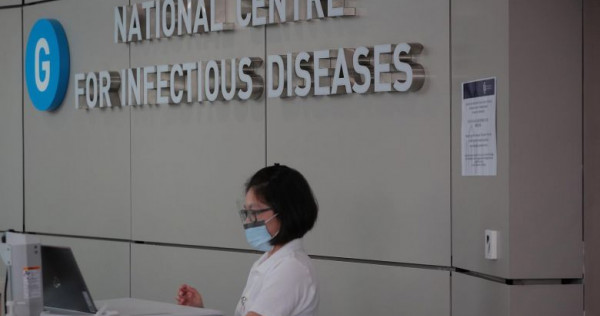
He was confirmed to have the novel coronavirus on Feb 8, and is currently warded in an isolation room at the National Centre for Infectious Diseases (NCID).
Before being admitted to hospital, he had visited Paya Lebar Methodist Church and attended a gathering at Braddell Heights Residents’ Committee.
He had also picked up his grandchild outside Pat’s Schoolhouse Kovan. He stays at Upper Serangoon Road.
CASE 42
Case 42 is a 39-year-old work pass holder from Bangladesh.
He reported onset of symptoms on Feb 1 and sought treatment at a general practitioner clinic on Feb 3, and then at Changi General Hospital on Feb 5.
He went for a follow-up appointment at Bedok Polyclinic on Feb 7 and was then admitted to the intensive care unit at Changi General Hospital.
Subsequent test results confirmed the novel coronavirus infection on Feb 8, and he was transferred to NCID, where he is currently warded in an isolation room.
Before being admitted to hospital he had visited Mustafa Centre and stayed at The Leo dormitory at Kaki Bukit Road.
CASE 43
Case 43 is a 54-year-old Singaporean man who is currently warded in an isolation room at Sengkang General Hospital.
He was in Malaysia on Jan 26. Four days later on Jan 30 he reported symptoms and went to two general practitioner clinics on Jan 30, Feb 5 and Feb 6.
He then sought treatment at Sengkang General Hospital on Feb 6 and was warded the next day.
He was confirmed to have the novel coronavirus on Feb 8.
Before being admitted to hospital, the man had stayed at home except for trips to seek medical treatment and one trip to work at Resorts World Sentosa. He lives at Fernvale Close.
SUSPECTED CASES
As of Feb 9 noon, 516 of the suspected cases have tested negative for the novel coronavirus. Test results for a remaining 98 cases are pending.
A total of 989 close contacts have been identified. Of the 892 who are still in Singapore, 845 have been contacted and are being quarantined or isolated. Efforts are ongoing to contact the remaining 47 close contacts, said MOH.
Contact tracing for the confirmed cases is ongoing, it said.
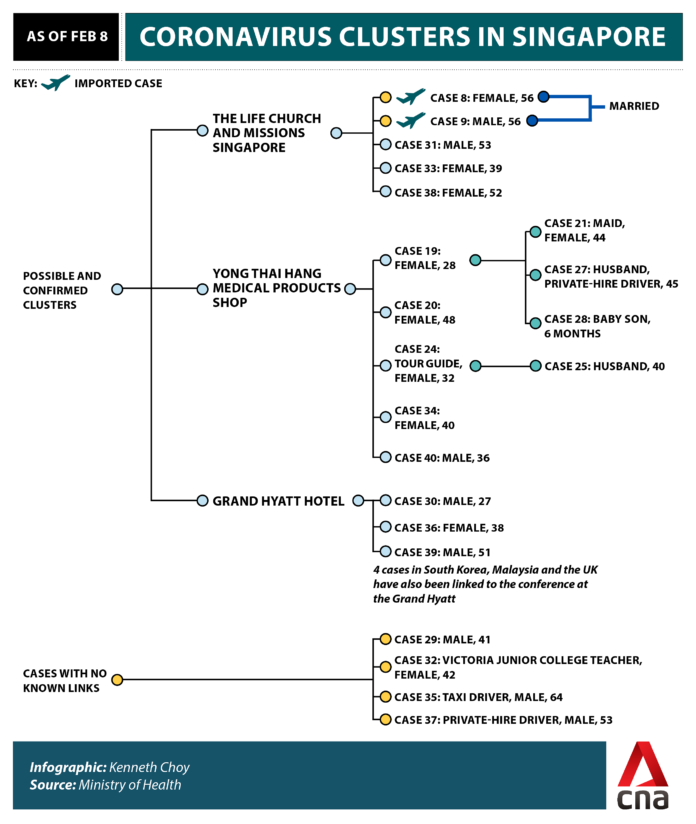
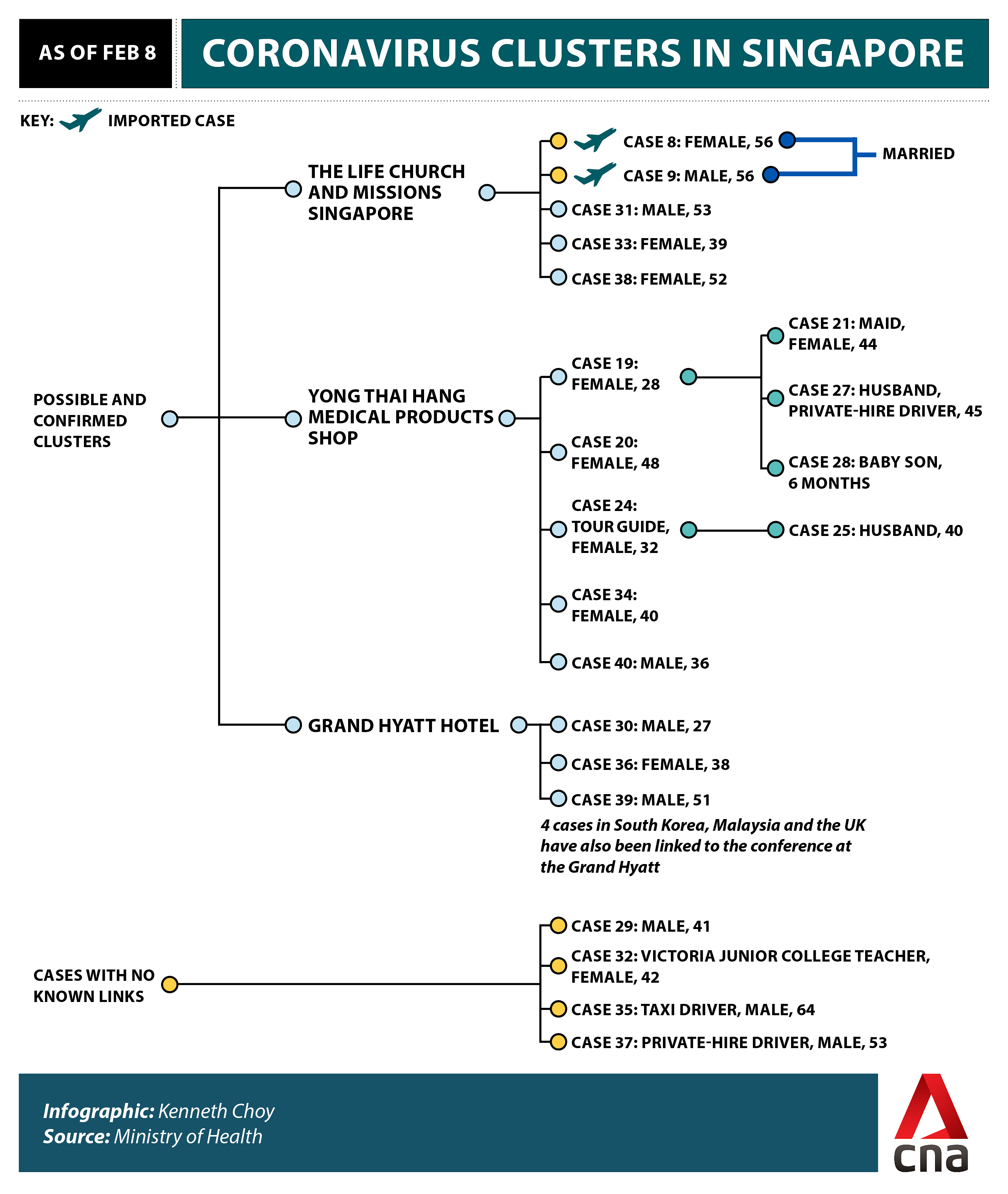
Two patients with previously unknown transmissions were later linked to a possible cluster associated with The Life Church and Missions Singapore, which includes two imported cases of Chinese nationals who are a married couple.
The connection was made by MOH in an update on Saturday as it announced seven new cases, including a taxi driver and a private-hire driver whose transmissions were unknown.
An infographic on possible and confirmed coronavirus clusters in Singapore as of Feb 8, 2020. (Graphic: Kenneth Choy, Source: MOH)
Two other clusters have also been identified: One related to health products shop Yong Thai Hang in Cavan Road and another linked to a business conference held at Grand Hyatt Singapore.
Reports of people stocking up on groceries and personal hygiene items have surfaced since Friday’s DORSCON Orange announcement.
NTUC FairPrice on the same day announced that every customer will only be allowed to buy four packs of paper products, two bags of rice and four bundle packs of instant noodles. A S$50 limit for vegetables also remained in place.
The number of confirmed infections in China has reached more than 37,000 nationwide with more than 800 deaths reported as of Sunday.
The World Health Organization believes the number of new cases in China is “stabilising”. But while it is a “good news”, the UN health agency cautioned that it was too early to make any predictions about whether the virus might have peaked.
SINGAPORE – A 71-year-old grandfather and a Bangladeshi worker are among three new coronavirus cases confirmed here on Sunday (Feb 9), said the Ministry of Health.
The third case is a 54-year-old Singaporean man who works at Resorts World Sentosa.
All three have no currently known links to previous cases or recent travel history to China.
The total number of people infected here has grown to 43.
Six are now in critical condition and in the intensive care unit, up from four previously, said MOH in its latest update.
Meanwhile, four have been discharged, making up a total of six who have recovered.
The grandfather, Singapore’s case 41, reported onset of symptoms on Feb 1, and had visited a general practitioner (GP) clinic on the same day, and again on 5 February. He sought treatment at Hougang Polyclinic on Feb 6, and at Tan Tock Seng Hospital’s emergency department on Feb 7 where he was immediately isolated. He was confirmed to have the infection on Feb 8 afternoon.
SINGAPORE: A church linked to a possible coronavirus cluster in Singapore said on Sunday (Feb 9) that it has engaged a professional cleaning company to disinfect its entire premises and will suspend meetings for at least two weeks.
“When the church got to know of the first case on Feb 7, right on the day itself, we engaged a professional cleaning company to disinfect our entire premises, using Ultima-S (410),” a spokesperson for The Life Church and Missions said in an email responding to CNA’s queries.
The church has also decided to suspend meetings for at least two weeks and will monitor the situation to see if meetings have to be postponed even longer, it said.
Five cases have been linked to the church, which is located at 146B Paya Lebar Road.
An infographic on possible and confirmed coronavirus clusters in Singapore as of Feb 8, 2020. (Graphic: Kenneth Choy, Source: MOH)
The figure includes a married couple from Wuhan (cases 8 and 9) as well as three Singaporeans (cases 31, 33 and 38) who had visited the church.
The Ministry of Health announced on Feb 8 that cases 8, 9 and 33 had links to the church, following further epidemiological investigations and contact tracing.
They include the married couple – both 56-year-old Chinese nationals from Wuhan – who arrived in Singapore together on Jan 19.
The third case is a 39-year-old Singaporean woman who did not have recent travel history to China, but had been in Malaysia from Jan 22 to Jan 29.
The other two Singaporeans – cases 31 and 38 – also have no recent travel history to China. But prior to hospital admission, both had been to The Life Church and Missions Singapore.
The church premises has been closed to the general public since Friday. Only a few authorised personnel are allowed access, said the church spokesperson.
The church has posted an advisory on its website and is assisting police with contact tracing. Its Sunday service was livestreamed to members and is available on Youtube.
“When the church reopens for service again, we will abide by the advisory of MOH and perform temperature screening to look out for worshippers who may be feeling unwell. We will also prepare masks for those who have the need for them,” it said.
“Our church will pray for those who are infected and those who are deeply concerned over the virus, and we also seek prayers from all to tide through this crisis together.”
SINGAPORE – The ongoing coronavirus outbreak is a test of Singapore’s social cohesion and psychological resilience, said Prime Minister Lee Hsien Loong on Saturday (Feb 8).
“Fear and anxiety are natural human reactions. We all want to protect ourselves and our families from what is still a new and unknown disease,” he said in a statement on the current situation.
“But fear can do more harm than the virus itself. It can make us panic, or do things which make matters worse, like circulating rumours online, hoarding face masks or food, or blaming particular groups for the outbreak.”
“We should take courage and see through this stressful time together,” he added.
PM Lee noted that Singapore is much better prepared to deal with the new coronavirus because of its experience tackling the severe acute respiratory syndrome (Sars) 17 years ago.
Singapore has stockpiled adequate supply of masks and personal protective equipment, expanded and upgraded medical facilities, and has more advanced research capabilities to study the virus.
Doctors and nurses are better trained as well, he said.